Lab 7
ML
Machine Learning
• Machine learning is an application of artificial intelligence (AI) that provides
systems the ability to automatically learn and improve from experience
without being explicitly programmed. Machine learning focuses on the
development of computer programs that can access data and use it learn
for themselves.
• The process of learning begins with observations or data, such as examples,
direct experience, or instruction, in order to look for patterns in data and
make better decisions in the future based on the examples that we
provide. The primary aim is to allow the computers learn automatically
without human intervention or assistance and adjust actions accordingly.
Terminology
• Dataset: A set of data examples, that contain features important to
solving the problem.
• Features: Important pieces of data that help us understand a
problem. These are fed in to a Machine Learning algorithm to help it
learn.
• Model: The representation (internal model) of a phenomenon that a
Machine Learning algorithm has learnt. It learns this from the data it
is shown during training. The model is the output you get after
training an algorithm. For example, a decision tree algorithm would
be trained and produce a decision tree model.
Process
• Data Collection: Collect the data that the algorithm will learn from.
• Data Preparation: Format and engineer the data into the optimal
format, extracting important features and performing dimensionality
reduction.
• Training: Also known as the fitting stage, this is where the Machine
Learning algorithm actually learns by showing it the data that has
been collected and prepared.
• Evaluation: Test the model to see how well it performs.
• Tuning: Fine tune the model to maximise it’s performance.
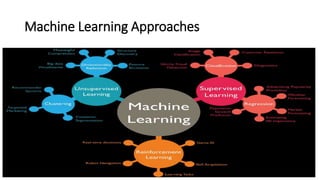
Machine Learning Approaches
Supervised machine learning
• In supervised learning, the goal is to learn the mapping (the rules)
between a set of inputs and outputs.
• For example, the inputs could be the weather forecast, and the
outputs would be the visitors to the beach. The goal in supervised
learning would be to learn the mapping that describes the
relationship between temperature and number of beach visitors.
Unsupervised Learning
• In unsupervised learning, only input data is provided in the examples.
There are no labelled example outputs to aim for. But it may be
surprising to know that it is still possible to find many interesting and
complex patterns hidden within data without any labels.
• An example of unsupervised learning in real life would be sorting
different colour coins into separate piles. Nobody taught you how to
separate them, but by just looking at their features such as colour,
you can see which colour coins are associated and cluster them into
their correct groups.
Semi-supervised learning
• Semi-supervised learning is a mix between supervised and
unsupervised approaches. The learning process isn’t closely
supervised with example outputs for every single input, but we also
don’t let the algorithm do its own thing and provide no form of
feedback. Semi-supervised learning takes the middle road.
• By being able to mix together a small amount of labelled data with a
much larger unlabeled dataset it reduces the burden of having
enough labelled data. Therefore, it opens up many more problems to
be solved with machine learning.
Reinforcement Learning
• Reinforcement machine learning algorithms is a learning method that interacts
with its environment by producing actions and discovers errors or rewards. Trial
and error search and delayed reward are the most relevant characteristics of
reinforcement learning. This method allows machines and software agents to
automatically determine the ideal behavior within a specific context in order to
maximize its performance. Simple reward feedback is required for the agent to
learn which action is best; this is known as the reinforcement signal.
• If you’re familiar with psychology, you’ll have heard of reinforcement learning. If
not, you’ll already know the concept from how we learn in everyday life. In this
approach, occasional positive and negative feedback is used to reinforce
behaviours. Think of it like training a dog, good behaviours are rewarded with a
treat and become more common. Bad behaviours are punished and become less
common. This reward-motivated behaviour is key in reinforcement learning.
Applications of Machine Learning
Following are some examples of ML Applications:
• Virtual Personal Assistants:Virtual personal assistants Siri, Alexa, Google Now
assist you in finding information when asked over voice and do the tasks assigned
to be done.
• Web Search Engine:One of the main reasons why search engines work so well is
because the system has learnt how to rank pages through a complex learning
algorithm.
• Online Shopping:Depending on your past searches, the Amazon or Facebook
algorithms learn what sort of items you are looking for.
• Stock Prediction:Machine Learning algorithms are used to analyze old stock data
and predict the future values.
• Photo Tagging Applications:In photo tagging applications, like Facebook,
the ability to tag friends makes it even more interesting and exciting. All of
this is possible because of a face recognition algorithm that runs behind
the application.
• Spam Detector:Our mail agent like Gmail or Hotmail does a lot of hard
work for us in classifying the mails and moving the spam mails to spam
folder. The only possible way by which it is achieved is by the use of spam
classifier running in the back end of mail application.
• Predictions During Travelling:Machine Learning predicts which route has
less congestion at that particular time by using traffic predictions. Not only
this it will also help you in booking a cab from your place by applications
like Uber and Ola.
• Surveillance of Videos: A single person monitoring many video cameras is
certainly a hard job to be done and boring too. This is why the idea of
training computers to do this job is implemented using ML.
Advantages
• Identifies trends and patterns easily- Machine learning involves reviewing
large volumes of data to discover specific trends and patterns that would
most often not be apparent to humans. For example, machine learning will
be useful for an e-commerce website like Amazon, to understand purchase
histories and browsing behaviors of its users to cater to the right deals,
products, and reminders that are relevant to them.
• Automation- Machine learning does not require human intervention. It
gives machines the ability to learn. It helps machines make predictions and
improve the algorithms by themselves. Anti-virus software is a common
example of this as they automatically filter new threats as & when they are
recognized.
• Continuous improvement- Machine learning algorithms improve in
accuracy and efficiency as they gain experience. This helps them take
better decisions.
Disadvantages
• Time and resources- Machine learning requires massive resources to
function. It may demand additional computing power. Machine
learning requires enough time to let the algorithms learn & develop
to fulfill their intended purpose with a considerable amount of
accuracy and relevancy.
• Interpretation of results- Accurately interpreting the results generated
by the algorithms is a challenging task. One needs to exercise caution
while choosing algorithms for their specific purpose.
• Data acquisition- Machine learning needs massive datasets to train
on. These must be unbiased/inclusive and of good quality. In certain
situations, they may need to wait for new data to be generated.
Important links
• https://www.rfwireless-world.com/Terminology/Advantages-and-Disadvantages-of-Machine-Learning.html
• https://www.outsource2india.com/software/articles/businesses-benefits-machine-learning.asp
• https://techvidvan.com/tutorials/advantages-and-disadvantages-of-machine-learning/
• https://blog.innofactor.com/en/the-advantages-of-machine-learning
• https://seventablets.com/blog/what-are-the-pros-and-cons-of-machine-learning/
• https://www.quora.com/What-are-the-advantages-and-disadvantages-of-machine-learning
• https://www.cisin.com/coffee-break/Enterprise/highlights-the-advantages-and-disadvantages-of-machine-learning.html
• https://www.technologyreview.com/s/612437/what-is-machine-learning-we-drew-you-another-flowchart/
• https://towardsdatascience.com/machine-learning-an-introduction-23b84d51e6d0
• https://www.coursera.org/learn/machine-learning
• https://expertsystem.com/machine-learning-definition/
• https://aws.amazon.com/free/machine-
learning/?trk=ps_a131L0000057irvQAA&trkCampaign=acq_paid_search&sc_channel=ps&sc_campaign=acquisition_pk&sc_publis
her=google&sc_category=Machine%20Learning&sc_country=PK&sc_geo=APAC&sc_outcome=acq&sc_detail=%2Bmachine%20%2
Blearning&sc_content=machine_learning_bmm&sc_segment=386494948705&sc_medium=ACQ-P|PS-GO|Non-
Brand|Desktop|SU|Machine%20Learning|Solution|PK|EN|Text&s_kwcid=AL!4422!3!386494948705!b!!g!!%2Bmachine%20%2Bl
earning&ef_id=EAIaIQobChMIw9bppbvV6AIVCM93Ch0YIgg4EAAYAiAAEgLys_D_BwE:G:s

Lab 7.pptx

  • 1.
  • 2.
    Machine Learning • Machinelearning is an application of artificial intelligence (AI) that provides systems the ability to automatically learn and improve from experience without being explicitly programmed. Machine learning focuses on the development of computer programs that can access data and use it learn for themselves. • The process of learning begins with observations or data, such as examples, direct experience, or instruction, in order to look for patterns in data and make better decisions in the future based on the examples that we provide. The primary aim is to allow the computers learn automatically without human intervention or assistance and adjust actions accordingly.
  • 3.
    Terminology • Dataset: Aset of data examples, that contain features important to solving the problem. • Features: Important pieces of data that help us understand a problem. These are fed in to a Machine Learning algorithm to help it learn. • Model: The representation (internal model) of a phenomenon that a Machine Learning algorithm has learnt. It learns this from the data it is shown during training. The model is the output you get after training an algorithm. For example, a decision tree algorithm would be trained and produce a decision tree model.
  • 4.
    Process • Data Collection:Collect the data that the algorithm will learn from. • Data Preparation: Format and engineer the data into the optimal format, extracting important features and performing dimensionality reduction. • Training: Also known as the fitting stage, this is where the Machine Learning algorithm actually learns by showing it the data that has been collected and prepared. • Evaluation: Test the model to see how well it performs. • Tuning: Fine tune the model to maximise it’s performance.
  • 5.
  • 6.
    Supervised machine learning •In supervised learning, the goal is to learn the mapping (the rules) between a set of inputs and outputs. • For example, the inputs could be the weather forecast, and the outputs would be the visitors to the beach. The goal in supervised learning would be to learn the mapping that describes the relationship between temperature and number of beach visitors.
  • 7.
    Unsupervised Learning • Inunsupervised learning, only input data is provided in the examples. There are no labelled example outputs to aim for. But it may be surprising to know that it is still possible to find many interesting and complex patterns hidden within data without any labels. • An example of unsupervised learning in real life would be sorting different colour coins into separate piles. Nobody taught you how to separate them, but by just looking at their features such as colour, you can see which colour coins are associated and cluster them into their correct groups.
  • 8.
    Semi-supervised learning • Semi-supervisedlearning is a mix between supervised and unsupervised approaches. The learning process isn’t closely supervised with example outputs for every single input, but we also don’t let the algorithm do its own thing and provide no form of feedback. Semi-supervised learning takes the middle road. • By being able to mix together a small amount of labelled data with a much larger unlabeled dataset it reduces the burden of having enough labelled data. Therefore, it opens up many more problems to be solved with machine learning.
  • 9.
    Reinforcement Learning • Reinforcementmachine learning algorithms is a learning method that interacts with its environment by producing actions and discovers errors or rewards. Trial and error search and delayed reward are the most relevant characteristics of reinforcement learning. This method allows machines and software agents to automatically determine the ideal behavior within a specific context in order to maximize its performance. Simple reward feedback is required for the agent to learn which action is best; this is known as the reinforcement signal. • If you’re familiar with psychology, you’ll have heard of reinforcement learning. If not, you’ll already know the concept from how we learn in everyday life. In this approach, occasional positive and negative feedback is used to reinforce behaviours. Think of it like training a dog, good behaviours are rewarded with a treat and become more common. Bad behaviours are punished and become less common. This reward-motivated behaviour is key in reinforcement learning.
  • 10.
    Applications of MachineLearning Following are some examples of ML Applications: • Virtual Personal Assistants:Virtual personal assistants Siri, Alexa, Google Now assist you in finding information when asked over voice and do the tasks assigned to be done. • Web Search Engine:One of the main reasons why search engines work so well is because the system has learnt how to rank pages through a complex learning algorithm. • Online Shopping:Depending on your past searches, the Amazon or Facebook algorithms learn what sort of items you are looking for. • Stock Prediction:Machine Learning algorithms are used to analyze old stock data and predict the future values.
  • 11.
    • Photo TaggingApplications:In photo tagging applications, like Facebook, the ability to tag friends makes it even more interesting and exciting. All of this is possible because of a face recognition algorithm that runs behind the application. • Spam Detector:Our mail agent like Gmail or Hotmail does a lot of hard work for us in classifying the mails and moving the spam mails to spam folder. The only possible way by which it is achieved is by the use of spam classifier running in the back end of mail application. • Predictions During Travelling:Machine Learning predicts which route has less congestion at that particular time by using traffic predictions. Not only this it will also help you in booking a cab from your place by applications like Uber and Ola. • Surveillance of Videos: A single person monitoring many video cameras is certainly a hard job to be done and boring too. This is why the idea of training computers to do this job is implemented using ML.
  • 13.
    Advantages • Identifies trendsand patterns easily- Machine learning involves reviewing large volumes of data to discover specific trends and patterns that would most often not be apparent to humans. For example, machine learning will be useful for an e-commerce website like Amazon, to understand purchase histories and browsing behaviors of its users to cater to the right deals, products, and reminders that are relevant to them. • Automation- Machine learning does not require human intervention. It gives machines the ability to learn. It helps machines make predictions and improve the algorithms by themselves. Anti-virus software is a common example of this as they automatically filter new threats as & when they are recognized. • Continuous improvement- Machine learning algorithms improve in accuracy and efficiency as they gain experience. This helps them take better decisions.
  • 14.
    Disadvantages • Time andresources- Machine learning requires massive resources to function. It may demand additional computing power. Machine learning requires enough time to let the algorithms learn & develop to fulfill their intended purpose with a considerable amount of accuracy and relevancy. • Interpretation of results- Accurately interpreting the results generated by the algorithms is a challenging task. One needs to exercise caution while choosing algorithms for their specific purpose. • Data acquisition- Machine learning needs massive datasets to train on. These must be unbiased/inclusive and of good quality. In certain situations, they may need to wait for new data to be generated.
  • 15.
    Important links • https://www.rfwireless-world.com/Terminology/Advantages-and-Disadvantages-of-Machine-Learning.html •https://www.outsource2india.com/software/articles/businesses-benefits-machine-learning.asp • https://techvidvan.com/tutorials/advantages-and-disadvantages-of-machine-learning/ • https://blog.innofactor.com/en/the-advantages-of-machine-learning • https://seventablets.com/blog/what-are-the-pros-and-cons-of-machine-learning/ • https://www.quora.com/What-are-the-advantages-and-disadvantages-of-machine-learning • https://www.cisin.com/coffee-break/Enterprise/highlights-the-advantages-and-disadvantages-of-machine-learning.html • https://www.technologyreview.com/s/612437/what-is-machine-learning-we-drew-you-another-flowchart/ • https://towardsdatascience.com/machine-learning-an-introduction-23b84d51e6d0 • https://www.coursera.org/learn/machine-learning • https://expertsystem.com/machine-learning-definition/ • https://aws.amazon.com/free/machine- learning/?trk=ps_a131L0000057irvQAA&trkCampaign=acq_paid_search&sc_channel=ps&sc_campaign=acquisition_pk&sc_publis her=google&sc_category=Machine%20Learning&sc_country=PK&sc_geo=APAC&sc_outcome=acq&sc_detail=%2Bmachine%20%2 Blearning&sc_content=machine_learning_bmm&sc_segment=386494948705&sc_medium=ACQ-P|PS-GO|Non- Brand|Desktop|SU|Machine%20Learning|Solution|PK|EN|Text&s_kwcid=AL!4422!3!386494948705!b!!g!!%2Bmachine%20%2Bl earning&ef_id=EAIaIQobChMIw9bppbvV6AIVCM93Ch0YIgg4EAAYAiAAEgLys_D_BwE:G:s