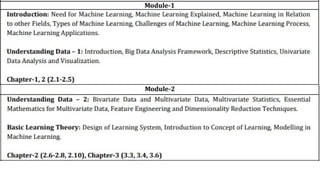
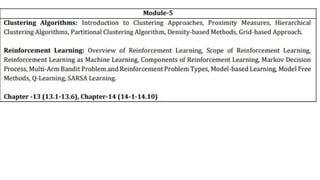
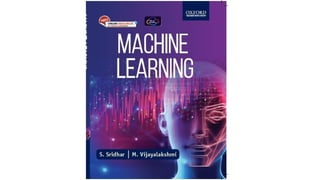
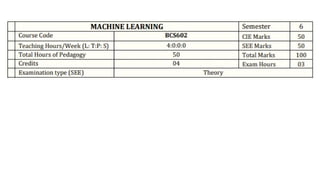
CO-PO of Machine Lerning
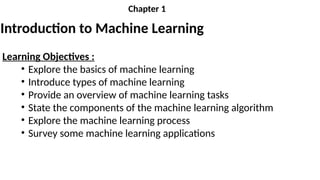
Introduction to Machine Learning
Chapter 1
Learning Objectives :
• Explore the basics of machine learning
• Introduce types of machine learning
• Provide an overview of machine learning tasks
• State the components of the machine learning algorithm
• Explore the machine learning process
• Survey some machine learning applications
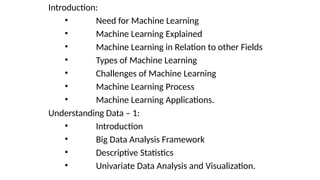
Introduction:
• Need for Machine Learning
• Machine Learning Explained
• Machine Learning in Relation to other Fields
• Types of Machine Learning
• Challenges of Machine Learning
• Machine Learning Process
• Machine Learning Applications.
Understanding Data – 1:
• Introduction
• Big Data Analysis Framework
• Descriptive Statistics
• Univariate Data Analysis and Visualization.
1.1 NEED FOR MACHINE LEARNING
Business organizations use huge amount of data for their daily activities.
Business organizations have started to use the technology, machine learning.
Machine learning has become so popular because of three reasons:
1. High volume of available data to manage. Facebook, Twitter, and YouTube.
2. Second reason is that the cost of storage has reduced.
3. Third is availability of complex algorithms. Deep learning etc.
• Machine Learning Explained
Machine learning is the field of study that gives the computers ability to learn
without being explicitly programmed.
An expert system like MYCIN was designed for medical diagnosis after converting
the expert knowledge of many doctors into a system.
However, this approach did not progress much as programs lacked real intelligence.
A MODEL CAN BE ANY ONE OF THE FOLLOWING –
• MATHEMATICAL EQUATION
• RELATIONAL DIAGRAMS LIKE GRAPHS/TREES
• LOGICAL IF/ELSE RULES
• GROUPINGS CALLED CLUSTERS
What is a Model?
"A computer program is said to learn from experience E, with respect
to task T and some performance measure P, if its performance on T
measured by P improves with experience E."
The important components of this definition are experience E, task T, and
performance measure P.
• RELATION BETWEEN MACHINE LEARNING AND AI
Machine Learning and AI
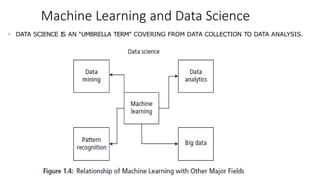
• DATA SCIENCE IS AN “UMBRELLA TERM” COVERING FROM DATA COLLECTION TO DATA ANALYSIS.
Machine Learning and Data Science
Machine Learning and Statistics
Statistics - A branch of mathematics
- Theoretical foundation for statistical learning
- It can learn from data
- Finds relationships among data
- Requires knowledge of the statistical procedures
- Mathematics intensive
- Require a strong statistical knowledge
Machine learning - Has less assumptions
- Requires less statistical knowledge
- Interact with tools to automate the process of learning
- Latest version of 'old Statistics'
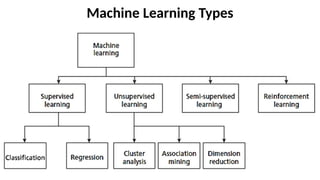
Machine Learning Types
Labelled Data
Data that is NOT associated with Labels are called Unlabeled Data.
Unlabelled Data
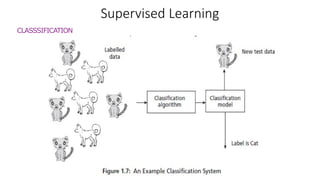
CLASSSIFICATION
Supervised Learning
KEY ALGORITHMS
Supervised Learning
REGRESSION ALGORITHM
Supervised Learning
CLUSTERING IS A GROUPING PROCESS.
Unsupervised Learning
KEY ALGORITHMS OF UNSUPERVISED
LEARNING
Unsupervised Learning
Key Differences
Semi-supervised Learning
• There are datasets which have a huge collection of unlabelled data
and some labelled data.
• Semi-supervised algorithms use unlabelled data by assigning a
pseudo-label.
• Then, the labelled and pseudo-labelled dataset can be combined.
Reinforcement Learning
• Reinforcement learning mimics human beings.
• Reinforcement learning allows the agent to interact with the
environment to get rewards.
• The agent can be robot or any independent program.
• The rewards enable the agent to gain experience.
• The agent aims to maximize the reward.
• The reward can be negative (Punishment).
• When the rewards are more, the behavior gets reinforced and
learning becomes possible.
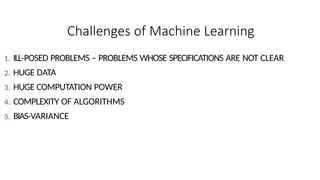
Challenges of Machine Learning
1. ILL-POSED PROBLEMS – PROBLEMS WHOSE SPECIFICATIONS ARE NOT CLEAR
2. HUGE DATA
3. HUGE COMPUTATION POWER
4. COMPLEXITY OF ALGORITHMS
5. BIAS-VARIANCE
MACHINE LEARNING/DATA MINING PROCESS
Machine Learning Process
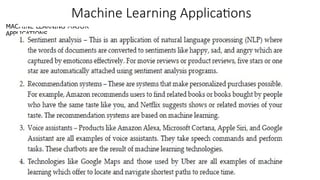
MACHINE LEARNING MAJOR
APPLICATIONS
Machine Learning Applications
MACHINE LEARNING MAJOR APPLICATIONS
Machine_Learning_VTU_6th_Semester_Module_1.pptx

Machine_Learning_VTU_6th_Semester_Module_1.pptx

  • 6.
  • 7.
    Introduction to MachineLearning Chapter 1 Learning Objectives : • Explore the basics of machine learning • Introduce types of machine learning • Provide an overview of machine learning tasks • State the components of the machine learning algorithm • Explore the machine learning process • Survey some machine learning applications
  • 8.
    Introduction: • Need forMachine Learning • Machine Learning Explained • Machine Learning in Relation to other Fields • Types of Machine Learning • Challenges of Machine Learning • Machine Learning Process • Machine Learning Applications. Understanding Data – 1: • Introduction • Big Data Analysis Framework • Descriptive Statistics • Univariate Data Analysis and Visualization.
  • 9.
    1.1 NEED FORMACHINE LEARNING Business organizations use huge amount of data for their daily activities. Business organizations have started to use the technology, machine learning. Machine learning has become so popular because of three reasons: 1. High volume of available data to manage. Facebook, Twitter, and YouTube. 2. Second reason is that the cost of storage has reduced. 3. Third is availability of complex algorithms. Deep learning etc.
  • 11.
    • Machine LearningExplained Machine learning is the field of study that gives the computers ability to learn without being explicitly programmed. An expert system like MYCIN was designed for medical diagnosis after converting the expert knowledge of many doctors into a system. However, this approach did not progress much as programs lacked real intelligence.
  • 13.
    A MODEL CANBE ANY ONE OF THE FOLLOWING – • MATHEMATICAL EQUATION • RELATIONAL DIAGRAMS LIKE GRAPHS/TREES • LOGICAL IF/ELSE RULES • GROUPINGS CALLED CLUSTERS What is a Model?
  • 14.
    "A computer programis said to learn from experience E, with respect to task T and some performance measure P, if its performance on T measured by P improves with experience E." The important components of this definition are experience E, task T, and performance measure P.
  • 15.
    • RELATION BETWEENMACHINE LEARNING AND AI Machine Learning and AI
  • 16.
    • DATA SCIENCEIS AN “UMBRELLA TERM” COVERING FROM DATA COLLECTION TO DATA ANALYSIS. Machine Learning and Data Science
  • 17.
    Machine Learning andStatistics Statistics - A branch of mathematics - Theoretical foundation for statistical learning - It can learn from data - Finds relationships among data - Requires knowledge of the statistical procedures - Mathematics intensive - Require a strong statistical knowledge Machine learning - Has less assumptions - Requires less statistical knowledge - Interact with tools to automate the process of learning - Latest version of 'old Statistics'
  • 18.
  • 19.
  • 20.
    Data that isNOT associated with Labels are called Unlabeled Data. Unlabelled Data
  • 21.
  • 22.
  • 25.
  • 26.
    CLUSTERING IS AGROUPING PROCESS. Unsupervised Learning
  • 27.
    KEY ALGORITHMS OFUNSUPERVISED LEARNING Unsupervised Learning
  • 28.
  • 29.
    Semi-supervised Learning • Thereare datasets which have a huge collection of unlabelled data and some labelled data. • Semi-supervised algorithms use unlabelled data by assigning a pseudo-label. • Then, the labelled and pseudo-labelled dataset can be combined.
  • 30.
    Reinforcement Learning • Reinforcementlearning mimics human beings. • Reinforcement learning allows the agent to interact with the environment to get rewards. • The agent can be robot or any independent program. • The rewards enable the agent to gain experience. • The agent aims to maximize the reward. • The reward can be negative (Punishment). • When the rewards are more, the behavior gets reinforced and learning becomes possible.
  • 32.
    Challenges of MachineLearning 1. ILL-POSED PROBLEMS – PROBLEMS WHOSE SPECIFICATIONS ARE NOT CLEAR 2. HUGE DATA 3. HUGE COMPUTATION POWER 4. COMPLEXITY OF ALGORITHMS 5. BIAS-VARIANCE
  • 33.
    MACHINE LEARNING/DATA MININGPROCESS Machine Learning Process
  • 35.
  • 36.
    Machine Learning Applications MACHINELEARNING MAJOR APPLICATIONS