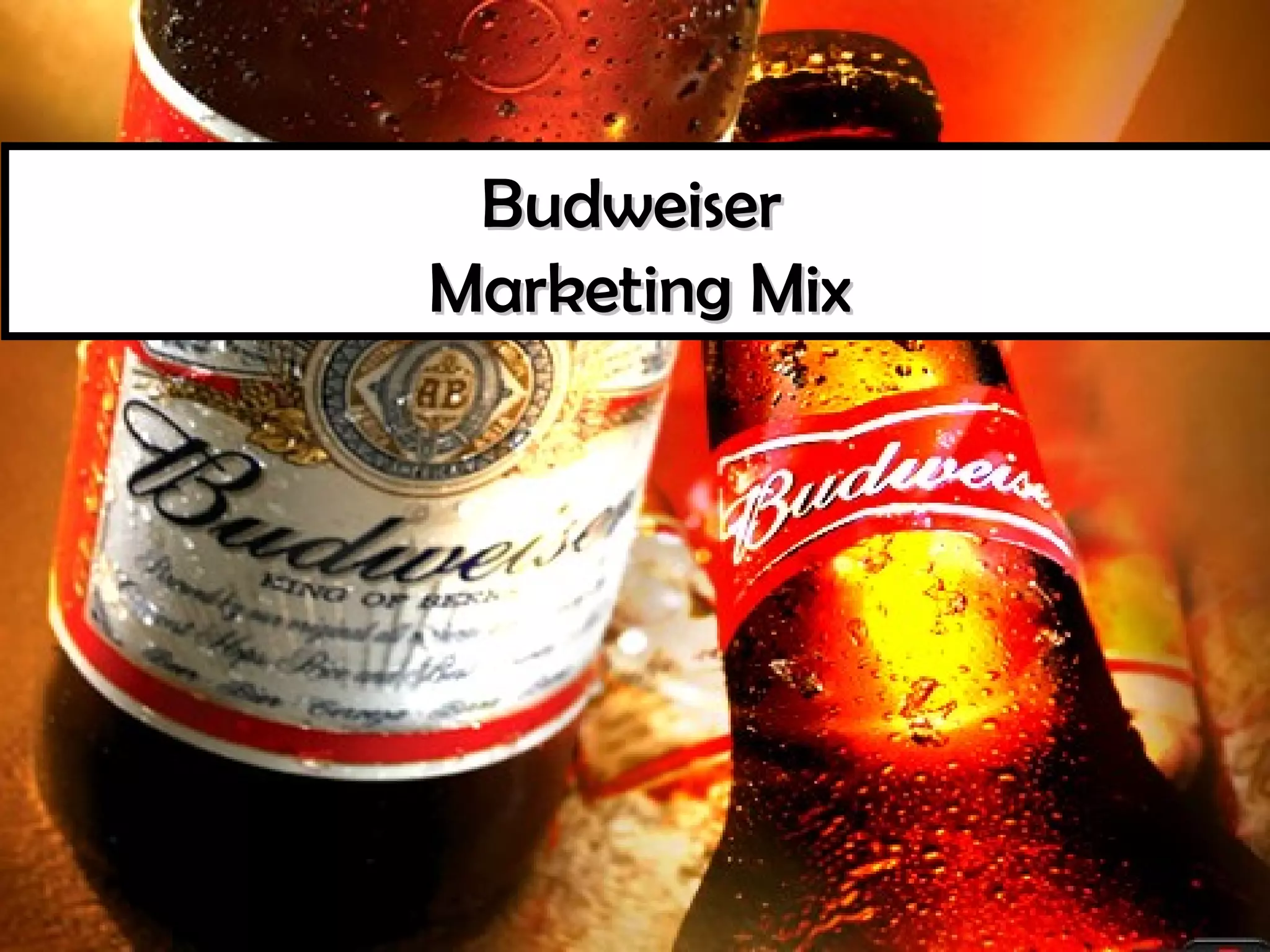
Budweiser
Marketing Mix
Many of life's failures are men who did
not realize how close they were to success
when they gave up.

                         - Thomas Edison
Introduction
               Anheuser-Busch

  Anheuser-Busch Inc. is a strong and dominating
  company that is a leader in the beer market. They
   are a company that is rooted in values, ethics and
                  sheer determination.
Anheuser-Busch targets consumers who are interested
    in alcoholic beverages that provide the best taste
     and quality. Their targets are anyone from the
   lower class of society, all the way up to the upper
      class. They have a wide range of brands and
  beverages to offer that are appealing to each social
                           class.
Brief History
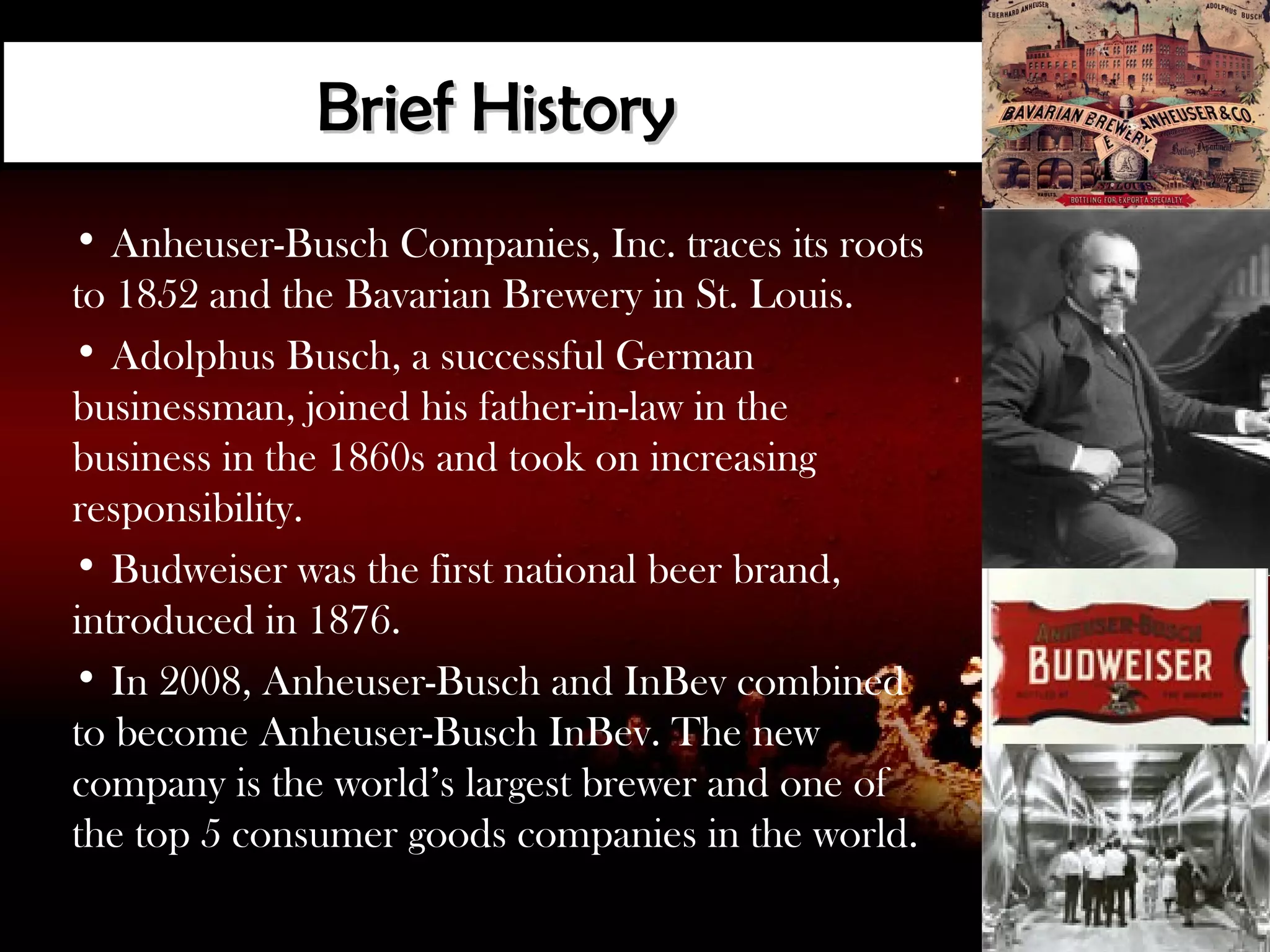
• Anheuser-Busch Companies, Inc. traces its roots
to 1852 and the Bavarian Brewery in St. Louis.
• Adolphus Busch, a successful German
businessman, joined his father-in-law in the
business in the 1860s and took on increasing
responsibility.
• Budweiser was the first national beer brand,
introduced in 1876.
• In 2008, Anheuser-Busch and InBev combined
to become Anheuser-Busch InBev. The new
company is the world’s largest brewer and one of
the top 5 consumer goods companies in the world.
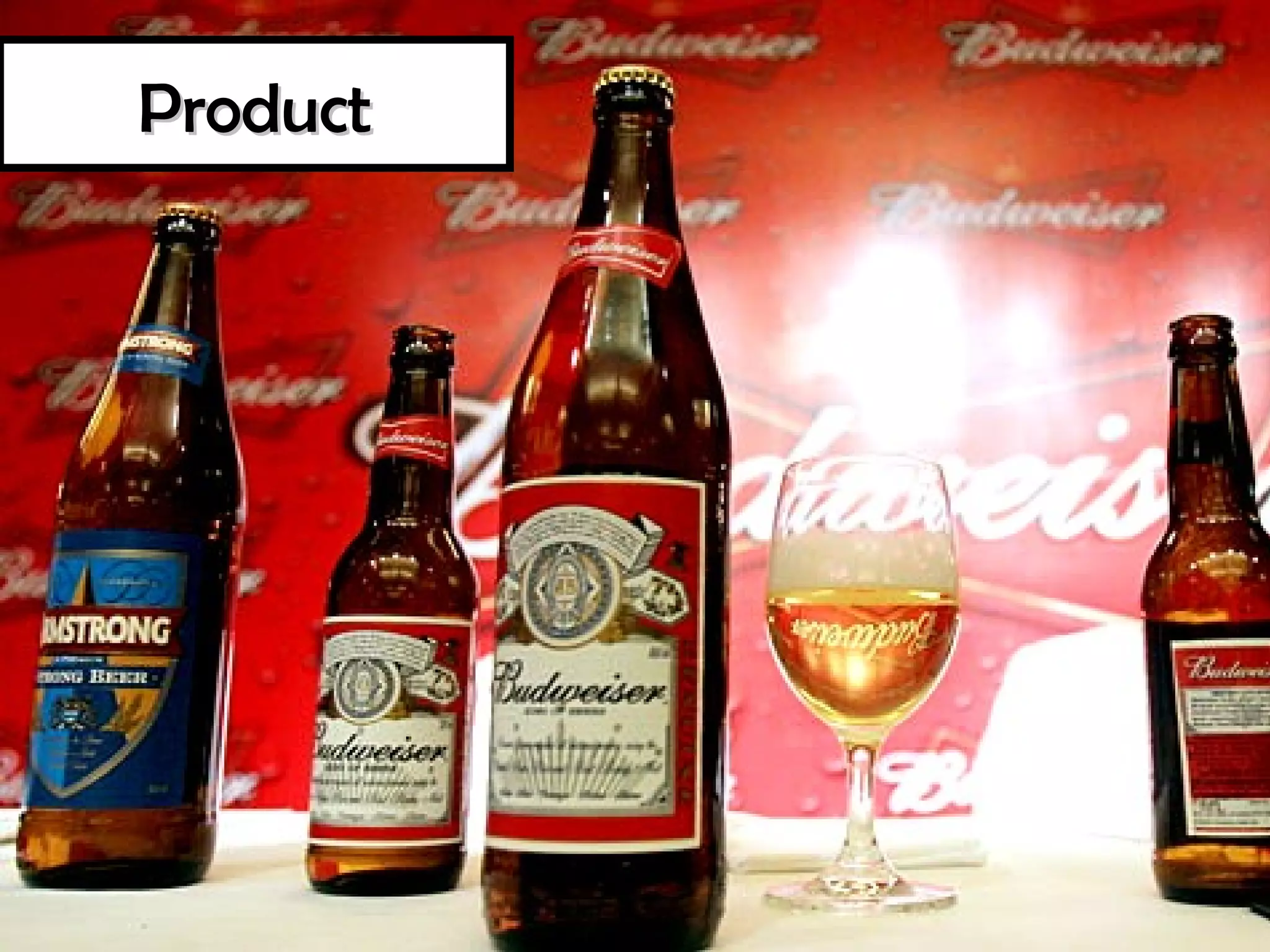
Product
Product
Product Definition

General: Good, idea, method, information, object,
   service, etc., that is the end result of a process
      and serves as a need or want satisfier. It is
     usually a bundle of tangible and intangible
    attributes (benefits, features, functions, uses)
     that a seller offers to a buyer for purchase.
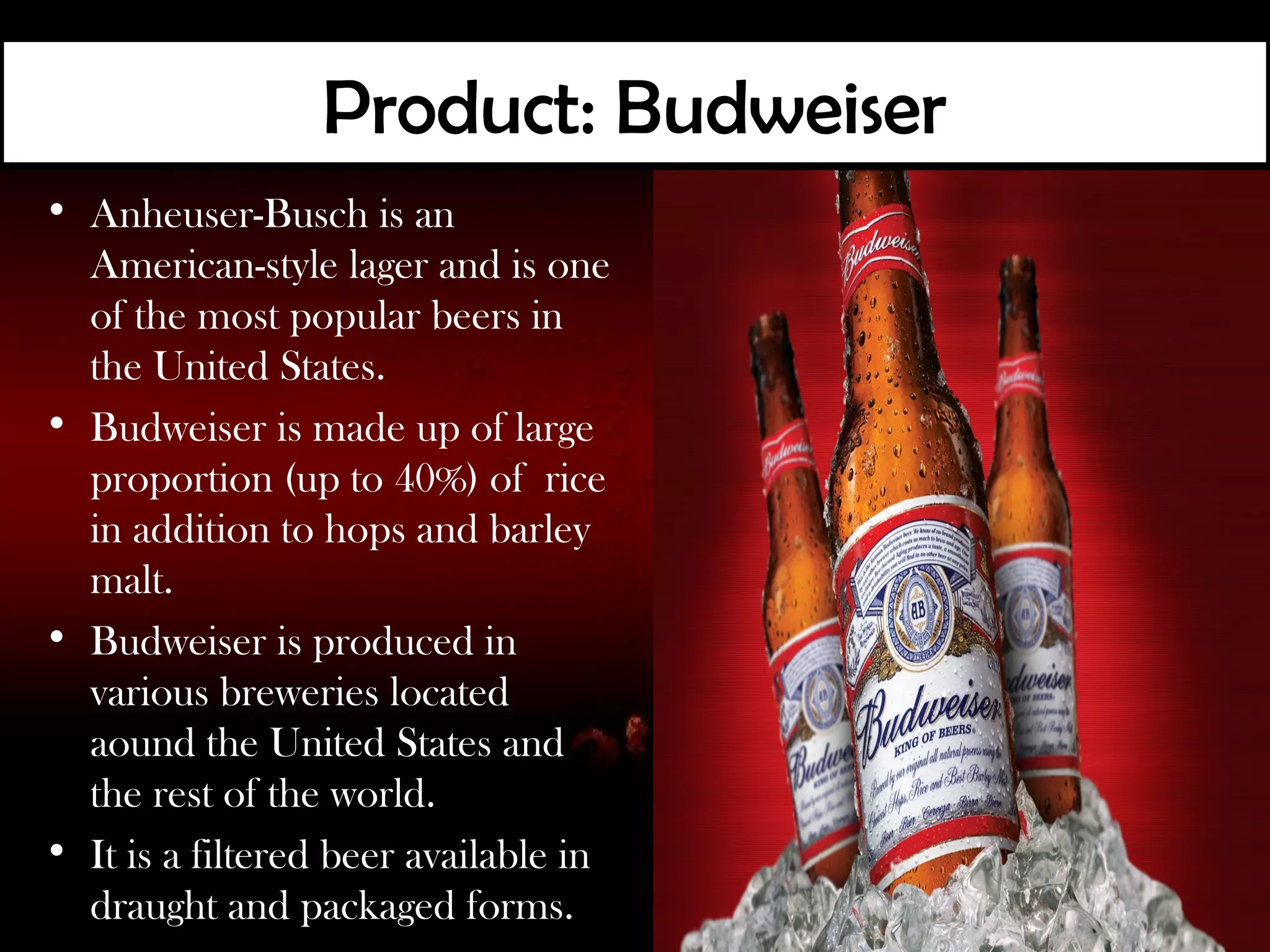
Product: Budweiser
• Anheuser-Busch is an
  American-style lager and is one
  of the most popular beers in
  the United States.
• Budweiser is made up of large
  proportion (up to 40%) of rice
  in addition to hops and barley
  malt.
• Budweiser is produced in
  various breweries located
  aound the United States and
  the rest of the world.
• It is a filtered beer available in
  draught and packaged forms.
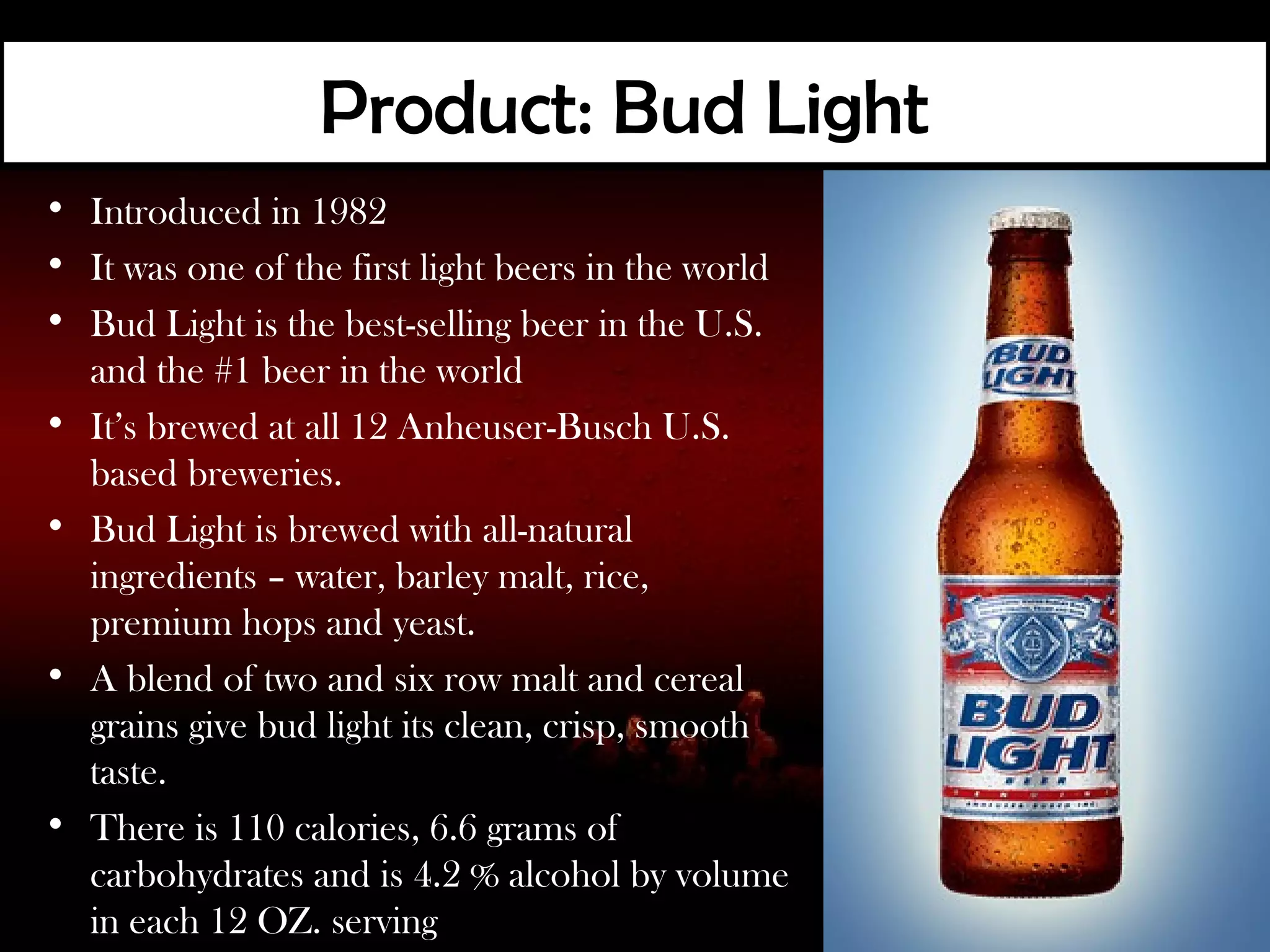
Product: Bud Light
• Introduced in 1982
• It was one of the first light beers in the world
• Bud Light is the best-selling beer in the U.S.
  and the #1 beer in the world
• It’s brewed at all 12 Anheuser-Busch U.S.
  based breweries.
• Bud Light is brewed with all-natural
  ingredients – water, barley malt, rice,
  premium hops and yeast.
• A blend of two and six row malt and cereal
  grains give bud light its clean, crisp, smooth
  taste.
• There is 110 calories, 6.6 grams of
  carbohydrates and is 4.2 % alcohol by volume
  in each 12 OZ. serving
Product: Bud Select
• Bavarian hops and an
  extended brewing process
  combine to give the
  Budweiser Select its
  distinctively full flavor-
  despite weighing in at only
  99 calories. Dark gold in
  color and pleasingly
  aromatic, Budweiser select is
  impressive from any angle.
• The Exception to the Rule.
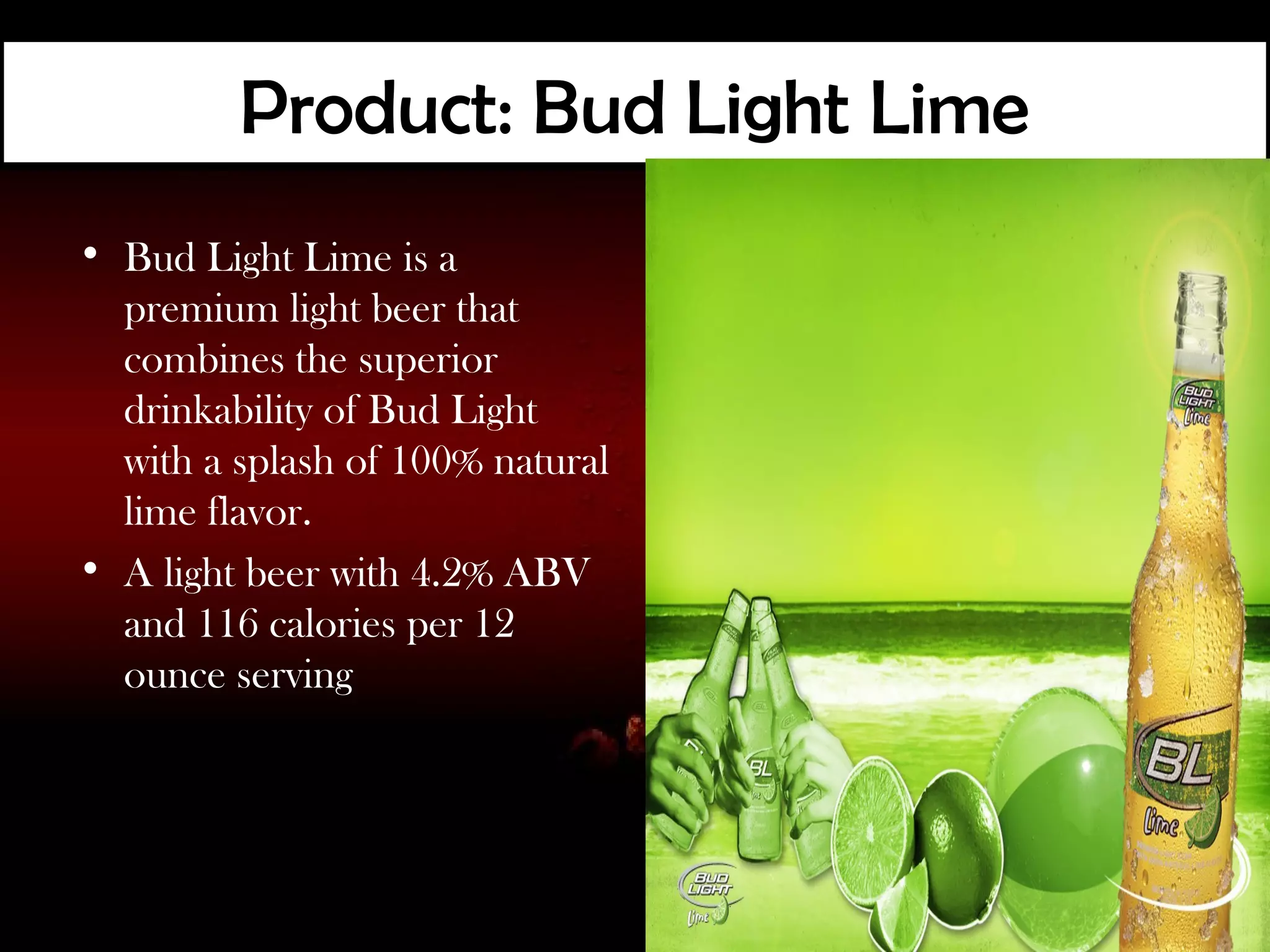
Product: Bud Light Lime
• Bud Light Lime is a
  premium light beer that
  combines the superior
  drinkability of Bud Light
  with a splash of 100% natural
  lime flavor.
• A light beer with 4.2% ABV
  and 116 calories per 12
  ounce serving
Product: American Ale
• Debuted in September 2008.
• The beer offer complex taste
  without much bitterness.
• It is the first beer under the
  Budweiser name that is
  brewed as an ale rather than a
  lager. The beer has a darker
  color which is a departure
  from other Budweiser brands
Product: Bud Dry
• was introduced in the U.S. in 1990
  with the slogan of “Why ask why?
  Drink Bud Dry.”
• It was originally successful in the
  test markets and was expected to
  be a popular beer with the rise in
  lager popularity.
• However, with the introduction of
  Bud Ice in 1994, Bud Dry began
  to decline in the mainstream
  popularity and no longer receives
  attention.
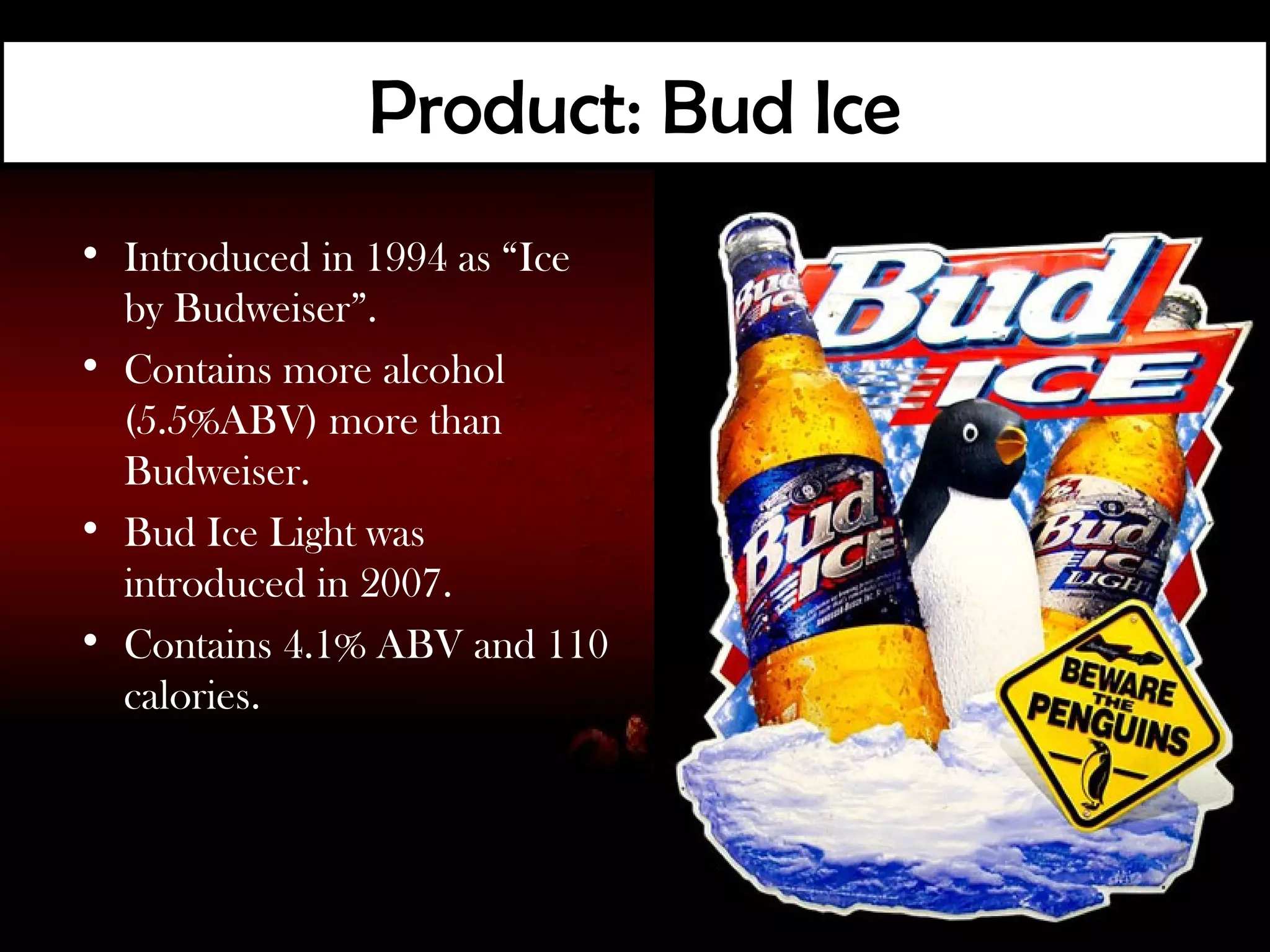
Product: Bud Ice
• Introduced in 1994 as “Ice
  by Budweiser”.
• Contains more alcohol
  (5.5%ABV) more than
  Budweiser.
• Bud Ice Light was
  introduced in 2007.
• Contains 4.1% ABV and 110
  calories.
Product: Clamato Chelada.
• A blend of Budweiser or Bud
  light and Clamato. This
  beverage became available
  nationally in late 2007 due to
  overwhelming popularity during
  test marketing.
• In its most basic form, the
  chelada is a fairly innocuous
  mixing of beer with lime and
  salt. Miller's new product, Miller
  Chill, incorporates these flavors
  in their new product, which they
  have slotted as a super premium
  light beer
Physical: Styling and Packaging
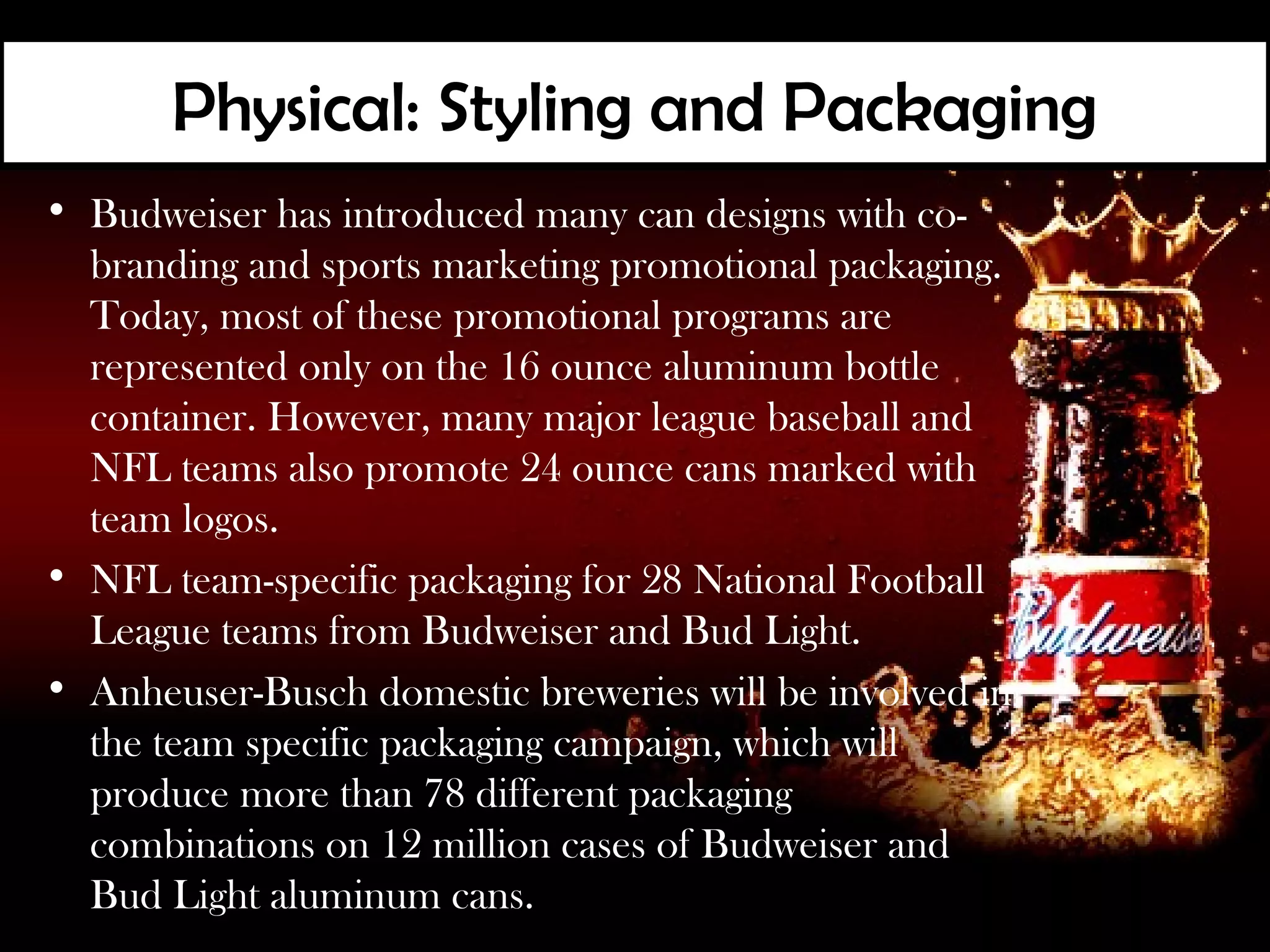
• Budweiser has introduced many can designs with co-
  branding and sports marketing promotional packaging.
  Today, most of these promotional programs are
  represented only on the 16 ounce aluminum bottle
  container. However, many major league baseball and
  NFL teams also promote 24 ounce cans marked with
  team logos.
• NFL team-specific packaging for 28 National Football
  League teams from Budweiser and Bud Light.
• Anheuser-Busch domestic breweries will be involved in
  the team specific packaging campaign, which will
  produce more than 78 different packaging
  combinations on 12 million cases of Budweiser and
  Bud Light aluminum cans.
Physical: Styling and Packaging
• Packages are sometimes
  tailored to local customs
  and traditions
• In St. Mary's County,
  Maryland, ten ounce
  cans are the preferred
  package.
• Chicagoans widely prefer
  the 16 ounce can.
• Michigan prefer the eight
  ounce can.
Styling and Packaging
Presently, Budweiser is distributed in
  four large container volumes: half-
  barrel 15.5 gal), quarter-barrel, 1/6
 barrel and beer balls (5.2 gallons). In
    smaller consumption volumes,
Budweiser is distributed in eight, ten,
   12, 16, 22, 24, 32 and 40 ounce
containers. Smaller containers may be
  made of glass, aluminum or plastic.
Physical: Styling and Packaging
• The Budweiser bottle has remained
  relatively unchanged since its
  introduction in 1876.
• The top label is red and currently
  reads "Budweiser". The top of the
  main label is red with a white
  banner with a pledge on it, which
  has changed three times. Below the
  banner is a coat of arms of sorts,
  which features an Anheuser-Busch
  stylization. Below that is a large
  white box.
Physical: Styling and Packaging
Through early 1950s Budweiser
was primarily distributed in just
3 packages:

•      Kegs
•      12 ounce bottles
•      Quart bottles
Physical: Styling and Packaging
• Metal Container Corp. supplies more than
  60 percent of Anheuser-Busch’s domestic
  lids.
• Anheuser-Busch Recycling Corp. recycles
  used beverage cans, which are remelted into
  new sheet aluminum. This business unit
  provides a positive alternative to mandatory
  deposits and helps reduce container costs.
  A-BRC annually recycles more aluminum
  cans than Anheuser-Busch sells
  domestically.
Physical: Styling and Packaging
• Eagle Packaging Inc. supplies 100
  percent of Anheuser-Busch’s domestic
  crown and closure liner materials
• Longhorn Glass Corp. produces
  longneck glass bottles and ships all its
  output to the Anheuser-Busch
  Houston brewery. LGC supplies the
  Houston brewery with more than 60
  percent of Anheuser-Busch’ total glass
  bottle needs.
Analysis

• Budweiser packaging concentrates more on co-
  branding and sports promotional packaging.
• The can packaging size differs from one
  community to the other.
• Larger container volumes ranges from 5.2
  gallons to 15.5 gallons
• A distinctive coat of arms of some sort which
  features Anheuser-Busch stylization.
Psychological: Entertainment
   Sponsorship of the world’s
    premier sporting events

Maintains a high-profile presence with adult
audiences through innovative marketing and
 sponsorship programs in sports, music and
              entertainment.
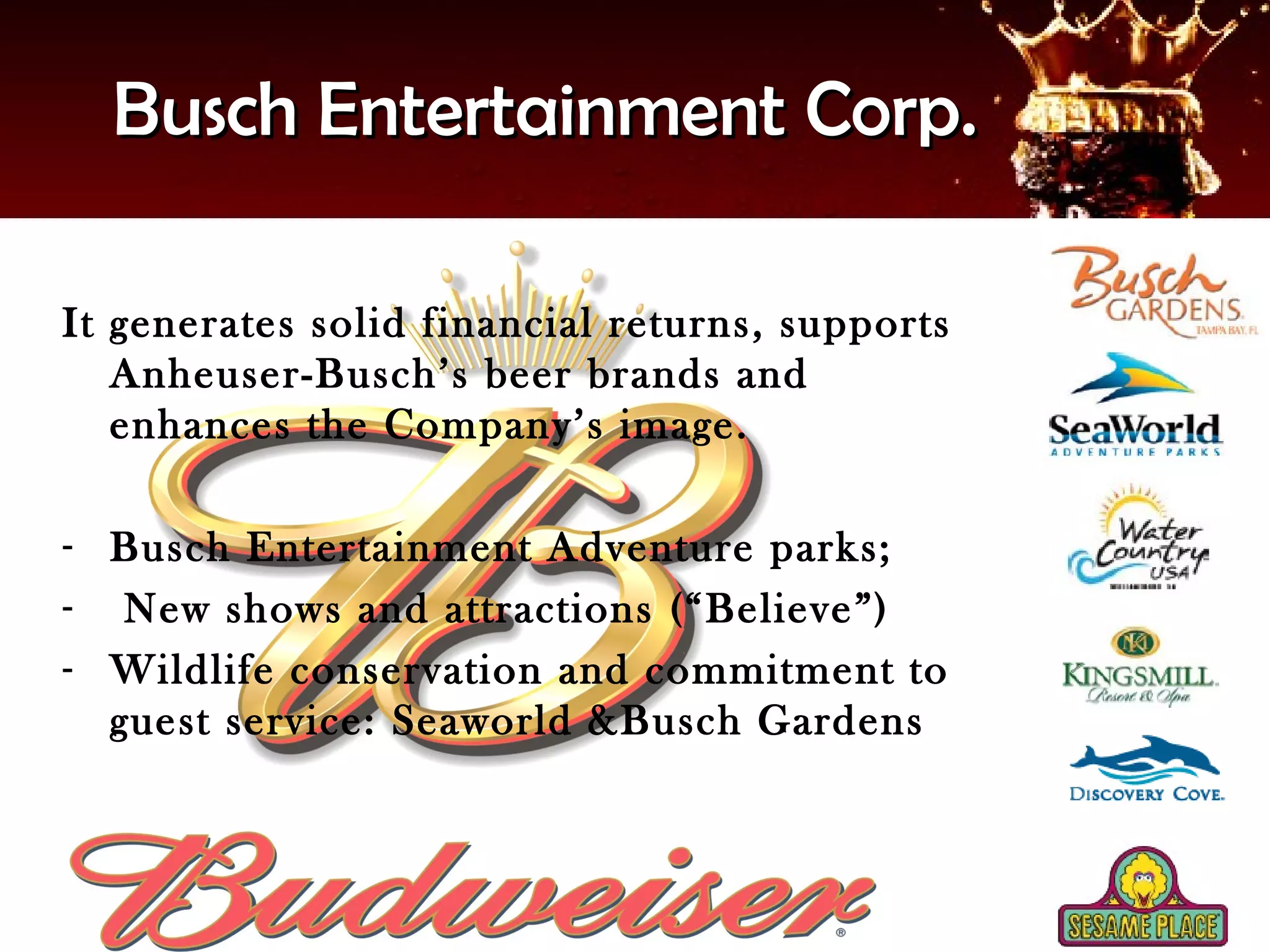
Busch Entertainment Corp.

It generates solid financial returns, supports
   Anheuser-Busch’s beer brands and
   enhances the Company’s image.

- Busch Entertainment Adventure parks;
- New shows and attractions (“Believe”)
- Wildlife conservation and commitment to
  guest service: Seaworld &Busch Gardens
Psychological: Environment

The company recognizes the importance
of being a good environmental steward
in the communities where it operates.
• Bio-Energy
• Wastewater into a renewable fuel
source
• Recycles more than 97 percent of the
waste it generates
• Projects with the National Fish and
Wildlife Foundation
Brand Image

We are all aware that it is very difficult to taste the
difference between the varieties of available beer
   brands when given it unlabelled, it is almost
  impossible for a common man to say for sure
 what brand is it, and there are several cases on
 this issue. Therefore the styling and, packaging
and brand image is very important. In the world
  of brew, consumer loyalty is shaped by brand
              culture (Barnet, 2001).
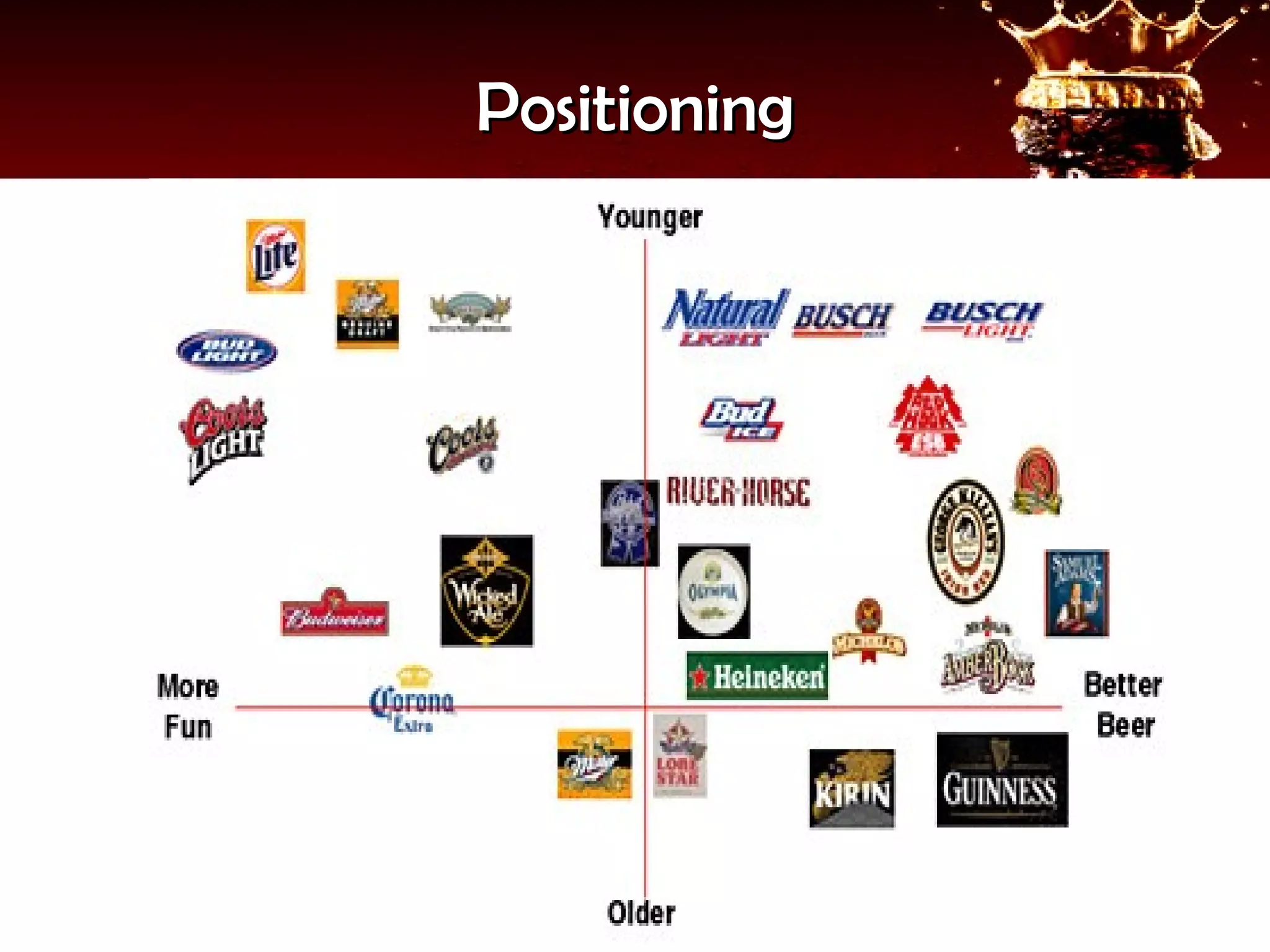
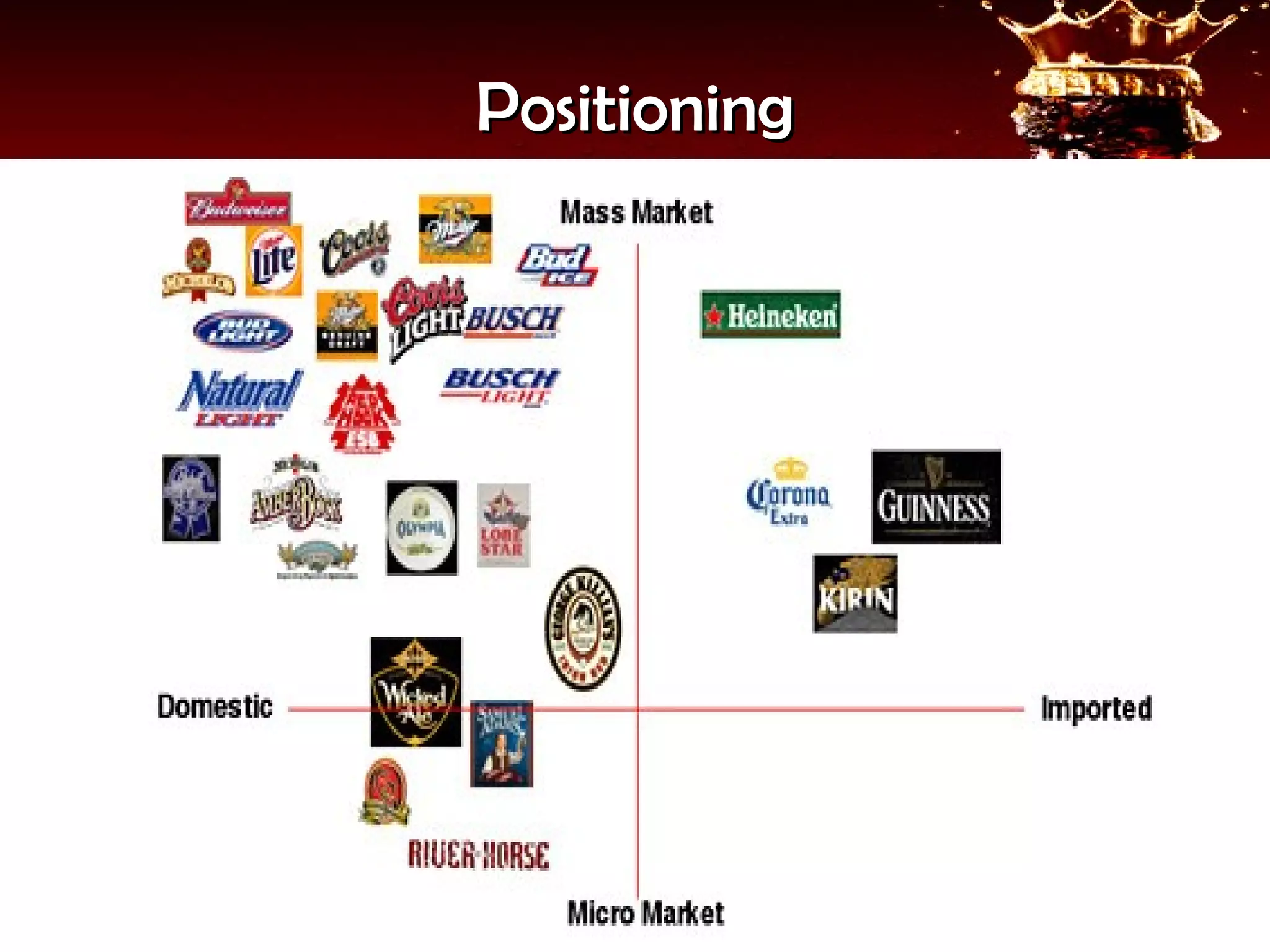
Positioning
• Globally brewed and considered as leader on
  the market.
• Holding a 49% market share of US beer sales
• Quality product, best tasting, satisfying beer on
  market
• Target market is 21 years and older
      - Fun loving
      - Care free individuals
      - Drink occasionally and or on daily
        basis
Positioning
Positioning
Brand Strategy
• Breweries:
   - 14 breweries in the US
   - 14 in China (to be 15 soon)
   - 1 in the UK
   - Brewing in partnership with Grupo Modelo
      in Mexico and Labatt Brewing Company in
      Canada
• Not sell direct to customers
• Good sold to wholesalers, then retailers and
  finally to customers
• Line strategy
• Brand extension
Brand Strategy
• Brand positioning
   - Attributes
   - Benefits
   - Benefits and values

• Brand name selection
   – Selection
   – Protection
Brand strategy cont…
• Brand sponsorship
   – Manufacturers brand
   – Co-branding

• Brand development
   – Line extension
   – Brand extension
Budweiser Brand Health
• Measuring brand health gives a view of forward
  momentum — keeping the brand position
  relevant by staying ahead of constantly shifting
  customer needs and competitive pressure.
  Brands can be eternal if nurtured well.
• Budweiser feels that, the “white and red blood
  cells” of healthy brands are resilience and
  leveragability thus their brand custodians must
  always realize that maintaining long-term brand
  health is usually more important than the short-
  term $ gains, thus they try to promote the health
  of their product through sponsorship.
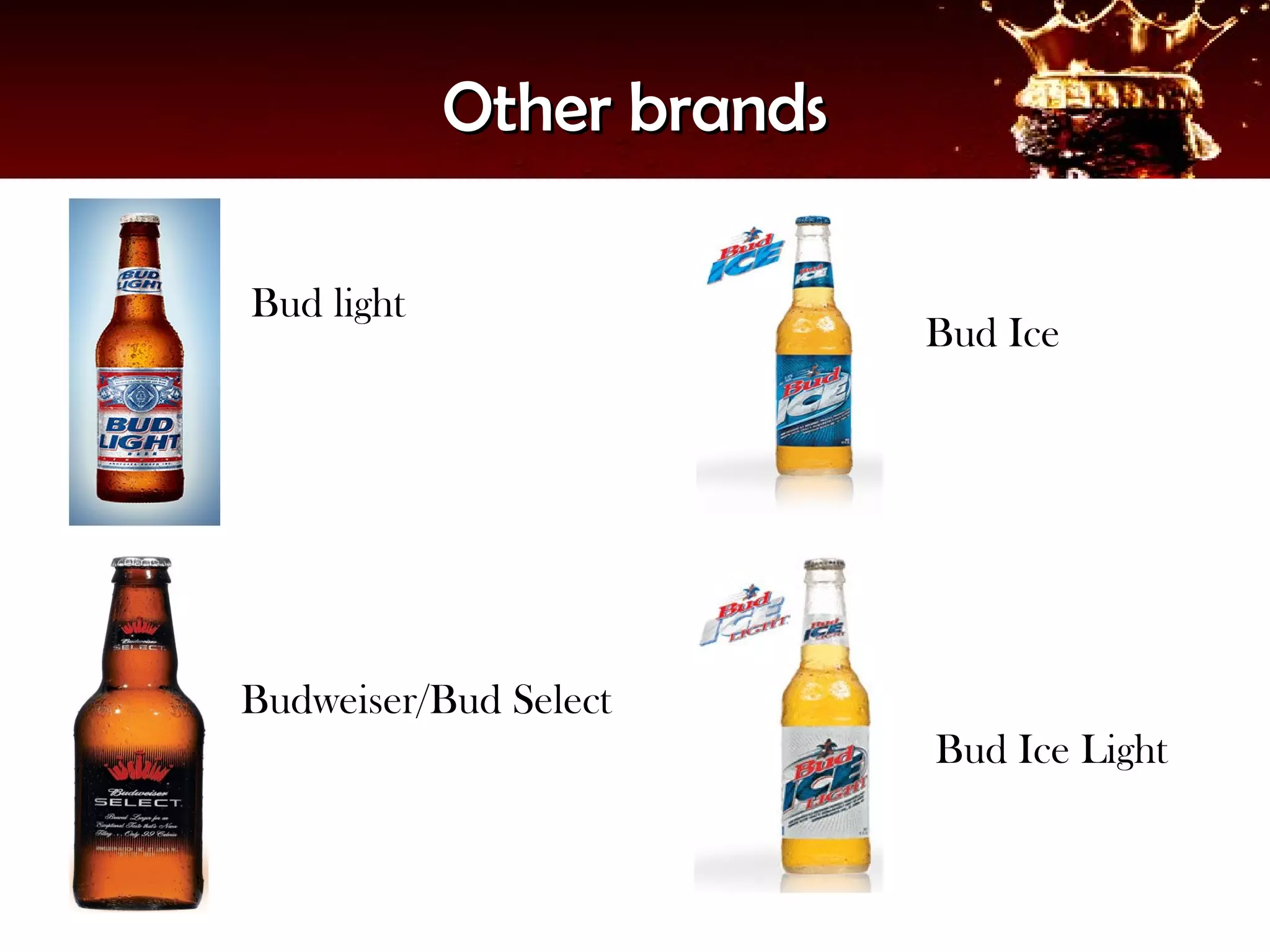
Other brands

Bud light
                           Bud Ice


Budweiser/Bud Select
                           Bud Ice Light
Other brands


Budweiser              Bud Light Lime
American Ale


 Bud Dry             Bud Silver
Other brands


Budweiser & Clamato Chelada


            Bud Light & Clamato Chelada
Thank you

Mkt budweiser

  • 1.
  • 2.
    Many of life'sfailures are men who did not realize how close they were to success when they gave up. - Thomas Edison
  • 3.
    Introduction Anheuser-Busch Anheuser-Busch Inc. is a strong and dominating company that is a leader in the beer market. They are a company that is rooted in values, ethics and sheer determination. Anheuser-Busch targets consumers who are interested in alcoholic beverages that provide the best taste and quality. Their targets are anyone from the lower class of society, all the way up to the upper class. They have a wide range of brands and beverages to offer that are appealing to each social class.
  • 4.
    Brief History • Anheuser-BuschCompanies, Inc. traces its roots to 1852 and the Bavarian Brewery in St. Louis. • Adolphus Busch, a successful German businessman, joined his father-in-law in the business in the 1860s and took on increasing responsibility. • Budweiser was the first national beer brand, introduced in 1876. • In 2008, Anheuser-Busch and InBev combined to become Anheuser-Busch InBev. The new company is the world’s largest brewer and one of the top 5 consumer goods companies in the world.
  • 5.
  • 6.
    Product Product Definition General: Good,idea, method, information, object, service, etc., that is the end result of a process and serves as a need or want satisfier. It is usually a bundle of tangible and intangible attributes (benefits, features, functions, uses) that a seller offers to a buyer for purchase.
  • 7.
    Product: Budweiser • Anheuser-Buschis an American-style lager and is one of the most popular beers in the United States. • Budweiser is made up of large proportion (up to 40%) of rice in addition to hops and barley malt. • Budweiser is produced in various breweries located aound the United States and the rest of the world. • It is a filtered beer available in draught and packaged forms.
  • 8.
    Product: Bud Light •Introduced in 1982 • It was one of the first light beers in the world • Bud Light is the best-selling beer in the U.S. and the #1 beer in the world • It’s brewed at all 12 Anheuser-Busch U.S. based breweries. • Bud Light is brewed with all-natural ingredients – water, barley malt, rice, premium hops and yeast. • A blend of two and six row malt and cereal grains give bud light its clean, crisp, smooth taste. • There is 110 calories, 6.6 grams of carbohydrates and is 4.2 % alcohol by volume in each 12 OZ. serving
  • 9.
    Product: Bud Select •Bavarian hops and an extended brewing process combine to give the Budweiser Select its distinctively full flavor- despite weighing in at only 99 calories. Dark gold in color and pleasingly aromatic, Budweiser select is impressive from any angle. • The Exception to the Rule.
  • 10.
    Product: Bud LightLime • Bud Light Lime is a premium light beer that combines the superior drinkability of Bud Light with a splash of 100% natural lime flavor. • A light beer with 4.2% ABV and 116 calories per 12 ounce serving
  • 11.
    Product: American Ale •Debuted in September 2008. • The beer offer complex taste without much bitterness. • It is the first beer under the Budweiser name that is brewed as an ale rather than a lager. The beer has a darker color which is a departure from other Budweiser brands
  • 12.
    Product: Bud Dry •was introduced in the U.S. in 1990 with the slogan of “Why ask why? Drink Bud Dry.” • It was originally successful in the test markets and was expected to be a popular beer with the rise in lager popularity. • However, with the introduction of Bud Ice in 1994, Bud Dry began to decline in the mainstream popularity and no longer receives attention.
  • 13.
    Product: Bud Ice •Introduced in 1994 as “Ice by Budweiser”. • Contains more alcohol (5.5%ABV) more than Budweiser. • Bud Ice Light was introduced in 2007. • Contains 4.1% ABV and 110 calories.
  • 14.
    Product: Clamato Chelada. •A blend of Budweiser or Bud light and Clamato. This beverage became available nationally in late 2007 due to overwhelming popularity during test marketing. • In its most basic form, the chelada is a fairly innocuous mixing of beer with lime and salt. Miller's new product, Miller Chill, incorporates these flavors in their new product, which they have slotted as a super premium light beer
  • 15.
    Physical: Styling andPackaging • Budweiser has introduced many can designs with co- branding and sports marketing promotional packaging. Today, most of these promotional programs are represented only on the 16 ounce aluminum bottle container. However, many major league baseball and NFL teams also promote 24 ounce cans marked with team logos. • NFL team-specific packaging for 28 National Football League teams from Budweiser and Bud Light. • Anheuser-Busch domestic breweries will be involved in the team specific packaging campaign, which will produce more than 78 different packaging combinations on 12 million cases of Budweiser and Bud Light aluminum cans.
  • 16.
    Physical: Styling andPackaging • Packages are sometimes tailored to local customs and traditions • In St. Mary's County, Maryland, ten ounce cans are the preferred package. • Chicagoans widely prefer the 16 ounce can. • Michigan prefer the eight ounce can.
  • 17.
    Styling and Packaging Presently,Budweiser is distributed in four large container volumes: half- barrel 15.5 gal), quarter-barrel, 1/6 barrel and beer balls (5.2 gallons). In smaller consumption volumes, Budweiser is distributed in eight, ten, 12, 16, 22, 24, 32 and 40 ounce containers. Smaller containers may be made of glass, aluminum or plastic.
  • 18.
    Physical: Styling andPackaging • The Budweiser bottle has remained relatively unchanged since its introduction in 1876. • The top label is red and currently reads "Budweiser". The top of the main label is red with a white banner with a pledge on it, which has changed three times. Below the banner is a coat of arms of sorts, which features an Anheuser-Busch stylization. Below that is a large white box.
  • 19.
    Physical: Styling andPackaging Through early 1950s Budweiser was primarily distributed in just 3 packages: • Kegs • 12 ounce bottles • Quart bottles
  • 20.
    Physical: Styling andPackaging • Metal Container Corp. supplies more than 60 percent of Anheuser-Busch’s domestic lids. • Anheuser-Busch Recycling Corp. recycles used beverage cans, which are remelted into new sheet aluminum. This business unit provides a positive alternative to mandatory deposits and helps reduce container costs. A-BRC annually recycles more aluminum cans than Anheuser-Busch sells domestically.
  • 21.
    Physical: Styling andPackaging • Eagle Packaging Inc. supplies 100 percent of Anheuser-Busch’s domestic crown and closure liner materials • Longhorn Glass Corp. produces longneck glass bottles and ships all its output to the Anheuser-Busch Houston brewery. LGC supplies the Houston brewery with more than 60 percent of Anheuser-Busch’ total glass bottle needs.
  • 22.
    Analysis • Budweiser packagingconcentrates more on co- branding and sports promotional packaging. • The can packaging size differs from one community to the other. • Larger container volumes ranges from 5.2 gallons to 15.5 gallons • A distinctive coat of arms of some sort which features Anheuser-Busch stylization.
  • 23.
    Psychological: Entertainment Sponsorship of the world’s premier sporting events Maintains a high-profile presence with adult audiences through innovative marketing and sponsorship programs in sports, music and entertainment.
  • 24.
    Busch Entertainment Corp. Itgenerates solid financial returns, supports Anheuser-Busch’s beer brands and enhances the Company’s image. - Busch Entertainment Adventure parks; - New shows and attractions (“Believe”) - Wildlife conservation and commitment to guest service: Seaworld &Busch Gardens
  • 25.
    Psychological: Environment The companyrecognizes the importance of being a good environmental steward in the communities where it operates. • Bio-Energy • Wastewater into a renewable fuel source • Recycles more than 97 percent of the waste it generates • Projects with the National Fish and Wildlife Foundation
  • 26.
    Brand Image We areall aware that it is very difficult to taste the difference between the varieties of available beer brands when given it unlabelled, it is almost impossible for a common man to say for sure what brand is it, and there are several cases on this issue. Therefore the styling and, packaging and brand image is very important. In the world of brew, consumer loyalty is shaped by brand culture (Barnet, 2001).
  • 27.
    Positioning • Globally brewedand considered as leader on the market. • Holding a 49% market share of US beer sales • Quality product, best tasting, satisfying beer on market • Target market is 21 years and older - Fun loving - Care free individuals - Drink occasionally and or on daily basis
  • 28.
  • 29.
  • 30.
    Brand Strategy • Breweries: - 14 breweries in the US - 14 in China (to be 15 soon) - 1 in the UK - Brewing in partnership with Grupo Modelo in Mexico and Labatt Brewing Company in Canada • Not sell direct to customers • Good sold to wholesalers, then retailers and finally to customers • Line strategy • Brand extension
  • 31.
    Brand Strategy • Brandpositioning - Attributes - Benefits - Benefits and values • Brand name selection – Selection – Protection
  • 32.
    Brand strategy cont… •Brand sponsorship – Manufacturers brand – Co-branding • Brand development – Line extension – Brand extension
  • 33.
    Budweiser Brand Health •Measuring brand health gives a view of forward momentum — keeping the brand position relevant by staying ahead of constantly shifting customer needs and competitive pressure. Brands can be eternal if nurtured well. • Budweiser feels that, the “white and red blood cells” of healthy brands are resilience and leveragability thus their brand custodians must always realize that maintaining long-term brand health is usually more important than the short- term $ gains, thus they try to promote the health of their product through sponsorship.
  • 34.
    Other brands Bud light Bud Ice Budweiser/Bud Select Bud Ice Light
  • 35.
    Other brands Budweiser Bud Light Lime American Ale Bud Dry Bud Silver
  • 36.
    Other brands Budweiser &Clamato Chelada Bud Light & Clamato Chelada
  • 37.