Heineken
Strategy and Value Creation
The Lisbon MBA
Groups 2 and 7
Ana Santos
Bruno Oliveira
Caspar Guggenbühl
James Shannon
Jide Famuyiwa
Leonor Martins
Marixcela Victoria
Pedro Henriques
Rui Barata
Agenda
STRATEGIC ANALYSIS
• PEST Analysis
• Segmentation
• Attractiveness
• Key Success Factors
• Strategic Groups
• Resources
• Core Competencies
• Strategic Fit
STRATEGIC FORMULATION
• Vision & Mission
• Objectives
• Products-Market Evolution
• Vertical Integration
• Internationalization
• Organizational Development
• Organizational Structure
RECOMMENDATIONS
• New SWOT Analysis
• Strategic Initiatives
We are Heineken
STRATEGIC
ANALYSIS
PEST ANALYSIS
Pest Analysis
•Heavy Regulations
•Restrictions on drinking ages
•Taxes
•Government anti-alcohol
campaigns
Political - Legal
•Economic slowdown / recession
•Middle income growing
•Raw materials price fluctuation
and scarcity
•Infrastructure developments
Economic
•Awareness of alcohol negative
effect
•Healthy lifestyle
•Cultural and social side of drinking
•Premium and craft
Social - Cultural
•Innovative techniques in the
production
•Digital interaction with customers
•Environmental regulations
•Eco-friendly packaging
Technological -
Ecological
S
SEGMENTATION
Product
Beer
Spirits
Wine
Cider/Perry
RTDs/High-
Strength
Premixes
Geography
North
America
Europe
Asia Pacific
Rest of the
World (RoW)
Demography
Adult Men
Adult
Women
Minors
Price
Super
Premium
Premium
Regular
Packaging
Can
Glass Bottle
Draught
Psychographic
Premium
Consumers
Price
sensitive
Consumers
Social
consumers
Engaged new
comers
Brand
loyalists
Segmentation
ATTRACTIVENESS
Attractiveness
KEY SUCCESS
FACTORS
Key Success Factors
STRATEGIC
GROUPS
Strategic Groups
Price/PerceivedQuality
Geographic Market Scope
Global Brewers
Regional Brewers
Local Micro-Brewers
RESOURCES
Resources
CORE
COMPETENCIES
Core Competencies
COMPETENCIES VALUE RARENESS IMITABILITY ORGANIZATION VRIO
Brand / Image
Global Presence
Technology / Innovation
Product Portfolio
Customer Loyalty
Partnerships
Marketing and Sales
Culture
Manufacturing Skills
Operational efficiency / Distribution Channels
Customer Orientation
Flexibility
STRATEGIC FIT
Strategic Fit
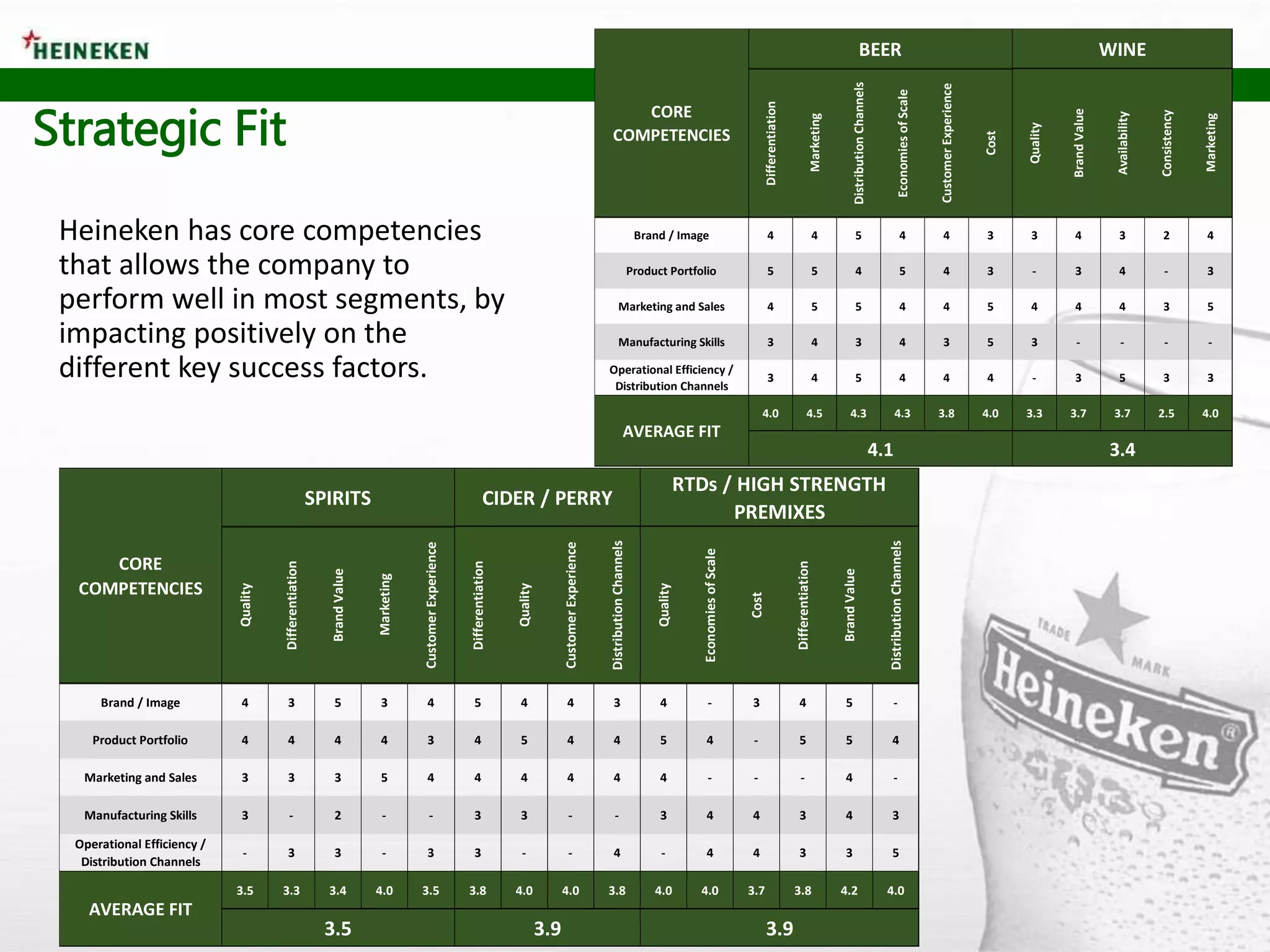
Heineken has core competencies
that allows the company to
perform well in most segments, by
impacting positively on the
different key success factors.
Differentiation
Marketing
DistributionChannels
EconomiesofScale
CustomerExperience
Cost
Quality
BrandValue
Availability
Consistency
Marketing
Brand / Image 4 4 5 4 4 3 3 4 3 2 4
Product Portfolio 5 5 4 5 4 3 - 3 4 - 3
Marketing and Sales 4 5 5 4 4 5 4 4 4 3 5
Manufacturing Skills 3 4 3 4 3 5 3 - - - -
Operational Efficiency /
Distribution Channels
3 4 5 4 4 4 - 3 5 3 3
4.0 4.5 4.3 4.3 3.8 4.0 3.3 3.7 3.7 2.5 4.0
CORE
COMPETENCIES
BEER WINE
AVERAGE FIT
4.1 3.4
Quality
Differentiation
BrandValue
Marketing
CustomerExperience
Differentiation
Quality
CustomerExperience
DistributionChannels
Quality
EconomiesofScale
Cost
Differentiation
BrandValue
DistributionChannels
Brand / Image 4 3 5 3 4 5 4 4 3 4 - 3 4 5 -
Product Portfolio 4 4 4 4 3 4 5 4 4 5 4 - 5 5 4
Marketing and Sales 3 3 3 5 4 4 4 4 4 4 - - - 4 -
Manufacturing Skills 3 - 2 - - 3 3 - - 3 4 4 3 4 3
Operational Efficiency /
Distribution Channels
- 3 3 - 3 3 - - 4 - 4 4 3 3 5
3.5 3.3 3.4 4.0 3.5 3.8 4.0 4.0 3.8 4.0 4.0 3.7 3.8 4.2 4.0
3.5
AVERAGE FIT
3.9
CIDER / PERRY
RTDs / HIGH STRENGTH
PREMIXES
3.9
CORE
COMPETENCIES
SPIRITS
Strategic Fit
Heineken has core
competencies that allows
the company to perform well
in most segments, by
impacting positively on the
different key success factors.
CORE
COMPETENCIES
BEER WINE
Differentiation
Marketing
Distribution
Channels
Economiesof
Scale
Customer
Experience
Cost
Quality
BrandValue
Availability
Consistency
Marketing
Brand / Image 4 4 5 4 4 3 3 4 3 2 4
Product Portfolio 5 5 4 5 4 3 - 3 4 - 3
Marketing and Sales 4 5 5 4 4 5 4 4 4 3 5
Manufacturing Skills 3 4 3 4 3 5 3 - - - -
Operational Efficiency
/ Distribution
Channels
3 4 5 4 4 4 - 3 5 3 3
AVERAGE FIT
4.0 4.5 4.3 4.3 3.8 4.0 3.3 3.7 3.7 2.5 4.0
4.1 3.4
CORE
COMPETENCIES
SPIRITS CIDER / PERRY
RTDs / HIGH STRENGTH
PREMIXES
Quality
Differentiation
BrandValue
Marketing
Customer
Experience
Differentiation
Quality
Customer
Experience
Distribution
Channels
Quality
EconomiesofScale
Cost
Differentiation
BrandValue
Distribution
Channels
Brand / Image 4 3 5 3 4 5 4 4 3 4 - 3 4 5 -
Product Portfolio 4 4 4 4 3 4 5 4 4 5 4 - 5 5 4
Marketing and Sales 3 3 3 5 4 4 4 4 4 4 - - - 4 -
Manufacturing Skills 3 - 2 - - 3 3 - - 3 4 4 3 4 3
Operational Efficiency /
Distribution Channels
- 3 3 - 3 3 - - 4 - 4 4 3 3 5
AVERAGE FIT
3.5 3.3 3.4 4.0 3.5 3.8 4.0 4.0 3.8 4.0 4.0 3.7 3.8 4.2 4.0
3.5 3.9 3.9
STRATEGIC
FORMULATION
VISION &
MISSION
Vision & Mission
Vision
• “To win in all markets with Heineken®,
and with a full brand portfolio in
markets where we choose.”
Mission
• A proud, independent, global brewer
committed to surprising and exciting
consumers everywhere.”
”A passion for quality, enjoyment of life, respect for
people and respect for our planet.”
OBJECTIVES
Objectives
Financial Other - Non Financial
o Lead by Innovation
o Opportunities in the emerging
markets
Shape the Cider market
o “Brewing a Better World”
o Global Business Services
o Lead by Cool Marketing
SMART
SMART
SMART
SMART
PRODUCTS-
MARKETS
STRATEGY
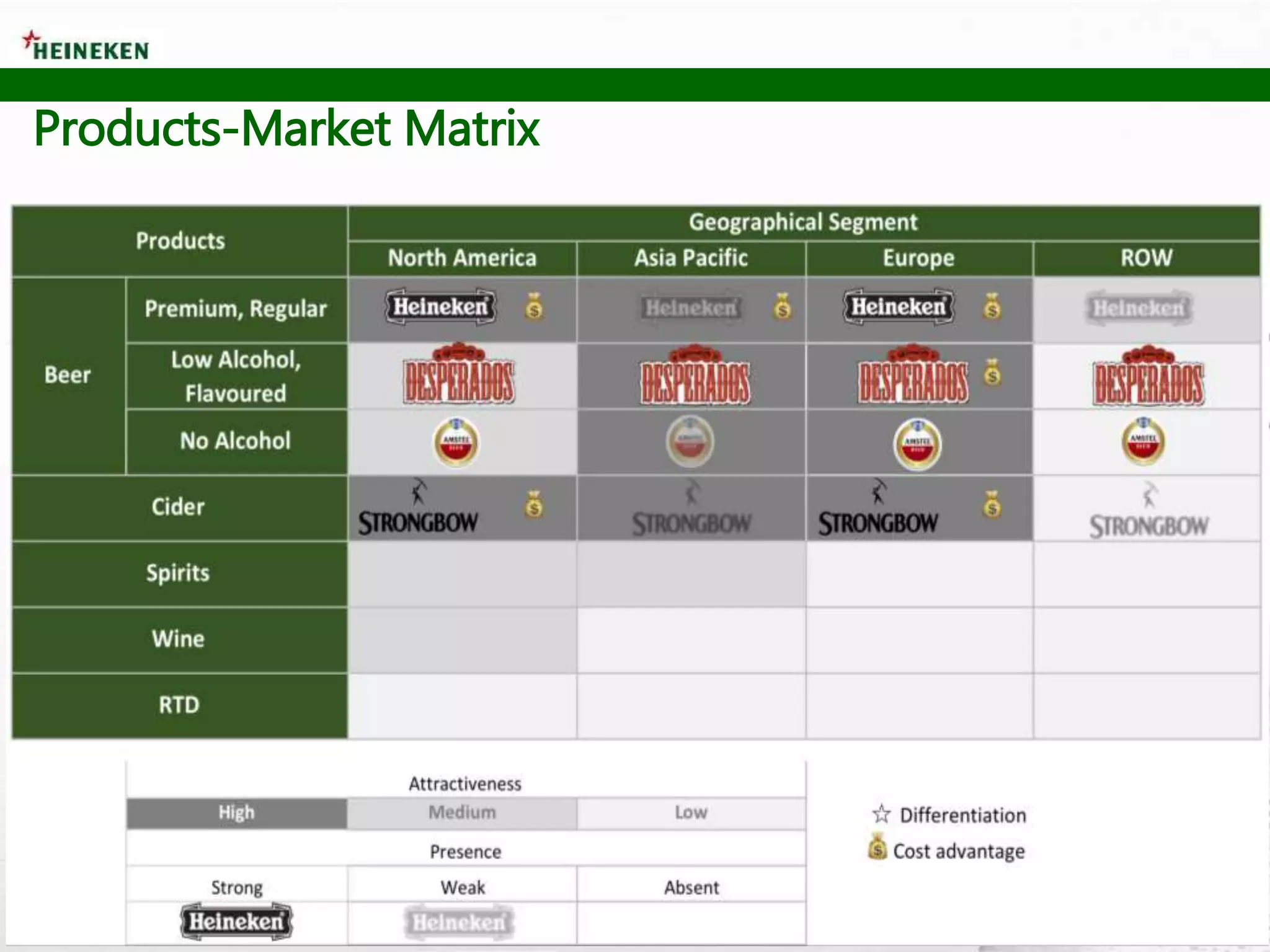
Products-Market Matrix
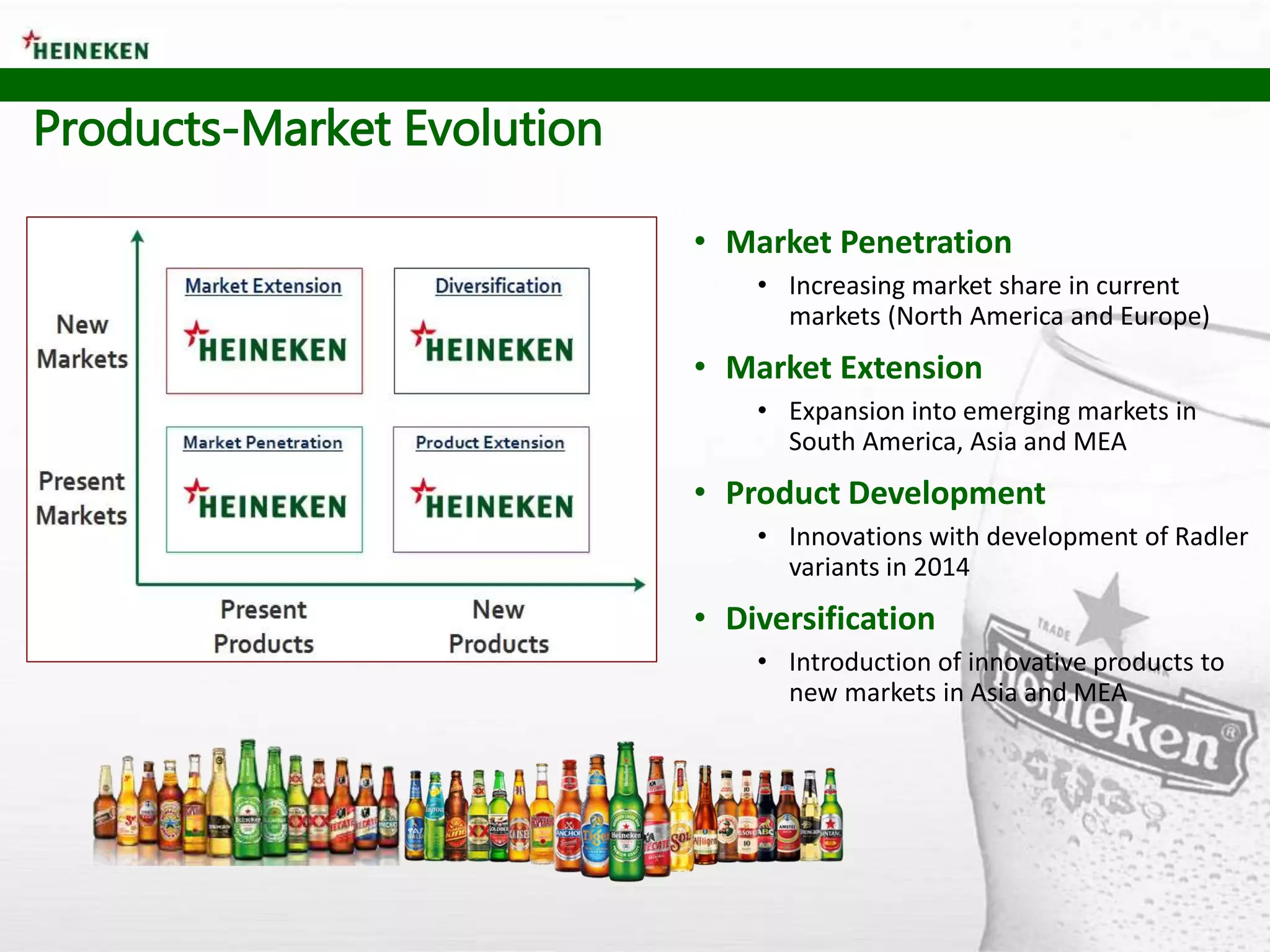
• Market Penetration
• Increasing market share in current
markets (North America and Europe)
• Market Extension
• Expansion into emerging markets in
South America, Asia and MEA
• Product Development
• Innovations with development of Radler
variants in 2014
• Diversification
• Introduction of innovative products to
new markets in Asia and MEA
Products-Market Evolution
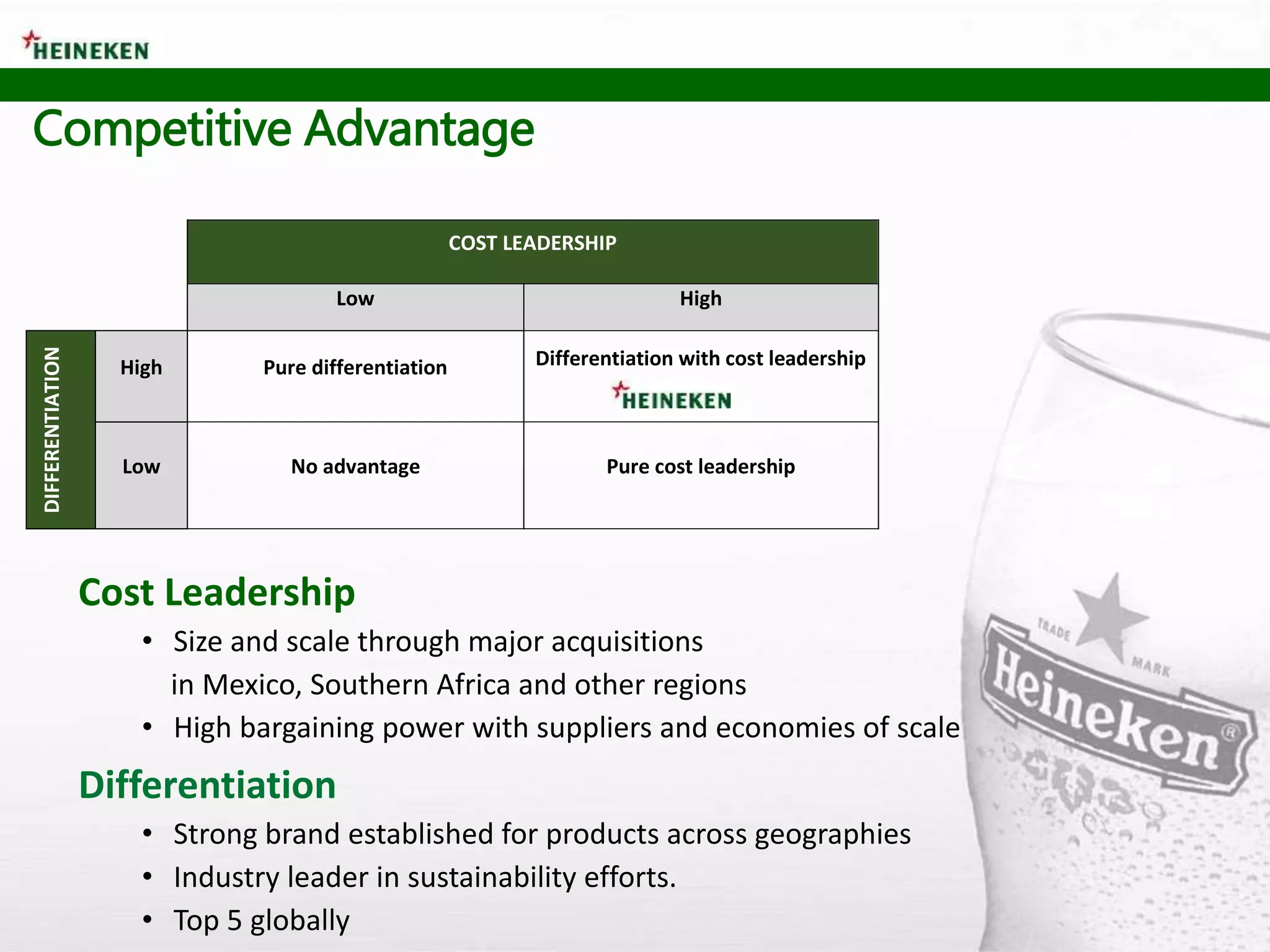
Cost Leadership
• Size and scale through major acquisitions
in Mexico, Southern Africa and other regions
• High bargaining power with suppliers and economies of scale
Differentiation
• Strong brand established for products across geographies
• Industry leader in sustainability efforts.
• Top 5 globally
Competitive Advantage
COST LEADERSHIP
Low High
DIFFERENTIATION
High Pure differentiation Differentiation with cost leadership
Low No advantage Pure cost leadership
Heineken embraces “moment marketing”
 Your best moments
 Your most premium moments
 Your most irreverent moments
 Your good moments
Key Product Differentiation Elements
Evolution of Products-Market Strategy
VERTICAL
INTEGRATION
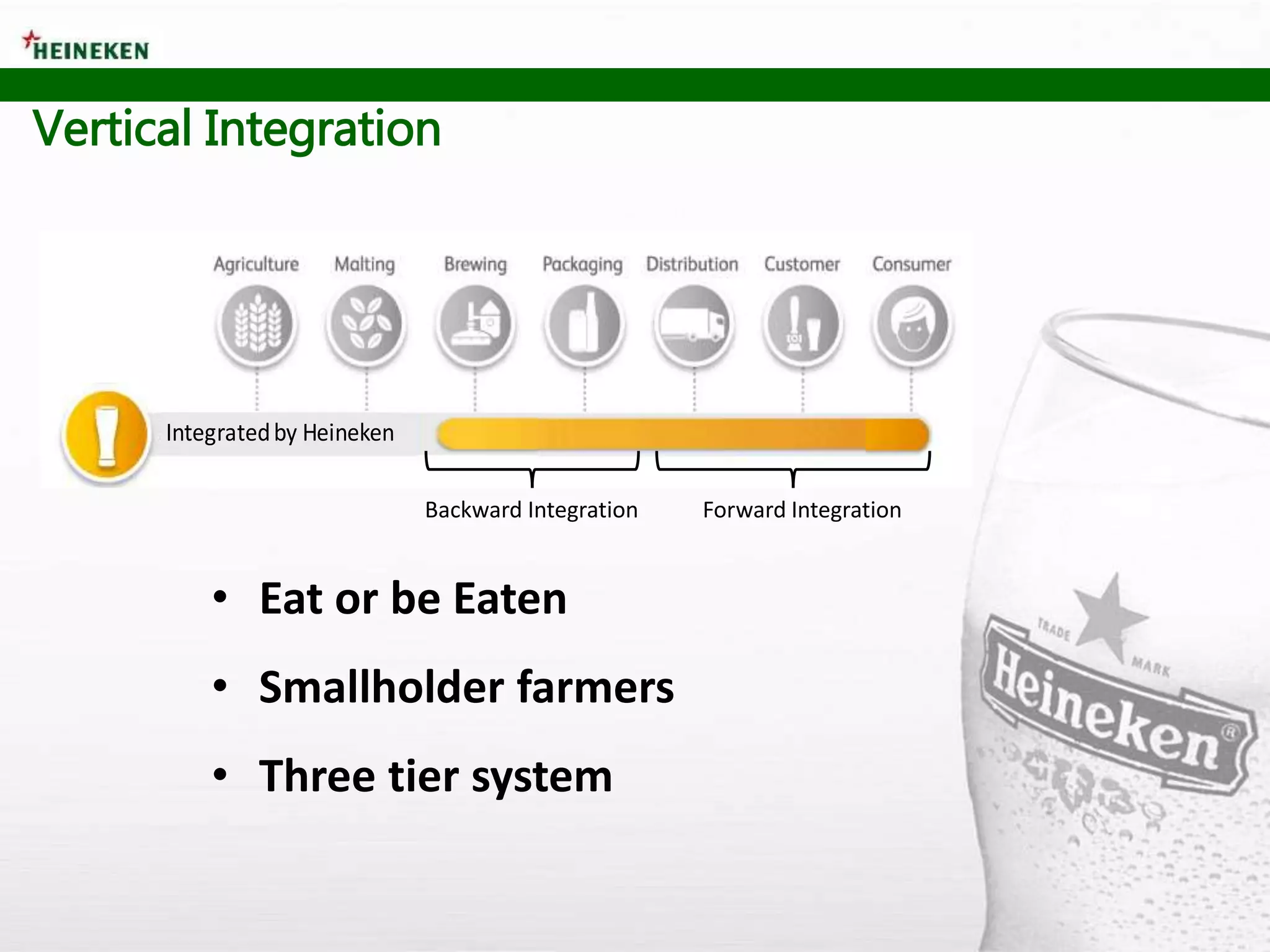
Vertical Integration
Integratedby Heineken
Forward IntegrationBackward Integration
• Eat or be Eaten
• Smallholder farmers
• Three tier system
INTERNATIONALIZATION
Internationalization
*Only Product extension so far has been Heineken Light for the US market
Local Adaptation
Low High
Global
Integration
High
Low
Culture/Habits Design Language Size/Package
Technical
System
Concept Standardized Standardized Standardized Standardized Standardized
Marketing Adapted Standardized Adapted Standardized Standardized
Technology Standardized Standardized Standardized Standardized Standardized
Product Standardized Standardized Standardized Standardized Standardized
Culture/Habits Design Language Size/Package
Technical
System
Concept Adapted Adapted Adapted Adapted Standardized
Marketing Adapted Adapted Adapted Adapted Standardized
Technology Standardized Standardized Adapted Adapted Adapted
Product Adapted Adapted Adapted Adapted Adapted
Portfolio
Heineken
Internationalization
Attractiveness Factors Weight (%) Asia Pacific Americas
Africa Middle
East and East
Europe
West Europe
Market evaluation 35% 2,51 2,43 1,93 2,34
Operational evaluation 35% 1,95 2,15 1,95 1,95
Risk evaluation 30% 1,64 1,9 1,64 2,3
Overall attractiveness 100% 6,1 6,48 5,52 6,59
Competitive Strength
Low Medium High
Country
Attractiveness
High
W. Europe/Pacific
Asia
Medium US/Canada/Africa
Low Middle East
Organizational Development
Products-
Markets
Heineken Light /
Draught
Experience
Buy Strongbow
Vertical
Integration
Efficiency /
Distribution
Breweries
Channels
International.
Partnerships /
Exports
Buy Breweries
Related
Diversification
Low/no alcohol
/ Radler /
Desperados
Cider / Craft
Beer
Internal
External
ORGANIZATIONAL
STRUCTURE
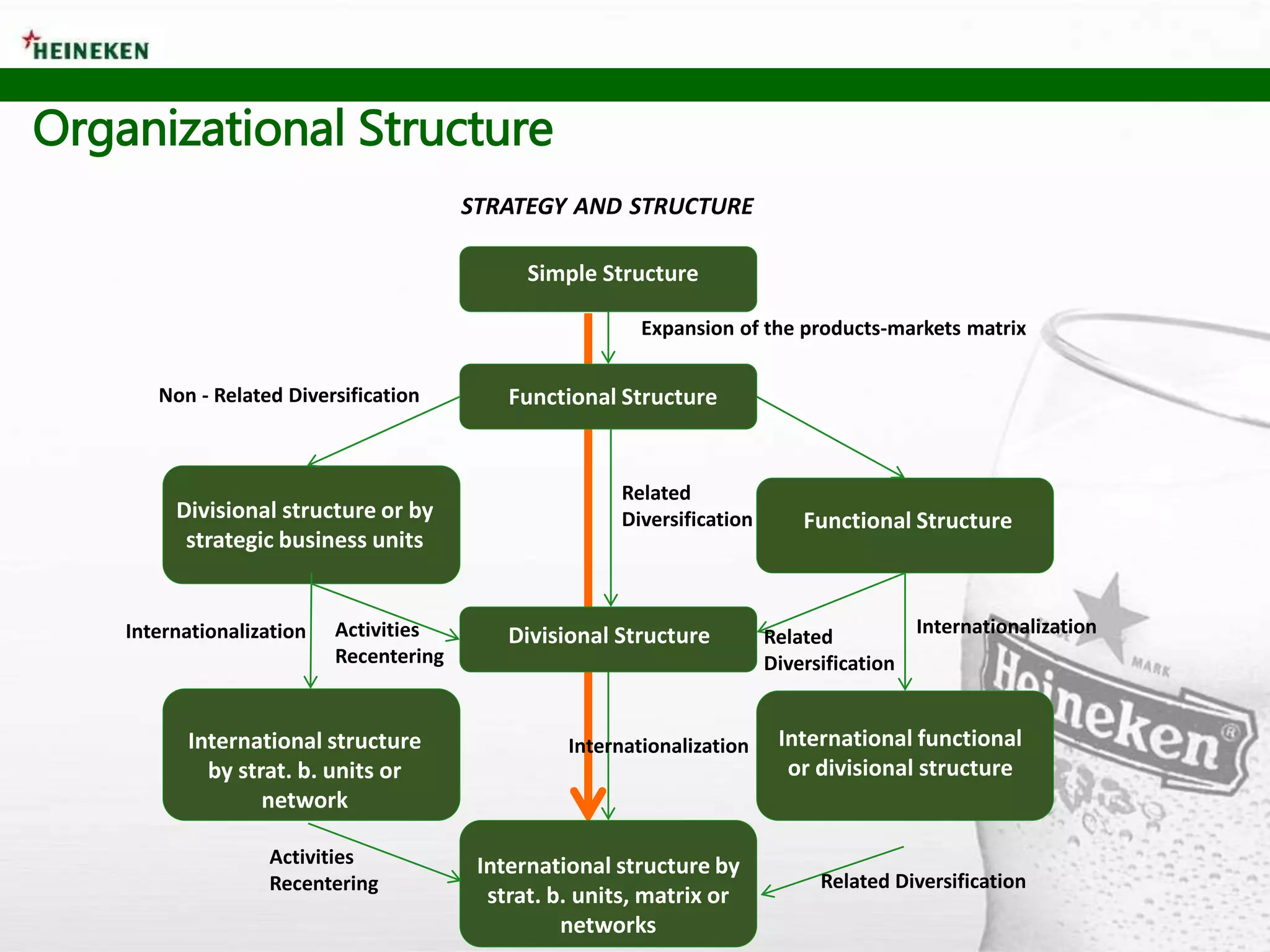
Organizational Structure
Simple Structure
Functional Structure
Divisional structure or by
strategic business units
International structure
by strat. b. units or
network
Divisional Structure
International structure by
strat. b. units, matrix or
networks
Functional Structure
International functional
or divisional structure
Expansion of the products-markets matrix
Related
Diversification
Internationalization
Related Diversification
Related
Diversification
Internationalization
Non - Related Diversification
Internationalization Activities
Recentering
Activities
Recentering
STRATEGY AND STRUCTURE
Organizational Structure
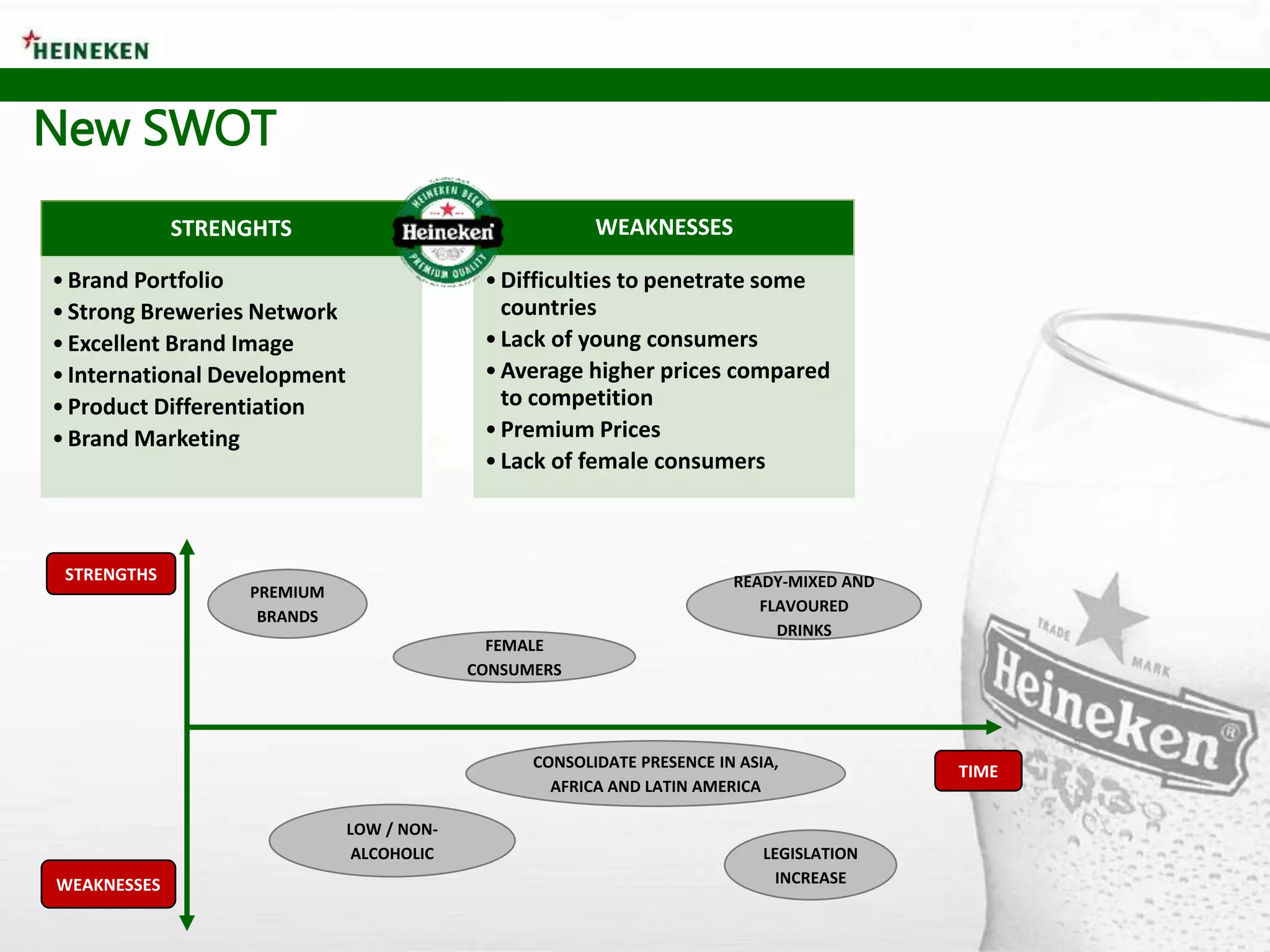
NEW SWOT
ANALYSIS
WEAKNESSES
STRENGTHS
TIME
PREMIUM
BRANDS
CONSOLIDATE PRESENCE IN ASIA,
AFRICA AND LATIN AMERICA
LOW / NON-
ALCOHOLIC
FEMALE
CONSUMERS
LEGISLATION
INCREASE
READY-MIXED AND
FLAVOURED
DRINKS
New SWOT
STRENGHTS
•Brand Portfolio
•Strong Breweries Network
•Excellent Brand Image
•International Development
•Product Differentiation
•Brand Marketing
WEAKNESSES
•Difficulties to penetrate some
countries
•Lack of young consumers
•Average higher prices compared
to competition
•Premium Prices
•Lack of female consumers
STRATEGIC
INITIATIVES
Strategic Initiatives
Diversification and Expansion
Consolidate presence in certain markets
Anticipate regulation increase
“Brewing a
better future”

Heineken Strategy Analysis and Discussion

  • 1.
    Heineken Strategy and ValueCreation The Lisbon MBA Groups 2 and 7 Ana Santos Bruno Oliveira Caspar Guggenbühl James Shannon Jide Famuyiwa Leonor Martins Marixcela Victoria Pedro Henriques Rui Barata
  • 2.
    Agenda STRATEGIC ANALYSIS • PESTAnalysis • Segmentation • Attractiveness • Key Success Factors • Strategic Groups • Resources • Core Competencies • Strategic Fit STRATEGIC FORMULATION • Vision & Mission • Objectives • Products-Market Evolution • Vertical Integration • Internationalization • Organizational Development • Organizational Structure RECOMMENDATIONS • New SWOT Analysis • Strategic Initiatives
  • 3.
  • 4.
  • 5.
  • 6.
    Pest Analysis •Heavy Regulations •Restrictionson drinking ages •Taxes •Government anti-alcohol campaigns Political - Legal •Economic slowdown / recession •Middle income growing •Raw materials price fluctuation and scarcity •Infrastructure developments Economic •Awareness of alcohol negative effect •Healthy lifestyle •Cultural and social side of drinking •Premium and craft Social - Cultural •Innovative techniques in the production •Digital interaction with customers •Environmental regulations •Eco-friendly packaging Technological - Ecological S
  • 7.
  • 8.
    Product Beer Spirits Wine Cider/Perry RTDs/High- Strength Premixes Geography North America Europe Asia Pacific Rest ofthe World (RoW) Demography Adult Men Adult Women Minors Price Super Premium Premium Regular Packaging Can Glass Bottle Draught Psychographic Premium Consumers Price sensitive Consumers Social consumers Engaged new comers Brand loyalists Segmentation
  • 9.
  • 10.
  • 11.
  • 12.
  • 13.
  • 14.
    Strategic Groups Price/PerceivedQuality Geographic MarketScope Global Brewers Regional Brewers Local Micro-Brewers
  • 15.
  • 16.
  • 17.
  • 18.
    Core Competencies COMPETENCIES VALUERARENESS IMITABILITY ORGANIZATION VRIO Brand / Image Global Presence Technology / Innovation Product Portfolio Customer Loyalty Partnerships Marketing and Sales Culture Manufacturing Skills Operational efficiency / Distribution Channels Customer Orientation Flexibility
  • 19.
  • 20.
    Strategic Fit Heineken hascore competencies that allows the company to perform well in most segments, by impacting positively on the different key success factors. Differentiation Marketing DistributionChannels EconomiesofScale CustomerExperience Cost Quality BrandValue Availability Consistency Marketing Brand / Image 4 4 5 4 4 3 3 4 3 2 4 Product Portfolio 5 5 4 5 4 3 - 3 4 - 3 Marketing and Sales 4 5 5 4 4 5 4 4 4 3 5 Manufacturing Skills 3 4 3 4 3 5 3 - - - - Operational Efficiency / Distribution Channels 3 4 5 4 4 4 - 3 5 3 3 4.0 4.5 4.3 4.3 3.8 4.0 3.3 3.7 3.7 2.5 4.0 CORE COMPETENCIES BEER WINE AVERAGE FIT 4.1 3.4 Quality Differentiation BrandValue Marketing CustomerExperience Differentiation Quality CustomerExperience DistributionChannels Quality EconomiesofScale Cost Differentiation BrandValue DistributionChannels Brand / Image 4 3 5 3 4 5 4 4 3 4 - 3 4 5 - Product Portfolio 4 4 4 4 3 4 5 4 4 5 4 - 5 5 4 Marketing and Sales 3 3 3 5 4 4 4 4 4 4 - - - 4 - Manufacturing Skills 3 - 2 - - 3 3 - - 3 4 4 3 4 3 Operational Efficiency / Distribution Channels - 3 3 - 3 3 - - 4 - 4 4 3 3 5 3.5 3.3 3.4 4.0 3.5 3.8 4.0 4.0 3.8 4.0 4.0 3.7 3.8 4.2 4.0 3.5 AVERAGE FIT 3.9 CIDER / PERRY RTDs / HIGH STRENGTH PREMIXES 3.9 CORE COMPETENCIES SPIRITS
  • 21.
    Strategic Fit Heineken hascore competencies that allows the company to perform well in most segments, by impacting positively on the different key success factors. CORE COMPETENCIES BEER WINE Differentiation Marketing Distribution Channels Economiesof Scale Customer Experience Cost Quality BrandValue Availability Consistency Marketing Brand / Image 4 4 5 4 4 3 3 4 3 2 4 Product Portfolio 5 5 4 5 4 3 - 3 4 - 3 Marketing and Sales 4 5 5 4 4 5 4 4 4 3 5 Manufacturing Skills 3 4 3 4 3 5 3 - - - - Operational Efficiency / Distribution Channels 3 4 5 4 4 4 - 3 5 3 3 AVERAGE FIT 4.0 4.5 4.3 4.3 3.8 4.0 3.3 3.7 3.7 2.5 4.0 4.1 3.4 CORE COMPETENCIES SPIRITS CIDER / PERRY RTDs / HIGH STRENGTH PREMIXES Quality Differentiation BrandValue Marketing Customer Experience Differentiation Quality Customer Experience Distribution Channels Quality EconomiesofScale Cost Differentiation BrandValue Distribution Channels Brand / Image 4 3 5 3 4 5 4 4 3 4 - 3 4 5 - Product Portfolio 4 4 4 4 3 4 5 4 4 5 4 - 5 5 4 Marketing and Sales 3 3 3 5 4 4 4 4 4 4 - - - 4 - Manufacturing Skills 3 - 2 - - 3 3 - - 3 4 4 3 4 3 Operational Efficiency / Distribution Channels - 3 3 - 3 3 - - 4 - 4 4 3 3 5 AVERAGE FIT 3.5 3.3 3.4 4.0 3.5 3.8 4.0 4.0 3.8 4.0 4.0 3.7 3.8 4.2 4.0 3.5 3.9 3.9
  • 22.
  • 23.
  • 24.
    Vision & Mission Vision •“To win in all markets with Heineken®, and with a full brand portfolio in markets where we choose.” Mission • A proud, independent, global brewer committed to surprising and exciting consumers everywhere.” ”A passion for quality, enjoyment of life, respect for people and respect for our planet.”
  • 25.
  • 26.
    Objectives Financial Other -Non Financial o Lead by Innovation o Opportunities in the emerging markets Shape the Cider market o “Brewing a Better World” o Global Business Services o Lead by Cool Marketing SMART SMART SMART SMART
  • 27.
  • 28.
  • 29.
    • Market Penetration •Increasing market share in current markets (North America and Europe) • Market Extension • Expansion into emerging markets in South America, Asia and MEA • Product Development • Innovations with development of Radler variants in 2014 • Diversification • Introduction of innovative products to new markets in Asia and MEA Products-Market Evolution
  • 30.
    Cost Leadership • Sizeand scale through major acquisitions in Mexico, Southern Africa and other regions • High bargaining power with suppliers and economies of scale Differentiation • Strong brand established for products across geographies • Industry leader in sustainability efforts. • Top 5 globally Competitive Advantage COST LEADERSHIP Low High DIFFERENTIATION High Pure differentiation Differentiation with cost leadership Low No advantage Pure cost leadership
  • 31.
    Heineken embraces “momentmarketing”  Your best moments  Your most premium moments  Your most irreverent moments  Your good moments Key Product Differentiation Elements
  • 32.
  • 33.
  • 34.
    Vertical Integration Integratedby Heineken ForwardIntegrationBackward Integration • Eat or be Eaten • Smallholder farmers • Three tier system
  • 35.
  • 36.
    Internationalization *Only Product extensionso far has been Heineken Light for the US market Local Adaptation Low High Global Integration High Low Culture/Habits Design Language Size/Package Technical System Concept Standardized Standardized Standardized Standardized Standardized Marketing Adapted Standardized Adapted Standardized Standardized Technology Standardized Standardized Standardized Standardized Standardized Product Standardized Standardized Standardized Standardized Standardized Culture/Habits Design Language Size/Package Technical System Concept Adapted Adapted Adapted Adapted Standardized Marketing Adapted Adapted Adapted Adapted Standardized Technology Standardized Standardized Adapted Adapted Adapted Product Adapted Adapted Adapted Adapted Adapted Portfolio Heineken
  • 37.
    Internationalization Attractiveness Factors Weight(%) Asia Pacific Americas Africa Middle East and East Europe West Europe Market evaluation 35% 2,51 2,43 1,93 2,34 Operational evaluation 35% 1,95 2,15 1,95 1,95 Risk evaluation 30% 1,64 1,9 1,64 2,3 Overall attractiveness 100% 6,1 6,48 5,52 6,59 Competitive Strength Low Medium High Country Attractiveness High W. Europe/Pacific Asia Medium US/Canada/Africa Low Middle East
  • 38.
    Organizational Development Products- Markets Heineken Light/ Draught Experience Buy Strongbow Vertical Integration Efficiency / Distribution Breweries Channels International. Partnerships / Exports Buy Breweries Related Diversification Low/no alcohol / Radler / Desperados Cider / Craft Beer Internal External
  • 39.
  • 40.
  • 41.
    Simple Structure Functional Structure Divisionalstructure or by strategic business units International structure by strat. b. units or network Divisional Structure International structure by strat. b. units, matrix or networks Functional Structure International functional or divisional structure Expansion of the products-markets matrix Related Diversification Internationalization Related Diversification Related Diversification Internationalization Non - Related Diversification Internationalization Activities Recentering Activities Recentering STRATEGY AND STRUCTURE Organizational Structure
  • 42.
  • 43.
    WEAKNESSES STRENGTHS TIME PREMIUM BRANDS CONSOLIDATE PRESENCE INASIA, AFRICA AND LATIN AMERICA LOW / NON- ALCOHOLIC FEMALE CONSUMERS LEGISLATION INCREASE READY-MIXED AND FLAVOURED DRINKS New SWOT STRENGHTS •Brand Portfolio •Strong Breweries Network •Excellent Brand Image •International Development •Product Differentiation •Brand Marketing WEAKNESSES •Difficulties to penetrate some countries •Lack of young consumers •Average higher prices compared to competition •Premium Prices •Lack of female consumers
  • 44.
  • 45.
    Strategic Initiatives Diversification andExpansion Consolidate presence in certain markets Anticipate regulation increase
  • 46.