Mitochondria
Introduction
• Mitochondria were first seen by kollicker in 1850 in
muscles and called them ‘sarcosomes’
• Flemming (1882) described these organelles as ‘fili
a’
• Altmann (1890) observed these structures and nam
ed them ‘bioblasts’.
• Benda (1898)stained these organelles with crystal v
iolet and renamed them ‘mitochondria’
• Michaelis (1900) used janus green B as a vital stain
to observe mitochondria in living cells.
Morphology
• The shape of mitochondria is highly variable rang
es from short rod shape to elongate filamentous fo
rm .
• The size of mitochondria is variable ,they generall
y measures about 0.5 to 2um in diameter.
• Mitochondria have an average length of 3 to 4um.
• The number of mitochondria varies from one cell t
ype to another.
• Mitochondria are not found in prokaryotes.
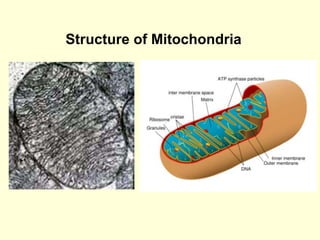
Structure of Mitochondria
Ultra Structure
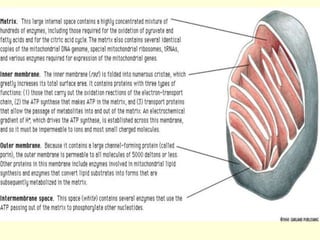
• A mitochondria is enclosed by a double membrane en
velope composed of lipid and protein.
• The two membranes are separated by a narrow fluid –
filled space called the outer compartment.
• The outer membrane is smooth, it is more permeable
to small molecules, contains some enzymes but is poo
rer in proteins.
• The inner membrane surrounds a central cavity or m
atrix (inner compartment) filled with a fluid.
• Folds of inner wall of mitochondria are called cristae.
Inner Membrane
• Inner membrane is the site of the e- transport
chain, across which the proton pump occurs
and contains ATP synthase.
• Inner membrane is highly folded – called crist
ae – increasing the surface area on which the
above reactions can take place
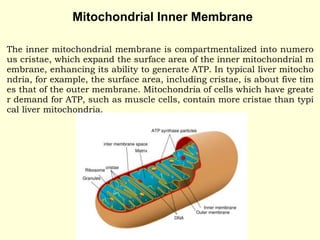
The inner mitochondrial membrane is compartmentalized into numero
us cristae, which expand the surface area of the inner mitochondrial m
embrane, enhancing its ability to generate ATP. In typical liver mitocho
ndria, for example, the surface area, including cristae, is about five tim
es that of the outer membrane. Mitochondria of cells which have greate
r demand for ATP, such as muscle cells, contain more cristae than typi
cal liver mitochondria.
Mitochondrial Inner Membrane
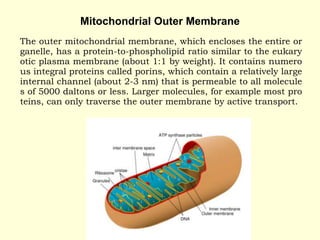
Mitochondrial Outer Membrane
The outer mitochondrial membrane, which encloses the entire or
ganelle, has a protein-to-phospholipid ratio similar to the eukary
otic plasma membrane (about 1:1 by weight). It contains numero
us integral proteins called porins, which contain a relatively large
internal channel (about 2-3 nm) that is permeable to all molecule
s of 5000 daltons or less. Larger molecules, for example most pro
teins, can only traverse the outer membrane by active transport.
Mitochondria
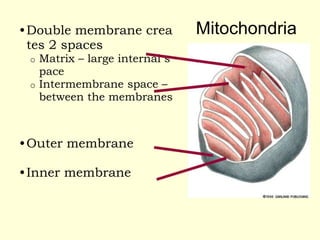
•Double membrane crea
tes 2 spaces
o Matrix – large internal s
pace
o Intermembrane space –
between the membranes
•Outer membrane
•Inner membrane
Page 457
Chemical Composition
• Mitochondria consists of protein-70 percent & lip
ids -25 -30percent.
• Mitochondria contain 0.5percent of RNA & traces
of DNA .
• Mitochondrial DNA comprises about 1 percent of
total cell DNA
• Mitochondria contain enzymes for oxidation phos
phorylation & electron transfer.
Mitochondria
• Produce most of a cells ATP – acetyl groups in the Kreb’s c
ycle producing CO2 and NADH.
• NADH donates the e- to the electron transport chain and b
ecomes oxidized to NAD+
• e- transfer promotes proton pump and ATP synthesis in pr
ocess called oxidative phosphorylation
• Cells that require large amounts of energy such as the hea
rt have large numbers of mitochondria
Mitochondria
• Contain their own copies of DNA and RNA along
with transcription and translation system (riboso
mes)
• Are able to regenerate themselves without the wh
ole cell undergoing division
• Shape and size dependent on what the cell’s func
tion is

Mitochondria-1.pptx

  • 1.
  • 2.
    Introduction • Mitochondria werefirst seen by kollicker in 1850 in muscles and called them ‘sarcosomes’ • Flemming (1882) described these organelles as ‘fili a’ • Altmann (1890) observed these structures and nam ed them ‘bioblasts’. • Benda (1898)stained these organelles with crystal v iolet and renamed them ‘mitochondria’ • Michaelis (1900) used janus green B as a vital stain to observe mitochondria in living cells.
  • 3.
    Morphology • The shapeof mitochondria is highly variable rang es from short rod shape to elongate filamentous fo rm . • The size of mitochondria is variable ,they generall y measures about 0.5 to 2um in diameter. • Mitochondria have an average length of 3 to 4um. • The number of mitochondria varies from one cell t ype to another. • Mitochondria are not found in prokaryotes.
  • 4.
  • 5.
    Ultra Structure • Amitochondria is enclosed by a double membrane en velope composed of lipid and protein. • The two membranes are separated by a narrow fluid – filled space called the outer compartment. • The outer membrane is smooth, it is more permeable to small molecules, contains some enzymes but is poo rer in proteins. • The inner membrane surrounds a central cavity or m atrix (inner compartment) filled with a fluid. • Folds of inner wall of mitochondria are called cristae.
  • 6.
    Inner Membrane • Innermembrane is the site of the e- transport chain, across which the proton pump occurs and contains ATP synthase. • Inner membrane is highly folded – called crist ae – increasing the surface area on which the above reactions can take place
  • 7.
    The inner mitochondrialmembrane is compartmentalized into numero us cristae, which expand the surface area of the inner mitochondrial m embrane, enhancing its ability to generate ATP. In typical liver mitocho ndria, for example, the surface area, including cristae, is about five tim es that of the outer membrane. Mitochondria of cells which have greate r demand for ATP, such as muscle cells, contain more cristae than typi cal liver mitochondria. Mitochondrial Inner Membrane
  • 8.
    Mitochondrial Outer Membrane Theouter mitochondrial membrane, which encloses the entire or ganelle, has a protein-to-phospholipid ratio similar to the eukary otic plasma membrane (about 1:1 by weight). It contains numero us integral proteins called porins, which contain a relatively large internal channel (about 2-3 nm) that is permeable to all molecule s of 5000 daltons or less. Larger molecules, for example most pro teins, can only traverse the outer membrane by active transport.
  • 9.
    Mitochondria •Double membrane crea tes2 spaces o Matrix – large internal s pace o Intermembrane space – between the membranes •Outer membrane •Inner membrane
  • 10.
  • 11.
    Chemical Composition • Mitochondriaconsists of protein-70 percent & lip ids -25 -30percent. • Mitochondria contain 0.5percent of RNA & traces of DNA . • Mitochondrial DNA comprises about 1 percent of total cell DNA • Mitochondria contain enzymes for oxidation phos phorylation & electron transfer.
  • 12.
    Mitochondria • Produce mostof a cells ATP – acetyl groups in the Kreb’s c ycle producing CO2 and NADH. • NADH donates the e- to the electron transport chain and b ecomes oxidized to NAD+ • e- transfer promotes proton pump and ATP synthesis in pr ocess called oxidative phosphorylation • Cells that require large amounts of energy such as the hea rt have large numbers of mitochondria
  • 13.
    Mitochondria • Contain theirown copies of DNA and RNA along with transcription and translation system (riboso mes) • Are able to regenerate themselves without the wh ole cell undergoing division • Shape and size dependent on what the cell’s func tion is