ANTIBACTERIAL AGENTS
What are antibacterial agents?
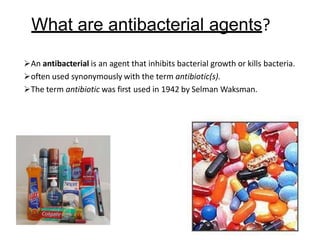
An antibacterial is an agent that inhibits bacterial growth or kills bacteria.
often used synonymously with the term antibiotic(s).
The term antibiotic was first used in 1942 by Selman Waksman.
HOW ARE THEY CLASSIFIED?
on the basis of chemical/biosynthetic origin into
Natural (ex- penicillin)
 semisynthetic
 synthetic(ex-Sulfanilamide)
On biological activity; according to their biological effect on
microorganisms:
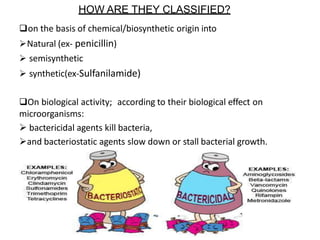
 bactericidal agents kill bacteria,
and bacteriostatic agents slow down or stall bacterial growth.
The bacterial cell
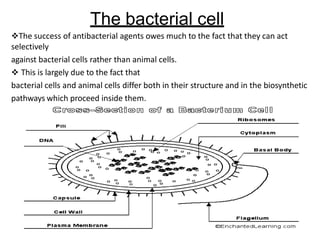
The success of antibacterial agents owes much to the fact that they can act
selectively
against bacterial cells rather than animal cells.
 This is largely due to the fact that
bacterial cells and animal cells differ both in their structure and in the biosynthetic
pathways which proceed inside them.
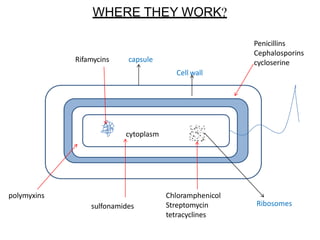
WHERE THEY WORK?
Rifamycins
Cell wall
Penicillins
Cephalosporins
cycloserine
polymyxins
sulfonamides
Chloramphenicol
Streptomycin
tetracyclines
Ribosomes
capsule
cytoplasm
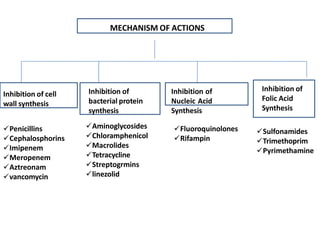
MECHANISM OF ACTIONS
Inhibition of cell
wall synthesis
Inhibition of
bacterial protein
synthesis
Inhibition of
Nucleic Acid
Synthesis
Inhibition of
Folic Acid
Synthesis
Penicillins
Cephalosphorins
Imipenem
Meropenem
Aztreonam
vancomycin
Aminoglycosides
Chloramphenicol
Macrolides
Tetracycline
Streptogrmins
linezolid
Fluoroquinolones
Rifampin
Sulfonamides
Trimethoprim
Pyrimethamine
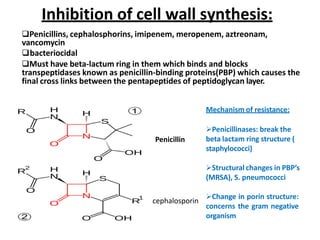
Inhibition of cell wall synthesis:
Penicillins, cephalosphorins, imipenem, meropenem, aztreonam,
vancomycin
bacteriocidal
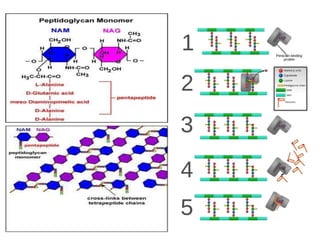
Must have beta-lactum ring in them which binds and blocks
transpeptidases known as penicillin-binding proteins(PBP) which causes the
final cross links between the pentapeptides of peptidoglycan layer.
Mechanism of resistance:
Penicillin
cephalosporin
Penicillinases: break the
beta lactam ring structure (
staphylococci)
Structural changes in PBP’s
(MRSA), S. pneumococci
Change in porin structure:
concerns the gram negative
organism
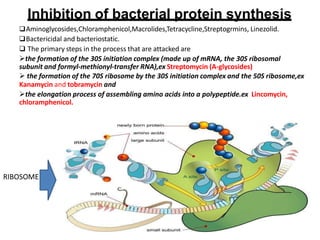
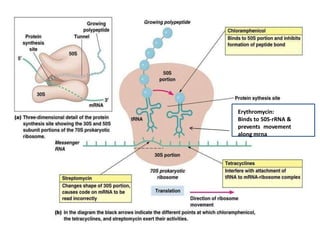
Inhibition of bacterial protein synthesis
Aminoglycosides,Chloramphenicol,Macrolides,Tetracycline,Streptogrmins, Linezolid.
Bactericidal and bacteriostatic.
 The primary steps in the process that are attacked are
the formation of the 30S initiation complex (made up of mRNA, the 30S ribosomal
subunit and formyl-methionyl-transfer RNA),ex Streptomycin (A-glycosides)
 the formation of the 70S ribosome by the 30S initiation complex and the 50S ribosome,ex
Kanamycin and tobramycin and
the elongation process of assembling amino acids into a polypeptide.ex Lincomycin,
chloramphenicol.
RIBOSOME
Erythromycin:
Binds to 50S-rRNA &
prevents movement
along mrna
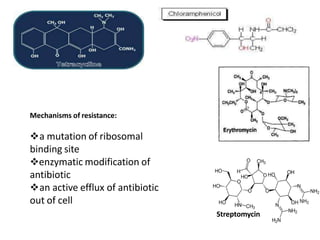
Streptomycin
Mechanisms of resistance:
a mutation of ribosomal
binding site
enzymatic modification of
antibiotic
an active efflux of antibiotic
out of cell
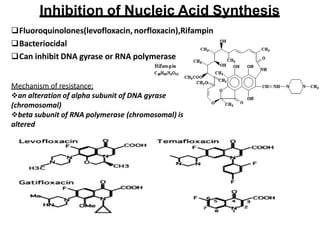
Inhibition of Nucleic Acid Synthesis
Fluoroquinolones(levofloxacin, norfloxacin),Rifampin
Bacteriocidal
Can inhibit DNA gyrase or RNA polymerase
Mechanism of resistance:
an alteration of alpha subunit of DNA gyrase
(chromosomal)
beta subunit of RNA polymerase (chromosomal) is
altered
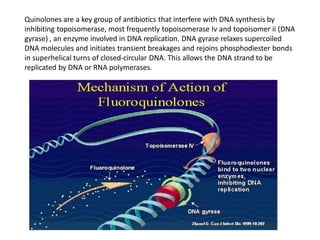
Quinolones are a key group of antibiotics that interfere with DNA synthesis by
inhibiting topoisomerase, most frequently topoisomerase Iv and topoisomer ii (DNA
gyrase) , an enzyme involved in DNA replication. DNA gyrase relaxes supercoiled
DNA molecules and initiates transient breakages and rejoins phosphodiester bonds
in superhelical turns of closed-circular DNA. This allows the DNA strand to be
replicated by DNA or RNA polymerases.
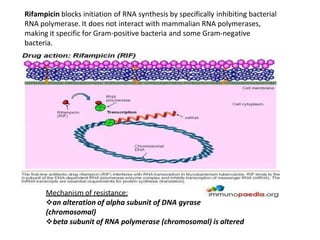
Rifampicin blocks initiation of RNA synthesis by specifically inhibiting bacterial
RNA polymerase. It does not interact with mammalian RNA polymerases,
making it specific for Gram-positive bacteria and some Gram-negative
bacteria.
Mechanism of resistance:
an alteration of alpha subunit of DNA gyrase
(chromosomal)
beta subunit of RNA polymerase (chromosomal) is altered
Inhibition of Folic Acid Synthesis
Sulfonamides, Trimethoprim, Pyrimethamine
Bacteriostatic
Binds and blocks enzymes mainly pteridine synthesase, dihydrofolate
reductase responsible for folic acid synthesis.
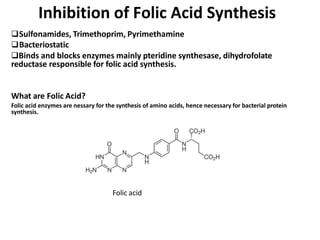
What are Folic Acid?
Folic acid enzymes are nessary for the synthesis of amino acids, hence necessary for bacterial protein
synthesis.
Folic acid
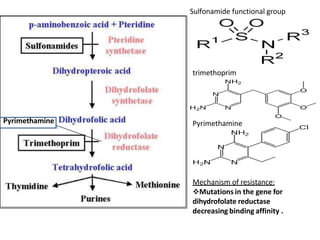
Sulfonamide functional group
trimethoprim
Pyrimethamine
Pyrimethamine
Mechanism of resistance:
Mutations in the gene for
dihydrofolate reductase
decreasing binding affinity .
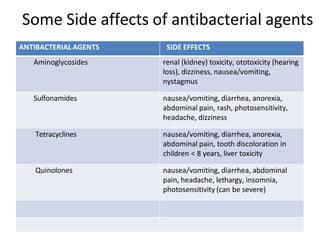
Some Side affects of antibacterial agents
ANTIBACTERIAL AGENTS SIDE EFFECTS
Aminoglycosides renal (kidney) toxicity, ototoxicity (hearing
loss), dizziness, nausea/vomiting,
nystagmus
Sulfonamides nausea/vomiting, diarrhea, anorexia,
abdominal pain, rash, photosensitivity,
headache, dizziness
Tetracyclines nausea/vomiting, diarrhea, anorexia,
abdominal pain, tooth discoloration in
children < 8 years, liver toxicity
Quinolones nausea/vomiting, diarrhea, abdominal
pain, headache, lethargy, insomnia,
photosensitivity (can be severe)
Bacterial and the important antibacterial.pptx

Bacterial and the important antibacterial.pptx

  • 1.
  • 2.
    What are antibacterialagents? An antibacterial is an agent that inhibits bacterial growth or kills bacteria. often used synonymously with the term antibiotic(s). The term antibiotic was first used in 1942 by Selman Waksman.
  • 3.
    HOW ARE THEYCLASSIFIED? on the basis of chemical/biosynthetic origin into Natural (ex- penicillin)  semisynthetic  synthetic(ex-Sulfanilamide) On biological activity; according to their biological effect on microorganisms:  bactericidal agents kill bacteria, and bacteriostatic agents slow down or stall bacterial growth.
  • 4.
    The bacterial cell Thesuccess of antibacterial agents owes much to the fact that they can act selectively against bacterial cells rather than animal cells.  This is largely due to the fact that bacterial cells and animal cells differ both in their structure and in the biosynthetic pathways which proceed inside them.
  • 5.
    WHERE THEY WORK? Rifamycins Cellwall Penicillins Cephalosporins cycloserine polymyxins sulfonamides Chloramphenicol Streptomycin tetracyclines Ribosomes capsule cytoplasm
  • 6.
    MECHANISM OF ACTIONS Inhibitionof cell wall synthesis Inhibition of bacterial protein synthesis Inhibition of Nucleic Acid Synthesis Inhibition of Folic Acid Synthesis Penicillins Cephalosphorins Imipenem Meropenem Aztreonam vancomycin Aminoglycosides Chloramphenicol Macrolides Tetracycline Streptogrmins linezolid Fluoroquinolones Rifampin Sulfonamides Trimethoprim Pyrimethamine
  • 7.
    Inhibition of cellwall synthesis: Penicillins, cephalosphorins, imipenem, meropenem, aztreonam, vancomycin bacteriocidal Must have beta-lactum ring in them which binds and blocks transpeptidases known as penicillin-binding proteins(PBP) which causes the final cross links between the pentapeptides of peptidoglycan layer. Mechanism of resistance: Penicillin cephalosporin Penicillinases: break the beta lactam ring structure ( staphylococci) Structural changes in PBP’s (MRSA), S. pneumococci Change in porin structure: concerns the gram negative organism
  • 9.
    Inhibition of bacterialprotein synthesis Aminoglycosides,Chloramphenicol,Macrolides,Tetracycline,Streptogrmins, Linezolid. Bactericidal and bacteriostatic.  The primary steps in the process that are attacked are the formation of the 30S initiation complex (made up of mRNA, the 30S ribosomal subunit and formyl-methionyl-transfer RNA),ex Streptomycin (A-glycosides)  the formation of the 70S ribosome by the 30S initiation complex and the 50S ribosome,ex Kanamycin and tobramycin and the elongation process of assembling amino acids into a polypeptide.ex Lincomycin, chloramphenicol. RIBOSOME
  • 10.
    Erythromycin: Binds to 50S-rRNA& prevents movement along mrna
  • 11.
    Streptomycin Mechanisms of resistance: amutation of ribosomal binding site enzymatic modification of antibiotic an active efflux of antibiotic out of cell
  • 12.
    Inhibition of NucleicAcid Synthesis Fluoroquinolones(levofloxacin, norfloxacin),Rifampin Bacteriocidal Can inhibit DNA gyrase or RNA polymerase Mechanism of resistance: an alteration of alpha subunit of DNA gyrase (chromosomal) beta subunit of RNA polymerase (chromosomal) is altered
  • 13.
    Quinolones are akey group of antibiotics that interfere with DNA synthesis by inhibiting topoisomerase, most frequently topoisomerase Iv and topoisomer ii (DNA gyrase) , an enzyme involved in DNA replication. DNA gyrase relaxes supercoiled DNA molecules and initiates transient breakages and rejoins phosphodiester bonds in superhelical turns of closed-circular DNA. This allows the DNA strand to be replicated by DNA or RNA polymerases.
  • 14.
    Rifampicin blocks initiationof RNA synthesis by specifically inhibiting bacterial RNA polymerase. It does not interact with mammalian RNA polymerases, making it specific for Gram-positive bacteria and some Gram-negative bacteria. Mechanism of resistance: an alteration of alpha subunit of DNA gyrase (chromosomal) beta subunit of RNA polymerase (chromosomal) is altered
  • 15.
    Inhibition of FolicAcid Synthesis Sulfonamides, Trimethoprim, Pyrimethamine Bacteriostatic Binds and blocks enzymes mainly pteridine synthesase, dihydrofolate reductase responsible for folic acid synthesis. What are Folic Acid? Folic acid enzymes are nessary for the synthesis of amino acids, hence necessary for bacterial protein synthesis. Folic acid
  • 16.
    Sulfonamide functional group trimethoprim Pyrimethamine Pyrimethamine Mechanismof resistance: Mutations in the gene for dihydrofolate reductase decreasing binding affinity .
  • 17.
    Some Side affectsof antibacterial agents ANTIBACTERIAL AGENTS SIDE EFFECTS Aminoglycosides renal (kidney) toxicity, ototoxicity (hearing loss), dizziness, nausea/vomiting, nystagmus Sulfonamides nausea/vomiting, diarrhea, anorexia, abdominal pain, rash, photosensitivity, headache, dizziness Tetracyclines nausea/vomiting, diarrhea, anorexia, abdominal pain, tooth discoloration in children < 8 years, liver toxicity Quinolones nausea/vomiting, diarrhea, abdominal pain, headache, lethargy, insomnia, photosensitivity (can be severe)