MIS - 604 Hackman, et al Page 1
Anthony Townsend
Hackman, J. R., & Morris, C. G. (1975). Group tasks, group interaction process, and group performance
effectiveness: A review and proposed integration. Advances in experimental social psychology, 8, 45-99.
Overview
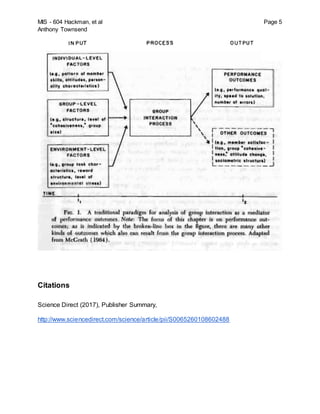
“This study reports tests of the input-process-output model of small group systems.
Regression statistics analyzed associations between interaction process variables and
measures of group task products under two task conditions: an unstructured outcome
case study problem and a structured outcome rank-order decision task Results for the
unstructured task showed positive relationships between specific process (independent)
and output (dependent) variables: Agreeing and Optimism; Gives Opinion and Issue
Involvement; Disagrees and Originality; Asks for Information and Length (of written
product). Nonsignificant results for the Structured task indicated that ranking-task
products were positively associated with messages of positive regard for others and
requests for opinion and negatively related to personally disconfirmatory messages sent
to others. Findings are discussed in terms of the general model's conceptual adequacy
and methodological limitations associated with small group inquiry. (Science Direct,
2017)”
Key Points
● Decision makers often assign important decision making tasks, like designing a
new policy, to groups for decisions.
● Group performance and performance improvement are a fields that could use
more research. This paper disagrees with pre-existing research that:
MIS - 604 Hackman, et al Page 2
Anthony Townsend
○ Current research suggests groups should not be used to perform
important tasks.
○ Research also suggests noninteracting individuals are at task/decision
making an interacting group.
● The paper offers the idea that a solution may be found in examining and
challenging the ongoing communication within collective teams, called the
“ongoing interaction process”.
○ Identify issues in interaction
○ Measure
○ Change impediments (alteration of input)
○ Influence group performance
○ Issues may include: input-process relationships and process-performance
relationships, task type, analytics (coding systems), behavior categories
and the way communication is evaluated, stochastic processes,
inconsistencies, research settings, cultural norms
● Other issues with current research may lie in the existing “methodological and
conceptual tools”.
● Some pro-group social psychologist say groups can have a positive outcome of
identifying and helping one-another remedy errors but that they are slow and
inefficient. They also suggest that if “group think” occurs, error resolution may
lesson.
MIS - 604 Hackman, et al Page 3
Anthony Townsend
● Positives: Member Effort, member knowledge and skill, strategies for
collaboration and communication, level of effort, member experience (positive)
will improve the initiative
● Steps for improvement: Process consultation, diagnosis feedback, task redesign,
strategic member effort allocation
● Motivation. Member knowledge and skill, self-management, outside team
assistance, and high personal energy impact groups and their success or failures
○ Task stimulus
○ Task moderator
○ Task classification systems
● Change oriented research may help with strategy intervention
● Elusiveness and general theory
○ “(a) the role of group interaction process as a major determinant of group
productivity; (b) some selected "input" variables which we see as powerful
influences on group performance and thus as useful points of leverage for
changing performance-whether directly, or through the group process; and
(c) three "summary variables" (effort, performance strategies, knowledge
and skill) which are proposed as devices for summarizing the most
powerful proximal causes of group task effectiveness. (Hackman, et al pp.
44)”
Conclusion
Team decision making is controversial and under-researched. Additional study could
involve diagnosing communication and team dynamic impediments to improve task
MIS - 604 Hackman, et al Page 4
Anthony Townsend
management and allocation of team ideas, efforts, which could make teams perform
even better than individually or as teams.
“In sum, the research suggests that it is in fact possible to create new, non-
traditional norms in groups (at least having to do with matters of task
performance strategy) and to trace the effects of those norms on group
effectiveness. Moreover, observations of the interaction of the groups in this
study showed both that group process was powerfully affected by the
interventions made, and that changes in interaction process led directly to
measurable differences in group productivity. (Hackman, et al pp. 43)”
MIS - 604 Hackman, et al Page 5
Anthony Townsend
Citations
Science Direct (2017), Publisher Summary,
http://www.sciencedirect.com/science/article/pii/S0065260108602488

MIS-604Hackman-week2

  • 1.
    MIS - 604Hackman, et al Page 1 Anthony Townsend Hackman, J. R., & Morris, C. G. (1975). Group tasks, group interaction process, and group performance effectiveness: A review and proposed integration. Advances in experimental social psychology, 8, 45-99. Overview “This study reports tests of the input-process-output model of small group systems. Regression statistics analyzed associations between interaction process variables and measures of group task products under two task conditions: an unstructured outcome case study problem and a structured outcome rank-order decision task Results for the unstructured task showed positive relationships between specific process (independent) and output (dependent) variables: Agreeing and Optimism; Gives Opinion and Issue Involvement; Disagrees and Originality; Asks for Information and Length (of written product). Nonsignificant results for the Structured task indicated that ranking-task products were positively associated with messages of positive regard for others and requests for opinion and negatively related to personally disconfirmatory messages sent to others. Findings are discussed in terms of the general model's conceptual adequacy and methodological limitations associated with small group inquiry. (Science Direct, 2017)” Key Points ● Decision makers often assign important decision making tasks, like designing a new policy, to groups for decisions. ● Group performance and performance improvement are a fields that could use more research. This paper disagrees with pre-existing research that:
  • 2.
    MIS - 604Hackman, et al Page 2 Anthony Townsend ○ Current research suggests groups should not be used to perform important tasks. ○ Research also suggests noninteracting individuals are at task/decision making an interacting group. ● The paper offers the idea that a solution may be found in examining and challenging the ongoing communication within collective teams, called the “ongoing interaction process”. ○ Identify issues in interaction ○ Measure ○ Change impediments (alteration of input) ○ Influence group performance ○ Issues may include: input-process relationships and process-performance relationships, task type, analytics (coding systems), behavior categories and the way communication is evaluated, stochastic processes, inconsistencies, research settings, cultural norms ● Other issues with current research may lie in the existing “methodological and conceptual tools”. ● Some pro-group social psychologist say groups can have a positive outcome of identifying and helping one-another remedy errors but that they are slow and inefficient. They also suggest that if “group think” occurs, error resolution may lesson.
  • 3.
    MIS - 604Hackman, et al Page 3 Anthony Townsend ● Positives: Member Effort, member knowledge and skill, strategies for collaboration and communication, level of effort, member experience (positive) will improve the initiative ● Steps for improvement: Process consultation, diagnosis feedback, task redesign, strategic member effort allocation ● Motivation. Member knowledge and skill, self-management, outside team assistance, and high personal energy impact groups and their success or failures ○ Task stimulus ○ Task moderator ○ Task classification systems ● Change oriented research may help with strategy intervention ● Elusiveness and general theory ○ “(a) the role of group interaction process as a major determinant of group productivity; (b) some selected "input" variables which we see as powerful influences on group performance and thus as useful points of leverage for changing performance-whether directly, or through the group process; and (c) three "summary variables" (effort, performance strategies, knowledge and skill) which are proposed as devices for summarizing the most powerful proximal causes of group task effectiveness. (Hackman, et al pp. 44)” Conclusion Team decision making is controversial and under-researched. Additional study could involve diagnosing communication and team dynamic impediments to improve task
  • 4.
    MIS - 604Hackman, et al Page 4 Anthony Townsend management and allocation of team ideas, efforts, which could make teams perform even better than individually or as teams. “In sum, the research suggests that it is in fact possible to create new, non- traditional norms in groups (at least having to do with matters of task performance strategy) and to trace the effects of those norms on group effectiveness. Moreover, observations of the interaction of the groups in this study showed both that group process was powerfully affected by the interventions made, and that changes in interaction process led directly to measurable differences in group productivity. (Hackman, et al pp. 43)”
  • 5.
    MIS - 604Hackman, et al Page 5 Anthony Townsend Citations Science Direct (2017), Publisher Summary, http://www.sciencedirect.com/science/article/pii/S0065260108602488