Binary Oppositions
By Alex Hunter
Levi-Strauss
Claude Levi-Strauss was a French anthropologist born on November
18th 1908 and died on October 30th 2009. He was less interested in the
order of events in narratives but rather the themes underneath.
He argued that that the we way in which we understand the things we
know depends on our understanding of the difference between its
opposite. This theory is known as ‘Binary Oppostites’
Examples of opposites
Good vs Bad
Power vs Weak
Man vs Women
Young vs Old
Protagonist vs Antagonist
Peace vs War
For example, the way in which we
understand what is ‘bad’ depends
on the way in which we
understand and compare ‘good’
and vice versa. In a piece of
media, if the audience isn’t shown
effectively what is good, how do
they know that what the director
wants to interpret as ‘bad’ is
‘bad’?
Examples in the Media
Before, Binary Opposites used to be easy to spot due to the simplicity
of character’s motives and appearances and themes in traditional
media. An example of which could be the original Star Wars trilogy, a
basic good vs bad opposition is portrayed.
However, in more recent years these oppositions have become harder
to notice through the complexity of the character developments and
narratives. Take the Twilight films for example, a saga switching back
and forth from vampires vs other vampires, vampires vs werewolves
and a love affair introducing a human vs vampires suggestion. This can
ultimately cause confusion in interpreting and understanding what is
what.
Harry Potter
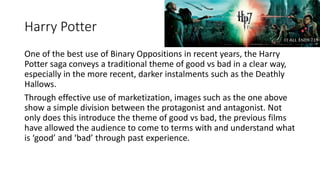
One of the best use of Binary Oppositions in recent years, the Harry
Potter saga conveys a traditional theme of good vs bad in a clear way,
especially in the more recent, darker instalments such as the Deathly
Hallows.
Through effective use of marketization, images such as the one above
show a simple division between the protagonist and antagonist. Not
only does this introduce the theme of good vs bad, the previous films
have allowed the audience to come to terms with and understand what
is ‘good’ and ‘bad’ through past experience.
The Narrative
In all media there is a presence of binary opposites, a conflict of forces,
as this is what the narrative is built upon, although some are not just as
clear or well developed. Here are some examples:
Matrix – Real vs Fake
Toy Story – Old vs New
Taken – Man vs Time
Garfield – Cat vs Dog
Unfriended – One vs Many

Binary Opposites

  • 1.
  • 2.
    Levi-Strauss Claude Levi-Strauss wasa French anthropologist born on November 18th 1908 and died on October 30th 2009. He was less interested in the order of events in narratives but rather the themes underneath. He argued that that the we way in which we understand the things we know depends on our understanding of the difference between its opposite. This theory is known as ‘Binary Oppostites’
  • 3.
    Examples of opposites Goodvs Bad Power vs Weak Man vs Women Young vs Old Protagonist vs Antagonist Peace vs War For example, the way in which we understand what is ‘bad’ depends on the way in which we understand and compare ‘good’ and vice versa. In a piece of media, if the audience isn’t shown effectively what is good, how do they know that what the director wants to interpret as ‘bad’ is ‘bad’?
  • 4.
    Examples in theMedia Before, Binary Opposites used to be easy to spot due to the simplicity of character’s motives and appearances and themes in traditional media. An example of which could be the original Star Wars trilogy, a basic good vs bad opposition is portrayed. However, in more recent years these oppositions have become harder to notice through the complexity of the character developments and narratives. Take the Twilight films for example, a saga switching back and forth from vampires vs other vampires, vampires vs werewolves and a love affair introducing a human vs vampires suggestion. This can ultimately cause confusion in interpreting and understanding what is what.
  • 5.
    Harry Potter One ofthe best use of Binary Oppositions in recent years, the Harry Potter saga conveys a traditional theme of good vs bad in a clear way, especially in the more recent, darker instalments such as the Deathly Hallows. Through effective use of marketization, images such as the one above show a simple division between the protagonist and antagonist. Not only does this introduce the theme of good vs bad, the previous films have allowed the audience to come to terms with and understand what is ‘good’ and ‘bad’ through past experience.
  • 6.
    The Narrative In allmedia there is a presence of binary opposites, a conflict of forces, as this is what the narrative is built upon, although some are not just as clear or well developed. Here are some examples: Matrix – Real vs Fake Toy Story – Old vs New Taken – Man vs Time Garfield – Cat vs Dog Unfriended – One vs Many