Conditional form
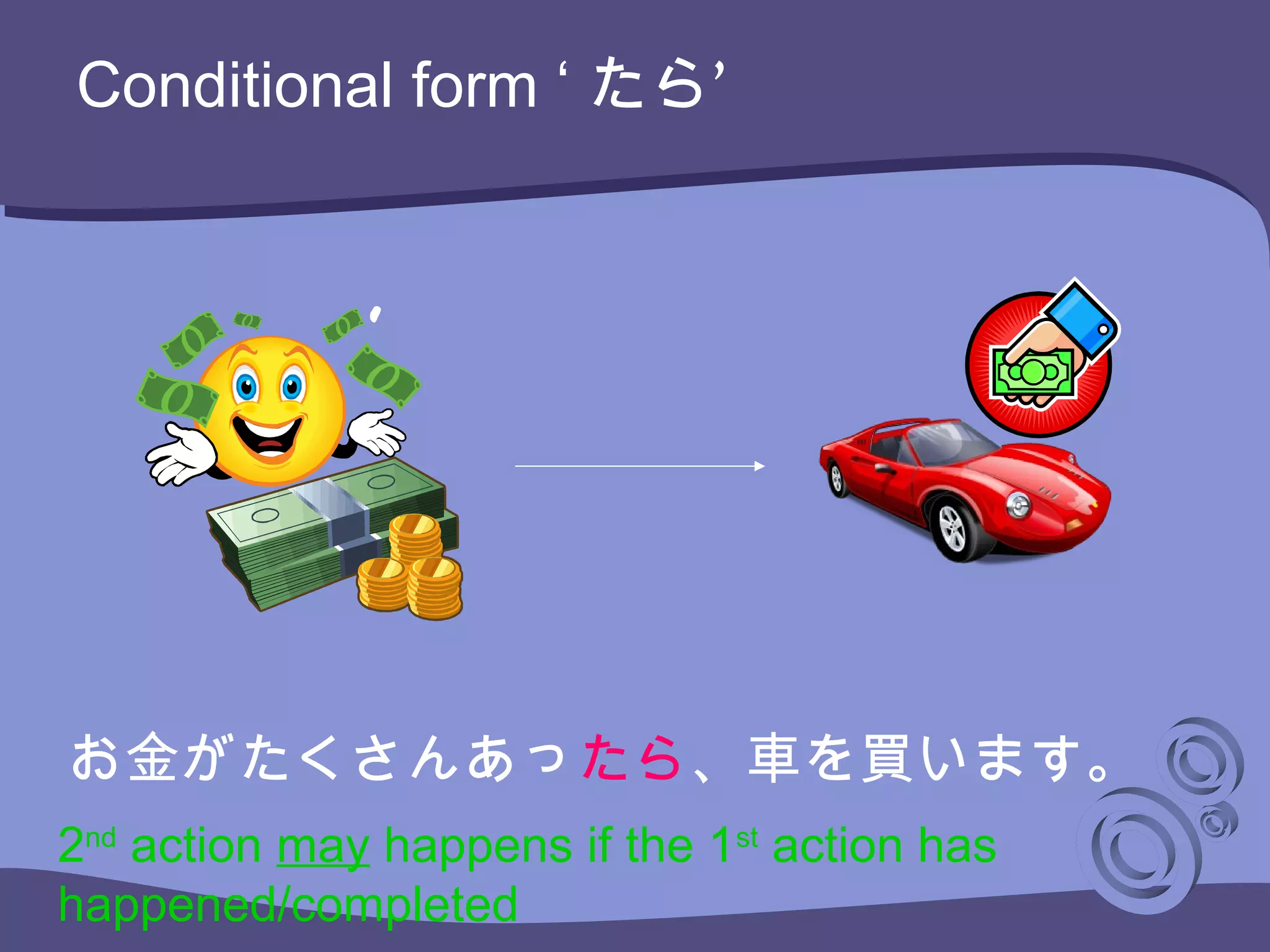
Conditional form ‘ ’たら
お金がたくさんあったら、車を買います。
2nd
action may happens if the 1st
action has
happened/completed
Conditional form ‘ ’たら
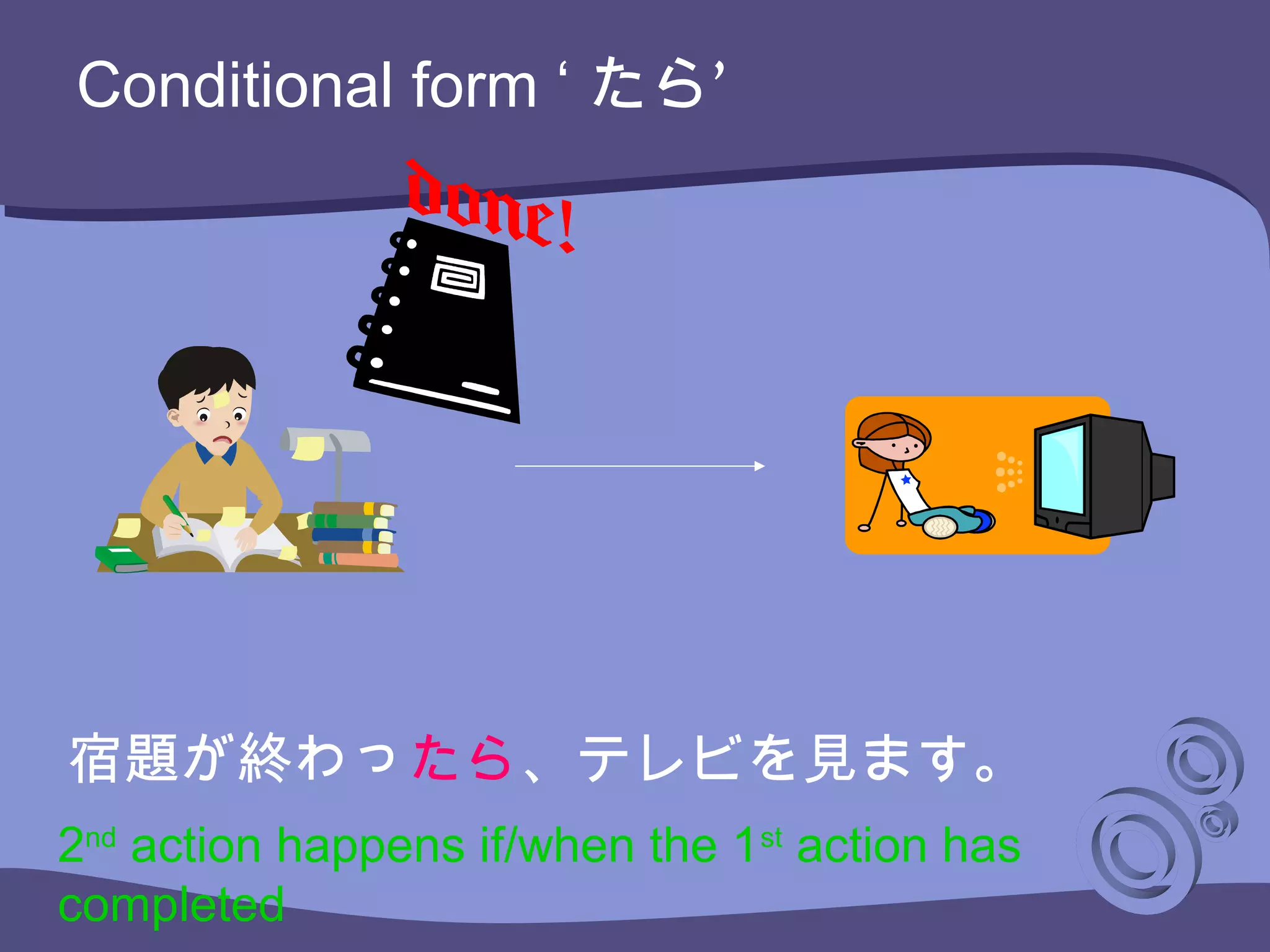
宿題が終わったら、テレビを見ます。
2nd
action happens if/when the 1st
action has
completed
Conditional form ‘ ’たら
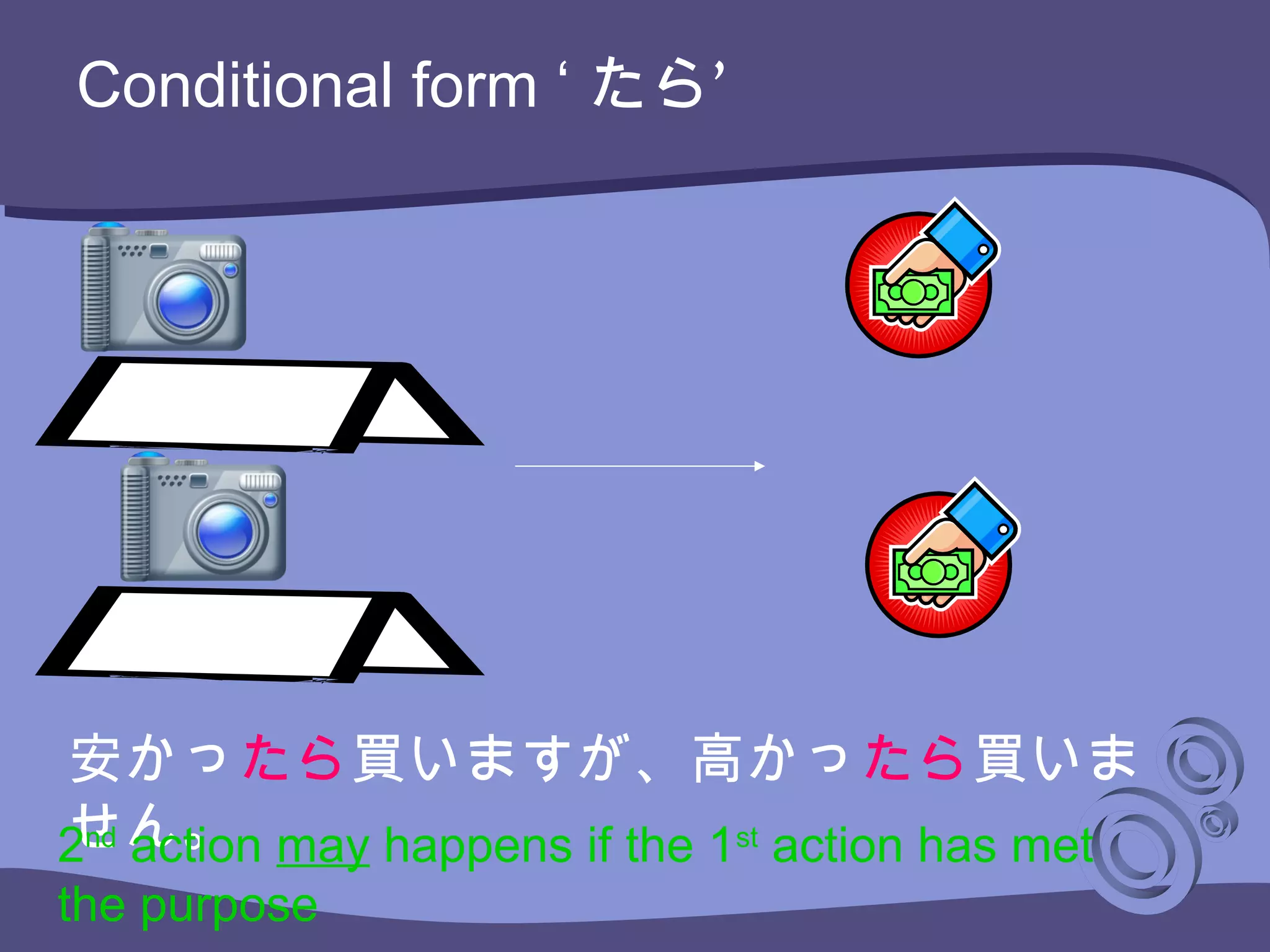
安かったら買いますが、高かったら買いま
せん。2nd
action may happens if the 1st
action has met
the purpose
Conditional form ‘ ’たら
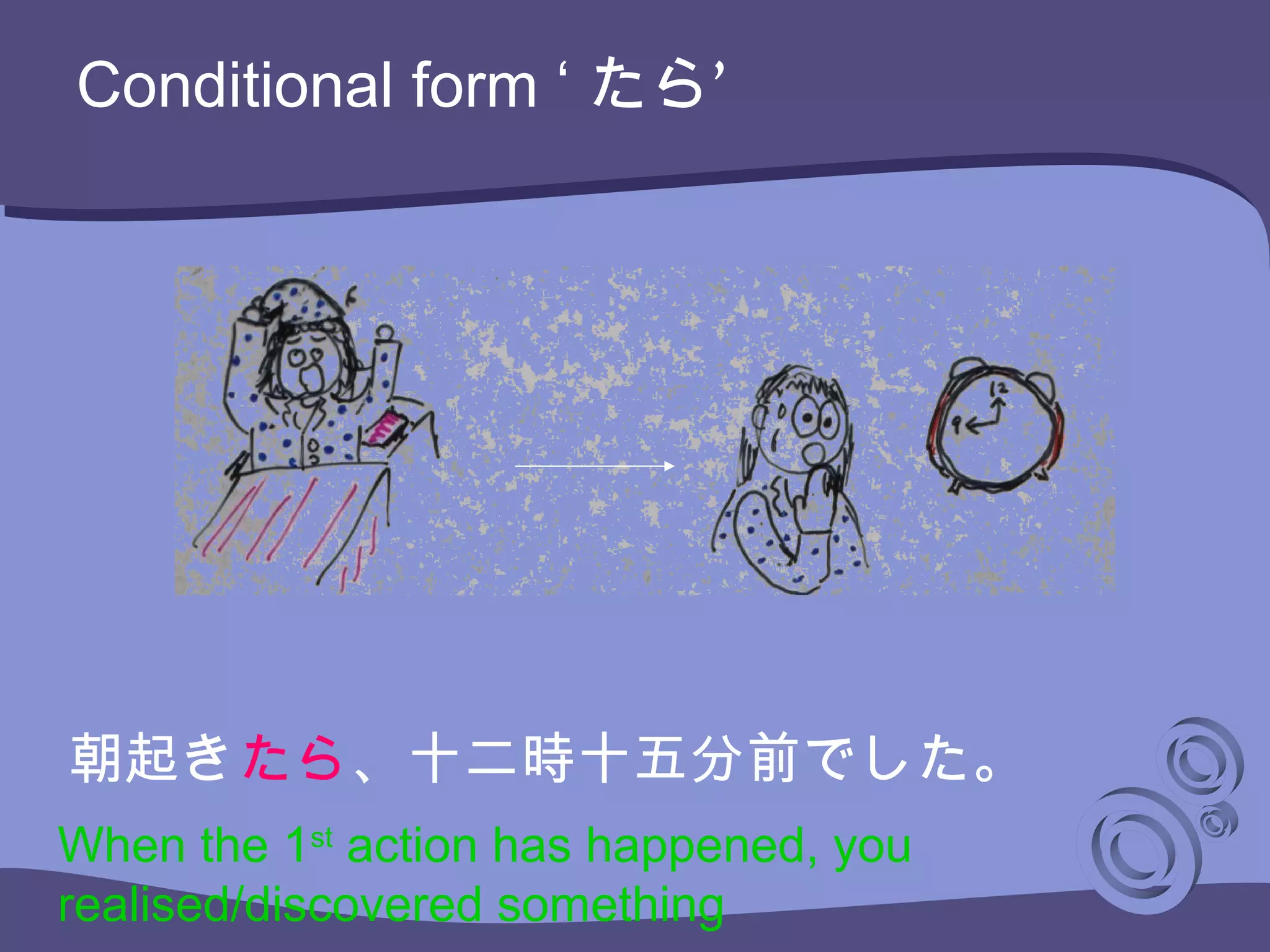
朝起きたら、十二時十五分前でした。
When the 1st
action has happened, you
realised/discovered something
Conditional form ‘ ’たら
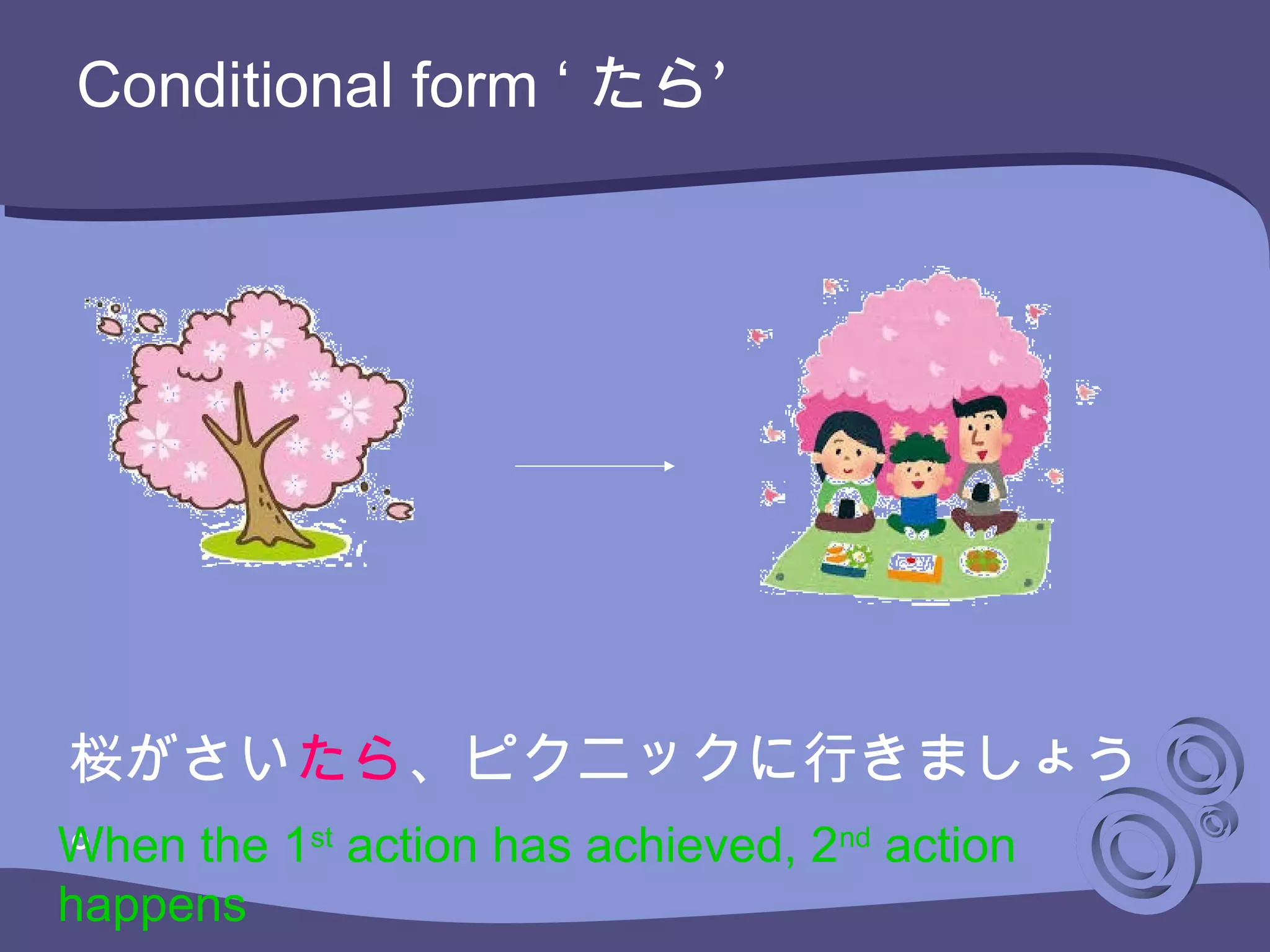
桜がさいたら、ピクニックに行きましょう
。When the 1st
action has achieved, 2nd
action
happens
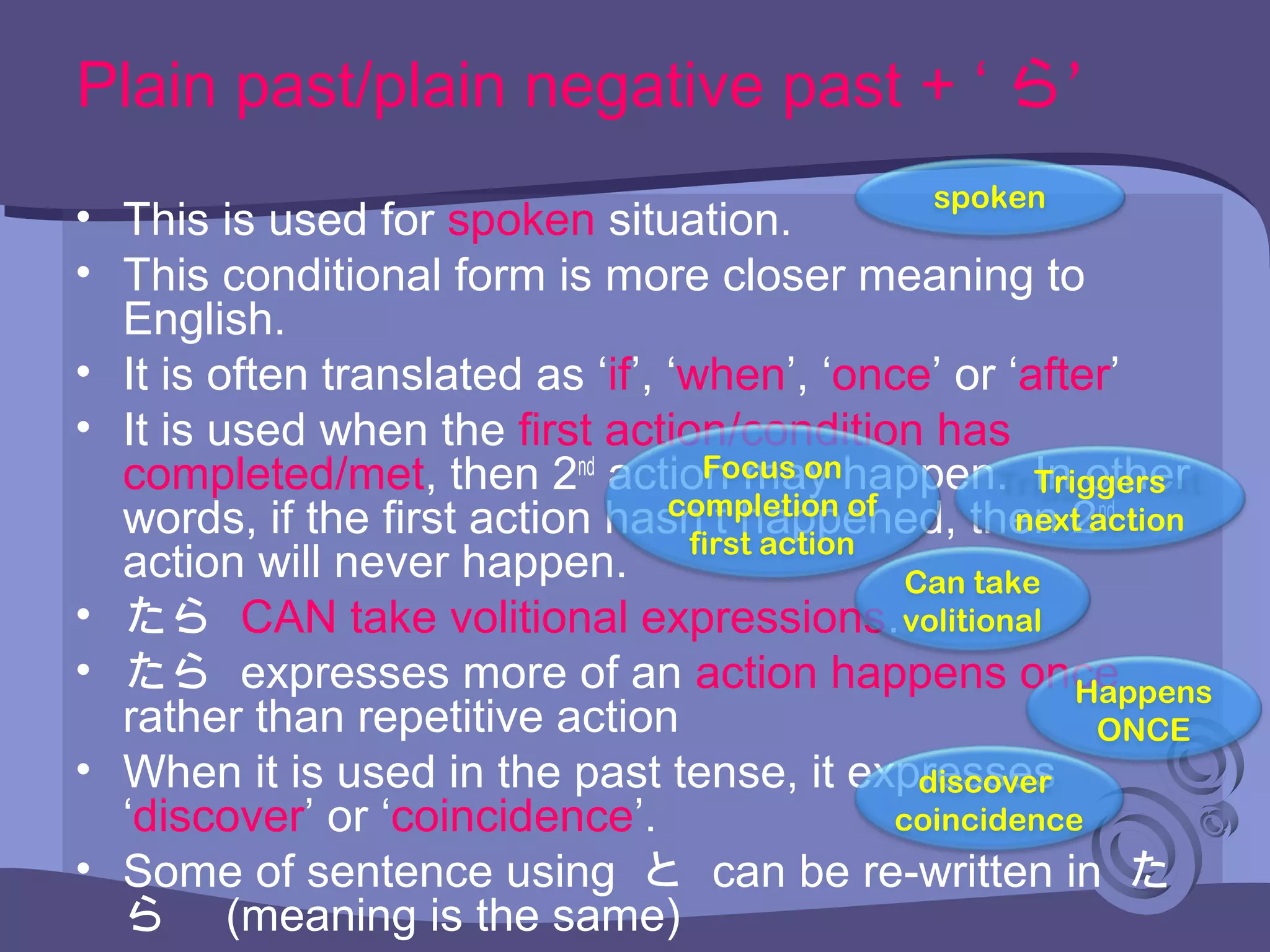
Plain past/plain negative past + ‘ ’ら
• This is used for spoken situation.
• This conditional form is more closer meaning to
English.
• It is often translated as ‘if’, ‘when’, ‘once’ or ‘after’
• It is used when the first action/condition has
completed/met, then 2nd
action may happen. In other
words, if the first action hasn’t happened, then 2nd
action will never happen.
• たら CAN take volitional expressions.
• たら expresses more of an action happens once
rather than repetitive action
• When it is used in the past tense, it expresses
‘discover’ or ‘coincidence’.
• Some of sentence using と can be re-written in た
ら  (meaning is the same)
spoken
Focus on
completion of
first action
Can take
volitional
Happens
ONCE
discover
coincidence
Triggers
next action
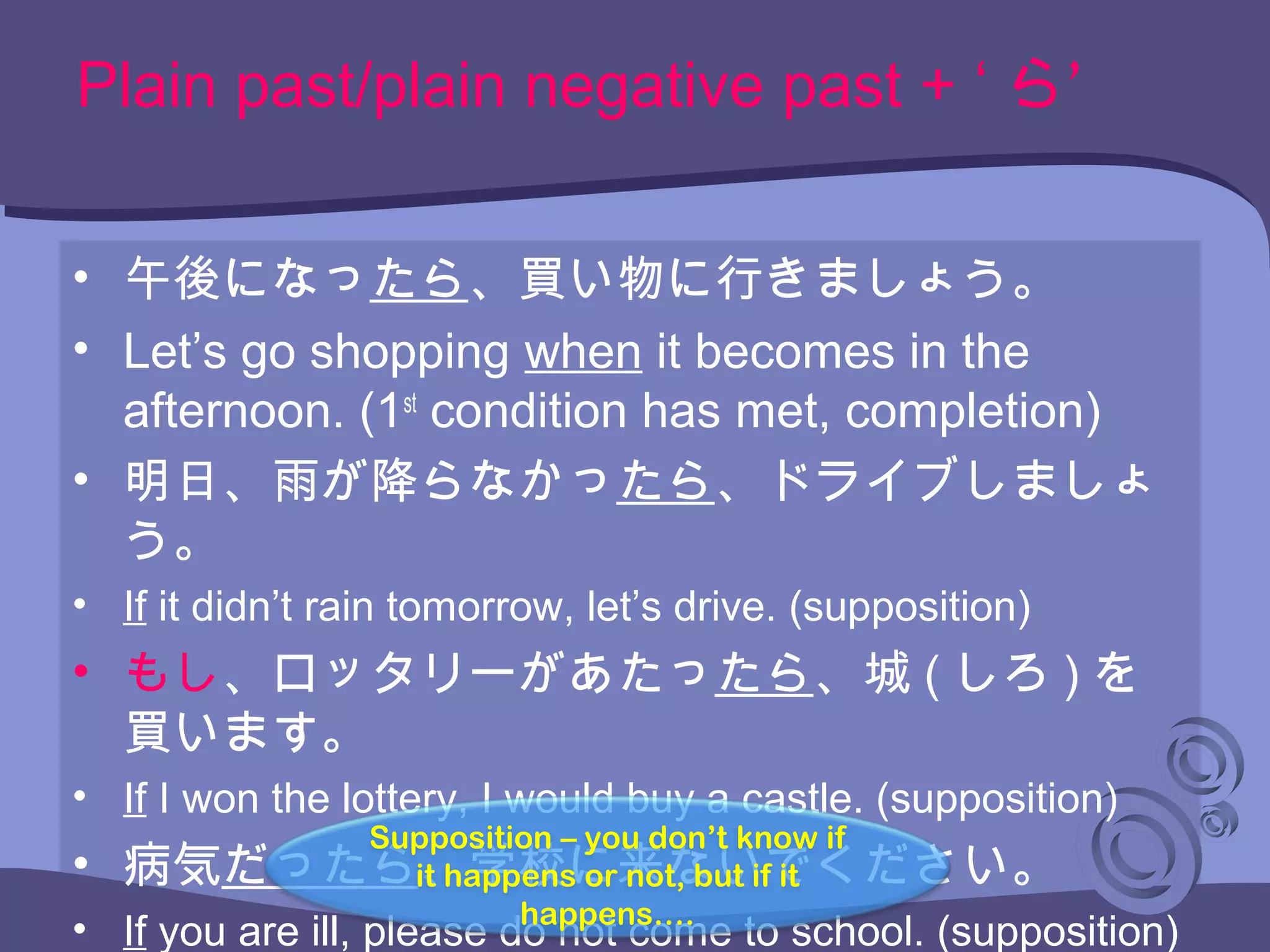
Plain past/plain negative past + ‘ ’ら
• 午後になったら、買い物に行きましょう。
• Let’s go shopping when it becomes in the
afternoon. (1st
condition has met, completion)
• 明日、雨が降らなかったら、ドライブしましょ
う。
• If it didn’t rain tomorrow, let’s drive. (supposition)
• もし、ロッタリーがあたったら、城 ( しろ ) を
買います。
• If I won the lottery, I would buy a castle. (supposition)
• 病気だったら、学校に来ないでください。
• If you are ill, please do not come to school. (supposition)
Supposition – you don’t know if
it happens or not, but if it
happens….
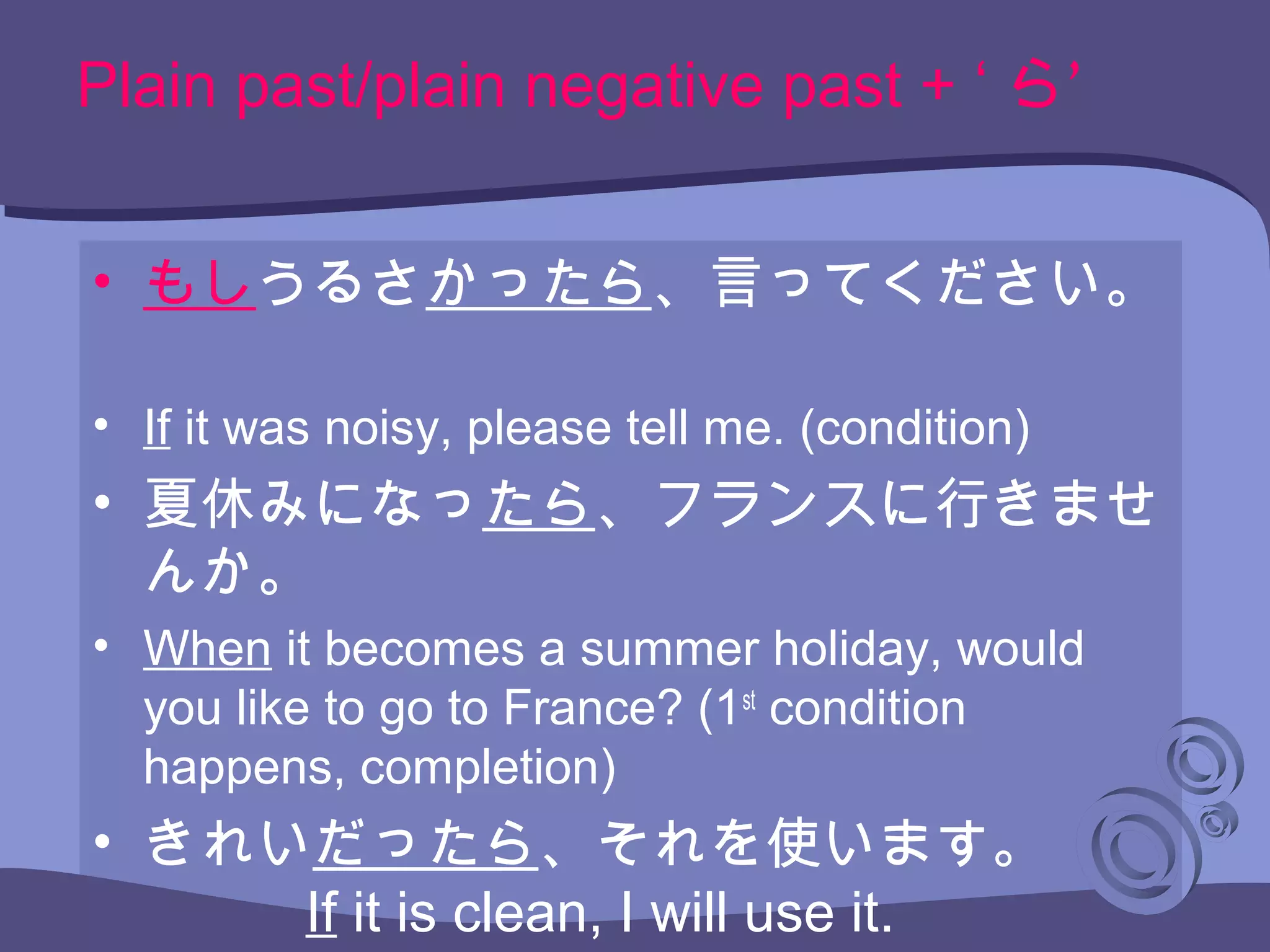
Plain past/plain negative past + ‘ ’ら
• もしうるさかったら、言ってください。
• If it was noisy, please tell me. (condition)
• 夏休みになったら、フランスに行きませ
んか。
• When it becomes a summer holiday, would
you like to go to France? (1st
condition
happens, completion)
• きれいだったら、それを使います。
If it is clean, I will use it.
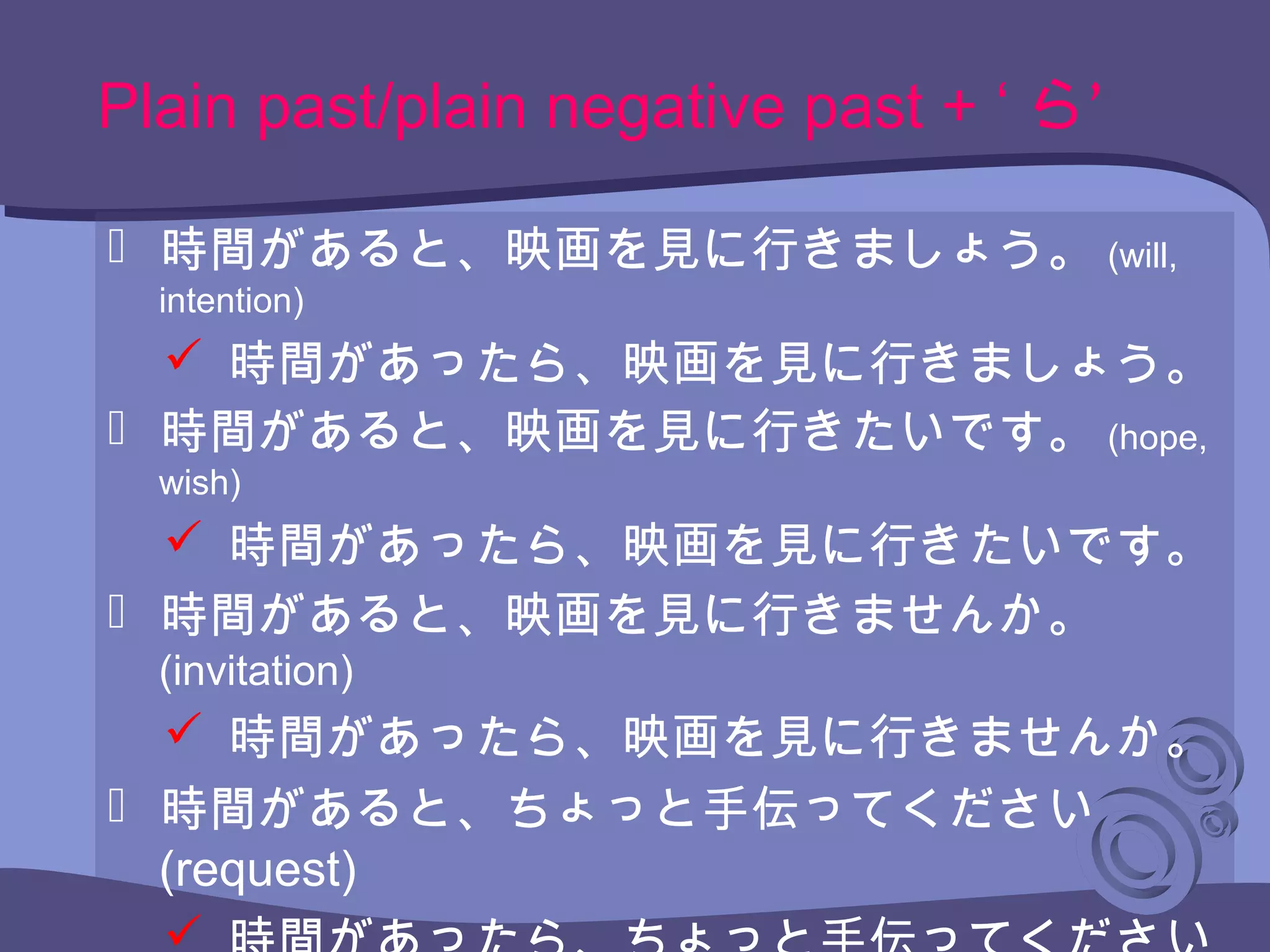
 時間があると、映画を見に行きましょう。 (will,
intention)
 時間があったら、映画を見に行きましょう。
 時間があると、映画を見に行きたいです。 (hope,
wish)
 時間があったら、映画を見に行きたいです。
 時間があると、映画を見に行きませんか。
(invitation)
 時間があったら、映画を見に行きませんか。
 時間があると、ちょっと手伝ってください
(request)
Plain past/plain negative past + ‘ ’ら
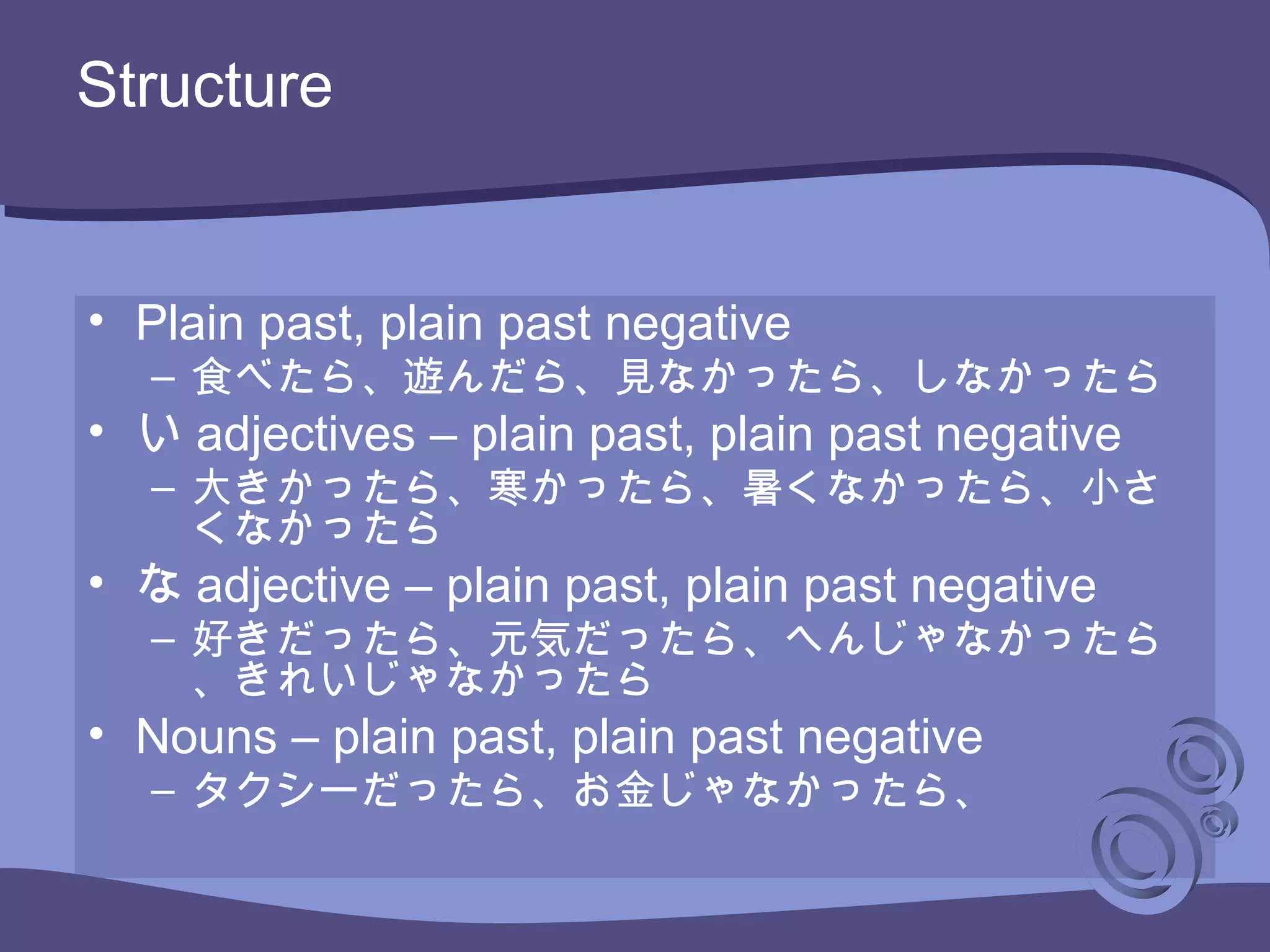
Structure
• Plain past, plain past negative
– 食べたら、遊んだら、見なかったら、しなかったら
• い adjectives – plain past, plain past negative
– 大きかったら、寒かったら、暑くなかったら、小さ
くなかったら
• な adjective – plain past, plain past negative
– 好きだったら、元気だったら、へんじゃなかったら
、きれいじゃなかったら
• Nouns – plain past, plain past negative
– タクシーだったら、お金じゃなかったら、
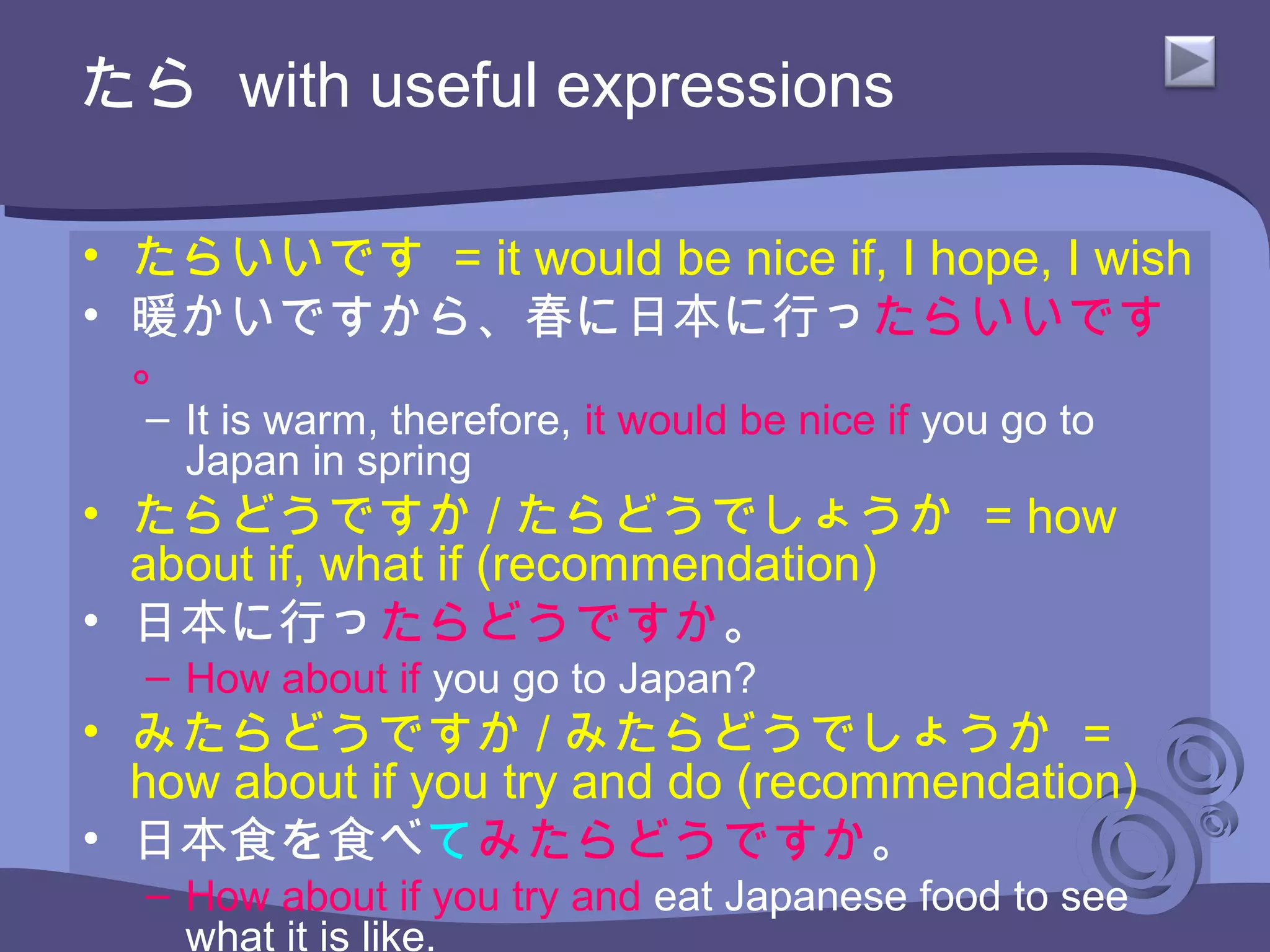
たら with useful expressions
• たらいいです = it would be nice if, I hope, I wish
• 暖かいですから、春に日本に行ったらいいです
。
– It is warm, therefore, it would be nice if you go to
Japan in spring
• たらどうですか / たらどうでしょうか = how
about if, what if (recommendation)
• 日本に行ったらどうですか。
– How about if you go to Japan?
• みたらどうですか / みたらどうでしょうか =
how about if you try and do (recommendation)
• 日本食を食べてみたらどうですか。
– How about if you try and eat Japanese food to see
what it is like.
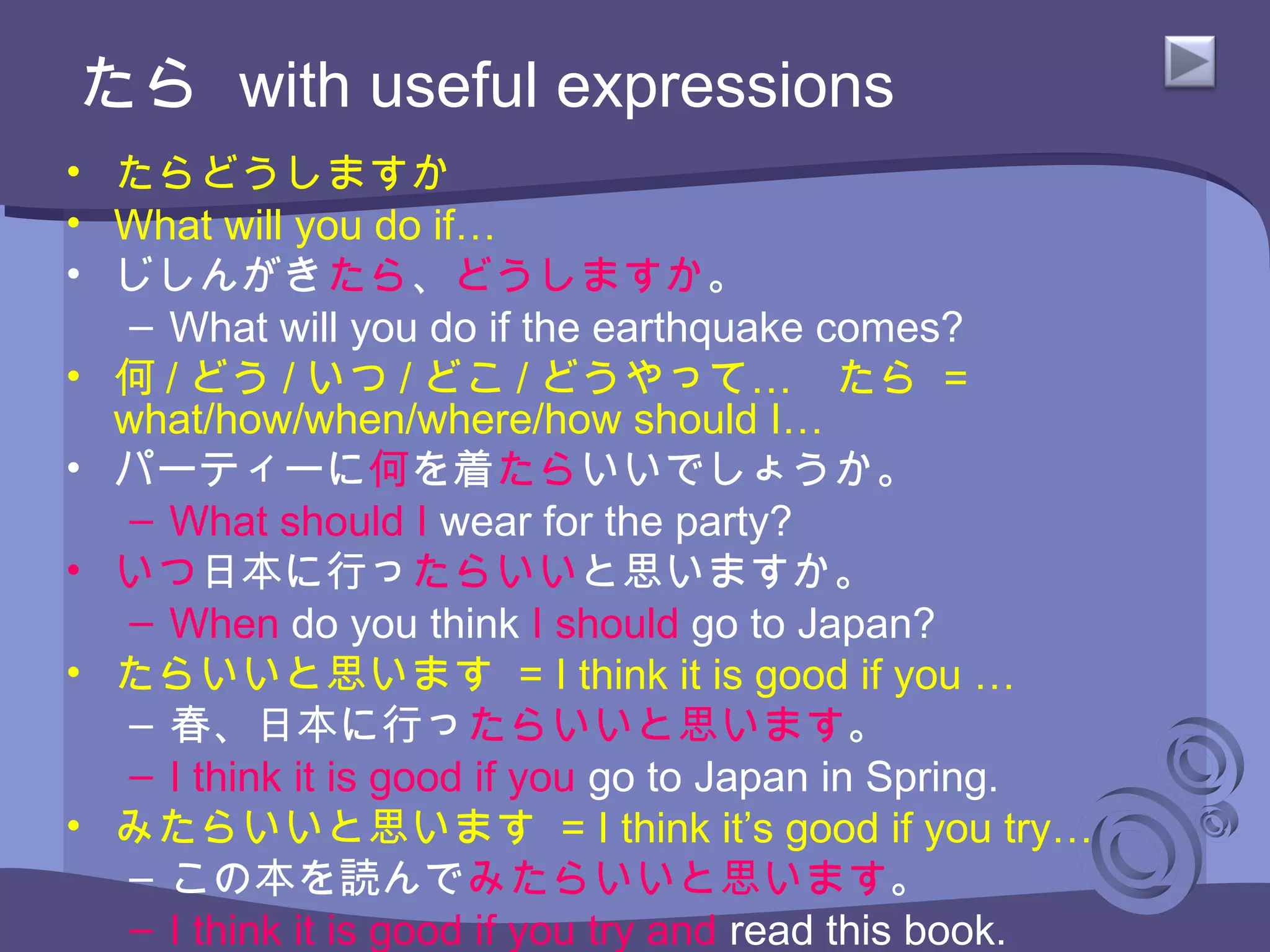
たら with useful expressions
• たらどうしますか
• What will you do if…
• じしんがきたら、どうしますか。
– What will you do if the earthquake comes?
• 何 / どう / いつ / どこ / …どうやって  たら =
what/how/when/where/how should I…
• パーティーに何を着たらいいでしょうか。
– What should I wear for the party?
• いつ日本に行ったらいいと思いますか。
– When do you think I should go to Japan?
• たらいいと思います = I think it is good if you …
– 春、日本に行ったらいいと思います。
– I think it is good if you go to Japan in Spring.
• みたらいいと思います = I think it’s good if you try…
– この本を読んでみたらいいと思います。
– I think it is good if you try and read this book.
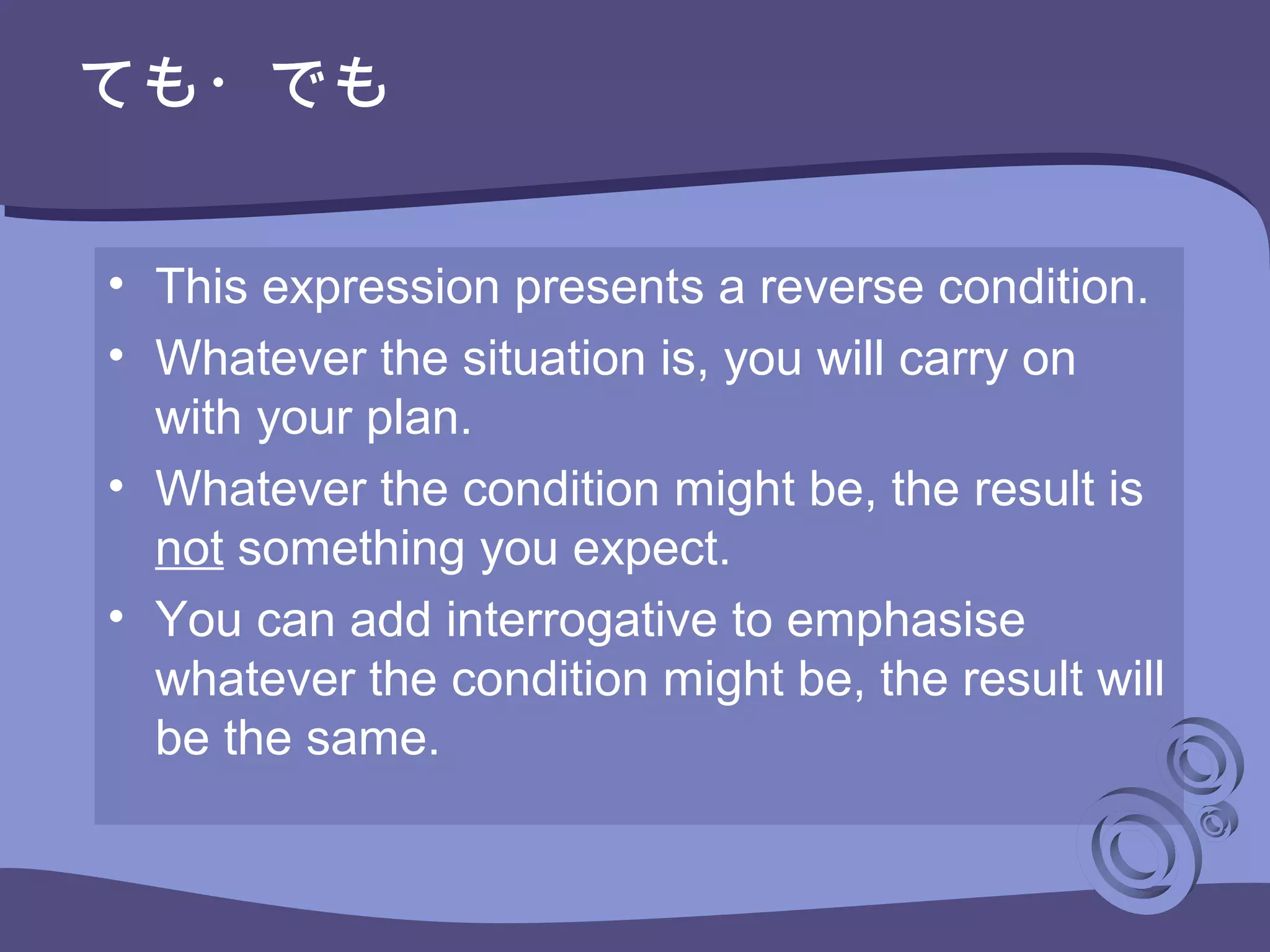
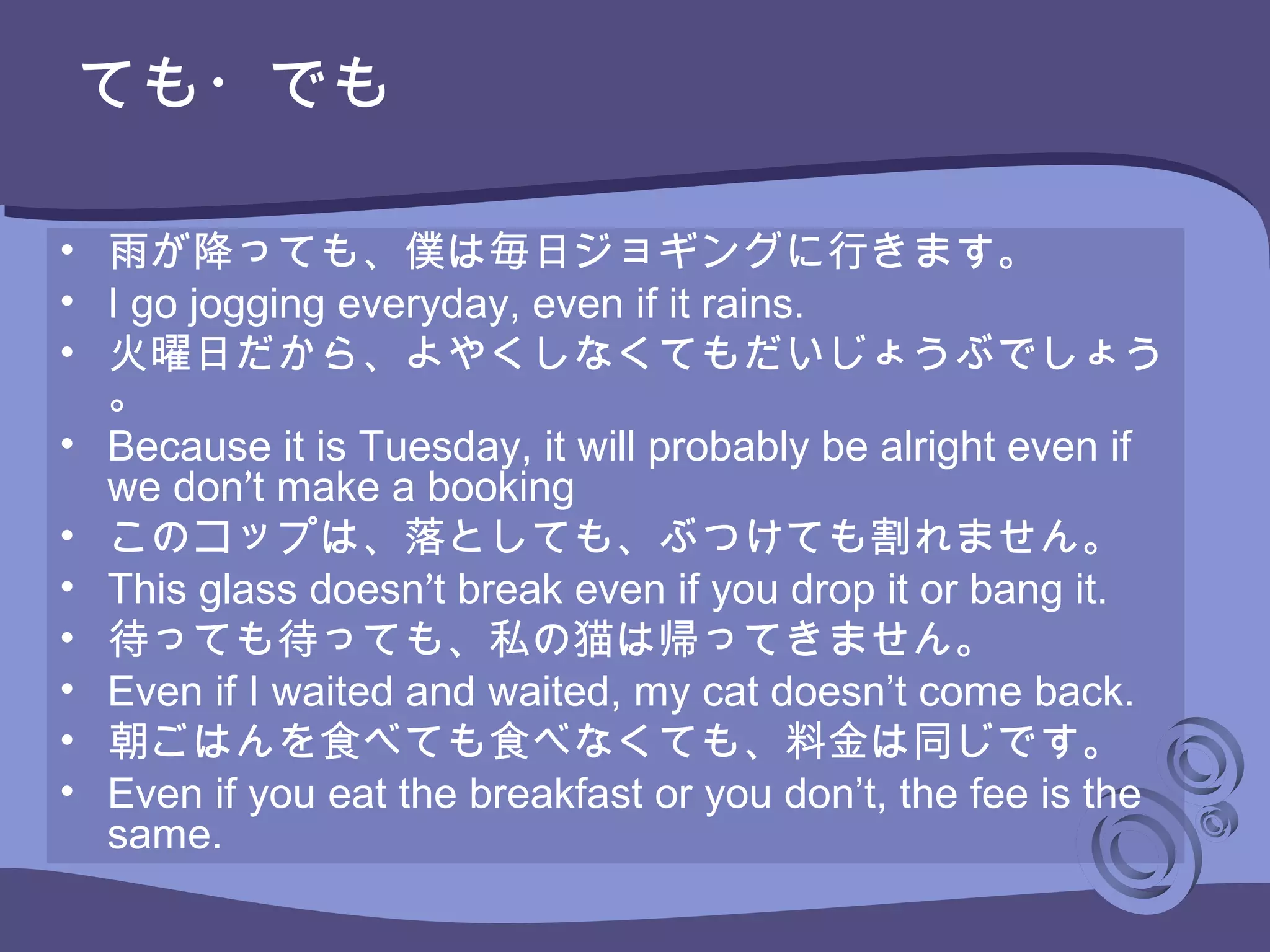
ても・でも
• This expression presents a reverse condition.
• Whatever the situation is, you will carry on
with your plan.
• Whatever the condition might be, the result is
not something you expect.
• You can add interrogative to emphasise
whatever the condition might be, the result will
be the same.
• 雨が降っても、僕は毎日ジョギングに行きます。
• I go jogging everyday, even if it rains.
• 火曜日だから、よやくしなくてもだいじょうぶでしょう
。
• Because it is Tuesday, it will probably be alright even if
we don’t make a booking
• このコップは、落としても、ぶつけても割れません。
• This glass doesn’t break even if you drop it or bang it.
• 待っても待っても、私の猫は帰ってきません。
• Even if I waited and waited, my cat doesn’t come back.
• 朝ごはんを食べても食べなくても、料金は同じです。
• Even if you eat the breakfast or you don’t, the fee is the
same.
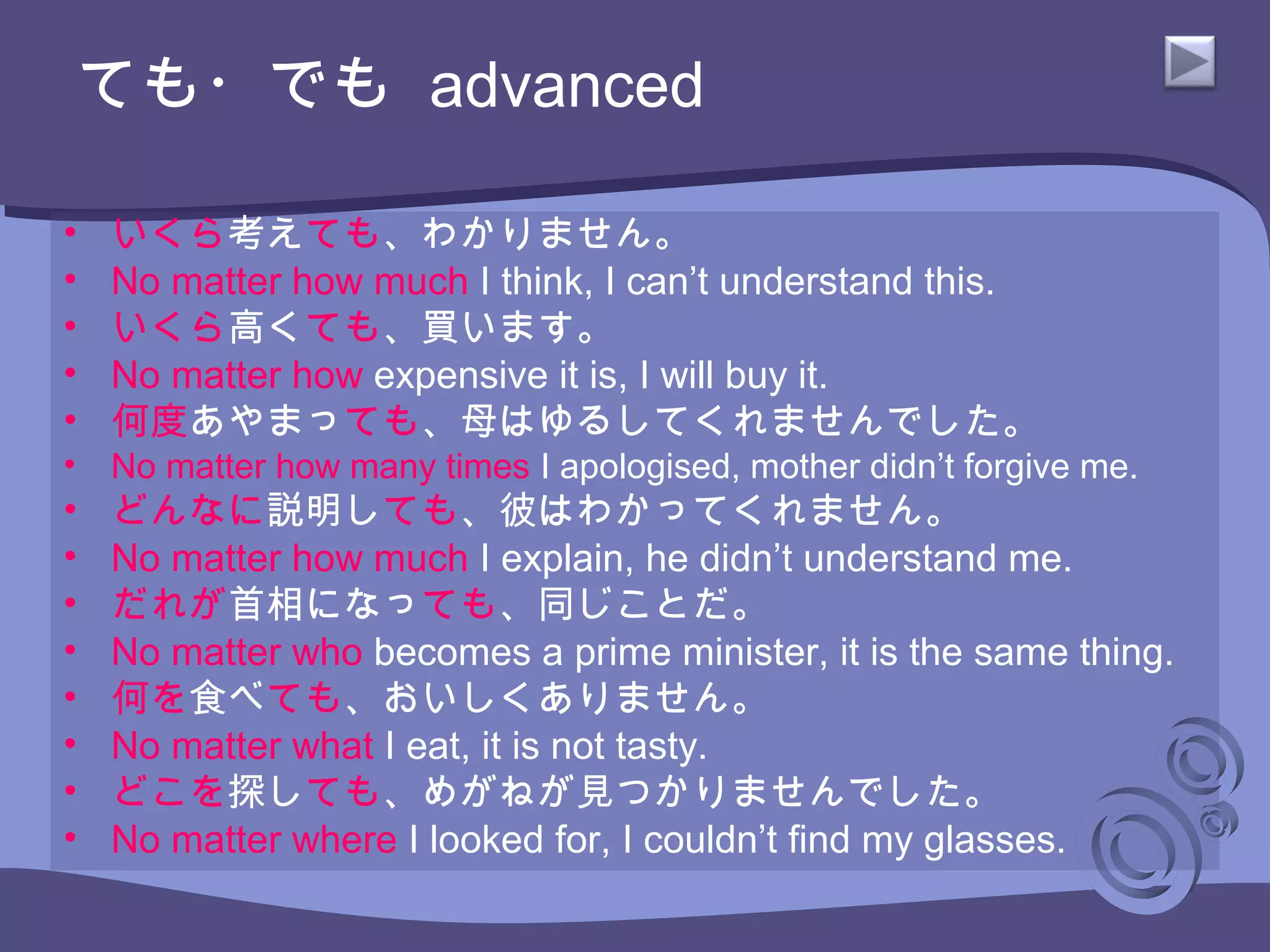
ても・でも
• いくら考えても、わかりません。
• No matter how much I think, I can’t understand this.
• いくら高くても、買います。
• No matter how expensive it is, I will buy it.
• 何度あやまっても、母はゆるしてくれませんでした。
• No matter how many times I apologised, mother didn’t forgive me.
• どんなに説明しても、彼はわかってくれません。
• No matter how much I explain, he didn’t understand me.
• だれが首相になっても、同じことだ。
• No matter who becomes a prime minister, it is the same thing.
• 何を食べても、おいしくありません。
• No matter what I eat, it is not tasty.
• どこを探しても、めがねが見つかりませんでした。
• No matter where I looked for, I couldn’t find my glasses.
ても・でも advanced
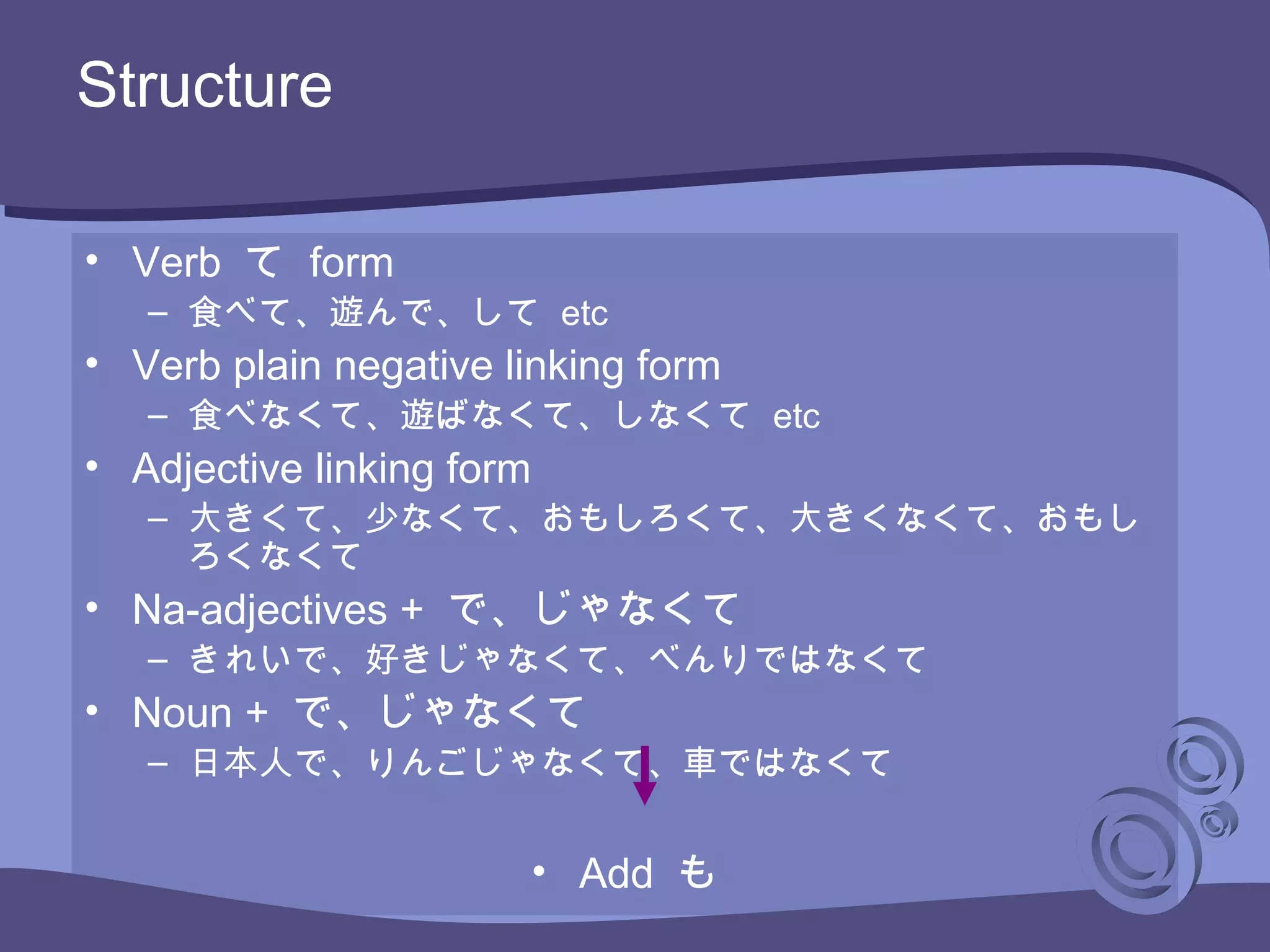
• Verb て form
– 食べて、遊んで、して etc
• Verb plain negative linking form
– 食べなくて、遊ばなくて、しなくて etc
• Adjective linking form
– 大きくて、少なくて、おもしろくて、大きくなくて、おもし
ろくなくて
• Na-adjectives + で、じゃなくて
– きれいで、好きじゃなくて、べんりではなくて
• Noun + で、じゃなくて
– 日本人で、りんごじゃなくて、車ではなくて
• Add も
Structure
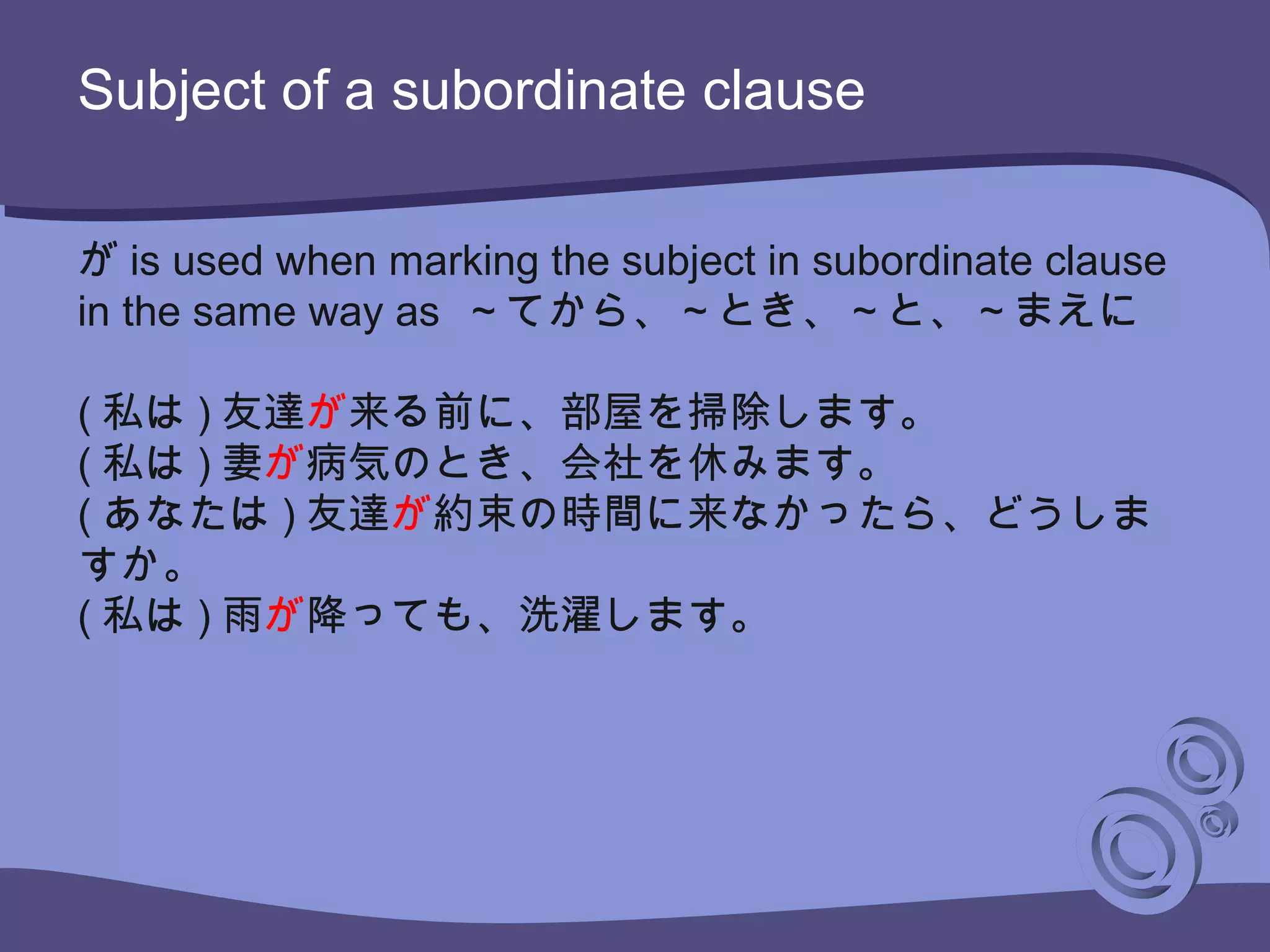
Subject of a subordinate clause
が is used when marking the subject in subordinate clause
in the same way as ~てから、~とき、~と、~まえに
( 私は ) 友達が来る前に、部屋を掃除します。
( 私は ) 妻が病気のとき、会社を休みます。
( あなたは ) 友達が約束の時間に来なかったら、どうしま
すか。
( 私は ) 雨が降っても、洗濯します。
Minna new l25 conditional form たら

  • 1.
  • 2.
    Conditional form ‘’たら お金がたくさんあったら、車を買います。 2nd action may happens if the 1st action has happened/completed
  • 3.
    Conditional form ‘’たら 宿題が終わったら、テレビを見ます。 2nd action happens if/when the 1st action has completed
  • 4.
    Conditional form ‘’たら 安かったら買いますが、高かったら買いま せん。2nd action may happens if the 1st action has met the purpose
  • 5.
    Conditional form ‘’たら 朝起きたら、十二時十五分前でした。 When the 1st action has happened, you realised/discovered something
  • 6.
    Conditional form ‘’たら 桜がさいたら、ピクニックに行きましょう 。When the 1st action has achieved, 2nd action happens
  • 7.
    Plain past/plain negativepast + ‘ ’ら • This is used for spoken situation. • This conditional form is more closer meaning to English. • It is often translated as ‘if’, ‘when’, ‘once’ or ‘after’ • It is used when the first action/condition has completed/met, then 2nd action may happen. In other words, if the first action hasn’t happened, then 2nd action will never happen. • たら CAN take volitional expressions. • たら expresses more of an action happens once rather than repetitive action • When it is used in the past tense, it expresses ‘discover’ or ‘coincidence’. • Some of sentence using と can be re-written in た ら  (meaning is the same) spoken Focus on completion of first action Can take volitional Happens ONCE discover coincidence Triggers next action
  • 8.
    Plain past/plain negativepast + ‘ ’ら • 午後になったら、買い物に行きましょう。 • Let’s go shopping when it becomes in the afternoon. (1st condition has met, completion) • 明日、雨が降らなかったら、ドライブしましょ う。 • If it didn’t rain tomorrow, let’s drive. (supposition) • もし、ロッタリーがあたったら、城 ( しろ ) を 買います。 • If I won the lottery, I would buy a castle. (supposition) • 病気だったら、学校に来ないでください。 • If you are ill, please do not come to school. (supposition) Supposition – you don’t know if it happens or not, but if it happens….
  • 9.
    Plain past/plain negativepast + ‘ ’ら • もしうるさかったら、言ってください。 • If it was noisy, please tell me. (condition) • 夏休みになったら、フランスに行きませ んか。 • When it becomes a summer holiday, would you like to go to France? (1st condition happens, completion) • きれいだったら、それを使います。 If it is clean, I will use it.
  • 10.
     時間があると、映画を見に行きましょう。 (will, intention) 時間があったら、映画を見に行きましょう。  時間があると、映画を見に行きたいです。 (hope, wish)  時間があったら、映画を見に行きたいです。  時間があると、映画を見に行きませんか。 (invitation)  時間があったら、映画を見に行きませんか。  時間があると、ちょっと手伝ってください (request) Plain past/plain negative past + ‘ ’ら
  • 11.
    Structure • Plain past,plain past negative – 食べたら、遊んだら、見なかったら、しなかったら • い adjectives – plain past, plain past negative – 大きかったら、寒かったら、暑くなかったら、小さ くなかったら • な adjective – plain past, plain past negative – 好きだったら、元気だったら、へんじゃなかったら 、きれいじゃなかったら • Nouns – plain past, plain past negative – タクシーだったら、お金じゃなかったら、
  • 12.
    たら with usefulexpressions • たらいいです = it would be nice if, I hope, I wish • 暖かいですから、春に日本に行ったらいいです 。 – It is warm, therefore, it would be nice if you go to Japan in spring • たらどうですか / たらどうでしょうか = how about if, what if (recommendation) • 日本に行ったらどうですか。 – How about if you go to Japan? • みたらどうですか / みたらどうでしょうか = how about if you try and do (recommendation) • 日本食を食べてみたらどうですか。 – How about if you try and eat Japanese food to see what it is like.
  • 13.
    たら with usefulexpressions • たらどうしますか • What will you do if… • じしんがきたら、どうしますか。 – What will you do if the earthquake comes? • 何 / どう / いつ / どこ / …どうやって  たら = what/how/when/where/how should I… • パーティーに何を着たらいいでしょうか。 – What should I wear for the party? • いつ日本に行ったらいいと思いますか。 – When do you think I should go to Japan? • たらいいと思います = I think it is good if you … – 春、日本に行ったらいいと思います。 – I think it is good if you go to Japan in Spring. • みたらいいと思います = I think it’s good if you try… – この本を読んでみたらいいと思います。 – I think it is good if you try and read this book.
  • 14.
    ても・でも • This expressionpresents a reverse condition. • Whatever the situation is, you will carry on with your plan. • Whatever the condition might be, the result is not something you expect. • You can add interrogative to emphasise whatever the condition might be, the result will be the same.
  • 15.
    • 雨が降っても、僕は毎日ジョギングに行きます。 • Igo jogging everyday, even if it rains. • 火曜日だから、よやくしなくてもだいじょうぶでしょう 。 • Because it is Tuesday, it will probably be alright even if we don’t make a booking • このコップは、落としても、ぶつけても割れません。 • This glass doesn’t break even if you drop it or bang it. • 待っても待っても、私の猫は帰ってきません。 • Even if I waited and waited, my cat doesn’t come back. • 朝ごはんを食べても食べなくても、料金は同じです。 • Even if you eat the breakfast or you don’t, the fee is the same. ても・でも
  • 16.
    • いくら考えても、わかりません。 • Nomatter how much I think, I can’t understand this. • いくら高くても、買います。 • No matter how expensive it is, I will buy it. • 何度あやまっても、母はゆるしてくれませんでした。 • No matter how many times I apologised, mother didn’t forgive me. • どんなに説明しても、彼はわかってくれません。 • No matter how much I explain, he didn’t understand me. • だれが首相になっても、同じことだ。 • No matter who becomes a prime minister, it is the same thing. • 何を食べても、おいしくありません。 • No matter what I eat, it is not tasty. • どこを探しても、めがねが見つかりませんでした。 • No matter where I looked for, I couldn’t find my glasses. ても・でも advanced
  • 17.
    • Verb てform – 食べて、遊んで、して etc • Verb plain negative linking form – 食べなくて、遊ばなくて、しなくて etc • Adjective linking form – 大きくて、少なくて、おもしろくて、大きくなくて、おもし ろくなくて • Na-adjectives + で、じゃなくて – きれいで、好きじゃなくて、べんりではなくて • Noun + で、じゃなくて – 日本人で、りんごじゃなくて、車ではなくて • Add も Structure
  • 18.
    Subject of asubordinate clause が is used when marking the subject in subordinate clause in the same way as ~てから、~とき、~と、~まえに ( 私は ) 友達が来る前に、部屋を掃除します。 ( 私は ) 妻が病気のとき、会社を休みます。 ( あなたは ) 友達が約束の時間に来なかったら、どうしま すか。 ( 私は ) 雨が降っても、洗濯します。