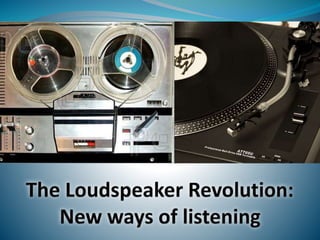
Music after 1945
 Technological rather than artistic
development
 Greater communication between composers –
accelerated pace of music change
Music after 1945
 Altered assumptions about composition,
performance & listening
 Creation of new medium – electronic music
The Long-playing Record & tape
recorder
The Long-playing Record & tape
recorder
 Inventions became commercially available late 1940s
 Transformed nature of music experience
 Today’s use of amplification & electric instruments in
live performance
 Growth of TV & radio
The Long-playing Record & tape
recorder
 Later development of Compact-disc, videocasette
recorder (VCR) & personal stereo
 Recordings, elect. amplification, & even electronic
instruments known before 1940s
 Date as far back as 1877:
 Thomas Edison – cylinder phonograph
 Unknown potential of recorded sound – alter musical
experience
The Long-playing Record & tape
recorder
 LP records & tapes simply vehicles for preservation &
transmission of concert music
 BUT, enormous impact on composers
The Long-playing Record & tape
recorder
 Accelerated development of music:
• More interaction between composers
• Improved communications & transportation
• Greater access to scores
• Presence of recordings
The tape recording medium
 Composers now with virtually unlimited access to
variety of musical stimuli
 Also works of fellow artists available
 Ease of storage & editing – tape recorder
The tape recording medium
 Global sharing of new works within matter of days of
1st performance
 Stylistic development influential before even accepted
by listeners
The tape recording medium
 Also rekindled interest in works of:
 Bach
 Vivaldi (& other Baroque composers)
 Berlioz
 Bruckner
 Ethnic & folk musics
 Renaissance motets & masses
 20th century ‘classics’ – Satie,
Hindermith, Stravinsky, Bartok & more
The tape recording medium
 Recording industry:
 Exposed listeners to greater range of music styles
 Historically, ethnically & geographically
 Composers could take advantage of audience’s broad
listening experience
Changes in listener perception
 Creative artists realized recordings could be used
to compose music in new ways:
 Methods which had not been possible before
 Resembled development in visual arts - photography
Changes in listener perception
 1930s:
 Ernst Toch & Paul Hindermith
 Experimented with distorting recorded sounds
 Mixing of sound on variable-speed turntables
Changes in listener perception
 Experimentation with technology:
 Records played backwards
 Scratches made into grooves to create sound of repeated
fragments
 John Cage – Imaginary landscape No. 1
 Variable Turntables used as performance instruments in
chamber ensemble
Changes in listener perception
 After WW2:
 Composers used unique features of recording &
playback
 Electronic / tape music composition
 Originally neutral perception of recording’s impact on
music appreciation changed – why?
Changes in listener perception
 Reconsideration of essentials of music
performance:
 Traditional association with visual stimuli
 Theatrical gesture
 Acoustics of performance space
 Immediacy of ‘real time’
Changes in listener perception
 Cage conceived Landscape No. 1 with radio
broadcast in mind
 Recognized that loudspeaker performance /
broadcast of chamber work = new possibilities
of listening
 Recorded music = music
Changes in listener perception
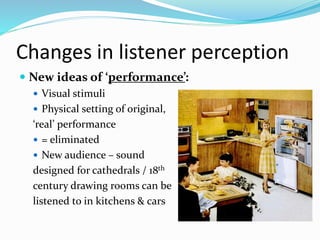
 New ideas of ‘performance’:
 Visual stimuli
 Physical setting of original,
‘real’ performance
 = eliminated
 New audience – sound
designed for cathedrals / 18th
century drawing rooms can be
listened to in kitchens & cars
Changes in listener perception
 New concept of sound:
 Has sound become sole focus? Sound = unchanged?
Changes in listener perception
 New concept of sound:
 New medium has altered sound itself
 Balances & timbres can be altered by mic placement
/ broadcast
 Record or tape – succession of sounds may be
artificial construction
 Edited ‘takes’
Changes in listener perception
 New concept of sound:
 Spontaneity of live performance ‘lost’
 Live performance in concert hall – subject to level of
focus (e.g. daydreaming)
 Loudspeaker performance can be ‘controlled’
 Single performance can be listened to multiple times
 ‘Fixed’ in time like visual art
Changes in listener perception
 Control of recorded sound:
 Order of movements can be changed
 Sections of work can be repeated
 Listener in unique position of ‘performing’ record
or ‘composing’ new work from isolated fragments
out of existing
Changes in listener perception
 Control of recorded sound:
 Musical performance indistinguishable from
electronic illusion
 Form, content, duration, direction = alterable
 Logic of musical continuity in Western concert
tradition removed
Changes in listener perception
 Control of recorded sound:
 Fadeouts of song endings
 Instant cuts to other tunes
 Directionality of sound determined by loudspeaker
placement
 ‘Look’ of sounding
objects changed –
electronic instruments
Changes in listener perception
 New instruments:
 Theremin (1920): Leon Theremin playing his own
instrument
 Jason Hou – (2010-2012) Alphasphere
Changes in listener perception
 Composers:
 Shaped music in accordance to changed perception
of sound, performance & listening
 Attempt to create spontaneous situations – cannot
be duplicated
 Improvisation
 New means to reassert
focus of visual
Changes in listener perception
 Music created which will benefit from
recordable form:
 Highly complex sound relationships
 Repeated hearing required for comprehension
 Music since 1940’s exploits new perception of
performance
New concepts & tools
 New musical concepts:
 Pitch logic
 Time
 Sound colour
 Texture
 Process
 Performance ritual
 Parody (Historicism)
New concepts & tools
 Pitch Logic:
 Western music, by definition, involved 12 notes of
chromatic scale
 Since Wagner, Debussy & others began to move beyond
these principles – more radical experimentation
 John Cage, Henry Cowell & Oliver Messiaen – unique
approaches
New concepts & tools
 Pitch Logic
 What is meant with ‘pitch logic’?
 “Manipulation / design of pitches & intervals
New concepts & tools
 Pitch Logic:
 Strict 12-tone procedures used by Anton Webern in
Piano Variations, Op. 27
 Traditional hierarchies of scale & key centre
replaced by a row & its
permutations
 Serialism – subject of
work = pitch logic
New concepts & tools
 Pitch Logic:
 Anton Webern: Piano Variations, Op. 27
New concepts & tools
 Pitch Logic
 Henry Cowell – innovative use of inner-string piano
sonorities & keyboard clusters
 Pitch not as important
 Messiaen’s Quartet for the end of time
 Pitches form scales
 Scales = unusual
 Non-directional, non-functional cycles & sequences
New concepts & tools
 Time:
 Composers – new ways of determining how pitches or
sounds located in time
 Music from 1600 – 1900: rhythmic patterns reliant on
unchanging meter
New concepts & tools
 Time:
 Charles Ives: Unanswered Question
 Opening devoid of meter
 Entire work = timeless, spacious quality
New concepts & tools
 Time - Charles Ives: Unanswered Question:
 Against a background of slow, quiet strings representing
"The Silence of the Druids", a solo trumpet poses "The
Perennial Question of Existence”
 Woodwind quartet of "Fighting Answerers" tries vainly
to provide an answer, growing more frustrated and
dissonant until they give up
 The three groups of instruments perform in
independent tempos and are placed separately on the
stage—the strings offstage.
New concepts & tools
 Time:
 Messiaen – Quartet for the end of time
 Isorhythmic relationship between time (rhythm) & pitch
 Both aspects = revolving in different orbits (timeless)
New concepts & tools
 Time:
 Webern Piano Variations – conveys expression of
compressed time
 Music locked in ‘fast forward’
New concepts & tools
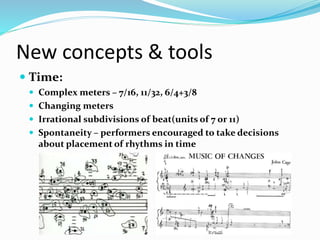
 Time:
 Complex meters – 7/16, 11/32, 6/4+3/8
 Changing meters
 Irrational subdivisions of beat(units of 7 or 11)
 Spontaneity – performers encouraged to take decisions
about placement of rhythms in time
New concepts & tools
 Sound Colour:
 Many composers turned to sound colour as primary field
of exploration
 Unanswered Question – extramusical program focuses
on timbral contrasts among 3 ‘forces’
 Timbre articulates form
New concepts & tools
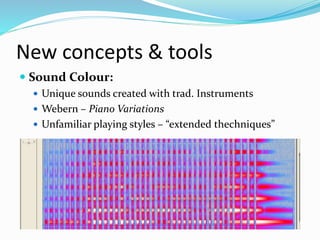
 Sound Colour:
 Unique sounds created with trad. Instruments
 Webern – Piano Variations
 Unfamiliar playing styles – “extended thechniques”
New concepts & tools
 Sound Colour:
 Unique playing styles also derived from jazz & rock
 Amplified instruments
 Electronic modification – e.g. Vocoder
 Instruments from other cultures – sitar & koto etc.
New concepts & tools
 Sound Colour:
 Use of non-musical sound
 Birdcalls, motors, running water, explosives
 Amplified electronically
 Acoustically modified
 Sampled & altered digitally
 Variety of tape editing techniques
New concepts & tools
 Texture:
 Usually characterised in ‘pictorial / tactile’ terms
 Heavy, light, dense, transparent, busy, simple
 Texture now given role sometimes more NB than pitch /
time
New concepts & tools
 Texture: Unanswered Question – 3 levels of activity
seem to exist in separate worlds = juxtaposition more
than polyphonic whole
New concepts & tools
 Texture:
 Factors such as time, sound colour & texture seem
independent
 But, one exerts effect on other – textural possibilities
influenced by approach to time
 Unlimited degree of rhythmic freedom in individual
parts = huge range of contrapuntal textures
 John Cage 4’33” – no texture
New concepts & tools
 Process:
 New processes of composition
 E.g. Unanswered Question: quasitheatric roles
determined process
 Piano Variations – pitch, rhythm, register, articulation,
dynamics related to asymmetrical 12-tone row
 Cage’s Imaginary Landscape No. 1 – rhythmic units to
overall form based on no. 16
New concepts & tools
 Process:
 One particular trend after WW2 – to treat composition
as problem solving
New concepts & tools
 Performance Ritual
 For concertgoers –
music performed on
stage (space set apart
from audience)
 Audience members
may converse & applaud
only at specific times
 Artistic sociological
ritual
New concepts & tools
 Performance Ritual
 NB – visual aspect
 Piano Variations – breath-taking to see pianist’s agility
with “extended technique” used
New concepts & tools
 Performance Ritual
 Other composers who wished to escape trad. concert
format
 New relationships between composer, performer,
audience
 Performers surround audience or vice versa
 Unanswered Question – wide spatial placement of
performers
New concepts & tools
 Performance Ritual
 Audience may be asked to participate – perform,
improvise or even compose part of work
 Members of audience may be encouraged to come & go
as they please
New concepts & tools
 Performance Ritual
 Audience may converse with performers – openly
confess approval / disapproval
 Unconventional performance spaces – streets, public
buildings etc.
New concepts & tools
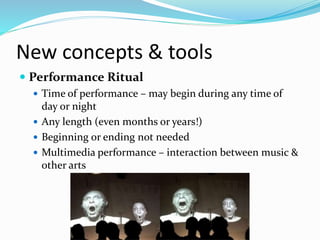
 Performance Ritual
 Time of performance – may begin during any time of
day or night
 Any length (even months or years!)
 Beginning or ending not needed
 Multimedia performance – interaction between music &
other arts
New concepts & tools
 Parody (Historicism)
 Parody not only a reference to satire
 Larger sense – refashioning of existent material
 Related to broader concept of ‘historicism’
 When entire styles are altered and given a new ‘guise’
New concepts & tools
 Parody & Historicism
 Composer – historical awareness created in works
 Reference serve as homage to styles
 Unanswered Question:
 Strings always triadic & constant (serene, language of
church music)
 Flutes = unstable (language of late 19th century dramatic
music)
New concepts & tools
 Parody & Historicism
 Piano Variations – also use of historicism:
 19th century ‘recital piece’
 2nd movement = strict binary dance form of Baroque era
(concept of terraced dynamics also used)
New concepts & tools
 Parody & Historicism
 Messiaen’s Quartet for the end of time – uses meditative
Indian music & connects works to scripture
 Cage – draws upon world of visual art & also Indian
mysticism
 Webern – European tradition of abstract art music
 Ives - philosophy
Questions?

Leereenheid 8

  • 3.
    Music after 1945 Technological rather than artistic development  Greater communication between composers – accelerated pace of music change
  • 4.
    Music after 1945 Altered assumptions about composition, performance & listening  Creation of new medium – electronic music
  • 5.
    The Long-playing Record& tape recorder
  • 6.
    The Long-playing Record& tape recorder  Inventions became commercially available late 1940s  Transformed nature of music experience  Today’s use of amplification & electric instruments in live performance  Growth of TV & radio
  • 7.
    The Long-playing Record& tape recorder  Later development of Compact-disc, videocasette recorder (VCR) & personal stereo  Recordings, elect. amplification, & even electronic instruments known before 1940s  Date as far back as 1877:  Thomas Edison – cylinder phonograph  Unknown potential of recorded sound – alter musical experience
  • 8.
    The Long-playing Record& tape recorder  LP records & tapes simply vehicles for preservation & transmission of concert music  BUT, enormous impact on composers
  • 9.
    The Long-playing Record& tape recorder  Accelerated development of music: • More interaction between composers • Improved communications & transportation • Greater access to scores • Presence of recordings
  • 10.
    The tape recordingmedium  Composers now with virtually unlimited access to variety of musical stimuli  Also works of fellow artists available  Ease of storage & editing – tape recorder
  • 11.
    The tape recordingmedium  Global sharing of new works within matter of days of 1st performance  Stylistic development influential before even accepted by listeners
  • 12.
    The tape recordingmedium  Also rekindled interest in works of:  Bach  Vivaldi (& other Baroque composers)  Berlioz  Bruckner  Ethnic & folk musics  Renaissance motets & masses  20th century ‘classics’ – Satie, Hindermith, Stravinsky, Bartok & more
  • 13.
    The tape recordingmedium  Recording industry:  Exposed listeners to greater range of music styles  Historically, ethnically & geographically  Composers could take advantage of audience’s broad listening experience
  • 14.
    Changes in listenerperception  Creative artists realized recordings could be used to compose music in new ways:  Methods which had not been possible before  Resembled development in visual arts - photography
  • 15.
    Changes in listenerperception  1930s:  Ernst Toch & Paul Hindermith  Experimented with distorting recorded sounds  Mixing of sound on variable-speed turntables
  • 16.
    Changes in listenerperception  Experimentation with technology:  Records played backwards  Scratches made into grooves to create sound of repeated fragments  John Cage – Imaginary landscape No. 1  Variable Turntables used as performance instruments in chamber ensemble
  • 17.
    Changes in listenerperception  After WW2:  Composers used unique features of recording & playback  Electronic / tape music composition  Originally neutral perception of recording’s impact on music appreciation changed – why?
  • 18.
    Changes in listenerperception  Reconsideration of essentials of music performance:  Traditional association with visual stimuli  Theatrical gesture  Acoustics of performance space  Immediacy of ‘real time’
  • 19.
    Changes in listenerperception  Cage conceived Landscape No. 1 with radio broadcast in mind  Recognized that loudspeaker performance / broadcast of chamber work = new possibilities of listening  Recorded music = music
  • 20.
    Changes in listenerperception  New ideas of ‘performance’:  Visual stimuli  Physical setting of original, ‘real’ performance  = eliminated  New audience – sound designed for cathedrals / 18th century drawing rooms can be listened to in kitchens & cars
  • 21.
    Changes in listenerperception  New concept of sound:  Has sound become sole focus? Sound = unchanged?
  • 22.
    Changes in listenerperception  New concept of sound:  New medium has altered sound itself  Balances & timbres can be altered by mic placement / broadcast  Record or tape – succession of sounds may be artificial construction  Edited ‘takes’
  • 23.
    Changes in listenerperception  New concept of sound:  Spontaneity of live performance ‘lost’  Live performance in concert hall – subject to level of focus (e.g. daydreaming)  Loudspeaker performance can be ‘controlled’  Single performance can be listened to multiple times  ‘Fixed’ in time like visual art
  • 24.
    Changes in listenerperception  Control of recorded sound:  Order of movements can be changed  Sections of work can be repeated  Listener in unique position of ‘performing’ record or ‘composing’ new work from isolated fragments out of existing
  • 25.
    Changes in listenerperception  Control of recorded sound:  Musical performance indistinguishable from electronic illusion  Form, content, duration, direction = alterable  Logic of musical continuity in Western concert tradition removed
  • 26.
    Changes in listenerperception  Control of recorded sound:  Fadeouts of song endings  Instant cuts to other tunes  Directionality of sound determined by loudspeaker placement  ‘Look’ of sounding objects changed – electronic instruments
  • 27.
    Changes in listenerperception  New instruments:  Theremin (1920): Leon Theremin playing his own instrument  Jason Hou – (2010-2012) Alphasphere
  • 28.
    Changes in listenerperception  Composers:  Shaped music in accordance to changed perception of sound, performance & listening  Attempt to create spontaneous situations – cannot be duplicated  Improvisation  New means to reassert focus of visual
  • 29.
    Changes in listenerperception  Music created which will benefit from recordable form:  Highly complex sound relationships  Repeated hearing required for comprehension  Music since 1940’s exploits new perception of performance
  • 31.
    New concepts &tools  New musical concepts:  Pitch logic  Time  Sound colour  Texture  Process  Performance ritual  Parody (Historicism)
  • 32.
    New concepts &tools  Pitch Logic:  Western music, by definition, involved 12 notes of chromatic scale  Since Wagner, Debussy & others began to move beyond these principles – more radical experimentation  John Cage, Henry Cowell & Oliver Messiaen – unique approaches
  • 33.
    New concepts &tools  Pitch Logic  What is meant with ‘pitch logic’?  “Manipulation / design of pitches & intervals
  • 34.
    New concepts &tools  Pitch Logic:  Strict 12-tone procedures used by Anton Webern in Piano Variations, Op. 27  Traditional hierarchies of scale & key centre replaced by a row & its permutations  Serialism – subject of work = pitch logic
  • 35.
    New concepts &tools  Pitch Logic:  Anton Webern: Piano Variations, Op. 27
  • 36.
    New concepts &tools  Pitch Logic  Henry Cowell – innovative use of inner-string piano sonorities & keyboard clusters  Pitch not as important  Messiaen’s Quartet for the end of time  Pitches form scales  Scales = unusual  Non-directional, non-functional cycles & sequences
  • 37.
    New concepts &tools  Time:  Composers – new ways of determining how pitches or sounds located in time  Music from 1600 – 1900: rhythmic patterns reliant on unchanging meter
  • 38.
    New concepts &tools  Time:  Charles Ives: Unanswered Question  Opening devoid of meter  Entire work = timeless, spacious quality
  • 39.
    New concepts &tools  Time - Charles Ives: Unanswered Question:  Against a background of slow, quiet strings representing "The Silence of the Druids", a solo trumpet poses "The Perennial Question of Existence”  Woodwind quartet of "Fighting Answerers" tries vainly to provide an answer, growing more frustrated and dissonant until they give up  The three groups of instruments perform in independent tempos and are placed separately on the stage—the strings offstage.
  • 40.
    New concepts &tools  Time:  Messiaen – Quartet for the end of time  Isorhythmic relationship between time (rhythm) & pitch  Both aspects = revolving in different orbits (timeless)
  • 41.
    New concepts &tools  Time:  Webern Piano Variations – conveys expression of compressed time  Music locked in ‘fast forward’
  • 42.
    New concepts &tools  Time:  Complex meters – 7/16, 11/32, 6/4+3/8  Changing meters  Irrational subdivisions of beat(units of 7 or 11)  Spontaneity – performers encouraged to take decisions about placement of rhythms in time
  • 43.
    New concepts &tools  Sound Colour:  Many composers turned to sound colour as primary field of exploration  Unanswered Question – extramusical program focuses on timbral contrasts among 3 ‘forces’  Timbre articulates form
  • 44.
    New concepts &tools  Sound Colour:  Unique sounds created with trad. Instruments  Webern – Piano Variations  Unfamiliar playing styles – “extended thechniques”
  • 45.
    New concepts &tools  Sound Colour:  Unique playing styles also derived from jazz & rock  Amplified instruments  Electronic modification – e.g. Vocoder  Instruments from other cultures – sitar & koto etc.
  • 46.
    New concepts &tools  Sound Colour:  Use of non-musical sound  Birdcalls, motors, running water, explosives  Amplified electronically  Acoustically modified  Sampled & altered digitally  Variety of tape editing techniques
  • 47.
    New concepts &tools  Texture:  Usually characterised in ‘pictorial / tactile’ terms  Heavy, light, dense, transparent, busy, simple  Texture now given role sometimes more NB than pitch / time
  • 48.
    New concepts &tools  Texture: Unanswered Question – 3 levels of activity seem to exist in separate worlds = juxtaposition more than polyphonic whole
  • 49.
    New concepts &tools  Texture:  Factors such as time, sound colour & texture seem independent  But, one exerts effect on other – textural possibilities influenced by approach to time  Unlimited degree of rhythmic freedom in individual parts = huge range of contrapuntal textures  John Cage 4’33” – no texture
  • 50.
    New concepts &tools  Process:  New processes of composition  E.g. Unanswered Question: quasitheatric roles determined process  Piano Variations – pitch, rhythm, register, articulation, dynamics related to asymmetrical 12-tone row  Cage’s Imaginary Landscape No. 1 – rhythmic units to overall form based on no. 16
  • 51.
    New concepts &tools  Process:  One particular trend after WW2 – to treat composition as problem solving
  • 52.
    New concepts &tools  Performance Ritual  For concertgoers – music performed on stage (space set apart from audience)  Audience members may converse & applaud only at specific times  Artistic sociological ritual
  • 53.
    New concepts &tools  Performance Ritual  NB – visual aspect  Piano Variations – breath-taking to see pianist’s agility with “extended technique” used
  • 54.
    New concepts &tools  Performance Ritual  Other composers who wished to escape trad. concert format  New relationships between composer, performer, audience  Performers surround audience or vice versa  Unanswered Question – wide spatial placement of performers
  • 55.
    New concepts &tools  Performance Ritual  Audience may be asked to participate – perform, improvise or even compose part of work  Members of audience may be encouraged to come & go as they please
  • 56.
    New concepts &tools  Performance Ritual  Audience may converse with performers – openly confess approval / disapproval  Unconventional performance spaces – streets, public buildings etc.
  • 57.
    New concepts &tools  Performance Ritual  Time of performance – may begin during any time of day or night  Any length (even months or years!)  Beginning or ending not needed  Multimedia performance – interaction between music & other arts
  • 58.
    New concepts &tools  Parody (Historicism)  Parody not only a reference to satire  Larger sense – refashioning of existent material  Related to broader concept of ‘historicism’  When entire styles are altered and given a new ‘guise’
  • 59.
    New concepts &tools  Parody & Historicism  Composer – historical awareness created in works  Reference serve as homage to styles  Unanswered Question:  Strings always triadic & constant (serene, language of church music)  Flutes = unstable (language of late 19th century dramatic music)
  • 60.
    New concepts &tools  Parody & Historicism  Piano Variations – also use of historicism:  19th century ‘recital piece’  2nd movement = strict binary dance form of Baroque era (concept of terraced dynamics also used)
  • 61.
    New concepts &tools  Parody & Historicism  Messiaen’s Quartet for the end of time – uses meditative Indian music & connects works to scripture  Cage – draws upon world of visual art & also Indian mysticism  Webern – European tradition of abstract art music  Ives - philosophy
  • 62.