QUACKERY
What is quackery?
How can you detect quackery?
What are some types of
quackery?
Medical , nutrition, device
“Consumers today face an amazing array of
choices when they consider taking action
to improve their health or seek care for a
health problem” In addition to health
professionals, there are also many other
forms of healthcare that offer alternatives.
These complementary and alternative
healthcare modalities are often taken
because some individuals believe that
traditional medical care may not be
enough to treat a particular health
A complementary medicine is
availed and integrated together
with traditional medicine. On
the other hand, alternative
medicine is offered in place of
traditional medicine.
There are four major domains of complementary
and alternative medicine: biology-based
practices, energy medicine, manipulative and
body-based practices, and mind-body medicine
.Examples of biologically-based practices are
taking herbal medicine and availing of special
diets and vitamins. Energy medicine uses
magnetic fields or biofields in belief that energy
fields may enter various points in the body.
Manipulative and body-based practices are
bodily-kinesthetic in nature and are concerned
with movement therapy. Mind-body medicine
uses mental exercises in belief that the brain is
central to the health of an individual.
In our country, Republic Act No. 8423 or
the Traditional and Alternative Medicine
Act of 1997 provisioned the creation of the
Philippine Institute of Traditional and
Alternative Healthcare (PITAHC),
which works closely with the Department
of Health. The PITAHC is also the law-
making body with regards to the effective
use of traditional and alternative
medicine. Here are examples of the
PITAHC-approved alternative modalities
Herbal medicine There are 10
herbs that are proven and tested
to have medicinal value and
approved by the Department of
Health”
 Activity 8: GARDEN OF HERBS What are the herbs
approved by the Department of Health? Unscramble the
letters to form each herb in column A. Read column B for
the medicinal value of each herb.
A Herb B Medicinal value
1. P L A U K A O C For ringworm and other skin
(fungal) infections
2. P A M A L A Y A For non-insulin dependent
diabetic patients
3. W A G N A B For blood pressure control
4. S A Y A B A B For use as antiseptic to disinfect
wounds For mouthwash or tooth
decay and gum infection
5. G U D N A L I For cough and asthma
6. Y I N O G – A I N Y O G N For intestinal
worms, particularly ascaris and trichina
7. B A S M N G O For urinary stones
8. A S A T N G B A T U G For mouthwash
9. N I P A S T – N A S I P A N T For arthritis
and gout
10. B E R Y A – N U B E A For relief
from body aches and pains
Examples of Alternative Medicine
 1. Acupuncture It is a form of energy
medicine where long thin needles are inserted
to specific points of the body to affect the
energy flow. Acupuncture is believed to treat
 musculoskeletal dysfunctions.
What to consider in
choosing Acupuncturist?
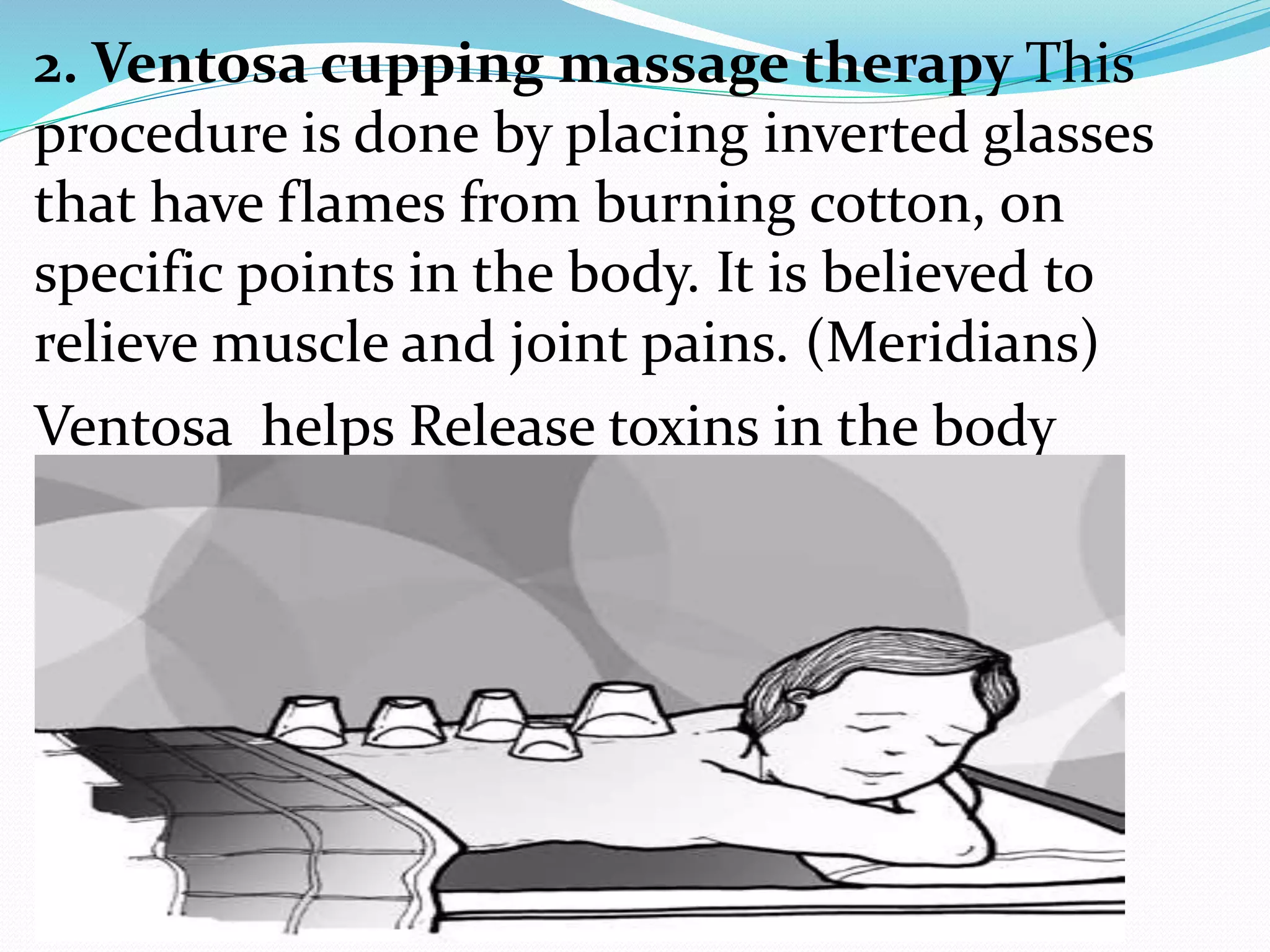
2. Ventosa cupping massage therapy This
procedure is done by placing inverted glasses
that have flames from burning cotton, on
specific points in the body. It is believed to
relieve muscle and joint pains. (Meridians)
Ventosa helps Release toxins in the body
3. Reflexology Similar to acupuncture,
reflexology focuses on treating specific
disorders through massaging of the soles of the
feet.
4. Acupressure Acupressure uses the same
technique as that of acupuncture. The only
difference is that acupressure does not use
needles but hands to apply pressure on certain
points of the body.
5. Nutrition Therapy Nutrition therapy
approaches treatment of a medical
condition by providing a tailored diet for
the patient.
Naturopathy
“Naturopathic medicine views
diseases as a manifestation of an
alteration in the processes by which
the body naturally heals itself”
Naturopathy offers a wide range of
natural practices including herbal
medicine acupuncture, acupressure,
nutritional therapy, and ventosa
cupping massage therapy.
Types of treatment that naturopathy
usually recommend
FASTING
HYDROTHERAPHY
DIET
AIR AND SUNLIGHT
A NATUROPATH NEVER CLAIMS TO
CURE AN ILLNESS, BUT ISTEAD AIMS
TO HELP THE BODY OVERCOME THE
AILMENT ITSELF.
THINK ABOUT IT
In 2-3 paragraphs, write your
thoughts about the question, “Why
are health professionals, whether
those that offer traditional,
alternative, or complementary, not
present in a lot of rural
municipalities in the country?”

Complimentary and alternative healthcare

  • 1.
    QUACKERY What is quackery? Howcan you detect quackery? What are some types of quackery? Medical , nutrition, device
  • 3.
    “Consumers today facean amazing array of choices when they consider taking action to improve their health or seek care for a health problem” In addition to health professionals, there are also many other forms of healthcare that offer alternatives. These complementary and alternative healthcare modalities are often taken because some individuals believe that traditional medical care may not be enough to treat a particular health
  • 4.
    A complementary medicineis availed and integrated together with traditional medicine. On the other hand, alternative medicine is offered in place of traditional medicine.
  • 5.
    There are fourmajor domains of complementary and alternative medicine: biology-based practices, energy medicine, manipulative and body-based practices, and mind-body medicine .Examples of biologically-based practices are taking herbal medicine and availing of special diets and vitamins. Energy medicine uses magnetic fields or biofields in belief that energy fields may enter various points in the body. Manipulative and body-based practices are bodily-kinesthetic in nature and are concerned with movement therapy. Mind-body medicine uses mental exercises in belief that the brain is central to the health of an individual.
  • 6.
    In our country,Republic Act No. 8423 or the Traditional and Alternative Medicine Act of 1997 provisioned the creation of the Philippine Institute of Traditional and Alternative Healthcare (PITAHC), which works closely with the Department of Health. The PITAHC is also the law- making body with regards to the effective use of traditional and alternative medicine. Here are examples of the PITAHC-approved alternative modalities
  • 7.
    Herbal medicine Thereare 10 herbs that are proven and tested to have medicinal value and approved by the Department of Health”
  • 8.
     Activity 8:GARDEN OF HERBS What are the herbs approved by the Department of Health? Unscramble the letters to form each herb in column A. Read column B for the medicinal value of each herb. A Herb B Medicinal value 1. P L A U K A O C For ringworm and other skin (fungal) infections 2. P A M A L A Y A For non-insulin dependent diabetic patients 3. W A G N A B For blood pressure control 4. S A Y A B A B For use as antiseptic to disinfect wounds For mouthwash or tooth decay and gum infection
  • 9.
    5. G UD N A L I For cough and asthma 6. Y I N O G – A I N Y O G N For intestinal worms, particularly ascaris and trichina 7. B A S M N G O For urinary stones 8. A S A T N G B A T U G For mouthwash 9. N I P A S T – N A S I P A N T For arthritis and gout 10. B E R Y A – N U B E A For relief from body aches and pains
  • 10.
    Examples of AlternativeMedicine  1. Acupuncture It is a form of energy medicine where long thin needles are inserted to specific points of the body to affect the energy flow. Acupuncture is believed to treat  musculoskeletal dysfunctions.
  • 11.
    What to considerin choosing Acupuncturist?
  • 12.
    2. Ventosa cuppingmassage therapy This procedure is done by placing inverted glasses that have flames from burning cotton, on specific points in the body. It is believed to relieve muscle and joint pains. (Meridians) Ventosa helps Release toxins in the body
  • 13.
    3. Reflexology Similarto acupuncture, reflexology focuses on treating specific disorders through massaging of the soles of the feet. 4. Acupressure Acupressure uses the same technique as that of acupuncture. The only difference is that acupressure does not use needles but hands to apply pressure on certain points of the body.
  • 15.
    5. Nutrition TherapyNutrition therapy approaches treatment of a medical condition by providing a tailored diet for the patient.
  • 16.
    Naturopathy “Naturopathic medicine views diseasesas a manifestation of an alteration in the processes by which the body naturally heals itself” Naturopathy offers a wide range of natural practices including herbal medicine acupuncture, acupressure, nutritional therapy, and ventosa cupping massage therapy.
  • 17.
    Types of treatmentthat naturopathy usually recommend FASTING HYDROTHERAPHY DIET AIR AND SUNLIGHT A NATUROPATH NEVER CLAIMS TO CURE AN ILLNESS, BUT ISTEAD AIMS TO HELP THE BODY OVERCOME THE AILMENT ITSELF.
  • 18.
    THINK ABOUT IT In2-3 paragraphs, write your thoughts about the question, “Why are health professionals, whether those that offer traditional, alternative, or complementary, not present in a lot of rural municipalities in the country?”