MINI PROJECT
Jet Engine Powered Locomotive
• A turbojet train is a train powered by turbojet engines. Like
a jet aircraft, but unlike a gas turbine locomotive, the train
is propelled by the jet thrust of the engines, rather than by
its wheels. Only a handful of jet-powered trains have been
built, for experimental research in high-speed rail.
• Turbojet engines have been built with the engine
incorporated into a railcar combining both propulsion and
passenger accommodation rather than as separate
locomotives hauling passenger coaches.
• As turbojet engines are most efficient at high speeds[note
1], the experimental research has focused in applications
for high-speed passenger services, rather than the heavier
trains (with more frequent stops) used for freight services.
Benefits of Jet Engine Powered
Locomotive
• Improve quality of life by cutting travel time.
• Reduce air pollution
• Reduce traffic congestion
• Provide a “safety valve” for crowded cities
• May reduce the problem of unavailability of
confirm tickets in Indian Railways.
• Rapid Two and Fro Movement of people,
goods and services between any two long
distance cities.
Previous Attempts
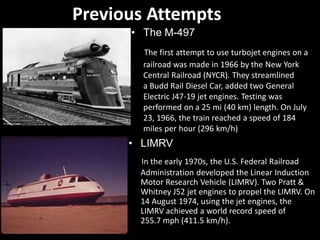
• The M-497
The first attempt to use turbojet engines on a
railroad was made in 1966 by the New York
Central Railroad (NYCR). They streamlined
a Budd Rail Diesel Car, added two General
Electric J47-19 jet engines. Testing was
performed on a 25 mi (40 km) length. On July
23, 1966, the train reached a speed of 184
miles per hour (296 km/h)
• LIMRV
In the early 1970s, the U.S. Federal Railroad
Administration developed the Linear Induction
Motor Research Vehicle (LIMRV). Two Pratt &
Whitney J52 jet engines to propel the LIMRV. On
14 August 1974, using the jet engines, the
LIMRV achieved a world record speed of
255.7 mph (411.5 km/h).
Previous Attempts
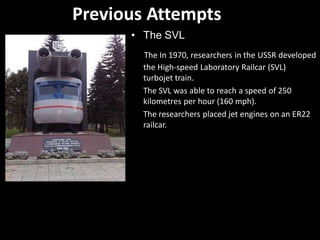
• The SVL
The In 1970, researchers in the USSR developed
the High-speed Laboratory Railcar (SVL)
turbojet train.
The SVL was able to reach a speed of 250
kilometres per hour (160 mph).
The researchers placed jet engines on an ER22
railcar.
Why These Locomotives Failed?
• Because they used the conventional type Jet
Engine on locomotive which is not having
synchronous specification :-
• But Nowadays Jet Engine with synchronous
specification are available.
Specifications (J47-GE-25) : Used in M497
General characteristics
Type: turbojet
Length: 145 inches (370 cm) (with tailcone)
Diameter: 36.75 inches (93.3 cm) maximum
Dry weight: 2,554 pounds (1,158 kg) dry, equipped
Components
Compressor: 12-stage axial compressor
Turbine: single-stage axial
Fuel type: JP-1, JP-2, JP-3, JP-4 or MIL-F-5572 gasoline
Oil system: pressure feed spray with scavenge
Performance
Maximum thrust: 5,970 lbf (26.56 kN) at 7950 rpm ; 6,970 lbf (31.00 kN) with water
injection
Overall pressure ratio: 5.35
Air mass flow: 92 lb/s (42 kg/s)
Specific fuel consumption: 1.014 lb/(lbf⋅h) (28.7 g/(kN⋅s))
Thrust-to-weight ratio: 2.34 at take-off dry power
Specifications(J52-P-408) :Used in LIMRV
General characteristics
Type: turbojet
Length: 118 in (300 cm)
Diameter: 38 in (96.5 cm)
Dry weight: 2,318 lb (1,052 kg)
Components
Compressor: axial flow, 5-stage LP, 7-stage HP
Turbine: single stage HP, single stage LP
Fuel type: JP-4
Performance
Maximum thrust: 11,200 lbf (50 kN)
Overall pressure ratio: 14.6 : 1
Air mass flow: 143 lb/s
Specific fuel consumption: 0.79 lb/(lbf⋅h) (22 g/(kN⋅s))
Thrust-to-weight ratio: 4.83
We Have Selected the Engine Honda Jet HA
-420 (GE Honda HF120)HondaJet
Crew: 1 - 2 crew members
Capacity: 5 - 6 passengers
Length: 42.62 ft (12.99 m)
Wingspan: 39.76 ft (12.12 m)
Height: 14.90 ft (4.54 m)
Height: 4.80 ft (1.46 m)
Length: 17.80 ft (5.43 m)
Width: 5.00 ft (1.52 m)
Total: 66 cubic feet
Within aft section: 57 cubic feet
Within nose section: 9 cubic feet
2 × GE Honda HF120 turbofan engines,2,050 lbf (9.12 kN) thrust each (Bypass
Ratio= 2.9)
Maximum cruise speed: 483 mph (420 KTAS) TAS 778 km/h at FL300
Maximum cruise altitude: 43,000 ft (FL430)
Range: 1,180 nautical miles; (1,358 mi; 2,185 km) NBAA IFR (4 occupants)
Rate of climb: 3,990 ft/min (20.27 m/s)
Specifications(GE Honda HF120)
General characteristics
Type: Turbofan engine
Length: 59.5 in (151 cm) (end-to-end)
Diameter: 25.8 in (66 cm)
Dry weight: 211.3 kg (466 lb) with basic accessories and optional equipment
Components
Compressor: One wide-chord fan, two axial LP stages, one centrifugal HP stage.
Combustors: Compact reverse flow annular
Turbine: One axial HP stage (48,777 rpm), two axial LP stages (19,055 rpm).
Performance
Maximum thrust: 2,050 lbf (9.1 kN) (Takeoff)
Overall pressure ratio: 24:1
Bypass ratio: 2.9:1
Turbine inlet temperature: 1,580 °F (860 °C) (Takeoff)
Specific fuel consumption: <0.7 lb/lbf/h (71 kg/kN/h)
Thrust-to-weight ratio: 4.4
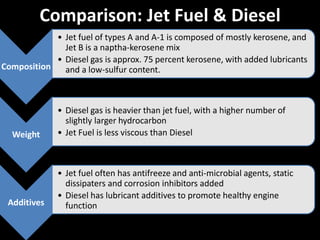
Comparison: Jet Fuel & Diesel
Composition
• Jet fuel of types A and A-1 is composed of mostly kerosene, and
Jet B is a naptha-kerosene mix
• Diesel gas is approx. 75 percent kerosene, with added lubricants
and a low-sulfur content.
Weight
• Diesel gas is heavier than jet fuel, with a higher number of
slightly larger hydrocarbon
• Jet Fuel is less viscous than Diesel
Additives
• Jet fuel often has antifreeze and anti-microbial agents, static
dissipaters and corrosion inhibitors added
• Diesel has lubricant additives to promote healthy engine
function
Advantages of Jet Fuel
• Aviation Turbine Fuel (ATF), used in aircraft,
costs less than petrol and diesel as the
common man auto fuels attract higher excise
duty.
• Jet Fuel has a higher energy content per unit
volume (Approximately 128000 Btu/gal for jet
fuel.
• Jet Fuel is less volatile than gasoline, reducing
handling danger and enhancing safety.
Mini project Jet Engine Powered Locomotive

Mini project Jet Engine Powered Locomotive

  • 1.
  • 2.
    Jet Engine PoweredLocomotive • A turbojet train is a train powered by turbojet engines. Like a jet aircraft, but unlike a gas turbine locomotive, the train is propelled by the jet thrust of the engines, rather than by its wheels. Only a handful of jet-powered trains have been built, for experimental research in high-speed rail. • Turbojet engines have been built with the engine incorporated into a railcar combining both propulsion and passenger accommodation rather than as separate locomotives hauling passenger coaches. • As turbojet engines are most efficient at high speeds[note 1], the experimental research has focused in applications for high-speed passenger services, rather than the heavier trains (with more frequent stops) used for freight services.
  • 3.
    Benefits of JetEngine Powered Locomotive • Improve quality of life by cutting travel time. • Reduce air pollution • Reduce traffic congestion • Provide a “safety valve” for crowded cities • May reduce the problem of unavailability of confirm tickets in Indian Railways. • Rapid Two and Fro Movement of people, goods and services between any two long distance cities.
  • 4.
    Previous Attempts • TheM-497 The first attempt to use turbojet engines on a railroad was made in 1966 by the New York Central Railroad (NYCR). They streamlined a Budd Rail Diesel Car, added two General Electric J47-19 jet engines. Testing was performed on a 25 mi (40 km) length. On July 23, 1966, the train reached a speed of 184 miles per hour (296 km/h) • LIMRV In the early 1970s, the U.S. Federal Railroad Administration developed the Linear Induction Motor Research Vehicle (LIMRV). Two Pratt & Whitney J52 jet engines to propel the LIMRV. On 14 August 1974, using the jet engines, the LIMRV achieved a world record speed of 255.7 mph (411.5 km/h).
  • 5.
    Previous Attempts • TheSVL The In 1970, researchers in the USSR developed the High-speed Laboratory Railcar (SVL) turbojet train. The SVL was able to reach a speed of 250 kilometres per hour (160 mph). The researchers placed jet engines on an ER22 railcar.
  • 6.
    Why These LocomotivesFailed? • Because they used the conventional type Jet Engine on locomotive which is not having synchronous specification :- • But Nowadays Jet Engine with synchronous specification are available.
  • 7.
    Specifications (J47-GE-25) :Used in M497 General characteristics Type: turbojet Length: 145 inches (370 cm) (with tailcone) Diameter: 36.75 inches (93.3 cm) maximum Dry weight: 2,554 pounds (1,158 kg) dry, equipped Components Compressor: 12-stage axial compressor Turbine: single-stage axial Fuel type: JP-1, JP-2, JP-3, JP-4 or MIL-F-5572 gasoline Oil system: pressure feed spray with scavenge Performance Maximum thrust: 5,970 lbf (26.56 kN) at 7950 rpm ; 6,970 lbf (31.00 kN) with water injection Overall pressure ratio: 5.35 Air mass flow: 92 lb/s (42 kg/s) Specific fuel consumption: 1.014 lb/(lbf⋅h) (28.7 g/(kN⋅s)) Thrust-to-weight ratio: 2.34 at take-off dry power
  • 8.
    Specifications(J52-P-408) :Used inLIMRV General characteristics Type: turbojet Length: 118 in (300 cm) Diameter: 38 in (96.5 cm) Dry weight: 2,318 lb (1,052 kg) Components Compressor: axial flow, 5-stage LP, 7-stage HP Turbine: single stage HP, single stage LP Fuel type: JP-4 Performance Maximum thrust: 11,200 lbf (50 kN) Overall pressure ratio: 14.6 : 1 Air mass flow: 143 lb/s Specific fuel consumption: 0.79 lb/(lbf⋅h) (22 g/(kN⋅s)) Thrust-to-weight ratio: 4.83
  • 9.
    We Have Selectedthe Engine Honda Jet HA -420 (GE Honda HF120)HondaJet Crew: 1 - 2 crew members Capacity: 5 - 6 passengers Length: 42.62 ft (12.99 m) Wingspan: 39.76 ft (12.12 m) Height: 14.90 ft (4.54 m) Height: 4.80 ft (1.46 m) Length: 17.80 ft (5.43 m) Width: 5.00 ft (1.52 m) Total: 66 cubic feet Within aft section: 57 cubic feet Within nose section: 9 cubic feet 2 × GE Honda HF120 turbofan engines,2,050 lbf (9.12 kN) thrust each (Bypass Ratio= 2.9) Maximum cruise speed: 483 mph (420 KTAS) TAS 778 km/h at FL300 Maximum cruise altitude: 43,000 ft (FL430) Range: 1,180 nautical miles; (1,358 mi; 2,185 km) NBAA IFR (4 occupants) Rate of climb: 3,990 ft/min (20.27 m/s)
  • 10.
    Specifications(GE Honda HF120) Generalcharacteristics Type: Turbofan engine Length: 59.5 in (151 cm) (end-to-end) Diameter: 25.8 in (66 cm) Dry weight: 211.3 kg (466 lb) with basic accessories and optional equipment Components Compressor: One wide-chord fan, two axial LP stages, one centrifugal HP stage. Combustors: Compact reverse flow annular Turbine: One axial HP stage (48,777 rpm), two axial LP stages (19,055 rpm). Performance Maximum thrust: 2,050 lbf (9.1 kN) (Takeoff) Overall pressure ratio: 24:1 Bypass ratio: 2.9:1 Turbine inlet temperature: 1,580 °F (860 °C) (Takeoff) Specific fuel consumption: <0.7 lb/lbf/h (71 kg/kN/h) Thrust-to-weight ratio: 4.4
  • 11.
    Comparison: Jet Fuel& Diesel Composition • Jet fuel of types A and A-1 is composed of mostly kerosene, and Jet B is a naptha-kerosene mix • Diesel gas is approx. 75 percent kerosene, with added lubricants and a low-sulfur content. Weight • Diesel gas is heavier than jet fuel, with a higher number of slightly larger hydrocarbon • Jet Fuel is less viscous than Diesel Additives • Jet fuel often has antifreeze and anti-microbial agents, static dissipaters and corrosion inhibitors added • Diesel has lubricant additives to promote healthy engine function
  • 12.
    Advantages of JetFuel • Aviation Turbine Fuel (ATF), used in aircraft, costs less than petrol and diesel as the common man auto fuels attract higher excise duty. • Jet Fuel has a higher energy content per unit volume (Approximately 128000 Btu/gal for jet fuel. • Jet Fuel is less volatile than gasoline, reducing handling danger and enhancing safety.