Philosophy Mini-Conference
Timetable
11:00What kind of students
do universities want?
(Dr Brendan Larvor &
Prof John Lippitt)
11:40 Break
11:50 Is it permissible for
parents to choose their
children’s disabilities?
(Dr Craig Bourne)
12:30 Lunch
13:30 How to Succeed at
University
(Philosophy Students)
13:50 Break
14:00 How to see your own
brain without surgery
(Dr Sam Coleman)
14:40 End
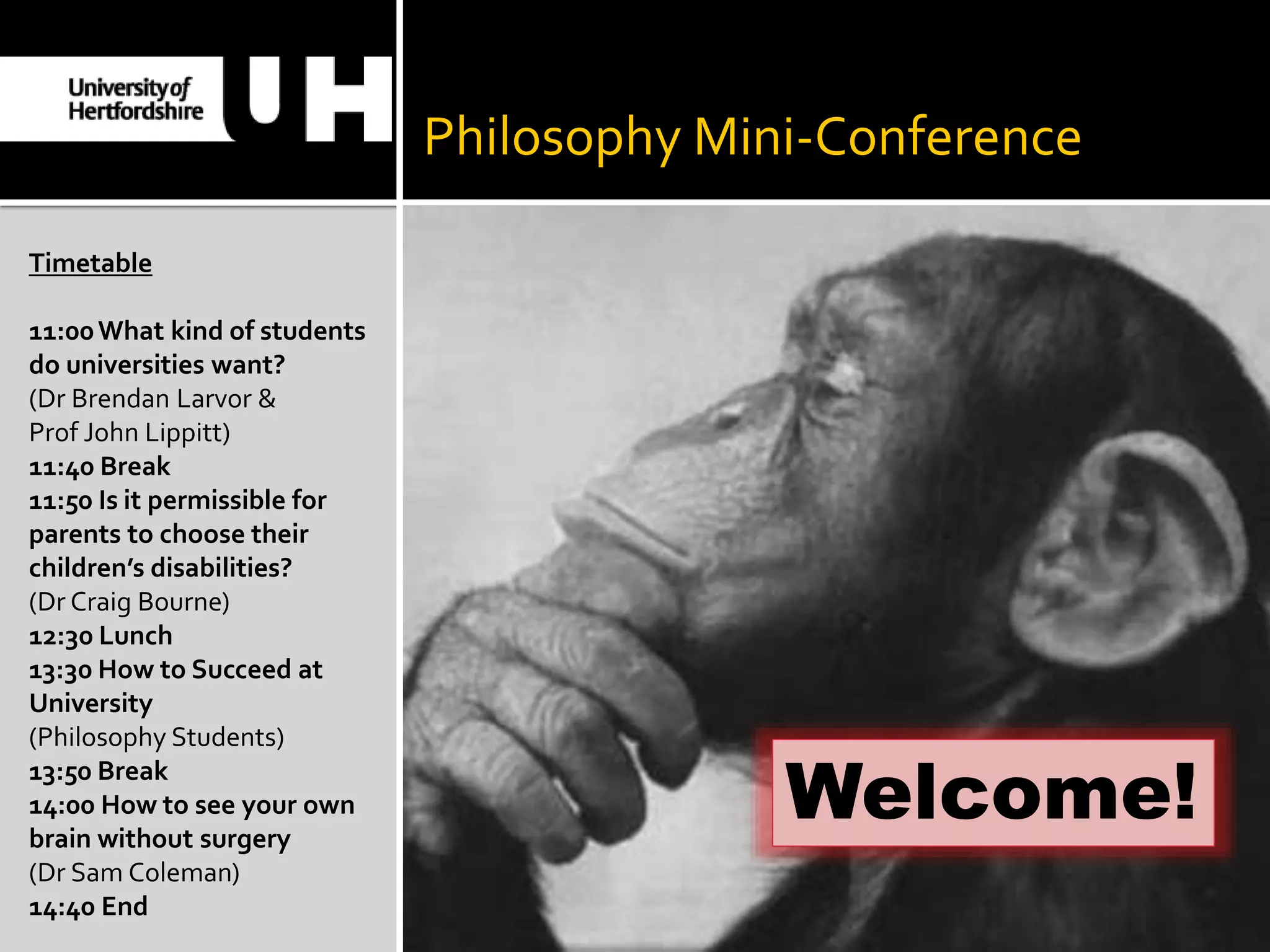
Welcome!
What kind of students do universities want?
Dr Brendan Larvor
Professor John Lippitt
www.herts.ac.uk/philosophy
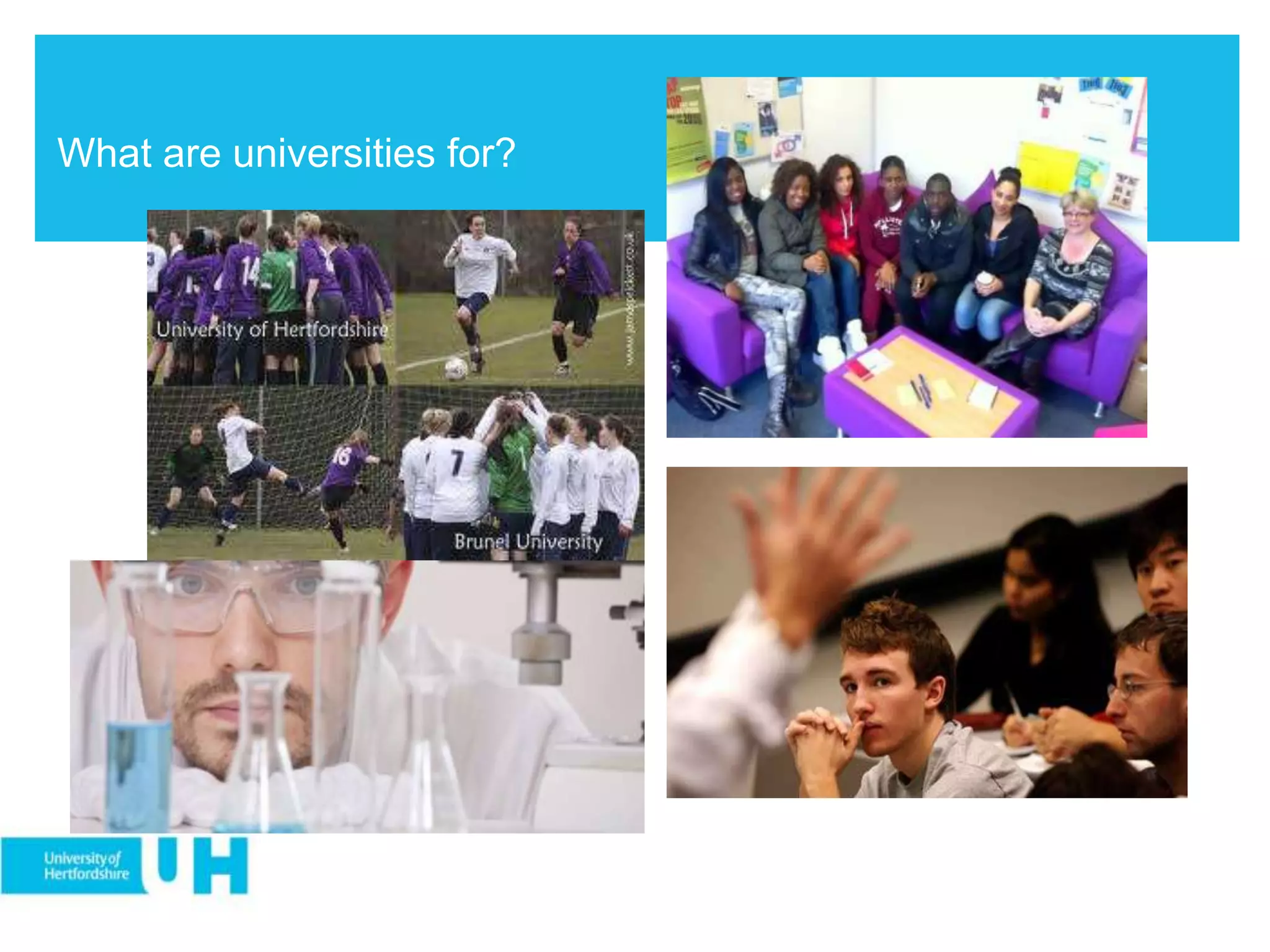
What are universities for?
Ethos
• Army: physical courage
and obedient loyalty
• Priesthood: piety and
giving of self
• University: rigorous,
gleeful curiosity
What should a student hope for from university
education?
Will University Change You?
UH Graduate Attributes
Professionalism, employability and enterprise
The University promotes professional integrity and provides
opportunities to develop the skills of communication, independent
and team working, problem solving, creativity, digital literacy,
numeracy and self-management.
Our graduates will be confident, act with integrity, set themselves
high standards and have skills that are essential to their future lives.
Learning and research skills
The University fosters intellectual curiosity and provides
opportunities to develop effective learning and research abilities.
Our graduates will be equipped to seek knowledge and to continue
learning throughout their lives.
UH Graduate Attributes
Intellectual depth, breadth and adaptability
The University encourages engagement in
curricular, co-curricular and extracurricular
activities that deepen and broaden knowledge and
develop powers of analysis, application, synthesis,
evaluation and criticality.
Our graduates will be able to consider multiple
perspectives as they apply intellectual rigour and
innovative thinking to the practical and theoretical
challenges they face.
UH Graduate Attributes
Respect for others
The University promotes self-awareness, empathy,
cultural awareness and mutual respect.
Our graduates will have respect for themselves and
others and will be courteous, inclusive and able to
work in a wide range of cultural settings.
Social responsibility
The University promotes the values of ethical
behaviour, sustainability and personal contribution.
Our graduates will understand how their actions can
enhance the wellbeing of others and will be equipped
to make a valuable contribution to society.
Essay Question
Should Universities attempt to mould students’
characters?
Learning Resources
Learning Resources
How professors write
Acknowledgements
This essay was improved by conversations with a large number of people who helped debug
it. Particular thanks to Jeff Dutky <dutky@wam.umd.edu>, who suggested the “debugging is
parallelizable” formulation, and helped develop the analysis that proceeds from it. Also to
Nancy Lebovitz <nancyl@universe.digex.net> for her suggestion that I emulate Weinberg by
quoting Kropotkin. Perceptive criticisms also came from Joan Eslinger
<wombat@kilimanjaro.engr.sgi.com> and Marty Franz <marty@net-link.net> of the General
Technics list. Glen Vandenburg <glv@vanderburg.org> pointed out the importance of self-
selection in contributor populations and suggested the fruitful idea that much development
rectifies `bugs of omission'; Daniel Upper <upper@peak.org> suggested the natural
analogies for this. I'm grateful to the members of PLUG, the Philadelphia Linux User's group,
for providing the first test audience for the first public version of this essay. Paula Matuszek
<matusp00@mh.us.sbphrd.com> enlightened me about the practice of software
management. Phil Hudson <phil.hudson@iname.com> reminded me that the social
organization of the hacker culture mirrors the organization of its software, and vice-versa.
John Buck <johnbuck@sea.ece.umassd.edu> pointed out that MATLAB makes an instructive
parallel to Emacs. Russell Johnston <russjj@mail.com> brought me to consciousness about
some of the mechanisms discussed in ``How Many Eyeballs Tame Complexity.'' Finally, Linus
Torvalds's comments were helpful and his early endorsement very encouraging.
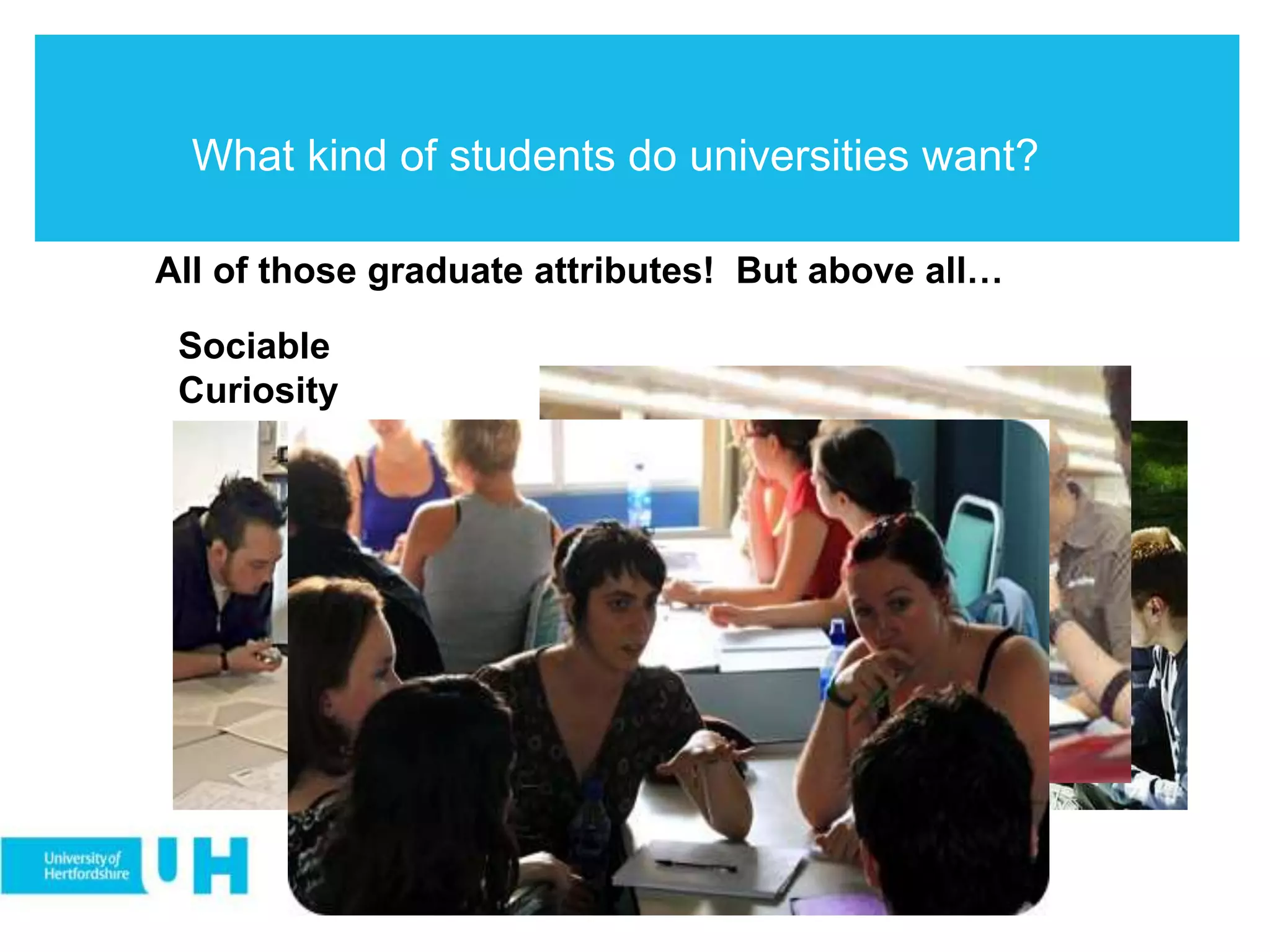
What kind of students do universities want?
All of those graduate attributes! But above all…
Sociable
Curiosity
What kind of students do universities want?
• The core of these ‘graduate attributes’ is in fact a cluster of
ethical and intellectual virtues.
• For instance: Successful team-working typically requires patience
and trust. In many circumstances, it also requires a subtle blend
of pride (in our work) and humility (recognition of what we owe to
others and of the defeasibility of our own judgements).
• Plus gratitude, hopefulness, justice and – sometimes – the
capacity for forgiveness.
• Student comment: “Talk about graduate attributes can be too
dogmatic ... Cultivate the virtues and you get them straight
away.”
What kind of students do universities want?
‘Today’s university students will be tomorrow’s doctors, engineers,
business managers, teachers, faith leaders, politicians, citizens,
activists, parents and neighbours. While they need to be able to
demonstrate key skills and knowledge …, they must also
demonstrate good character in carrying out these responsibilities
... In recent history ... moral and social aims of higher education
have been overshadowed by emphases on instrumental and
economic goals, including employability skills and preparation for
the workplace.’
K. M. Quinlan (2012). ‘Developing the whole student: leading higher education initiatives that
integrate mind and heart’.
But might the former enhance the latter?
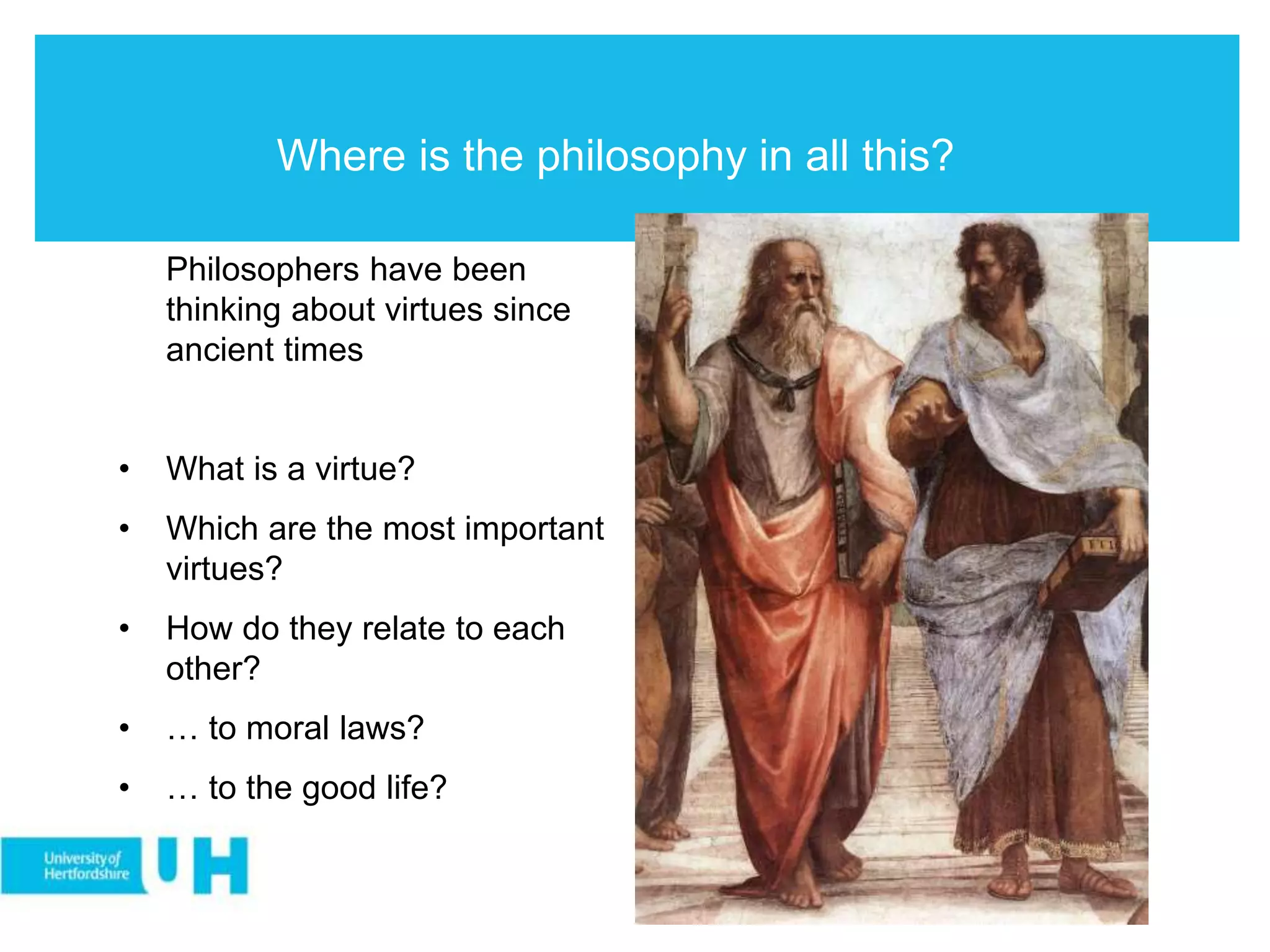
Where is the philosophy in all this?
Philosophers have been
thinking about virtues since
ancient times
• What is a virtue?
• Which are the most important
virtues?
• How do they relate to each
other?
• … to moral laws?
• … to the good life?
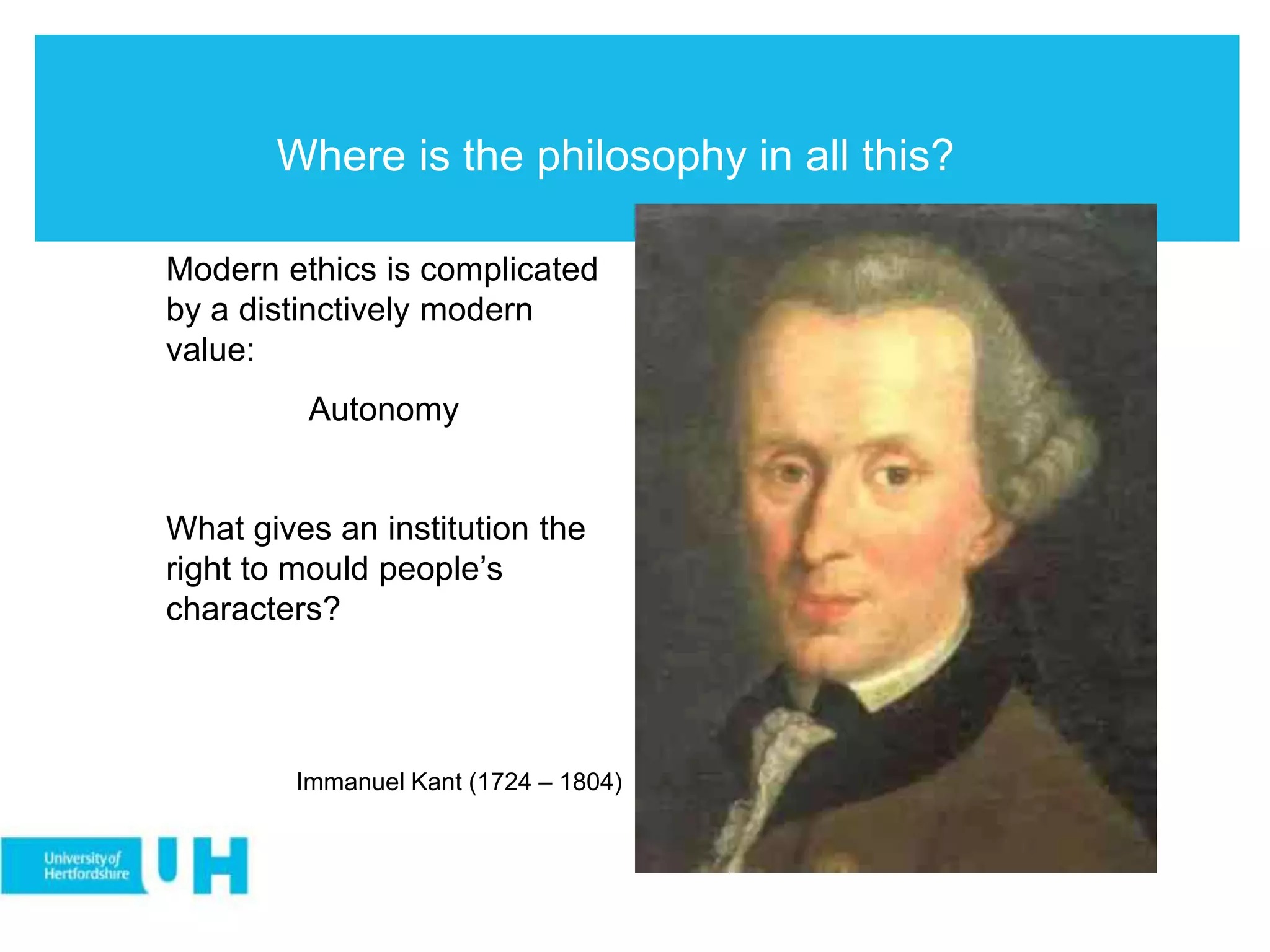
Where is the philosophy in all this?
Modern ethics is complicated
by a distinctively modern
value:
Autonomy
What gives an institution the
right to mould people’s
characters?
Immanuel Kant (1724 – 1804)
Where is the philosophy in all this?
Philosophy starts when two apparently reasonable
thoughts conflict
Who was that?
Brendan Larvor
Reader in Philosophy
John Lippitt
Professor of Ethics and
Philosophy of Religion
Philosophy Mini-Conference
Timetable
11:40 Break
11:50 Is it permissible for
parents to choose their
children’s disabilities?
(Dr Craig Bourne)
12:30 Lunch
13:30 How to Succeed at
University
(Philosophy Students)
13:50 Break
14:00 How to see your own
brain without surgery
(Dr Sam Coleman)
14:40 What next?
14:45 End
Dr Craig Bourne
Philosophy Mini-Conference, 2014
University of Hertfordshire
• The life that a child leads is determined to a large extent by the
choices that its parent/guardian makes on the child’s behalf.
• These choices go beyond (e.g.) allowing the child to eat sweets or to
watch a certain film. Many choices will affect what the child will be
able to choose as an adult.
• e.g. deciding whether a child will undergo a physical procedure (a course of
growth hormones, circumcision, etc.) will determine certain choices that the
child can make as an adult.
• e.g. not giving a child piano lessons from an early age will make it unlikely that
they would be in a position to be a great pianist as an adult.
• Some of the decisions that a parent makes for a child might not be
considered harmful but (at best) unfortunate for that adult.
• e.g. being a good pianist but not a great pianist might well be a source of pain.
The adult may well feel that the parent limited their opportunities. But we
might think that it goes too far to say that the parent harmed their child.
• However, limiting opportunities in some cases might be thought to be
more serious and the parent might be thought to be harming the child
in making these decisions. Let’s consider two cases where some
think the parent has harmed the child in this way – one concerning
education and the other concerning physical ability.
Case 1
Joel Feinberg (1980) ‘The Child’s Right to an Open
Future’, writes about this case (Wisconsin v. Yoder,
1972):
‘The aim of Amish education is to prepare the young
for a life of industry and piety by transmitting to them
the unchanged farming and household methods of
their ancestors and a thorough distrust of modern
techniques and styles … [T]he Amish have always
tried their best to insulate their communities from
external influences … Their own schools teach only
enough reading to make a lifetime of Bible study
possible, only enough arithmetic to permit the keeping
of budget books and records of simple commercial
transactions. Four or five years of this, plus exercises
in sociality, devotional instruction, inculcation of
traditional virtues, and on-the-job training in simple
crafts of field, shop, or kitchen are all that is required,
in a formal way, to prepare children for the traditional
Amish way of life to which their parents are bound by
the most solemn commitments.’
‘Amish [parents] … had been convicted of violating …
compulsory school attendance law (which requires
attendance until the age of sixteen) by refusing to
send their children to … school after they had
graduated from the eighth grade. The Court
acknowledged that the case required a balancing of
legitimate interests …
…but concluded that the interest of the parents in
determining the religious upbringing of their children
out-weighed the claim of the state … “to extend the
benefit of secondary education to children regardless
of the wishes of their parents.”’
Questions:
Which interests are in conflict? Which are more important to protect?
Have the parents deprived their children by limiting the options the
child could choose for its future (e.g. going to university)?
Is it more important to preserve the existence of different ways of
life?
From whose point of view should we judge which options are
• The child should grow up able to choose a lifestyle which is not deficient
according to their own value system
• Contrast with what is deficient according to our value system. The fact
that we would not choose the Amish lifestyle does not mean the Amish
lifestyle falls short of the child’s values
• Successful vs. unsuccessful acculturation. A parent who adopts a
religion or culture as a fad and imposes it on the child without
developing a coherent corresponding value system will not raise a child
whose opportunities are in accord with his values. This would be a
genuine limitation of the opportunities to the child.
• But a child who is brought up with Amish values, it seems, is in a
different situation. The child will not agree that opportunities have been
limited because those opportunities (e.g. university) are not
opportunities that the child values.
• Nevertheless, might we still wonder whether there should be a limitation
on which values a child could be brought up to have? What reason, if
any, could we give for such a limitation?
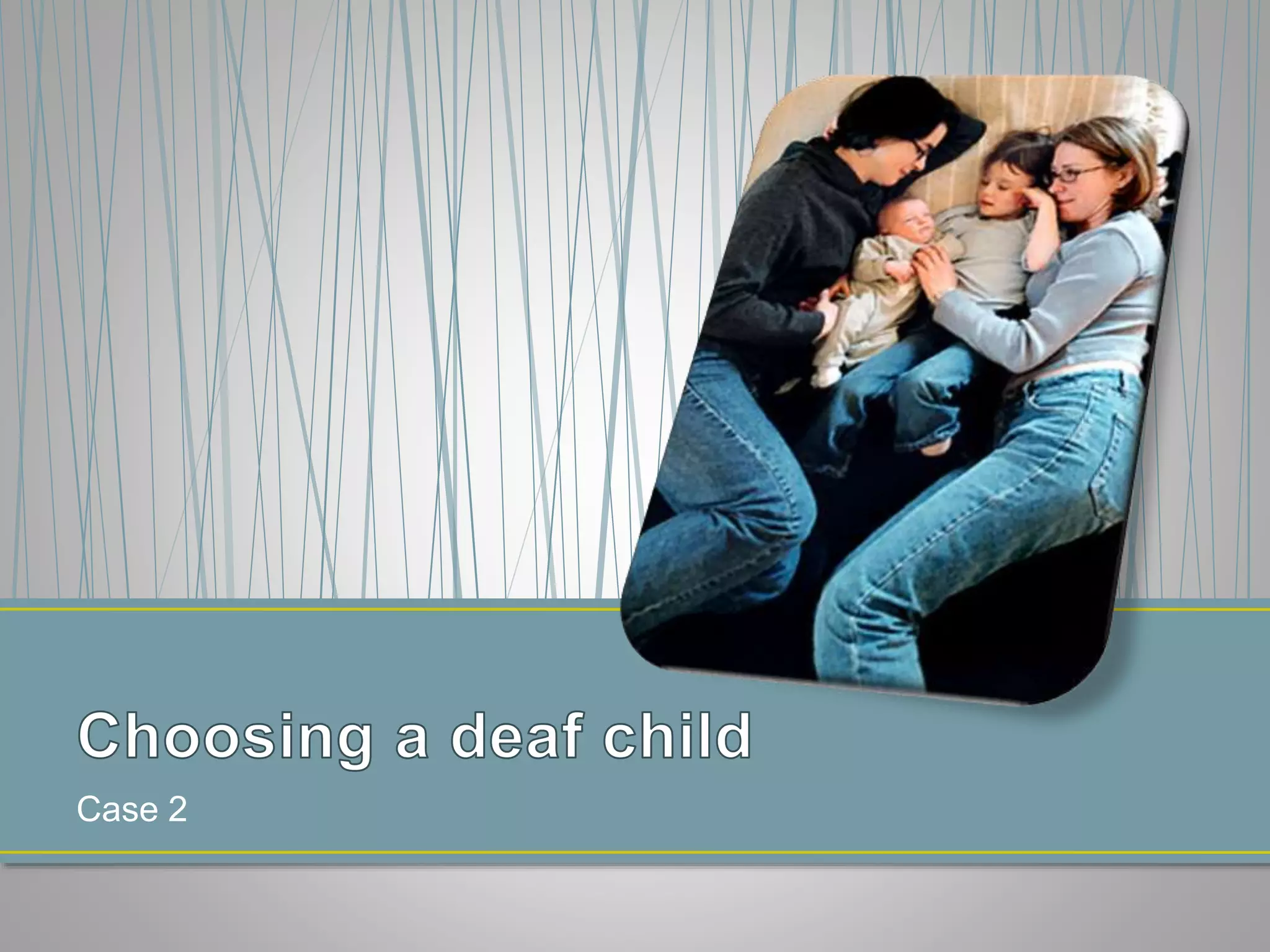
Case 2
Jonathan Glover, in Choosing Children (2006),
writes about this case:
‘In 2002 a lesbian couple, Sharon Duchesneau and
Candy McCullough, who are both deaf, used sperm
donated by a friend with hereditary deafness to
have a deaf baby. … During her pregnancy, Sharon
Duchesneau said, “It would be nice to have a deaf
child who is the same as us … A hearing baby
would be a blessing. A deaf baby would be a special
blessing.”’
• Peter Garrett, research director for LIFE: ‘To deprive a baby of a natural
faculty is unethical behaviour….We are saying no to deselecting a baby
because it is deaf, and no to deliberately choosing to have a deaf baby.’
• Dr Richard Nicholson, editor of the Bulletin of Medical Ethics: ‘This is an
inevitable result of deciding that we allow people to have a choice over
what sort of child they are going to produce.’
• Dr Vivienne Nathanson, head of science and ethics at the British
Medical Association: ‘There are two sides….I think most people would
say it was a bad thing.’
• Nancy Rarus, from US National Association for the Deaf said: ‘I can't
understand why anybody would want to bring a disabled child into the
world.’
• Stephen Rooney, spokesman for the British Deaf Association: ‘The real
issue is not whether people are trying to design deaf babies, but how
society currently denies deaf children … the same rights,
responsibilities, opportunities and quality of life as everyone.’
• What is ‘disability’?
• What (if anything) is the child ‘deprived’ of?
• Did the parents do a ‘bad thing’? Was it ‘unethical
behaviour’?
• What is the standard for a disability?
• Statistical normality?
• Consider: high intelligence; obesity
• How one would prefer to be?
• Consider: average looking; comfortable but not wealthy
• What it takes to flourish as a person?
• Disabilities are differences which restrict a person. How should these
restrictions be captured?
• Medical models vs. social models of disability
• Disability is perhaps best understood as involving both components (medical
and social)
• Nevertheless, even if we adopt the social model, we could ask
whether it was wrong to bring a deaf child into the world at a stage
where it counts as a disability because society has made it so.
• The status of testimonial evidence for disabilities
restricting flourishing
• Judgements of how much a particular sense – such as hearing –
contributes to human flourishing may differ from person to person.
In particular, judgements from someone who has this sense may
differ from judgements from someone who lacks it, since different
experience informs their evaluations.
• It is not clear that a hearing person’s estimate of the value of
hearing would be a reliable guide to precisely what value hearing
would contribute to the deaf person’s life.
• From a hearing person’s perspective, the deaf person may
legitimately be judged worse off than the hearing person in certain
ways. (Such as not being able to experience some aspects of
music.)
• But this does not mean the deaf person should make the same
judgement, since what the deaf person attaches value to is going
to be informed by her experiences.
• By selecting a different donor, the parents could have reduced the
chances of having a deaf child
• But they would not have reduced the chances of that child – the one
they actually had – being deaf
• That child exists as the product of a process involving a deaf donor,
and would not have existed otherwise.
• Had a different donor been selected, another child would have
existed
• So the actual child cannot be said to have been deprived of hearing.
Thus the parents cannot be judged to have done anything bad on
that score. ‘No children were harmed in the making of this child.’
• What they did was bring someone into existence who would not have
existed other than by this process.
• …although no child was harmed, it might be thought that it
would have been better to bring a different child into
existence. So given the parents had a choice over whether
to bring a deaf or a hearing child into existence, they should
have brought a hearing child into existence.
• One might acknowledge that the deaf person does not value
hearing and cannot be said to have been deprived of it…
• …but think that this is a bad thing because what they value
is in some way impoverished.
• But what makes some values impoverished?
• Building in unjust inequalities (e.g. women growing up with beliefs
that allow them to be satisfied with having fewer opportunities than
men)
• Are Amish values impoverished? Are deaf-community values
impoverished?
• Doesn’t it make a difference that the child finds positive value in
some things associated with the foreclosing of options? (For these
children, the Amish lifestyle or the deaf lifestyle is characterised
partly by a distinctive value system.)
Philosophy Mini-Conference
Timetable
12:30 Lunch
13:30 How to Succeed at
University
(Philosophy Students)
13:50 Break
14:00 How to see your own
brain without surgery
(Dr Sam Coleman)
14:40 What next?
14:45 End
How to Succeed at University
(Philosophy Students)
Philosophy Mini-Conference
Timetable
13:50 Break
14:00 How to see your own
brain without surgery
(Dr Sam Coleman)
14:40 What next?
14:45 End
Phenomenal Consciousness and the Physical
World
Public Philosophy Lecture at the University of Hertfordshire
This free of charge lecture is the final event in the four-year
Phenomenal Qualities Project, a series of events supported by
the Arts and Humanities Research Council as part of an
investigation into the nature of sensory experience. University
of Hertfordshire Professor Paul Coates is the Principal
Investigator of the project and will give a talk about the
research work that has been carried out.
Wednesday 12 February at 19:00
N003, de Havilland Lane Campus
More information and booking
Philosophy Mini-Conference
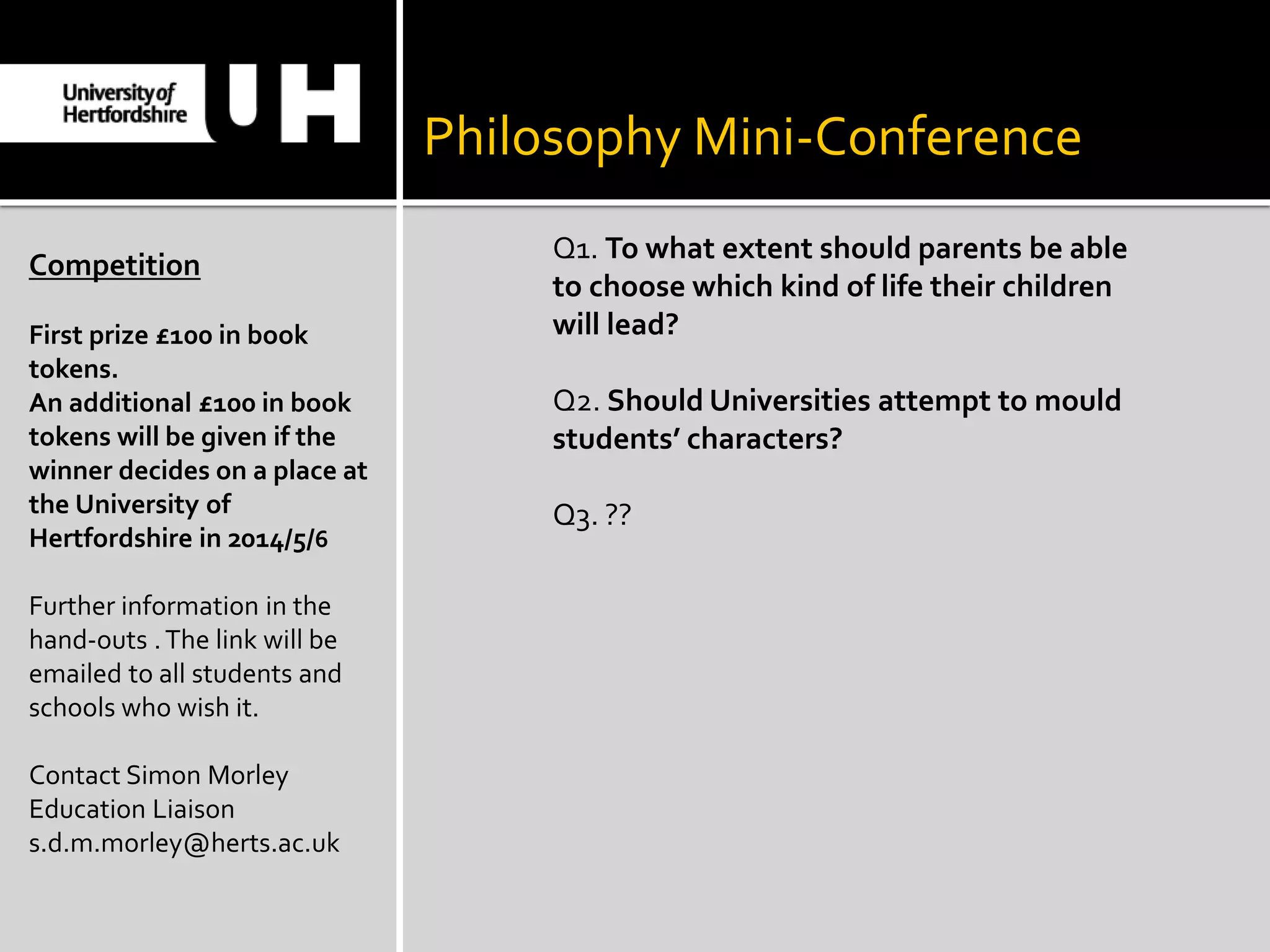
Competition
First prize £100 in book
tokens.
An additional £100 in book
tokens will be given if the
winner decides on a place at
the University of
Hertfordshire in 2014/5/6
Further information in the
hand-outs .The link will be
emailed to all students and
schools who wish it.
Contact Simon Morley
Education Liaison
s.d.m.morley@herts.ac.uk
Q1. To what extent should parents be able
to choose which kind of life their children
will lead?
Q2. Should Universities attempt to mould
students’ characters?
Q3. ??

Mini conference 2014 final

  • 1.
    Philosophy Mini-Conference Timetable 11:00What kindof students do universities want? (Dr Brendan Larvor & Prof John Lippitt) 11:40 Break 11:50 Is it permissible for parents to choose their children’s disabilities? (Dr Craig Bourne) 12:30 Lunch 13:30 How to Succeed at University (Philosophy Students) 13:50 Break 14:00 How to see your own brain without surgery (Dr Sam Coleman) 14:40 End Welcome!
  • 2.
    What kind ofstudents do universities want? Dr Brendan Larvor Professor John Lippitt www.herts.ac.uk/philosophy
  • 3.
  • 4.
    Ethos • Army: physicalcourage and obedient loyalty • Priesthood: piety and giving of self • University: rigorous, gleeful curiosity
  • 5.
    What should astudent hope for from university education?
  • 6.
  • 7.
    UH Graduate Attributes Professionalism,employability and enterprise The University promotes professional integrity and provides opportunities to develop the skills of communication, independent and team working, problem solving, creativity, digital literacy, numeracy and self-management. Our graduates will be confident, act with integrity, set themselves high standards and have skills that are essential to their future lives. Learning and research skills The University fosters intellectual curiosity and provides opportunities to develop effective learning and research abilities. Our graduates will be equipped to seek knowledge and to continue learning throughout their lives.
  • 8.
    UH Graduate Attributes Intellectualdepth, breadth and adaptability The University encourages engagement in curricular, co-curricular and extracurricular activities that deepen and broaden knowledge and develop powers of analysis, application, synthesis, evaluation and criticality. Our graduates will be able to consider multiple perspectives as they apply intellectual rigour and innovative thinking to the practical and theoretical challenges they face.
  • 9.
    UH Graduate Attributes Respectfor others The University promotes self-awareness, empathy, cultural awareness and mutual respect. Our graduates will have respect for themselves and others and will be courteous, inclusive and able to work in a wide range of cultural settings. Social responsibility The University promotes the values of ethical behaviour, sustainability and personal contribution. Our graduates will understand how their actions can enhance the wellbeing of others and will be equipped to make a valuable contribution to society.
  • 10.
    Essay Question Should Universitiesattempt to mould students’ characters?
  • 11.
  • 12.
    Learning Resources How professorswrite Acknowledgements This essay was improved by conversations with a large number of people who helped debug it. Particular thanks to Jeff Dutky <dutky@wam.umd.edu>, who suggested the “debugging is parallelizable” formulation, and helped develop the analysis that proceeds from it. Also to Nancy Lebovitz <nancyl@universe.digex.net> for her suggestion that I emulate Weinberg by quoting Kropotkin. Perceptive criticisms also came from Joan Eslinger <wombat@kilimanjaro.engr.sgi.com> and Marty Franz <marty@net-link.net> of the General Technics list. Glen Vandenburg <glv@vanderburg.org> pointed out the importance of self- selection in contributor populations and suggested the fruitful idea that much development rectifies `bugs of omission'; Daniel Upper <upper@peak.org> suggested the natural analogies for this. I'm grateful to the members of PLUG, the Philadelphia Linux User's group, for providing the first test audience for the first public version of this essay. Paula Matuszek <matusp00@mh.us.sbphrd.com> enlightened me about the practice of software management. Phil Hudson <phil.hudson@iname.com> reminded me that the social organization of the hacker culture mirrors the organization of its software, and vice-versa. John Buck <johnbuck@sea.ece.umassd.edu> pointed out that MATLAB makes an instructive parallel to Emacs. Russell Johnston <russjj@mail.com> brought me to consciousness about some of the mechanisms discussed in ``How Many Eyeballs Tame Complexity.'' Finally, Linus Torvalds's comments were helpful and his early endorsement very encouraging.
  • 13.
    What kind ofstudents do universities want? All of those graduate attributes! But above all… Sociable Curiosity
  • 14.
    What kind ofstudents do universities want? • The core of these ‘graduate attributes’ is in fact a cluster of ethical and intellectual virtues. • For instance: Successful team-working typically requires patience and trust. In many circumstances, it also requires a subtle blend of pride (in our work) and humility (recognition of what we owe to others and of the defeasibility of our own judgements). • Plus gratitude, hopefulness, justice and – sometimes – the capacity for forgiveness. • Student comment: “Talk about graduate attributes can be too dogmatic ... Cultivate the virtues and you get them straight away.”
  • 15.
    What kind ofstudents do universities want? ‘Today’s university students will be tomorrow’s doctors, engineers, business managers, teachers, faith leaders, politicians, citizens, activists, parents and neighbours. While they need to be able to demonstrate key skills and knowledge …, they must also demonstrate good character in carrying out these responsibilities ... In recent history ... moral and social aims of higher education have been overshadowed by emphases on instrumental and economic goals, including employability skills and preparation for the workplace.’ K. M. Quinlan (2012). ‘Developing the whole student: leading higher education initiatives that integrate mind and heart’. But might the former enhance the latter?
  • 16.
    Where is thephilosophy in all this? Philosophers have been thinking about virtues since ancient times • What is a virtue? • Which are the most important virtues? • How do they relate to each other? • … to moral laws? • … to the good life?
  • 17.
    Where is thephilosophy in all this? Modern ethics is complicated by a distinctively modern value: Autonomy What gives an institution the right to mould people’s characters? Immanuel Kant (1724 – 1804)
  • 18.
    Where is thephilosophy in all this? Philosophy starts when two apparently reasonable thoughts conflict
  • 19.
    Who was that? BrendanLarvor Reader in Philosophy John Lippitt Professor of Ethics and Philosophy of Religion
  • 20.
    Philosophy Mini-Conference Timetable 11:40 Break 11:50Is it permissible for parents to choose their children’s disabilities? (Dr Craig Bourne) 12:30 Lunch 13:30 How to Succeed at University (Philosophy Students) 13:50 Break 14:00 How to see your own brain without surgery (Dr Sam Coleman) 14:40 What next? 14:45 End
  • 21.
    Dr Craig Bourne PhilosophyMini-Conference, 2014 University of Hertfordshire
  • 22.
    • The lifethat a child leads is determined to a large extent by the choices that its parent/guardian makes on the child’s behalf. • These choices go beyond (e.g.) allowing the child to eat sweets or to watch a certain film. Many choices will affect what the child will be able to choose as an adult. • e.g. deciding whether a child will undergo a physical procedure (a course of growth hormones, circumcision, etc.) will determine certain choices that the child can make as an adult. • e.g. not giving a child piano lessons from an early age will make it unlikely that they would be in a position to be a great pianist as an adult. • Some of the decisions that a parent makes for a child might not be considered harmful but (at best) unfortunate for that adult. • e.g. being a good pianist but not a great pianist might well be a source of pain. The adult may well feel that the parent limited their opportunities. But we might think that it goes too far to say that the parent harmed their child. • However, limiting opportunities in some cases might be thought to be more serious and the parent might be thought to be harming the child in making these decisions. Let’s consider two cases where some think the parent has harmed the child in this way – one concerning education and the other concerning physical ability.
  • 23.
  • 24.
    Joel Feinberg (1980)‘The Child’s Right to an Open Future’, writes about this case (Wisconsin v. Yoder, 1972): ‘The aim of Amish education is to prepare the young for a life of industry and piety by transmitting to them the unchanged farming and household methods of their ancestors and a thorough distrust of modern techniques and styles … [T]he Amish have always tried their best to insulate their communities from external influences … Their own schools teach only enough reading to make a lifetime of Bible study possible, only enough arithmetic to permit the keeping of budget books and records of simple commercial transactions. Four or five years of this, plus exercises in sociality, devotional instruction, inculcation of traditional virtues, and on-the-job training in simple crafts of field, shop, or kitchen are all that is required, in a formal way, to prepare children for the traditional Amish way of life to which their parents are bound by the most solemn commitments.’
  • 25.
    ‘Amish [parents] …had been convicted of violating … compulsory school attendance law (which requires attendance until the age of sixteen) by refusing to send their children to … school after they had graduated from the eighth grade. The Court acknowledged that the case required a balancing of legitimate interests … …but concluded that the interest of the parents in determining the religious upbringing of their children out-weighed the claim of the state … “to extend the benefit of secondary education to children regardless of the wishes of their parents.”’ Questions: Which interests are in conflict? Which are more important to protect? Have the parents deprived their children by limiting the options the child could choose for its future (e.g. going to university)? Is it more important to preserve the existence of different ways of life? From whose point of view should we judge which options are
  • 26.
    • The childshould grow up able to choose a lifestyle which is not deficient according to their own value system • Contrast with what is deficient according to our value system. The fact that we would not choose the Amish lifestyle does not mean the Amish lifestyle falls short of the child’s values • Successful vs. unsuccessful acculturation. A parent who adopts a religion or culture as a fad and imposes it on the child without developing a coherent corresponding value system will not raise a child whose opportunities are in accord with his values. This would be a genuine limitation of the opportunities to the child. • But a child who is brought up with Amish values, it seems, is in a different situation. The child will not agree that opportunities have been limited because those opportunities (e.g. university) are not opportunities that the child values. • Nevertheless, might we still wonder whether there should be a limitation on which values a child could be brought up to have? What reason, if any, could we give for such a limitation?
  • 27.
  • 28.
    Jonathan Glover, inChoosing Children (2006), writes about this case: ‘In 2002 a lesbian couple, Sharon Duchesneau and Candy McCullough, who are both deaf, used sperm donated by a friend with hereditary deafness to have a deaf baby. … During her pregnancy, Sharon Duchesneau said, “It would be nice to have a deaf child who is the same as us … A hearing baby would be a blessing. A deaf baby would be a special blessing.”’
  • 29.
    • Peter Garrett,research director for LIFE: ‘To deprive a baby of a natural faculty is unethical behaviour….We are saying no to deselecting a baby because it is deaf, and no to deliberately choosing to have a deaf baby.’ • Dr Richard Nicholson, editor of the Bulletin of Medical Ethics: ‘This is an inevitable result of deciding that we allow people to have a choice over what sort of child they are going to produce.’ • Dr Vivienne Nathanson, head of science and ethics at the British Medical Association: ‘There are two sides….I think most people would say it was a bad thing.’ • Nancy Rarus, from US National Association for the Deaf said: ‘I can't understand why anybody would want to bring a disabled child into the world.’ • Stephen Rooney, spokesman for the British Deaf Association: ‘The real issue is not whether people are trying to design deaf babies, but how society currently denies deaf children … the same rights, responsibilities, opportunities and quality of life as everyone.’
  • 30.
    • What is‘disability’? • What (if anything) is the child ‘deprived’ of? • Did the parents do a ‘bad thing’? Was it ‘unethical behaviour’?
  • 31.
    • What isthe standard for a disability? • Statistical normality? • Consider: high intelligence; obesity • How one would prefer to be? • Consider: average looking; comfortable but not wealthy • What it takes to flourish as a person? • Disabilities are differences which restrict a person. How should these restrictions be captured? • Medical models vs. social models of disability • Disability is perhaps best understood as involving both components (medical and social) • Nevertheless, even if we adopt the social model, we could ask whether it was wrong to bring a deaf child into the world at a stage where it counts as a disability because society has made it so.
  • 32.
    • The statusof testimonial evidence for disabilities restricting flourishing • Judgements of how much a particular sense – such as hearing – contributes to human flourishing may differ from person to person. In particular, judgements from someone who has this sense may differ from judgements from someone who lacks it, since different experience informs their evaluations. • It is not clear that a hearing person’s estimate of the value of hearing would be a reliable guide to precisely what value hearing would contribute to the deaf person’s life. • From a hearing person’s perspective, the deaf person may legitimately be judged worse off than the hearing person in certain ways. (Such as not being able to experience some aspects of music.) • But this does not mean the deaf person should make the same judgement, since what the deaf person attaches value to is going to be informed by her experiences.
  • 33.
    • By selectinga different donor, the parents could have reduced the chances of having a deaf child • But they would not have reduced the chances of that child – the one they actually had – being deaf • That child exists as the product of a process involving a deaf donor, and would not have existed otherwise. • Had a different donor been selected, another child would have existed • So the actual child cannot be said to have been deprived of hearing. Thus the parents cannot be judged to have done anything bad on that score. ‘No children were harmed in the making of this child.’ • What they did was bring someone into existence who would not have existed other than by this process.
  • 34.
    • …although nochild was harmed, it might be thought that it would have been better to bring a different child into existence. So given the parents had a choice over whether to bring a deaf or a hearing child into existence, they should have brought a hearing child into existence. • One might acknowledge that the deaf person does not value hearing and cannot be said to have been deprived of it… • …but think that this is a bad thing because what they value is in some way impoverished. • But what makes some values impoverished? • Building in unjust inequalities (e.g. women growing up with beliefs that allow them to be satisfied with having fewer opportunities than men) • Are Amish values impoverished? Are deaf-community values impoverished? • Doesn’t it make a difference that the child finds positive value in some things associated with the foreclosing of options? (For these children, the Amish lifestyle or the deaf lifestyle is characterised partly by a distinctive value system.)
  • 35.
    Philosophy Mini-Conference Timetable 12:30 Lunch 13:30How to Succeed at University (Philosophy Students) 13:50 Break 14:00 How to see your own brain without surgery (Dr Sam Coleman) 14:40 What next? 14:45 End
  • 36.
    How to Succeedat University (Philosophy Students)
  • 37.
    Philosophy Mini-Conference Timetable 13:50 Break 14:00How to see your own brain without surgery (Dr Sam Coleman) 14:40 What next? 14:45 End
  • 38.
    Phenomenal Consciousness andthe Physical World Public Philosophy Lecture at the University of Hertfordshire This free of charge lecture is the final event in the four-year Phenomenal Qualities Project, a series of events supported by the Arts and Humanities Research Council as part of an investigation into the nature of sensory experience. University of Hertfordshire Professor Paul Coates is the Principal Investigator of the project and will give a talk about the research work that has been carried out. Wednesday 12 February at 19:00 N003, de Havilland Lane Campus More information and booking
  • 39.
    Philosophy Mini-Conference Competition First prize£100 in book tokens. An additional £100 in book tokens will be given if the winner decides on a place at the University of Hertfordshire in 2014/5/6 Further information in the hand-outs .The link will be emailed to all students and schools who wish it. Contact Simon Morley Education Liaison s.d.m.morley@herts.ac.uk Q1. To what extent should parents be able to choose which kind of life their children will lead? Q2. Should Universities attempt to mould students’ characters? Q3. ??

Editor's Notes

  • #4 Collect answers from audience before revealing images. Expect students to say “educating me”.
  • #6  Collect answers from audience. When all answers in, ask: do you expect university to change you as a person? Is it the university’s job to manage personal change? Then reveal attributes which show that top corridor thinks the answer is ‘yes’.
  • #10 Highlight ethical terms
  • #12 Ask: what learning resources are available to you? Prediction: no-one will say “Other students”
  • #13 Ask: what learning resources are available to you? Prediction: no-one will say “Other students”
  • #14 All uni websites have versions of this picture—because more lovely people is better but also because group-work is central to HE
  • #16 Graduate employer at Bham: ‘The first lot of job applications we put in the bin are from those we don’t think we could trust’.
  • #19 Remind that this is the essay question