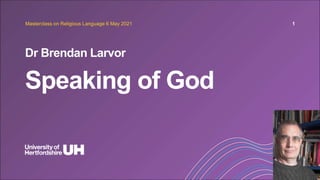
Speaking of God
Dr Brendan Larvor
Masterclass on Religious Language 6 May 2021 1
2
• cognitive/non-cognitive distinction
• verification principle
• falsification criterion.
• Wittgenstein
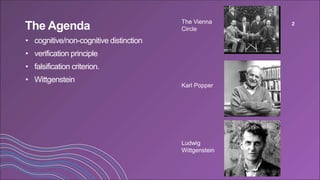
The Agenda The Vienna
Circle
Karl Popper
Ludwig
Wittgenstein
Preliminaries: Which language? Who’s speaking?
Jesus said to some theologians, “Who do you say that I am?”
They replied, “You are the eschatological manifestation of the ground of our being,
in the kerygma of which we find the ultimate meaning of our interpersonal
relationships.”
And Jesus said, “What?”
Masterclass on Religious Language 6 May 2021 3
Preliminaries: Which language? Who’s speaking?
“Please be seated.”
“We will now sing hymn 253.”
“Thou shalt not commit adultery.”
“God is love.”
“There is just one god.”
Masterclass on Religious Language 6 May 2021 4
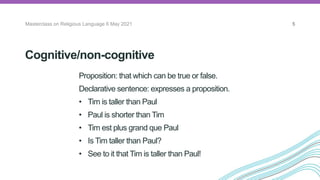
Cognitive/non-cognitive
Proposition: that which can be true or false.
Declarative sentence: expresses a proposition.
• Tim is taller than Paul
• Paul is shorter than Tim
• Tim est plus grand que Paul
• Is Tim taller than Paul?
• See to it that Tim is taller than Paul!
Masterclass on Religious Language 6 May 2021 5
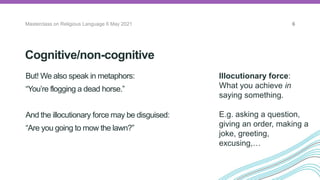
Cognitive/non-cognitive
But! We also speak in metaphors:
“You’re flogging a dead horse.”
And the illocutionary force may be disguised:
“Are you going to mow the lawn?”
Masterclass on Religious Language 6 May 2021 6
Illocutionary force:
What you achieve in
saying something.
E.g. asking a question,
giving an order, making a
joke, greeting,
excusing,…
Cognitive/non-cognitive
Masterclass on Religious Language 6 May 2021 7
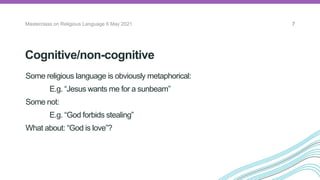
Some religious language is obviously metaphorical:
E.g. “Jesus wants me for a sunbeam”
Some not:
E.g. “God forbids stealing”
What about: “God is love”?
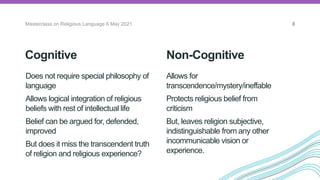
Cognitive
Does not require special philosophy of
language
Allows logical integration of religious
beliefs with rest of intellectual life
Belief can be argued for, defended,
improved
But does it miss the transcendent truth
of religion and religious experience?
Allows for
transcendence/mystery/ineffable
Protects religious belief from
criticism
But, leaves religion subjective,
indistinguishable from any other
incommunicable vision or
experience.
Masterclass on Religious Language 6 May 2021 8
Non-Cognitive
Cognitive/non-cognitive
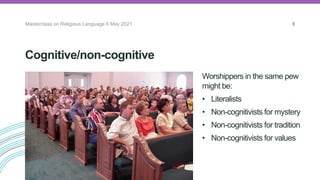
Worshippers in the same pew
might be:
• Literalists
• Non-cognitivists for mystery
• Non-cognitivists for tradition
• Non-cognitivists for values
Masterclass on Religious Language 6 May 2021 9
Verification Principle
Masterclass on Religious Language 6 May 2021 10
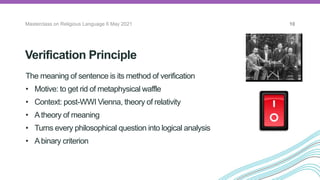
The meaning of sentence is its method of verification
• Motive: to get rid of metaphysical waffle
• Context: post-WWI Vienna, theory of relativity
• Atheory of meaning
• Turns every philosophical question into logical analysis
• Abinary criterion
The Vienna
Circle
Verification Principle: problems
Masterclass on Religious Language 6 May 2021 11
The meaning of sentence is its method of verification
• How to fine-tune it to keep physics verifiable but metaphysics
unverifiable?
• The fine-tuning embarrassingly obvious and ad hoc
• What about ethics?
• Is the verification principle verifiable?
The Vienna
Circle
Falsification Principle
Masterclass on Religious Language 6 May 2021 12
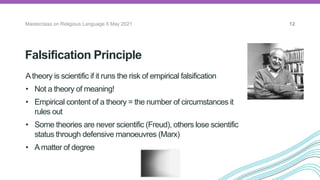
Atheory is scientific if it runs the risk of empirical falsification
• Not a theory of meaning!
• Empirical content of a theory = the number of circumstances it
rules out
• Some theories are never scientific (Freud), others lose scientific
status through defensive manoeuvres (Marx)
• Amatter of degree
The Vienna
Circle
Falsification Principle
Masterclass on Religious Language 6 May 2021 13
Atheory is scientific if it runs the risk of empirical falsification
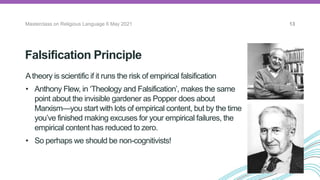
• Anthony Flew, in ‘Theology and Falsification’, makes the same
point about the invisible gardener as Popper does about
Marxism—you start with lots of empirical content, but by the time
you’ve finished making excuses for your empirical failures, the
empirical content has reduced to zero.
• So perhaps we should be non-cognitivists!
The Vienna
Circle
Ludwig Wittgenstein (1889-1951)
Masterclass on Religious Language 6 May 2021 14
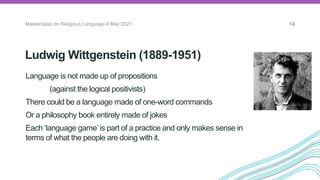
Language is not made up of propositions
(against the logical positivists)
There could be a language made of one-word commands
Or a philosophy book entirely made of jokes
Each ‘language game’ is part of a practice and only makes sense in
terms of what the people are doing with it.
The Vienna
Circle
Ludwig Wittgenstein (1889-1951)
Masterclass on Religious Language 6 May 2021 15
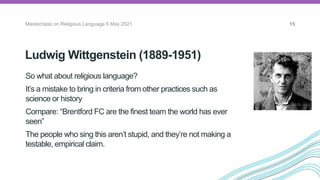
So what about religious language?
It’s a mistake to bring in criteria from other practices such as
science or history
Compare: “Brentford FC are the finest team the world has ever
seen”
The people who sing this aren’t stupid, and they’re not making a
testable, empirical claim.
The Vienna
Circle
Ludwig Wittgenstein (1889-1951)
Masterclass on Religious Language 6 May 2021 16
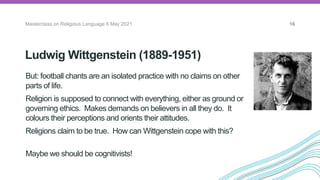
But: football chants are an isolated practice with no claims on other
parts of life.
Religion is supposed to connect with everything, either as ground or
governing ethics. Makes demands on believers in all they do. It
colours their perceptions and orients their attitudes.
Religions claim to be true. How can Wittgenstein cope with this?
Maybe we should be cognitivists!
The Vienna
Circle
Thank you
Masterclass on Religious Language 6 May 2021 17

Religious language

  • 1.
    Speaking of God DrBrendan Larvor Masterclass on Religious Language 6 May 2021 1
  • 2.
    2 • cognitive/non-cognitive distinction •verification principle • falsification criterion. • Wittgenstein The Agenda The Vienna Circle Karl Popper Ludwig Wittgenstein
  • 3.
    Preliminaries: Which language?Who’s speaking? Jesus said to some theologians, “Who do you say that I am?” They replied, “You are the eschatological manifestation of the ground of our being, in the kerygma of which we find the ultimate meaning of our interpersonal relationships.” And Jesus said, “What?” Masterclass on Religious Language 6 May 2021 3
  • 4.
    Preliminaries: Which language?Who’s speaking? “Please be seated.” “We will now sing hymn 253.” “Thou shalt not commit adultery.” “God is love.” “There is just one god.” Masterclass on Religious Language 6 May 2021 4
  • 5.
    Cognitive/non-cognitive Proposition: that whichcan be true or false. Declarative sentence: expresses a proposition. • Tim is taller than Paul • Paul is shorter than Tim • Tim est plus grand que Paul • Is Tim taller than Paul? • See to it that Tim is taller than Paul! Masterclass on Religious Language 6 May 2021 5
  • 6.
    Cognitive/non-cognitive But! We alsospeak in metaphors: “You’re flogging a dead horse.” And the illocutionary force may be disguised: “Are you going to mow the lawn?” Masterclass on Religious Language 6 May 2021 6 Illocutionary force: What you achieve in saying something. E.g. asking a question, giving an order, making a joke, greeting, excusing,…
  • 7.
    Cognitive/non-cognitive Masterclass on ReligiousLanguage 6 May 2021 7 Some religious language is obviously metaphorical: E.g. “Jesus wants me for a sunbeam” Some not: E.g. “God forbids stealing” What about: “God is love”?
  • 8.
    Cognitive Does not requirespecial philosophy of language Allows logical integration of religious beliefs with rest of intellectual life Belief can be argued for, defended, improved But does it miss the transcendent truth of religion and religious experience? Allows for transcendence/mystery/ineffable Protects religious belief from criticism But, leaves religion subjective, indistinguishable from any other incommunicable vision or experience. Masterclass on Religious Language 6 May 2021 8 Non-Cognitive
  • 9.
    Cognitive/non-cognitive Worshippers in thesame pew might be: • Literalists • Non-cognitivists for mystery • Non-cognitivists for tradition • Non-cognitivists for values Masterclass on Religious Language 6 May 2021 9
  • 10.
    Verification Principle Masterclass onReligious Language 6 May 2021 10 The meaning of sentence is its method of verification • Motive: to get rid of metaphysical waffle • Context: post-WWI Vienna, theory of relativity • Atheory of meaning • Turns every philosophical question into logical analysis • Abinary criterion The Vienna Circle
  • 11.
    Verification Principle: problems Masterclasson Religious Language 6 May 2021 11 The meaning of sentence is its method of verification • How to fine-tune it to keep physics verifiable but metaphysics unverifiable? • The fine-tuning embarrassingly obvious and ad hoc • What about ethics? • Is the verification principle verifiable? The Vienna Circle
  • 12.
    Falsification Principle Masterclass onReligious Language 6 May 2021 12 Atheory is scientific if it runs the risk of empirical falsification • Not a theory of meaning! • Empirical content of a theory = the number of circumstances it rules out • Some theories are never scientific (Freud), others lose scientific status through defensive manoeuvres (Marx) • Amatter of degree The Vienna Circle
  • 13.
    Falsification Principle Masterclass onReligious Language 6 May 2021 13 Atheory is scientific if it runs the risk of empirical falsification • Anthony Flew, in ‘Theology and Falsification’, makes the same point about the invisible gardener as Popper does about Marxism—you start with lots of empirical content, but by the time you’ve finished making excuses for your empirical failures, the empirical content has reduced to zero. • So perhaps we should be non-cognitivists! The Vienna Circle
  • 14.
    Ludwig Wittgenstein (1889-1951) Masterclasson Religious Language 6 May 2021 14 Language is not made up of propositions (against the logical positivists) There could be a language made of one-word commands Or a philosophy book entirely made of jokes Each ‘language game’ is part of a practice and only makes sense in terms of what the people are doing with it. The Vienna Circle
  • 15.
    Ludwig Wittgenstein (1889-1951) Masterclasson Religious Language 6 May 2021 15 So what about religious language? It’s a mistake to bring in criteria from other practices such as science or history Compare: “Brentford FC are the finest team the world has ever seen” The people who sing this aren’t stupid, and they’re not making a testable, empirical claim. The Vienna Circle
  • 16.
    Ludwig Wittgenstein (1889-1951) Masterclasson Religious Language 6 May 2021 16 But: football chants are an isolated practice with no claims on other parts of life. Religion is supposed to connect with everything, either as ground or governing ethics. Makes demands on believers in all they do. It colours their perceptions and orients their attitudes. Religions claim to be true. How can Wittgenstein cope with this? Maybe we should be cognitivists! The Vienna Circle
  • 17.
    Thank you Masterclass onReligious Language 6 May 2021 17