Minerals in India
- Key Strategies in the 12th Five Year Plan
MINERAL WEALTH AND MINING
– Mineral assets play a direct role in the growth
  and prosperity and hence substantial
  investments is essential for exploration of
  these assets through different agencies
  having the requisite skills
– India having 2.4% of the global area, sustains
  17.5% (Census-2011) of the world
  population.
– Our per capita consumption of minerals and
  its products is one of the lowest in the world.
• India has vast mineral potential but
    insufficient exploration technology.
•   The demand for various metals and minerals
    will grow 4-5 times over the next 15 years (9-
    11% growth per annum).
•   The aspiration of the mining sector in the GDP
    is to increase from the current contribution of
    2.3% to around 7-8% over the next 20 years.
•   The mining sector needs to play a major role
    if India has to realize the potential growth of
    9% per annum in the coming years.
Key Objectives Under the Twelfth
Plan

• The mining sector is strategically very
    important for India. The key goals that need
    to be met for this space are:
•   Raw material security: for all the user
    industries
•   Enhanced co-production of by-product metals
    for technology metals and energy critical
    metals
•   Ensuring sustainability of the environment
Key Recommendations
A. Strengthening of Institutions
• Equip and position public agencies like the Mineral
    Exploration Corporation Limited, Directorates of
    States and other organisations to conduct detailed
    exploration at the State’s expense to enable the State
    Government to adopt a bidding route for exploration
    to a larger extent.
•   Position GSI to emphasise on geospatial and multi-
    disciplinary work for the benefit of science, society
    and the nation.
•   An overarching mechanism to provide policy direction
    for geosciences is a must.
B. Encouraging R&D and Technology
  Development
• Engage IBM to drive process of giving
  special focus in select areas of mining.
• Strengthen the Mineral Process
  Laboratories of IBM and other research
  organisations must before the
  development of processes for
  beneficiation, elemental analysis of ores.
• Inspire concessionaires to undertake
  deposit-specific process R&D.
C. Institutional Mechanism
• Develop an institutional mechanism for the
  direct lab scale research to commercialisation
  for the production of materials of high purity,
• Reorient focus of organisations like Non-
  Ferrous Technology Development Centre,
  Jawaharlal Nehru Aluminium Research
• Development and Design Centre on process
  R&D for Technology and Energy Critical
  Metals.
• Creation of Infrastructure
• Skill Development
• Ensuring Full and Productive Coverage
  of Survey and Exploration
• A Database of Mineral Resources Needs
  to be Developed
• Ensuring Availability of Financial
  Resources
• Policy Changes in Line with the Overall
  Strategy
Ensuring Environmental Sustainability of Mining
• Promote a scientific and efficient process of small scale mining of
    small deposits
•   Regulations related to safeguarding the ecology must be ensured
    and their compliance strengthened.
•   A cluster approach must be adopted with a single lease model for
    multiple small deposits within a defined area
•   Undertake all mining undertaken within the parameters of a
    comprehensive Sustainable Development Framework
•   Under such a framework, no mining lease should be granted
    without a proper mining plan including an approved environment
•   management plan.
•   For this purpose, the IBM must acquire the expertise to approve
    Environment Management Plans and conduct
•   Environmental Impact Assessments. Thus, the IBM should be able
    to position itself as the internal environmental regulator as well as
    the official mining regulator for the sector.
GEOLOGICAL SURVEY OF INDIA
                  Baseline Geoscience Data Generation
Main Activities
A. GROUND SURVEYS
     Systematic Geological Mapping (GM)
     Specialized Thematic Mapping (STM)
     Geochemical Mapping (GCM)
     Geophysical Mapping (GPM)

B. REMOTE SENSING AND AERIAL SURVEYS
     Geomorphological Survey
     Hyperspectral Survey
     Airborne Mineral Survey
     Photogeology and Remote Sensing

C. MARINE AND COASTAL SURVEY
     Marine Survey
     Coastal Survey
     Marine Geotechnics
Strategy (XIIth Plan)

  Adaptation of the state-of-the-art technology to
explore deep seated / concealed deposits.

  Intensive search for new mineral findings based on
baseline data generated by GSI and other agencies.

  Complete NGCM and National Aeromagnetics and
HSM of OGP by end of XII Plan and rest of the country
by end of XIII Plan.

 Intensive search on priority basis for minerals in
which the country is deficient or scarce.

  The strategy requires application of different
advance techniques for regional and detailed
exploration.
Strategy for XII Plan
1. Thrust for quality data generation by infusing technology
    Field laptop or table PC, GPS, GSI portal accessibility, digital toposheets
    with facility for data capture using wireless network mobile mapping van
    with portable generator.
    GPM High precision gravimeter and total field magnetometer.
    Geomorphological mapping- acquiring new generation satellite data
    preparation of DEM for lineament detection.
    Hyperspectral survey- procurement of softwares, space and airborne
    hyperion data with spectral range- seek help from USGS and Australian
    source through World bank.
    Acquisition of advance filtering image processing technics for
    enhansment of magnetic and radiometric data collected in high accuracy
    sensors from aeromag survey.

2. Integrated thematic mapping is proposed.
    Surface mapping with multi disciplinary inputs.
    Undertaking GPM over the NGCM covered areas obtaining complimentary
    gravity and magnetic data.
    Digital overlay of multidisciplinary data for 3D modeling to locate
    concealed/ deep seated ore bodies.
Thrust Areas (XII Plan)
GSI to complete geophysical and geochemical mapping expeditiously

The Geomorphological and Lineament Mapping (GMM) on 1:50,000

Complete National Geochemical mapping (NGCM) of the Obvious
Geological Potential (OGP) areas by end of 12th Plan and rest of
country of 13th Plan.

Hyper Spectral Mapping (HSM) in OGP areas on 1:50,000 scale by
end of 12th Plan.

National Aeromagnetic Surveys by the GSI in comprehensive and
systematic manner for OGP by end of 12th Plan and rest of the
country (including off-shore) by end of 13th Plan.

Exploration for deep-seated mineral deposits through modern
technology infusion.
Thrust Areas (XII Plan)
Prepare and implement project to enable 1:50 K geological,
geophysical, and geochemical maps to be made available thru
internet in GIS platform in line with international practice.

Special attention for exploration for strategic, scarce and deficit
minerals to reduce imports.

Create National Geophysical Data Repository and National Core
Repository, to assist entrepreneurs to take-up exploration.

 GSI to procure another Ocean Going Research Vessel (OGRV); Geo-
technical Vessel (GTV) and Coastal Launches for offshore and coastal
geoscience work.

 Create and enhance capacity offshore / Coastal geoscience including
Coastal geomorphology and beach sand / tidal deposit resources.
Systematic Geological Mapping (GM)

 Major part of country is systematically
 mapped on 1:50,000 scale.

 It has brought out 5.71 lakh sq km of OGP
 areas.

 Priority during XII Plan is to undertake
 2400 km2 in Manipur and Nagaland.
Specialized Thematic Mapping (STM)
Geological mapping on 1:25,000 scale on special themes to
resolve problems in establishing stratigraphy and tectonics,
to bring our crustal evolution, to understand metallogenesis,
to study geological processes and to prognosticate areas for
future exploration.

By the end of XI Plan an area of about 1,66,000 sq km has
been covered under this programme. A target of 80,000 km2
is planned for XII Plan covering the areas in OGP (almost all
mineral belts spread over cratons like Dharwar, Bastar,
Singbum, Bundalkhand).

Studies on Deccan trap, Biostratigraphic studies in Siwaliks,
lithostratigraphy in NER, Proterozoic granitoids study in
Sikkim, phases of granitic activity in Aravalli fold belt,
Mesozoic –Tertiary study in Jaisalmer and coastal dynamic
study in Kuchch.

Studies in Eastern Ghat Mobile belt, Pakhals and in Southern
Granulite Terrain.
Geochemical Mapping

  It picks up anomalies and provides information of elemental
concentrations in the areas mapped.

  It has significant application in the domains of mineral search
(concealed deposits), and societal relevance in agriculture, study of
environmental degradation and hazards, and human health aspects
(water pollution, mining waste pollution)

   The GSI initiated programme in FSP 2001-02 targeting to cover
8.13 lakh sq.km encompassing OGP and contiguous areas and
completed about 3.15 lakh sq.km till January 2013. In XII plan it is
envisaged to cover 2.83 lakh sq.km in OGP areas.
Geophysical Mapping
GPM picks up gravity & magnetic signals of surface
and subsurface rock formations of the earth’s crust.

It has significant application in the delineation of
basement configuration, concealed structures and
lithological variations, through which concealed
mineral deposits can be targeted.

GSI initiated Geophysical Mapping, since FSP 2002-03.
Density of data is one station per 2.5 sq.km.

Till XI Plan 1.66 lakh km2 is covered and during XII
Plan 2.23 lakh sq.km is targeted in OGP area.
National Aeromagnetic mapping programme
• It is taken up for aeromagnetic (Total field) survey on uniform scale at
  national level as joint endeavour with AMD, NGRI, ONGC, DGH and Oil
  India.
• Aim to produce seamless aeromagnetic map.
• 10 fixed wing planes are to be deployed by outsourcing.
• It is targeted to cover 22,70,000 sq.km in XII plan.

    Hyperspectral survey
•    Remote sensing technique using airborne hyperspectral is used as a tool
     for mineral exploration by locating hydrothermal alteration zones.
•    HT altered rocks with secondary minerals have signatures in various
     spectral bands.
•    Started in XI Plan the programme will continue in XII Plan also with
     proposal to create a terrain wise spectral library for all OGP areas.
•    It is proposed to equip centres with spectroradiometer, data processing
     software and hyperspectral RS data.

    Geomorphological and lineament mapping
• National mission was initiated on 1:50,000 scale in XI plan collaboration
  with DoS by outsourcing through 32 partners institutes under the control
  of NRSC. 600 sheets are completed by quality checking.
• In XII Plan 4,400 toposheets will be quality checked (Pre and post field).
Marine & Coastal Survey Division :

Deep Sea Sector: EEZ and beyond

    With the advent of state of art new vessel - close grid seabed
mapping is programmed with multibeam bathymetry, multi-channel
seismic, magnetic, gravity, side scan, deep core sampling, dredge, heat
probe etc. within EEZ.
    The multibeam swath bathymetric survey within the EEZ to be
undertaken jointly by GSI and MoES under an MoU.
    Search for sulphide mineralization in the Andaman Sea within EEZ
and in the Indian Ocean.
    Search for phosphate rich sediments, lime mud, ferromanganese
encrustations, etc within EEZ.
    Geochemical scan for thermogenic hydrocarbons, high resolution
survey for gas hydrate occurrences within EEZ.
    Selection of favourable sites for OTEC and fresh water generation
from sea water.
    Survey for cobalt rich encrustations and polymetallic nodules in
selected sectors near spreading centres of Indian Ocean.
Shallow Water Sector: Continental shelf
     Seabed mapping of the remaining area of Territorial Waters.
     Multibeam swath bathymetric survey of TW and outer continental shelf
to be undertaken jointly by GSI and MoES under a MoU.
     Resource evaluation of offshore relict silica sand
     Search/ assessment of placer mineral resources in the inner shelf
region and preparation of 3-D models of placer deposits
     Generation of Site specific geotechnical data of seabed and sub-seabed
for developmental activities like ports, harbours etc.
    Geotechnical survey for oil field development, drilling platforms, laying
of pipelines and cables etc.
    Studies of near shore areas for understanding coastal processes and the
related dynamics.
    Studies of seabed morphology; study for Archaeological finding.

Coastal surveys:
   Placer Mineral resource evaluation in the beach sand and sand dunes.
   Coastal erosion studies – identify and demarcate areas.
   Environmental impact studies of coastal areas.
   Morphology and evolution of sand bars / spits, coastal lagoons.
OFFSHORE CAPABILITIES
Existing Vessels
      1. R.V. Samudra Manthan (Deep Sea)
      2. R.V. Samudra Kaustubh (Coastal)
      3. R.V. Samudra Shaudhikama (Coastal)

New Ocean Going Vessel (Under Construction)
    1. Samudra Ratnakar

New Proposals
    1. Geotechnical Drilling Vessel
    2. Coastal launches
SCOPE OF FUTURE WORK IN DEEP WATER
                    SECTOR
• Comprehensive topographic mapping of EEZ as part of
  NMP-2008

• Mapping of remaining part of the seabed within EEZ of
  India and multi channel seismic surveys along with deep
  sampling within the EEZ for the preparation of seabed
  map within EEZ of India on 1:500,000 scale

• Mapping of additional EEZ area of about 1.07 million sq.
  km. under Legal Continental shelf

• Geological, geophysical and geochemical surveys, search
  for sulphide mineralisation and other types of studies on
  tectonic set-up of Andaman Sea.
• High resolution surveys for phosphate rich
  sediments, lime mud deposits, ferromanganese
  encrustations, ocean environment in potential
  offshore blocks

• Strategic studies of seabed morphology; geochemical
  scan for thermogenic hydrocarbons, high resolution
  survey in potential areas of gas hydrates
  accumulation; surveys for selection of sites for Ocean
  Thermal Energy Conversion (OTEC) system
  development

• Search for cobalt rich encrustation; polymetallic
  nodules in selected sectors of Indian Ocean.
Airborne Geophysical Surveys
 Acquisition of airborne geophysical data
 Processing of airborne data
 Interpretation of airborne geophysical data
Photo Geology and Remote Sensing
Procurement and interpretation of satellite data
Interpretation of remote sensing and geological data
 Preparation of different Thematic Maps on 1:50,000 scale
 Integration of Remote Sensing, Geological & airborne geophysical data.
 Identification of Target blocks for detailed ground evaluation by Regions
Hyperspectral Mapping
Building up of a spectral library of various rocks/minerals from known
mineralised zones and integrate with similar other datasets to build up a
massive and comprehensive spectral library of native rocks/minerals.
National Geomorphological & Lineament Mapping
[NGL]
Evaluating the quality of the final maps prepared by various work centres under
NRSC
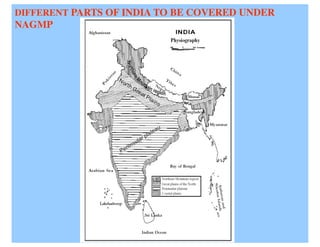
DIFFERENT PARTS OF INDIA TO BE COVERED UNDER
NAGMP

Minerals Sector Presentation - 12th Plan (2012 - 2017)

  • 1.
    Minerals in India -Key Strategies in the 12th Five Year Plan
  • 2.
    MINERAL WEALTH ANDMINING – Mineral assets play a direct role in the growth and prosperity and hence substantial investments is essential for exploration of these assets through different agencies having the requisite skills – India having 2.4% of the global area, sustains 17.5% (Census-2011) of the world population. – Our per capita consumption of minerals and its products is one of the lowest in the world.
  • 3.
    • India hasvast mineral potential but insufficient exploration technology. • The demand for various metals and minerals will grow 4-5 times over the next 15 years (9- 11% growth per annum). • The aspiration of the mining sector in the GDP is to increase from the current contribution of 2.3% to around 7-8% over the next 20 years. • The mining sector needs to play a major role if India has to realize the potential growth of 9% per annum in the coming years.
  • 4.
    Key Objectives Underthe Twelfth Plan • The mining sector is strategically very important for India. The key goals that need to be met for this space are: • Raw material security: for all the user industries • Enhanced co-production of by-product metals for technology metals and energy critical metals • Ensuring sustainability of the environment
  • 5.
    Key Recommendations A. Strengtheningof Institutions • Equip and position public agencies like the Mineral Exploration Corporation Limited, Directorates of States and other organisations to conduct detailed exploration at the State’s expense to enable the State Government to adopt a bidding route for exploration to a larger extent. • Position GSI to emphasise on geospatial and multi- disciplinary work for the benefit of science, society and the nation. • An overarching mechanism to provide policy direction for geosciences is a must.
  • 6.
    B. Encouraging R&Dand Technology Development • Engage IBM to drive process of giving special focus in select areas of mining. • Strengthen the Mineral Process Laboratories of IBM and other research organisations must before the development of processes for beneficiation, elemental analysis of ores. • Inspire concessionaires to undertake deposit-specific process R&D.
  • 7.
    C. Institutional Mechanism •Develop an institutional mechanism for the direct lab scale research to commercialisation for the production of materials of high purity, • Reorient focus of organisations like Non- Ferrous Technology Development Centre, Jawaharlal Nehru Aluminium Research • Development and Design Centre on process R&D for Technology and Energy Critical Metals.
  • 8.
    • Creation ofInfrastructure • Skill Development • Ensuring Full and Productive Coverage of Survey and Exploration • A Database of Mineral Resources Needs to be Developed • Ensuring Availability of Financial Resources • Policy Changes in Line with the Overall Strategy
  • 9.
    Ensuring Environmental Sustainabilityof Mining • Promote a scientific and efficient process of small scale mining of small deposits • Regulations related to safeguarding the ecology must be ensured and their compliance strengthened. • A cluster approach must be adopted with a single lease model for multiple small deposits within a defined area • Undertake all mining undertaken within the parameters of a comprehensive Sustainable Development Framework • Under such a framework, no mining lease should be granted without a proper mining plan including an approved environment • management plan. • For this purpose, the IBM must acquire the expertise to approve Environment Management Plans and conduct • Environmental Impact Assessments. Thus, the IBM should be able to position itself as the internal environmental regulator as well as the official mining regulator for the sector.
  • 10.
    GEOLOGICAL SURVEY OFINDIA Baseline Geoscience Data Generation Main Activities A. GROUND SURVEYS Systematic Geological Mapping (GM) Specialized Thematic Mapping (STM) Geochemical Mapping (GCM) Geophysical Mapping (GPM) B. REMOTE SENSING AND AERIAL SURVEYS Geomorphological Survey Hyperspectral Survey Airborne Mineral Survey Photogeology and Remote Sensing C. MARINE AND COASTAL SURVEY Marine Survey Coastal Survey Marine Geotechnics
  • 11.
    Strategy (XIIth Plan) Adaptation of the state-of-the-art technology to explore deep seated / concealed deposits. Intensive search for new mineral findings based on baseline data generated by GSI and other agencies. Complete NGCM and National Aeromagnetics and HSM of OGP by end of XII Plan and rest of the country by end of XIII Plan. Intensive search on priority basis for minerals in which the country is deficient or scarce. The strategy requires application of different advance techniques for regional and detailed exploration.
  • 12.
    Strategy for XIIPlan 1. Thrust for quality data generation by infusing technology Field laptop or table PC, GPS, GSI portal accessibility, digital toposheets with facility for data capture using wireless network mobile mapping van with portable generator. GPM High precision gravimeter and total field magnetometer. Geomorphological mapping- acquiring new generation satellite data preparation of DEM for lineament detection. Hyperspectral survey- procurement of softwares, space and airborne hyperion data with spectral range- seek help from USGS and Australian source through World bank. Acquisition of advance filtering image processing technics for enhansment of magnetic and radiometric data collected in high accuracy sensors from aeromag survey. 2. Integrated thematic mapping is proposed. Surface mapping with multi disciplinary inputs. Undertaking GPM over the NGCM covered areas obtaining complimentary gravity and magnetic data. Digital overlay of multidisciplinary data for 3D modeling to locate concealed/ deep seated ore bodies.
  • 13.
    Thrust Areas (XIIPlan) GSI to complete geophysical and geochemical mapping expeditiously The Geomorphological and Lineament Mapping (GMM) on 1:50,000 Complete National Geochemical mapping (NGCM) of the Obvious Geological Potential (OGP) areas by end of 12th Plan and rest of country of 13th Plan. Hyper Spectral Mapping (HSM) in OGP areas on 1:50,000 scale by end of 12th Plan. National Aeromagnetic Surveys by the GSI in comprehensive and systematic manner for OGP by end of 12th Plan and rest of the country (including off-shore) by end of 13th Plan. Exploration for deep-seated mineral deposits through modern technology infusion.
  • 14.
    Thrust Areas (XIIPlan) Prepare and implement project to enable 1:50 K geological, geophysical, and geochemical maps to be made available thru internet in GIS platform in line with international practice. Special attention for exploration for strategic, scarce and deficit minerals to reduce imports. Create National Geophysical Data Repository and National Core Repository, to assist entrepreneurs to take-up exploration. GSI to procure another Ocean Going Research Vessel (OGRV); Geo- technical Vessel (GTV) and Coastal Launches for offshore and coastal geoscience work. Create and enhance capacity offshore / Coastal geoscience including Coastal geomorphology and beach sand / tidal deposit resources.
  • 15.
    Systematic Geological Mapping(GM) Major part of country is systematically mapped on 1:50,000 scale. It has brought out 5.71 lakh sq km of OGP areas. Priority during XII Plan is to undertake 2400 km2 in Manipur and Nagaland.
  • 16.
    Specialized Thematic Mapping(STM) Geological mapping on 1:25,000 scale on special themes to resolve problems in establishing stratigraphy and tectonics, to bring our crustal evolution, to understand metallogenesis, to study geological processes and to prognosticate areas for future exploration. By the end of XI Plan an area of about 1,66,000 sq km has been covered under this programme. A target of 80,000 km2 is planned for XII Plan covering the areas in OGP (almost all mineral belts spread over cratons like Dharwar, Bastar, Singbum, Bundalkhand). Studies on Deccan trap, Biostratigraphic studies in Siwaliks, lithostratigraphy in NER, Proterozoic granitoids study in Sikkim, phases of granitic activity in Aravalli fold belt, Mesozoic –Tertiary study in Jaisalmer and coastal dynamic study in Kuchch. Studies in Eastern Ghat Mobile belt, Pakhals and in Southern Granulite Terrain.
  • 17.
    Geochemical Mapping It picks up anomalies and provides information of elemental concentrations in the areas mapped. It has significant application in the domains of mineral search (concealed deposits), and societal relevance in agriculture, study of environmental degradation and hazards, and human health aspects (water pollution, mining waste pollution) The GSI initiated programme in FSP 2001-02 targeting to cover 8.13 lakh sq.km encompassing OGP and contiguous areas and completed about 3.15 lakh sq.km till January 2013. In XII plan it is envisaged to cover 2.83 lakh sq.km in OGP areas.
  • 18.
    Geophysical Mapping GPM picksup gravity & magnetic signals of surface and subsurface rock formations of the earth’s crust. It has significant application in the delineation of basement configuration, concealed structures and lithological variations, through which concealed mineral deposits can be targeted. GSI initiated Geophysical Mapping, since FSP 2002-03. Density of data is one station per 2.5 sq.km. Till XI Plan 1.66 lakh km2 is covered and during XII Plan 2.23 lakh sq.km is targeted in OGP area.
  • 19.
    National Aeromagnetic mappingprogramme • It is taken up for aeromagnetic (Total field) survey on uniform scale at national level as joint endeavour with AMD, NGRI, ONGC, DGH and Oil India. • Aim to produce seamless aeromagnetic map. • 10 fixed wing planes are to be deployed by outsourcing. • It is targeted to cover 22,70,000 sq.km in XII plan. Hyperspectral survey • Remote sensing technique using airborne hyperspectral is used as a tool for mineral exploration by locating hydrothermal alteration zones. • HT altered rocks with secondary minerals have signatures in various spectral bands. • Started in XI Plan the programme will continue in XII Plan also with proposal to create a terrain wise spectral library for all OGP areas. • It is proposed to equip centres with spectroradiometer, data processing software and hyperspectral RS data. Geomorphological and lineament mapping • National mission was initiated on 1:50,000 scale in XI plan collaboration with DoS by outsourcing through 32 partners institutes under the control of NRSC. 600 sheets are completed by quality checking. • In XII Plan 4,400 toposheets will be quality checked (Pre and post field).
  • 20.
    Marine & CoastalSurvey Division : Deep Sea Sector: EEZ and beyond With the advent of state of art new vessel - close grid seabed mapping is programmed with multibeam bathymetry, multi-channel seismic, magnetic, gravity, side scan, deep core sampling, dredge, heat probe etc. within EEZ. The multibeam swath bathymetric survey within the EEZ to be undertaken jointly by GSI and MoES under an MoU. Search for sulphide mineralization in the Andaman Sea within EEZ and in the Indian Ocean. Search for phosphate rich sediments, lime mud, ferromanganese encrustations, etc within EEZ. Geochemical scan for thermogenic hydrocarbons, high resolution survey for gas hydrate occurrences within EEZ. Selection of favourable sites for OTEC and fresh water generation from sea water. Survey for cobalt rich encrustations and polymetallic nodules in selected sectors near spreading centres of Indian Ocean.
  • 21.
    Shallow Water Sector:Continental shelf Seabed mapping of the remaining area of Territorial Waters. Multibeam swath bathymetric survey of TW and outer continental shelf to be undertaken jointly by GSI and MoES under a MoU. Resource evaluation of offshore relict silica sand Search/ assessment of placer mineral resources in the inner shelf region and preparation of 3-D models of placer deposits Generation of Site specific geotechnical data of seabed and sub-seabed for developmental activities like ports, harbours etc. Geotechnical survey for oil field development, drilling platforms, laying of pipelines and cables etc. Studies of near shore areas for understanding coastal processes and the related dynamics. Studies of seabed morphology; study for Archaeological finding. Coastal surveys: Placer Mineral resource evaluation in the beach sand and sand dunes. Coastal erosion studies – identify and demarcate areas. Environmental impact studies of coastal areas. Morphology and evolution of sand bars / spits, coastal lagoons.
  • 22.
    OFFSHORE CAPABILITIES Existing Vessels 1. R.V. Samudra Manthan (Deep Sea) 2. R.V. Samudra Kaustubh (Coastal) 3. R.V. Samudra Shaudhikama (Coastal) New Ocean Going Vessel (Under Construction) 1. Samudra Ratnakar New Proposals 1. Geotechnical Drilling Vessel 2. Coastal launches
  • 23.
    SCOPE OF FUTUREWORK IN DEEP WATER SECTOR • Comprehensive topographic mapping of EEZ as part of NMP-2008 • Mapping of remaining part of the seabed within EEZ of India and multi channel seismic surveys along with deep sampling within the EEZ for the preparation of seabed map within EEZ of India on 1:500,000 scale • Mapping of additional EEZ area of about 1.07 million sq. km. under Legal Continental shelf • Geological, geophysical and geochemical surveys, search for sulphide mineralisation and other types of studies on tectonic set-up of Andaman Sea.
  • 24.
    • High resolutionsurveys for phosphate rich sediments, lime mud deposits, ferromanganese encrustations, ocean environment in potential offshore blocks • Strategic studies of seabed morphology; geochemical scan for thermogenic hydrocarbons, high resolution survey in potential areas of gas hydrates accumulation; surveys for selection of sites for Ocean Thermal Energy Conversion (OTEC) system development • Search for cobalt rich encrustation; polymetallic nodules in selected sectors of Indian Ocean.
  • 25.
    Airborne Geophysical Surveys Acquisition of airborne geophysical data Processing of airborne data Interpretation of airborne geophysical data Photo Geology and Remote Sensing Procurement and interpretation of satellite data Interpretation of remote sensing and geological data Preparation of different Thematic Maps on 1:50,000 scale Integration of Remote Sensing, Geological & airborne geophysical data. Identification of Target blocks for detailed ground evaluation by Regions Hyperspectral Mapping Building up of a spectral library of various rocks/minerals from known mineralised zones and integrate with similar other datasets to build up a massive and comprehensive spectral library of native rocks/minerals. National Geomorphological & Lineament Mapping [NGL] Evaluating the quality of the final maps prepared by various work centres under NRSC
  • 26.
    DIFFERENT PARTS OFINDIA TO BE COVERED UNDER NAGMP