Volume 8, Issue 3
Geonesis
T
The government plans to bring in struc-
tural reforms in this crucial sector. But the
devil lies in the detail
India has huge mineral deposits, but the
country’s mining sector is still suffering
from legacy issues. Making a fresh attempt
for a course correction, the Union Cabinet
recently approved a blueprint to usher in
reforms in the mining sector.
This blueprint, which will be presented in
the coming Parliament session, proposes to
amend the Mines and Mineral
(Development and Regulation) Act, 1957,
clarifying doubts on double taxation, ration-
alising stamp duty and developing the Na-
tional Mineral Index, among others.
This is not the first attempt by a govern-
ment to bring in reforms in this sector. But
why did the earlier attempts not yield sig-
nificant results? What were the constraints?
Why has the potential of the sector not be-
ing fully realised?
According to the government’s own assess-
ment, traditionally, one percentage point
growth in mining pushes up the growth rate
of industrial production by 1.2-1.4 percent-
age points. Also, one direct job in the sector
creates 10 indirect jobs. The mineral sec-
tor’s contribution to the GDP is only 1.75
per cent, currently. Despite having a huge
potential, the country is far from being At-
manirbhar in mineral production. India
imports minerals worth over ₹2.5-lakh crore
every year whereas the domestic production
is only half of that, at ₹1.25-lakh crore.
With the latest move, the government aims
to increase minerals production by 200 per
cent in seven years. But can it achieve that?
There is an urgent need to unlock the sector,
everyone agrees, but still remain cautious.
According to Aruna Sharma, a Develop-
ment Economist and a former Secretary to
the government, “Let us say a move has
been made. Intent is there. But the devil lies in
the detail. One has to see what the rules say
once the amendments pass Parliament mus-
ter.”
Auctions -- a mixed bag
For example, the “auction only” regime for
allocation of mineral blocks was introduced by
the Modi government under the MMDR
(Amendment) Act, 2015. However, holders of
partially or minimally explored blocks were
protected and kept out of the auction regime.
This relief was given under Section 10A (2)(b)
of the Act. But these concessions have neither
resulted in a mining lease nor have they
reached closure till date.
Similarly, existing holders of Letters of Intent
were given protection and kept out of the auc-
tion regime on the condition that they will
obtain mining leases in a two-year period, by
January 2017. This relief was given under
Section 10A(2)(c) of the Act. These holders
also have not been able to obtain mining leases
so far.
India’s huge mineral reserves (about 2.7-lakh
hectares of mineral land) are locked because of
legacy issues created by the provisions of Sec-
tion 10A (2) (b) and 10A (2) (c). Also, public
sector enterprises have for long been sitting on
a large number of blocks without producing.
Hence, the government, after wide consulta-
tions with States, ministries, industry associa-
tions, public and NITI Aayog, plans to bring in
major structural reforms that can help India
become Atmanirbhar in the mineral sector.
A step towards this is to resolve the legacy
issues by amending Section 10A (2)(b) and
10A (2)(c) of the MMDR Act and granting
mineral rights only through auction for these
blocks. It also proposes to reimburseexplora-
tion expenditure of those lease holders whose
rights under Section 10A(2)(b) have lapsed.
If a PSU does not obtain a mining lease in the
specified time, its allotted mineral block will
be auctioned by the State government.
Continued on Page 2
Page No 1
FEBRUARY 2021
Mining sector — unburdening the legacy issues
The major objective of the latest set of reforms
is to generate jobs, reduce imports and in-
crease production by bringing large mineral
blocks into auction.
These amendments will bring a large number
of mines for auction. The governmentbelieves
this will help strengthen the “auction only”
regime and boost transparency in the system.
The counterpoint
Will this lead to a maturing of the mining sec-
tor? RK Sharma, Secretary-General, Federa-
tion of Indian Mineral Industries, feels that the
proposed mining reforms are not going to help
in establishing a matured system.
“One of the major reforms which is being
highlighted is repealing of Section 10 A (2)(b)
thereby claiming to make more than 500 min-
eral blocks available for auction.
It is worth mentioning that while amending the
MMDR Act, 1957 in 2015, the government
had acknowledged the valuable contribution
made by these license holders by introducing
Section 10A(2)(b).
“And now removing it from the Act and offer-
ing such blocks for auction is against natural
justice and will have far reaching adverse im-
plications on the growth of the domestic min-
eral sector besides tarnishing the image of the
country globally,” he said adding “It will also
show that the government has faltered on its
Act and is bound to lead to irreparable loss of
investors’ confidence in Indian mineral sector,
apart from multiple litigation in Courts result-
ing in such an exercise of the government
being rendered completely futile.”
Moreover, it will also affect adoption of state-
of-the-art technology required in exploration
and mining sector besides impeding much-
needed FDI, he said adding that “the recent
experience of auctioning of coal blocks for
commercial mining is a testimony where none
Page No 2
Volume 8, Issue 3
Geonesis
of the international mining companies evinced
interest to participate despite best efforts of the
government to attract FDI in coal sector.”
Implementation, the key
While Sharma may have a point, it is also
important to note that the government has been
Institute for Space Applications and Geoinfor-
matics, Gandhinagar, a national institute under
Ministry of Information and Technology for
development of NGDR.
To expedite exploration activities in the coun-
try, GSI has also embarked upon an ambitious
scheme to complete major national level sur-
veys by 2022. These include the National Geo-
chemical Mapping (NGCM), National Geo-
physical Mapping (NGPM) and National Aero
Geophysical Mapping Program (NAGMP).
NGCM is an all India programme to cover the
entire surface area of the country by geochem-
ical sampling. It will generate distribution
pattern of 62 elements for use in managing and
developing natural resources; application in
environmental, agricultural, human health and
other social concerns, as well as to search for
hidden mineral deposits.
NAGMP, which is the first of its kind project
in the country, is meant to delineate concealed,
deep seated structure/ litho-units capable of
hosting mineralisation, delineate extension of
the existing mineralised zone and understating
of shallow crustal architecture in the context of
mineral occurrence.
The collation, assimilation and integration of
the data generated from the above projects and
further interpretation will lead to identification
of more areas for mineral exploration in the
country, according to a statement issued today
by the Ministry of Mines.
The increased investment in mineral explora-
tion will build a robust pipeline of prospective
mineral blocks for auction. This will ensure
long-term viability and continuity of mining in
the country in pursuit of self –reliance.
GSI is also going to adopt sophisticated deep
penetration geophysical techniques such as
Magneto-Telluric Surveys and Deep Seismic
Reflection Surveys to define the crustal archi-
tecture for deep seated mineral targeting.
Out of the total mappable area of 3.146 million
square kilometres of the country, 3.119 million
square kilometres has been covered by Sys-
tematic Geological Mapping till December
2020, building up the knowledge database for
National Geo-scientific information for boost-
ing mineral exploration activities and other
earth science related socio-economic activities
and programmes.
FEBRUARY 2021
taking corrective measures. If implemented
properly they will strengthen the auction re-
gime, increase production by auctioning large
number of mineral blocks as almost 500-plus
non-operational blocks will be made available
for auction.
But, as is the case with electricity, in mining
too, States play a critical role. It will be im-
portant for the Centre to have States on board.
It needs to adopt a consultative approach for
the sector. Besides, on paper, the blueprint
seems attractive but it remains to be seen when
it finally becomes a law, how good the rules
are to implement it. Till then one will have to
wait and watch.
The project is being undertaken under the
aegis of the Ministry of Mines
To collate and disseminate all the geological
data of the country, the Geological Survey of
India has initiated a project, National Geosci-
ence Data Repository (NGDR) that would
hold data by all agencies engaged in explora-
tion and geoscientific pursuits.
The project, being undertaken under the aegis
of the Ministry of Mines, aims at integrating
the data collected by GSI, state geological
departments, central public sector enterprises,
academic and private sector agencies working
in the domain to build a repository in the digi-
tal medium entailing multiple user access.
The ministry has also proposed that all the
stakeholders from India and across the globe
who are willing to participate in the current
auction regime for allocation of mineral acre-
ages will also be able to use the NGDR.
Further, the planned Baseline Geoscience Data
Collection campaign would also lead to a huge
database, which will be the primary inputs for
future exploration programmes.
GSI is in consultation with Bhaskaracharya
To boost mineral exploration, GSI developing repository of
all geological data of country
Volume 8, Issue 3
Geonesis
Coal Minister Pralhad Joshi
on Thursday assured Coal
India of full government sup-
port
Coal Minister Pralhad
Joshi on Thursday assured
Coal India of full government
support, even as he said the
PSU needs to learn "new
things" for improvement in its
future prospects.
The minister, who was speak-
ing during the launch of En-
terprise Resource Planning
(ERP) of Coal India Ltd
(CIL), said there will be full support to the
company because it is the "backbone of the
country".
"But having said that the improvement is a
continuous process, learning is a continuous
process....let us learn new things, new ideas,
new approach, and new goal. And in this, the
image of coal (sector), Coal India needs to be
changed. We have to change the image of Coal
India," Joshi stressed.
The ERP of CIL will help improve business
performance and growth of the company with
enhanced data integrity.
Stating that one and two subsidiaries of CIL
were doing very good work, the minister said
that other arms of the PSU should also learn
from them.
"Implementation of ERP will help CIL in real-
time decision making, improving efficiency
and reducing costs. It will empower CIL to
achieve 1 billion tonne coal production by FY
2023-24 and make it one of the most efficient
mining companies in today's dynamic and
ever-changing energy scenario," Joshi said.
Coal India accounts for over 80 per cent of
domestic coal output.
ERP in Coal India will be implemented in two
phases. The first phase launched on Thursday
covers operations of CIL headquarters and its
two subsidiaries Western Coalfields Ltd
(WCL) and Mahanadi Coalfields Ltd (MCL).
The second phase will cover rest six subsidiar-
ies and will be made operational by August
this year.
The minister also presented 'Coal
Minister's Award' to three
coal companies of Coal India Ltd -
Northern Coalfields Ltd (NCL),
Central Coalfields Ltd (CCL) and
WCL in a function held here.
The award has been instituted to
promote best and sustainable prac-
tices for coal mining in the country.
The minister inaugurated a new
Coal Handling
Plant (CHP) at Krishnashila Coal
Project of NCL via video conferenc-
ing. Having four million tonnes per
annum (MTPA) coal handing capac-
ity, this state of the art CHP will transport coal
through conveyor belts and Rapid Loading
system to Anpara Thermal Power Station
(ATPS) of Uttar Pradesh Rajya Vidyut Utpa-
dan Nigam Ltd and Renusagar Power Division
of Hindalco.
CHP is part of CIL's 35 First Mile Connectivi-
ty (FMC) projects with over 400 MTPA ca-
pacity that the company aims to complete by
FY'24 with a whopping investment of Rs
12,500 crore.
Coal Secretary Anil Kumar Jain, CIL Chair-
man Pramod Agarwal, NCL CMD P K Sinha,
CCL CMD P M Prasad, WCL CMD Manoj
Kumar and other dignitaries were also present
during the function.
Govt assures Coal India of 'full support', stresses learning
'new things'
Page No 3
Continued on Page 4
Decade after scam, Odisha imposes penalty of ₹2056 cr
for illegal mining
This is the biggest ever penalty on any mining
company after the mining scam broke out a
decade ago.
A decade after the mining scam rocked Odisha
leading to tightening of rules governing raising
and transportation of minerals, the state min-
ing department for the first time detected a
major illegality, imposing penalty of ₹2,056
crore on Sarda Mines, a merchant miner for
excess mining.
FEBRUARY 2021
Volume 8, Issue 3
Geonesis
The joint director of mines in Joda of mines-
rich Keonjhar district last week sent the no-
tice to Sarda Mines under Section 21 (5) of
The Mines and Minerals (Development and
Regulation) (MMDR) Act, 1957, for raising
4.2 million tonnes of iron ore in excess of the
limits stipulated under environmental clear-
ance, mining plan as well as the limit set by
State Pollution Control Board.
The mines department in its penalty demand
said the Thakurani Block-B iron mines held
by Sarda Mines in Keonjhar district over an
area of 947.046 hectare produced at least 7
times of the limit set up by different govern-
ment agencies such as Indian Bureau of
Mines, the OPCB as well as the Ministry of
Environment and Forests, Climate Change
for the financial year 2019-20
The demand note from the joint director of
mines said the excess mining happened in the
month of February and March 2020. The
mines department calculated the penalty tak-
ing into account the price of lump ore decid-
ed by the Indian Bureau of Mines. In Febru-
ary 2020, the highest price of lump ore
was ₹4,691 per tonne while in March it
was ₹4,835 per tonne.
"This is the biggest ever penalty on any min-
ing company after the mining scam broke out
a decade ago," confirmed joint director of
mines, Salil Behera. He, however, could not
clarify how the company raised so much ore in
excess of the limits set by various authorities
even after many regulations were brought in
after the mining scam. In 2010, the state min-
ing department had started Integrated Mines
and Minerals Management System (i3MS), a
comprehensive information technology-based
e-Governance initiative that provided an end-
to-end tracking of minerals produced, des-
patched and consumed in all the 14 mining
circles.
Other senior mining officials did not comment
on the penalty imposed. HN Singh, vice-
president of Sarda Mines, said his company
would challenge the order in High Court. "We
don't agree with the penalty demand. There are
several flaws in it," he said.
After the mining scam was unearthed in Od-
isha in 2009, Justice MB Shah Commission of
Enquiry had found that around ₹60,000 crore
worth of ore was mined illegally from
Keonjhar and Sundargarh between 2000 and
2010. However, in 2017, central empowered
committee, that was appointed by Supreme
Court to probe into illegal mining in Odisha,
put the amount at ₹17,576.17 crore following
which the apex court ruled that the errant com-
panies have to pay the amount. The CEC cal-
culated the figure for illegal extraction of
215.5 million tonnes of iron and manganese
ore between 2000-01 and 2010-11.
The Thakurani B iron ore mines in Joda area
leased to Sarda Mines in August 1991 was a
supplier of high-quality ore to the Naveen
Jindal-led Jindal Steel and Power Limited
plant before it was closed on March 31, 2014,
due to lack of environment clearances. In Jan-
uary last year, the Supreme Court had allowed
it to resume mining operations after directing
to pay around ₹933 crore towards environ-
mental compensation to the state government.
However, in September last year, the Ministry
of Environment and Forest and Climate
Change asked Sarda Mines to stop operation
immediately noting that its environment clear-
ance was invalid. Sarda Mines, however, got a
stay against the order from Delhi High Court
and resumed its operation. Its lease over the
Thakurani B mines is scheduled to end in
August this year.
Page No 4
Three years on, Goa's stalled mining sector still gathers rust
As Goa's stricken iron ore mining sector
completes three years in a deathly slump on
February 7, a collective of private sector
mines workers and other industry-dependents
now appear to be banking on Prime Minister
Narendra Modi's intervention to resolve the
ongoing deadlock.
Three BJP chief ministers -- namely late
Manohar Parrikar, Laxmikant Parsekar and
the latest incumbent Pramod Sawant -- have
so far failed to resolve Goa's prolonged min-
ing imbroglio, which began first with a Su-
preme Court ban on mining in 2012. In 2018,
another apex court order had led to complete
curtailment of fresh excavation of ore in Goa.
"We now urge Prime Minister Narendra Modi
for his immediate intervention for resumption
of mining in Goa, before Goa loses its fourth
consecutive mining year due to the mining ban
imposed by the apex court of India," president
of the Goa Mining People's Front Puti Gaon-
kar has said.
While the state's mining sector contributed
between 15 to 18 per cent of Goa's Gross Do-
mestic Product at its peak in 2012, in the same
year witnessed a series of events, beginning
with the revelation of a Rs. 35,000 crore ille-
gal mining scam by a judicial commission, led
to the closure of the mining sector.
The mining scam became one of the key
agendas of the 2012 state assembly elections,
which resulted in the Manohar Parrikar-led
Bharatiya Janata Party coming to power.
Months after taking charge, Parrikar ordered a
temporary suspension of all mining activity in
the state, pending verification of mining leas-
es.
Days after Parrikar's decision, then Union
Minister of State (Ind. charge) for Environ-
ment and Forests Jayanthi Natarajan cancelled
all environment clearances granted to the 90-
odd mining leases, before the Supreme Court
in the same year imposed a ban on mining,
Continued on Page 5
FEBRUARY 2021
Volume 8, Issue 3
Geonesis
Continued on Page 6
while hearing a petition filed by Goa Founda-
tion, one of the state's top green NGOs.
The mining sector resumed again in 2014
with a 20 million ton cap on extraction of ore,
but came to a standstill once again in 2018,
after the apex court found glaring irregulari-
ties in the lease renewal processes. This time
the top court -- and later the Goa Lokayukta
as well -- faulted then Chief Minister Laxmi-
kant Parsekar for hurriedly renewing a major-
ity of the mining leases without following
due processes.
The apex court had also urged the state gov-
ernment to start the process for fresh allot-
ment of leases, a step which the Goa govern-
ment has still not adopted. The 2015 amend-
ment to the Mines and Minerals
(Development and Regulation) Act mandates
that iron ore leases should be mandatorily
auctioned.
According to Claude Alvares, director of Goa
Foundation, auctioning of the mining leases
would be a faster way to resume mining in
Goa, instead of scouting for a "legislative
cure" to restart the sector, which Chief Minis-
ter Pramod Sawant as well as Bharatiya Janata
Party's central leaders have insisting on.
"Second, since the stoppage of mining on 15
March 2018, over two and a half years have
passed, and there has been absolutely no
movement. Is a 'legislative cure' actually the
quickest way to resume mining? Had the state
government adopted either the auction or the
state mining route, surely operations could
have begun?" Alvares said, adding that going
the auctioning route would also earn more
revenue to the state exchequer.
"The iron ore lease auctions over 2015-2019
across India have resulted in a six-fold
increase in the mineral sale proceeds," Alvares
said. Congress spokesperson Ramakant
Khalap has blamed the BJP for the current
mining impasse.
"The present economic chaos is basically be-
cause of late Manohar Parrikar's haughtiness
and obstinacy in abruptly closing mining in
Goa and later not opposing continuation of
closure of mines in the Supreme Court and
aggravating the misery by illegal renewal of
88 mining leases," said Khalap, a former Un-
ion Minister of State for Law.
While little has emerged by way of a political
or a legislative solution to the crisis, the Su-
preme Court is currently hearing a review
petition filed by the Goa government which
has urged the apex court to take a relook at its
2018 order.
Page No 5
Boost to production and pvt investment as mining
reforms get green signal
Centre removes distinction between captive
and merchant mines, will amend the Mines
and Minerals (Development and Regulation)
Act, 1957 to enforce reforms
The Union Cabinet is learnt to have approved
a reform package for the mineral mining
sector which would entail amendments to
three existing laws, pricing formula for min-
erals, exploration of mines and several taxes
and duties levied on mining. Officials said
this is expected to boost production and pri-
vate investment in the sector.
The Centre has removed the distinction be-
tween captive (self-use) and merchant
(commercial sale) mines. The Centre would
amend the Mines and Minerals (Development
and Regulation) Act, 1957 (MMDRA) to
enforce the reforms.
Senior officials said the amended MMDRA
would be placed in Parliament in the upcom-
ing session.
Under the proposed reforms, captive mines
would be allowed to sell 50 per cent of the
minerals excavated in a year. The Centre has
also proposed to give 50 per cent rebate in the
quoted revenue share, for the quantity of min-
eral produced and dispatched earlier than
scheduled date of production
The Centre has proposed to amend the section
10A(2)(b) & 10A(2)(c) of the MMDRA in
order to unlock more mines for auctioning.
This would entail Centre auctioning the pend-
ing mining leases as well. Section 10A(2)(b)
pertains to the leases where reconnaissance
permit (RP) or prospecting licence (PL) were
granted and 10A(2)(c) relates to grant of min-
ing leases (ML).
The Centre plans to compensate for the
mineral concessions which would get can-
celled under this amendment. The compensa-
tion would come from the National Mineral
Exploration Trust (NMET). NMET receives
Rs 800 crore annually via the royalty paid by
mineral mine owners. The Centre has also
proposed to make NMET an autonomous body
in order to boost exploration.
The move comes after auction of coal mines to
private companies for commercial mining and
sale was successful with the Centre awarding
19 mines to varied set of companies.
With this, the monopoly of state-owned Coal
India Limited (CIL) ended, 42 years after coal
mining was nationalised.
The Centre amended the Coal Mines (Special
Provisions) Act, 2015, in May 2020 to open
the coal auction for non-mining, MSMEs and
foreign companies. This paper reported
FEBRUARY 2021
Volume 8, Issue 3
Geonesis
recently, the Centre would announce opening
up of mineral mining sector similarly and
amend the MMDRA for the same.
“We have brought reforms in the coal sector
and we want to bring them in mining as well.
But implementation and auction of non-coal
mines is with the states. In 40-45 days, we
will come out with other mineral reforms,”
Union Minister of Coal, Mines and Parlia-
mentary Affairs Pralhad Joshi had told the
paper in November.
Federation of Indian Mineral Industries
(FIMI) in a recent note, however, had asked
the government to review the auction strategy
for mineral mining. “Auction has neither
served public good nor led to fair allocation
of resources. The sole focus to maximize
revenues for the States has adversely affected
long-term mineral development in the country
and socio-economic benefits in mining areas,”
R K Sharma, Secretary General, FIMI said.
As part of the mining reforms, the Centre will
also amend the Indian Stamp Act, 1899, in
order to bring uniformity across the States in
calculation of stamp duty. “Effective tax rate
(ETR) on mining in India is 64 per cent which
is highest in the world where in other countries
it ranges between 34-38 per cent. One such tax
is stamp duty which is computed in different
ways in different states. We will simplify it,”
said an official. A committee would also be set
up to resolve the “double taxation” issue in
the mining sector.
The MEMC Rules (Minerals (Evidence of
Mineral Contents) Rules, 2015) will be
amended for inclusion of the globally accepted
classification standards like CRIRSCO,
JORC, etc. and latest UNFC classification.
The Centre has also proposed to reallocate
non-producing blocks of the public sector
utilities (PSUs) so as to increase number of
mines into production. There will also be
charges levied on extension of mining leases
of PSUs. But, there will not be any charges on
transfer of mineral concessions for non-
auctioned captive mines.
It is learnt that the Centre would also ask
PSUs to facilitate production from those mines
which were auctioned in March 2020 but have
started production even after transfer of valid
rights, clearances, etc.
Page No 6
Deep mining: Over 500 non-coal mineral blocks up for grabs
Sources said the Cabinet also gave the go-
ahead for reallocation of several non-
producing blocks of the state-run companies,
a move that could also enthuse the private
players as many of these blocks have abun-
dant proven resources.
Over 500 non-coal mineral blocks, partially
or minimally explored under current leases,
but are entangled in legacy issues and litiga-
tion, will be up for grabs as the Cabinet is
learnt to have approved a proposal to amend
the relevant law for their re-allocations
through competitive bidding. Also, the em-
ployment-intensive, but highly under-
invested sector, will get a fillip from a Cabi-
net decision to do away with end-use re-
strictions for miners. Those with captive
leases will be allowed to sell the minerals in
the open market.
Sources said the Cabinet also gave the go-
ahead for reallocation of several non-
producing blocks of the state-run companies,
a move that could also enthuse the private
players as many of these blocks have abundant
proven resources.
The moves are in sync with the National Min-
eral Policy, which aims to increase the domes-
tic production of non-coal, non-fuel minerals
by 200% in seven years with a greater private
sector participation.
The leases stuck in disputes and legacy issues
have failed to start production even after a 5-
year window provided under the Mines and
Minerals (Development and Regulation) Act
in 2015. The rescinding of the relevant sec-
tions of the Act will bring these leases back in
the hands of state for prompt reallocation, the
sources said. The current holders of these leas-
es will be compensated for exploration ex-
penditure incurred by them, by dipping into
the funds under the National Mineral Explora-
tion Trust (NMET).
Mineral-potential areas will be put to auction
offering seamless prospecting licence-cum-
mining-leases and this will add to certainty of
tenure and will come in handy for potential
investors with deep pockets and appetite for
long-gestation projects.
“These amendments will make a large number
of mines available for auctions. It will help us
strengthen the ‘auction-only’ regime and boost
transparency in the system,” an official source
said.
The investor-friendly measures are taken as
part of the Atmanirbhar Bharat scheme for the
mining sector announced by finance minister
Nirmala Sitharaman in May last year.
While the distinction between captive and non
-captive mines will be removed, captive min-
ers will likely augment production for sale in
the open market, boosting supplies in the
country. This also means that the preference to
‘captive’ users will go and, instead, all mines
will be available for anyone including com-
mercial miners. Captive mines will be allowed
to sell up to 50% of the minerals excavated.
Continued on Page 7
FEBRUARY 2021
Volume 8, Issue 3
Geonesis
The sources added that as in the coal sector, it
is proposed to provide 50% rebate in the
quoted revenue share for non-coal mineral
lease holders, for the quantity of mineral
produced and dispatched earlier than sched-
uled date of production. Further, the cabinet
has also cleared the long-pending demand of
the industry for waiver of charges for trans-
ferring mineral concessions for non-
auctioned captive mines.
Given that hefty levies are making India’s
mineral sector globally uncompetitive – the
effective tax rate (ETR) on mining in India is
about 64% which is highest in the world where
in other mineral-rich countries it ranges be-
tween 34-38 % – , the government has also
proposed to bring in necessary amendments to
the Indian Stamp Act, 1989, to bring in uni-
formity across states in calculation of stamp
duty. However, it remains to be seen if these
will be duly complied with by states, as royal-
ty from minerals and stamp duties on these
items are large revenue sources for mineral-
rich states.
The cabinet has also approved introduction of
an index-based mechanism by developing a
National Mineral Index (NMI) for various
statutory payments and others for future auc-
tions. At present, the average sale price (ASP)
is the basis for calculation of various statutory
payments, which is subject to distortions due
to absence of sale price data for some miner-
als, differences in prices across states, etc. A
committee will be constituted to examine the
issue, the sources added.
Page No 7
Prospects of Phosphorite in Jurassic Sequence of Jaisalmer
Basin, Western Rajasthan
During the course of systematic Geological
mapping ( 1974- 1982) author recorded phos-
phatic nodules in upper most unit-D of
Jaisalmer Formation ( Middle Jurassic)and
basal unit -A of Baisakhi Formation ( upper
Jurassic) of author's classification. The nod-
ules were recorded at places like Nibh Dun-
gar, Kuldhar , Manpiya, Rupsi, north of Kha-
ra Rann and Kaladungar. Keeping in view
better concentration of phosphatic nodules
Kaladungar section was studied in detail.
Geology and distribution of Phosphorite in
Jaisalmer
Kaladungar occurrence : Phosphorite as
phosphatic nodules occur in the Jaisalmer-
Baisakhi contact zone of Middle to upper
Jurassic age. Phosphatic nodules are sporadi-
cally distributed in marls and marly calcare-
nite in unit-D of Jaisalmer Formation and is
exposed over potential area of 0.4 Sqkm with
average thickness of 0.35 m while Basal
Baisakhi unit-A is mainly made up of shales
which contains five phosphatic nodules bear-
ing ferruginous bands in thickness of 0.35 m
covering an area of 0.65 sq km. Preliminary
estimates shows the Kaladungar prospect
may have total geological resource of 2.6
million tonnes. Baisakhi nodules solubility
tests of two samples show solubility of phos-
phate in 2% formic acid ( FA)39.19 % and
34.5% and in neutral ammonium citrate
(NAC) 16.71 and 9.76% .The Kaladungar
phosphorite is suitable for direct application in
acidic soils. Basal Baisakhi shale has five
phosphatic nodules bearing ferruginous bands
and nodules have analysed phosphate content
varying from 5.85 -22.42 % P2O5, ferruginous
cortex 0.5-9.95 % and host rock shale 0.5-1%
(Laul and Kumar, 1994) . Average grade is
9.5% P2O5. Jaisalmer Formation phosphatic
nodules have average grade of 22.47%
P2O5.The average grade of Jaisalmer- Baisak-
hi contact Zone is 12.75 % P2O5 in potential
area. The other economic minerals in vicinity
of area are cement to high grade limestone of
Pohar area and locally produced salt of Kanod
rann. Pohar area contains drinkable groundwa-
ter under artesian conditions unlike other areas
of marine Jurassic sequence having saline
groundwater.
Kanod rann area may be prospective to ex-
plore the thin phosphate bearing zone but rich
in grade of 22% or more of P2O5 in unit- D of
Jaisalmer Formation by geochemical sam-
pling followed by pitting and trenching.
Nibh Dungar area: Nibh Dungar is mainly
represented by units- C and D of Jaisalmer
Formation. The unit-C in general is represent-
ed by calcarenite, calcareous sandstone and at
places associated with fragile sandstone
whereas unit-D in general is represented by
sequence of calcarenite-oolitic calcarenite-
calcareous sandstone- calcilutite. At places
limestone is marly to shaly. Localised occur-
rences of small phosphatic nodules ( 4-5 cms)
have recorded in shaly to marly limestone in
south-eastern part of Nibh Dungar. In sur-
rounding area Basal Baisakhi unit-A is main-
ly concealed and sometimes exposed in Nala
sections. It is mainly made up of shales/ clays
with intercalated sandstone It is 4m thick west
of Nibh Dungar in nala section and contains
phosphatic nodules( 4-5 cms) as core of
ferruginous nodules in ferruginous partings.
Baisakhi unit-A is 6m thick north and west of
Bhuj Kharin/ khadin overlain by arenaceous
bed of unit- B of Baisakhi Formation.
Manpiya area: East of Manpiya NNW trend-
ing fault( Manpiya Fault) is perhaps continua-
tion of Ramgarh Fault along which Jaisalmer-
Baisakhi contact zone has been faulted down
and Basal Baisakhi shales form depression.
Continued on Page 8
FEBRUARY 2021
Volume 8, Issue 3
Geonesis
Fault controlled ephemeral stream Kankani
flows through this depression. The phosphat-
ic nodules bearing zone is exposed in lower
part of fault scrap section. The Baisakhi
shales have been eroded away by river. How-
ever phosphathic nodules bearing zone of
Jaisalmer Formation with limited average
thickness of around 0.35m and rich grade of
22 to 27% P2O5 is expected at shallow
depth.
Rupsi hill section : This Baisakhi section is
mainly represented by 4m thick dark grayish
shale at basal part followed upward by 3m
thick greenish shale with nodules (8-9 cms)
bearing layer. The nodules have phosphatic
core at places. The eastern part of Mitha rann
may be prospected by geochemical sampling
initially followed by pitting and trenching if
required. The limestone of Jaisalmer For-
mation near rann may also be examined.
Baisakhi section north of Khara Rann:
This section is mainly represented by 9m
thick shales (unit- A) of Baisakhi Formation
containing phosphatic nodules bearing ferru-
ginous bands at 5.50-9m level (about 3.50
thick zone). Kaladungar near kanod rann is
extension of Khara rann section. Khara rann
Baisakhi section (unit- A& B) along with
Jaisalmer unit-D exposed on other side of
rann and rann area deserves attention for
more studies and prospecting. Baisakhi sec-
tion north of Khara can be easily prospected
by pitting, trenching, section measurement
and sampling as arenaceous beds over phos-
phorite bearing shales are only 1.50 m thick.
Kuldhar area : This area is well known to
Geologists as type section of Kuldhar mem-
ber- topmost member of Jaisalmer Formation.
This has been mapped as unit- D of Jaisalmer
Formation. This unit and overlying unit A
( Baisakhi Formation) may be examined for
phosphorite.
Prospective Areas: Most of occurrences of
phosphorite as phosphatic nodules were rec-
orded during mapping and not studied as
mineral prospects excepting Kaladungar oc-
currence. All the occurrences deserve atten-
tion as mineral prospects.
Following are suggestions for systematic ap-
proach for studying and prospecting of record-
ed occurrences.
History of Kankani river and its bearing on
phosphorite prospects:
During wet Holocene period Kankani now
ephemeral stream was perhaps flowing along
NNW trending fault in upper reaches followed
by flowing in ENE direction (general strike
direction of formations) through valley now
ranns and eroded away Basal Baisakhi shales
along with phosphatic bands as results only
thin layer of rich phosphatic nodules ( 22-23
% P2O5) of Jaisalmer Formation may be
expected below Manpiya depression of
Kankani and eastern part of Mitha rann of
Rupsi, Khara rann and Kanod ranns. The
Jaisalmer limestone sections near
Mitha rann, Jaisalmer limestone
with high grade phosphatic nod-
ules in thin layer together with
Baisakhi shales and its phospho-
rite bearing ferruginous bands,
overlain by ferruginous sandstone/
ironstone exposed on either side
of Khara rann and Kanod rann
may be studied in detail and pro-
spected by pitting and trenching
for sampling along with host
rocks- limestone , marls ( unit -D)
of Jaisalmer Formation and shales
( unit -A)) of Baisakhi Formation
The area around Nibh Dungar
deserves attention for prospecting
of phosphorite zone by geochemi-
cal sampling followed by pitting and
trenching for sampling. In Kuldhar
area Jaisalmer- Baisakhi contact is
gradational and appears to less disturbed so
this area may be examined for phosphatic
nodules in contact zone. Outcrops and depres-
sions of Baisakhi unit-A around Kuldhar may
be carefully examined.
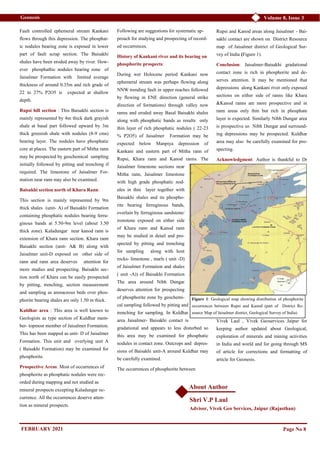
The occurrences of phosphorite between
Rupsi and Kanod areas along Jaisalmer - Bai-
sakhi contact are shown on District Resource
map of Jaisalmer district of Geological Sur-
vey of India (Figure 1).
Conclusion: Jaisalmer-Baisakhi gradational
contact zone is rich in phosphorite and de-
serves attention. It may be mentioned that
depressions along Kankani river only exposed
sections on either side of ranns like Khara
&Kanod ranns are more prospective and in
rann areas only thin but rich in phosphate
layer is expected. Similarly Nibh Dungar area
is prospective so Nibh Dungar and surround-
ing depressions may be prospected. Kuldhar
area may also be carefully examined for pro-
specting.
Acknowledgment: Author is thankful to Dr
Vivek Laul , Vivek Geoservices Jaipur for
keeping author updated about Geological,
exploration of minerals and mining activities
in India and world and for going through MS
of article for corrections and formatting of
article for Geonesis.
Page No 8
Figure 1: Geological map showing distribution of phosphorite
occurrences between Rupsi and Kanod (part of District Re-
source Map of Jaisalmer district, Geological Survey of India)
About Author
Shri V.P Laul
Advisor, Vivek Geo Services, Jaipur (Rajasthan)
FEBRUARY 2021
Continued on Page 10
Volume 8, Issue 3
Geonesis
Page No 9
How Long Will Coal Remain King in India?
India isn’t ditching coal. But its use could
plateau and even decline with the right blend
of policies and technologies.
Despite market turbulence brought by the
coronavirus pandemic, 2020 proved to be
a formative year for India’s clean energy
transition.
Solar prices hit record lows, definitively
ousting coal as the cheapest source of
electricity. The government held creative
auctions designed to facilitate adding
greater amounts of intermittent renewa-
bles on the grid. And Prime Minister Nar-
endra Modi reaffirmed India’s commit-
ment to reaching its bold renewable ener-
gy targets, claiming the country will ulti-
mately exceed its Paris climate goals.
But the growing adoption of solar, wind
and other clean energy technologies
doesn’t tell the full story of India’s ener-
gy shift. It is impossible to ignore the role
of coal.
State-owned enterprise Coal India is the
largest coal mining company in the world.
The coal sector is a major source of reve-
nue for states and the central government.
Also, while renewable energy capacity is
dramatically increasing, coal still pro-
vides around 70 percent of the country’s
electricity.
Last year, the Modi government sought to
boost the domestic coal mining sector
with a series of commercial auctions. The
government has also repeatedly delayed
the implementation of pollution regula-
tions for coal plants, effectively throwing
the dirtiest coal plants a lifeline.
As the third-largest producer of carbon
dioxide emissions in the world today with
an economy that's poised to see massive
growth in the future, what happens to
India’s energy mix will have a significant
impact on the entire planet and its inhabit-
ants.
Experts say that these factors have already
killed prospects for new coal-fired power
plants in India. In 2019, the states
of Gujarat and Chhattisgarh, the latter of
which is home to India’s third-largest coal
reserves, announced that they will not
build any new coal generating facilities.
Last fall, Indian power minister R.K. Singh
said that the generating capacity from 29
coal plants scheduled to retire in the com-
ing years would be replaced entirely by
renewables.
Still, coal isn’t going away. Even as the
Indian government strives to meet bold
renewable energy targets, coal use is ex-
pected to increase as India’s overall energy
demand grows. With a robust domestic
supply chain and ample capacity available
to ramp up coal use at existing power
plants, India could burn through a lot more
of the polluting resource without having to
build any new generating stations.
“We have an abundance of coal, so the
reality is that we will have more coal as we
go forward,” said Sumant Sinha, chairman
and managing director of ReNew Power,
India's largest clean energy company, and
author of the book Fossil Free.
As a percentage of India's total power
production, coal is expected to decline
from 70 percent to 50 percent over the
next decade, according to India’s Central
Electricity Authority. But in absolute
terms, coal use will increase as India’s
overall energy demand grows.
“Now, the question is what happens after
that? What happens after 2030 and 2035?”
said Sinha. “Because in reality, nobody's
going to want to invest in new coal capac-
ities.”
All eyes on solar and storage
What India’s energy mix will look like in
the medium term relies in large part on
how the next phase of India’s clean ener-
gy transition unfolds. Solar and wind have
proven to be reliable and affordable ener-
gy resources. But the market for energy
storage and other advanced technologies
needed to balance the use of intermittent
renewables on the grid is still emerging.
Until clean energy is flexible enough to
FEBRUARY 2021
Volume 8, Issue 3
Geonesis
provide power whenever it's needed, ex-
perts say there will be a role for coal in
India — even if it’s not as dominant in
the mix of energy resources as it once
was.
“Today, solar electricity is the cheapest
electricity that is produced in India, but
only when the sun is shining. At night,
coal is the cheapest electricity. So we are
living in these times where both coal and
solar are growing,” said Ajay Mathur,
director general of The Energy & Re-
sources Institute (TERI), in an interview
in Delhi early last year.
“This will continue until we get batteries
that are inexpensive enough that…the
cost of solar-plus-storage is less than the
cost of coal electricity,” he continued.
“Once that happens, nobody, not a devel-
oper or a financier, will have any interest
in financing a coal plant.”
Before the pandemic hit, TERI projected
that the tipping point for low-cost battery
storage would come before 2030. In
a year-end memo, TERI researchers af-
firmed their belief that India may not
need any new coal-fired power plants
beyond what’s in the current pipeline. But
the memo also underscored that India
does need a comprehensive set of solu-
tions to increase the flexibility of its pow-
er system and integrate a larger share of
variable renewable energy.
According to a 2019 Brookings Institu-
tion report, coal will still produce the
majority of electricity used in India at the
end of the decade. Coal use in the power
sector could plateau, according to the
authors. But that will require deploying
renewables at an even faster pace than the
current trajectory and increasing the utili-
zation or load factor for those renewable
energy projects, as well as converting
coal-fired power plants to natural gas and
growing hydro and nuclear power genera-
tion.
Sivaram noted that accelerated invest-
ments in energy efficiency, and air condi-
tioning in particular, will be critical.
India’s cooling demand could drive de-
mand for an additional 800 gigawatts of
power generation by midcentury, which is
more than twice the capacity of India’s
entire electricity capacity today.
Sinha of ReNew Power believes that coal
will eventually reach negligible levels in
India, but that the transition will take time
and require building new competencies and
promoting an equitable transition.
“It's going to be a gradual process,” he
said. “But that gives sufficient time for
people to get trained away from coal and
into newer areas [and] for those companies
that are coal-based...to wind down and find
new business models and invest their mon-
ey into new activities. It could be solar
manufacturing, for example. I think that's
the way the transition is going to work
out.”
An all-of-the-above approach
There are signs that India’s transition
could move more rapidly than expected.
Continued cost declines in solar and wind,
coupled with pervasive health and environ-
mental issues, have started to trigger dis-
cussions in India around closing existing
coal facilities, in addition to avoiding the
construction of new ones. Notably, Power
Minister R.K. Singh and Finance Minis-
ter Nirmala Sitharaman have both stated
that India’s oldest and dirtiest coal-fired
power plants need to shut down.
Aarti Khosla, founder and director of Cli-
mate Trends, a Delhi-based strategic com-
munications initiative, said these are no
longer isolated remarks.
“The fact is that there are a lot of open
doors now to have these conversations
because there is growing evidence of coal
power’s role in aggravating air pollution,”
she said. “It is about a range of issues
from societal impacts, the impact on
health, and also economic indicators,
which are looking worse due to air pollu-
tion impacts. Today, it's far more possible
for states to be discussing the phase-down
of existing coal and not just stopping the
new build.”
However, India’s Ministry of Power ap-
peared to backtrack last month on com-
mitments to shutter existing coal facili-
ties by proposing to allow relinquished
plants to continue selling power, which
could help old coal plants earn additional
revenue. The situation today remains
murky as policymakers seek to mitigate
poor air quality while keeping coal plants
open.
“It's interesting because the government
does have a really strong commitment to
clean energy, but that is not the same as a
really strong commitment to decarboniza-
tion,” said Kanika Chawla, senior
Page No 10
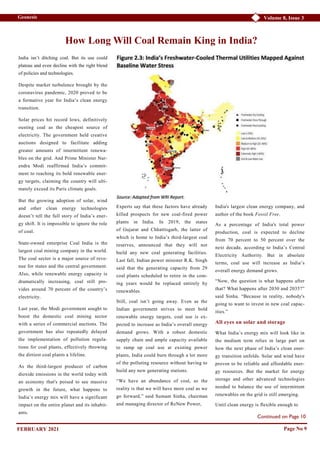
Source: The Brookings Institution's "Coal in India" report
Continued on Page 11
FEBRUARY 2021
Volume 8, Issue 3
Geonesis
Continued on Page 12
program lead at the Council on Energy,
Environment and Water, a Delhi-based
think tank.
“They want clean energy to thrive. They
want it to be a new business and industry
that develops in India. They want the
world to come and participate in the Indi-
an energy transition given how much pri-
vate money is required. But that doesn’t
mean they’re willing to shut down power
plants,” she said. “So it's a bit of an all-
of-the-above kind of approach.”
That approach is reflected in the govern-
ment’s treatment of air pollution regula-
tions, which would require coal plants to
adopt new pollution control technologies.
The rules have already
been delayed several times. And yet 70
percent of India's coal plants may still fail
to comply with the current 2022 deadline,
according to the Centre for Science and
Environment, a Delhi-based think-tank.
In addition to propping up coal-fired pow-
er plants, the central government has tak-
en concerted steps to support coal mining.
Because existing coal plants are operating
at extremely low plant load factors
(PLFs), there is plenty of room for India
to use more coal without having to build
additional plants.
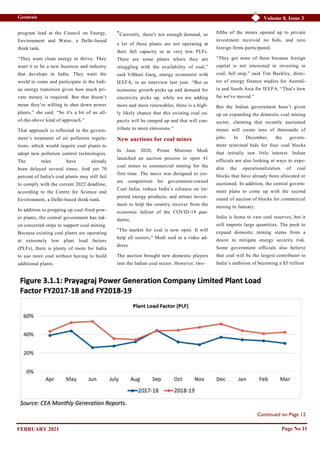
“Currently, there's not enough demand, so
a lot of these plants are not operating at
their full capacity or at very low PLFs.
There are some plants where they are
struggling with the availability of coal,”
said Vibhuti Garg, energy economist with
IEEFA, in an interview last year. “But as
economic growth picks up and demand for
electricity picks up, while we are adding
more and more renewables, there is a high-
ly likely chance that this existing coal ca-
pacity will be ramped up and that will con-
tribute to more emissions.”
New auctions for coal mines
In June 2020, Prime Minister Modi
launched an auction process to open 41
coal mines to commercial mining for the
first time. The move was designed to cre-
ate competition for government-owned
Coal India, reduce India’s reliance on im-
ported energy products, and attract invest-
ment to help the country recover from the
economic fallout of the COVID-19 pan-
demic.
"The market for coal is now open. It will
help all sectors," Modi said in a video ad-
dress.
The auction brought new domestic players
into the Indian coal sector. However, two-
fifths of the mines opened up to private
investment received no bids, and zero
foreign firms participated.
“They got none of them because foreign
capital is not interested in investing in
coal, full stop,” said Tim Buckley, direc-
tor of energy finance studies for Austral-
ia and South Asia for IEEFA. “That's how
far we've moved.”
But the Indian government hasn’t given
up on expanding the domestic coal mining
sector, claiming that recently auctioned
mines will create tens of thousands of
jobs. In December, the govern-
ment reinvited bids for four coal blocks
that initially saw little interest. Indian
officials are also looking at ways to expe-
dite the operationalization of coal
blocks that have already been allocated or
auctioned. In addition, the central govern-
ment plans to come up with the second
round of auction of blocks for commercial
mining in January.
India is home to vast coal reserves, but it
still imports large quantities. The push to
expand domestic mining stems from a
desire to mitigate energy security risk.
Some government officials also believe
that coal will be the largest contributor to
India’s ambition of becoming a $5 trillion
Page No 11
FEBRUARY 2021
Volume 8, Issue 3
Geonesis
economy.
Balancing development and
"breathable air”
While energy demand took a dive in 2020
amid the pandemic, the International En-
ergy Agency’s December market report
forecasts global electricity demand to
increase in 2021, driven predominantly by
China and India.
Looking at the longer term, India is ex-
pected to lead the world in energy de-
mand growth between now and 2030. To
meet the needs of a growing population
seeking upward mobility, India’s per cap-
ita energy consumption will have to quad-
ruple, according to an economic survey
presented in Parliament last year.
Meeting all of India’s growing energy
needs will take more than reaching the
country’s target of 450 gigawatts of re-
newables by 2030. Even if the energy
transition continues to accelerate in the
electricity sector, coal use in India’s grow-
ing industrial sector must still be ad-
dressed.
“Even if India meets the ambitious 450-
gigawatt target, its overall coal use is still
slated to rise because of its industrial sec-
tor, which the IEA projects will be the
economy's largest source of growing emis-
sions and coal use,” said Columbia’s Si-
varam. “So it's just as important this dec-
ade to demonstrate clean industrial tech-
nologies — in steel, fertilizer, cement,
petrochemicals and other industrial sectors
— that can avoid the need for coal use so
that in subsequent decades, India can rap-
idly wean its industrial sector off coal.”
“India should not have to sacrifice devel-
opment for breathable air,” he added.
Air pollution killed more Indians in 2019
than any other risk factor — and that was
before the pandemic. Doctors are con-
cerned that poor air quality makes COVID-
19 even more deadly. Recognition of these
threats could fuel the political will to put
India’s clean energy transition on an even
faster path.
Cities have already seen air pollution lev-
els spike as winter sets in and business
activity resumes. The mountains that were
briefly visible from Delhi at the height of
the coronavirus lockdown are once again
shrouded in smog. While it’s a mixed
picture, market-watchers are optimistic
that coal will meet its demise sooner ra-
ther than later.
“It is a period of flux, but it will shake out
very soon in favor of a transition to-
ward renewables,” said Khosla of Climate
Trends.
“I think among the policymakers in the
country, one thing is pretty clear: With the
rapid expansion that will happen in the
consumption of energy, not all of it can be
met by fossil-fuel sources,” she said.
“Coal will no longer be the king.”
Page No 12
India’s mining reforms ignore the livelihood and rehabilitation of
those affected by the industry
The reforms focus on increasing mineral
production while remaining silent on the
damaging effects of mining over the last
few decades.
As the debate around the new farm laws
rages on, the Indian government has gone
ahead and cleared changes in the coun-
try’s mining laws, to push mineral extrac-
tion and production. Like farming, mining
is another sector where the mining re-
forms, meant to boost the economy, are
going to have large-scale consequences.
The changes, according to the govern-
ment, will have a positive impact on the
sector and economy, but experts working
with the mining-affected communities
note that they could have a domino effect,
with a negative impact on communities,
human health, water bodies, environment
or wildlife.
The experts point out that the government,
in fact, needs to look at displacement and
rehabilitation issues and give attention to
the transition of communities and their
livelihoods in areas where mines will ex-
haust in another two or three decades.
The mining reforms proposed in August
2020 aimed at increasing participation of
the private sector in mineral exploration,
clearly defining illegal mining, removing
the distinction between captive and non-
captive mines, resolving legal issues, mov-
ing towards an auction-only regime, devel-
oping a national mineral index and creating
tangible assets using the district mineral
fund.
In May 2020, while the central govern-
ment was announcing a Rs 20-lakh crore
package to kickstart the stalling economy,
mining reforms was a big item on the
agenda. It was also emphasised during the
budget of 2020.
The move, however, was criticised by the
mining-affected communities with experts
stating that it comes in the middle of the
Covid-19 pandemic while people are bat-
tling for survival. They had also noted
that such far-reaching changes – propagat-
ed only in English language and only
Continued on Page 13
FEBRUARY 2021
Volume 8, Issue 3
Geonesis
Continued on Page 14
Page No 13
online – need to be widely accessed and
debated instead of just giving a few weeks
to people to send suggestions. The gov-
ernment had received a large number of
comments and suggestions on the pro-
posed reforms in response to the public
consultation notice.
Earlier this month, sources confirmed that
the Union Cabinet, chaired by Prime Min-
ister Narendra Modi, cleared changes in
the mining norms to give a push to the
sluggish economy. The view that the up-
tick in mining activities and mining re-
forms will give a significant push to the
slowing economy, including providing
jobs, has been highlighted by many in the
central government and industry, stating
that it will help in taking the Indian econ-
omy to the “five trillion-dollar mark”
within the next few years.
What changes will mining reforms
bring?
According to sources, the changes made
by the Union Cabinet will “resolve legacy
issues through amending the Mines and
Minerals (Development and Regulation)
Act which will make a large number of
mines available for auctions and strength-
en the government’s idea of an auction
only regime and boost transparency in the
system”.
The mining reforms cleared by the cabi-
net, including amendments of certain acts,
will now go to parliament for clearance
during the budget session in February
2021.
The reforms will also have provisions for
“compensating those whose mineral con-
cessions would be cancelled under this
amendment, through the National Mineral
Exploration Trust funds”.
According to sources, the government
believes that the move will
“operationalise a large number of mines
and will bring a large number of mines
into production while making the public
sector units efficient and competitive”.
In other words, this would mean a lot of
new chances for the private sector into
mining as well as taking big strides to-
wards an auction-only regime for minerals
– a move that is not entirely appreciated by
some players in the mining sector.
This would mean that soon about 500 min-
eral blocks across the country would be up
for auction even as the final decision of it
will depend on the states where those
mines are situated.
The reforms also talk about charges on the
extension of mining leases for government
companies to create a “level playing field”
and bring uniformity in the sector. The
changes further focus on the removal of the
distinction between captive and merchant
mines following which the captive mines
will be allowed to sell up to 50% of the
minerals excavated during the current year.
Kanchi Kohli, a senior researcher with
Delhi-based Centre for Policy Research,
emphasised that these reforms “present a
myopic view of the mining sector.”
“The legacy issues do not identify the seri-
ous infirmities that have been identified by
high-level committees, including that of
the Supreme Court,” Kohli told Mongabay-
India. “These include decades of illegal
mining resulting in land grab, high levels
of pollution, unemployment and loss of the
biodiverse farm, forest or grasslands, over
and above the huge loss of revenue for
both central and state governments. All
these continue to prevail and cannot be
wished away simply by ownership and
management to the private sector.”
District mineral fund to focus on visi-
ble outcomes
As part of the approved amendments, the
cabinet has reportedly okayed amendments
to the guidelines related to the district min-
eral fund which “intend to utilise these
funds better with more visible outcomes”
and make the local member of Parliament a
member of the body governing those funds.
But this is one area of concern that mining-
affected communities have repeatedly
voiced. They often complain that there is
no transparency on how this fund is used
and that bodies tasked with use of district
mineral fund do not properly involve the
mining-affected communities resulting in
funds being used for issues that don’t mat-
ter to them.
Rajesh Tripathi of Chhattisgarh-based Jan
Chetna Manch, who works with mining-
affected communities in Raigarh, states
that even though their district has hun-
dreds of millions under the district miner-
al fund mechanism the people are devoid
of basic facilities which should have been
provided for them anyways.
He also said the government failed in
reaching out to the mining-affected com-
munities – an important stakeholder – and
consider their concerns while deciding
about the mining reforms.
Kohli said that the “design and viability of
the district mineral fund as a concept has
faced serious criticisms from the time it
was proposed and envisaged”.
“One of the fundamental criticisms was
that the district mineral fund is a distrac-
tion and justifies mining at all cost,”
Kohli said. “In fact, it is viable only if
mining operations continue to grow. The
experience with the district mineral fund
has thrown open even more challenges
where fund collections are increasingly
being channelised away from the needs
and welfare of people most affected by
mining operations. In such a context, the
intention to better utilise the district min-
eral funds appears to be mere lip service
to address serious hardships being faced
in most heavily mined areas.”
Reforms aim to simplify the mineral
exploration
In order to give the impetus to the mining
sector, the government also proposes to
simplify the mineral exploration process.
FEBRUARY 2021
Volume 8, Issue 3
Geonesis
Page No 14
According to the government, despite the
huge mineral potential, the exploration
activities are abysmally low in India and
that of the total Obvious Geological Po-
tential area of 0.571 million square kilo-
metres only 10% of the area has been
explored so far while mining is carried
out in only 1.5% of the Obvious Geologi-
cal Potential area.
The government sources point out that
while countries like Canada and Australia
spend almost 14% of global exploration
expenditure, India’s exploration expendi-
ture is approximately 0.2% and that too
mainly on surficial deposits and not on
minerals which we import.
Under the changes that were cleared by
the cabinet, the focus is also on facilitat-
ing a seamless transition from exploration
to production and rationalising stamp
duty. The government sources claim that
the effective tax rate on mining in India is
about 64% which is highest in the world
wherein other countries it ranges between
34%-38%. They note that one such tax is
stamp duty which is computed differently
in different states. Thus the government
proposes to amend the Indian Stamp Act,
1899 to bring uniformity across the states
in the calculation of the stamp duty.
The reforms cleared by the cabinet also
propose to introduce an index-based
mechanism by developing a National
Mineral Index for various statutory pay-
ments and others for future auctions.
They propose steps to review the function-
ing of National Mineral Exploration Trust,
which was formed to promote exploration
of minerals in the country, as the pace of
exploration, the government often says is
abysmally low and expenditure is negligi-
ble.
“Due to various reasons, expenditure under
the National Mineral Exploration Trust is
not satisfactory and thus exploration,” said
government sources. “Therefore in order to
boost exploration, it is proposed to make
the National Mineral Exploration Trust an
autonomous body.”
Sreedhar Ramamurthi, an earth scientist of
the Environics Trust, which is involved in
research and development on environmen-
tal issues, called for rationalising of min-
ing activities.
“Whether it is the cement industry, iron ore
or many other minerals, there is this prob-
lem of excess capacity and ultimately this
ends up cartels where prices of the com-
modities such as cement and steel are not
coming down,” Ramamurthi
told Mongabay-India. “There is very poor
demand in the market. But still, there is
this rush for increasing the mining activi-
ties. This is going to end up digging more
of our land across the country – in destroy-
ing the forests, water bodies and lives of
communities who, as per the experience so
far, are rarely rehabilitated properly.”
“If we continue with this rush, it is only
going to add to the woes of the communi-
ties and the environment,” he added.
“Instead, the idea should be to look at
rationalising mining activities and utilis-
ing already opened areas rather than open-
ing new ones.”
Kohli stressed that the “government is
increasingly missing the opportunity to
bring in reforms which look at the rehabil-
itation of areas where mines capacity will
be exhausted in the next two-three dec-
ades”.
“This can lead to a serious crisis for local
contractors and ancillary operations which
will have no relevance,” said Kohli.
“Most people have already lost their farms
and access to forests for livelihoods, and
few daily wage or petty jobs available will
be lost too. Single-minded reforms focus-
ing only on mineral extraction and pro-
duction are blind to all the other lived
realities of mining geography, be it wild-
life, forests, food, water or human cul-
tures.”
She emphasised that India needs a “reform
in the way mineral policy is designed”.
“Legacy issues include displacement, con-
tamination and human health or ecological
fragmentation,” she added. “It also needs
an upfront evaluation not only on fiscal
parameters but also on grounds of human
rights and environmental justice.”
DISCLAIMER: This is a compilation of various news appeared in different sources. In this issue we have
tried to do an honest compilation. This edition is exclusively for information purpose and not for any com-
mercial use. Your suggestions are most valuable.
Your suggestions and feedback is awaited at :-
editor@geonesis.in
FEBRUARY 2021

Geonesis February 2021

  • 2.
    Volume 8, Issue3 Geonesis T The government plans to bring in struc- tural reforms in this crucial sector. But the devil lies in the detail India has huge mineral deposits, but the country’s mining sector is still suffering from legacy issues. Making a fresh attempt for a course correction, the Union Cabinet recently approved a blueprint to usher in reforms in the mining sector. This blueprint, which will be presented in the coming Parliament session, proposes to amend the Mines and Mineral (Development and Regulation) Act, 1957, clarifying doubts on double taxation, ration- alising stamp duty and developing the Na- tional Mineral Index, among others. This is not the first attempt by a govern- ment to bring in reforms in this sector. But why did the earlier attempts not yield sig- nificant results? What were the constraints? Why has the potential of the sector not be- ing fully realised? According to the government’s own assess- ment, traditionally, one percentage point growth in mining pushes up the growth rate of industrial production by 1.2-1.4 percent- age points. Also, one direct job in the sector creates 10 indirect jobs. The mineral sec- tor’s contribution to the GDP is only 1.75 per cent, currently. Despite having a huge potential, the country is far from being At- manirbhar in mineral production. India imports minerals worth over ₹2.5-lakh crore every year whereas the domestic production is only half of that, at ₹1.25-lakh crore. With the latest move, the government aims to increase minerals production by 200 per cent in seven years. But can it achieve that? There is an urgent need to unlock the sector, everyone agrees, but still remain cautious. According to Aruna Sharma, a Develop- ment Economist and a former Secretary to the government, “Let us say a move has been made. Intent is there. But the devil lies in the detail. One has to see what the rules say once the amendments pass Parliament mus- ter.” Auctions -- a mixed bag For example, the “auction only” regime for allocation of mineral blocks was introduced by the Modi government under the MMDR (Amendment) Act, 2015. However, holders of partially or minimally explored blocks were protected and kept out of the auction regime. This relief was given under Section 10A (2)(b) of the Act. But these concessions have neither resulted in a mining lease nor have they reached closure till date. Similarly, existing holders of Letters of Intent were given protection and kept out of the auc- tion regime on the condition that they will obtain mining leases in a two-year period, by January 2017. This relief was given under Section 10A(2)(c) of the Act. These holders also have not been able to obtain mining leases so far. India’s huge mineral reserves (about 2.7-lakh hectares of mineral land) are locked because of legacy issues created by the provisions of Sec- tion 10A (2) (b) and 10A (2) (c). Also, public sector enterprises have for long been sitting on a large number of blocks without producing. Hence, the government, after wide consulta- tions with States, ministries, industry associa- tions, public and NITI Aayog, plans to bring in major structural reforms that can help India become Atmanirbhar in the mineral sector. A step towards this is to resolve the legacy issues by amending Section 10A (2)(b) and 10A (2)(c) of the MMDR Act and granting mineral rights only through auction for these blocks. It also proposes to reimburseexplora- tion expenditure of those lease holders whose rights under Section 10A(2)(b) have lapsed. If a PSU does not obtain a mining lease in the specified time, its allotted mineral block will be auctioned by the State government. Continued on Page 2 Page No 1 FEBRUARY 2021 Mining sector — unburdening the legacy issues The major objective of the latest set of reforms is to generate jobs, reduce imports and in- crease production by bringing large mineral blocks into auction. These amendments will bring a large number of mines for auction. The governmentbelieves this will help strengthen the “auction only” regime and boost transparency in the system. The counterpoint Will this lead to a maturing of the mining sec- tor? RK Sharma, Secretary-General, Federa- tion of Indian Mineral Industries, feels that the proposed mining reforms are not going to help in establishing a matured system. “One of the major reforms which is being highlighted is repealing of Section 10 A (2)(b) thereby claiming to make more than 500 min- eral blocks available for auction. It is worth mentioning that while amending the MMDR Act, 1957 in 2015, the government had acknowledged the valuable contribution made by these license holders by introducing Section 10A(2)(b). “And now removing it from the Act and offer- ing such blocks for auction is against natural justice and will have far reaching adverse im- plications on the growth of the domestic min- eral sector besides tarnishing the image of the country globally,” he said adding “It will also show that the government has faltered on its Act and is bound to lead to irreparable loss of investors’ confidence in Indian mineral sector, apart from multiple litigation in Courts result- ing in such an exercise of the government being rendered completely futile.” Moreover, it will also affect adoption of state- of-the-art technology required in exploration and mining sector besides impeding much- needed FDI, he said adding that “the recent experience of auctioning of coal blocks for commercial mining is a testimony where none
  • 3.
    Page No 2 Volume8, Issue 3 Geonesis of the international mining companies evinced interest to participate despite best efforts of the government to attract FDI in coal sector.” Implementation, the key While Sharma may have a point, it is also important to note that the government has been Institute for Space Applications and Geoinfor- matics, Gandhinagar, a national institute under Ministry of Information and Technology for development of NGDR. To expedite exploration activities in the coun- try, GSI has also embarked upon an ambitious scheme to complete major national level sur- veys by 2022. These include the National Geo- chemical Mapping (NGCM), National Geo- physical Mapping (NGPM) and National Aero Geophysical Mapping Program (NAGMP). NGCM is an all India programme to cover the entire surface area of the country by geochem- ical sampling. It will generate distribution pattern of 62 elements for use in managing and developing natural resources; application in environmental, agricultural, human health and other social concerns, as well as to search for hidden mineral deposits. NAGMP, which is the first of its kind project in the country, is meant to delineate concealed, deep seated structure/ litho-units capable of hosting mineralisation, delineate extension of the existing mineralised zone and understating of shallow crustal architecture in the context of mineral occurrence. The collation, assimilation and integration of the data generated from the above projects and further interpretation will lead to identification of more areas for mineral exploration in the country, according to a statement issued today by the Ministry of Mines. The increased investment in mineral explora- tion will build a robust pipeline of prospective mineral blocks for auction. This will ensure long-term viability and continuity of mining in the country in pursuit of self –reliance. GSI is also going to adopt sophisticated deep penetration geophysical techniques such as Magneto-Telluric Surveys and Deep Seismic Reflection Surveys to define the crustal archi- tecture for deep seated mineral targeting. Out of the total mappable area of 3.146 million square kilometres of the country, 3.119 million square kilometres has been covered by Sys- tematic Geological Mapping till December 2020, building up the knowledge database for National Geo-scientific information for boost- ing mineral exploration activities and other earth science related socio-economic activities and programmes. FEBRUARY 2021 taking corrective measures. If implemented properly they will strengthen the auction re- gime, increase production by auctioning large number of mineral blocks as almost 500-plus non-operational blocks will be made available for auction. But, as is the case with electricity, in mining too, States play a critical role. It will be im- portant for the Centre to have States on board. It needs to adopt a consultative approach for the sector. Besides, on paper, the blueprint seems attractive but it remains to be seen when it finally becomes a law, how good the rules are to implement it. Till then one will have to wait and watch. The project is being undertaken under the aegis of the Ministry of Mines To collate and disseminate all the geological data of the country, the Geological Survey of India has initiated a project, National Geosci- ence Data Repository (NGDR) that would hold data by all agencies engaged in explora- tion and geoscientific pursuits. The project, being undertaken under the aegis of the Ministry of Mines, aims at integrating the data collected by GSI, state geological departments, central public sector enterprises, academic and private sector agencies working in the domain to build a repository in the digi- tal medium entailing multiple user access. The ministry has also proposed that all the stakeholders from India and across the globe who are willing to participate in the current auction regime for allocation of mineral acre- ages will also be able to use the NGDR. Further, the planned Baseline Geoscience Data Collection campaign would also lead to a huge database, which will be the primary inputs for future exploration programmes. GSI is in consultation with Bhaskaracharya To boost mineral exploration, GSI developing repository of all geological data of country
  • 4.
    Volume 8, Issue3 Geonesis Coal Minister Pralhad Joshi on Thursday assured Coal India of full government sup- port Coal Minister Pralhad Joshi on Thursday assured Coal India of full government support, even as he said the PSU needs to learn "new things" for improvement in its future prospects. The minister, who was speak- ing during the launch of En- terprise Resource Planning (ERP) of Coal India Ltd (CIL), said there will be full support to the company because it is the "backbone of the country". "But having said that the improvement is a continuous process, learning is a continuous process....let us learn new things, new ideas, new approach, and new goal. And in this, the image of coal (sector), Coal India needs to be changed. We have to change the image of Coal India," Joshi stressed. The ERP of CIL will help improve business performance and growth of the company with enhanced data integrity. Stating that one and two subsidiaries of CIL were doing very good work, the minister said that other arms of the PSU should also learn from them. "Implementation of ERP will help CIL in real- time decision making, improving efficiency and reducing costs. It will empower CIL to achieve 1 billion tonne coal production by FY 2023-24 and make it one of the most efficient mining companies in today's dynamic and ever-changing energy scenario," Joshi said. Coal India accounts for over 80 per cent of domestic coal output. ERP in Coal India will be implemented in two phases. The first phase launched on Thursday covers operations of CIL headquarters and its two subsidiaries Western Coalfields Ltd (WCL) and Mahanadi Coalfields Ltd (MCL). The second phase will cover rest six subsidiar- ies and will be made operational by August this year. The minister also presented 'Coal Minister's Award' to three coal companies of Coal India Ltd - Northern Coalfields Ltd (NCL), Central Coalfields Ltd (CCL) and WCL in a function held here. The award has been instituted to promote best and sustainable prac- tices for coal mining in the country. The minister inaugurated a new Coal Handling Plant (CHP) at Krishnashila Coal Project of NCL via video conferenc- ing. Having four million tonnes per annum (MTPA) coal handing capac- ity, this state of the art CHP will transport coal through conveyor belts and Rapid Loading system to Anpara Thermal Power Station (ATPS) of Uttar Pradesh Rajya Vidyut Utpa- dan Nigam Ltd and Renusagar Power Division of Hindalco. CHP is part of CIL's 35 First Mile Connectivi- ty (FMC) projects with over 400 MTPA ca- pacity that the company aims to complete by FY'24 with a whopping investment of Rs 12,500 crore. Coal Secretary Anil Kumar Jain, CIL Chair- man Pramod Agarwal, NCL CMD P K Sinha, CCL CMD P M Prasad, WCL CMD Manoj Kumar and other dignitaries were also present during the function. Govt assures Coal India of 'full support', stresses learning 'new things' Page No 3 Continued on Page 4 Decade after scam, Odisha imposes penalty of ₹2056 cr for illegal mining This is the biggest ever penalty on any mining company after the mining scam broke out a decade ago. A decade after the mining scam rocked Odisha leading to tightening of rules governing raising and transportation of minerals, the state min- ing department for the first time detected a major illegality, imposing penalty of ₹2,056 crore on Sarda Mines, a merchant miner for excess mining. FEBRUARY 2021
  • 5.
    Volume 8, Issue3 Geonesis The joint director of mines in Joda of mines- rich Keonjhar district last week sent the no- tice to Sarda Mines under Section 21 (5) of The Mines and Minerals (Development and Regulation) (MMDR) Act, 1957, for raising 4.2 million tonnes of iron ore in excess of the limits stipulated under environmental clear- ance, mining plan as well as the limit set by State Pollution Control Board. The mines department in its penalty demand said the Thakurani Block-B iron mines held by Sarda Mines in Keonjhar district over an area of 947.046 hectare produced at least 7 times of the limit set up by different govern- ment agencies such as Indian Bureau of Mines, the OPCB as well as the Ministry of Environment and Forests, Climate Change for the financial year 2019-20 The demand note from the joint director of mines said the excess mining happened in the month of February and March 2020. The mines department calculated the penalty tak- ing into account the price of lump ore decid- ed by the Indian Bureau of Mines. In Febru- ary 2020, the highest price of lump ore was ₹4,691 per tonne while in March it was ₹4,835 per tonne. "This is the biggest ever penalty on any min- ing company after the mining scam broke out a decade ago," confirmed joint director of mines, Salil Behera. He, however, could not clarify how the company raised so much ore in excess of the limits set by various authorities even after many regulations were brought in after the mining scam. In 2010, the state min- ing department had started Integrated Mines and Minerals Management System (i3MS), a comprehensive information technology-based e-Governance initiative that provided an end- to-end tracking of minerals produced, des- patched and consumed in all the 14 mining circles. Other senior mining officials did not comment on the penalty imposed. HN Singh, vice- president of Sarda Mines, said his company would challenge the order in High Court. "We don't agree with the penalty demand. There are several flaws in it," he said. After the mining scam was unearthed in Od- isha in 2009, Justice MB Shah Commission of Enquiry had found that around ₹60,000 crore worth of ore was mined illegally from Keonjhar and Sundargarh between 2000 and 2010. However, in 2017, central empowered committee, that was appointed by Supreme Court to probe into illegal mining in Odisha, put the amount at ₹17,576.17 crore following which the apex court ruled that the errant com- panies have to pay the amount. The CEC cal- culated the figure for illegal extraction of 215.5 million tonnes of iron and manganese ore between 2000-01 and 2010-11. The Thakurani B iron ore mines in Joda area leased to Sarda Mines in August 1991 was a supplier of high-quality ore to the Naveen Jindal-led Jindal Steel and Power Limited plant before it was closed on March 31, 2014, due to lack of environment clearances. In Jan- uary last year, the Supreme Court had allowed it to resume mining operations after directing to pay around ₹933 crore towards environ- mental compensation to the state government. However, in September last year, the Ministry of Environment and Forest and Climate Change asked Sarda Mines to stop operation immediately noting that its environment clear- ance was invalid. Sarda Mines, however, got a stay against the order from Delhi High Court and resumed its operation. Its lease over the Thakurani B mines is scheduled to end in August this year. Page No 4 Three years on, Goa's stalled mining sector still gathers rust As Goa's stricken iron ore mining sector completes three years in a deathly slump on February 7, a collective of private sector mines workers and other industry-dependents now appear to be banking on Prime Minister Narendra Modi's intervention to resolve the ongoing deadlock. Three BJP chief ministers -- namely late Manohar Parrikar, Laxmikant Parsekar and the latest incumbent Pramod Sawant -- have so far failed to resolve Goa's prolonged min- ing imbroglio, which began first with a Su- preme Court ban on mining in 2012. In 2018, another apex court order had led to complete curtailment of fresh excavation of ore in Goa. "We now urge Prime Minister Narendra Modi for his immediate intervention for resumption of mining in Goa, before Goa loses its fourth consecutive mining year due to the mining ban imposed by the apex court of India," president of the Goa Mining People's Front Puti Gaon- kar has said. While the state's mining sector contributed between 15 to 18 per cent of Goa's Gross Do- mestic Product at its peak in 2012, in the same year witnessed a series of events, beginning with the revelation of a Rs. 35,000 crore ille- gal mining scam by a judicial commission, led to the closure of the mining sector. The mining scam became one of the key agendas of the 2012 state assembly elections, which resulted in the Manohar Parrikar-led Bharatiya Janata Party coming to power. Months after taking charge, Parrikar ordered a temporary suspension of all mining activity in the state, pending verification of mining leas- es. Days after Parrikar's decision, then Union Minister of State (Ind. charge) for Environ- ment and Forests Jayanthi Natarajan cancelled all environment clearances granted to the 90- odd mining leases, before the Supreme Court in the same year imposed a ban on mining, Continued on Page 5 FEBRUARY 2021
  • 6.
    Volume 8, Issue3 Geonesis Continued on Page 6 while hearing a petition filed by Goa Founda- tion, one of the state's top green NGOs. The mining sector resumed again in 2014 with a 20 million ton cap on extraction of ore, but came to a standstill once again in 2018, after the apex court found glaring irregulari- ties in the lease renewal processes. This time the top court -- and later the Goa Lokayukta as well -- faulted then Chief Minister Laxmi- kant Parsekar for hurriedly renewing a major- ity of the mining leases without following due processes. The apex court had also urged the state gov- ernment to start the process for fresh allot- ment of leases, a step which the Goa govern- ment has still not adopted. The 2015 amend- ment to the Mines and Minerals (Development and Regulation) Act mandates that iron ore leases should be mandatorily auctioned. According to Claude Alvares, director of Goa Foundation, auctioning of the mining leases would be a faster way to resume mining in Goa, instead of scouting for a "legislative cure" to restart the sector, which Chief Minis- ter Pramod Sawant as well as Bharatiya Janata Party's central leaders have insisting on. "Second, since the stoppage of mining on 15 March 2018, over two and a half years have passed, and there has been absolutely no movement. Is a 'legislative cure' actually the quickest way to resume mining? Had the state government adopted either the auction or the state mining route, surely operations could have begun?" Alvares said, adding that going the auctioning route would also earn more revenue to the state exchequer. "The iron ore lease auctions over 2015-2019 across India have resulted in a six-fold increase in the mineral sale proceeds," Alvares said. Congress spokesperson Ramakant Khalap has blamed the BJP for the current mining impasse. "The present economic chaos is basically be- cause of late Manohar Parrikar's haughtiness and obstinacy in abruptly closing mining in Goa and later not opposing continuation of closure of mines in the Supreme Court and aggravating the misery by illegal renewal of 88 mining leases," said Khalap, a former Un- ion Minister of State for Law. While little has emerged by way of a political or a legislative solution to the crisis, the Su- preme Court is currently hearing a review petition filed by the Goa government which has urged the apex court to take a relook at its 2018 order. Page No 5 Boost to production and pvt investment as mining reforms get green signal Centre removes distinction between captive and merchant mines, will amend the Mines and Minerals (Development and Regulation) Act, 1957 to enforce reforms The Union Cabinet is learnt to have approved a reform package for the mineral mining sector which would entail amendments to three existing laws, pricing formula for min- erals, exploration of mines and several taxes and duties levied on mining. Officials said this is expected to boost production and pri- vate investment in the sector. The Centre has removed the distinction be- tween captive (self-use) and merchant (commercial sale) mines. The Centre would amend the Mines and Minerals (Development and Regulation) Act, 1957 (MMDRA) to enforce the reforms. Senior officials said the amended MMDRA would be placed in Parliament in the upcom- ing session. Under the proposed reforms, captive mines would be allowed to sell 50 per cent of the minerals excavated in a year. The Centre has also proposed to give 50 per cent rebate in the quoted revenue share, for the quantity of min- eral produced and dispatched earlier than scheduled date of production The Centre has proposed to amend the section 10A(2)(b) & 10A(2)(c) of the MMDRA in order to unlock more mines for auctioning. This would entail Centre auctioning the pend- ing mining leases as well. Section 10A(2)(b) pertains to the leases where reconnaissance permit (RP) or prospecting licence (PL) were granted and 10A(2)(c) relates to grant of min- ing leases (ML). The Centre plans to compensate for the mineral concessions which would get can- celled under this amendment. The compensa- tion would come from the National Mineral Exploration Trust (NMET). NMET receives Rs 800 crore annually via the royalty paid by mineral mine owners. The Centre has also proposed to make NMET an autonomous body in order to boost exploration. The move comes after auction of coal mines to private companies for commercial mining and sale was successful with the Centre awarding 19 mines to varied set of companies. With this, the monopoly of state-owned Coal India Limited (CIL) ended, 42 years after coal mining was nationalised. The Centre amended the Coal Mines (Special Provisions) Act, 2015, in May 2020 to open the coal auction for non-mining, MSMEs and foreign companies. This paper reported FEBRUARY 2021
  • 7.
    Volume 8, Issue3 Geonesis recently, the Centre would announce opening up of mineral mining sector similarly and amend the MMDRA for the same. “We have brought reforms in the coal sector and we want to bring them in mining as well. But implementation and auction of non-coal mines is with the states. In 40-45 days, we will come out with other mineral reforms,” Union Minister of Coal, Mines and Parlia- mentary Affairs Pralhad Joshi had told the paper in November. Federation of Indian Mineral Industries (FIMI) in a recent note, however, had asked the government to review the auction strategy for mineral mining. “Auction has neither served public good nor led to fair allocation of resources. The sole focus to maximize revenues for the States has adversely affected long-term mineral development in the country and socio-economic benefits in mining areas,” R K Sharma, Secretary General, FIMI said. As part of the mining reforms, the Centre will also amend the Indian Stamp Act, 1899, in order to bring uniformity across the States in calculation of stamp duty. “Effective tax rate (ETR) on mining in India is 64 per cent which is highest in the world where in other countries it ranges between 34-38 per cent. One such tax is stamp duty which is computed in different ways in different states. We will simplify it,” said an official. A committee would also be set up to resolve the “double taxation” issue in the mining sector. The MEMC Rules (Minerals (Evidence of Mineral Contents) Rules, 2015) will be amended for inclusion of the globally accepted classification standards like CRIRSCO, JORC, etc. and latest UNFC classification. The Centre has also proposed to reallocate non-producing blocks of the public sector utilities (PSUs) so as to increase number of mines into production. There will also be charges levied on extension of mining leases of PSUs. But, there will not be any charges on transfer of mineral concessions for non- auctioned captive mines. It is learnt that the Centre would also ask PSUs to facilitate production from those mines which were auctioned in March 2020 but have started production even after transfer of valid rights, clearances, etc. Page No 6 Deep mining: Over 500 non-coal mineral blocks up for grabs Sources said the Cabinet also gave the go- ahead for reallocation of several non- producing blocks of the state-run companies, a move that could also enthuse the private players as many of these blocks have abun- dant proven resources. Over 500 non-coal mineral blocks, partially or minimally explored under current leases, but are entangled in legacy issues and litiga- tion, will be up for grabs as the Cabinet is learnt to have approved a proposal to amend the relevant law for their re-allocations through competitive bidding. Also, the em- ployment-intensive, but highly under- invested sector, will get a fillip from a Cabi- net decision to do away with end-use re- strictions for miners. Those with captive leases will be allowed to sell the minerals in the open market. Sources said the Cabinet also gave the go- ahead for reallocation of several non- producing blocks of the state-run companies, a move that could also enthuse the private players as many of these blocks have abundant proven resources. The moves are in sync with the National Min- eral Policy, which aims to increase the domes- tic production of non-coal, non-fuel minerals by 200% in seven years with a greater private sector participation. The leases stuck in disputes and legacy issues have failed to start production even after a 5- year window provided under the Mines and Minerals (Development and Regulation) Act in 2015. The rescinding of the relevant sec- tions of the Act will bring these leases back in the hands of state for prompt reallocation, the sources said. The current holders of these leas- es will be compensated for exploration ex- penditure incurred by them, by dipping into the funds under the National Mineral Explora- tion Trust (NMET). Mineral-potential areas will be put to auction offering seamless prospecting licence-cum- mining-leases and this will add to certainty of tenure and will come in handy for potential investors with deep pockets and appetite for long-gestation projects. “These amendments will make a large number of mines available for auctions. It will help us strengthen the ‘auction-only’ regime and boost transparency in the system,” an official source said. The investor-friendly measures are taken as part of the Atmanirbhar Bharat scheme for the mining sector announced by finance minister Nirmala Sitharaman in May last year. While the distinction between captive and non -captive mines will be removed, captive min- ers will likely augment production for sale in the open market, boosting supplies in the country. This also means that the preference to ‘captive’ users will go and, instead, all mines will be available for anyone including com- mercial miners. Captive mines will be allowed to sell up to 50% of the minerals excavated. Continued on Page 7 FEBRUARY 2021
  • 8.
    Volume 8, Issue3 Geonesis The sources added that as in the coal sector, it is proposed to provide 50% rebate in the quoted revenue share for non-coal mineral lease holders, for the quantity of mineral produced and dispatched earlier than sched- uled date of production. Further, the cabinet has also cleared the long-pending demand of the industry for waiver of charges for trans- ferring mineral concessions for non- auctioned captive mines. Given that hefty levies are making India’s mineral sector globally uncompetitive – the effective tax rate (ETR) on mining in India is about 64% which is highest in the world where in other mineral-rich countries it ranges be- tween 34-38 % – , the government has also proposed to bring in necessary amendments to the Indian Stamp Act, 1989, to bring in uni- formity across states in calculation of stamp duty. However, it remains to be seen if these will be duly complied with by states, as royal- ty from minerals and stamp duties on these items are large revenue sources for mineral- rich states. The cabinet has also approved introduction of an index-based mechanism by developing a National Mineral Index (NMI) for various statutory payments and others for future auc- tions. At present, the average sale price (ASP) is the basis for calculation of various statutory payments, which is subject to distortions due to absence of sale price data for some miner- als, differences in prices across states, etc. A committee will be constituted to examine the issue, the sources added. Page No 7 Prospects of Phosphorite in Jurassic Sequence of Jaisalmer Basin, Western Rajasthan During the course of systematic Geological mapping ( 1974- 1982) author recorded phos- phatic nodules in upper most unit-D of Jaisalmer Formation ( Middle Jurassic)and basal unit -A of Baisakhi Formation ( upper Jurassic) of author's classification. The nod- ules were recorded at places like Nibh Dun- gar, Kuldhar , Manpiya, Rupsi, north of Kha- ra Rann and Kaladungar. Keeping in view better concentration of phosphatic nodules Kaladungar section was studied in detail. Geology and distribution of Phosphorite in Jaisalmer Kaladungar occurrence : Phosphorite as phosphatic nodules occur in the Jaisalmer- Baisakhi contact zone of Middle to upper Jurassic age. Phosphatic nodules are sporadi- cally distributed in marls and marly calcare- nite in unit-D of Jaisalmer Formation and is exposed over potential area of 0.4 Sqkm with average thickness of 0.35 m while Basal Baisakhi unit-A is mainly made up of shales which contains five phosphatic nodules bear- ing ferruginous bands in thickness of 0.35 m covering an area of 0.65 sq km. Preliminary estimates shows the Kaladungar prospect may have total geological resource of 2.6 million tonnes. Baisakhi nodules solubility tests of two samples show solubility of phos- phate in 2% formic acid ( FA)39.19 % and 34.5% and in neutral ammonium citrate (NAC) 16.71 and 9.76% .The Kaladungar phosphorite is suitable for direct application in acidic soils. Basal Baisakhi shale has five phosphatic nodules bearing ferruginous bands and nodules have analysed phosphate content varying from 5.85 -22.42 % P2O5, ferruginous cortex 0.5-9.95 % and host rock shale 0.5-1% (Laul and Kumar, 1994) . Average grade is 9.5% P2O5. Jaisalmer Formation phosphatic nodules have average grade of 22.47% P2O5.The average grade of Jaisalmer- Baisak- hi contact Zone is 12.75 % P2O5 in potential area. The other economic minerals in vicinity of area are cement to high grade limestone of Pohar area and locally produced salt of Kanod rann. Pohar area contains drinkable groundwa- ter under artesian conditions unlike other areas of marine Jurassic sequence having saline groundwater. Kanod rann area may be prospective to ex- plore the thin phosphate bearing zone but rich in grade of 22% or more of P2O5 in unit- D of Jaisalmer Formation by geochemical sam- pling followed by pitting and trenching. Nibh Dungar area: Nibh Dungar is mainly represented by units- C and D of Jaisalmer Formation. The unit-C in general is represent- ed by calcarenite, calcareous sandstone and at places associated with fragile sandstone whereas unit-D in general is represented by sequence of calcarenite-oolitic calcarenite- calcareous sandstone- calcilutite. At places limestone is marly to shaly. Localised occur- rences of small phosphatic nodules ( 4-5 cms) have recorded in shaly to marly limestone in south-eastern part of Nibh Dungar. In sur- rounding area Basal Baisakhi unit-A is main- ly concealed and sometimes exposed in Nala sections. It is mainly made up of shales/ clays with intercalated sandstone It is 4m thick west of Nibh Dungar in nala section and contains phosphatic nodules( 4-5 cms) as core of ferruginous nodules in ferruginous partings. Baisakhi unit-A is 6m thick north and west of Bhuj Kharin/ khadin overlain by arenaceous bed of unit- B of Baisakhi Formation. Manpiya area: East of Manpiya NNW trend- ing fault( Manpiya Fault) is perhaps continua- tion of Ramgarh Fault along which Jaisalmer- Baisakhi contact zone has been faulted down and Basal Baisakhi shales form depression. Continued on Page 8 FEBRUARY 2021
  • 9.
    Volume 8, Issue3 Geonesis Fault controlled ephemeral stream Kankani flows through this depression. The phosphat- ic nodules bearing zone is exposed in lower part of fault scrap section. The Baisakhi shales have been eroded away by river. How- ever phosphathic nodules bearing zone of Jaisalmer Formation with limited average thickness of around 0.35m and rich grade of 22 to 27% P2O5 is expected at shallow depth. Rupsi hill section : This Baisakhi section is mainly represented by 4m thick dark grayish shale at basal part followed upward by 3m thick greenish shale with nodules (8-9 cms) bearing layer. The nodules have phosphatic core at places. The eastern part of Mitha rann may be prospected by geochemical sampling initially followed by pitting and trenching if required. The limestone of Jaisalmer For- mation near rann may also be examined. Baisakhi section north of Khara Rann: This section is mainly represented by 9m thick shales (unit- A) of Baisakhi Formation containing phosphatic nodules bearing ferru- ginous bands at 5.50-9m level (about 3.50 thick zone). Kaladungar near kanod rann is extension of Khara rann section. Khara rann Baisakhi section (unit- A& B) along with Jaisalmer unit-D exposed on other side of rann and rann area deserves attention for more studies and prospecting. Baisakhi sec- tion north of Khara can be easily prospected by pitting, trenching, section measurement and sampling as arenaceous beds over phos- phorite bearing shales are only 1.50 m thick. Kuldhar area : This area is well known to Geologists as type section of Kuldhar mem- ber- topmost member of Jaisalmer Formation. This has been mapped as unit- D of Jaisalmer Formation. This unit and overlying unit A ( Baisakhi Formation) may be examined for phosphorite. Prospective Areas: Most of occurrences of phosphorite as phosphatic nodules were rec- orded during mapping and not studied as mineral prospects excepting Kaladungar oc- currence. All the occurrences deserve atten- tion as mineral prospects. Following are suggestions for systematic ap- proach for studying and prospecting of record- ed occurrences. History of Kankani river and its bearing on phosphorite prospects: During wet Holocene period Kankani now ephemeral stream was perhaps flowing along NNW trending fault in upper reaches followed by flowing in ENE direction (general strike direction of formations) through valley now ranns and eroded away Basal Baisakhi shales along with phosphatic bands as results only thin layer of rich phosphatic nodules ( 22-23 % P2O5) of Jaisalmer Formation may be expected below Manpiya depression of Kankani and eastern part of Mitha rann of Rupsi, Khara rann and Kanod ranns. The Jaisalmer limestone sections near Mitha rann, Jaisalmer limestone with high grade phosphatic nod- ules in thin layer together with Baisakhi shales and its phospho- rite bearing ferruginous bands, overlain by ferruginous sandstone/ ironstone exposed on either side of Khara rann and Kanod rann may be studied in detail and pro- spected by pitting and trenching for sampling along with host rocks- limestone , marls ( unit -D) of Jaisalmer Formation and shales ( unit -A)) of Baisakhi Formation The area around Nibh Dungar deserves attention for prospecting of phosphorite zone by geochemi- cal sampling followed by pitting and trenching for sampling. In Kuldhar area Jaisalmer- Baisakhi contact is gradational and appears to less disturbed so this area may be examined for phosphatic nodules in contact zone. Outcrops and depres- sions of Baisakhi unit-A around Kuldhar may be carefully examined. The occurrences of phosphorite between Rupsi and Kanod areas along Jaisalmer - Bai- sakhi contact are shown on District Resource map of Jaisalmer district of Geological Sur- vey of India (Figure 1). Conclusion: Jaisalmer-Baisakhi gradational contact zone is rich in phosphorite and de- serves attention. It may be mentioned that depressions along Kankani river only exposed sections on either side of ranns like Khara &Kanod ranns are more prospective and in rann areas only thin but rich in phosphate layer is expected. Similarly Nibh Dungar area is prospective so Nibh Dungar and surround- ing depressions may be prospected. Kuldhar area may also be carefully examined for pro- specting. Acknowledgment: Author is thankful to Dr Vivek Laul , Vivek Geoservices Jaipur for keeping author updated about Geological, exploration of minerals and mining activities in India and world and for going through MS of article for corrections and formatting of article for Geonesis. Page No 8 Figure 1: Geological map showing distribution of phosphorite occurrences between Rupsi and Kanod (part of District Re- source Map of Jaisalmer district, Geological Survey of India) About Author Shri V.P Laul Advisor, Vivek Geo Services, Jaipur (Rajasthan) FEBRUARY 2021
  • 10.
    Continued on Page10 Volume 8, Issue 3 Geonesis Page No 9 How Long Will Coal Remain King in India? India isn’t ditching coal. But its use could plateau and even decline with the right blend of policies and technologies. Despite market turbulence brought by the coronavirus pandemic, 2020 proved to be a formative year for India’s clean energy transition. Solar prices hit record lows, definitively ousting coal as the cheapest source of electricity. The government held creative auctions designed to facilitate adding greater amounts of intermittent renewa- bles on the grid. And Prime Minister Nar- endra Modi reaffirmed India’s commit- ment to reaching its bold renewable ener- gy targets, claiming the country will ulti- mately exceed its Paris climate goals. But the growing adoption of solar, wind and other clean energy technologies doesn’t tell the full story of India’s ener- gy shift. It is impossible to ignore the role of coal. State-owned enterprise Coal India is the largest coal mining company in the world. The coal sector is a major source of reve- nue for states and the central government. Also, while renewable energy capacity is dramatically increasing, coal still pro- vides around 70 percent of the country’s electricity. Last year, the Modi government sought to boost the domestic coal mining sector with a series of commercial auctions. The government has also repeatedly delayed the implementation of pollution regula- tions for coal plants, effectively throwing the dirtiest coal plants a lifeline. As the third-largest producer of carbon dioxide emissions in the world today with an economy that's poised to see massive growth in the future, what happens to India’s energy mix will have a significant impact on the entire planet and its inhabit- ants. Experts say that these factors have already killed prospects for new coal-fired power plants in India. In 2019, the states of Gujarat and Chhattisgarh, the latter of which is home to India’s third-largest coal reserves, announced that they will not build any new coal generating facilities. Last fall, Indian power minister R.K. Singh said that the generating capacity from 29 coal plants scheduled to retire in the com- ing years would be replaced entirely by renewables. Still, coal isn’t going away. Even as the Indian government strives to meet bold renewable energy targets, coal use is ex- pected to increase as India’s overall energy demand grows. With a robust domestic supply chain and ample capacity available to ramp up coal use at existing power plants, India could burn through a lot more of the polluting resource without having to build any new generating stations. “We have an abundance of coal, so the reality is that we will have more coal as we go forward,” said Sumant Sinha, chairman and managing director of ReNew Power, India's largest clean energy company, and author of the book Fossil Free. As a percentage of India's total power production, coal is expected to decline from 70 percent to 50 percent over the next decade, according to India’s Central Electricity Authority. But in absolute terms, coal use will increase as India’s overall energy demand grows. “Now, the question is what happens after that? What happens after 2030 and 2035?” said Sinha. “Because in reality, nobody's going to want to invest in new coal capac- ities.” All eyes on solar and storage What India’s energy mix will look like in the medium term relies in large part on how the next phase of India’s clean ener- gy transition unfolds. Solar and wind have proven to be reliable and affordable ener- gy resources. But the market for energy storage and other advanced technologies needed to balance the use of intermittent renewables on the grid is still emerging. Until clean energy is flexible enough to FEBRUARY 2021
  • 11.
    Volume 8, Issue3 Geonesis provide power whenever it's needed, ex- perts say there will be a role for coal in India — even if it’s not as dominant in the mix of energy resources as it once was. “Today, solar electricity is the cheapest electricity that is produced in India, but only when the sun is shining. At night, coal is the cheapest electricity. So we are living in these times where both coal and solar are growing,” said Ajay Mathur, director general of The Energy & Re- sources Institute (TERI), in an interview in Delhi early last year. “This will continue until we get batteries that are inexpensive enough that…the cost of solar-plus-storage is less than the cost of coal electricity,” he continued. “Once that happens, nobody, not a devel- oper or a financier, will have any interest in financing a coal plant.” Before the pandemic hit, TERI projected that the tipping point for low-cost battery storage would come before 2030. In a year-end memo, TERI researchers af- firmed their belief that India may not need any new coal-fired power plants beyond what’s in the current pipeline. But the memo also underscored that India does need a comprehensive set of solu- tions to increase the flexibility of its pow- er system and integrate a larger share of variable renewable energy. According to a 2019 Brookings Institu- tion report, coal will still produce the majority of electricity used in India at the end of the decade. Coal use in the power sector could plateau, according to the authors. But that will require deploying renewables at an even faster pace than the current trajectory and increasing the utili- zation or load factor for those renewable energy projects, as well as converting coal-fired power plants to natural gas and growing hydro and nuclear power genera- tion. Sivaram noted that accelerated invest- ments in energy efficiency, and air condi- tioning in particular, will be critical. India’s cooling demand could drive de- mand for an additional 800 gigawatts of power generation by midcentury, which is more than twice the capacity of India’s entire electricity capacity today. Sinha of ReNew Power believes that coal will eventually reach negligible levels in India, but that the transition will take time and require building new competencies and promoting an equitable transition. “It's going to be a gradual process,” he said. “But that gives sufficient time for people to get trained away from coal and into newer areas [and] for those companies that are coal-based...to wind down and find new business models and invest their mon- ey into new activities. It could be solar manufacturing, for example. I think that's the way the transition is going to work out.” An all-of-the-above approach There are signs that India’s transition could move more rapidly than expected. Continued cost declines in solar and wind, coupled with pervasive health and environ- mental issues, have started to trigger dis- cussions in India around closing existing coal facilities, in addition to avoiding the construction of new ones. Notably, Power Minister R.K. Singh and Finance Minis- ter Nirmala Sitharaman have both stated that India’s oldest and dirtiest coal-fired power plants need to shut down. Aarti Khosla, founder and director of Cli- mate Trends, a Delhi-based strategic com- munications initiative, said these are no longer isolated remarks. “The fact is that there are a lot of open doors now to have these conversations because there is growing evidence of coal power’s role in aggravating air pollution,” she said. “It is about a range of issues from societal impacts, the impact on health, and also economic indicators, which are looking worse due to air pollu- tion impacts. Today, it's far more possible for states to be discussing the phase-down of existing coal and not just stopping the new build.” However, India’s Ministry of Power ap- peared to backtrack last month on com- mitments to shutter existing coal facili- ties by proposing to allow relinquished plants to continue selling power, which could help old coal plants earn additional revenue. The situation today remains murky as policymakers seek to mitigate poor air quality while keeping coal plants open. “It's interesting because the government does have a really strong commitment to clean energy, but that is not the same as a really strong commitment to decarboniza- tion,” said Kanika Chawla, senior Page No 10 Source: The Brookings Institution's "Coal in India" report Continued on Page 11 FEBRUARY 2021
  • 12.
    Volume 8, Issue3 Geonesis Continued on Page 12 program lead at the Council on Energy, Environment and Water, a Delhi-based think tank. “They want clean energy to thrive. They want it to be a new business and industry that develops in India. They want the world to come and participate in the Indi- an energy transition given how much pri- vate money is required. But that doesn’t mean they’re willing to shut down power plants,” she said. “So it's a bit of an all- of-the-above kind of approach.” That approach is reflected in the govern- ment’s treatment of air pollution regula- tions, which would require coal plants to adopt new pollution control technologies. The rules have already been delayed several times. And yet 70 percent of India's coal plants may still fail to comply with the current 2022 deadline, according to the Centre for Science and Environment, a Delhi-based think-tank. In addition to propping up coal-fired pow- er plants, the central government has tak- en concerted steps to support coal mining. Because existing coal plants are operating at extremely low plant load factors (PLFs), there is plenty of room for India to use more coal without having to build additional plants. “Currently, there's not enough demand, so a lot of these plants are not operating at their full capacity or at very low PLFs. There are some plants where they are struggling with the availability of coal,” said Vibhuti Garg, energy economist with IEEFA, in an interview last year. “But as economic growth picks up and demand for electricity picks up, while we are adding more and more renewables, there is a high- ly likely chance that this existing coal ca- pacity will be ramped up and that will con- tribute to more emissions.” New auctions for coal mines In June 2020, Prime Minister Modi launched an auction process to open 41 coal mines to commercial mining for the first time. The move was designed to cre- ate competition for government-owned Coal India, reduce India’s reliance on im- ported energy products, and attract invest- ment to help the country recover from the economic fallout of the COVID-19 pan- demic. "The market for coal is now open. It will help all sectors," Modi said in a video ad- dress. The auction brought new domestic players into the Indian coal sector. However, two- fifths of the mines opened up to private investment received no bids, and zero foreign firms participated. “They got none of them because foreign capital is not interested in investing in coal, full stop,” said Tim Buckley, direc- tor of energy finance studies for Austral- ia and South Asia for IEEFA. “That's how far we've moved.” But the Indian government hasn’t given up on expanding the domestic coal mining sector, claiming that recently auctioned mines will create tens of thousands of jobs. In December, the govern- ment reinvited bids for four coal blocks that initially saw little interest. Indian officials are also looking at ways to expe- dite the operationalization of coal blocks that have already been allocated or auctioned. In addition, the central govern- ment plans to come up with the second round of auction of blocks for commercial mining in January. India is home to vast coal reserves, but it still imports large quantities. The push to expand domestic mining stems from a desire to mitigate energy security risk. Some government officials also believe that coal will be the largest contributor to India’s ambition of becoming a $5 trillion Page No 11 FEBRUARY 2021
  • 13.
    Volume 8, Issue3 Geonesis economy. Balancing development and "breathable air” While energy demand took a dive in 2020 amid the pandemic, the International En- ergy Agency’s December market report forecasts global electricity demand to increase in 2021, driven predominantly by China and India. Looking at the longer term, India is ex- pected to lead the world in energy de- mand growth between now and 2030. To meet the needs of a growing population seeking upward mobility, India’s per cap- ita energy consumption will have to quad- ruple, according to an economic survey presented in Parliament last year. Meeting all of India’s growing energy needs will take more than reaching the country’s target of 450 gigawatts of re- newables by 2030. Even if the energy transition continues to accelerate in the electricity sector, coal use in India’s grow- ing industrial sector must still be ad- dressed. “Even if India meets the ambitious 450- gigawatt target, its overall coal use is still slated to rise because of its industrial sec- tor, which the IEA projects will be the economy's largest source of growing emis- sions and coal use,” said Columbia’s Si- varam. “So it's just as important this dec- ade to demonstrate clean industrial tech- nologies — in steel, fertilizer, cement, petrochemicals and other industrial sectors — that can avoid the need for coal use so that in subsequent decades, India can rap- idly wean its industrial sector off coal.” “India should not have to sacrifice devel- opment for breathable air,” he added. Air pollution killed more Indians in 2019 than any other risk factor — and that was before the pandemic. Doctors are con- cerned that poor air quality makes COVID- 19 even more deadly. Recognition of these threats could fuel the political will to put India’s clean energy transition on an even faster path. Cities have already seen air pollution lev- els spike as winter sets in and business activity resumes. The mountains that were briefly visible from Delhi at the height of the coronavirus lockdown are once again shrouded in smog. While it’s a mixed picture, market-watchers are optimistic that coal will meet its demise sooner ra- ther than later. “It is a period of flux, but it will shake out very soon in favor of a transition to- ward renewables,” said Khosla of Climate Trends. “I think among the policymakers in the country, one thing is pretty clear: With the rapid expansion that will happen in the consumption of energy, not all of it can be met by fossil-fuel sources,” she said. “Coal will no longer be the king.” Page No 12 India’s mining reforms ignore the livelihood and rehabilitation of those affected by the industry The reforms focus on increasing mineral production while remaining silent on the damaging effects of mining over the last few decades. As the debate around the new farm laws rages on, the Indian government has gone ahead and cleared changes in the coun- try’s mining laws, to push mineral extrac- tion and production. Like farming, mining is another sector where the mining re- forms, meant to boost the economy, are going to have large-scale consequences. The changes, according to the govern- ment, will have a positive impact on the sector and economy, but experts working with the mining-affected communities note that they could have a domino effect, with a negative impact on communities, human health, water bodies, environment or wildlife. The experts point out that the government, in fact, needs to look at displacement and rehabilitation issues and give attention to the transition of communities and their livelihoods in areas where mines will ex- haust in another two or three decades. The mining reforms proposed in August 2020 aimed at increasing participation of the private sector in mineral exploration, clearly defining illegal mining, removing the distinction between captive and non- captive mines, resolving legal issues, mov- ing towards an auction-only regime, devel- oping a national mineral index and creating tangible assets using the district mineral fund. In May 2020, while the central govern- ment was announcing a Rs 20-lakh crore package to kickstart the stalling economy, mining reforms was a big item on the agenda. It was also emphasised during the budget of 2020. The move, however, was criticised by the mining-affected communities with experts stating that it comes in the middle of the Covid-19 pandemic while people are bat- tling for survival. They had also noted that such far-reaching changes – propagat- ed only in English language and only Continued on Page 13 FEBRUARY 2021
  • 14.
    Volume 8, Issue3 Geonesis Continued on Page 14 Page No 13 online – need to be widely accessed and debated instead of just giving a few weeks to people to send suggestions. The gov- ernment had received a large number of comments and suggestions on the pro- posed reforms in response to the public consultation notice. Earlier this month, sources confirmed that the Union Cabinet, chaired by Prime Min- ister Narendra Modi, cleared changes in the mining norms to give a push to the sluggish economy. The view that the up- tick in mining activities and mining re- forms will give a significant push to the slowing economy, including providing jobs, has been highlighted by many in the central government and industry, stating that it will help in taking the Indian econ- omy to the “five trillion-dollar mark” within the next few years. What changes will mining reforms bring? According to sources, the changes made by the Union Cabinet will “resolve legacy issues through amending the Mines and Minerals (Development and Regulation) Act which will make a large number of mines available for auctions and strength- en the government’s idea of an auction only regime and boost transparency in the system”. The mining reforms cleared by the cabi- net, including amendments of certain acts, will now go to parliament for clearance during the budget session in February 2021. The reforms will also have provisions for “compensating those whose mineral con- cessions would be cancelled under this amendment, through the National Mineral Exploration Trust funds”. According to sources, the government believes that the move will “operationalise a large number of mines and will bring a large number of mines into production while making the public sector units efficient and competitive”. In other words, this would mean a lot of new chances for the private sector into mining as well as taking big strides to- wards an auction-only regime for minerals – a move that is not entirely appreciated by some players in the mining sector. This would mean that soon about 500 min- eral blocks across the country would be up for auction even as the final decision of it will depend on the states where those mines are situated. The reforms also talk about charges on the extension of mining leases for government companies to create a “level playing field” and bring uniformity in the sector. The changes further focus on the removal of the distinction between captive and merchant mines following which the captive mines will be allowed to sell up to 50% of the minerals excavated during the current year. Kanchi Kohli, a senior researcher with Delhi-based Centre for Policy Research, emphasised that these reforms “present a myopic view of the mining sector.” “The legacy issues do not identify the seri- ous infirmities that have been identified by high-level committees, including that of the Supreme Court,” Kohli told Mongabay- India. “These include decades of illegal mining resulting in land grab, high levels of pollution, unemployment and loss of the biodiverse farm, forest or grasslands, over and above the huge loss of revenue for both central and state governments. All these continue to prevail and cannot be wished away simply by ownership and management to the private sector.” District mineral fund to focus on visi- ble outcomes As part of the approved amendments, the cabinet has reportedly okayed amendments to the guidelines related to the district min- eral fund which “intend to utilise these funds better with more visible outcomes” and make the local member of Parliament a member of the body governing those funds. But this is one area of concern that mining- affected communities have repeatedly voiced. They often complain that there is no transparency on how this fund is used and that bodies tasked with use of district mineral fund do not properly involve the mining-affected communities resulting in funds being used for issues that don’t mat- ter to them. Rajesh Tripathi of Chhattisgarh-based Jan Chetna Manch, who works with mining- affected communities in Raigarh, states that even though their district has hun- dreds of millions under the district miner- al fund mechanism the people are devoid of basic facilities which should have been provided for them anyways. He also said the government failed in reaching out to the mining-affected com- munities – an important stakeholder – and consider their concerns while deciding about the mining reforms. Kohli said that the “design and viability of the district mineral fund as a concept has faced serious criticisms from the time it was proposed and envisaged”. “One of the fundamental criticisms was that the district mineral fund is a distrac- tion and justifies mining at all cost,” Kohli said. “In fact, it is viable only if mining operations continue to grow. The experience with the district mineral fund has thrown open even more challenges where fund collections are increasingly being channelised away from the needs and welfare of people most affected by mining operations. In such a context, the intention to better utilise the district min- eral funds appears to be mere lip service to address serious hardships being faced in most heavily mined areas.” Reforms aim to simplify the mineral exploration In order to give the impetus to the mining sector, the government also proposes to simplify the mineral exploration process. FEBRUARY 2021
  • 15.
    Volume 8, Issue3 Geonesis Page No 14 According to the government, despite the huge mineral potential, the exploration activities are abysmally low in India and that of the total Obvious Geological Po- tential area of 0.571 million square kilo- metres only 10% of the area has been explored so far while mining is carried out in only 1.5% of the Obvious Geologi- cal Potential area. The government sources point out that while countries like Canada and Australia spend almost 14% of global exploration expenditure, India’s exploration expendi- ture is approximately 0.2% and that too mainly on surficial deposits and not on minerals which we import. Under the changes that were cleared by the cabinet, the focus is also on facilitat- ing a seamless transition from exploration to production and rationalising stamp duty. The government sources claim that the effective tax rate on mining in India is about 64% which is highest in the world wherein other countries it ranges between 34%-38%. They note that one such tax is stamp duty which is computed differently in different states. Thus the government proposes to amend the Indian Stamp Act, 1899 to bring uniformity across the states in the calculation of the stamp duty. The reforms cleared by the cabinet also propose to introduce an index-based mechanism by developing a National Mineral Index for various statutory pay- ments and others for future auctions. They propose steps to review the function- ing of National Mineral Exploration Trust, which was formed to promote exploration of minerals in the country, as the pace of exploration, the government often says is abysmally low and expenditure is negligi- ble. “Due to various reasons, expenditure under the National Mineral Exploration Trust is not satisfactory and thus exploration,” said government sources. “Therefore in order to boost exploration, it is proposed to make the National Mineral Exploration Trust an autonomous body.” Sreedhar Ramamurthi, an earth scientist of the Environics Trust, which is involved in research and development on environmen- tal issues, called for rationalising of min- ing activities. “Whether it is the cement industry, iron ore or many other minerals, there is this prob- lem of excess capacity and ultimately this ends up cartels where prices of the com- modities such as cement and steel are not coming down,” Ramamurthi told Mongabay-India. “There is very poor demand in the market. But still, there is this rush for increasing the mining activi- ties. This is going to end up digging more of our land across the country – in destroy- ing the forests, water bodies and lives of communities who, as per the experience so far, are rarely rehabilitated properly.” “If we continue with this rush, it is only going to add to the woes of the communi- ties and the environment,” he added. “Instead, the idea should be to look at rationalising mining activities and utilis- ing already opened areas rather than open- ing new ones.” Kohli stressed that the “government is increasingly missing the opportunity to bring in reforms which look at the rehabil- itation of areas where mines capacity will be exhausted in the next two-three dec- ades”. “This can lead to a serious crisis for local contractors and ancillary operations which will have no relevance,” said Kohli. “Most people have already lost their farms and access to forests for livelihoods, and few daily wage or petty jobs available will be lost too. Single-minded reforms focus- ing only on mineral extraction and pro- duction are blind to all the other lived realities of mining geography, be it wild- life, forests, food, water or human cul- tures.” She emphasised that India needs a “reform in the way mineral policy is designed”. “Legacy issues include displacement, con- tamination and human health or ecological fragmentation,” she added. “It also needs an upfront evaluation not only on fiscal parameters but also on grounds of human rights and environmental justice.” DISCLAIMER: This is a compilation of various news appeared in different sources. In this issue we have tried to do an honest compilation. This edition is exclusively for information purpose and not for any com- mercial use. Your suggestions are most valuable. Your suggestions and feedback is awaited at :- editor@geonesis.in FEBRUARY 2021