RIDA BATOOL
SHEHZADI SANA
IRAM HAROON
AYESHA SADIQQA
Basic and Clinical Pharmacology Katzung 13E
Lippincott Illustrated Reviews, Pharmacology
Reference:
CORTICOSTEROIDS
MINERALOCORTICOIDS
GENERAL REVIEW OF CORTICOSTEROIDS
• Hormones of adrenal cortex are called
corticosteroids or corticoids.
• CORTICO – related to adrenal cortex
• STEROIDS – related to steroidal nucleus.
ANATOMY OF ADRENAL GLANDS
FUNCTIONAL ANATOMY OF ADRENAL GLANDS
• Body has 2 adrenal glands , also called
SUPRARENAL GLANDS.
• These have 2 Parts
- Adrenal cortex
- Adrenal medulla
CORTICOSTEROIDS are related to Adrenal
CORTEX
ANATOMY OF ADRENAL CORTEX
HORMONES OF ADRENAL CORTEX
Adrenal cortex hormones are classified into three groups.
Mineralocorticoids
-cortisol
–corticosterone
–cortisone
Glucocorticoids
-aldosterone
-deoxycorticosterone
Androgens
-dehydroepiandrosterone (DHEA)
-androstenedione
-testosterone
HORMONES OF ADRENAL CORTEX
INTRODUCTION
• Mineralocorticoids are the corticosteroids that act
on MINERALS(electrolytes) ,particularly
* SODIUM (Na+ )
*POTASSIUM ( K+ )
SYNTHESIS and REGULATION
SYNTHESIS
Aldosterone is
synthesized
and release from
zona glomerulosa
of adrenal cortex
SYNTHESIS and REGULATION
REGULATION OF SECRETION
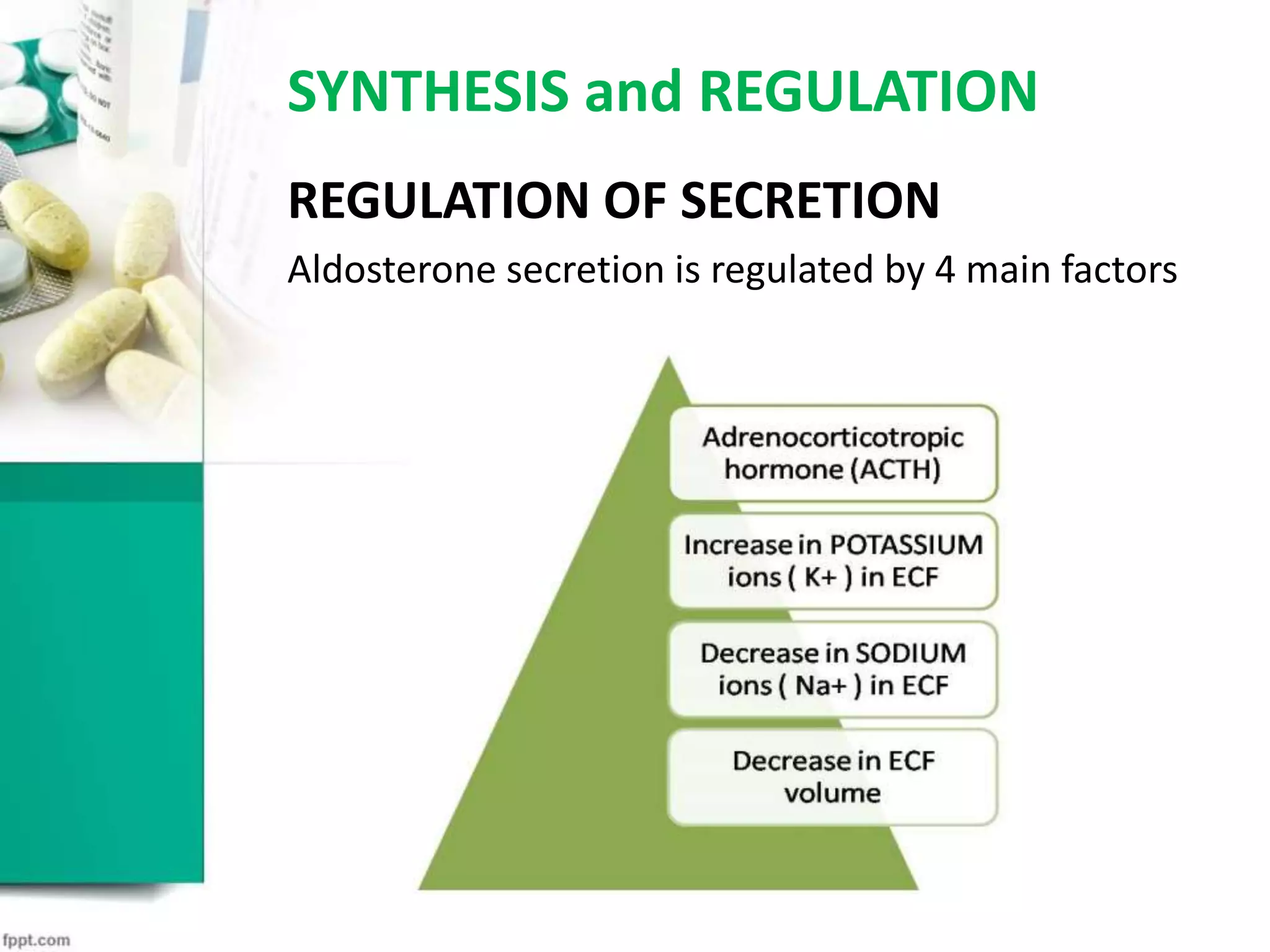
Aldosterone secretion is regulated by 4 main factors
ACTH plays
insufficient role in
regulating the
aldosterone
secretion.
Other factors like ,
Angiotensin are
able to maintain or
regulate its
secretion.
(ref. BC Pharmacology by
Katzung pg. 708 and
Lippincott Pharmacology)
MECHANASIM OF ACTION
• Aldosterone acts through mRNA mechanism
• Its receptors are cytoplasmic.
• It binds to its specific receptors , Hsp90 releases
• Receptor-steroid complex forms dimer and
enters the nucleus
• Binds to response element (MRE) and regulate
transcription and translation
• Synthesized protein are in the form of enzymes
i.e. Sodium/Potassium ATPase and increase
expression of epithelial sodium channel (ENaC).
MECHANASIM OF ACTION
PHARMACOKINETICS
• Synthesized in body and injected in tracer
quantities.
• Binds to albumin in Plasma
• Half life is 15-20 minutes
• Degraded by liver and conjugated to form
glucoronides
• Excretion via urine
PHARMACODYANMICS
• ALDOSTERONE Has following actions
• LIFE SAVING HORMONE
-maintains osmolarity and volume of ECF
-without it, death occurs within weeks
- has 3 important function
*reabsorption of sodium
*excretion of potassium
* secretion of hydrogen ions
PHARMACODYANMICS
• Effect on sodium ion :
Increases sodium reabsorption , during
hyper secretion of aldosterone , the
loss of sodium is less but in hypo
secretion , excretion of sodium
increases and resulting in
hypernatriuria
PHARMACODYANMICS
• Effect on ECF:
Along with sodium ion , 2 molecules of water
are reabsorbed which result in an increase in
ECF volume.
But still mild hypernatremia occurs
It induces thirst, leading to intake of water
again.. IT will lead to increase ECF and blood
volume.
PHARMACODYANMICS
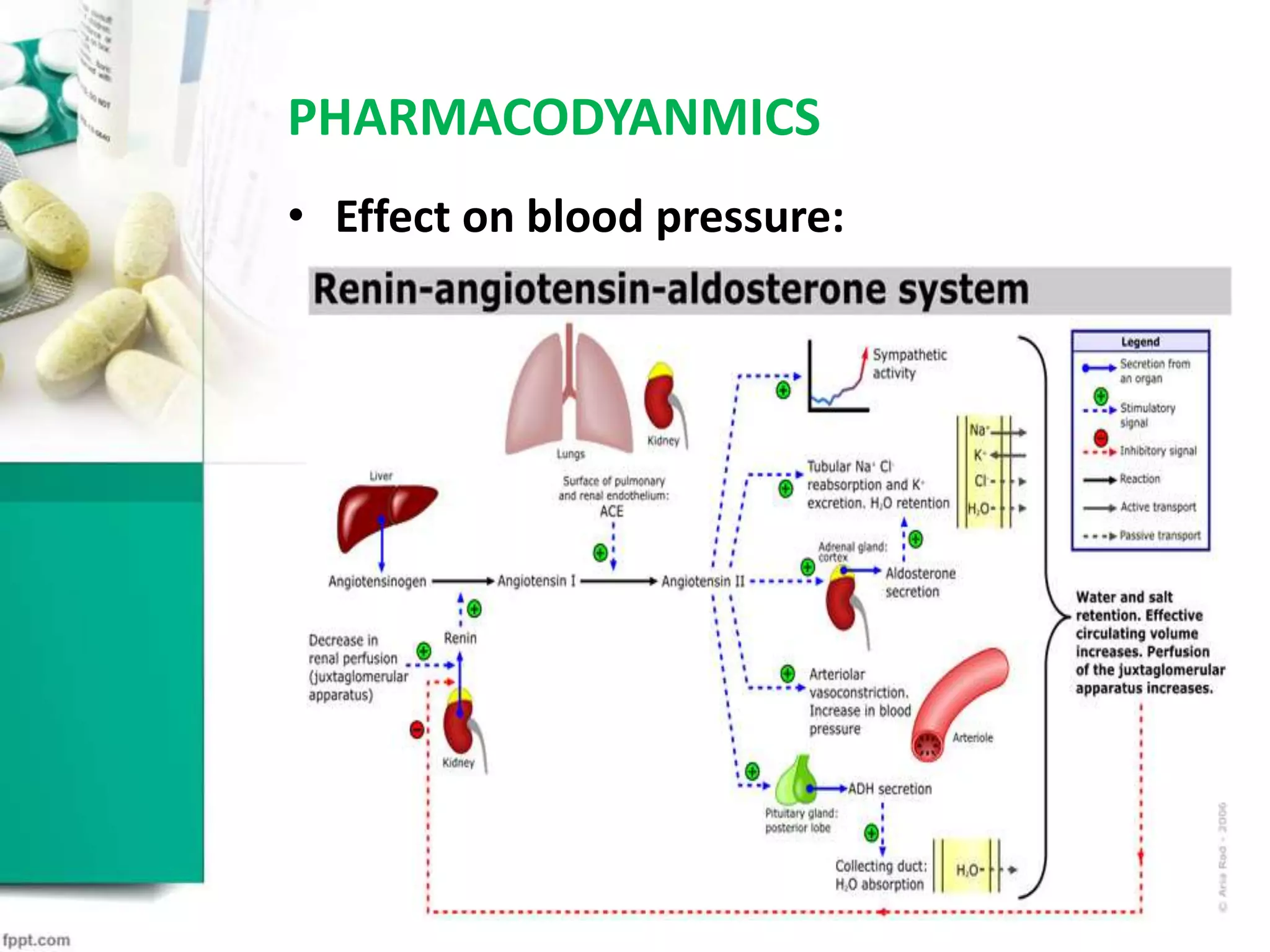
• Effect on blood pressure:
PHARMACODYANMICS
• Effect on Potassium ions:
Aldosterone results in excretion of potassium
from body , it will result in HYPOKALEMIA
and muscle weakness
HYPERKALEMIA is also very dangerous
condition, may lead to cardiac Toxicity ……
arrhythmias….. Cardiac collapse and then
DEATH .
PHARMACODYANMICS
• EFFECT ON HYDROGEN IONS:
In order to keep electrolyte imbalance ,
aldosterone causes tubular secretion of
hydrogen ions ,
Excreted in exchange of Sodium ions
Helps to maintain acid-base balance in body
In hyper secretion, causes alkalosis and in
hypo secretion , causes acidosis
PHARMACODYANMICS
• EFFECT ON OTHER ORGANS :
• Prevents sodium loss via salivary and sweat
glands
• Prevent loss of sodium through feces.
• Hypo secretion of aldosterone may lead to
diarrhea with sodium and water loss
CLINICAL INDICATION
MINERALOCORTICOIDS clinical indications are:
 Aldosterone and DOC (precursor of aldosterone)
help to maintain acid-base balance and use in
acidosis.
 Use to treat hypotension
 FLUDROCORTISONE, a potent steroid has potent
salt retaining activity and used to treat
adrenocortical insufficiency related to
mineralocorticoid deficiency
 Use in a treatment of hyperkalemia
ADVERSE EFFECTS
HYPERSECRETION :
 Hyperaldosteronism : Primary
hyperaldosteronism or Conn syndrome…..
Occurs due to tumor on zona glomerulosa
Secondary hyperaldosteronism occurs due to
.. CHF, Nephrosis and toxemia of pregnancy
 HYPOKALEMIA: hypokalemia
 will lead to muscle weakness
ADVERSE EFFECTS
 HYPERTENSION: Occurs due to increase in ECF ,Blood
volume, cardiac output ..
Cardiac output IS directly
proportional to BP
 ALKALOSIS
 ADDISON Disease
 PERIPHERAL EDEMA
ADVERSE EFFECTS
• HYPOSECRETION :
 Hyperkalemia
 Acidosis
 Hypotension
 Electrolyte imbalance
 Cardiac arrhythmias
ANTAGONISTS
Ref: BC Pharmacology 12E (chapter 15)
ANTAGONISTS
THE END

Mineralcorticoids

  • 1.
    RIDA BATOOL SHEHZADI SANA IRAMHAROON AYESHA SADIQQA Basic and Clinical Pharmacology Katzung 13E Lippincott Illustrated Reviews, Pharmacology Reference:
  • 2.
  • 3.
    GENERAL REVIEW OFCORTICOSTEROIDS • Hormones of adrenal cortex are called corticosteroids or corticoids. • CORTICO – related to adrenal cortex • STEROIDS – related to steroidal nucleus.
  • 4.
  • 5.
    FUNCTIONAL ANATOMY OFADRENAL GLANDS • Body has 2 adrenal glands , also called SUPRARENAL GLANDS. • These have 2 Parts - Adrenal cortex - Adrenal medulla CORTICOSTEROIDS are related to Adrenal CORTEX
  • 6.
  • 7.
    HORMONES OF ADRENALCORTEX Adrenal cortex hormones are classified into three groups. Mineralocorticoids -cortisol –corticosterone –cortisone Glucocorticoids -aldosterone -deoxycorticosterone Androgens -dehydroepiandrosterone (DHEA) -androstenedione -testosterone
  • 8.
  • 10.
    INTRODUCTION • Mineralocorticoids arethe corticosteroids that act on MINERALS(electrolytes) ,particularly * SODIUM (Na+ ) *POTASSIUM ( K+ )
  • 11.
    SYNTHESIS and REGULATION SYNTHESIS Aldosteroneis synthesized and release from zona glomerulosa of adrenal cortex
  • 12.
    SYNTHESIS and REGULATION REGULATIONOF SECRETION Aldosterone secretion is regulated by 4 main factors
  • 13.
    ACTH plays insufficient rolein regulating the aldosterone secretion. Other factors like , Angiotensin are able to maintain or regulate its secretion. (ref. BC Pharmacology by Katzung pg. 708 and Lippincott Pharmacology)
  • 15.
    MECHANASIM OF ACTION •Aldosterone acts through mRNA mechanism • Its receptors are cytoplasmic. • It binds to its specific receptors , Hsp90 releases • Receptor-steroid complex forms dimer and enters the nucleus • Binds to response element (MRE) and regulate transcription and translation • Synthesized protein are in the form of enzymes i.e. Sodium/Potassium ATPase and increase expression of epithelial sodium channel (ENaC).
  • 16.
  • 17.
    PHARMACOKINETICS • Synthesized inbody and injected in tracer quantities. • Binds to albumin in Plasma • Half life is 15-20 minutes • Degraded by liver and conjugated to form glucoronides • Excretion via urine
  • 18.
    PHARMACODYANMICS • ALDOSTERONE Hasfollowing actions • LIFE SAVING HORMONE -maintains osmolarity and volume of ECF -without it, death occurs within weeks - has 3 important function *reabsorption of sodium *excretion of potassium * secretion of hydrogen ions
  • 19.
    PHARMACODYANMICS • Effect onsodium ion : Increases sodium reabsorption , during hyper secretion of aldosterone , the loss of sodium is less but in hypo secretion , excretion of sodium increases and resulting in hypernatriuria
  • 20.
    PHARMACODYANMICS • Effect onECF: Along with sodium ion , 2 molecules of water are reabsorbed which result in an increase in ECF volume. But still mild hypernatremia occurs It induces thirst, leading to intake of water again.. IT will lead to increase ECF and blood volume.
  • 21.
  • 22.
    PHARMACODYANMICS • Effect onPotassium ions: Aldosterone results in excretion of potassium from body , it will result in HYPOKALEMIA and muscle weakness HYPERKALEMIA is also very dangerous condition, may lead to cardiac Toxicity …… arrhythmias….. Cardiac collapse and then DEATH .
  • 24.
    PHARMACODYANMICS • EFFECT ONHYDROGEN IONS: In order to keep electrolyte imbalance , aldosterone causes tubular secretion of hydrogen ions , Excreted in exchange of Sodium ions Helps to maintain acid-base balance in body In hyper secretion, causes alkalosis and in hypo secretion , causes acidosis
  • 25.
    PHARMACODYANMICS • EFFECT ONOTHER ORGANS : • Prevents sodium loss via salivary and sweat glands • Prevent loss of sodium through feces. • Hypo secretion of aldosterone may lead to diarrhea with sodium and water loss
  • 26.
    CLINICAL INDICATION MINERALOCORTICOIDS clinicalindications are:  Aldosterone and DOC (precursor of aldosterone) help to maintain acid-base balance and use in acidosis.  Use to treat hypotension  FLUDROCORTISONE, a potent steroid has potent salt retaining activity and used to treat adrenocortical insufficiency related to mineralocorticoid deficiency  Use in a treatment of hyperkalemia
  • 27.
    ADVERSE EFFECTS HYPERSECRETION : Hyperaldosteronism : Primary hyperaldosteronism or Conn syndrome….. Occurs due to tumor on zona glomerulosa Secondary hyperaldosteronism occurs due to .. CHF, Nephrosis and toxemia of pregnancy  HYPOKALEMIA: hypokalemia  will lead to muscle weakness
  • 28.
    ADVERSE EFFECTS  HYPERTENSION:Occurs due to increase in ECF ,Blood volume, cardiac output .. Cardiac output IS directly proportional to BP  ALKALOSIS  ADDISON Disease  PERIPHERAL EDEMA
  • 29.
    ADVERSE EFFECTS • HYPOSECRETION:  Hyperkalemia  Acidosis  Hypotension  Electrolyte imbalance  Cardiac arrhythmias
  • 30.
  • 31.
  • 32.