NEW COURSE
Program Name : Diploma in Mining
and Mine Surveying / Diploma in Mine
Engineering / Mining Engineering
Program Code : MN / MS / MZ
Year : Third
Course Title : Mine Economics
Course Code: 22381
Unit
Marks
as per
Curric
ulum
Max
Marks
[1.5 x
Clo.-
(2)]
Qu
e1
Que
-2
Que-
3
Que-
4
Que-5
Que-
6
Total
Marks
in a
paper
set
Remar
ks
I 12 18 4 4 - 4 - 6 18
Q1 Define type of 2 marks
Q2 Explain type of 4 marks/6 marks
NOTE : The presentation is respect of various topics and
units are only indicative and not exhaustive.
Students are advised to keep themselves abreast and well
informed about the subject by referring to the suggested
reference books & latest information available from
different available sources.
IMP slides/definitions from exam view point
are marked .
Some lectures are on YouTube: Basic mining by sharad
sapkal in Hindi
Rest of the material is for general information and subject
understanding.
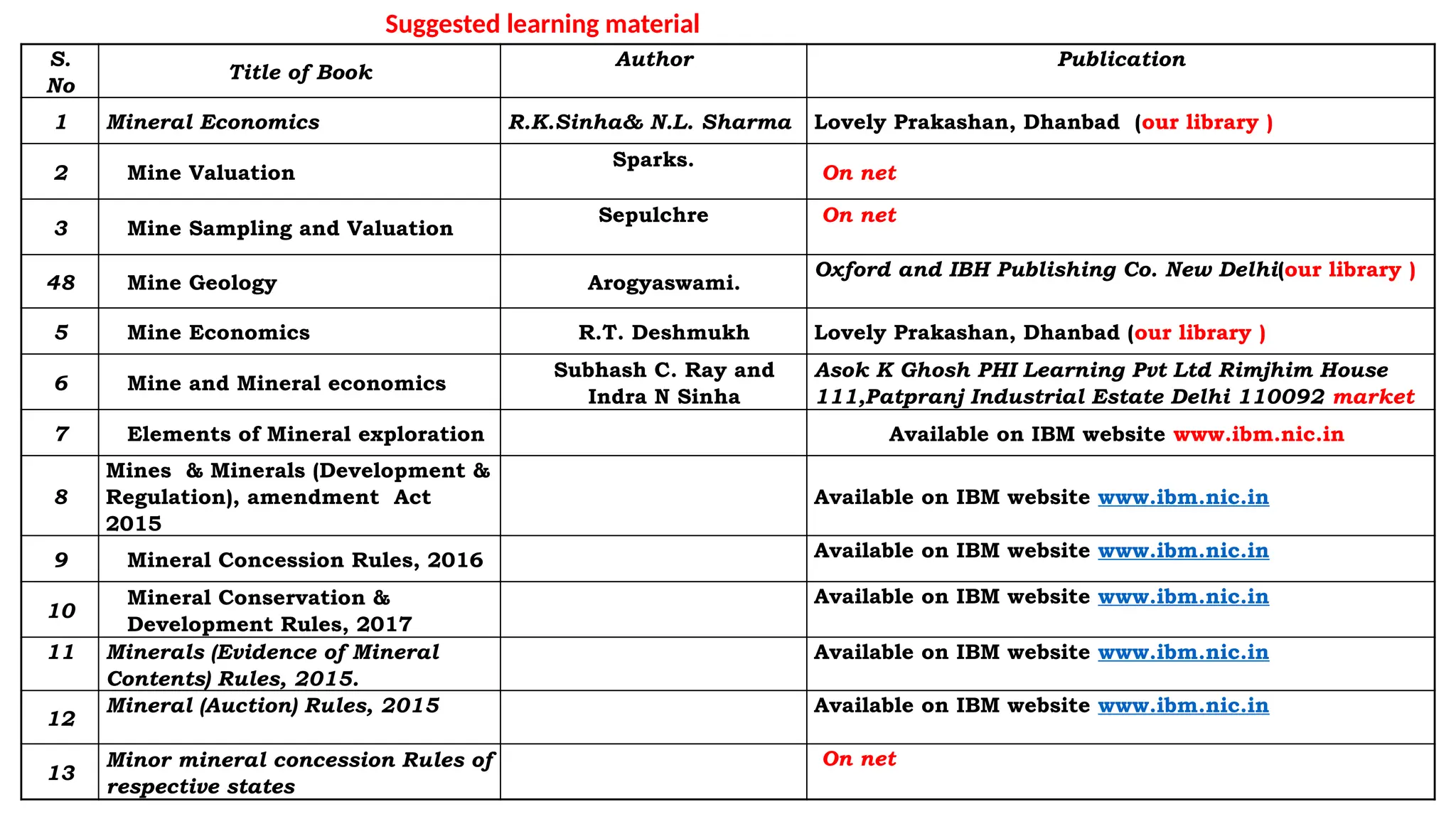
S.
No
Title of Book
Author Publication
1 Mineral Economics R.K.Sinha& N.L. Sharma Lovely Prakashan, Dhanbad (our library )
2 Mine Valuation
Sparks.
On net
3 Mine Sampling and Valuation
Sepulchre On net
48 Mine Geology Arogyaswami.
Oxford and IBH Publishing Co. New Delhi(our library )
5 Mine Economics R.T. Deshmukh Lovely Prakashan, Dhanbad (our library )
6 Mine and Mineral economics
Subhash C. Ray and
Indra N Sinha
Asok K Ghosh PHI Learning Pvt Ltd Rimjhim House
111,Patpranj Industrial Estate Delhi 110092 market
7 Elements of Mineral exploration Available on IBM website www.ibm.nic.in
8
Mines & Minerals (Development &
Regulation), amendment Act
2015
Available on IBM website www.ibm.nic.in
9 Mineral Concession Rules, 2016 Available on IBM website www.ibm.nic.in
10
Mineral Conservation &
Development Rules, 2017
Available on IBM website www.ibm.nic.in
11 Minerals (Evidence of Mineral
Contents) Rules, 2015.
Available on IBM website www.ibm.nic.in
12
Mineral (Auction) Rules, 2015 Available on IBM website www.ibm.nic.in
13
Minor mineral concession Rules of
respective states
On net
Suggested learning material
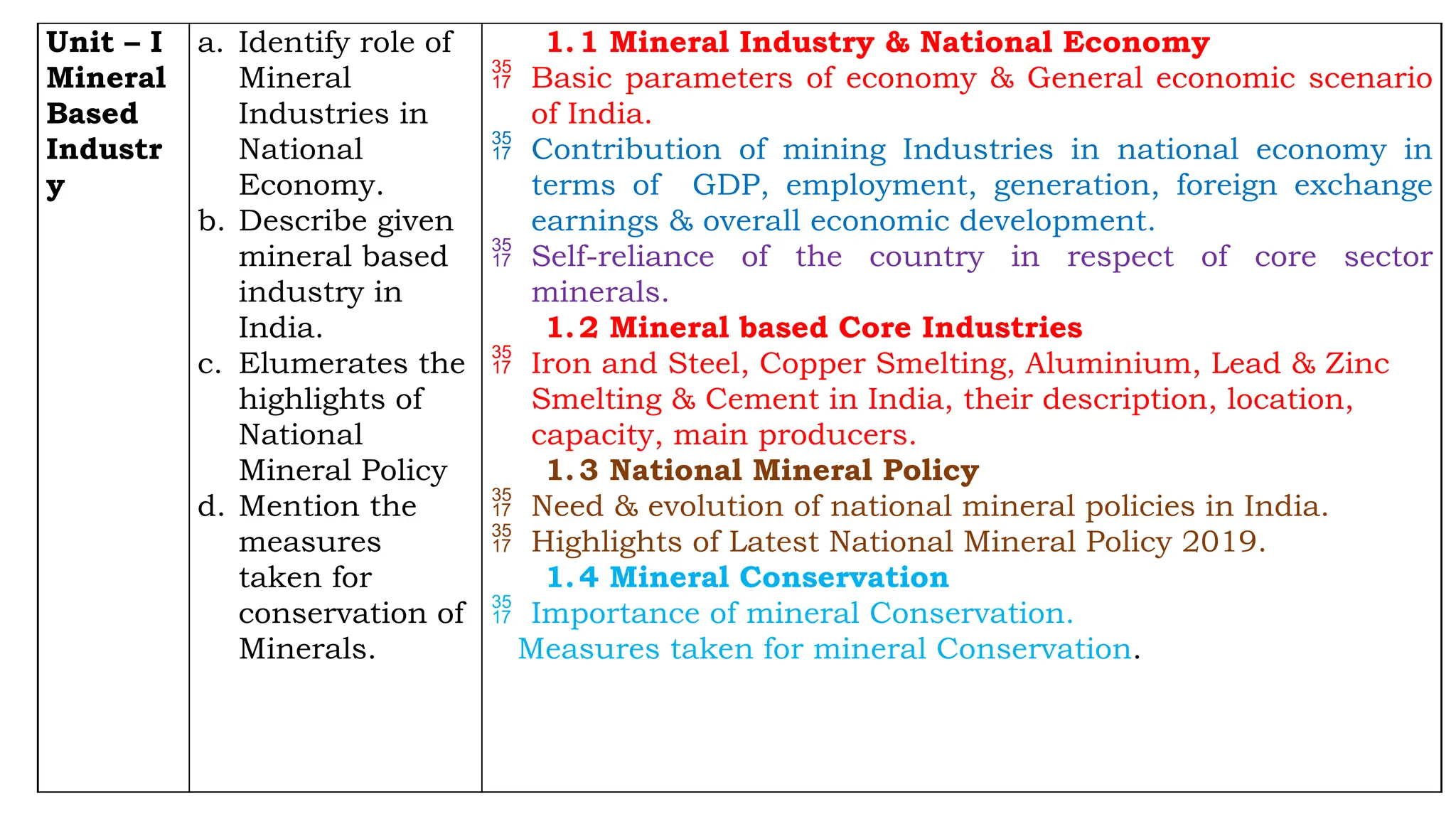
Unit – I
Mineral
Based
Industr
y
a. Identify role of
Mineral
Industries in
National
Economy.
b. Describe given
mineral based
industry in
India.
c. Elumerates the
highlights of
National
Mineral Policy
d. Mention the
measures
taken for
conservation of
Minerals.
1.1 Mineral Industry & National Economy
 Basic parameters of economy & General economic scenario
of India.
 Contribution of mining Industries in national economy in
terms of GDP, employment, generation, foreign exchange
earnings & overall economic development.
 Self-reliance of the country in respect of core sector
minerals.
1.2 Mineral based Core Industries
 Iron and Steel, Copper Smelting, Aluminium, Lead & Zinc
Smelting & Cement in India, their description, location,
capacity, main producers.
1.3 National Mineral Policy
 Need & evolution of national mineral policies in India.
 Highlights of Latest National Mineral Policy 2019.
1.4 Mineral Conservation
 Importance of mineral Conservation.
Measures taken for mineral Conservation.
INTRODUCTION
Mineral Economics
* Basic parameters of economy &
General economic scenario of India.
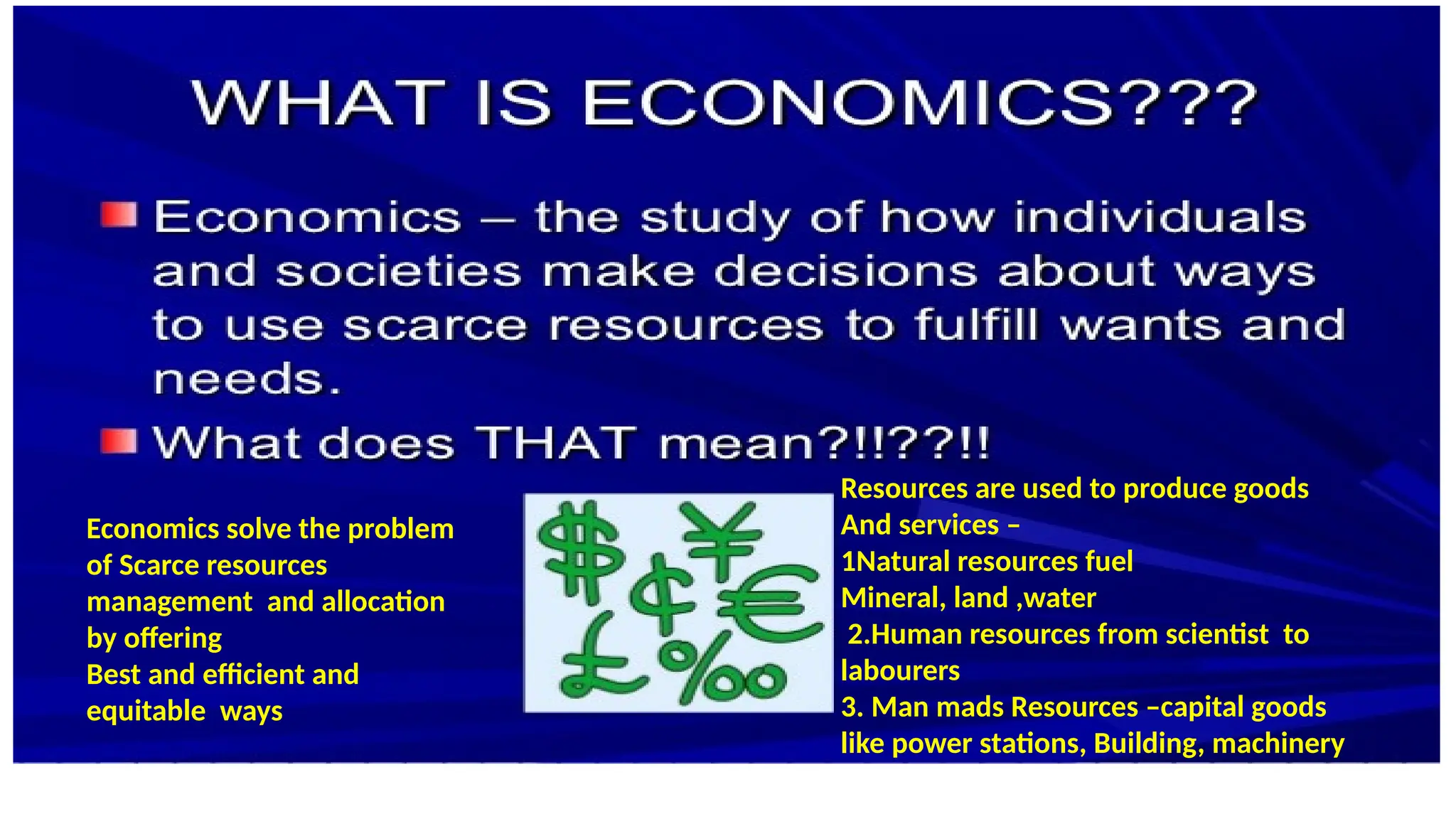
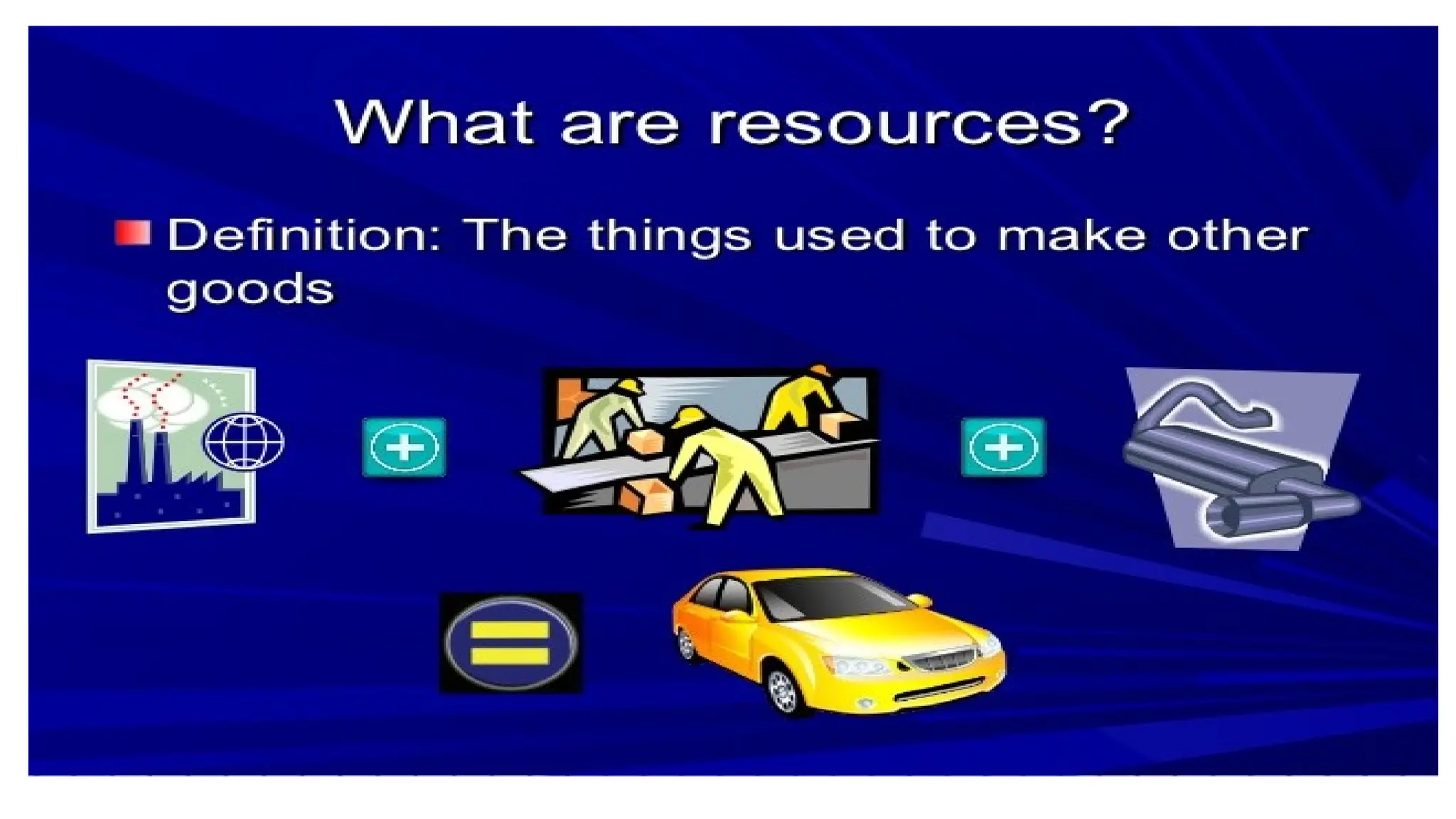
Resources are used to produce goods
And services –
1Natural resources fuel
Mineral, land ,water
2.Human resources from scientist to
labourers
3. Man mads Resources –capital goods
like power stations, Building, machinery
Economics solve the problem
of Scarce resources
management and allocation
by offering
Best and efficient and
equitable ways
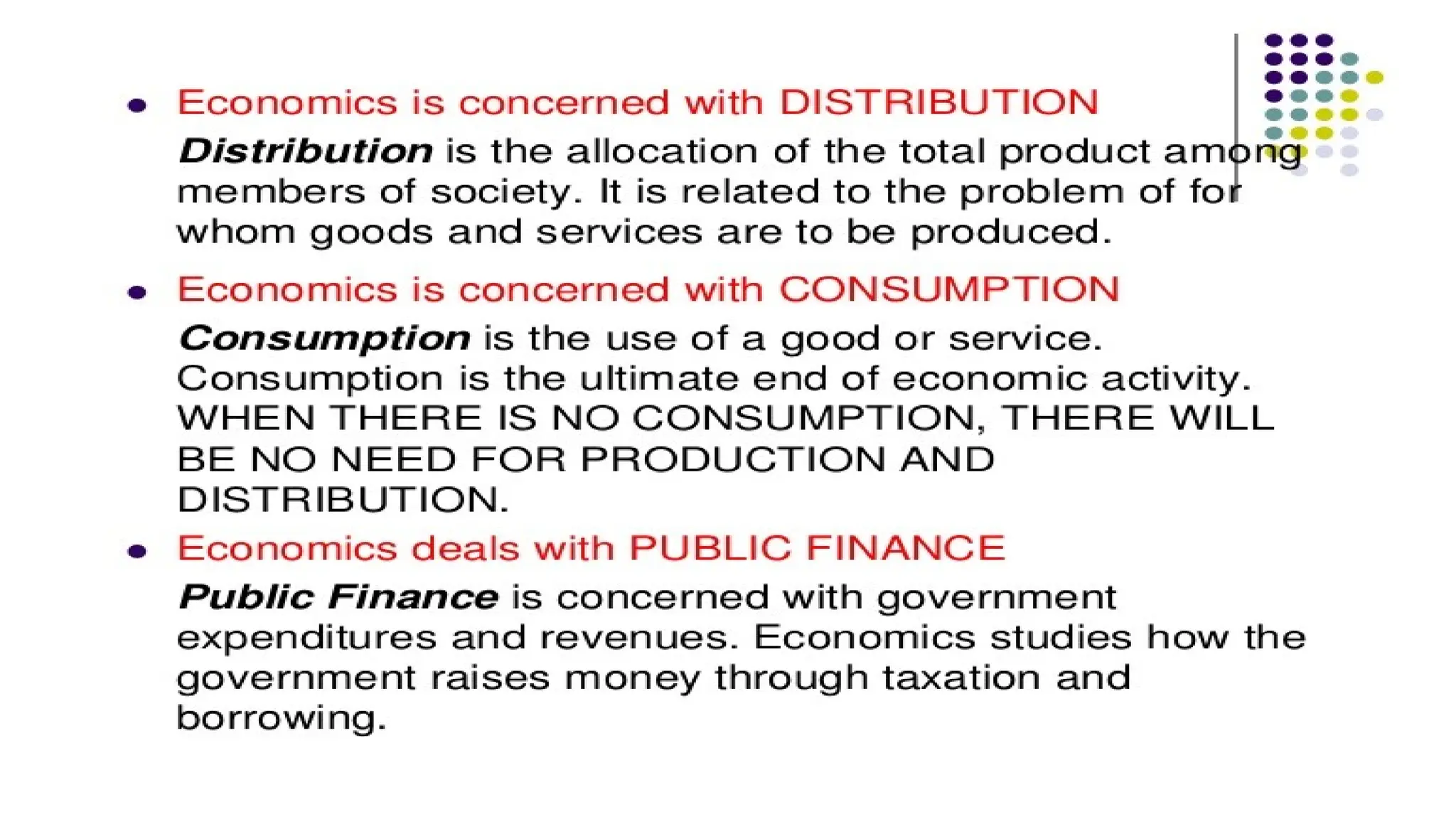
 Definition of Economics
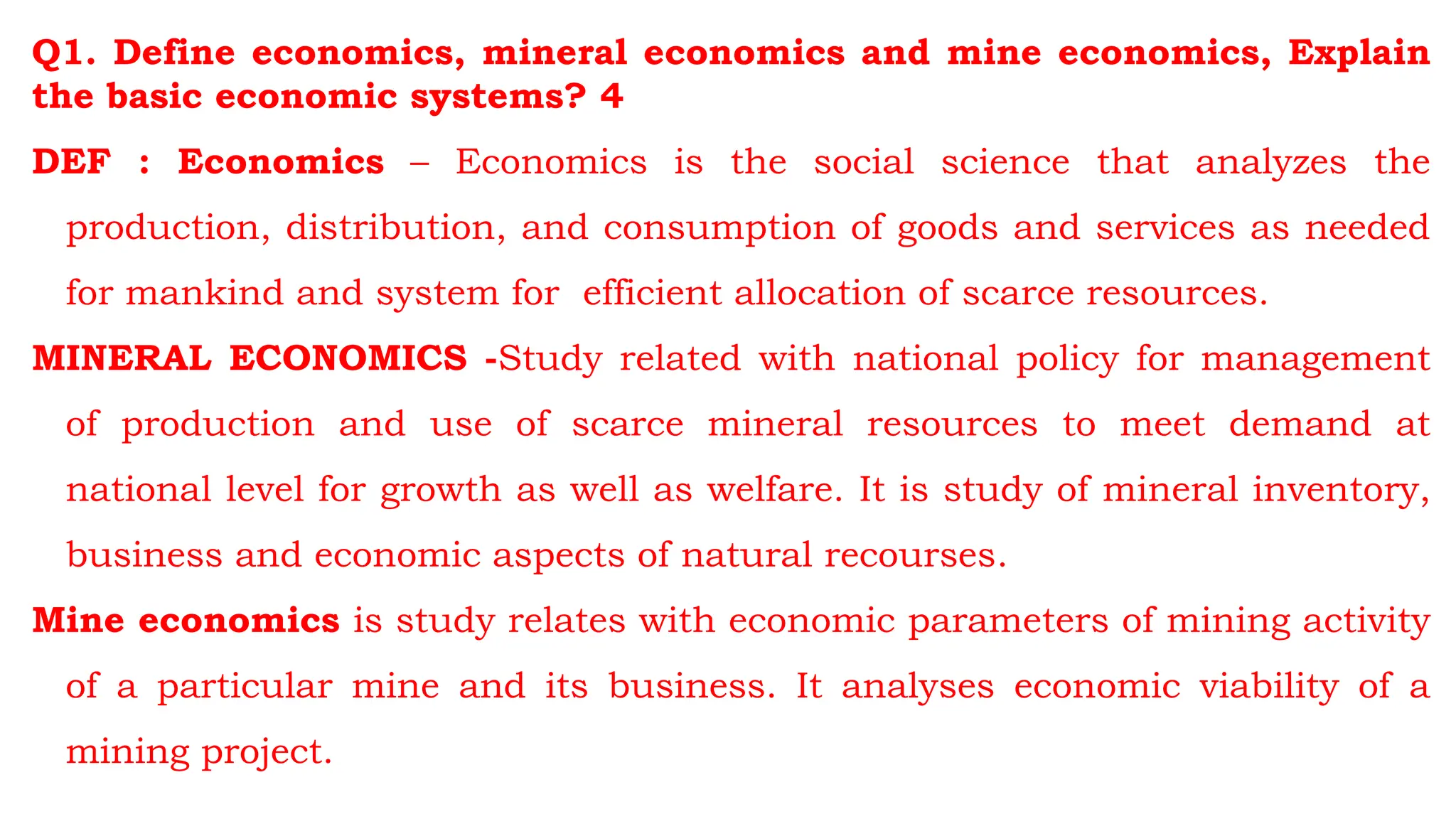
DEF : Economics – Economics is the social science that analyzes the
production, distribution, and consumption of goods and services as needed
for mankind and system for efficient allocation of scarce resources.
MINERAL ECONOMICS -Study related with national policy for management
of production and use of scarce mineral resources to meet demand at
national level for growth as well as welfare. It is study of mineral inventory,
business and economic aspects of natural recourses.
Mine economics is study relates with economic parameters of mining activity
of a particular mine and its business. It analyses economic viability of a
mining project
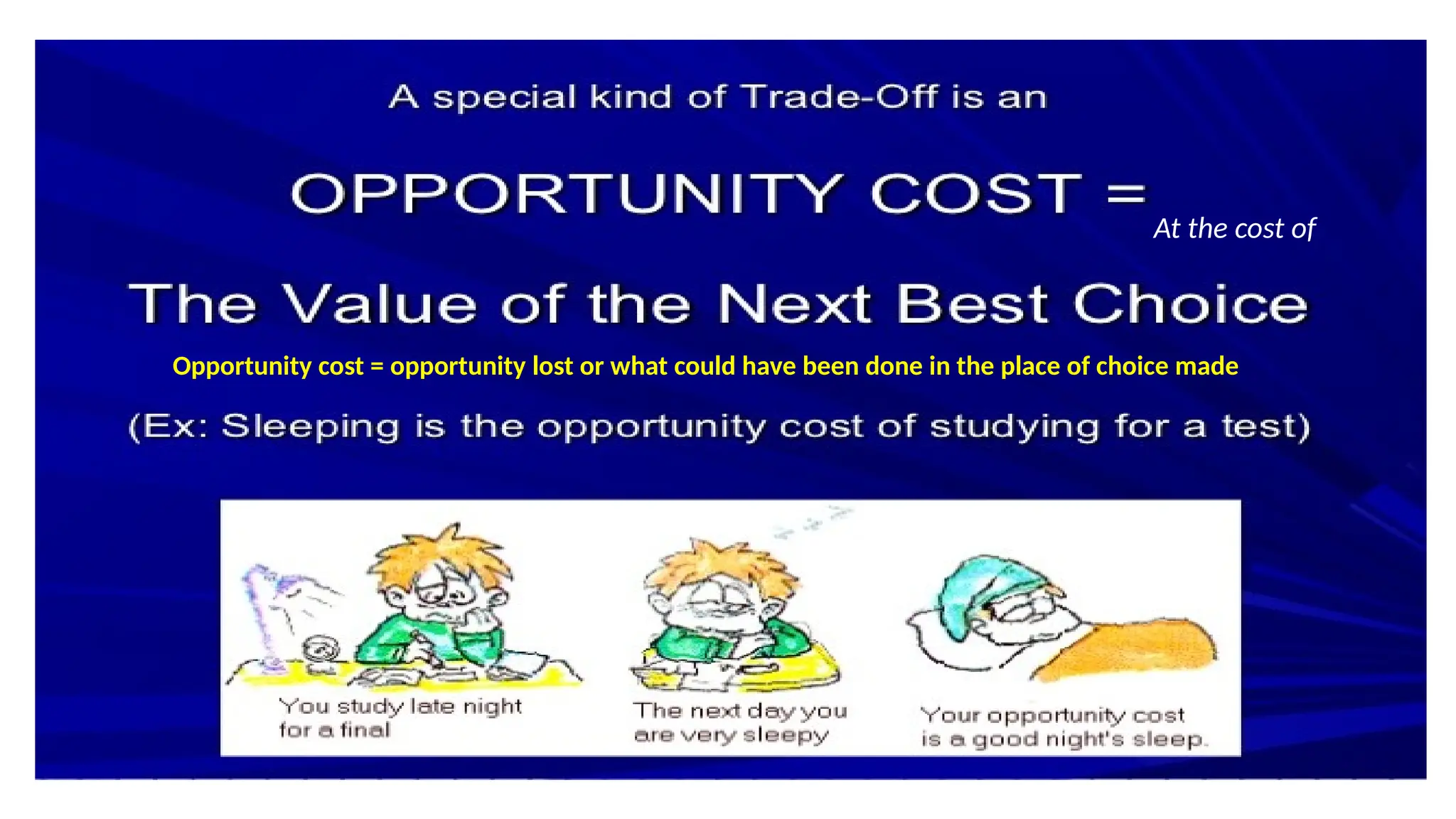
Opportunity cost = opportunity lost or what could have been done in the place of choice made
At the cost of
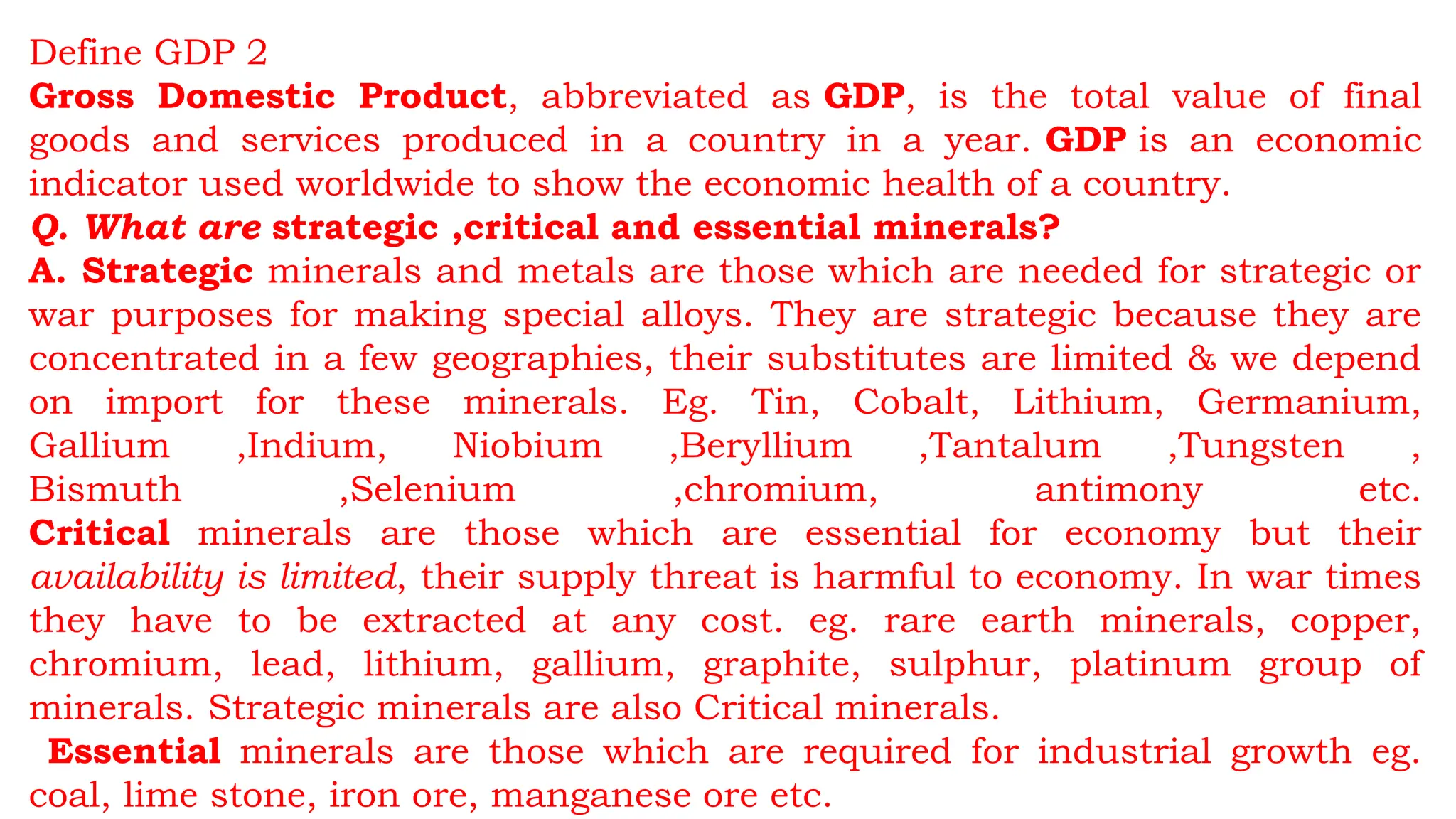
Gross Domestic Product, abbreviated as GDP, is the total value of final
goods and services produced in a country in a year.
GDP is an economic indicator used worldwide to show the economic health of
a country.
Gross value added GVA= GDP + Subsidies on products - Taxes on products.
It is used by Govt to identify sectors to be subsidized and taxed.
Two policies of Govt to manage economy in order to curbs inflation,
increase employment & GDP, maintains a healthy value of currency &
manage recession.
Fiscal policy implemented by government through regulating its public
expenditure and tax rates .
Monetary policy adopted by the RBI through regulating the supply of money,
i.e. 'printing' more money or decreasing the money supply by modifying the
interest rate, buying or selling Govt. bonds ,regulating foreign exchange rates
and changing the amount of money banks are required to maintain as
reserves.
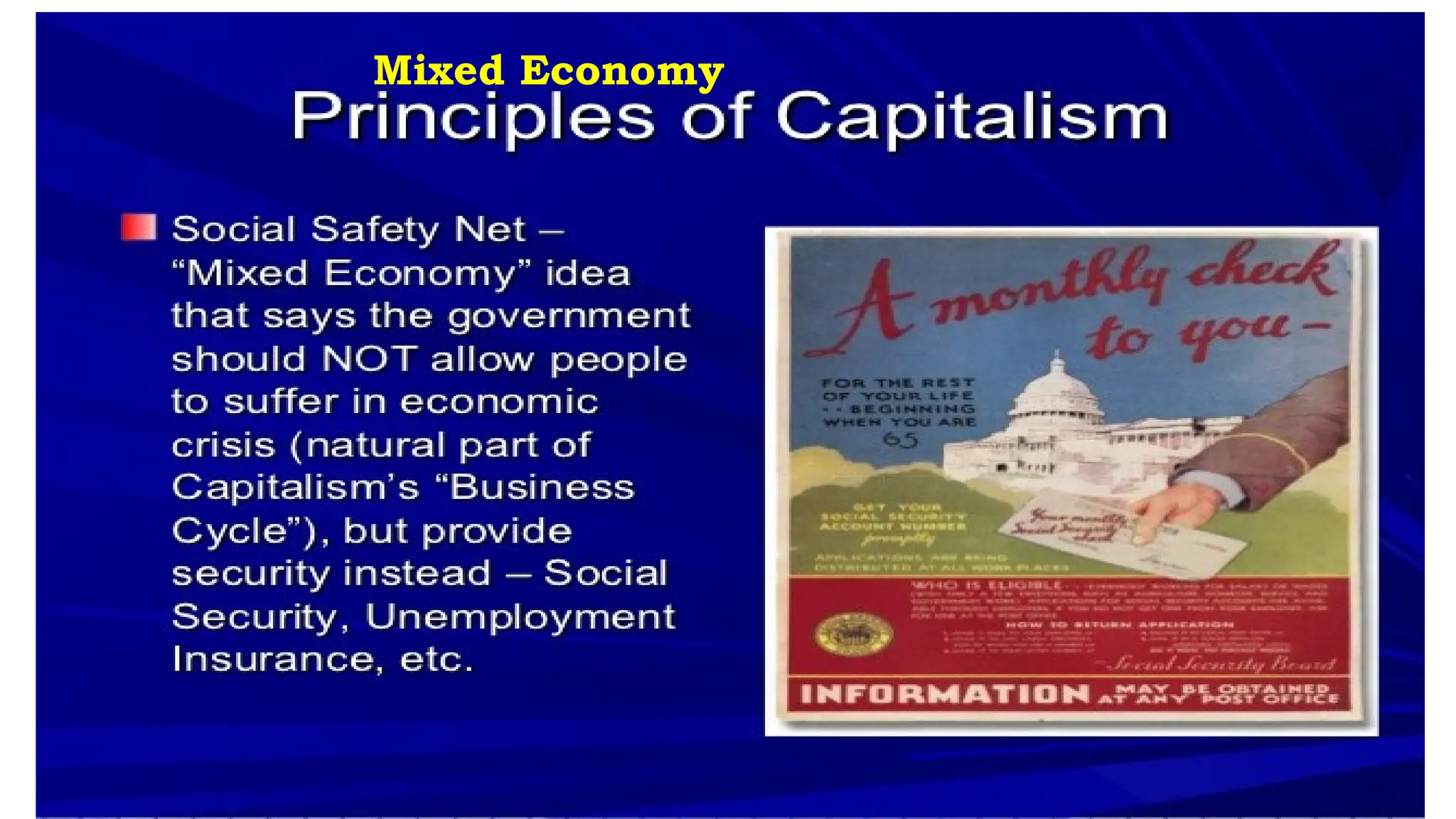
Mixed Economy
Indian Economy
(Subject to updating)
Economic developments: Under British rule, India's share of the world
economy declined from 24.4% in 1700 down to 4.2% in 1950. India's share of
global industrial output declined from 25% in 1750 down to 2% in 1900. At
the same time, the United Kingdom's share of the world economy rose from
2.9% in 1700 up to 9% in 1870
The British East India Company, following their conquest of Bengal in 1757,
had forced open the large Indian market to British goods, which could be
sold in India without tariffs or duties, compared to local Indian producers
who were heavily taxed, while in Britain, protectionist policies such as bans
and high tariffs were implemented to restrict Indian textiles from being sold
there, whereas raw cotton was imported from India without tariffs to British
factories which manufactured textiles from Indian cotton and sold them back
to the Indian market. British economic policies gave them a monopoly over
India's large market and cotton resources.
India served as both a significant supplier of raw goods to British
manufacturers and a large captive market for British manufactured goods.
Pre-liberalisation period (1947–1991)
However, at the end of colonial rule, India inherited an economy that was
one of the poorest in the developing world, with industrial development
stalled, agriculture unable to feed a rapidly growing population, a largely
illiterate and unskilled labour force, and extremely inadequate
infrastructure.
Indian economic policy after independence was influenced by the colonial
experience, which was seen as exploitative by Indian leaders exposed to
British social democracy and the planned economy of the Soviet Union
. Domestic policy tended towards protectionism, with a strong emphasis
on import substitution, industrialisation, economic interventionism, a large
government-run public sector, business regulation, and central planning .
India resembled central planning in the Soviet Union. Steel, mining,
machine tools, telecommunications, insurance, and power plants, among
other industries, were effectively nationalised in the mid-1950s.
Since 1965, the use of high-yielding varieties of seeds,
increased fertilisers and improved irrigation facilities
collectively contributed to the Green Revolution in India,
which improved the condition of agriculture by increasing
crop productivity.
In the late 1970s, the government led by Morarji
Desai eased restrictions on capacity expansion
for incumbent companies, removed price controls,
reduced corporate taxes and promoted the creation of
small-scale industries in large numbers.[
Post-liberalisation period (since 1991)
The collapse of the Soviet Union, which was India's major trading partner,
and the Gulf War, which caused a spike in oil prices, resulted in a major
balance-of-payments crisis for India, which found itself facing the prospect
of defaulting on its loans. India asked for bailout loan from the
International Monetary Fund (IMF), which in return demanded de-
regulation.
In response, the Narasimha Rao government, including Finance Minister
Manmohan Singh, initiated economic reforms in 1991. The reforms did away
with the Licence Raj, reduced tariffs and interest rates and ended many
public monopolies, allowing automatic approval of foreign direct investment
in many sectors.
By the turn of the 21st century, India had progressed towards a free-market
economy, with a substantial reduction in state control of the economy and
increased financial liberalisation. This has been accompanied by increases in
life expectancy, literacy rates and food security, although urban
residents have benefited more than rural residents.
India has classified and tracked its economy and GDP in three sectors:
agriculture, industry and services.
Agriculture or primary includes crops, horticulture, milk and animal
husbandry, aquaculture, fishing, sericulture, aviculture, forestry and related
activities.
Industry or secondary includes various manufacturing sub-sectors,
Petroleum products and Chemicals Pharmaceuticals Engineering transport
equipment, machine tools, capital goods, transformers, switchgears,
furnaces, and cast and forged parts for turbines, automobiles and railway
car, motorcycle and scooters industry and Mining.
Services or tertiary construction, retail, software, IT, communications,
hospitality, infrastructure operations, education, health, banking and
insurance, etc.
The industrial sector underwent significant changes due to the 1991
economic reforms, which removed import restrictions, brought in foreign
competition, led to the privatisation of certain government-owned public-
sector industries, liberalised the foreign direct investment regime, improved
infrastructure and led to an expansion in the production of
fast-moving consumer goods. Post-liberalisation, the Indian private sector
was faced with increasing domestic and foreign competition, including the
threat of cheaper Chinese imports.
It has since handled the change by squeezing costs, revamping management,
and relying on cheap labour and new technology. However, this has also
reduced employment generation, even among smaller manufacturers who
previously relied on labour-intensive processes.
(FDI Foreign direct Investment = manufacturing in India, stable foreign
investment in dollars
FII Foreign institutional Investment = investing in share market unstable
foreign investment in dollars)
India’s major trading partners are the European Union, China,
the United States and the United Arab Emirates.
Major export commodities included engineering goods, petroleum
products, chemicals and pharmaceuticals, gems and jewellery,
textiles and garments, agricultural products, iron ore and other
minerals.
Major import commodities included crude oil and related
products, machinery, electronic goods, gold and silver.
India's growing oil import bill is seen as the main driver behind
the large current account deficit
India's reliance on external assistance and concessional debt has
decreased since liberalisation of the economy, and the ratio
decreased from 35.3% in 1990–91 to 4.4% in 2008–09 India
liberalised its FDI policy in 2005, allowing up to a 100% FDI .
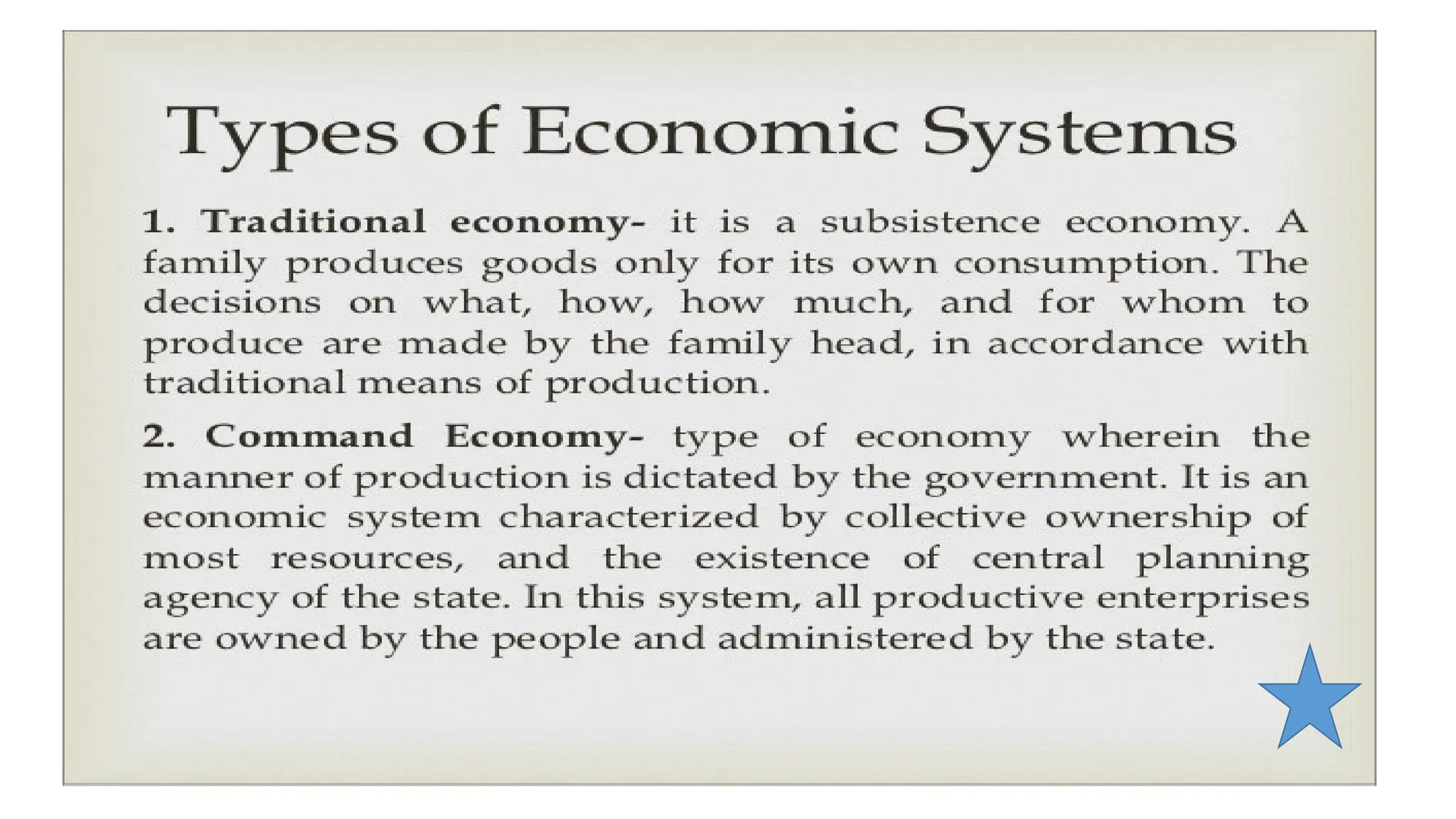
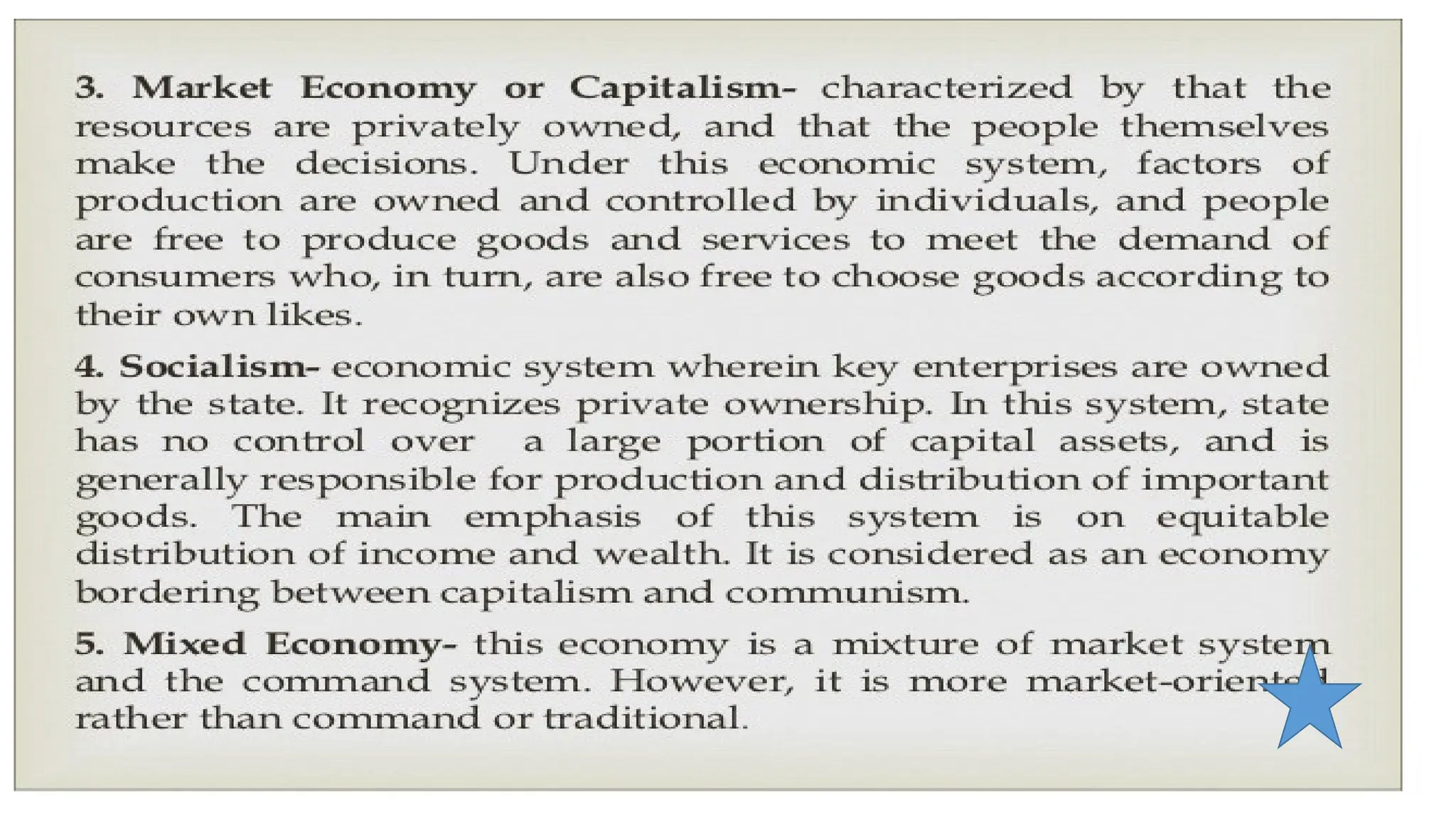
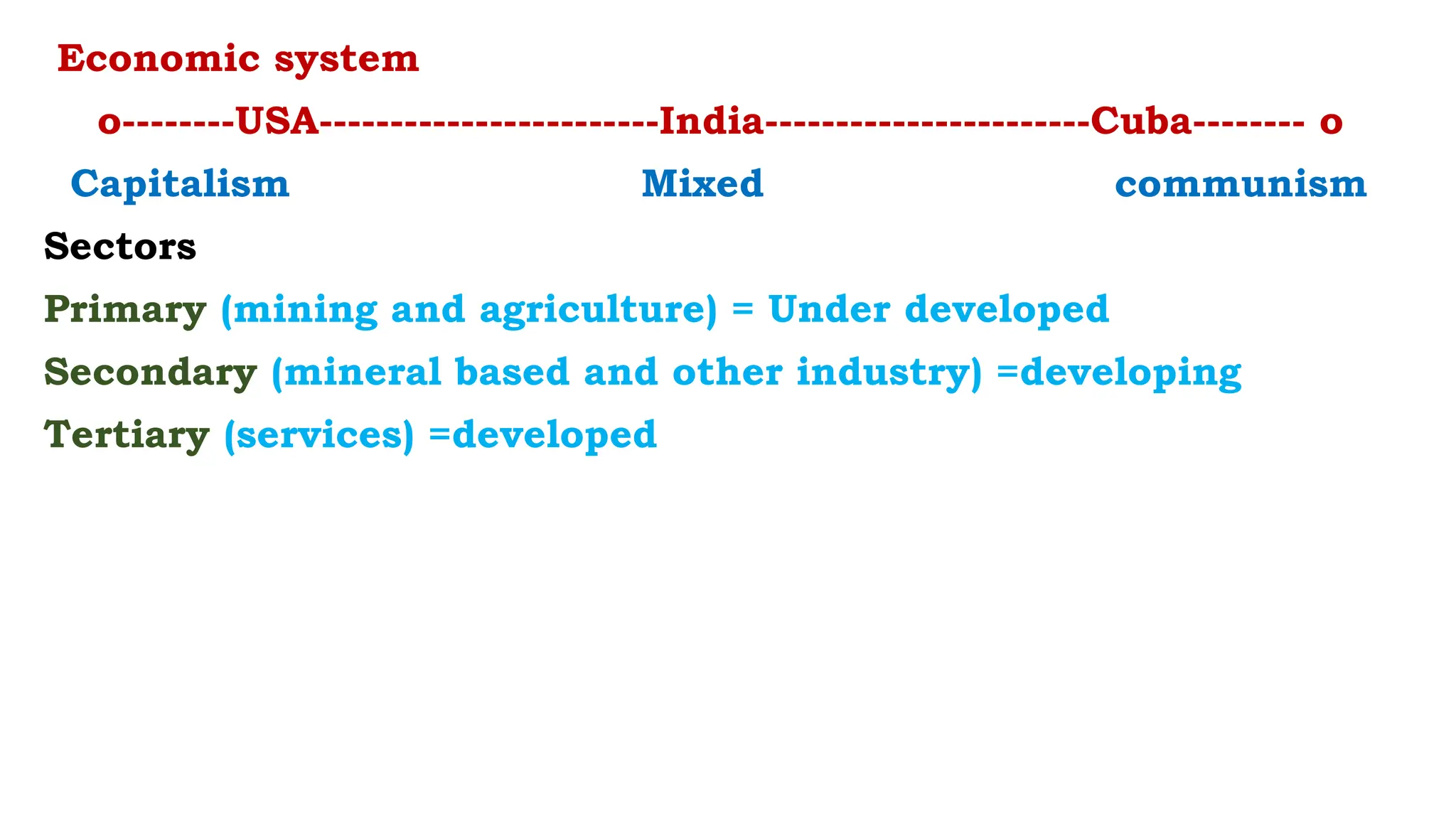
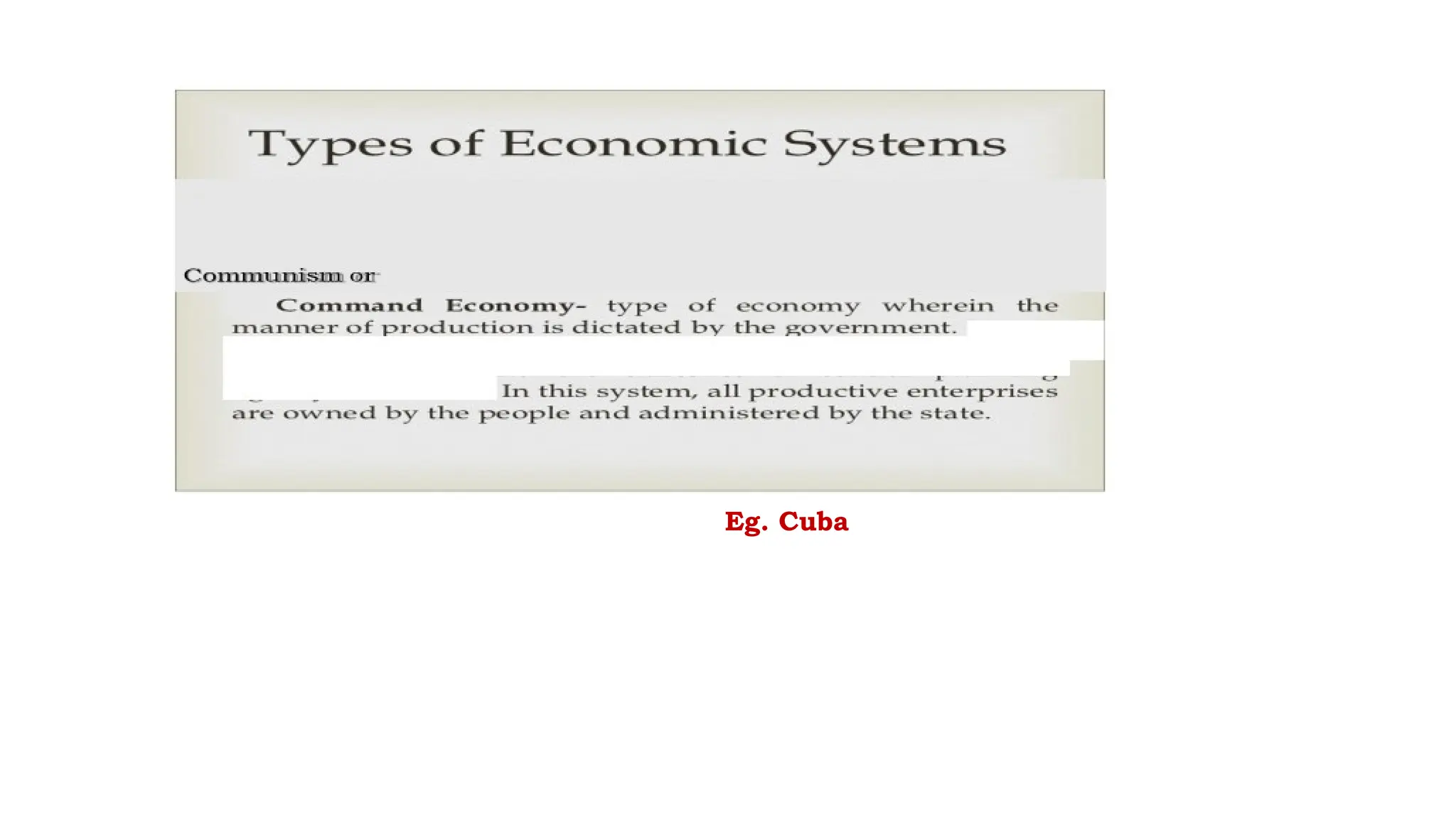
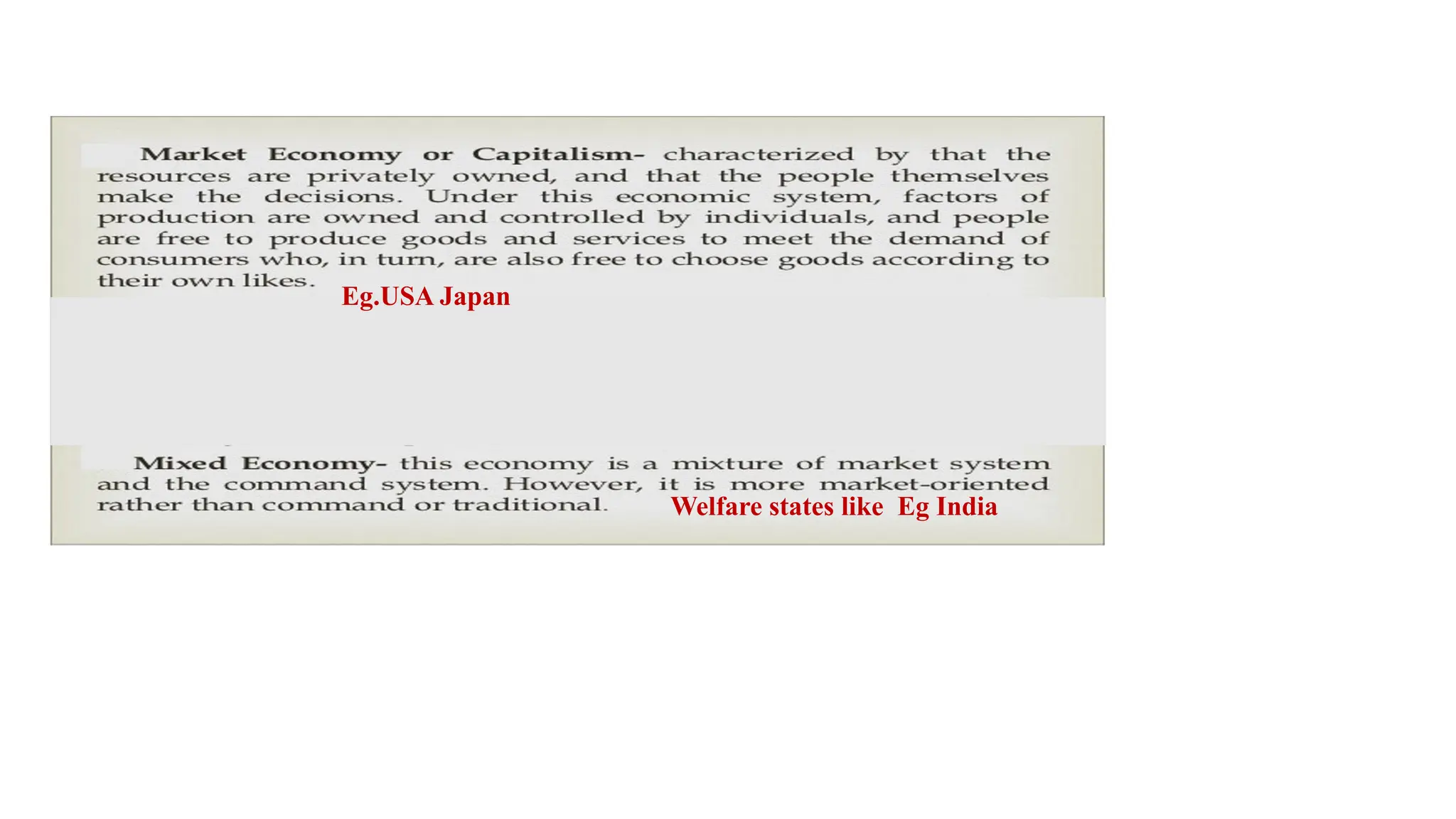
Economic system
o--------USA------------------------India-----------------------Cuba-------- o
Capitalism Mixed communism
Sectors
Primary (mining and agriculture) = Under developed
Secondary (mineral based and other industry) =developing
Tertiary (services) =developed
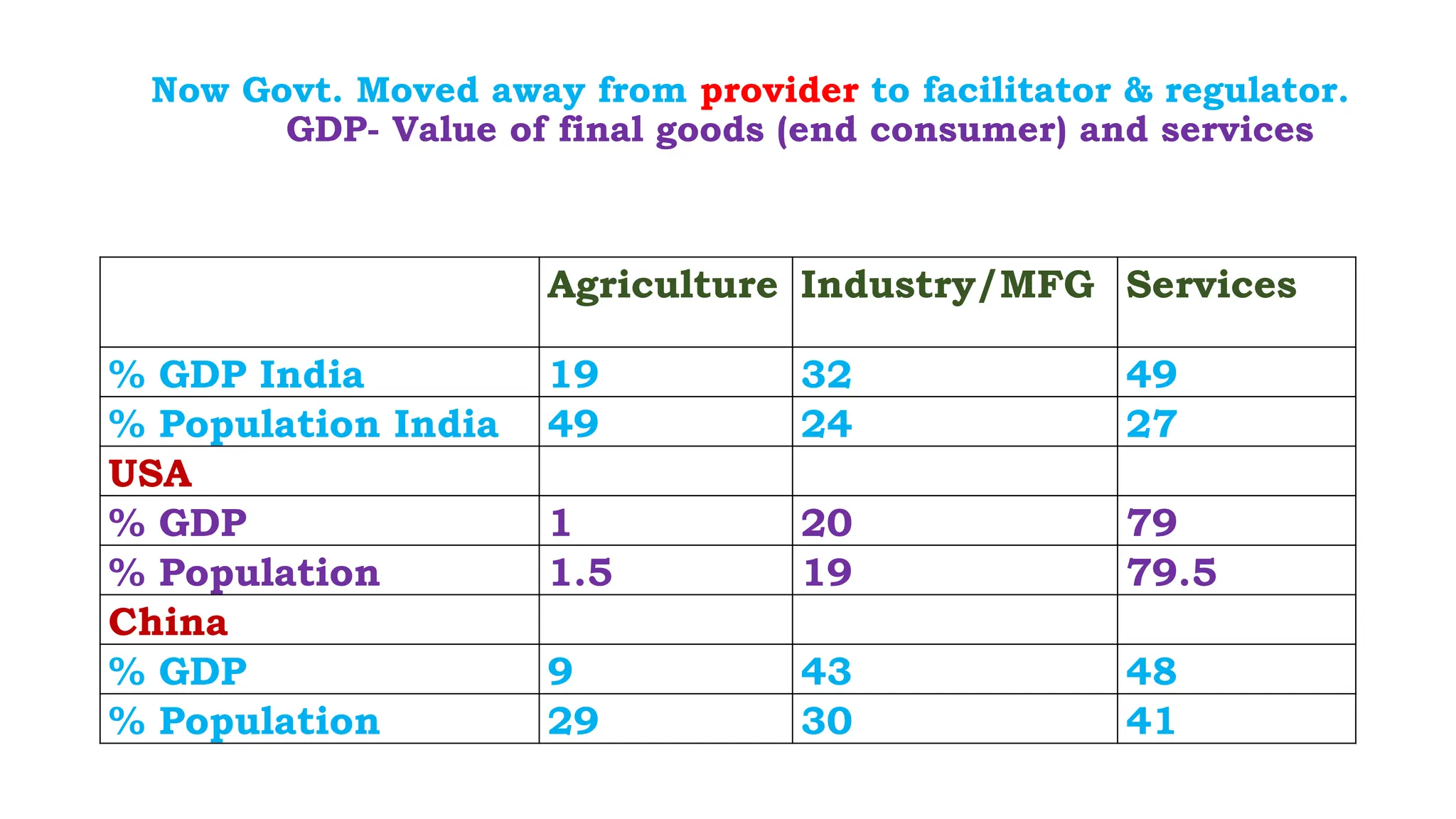
Now Govt. Moved away from provider to facilitator & regulator.
GDP- Value of final goods (end consumer) and services
Agriculture Industry/MFG Services
% GDP India 19 32 49
% Population India 49 24 27
USA
% GDP 1 20 79
% Population 1.5 19 79.5
China
% GDP 9 43 48
% Population 29 30 41
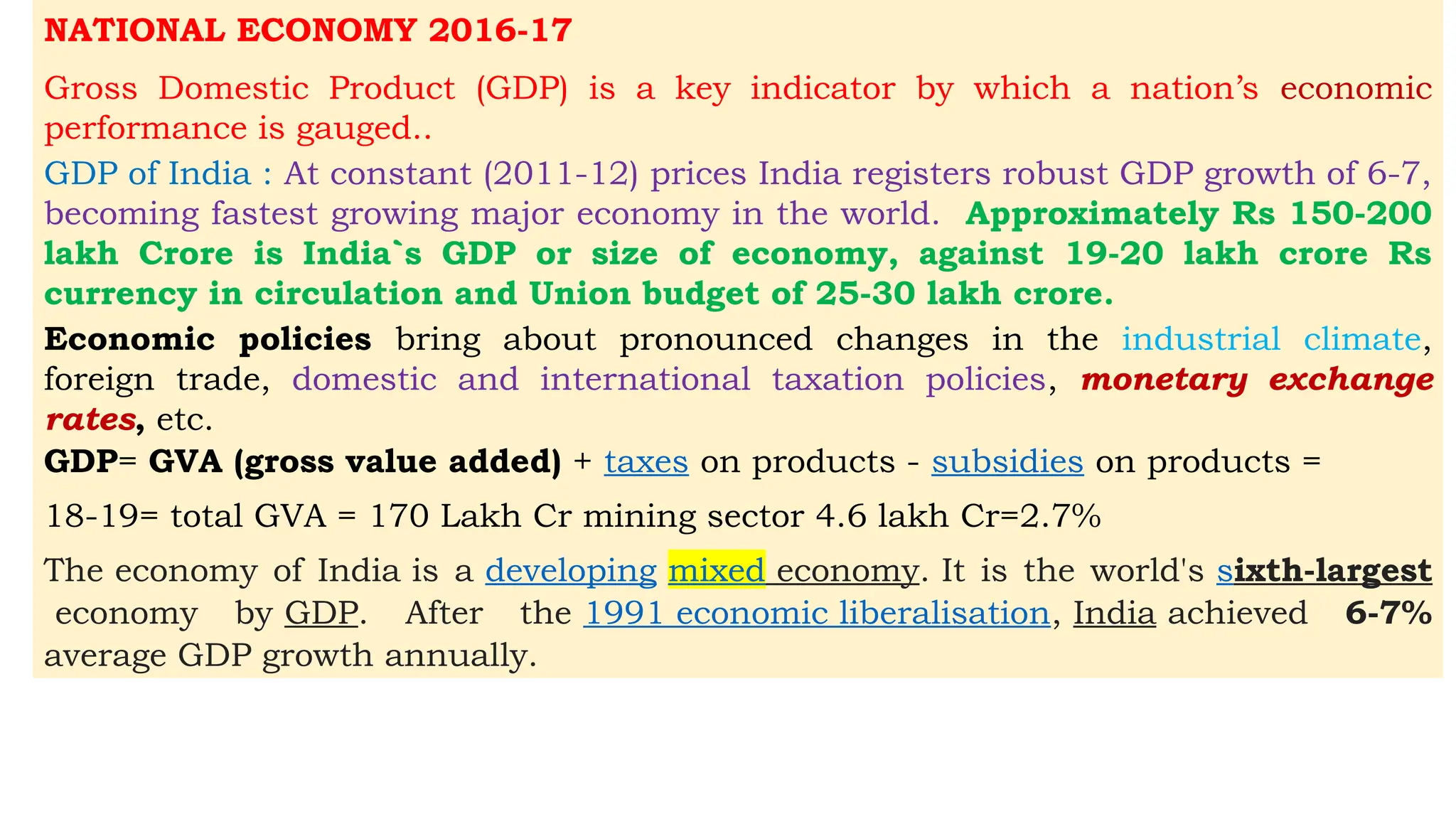
NATIONAL ECONOMY 2016-17
Gross Domestic Product (GDP) is a key indicator by which a nation’s economic
performance is gauged..
GDP of India : At constant (2011-12) prices India registers robust GDP growth of 6-7,
becoming fastest growing major economy in the world. Approximately Rs 150-200
lakh Crore is India`s GDP or size of economy, against 19-20 lakh crore Rs
currency in circulation and Union budget of 25-30 lakh crore.
Economic policies bring about pronounced changes in the industrial climate,
foreign trade, domestic and international taxation policies, monetary exchange
rates, etc.
GDP= GVA (gross value added) + taxes on products - subsidies on products =
18-19= total GVA = 170 Lakh Cr mining sector 4.6 lakh Cr=2.7%
The economy of India is a developing mixed economy. It is the world's sixth-largest
economy by GDP. After the 1991 economic liberalisation, India achieved 6-7%
average GDP growth annually.
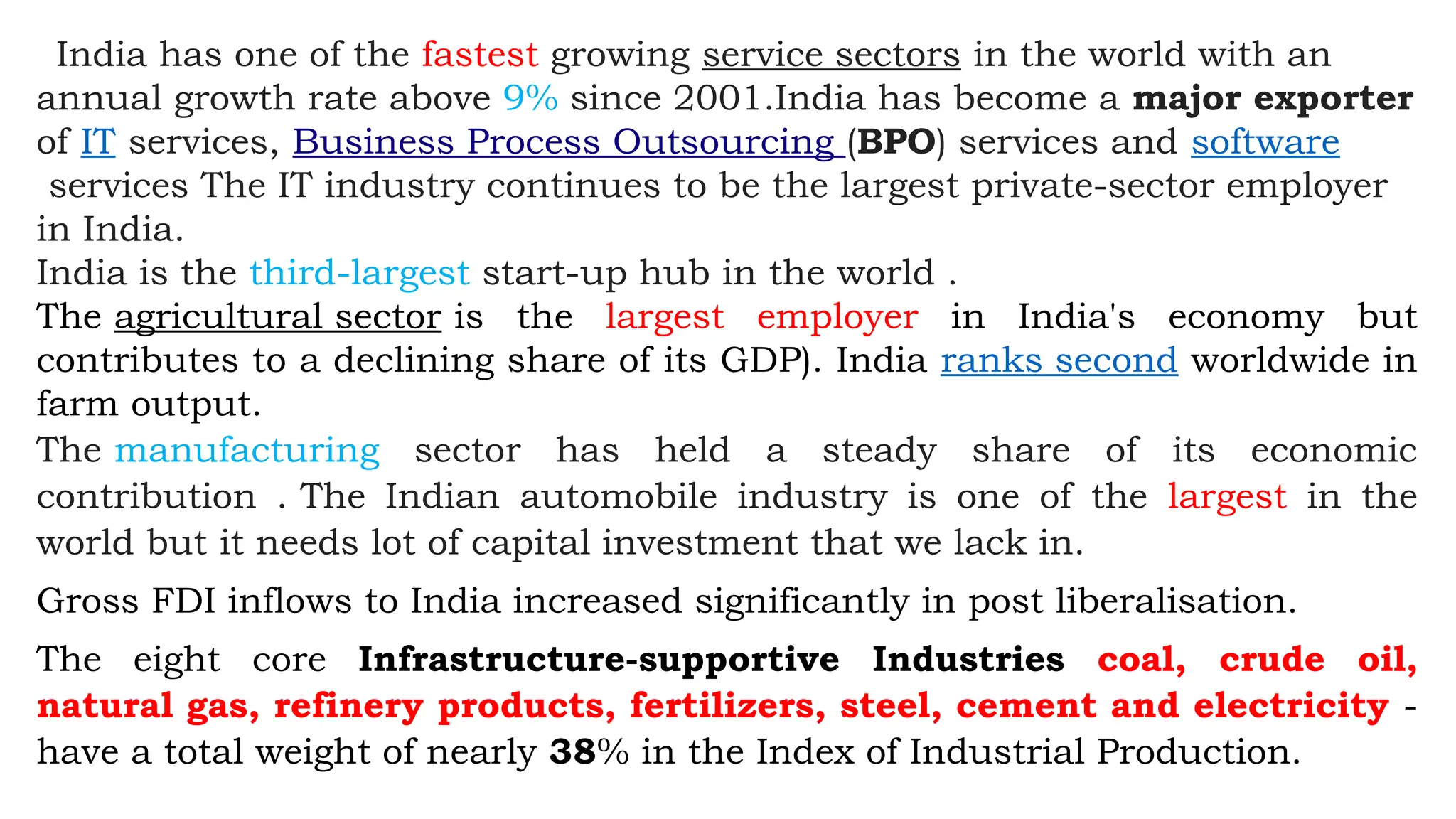
India has one of the fastest growing service sectors in the world with an
annual growth rate above 9% since 2001.India has become a major exporter
of IT services, Business Process Outsourcing (BPO) services and software
services The IT industry continues to be the largest private-sector employer
in India.
India is the third-largest start-up hub in the world .
The agricultural sector is the largest employer in India's economy but
contributes to a declining share of its GDP). India ranks second worldwide in
farm output.
The manufacturing sector has held a steady share of its economic
contribution . The Indian automobile industry is one of the largest in the
world but it needs lot of capital investment that we lack in.
Gross FDI inflows to India increased significantly in post liberalisation.
The eight core Infrastructure-supportive Industries coal, crude oil,
natural gas, refinery products, fertilizers, steel, cement and electricity -
have a total weight of nearly 38% in the Index of Industrial Production.
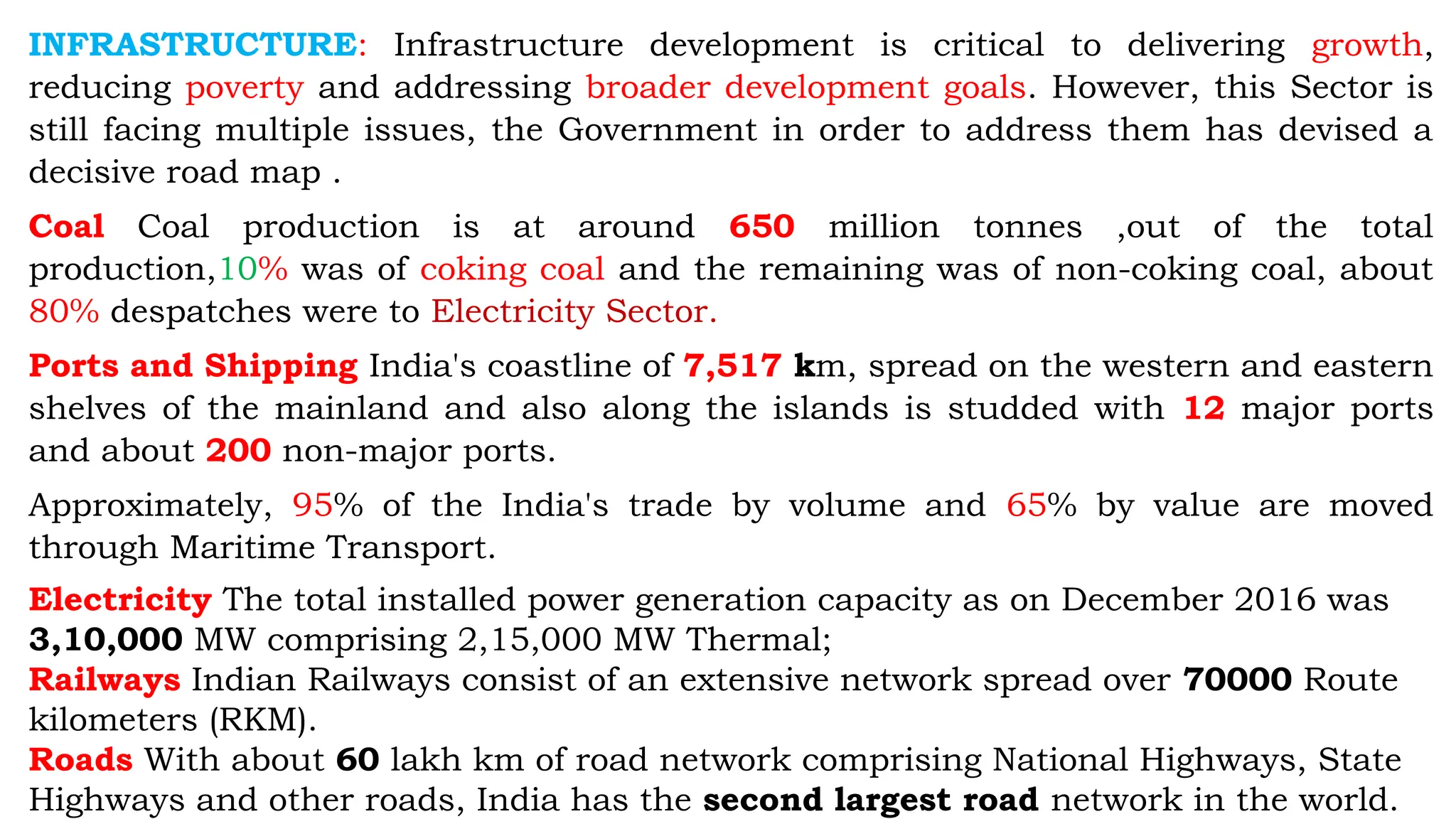
INFRASTRUCTURE: Infrastructure development is critical to delivering growth,
reducing poverty and addressing broader development goals. However, this Sector is
still facing multiple issues, the Government in order to address them has devised a
decisive road map .
Coal Coal production is at around 650 million tonnes ,out of the total
production,10% was of coking coal and the remaining was of non-coking coal, about
80% despatches were to Electricity Sector.
Ports and Shipping India's coastline of 7,517 km, spread on the western and eastern
shelves of the mainland and also along the islands is studded with 12 major ports
and about 200 non-major ports.
Approximately, 95% of the India's trade by volume and 65% by value are moved
through Maritime Transport.
Electricity The total installed power generation capacity as on December 2016 was
3,10,000 MW comprising 2,15,000 MW Thermal;
Railways Indian Railways consist of an extensive network spread over 70000 Route
kilometers (RKM).
Roads With about 60 lakh km of road network comprising National Highways, State
Highways and other roads, India has the second largest road network in the world.
 Contribution of mining Industries in national economy in
terms of GDP, employment, generation, foreign exchange
earnings & overall economic development.
 Self-reliance of the country in respect of core sector
minerals.
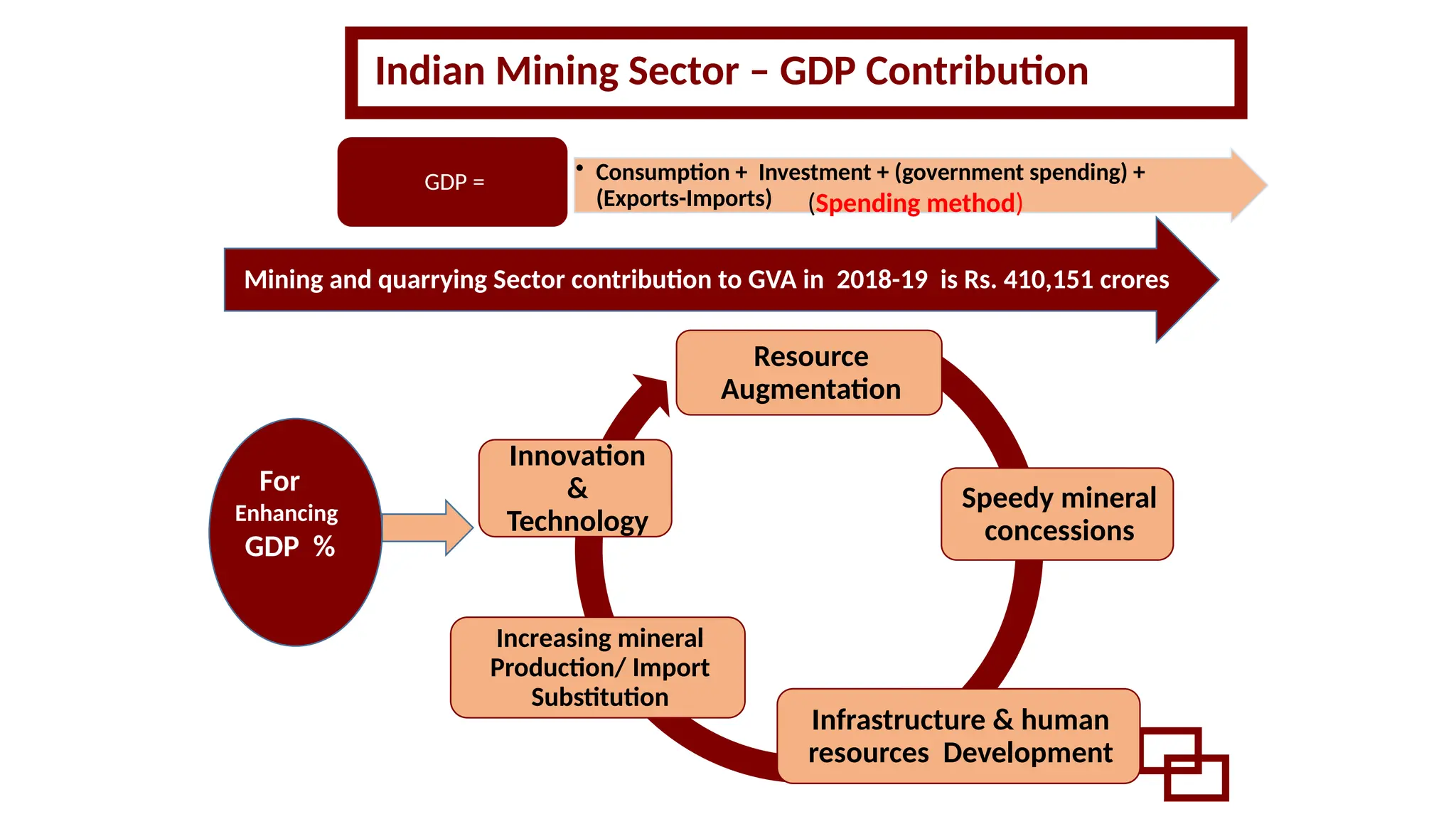
Indian Mining Sector – GDP Contribution
• Consumption + Investment + (government spending) +
(Exports-Imports)
GDP =
Mining and quarrying Sector contribution to GVA in 2018-19 is Rs. 410,151 crores
Resource
Augmentation
Speedy mineral
concessions
Infrastructure & human
resources Development
Increasing mineral
Production/ Import
Substitution
Innovation
&
Technology
For
Enhancing
GDP %
(Spending method)
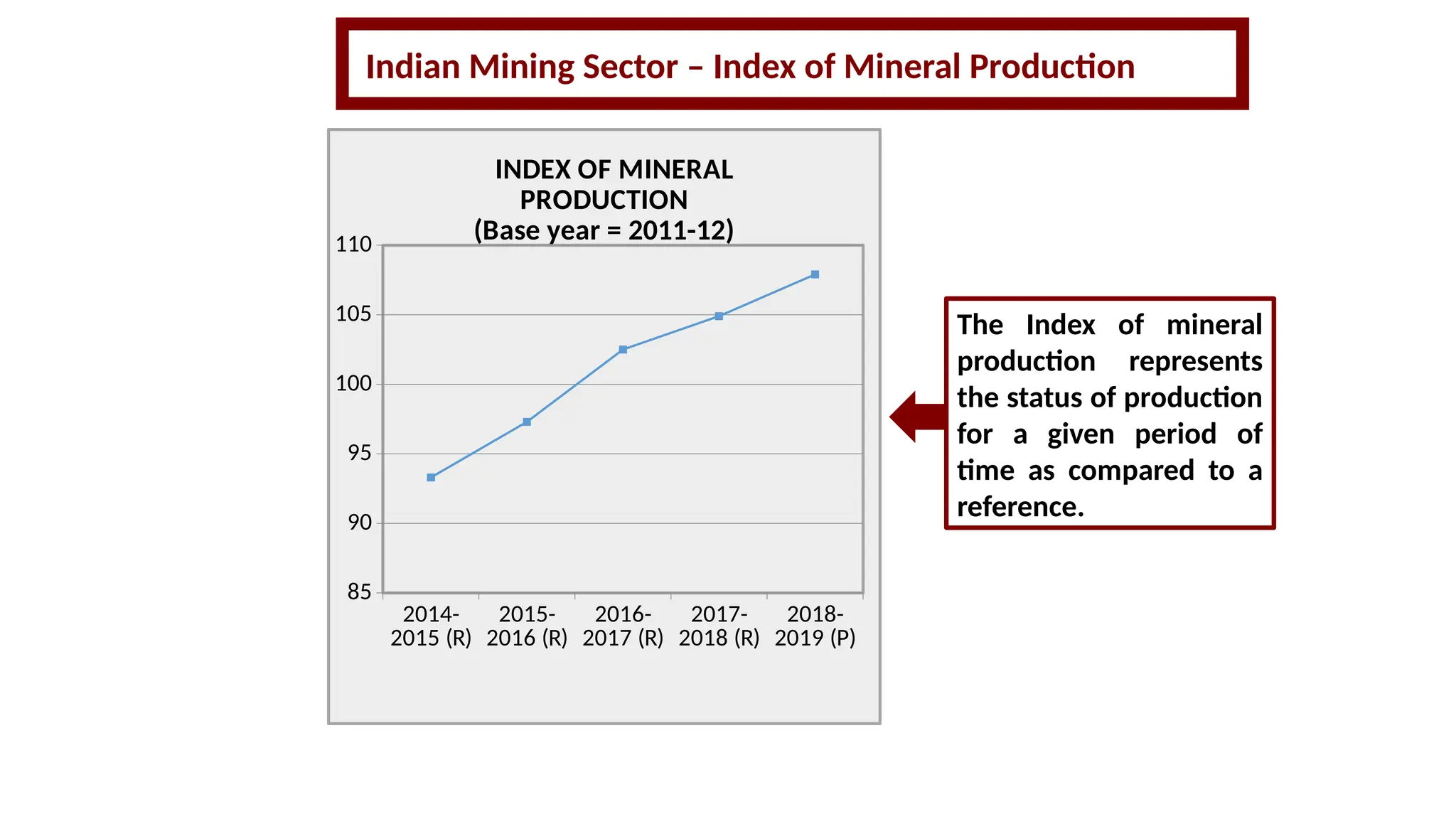
Indian Mining Sector – Index of Mineral Production
The Index of mineral
production represents
the status of production
for a given period of
time as compared to a
reference.
2014-
2015 (R)
2015-
2016 (R)
2016-
2017 (R)
2017-
2018 (R)
2018-
2019 (P)
85
90
95
100
105
110
INDEX OF MINERAL
PRODUCTION
(Base year = 2011-12)
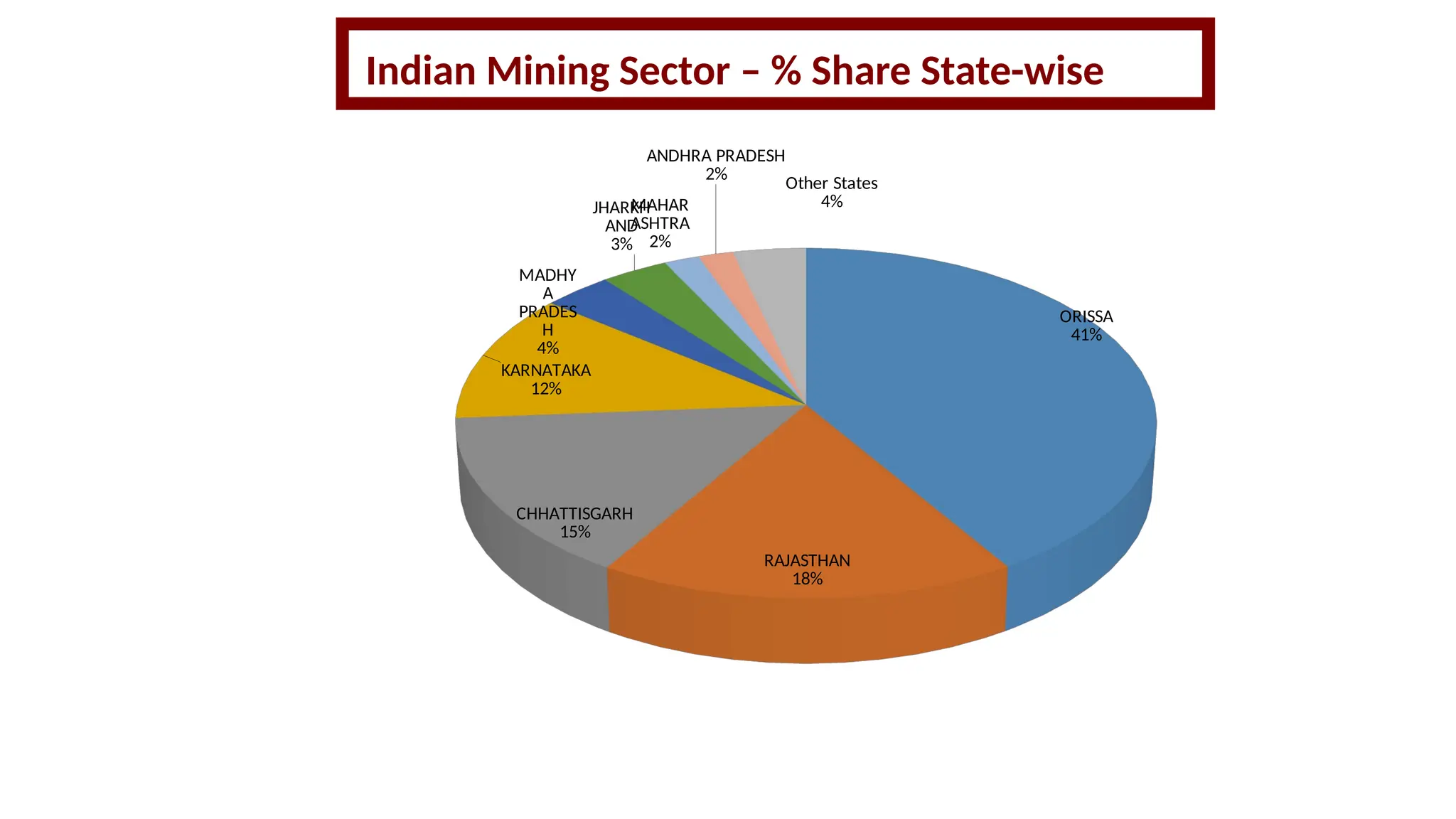
Indian Mining Sector – % Share State-wise
ORISSA
41%
RAJASTHAN
18%
CHHATTISGARH
15%
KARNATAKA
12%
MADHY
A
PRADES
H
4%
JHARKH
AND
3%
MAHAR
ASHTRA
2%
ANDHRA PRADESH
2%
Other States
4%
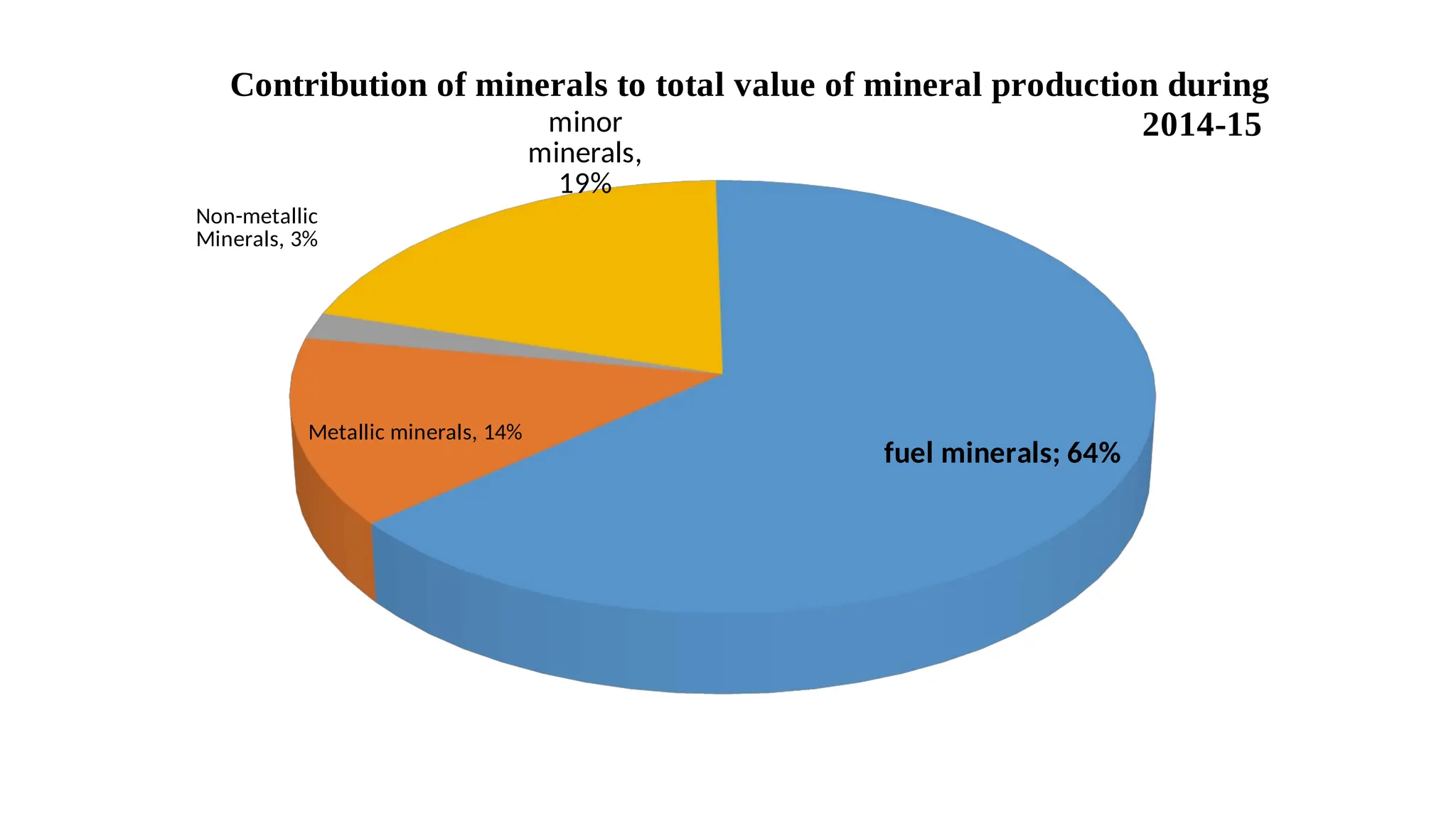
fuel minerals; 64%
Metallic minerals, 14%
Non-metallic
Minerals, 3%
minor
minerals,
19%
Contribution of minerals to total value of mineral production during
2014-15
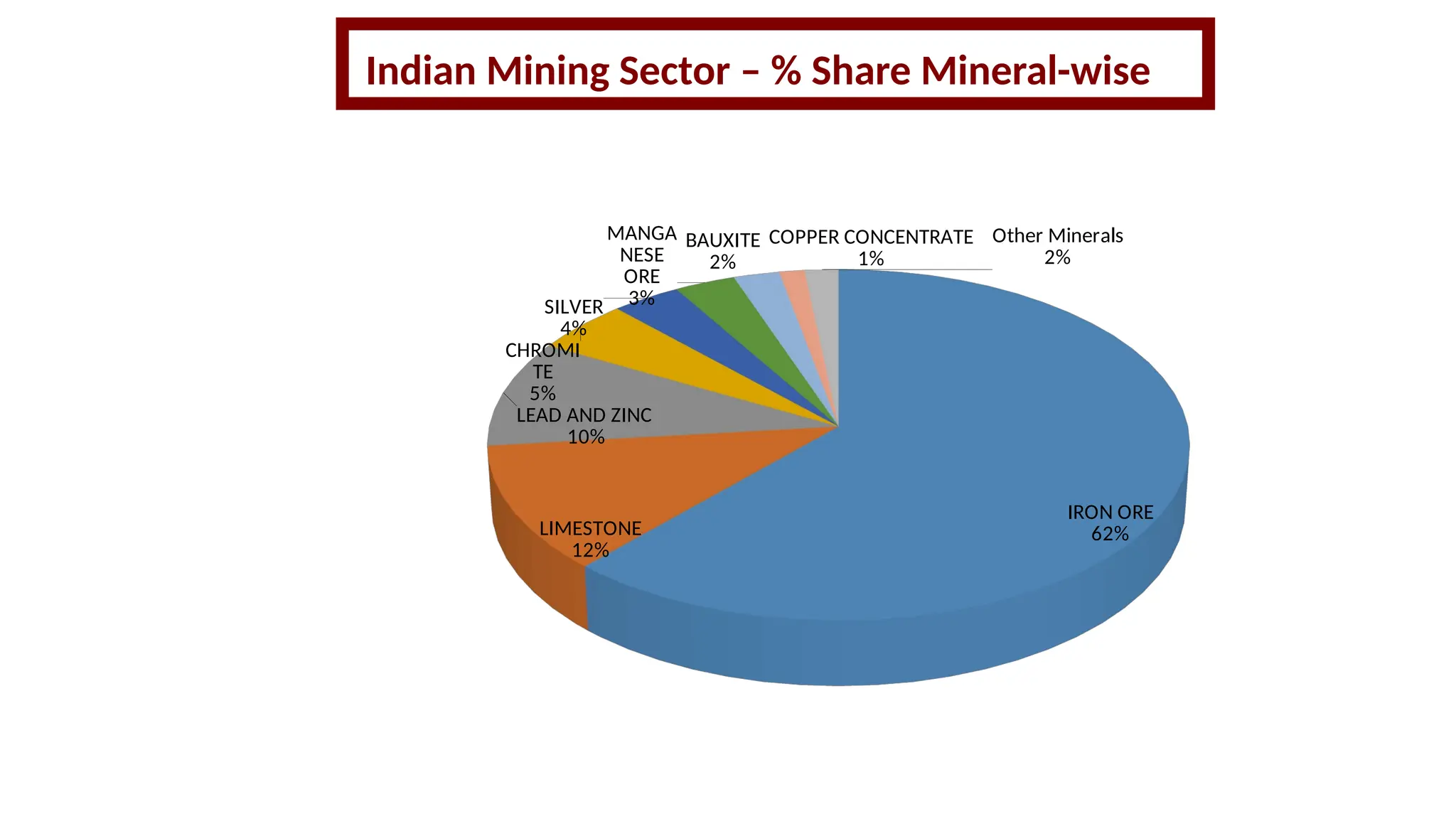
Indian Mining Sector – % Share Mineral-wise
IRON ORE
62%
LIMESTONE
12%
LEAD AND ZINC
10%
CHROMI
TE
5%
SILVER
4%
MANGA
NESE
ORE
3%
BAUXITE
2%
COPPER CONCENTRATE
1%
Other Minerals
2%
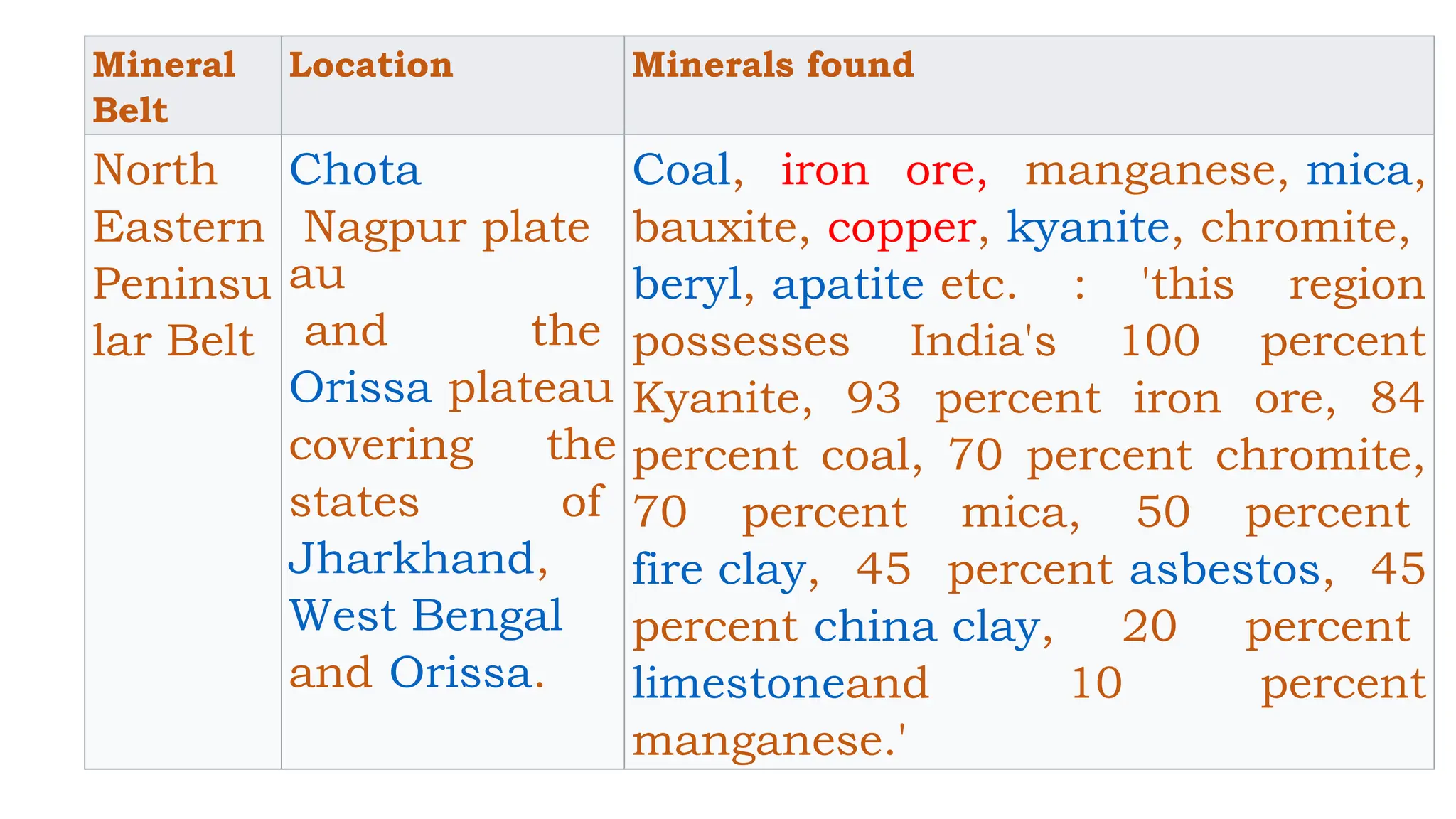
Mineral
Belt
Location Minerals found
North
Eastern
Peninsu
lar Belt
Chota
Nagpur plate
au
and the
Orissa plateau
covering the
states of
Jharkhand,
West Bengal
and Orissa.
Coal, iron ore, manganese, mica,
bauxite, copper, kyanite, chromite,
beryl, apatite etc. : 'this region
possesses India's 100 percent
Kyanite, 93 percent iron ore, 84
percent coal, 70 percent chromite,
70 percent mica, 50 percent
fire clay, 45 percent asbestos, 45
percent china clay, 20 percent
limestoneand 10 percent
manganese.'
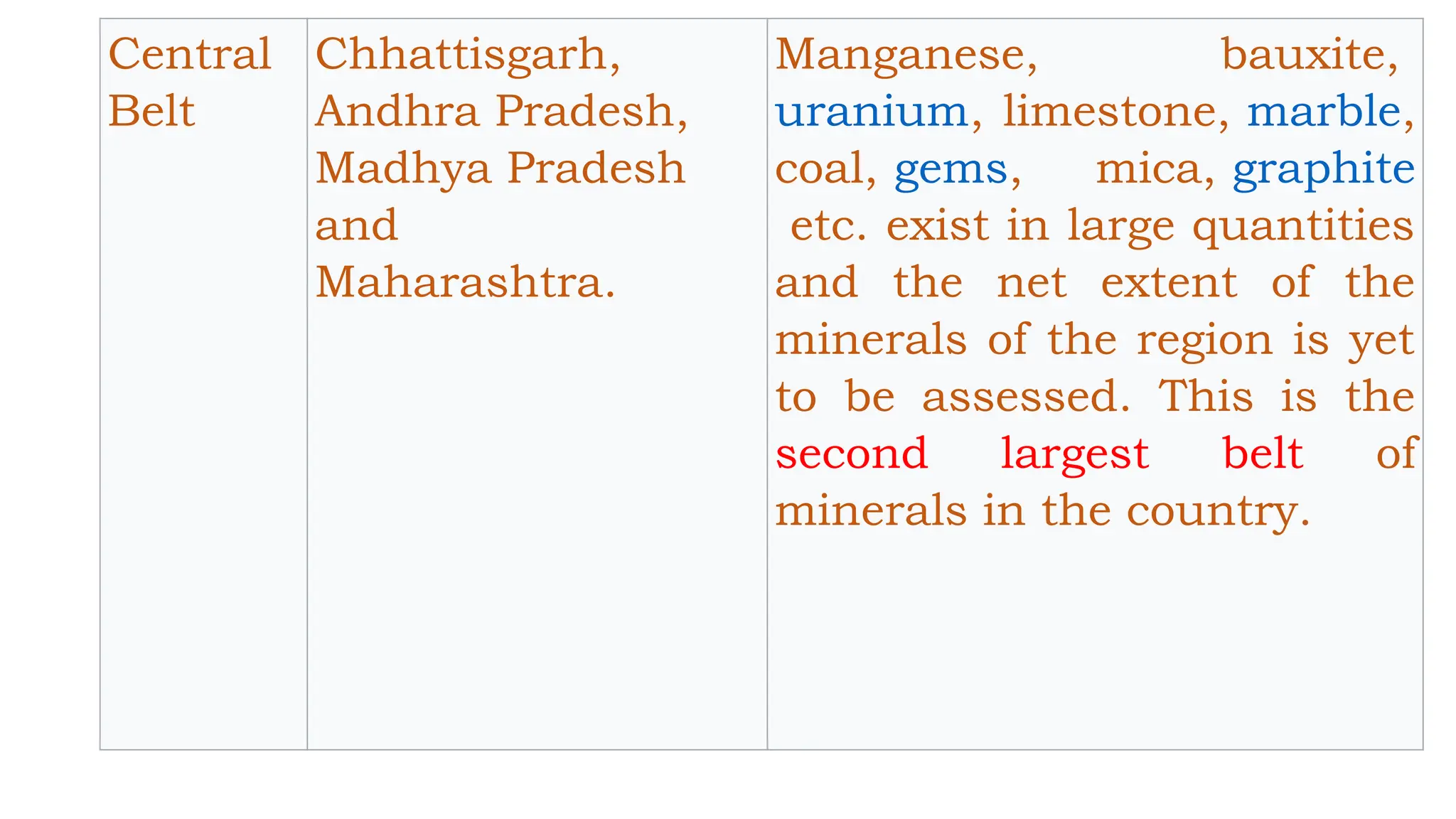
Central
Belt
Chhattisgarh,
Andhra Pradesh,
Madhya Pradesh
and
Maharashtra.
Manganese, bauxite,
uranium, limestone, marble,
coal, gems, mica, graphite
etc. exist in large quantities
and the net extent of the
minerals of the region is yet
to be assessed. This is the
second largest belt of
minerals in the country.
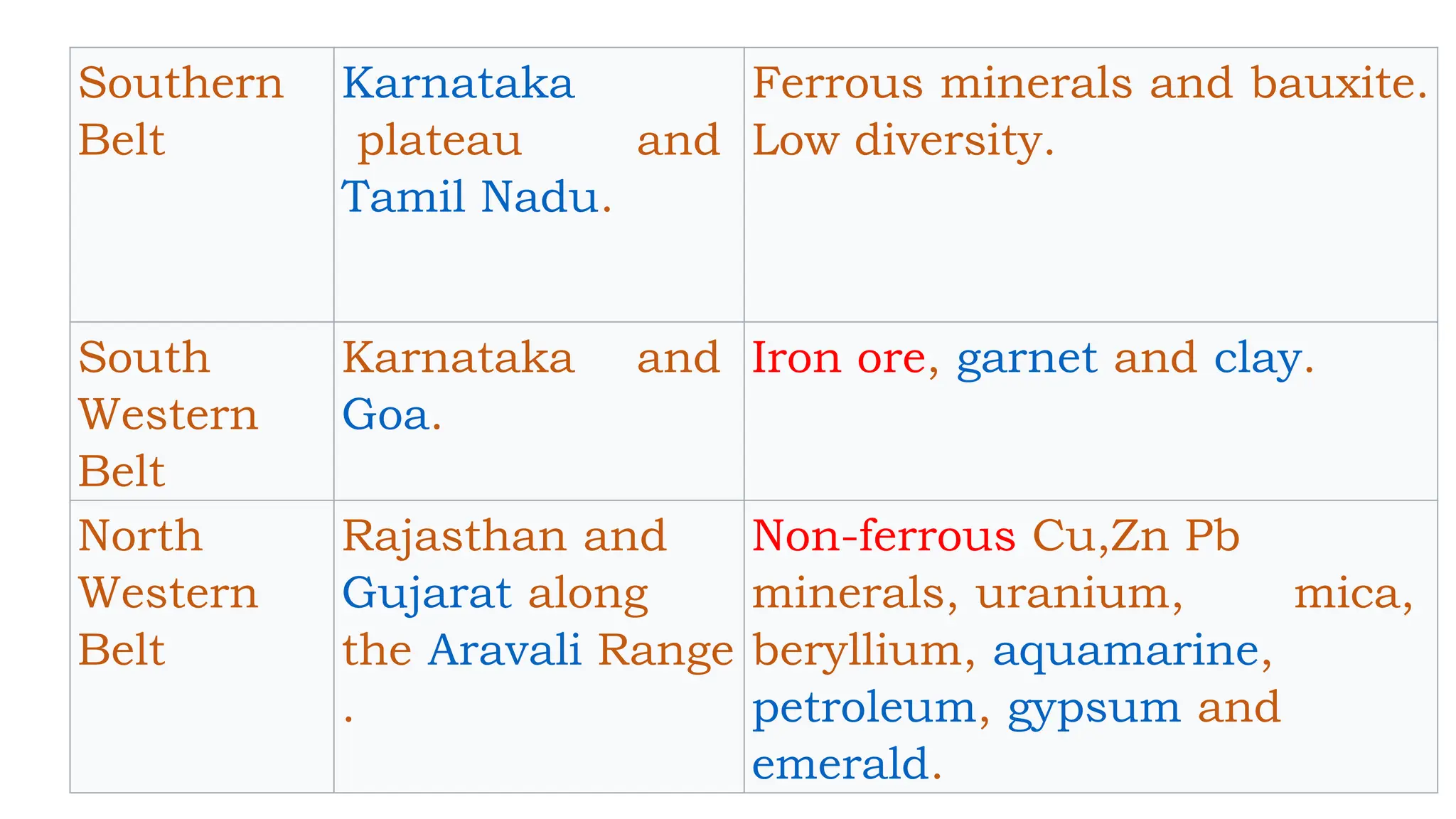
Southern
Belt
Karnataka
plateau and
Tamil Nadu.
Ferrous minerals and bauxite.
Low diversity.
South
Western
Belt
Karnataka and
Goa.
Iron ore, garnet and clay.
North
Western
Belt
Rajasthan and
Gujarat along
the Aravali Range
.
Non-ferrous Cu,Zn Pb
minerals, uranium, mica,
beryllium, aquamarine,
petroleum, gypsum and
emerald.
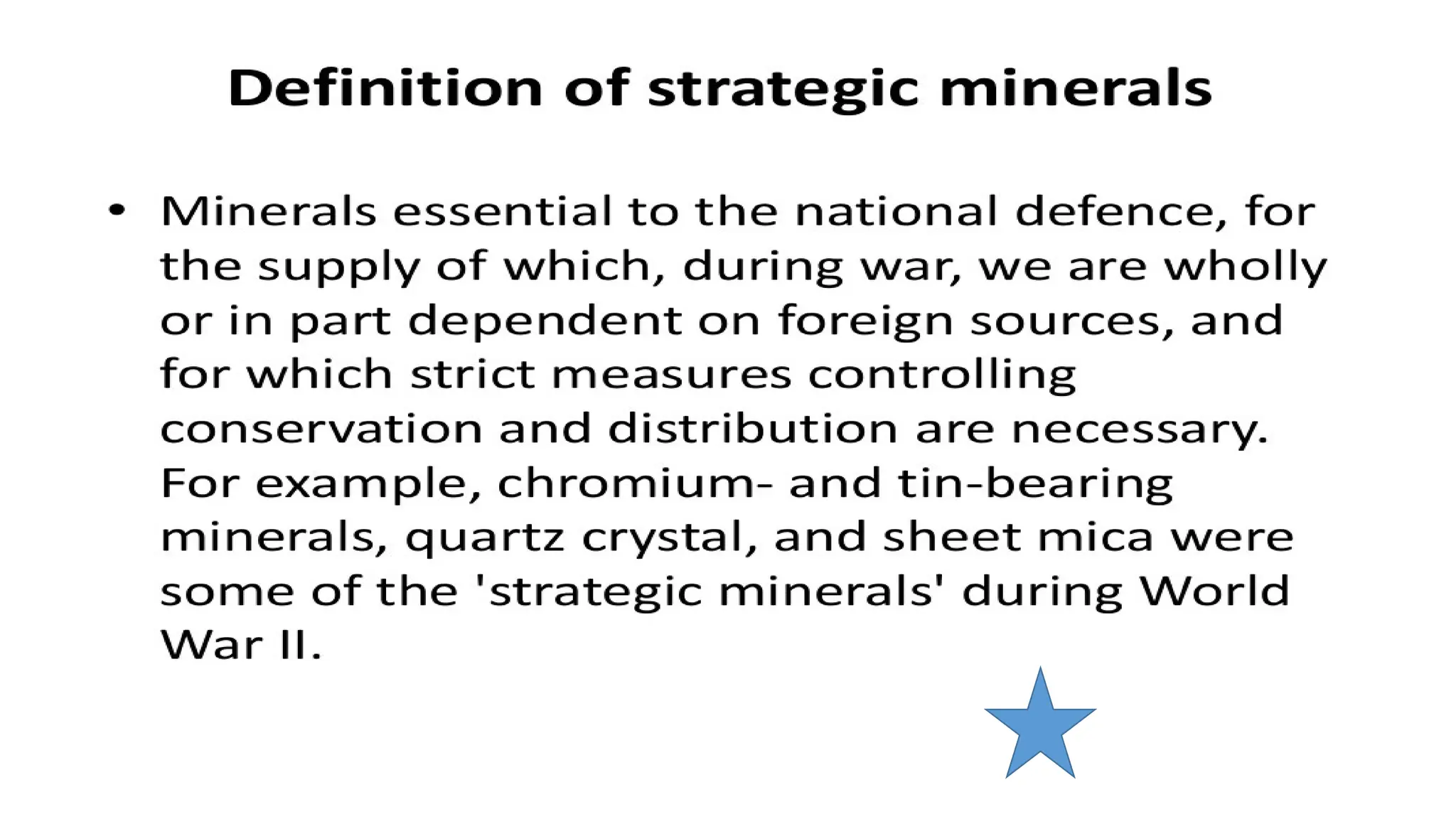
STRATEGIC MINERALS AND METALS FOR INDIA
Strategic minerals and metals are those which are needed for strategic
or war purposes for making special alloys they are1.Tin 2. Cobalt
3.Lithium 4.Germanium 5.Gallium 6.Indium7.Niobium 8.Beryllium
9.Tantalum 10.Tungsten 11. Bismuth 12.Selenium 13.chromium,14
antimony etc. They are concentrated in a few geographies & their
substitutes are limited .
Limited in availability
Copper, chromium lead
• Essential minerals are those which are required for
industrial growth like coal, iron ore Mn ore limestone etc
–State Review
Andhra pradesh - Resources: - Asbestos, Barytes, Mica, Felspar, Limestone,
Clay, Diamond, Coal. PNG
Production : Mica - 99% barytes 99%, felspar 90%, Silica Sand - 56%,
laterite - 50%, Quartz- 35%, Dolomite - 25%, Limestone -20%
Arunachal Pradesh: - PNG, Coal, Limestone.
Assam: - PNG, Coal, Limestone, Clay.
Bihar: - Resources: - Limestone, Mica, Quartz, S/Sand Minor mineral 99%
in value.
Chhattisgarh :-Resources : 28% diamond, 38% tin, 20%, Iron ore 10%, Coal
10%, dolomite.
Production : Production :- (Sole Producer of tin), coal, dolomite, iron ore. 3rd
in order - coal, bauxite, iron ore, dolomite, limestone, quartzite.
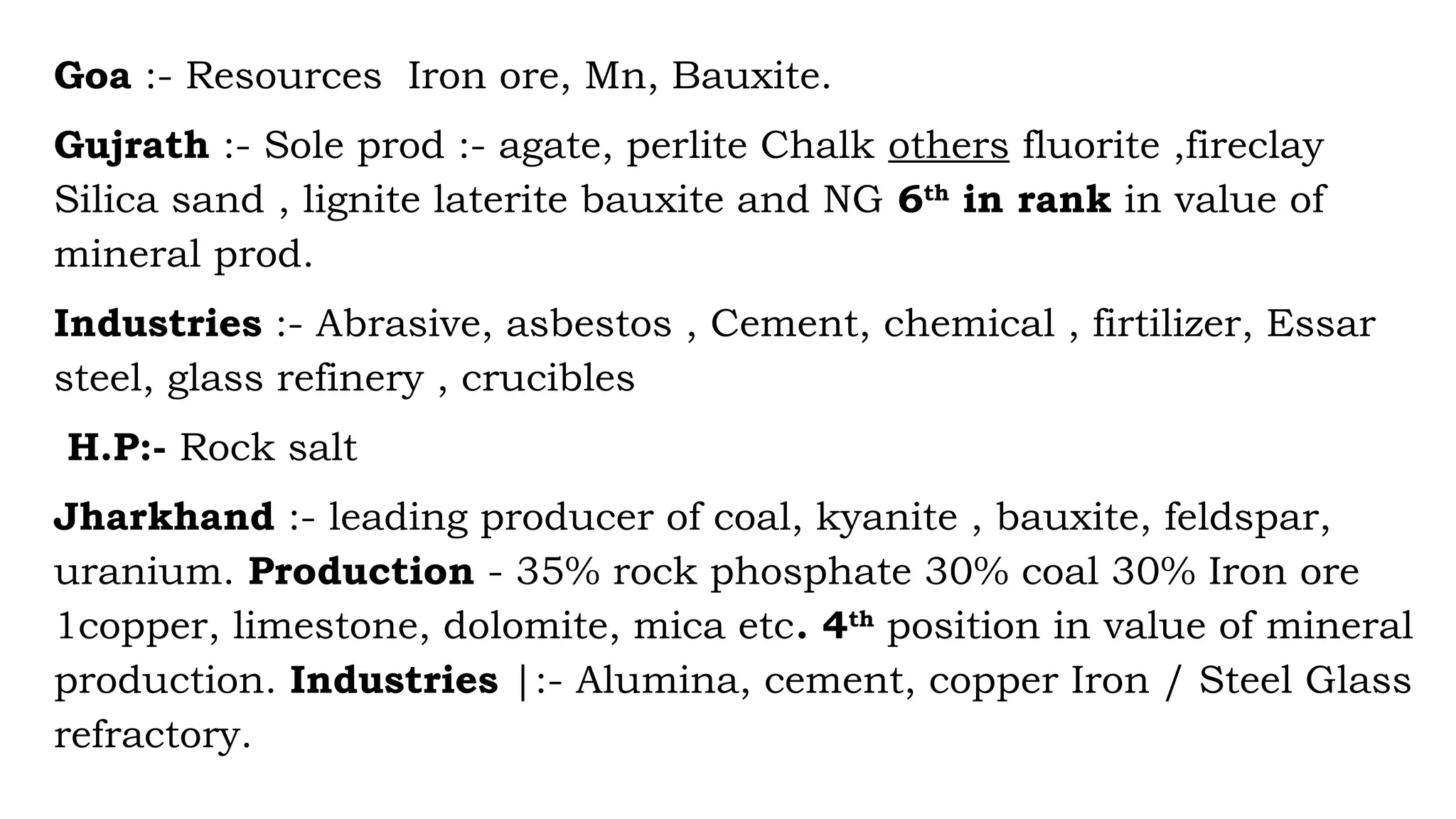
Goa :- Resources Iron ore, Mn, Bauxite.
Gujrath :- Sole prod :- agate, perlite Chalk others fluorite ,fireclay
Silica sand , lignite laterite bauxite and NG 6th
in rank in value of
mineral prod.
Industries :- Abrasive, asbestos , Cement, chemical , firtilizer, Essar
steel, glass refinery , crucibles
H.P:- Rock salt
Jharkhand :- leading producer of coal, kyanite , bauxite, feldspar,
uranium. Production - 35% rock phosphate 30% coal 30% Iron ore
1copper, limestone, dolomite, mica etc. 4th
position in value of mineral
production. Industries |:- Alumina, cement, copper Iron / Steel Glass
refractory.
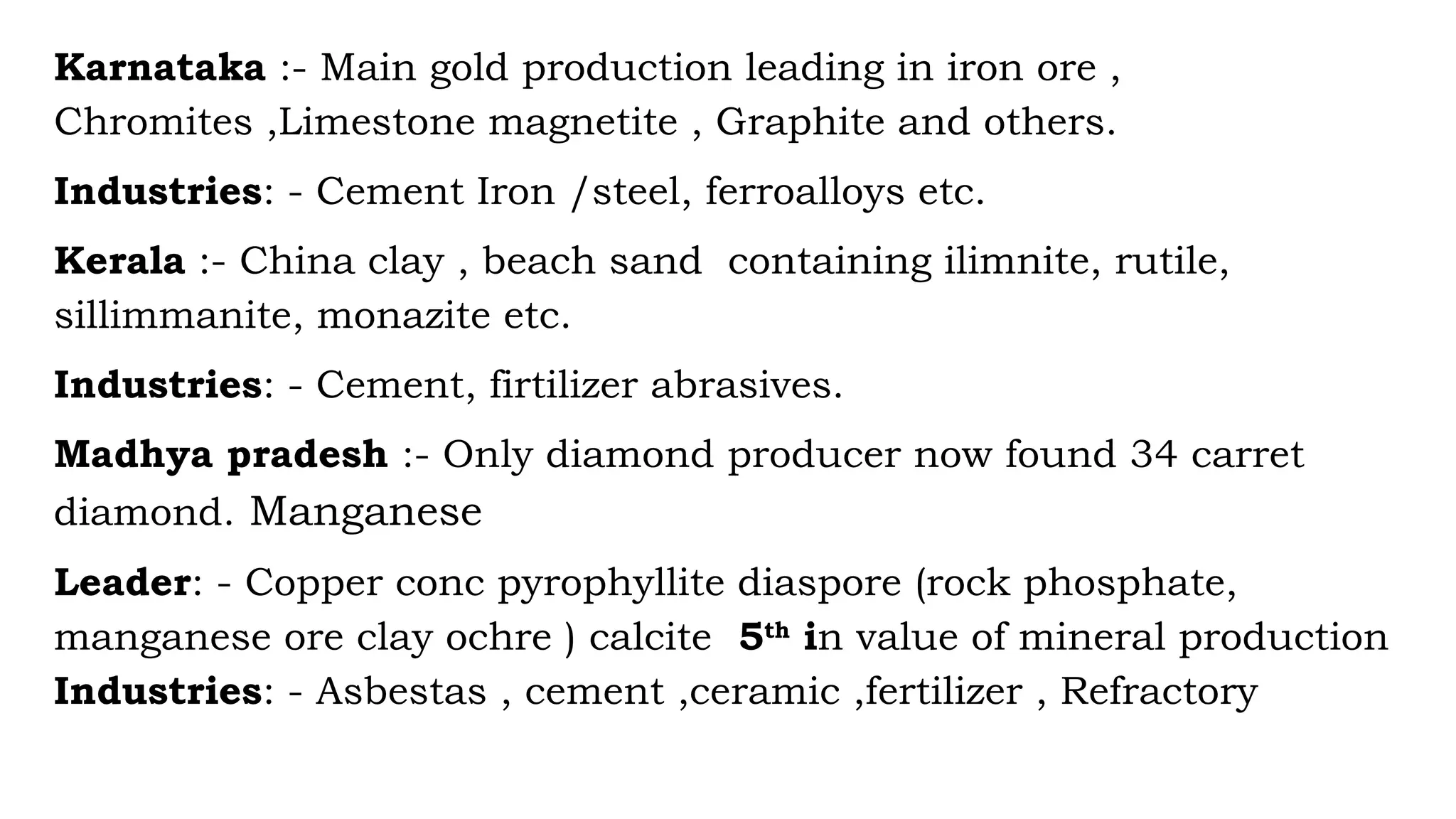
Karnataka :- Main gold production leading in iron ore ,
Chromites ,Limestone magnetite , Graphite and others.
Industries: - Cement Iron /steel, ferroalloys etc.
Kerala :- China clay , beach sand containing ilimnite, rutile,
sillimmanite, monazite etc.
Industries: - Cement, firtilizer abrasives.
Madhya pradesh :- Only diamond producer now found 34 carret
diamond. Manganese
Leader: - Copper conc pyrophyllite diaspore (rock phosphate,
manganese ore clay ochre ) calcite 5th
in value of mineral production
Industries: - Asbestas , cement ,ceramic ,fertilizer , Refractory
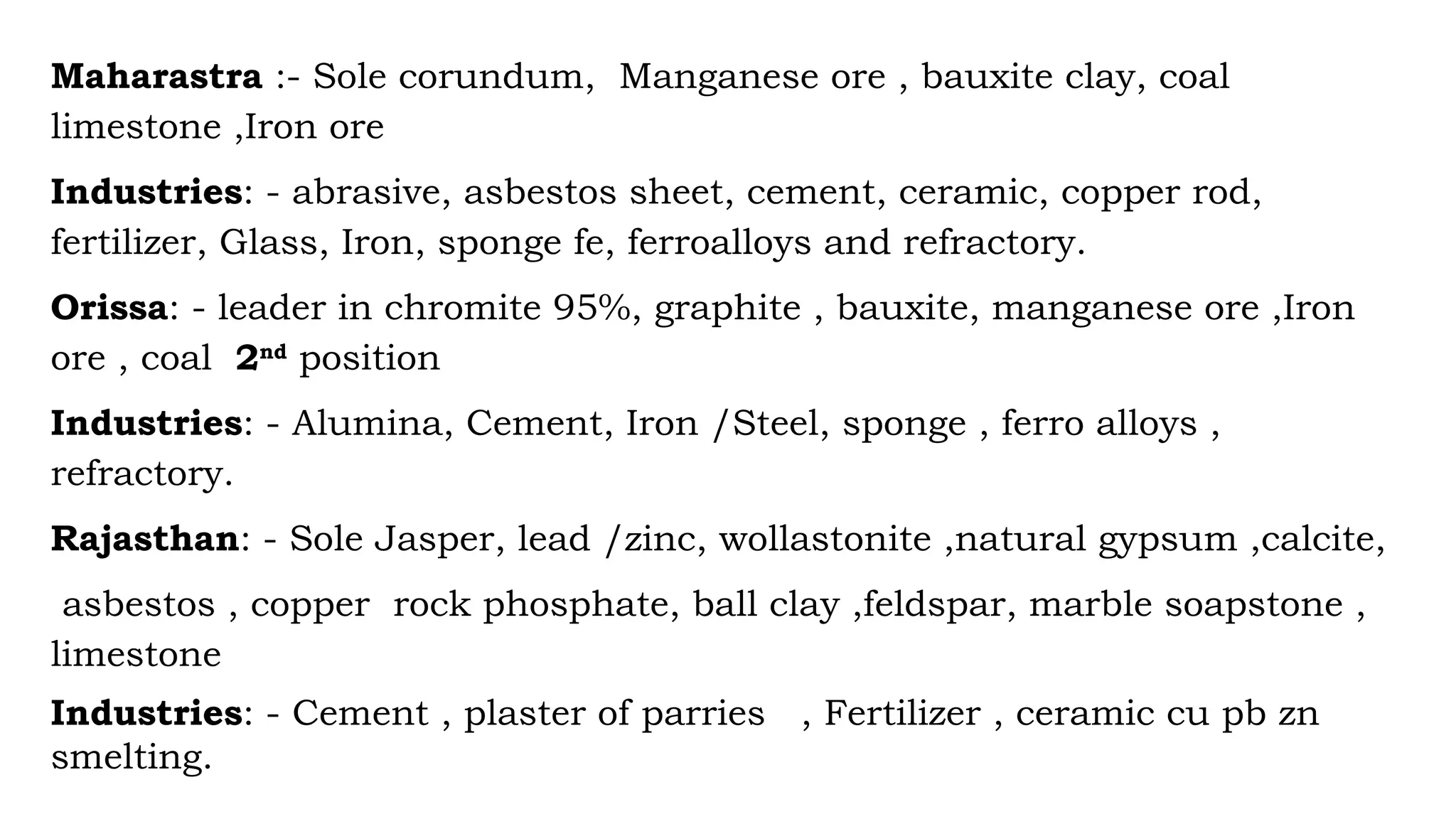
Maharastra :- Sole corundum, Manganese ore , bauxite clay, coal
limestone ,Iron ore
Industries: - abrasive, asbestos sheet, cement, ceramic, copper rod,
fertilizer, Glass, Iron, sponge fe, ferroalloys and refractory.
Orissa: - leader in chromite 95%, graphite , bauxite, manganese ore ,Iron
ore , coal 2nd
position
Industries: - Alumina, Cement, Iron /Steel, sponge , ferro alloys ,
refractory.
Rajasthan: - Sole Jasper, lead /zinc, wollastonite ,natural gypsum ,calcite,
asbestos , copper rock phosphate, ball clay ,feldspar, marble soapstone ,
limestone
Industries: - Cement , plaster of parries , Fertilizer , ceramic cu pb zn
smelting.
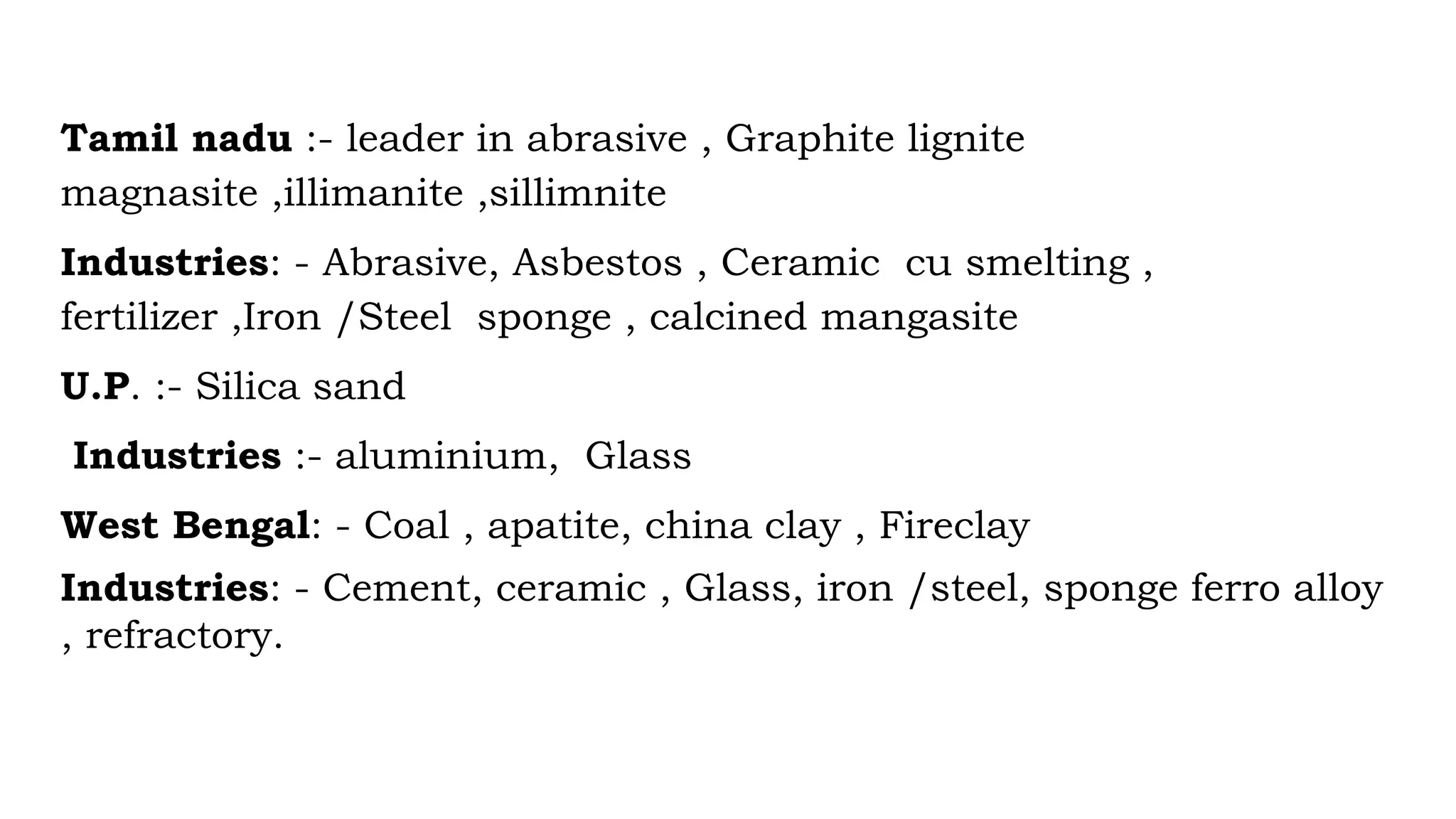
Tamil nadu :- leader in abrasive , Graphite lignite
magnasite ,illimanite ,sillimnite
Industries: - Abrasive, Asbestos , Ceramic cu smelting ,
fertilizer ,Iron /Steel sponge , calcined mangasite
U.P. :- Silica sand
Industries :- aluminium, Glass
West Bengal: - Coal , apatite, china clay , Fireclay
Industries: - Cement, ceramic , Glass, iron /steel, sponge ferro alloy
, refractory.
Mineral Industries and National Economy
Def : MINERAL ECONOMICS = Study of how to manage production and use of scarce
mineral resources having alternative uses to meet demand at national level for growth
as well as welfare.
India has mining lease area (Excluding fuel, atomic and minor minerals) around 0.14
percent of total geographical area.
India produces as many as 90 important minerals which include 35 major minerals
[ie 4 fuel (coal, lignite, petroleum and NG)minerals, 5 atomic minerals(uranium,
thorium, tantalum, beryllium, zirconium, lithium, and rare earth minerals) 10
metallic (Bauxite, Chrome ore, Copper ore, Gold, Iron ore. Lead. Manganese ore,
Zinc etc) , 16 non-metallic/industrial minerals] and 55 minor minerals (including
building and other materials along with the recently notified 31 additional minerals)
(Apart from these there are few more major minerals of lesser occurrences thus total
about 45 major minerals).
10 metallic & 16 non-metallic minerals are also called as MCDR minerals.
Minor minerals are notified by central govt under sec 3e of MMDR Act 1957 they are
55 in nos. rest are major minerals.
The number of mining leases of 44 important metallic and non-metallic minerals
(excluding Atomic, fuel , P and G and Minor Minerals) varies between 4300 to
4600 .Where as in 14-15 figure was 11000 (due to declaration of 31 major minerals as
minor one)
Madhya Pradesh leads in no of mining leases followed by Tamil Nadu ,Gujarat ,Andhra
Pradesh , Karnataka ,Odisha , Goa , Chhattisgarh , Maharashtra , Jharkhand , Rajasthan
and Telangana . These 12 states together accounted for about 96% of total mining leases.
Number of mining leases for iron ore is maximum followed by bauxite ,manganese
ore ,chromite ,copper ore ,lead & zinc ores ,gold ,ruby ,diamond ,and asbestos &
sapphire ,
Out of the total , mining leases in force in the country, (93%) mining leases with an area
of (72%) are in the Private Sector and the remaining (7%) with an area of (28%) are in the
Public Sector.
There are no mining leases for molybdenum, nickel, silver and platinum group of metals
in the country.
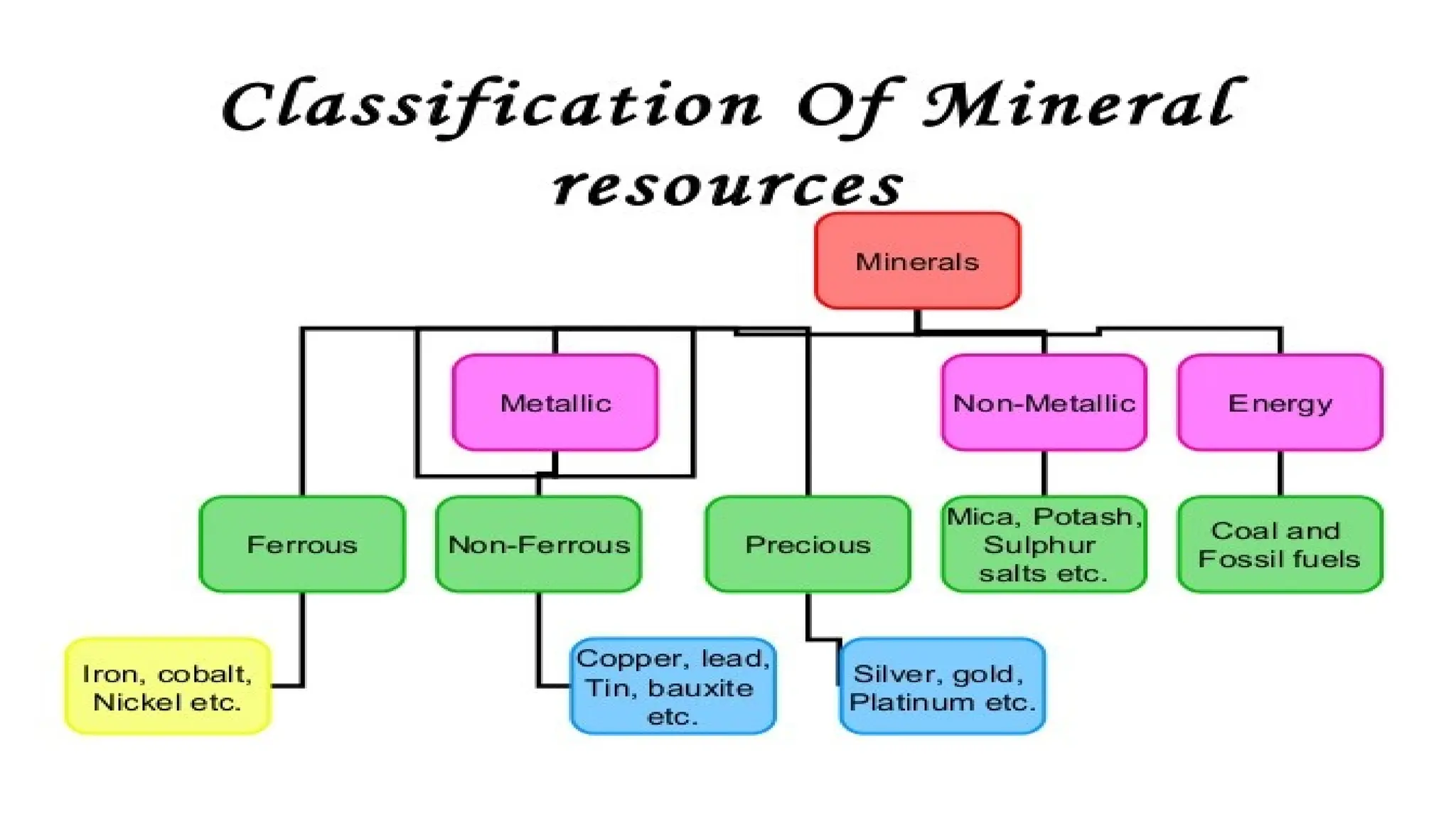
Metallic Minerals (Ferrous Group) 1. Chromite 2. Iron Ore (Haematite) 3. Iron Ore
(Magnetite) 4. Manganese Ore
2. Metallic Minerals (Non-Ferrous Group) 5. Antimony 6. Bauxite 7. Copper 8. Lead &
Precious semiprecious group : Corundum 11. Diamond 12. Garnet 13. Gold
14. Ruby 15. Sapphire 16. Silver
Fertilizer Minerals : Gypsum 25. Phosphate (Apatite) 26. Rock Phosphate
(Phosphorite) 27. Potash 28. Pyrite 29. Sulphur (Native)
Refractory minerals : Fireclay 27. Graphite 28. Kyanite 29. Magnesite 30.
Pyrophyllite 31. Sillimanite
Ceramic and Glass minerals :Ball Clay 33. China clay 34. Feldspar 35.
Quartz & Silica Sand 36. Wollastonite
Platinum group elements comprise of platinum, palladium, iridium, rhodium,
osmium and ruthenium, have extensive use in jewelry, pharmaceuticals,

telecommunications and fuel cell technologies. Basically a bright white precious metal
& often associated with gold and silver& known as Noble Metals.
Corundum is a crystalline form of aluminum oxide (Al2O3) with traces of iron,
titanium and chromium. Transparent specimens are used as gems, called ruby.
Colored ones are called sapphire.
Garnet is a collective name for a group of minerals It is used both as semi-precious
stone and also as an abrasive.
Uses of different Minerals produced in Indian
Direct Use: As ornamental precious stone & dimensional stones. Granite, marbles,
sand stone, limestone slabs in building, temples & other archaeological monuments.
The construction activity needs large quantum of gravel, sand, crushed rock etc.
Mineral Fuels: This group of mineral has coal, lignite, petroleum oil, natural gas etc.
used for power generation. The oil producing nations are the richest of all because of
the reach oil resource.
Metalic : Metals derived from smelting of minerals have multiple uses depending
upon its physical properties such as strength, malleability, ductility, tensile strength,
specific gravity, conductivity. The metals are also used to produce more useful &
costly alloys.
Non-Metalic/industrial minerals: The non-metallic minerals other than fuels are
consumed in the industry in huge quantity. Mineral fertilisers are also used in the
agriculture, some minerals have insulating property against electricity, heat & sound,
hence these non-metals are used in making of electric insulators, and fire clay &
kynite are used in refractory and some other are used as fluxes.
Specialities of minerals & mineral deposits are:-
indispensability to survival of mankind
finiteness & non-renewability
hidden occurrence underground
uncertainties of quality, quantity, usability
hence need for prospecting/exploration
independence of political boundaries
location beyond human control
long gestation period
foundation of all economic activities – directly or indirectly
ROLE OF MINING SECTOR IN INDIAN ECONOMY
Mining is one of the core sectors that drive growth in an economy, It
contributes to GDP attracts investment and generate employment in the
country.
Mining sector provides basic raw materials to many important industries like
(thermal) power generation, iron and steel, cement, petroleum and natural
gas, petro-chemicals, fertilisers, precious and semiprecious metals and
stones, electrical and electronic equipment, glass and ceramics etc. and
boosts peripheral economic activity like Railways and transport industry,
small workshops in the near by area to cater day to day repair needs of
mining industry and in turn boost the economy of the local area. Mineral is
also used directly in construction and ornament field.
Value of Mineral Production
The total value of mineral production is app 2.5-3 L crore which was mare
Rs. 88 crore in 1954. The value of fuel minerals increased from Rs. 56 crore in
1954 to app Rs. 2 Lakh crore .
Mineral based industries provide metals and other products for use in construction,
plants and heavy industries, tools & equipment, electrical & electronics,
automobiles and machinery, chemicals & agriculture, strategic industry and for
manufacture of almost all goods.
Minerals also find Direct Use as Ornamental stones like diamond ruby
sapphire ,dimensional stones like granite, marbles sand stone/ limestone slabs , in
construction like gravel, laterite, sand & crushed rock etc.
Gross Domestic Product, GDP, is the total value of final goods and services
produced in a country in a year. GDP is an economic indicator used worldwide to
show the economic health of a country.
The GDP contribution of the mining industry in national economy varies from
2.2% to 2.5% only, but going by the GDP of the total industrial sector it
contributes around 10% to 11%. Amongst the MCDR minerals iron ore is the top
contributor in the GDP of mining sector, followed by chromite, limestone etc.
Standard of living which is measured by per capita consumption of energy and
minerals has increased in the country as India`s ranking in world production is 3 rd
in steel ,coal & lignite; 4th in bauxite, chromite and iron ore; 5th in aluminium and
zinc (slab); 6th in manganese ore & 7th in copper (refined) .
The value of mineral production is around 3lakh crore out of which 2 lakh Cr is
from fuel minerals.
Employment : Indian mining industry provides roughly job opportunities to
around 5 L to 7L individuals 77% in Public Sector and 23% in private sector. Fuel
minerals accounted for 75%, metallic minerals 15% and non-metallic minerals
10% of the total labour force. Due to automation employment potential in mining
industry also got affected in recent time. Small-scale mining in India, exclusively
produce minor minerals and mostly labor intensive and employ significant work
force.
Export Earnings : Mining industry accounts for 18% of export earnings of the
country. (9 % share in exports of ores and minerals and 9 % share in export of
metals & alloys) Cut (polished)Diamond continued to be the largest constituent
item with a share of more than 80% in the total value of mineral exports. Next in
order granite followed by alumina ,bauxite and emerald.
Metals & Alloys The contribution of metals & alloys in the total value of India’s
exports is app 9%. Iron & steel with a share of >40% hold the top position
Gold ,Aluminium and alloys, copper & alloys, ferro alloys, zinc & alloys are in
Imports Petroleum is the largest constituent item 60% in the total value of
mineral imports .Next is diamond followed by coal ,natural gas and copper
ores / concentrates .
Gold, with a share of > 50% occupies the top position in the total import
value of metals & alloys followed by iron & steel ,silver ,aluminium &
alloys ,copper & alloys etc.
Revenue : Government earns national revenue by way of royalty and
various taxes from the sale of minerals which is used for national
development.
Allied industries: Apart from mineral based industries ,transport activity
through rails, cargo shipment and road also come up for movement of
minerals. Similarly peripheral economic activities including different types of
workshops to meet the day to day repair requirements of primary industry
also thrive which in turn develop skill , talent & local economic standard of
the area.
* Self-reliance of the country in respect of core
sector minerals.
Self-sufficiency: India is wholly or largely self-sufficient in minerals which
constitute primary mineral raw materials to industries, such as, thermal
power generation, iron & steel, ferro-alloys, aluminum, cement, various
types of refractories, China Clay-based Ceramics, Glass, Chemicals like
caustic soda, soda ash, calcium carbide, white pigment, etc.
By and large, self-sufficient in coal and lignite; bauxite, chromite, iron and
manganese ores, and almost all the industrial minerals.
Among the principal metallic minerals, iron ore contributed 63%.
Among the principal non-metallic, Limestone's contribution is 90% of the total
value .
Major mineral rich states are Odisha, Chhattisgarh, Rajasthan, Karnataka,
Jharkhand etc.
Production of finished steel is around 100mt and capacity 140mt. India is
the largest producer of direct reduced iron (DRI) or sponge iron in the world.
Production of cement is around 300 million tonnes & installed capacity 350
mt. India exports cement including white cement and clinker.
Offshore regions leads in terms of value of mineral production with share of
about. 20% through supply of petroleum (crude) and natural gas .
Among all minerals Fuel minerals contributed 67% ,metallic minerals 12%
& nonmetallic minerals (including minor minerals) 21% in value of mineral
production.
India’s ranking in world production is 3 rd in steel (crude), barytes,
talc/steatite/pyrophyllite, kyanite, andalusite & sillimanite and coal &
lignite; 4th in bauxite, chromite and iron ore; 5th in aluminium and zinc
(slab); 6th in manganese ore ; 7th in copper (refined) and 12th in magnesite.
Despite high degree of self-sufficiency, some quantities of various
minerals/ores are imported due to economic consideration or requirement of
specific grade to meet the demand for either blending with locally available
mineral raw materials and/or for manufacturing special qualities of mineral-
based products. We import very low ash coking coal required by the steel
plants) with the exception of chrysotile asbestos, borax, fluorite, kyanite,
potash, rock phosphate , elemental Sulphur, flaky and amorphous graphite of
high fixed carbon, very low silica limestone, dead-burnt magnesite battery-
grade manganese dioxide, etc.
To meet the increasing demand of uncut diamonds, emerald and other
precious and semiprecious stones by the domestic cutting and polishing
industry, India continued to depend on imports of raw uncut stones for their
further value-added re-exports.
Imports Petroleum is the largest constituent item 60% in the total value of
mineral imports .Next is diamond followed by coal ,natural gas and copper
ores / concentrates .Gold, with a share of > 50% occupies the top position in
the total import value of metals & alloys followed by iron &
steel ,silver ,aluminium & alloys ,copper & alloys etc.
1.2. Mineral based Core Industries
 Iron and Steel, Copper Smelting, Aluminium, Lead & Zinc Smelting
& Cement in India, their description, location, capacity, main
producers.
Mineral-based Industries
Industry using minerals as raw material to produce some other product is
called mineral based industry.
The eight core Infrastructure-supportive Industries are coal, crude oil, natural
gas, refinery products, fertilizers, steel, cement and electricity.
Minerals are vital raw material for many basic industries and are major
components for growth and industrial development.
Five Major mineral-based industries in India are:
1. Iron and Steel Industry
2. Copper Smelting Industry
3. Aluminium Industry
4. Lead arid Zinc Smelting Industry
5. Cement Industry.
These industries use minerals, both metallic and non-metallic, as raw
materials and are based on ferrous and non-ferrous metallurgical processes.
1. Iron and Steel Industry:
The iron and steel industry in India had a real beginning in the year 1907
after the establishment of Tata Iron and Steel Company (TISCO) at Sakchi in
Bihar.
Iron and steel are basic industries and the backbone of industrial
development of any country because most of the big or small industries
require Iron and steel for further manufacturing.
The industries produce pig iron, sponge iron and finished steel in
integrated steel plants from iron ore. The iron ore is used mainly in blast
furnaces, mini blast furnaces (MBF), sponge iron (DRI) & iron ore fine in
sintering and palletisation plants.
The growth in the Steel Sector in the initial decades since independence was
mainly in the Public Sector units .The situation changed dramatically during
the period from 1990 with the entry of Private Sector in steel making .
The National Steel Policy (NSP) announced in 2017 aspires to achieve 300 mt
of steel making capacity by 2030. Steel (finished steel) production is around
100 mt tonnes in our country.
Pig iron is the product of smelting of iron ore with high-carbon fuel, such as,
coke and charcoal and is the basic raw material in Foundry and Casting
Industry for manufacture of various types of castings required for
engineering sector.
Pig iron usually has very high carbon content of 3.5% to 4.5%. The main
sources of pig iron have traditionally been the integrated steel plants of SAIL
besides plants of Tata Steel and Rashtriya Ispat Nigam Ltd.
About 10 million tonnes pig iron is produced in our country. The Pig Iron
Industry is confronted with problems of rising production cost due to
imported metallurgical coke and obsolete technologies .
Sponge Iron: India is the world's largest producer of sponge iron or Direct
reduced Iron (DRI) or Hot Briquetted Iron (HBI) and it has many coal-based units
located in the mineral-rich states of the country. Sponge iron is a good substitute
for scrap which is required by the electric arc furnaces and induction furnaces in
mini-steel plants in the country for making steel.
The availability of indigenous metal scrap is scarce, and therefore, to meet the
domestic demand, scrap is usually imported.
Sponge iron is produced by direct reduction of high-grade iron ore or pellets to
metallic iron ore in solid state by using coal or natural gas as reducing agent.
Commercial production of sponge iron in India commenced in 1980. The
installed capacity of sponge iron is about 50 million tonnes and the production is
about 30 million tonnes. The capacity of gas-based sponge iron plant of Essar
Steel Ltd, the world's largest sponge iron producer has risen to 7 million tpy.
Mini Steel Plants:
Apart from the integrated steel plants which produce mild steel and alloy steel,
including stainless steel, steel is also produced by electric arc furnace units
which are popularly known as mini steel plants, from steel scrap/sponge iron.
These plants are located in areas away from the integrated steel plants to meet
the demand there. Their period of construction and gestation is short and they
offer greater flexibility in operation.
Finished Steel: The finished steel production for SAIL has grown from a mere 1.1
million tonnes in 1951 to 100 million tonnes at present. India has risen to the 3rd
position as largest crude steel producing country in the world.
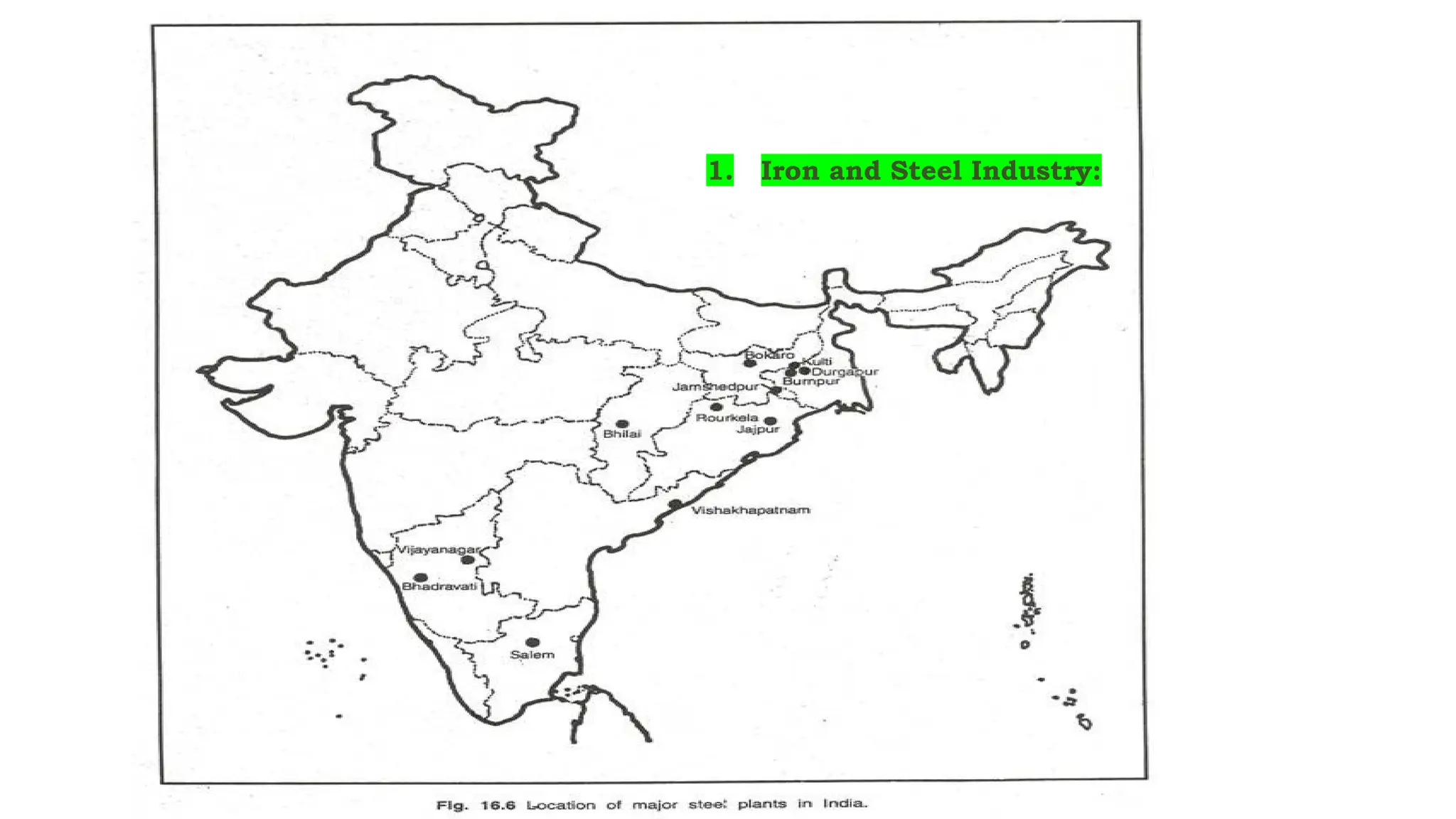
Steel Companies Under Public Sector Steel Authority of India Ltd (SAIL) operates five
integrated steel plants at Bhilai in Chhattisgarh, Bokaro in Jharkhand, Durgapur & Burnpur
in West Bengal and Rourkela in Odisha. SAIL has three special and alloy streel plants viz
Alloy Steel Plant at Durgapur (West Bengal), Salem Steel Plant at Salem (Tamil Nadu) &
Visvesvaraya Iron & Steel Plant at Bhadravati (Karnataka).
Rashtriya Ispat Nigam Ltd (RINL) Neelachal Ispat Nigam Ltd (NINL) National Mineral
Development Corporation Ltd
Steel Companies Under Private Sector Tata Steel Ltd (formerly TISCO) JSW Steel
Ltd ,Jindal Steel & Power Ltd (JSPL) Essar Steel Limited (ESL) Electrosteel Steels
(Vedanta )Monnet Ispat and Energy Limited
The Private Sector units consist of both major steel producers and relatively smaller &
medium scale units, such as, sponge iron plants, mini-blast furnace units, electric arc
furnaces, induction furnaces, re-rolling mills, cold rolling mills and coating units etc.
1. Iron and Steel Industry:
Aluminium Industry:
Besides mining of ore, the aluminium industry has distinct stages, viz.
production of alumina followed by production of aluminium and fabrication
of aluminium ingots into sheets, circles, foils and various other types of
structural, and household goods.
The aluminium industry in India is strategically well-placed and ranks fifth
largest in the world due to India's rich bauxite mineral base.
In India, aluminium is consumed mainly in the electrical sector (50%),
followed by transport sector (15%), construction (15%), consumer durables
(machinery & equipment packing material and furniture etc.
It has been found that to produce – one tonne of aluminium of 50 per cent or
more content, nine tonnes of bauxite, 0.45 tonne of petroleum coke, 0.26
tonne of caustic soda, about 18,750 KW of electricity are required. Hence, the
aluminium industry is mostly located in areas producing bauxite and having
relatively cheap availability of hydro-electricity as in West Bengal, Uttar
Pradesh, Maharashtra, and Tamil Nadu.
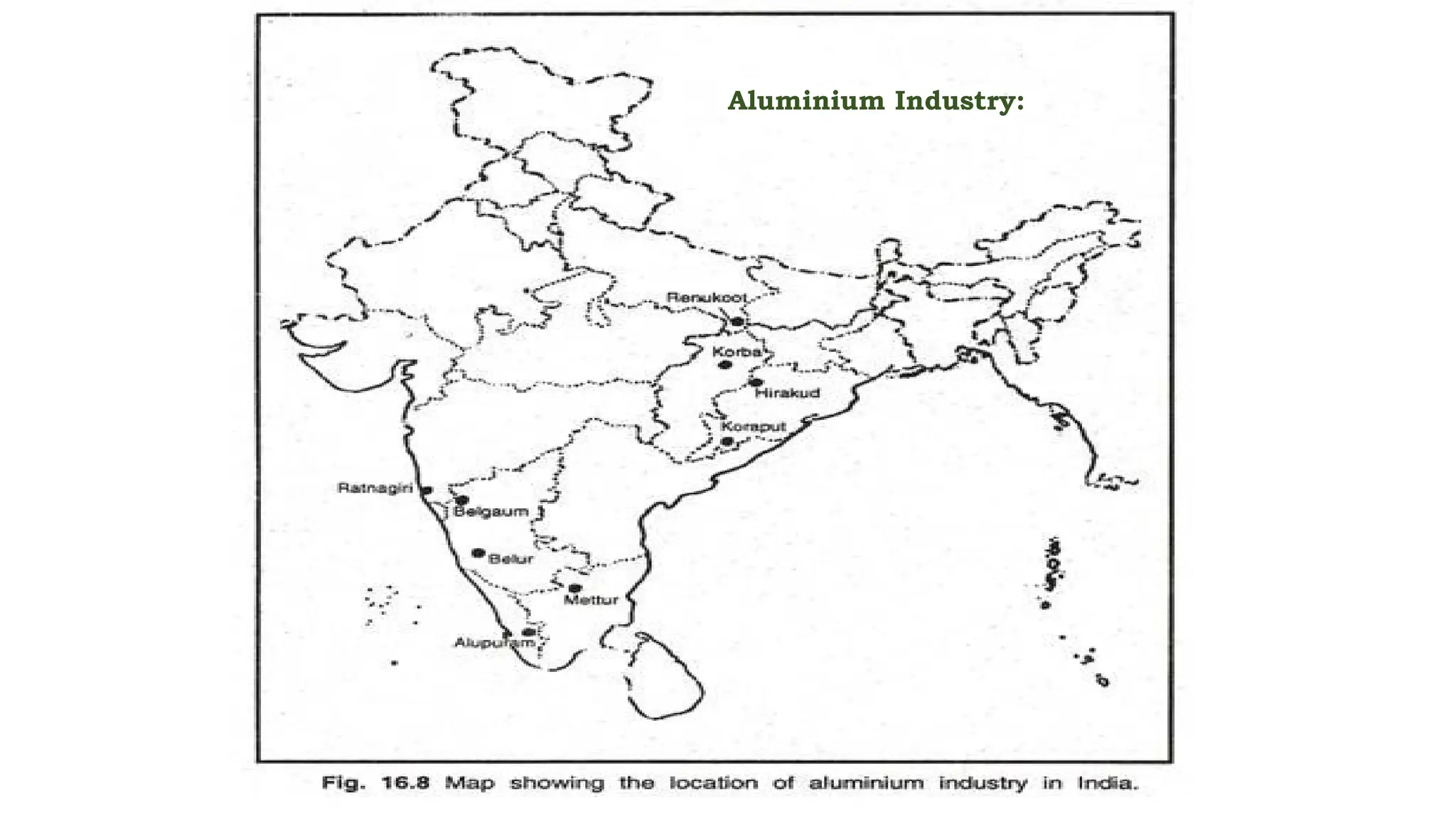
Four major primary producers are National Aluminium Co. Ltd, Hindalco
Industries Ltd, Bharat Aluminium Co. Ltd and Vedanta Aluminium Ltd (VAL)
having seven aluminium smelters having total installed capacity of 26 lakh
tpy.
NALCO the Public Sector continued to be the leading producer of alumina
accounting for 45% of the total production with installed capacity of 460,000
tpy Aluminium with smelter at Angul, Orissa..
BALCO, Private Sector with stake holdings Sterlite Industries (India) Ltd
(51%) and Government of India (49%). has an installed capacity of 3.45 lakh
tpy at Korba.
The remaining five smelters of Hindalco and Vedanta Aluminium Ltd are in
the Private Sector. Hindalco Aluminium smelting operations are located at
Renukoot (Uttar Pradesh) and Hirakud, Orissa.
Aluminium Industry:
Copper Smelting Industry:
Copper is an important non-ferrous base metal having wide industrial
applications, ranging from defence, space programme, railways, power cables,
telecommunication cables, etc. the share of Electrical and Telecommunication
Industry in total consumption is 56%, followed by Process
Industries ,Transport ,Consumer Durables ,Building & Construction ,General
Engineering goods , and other industries including process Industries.
India is not self-sufficient in the production of copper ore. In addition to
domestic production of ore and concentrates, India imports copper
concentrates for its smelters. The domestic demand of copper and its alloys is
met through domestic production, recycling of scrap and by imports.
Hindustan Copper Limited (HCL), a Public Sector Undertaking, is the only
integrated company in the country that is involved in mining & beneficiation
and smelting & refining and casting of refined copper.
Birla Copper (unit of Hindalco) and Sterlite Industries (India) Ltd, are the
major copper producers in the Private Sector that mainly rely on imported
copper concentrates.
Madhya Pradesh is the leading producer of copper concentrates, accounted
for > 50% of the production, followed by Rajasthan with 40% and Jharkhand .
Khetri Copper Complex (KCC)
The KCC smelter earlier located at Khetri in Raj has been closed owing to
economic considerations since December, 2008.
Indian Copper Complex
ICC has the smelting & refining facility of 18,500 tonnes per annum
capacity at Ghatsila, East Singhbhum district, Jharkhand.
Malanjkhand Copper Project (MCP) has mine and concentration plant at
Malanjkhand in Madhya Pradesh
Taloja Copper Project (TCP)
The continuous cast wire rods plant of HCL with a capacity of 60,000
tonnes per annum is located at Taloja in Maharashtra.
Sterlite Industries (India) Ltd smelter capacity of 4,00,000 tonnes per
annum copper anodes located at Thoothukudi in coastal Tamil Nadu is
closed down due to Environment problems
Hindalco Industries Ltd (Birla Copper) The Company's smelter
located at Dahej, Bharuch district, Gujarat, has a capacity of
5,00,000 tpy
Gujarat Copper Project (GCP) of Government-owned Hindustan
Copper ltd acquired plant is designed to produce 50,000 tonnes
based on secondary route.(By recycling scrape)
The total installed capacity of copper smelter in the country is app
1 million tonnes per annum.
Copper is one of the most recycled metal of all the metals. In India
there are 35 Units operating in different States with a combined
capacity of 2.42 lakh tpy for handling different types of scrap.
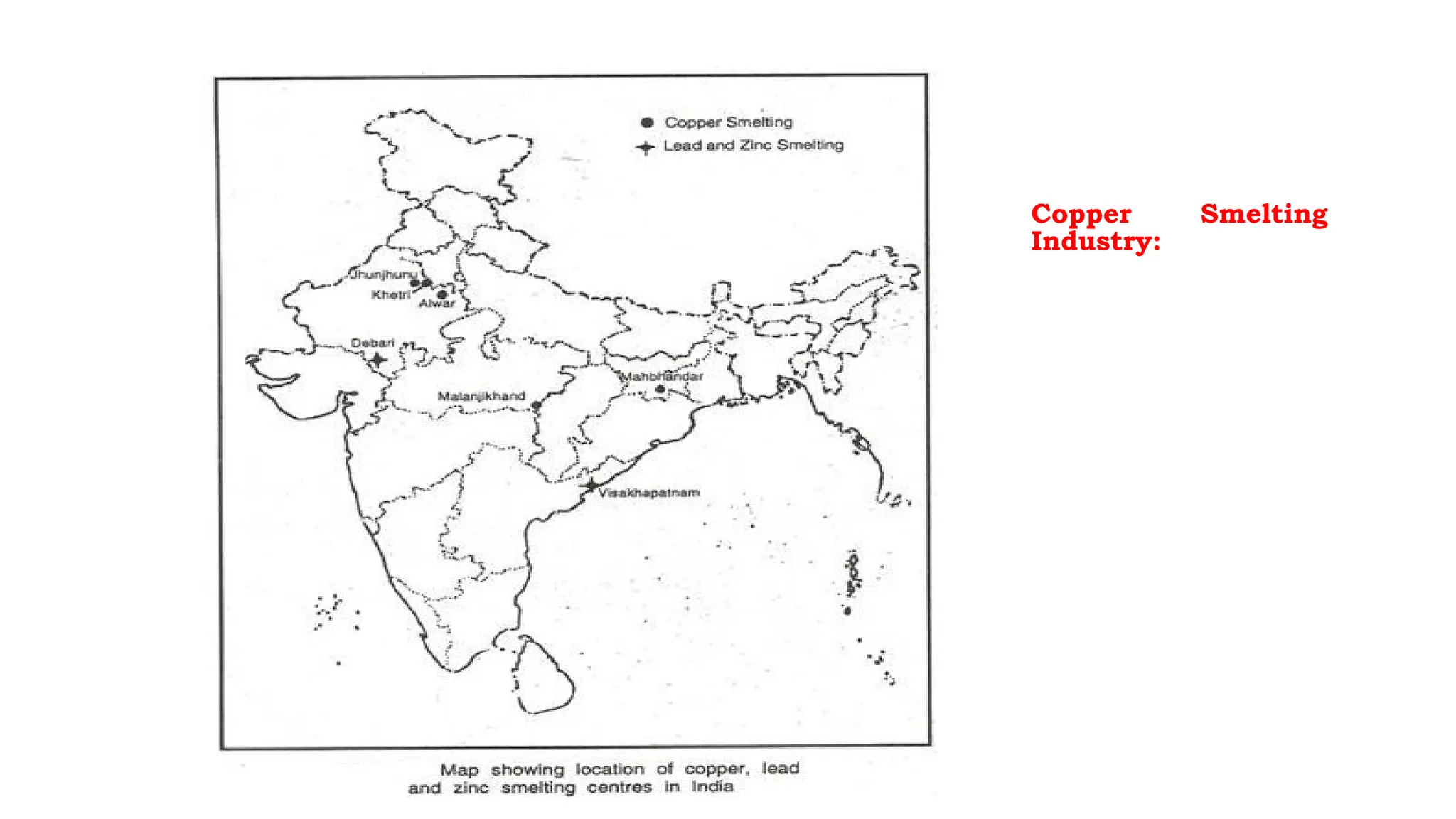
Copper Smelting
Industry:
Zinc is a silvery blue-grey metal with a relatively low melting and boiling
point. The single largest use for zinc is in the Galvanising and brass Industry.
The zinc once used for galvanising as well as for brass making is not
recoverable. The secondary zinc was recovered from pure zinc scrap in the
form of sheet cutting, zinc roofings, old zinc anodes and alloys containing zinc
as a major constituent. There were 192 units of zinc recycling with combined
capacity of 4,63,102 tpy. The country enjoys self-sufficiency in respect of zinc.
Production of zinc is more than its consumption.
Lead is a soft, heavy, toxic and highly malleable metal. Both lead & zinc are
found to occur together in ore along with other metals like silver and
cadmium. The largest single use of lead is in the manufacture of lead-acid
storage batteries, It is one of the highest recycled metal. The secondary lead is
recovered from used lead-acid batteries, cable sheathing, pipes and plates. The
ever increasing demand for lead especially from Lead Acid Battery Sector is
met through lead scrap recycling. There is short supply of lead vis-a-vis the
demand in the country.
Lead and Zinc Smelting Industry:
Hindustan Zinc Ltd (now owned by Sterlite Ind ) is the only producer of
primary (from Ore) lead and zinc extracted from its mines situated in Zawar
Udaipur and Rampura Agucha Bhilwara Rajasthan.
Primary lead was produced entirely by HZL which operated smelter at
Chanderiya in Chitorgarh and Dariba having capacity of 85,000 tpy and
1,00,000 tpy of lead metal, respectively. Total smelting capacity for lead
(primary) in the country presently is 1,85,000 tpy.
The smelting capacity of HZL for zinc is distributed between three smelters at
Debari Udaipur (88,000 tpy), Chanderiya (5,25,000 tpy) and Dariba Udaipur
Smelting Complex (2,10,000 tpy). Total smelting capacity for zinc (primary)
in the country presently is >8Lakh tpy.
Besides lead & zinc capacities, HZL has capacities to produce 518 tpy of
silver, 740 tpy of cadmium and 1.74 million tpy of sulphuric acid as by
products.
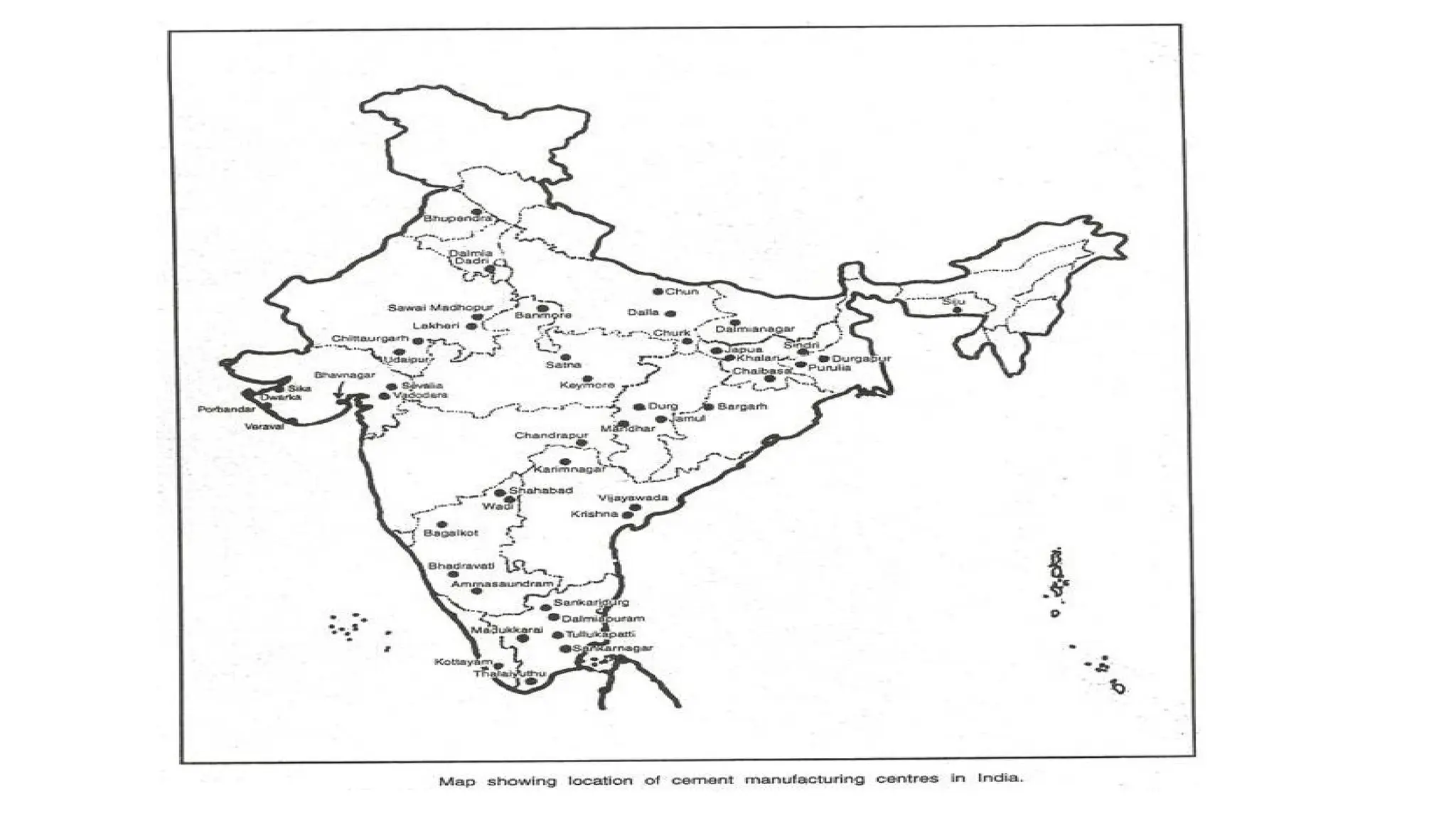
Cement Industry:
Cement, is an important infrastructure core industry in the country. The country
was deficient in cement until the policy reforms. Industry was de-licensed in 1991 &
there has been remarkable growth .It is basic requirement in construction
activity right from house to road, dams, plants etc.
Cement is made mainly from limestone. Other raw materials include shale, iron
ore,coal and gypsum . Thus, cement factories are located near limestone deposits.
Since coal and gypsum are brought generally from long distances and cement has to
be dispatched to far-off consuming centres, the cement plants are located close to
rail routes. Sludge from fertiliser plants, blast furnace slag and sea-shells are used
instead of limestone in some cement plants to make pozzolana cement.
India exports about 6 million tonnes cement to Sri Lanka, Nepal, Egypt, Bhutan,
Bangladesh and Myanmar.
There were > 200 large cement plants having total annual installed capacity of 350
million tonnes. In addition, there are mini and white cement plants having total
estimated capacity of 6 million tonnes per annum. Three cement plants, having a
total capacity of about 1million tonnes per year produce white cement.
There are as many as 112 plants with over a million tonnes or more
capacity. There are five large cement plants owned by various State
Government Undertakings like Tamil Nadu Cement, Malabar Cements, J & K
Ltd etc.
The mini-cement plants are meant to tap scattered limestone resources,
mostly in Andhra Pradesh, Gujarat, Rajasthan and Madhya Pradesh.
India is producing different varieties of cements like Ordinary Portland
Cement (OPC), Portland Pozzolana Cement (PPC), Portland Blast Furnace
Slag Cement (PBFSC), Oil-well Cement, Rapid Hardening Portland Cement,
Sulphate Resistant Portland Cement (SRPC) and White Cement.
The industry is largely under Private Sector.UltraTech Cement is the India's
largest and amongst the World's top cement manufacturers. Shree Cements.
Ambuja Cements. ACC.Binani Cement. Ramco Cements OCL India. Birla
Corp etc are major producers.
The total production of cement is around 280 million tonnes per yr.
1.3.National Mineral
Policy
Need & evolution of national mineral
policies in India.
Highlights of Latest National Mineral Policy
2019.
Need of national mineral policy :Mineral resources are natural, finite and
non-renewable. No nations have domestic resources sufficient for its industrial
needs.Minerals are vital raw materials for basic industries, & source of energy.
The regulation of mines and development of mineral resources in accordance
with the national goals and priorities are the responsibility of Central and State
Governments.
Mining is a three-stage operation, involving regional exploration, detailed
exploration, and actual mining.
Mining projects, therefore, have a long gestation period requiring large
investments in exploration and other development
activities before commercial production can begin, and are thus considered as a
high risky venture.
In order to secure long term Raw Material (minerals) supply for its industry from domestic
resources and minimising import so as to boost its economy there has to be a national
mineral policy in place as a guiding principle.
Def: National Mineral Policy (NMP) : A systematic, comprehensive framework,
implemented on national level to promote mineral sector for management and
economic use of mineral resources.
• Basic objective of national mineral policy of any country is Conservation of
mineral resources, sustainable ,Systematic and scientific development of
mineral resources, Environment protection of mining area and Socio
economic development of mining project affected people.
• Prior to formal introduction of national mineral policy of the country mining
activities were governed through certain set of rules without keeping any
mineral development model in mind.
• These rules were related to mineral development,leasing and safety of
workers. Mineral development was taken care of by MMDR Act 1957 and
rules there under and safety and welfare of workers was taken care of by
Mines Act1952.
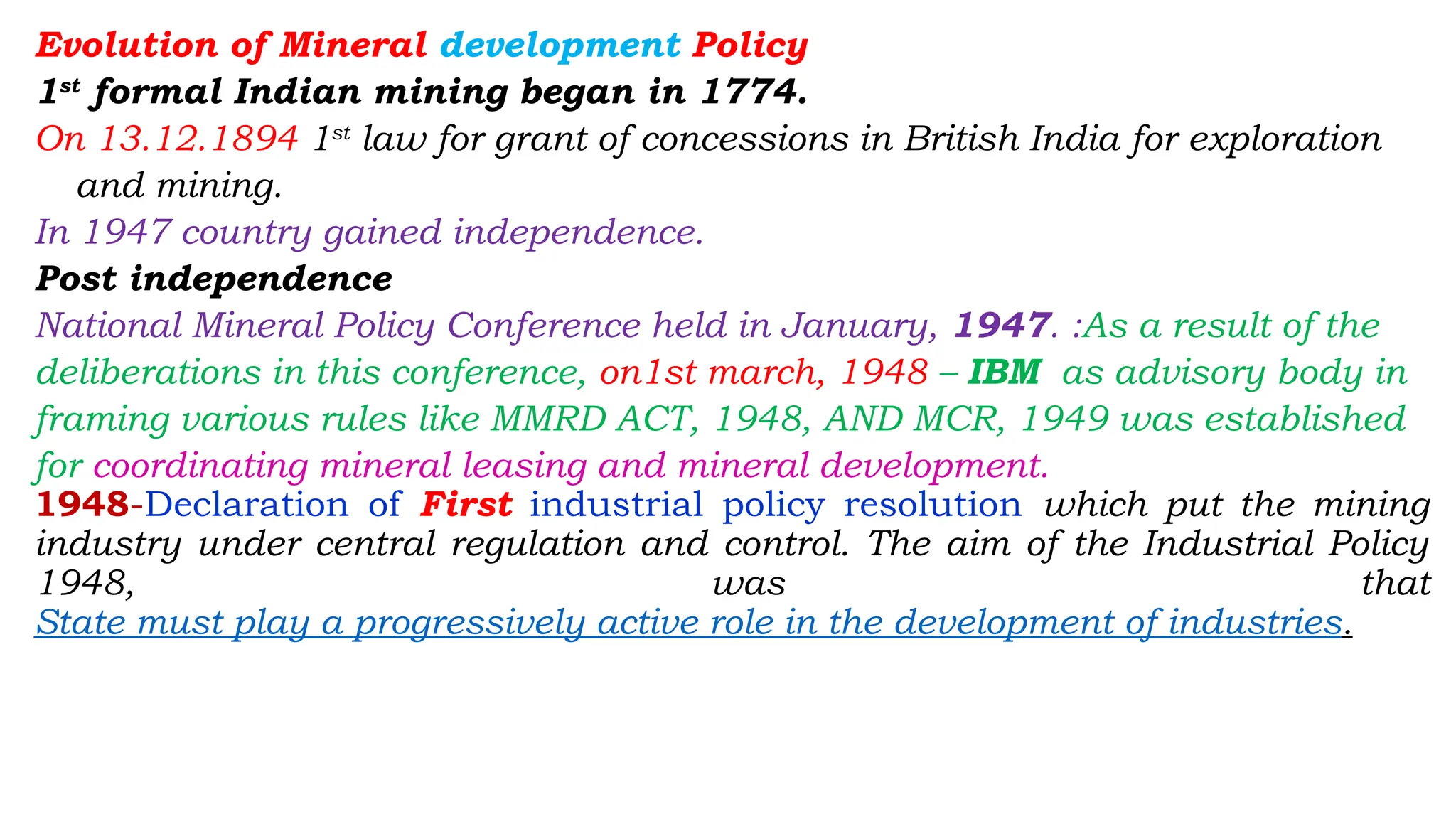
Evolution of Mineral development Policy
1st
formal Indian mining began in 1774.
On 13.12.1894 1st
law for grant of concessions in British India for exploration
and mining.
In 1947 country gained independence.
Post independence
National Mineral Policy Conference held in January, 1947. :As a result of the
deliberations in this conference, on1st march, 1948 – IBM as advisory body in
framing various rules like MMRD ACT, 1948, AND MCR, 1949 was established
for coordinating mineral leasing and mineral development.
1948-Declaration of First industrial policy resolution which put the mining
industry under central regulation and control. The aim of the Industrial Policy
1948, was that
State must play a progressively active role in the development of industries.
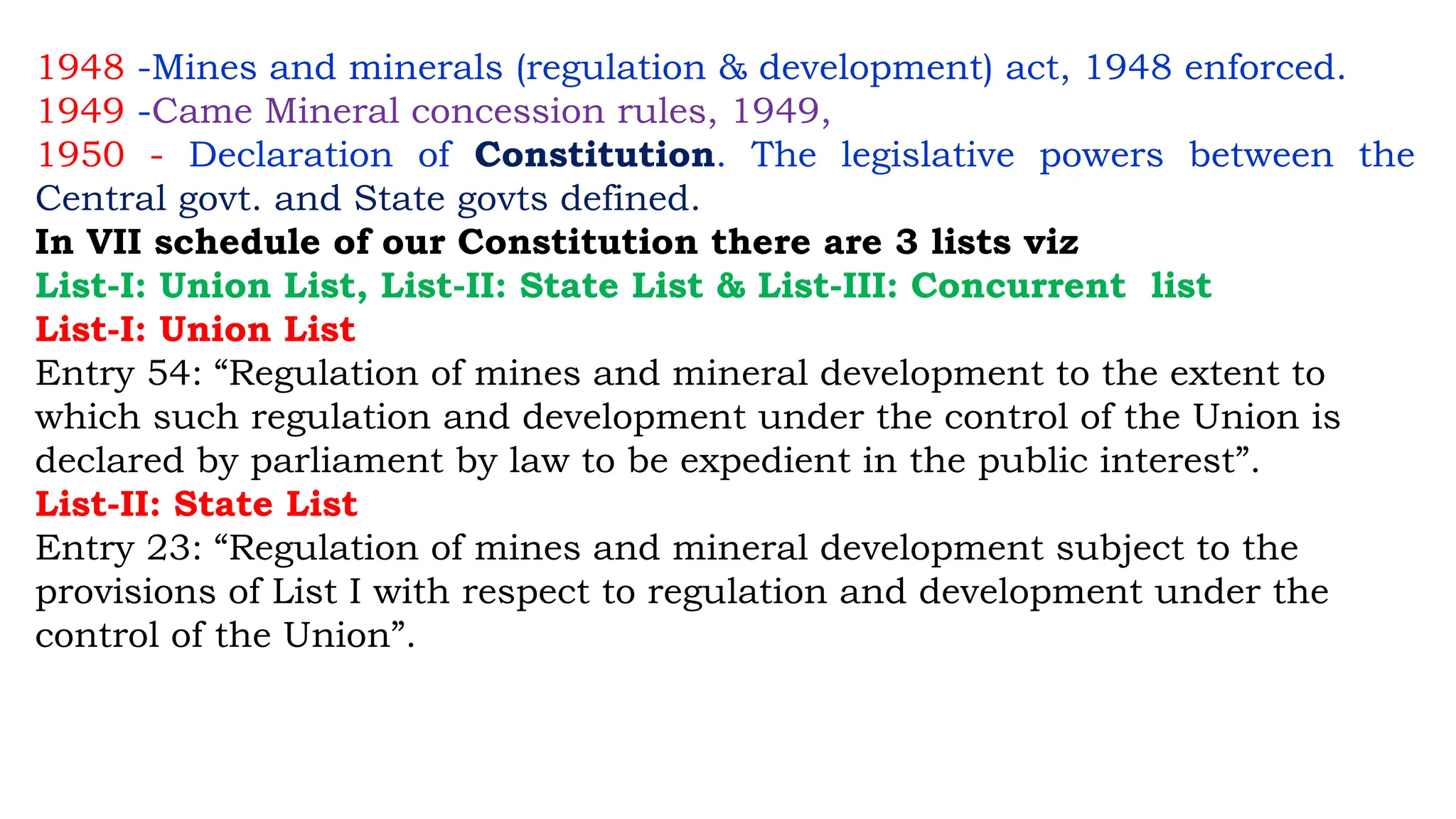
1948 -Mines and minerals (regulation & development) act, 1948 enforced.
1949 -Came Mineral concession rules, 1949,
1950 - Declaration of Constitution. The legislative powers between the
Central govt. and State govts defined.
In VII schedule of our Constitution there are 3 lists viz
List-I: Union List, List-II: State List & List-III: Concurrent list
List-I: Union List
Entry 54: “Regulation of mines and mineral development to the extent to
which such regulation and development under the control of the Union is
declared by parliament by law to be expedient in the public interest”.
List-II: State List
Entry 23: “Regulation of mines and mineral development subject to the
provisions of List I with respect to regulation and development under the
control of the Union”.
Article 294 of Constitution Minerals rights on land vest with the respective
State Governments.
Article 246: Empowers the Union govt. to make rules and regulation for
development of major mineral resources & the State govts to make rules and
regulations for development of minor minerals.
Article 297 of Constitution
Minerals rights in off-shore areas vest with the Union Government
“Minerals” means all minerals except mineral oils.
“Mineral Oil” means natural gas and petroleum
As per constitution Minerals rights kept with state but their development was
central govt responsibility also and power to frame laws for grant of concession
is vested with central govt .
1950 IBM was given functions of mineral regulation & development through
inspection of mines.
2nd
Industrial policy resolution was enunciated in 1956
• It spelt out Role of the public and private sectors in industry including mining.
• It divided industries into three broad categories.
First category, Schedule ‘A’ include those industries the future development of which
could be the exclusive responsibility of the Government like Arms and ammunition,
atomic energy, railway-transport, coal, iron & steel, aircraft manufacturing, ship-
building, manufacture of telephone, telegraphs and wireless apparatus these were
kept reserved for establishment by public sector.
Schedule A industry minerals were Coal, lignite, mineral oil, Asbestos, Bauxite, iron,
manganese, chrome, gypsum, sulphur, gold, diamond, copper, lead, zinc, molybdenum,
wolfram, tin ore Precious stones and atomic minerals.
• The second category Schedule ‘B’ were to be progressively state owned and all
minerals other than minor minerals and minerals listed in Schedule ‘A’ were included
in this category.
• The third category Schedule ‘C’ consisted of those industries, which were not
included in first two categories. Only minor minerals of local importance for benefit of
local people were included in this category. Minor Mineral were left for Private
Initiatives, but open for Exploitation by Public Sector as well. Minor minerals are
those notified by Govt in sec 3 e of MMDR Act 1957.
• To implement the industrial policy, a number of public sector undertakings were
created .
• It was stated that all new mines will be developed by the State ie Govt.
• MM(RD) ACT,1957 repealed MM(RD) ACT,1948. Mother act dealing with regulation of
mines and development of mineral resources. Made applicable to all states and all
minerals except petroleum and NG. Defined terms and conditions for grant of PL and
ML, eligibility for grant of PL and ML, payment of Royalty on mineral production etc.
• Section 15 of the Act empowers the State govts to frame Minor Mineral Concession
Rules of the respective state.
• In 1958- Mineral Conservation and Development Rules, 1958 framed under sec 18 of
MMRD Act 1957-It is applicable to all major minerals and not for fuel (coal/lignite),
atomic, minor, petroleum and NG .It provides guidelines for scientific mining and
systematic development and conservation of minerals and protection of environment.
• In 1960-Mineral Concession Rules 1960 (under sec13)-for grant of Concessions
(Applicable to all minerals ie fuel, major, atomic except minor, petro &NG) :Deals with
procedures for grant, renewal, surrender, transfer, etc. of Prospecting licences and
Mining Leases in respect of minerals other than oil. The rules being administered by the
State govts.
IMP amendment
In 1986- MMRD amendment act 1986 notified on 22.8.86
came into force wef 10.2.87- Provides Mining plan with
EMP, No grant of ML if no mineral evidence sec 5 (2)(a)
In 1987- MCR 1960 amended as on 10.2.87 providing-
Mining plan in Rule 22
In 1987- Additional functions to IBM- approval of mining
plans and mining schemes
In 1988- MCDR 1988 replaced MCDR 58 wef 24.10.1988 -
Mining plan rules (9-13) and environment protection rules
(31-41)
NEW INDUSTRIAL POLICY STATEMENT 1991
Reason to announce Industrial Policy Statement, 1991
Public sector did not run on business line as envisaged in the Industrial
Policy Resolution, 1956.
Facing unprecedented negative economic growth, the Government introduced
basic structural, and economic reforms in July, 1991.
Era of globalization and privatization begins:
Hitherto reserved sectors like power generation, mining and metallurgical
industries opened to the private initiatives, both domestic and foreign, to
attract continuous flow of investment and technology.
National Mineral Policy 1993 : Mineral sector is capital intensive and needed
huge resources, huge capital and advanced technology. Inadequate capital,
obsolete technology, poor infrastructure and higher input cost had resulted in
low productivity in this sector. Expenditure on exploration in India, was meager
around 0.7%. In order to globalize the mineral sector, First National Mineral
Policy was announced in 1993 by the Indian Government.
Objectives were to explore mineral wealth in land & off-shore ,develop mineral
resources with strategic considerations and best use keeping in view the present
and future requirements, promote necessary linkages, promote research and
development human resource environment and ecology protective measures.
Subsequently, it was observed that the results of the Mineral Policy 1993 had
not been encouraging.
The main factors identified as procedural delays in the processing of
applications for mineral concessions & the absence of adequate infrastructure
in mining areas.
Accordingly, the Planning Commission constituted a Committee in September
2005 under the Chairmanship of Shri Anwarul Hoda, Member, Planning
Commission.
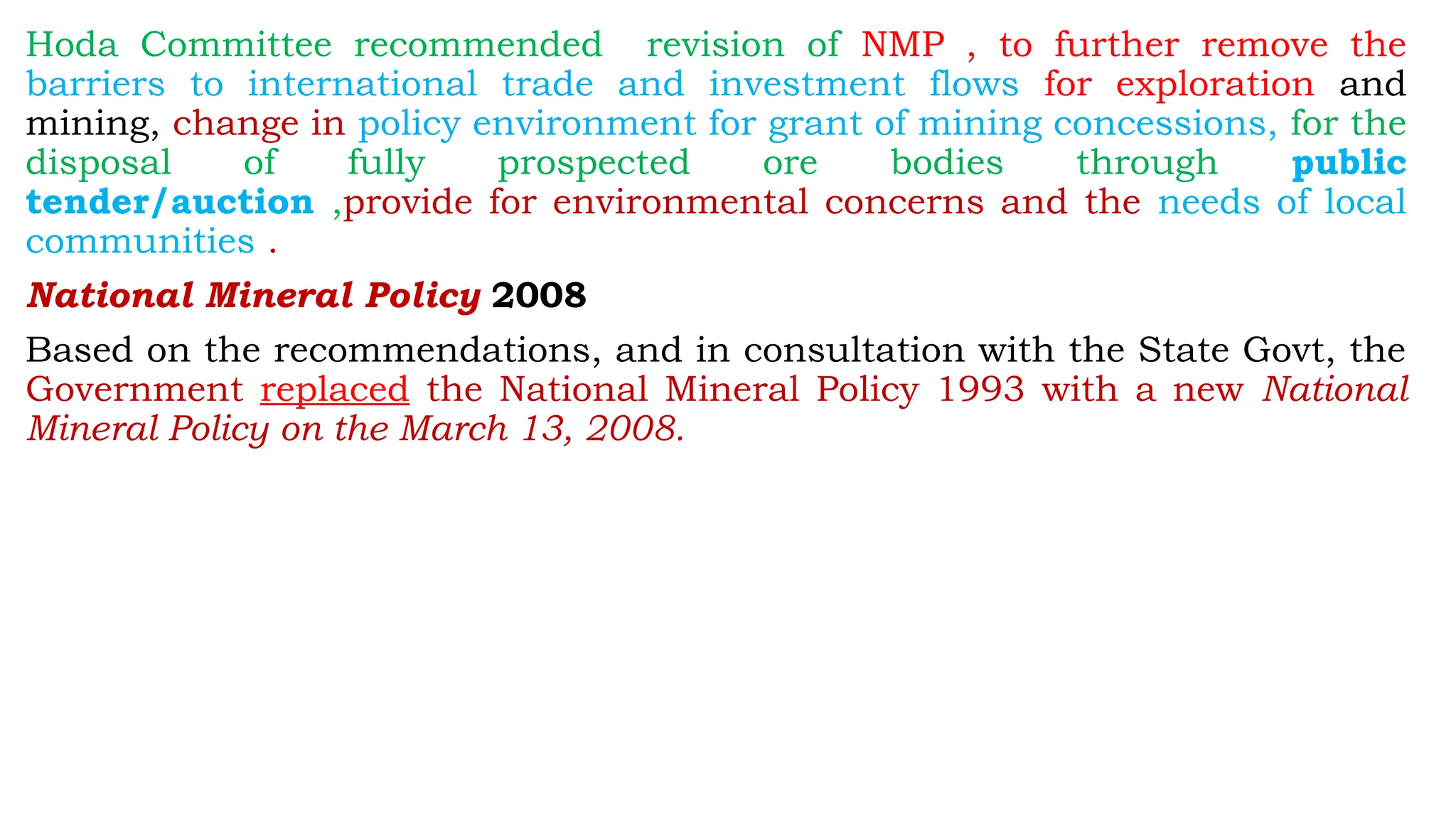
Hoda Committee recommended revision of NMP , to further remove the
barriers to international trade and investment flows for exploration and
mining, change in policy environment for grant of mining concessions, for the
disposal of fully prospected ore bodies through public
tender/auction ,provide for environmental concerns and the needs of local
communities .
National Mineral Policy 2008
Based on the recommendations, and in consultation with the State Govt, the
Government replaced the National Mineral Policy 1993 with a new National
Mineral Policy on the March 13, 2008.
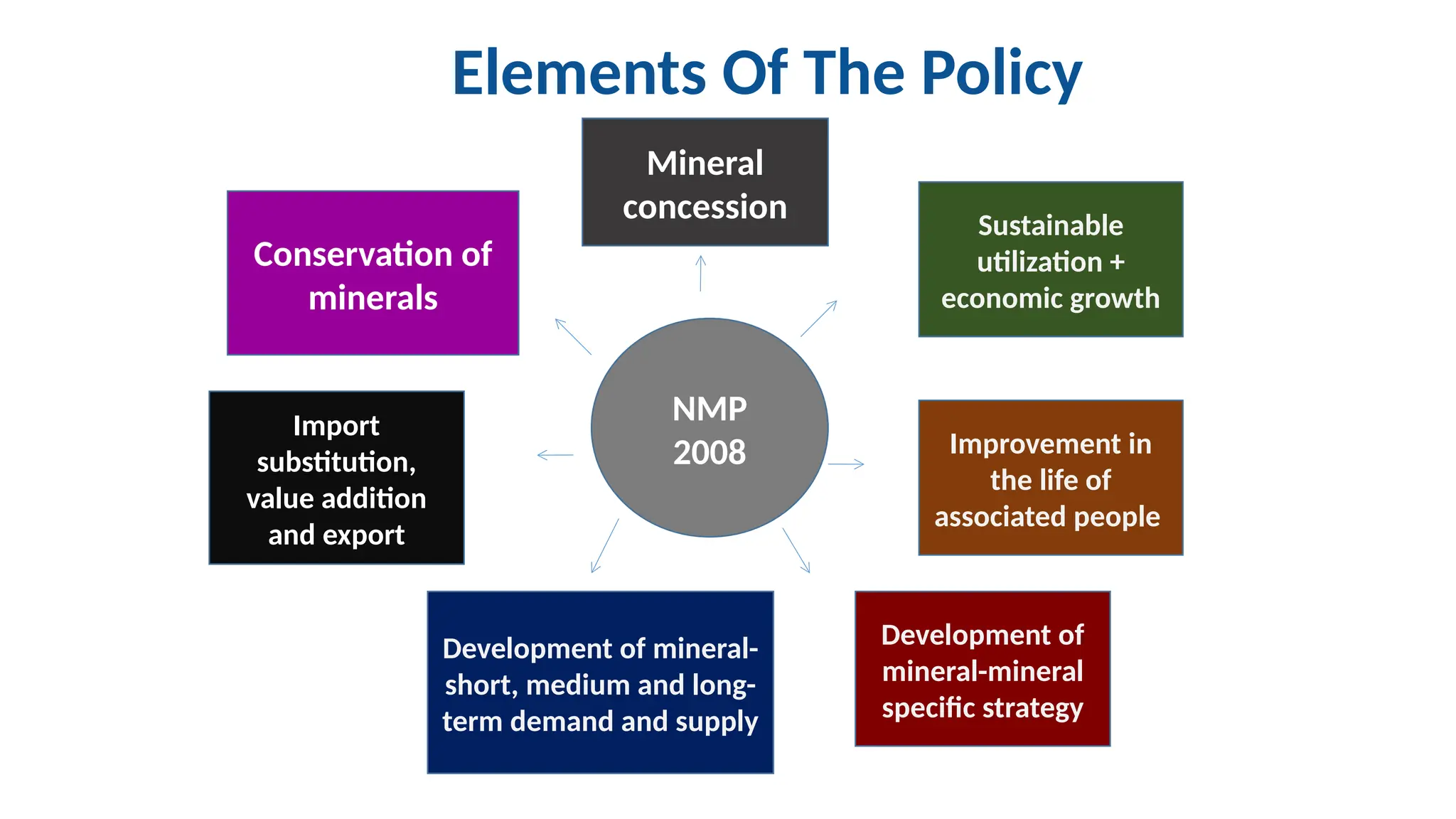
NMP
2008
Mineral
concession Sustainable
utilization +
economic growth
Improvement in
the life of
associated people
Development of
mineral-mineral
specific strategy
Development of mineral-
short, medium and long-
term demand and supply
Import
substitution,
value addition
and export
Conservation of
minerals
Elements Of The Policy
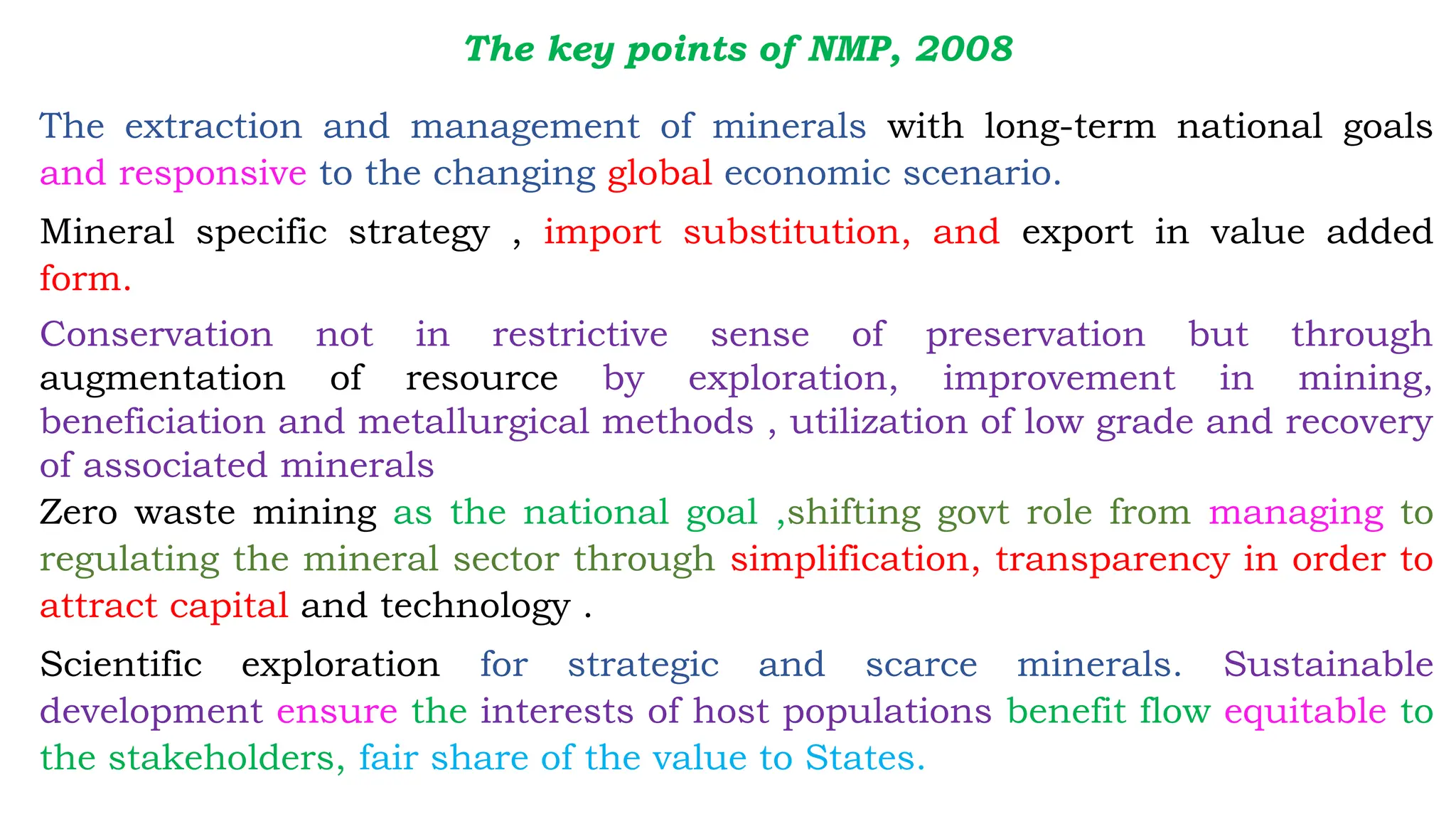
The key points of NMP, 2008
The extraction and management of minerals with long-term national goals
and responsive to the changing global economic scenario.
Mineral specific strategy , import substitution, and export in value added
form.
Conservation not in restrictive sense of preservation but through
augmentation of resource by exploration, improvement in mining,
beneficiation and metallurgical methods , utilization of low grade and recovery
of associated minerals
Zero waste mining as the national goal ,shifting govt role from managing to
regulating the mineral sector through simplification, transparency in order to
attract capital and technology .
Scientific exploration for strategic and scarce minerals. Sustainable
development ensure the interests of host populations benefit flow equitable to
the stakeholders, fair share of the value to States.
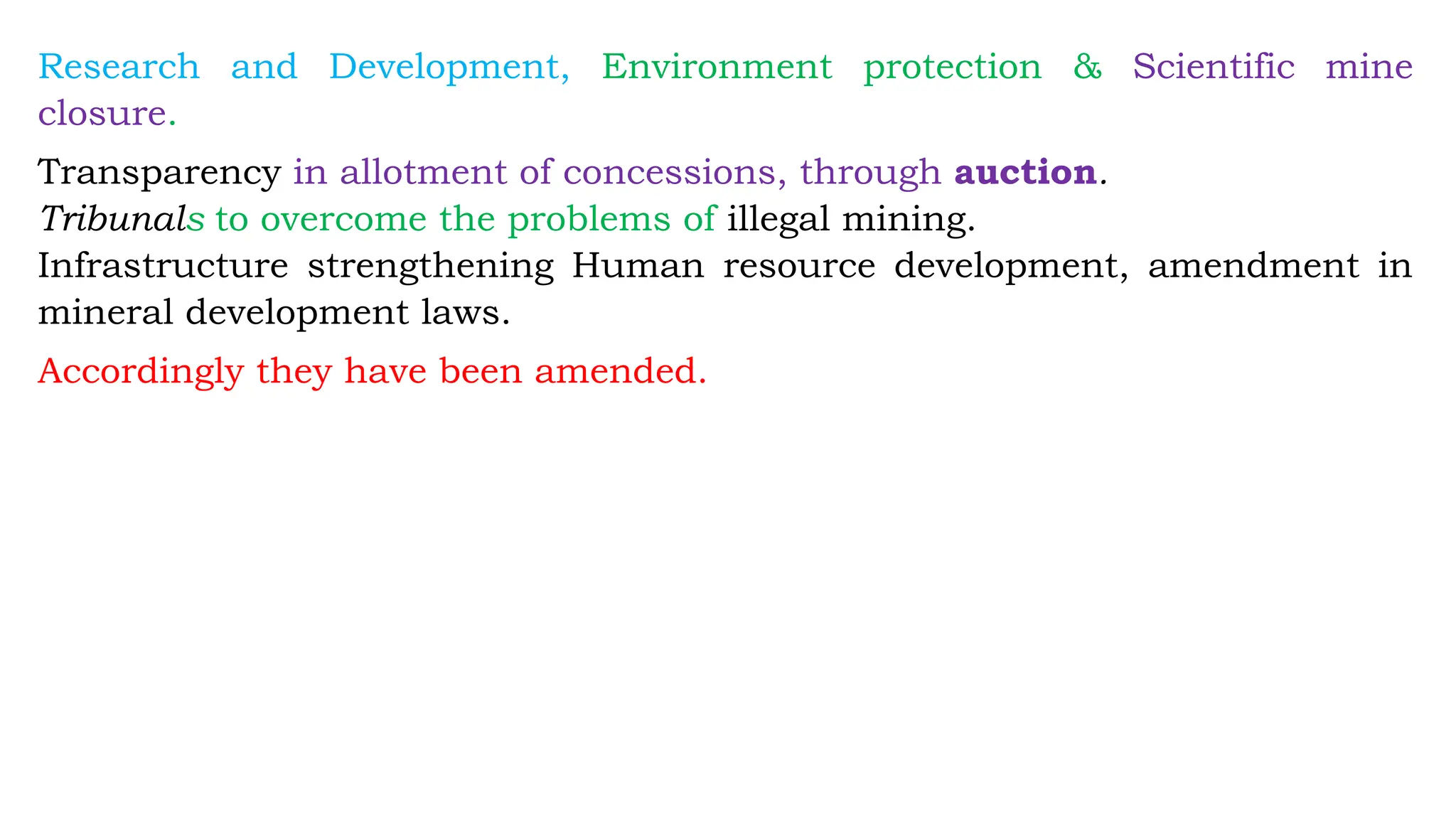
Research and Development, Environment protection & Scientific mine
closure.
Transparency in allotment of concessions, through auction.
Tribunals to overcome the problems of illegal mining.
Infrastructure strengthening Human resource development, amendment in
mineral development laws.
Accordingly they have been amended.
The highlights of NMP, 2019
NMP 2019: SALIENT FEATURES
Latest policy is NMP 2019 it is extension of NMP 2008.
Main features of NMP 2019 are:
Attracting investments by offering ‘ease of doing businesses’ through
simpler, transparent and time-bound procedures for obtaining clearances.
Strengthening the regulatory mechanism by incorporating E-Governance &
effective mining surveillance system to curb illegal mining activity.
Focus on exploration of energy critical minerals & fertilizer minerals,
precious metals ,strategic minerals & import dependent minerals through
National mineral exploration trust (NMET).
Incentive for private sector for state-of-the-art technology.
Maintain database on online public portal Mineral Resources and mining
Tenement System to have check points for curbing delay in procedure.
Transparent and fair allotment of concessions through auction.
Setting up of Inter Ministerial body to coordinate & increase the production
of major minerals by 200 per cent and reduce trade deficit (gap in export
and import) in mineral sector & increase the share of the manufacturing
sector through Make in India initiative.
Conservation of minerals with positive concept of augmentation of
reserve/resource base , zero-waste mining & metal recovery through
recycling.
Rationalization of unused areas reserved for the PSUs and offer them for
auction, to private sector .
Scientific Methods of Mining to improve the efficiency, safety and
economics of mining operations.
Creation of “exclusive mining zones with approved, clearances to “curtail
delay in commencement of mining operations.
Harmonizing taxes, levies & royalty with world benchmarks.
Development of mineral corridors to facilitate smooth transportation of
minerals and encourage use coastal waterways and inland shipping for
transportation of minerals.
• Grant of industry status to mining to facilitate finance for exploration and mine
development.
• Incentive for foreign investment in large scale commercial mining activity.
• Export of minerals in value added form.
• Cluster approach to develop small deposits in the vicinity with common smelting
and refining facilities.
• Extraction of the replenishable deposits of beach sand minerals.
• Sustainable development ensuring well-being of the local population & the future
generations .
• No Mining operations in ecologically fragile and biologically rich areas.
• Relief & Rehabilitation of mining affected people through District Mineral
Foundation (DMF) .
• Orderly and systematic Mine closure and land reclamation to reduce impact on
environment.
• Introducing online public portal to have check points in the event of delay of
clearances.
1. 4.Mineral Conservation
Importance of mineral Conservation.
* Measures taken for mineral Conservation
Mineral conservation
Need for conservation
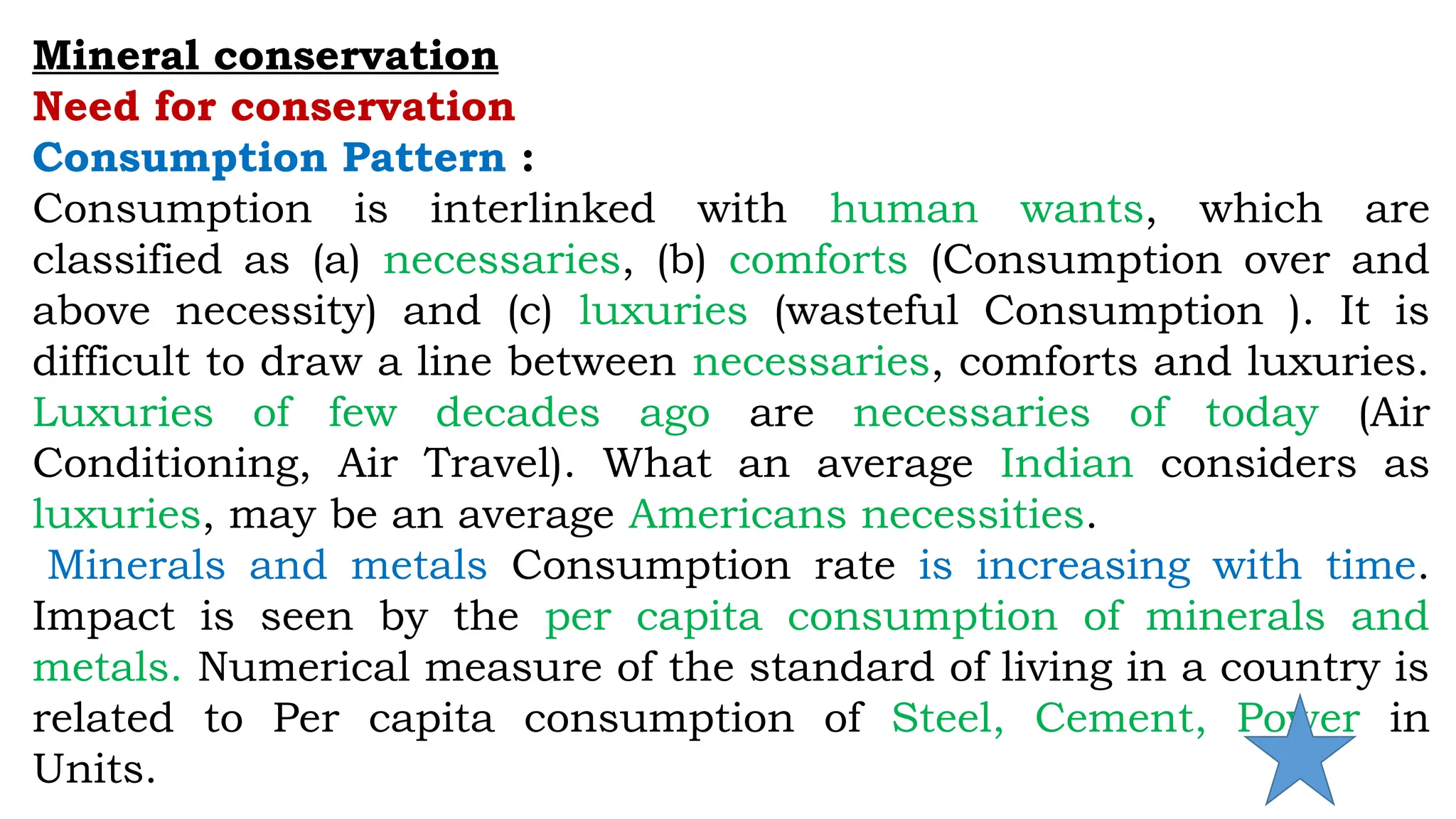
Consumption Pattern :
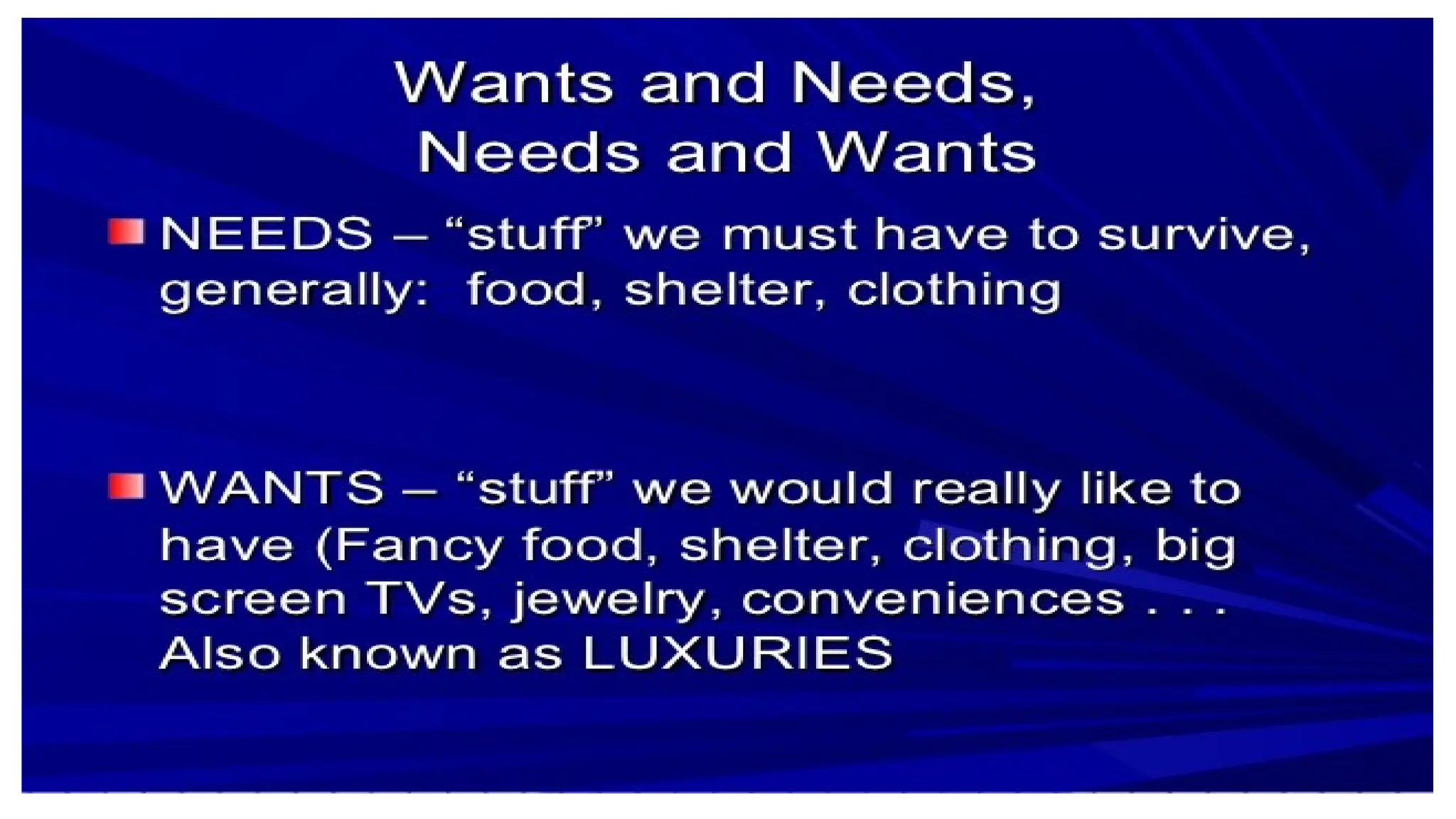
Consumption is interlinked with human wants, which are
classified as (a) necessaries, (b) comforts (Consumption over and
above necessity) and (c) luxuries (wasteful Consumption ). It is
difficult to draw a line between necessaries, comforts and luxuries.
Luxuries of few decades ago are necessaries of today (Air
Conditioning, Air Travel). What an average Indian considers as
luxuries, may be an average Americans necessities.
Minerals and metals Consumption rate is increasing with time.
Impact is seen by the per capita consumption of minerals and
metals. Numerical measure of the standard of living in a country is
related to Per capita consumption of Steel, Cement, Power in
Units.
Minerals are formed by inorganic processes of long duration.
Minerals are exhaustible and non-renewable resources.
Extraction of minerals has increased at large scale to meet the
ever increasing population and demand of country.
Due to improper and excessive use, minerals in certain regions
are on the verge of extinction. Hence, there is a need of
conservation of minerals. Unlike minerals in most other
commodities man is both consumer as well as producer.
Conservation means making the most of the exhaustible
resources we have. It is an effort to increase the life of
resources , without sacrificing our own need.
Conservation is maximum utility of a given commodity and not merely
idle saving as per National Mineral Policy (2008 ,now 2019). It is
intelligent utilization, which means efficiency in production and the
minimum wastage during processing and use.
Conservation aims at maximum recovery ,minimum loss & judicious use
of ever depleting natural resources so that long term and holistic
development of nation is taken care of.
Conservation is to be safeguarded through augmentation of resource
base through exploration, zero waste mining, improvement in
beneficiation and metallurgical process and utilization of low grade ore
and the rejects, recovery of associated minerals & sustainable
development.
Sustainable development is for the benefit of present generation
without affecting the requirement of future generation or the
“environmental, economic and social well-being for today and
tomorrow”
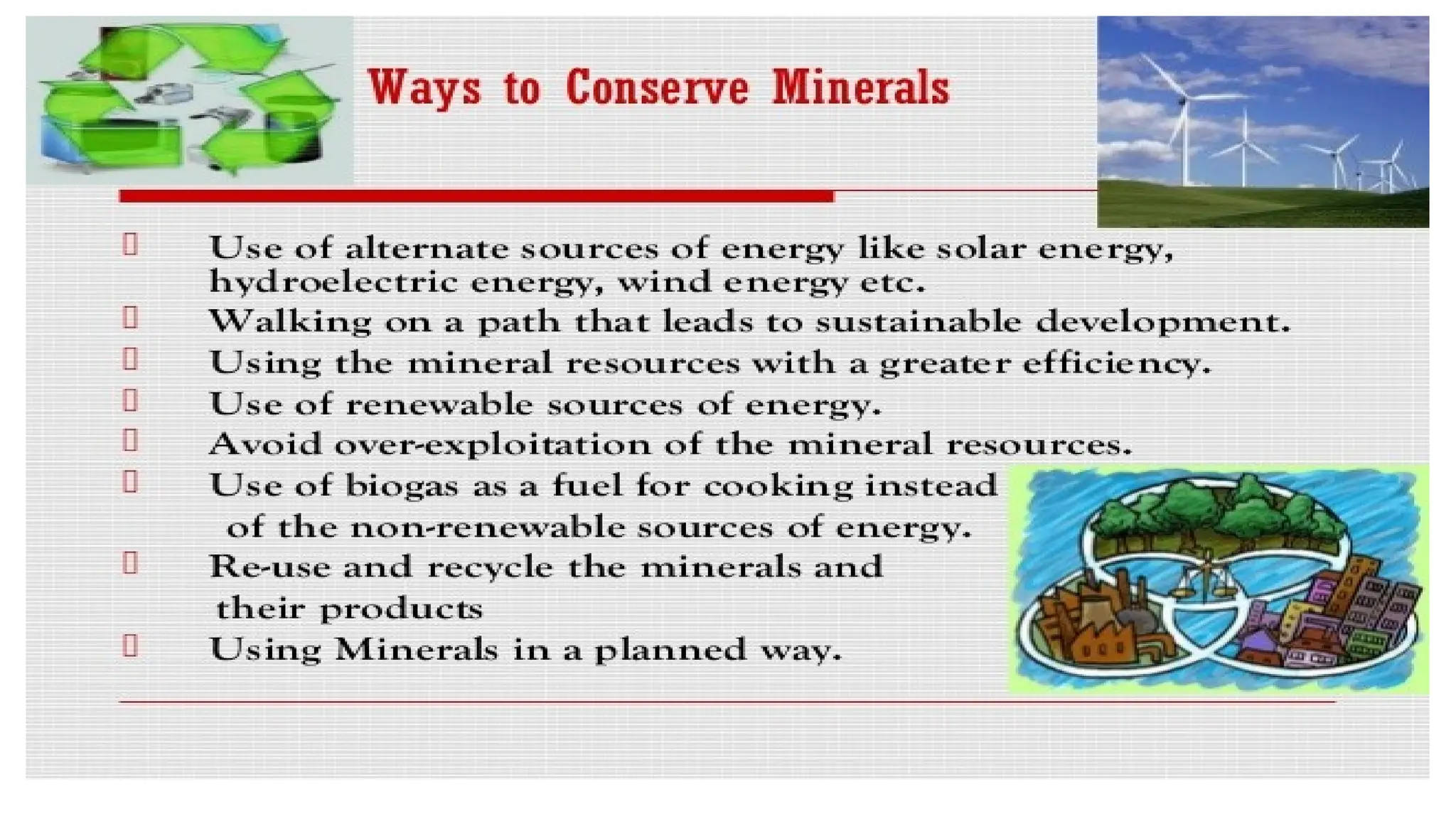
Following measures are necessary for the conservation of
minerals:
1.Extensive Exploration: For every ton of mining a ton must be
added. Exploration geologists often have a success rate of
1% or less. NMP stipulates Scientific and detailed exploration by state of
the art technology by private players and by GSI/MECL & DGMs mainly for
strategic and scarce minerals & Development of proper resource inventory.
2.Mineral Inventory
Development of proper mineral inventory for effective monitoring of
the country’s mineral resources in terms of rates of depletion or
augmentation of resources and to identify thrust areas and decide EXIM
policies and mineral development strategy.
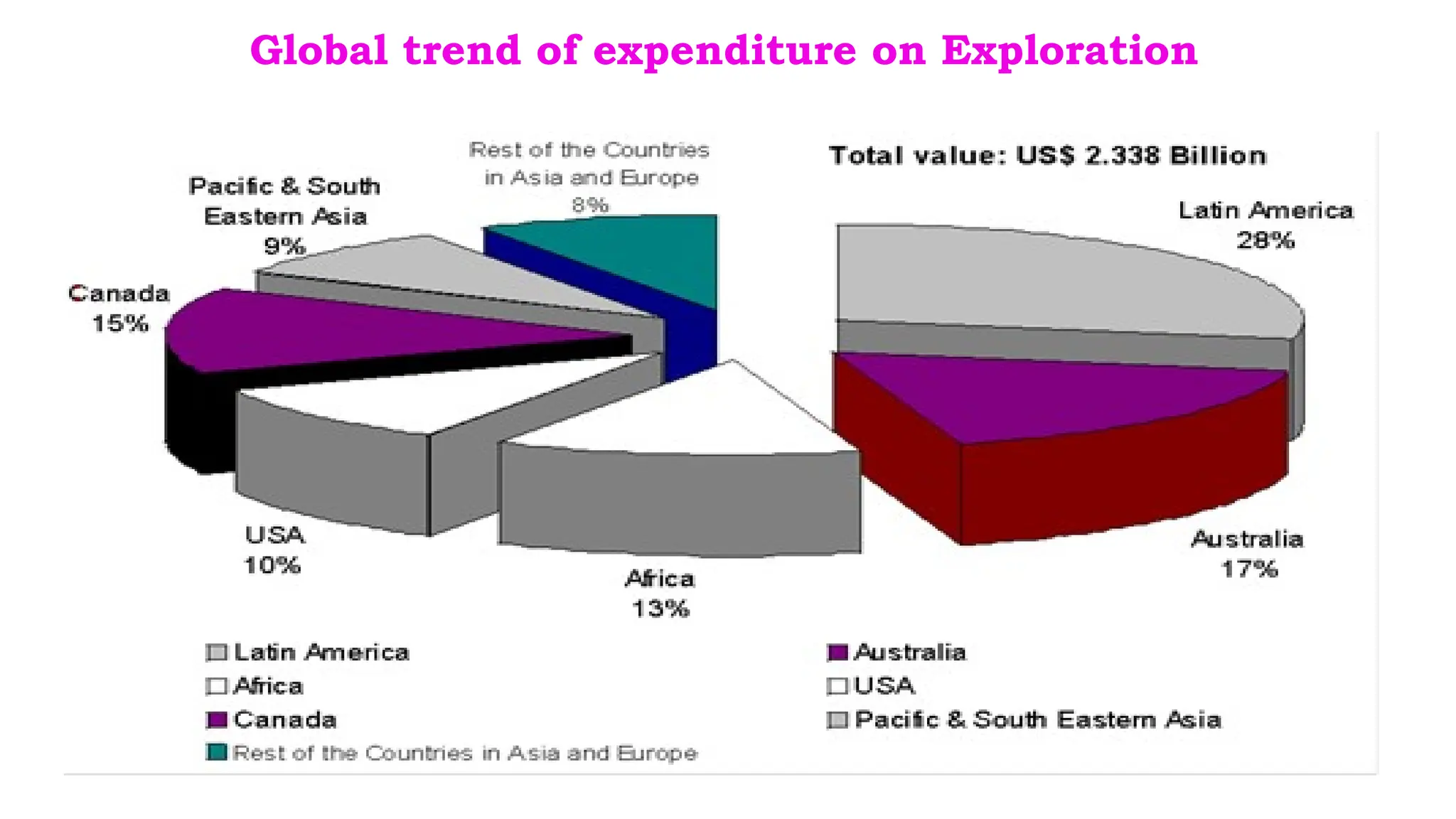
Global trend of expenditure on Exploration
3.Govt Policies
Export regulation It is in national interest not to export minerals as such, but
to export only value added manufactured products .
Import Liberalization : Minerals do not perish and can be stored easily so,
when it is available in international market at a cheaper price, it is wise to
import it or keep it for the future viz. US not exhausting its petro resource.
Leasing policy decides where and which mineral to be granted or
reserved ,which minerals to be heavily taxed and which should be subsidized,
which to be exported and which imported etc;
4. Following planned systematic, scientific and efficient mining as per MCDR
2017 to ensure efficient and adequate recovery at the mining stage. Adopt OC mining
if feasible and disallow selective mining to curb losses . In Mechanized mining there
is more ore loss and higher waste development.
Unsystematic mining carried out in the past rendered Mica in Bihar, coal in Jharia and
iron ore in Bellari unwinnable.
Separate advanced benches in OB and in different grades of ore.
Separate Stacking of non-saleable sub grade minerals above Threshold value. so
that it can be used in future with the advent of new technology ( eg. black dumps of
MOIL.)
Maximum ore recovery from UG by rock mechanics study to decide optimum size of
pillars, sub grade ore/minerals shall be brought to the surface
Cable bolting and grouting technique permitted to have smaller pillars in manganese
mines. It saved million of tonnes of coal being lost by underground fire in coal mines.
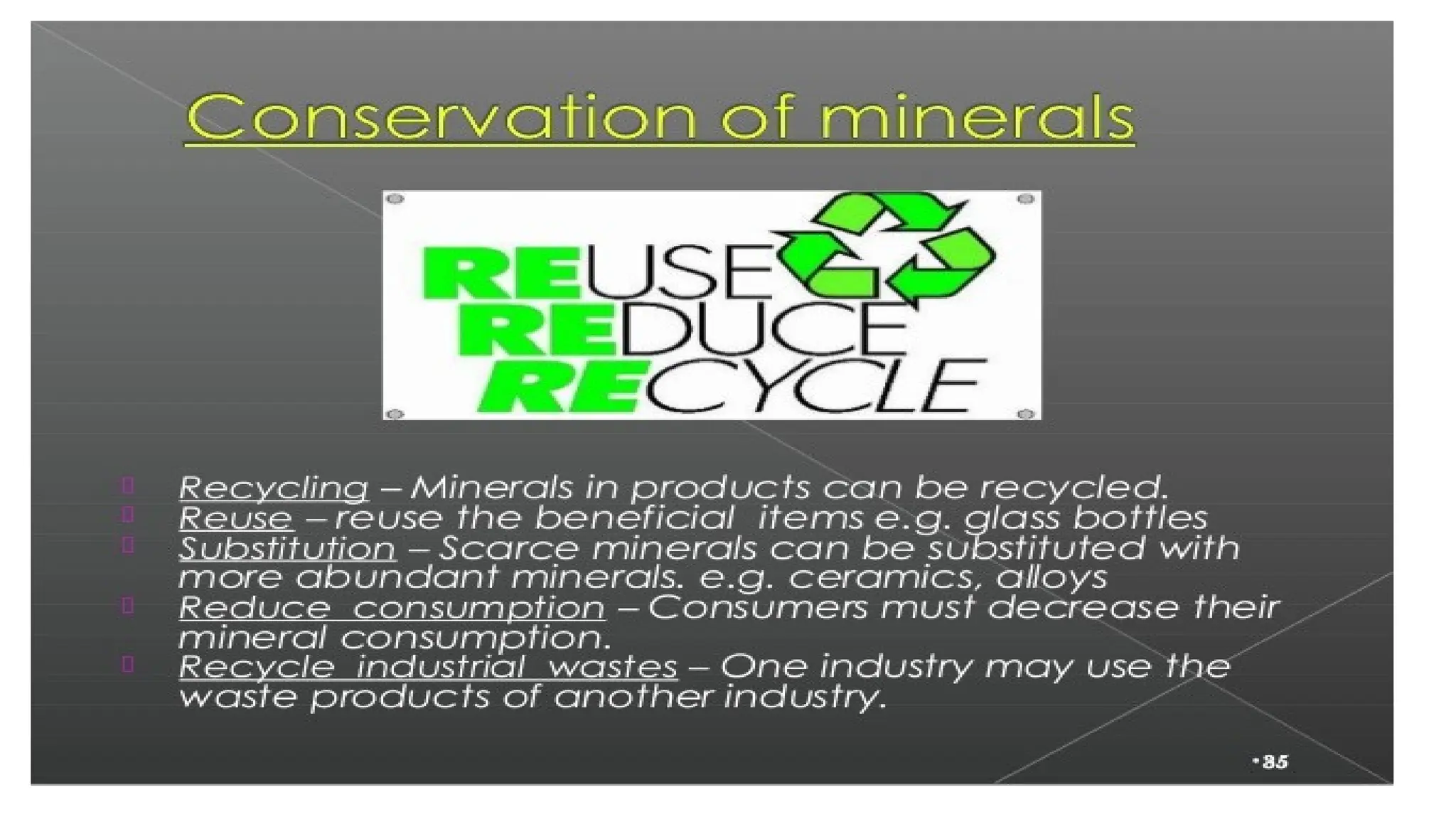
5.Scrap recycling : 3 types of scrap (1) generation in factories during
manufacturing, (2) worn out consumer articles e.g. cans, bottles i.e. domestic
or household scrap; (3) scrap recovered out of end-use goods by secondary
recovery processes e.g. lead from used storage batteries. They also form a
huge source of secondary metals.
Mineral Utilisation is expendable & non-expendable.
Expendable minerals have practically no salvage value & once used is
consumed & lost forever these include coal, petroleum gas, limestone,
manganese ore, refractory, flux and abrasive minerals & most of the non-
metallic minerals excluding precious stone.
Non-expendable Metallic minerals have greatly aided conservation due to
good salvage value as scrap & are recycled into normal run of consumption
except those quantities that are lost due to corrosion Common metals like
iron & steel, aluminium, copper, lead, zinc, tin & antimony have good
recoverable value as scrap & can be recycled. Precious metals gold, silver &
platinum are seldom lost. In the USA about 70% of the total steel production &
32% of total aluminium production comes from secondary sources.
According to USBM (United States Bureau of Mines), the primary copper
comes into circulation as scrap in 25 years & the quantity recovered is 60%
copper, zinc has recovery value from the scrap of dry cell & alloy like brass
containing zinc. While separating zinc from brass considerable loss of zinc
occurs & recovery of zinc from alloys is 30% only.
A wide range of components made of metals, plastics and other substances
are contained in electrical and electronic equipment.
A personal computer, which is one of the most commonly used electronic
equipment, contains metals like Iron, Aluminium, Copper, Tin, Cobalt, Gold,
Palladium almost in their pure state etc
Reusing items over and over again reduces mineral consumption, power in put
and pollution of solid waste disposal.
Broken glass can be recast to conserve silica sand
6. Substitution: Substitute the expensive/scarce mineral resources by
inexpensive/abundant ones and by putting minerals of limited resources to
specific & indispensable uses only. Substitutes may make some mineral
resources unnecessary in the future (mica). Substitute may not do as good a
job as the original.
(a)Substitution by lower grade variety as such or after up gradation–Lower
grades may be used (by Coal Washing, Beneficiation). Steel industry
switching to better process using lower Mn. grades).
(b)Substitution by another mineral commodity – Substituting Cu by Al in
electrical wires/cables, steel by Al in structural material, Tin sheets by
Asbestos sheets.
c) Substitution by a different substance & not a mineral – Substituting Coal
by Wind/Solar Energy or Cement and bricks by Timber in bldg industry.
Examples:
Using plastic, glass or aluminium in place of tin.
Using glass fibres instead of copper wiring in telephone cables
Use fly ash for bricks and cement, aluminium for copper in electrical
industry.
Reconstituted scrap mica, & ceramics are steadily substituting mineral
mica in capacitors & electronic equipment.
Synthetic cryolite for natural one in Aluminium industry (natural cryolite
of Greenland exhausted 1980)
Low grade rock phosphate for high grade rock phosphate
By-product gypsum produced during manufacture of phosphoric acid
replaces natural gypsum.
lignite/diesel for coal in South and West India,
Wollestonite for asbestos due to environment problem.
Electrolytic Manganese di oxide, synthetic nitre, synthetic graphite have
replaced natural Manganese di oxides nitre and graphite.
Molybdenum is good substitute for tungsten in high speed steel.
Number of synthetic abrasives and refractories replaced natural one
Electricity has substituted coke in blast furnace Dieselisation & electrification
of rail/roads helped conserving quality coal.
The substitution of sulphuric acid by hydrochloric acid (HCl) in fertiliser
manufacturing, in pickling of steel for galvanising & tinning purposes.
Tungsten carbide has been found to be a good substitute of industrial
diamond in cutting tools especially in drilling
Nuclear and Hydropower replaced coal based thermal power
Bauxite has to a great extent substituted scarce mineral fluorspar in steel
industry, where it is used as flux in reducing viscosity.
Pyrophyllite for soapstone, soapstone for china clay in paper,
Diaspor in place of kynite in refractory & Plastic replacing steel/aluminium.
Synthetic diamond, quartz in place of natural diamond, quartz.
7.Improving technology of processing and refining through R & D work
It reduces the cut of grade at mining and smelting stage and increase the
tolerance limits of specifications thereby expands the resource base.
Make use of lower grade ores. eg. Earlier in1900 we used to need 5% copper to
make the ore economic, now just 0.5%.
R & D on Beneficiation of low grade ore is attempted by the industries like
National Metallurgical Laboratory Jamshedpur, The Central Glass & Ceramics
Research Institute Kolkata, Fuel Research Institute, Dhanbad, Modern mineral
processing lab, IBM Nagpur & the Central Electrochemical Research Institute
Karaipudi.
Work on beneficiation of alumina, bauxite, chromate, clay, gold, copper ore,
dolomite, lime, kynite, limestone, magnetite, manganese ore, molybdenum ore,
mica, nickel, phosphate, quartz & silica is in progress in various research
centres.
With the growing demand for coking coal for steel production coal washing &
upgrading has assumed great importance.
LD process of steel making has displaced chromite refractory bricks by
cheaper low silica magnesite and dolomite bricks.
DRI process for making sponge iron don’t require coke and fluxing material
and sponge iron can be fed to Mini Steel Plants in place of scraps.
With change in blast furnace technology lump size also got reduced &
consumption norms for coke came down from1000 to 350 kg/t of pig iron,
refractory consumption from 100 to 40 kg/t of steel & also flux requirement
got reduced.
Fines hitherto waste can be sintered /palletised & fed to blast furnace.
CIMFER (Central institute of mining and fuel research) under the aegis of
CSIR (Council of Scientific research) is trying this for coal fines also.
Charge chrome technology makes use of 42-45% Cr2O3 with Cr :Fe ratio 1:6
in place of +48% Cr2O3 and Cr :Fe ratio 1:2.8. Further the chrome ore fines
are used as briquettes and pallets.
Bio mining (using metal-eating bacteria) is now being used, cyanide heap
leaching and Heap leaching practiced at Malanjkhand by dilute H2SO4
8. Recovery of By products and associated minerals
HCL recovers sulphuric acid, nickel sulphate, cobalt, silver, gold. HZL
recovers the silver and cadmium.
9. Use of mineral rejects by blending (Mixing higher grade (sweetener)
with low grade ore to obtain the optimum grade so that un-useful low grade
gets utilized and also the volume of consumption of higher grade mineral is
reduced)or beneficiation or stack it aside for potential future use. In
several mines in Masoori initiative has been taken to utilise gainfully the
final debris of limestone for the manufacturing of lime & cement.
The mineral reject could be (i) chemically sub grade below cut off grade and
above threshold value (ii) materials of physical characteristics/size not
acceptable to the market (Mandala dolomite fines), (iii) material having
deleterious constituents. The tendency observed in iron ore, manganese,
dolomite mines is to mine only the best. It is wise to blend the marginal &
sub-marginal grades of ores with high grade material.
10.Prohibiting under utilisation: Use of blast furnace grade limestone for
cement and cement grade for road mettle should be checked.
11.Other measures Control population growth to reduce demand for
minerals. Create social awareness regarding conservation of minerals. Rising
prices (petrol) and introducing paper less work .
Marine resources also can be exploited. Deposits can be located on the
shallow continental shelf (sand and gravel, diamonds and other placer
deposits), Manganese nodules (30-40% Mn along with Ni, Cu, and Co) may
cover over 20% of the deep-ocean floor.
Thanks
Asked questions summer winter 2022 & 23
Define Basic Economic System. 2
Name mineral based industries 2
List four uses of “Iron-ore”. 2
Define expendable and non-expendable minerals. 2
List 4 ores of copper 2
Define GDP. 2
List four uses of Aluminum metal. 2
Role of mineral industries in national economy 4
Describe highlights of National Mineral Policy 2019. 4
Explain origin and nature of iron and iron ore reserve distribution in India with extraction
process. 4
Explain conservation with eg 4
Justify importance of iron and steel industry in India 4M. Describe the importance of
mineral conservation and substitution justify with proper reason. 6N. Justify the
importance of mineral conservation and various steps taken to conserve the minerals.
Q1. Define economics, mineral economics and mine economics, Explain
the basic economic systems? 4
DEF : Economics – Economics is the social science that analyzes the
production, distribution, and consumption of goods and services as needed
for mankind and system for efficient allocation of scarce resources.
MINERAL ECONOMICS -Study related with national policy for management
of production and use of scarce mineral resources to meet demand at
national level for growth as well as welfare. It is study of mineral inventory,
business and economic aspects of natural recourses.
Mine economics is study relates with economic parameters of mining activity
of a particular mine and its business. It analyses economic viability of a
mining project.
Eg. Cuba
Eg.USA Japan
Welfare states like Eg India
Define GDP 2
Gross Domestic Product, abbreviated as GDP, is the total value of final
goods and services produced in a country in a year. GDP is an economic
indicator used worldwide to show the economic health of a country.
Q. What are strategic ,critical and essential minerals?
A. Strategic minerals and metals are those which are needed for strategic or
war purposes for making special alloys. They are strategic because they are
concentrated in a few geographies, their substitutes are limited & we depend
on import for these minerals. Eg. Tin, Cobalt, Lithium, Germanium,
Gallium ,Indium, Niobium ,Beryllium ,Tantalum ,Tungsten ,
Bismuth ,Selenium ,chromium, antimony etc.
Critical minerals are those which are essential for economy but their
availability is limited, their supply threat is harmful to economy. In war times
they have to be extracted at any cost. eg. rare earth minerals, copper,
chromium, lead, lithium, gallium, graphite, sulphur, platinum group of
minerals. Strategic minerals are also Critical minerals.
Essential minerals are those which are required for industrial growth eg.
coal, lime stone, iron ore, manganese ore etc.
Q. Explain in brief uses of different Minerals produced in Indian
Minerals find use as follows:
Direct Use: As ornamental precious stone like diamond ruby sapphire & dimensional stones
like Granite, marbles, sand stone, limestone slabs in building, temples & other
archaeological monuments. The construction activity also needs large quantum of gravel,
sand, crushed rock etc.
Mineral Fuels: This group of mineral has coal, lignite, petroleum oil, natural gas etc used
for power generation.
Metalic minerals: Metals derived from smelting of minerals have multiple uses depending
upon its physical properties such as strength, malleability, ductility, tensile strength,
specific gravity, conductivity etc. The metals are also used to produce more useful & costly
alloys.
Non-Metalic/industrial minerals: The non-metallic minerals other than fuels are
consumed in the industry in huge quantity. The non-metallic fertilizers minerals like gypsum,
apatite, rock phosphate, potash, pyrite are used in the agriculture, some minerals like mica
have electric insulating property, gypsum and vermiculite have insulating property against,
heat & sound, fireclay ,graphite, kyanite ,magnesite ,pyrophyllite , sillimanite are used in
refractory industry.Limestone dolomite as fluxes, ball clay, China clay ,feldspar ,quartz &
silica sand ,wollastonite in ceramic and glass industry, hard minerals like corundum diamond
quartz jasper, garnet in abrasive industry.
Q. Explain the Role of mineral industries in National Economic development. -
Ans: The mines and mineral industries in India contribute significantly to the economic
development, investment attraction, world trade and employment generation.
1. Mining industry is one of the core sectors that provides basic raw materials to many
basic industries like power generation, iron and steel, cement, petroleum and natural gas,
Petro-chemicals, fertilisers, precious & semi-precious metals/stones, glass, refractory,
ceramics and construction.
2.Mineral based industries provide metals and other products for use in construction,
plants and heavy industries, tools & equipment, electrical & electronics, automobiles and
machinery, chemicals & agriculture, strategic industry and for manufacture of almost all
goods.
3.Minerals also find Direct Use as Ornamental stones like diamond ruby sapphire,
dimensional stones like granite, marbles sand stone/ limestone slabs, in construction like
gravel, laterite, sand & crushed rock etc.
4.Standard of living which is measured by per capita consumption of energy and minerals
has increased in the country as India`s ranking in world production is 3 rd in steel ,coal &
lignite; 4th in bauxite, chromite and iron ore; 5th in aluminium and zinc (slab); 6th in
manganese ore & 7th in copper (refined) .
5.The value of mineral production is around 3lakh crore out of which 2 lakh Cr is from fuel
minerals.
6.In national economy GDP contribution of the mining industry varies from 2.2% to
2.5% whereas GDP contribution of the mineral industrial in industrial sector is around
10% to 11%.
7.Employment: Indian mining industry provides direct job opportunities to around 5 L to 7L
individuals 77% in Public Sector and 23% in private sector. Small-scale mining in India,
exclusively produce minor minerals and mostly labor intensive and employ significant work
force.
8. Export Earnings: It accounts for around 18% of export earnings of the country. The value
of exports of ores and minerals accounts for about 9-10% and that of metals & alloys
accounts for 8-9%. Cut and polished diamond shares > 80% in the total value of mineral
exports followed by granite, alumina & bauxite, Iron & steel alloys. Among metals & alloys
app Iron & steel with a share of >40% hold the top position Gold, Aluminium and alloys
copper & alloys ferro alloys, zinc & alloys are in order.
9.Revenue: Government earns national revenue by way of royalty and various taxes from
the sale of minerals which is used for national development.
10.Allied industries: Apart from mineral based industries, transport activity through rails,
cargo shipment and road also come up for movement of minerals. Similarly peripheral
economic activities including different types of workshops to meet the day-to-day repair
requirements of primary industry also thrive which in turn develop skill, talent & local
Q4. Explain the position of self-reliance of the country in respect of core sector minerals
Ans :1. India is wholly self-sufficient in minerals required for power, Iron & Steel, Aluminum, Cement,
various types of refractories, China Clay based Ceramics, Glass, Chemicals like caustic soda, soda ash,
calcium carbide, white pigment, etc.
2.India is by and large, self-sufficient in coal and lignite bauxite, chromite, iron ore and ilmenite among
metallic minerals and most of the industrial minerals.
3.India’s ranking in world production is 3rd in steel (crude), barytes, talc/steatite/pyrophyllite, kyanite,
andalusite & sillimanite and coal & lignite;4th in bauxite, chromite and iron ore; 5th in aluminium and
zinc (slab); 6th in manganese ore ; 7th in copper (refined) and 12th in magnesite.
4.Production of finished steel is around 100 mt against installed capacity 140mt. India is the largest
producer of direct reduced iron (DRI) or sponge iron in the world.
5.Production of cement is around 300 million tones against installed capacity 350 mt. India exports
cement including white cement and clinker.
6.Major mineral rich states are Odisha, Chhattisgarh, Rajasthan, Karnataka, Jharkhand etc.
7.However some quantities of various minerals/ores are imported to meet requirement of specific grade
for manufacturing special qualities of mineral based products like very low ash coking coal ,chrysotile
asbestos, borax, fluorite, kyanite, potash, rock phosphate , elemental Sulphur, flaky and amorphous
graphite of high fixed carbon, very low silica limestone, dead-burnt magnesite battery-grade manganese
dioxide, etc.
8. India continues to depend on imports of raw uncut stones for their further value-added re-exports.
9. Petroleum is the largest constituent item 60% in the total value of mineral imports. Next is diamond
followed by coal, natural gas and copper ores / concentrates. Gold, with a share of > 50% occupies the
top position in the total metals & alloys import by iron & steel, silver, aluminum & alloys, copper &
alloys etc.
Q5. What are mineral based industries in India? explain the use of
minerals in various industries
Ans: Mineral-based Industries
*Industry using minerals as raw material to produce some other product is
called mineral based industry.
*Minerals are vital raw materials for many basic industries contributing in
industrial development and national economy. Five Major mineral-based
industries in India are:
1. Iron and Steel Industry
2. Copper Smelting Industry
3. Aluminium Industry
4. Lead arid Zinc Smelting Industry
5. Cement Industry.
Besides these there are other mineral based industries, producing
ferromanganese, refractories, fluxes, ceramics, glass, chemicals &
fertilizers, fillers, abrasive & insulator leather, paint, paper, cosmetics etc
Q6. Explain Iron and Steel Industry in India:-
1.Iron and steel industries are the backbone of industrial development because most of the big or
small industries require iron and steel as input for manufacturing further products. Iron ore is used
for making pig iron, sponge iron and finished steel in integrated steel plants and mini steel plants.
Steel producing capacity of country is approximately 140 million tonnes and production is about 100
million tonnes .
2.Pig iron a product of smelting of iron ore with high-carbon fuel, such as, coke and charcoal is the
basic raw material in Foundry and Casting Industry. About 10 million tonnes pig iron is produced in
our country.
3.Sponge Iron: India is the world's largest producer of sponge iron it is produced by direct reduction of
high-grade iron ore or pellets. It is a good substitute for scrap required by the electric arc furnaces and
induction furnaces in mini-steel plants. The installed capacity of sponge iron is about 50 million
tonnes.
Mini Steel Plants: Steel is also produced by electric arc furnace units in mini steel plants, from steel
scrap/sponge iron to meet the demand. India has 3rd largest position as crude steel producing country
in the world.
Steel Companies Under Public Sector are Steel Authority of India Ltd (SAIL) Rashtriya Ispat Nigam Ltd
(RINL) Neelachal Ispat Nigam Ltd (NINL) National Mineral Development Corporation Ltd
Steel Companies Under Private Sector are Tata Steel Ltd (formerly TISCO) JSW Steel Ltd, Jindal Steel
& Power Ltd (JSPL) Essar Steel Limited (ESL) Electrosteel Steels Ltd, Monnet Ispat and Energy Limited.
The Private Sector units consist of both integrated steel plants and relatively smaller & medium scale
units, such as, sponge iron plants, mini-blast furnace units, electric arc furnaces, induction furnaces,
re-rolling mills, cold rolling mills and coating units etc.
Q7. Explain Aluminum & Cement Industry.
Aluminum Industry:
Our aluminum industry ranks fifth largest in the world due to India's rich bauxite deposits.
Metal aluminum is produced from alumina which in turn is produced from bauxite. To
produce – one tonne of aluminum, nine tonnes of bauxite (50 % Al2O3) , 0.5 tonne of
petroleum coke, 0.25 tonne of caustic soda, and about 18,750 KW of electricity are required.
Aluminum is consumed mainly in the electrical sector (50%), followed by transport sector &
construction.
Four major primary producers are National Aluminum Co. Ltd, Hindalco Industries Ltd,
Bharat Aluminum Co. Ltd and Vedanta Aluminum Ltd (VAL) having seven aluminum smelters
with total installed capacity of 26 lakh tpy. NALCO the Public Sector continued to be the
leading producer.
Cement Industry:
Cement, is an important core infrastructure industry in the country, It is basic requirement in
construction activity right from house to road, dams, plants etc. Cement is made mainly from
limestone, shale, iron ore, and gypsum. Sludge from fertilizer plants and blast furnace slag are
used in some cement plants to make pozzolana cement. India`s total annual installed capacity
is 350 million tonnes. There are as many as 112 plants with over a million tonnes or more
capacity. The total production of cement is around 280 million tonnes per yr.
The industry is largely under Private Sector. eg Ultra Tech Cement , Shree Cements, Ambuja
Cements. ACC, Binani Cement, OCL India, Birla Corp etc are major producers. There are mini
and white cement plants having total estimated capacity of 6 million tonnes per annum.
Q8. Explain Copper Smelting Industry.
Copper Smelting Industry:
Copper has wide industrial applications directly as well as in the form of alloys like brass and bronze.
India is not self-sufficient in the production of copper ore. Main copper mineral in Indian ore is
chalcopyrite. Madhya Pradesh is the leading producer of copper concentrates, accounted for > 50% of
the production, followed by Rajasthan with 40% and Jharkhand. The share of Electrical and
Telecommunication Industry in total consumption of copper is 56%, followed by Process, Transport,
Consumer durables, Building & Construction ,General Engineering goods etc
Hindustan Copper Limited (HCL), is the only integrated company in the country that is involved in
mining, beneficiation, smelting and casting of refined copper.
HCL operates: Khetri Copper Complex having mine and concentrate plant at Khetri in Raj .
Indian Copper Complex having mines & smelting & refining facility of 18,500 tonnes per annum
capacity at Ghatsila, Jharkhand.
Malanjkhand Copper Project having mine and concentration plant at Malanjkhand in Madhya
Pradesh
Taloja Copper Project (TCP) having continuous cast wire rods plant of capacity of 60,000 tonnes per
annum at Taloja in Maharashtra.
Birla Copper (unit of Hindalco) and Sterlite Industries (India) Ltd, are the major copper
producers in the Private Sector that mainly rely on imported copper concentrates. The domestic
demand of copper and its alloys is met through domestic production, recycling of scrap (secondary
route) and also through imports. The total installed capacity of copper smelter in the country is app 1
million t. per annum. Copper is one of the most recycled metals of all the metals.
Q9. Explain Lead Zinc Smelting Industry.
Zinc: The single largest use for zinc is in galvanizing and alloy Industry. The zinc once used
for galvanizing as well as for brass making is not recoverable. The secondary zinc is
recovered from pure zinc scrap in the form of sheet cutting, old zinc anodes and alloys. The
country enjoys self-sufficiency in respect of zinc. Production of zinc is more than its
consumption.
HZL is the only producer of primary lead and zinc extracted from its mines and smelters
situated in Rajasthan. Hindustan Zinc Ltd owned by Sterlite Industry is the only producer
of primary lead and zinc extracted from its mines situated in Zawar Udaipur and Rampura
Agucha Bhilwara Rajasthan.
The three smelters of HZL for zinc are at Debari & Dariba in Udaipur and Chanderia
Chitorgarh .Total smelting capacity for zinc (primary) in the country presently is >8Lakh
tpy. Besides this HZL produce silver, cadmium and sulphuric acid as by products.
Lead: Both lead & zinc are found to occur together in ore along with other metals like silver
and cadmium.
Lead is one of the highest recycled metals. The secondary lead is recovered mostly from
used lead-acid batteries. The largest single use of lead is in the manufacture of lead-acid
storage batteries.
The ever-increasing demand for lead especially from Lead Acid Battery Sector is met
through lead scrap recycling. There is short supply of lead vis-a-vis the demand in the
country. Total smelting capacity for lead (primary) in the country presently is 1,85,000 tpy.
Q10.Describe the highlights of National Mineral Policy 2019?
The main objective of any country’s mineral policy is to secure long term raw Material
(minerals) supply for its industry from domestic resources and minimizing import so as
to boost its economy.
Main features of NMP 2019 are:
1.Attracting investments by offering ‘ease of doing businesses’ through simpler,
transparent and time-bound procedures for obtaining clearances.
2.Strengthening the regulatory mechanism by incorporating e-governance & effective
mining surveillance system to curb illegal mining activity.
3.Focus on exploration of energy critical, precious, strategic & import dependent
minerals through National mineral exploration trust (NMET).
4.Incentive for private sector for bringing in state-of-the-art technology.
5.Setting up of Inter-Ministerial body to coordinate & increase the production of major
minerals by 200 per cent and reduce trade deficit & increase the share of the
manufacturing sector through Make in India initiative.
6.Conservation of minerals trough augmentation of reserve/resource base, zero-waste
mining & metal recovery through recycling.
7.Rationalization of unused areas reserved for the PSUs and offer them for auction, to
private sector.
8.Creation of “exclusive mining zones with approved, clearances to curtail delay in
commencement of mining operations.
9.Harmonizing taxes, levies & royalty with world benchmarks.
10. Development of mineral corridors to facilitate smooth transportation of minerals and
encourage use coastal waterways and inland shipping for transportation of minerals and
development of infrastructure.
11.Grant of industry status to mining to facilitate finance for exploration and mine
development.
12. Transparent and fair allotment of concessions through auction.
13.Maintain database on online public portal Mineral Resources and mining Tenement
System to have check points for curbing delay in procedure.
14.Incentive for foreign investment in large scale commercial mining activity.
15. Orderly and systematic Mine closure and land reclamation to reduce impact on
environment.
16.Cluster approach to develop small deposits in the vicinity with common smelting and
refining facilities.
17.Sustainable development ensuring well-being of the local population & the future
generations.
18.No Mining operations in ecologically fragile and biologically rich areas.
19.Relief & Rehabilitation of mining affected people through District Mineral Foundation
(DMF).
Q11. What are the measures for Mineral conservation?
Ans: Minerals are exhaustible & non-renewable resources. Hence there is a need for
conservation of minerals to ensure its long-term availability for development of
nation.
Mineral Conservation means making the most of the exhaustible resources and to
increase the life of deposit without sacrificing our own needs. Conservation aims at
sustainable development of nation, Maximum recovery, zero waste and sensible
utilization. Following measures are necessary for the conservation of minerals:
1.Extensive Exploration: Through state-of-the-art exploration technology mainly for
strategic and scarce minerals resource base can be increased.
2.Mineral Inventory: Development of proper mineral inventory for effective
monitoring of the country’s mineral resources and decide EXIM policies and mineral
development strategies.
3.Govt Policies like restrictions on Export of raw minerals, Import Liberalization and
right leasing policy.
4. Following planned, scientific and efficient mining as per MCDR 2017 to ensure
efficient and adequate recovery at the mining stage.
5.Scrap recycling: Non exhausting (non-expendable) metallic minerals like iron &
steel, aluminum, copper, lead, zinc, tin & antimony have good salvage value as scrap
6. Substitution: Substitution is one of the measures for conserving scarce minerals.
Expensive/scarce mineral resources are substituted by inexpensive/abundant minerals and
expensive/scarce minerals are used for specific & indispensable purpose only.
Examples: Fiber plastic is replacing steel/aluminum. Using glass fibers instead of copper
wiring in telephone cables. Low grade rock phosphate for high grade rock phosphate.
Wollastonite for asbestos due to environment problem. Electrolytic Manganese di oxide for
natural Manganese di oxide, Tungsten carbide for industrial diamond in cutting tools
especially in drilling, diaspor for kynite in refractory and so on.
7.Improving technology of processing and refining through R & D work to reduce the cut of
grade at mining and smelting stage and increase the tolerance limits of specifications thereby
expanding the resource base. eg. Copper ore cut off grade came down to 0.5 from 1% in recent
past. Mechanized opencast (OC) mining allows maximum recovery of low-grade ore due to low-
cost mining with the advent of big machinery, Fines hitherto waste, can be sintered /palletized
& fed to blast furnace. LD process of steel making has displaced chromite refractory bricks by
cheaper low silica magnesite and dolomite bricks. DRI process produced sponge iron don’t
require coke and fluxing material and sponge iron can be fed to Mini Steel Plants in place of
scraps.
8. Recovery of By products and associated minerals: -Sulphuric acid, nickel sulphate, cobalt,
silver, gold, silver and cadmium can be recovered as by product while refining base metals.
9.Prohibiting underutilization and selective mining: Blast furnace grade limestone for cement
and cement grade for road mettle should be checked. Blending of low grade with high grade or
its separate storage for future use can also be practiced.
Define expendable and non-expendable minerals
Expendable minerals have practically no salvage value & once used is
consumed & lost forever these include coal, petroleum gas, limestone,
manganese ore, refractory, flux and abrasive minerals & most of the non-
metallic minerals excluding precious stone.
Non-expendable Metallic minerals have good salvage value as scrap & are
recycled into normal run of consumption Common metals like iron &
steel, aluminium, copper, lead, zinc etc.
Thanks

Mineral resources and development projects

  • 1.
    NEW COURSE Program Name: Diploma in Mining and Mine Surveying / Diploma in Mine Engineering / Mining Engineering Program Code : MN / MS / MZ Year : Third Course Title : Mine Economics Course Code: 22381
  • 2.
    Unit Marks as per Curric ulum Max Marks [1.5 x Clo.- (2)] Qu e1 Que -2 Que- 3 Que- 4 Que-5 Que- 6 Total Marks ina paper set Remar ks I 12 18 4 4 - 4 - 6 18 Q1 Define type of 2 marks Q2 Explain type of 4 marks/6 marks
  • 3.
    NOTE : Thepresentation is respect of various topics and units are only indicative and not exhaustive. Students are advised to keep themselves abreast and well informed about the subject by referring to the suggested reference books & latest information available from different available sources. IMP slides/definitions from exam view point are marked . Some lectures are on YouTube: Basic mining by sharad sapkal in Hindi Rest of the material is for general information and subject understanding.
  • 4.
    S. No Title of Book AuthorPublication 1 Mineral Economics R.K.Sinha& N.L. Sharma Lovely Prakashan, Dhanbad (our library ) 2 Mine Valuation Sparks. On net 3 Mine Sampling and Valuation Sepulchre On net 48 Mine Geology Arogyaswami. Oxford and IBH Publishing Co. New Delhi(our library ) 5 Mine Economics R.T. Deshmukh Lovely Prakashan, Dhanbad (our library ) 6 Mine and Mineral economics Subhash C. Ray and Indra N Sinha Asok K Ghosh PHI Learning Pvt Ltd Rimjhim House 111,Patpranj Industrial Estate Delhi 110092 market 7 Elements of Mineral exploration Available on IBM website www.ibm.nic.in 8 Mines & Minerals (Development & Regulation), amendment Act 2015 Available on IBM website www.ibm.nic.in 9 Mineral Concession Rules, 2016 Available on IBM website www.ibm.nic.in 10 Mineral Conservation & Development Rules, 2017 Available on IBM website www.ibm.nic.in 11 Minerals (Evidence of Mineral Contents) Rules, 2015. Available on IBM website www.ibm.nic.in 12 Mineral (Auction) Rules, 2015 Available on IBM website www.ibm.nic.in 13 Minor mineral concession Rules of respective states On net Suggested learning material
  • 5.
    Unit – I Mineral Based Industr y a.Identify role of Mineral Industries in National Economy. b. Describe given mineral based industry in India. c. Elumerates the highlights of National Mineral Policy d. Mention the measures taken for conservation of Minerals. 1.1 Mineral Industry & National Economy  Basic parameters of economy & General economic scenario of India.  Contribution of mining Industries in national economy in terms of GDP, employment, generation, foreign exchange earnings & overall economic development.  Self-reliance of the country in respect of core sector minerals. 1.2 Mineral based Core Industries  Iron and Steel, Copper Smelting, Aluminium, Lead & Zinc Smelting & Cement in India, their description, location, capacity, main producers. 1.3 National Mineral Policy  Need & evolution of national mineral policies in India.  Highlights of Latest National Mineral Policy 2019. 1.4 Mineral Conservation  Importance of mineral Conservation. Measures taken for mineral Conservation.
  • 6.
    INTRODUCTION Mineral Economics * Basicparameters of economy & General economic scenario of India.
  • 7.
    Resources are usedto produce goods And services – 1Natural resources fuel Mineral, land ,water 2.Human resources from scientist to labourers 3. Man mads Resources –capital goods like power stations, Building, machinery Economics solve the problem of Scarce resources management and allocation by offering Best and efficient and equitable ways
  • 9.
     Definition ofEconomics DEF : Economics – Economics is the social science that analyzes the production, distribution, and consumption of goods and services as needed for mankind and system for efficient allocation of scarce resources. MINERAL ECONOMICS -Study related with national policy for management of production and use of scarce mineral resources to meet demand at national level for growth as well as welfare. It is study of mineral inventory, business and economic aspects of natural recourses. Mine economics is study relates with economic parameters of mining activity of a particular mine and its business. It analyses economic viability of a mining project
  • 17.
    Opportunity cost =opportunity lost or what could have been done in the place of choice made At the cost of
  • 19.
    Gross Domestic Product,abbreviated as GDP, is the total value of final goods and services produced in a country in a year. GDP is an economic indicator used worldwide to show the economic health of a country. Gross value added GVA= GDP + Subsidies on products - Taxes on products. It is used by Govt to identify sectors to be subsidized and taxed. Two policies of Govt to manage economy in order to curbs inflation, increase employment & GDP, maintains a healthy value of currency & manage recession. Fiscal policy implemented by government through regulating its public expenditure and tax rates . Monetary policy adopted by the RBI through regulating the supply of money, i.e. 'printing' more money or decreasing the money supply by modifying the interest rate, buying or selling Govt. bonds ,regulating foreign exchange rates and changing the amount of money banks are required to maintain as reserves.
  • 43.
  • 49.
  • 50.
    Economic developments: UnderBritish rule, India's share of the world economy declined from 24.4% in 1700 down to 4.2% in 1950. India's share of global industrial output declined from 25% in 1750 down to 2% in 1900. At the same time, the United Kingdom's share of the world economy rose from 2.9% in 1700 up to 9% in 1870 The British East India Company, following their conquest of Bengal in 1757, had forced open the large Indian market to British goods, which could be sold in India without tariffs or duties, compared to local Indian producers who were heavily taxed, while in Britain, protectionist policies such as bans and high tariffs were implemented to restrict Indian textiles from being sold there, whereas raw cotton was imported from India without tariffs to British factories which manufactured textiles from Indian cotton and sold them back to the Indian market. British economic policies gave them a monopoly over India's large market and cotton resources. India served as both a significant supplier of raw goods to British manufacturers and a large captive market for British manufactured goods.
  • 51.
    Pre-liberalisation period (1947–1991) However,at the end of colonial rule, India inherited an economy that was one of the poorest in the developing world, with industrial development stalled, agriculture unable to feed a rapidly growing population, a largely illiterate and unskilled labour force, and extremely inadequate infrastructure. Indian economic policy after independence was influenced by the colonial experience, which was seen as exploitative by Indian leaders exposed to British social democracy and the planned economy of the Soviet Union . Domestic policy tended towards protectionism, with a strong emphasis on import substitution, industrialisation, economic interventionism, a large government-run public sector, business regulation, and central planning . India resembled central planning in the Soviet Union. Steel, mining, machine tools, telecommunications, insurance, and power plants, among other industries, were effectively nationalised in the mid-1950s.
  • 52.
    Since 1965, theuse of high-yielding varieties of seeds, increased fertilisers and improved irrigation facilities collectively contributed to the Green Revolution in India, which improved the condition of agriculture by increasing crop productivity. In the late 1970s, the government led by Morarji Desai eased restrictions on capacity expansion for incumbent companies, removed price controls, reduced corporate taxes and promoted the creation of small-scale industries in large numbers.[
  • 53.
    Post-liberalisation period (since1991) The collapse of the Soviet Union, which was India's major trading partner, and the Gulf War, which caused a spike in oil prices, resulted in a major balance-of-payments crisis for India, which found itself facing the prospect of defaulting on its loans. India asked for bailout loan from the International Monetary Fund (IMF), which in return demanded de- regulation. In response, the Narasimha Rao government, including Finance Minister Manmohan Singh, initiated economic reforms in 1991. The reforms did away with the Licence Raj, reduced tariffs and interest rates and ended many public monopolies, allowing automatic approval of foreign direct investment in many sectors. By the turn of the 21st century, India had progressed towards a free-market economy, with a substantial reduction in state control of the economy and increased financial liberalisation. This has been accompanied by increases in life expectancy, literacy rates and food security, although urban residents have benefited more than rural residents.
  • 54.
    India has classifiedand tracked its economy and GDP in three sectors: agriculture, industry and services. Agriculture or primary includes crops, horticulture, milk and animal husbandry, aquaculture, fishing, sericulture, aviculture, forestry and related activities. Industry or secondary includes various manufacturing sub-sectors, Petroleum products and Chemicals Pharmaceuticals Engineering transport equipment, machine tools, capital goods, transformers, switchgears, furnaces, and cast and forged parts for turbines, automobiles and railway car, motorcycle and scooters industry and Mining. Services or tertiary construction, retail, software, IT, communications, hospitality, infrastructure operations, education, health, banking and insurance, etc.
  • 55.
    The industrial sectorunderwent significant changes due to the 1991 economic reforms, which removed import restrictions, brought in foreign competition, led to the privatisation of certain government-owned public- sector industries, liberalised the foreign direct investment regime, improved infrastructure and led to an expansion in the production of fast-moving consumer goods. Post-liberalisation, the Indian private sector was faced with increasing domestic and foreign competition, including the threat of cheaper Chinese imports. It has since handled the change by squeezing costs, revamping management, and relying on cheap labour and new technology. However, this has also reduced employment generation, even among smaller manufacturers who previously relied on labour-intensive processes. (FDI Foreign direct Investment = manufacturing in India, stable foreign investment in dollars FII Foreign institutional Investment = investing in share market unstable foreign investment in dollars)
  • 56.
    India’s major tradingpartners are the European Union, China, the United States and the United Arab Emirates. Major export commodities included engineering goods, petroleum products, chemicals and pharmaceuticals, gems and jewellery, textiles and garments, agricultural products, iron ore and other minerals. Major import commodities included crude oil and related products, machinery, electronic goods, gold and silver. India's growing oil import bill is seen as the main driver behind the large current account deficit India's reliance on external assistance and concessional debt has decreased since liberalisation of the economy, and the ratio decreased from 35.3% in 1990–91 to 4.4% in 2008–09 India liberalised its FDI policy in 2005, allowing up to a 100% FDI .
  • 57.
    Economic system o--------USA------------------------India-----------------------Cuba-------- o CapitalismMixed communism Sectors Primary (mining and agriculture) = Under developed Secondary (mineral based and other industry) =developing Tertiary (services) =developed
  • 58.
    Now Govt. Movedaway from provider to facilitator & regulator. GDP- Value of final goods (end consumer) and services Agriculture Industry/MFG Services % GDP India 19 32 49 % Population India 49 24 27 USA % GDP 1 20 79 % Population 1.5 19 79.5 China % GDP 9 43 48 % Population 29 30 41
  • 59.
    NATIONAL ECONOMY 2016-17 GrossDomestic Product (GDP) is a key indicator by which a nation’s economic performance is gauged.. GDP of India : At constant (2011-12) prices India registers robust GDP growth of 6-7, becoming fastest growing major economy in the world. Approximately Rs 150-200 lakh Crore is India`s GDP or size of economy, against 19-20 lakh crore Rs currency in circulation and Union budget of 25-30 lakh crore. Economic policies bring about pronounced changes in the industrial climate, foreign trade, domestic and international taxation policies, monetary exchange rates, etc. GDP= GVA (gross value added) + taxes on products - subsidies on products = 18-19= total GVA = 170 Lakh Cr mining sector 4.6 lakh Cr=2.7% The economy of India is a developing mixed economy. It is the world's sixth-largest economy by GDP. After the 1991 economic liberalisation, India achieved 6-7% average GDP growth annually.
  • 60.
    India has oneof the fastest growing service sectors in the world with an annual growth rate above 9% since 2001.India has become a major exporter of IT services, Business Process Outsourcing (BPO) services and software services The IT industry continues to be the largest private-sector employer in India. India is the third-largest start-up hub in the world . The agricultural sector is the largest employer in India's economy but contributes to a declining share of its GDP). India ranks second worldwide in farm output. The manufacturing sector has held a steady share of its economic contribution . The Indian automobile industry is one of the largest in the world but it needs lot of capital investment that we lack in. Gross FDI inflows to India increased significantly in post liberalisation. The eight core Infrastructure-supportive Industries coal, crude oil, natural gas, refinery products, fertilizers, steel, cement and electricity - have a total weight of nearly 38% in the Index of Industrial Production.
  • 61.
    INFRASTRUCTURE: Infrastructure developmentis critical to delivering growth, reducing poverty and addressing broader development goals. However, this Sector is still facing multiple issues, the Government in order to address them has devised a decisive road map . Coal Coal production is at around 650 million tonnes ,out of the total production,10% was of coking coal and the remaining was of non-coking coal, about 80% despatches were to Electricity Sector. Ports and Shipping India's coastline of 7,517 km, spread on the western and eastern shelves of the mainland and also along the islands is studded with 12 major ports and about 200 non-major ports. Approximately, 95% of the India's trade by volume and 65% by value are moved through Maritime Transport. Electricity The total installed power generation capacity as on December 2016 was 3,10,000 MW comprising 2,15,000 MW Thermal; Railways Indian Railways consist of an extensive network spread over 70000 Route kilometers (RKM). Roads With about 60 lakh km of road network comprising National Highways, State Highways and other roads, India has the second largest road network in the world.
  • 62.
     Contribution ofmining Industries in national economy in terms of GDP, employment, generation, foreign exchange earnings & overall economic development.  Self-reliance of the country in respect of core sector minerals.
  • 63.
    Indian Mining Sector– GDP Contribution • Consumption + Investment + (government spending) + (Exports-Imports) GDP = Mining and quarrying Sector contribution to GVA in 2018-19 is Rs. 410,151 crores Resource Augmentation Speedy mineral concessions Infrastructure & human resources Development Increasing mineral Production/ Import Substitution Innovation & Technology For Enhancing GDP % (Spending method)

  • 64.
    Indian Mining Sector– Index of Mineral Production The Index of mineral production represents the status of production for a given period of time as compared to a reference. 2014- 2015 (R) 2015- 2016 (R) 2016- 2017 (R) 2017- 2018 (R) 2018- 2019 (P) 85 90 95 100 105 110 INDEX OF MINERAL PRODUCTION (Base year = 2011-12)
  • 65.
    Indian Mining Sector– % Share State-wise ORISSA 41% RAJASTHAN 18% CHHATTISGARH 15% KARNATAKA 12% MADHY A PRADES H 4% JHARKH AND 3% MAHAR ASHTRA 2% ANDHRA PRADESH 2% Other States 4%
  • 66.
    fuel minerals; 64% Metallicminerals, 14% Non-metallic Minerals, 3% minor minerals, 19% Contribution of minerals to total value of mineral production during 2014-15
  • 67.
    Indian Mining Sector– % Share Mineral-wise IRON ORE 62% LIMESTONE 12% LEAD AND ZINC 10% CHROMI TE 5% SILVER 4% MANGA NESE ORE 3% BAUXITE 2% COPPER CONCENTRATE 1% Other Minerals 2%
  • 69.
    Mineral Belt Location Minerals found North Eastern Peninsu larBelt Chota Nagpur plate au and the Orissa plateau covering the states of Jharkhand, West Bengal and Orissa. Coal, iron ore, manganese, mica, bauxite, copper, kyanite, chromite, beryl, apatite etc. : 'this region possesses India's 100 percent Kyanite, 93 percent iron ore, 84 percent coal, 70 percent chromite, 70 percent mica, 50 percent fire clay, 45 percent asbestos, 45 percent china clay, 20 percent limestoneand 10 percent manganese.'
  • 70.
    Central Belt Chhattisgarh, Andhra Pradesh, Madhya Pradesh and Maharashtra. Manganese,bauxite, uranium, limestone, marble, coal, gems, mica, graphite etc. exist in large quantities and the net extent of the minerals of the region is yet to be assessed. This is the second largest belt of minerals in the country.
  • 71.
    Southern Belt Karnataka plateau and Tamil Nadu. Ferrousminerals and bauxite. Low diversity. South Western Belt Karnataka and Goa. Iron ore, garnet and clay. North Western Belt Rajasthan and Gujarat along the Aravali Range . Non-ferrous Cu,Zn Pb minerals, uranium, mica, beryllium, aquamarine, petroleum, gypsum and emerald.
  • 73.
    STRATEGIC MINERALS ANDMETALS FOR INDIA Strategic minerals and metals are those which are needed for strategic or war purposes for making special alloys they are1.Tin 2. Cobalt 3.Lithium 4.Germanium 5.Gallium 6.Indium7.Niobium 8.Beryllium 9.Tantalum 10.Tungsten 11. Bismuth 12.Selenium 13.chromium,14 antimony etc. They are concentrated in a few geographies & their substitutes are limited .
  • 74.
    Limited in availability Copper,chromium lead • Essential minerals are those which are required for industrial growth like coal, iron ore Mn ore limestone etc
  • 76.
    –State Review Andhra pradesh- Resources: - Asbestos, Barytes, Mica, Felspar, Limestone, Clay, Diamond, Coal. PNG Production : Mica - 99% barytes 99%, felspar 90%, Silica Sand - 56%, laterite - 50%, Quartz- 35%, Dolomite - 25%, Limestone -20% Arunachal Pradesh: - PNG, Coal, Limestone. Assam: - PNG, Coal, Limestone, Clay. Bihar: - Resources: - Limestone, Mica, Quartz, S/Sand Minor mineral 99% in value. Chhattisgarh :-Resources : 28% diamond, 38% tin, 20%, Iron ore 10%, Coal 10%, dolomite. Production : Production :- (Sole Producer of tin), coal, dolomite, iron ore. 3rd in order - coal, bauxite, iron ore, dolomite, limestone, quartzite.
  • 77.
    Goa :- ResourcesIron ore, Mn, Bauxite. Gujrath :- Sole prod :- agate, perlite Chalk others fluorite ,fireclay Silica sand , lignite laterite bauxite and NG 6th in rank in value of mineral prod. Industries :- Abrasive, asbestos , Cement, chemical , firtilizer, Essar steel, glass refinery , crucibles H.P:- Rock salt Jharkhand :- leading producer of coal, kyanite , bauxite, feldspar, uranium. Production - 35% rock phosphate 30% coal 30% Iron ore 1copper, limestone, dolomite, mica etc. 4th position in value of mineral production. Industries |:- Alumina, cement, copper Iron / Steel Glass refractory.
  • 78.
    Karnataka :- Maingold production leading in iron ore , Chromites ,Limestone magnetite , Graphite and others. Industries: - Cement Iron /steel, ferroalloys etc. Kerala :- China clay , beach sand containing ilimnite, rutile, sillimmanite, monazite etc. Industries: - Cement, firtilizer abrasives. Madhya pradesh :- Only diamond producer now found 34 carret diamond. Manganese Leader: - Copper conc pyrophyllite diaspore (rock phosphate, manganese ore clay ochre ) calcite 5th in value of mineral production Industries: - Asbestas , cement ,ceramic ,fertilizer , Refractory
  • 79.
    Maharastra :- Solecorundum, Manganese ore , bauxite clay, coal limestone ,Iron ore Industries: - abrasive, asbestos sheet, cement, ceramic, copper rod, fertilizer, Glass, Iron, sponge fe, ferroalloys and refractory. Orissa: - leader in chromite 95%, graphite , bauxite, manganese ore ,Iron ore , coal 2nd position Industries: - Alumina, Cement, Iron /Steel, sponge , ferro alloys , refractory. Rajasthan: - Sole Jasper, lead /zinc, wollastonite ,natural gypsum ,calcite, asbestos , copper rock phosphate, ball clay ,feldspar, marble soapstone , limestone Industries: - Cement , plaster of parries , Fertilizer , ceramic cu pb zn smelting.
  • 80.
    Tamil nadu :-leader in abrasive , Graphite lignite magnasite ,illimanite ,sillimnite Industries: - Abrasive, Asbestos , Ceramic cu smelting , fertilizer ,Iron /Steel sponge , calcined mangasite U.P. :- Silica sand Industries :- aluminium, Glass West Bengal: - Coal , apatite, china clay , Fireclay Industries: - Cement, ceramic , Glass, iron /steel, sponge ferro alloy , refractory.
  • 81.
    Mineral Industries andNational Economy Def : MINERAL ECONOMICS = Study of how to manage production and use of scarce mineral resources having alternative uses to meet demand at national level for growth as well as welfare. India has mining lease area (Excluding fuel, atomic and minor minerals) around 0.14 percent of total geographical area. India produces as many as 90 important minerals which include 35 major minerals [ie 4 fuel (coal, lignite, petroleum and NG)minerals, 5 atomic minerals(uranium, thorium, tantalum, beryllium, zirconium, lithium, and rare earth minerals) 10 metallic (Bauxite, Chrome ore, Copper ore, Gold, Iron ore. Lead. Manganese ore, Zinc etc) , 16 non-metallic/industrial minerals] and 55 minor minerals (including building and other materials along with the recently notified 31 additional minerals) (Apart from these there are few more major minerals of lesser occurrences thus total about 45 major minerals). 10 metallic & 16 non-metallic minerals are also called as MCDR minerals. Minor minerals are notified by central govt under sec 3e of MMDR Act 1957 they are 55 in nos. rest are major minerals.
  • 82.
    The number ofmining leases of 44 important metallic and non-metallic minerals (excluding Atomic, fuel , P and G and Minor Minerals) varies between 4300 to 4600 .Where as in 14-15 figure was 11000 (due to declaration of 31 major minerals as minor one) Madhya Pradesh leads in no of mining leases followed by Tamil Nadu ,Gujarat ,Andhra Pradesh , Karnataka ,Odisha , Goa , Chhattisgarh , Maharashtra , Jharkhand , Rajasthan and Telangana . These 12 states together accounted for about 96% of total mining leases. Number of mining leases for iron ore is maximum followed by bauxite ,manganese ore ,chromite ,copper ore ,lead & zinc ores ,gold ,ruby ,diamond ,and asbestos & sapphire , Out of the total , mining leases in force in the country, (93%) mining leases with an area of (72%) are in the Private Sector and the remaining (7%) with an area of (28%) are in the Public Sector. There are no mining leases for molybdenum, nickel, silver and platinum group of metals in the country. Metallic Minerals (Ferrous Group) 1. Chromite 2. Iron Ore (Haematite) 3. Iron Ore (Magnetite) 4. Manganese Ore 2. Metallic Minerals (Non-Ferrous Group) 5. Antimony 6. Bauxite 7. Copper 8. Lead &
  • 83.
    Precious semiprecious group: Corundum 11. Diamond 12. Garnet 13. Gold 14. Ruby 15. Sapphire 16. Silver Fertilizer Minerals : Gypsum 25. Phosphate (Apatite) 26. Rock Phosphate (Phosphorite) 27. Potash 28. Pyrite 29. Sulphur (Native) Refractory minerals : Fireclay 27. Graphite 28. Kyanite 29. Magnesite 30. Pyrophyllite 31. Sillimanite Ceramic and Glass minerals :Ball Clay 33. China clay 34. Feldspar 35. Quartz & Silica Sand 36. Wollastonite Platinum group elements comprise of platinum, palladium, iridium, rhodium, osmium and ruthenium, have extensive use in jewelry, pharmaceuticals,  telecommunications and fuel cell technologies. Basically a bright white precious metal & often associated with gold and silver& known as Noble Metals. Corundum is a crystalline form of aluminum oxide (Al2O3) with traces of iron, titanium and chromium. Transparent specimens are used as gems, called ruby. Colored ones are called sapphire. Garnet is a collective name for a group of minerals It is used both as semi-precious stone and also as an abrasive.
  • 84.
    Uses of differentMinerals produced in Indian Direct Use: As ornamental precious stone & dimensional stones. Granite, marbles, sand stone, limestone slabs in building, temples & other archaeological monuments. The construction activity needs large quantum of gravel, sand, crushed rock etc. Mineral Fuels: This group of mineral has coal, lignite, petroleum oil, natural gas etc. used for power generation. The oil producing nations are the richest of all because of the reach oil resource. Metalic : Metals derived from smelting of minerals have multiple uses depending upon its physical properties such as strength, malleability, ductility, tensile strength, specific gravity, conductivity. The metals are also used to produce more useful & costly alloys. Non-Metalic/industrial minerals: The non-metallic minerals other than fuels are consumed in the industry in huge quantity. Mineral fertilisers are also used in the agriculture, some minerals have insulating property against electricity, heat & sound, hence these non-metals are used in making of electric insulators, and fire clay & kynite are used in refractory and some other are used as fluxes.
  • 85.
    Specialities of minerals& mineral deposits are:- indispensability to survival of mankind finiteness & non-renewability hidden occurrence underground uncertainties of quality, quantity, usability hence need for prospecting/exploration independence of political boundaries location beyond human control long gestation period foundation of all economic activities – directly or indirectly
  • 87.
    ROLE OF MININGSECTOR IN INDIAN ECONOMY Mining is one of the core sectors that drive growth in an economy, It contributes to GDP attracts investment and generate employment in the country. Mining sector provides basic raw materials to many important industries like (thermal) power generation, iron and steel, cement, petroleum and natural gas, petro-chemicals, fertilisers, precious and semiprecious metals and stones, electrical and electronic equipment, glass and ceramics etc. and boosts peripheral economic activity like Railways and transport industry, small workshops in the near by area to cater day to day repair needs of mining industry and in turn boost the economy of the local area. Mineral is also used directly in construction and ornament field. Value of Mineral Production The total value of mineral production is app 2.5-3 L crore which was mare Rs. 88 crore in 1954. The value of fuel minerals increased from Rs. 56 crore in 1954 to app Rs. 2 Lakh crore .
  • 88.
    Mineral based industriesprovide metals and other products for use in construction, plants and heavy industries, tools & equipment, electrical & electronics, automobiles and machinery, chemicals & agriculture, strategic industry and for manufacture of almost all goods. Minerals also find Direct Use as Ornamental stones like diamond ruby sapphire ,dimensional stones like granite, marbles sand stone/ limestone slabs , in construction like gravel, laterite, sand & crushed rock etc. Gross Domestic Product, GDP, is the total value of final goods and services produced in a country in a year. GDP is an economic indicator used worldwide to show the economic health of a country. The GDP contribution of the mining industry in national economy varies from 2.2% to 2.5% only, but going by the GDP of the total industrial sector it contributes around 10% to 11%. Amongst the MCDR minerals iron ore is the top contributor in the GDP of mining sector, followed by chromite, limestone etc. Standard of living which is measured by per capita consumption of energy and minerals has increased in the country as India`s ranking in world production is 3 rd in steel ,coal & lignite; 4th in bauxite, chromite and iron ore; 5th in aluminium and zinc (slab); 6th in manganese ore & 7th in copper (refined) .
  • 89.
    The value ofmineral production is around 3lakh crore out of which 2 lakh Cr is from fuel minerals. Employment : Indian mining industry provides roughly job opportunities to around 5 L to 7L individuals 77% in Public Sector and 23% in private sector. Fuel minerals accounted for 75%, metallic minerals 15% and non-metallic minerals 10% of the total labour force. Due to automation employment potential in mining industry also got affected in recent time. Small-scale mining in India, exclusively produce minor minerals and mostly labor intensive and employ significant work force. Export Earnings : Mining industry accounts for 18% of export earnings of the country. (9 % share in exports of ores and minerals and 9 % share in export of metals & alloys) Cut (polished)Diamond continued to be the largest constituent item with a share of more than 80% in the total value of mineral exports. Next in order granite followed by alumina ,bauxite and emerald. Metals & Alloys The contribution of metals & alloys in the total value of India’s exports is app 9%. Iron & steel with a share of >40% hold the top position Gold ,Aluminium and alloys, copper & alloys, ferro alloys, zinc & alloys are in
  • 90.
    Imports Petroleum isthe largest constituent item 60% in the total value of mineral imports .Next is diamond followed by coal ,natural gas and copper ores / concentrates . Gold, with a share of > 50% occupies the top position in the total import value of metals & alloys followed by iron & steel ,silver ,aluminium & alloys ,copper & alloys etc. Revenue : Government earns national revenue by way of royalty and various taxes from the sale of minerals which is used for national development. Allied industries: Apart from mineral based industries ,transport activity through rails, cargo shipment and road also come up for movement of minerals. Similarly peripheral economic activities including different types of workshops to meet the day to day repair requirements of primary industry also thrive which in turn develop skill , talent & local economic standard of the area.
  • 91.
    * Self-reliance ofthe country in respect of core sector minerals.
  • 92.
    Self-sufficiency: India iswholly or largely self-sufficient in minerals which constitute primary mineral raw materials to industries, such as, thermal power generation, iron & steel, ferro-alloys, aluminum, cement, various types of refractories, China Clay-based Ceramics, Glass, Chemicals like caustic soda, soda ash, calcium carbide, white pigment, etc. By and large, self-sufficient in coal and lignite; bauxite, chromite, iron and manganese ores, and almost all the industrial minerals. Among the principal metallic minerals, iron ore contributed 63%. Among the principal non-metallic, Limestone's contribution is 90% of the total value . Major mineral rich states are Odisha, Chhattisgarh, Rajasthan, Karnataka, Jharkhand etc. Production of finished steel is around 100mt and capacity 140mt. India is the largest producer of direct reduced iron (DRI) or sponge iron in the world. Production of cement is around 300 million tonnes & installed capacity 350 mt. India exports cement including white cement and clinker.
  • 93.
    Offshore regions leadsin terms of value of mineral production with share of about. 20% through supply of petroleum (crude) and natural gas . Among all minerals Fuel minerals contributed 67% ,metallic minerals 12% & nonmetallic minerals (including minor minerals) 21% in value of mineral production. India’s ranking in world production is 3 rd in steel (crude), barytes, talc/steatite/pyrophyllite, kyanite, andalusite & sillimanite and coal & lignite; 4th in bauxite, chromite and iron ore; 5th in aluminium and zinc (slab); 6th in manganese ore ; 7th in copper (refined) and 12th in magnesite. Despite high degree of self-sufficiency, some quantities of various minerals/ores are imported due to economic consideration or requirement of specific grade to meet the demand for either blending with locally available mineral raw materials and/or for manufacturing special qualities of mineral- based products. We import very low ash coking coal required by the steel plants) with the exception of chrysotile asbestos, borax, fluorite, kyanite, potash, rock phosphate , elemental Sulphur, flaky and amorphous graphite of high fixed carbon, very low silica limestone, dead-burnt magnesite battery- grade manganese dioxide, etc.
  • 94.
    To meet theincreasing demand of uncut diamonds, emerald and other precious and semiprecious stones by the domestic cutting and polishing industry, India continued to depend on imports of raw uncut stones for their further value-added re-exports. Imports Petroleum is the largest constituent item 60% in the total value of mineral imports .Next is diamond followed by coal ,natural gas and copper ores / concentrates .Gold, with a share of > 50% occupies the top position in the total import value of metals & alloys followed by iron & steel ,silver ,aluminium & alloys ,copper & alloys etc.
  • 95.
    1.2. Mineral basedCore Industries  Iron and Steel, Copper Smelting, Aluminium, Lead & Zinc Smelting & Cement in India, their description, location, capacity, main producers.
  • 96.
    Mineral-based Industries Industry usingminerals as raw material to produce some other product is called mineral based industry. The eight core Infrastructure-supportive Industries are coal, crude oil, natural gas, refinery products, fertilizers, steel, cement and electricity. Minerals are vital raw material for many basic industries and are major components for growth and industrial development. Five Major mineral-based industries in India are: 1. Iron and Steel Industry 2. Copper Smelting Industry 3. Aluminium Industry 4. Lead arid Zinc Smelting Industry 5. Cement Industry. These industries use minerals, both metallic and non-metallic, as raw materials and are based on ferrous and non-ferrous metallurgical processes.
  • 97.
    1. Iron andSteel Industry: The iron and steel industry in India had a real beginning in the year 1907 after the establishment of Tata Iron and Steel Company (TISCO) at Sakchi in Bihar. Iron and steel are basic industries and the backbone of industrial development of any country because most of the big or small industries require Iron and steel for further manufacturing. The industries produce pig iron, sponge iron and finished steel in integrated steel plants from iron ore. The iron ore is used mainly in blast furnaces, mini blast furnaces (MBF), sponge iron (DRI) & iron ore fine in sintering and palletisation plants. The growth in the Steel Sector in the initial decades since independence was mainly in the Public Sector units .The situation changed dramatically during the period from 1990 with the entry of Private Sector in steel making . The National Steel Policy (NSP) announced in 2017 aspires to achieve 300 mt of steel making capacity by 2030. Steel (finished steel) production is around 100 mt tonnes in our country.
  • 98.
    Pig iron isthe product of smelting of iron ore with high-carbon fuel, such as, coke and charcoal and is the basic raw material in Foundry and Casting Industry for manufacture of various types of castings required for engineering sector. Pig iron usually has very high carbon content of 3.5% to 4.5%. The main sources of pig iron have traditionally been the integrated steel plants of SAIL besides plants of Tata Steel and Rashtriya Ispat Nigam Ltd. About 10 million tonnes pig iron is produced in our country. The Pig Iron Industry is confronted with problems of rising production cost due to imported metallurgical coke and obsolete technologies .
  • 99.
    Sponge Iron: Indiais the world's largest producer of sponge iron or Direct reduced Iron (DRI) or Hot Briquetted Iron (HBI) and it has many coal-based units located in the mineral-rich states of the country. Sponge iron is a good substitute for scrap which is required by the electric arc furnaces and induction furnaces in mini-steel plants in the country for making steel. The availability of indigenous metal scrap is scarce, and therefore, to meet the domestic demand, scrap is usually imported. Sponge iron is produced by direct reduction of high-grade iron ore or pellets to metallic iron ore in solid state by using coal or natural gas as reducing agent. Commercial production of sponge iron in India commenced in 1980. The installed capacity of sponge iron is about 50 million tonnes and the production is about 30 million tonnes. The capacity of gas-based sponge iron plant of Essar Steel Ltd, the world's largest sponge iron producer has risen to 7 million tpy. Mini Steel Plants: Apart from the integrated steel plants which produce mild steel and alloy steel, including stainless steel, steel is also produced by electric arc furnace units which are popularly known as mini steel plants, from steel scrap/sponge iron. These plants are located in areas away from the integrated steel plants to meet the demand there. Their period of construction and gestation is short and they offer greater flexibility in operation.
  • 100.
    Finished Steel: Thefinished steel production for SAIL has grown from a mere 1.1 million tonnes in 1951 to 100 million tonnes at present. India has risen to the 3rd position as largest crude steel producing country in the world. Steel Companies Under Public Sector Steel Authority of India Ltd (SAIL) operates five integrated steel plants at Bhilai in Chhattisgarh, Bokaro in Jharkhand, Durgapur & Burnpur in West Bengal and Rourkela in Odisha. SAIL has three special and alloy streel plants viz Alloy Steel Plant at Durgapur (West Bengal), Salem Steel Plant at Salem (Tamil Nadu) & Visvesvaraya Iron & Steel Plant at Bhadravati (Karnataka). Rashtriya Ispat Nigam Ltd (RINL) Neelachal Ispat Nigam Ltd (NINL) National Mineral Development Corporation Ltd Steel Companies Under Private Sector Tata Steel Ltd (formerly TISCO) JSW Steel Ltd ,Jindal Steel & Power Ltd (JSPL) Essar Steel Limited (ESL) Electrosteel Steels (Vedanta )Monnet Ispat and Energy Limited The Private Sector units consist of both major steel producers and relatively smaller & medium scale units, such as, sponge iron plants, mini-blast furnace units, electric arc furnaces, induction furnaces, re-rolling mills, cold rolling mills and coating units etc.
  • 101.
    1. Iron andSteel Industry:
  • 104.
    Aluminium Industry: Besides miningof ore, the aluminium industry has distinct stages, viz. production of alumina followed by production of aluminium and fabrication of aluminium ingots into sheets, circles, foils and various other types of structural, and household goods. The aluminium industry in India is strategically well-placed and ranks fifth largest in the world due to India's rich bauxite mineral base. In India, aluminium is consumed mainly in the electrical sector (50%), followed by transport sector (15%), construction (15%), consumer durables (machinery & equipment packing material and furniture etc. It has been found that to produce – one tonne of aluminium of 50 per cent or more content, nine tonnes of bauxite, 0.45 tonne of petroleum coke, 0.26 tonne of caustic soda, about 18,750 KW of electricity are required. Hence, the aluminium industry is mostly located in areas producing bauxite and having relatively cheap availability of hydro-electricity as in West Bengal, Uttar Pradesh, Maharashtra, and Tamil Nadu.
  • 105.
    Four major primaryproducers are National Aluminium Co. Ltd, Hindalco Industries Ltd, Bharat Aluminium Co. Ltd and Vedanta Aluminium Ltd (VAL) having seven aluminium smelters having total installed capacity of 26 lakh tpy. NALCO the Public Sector continued to be the leading producer of alumina accounting for 45% of the total production with installed capacity of 460,000 tpy Aluminium with smelter at Angul, Orissa.. BALCO, Private Sector with stake holdings Sterlite Industries (India) Ltd (51%) and Government of India (49%). has an installed capacity of 3.45 lakh tpy at Korba. The remaining five smelters of Hindalco and Vedanta Aluminium Ltd are in the Private Sector. Hindalco Aluminium smelting operations are located at Renukoot (Uttar Pradesh) and Hirakud, Orissa.
  • 106.
  • 107.
    Copper Smelting Industry: Copperis an important non-ferrous base metal having wide industrial applications, ranging from defence, space programme, railways, power cables, telecommunication cables, etc. the share of Electrical and Telecommunication Industry in total consumption is 56%, followed by Process Industries ,Transport ,Consumer Durables ,Building & Construction ,General Engineering goods , and other industries including process Industries. India is not self-sufficient in the production of copper ore. In addition to domestic production of ore and concentrates, India imports copper concentrates for its smelters. The domestic demand of copper and its alloys is met through domestic production, recycling of scrap and by imports. Hindustan Copper Limited (HCL), a Public Sector Undertaking, is the only integrated company in the country that is involved in mining & beneficiation and smelting & refining and casting of refined copper. Birla Copper (unit of Hindalco) and Sterlite Industries (India) Ltd, are the major copper producers in the Private Sector that mainly rely on imported copper concentrates. Madhya Pradesh is the leading producer of copper concentrates, accounted for > 50% of the production, followed by Rajasthan with 40% and Jharkhand .
  • 108.
    Khetri Copper Complex(KCC) The KCC smelter earlier located at Khetri in Raj has been closed owing to economic considerations since December, 2008. Indian Copper Complex ICC has the smelting & refining facility of 18,500 tonnes per annum capacity at Ghatsila, East Singhbhum district, Jharkhand. Malanjkhand Copper Project (MCP) has mine and concentration plant at Malanjkhand in Madhya Pradesh Taloja Copper Project (TCP) The continuous cast wire rods plant of HCL with a capacity of 60,000 tonnes per annum is located at Taloja in Maharashtra. Sterlite Industries (India) Ltd smelter capacity of 4,00,000 tonnes per annum copper anodes located at Thoothukudi in coastal Tamil Nadu is closed down due to Environment problems
  • 109.
    Hindalco Industries Ltd(Birla Copper) The Company's smelter located at Dahej, Bharuch district, Gujarat, has a capacity of 5,00,000 tpy Gujarat Copper Project (GCP) of Government-owned Hindustan Copper ltd acquired plant is designed to produce 50,000 tonnes based on secondary route.(By recycling scrape) The total installed capacity of copper smelter in the country is app 1 million tonnes per annum. Copper is one of the most recycled metal of all the metals. In India there are 35 Units operating in different States with a combined capacity of 2.42 lakh tpy for handling different types of scrap.
  • 110.
  • 111.
    Zinc is asilvery blue-grey metal with a relatively low melting and boiling point. The single largest use for zinc is in the Galvanising and brass Industry. The zinc once used for galvanising as well as for brass making is not recoverable. The secondary zinc was recovered from pure zinc scrap in the form of sheet cutting, zinc roofings, old zinc anodes and alloys containing zinc as a major constituent. There were 192 units of zinc recycling with combined capacity of 4,63,102 tpy. The country enjoys self-sufficiency in respect of zinc. Production of zinc is more than its consumption. Lead is a soft, heavy, toxic and highly malleable metal. Both lead & zinc are found to occur together in ore along with other metals like silver and cadmium. The largest single use of lead is in the manufacture of lead-acid storage batteries, It is one of the highest recycled metal. The secondary lead is recovered from used lead-acid batteries, cable sheathing, pipes and plates. The ever increasing demand for lead especially from Lead Acid Battery Sector is met through lead scrap recycling. There is short supply of lead vis-a-vis the demand in the country.
  • 112.
    Lead and ZincSmelting Industry: Hindustan Zinc Ltd (now owned by Sterlite Ind ) is the only producer of primary (from Ore) lead and zinc extracted from its mines situated in Zawar Udaipur and Rampura Agucha Bhilwara Rajasthan. Primary lead was produced entirely by HZL which operated smelter at Chanderiya in Chitorgarh and Dariba having capacity of 85,000 tpy and 1,00,000 tpy of lead metal, respectively. Total smelting capacity for lead (primary) in the country presently is 1,85,000 tpy. The smelting capacity of HZL for zinc is distributed between three smelters at Debari Udaipur (88,000 tpy), Chanderiya (5,25,000 tpy) and Dariba Udaipur Smelting Complex (2,10,000 tpy). Total smelting capacity for zinc (primary) in the country presently is >8Lakh tpy. Besides lead & zinc capacities, HZL has capacities to produce 518 tpy of silver, 740 tpy of cadmium and 1.74 million tpy of sulphuric acid as by products.
  • 113.
    Cement Industry: Cement, isan important infrastructure core industry in the country. The country was deficient in cement until the policy reforms. Industry was de-licensed in 1991 & there has been remarkable growth .It is basic requirement in construction activity right from house to road, dams, plants etc. Cement is made mainly from limestone. Other raw materials include shale, iron ore,coal and gypsum . Thus, cement factories are located near limestone deposits. Since coal and gypsum are brought generally from long distances and cement has to be dispatched to far-off consuming centres, the cement plants are located close to rail routes. Sludge from fertiliser plants, blast furnace slag and sea-shells are used instead of limestone in some cement plants to make pozzolana cement. India exports about 6 million tonnes cement to Sri Lanka, Nepal, Egypt, Bhutan, Bangladesh and Myanmar. There were > 200 large cement plants having total annual installed capacity of 350 million tonnes. In addition, there are mini and white cement plants having total estimated capacity of 6 million tonnes per annum. Three cement plants, having a total capacity of about 1million tonnes per year produce white cement.
  • 114.
    There are asmany as 112 plants with over a million tonnes or more capacity. There are five large cement plants owned by various State Government Undertakings like Tamil Nadu Cement, Malabar Cements, J & K Ltd etc. The mini-cement plants are meant to tap scattered limestone resources, mostly in Andhra Pradesh, Gujarat, Rajasthan and Madhya Pradesh. India is producing different varieties of cements like Ordinary Portland Cement (OPC), Portland Pozzolana Cement (PPC), Portland Blast Furnace Slag Cement (PBFSC), Oil-well Cement, Rapid Hardening Portland Cement, Sulphate Resistant Portland Cement (SRPC) and White Cement. The industry is largely under Private Sector.UltraTech Cement is the India's largest and amongst the World's top cement manufacturers. Shree Cements. Ambuja Cements. ACC.Binani Cement. Ramco Cements OCL India. Birla Corp etc are major producers. The total production of cement is around 280 million tonnes per yr.
  • 116.
    1.3.National Mineral Policy Need &evolution of national mineral policies in India. Highlights of Latest National Mineral Policy 2019.
  • 117.
    Need of nationalmineral policy :Mineral resources are natural, finite and non-renewable. No nations have domestic resources sufficient for its industrial needs.Minerals are vital raw materials for basic industries, & source of energy. The regulation of mines and development of mineral resources in accordance with the national goals and priorities are the responsibility of Central and State Governments. Mining is a three-stage operation, involving regional exploration, detailed exploration, and actual mining. Mining projects, therefore, have a long gestation period requiring large investments in exploration and other development activities before commercial production can begin, and are thus considered as a high risky venture. In order to secure long term Raw Material (minerals) supply for its industry from domestic resources and minimising import so as to boost its economy there has to be a national mineral policy in place as a guiding principle. Def: National Mineral Policy (NMP) : A systematic, comprehensive framework, implemented on national level to promote mineral sector for management and economic use of mineral resources.
  • 118.
    • Basic objectiveof national mineral policy of any country is Conservation of mineral resources, sustainable ,Systematic and scientific development of mineral resources, Environment protection of mining area and Socio economic development of mining project affected people. • Prior to formal introduction of national mineral policy of the country mining activities were governed through certain set of rules without keeping any mineral development model in mind. • These rules were related to mineral development,leasing and safety of workers. Mineral development was taken care of by MMDR Act 1957 and rules there under and safety and welfare of workers was taken care of by Mines Act1952.
  • 119.
    Evolution of Mineraldevelopment Policy 1st formal Indian mining began in 1774. On 13.12.1894 1st law for grant of concessions in British India for exploration and mining. In 1947 country gained independence. Post independence National Mineral Policy Conference held in January, 1947. :As a result of the deliberations in this conference, on1st march, 1948 – IBM as advisory body in framing various rules like MMRD ACT, 1948, AND MCR, 1949 was established for coordinating mineral leasing and mineral development. 1948-Declaration of First industrial policy resolution which put the mining industry under central regulation and control. The aim of the Industrial Policy 1948, was that State must play a progressively active role in the development of industries.
  • 120.
    1948 -Mines andminerals (regulation & development) act, 1948 enforced. 1949 -Came Mineral concession rules, 1949, 1950 - Declaration of Constitution. The legislative powers between the Central govt. and State govts defined. In VII schedule of our Constitution there are 3 lists viz List-I: Union List, List-II: State List & List-III: Concurrent list List-I: Union List Entry 54: “Regulation of mines and mineral development to the extent to which such regulation and development under the control of the Union is declared by parliament by law to be expedient in the public interest”. List-II: State List Entry 23: “Regulation of mines and mineral development subject to the provisions of List I with respect to regulation and development under the control of the Union”.
  • 121.
    Article 294 ofConstitution Minerals rights on land vest with the respective State Governments. Article 246: Empowers the Union govt. to make rules and regulation for development of major mineral resources & the State govts to make rules and regulations for development of minor minerals. Article 297 of Constitution Minerals rights in off-shore areas vest with the Union Government “Minerals” means all minerals except mineral oils. “Mineral Oil” means natural gas and petroleum As per constitution Minerals rights kept with state but their development was central govt responsibility also and power to frame laws for grant of concession is vested with central govt . 1950 IBM was given functions of mineral regulation & development through inspection of mines.
  • 122.
    2nd Industrial policy resolutionwas enunciated in 1956 • It spelt out Role of the public and private sectors in industry including mining. • It divided industries into three broad categories. First category, Schedule ‘A’ include those industries the future development of which could be the exclusive responsibility of the Government like Arms and ammunition, atomic energy, railway-transport, coal, iron & steel, aircraft manufacturing, ship- building, manufacture of telephone, telegraphs and wireless apparatus these were kept reserved for establishment by public sector. Schedule A industry minerals were Coal, lignite, mineral oil, Asbestos, Bauxite, iron, manganese, chrome, gypsum, sulphur, gold, diamond, copper, lead, zinc, molybdenum, wolfram, tin ore Precious stones and atomic minerals. • The second category Schedule ‘B’ were to be progressively state owned and all minerals other than minor minerals and minerals listed in Schedule ‘A’ were included in this category. • The third category Schedule ‘C’ consisted of those industries, which were not included in first two categories. Only minor minerals of local importance for benefit of local people were included in this category. Minor Mineral were left for Private Initiatives, but open for Exploitation by Public Sector as well. Minor minerals are those notified by Govt in sec 3 e of MMDR Act 1957.
  • 123.
    • To implementthe industrial policy, a number of public sector undertakings were created . • It was stated that all new mines will be developed by the State ie Govt. • MM(RD) ACT,1957 repealed MM(RD) ACT,1948. Mother act dealing with regulation of mines and development of mineral resources. Made applicable to all states and all minerals except petroleum and NG. Defined terms and conditions for grant of PL and ML, eligibility for grant of PL and ML, payment of Royalty on mineral production etc. • Section 15 of the Act empowers the State govts to frame Minor Mineral Concession Rules of the respective state. • In 1958- Mineral Conservation and Development Rules, 1958 framed under sec 18 of MMRD Act 1957-It is applicable to all major minerals and not for fuel (coal/lignite), atomic, minor, petroleum and NG .It provides guidelines for scientific mining and systematic development and conservation of minerals and protection of environment. • In 1960-Mineral Concession Rules 1960 (under sec13)-for grant of Concessions (Applicable to all minerals ie fuel, major, atomic except minor, petro &NG) :Deals with procedures for grant, renewal, surrender, transfer, etc. of Prospecting licences and Mining Leases in respect of minerals other than oil. The rules being administered by the State govts.
  • 124.
    IMP amendment In 1986-MMRD amendment act 1986 notified on 22.8.86 came into force wef 10.2.87- Provides Mining plan with EMP, No grant of ML if no mineral evidence sec 5 (2)(a) In 1987- MCR 1960 amended as on 10.2.87 providing- Mining plan in Rule 22 In 1987- Additional functions to IBM- approval of mining plans and mining schemes In 1988- MCDR 1988 replaced MCDR 58 wef 24.10.1988 - Mining plan rules (9-13) and environment protection rules (31-41)
  • 125.
    NEW INDUSTRIAL POLICYSTATEMENT 1991 Reason to announce Industrial Policy Statement, 1991 Public sector did not run on business line as envisaged in the Industrial Policy Resolution, 1956. Facing unprecedented negative economic growth, the Government introduced basic structural, and economic reforms in July, 1991. Era of globalization and privatization begins: Hitherto reserved sectors like power generation, mining and metallurgical industries opened to the private initiatives, both domestic and foreign, to attract continuous flow of investment and technology.
  • 126.
    National Mineral Policy1993 : Mineral sector is capital intensive and needed huge resources, huge capital and advanced technology. Inadequate capital, obsolete technology, poor infrastructure and higher input cost had resulted in low productivity in this sector. Expenditure on exploration in India, was meager around 0.7%. In order to globalize the mineral sector, First National Mineral Policy was announced in 1993 by the Indian Government. Objectives were to explore mineral wealth in land & off-shore ,develop mineral resources with strategic considerations and best use keeping in view the present and future requirements, promote necessary linkages, promote research and development human resource environment and ecology protective measures. Subsequently, it was observed that the results of the Mineral Policy 1993 had not been encouraging. The main factors identified as procedural delays in the processing of applications for mineral concessions & the absence of adequate infrastructure in mining areas. Accordingly, the Planning Commission constituted a Committee in September 2005 under the Chairmanship of Shri Anwarul Hoda, Member, Planning Commission.
  • 127.
    Hoda Committee recommendedrevision of NMP , to further remove the barriers to international trade and investment flows for exploration and mining, change in policy environment for grant of mining concessions, for the disposal of fully prospected ore bodies through public tender/auction ,provide for environmental concerns and the needs of local communities . National Mineral Policy 2008 Based on the recommendations, and in consultation with the State Govt, the Government replaced the National Mineral Policy 1993 with a new National Mineral Policy on the March 13, 2008.
  • 128.
    NMP 2008 Mineral concession Sustainable utilization + economicgrowth Improvement in the life of associated people Development of mineral-mineral specific strategy Development of mineral- short, medium and long- term demand and supply Import substitution, value addition and export Conservation of minerals Elements Of The Policy
  • 129.
    The key pointsof NMP, 2008 The extraction and management of minerals with long-term national goals and responsive to the changing global economic scenario. Mineral specific strategy , import substitution, and export in value added form. Conservation not in restrictive sense of preservation but through augmentation of resource by exploration, improvement in mining, beneficiation and metallurgical methods , utilization of low grade and recovery of associated minerals Zero waste mining as the national goal ,shifting govt role from managing to regulating the mineral sector through simplification, transparency in order to attract capital and technology . Scientific exploration for strategic and scarce minerals. Sustainable development ensure the interests of host populations benefit flow equitable to the stakeholders, fair share of the value to States.
  • 130.
    Research and Development,Environment protection & Scientific mine closure. Transparency in allotment of concessions, through auction. Tribunals to overcome the problems of illegal mining. Infrastructure strengthening Human resource development, amendment in mineral development laws. Accordingly they have been amended.
  • 131.
  • 132.
    NMP 2019: SALIENTFEATURES Latest policy is NMP 2019 it is extension of NMP 2008. Main features of NMP 2019 are: Attracting investments by offering ‘ease of doing businesses’ through simpler, transparent and time-bound procedures for obtaining clearances. Strengthening the regulatory mechanism by incorporating E-Governance & effective mining surveillance system to curb illegal mining activity. Focus on exploration of energy critical minerals & fertilizer minerals, precious metals ,strategic minerals & import dependent minerals through National mineral exploration trust (NMET). Incentive for private sector for state-of-the-art technology. Maintain database on online public portal Mineral Resources and mining Tenement System to have check points for curbing delay in procedure. Transparent and fair allotment of concessions through auction.
  • 133.
    Setting up ofInter Ministerial body to coordinate & increase the production of major minerals by 200 per cent and reduce trade deficit (gap in export and import) in mineral sector & increase the share of the manufacturing sector through Make in India initiative. Conservation of minerals with positive concept of augmentation of reserve/resource base , zero-waste mining & metal recovery through recycling. Rationalization of unused areas reserved for the PSUs and offer them for auction, to private sector . Scientific Methods of Mining to improve the efficiency, safety and economics of mining operations. Creation of “exclusive mining zones with approved, clearances to “curtail delay in commencement of mining operations. Harmonizing taxes, levies & royalty with world benchmarks. Development of mineral corridors to facilitate smooth transportation of minerals and encourage use coastal waterways and inland shipping for transportation of minerals.
  • 134.
    • Grant ofindustry status to mining to facilitate finance for exploration and mine development. • Incentive for foreign investment in large scale commercial mining activity. • Export of minerals in value added form. • Cluster approach to develop small deposits in the vicinity with common smelting and refining facilities. • Extraction of the replenishable deposits of beach sand minerals. • Sustainable development ensuring well-being of the local population & the future generations . • No Mining operations in ecologically fragile and biologically rich areas. • Relief & Rehabilitation of mining affected people through District Mineral Foundation (DMF) . • Orderly and systematic Mine closure and land reclamation to reduce impact on environment. • Introducing online public portal to have check points in the event of delay of clearances.
  • 135.
    1. 4.Mineral Conservation Importanceof mineral Conservation. * Measures taken for mineral Conservation
  • 143.
    Mineral conservation Need forconservation Consumption Pattern : Consumption is interlinked with human wants, which are classified as (a) necessaries, (b) comforts (Consumption over and above necessity) and (c) luxuries (wasteful Consumption ). It is difficult to draw a line between necessaries, comforts and luxuries. Luxuries of few decades ago are necessaries of today (Air Conditioning, Air Travel). What an average Indian considers as luxuries, may be an average Americans necessities. Minerals and metals Consumption rate is increasing with time. Impact is seen by the per capita consumption of minerals and metals. Numerical measure of the standard of living in a country is related to Per capita consumption of Steel, Cement, Power in Units.
  • 144.
    Minerals are formedby inorganic processes of long duration. Minerals are exhaustible and non-renewable resources. Extraction of minerals has increased at large scale to meet the ever increasing population and demand of country. Due to improper and excessive use, minerals in certain regions are on the verge of extinction. Hence, there is a need of conservation of minerals. Unlike minerals in most other commodities man is both consumer as well as producer. Conservation means making the most of the exhaustible resources we have. It is an effort to increase the life of resources , without sacrificing our own need.
  • 145.
    Conservation is maximumutility of a given commodity and not merely idle saving as per National Mineral Policy (2008 ,now 2019). It is intelligent utilization, which means efficiency in production and the minimum wastage during processing and use. Conservation aims at maximum recovery ,minimum loss & judicious use of ever depleting natural resources so that long term and holistic development of nation is taken care of. Conservation is to be safeguarded through augmentation of resource base through exploration, zero waste mining, improvement in beneficiation and metallurgical process and utilization of low grade ore and the rejects, recovery of associated minerals & sustainable development. Sustainable development is for the benefit of present generation without affecting the requirement of future generation or the “environmental, economic and social well-being for today and tomorrow”
  • 146.
    Following measures arenecessary for the conservation of minerals: 1.Extensive Exploration: For every ton of mining a ton must be added. Exploration geologists often have a success rate of 1% or less. NMP stipulates Scientific and detailed exploration by state of the art technology by private players and by GSI/MECL & DGMs mainly for strategic and scarce minerals & Development of proper resource inventory. 2.Mineral Inventory Development of proper mineral inventory for effective monitoring of the country’s mineral resources in terms of rates of depletion or augmentation of resources and to identify thrust areas and decide EXIM policies and mineral development strategy.
  • 147.
    Global trend ofexpenditure on Exploration
  • 148.
    3.Govt Policies Export regulationIt is in national interest not to export minerals as such, but to export only value added manufactured products . Import Liberalization : Minerals do not perish and can be stored easily so, when it is available in international market at a cheaper price, it is wise to import it or keep it for the future viz. US not exhausting its petro resource. Leasing policy decides where and which mineral to be granted or reserved ,which minerals to be heavily taxed and which should be subsidized, which to be exported and which imported etc;
  • 149.
    4. Following plannedsystematic, scientific and efficient mining as per MCDR 2017 to ensure efficient and adequate recovery at the mining stage. Adopt OC mining if feasible and disallow selective mining to curb losses . In Mechanized mining there is more ore loss and higher waste development. Unsystematic mining carried out in the past rendered Mica in Bihar, coal in Jharia and iron ore in Bellari unwinnable. Separate advanced benches in OB and in different grades of ore. Separate Stacking of non-saleable sub grade minerals above Threshold value. so that it can be used in future with the advent of new technology ( eg. black dumps of MOIL.) Maximum ore recovery from UG by rock mechanics study to decide optimum size of pillars, sub grade ore/minerals shall be brought to the surface Cable bolting and grouting technique permitted to have smaller pillars in manganese mines. It saved million of tonnes of coal being lost by underground fire in coal mines.
  • 150.
    5.Scrap recycling :3 types of scrap (1) generation in factories during manufacturing, (2) worn out consumer articles e.g. cans, bottles i.e. domestic or household scrap; (3) scrap recovered out of end-use goods by secondary recovery processes e.g. lead from used storage batteries. They also form a huge source of secondary metals. Mineral Utilisation is expendable & non-expendable. Expendable minerals have practically no salvage value & once used is consumed & lost forever these include coal, petroleum gas, limestone, manganese ore, refractory, flux and abrasive minerals & most of the non- metallic minerals excluding precious stone. Non-expendable Metallic minerals have greatly aided conservation due to good salvage value as scrap & are recycled into normal run of consumption except those quantities that are lost due to corrosion Common metals like iron & steel, aluminium, copper, lead, zinc, tin & antimony have good recoverable value as scrap & can be recycled. Precious metals gold, silver & platinum are seldom lost. In the USA about 70% of the total steel production & 32% of total aluminium production comes from secondary sources.
  • 151.
    According to USBM(United States Bureau of Mines), the primary copper comes into circulation as scrap in 25 years & the quantity recovered is 60% copper, zinc has recovery value from the scrap of dry cell & alloy like brass containing zinc. While separating zinc from brass considerable loss of zinc occurs & recovery of zinc from alloys is 30% only. A wide range of components made of metals, plastics and other substances are contained in electrical and electronic equipment. A personal computer, which is one of the most commonly used electronic equipment, contains metals like Iron, Aluminium, Copper, Tin, Cobalt, Gold, Palladium almost in their pure state etc Reusing items over and over again reduces mineral consumption, power in put and pollution of solid waste disposal. Broken glass can be recast to conserve silica sand
  • 152.
    6. Substitution: Substitutethe expensive/scarce mineral resources by inexpensive/abundant ones and by putting minerals of limited resources to specific & indispensable uses only. Substitutes may make some mineral resources unnecessary in the future (mica). Substitute may not do as good a job as the original. (a)Substitution by lower grade variety as such or after up gradation–Lower grades may be used (by Coal Washing, Beneficiation). Steel industry switching to better process using lower Mn. grades). (b)Substitution by another mineral commodity – Substituting Cu by Al in electrical wires/cables, steel by Al in structural material, Tin sheets by Asbestos sheets. c) Substitution by a different substance & not a mineral – Substituting Coal by Wind/Solar Energy or Cement and bricks by Timber in bldg industry. Examples: Using plastic, glass or aluminium in place of tin. Using glass fibres instead of copper wiring in telephone cables
  • 153.
    Use fly ashfor bricks and cement, aluminium for copper in electrical industry. Reconstituted scrap mica, & ceramics are steadily substituting mineral mica in capacitors & electronic equipment. Synthetic cryolite for natural one in Aluminium industry (natural cryolite of Greenland exhausted 1980) Low grade rock phosphate for high grade rock phosphate By-product gypsum produced during manufacture of phosphoric acid replaces natural gypsum. lignite/diesel for coal in South and West India, Wollestonite for asbestos due to environment problem. Electrolytic Manganese di oxide, synthetic nitre, synthetic graphite have replaced natural Manganese di oxides nitre and graphite. Molybdenum is good substitute for tungsten in high speed steel.
  • 154.
    Number of syntheticabrasives and refractories replaced natural one Electricity has substituted coke in blast furnace Dieselisation & electrification of rail/roads helped conserving quality coal. The substitution of sulphuric acid by hydrochloric acid (HCl) in fertiliser manufacturing, in pickling of steel for galvanising & tinning purposes. Tungsten carbide has been found to be a good substitute of industrial diamond in cutting tools especially in drilling Nuclear and Hydropower replaced coal based thermal power Bauxite has to a great extent substituted scarce mineral fluorspar in steel industry, where it is used as flux in reducing viscosity. Pyrophyllite for soapstone, soapstone for china clay in paper, Diaspor in place of kynite in refractory & Plastic replacing steel/aluminium. Synthetic diamond, quartz in place of natural diamond, quartz.
  • 155.
    7.Improving technology ofprocessing and refining through R & D work It reduces the cut of grade at mining and smelting stage and increase the tolerance limits of specifications thereby expands the resource base. Make use of lower grade ores. eg. Earlier in1900 we used to need 5% copper to make the ore economic, now just 0.5%. R & D on Beneficiation of low grade ore is attempted by the industries like National Metallurgical Laboratory Jamshedpur, The Central Glass & Ceramics Research Institute Kolkata, Fuel Research Institute, Dhanbad, Modern mineral processing lab, IBM Nagpur & the Central Electrochemical Research Institute Karaipudi. Work on beneficiation of alumina, bauxite, chromate, clay, gold, copper ore, dolomite, lime, kynite, limestone, magnetite, manganese ore, molybdenum ore, mica, nickel, phosphate, quartz & silica is in progress in various research centres. With the growing demand for coking coal for steel production coal washing & upgrading has assumed great importance.
  • 156.
    LD process ofsteel making has displaced chromite refractory bricks by cheaper low silica magnesite and dolomite bricks. DRI process for making sponge iron don’t require coke and fluxing material and sponge iron can be fed to Mini Steel Plants in place of scraps. With change in blast furnace technology lump size also got reduced & consumption norms for coke came down from1000 to 350 kg/t of pig iron, refractory consumption from 100 to 40 kg/t of steel & also flux requirement got reduced. Fines hitherto waste can be sintered /palletised & fed to blast furnace. CIMFER (Central institute of mining and fuel research) under the aegis of CSIR (Council of Scientific research) is trying this for coal fines also. Charge chrome technology makes use of 42-45% Cr2O3 with Cr :Fe ratio 1:6 in place of +48% Cr2O3 and Cr :Fe ratio 1:2.8. Further the chrome ore fines are used as briquettes and pallets. Bio mining (using metal-eating bacteria) is now being used, cyanide heap leaching and Heap leaching practiced at Malanjkhand by dilute H2SO4
  • 157.
    8. Recovery ofBy products and associated minerals HCL recovers sulphuric acid, nickel sulphate, cobalt, silver, gold. HZL recovers the silver and cadmium. 9. Use of mineral rejects by blending (Mixing higher grade (sweetener) with low grade ore to obtain the optimum grade so that un-useful low grade gets utilized and also the volume of consumption of higher grade mineral is reduced)or beneficiation or stack it aside for potential future use. In several mines in Masoori initiative has been taken to utilise gainfully the final debris of limestone for the manufacturing of lime & cement.
  • 158.
    The mineral rejectcould be (i) chemically sub grade below cut off grade and above threshold value (ii) materials of physical characteristics/size not acceptable to the market (Mandala dolomite fines), (iii) material having deleterious constituents. The tendency observed in iron ore, manganese, dolomite mines is to mine only the best. It is wise to blend the marginal & sub-marginal grades of ores with high grade material. 10.Prohibiting under utilisation: Use of blast furnace grade limestone for cement and cement grade for road mettle should be checked. 11.Other measures Control population growth to reduce demand for minerals. Create social awareness regarding conservation of minerals. Rising prices (petrol) and introducing paper less work . Marine resources also can be exploited. Deposits can be located on the shallow continental shelf (sand and gravel, diamonds and other placer deposits), Manganese nodules (30-40% Mn along with Ni, Cu, and Co) may cover over 20% of the deep-ocean floor.
  • 159.
  • 160.
    Asked questions summerwinter 2022 & 23 Define Basic Economic System. 2 Name mineral based industries 2 List four uses of “Iron-ore”. 2 Define expendable and non-expendable minerals. 2 List 4 ores of copper 2 Define GDP. 2 List four uses of Aluminum metal. 2 Role of mineral industries in national economy 4 Describe highlights of National Mineral Policy 2019. 4 Explain origin and nature of iron and iron ore reserve distribution in India with extraction process. 4 Explain conservation with eg 4 Justify importance of iron and steel industry in India 4M. Describe the importance of mineral conservation and substitution justify with proper reason. 6N. Justify the importance of mineral conservation and various steps taken to conserve the minerals.
  • 161.
    Q1. Define economics,mineral economics and mine economics, Explain the basic economic systems? 4 DEF : Economics – Economics is the social science that analyzes the production, distribution, and consumption of goods and services as needed for mankind and system for efficient allocation of scarce resources. MINERAL ECONOMICS -Study related with national policy for management of production and use of scarce mineral resources to meet demand at national level for growth as well as welfare. It is study of mineral inventory, business and economic aspects of natural recourses. Mine economics is study relates with economic parameters of mining activity of a particular mine and its business. It analyses economic viability of a mining project.
  • 162.
  • 163.
  • 164.
    Define GDP 2 GrossDomestic Product, abbreviated as GDP, is the total value of final goods and services produced in a country in a year. GDP is an economic indicator used worldwide to show the economic health of a country. Q. What are strategic ,critical and essential minerals? A. Strategic minerals and metals are those which are needed for strategic or war purposes for making special alloys. They are strategic because they are concentrated in a few geographies, their substitutes are limited & we depend on import for these minerals. Eg. Tin, Cobalt, Lithium, Germanium, Gallium ,Indium, Niobium ,Beryllium ,Tantalum ,Tungsten , Bismuth ,Selenium ,chromium, antimony etc. Critical minerals are those which are essential for economy but their availability is limited, their supply threat is harmful to economy. In war times they have to be extracted at any cost. eg. rare earth minerals, copper, chromium, lead, lithium, gallium, graphite, sulphur, platinum group of minerals. Strategic minerals are also Critical minerals. Essential minerals are those which are required for industrial growth eg. coal, lime stone, iron ore, manganese ore etc.
  • 165.
    Q. Explain inbrief uses of different Minerals produced in Indian Minerals find use as follows: Direct Use: As ornamental precious stone like diamond ruby sapphire & dimensional stones like Granite, marbles, sand stone, limestone slabs in building, temples & other archaeological monuments. The construction activity also needs large quantum of gravel, sand, crushed rock etc. Mineral Fuels: This group of mineral has coal, lignite, petroleum oil, natural gas etc used for power generation. Metalic minerals: Metals derived from smelting of minerals have multiple uses depending upon its physical properties such as strength, malleability, ductility, tensile strength, specific gravity, conductivity etc. The metals are also used to produce more useful & costly alloys. Non-Metalic/industrial minerals: The non-metallic minerals other than fuels are consumed in the industry in huge quantity. The non-metallic fertilizers minerals like gypsum, apatite, rock phosphate, potash, pyrite are used in the agriculture, some minerals like mica have electric insulating property, gypsum and vermiculite have insulating property against, heat & sound, fireclay ,graphite, kyanite ,magnesite ,pyrophyllite , sillimanite are used in refractory industry.Limestone dolomite as fluxes, ball clay, China clay ,feldspar ,quartz & silica sand ,wollastonite in ceramic and glass industry, hard minerals like corundum diamond quartz jasper, garnet in abrasive industry.
  • 166.
    Q. Explain theRole of mineral industries in National Economic development. - Ans: The mines and mineral industries in India contribute significantly to the economic development, investment attraction, world trade and employment generation. 1. Mining industry is one of the core sectors that provides basic raw materials to many basic industries like power generation, iron and steel, cement, petroleum and natural gas, Petro-chemicals, fertilisers, precious & semi-precious metals/stones, glass, refractory, ceramics and construction. 2.Mineral based industries provide metals and other products for use in construction, plants and heavy industries, tools & equipment, electrical & electronics, automobiles and machinery, chemicals & agriculture, strategic industry and for manufacture of almost all goods. 3.Minerals also find Direct Use as Ornamental stones like diamond ruby sapphire, dimensional stones like granite, marbles sand stone/ limestone slabs, in construction like gravel, laterite, sand & crushed rock etc. 4.Standard of living which is measured by per capita consumption of energy and minerals has increased in the country as India`s ranking in world production is 3 rd in steel ,coal & lignite; 4th in bauxite, chromite and iron ore; 5th in aluminium and zinc (slab); 6th in manganese ore & 7th in copper (refined) .
  • 167.
    5.The value ofmineral production is around 3lakh crore out of which 2 lakh Cr is from fuel minerals. 6.In national economy GDP contribution of the mining industry varies from 2.2% to 2.5% whereas GDP contribution of the mineral industrial in industrial sector is around 10% to 11%. 7.Employment: Indian mining industry provides direct job opportunities to around 5 L to 7L individuals 77% in Public Sector and 23% in private sector. Small-scale mining in India, exclusively produce minor minerals and mostly labor intensive and employ significant work force. 8. Export Earnings: It accounts for around 18% of export earnings of the country. The value of exports of ores and minerals accounts for about 9-10% and that of metals & alloys accounts for 8-9%. Cut and polished diamond shares > 80% in the total value of mineral exports followed by granite, alumina & bauxite, Iron & steel alloys. Among metals & alloys app Iron & steel with a share of >40% hold the top position Gold, Aluminium and alloys copper & alloys ferro alloys, zinc & alloys are in order. 9.Revenue: Government earns national revenue by way of royalty and various taxes from the sale of minerals which is used for national development. 10.Allied industries: Apart from mineral based industries, transport activity through rails, cargo shipment and road also come up for movement of minerals. Similarly peripheral economic activities including different types of workshops to meet the day-to-day repair requirements of primary industry also thrive which in turn develop skill, talent & local
  • 168.
    Q4. Explain theposition of self-reliance of the country in respect of core sector minerals Ans :1. India is wholly self-sufficient in minerals required for power, Iron & Steel, Aluminum, Cement, various types of refractories, China Clay based Ceramics, Glass, Chemicals like caustic soda, soda ash, calcium carbide, white pigment, etc. 2.India is by and large, self-sufficient in coal and lignite bauxite, chromite, iron ore and ilmenite among metallic minerals and most of the industrial minerals. 3.India’s ranking in world production is 3rd in steel (crude), barytes, talc/steatite/pyrophyllite, kyanite, andalusite & sillimanite and coal & lignite;4th in bauxite, chromite and iron ore; 5th in aluminium and zinc (slab); 6th in manganese ore ; 7th in copper (refined) and 12th in magnesite. 4.Production of finished steel is around 100 mt against installed capacity 140mt. India is the largest producer of direct reduced iron (DRI) or sponge iron in the world. 5.Production of cement is around 300 million tones against installed capacity 350 mt. India exports cement including white cement and clinker. 6.Major mineral rich states are Odisha, Chhattisgarh, Rajasthan, Karnataka, Jharkhand etc. 7.However some quantities of various minerals/ores are imported to meet requirement of specific grade for manufacturing special qualities of mineral based products like very low ash coking coal ,chrysotile asbestos, borax, fluorite, kyanite, potash, rock phosphate , elemental Sulphur, flaky and amorphous graphite of high fixed carbon, very low silica limestone, dead-burnt magnesite battery-grade manganese dioxide, etc. 8. India continues to depend on imports of raw uncut stones for their further value-added re-exports. 9. Petroleum is the largest constituent item 60% in the total value of mineral imports. Next is diamond followed by coal, natural gas and copper ores / concentrates. Gold, with a share of > 50% occupies the top position in the total metals & alloys import by iron & steel, silver, aluminum & alloys, copper & alloys etc.
  • 169.
    Q5. What aremineral based industries in India? explain the use of minerals in various industries Ans: Mineral-based Industries *Industry using minerals as raw material to produce some other product is called mineral based industry. *Minerals are vital raw materials for many basic industries contributing in industrial development and national economy. Five Major mineral-based industries in India are: 1. Iron and Steel Industry 2. Copper Smelting Industry 3. Aluminium Industry 4. Lead arid Zinc Smelting Industry 5. Cement Industry. Besides these there are other mineral based industries, producing ferromanganese, refractories, fluxes, ceramics, glass, chemicals & fertilizers, fillers, abrasive & insulator leather, paint, paper, cosmetics etc
  • 170.
    Q6. Explain Ironand Steel Industry in India:- 1.Iron and steel industries are the backbone of industrial development because most of the big or small industries require iron and steel as input for manufacturing further products. Iron ore is used for making pig iron, sponge iron and finished steel in integrated steel plants and mini steel plants. Steel producing capacity of country is approximately 140 million tonnes and production is about 100 million tonnes . 2.Pig iron a product of smelting of iron ore with high-carbon fuel, such as, coke and charcoal is the basic raw material in Foundry and Casting Industry. About 10 million tonnes pig iron is produced in our country. 3.Sponge Iron: India is the world's largest producer of sponge iron it is produced by direct reduction of high-grade iron ore or pellets. It is a good substitute for scrap required by the electric arc furnaces and induction furnaces in mini-steel plants. The installed capacity of sponge iron is about 50 million tonnes. Mini Steel Plants: Steel is also produced by electric arc furnace units in mini steel plants, from steel scrap/sponge iron to meet the demand. India has 3rd largest position as crude steel producing country in the world. Steel Companies Under Public Sector are Steel Authority of India Ltd (SAIL) Rashtriya Ispat Nigam Ltd (RINL) Neelachal Ispat Nigam Ltd (NINL) National Mineral Development Corporation Ltd Steel Companies Under Private Sector are Tata Steel Ltd (formerly TISCO) JSW Steel Ltd, Jindal Steel & Power Ltd (JSPL) Essar Steel Limited (ESL) Electrosteel Steels Ltd, Monnet Ispat and Energy Limited. The Private Sector units consist of both integrated steel plants and relatively smaller & medium scale units, such as, sponge iron plants, mini-blast furnace units, electric arc furnaces, induction furnaces, re-rolling mills, cold rolling mills and coating units etc.
  • 171.
    Q7. Explain Aluminum& Cement Industry. Aluminum Industry: Our aluminum industry ranks fifth largest in the world due to India's rich bauxite deposits. Metal aluminum is produced from alumina which in turn is produced from bauxite. To produce – one tonne of aluminum, nine tonnes of bauxite (50 % Al2O3) , 0.5 tonne of petroleum coke, 0.25 tonne of caustic soda, and about 18,750 KW of electricity are required. Aluminum is consumed mainly in the electrical sector (50%), followed by transport sector & construction. Four major primary producers are National Aluminum Co. Ltd, Hindalco Industries Ltd, Bharat Aluminum Co. Ltd and Vedanta Aluminum Ltd (VAL) having seven aluminum smelters with total installed capacity of 26 lakh tpy. NALCO the Public Sector continued to be the leading producer. Cement Industry: Cement, is an important core infrastructure industry in the country, It is basic requirement in construction activity right from house to road, dams, plants etc. Cement is made mainly from limestone, shale, iron ore, and gypsum. Sludge from fertilizer plants and blast furnace slag are used in some cement plants to make pozzolana cement. India`s total annual installed capacity is 350 million tonnes. There are as many as 112 plants with over a million tonnes or more capacity. The total production of cement is around 280 million tonnes per yr. The industry is largely under Private Sector. eg Ultra Tech Cement , Shree Cements, Ambuja Cements. ACC, Binani Cement, OCL India, Birla Corp etc are major producers. There are mini and white cement plants having total estimated capacity of 6 million tonnes per annum.
  • 172.
    Q8. Explain CopperSmelting Industry. Copper Smelting Industry: Copper has wide industrial applications directly as well as in the form of alloys like brass and bronze. India is not self-sufficient in the production of copper ore. Main copper mineral in Indian ore is chalcopyrite. Madhya Pradesh is the leading producer of copper concentrates, accounted for > 50% of the production, followed by Rajasthan with 40% and Jharkhand. The share of Electrical and Telecommunication Industry in total consumption of copper is 56%, followed by Process, Transport, Consumer durables, Building & Construction ,General Engineering goods etc Hindustan Copper Limited (HCL), is the only integrated company in the country that is involved in mining, beneficiation, smelting and casting of refined copper. HCL operates: Khetri Copper Complex having mine and concentrate plant at Khetri in Raj . Indian Copper Complex having mines & smelting & refining facility of 18,500 tonnes per annum capacity at Ghatsila, Jharkhand. Malanjkhand Copper Project having mine and concentration plant at Malanjkhand in Madhya Pradesh Taloja Copper Project (TCP) having continuous cast wire rods plant of capacity of 60,000 tonnes per annum at Taloja in Maharashtra. Birla Copper (unit of Hindalco) and Sterlite Industries (India) Ltd, are the major copper producers in the Private Sector that mainly rely on imported copper concentrates. The domestic demand of copper and its alloys is met through domestic production, recycling of scrap (secondary route) and also through imports. The total installed capacity of copper smelter in the country is app 1 million t. per annum. Copper is one of the most recycled metals of all the metals.
  • 173.
    Q9. Explain LeadZinc Smelting Industry. Zinc: The single largest use for zinc is in galvanizing and alloy Industry. The zinc once used for galvanizing as well as for brass making is not recoverable. The secondary zinc is recovered from pure zinc scrap in the form of sheet cutting, old zinc anodes and alloys. The country enjoys self-sufficiency in respect of zinc. Production of zinc is more than its consumption. HZL is the only producer of primary lead and zinc extracted from its mines and smelters situated in Rajasthan. Hindustan Zinc Ltd owned by Sterlite Industry is the only producer of primary lead and zinc extracted from its mines situated in Zawar Udaipur and Rampura Agucha Bhilwara Rajasthan. The three smelters of HZL for zinc are at Debari & Dariba in Udaipur and Chanderia Chitorgarh .Total smelting capacity for zinc (primary) in the country presently is >8Lakh tpy. Besides this HZL produce silver, cadmium and sulphuric acid as by products. Lead: Both lead & zinc are found to occur together in ore along with other metals like silver and cadmium. Lead is one of the highest recycled metals. The secondary lead is recovered mostly from used lead-acid batteries. The largest single use of lead is in the manufacture of lead-acid storage batteries. The ever-increasing demand for lead especially from Lead Acid Battery Sector is met through lead scrap recycling. There is short supply of lead vis-a-vis the demand in the country. Total smelting capacity for lead (primary) in the country presently is 1,85,000 tpy.
  • 174.
    Q10.Describe the highlightsof National Mineral Policy 2019? The main objective of any country’s mineral policy is to secure long term raw Material (minerals) supply for its industry from domestic resources and minimizing import so as to boost its economy. Main features of NMP 2019 are: 1.Attracting investments by offering ‘ease of doing businesses’ through simpler, transparent and time-bound procedures for obtaining clearances. 2.Strengthening the regulatory mechanism by incorporating e-governance & effective mining surveillance system to curb illegal mining activity. 3.Focus on exploration of energy critical, precious, strategic & import dependent minerals through National mineral exploration trust (NMET). 4.Incentive for private sector for bringing in state-of-the-art technology. 5.Setting up of Inter-Ministerial body to coordinate & increase the production of major minerals by 200 per cent and reduce trade deficit & increase the share of the manufacturing sector through Make in India initiative. 6.Conservation of minerals trough augmentation of reserve/resource base, zero-waste mining & metal recovery through recycling. 7.Rationalization of unused areas reserved for the PSUs and offer them for auction, to private sector.
  • 175.
    8.Creation of “exclusivemining zones with approved, clearances to curtail delay in commencement of mining operations. 9.Harmonizing taxes, levies & royalty with world benchmarks. 10. Development of mineral corridors to facilitate smooth transportation of minerals and encourage use coastal waterways and inland shipping for transportation of minerals and development of infrastructure. 11.Grant of industry status to mining to facilitate finance for exploration and mine development. 12. Transparent and fair allotment of concessions through auction. 13.Maintain database on online public portal Mineral Resources and mining Tenement System to have check points for curbing delay in procedure. 14.Incentive for foreign investment in large scale commercial mining activity. 15. Orderly and systematic Mine closure and land reclamation to reduce impact on environment. 16.Cluster approach to develop small deposits in the vicinity with common smelting and refining facilities. 17.Sustainable development ensuring well-being of the local population & the future generations. 18.No Mining operations in ecologically fragile and biologically rich areas. 19.Relief & Rehabilitation of mining affected people through District Mineral Foundation (DMF).
  • 176.
    Q11. What arethe measures for Mineral conservation? Ans: Minerals are exhaustible & non-renewable resources. Hence there is a need for conservation of minerals to ensure its long-term availability for development of nation. Mineral Conservation means making the most of the exhaustible resources and to increase the life of deposit without sacrificing our own needs. Conservation aims at sustainable development of nation, Maximum recovery, zero waste and sensible utilization. Following measures are necessary for the conservation of minerals: 1.Extensive Exploration: Through state-of-the-art exploration technology mainly for strategic and scarce minerals resource base can be increased. 2.Mineral Inventory: Development of proper mineral inventory for effective monitoring of the country’s mineral resources and decide EXIM policies and mineral development strategies. 3.Govt Policies like restrictions on Export of raw minerals, Import Liberalization and right leasing policy. 4. Following planned, scientific and efficient mining as per MCDR 2017 to ensure efficient and adequate recovery at the mining stage. 5.Scrap recycling: Non exhausting (non-expendable) metallic minerals like iron & steel, aluminum, copper, lead, zinc, tin & antimony have good salvage value as scrap
  • 177.
    6. Substitution: Substitutionis one of the measures for conserving scarce minerals. Expensive/scarce mineral resources are substituted by inexpensive/abundant minerals and expensive/scarce minerals are used for specific & indispensable purpose only. Examples: Fiber plastic is replacing steel/aluminum. Using glass fibers instead of copper wiring in telephone cables. Low grade rock phosphate for high grade rock phosphate. Wollastonite for asbestos due to environment problem. Electrolytic Manganese di oxide for natural Manganese di oxide, Tungsten carbide for industrial diamond in cutting tools especially in drilling, diaspor for kynite in refractory and so on. 7.Improving technology of processing and refining through R & D work to reduce the cut of grade at mining and smelting stage and increase the tolerance limits of specifications thereby expanding the resource base. eg. Copper ore cut off grade came down to 0.5 from 1% in recent past. Mechanized opencast (OC) mining allows maximum recovery of low-grade ore due to low- cost mining with the advent of big machinery, Fines hitherto waste, can be sintered /palletized & fed to blast furnace. LD process of steel making has displaced chromite refractory bricks by cheaper low silica magnesite and dolomite bricks. DRI process produced sponge iron don’t require coke and fluxing material and sponge iron can be fed to Mini Steel Plants in place of scraps. 8. Recovery of By products and associated minerals: -Sulphuric acid, nickel sulphate, cobalt, silver, gold, silver and cadmium can be recovered as by product while refining base metals. 9.Prohibiting underutilization and selective mining: Blast furnace grade limestone for cement and cement grade for road mettle should be checked. Blending of low grade with high grade or its separate storage for future use can also be practiced.
  • 178.
    Define expendable andnon-expendable minerals Expendable minerals have practically no salvage value & once used is consumed & lost forever these include coal, petroleum gas, limestone, manganese ore, refractory, flux and abrasive minerals & most of the non- metallic minerals excluding precious stone. Non-expendable Metallic minerals have good salvage value as scrap & are recycled into normal run of consumption Common metals like iron & steel, aluminium, copper, lead, zinc etc.
  • 179.

Editor's Notes

  • #122 The minerals included in Schedule ‘A’ were coal & lignite, mineral oils, iron, manganese, chrome, gypsum, sulphur, gold, diamond, copper, lead, zinc, molybdenum, wolfram, tin ore and atomic minerals.