INDIAN ECONOMY
By Ravi Tripathi August | 2019 @RaviTripathi4
INDIAN ECONOMY
1
TABLE OF CONTENTS
Sr. No Title Page No.
1. Introduction 1.1-1.2 2
2. India: A Snapshot 2.1-2.3 10
3. Types of Economies 13
4. Industry 4.1-4.31 15
5. Economy Data & Analysis 5.1-5.4 90
6. India’s Consumption Story 92
7. Indian Economy: Issues and Challenges 94
8. Conclusion 98
9. Glossary 99
10. Bibliography 100
INDIAN ECONOMY
2
CHAPTER-1
INTRODUCTION
India has emerged as the fastest growing major economy in the world and is expected to be one of
the top three economic powers of the world over the next 10-15 years, backed by its strong
democracy and partnerships.
India is in a period of unprecedented opportunity, challenge and ambition in its development.
Already the world’s third largest economy in purchasing parity terms, India aspires to better the
lives of all its citizens and become a high-middle income country by 2030, well before the
centenary of its independence.
The Indian economy will grow at its fastest pace in three years in the current financial year, as it
recovers from the twin shocks of demonetisation and the implementation of the Goods and
Services Tax.
GDP growth is expected at 7.2 percent in 2018-19 compared to 6.7 percent last year, according to
the first advance estimates released by the Central Statistics Office on 7th
January 2019. Gross
Value Added, which strips out indirect tax and subsidies, is expected to grow at 7 percent compared
to 6.5 percent last year.
India’s economy is picking up and growth prospects look bright—partly thanks to the
implementation of recent policies, such as the nationwide goods and services tax. As one of the
world’s fastest-growing economies—accounting for about 15 percent of global growth—India’s
economy has helped to lift millions out of poverty.
In recent years, the country has made a significant dent in poverty levels, with extreme poverty
dropping from 46 percent to an estimated 13.4 percent over the two decades before 2015. While
India is still home to 176 million poor people, it is seeking to achieve better growth, as well as to
promote inclusion and sustainability by reshaping policy approaches to human development, social
protection, financial inclusion, rural transformation, and infrastructure development.
While the country’s development trajectory is strong, challenges remain. Economic performance
has been strong, but development has been uneven, with the gains of economic progress and access
to opportunities differing between population groups and geographic areas. Despite regulatory
improvements to spur competitiveness, levels of private investment and exports continue to be
relatively low, undermining prospects for longer term growth. The country’s human development
indicators – ranging from education outcomes to a low and declining rate of female labor force
participation - underscore its substantial development needs.
The economy of India is a developing mixed economy. After the 1991 economic liberalisation,
India achieved 6-7% average GDP growth annually. Since 2014 with the exception of 2017, India's
economy has been the world's fastest growing major economy, surpassing China.
INDIAN ECONOMY
3
The long-term growth prospective of the Indian economy is positive due to its young population,
corresponding low dependency ratio, healthy savings and investment rates, and increasing
integration into the global economy.
1.1 MARKET SIZE
India’s GDP is estimated to have increased 6.6 per cent in 2017-18 and is expected to grow 7.3
per cent in 2018-19. During the first half of 2018-19, GDP (at constant 2011-12 prices) grew by
7.6 per cent.
India has retained its position as the third largest startup base in the world with over 4,750
technology startups, with about 1,400 new start-ups being founded in 2016, according to a report
by NASSCOM.
India's labour force is expected to touch 160-170 million by 2020, based on rate of population
growth, increased labour force participation, and higher education enrolment, among other factors,
according to a study by ASSOCHAM and Thought Arbitrage Research Institute.
India's foreign exchange reserves were US$ 393.29 billion in the week up to December 21, 2018,
according to data from the RBI.
1.2 BRIEF HISTORY OF INDIAN ECONOMY
The combination of protectionist, import-substitution, Fabian socialism, and social democratic-
inspired policies governed India for sometime after the end of British rule. The economy was then
characterised by extensive regulation, protectionism, public ownership of large monopolies,
pervasive corruption and slow growth. Since 1991, continuing economic liberalisation has moved
the country towards a market-based economy. By 2008, India had established itself as one of the
world's faster-growing economies.
Ancient and medieval eras
Indus Valley Civilisation
The citizens of the Indus Valley Civilisation, a permanent settlement that flourished between 2800
BC and 1800 BC, practised agriculture, domesticated animals, used uniform weights and
measures, made tools and weapons, and traded with other cities. Evidence of well-planned streets,
a drainage system and water supply reveals their knowledge of urban planning, which included
the first-known urban sanitation systems and the existence of a form of municipal government.
For a continuous duration of nearly 1700 years from the year 1 AD, India is the top most economy
constituting 35 to 40% of world GDP.
INDIAN ECONOMY
4
West Coast
Maritime trade was carried out extensively between South India and Southeast and West Asia from
early times until around the fourteenth century AD. Both the Malabar and Coromandel Coasts
were the sites of important trading centres from as early as the first century BC, used for import
and export as well as transit points between the Mediterranean region and southeast Asia. Over
time, traders organised themselves into associations which received state patronage. Historians
Tapan Raychaudhuri and Irfan Habib claim this state patronage for overseas trade came to an end
by the thirteenth century AD, when it was largely taken over by the local Parsi, Jewish, Syrian
Christian and Muslim communities, initially on the Malabar and subsequently on the Coromandel
coast.
Silk Route
Other scholars suggest trading from India to West Asia and Eastern Europe was active between
the 14th and 18th centuries. During this period, Indian traders settled in Surakhani, a suburb of
greater Baku, Azerbaijan. These traders built a Hindu temple, which suggests commerce was
active and prosperous for Indians by the 17th century.
Further north, the Saurashtra and Bengal coasts played an important role in maritime trade, and
the Gangetic plains and the Indus valley housed several centres of river-borne commerce. Most
overland trade was carried out via the Khyber Pass connecting the Punjab region with Afghanistan
and onward to the Middle East and Central Asia. Although many kingdoms and rulers issued coins,
barter was prevalent. Villages paid a portion of their agricultural produce as revenue to the rulers,
while their craftsmen received a part of the crops at harvest time for their services.
Mughal era (1526–1793)
The Indian economy was large and prosperous under the Mughal Empire, up until the 18th century.
Sean Harkin estimates China and India may have accounted for 60 to 70 percent of world GDP in
the 17th century. The Mughal economy functioned on an elaborate system of coined currency,
land revenue and trade. Gold, silver and copper coins were issued by the royal mints which
functioned on the basis of free coinage. The political stability and uniform revenue policy resulting
from a centralised administration under the Mughals, coupled with a well-developed internal trade
network, ensured that India–before the arrival of the British–was to a large extent economically
unified, despite having a traditional agrarian economy characterised by a predominance of
subsistence agriculture, with 64% of the workforce in the primary sector (including agriculture),
but with 36% of the workforce also in the secondary and tertiary sectors, higher than in Europe,
where 65–90% of its workforce were in agriculture in 1700 and 65–75% were in agriculture in
1750. Agricultural production increased under Mughal agrarian reforms, with Indian agriculture
being advanced compared to Europe at the time, such as the widespread use of the seed drill among
INDIAN ECONOMY
5
Indian peasants before its adoption in European agriculture, and higher per-capita agricultural
output and standards of consumption.
The Mughal Empire had a thriving industrial manufacturing economy, with India producing about
25% of the world's industrial output up until 1750, making it the most important manufacturing
center in international trade. Manufactured goods and cash crops from the Mughal Empire were
sold throughout the world. Key industries included textiles, shipbuilding, and steel, and processed
exports included cotton textiles, yarns, thread, silk, jute products, metalware, and foods such as
sugar, oils and butter. Cities and towns boomed under the Mughal Empire, which had a relatively
high degree of urbanization for its time, with 15% of its population living in urban centres, higher
than the percentage of the urban population in contemporary Europe at the time and higher than
that of British India in the 19th century.
In early modern Europe, there was significant demand for products from Mughal India, particularly
cotton textiles, as well as goods such as spices, peppers, indigo, silks, and saltpeter (for use in
munitions). European fashion, for example, became increasingly dependent on Mughal Indian
textiles and silks. From the late 17th century to the early 18th century, Mughal India accounted for
95% of British imports from Asia, and the Bengal Subah province alone accounted for 40% of
Dutch imports from Asia. In contrast, there was very little demand for European goods in Mughal
India, which was largely self-sufficient. Indian goods, especially those from Bengal, were also
exported in large quantities to other Asian markets, such as Indonesia and Japan. At the time,
Mughal Bengal was the most important center of cotton textile production and shipbuilding.
In the early 18th century, the Mughal Empire declined, as it lost western, central and parts of south
and north India to the Maratha Empire, which integrated and continued to administer those
regions.[85] The decline of the Mughal Empire led to decreased agricultural productivity, which
in turn negatively affected the textile industry. The subcontinent's dominant economic power in
the post-Mughal era was the Bengal Subah in the east., which continued to maintain thriving textile
industries and relatively high real wages. However, the former was devastated by the Maratha
invasions of Bengal and then British colonization in the mid-18th century. After the loss at the
Third Battle of Panipat, the Maratha Empire disintegrated into several confederate states, and the
resulting political instability and armed conflict severely affected economic life in several parts of
the country – although this was mitigated by localised prosperity in the new provincial kingdoms.
By the late eighteenth century, the British East India Company had entered the Indian political
theatre and established its dominance over other European powers. This marked a determinative
shift in India's trade, and a less-powerful impact on the rest of the economy.
British era (1793–1947)
From the beginning of the 19th century, the British East India Company's gradual expansion and
consolidation of power brought a major change in taxation and agricultural policies, which tended
to promote commercialisation of agriculture with a focus on trade, resulting in decreased
production of food crops, mass impoverishment and destitution of farmers, and in the short term,
INDIAN ECONOMY
6
led to numerous famines. The economic policies of the British Raj caused a severe decline in the
handicrafts and handloom sectors, due to reduced demand and dipping employment. After the
removal of international restrictions by the Charter of 1813, Indian trade expanded substantially
with steady growth. The result was a significant transfer of capital from India to England, which,
due to the colonial policies of the British, led to a massive drain of revenue rather than any
systematic effort at modernisation of the domestic economy.
Under British rule, India's share of the world economy declined from 24.4% in 1700 down to 4.2%
in 1950. India's GDP (PPP) per capita was stagnant during the Mughal Empire and began to decline
prior to the onset of British rule. India's share of global industrial output declined from 25% in
1750 down to 2% in 1900. At the same time, the United Kingdom's share of the world economy
rose from 2.9% in 1700 up to 9% in 1870. The British East India Company, following their
conquest of Bengal in 1757, had forced open the large Indian market to British goods, which could
be sold in India without tariffs or duties, compared to local Indian producers who were heavily
taxed, while in Britain protectionist policies such as bans and high tariffs were implemented to
restrict Indian textiles from being sold there, whereas raw cotton was imported from India without
tariffs to British factories which manufactured textiles from Indian cotton and sold them back to
the Indian market. British economic policies gave them a monopoly over India's large market and
cotton resources. India served as both a significant supplier of raw goods to British manufacturers
and a large captive market for British manufactured goods.
British territorial expansion in India throughout the 19th century created an institutional
environment that, on paper, guaranteed property rights among the colonisers, encouraged free
trade, and created a single currency with fixed exchange rates, standardised weights and measures
and capital markets within the company-held territories. It also established a system of railways
and telegraphs, a civil service that aimed to be free from political interference, a common-law and
an adversarial legal system. This coincided with major changes in the world economy –
industrialisation, and significant growth in production and trade. However, at the end of colonial
rule, India inherited an economy that was one of the poorest in the developing world, with
industrial development stalled, agriculture unable to feed a rapidly growing population, a largely
illiterate and unskilled labour force, and extremely inadequate infrastructure.
The 1872 census revealed that 91.3% of the population of the region constituting present-day India
resided in villages. This was a decline from the earlier Mughal era, when 85% of the population
resided in villages and 15% in urban centers under Akbar's reign in 1600. Urbanisation generally
remained sluggish in British India until the 1920s, due to the lack of industrialisation and absence
of adequate transportation. Subsequently, the policy of discriminating protection (where certain
important industries were given financial protection by the state), coupled with the Second World
War, saw the development and dispersal of industries, encouraging rural–urban migration, and in
particular the large port cities of Bombay, Calcutta and Madras grew rapidly. Despite this, only
one-sixth of India's population lived in cities by 1951.
The impact of British rule on India's economy is a controversial topic. Leaders of the Indian
independence movement and economic historians have blamed colonial rule for the dismal state
INDIAN ECONOMY
7
of India's economy in its aftermath and argued that financial strength required for industrial
development in Britain was derived from the wealth taken from India. At the same time, right-
wing historians have countered that India's low economic performance was due to various sectors
being in a state of growth and decline due to changes brought in by colonialism and a world that
was moving towards industrialisation and economic integration.
Several economic historians have argued that real wage decline occurred in the early 19th century,
or possibly beginning in the very late 18th century, largely as a result of British imperialism.
Economic historian Prasannan Parthasarathi presented earnings data which showed real wages and
living standards in 18th century Bengal and Mysore being higher than in Britain, which in turn had
the highest living standards in Europe. Mysore's average per-capita income was five times higher
than subsistence level, i.e. five times higher than $400 (1990 international dollars), or $2,000 per
capita. In comparison, the highest national per-capita incomes in 1820 were $1,838 for the
Netherlands and $1,706 for Britain. It has also been argued that India went through a period of
deindustrialization in the latter half of the 18th century as an indirect outcome of the collapse of
the Mughal Empire.
Pre-liberalisation period (1947–1991)
Indian economic policy after independence was influenced by the colonial experience, which was
seen as exploitative by Indian leaders exposed to British social democracy and the planned
economy of the Soviet Union. Domestic policy tended towards protectionism, with a strong
emphasis on import substitution industrialisation, economic interventionism, a large government-
run public sector, business regulation, and central planning, while trade and foreign investment
policies were relatively liberal. Five-Year Plans of India resembled central planning in the Soviet
Union. Steel, mining, machine tools, telecommunications, insurance, and power plants, among
other industries, were effectively nationalised in the mid-1950s.
Jawaharlal Nehru, the first prime minister of India, along with the statistician Prasanta Chandra
Mahalanobis, formulated and oversaw economic policy during the initial years of the country's
independence. They expected favourable outcomes from their strategy, involving the rapid
development of heavy industry by both public and private sectors, and based on direct and indirect
state intervention, rather than the more extreme Soviet-style central command system. The policy
of concentrating simultaneously on capital- and technology-intensive heavy industry and
subsidising manual, low-skill cottage industries was criticised by economist Milton Friedman, who
thought it would waste capital and labour, and retard the development of small manufacturers. The
rate of growth of the Indian economy in the first three decades after independence was derisively
referred to as the Hindu rate of growth by economists, because of the unfavourable comparison
with growth rates in other Asian countries.
Since 1965, the use of high-yielding varieties of seeds, increased fertilisers and improved irrigation
facilities collectively contributed to the Green Revolution in India, which improved the condition
of agriculture by increasing crop productivity, improving crop patterns and strengthening forward
INDIAN ECONOMY
8
and backward linkages between agriculture and industry. However, it has also been criticised as
an unsustainable effort, resulting in the growth of capitalistic farming, ignoring institutional
reforms and widening income disparities.
Subsequently, the Emergency and Garibi Hatao concept under which income tax levels at one
point rose to a maximum of 97.5% – a world record for non-communist economies – started
diluting the earlier efforts.
In the late 1970s, the government led by Morarji Desai eased restrictions on capacity expansion
for incumbent companies, removed price controls, reduced corporate taxes and promoted the
creation of small-scale industries in large numbers.
Post-liberalisation period (since 1991)
The collapse of the Soviet Union, which was India's major trading partner, and the Gulf War,
which caused a spike in oil prices, resulted in a major balance-of-payments crisis for India, which
found itself facing the prospect of defaulting on its loans. India asked for a $1.8 billion bailout
loan from the International Monetary Fund (IMF), which in return demanded de-regulation.
In response, the Narasimha Rao government, including Finance Minister Manmohan Singh,
initiated economic reforms in 1991. The reforms did away with the Licence Raj, reduced tariffs
and interest rates and ended many public monopolies, allowing automatic approval of foreign
direct investment in many sectors. Since then, the overall thrust of liberalisation has remained the
same, although no government has tried to take on powerful lobbies such as trade unions and
farmers, on contentious issues such as reforming labour laws and reducing agricultural subsidies.
By the turn of the 21st century, India had progressed towards a free-market economy, with a
substantial reduction in state control of the economy and increased financial liberalisation. This
has been accompanied by increases in life expectancy, literacy rates and food security, although
urban residents have benefited more than rural residents.
While the credit rating of India was hit by its nuclear weapons tests in 1998, it has since been
raised to investment level in 2003 by Standard & Poor's (S&P) and Moody's. India experienced
high growth rates, averaging 9% from 2003 to 2007. Growth then moderated in 2008 due to the
global financial crisis. In 2003, Goldman Sachs predicted that India's GDP in current prices would
overtake France and Italy by 2020, Germany, UK and Russia by 2025 and Japan by 2035, making
it the third-largest economy of the world, behind the US and China. India is often seen by most
economists as a rising economic superpower which will play a major role in the 21st-century global
economy.
Starting in 2012, India entered a period of reduced growth, which slowed to 5.6%. Other economic
problems also became apparent: a plunging Indian rupee, a persistent high current account deficit
and slow industrial growth. Hit by the US Federal Reserve's decision to taper quantitative easing,
foreign investors began rapidly pulling money out of India – though this reversed with the stock
market approaching its all-time high and the current account deficit narrowing substantially.
INDIAN ECONOMY
9
India started recovery in 2013–14 when the GDP growth rate accelerated to 6.4% from the previous
year's 5.5%. The acceleration continued through 2014–15 and 2015–16 with growth rates of 7.5%
and 8.0% respectively. For the first time since 1990, India grew faster than China which registered
6.9% growth in 2015. However, the growth rate subsequently decelerated, to 7.1% and 6.6% in
2016–17 and 2017–18 respectively, partly because of the disruptive effects of 2016 Indian
banknote demonetisation and the Goods and Services Tax (India). As of October 2018, India is
the world's fastest growing economy, and is expected to maintain that status for at least three more
years.
India is ranked 77th out of 190 countries in the World Bank's 2018 ease of doing business index,
up 23 points from the last year's 100 and up 53 points in just two years. In terms of dealing with
construction permits and enforcing contracts, it is ranked among the 10 worst in the world, while
it has a relatively favourable ranking when it comes to protecting minority investors or getting
credit. The strong efforts taken by the Department of Industrial Policy and Promotion (DIPP) to
boost ease of doing business rankings at the state level is said to impact the overall rankings of
India.
INDIAN ECONOMY
10
CHAPTER-2
INDIA: A SNAPSHOT
India, a South Asian nation, is the seventh-largest country by area, the second-most populous
country with over 1.33 billion people, and the most populous democracy in the world. India boasts
of an immensely rich cultural heritage including numerous languages, traditions and people. The
country holds its uniqueness in its diversity and hence has adapted itself to international changes
with poise and comfort. While the economy has welcomed international companies to invest in it
with open arms since liberalisation in 1990s, Indians have been prudent and pro-active in adopting
global approach and skills. Indian villagers proudly take up farming, advanced agriculture and
unique handicrafts as their profession on one hand while modern industries and professional
services sectors are coming up in a big way on the other.
Thus, the country is attracting many global majors for strategic investments owing to the presence
of vast range of industries, investment avenues and a supportive government. Huge population,
mostly comprising the youth, is a strong driver for demand and an ample source of manpower.
Location: India lies to the north of the equator in Southern Asia
Latitude: 8° 4' to 37° 6' north
Longitude: 68° 7' to 97° 25' east
Neighbouring Countries: Pakistan and Afghanistan share political borders with India on the West
while Bangladesh and Myanmar stand adjacent on the Eastern borders. The northern boundary
comprises the Sinkiang province of China, Tibet, Nepal and Bhutan. Sri Lanka is another
neighbouring country which is separated by a narrow channel of sea formed by the Palk Strait and
the Gulf of Mannar.
Capital: New Delhi
Coastline: 7,517 km, including the mainland, the coastlines of Andaman and Nicobar Islands in
the Bay of Bengal and Lakshadweep Islands in the Arabian Sea.
Climate: Southern India majorly enjoys tropical climate but northern India experiences
temperatures from sub-zero degrees to 50 degrees Celsius. Winters embrace northern India during
December to February while springs blossom in March and April. Monsoons arrive in June and
stay till September, followed by autumn in October and November.
Area: India measures 3,214 km from north to south and 2,933 km from east to west with a total
area of 3,287,263 sq km.
Natural Resources: Coal (fourth-largest reserves in the world), iron ore, manganese, mica,
bauxite, rare earth elements, titanium ore, chromite, natural gas, diamonds, petroleum, limestone,
arable land.
INDIAN ECONOMY
11
Land: 2,973,190 sq km
Water: 314,070 sq km
2.1 Political Profile
Political System and Government:
The world's largest democracy implemented its Constitution in 1950 that provided for a
parliamentary system of Government with a bicameral parliament and three independent branches:
the executive, the legislature and the judiciary. The country has a federal structure with elected
governments in States.
Administrative Divisions: 29 States and 7 Union Territories
Constitution: The Constitution of India came into force on January 26, 1950
Executive Branch: The President of India is the Head of State, while the Prime Minister is the
Head of the government and runs office with the support of the Council of Ministers who forms
the Cabinet.
Legislative Branch: The Federal Legislature comprises of the Lok Sabha (House of the People)
and the Rajya Sabha (Council of States) forming both the Houses of the Parliament.
Judicial Branch: The Supreme Court of India is the apex body of the Indian legal system,
followed by other High Courts and subordinate Courts.
Chief of State: President, Mr Ram Nath Kovind (since July 25, 2017)
Head of Government: Prime Minister, Mr Narendra Modi (since May 26, 2014)
2.2 Demographic profile
Population: 1,326,801,000
Population Growth Rate: 1.2 per cent (2015)
Religions: Hinduism, Islam, Christianity, Sikhism, Buddhism, Jainism
Languages: Hindi, English and at least 16 other official languages
Literacy: Total population: 74.04 per cent (provisional data-2011 census)
Male: 82.14 per cent
Female: 65.46 per cent
Suffrage: 18 years of age; universal
Life expectancy: 66.9 years (men), 69.9 years (women) (2015 – WHO 2016 Report)
INDIAN ECONOMY
12
2.3 Economic Profile
India’s GDP is estimated to have increased 6.6 per cent in 2017-18 and is expected to grow 7.3
per cent in 2018-19. Between April-September 2018-19, the GDP (at constant 2011-12 prices)
grew 7.6 per cent year-on-year.
▪ Gross Value Added (GVA) Composition by Sector (2017-18 2nd Advance Estimate)
o Services: 53.9 per cent
o Industry: 29.1 per cent
o Agriculture: 17.1 per cent
Forex Reserves: US$ 393.29 billion in the week up to December 21, 2018.
Gross Fixed Capital Formation (GFCF) at current prices: Gross Fixed Capital Formation (GFCF)
at current prices is expected to be Rs 26.03 trillion (US$ 373.04 billion) during the first half of
2018-19.
Value of Exports: India's exports stood at US$ 351.99 billion in April-November 2018.
Export Partners: US, Germany, UAE, China, Japan, Thailand, Indonesia and European Union.
India is also tapping newer markets in Africa and Latin America.
Currency (code): Indian rupee (INR)
Exchange Rates: Indian rupees per US dollar - 1 USD = 69.7923 INR (December 31, 2018)
Fiscal Year: April 01 – March 31
Transportation in India:
▪ Airports: Airports Authority of India (AAI) manages 129 airports in the country, which
includes 23 international airports and 20 civil enclaves at defence airfields.
▪ International Airports: Ahmedabad, Amritsar, Bengaluru, Chennai, Goa, Guwahati,
Hyderabad, Kochi, Kolkata, Mumbai, New Delhi, Thiruvananthapuram, Port Blair,
Srinagar, Jaipur, Nagpur, Calicut.
▪ Railways: The Indian Railways network is spread over 108,706 km, with 12,617 passenger
and 7,421 freight trains each day from 7,172 stations plying 23 million travellers and 3
million tonnes (MT) of freight daily.
▪ Roadways: India’s road network of 4.87 million km is the second largest in the world.
With the number of vehicles growing at an average annual pace of 10.16 per cent, Indian
roads carry about 65 per cent of freight and 85 per cent of passenger traffic.
▪ Waterways: 14,500 km
INDIAN ECONOMY
13
CHAPTER-3
TYPES OF ECONOMIES
Depending upon the shares of the particular sectors in the total production of an economy and the
ratio of the dependent population on them for their livelihood, economies are categorised as:
Agrarian Economy
An Economy is called an Agrarian if the share of its primary sector is 50 percent or more in the
total output of the of the economy. At the time of Independence, India was an Agrarian Economy.
Agrarian societies are especially noted for their extremes of social classes and rigid social mobility.
As land is the major source of wealth, a social hierarchy develops based on land ownership and
not labour. The system of stratification is characterized by three coinciding contrasts: governing
class versus the masses, urban minority versus peasant majority, and literate minority versus
illiterate majority. This results in two distinct subcultures the urban elite versus the peasant masses.
Moreover, this means that cultural differences within agrarian societies greater the differences
between them.
Industrial Economy
In a country, if the secondary sector contributes more than 50% to the total production value of an
economy, it is an industrial economy. The industrial organization adds real-world complications
to the perfectly competitive model, complications such as transaction costs, limited information,
and barriers to entry of new firms that may be associated with imperfect competition. It analyzes
determinants of firm and market organization and behaviour as between competition and
monopoly, including from government actions.
There are different approaches to the subject. One approach is descriptive in providing an overview
of the industrial organization, such as measures of competition and the size-concentration of firms
in an industry. A second approach uses microeconomic models to explain the internal firm
organization and market strategy, which includes internal research and development along with
issues of internal reorganization and renewal. A third aspect is oriented to public policy as to
economic regulation, antitrust law, and, more generally, the economic governance of law in
defining property rights, enforcing contracts, and providing organizational infrastructure.
Service Economy
If the contribution of the tertiary sector is more than 50% in an economy, it can be referred to as a
Service Economy.
Service economy can refer to one or both of two recent economic developments:
INDIAN ECONOMY
14
▪ The increased importance of the service sector in industrialized economies. The current list
of Fortune 500 companies contains more service companies and fewer manufacturers than
in previous decades.
▪ The relative importance of service in a product offering. The service economy in
developing countries is mostly concentrated in financial services, hospitality, retail, health,
human services, information technology and education. Products today have a higher
service component than in previous decades. In the management literature, this is referred
to as the servitization of products or a product-service system. Virtually every product
today has a service component to it.
INDIAN ECONOMY
15
CHAPTER-4
INDUSTRY
4.1 Agriculture and Allied Industries
Agriculture is the primary source of livelihood for about 58 per cent of India’s population. Gross
Value Added by agriculture, forestry and fishing is estimated at Rs 17.67 trillion (US$ 274.23
billion) in FY18.
The Indian food industry is poised for huge growth, increasing its contribution to world food trade
every year due to its immense potential for value addition, particularly within the food processing
industry. The Indian food and grocery market is the world’s sixth largest, with retail contributing
70 per cent of the sales. The Indian food processing industry accounts for 32 per cent of the
country’s total food market, one of the largest industries in India and is ranked fifth in terms of
production, consumption, export and expected growth. It contributes around 8.80 and 8.39 per cent
of Gross Value Added (GVA) in Manufacturing and Agriculture respectively, 13 per cent of
India’s exports and six per cent of total industrial investment.
Market Size
During 2017-18 crop year, food grain production is estimated at record 284.83 million tonnes. In
2018-19, Government of India is targeting foodgrain production of 285.2 million tonnes. Milk
production was estimated at 165.4 million tonnes during FY17, while meat production was 7.4
million tonnes. As of September 2018, total area sown with kharif crops in India reached 105.78
million hectares.
India is the second largest fruit producer in the world. Production of horticulture crops is estimated
at record 306.82 million tonnes (mt) in 2017-18 as per third advance estimates.
INDIAN ECONOMY
16
Total agricultural exports from India grew at a CAGR of 16.45 per cent over FY10-18 to reach
US$ 38.21 billion in FY18. Between Apr-Oct 2018 agriculture exports were US$ 21.61 billion.
India is also the largest producer, consumer and exporter of spices and spice products. Spice
exports from India reached US$ 3.1 billion in 2017-18. Tea exports from India reached a 36 year
high of 240.68 million kgs in CY 2017 while coffee exports reached record 395,000 tonnes in
2017-18.
Food & Grocery retail market in India was worth US$ 380 billion in 2017.
Investments
According to the Department of Industrial Policy and Promotion (DIPP), the Indian food
processing industry has cumulatively attracted Foreign Direct Investment (FDI) equity inflow of
about US$ 8.57 billion between April 2000 and June 2018.
Some major investments and developments in agriculture are as follows:
▪ By early 2019, India will start exporting sugar to China.
▪ The first mega food park in Rajasthan was inaugurated in March 2018.
▪ Agrifood start-ups in India received funding of US$ 1,66 billion between 2013-17 in 558
deals.
▪ In 2017, agriculture sector in India witnessed 18 M&A deals worth US$ 251 million.
Government Initiatives
Some of the recent major government initiatives in the sector are as follows:
▪ The Agriculture Export Policy, 2018 was approved by Government of India in December
2018. The new policy aims to increase India’s agricultural exports to US$ 60 billion by
2022 and US$ 100 billion in the next few years with a stable trade policy regime.
▪ In September 2018, the Government of India announced Rs 15,053 crore (US$ 2.25 billion)
procurement policy named ‘Pradhan Mantri Annadata Aay SanraksHan Abhiyan' (PM-
AASHA), under which states can decide the compensation scheme and can also partner
with private agencies to ensure fair prices for farmers in the country.
▪ In September 2018, the Cabinet Committee on Economic Affairs (CCEA) approved a Rs
5,500 crore (US$ 820.41 million) assistance package for the sugar industry in India.
▪ The Government of India is going to provide Rs 2,000 crore (US$ 306.29 million) for
computerisation of Primary Agricultural Credit Society (PACS) to ensure cooperatives are
benefitted through digital technology.
▪ With an aim to boost innovation and entrepreneurship in agriculture, the Government of
India is introducing a new AGRI-UDAAN programme to mentor start-ups and to enable
them to connect with potential investors.
INDIAN ECONOMY
17
▪ The Government of India has launched the Pradhan Mantri Krishi Sinchai Yojana
(PMKSY) with an investment of Rs 50,000 crore (US$ 7.7 billion) aimed at development
of irrigation sources for providing a permanent solution from drought.
▪ The Government of India plans to triple the capacity of food processing sector in India
from the current 10 per cent of agriculture produce and has also committed Rs 6,000 crore
(US$ 936.38 billion) as investments for mega food parks in the country, as a part of the
Scheme for Agro-Marine Processing and Development of Agro-Processing Clusters
(SAMPADA).
▪ The Government of India has allowed 100 per cent FDI in marketing of food products and
in food product e-commerce under the automatic route.
Achievements in the sector
▪ The Electronic National Agriculture Market (eNAM) was launched in April 2016 to create
a unified national market for agricultural commodities by networking existing APMCs. Up
to May 2018, 9.87 million farmers, 109,725 traders were registered on the e-NAM
platform. 585 mandis in India have been linked while 415 additional mandis will be linked
in 2018-19 and 2019-20.
▪ Agriculture storage capacity in India increased at 4 per cent CAGR between 2014-17 to
reach 131.8 million metric tonnes.
▪ Coffee exports reached record 395,000 tonnes in 2017-18.
▪ Between 2014-18, 10,000 clusters were approved under the Paramparagat Krishi Vikas
Yojana (PKVY).
▪ Between 2014-15 and 2017-18 (up to December 2017), capacity of 2.3 million metric
tonnes was added in godowns while steel silos with a capacity of 625,000 were also created
during the same period.
▪ Around 100 million Soil Health Cards (SHCs) have been distributed in the country during
2015-17 and a soil health mobile app has been launched to help Indian farmers.
Road Ahead
India is expected to achieve the ambitious goal of doubling farm income by 2022. The agriculture
sector in India is expected to generate better momentum in the next few years due to increased
investments in agricultural infrastructure such as irrigation facilities, warehousing and cold
storage. Furthermore, the growing use of genetically modified crops will likely improve the yield
for Indian farmers. India is expected to be self-sufficient in pulses in the coming few years due to
concerted efforts of scientists to get early-maturing varieties of pulses and the increase in minimum
support price.
The government of India targets to increase the average income of a farmer household at current
prices to Rs 219,724 (US$ 3,420.21) by 2022-23 from Rs 96,703 (US$ 1,505.27) in 2015-16.
INDIAN ECONOMY
18
Going forward, the adoption of food safety and quality assurance mechanisms such as Total
Quality Management (TQM) including ISO 9000, ISO 22000, Hazard Analysis and Critical
Control Points (HACCP), Good Manufacturing Practices (GMP) and Good Hygienic Practices
(GHP) by the food processing industry will offer several benefits.
References: Agricultural and Processed Food Products Export Development Authority (APEDA),
Department of Commerce and Industry, Union Budget 2018–19, Press Information Bureau,
Ministry of Statistics and Programme Implementation, Press Releases, Media Reports, Ministry
of Agriculture and Farmers Welfare, Crisil
4.2 Automobile
The Indian auto industry became the 4th largest in the world with sales increasing 9.5 per cent
year-on-year to 4.02 million units (excluding two wheelers) in 2017. It was the 7th largest
manufacturer of commercial vehicles in 2017.
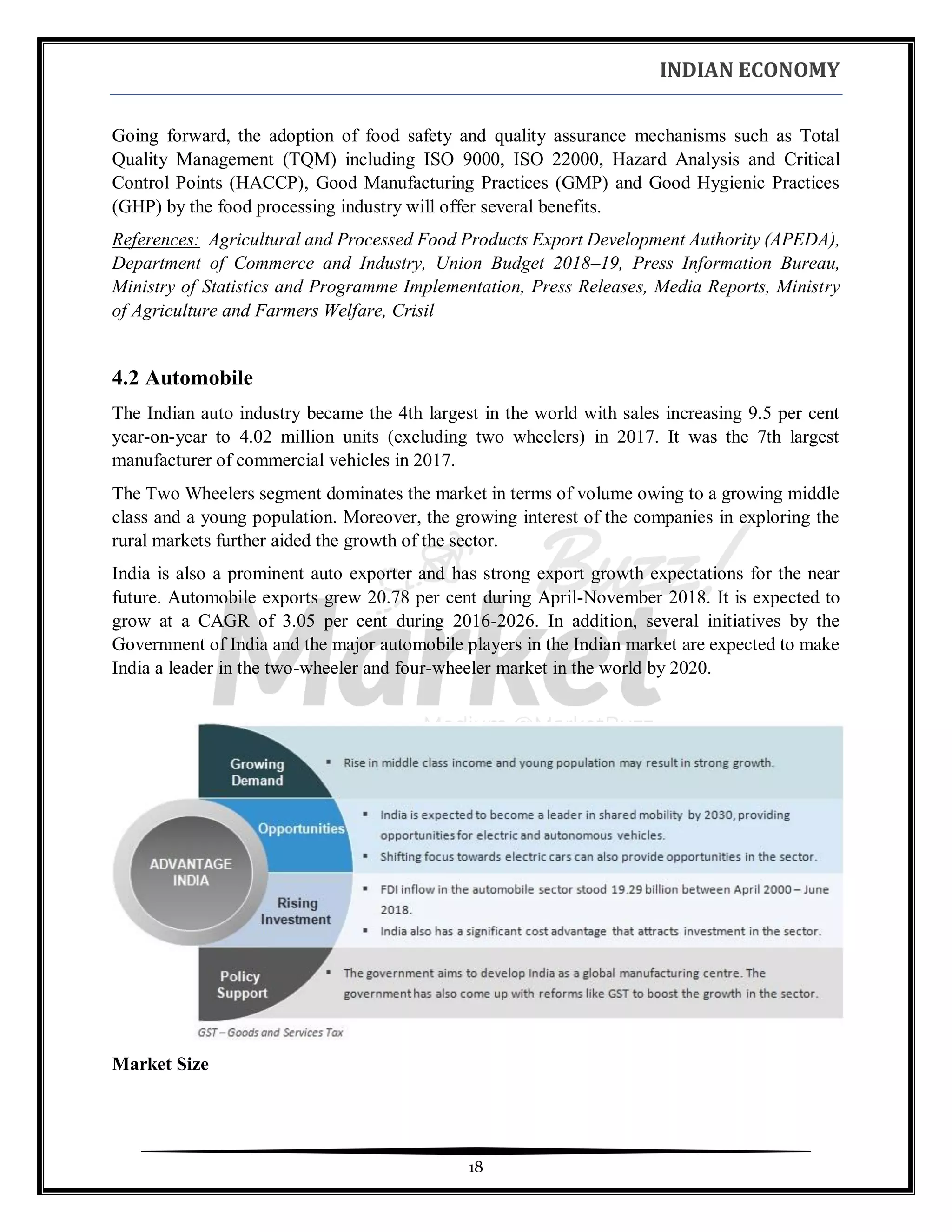
The Two Wheelers segment dominates the market in terms of volume owing to a growing middle
class and a young population. Moreover, the growing interest of the companies in exploring the
rural markets further aided the growth of the sector.
India is also a prominent auto exporter and has strong export growth expectations for the near
future. Automobile exports grew 20.78 per cent during April-November 2018. It is expected to
grow at a CAGR of 3.05 per cent during 2016-2026. In addition, several initiatives by the
Government of India and the major automobile players in the Indian market are expected to make
India a leader in the two-wheeler and four-wheeler market in the world by 2020.
Market Size
INDIAN ECONOMY
19
Domestic automobile production increased at 7.08 per cent CAGR between FY13-18 with 29.07
million vehicles manufactured in the country in FY18. During April-November 2018, automobile
production increased 12.53 per cent year-on-year to reach 21.95 million vehicle units.
Overall domestic automobiles sales increased at 7.01 per cent CAGR between FY13-18 with 24.97
million vehicles getting sold in FY18. During April-November 2018, highest year-on-year growth
in domestic sales among all the categories was recorded in commercial vehicles at 31.49 per cent
followed by 25.16 per cent year-on-year growth in the sales of three-wheelers.
Premium motorbike sales in India crossed one million units in FY18. . During January-September
2018, BMW registered a growth of 11 per cent year-on-year in its sales in India at 7,915 units.
Mercedes Benz ranked first in sales satisfaction in the luxury vehicles segment according to J D
Power 2018 India sales satisfaction index (luxury).
Sales of electric two-wheelers are estimated to have crossed 55,000 vehicles in 2017-18.
Investments
In order to keep up with the growing demand, several auto makers have started investing heavily
in various segments of the industry during the last few months. The industry has attracted Foreign
Direct Investment (FDI) worth US$ 19.29 billion during the period April 2000 to June 2018,
according to data released by Department of Industrial Policy and Promotion (DIPP).
Some of the recent/planned investments and developments in the automobile sector in India are as
follows:
▪ Ashok Leyland has planned a capital expenditure of Rs 1,000 crore (US$ 155.20 million)
to launch 20-25 new models across various commercial vehicle categories in 2018-19.
▪ Hyundai is planning to invest US$ 1 billion in India by 2020. SAIC Motor has also
announced to invest US$ 310 million in India.
▪ Mercedes Benz has increased the manufacturing capacity of its Chakan Plant to 20,000
units per year, highest for any luxury car manufacturing in India.
▪ As of October 2018, Honda Motors Company is planning to set up its third factory in India
for launching hybrid and electric vehicles with the cost of Rs 9,200 crore (US$ 1.31
billion), its largest investment in India so far.
Government Initiatives
The Government of India encourages foreign investment in the automobile sector and allows 100
per cent FDI under the automatic route.
Some of the recent initiatives taken by the Government of India are –
▪ The government aims to develop India as a global manufacturing centre and an R&D hub.
▪ Under NATRiP, the Government of India is planning to set up R&D centres at a total cost
of US$ 388.5 million to enable the industry to be on par with global standards
INDIAN ECONOMY
20
▪ The Ministry of Heavy Industries, Government of India has shortlisted 11 cities in the
country for introduction of electric vehicles (EVs) in their public transport systems under
the FAME (Faster Adoption and Manufacturing of (Hybrid) and Electric Vehicles in India)
scheme. The government will also set up incubation centre for start-ups working in electric
vehicles space.
Achievements
Following are the achievements of the government in the past four years:
▪ Number of vehicles supported under FAME scheme increased from 5,197 in June 2015 to
192,451 in March 2018. During 2017-18, 47,912 two-wheelers, 2,202 three-wheelers, 185
four-wheelers and 10 light commercial vehicles were supported under FAME scheme.
▪ Under National Automotive Testing And R&D Infrastructure Project (NATRIP), following
testing and research centres have been established in the country since 2015
o International Centre for Automotive Technology (ICAT), Manesar
o National Institute for Automotive Inspection, Maintenance & Training (NIAIMT),
Silchar
o National Automotive Testing Tracks (NATRAX), Indore
o Automotive Research Association of India (ARAI), Pune
o Global Automotive Research Centre (GARC), Chennai
▪ SAMARTH Udyog – Industry 4.0 centres: ‘Demo cum experience’ centres are being set
up in the country for promoting smart and advanced manufacturing helping SMEs to
implement Industry 4.0 (automation and data exchange in manufacturing technology).
Road Ahead
The automobile industry is supported by various factors such as availability of skilled labour at
low cost, robust R&D centres and low cost steel production. The industry also provides great
opportunities for investment and direct and indirect employment to skilled and unskilled labour.
Indian automotive industry (including component manufacturing) is expected to reach Rs 16.16-
18.18 trillion (US$ 251.4-282.8 billion) by 2026. Two-wheelers are expected to grow 9 per cent
in 2018.
References: Media Reports, Press Releases, Department of Industrial Policy and Promotion
(DIPP), Automotive Component Manufacturers Association of India (ACMA), Society of Indian
Automobile Manufacturers (SIAM), Union Budget 2015-16, Union Budget 2017-18
4.3 Indian Aviation Industry
The civil aviation industry in India has emerged as one of the fastest growing industries in the
country during the last three years. India is currently considered the third largest domestic civil
aviation market in the world. India is expected to become the world’s largest domestic civil
INDIAN ECONOMY
21
aviation market in the next 10 to 15 years. India is also expected to displace the UK to become the
third largest air passenger* market by 2025.
Market Size
India’s passenger* traffic grew at 16.52 per cent year on year to reach 308.75 million. It grew at a
CAGR of 12.72 per cent during FY06-FY18.
Domestic passenger traffic grew YoY by 18.28 per cent to reach 243 million in FY18 and is
expected to become 293.28 million in FY20E. International passenger grew YoY by 10.43 per
cent to reach 65.48 million in FY18 and traffic is expected to become 76 million in FY20E.
In FY18, domestic freight traffic stood at 1,213.06 million tonnes, while international freight
traffic was at 2,143.97 million tonnes.
India’s domestic and international aircraft movements grew 14.40 per cent YoY and 9.40 per cent
YoY to 1,886.63 thousand and 437.93 thousand during 2017-18, respectively.
During Apr-Aug 2018, passenger* traffic in India stood at 141.77 million. Out of which domestic
passenger traffic stood at 113.44 million while international traffic stood at 28.32 million. Total
freight traffic handled in India stood at 1.49 million tonnes during the same time.
During Apr-Aug 2018, domestic aircraft movement stood at 0.89 million while international
aircraft movement stood at 0.19 million.
As of May 2018, there are nearly 558 commercial aircraft in operation in India.
Investment
INDIAN ECONOMY
22
According to data released by the Department of Industrial Policy and Promotion (DIPP), FDI
inflows in India’s air transport sector (including air freight) reached US$ 1,658.23 million between
April 2000 and June 2018. The government has 100 per cent FDI under automatic route in
scheduled air transport service, regional air transport service and domestic scheduled passenger
airline. However, FDI over 49 per cent would require government approval.
India’s aviation industry is expected to witness Rs 1 lakh crore (US$ 15.52 billion) worth of
investments in the next five years.
The Indian government is planning to invest US$ 1.83 billion for development of airport
infrastructure along with aviation navigation services by 2026.
Key investments and developments in India’s aviation industry include:
▪ AAI is going to invest Rs 15,000 crore (US$ 2.32 billion) in 2018-19 for expanding existing
terminals and constructing 15 new ones.
▪ In June 2018, India has signed an open sky agreement with Australia allowing airlines on
either side to offer unlimited seats to six Indian metro cities and various Australian cities.
▪ The AAI plans to develop Guwahati as an inter-regional hub and Agartala, Imphal and
Dibrugarh as intra-regional hubs.
▪ Indian aircraft Manufacture, Repair and Overhaul (MRO) service providers are exempted
completely from customs and countervailing duties
Government Initiatives
Some major initiatives undertaken by the government are:
▪ Allocation to Civil Aviation Ministry has been tripled to Rs 6,602.86 crore (US$ 1,019.9
million) under Union Budget 2018-19.
▪ In February 2018, the Prime Minister of India launched the construction of Navi Mumbai
airport which is expected to be built at a cost of US$ 2.58 billion. The first phase of the
airport will be completed by end of 2019.
▪ The Government of Andhra Pradesh is to develop Greenfield airports in six cities-
Nizamabad, Nellore, Kurnool, Ramagundam, Tadepalligudem and Kothagudem under the
PPP model.
▪ Regional Connectivity Scheme (RCS) has been launched under the policy
▪ In September 2018, Jharsuguda Airport in Odisha and Pakyong Airport in Sikkim were
inaugurated. Pakyong airport is Sikkim’s first ever airport and AAI’s first greenfield airport
construction.
Road Ahead
India’s aviation industry is largely untapped with huge growth opportunities, considering that air
transport is still expensive for majority of the country’s population, of which nearly 40 per cent is
the upwardly mobile middle class.
INDIAN ECONOMY
23
The industry stakeholders should engage and collaborate with policy makers to implement
efficient and rational decisions that would boost India’s civil aviation industry. With the right
policies and relentless focus on quality, cost and passenger interest, India would be well placed to
achieve its vision of becoming the third-largest aviation market by 2025.
Exchange Rate Used: INR 1 = US$ 0.0149 as of Q1 FY19.
Note: * - International and Domestic
References: Media Reports, Press Releases, Press Information Bureau, Directorate General of
Civil Aviation (DGCA), Airports Authority of India (AAI), Union Budget 2018-19, Boeing
4.4 Banking Sector in India
As per the Reserve Bank of India (RBI), India’s banking sector is sufficiently capitalised and well-
regulated. The financial and economic conditions in the country are far superior to any other
country in the world. Credit, market and liquidity risk studies suggest that Indian banks are
generally resilient and have withstood the global downturn well.
Indian banking industry has recently witnessed the roll out of innovative banking models like
payments and small finance banks. RBI’s new measures may go a long way in helping the
restructuring of the domestic banking industry.
The digital payments system in India has evolved the most among 25 countries with India’s
Immediate Payment Service (IMPS) being the only system at level 5 in the Faster Payments
Innovation Index (FPII).*
Market Size
The Indian banking system consists of 27 public sector banks, 21 private sector banks, 49 foreign
banks, 56 regional rural banks, 1,562 urban cooperative banks and 94,384 rural cooperative banks,
INDIAN ECONOMY
24
in addition to cooperative credit institutions.^^ In FY07-18, total lending increased at a CAGR of
10.94 per cent and total deposits increased at a CAGR of 11.66 per cent. India’s retail credit market
is the fourth largest in the emerging countries. It increased to US$ 281 billion on December 2017
from US$ 181 billion on December 2014.
Investments/developments
Key investments and developments in India’s banking industry include:
▪ As of September 2018, the Government of India launched India Post Payments Bank
(IPPB) and has opened branches across 650 districts to achieve the objective of financial
inclusion.
▪ The total value of mergers and acquisition during 2017 in NBFC diversified financial
services and banking was US$ 2,564 billion, US$ 103 million and US$ 79 million
respectively @.
▪ The biggest merger deal of FY17 was in the microfinance segment of IndusInd Bank
Limited and Bharat Financial Inclusion Limited of US$ 2.4 billion @.
▪ In May 2018, total equity funding's of microfinance sector grew at the rate of 39.88 to Rs
96.31 billion (Rs 4.49 billion) in 2017-18 from Rs 68.85 billion (US$ 1.03 billion) #.
Government Initiatives
▪ As of September 2018, the Government of India has made the Pradhan Mantri Jan Dhan
Yojana (PMJDY) scheme an open ended scheme and has also added more incentives.
▪ The Government of India is planning to inject Rs 42,000 crore (US$ 5.99 billion) in the
public sector banks by March 2019 and will infuse the next tranche of recapitalisation by
mid-December 2018.
Achievements
Following are the achievements of the government in the year 2017-18:
▪ To improve infrastructure in villages, 204,000 Point of Sale (PoS) terminals have been
sanctioned from the Financial Inclusion Fund by National Bank for Agriculture & Rural
Development (NABARD).
▪ Between December 2016 and March 2017, a major drive was undertaken to boost use of
debit cards, resulting in an increase in the number of Point of Sale (PoS) terminals by an
additional 1.25 million by 2017 end from 1.52 million as on November 30, 2016.
▪ The number of total bank accounts opened under Pradhan Mantri Jan Dhan Yojana
(PMJDY) reached 333.8 million as on November 28, 2018.
Road Ahead
INDIAN ECONOMY
25
Enhanced spending on infrastructure, speedy implementation of projects and continuation of
reforms are expected to provide further impetus to growth. All these factors suggest that India’s
banking sector is also poised for robust growth as the rapidly growing business would turn to banks
for their credit needs.
Also, the advancements in technology have brought the mobile and internet banking services to
the fore. The banking sector is laying greater emphasis on providing improved services to their
clients and also upgrading their technology infrastructure, in order to enhance the customer’s
overall experience as well as give banks a competitive edge.
India’s digital lending stood at US$ 75 billion in FY18 and is estimated to reach US$ 1 trillion by
FY2023 driven by the five-fold increase in the digital disbursements.
Exchange Rate Used: INR 1 = US$ 0.0142 as on Q2 FY19.
References: Media Reports, Press releases, Reserve Bank of India, Press Information Bureau,
www.pmjdy.gov.in
Notes: * - according to an FIS report, # - Microfinances Institution Network, @ - EY Annual
Report, ^^ - Indicates data for FY17
4.5 Cement industry in India
India is the second largest producer of cement in the world. No wonder, India's cement industry is
a vital part of its economy, providing employment to more than a million people, directly or
indirectly. Ever since it was deregulated in 1982, the Indian cement industry has attracted huge
investments, both from Indian as well as foreign investors.
India has a lot of potential for development in the infrastructure and construction sector and the
cement sector is expected to largely benefit from it. Some of the recent major initiatives such as
development of 98 smart cities are expected to provide a major boost to the sector.
Expecting such developments in the country and aided by suitable government foreign policies,
several foreign players such as Lafarge-Holcim, Heidelberg Cement, and Vicat have invested in
the country in the recent past. A significant factor which aids the growth of this sector is the ready
availability of the raw materials for making cement, such as limestone and coal.
INDIAN ECONOMY
26
Market Size
The housing and real estate sector is the biggest demand driver of cement, accounting for about 65
per cent of the total consumption in India. The other major consumers of cement include public
infrastructure at 20 per cent and industrial development at 15 per cent.
Cement production capacity stood at 502 million tonnes per year (mtpy) in 2018. Cement
consumption is expected to grow by 4.5 per cent in FY19 supported by pick-up in the housing
segment and higher infrastructure spending. The industry is currently producing 280 MT for
meetings its domestic demand and 5 MT for exports requirement.
The Indian cement industry is dominated by a few companies. The top 20 cement companies
account for almost 70 per cent of the total cement production of the country. A total of 210 large
cement plants account for a cumulative installed capacity of over 350 million tonnes, with 350
small plants accounting for the rest. Of these 210 large cement plants, 77 are located in the states
of Andhra Pradesh, Rajasthan and Tamil Nadu.
Investments
On the back of growing demand, due to increased construction and infrastructural activities, the
cement sector in India has seen many investments and developments in recent times.
According to data released by the Department of Industrial Policy and Promotion (DIPP), cement
and gypsum products attracted Foreign Direct Investment (FDI) worth US$ 5.26 billion between
April 2000 and June 2018.
Some of the major investments in Indian cement industry are as follows:
▪ As of December 2018, Raysut Cement Company is planning to invest US$ 700 million in
India by 2022.
INDIAN ECONOMY
27
▪ During 2017-18, Ultratech commissioned a greenfield clinker plant with a capacity of 2.5
MTPA and a cement grinding facility with 1.75 MTPA capacity in Dhar, Madhya Pradesh.
The company is expecting to complete a 1.75 MTPA cement grinding facility and a 13
MW waste heat recovery system by September 2018 at the same location.
▪ In May 2018, Ultratech Cement decided to acquire the 13.4 MTPA capacity cement
business of Century Textiles and Industries.
▪ JK Cement is planning to invest Rs 1,500 crore (US$ 231.7 million) over the next 3 to 4
years to increase its production capacity at its Mangrol plant from 10.5 MTPA to 14 MTPA.
Government Initiatives
In order to help the private sector companies thrive in the industry, the government has been
approving their investment schemes. Some such initiatives by the government in the recent past
are as follows:
In Budget 2018-19, Government of India announced setting up of an Affordable Housing Fund of
Rs 25,000 crore (US$ 3.86 billion) under the National Housing Bank (NHB) which will be utilised
for easing credit to homebuyers. The move is expected to boost the demand of cement from the
housing segment.
Road Ahead
The eastern states of India are likely to be the newer and virgin markets for cement companies and
could contribute to their bottom line in future. In the next 10 years, India could become the main
exporter of clinker and gray cement to the Middle East, Africa, and other developing nations of
the world. Cement plants near the ports, for instance the plants in Gujarat and Visakhapatnam, will
have an added advantage for exports and will logistically be well armed to face stiff competition
from cement plants in the interior of the country.
Due to the increasing demand in various sectors such as housing, commercial construction and
industrial construction, cement industry is expected to reach 550-600 Million Tonnes Per Annum
(MTPA) by the year 2025.
A large number of foreign players are also expected to enter the cement sector, owing to the profit
margins and steady demand. In future, domestic cement companies could go for global listings
either through the FCCB route or the GDR route.
With help from the government in terms of friendlier laws, lower taxation, and increased
infrastructure spending, the sector will grow and take India’s economy forward along with it.
Exchange Rate Used: INR 1 = US$ 0.0142 as of Q2 FY19.
References: Media Reports, Press releases, Union Budget 2018-19, Edelweiss Securities Ltd.
INDIAN ECONOMY
28
4.6 Indian Consumer Market
Indian consumer durables market is broadly segregated into urban and rural markets, and is
attracting marketers from across the world. The sector comprises of a huge middle class,
relatively large affluent class and a small economically disadvantaged class. Global corporations
view India as one of the key markets from where future growth is likely to emerge. The growth
in India’s consumer market would be primarily driven by a favourable population composition
and increasing disposable incomes.
Per capita GDP of India is expected to reach US$ 3,273.85 in 2023 from US$ 1,983 in 2012. The
maximum consumer spending is likely to occur in food, housing, consumer durables, and
transport and communication sectors.
Market Size
▪ The growing purchasing power and rising influence of the social media have enabled
Indian consumers to splurge on good things. Import of electronic goods reached US$ 53
billion in FY18.
▪ Indian appliance and consumer electronics (ACE) market reached Rs 2.05 trillion (US$
31.48 billion) in 2017. India is one of the largest growing electronics market in the world.
Indian electronics market is expected to grow at 41 per cent CAGR between 2017-20 to
reach US$ 400 billion.
▪ As of FY18, washing machine, refrigerator and air conditioner market in India were
estimated around Rs 7,000 crore (US$ 1.09 billion), Rs 19,500 crore (US$ 3.03 billion)
and Rs 20,000 crore (US$ 3.1 billion), respectively.
▪ India became world's second largest smartphone market with 40.1 million units shipped
between July-September 2018. India is expected to have 829 million smartphone users by
2022.
INDIAN ECONOMY
29
Investments
According to the data released by the Department of Industrial Policy and Promotion (DIPP), the
electronics sector attracted foreign direct investment (FDI) worth US$ 1.97 billion between April
2000 and June 2018. The S&P BSE Consumer Durables Index has grown at 20 per cent CAGR
between 2010-17.
Following are some recent investments and developments in the Indian consumer market sector.
▪ India is now the world’s second largest mobile phone manufacturer with presence of 120
factories as of July 2018.
▪ In July 2018, Samsung announced an investment of Rs 5,000 crore (US$ 745.82 million)
for expansion of manufacturing capacity to 120 million from 68 million devices at its Noida
plant in India.
▪ Intex Technologies will invest around Rs 60 crore (US$ 9.27 million) in 2018 in technology
software and Internet of Things (IoT) startups in India in order to create an ecosystem for
its consumer appliances and mobile devices.
▪ Micromax plans to invest US$ 89.25 million by 2020 for transforming itself into a
consumer electronics company.
Government Initiatives
▪ A draft National Policy on Electronics Policy was released by the Ministry of Electronics
& Information Technology in October 2018.
▪ A new Consumer Protection Bill has been approved by the Union Cabinet, Government of
India that will make the existing laws more effective with a broader scope.
▪ The mobile phone industry in India expects that the Government of India's boost to
production of battery chargers will result in setting up of 365 factories, thereby generating
800,000 jobs by 2025.
▪ The Union Cabinet has approved incentives up to Rs 10,000 crore (US$ 1.47 billion) for
investors by amending the M-SIPS scheme, in order to further incentivise investments in
electronics sector, create employment opportunities and reduce dependence on imports by
2020.
▪ The Government of India has allowed 100 per cent Foreign Direct Investment (FDI) under
the automatic route in Electronics Systems Design & Manufacturing sector. FDI into single
brand retail has been increased from 51 per cent to 100 per cent; the government is planning
to hike FDI limit in multi-brand retail to 51 per cent.
Road Ahead
Indian appliance and consumer electronics (ACE) market is expected to increase at a 9 per cent
CAGR to reach Rs 3.15 trillion (US$ 48.37 billion) in 2022. Demand growth is likely to accelerate
INDIAN ECONOMY
30
with rising disposable incomes and easy access to credit. Increasing electrification of rural areas
and wide usability of online sales would also aid growth in demand.
Exchange Rate Used: INR 1 = US$ 0.0149 as of Q1 FY19
References: Media reports, press releases, Press Information Bureau (PIB), Union Budget 2017-
18, Boston Consulting Group, International Data Corporation.
4.7 E-commerce Industry in India
The e-commerce has transformed the way business is done in India. The Indian e-commerce
market is expected to grow to US$ 200 billion by 2026 from US$ 38.5 billion as of 2017. Much
growth of the industry has been triggered by increasing internet and smartphone penetration. The
ongoing digital transformation in the country is expected to increase India’s total internet user base
to 829 million by 2021 from 445.96 million in2017. India’s internet economy is expected to double
from US$125 billion as of April 2017 to US$ 250 billion by 2020, majorly backed by ecommerce.
India’s E-commerce revenue is expected to jump from US$ 39 billion in 2017 to US$ 120 billion
in 2020, growing at an annual rate of 51 per cent, the highest in the world.
Market Size
Propelled by rising smartphone penetration, the launch of 4G networks and increasing consumer
wealth, the Indian e-commerce market is expected to grow to US$ 200 billion by 2026 from US$
38.5 billion in 2017 Online retail sales in India are expected to grow by 31 per cent to touch US$
32.70 billion in 2018, led by Flipkart, Amazon India and Paytm Mall.
During 2018, electronics is currently the biggest contributor to online retail sales in India with a
share of 48 per cent, followed closely by apparel at 29 per cent.
INDIAN ECONOMY
31
Investments/ Developments
Some of the major developments in the Indian e-commerce sector are as follows:
▪ Flipkart, after getting acquired by Walmart for US$ 16 billion, is expected to launch more
offline retail stores in India to promote private labels in segments such as fashion and
electronics. In September 2018, Flipkart acquired Israel based analytics start-up Upstream
Commerce that will help the firm to price and position its products in an efficient way.
▪ Paytm has launched its bank - Paytm Payment Bank. Paytm bank is India's first bank with
zero charges on online transactions, no minimum balance requirement and free virtual debit
card
▪ As of June 2018, Google is also planning to enter into the E-commerce space by November
2018. India is expected to be its first market.
▪ E-commerce industry in India witnessed 21 private equity and venture capital deals worth
US$ 2.1 billion in 2017 and 40 deals worth US$ 1,129 million in the first half of 2018.
▪ Google and Tata Trust have collaborated for the project ‘Internet Saathi’ to improve
internet penetration among rural women in India
Government initiatives
Since 2014, the Government of India has announced various initiatives namely, Digital India,
Make in India, Start-up India, Skill India and Innovation Fund. The timely and effective
implementation of such programs will likely support the e-commerce growth in the country. Some
of the major initiatives taken by the government to promote the e-commerce sector in India are as
follows:
▪ In order to increase the participation of foreign players in the e-commerce field, the Indian
Government hiked the limit of foreign direct investment (FDI) in the E-commerce
marketplace model for up to 100 per cent (in B2B models).
▪ In the Union Budget of 2018-19, government has allocated Rs 8,000 crore (US$ 1.24
billion) to BharatNet Project, to provide broadband services to 150,000 gram panchayats
▪ As of August 2018, the government is working on the second draft of e-commerce policy,
incorporating inputs from various industry stakeholders.
Road Ahead
The e-commerce industry been directly impacting the micro, small & medium enterprises (MSME)
in India by providing means of financing, technology and training and has a favourable cascading
effect on other industries as well. The Indian e-commerce industry has been on an upward growth
trajectory and is expected to surpass the US to become the second largest e-commerce market in
the world by 2034. Technology enabled innovations like digital payments, hyper-local logistics,
analytics driven customer engagement and digital advertisements will likely support the growth in
the sector. The growth in e-commerce sector will also boost employment, increase revenues from
INDIAN ECONOMY
32
export, increase tax collection by ex-chequers, and provide better products and services to
customers in the long-term.
4.8 Education & Training Industry in India
India holds an important place in the global education industry. India has one of the largest
networks of higher education institutions in the world. However, there is still a lot of potential for
further development in the education system.
Moreover, the aim of the government to raise its current gross enrolment ratio to 30 per cent by
2020 will also boost the growth of the distance education in India.
Market Size
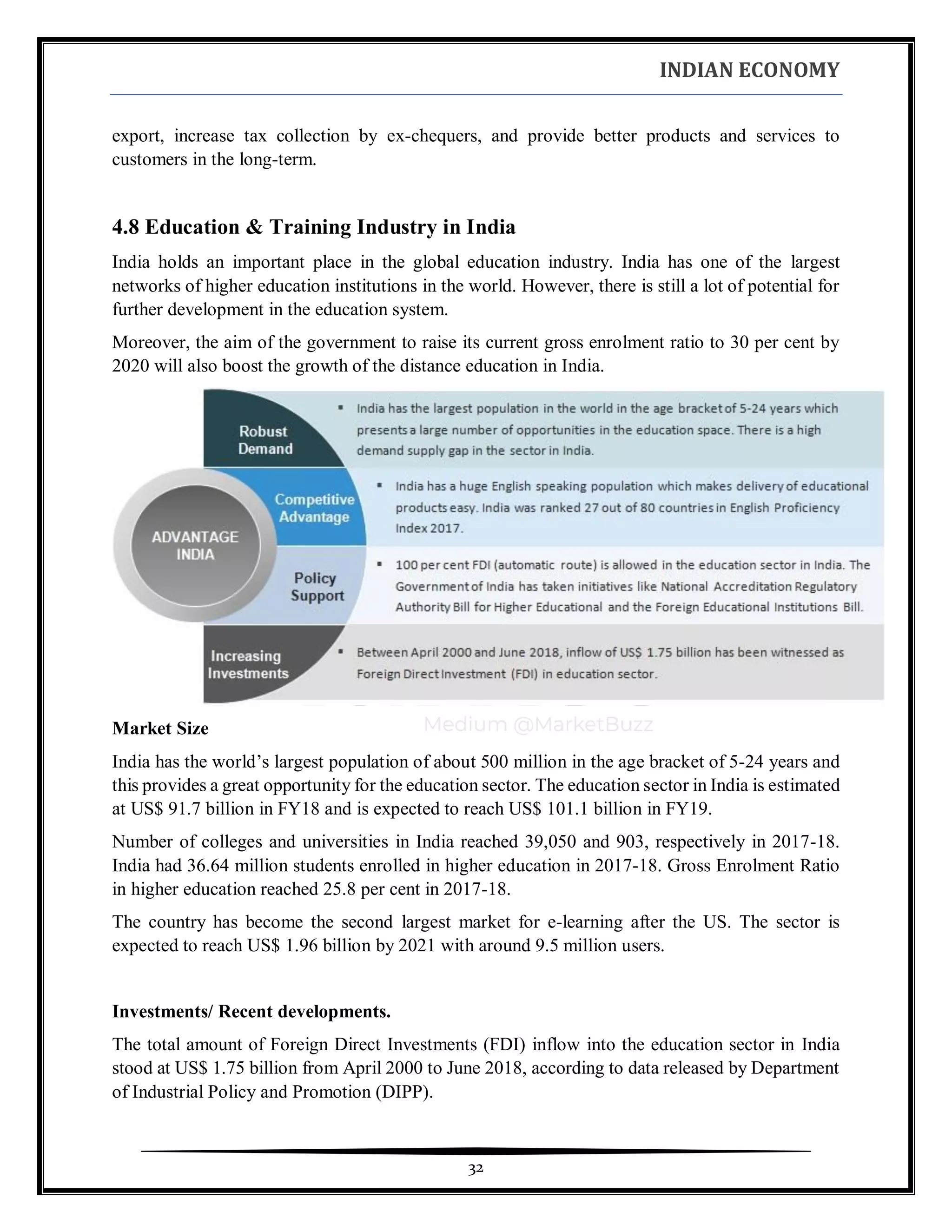
India has the world’s largest population of about 500 million in the age bracket of 5-24 years and
this provides a great opportunity for the education sector. The education sector in India is estimated
at US$ 91.7 billion in FY18 and is expected to reach US$ 101.1 billion in FY19.
Number of colleges and universities in India reached 39,050 and 903, respectively in 2017-18.
India had 36.64 million students enrolled in higher education in 2017-18. Gross Enrolment Ratio
in higher education reached 25.8 per cent in 2017-18.
The country has become the second largest market for e-learning after the US. The sector is
expected to reach US$ 1.96 billion by 2021 with around 9.5 million users.
Investments/ Recent developments.
The total amount of Foreign Direct Investments (FDI) inflow into the education sector in India
stood at US$ 1.75 billion from April 2000 to June 2018, according to data released by Department
of Industrial Policy and Promotion (DIPP).
INDIAN ECONOMY
33
The education and training sector in India has witnessed some major investments and
developments in the recent past. Some of them are:
▪ Indian education sector witnessed 18 merger and acquisition deals worth US$ 49 million
in 2017.
▪ The Ministry of Human Resource Development, Government of India is also planning to
raise around Rs 1 lakh crore (US$ 15.52 billion) from private companies and high net worth
individuals to finance improvement of education infrastructure in the country.
▪ India has signed a loan agreement with World Bank under 'Skills Acquisition and
Knowledge Awareness for Livelihood Promotion' (SANKALP) Project to enhance
institutional mechanisms for skills development.
▪ Singapore is going to open its first skill development centre in Assam, which will provide
vocational training to youth in the region.
Government Initiatives
Some of the other major initiatives taken by the Government of India are:
▪ In August 2018, Innovation Cell and Atal Ranking of Institutions on Innovation
Achievements (ARIIA) were launched to assess innovation efforts and encourage a healthy
competition among higher educational institutions in the country.
▪ In August 2018, Government of India launched the second phase of ‘Unnat Bharat
Abhiyan’ which aims to link higher educational institutions in the country with at least five
villages. The scheme covers 750 such institutions.
▪ The allocation for school education under the Union Budget 2018-19 is expected to
increase by 14 per cent, to focus on accelerating existing schemes and quality
improvement.
▪ In order to boost the Skill India Mission, two new schemes, Skills Acquisition and
Knowledge Awareness for Livelihood Promotion (SANKALP) and Skill Strengthening for
Industrial Value Enhancement (STRIVE), have been approved by the Cabinet Committee
on Economic Affairs (CCEA), Government of India, with an outlay of Rs 6,655 crore (US$
1.02 billion) and will be supported by the World Bank.
▪ The Ek Bharat Shreshtha Bharat (EBSB) campaign is undertaken by Ministry of Human
Resource Development to increase engagement between states, union territories, central
ministries, educational institutions and general public.
▪ Prime Minister Mr Narendra Modi launched the Skill India initiative – ‘Kaushal Bharat,
Kushal Bharat’. Under this initiative, the government has set itself a target of training 400
million citizens by 2022 that would enable them to find jobs. The initiatives launched
include various programmes like: Pradhan Mantri Kaushal Vikas Yojana (PMKVY),
National Policy for Skill Development and Entrepreneurship 2015, Skill Loan scheme, and
the National Skill Development Mission.
INDIAN ECONOMY
34
Government Achievements
Following are the achievements of the government in the past four years:
▪ Under the mid-day meal scheme initiated by the Government of India, about 95 million
students of around 1.14 million schools enjoy fresh meal every day.
▪ The Government has laid foundation of 141 universities and 7 IITs in the past four years.
▪ With an aim of promoting innovation and entreprenuership among secondary school
students in the country NITI Aayog, Government of India has launched the Atal Innovation
Mission (AIM)In June 2018, 3,000 additional Atal Tinkering Labs were approved, taking
the total number of labs to 5,441.
Road Ahead
In 2030, it is estimated that India’s higher education will:
▪ Adopt transformative and innovative approaches in Higher education.
▪ Have an augmented Gross Enrolment Ratio (GER) of 50 per cent
▪ Reduce state-wise, gender based and social disparity in GER to 5 per cent.
▪ Emerge as a single largest provider of global talent, with one in four graduates in the world
being a product of the Indian higher education system.
▪ Be among the top five countries in the world in terms of research output with an annual
R&D spent of US$ 140 billion.
▪ Have more than 20 universities among the global top 200.
Various government initiatives are being adopted to boost the growth of distance education market,
besides focusing on new education techniques, such as E-learning and M-learning.
Education sector has seen a host of reforms and improved financial outlays in recent years that
could possibly transform the country into a knowledge haven. With human resource increasingly
gaining significance in the overall development of the country, development of education
infrastructure is expected to remain the key focus in the current decade. In this scenario,
infrastructure investment in the education sector is likely to see a considerable increase in the
current decade
Moreover, availability of English speaking tech-educated talent, democratic governance and a
strong legal and intellectual property protection framework are enablers for world class product
development, as per Mr Amit Phadnis, President-Engineering and Site Leader for Cisco (India).
The Government of India has taken several steps including opening of IIT’s and IIM’s in new
locations as well as allocating educational grants for research scholars in most government
institutions. Furthermore, with online modes of education being used by several educational
organisations, the higher education sector in India is set for some major changes and developments
in the years to come.
INDIAN ECONOMY
35
Exchange Rate Used: INR 1 = US$ 0.015 as of March 30, 2018.
References: Media Reports, Press Releases, Press Information Bureau, RNCOS Report,
Department of Industrial Policy and Promotion (DIPP), Union Budget 2018-19
4.9 Financial Services in India
India has a diversified financial sector undergoing rapid expansion, both in terms of strong growth
of existing financial services firms and new entities entering the market. The sector comprises
commercial banks, insurance companies, non-banking financial companies, co-operatives, pension
funds, mutual funds and other smaller financial entities. The banking regulator has allowed new
entities such as payments banks to be created recently thereby adding to the types of entities
operating in the sector. However, the financial sector in India is predominantly a banking sector
with commercial banks accounting for more than 64 per cent of the total assets held by the financial
system.
The Government of India has introduced several reforms to liberalise, regulate and enhance this
industry. The Government and Reserve Bank of India (RBI) have taken various measures to
facilitate easy access to finance for Micro, Small and Medium Enterprises (MSMEs). These
measures include launching Credit Guarantee Fund Scheme for Micro and Small Enterprises,
issuing guideline to banks regarding collateral requirements and setting up a Micro Units
Development and Refinance Agency (MUDRA). With a combined push by both government and
private sector, India is undoubtedly one of the world's most vibrant capital markets. In 2017, a new
portal named 'Udyami Mitra' has been launched by the Small Industries Development Bank of
India (SIDBI) with the aim of improving credit availability to Micro, Small and Medium
Enterprises' (MSMEs) in the country. India has scored a perfect 10 in protecting shareholders'
rights on the back of reforms implemented by Securities and Exchange Board of India (SEBI).
Market Size
INDIAN ECONOMY
36
The Mutual Fund (MF) industry in India has seen rapid growth in Assets Under Management
(AUM). Total AUM of the industry stood at Rs 24.03 trillion (US$ 342.01 billion) between April-
November 2018. At the same time the number of Mutual fund (MF) equity portfolios reached a
high of 74.6 million as of June 2018.
Another crucial component of India’s financial industry is the insurance industry. The insurance
industry has been expanding at a fast pace. The total first year premium of life insurance companies
reached Rs 193,866.23 crore (US$ 30.10 billion) during FY18.
Along with the secondary market, the market for Initial Public Offers (IPOs) has also witnessed
rapid expansion. The total amount of Initial Public Offerings (IPO) increased to US$ 1.2 billion
raised from 37 between April – June 2018.
Over the past few years India has witnessed a huge increase in Mergers and Acquisition (M&A)
activity. In H12018, 74 deals of acquisition took place in financial sector. The total value of such
transactions was US$ 4.166 billion. *
Furthermore, India’s leading bourse Bombay Stock Exchange (BSE) will set up a joint venture
with Ebix Inc to build a robust insurance distribution network in the country through a new
distribution exchange platform.
Investments/Developments
▪ Investments by Foreign Portfolio Investors (FPIs) in Indian capital markets have reached
Rs 6,310 crore (US$ 899.12 million) up to November 22, 2018.
▪ As of October 2018, the Financial Inclusion Lab has selected 11 fintech innovators with an
investment of US$ 9.5 million promoted by the IIM-Ahmedabad's Bharat Inclusion
Initiative (BII) along with JP Morgan, Michael and Susan Dell Foundation, and the Bill
and Melinda Gates Foundation.
▪ The private equity and venture capital (PE/VC) investments reached US$ 25.20 billion
between January to October 2018.*
Government Initiatives
▪ In December, 2018, Securities and Exchange Board of India (SEBI) proposed direct
overseas listing of Indian companies and other regulatory changes.
▪ Bombay Stock Exchange (BSE) introduced weekly futures and options contracts on Sensex
50 index from October 26, 2018.
▪ In September 2018, SEBI asked for recommendations to strengthen rules which will
enhance the overall governance standards for issuers, intermediaries or infrastructure
providers in the financial market.
▪ The Government of India launched India Post Payments Bank (IPPB), to provide every
district with one branch which will help increase rural penetration. As of August 2018, two
branches out of 650 branches are already operational.
INDIAN ECONOMY
37
Road Ahead
▪ India is today one of the most vibrant global economies, on the back of robust banking and
insurance sectors. The relaxation of foreign investment rules has received a positive
response from the insurance sector, with many companies announcing plans to increase
their stakes in joint ventures with Indian companies. Over the coming quarters there could
be a series of joint venture deals between global insurance giants and local players.
▪ The Association of Mutual Funds in India (AMFI) is targeting nearly five fold growth in
assets under management (AUM) to Rs 95 lakh crore (US$ 1.47 trillion) and a more than
three times growth in investor accounts to 130 million by 2025.
▪ India's mobile wallet industry is estimated to grow at a Compound Annual Growth Rate
(CAGR) of 150 per cent to reach US$ 4.4 billion by 2022 while mobile wallet transactions
to touch Rs 32 trillion (USD $ 492.6 billion) by 2022.
Exchange Rate Used: INR 1 = US$ 0.0142 as of Q2 FY19
Notes - * - Private Equity Deal Tracker report by EY
References: Media Reports, Press Releases, IRDAI, General Insurance Council, Reserve Bank of
India, Union Budget 2017-18
4.10 FMCG Industry in India
Fast-moving consumer goods (FMCG) sector is the 4th largest sector in the Indian economy with
Household and Personal Care accounting for 50 per cent of FMCG sales in India. Growing
awareness, easier access and changing lifestyles have been the key growth drivers for the sector.
The urban segment (accounts for a revenue share of around 55 per cent) is the largest contributor
to the overall revenue generated by the FMCG sector in India However, in the last few years, the
FMCG market has grown at a faster pace in rural India compared with urban India. Semi-urban
and rural segments are growing at a rapid pace and FMCG products account for 50 per cent of
total rural spending.
INDIAN ECONOMY
38
Market Size
The Retail market in India is estimated to reach US$ 1.1 trillion by 2020 from US$ 840 billion in
2017, with modern trade expected to grow at 20 per cent - 25 per cent per annum, which is likely
to boost revenues of FMCG companies. Revenues of FMCG sector reached Rs 3.4 lakh crore (US$
52.75 billion) in FY18 and are estimated to reach US$ 103.7 billion in 2020. The sector witnessed
growth of 16.5 per cent in value terms between July-September 2018; supported by moderate
inflation, increase in private consumption and rural income.@
Investments/ Developments
The government has allowed 100 per cent Foreign Direct Investment (FDI) in food processing and
single-brand retail and 51 per cent in multi-brand retail. This would bolster employment and supply
chains, and also provide high visibility for FMCG brands in organised retail markets, bolstering
consumer spending and encouraging more product launches. The sector witnessed healthy FDI
inflows of US$ 13.63 billion, during April 2000 to June 2018. Some of the recent developments
in the FMCG sector are as follows:
▪ Patanjali will spend US$743.72 million in various food parks in Maharashtra, Madhya
Pradesh, Assam, Andhra Pradesh and Uttar Pradesh.
▪ Dabur is planning to invest Rs 250-300 crore (US$ 38.79-46.55 million) in FY19 for
capacity expansion and is also planning to make acquisitions in the domestic market.
▪ In May 2018, RP-Sanjiv Goenka Group created an Rs 1 billion (US$ 14.92 million) venture
capital fund to invest in FMCG start-ups.
▪ In August 2018, Fonterra announced a joint venture with Future Consumer Ltd which will
produce a range of consumer and foodservice dairy products.
Government Initiatives
INDIAN ECONOMY
39
Some of the major initiatives taken by the government to promote the FMCG sector in India are
as follows:
▪ The Government of India has approved 100 per cent Foreign Direct Investment (FDI) in
the cash and carry segment and in single-brand retail along with 51 per cent FDI in multi-
brand retail.
▪ The Government of India has drafted a new Consumer Protection Bill with special
emphasis on setting up an extensive mechanism to ensure simple, speedy, accessible,
affordable and timely delivery of justice to consumers.
▪ The Goods and Services Tax (GST) is beneficial for the FMCG industry as many of the
FMCG products such as Soap, Toothpaste and Hair oil now come under 18 per cent tax
bracket against the previous 23-24 per cent rate.
▪ The GST is expected to transform logistics in the FMCG sector into a modern and efficient
model as all major corporations are remodeling their operations into larger logistics and
warehousing.
Achievements
Following are the achievements of the government in the past four years:
▪ Number of mega food parks ready increased from 2 between 2008-14 to 13 between 2014-
18.
▪ Preservation and processing capacity increased from 308,000 during 2008-14 to 1.41
million during 2014-18.
▪ The number of food labs increased from 31 during 2008-14 to 42 during 2014-18.
Road Ahead
Rural consumption has increased, led by a combination of increasing incomes and higher
aspiration levels; there is an increased demand for branded products in rural India. The rural FMCG
market in India is expected to grow to US$ 220 billion by 2025 from US$ 23.6 billion in FY18. In
FY18, FMCG’s rural segment contributed an estimated 10 per cent of the total income and it is
forecasted to contribute 15-16 per cent in FY 19. ^ FMCG sector is forecasted to grow at 12-13
per cent between September–December 2018. @
On the other hand, with the share of unorganised market in the FMCG sector falling, the organised
sector growth is expected to rise with increased level of brand consciousness, also augmented by
the growth in modern retail.
Another major factor propelling the demand for food services in India is the growing youth
population, primarily in the country’s urban regions. India has a large base of young consumers
who form the majority of the workforce and, due to time constraints, barely get time for cooking.
INDIAN ECONOMY
40
Online portals are expected to play a key role for companies trying to enter the hinterlands. The
Internet has contributed in a big way, facilitating a cheaper and more convenient means to increase
a company’s reach. It is estimated that 40 per cent of all FMCG consumption in India will be
online by 2020. The online FMCG market is forecasted to reach US$ 45 billion in 2020 from US$
20 billion in 2017.
It is estimated that India will gain US$ 15 billion a year by implementing the Goods and Services
Tax. GST and demonetisation are expected to drive demand, both in the rural and urban areas, and
economic growth in a structured manner in the long term and improve performance of companies
within the sector.
Exchange Rate Used: INR 1 = US$ 0.0142 as on Q2 FY18
Note - ^ - According to CRISIL report, @ - according to Nielsen
References: Media Reports, Press Information Bureau (PIB), Union Budget 2018-19, Firstpost
4.11 Healthcare Industry in India
Healthcare has become one of India’s largest sectors - both in terms of revenue and employment.
Healthcare comprises hospitals, medical devices, clinical trials, outsourcing, telemedicine, medical
tourism, health insurance and medical equipment. The Indian healthcare sector is growing at a
brisk pace due to its strengthening coverage, services and increasing expenditure by public as well
private players.
Indian healthcare delivery system is categorised into two major components - public and private.
The Government, i.e. public healthcare system comprises limited secondary and tertiary care
institutions in key cities and focuses on providing basic healthcare facilities in the form of primary
healthcare centres (PHCs) in rural areas. The private sector provides majority of secondary, tertiary
and quaternary care institutions with a major concentration in metros, tier I and tier II cities.
India's competitive advantage lies in its large pool of well-trained medical professionals. India is
also cost competitive compared to its peers in Asia and Western countries. The cost of surgery in
India is about one-tenth of that in the US or Western Europe.
INDIAN ECONOMY
41
Market Size
The healthcare market can increase three-fold to Rs 8.6 trillion (US$ 133.44 billion) by 2022.
India is experiencing 22-25 per cent growth in medical tourism and the industry is expected to
double its size from present (April 2017) US$ 3 billion to US$ 6 billion by 2018.
There is a significant scope for enhancing healthcare services considering that healthcare spending
as a percentage of Gross Domestic Product (GDP) is rising. The government’s expenditure on the
health sector has grown to 1.4 per cent in FY18E from 1.2 per cent in FY14. The Government of
India is planning to increase public health spending to 2.5 per cent of the country's GDP by 2025.
Investment
The hospital and diagnostic centers attracted Foreign Direct Investment (FDI) worth US$ 5.25
billion between April 2000 and June 2018, according to data released by the Department of
Industrial Policy and Promotion (DIPP). Some of the recent investments in the Indian healthcare
industry are as follows:
▪ Healthcare sector in India witnessed 23 deals worth US$ 679 million in H12018.
▪ India and Cuba have signed a Memorandum of Understanding (MoU) to increase
cooperation in the areas of health and medicine, according to Ministry of Health and Family
Welfare, Government of India.
▪ Fortis Healthcare has approved the de-merger of its hospital business with Manipal
Hospital Enterprises. TPG and Dr. Ranjan Pal could invest Rs. 3,900 crore (US$ 602.41
million) in Manipal Hospital Enterprise.
Government Initiatives
INDIAN ECONOMY
42
Some of the major initiatives taken by the Government of India to promote Indian healthcare
industry are as follows:
▪ On September 23, 2018, Government of India launched Pradhan Mantri Jan Arogya Yojana
(PMJAY), to provide health insurance worth Rs 500,000 (US$ 7,124.54) to over 100
million families every year.
▪ In August 2018, the Government of India has approved Ayushman Bharat-National Health
Protection Mission as a centrally Sponsored Scheme contributed by both center and state
government at a ratio of 60:40 for all States, 90:10 for hilly North Eastern States and 60:40
for Union Territories with legislature. The center will contribute 100 per cent for Union
Territories without legislature.
▪ The Government of India has launched Mission Indradhanush with the aim of improving
coverage of immunisation in the country. It aims to achieve atleast 90 per cent
immunisation coverage by December 2018 which will cover unvaccinated and partially
vaccinated children in rural and urban areas of India.
Achievements
Following are the achievements of the government in the year 2017:
▪ In 2017, the Government of India approved National Nutrition Mission (NNM), a joint
effort of Ministry of Health and Family Welfare (MoHFW) and the Ministry of Women
and Child development (WCD) towards a life cycle approach for interrupting the
intergenerational cycle of under nutrition.
▪ As of September 23, 2018, the world’s largest government funded healthcare scheme,
Ayushman Bharat was launched.
▪ As of November 15, 2017, 4.45 million patients were benefitted from Affordable
Medicines and Reasonable Implants for Treatment (AMRIT) Pharmacies.
▪ As of December 15, 2017, the Government of India approved the National Medical
Commission Bill 2017, it aims to promote area of medical education reform.
Road Ahead
India is a land full of opportunities for players in the medical devices industry. India’s healthcare
industry is one of the fastest growing sectors and it is expected to reach $280 billion by 2020. The
country has also become one of the leading destinations for high-end diagnostic services with
tremendous capital investment for advanced diagnostic facilities, thus catering to a greater
proportion of population. Besides, Indian medical service consumers have become more conscious
towards their healthcare upkeep.
Indian healthcare sector is much diversified and is full of opportunities in every segment which
includes providers, payers and medical technology. With the increase in the competition,
businesses are looking to explore for the latest dynamics and trends which will have positive
INDIAN ECONOMY
43
impact on their business. The hospital industry in India is forecasted to increase to Rs 8.6 trillion
(US$ 132.84 billion) by FY22 from Rs 4 trillion (US$ 61.79 billion) in FY17 at a CAGR of 16-17
per cent.
India's competitive advantage also lies in the increased success rate of Indian companies in getting
Abbreviated New Drug Application (ANDA) approvals. India also offers vast opportunities in
R&D as well as medical tourism. To sum up, there are vast opportunities for investment in
healthcare infrastructure in both urban and rural India.
Exchange Rate Used: INR 1 = US$ 0.0142 as on Q2 FY19
References: Department of Industrial Policy and Promotion (DIPP), RNCOS Reports, Media
Reports, Press Information Bureau (PIB)
4.12 Infrastructure Sector in India
Infrastructure sector is a key driver for the Indian economy. The sector is highly responsible for
propelling India’s overall development and enjoys intense focus from Government for initiating
policies that would ensure time-bound creation of world class infrastructure in the country.
Infrastructure sector includes power, bridges, dams, roads and urban infrastructure development.
In 2018, India ranked 44th out of 167 countries in World Bank's Logistics Performance Index
(LPI) 2018.
Market Size
Foreign Direct Investment (FDI) received in Construction Development sector (townships,
housing, built up infrastructure and construction development projects) from April 2000 to June
2018 stood at US$ 24.87 billion, according to the Department of Industrial Policy and Promotion
(DIPP). The logistics sector in India is growing at a CAGR of 10.5 per cent annually and is
expected to reach US$ 215 billion in 2020.
INDIAN ECONOMY
44
Investments
India has a requirement of investment worth Rs 50 trillion (US$ 777.73 billion) in infrastructure
by 2022 to have sustainable development in the country. India is witnessing significant interest
from international investors in the infrastructure space. Some key investments in the sector are
listed below.
▪ In June 2018, the Asian Infrastructure Investment Bank (AIIB) has announced US$ 200
million investment into the National Investment & Infrastructure Fund (NIIF).
▪ Private equity and venture capital (PE/VC) investments in the infrastructure sector reached
US$ 1,827 million during January-November 2018
▪ Indian infrastructure sector witnessed 91 M&A deals worth US$ 5.4 billion in 2017
Government Initiatives
The Government of India is expected to invest highly in the infrastructure sector, mainly highways,
renewable energy and urban transport.
The Government of India is taking every possible initiative to boost the infrastructure sector. Some
of the steps taken in the recent past are being discussed hereafter.
Announcements in Union Budget 2018-19:
▪ Massive push to the infrastructure sector by allocating Rs 5.97 lakh crore (US$ 92.22
billion) for the sector.
▪ Railways received the highest ever budgetary allocation of Rs 1.48 trillion (US$ 22.86
billion).
▪ Rs 16,000 crore (US$2.47 billion) towards Sahaj Bijli Har Ghar Yojana (Saubhagya)
scheme. The scheme aims to achieve universal household electrification in the country.
▪ Rs 4,200 crore (US$ 648.75 billion) to increase capacity of Green Energy Corridor Project
along with other wind and solar power projects.
▪ Allocation of Rs 10,000 crore (US$ 1.55 billion) to boost telecom infrastructure.
A new committee to lay down standards for metro rail systems was approved in June 2018. As of
August 2018, 22 metro rail projects are ongoing or are under construction.
Rs 2.05 lakh crore (US$ 31.81 billion) will be invested in the smart cities mission. All 100 cities
have been selected as of June 2018.
The Government of India is working to ensure a good living habitat for the poor in the country and
has launched new flagship urban mission, the Pradhan Mantri Awas Yojana (Urban). In May 2018,
construction of additional 150,000 affordable houses was sanctioned under Pradhan Mantri Awas
Yojana (PMAY), Urban.
INDIAN ECONOMY
45
Achievements
Following are the achievements of the government in the past four years:
▪ The total national highways length increased to 122,434 kms in FY18 from 92,851 kms in
FY14.
▪ India’s rank jumped to 24 in 2018 from 137 in 2014 on World Bank’s Ease of doing
business - "Getting Electricity" ranking.
▪ Energy deficit reduced to 0.7 per cent in FY18 from 4.2 per cent in FY14.
▪ Number of airports has increased to 102 in 2018.
Road Ahead
India’s national highway network is expected to cover 50,000 kilometres by 2019. National
highway construction in India has increased by 20 per cent year-on-year in 2017-18.
India and Japan have joined hands for infrastructure development in India's north-eastern states
and are also setting up an India-Japan Coordination Forum for Development of North East to
undertake strategic infrastructure projects in the northeast.
Exchange Rate Used: INR 1 = US$ 0.0155 as of March 30, 2018.
4.13 Indian Insurance Industry Overview & Market Development Analysis
The insurance industry of India consists of 57 insurance companies of which 24 are in life
insurance business and 33 are non-life insurers. Among the life insurers, Life Insurance
Corporation (LIC) is the sole public sector company. Apart from that, among the non-life insurers
there are six public sector insurers. In addition to these, there is sole national re-insurer, namely,
General Insurance Corporation of India (GIC Re). Other stakeholders in Indian Insurance market
include agents (individual and corporate), brokers, surveyors and third-party administrators
servicing health insurance claims.
INDIAN ECONOMY
46
Market Size
Government's policy of insuring the uninsured has gradually pushed insurance penetration in the
country and proliferation of insurance schemes.
Gross premiums written in India reached Rs 5.53 trillion (US$ 94.48 billion) in FY18, with Rs
4.58 trillion (US$ 71.1 billion) from life insurance and Rs 1.51 trillion (US$ 23.38 billion) from
non-life insurance. Overall insurance penetration (premiums as % of GDP) in India reached 3.69
per cent in 2017 from 2.71 per cent in 2001.
In FY19 (up to October 2018), premium from new life insurance business increased 3.66 per cent
year-on-year to Rs 1.09 trillion (US$ 15.46 billion). In FY19 (up to October 2018), gross direct
premiums of non-life insurers reached Rs 962.05 billion (US$ 13.71 billion), showing a year-on-
year growth rate of 12.40 per cent.
Investments and Recent Developments
The following are some of the major investments and developments in the Indian insurance sector.
▪ As of November 2018, HDFC Ergo is in advanced talks to acquire Apollo Munich Health
Insurance at a valuation of around Rs 2,600 crore (US$ 370.05 million).
▪ In October 2018, Indian e-commerce major Flipkart entered the insurance space in
partnership with Bajaj Allianz to offer mobile insurance.
▪ In August 2018, a consortium of WestBridge Capital, billionaire investor Mr Rakesh
Jhunjunwala announced that it would acquire India’s largest health insurer Star Health and
Allied Insurance in a deal estimated at around US$ 1 billion.
▪ In September 2018, HDFC Ergo launched ‘E@Secure’ a cyber insurance policy for
individuals.
▪ Insurance sector companies in India raised around Rs 434.3 billion (US$ 6.7 billion)
through public issues in 2017.
INDIAN ECONOMY
47
▪ In 2017, insurance sector in India saw 10 merger and acquisition (M&A) deals worth US$
903 million.
▪ India's leading bourse Bombay Stock Exchange (BSE) will set up a joint venture with Ebix
Inc to build a robust insurance distribution network in the country through a new
distribution exchange platform.
Government Initiatives
The Government of India has taken a number of initiatives to boost the insurance industry. Some
of them are as follows:
▪ In September 2018, National Health Protection Scheme was launched under Ayushman
Bharat to provide coverage of up to Rs 500,000 (US$ 7,723) to more than 100 million
vulnerable families. The scheme is expected to increase penetration of health insurance in
India from 34 per cent to 50 per cent.
▪ Over 47.9 million famers were benefitted under Pradhan Mantri Fasal Bima Yojana
(PMFBY) in 2017-18.
▪ The Insurance Regulatory and Development Authority of India (IRDAI) plans to issue
redesigned initial public offering (IPO) guidelines for insurance companies in India, which
are to looking to divest equity through the IPO route.
▪ IRDAI has allowed insurers to invest up to 10 per cent in additional tier 1 (AT1) bonds that
are issued by banks to augment their tier 1 capital, in order to expand the pool of eligible
investors for the banks.
Road Ahead
The future looks promising for the life insurance industry with several changes in regulatory
framework which will lead to further change in the way the industry conducts its business and
engages with its customers.
The overall insurance industry is expected to reach US$ 280 billion by 2020. Life insurance
industry in the country is expected grow by 12-15 per cent annually for the next three to five years.
Demographic factors such as growing middle class, young insurable population and growing
awareness of the need for protection and retirement planning will support the growth of Indian life
insurance.
Exchange Rate Used: INR 1 = US$ 0.0149 as on June 29, 2018
References: Media Reports, Press Releases, Press Information Bureau, Union Budget 2017-18,
Insurance Regulatory and Development Authority of India (IRDA), Crisil
4.14 IT & ITeS Industry in India
INDIAN ECONOMY
48
The global sourcing market in India continues to grow at a higher pace compared to the IT-BPM
industry. India is the leading sourcing destination across the world, accounting for approximately
55 per cent market share of the US$ 185-190 billion global services sourcing business in 2017-18.
Indian IT & ITeS companies have set up over 1,000 global delivery centres in about 80 countries
across the world.
India has become the digital capabilities hub of the world with around 75 per cent of global digital
talent present in the country.
Market Size
India’s IT & ITeS industry grew to US$ 167 billion in 2017-18. Exports from the industry
increased to US$ 126 billion in FY18 while domestic revenues (including hardware) advanced to
US$ 41 billion.
Spending on Information Technology in India is expected to grow over 9 per cent to reach US$
87.1 billion in 2018.*
Revenue from digital segment is expected to comprise 38 per cent of the forecasted US$ 350 billion
industry revenue by 2025.
Investments/ Developments
Indian IT's core competencies and strengths have attracted significant investments from major
countries. The computer software and hardware sector in India attracted cumulative Foreign Direct
Investment (FDI) inflows worth US$ 32.23 billion between April 2000 to June 2018, according to
data released by the Department of Industrial Policy and Promotion (DIPP).
INDIAN ECONOMY
49
Leading Indian IT firms like Infosys, Wipro, TCS and Tech Mahindra, are diversifying their
offerings and showcasing leading ideas in blockchain, artificial intelligence to clients using
innovation hubs, research and development centres, in order to create differentiated offerings.
Some of the major developments in the Indian IT and ITeS sector are as follows:
▪ Nasscom has launched an online platform which is aimed at up-skilling over 2 million
technology professionals and skilling another 2 million potential employees and students.
▪ Revenue growth in the BFSI vertical stood at 10.3 per cent y-o-y in the first quarter of
2018-19.
▪ As of March 2018, there were over 1,140 GICs operating out of India.
▪ Private Equity (PE)/Venture Capital (VC) investments in India's IT & ITeS sector reached
US$ 7.6 billion during April-December 2017.
Government Initiatives
Some of the major initiatives taken by the government to promote IT and ITeS sector in India are
as follows:
▪ The government has identified Information Technology as one of 12 champion service
sectors for which an action plan is being developed. Also, the government has set up a Rs
5,000 crore (US$ 745.82 million) fund for realising the potential of these champion service
sectors.
▪ As a part of Union Budget 2018-19, NITI Aayog is going to set up a national level
programme that will enable efforts in AI^ and will help in leveraging AI^ technology for
development works in the country.
Achievements
Following are the achievements of the government during 2017-18:
▪ About 200 Indian IT firms are present in around 80 countries.
▪ IT exports from India are expected to reach highest ever mark of US$ 126 billion in 2017-
18.
▪ Highest ever revenue was generated by Indian IT firms at US$ 167 billion in 2017-18.
Road Ahead
India is the topmost offshoring destination for IT companies across the world. Having proven its
capabilities in delivering both on-shore and off-shore services to global clients, emerging
technologies now offer an entire new gamut of opportunities for top IT firms in India. Export
revenue of the industry is expected to grow 7-9 per cent year-on-year to US$ 135-137 billion in
FY19. The industry is expected to grow to US$ 350 billion by 2025 and BPM is expected to
account for US$ 50-55 billion out of the total revenue.
INDIAN ECONOMY
50
Exchange Rate Used: INR 1 = US$ 0.0149 as of Q1 FY19
Notes: * - As per Gartner, ^ - Artificial Intelligence
References: Media Reports, Press Information Bureau (PIB), Department of Industrial Policy and
Promotion (DIPP) statistics, Department of Information and Technology, Union Budget 2017-18
4.15 Manufacturing Sector in India
Manufacturing has emerged as one of the high growth sectors in India. Prime Minister of India,
Mr Narendra Modi, had launched the ‘Make in India’ program to place India on the world map
as a manufacturing hub and give global recognition to the Indian economy. India is expected to
become the fifth largest manufacturing country in the world by the end of year 2020*.
Market Size
The Gross Value Added (GVA) at basic current prices from the manufacturing sector in India grew
at a CAGR of 4.34 per cent during FY12 and FY18 as per the second advance estimates of annual
national income published by the Government of India. During April-September 2018, GVA from
manufacturing at current prices grew 14.8 per cent year-on-year to Rs 138.99 trillion (US$ 198.05
billion). Under the Make in India initiative, the Government of India aims to increase the share of
the manufacturing sector to the gross domestic product (GDP) to 25 per cent by 2022, from 16 per
cent, and to create 100 million new jobs by 2022. Business conditions in the Indian manufacturing
sector continue to remain positive.
Investments
INDIAN ECONOMY
51
With the help of Make in India drive, India is on the path of becoming the hub for hi-tech
manufacturing as global giants such as GE, Siemens, HTC, Toshiba, and Boeing have either set
up or are in process of setting up manufacturing plants in India, attracted by India's market of more
than a billion consumers and increasing purchasing power.
Cumulative Foreign Direct Investment (FDI) in India’s manufacturing sector reached US$ 76.82
billion during April 2000-June 2018.
India has become one of the most attractive destinations for investments in the manufacturing
sector. Some of the major investments and developments in this sector in the recent past are:
▪ India’s manufacturing PMI increased for the third consecutive month to 54.0 in November
2018 from 53.1 in October 2018. The expansion was driven by strong inflows of new orders
which led to higher production and input purchasing.
▪ As of December 2018, premium smartphone maker OnePlus is anticipating that India will
become its largest Research and Development (R&D) base within the next three years.
▪ As of October 2018, Filatex India, a polymer manufacturer, is planning to undertake
forward integration by setting up a fabric manufacturing and processing unit.
▪ As of August 2018, IISC’s Society of Innovation and Development (SID) and WIPRO 3D
are collaborating to produce India’s first industrial scale 3D printing machine.
▪ For its Commercial Vehicles, Ashok Leyland is utilising machine learning algorithms and
its newly created telematics unit to improve the performance of the vehicle, driver and so
on.
Government Initiatives
The Government of India has taken several initiatives to promote a healthy environment for the
growth of manufacturing sector in the country. Some of the notable initiatives and developments
are:
▪ In October 2018, the Government of India released the draft National Policy on Electronics
(NPE) which has envisaged creation of a US$ 400 billion electronics manufacturing
industry in the country by 2025.
▪ In September 2018, the Government of India exempted 35 machine parts from basic
custom duty in order to boost mobile handset production in the country.
▪ Government of India is in the process of coming up with a new industrial policy which
envisions development of a globally competitive Indian industry. As of December 2018,
the policy has been sent to the Union Cabinet for approval.
▪ In Union Budget 2018-19, the Government of India reduced the income tax rate to 25 per
cent for all companies having a turnover of up to Rs 250 crore (US$ 38.75 million).
▪ Under the Mid-Term Review of Foreign Trade Policy (2015-20), the Government of India
increased export incentives available to labour intensive MSME sectors by 2 per cent.
▪ The Government of India has launched a phased manufacturing programme (PMP) aimed
at adding more smartphone components under the Make in India initiative thereby giving
a push to the domestic manufacturing of mobile handsets.
INDIAN ECONOMY
52
▪ The Government of India is in talks with stakeholders to further ease foreign direct
investment (FDI) in defence under the automatic route to 51 per cent from the current 49
per cent, in order to give a boost to the Make in India initiative and to generate employment.
▪ The Ministry of Defence, Government of India, approved the “Strategic Partnership”
model which will enable private companies to tie up with foreign players for manufacturing
submarines, fighter jets, helicopters and armoured vehicles.
▪ The Union Cabinet has approved the Modified Special Incentive Package Scheme (M-
SIPS) in which, proposals will be accepted till December 2018 or up to an incentive
commitment limit of Rs 10,000 crore (US$ 1.5 billion).
Road Ahead
India is an attractive hub for foreign investments in the manufacturing sector. Several mobile
phone, luxury and automobile brands, among others, have set up or are looking to establish their
manufacturing bases in the country.
The manufacturing sector of India has the potential to reach US$ 1 trillion by 2025 and India is
expected to rank amongst the top three growth economies and manufacturing destination of the
world by the year 2020. The implementation of the Goods and Services Tax (GST) will make India
a common market with a GDP of US$ 2.5 trillion along with a population of 1.32 billion people,
which will be a big draw for investors.
With impetus on developing industrial corridors and smart cities, the government aims to ensure
holistic development of the nation. The corridors would further assist in integrating, monitoring
and developing a conducive environment for the industrial development and will promote advance
practices in manufacturing.
Exchange Rate Used: INR 1 = US$ 0.0142 as of Q2 FY19
Notes: * - According to the Global Manufacturing Competitiveness Index published by Deloitte
4.16 Media and Entertainment Industry
The Indian Media and Entertainment (M&E) industry is a sunrise sector for the economy and is
making high growth strides. Proving its resilience to the world, the Indian M&E industry is on the
cusp of a strong phase of growth, backed by rising consumer demand and improving advertising
revenues. The industry has been largely driven by increasing digitisation and higher internet usage
over the last decade. Internet has almost become a mainstream media for entertainment for most
of the people.
The Indian advertising industry is projected to be the second fastest growing advertising market in
Asia after China. At present, advertising revenue accounts for around 0.38 per cent of India’s gross
domestic product.
INDIAN ECONOMY
53
Market Dynamics
Indian media and entertainment (M&E) industry grew at a CAGR of 10.90 per cent from FY17-
18; and is expected to grow at a CAGR of 13.10 per cent to touch Rs 2,660.20 billion (US$ 39.68
billion) by FY23 from Rs 1,436.00 billion (US$ 22.28 billion) in FY18. India's media consumption
has grown at a CAGR of 9 per cent between 2012-18, almost nine times that of US and two times
that of China. The industry provides employment to 3.5-4 million people, including both direct
and indirect employment in CY 2017.
Newspaper readership in India has increased by 40 per cent to 407 million in 2017 from 295
million in 2014.
India’s advertising revenue is projected to reach Rs 1,232.70 billion (US$ 18.39 billion) in FY23
from Rs 608.30 billion (US$ 9.44 billion) in FY18.
Recent development/Investments
The Foreign Direct Investment (FDI) inflows in the Information and Broadcasting (I&B) sector
(including Print Media) in the period April 2000 – June 2018 stood at US$ 7.17 billion, as per data
released by Department of Industrial Policy and Promotion (DIPP).
▪ As of September 2018, Twitter announced video content collaboration with 12 Indian
partners for video highlights and live streaming of sports, entertainment and news.
▪ As of August 2018, PVR Ltd acquired SPI Cinema for worth US$ 94.42 million.
▪ In H12018, 5 private equity investments deals were recorded of worth US$ 115 million.
▪ The Indian digital advertising industry is expected to grow at a Compound Annual Growth
Rate (CAGR) of 32 per cent to reach Rs 18,986 crore (US$ 2.93 billion) by 2020, backed
by affordable data and rising smartphone penetration.
INDIAN ECONOMY
54
▪ India is one of the top five markets for the media, content and technology agency
Wavemaker where it services clients like Hero MotoCorp, Paytm, IPL and Myntra among
others
▪ After bagging media rights of Indian Premier League (IPL), Star India has also won
broadcast and digital rights for New Zealand Cricket upto April 2020.
Government Initiatives
The Telecom Regulatory Authority of India (TRAI) is set to approach the Ministry of Information
and Broadcasting, Government of India, with a request to fastrack the recommendations on
broadcasting, in an attempt to boost reforms in the broadcasting sector. The Government of India
has agreed to set up the National Centre of Excellence for Animation, Gaming, Visual Effects and
Comics industry in Mumbai. The Indian and Canadian Government have signed an audio visual
co-production deal to enable producers from both the countries exchange and explore their culture
and creativity, respectively.
The Government of India has supported Media and Entertainment industry’s growth by taking
various initiatives such as digitising the cable distribution sector to attract greater institutional
funding, increasing FDI limit from 74 per cent to 100 per cent in cable and DTH satellite platforms,
and granting industry status to the film industry for easy access to institutional finance.
Road Ahead
The Indian Media and Entertainment industry is on an impressive growth path. The industry is
expected to grow at a much faster rate than the global average rate.
Growth is expected in retail advertisement, on the back of factors such as several players entering
the food and beverages segment, e-commerce gaining more popularity in the country, and domestic
companies testing out the waters. The rural region is also a potentially profitable target.
Exchange Rate Used: INR 1 = US$ 0.0142 as on Q2 FY19
Note: H12018 – January to June 2018
References: Media Reports, Press Releases, Press Information Bureau, Department of Industrial
Policy and promotion (DIPP), KPMG report – Media ecosystems: The walls fall down –
September 2018
4.17 Metals & Mining Industry in India
India holds a fair advantage in cost of production and conversion costs in steel and alumina. Its
strategic location enables convenient exports to develop as well as the fast-developing Asian
markets.
INDIAN ECONOMY
55
India produces 95 minerals– 4 fuel-related minerals, 10 metallic minerals, 23 non-metallic
minerals, 3 atomic minerals and 55 minor minerals (including building and other minerals).
Rise in infrastructure development and automotive production are driving growth in the sector.
Power and cement industries are also aiding growth in the metals and mining sector. Demand for
iron and steel is set to continue, given the strong growth expectations for the residential and
commercial building industry.
Market Size
India is the 3rd largest producer of coal. Coal production stood at 676.51 million tonnes in FY18.
India has the 5th largest estimated coal reserves in the world, standing at 319.02 billion tonnes in
FY18.
India ranks 4th in terms of iron ore production globally. In FY18, production of iron ore stood at
210 million tonnes. India has around 8 per cent of world’s deposits of iron ore.
India stood as the third largest crude steel producer with output of 101.4 million tonnes in 2017.
Crude steel production in the country rose to 102.34 million tonnes in FY18.
According to Ministry of Mines, India has the 7th largest bauxite reserves- around 2,908.85 million
tonnes in FY17. Aluminium production stood at 1.60 million metric tonnes during Apr-Sept 2017
and is forecasted to grow to 3.33 million tonnes in FY20.
Investments/ Developments
▪ Cumulative FDI inflows into the metals and mining sector between April 2000 and June
2018 stood at US$ 14.33 billion as per Department of Industrial Policy and Promotion
(DIPP).
INDIAN ECONOMY
56
▪ Under the Mines and Minerals (Development and Regulation) Act of 1957, FDI upto 100%
under Automatic route is allowed for the mining and exploration of metal and non- metal
ores including diamond, gold, silver and precious ores, while FDI upto 100% under
Government route is allowed in for mining and mineral separation of titanium bearing
minerals and its ores.
▪ The Government of India is taking steps boost the country's domestic steel sector and raise
its capacity to 300 million tonnes (MT) by 2030-31.
Government Initiatives
▪ FDI caps in the mining and exploration of metal and non-metal ores have been increased
to 100 per cent under the automatic route.
▪ In July 2018, Union Minister of Coal, Railways, Finance & Corporate Affairs launched a
mobile application ‘Khan Prahari’ and Coal Mine Surveillance & Management System
(CMSMS) developed by Central Mine Planning and Design Institute (CMPDI).
Achievements
Following are the achievements of the government in the past year:
▪ 33 blocks of major minerals were successfully allocated in 2017.
▪ The Multi-sensor Aero-geophysical Survey of the obvious geological potential area was
inaugurated on April 07, 2017.
▪ Mining Surveillance System (MSS) was launched on January 24, 2017. It aims to curb
illegal mining activity through automatic remote sensing detection technology.
Road Ahead
There is significant scope for new mining capacities in iron ore, bauxite and coal and considerable
opportunities for future discoveries of sub- surface deposits.
Infrastructure projects continue to provide lucrative business opportunities for steel, zinc and
aluminium producers. Aluminium production is forecasted to grow to 3.33 million metric tonnes
by FY20.
Iron and steel make up a core component of the real estate sector. Demand for these metals is set
to continue given strong growth expectations for the residential and commercial building industry.
Exchange Rate Used: INR 1 = US$ 0.0142 as of Q2 FY19
References: Media Reports, Press Information Bureau (PIB), Union Budget 2017-18
4.18 Oil & Gas Industry in India
INDIAN ECONOMY
57
The oil and gas sector is among the eight core industries in India and plays a major role in
influencing decision making for all the other important sections of the economy.
India’s economic growth is closely related to energy demand; therefore, the need for oil and gas is
projected to grow more, thereby making the sector quite conducive for investment.
The Government of India has adopted several policies to fulfil the increasing demand. The
government has allowed 100 per cent Foreign Direct Investment (FDI) in many segments of the
sector, including natural gas, petroleum products, and refineries, among others. Today, it attracts
both domestic and foreign investment, as attested by the presence of Reliance Industries Ltd (RIL)
and Cairn India.
Market Size
India is expected to be one of the largest contributors to non-OECD petroleum consumption
growth globally. Oil imports rose sharply to US$ 87.37 billion in 2017-18 from US$ 70.72 billion
in 2016-17. India retained its spot as the third largest consumer of oil in the world in 2017 with
consumption of 4.69 mbpd of oil in 2017, compared to 4.56 mbpd in 2016.
India was the fourth-largest Liquefied Natural Gas (LNG) importer in 2017 after Japan, South
Korea and China. LNG imports increased to 26.11 bcm in 2017-18 from 24.48 bcm in 2016-17.
Gas pipeline infrastructure in the country stood at 16,771 km at the beginning of September 2018.
Investments
INDIAN ECONOMY
58
According to data released by the Department of Industrial Policy and Promotion (DIPP), the
petroleum and natural gas sector attracted FDI worth US$ 7.00 billion between April 2000 and
June 2018.
Following are some of the major investments and developments in the oil and gas sector:
▪ In September 2018, the Government of Gujarat selected Energy Infrastructure Limited
(EIL), a subsidiary of the Netherlands-based Energy Infrastructure Butano (Asia) BV, to
set up a Liquefied Petroleum Gas (LPG) terminal at Okha with an investment of Rs 700
crore (US$ 104.42 million).
▪ World's largest oil exporter Saudi Aramco is planning to invest in refineries and
petrochemicals in India as it looks to enter into a strategic partnership with the country.
▪ Foreign investors will have opportunities to invest in projects worth US$ 300 billion in
India, as the country looks to cut reliance on oil imports by 10 per cent by 2022, according
to Mr Dharmendra Pradhan, Minister of Petroleum and Natural Gas, Government of India.
▪ Oil and Natural Gas Corporation (ONGC) is going to invest Rs 17,615 crore (US$ 2.73
billion) on drilling oil and gas wells in 2018-19.
Government Initiatives
Some of the major initiatives taken by the Government of India to promote oil and gas sector are:
▪ In September 2018, Government of India approved fiscal incentives to attract investments
and technology to improve recovery from oil fields which is expected to lead to
hydrocarbon production worth Rs 50 lakh crore (US$ 745.82 billion) in the next twenty
years.
▪ State-run oil firms are planning investments worth Rs 723 crore (US$ 111.30 million) in
Uttar Pradesh to improve the liquefied petroleum gas (LPG) infrastructure in a bid to
promote clean energy and generate employment, according to Mr Dharmendra Pradhan,
Minister of Petroleum and Natural Gas, Government of India.
▪ A gas exchange is planned in order to bring market-driven pricing in the energy market of
India and the proposal for the same is ready to be taken to the Union Cabinet, according to
Mr Dharmendra Pradhan, Minister of Petroleum and Natural Gas, Government of India.
▪ The Oil Ministry plans to set up bio-CNG (compressed natural gas) plants and allied
infrastructure at a cost of Rs 7,000 crore (US$ 1.10 billion) to promote the use of clean
fuel.
Road Ahead
Energy demand of India is anticipated to grow faster than energy demand of all major economies,
on the back of continuous robust economic growth. Consequently, India’s energy demand as a
percentage of global energy demand is expected to rise to 11 per cent in 2040 from 5.58 per cent
in 2017.
INDIAN ECONOMY
59
Crude oil consumption is expected to grow at a CAGR of 3.60 per cent to 500 million tonnes by
2040 from 221.76 million tonnes in 2017.^
Natural Gas consumption is forecasted to increase at a CAGR of 4.31 per cent to 143.08 million
tonnes by 2040 from 54.20 million tonnes in 2017.^
Exchange Rate Used: INR 1 = US$ 0.0149 as on Q1 2018-19
Note: ^As per BP Energy Outlook 2018
References: Media Reports, Press Releases, Press Information Bureau, Ministry of Petroleum and
Natural Gas, Petroleum Planning and Analysis Cell, News Articles, International Energy Agency
4.19 Indian Pharmaceutical Industry
India is the largest provider of generic drugs globally. Indian pharmaceutical sector industry
supplies over 50 per cent of global demand for various vaccines, 40 per cent of generic demand in
the US and 25 per cent of all medicine in UK.
India enjoys an important position in the global pharmaceuticals sector. The country also has a
large pool of scientists and engineers who have the potential to steer the industry ahead to an even
higher level. Presently over 80 per cent of the antiretroviral drugs used globally to combat AIDS
(Acquired Immune Deficiency Syndrome) are supplied by Indian pharmaceutical firms.
Market Size
The pharmaceutical sector was valued at US$ 33 billion in 2017. The country’s pharmaceutical
industry is expected to expand at a CAGR of 22.4 per cent over 2015–20 to reach US$ 55 billion.
India’s pharmaceutical exports stood at US$ 17.27 billion in 2017-18. In 2018-19 these exports
are expected to cross US$ 19 billion.
INDIAN ECONOMY
60
Indian companies received 304 Abbreviated New Drug Application (ANDA) approvals from the
US Food and Drug Administration (USFDA) in 2017. The country accounts for around 30 per cent
(by volume) and about 10 per cent (value) in the US$ 70-80 billion US generics market.
India's biotechnology industry comprising bio-pharmaceuticals, bio-services, bio-agriculture, bio-
industry and bioinformatics is expected grow at an average growth rate of around 30 per cent a
year and reach US$ 100 billion by 2025.
Investments and Recent Developments
The Union Cabinet has given its nod for the amendment of the existing Foreign Direct Investment
(FDI) policy in the pharmaceutical sector in order to allow FDI up to 100 per cent under the
automatic route for manufacturing of medical devices subject to certain conditions.
The drugs and pharmaceuticals sector attracted cumulative FDI inflows worth US$ 15.83 billion
between April 2000 and June 2018, according to data released by the Department of Industrial
Policy and Promotion (DIPP).
Some of the recent developments/investments in the Indian pharmaceutical sector are as follows:
▪ In August 2018, the market grew by 8.7 per cent year-on-year with sales of Rs 11,342 crore
(US$ 1.69 billion).
▪ During April-June 2018, pharmaceutical sector in India witnessed private equity and
venture capital investments of US$ 396 million.
▪ In 2017, Indian pharmaceutical sector witnessed 46 merger & acquisition (M&A) deals
worth US$ 1.47 billion
▪ The exports of Indian pharmaceutical industry to the US will get a boost, as branded drugs
worth US$ 55 billion will become off-patent during 2017-2019.#
Government Initiatives
Some of the initiatives taken by the government to promote the pharmaceutical sector in India are
as follows:
▪ The National Health Protection Scheme is largest government funded healthcare
programme in the world, which is expected to benefit 100 million poor families in the
country by providing a cover of up to Rs 5 lakh (US$ 7,723.2) per family per year for
secondary and tertiary care hospitalisation. The programme was announced in Union
Budget 2018-19.
▪ In March 2018, the Drug Controller General of India (DCGI) announced its plans to start
a single-window facility to provide consents, approvals and other information. The move
is aimed at giving a push to the Make in India initiative.
INDIAN ECONOMY
61
▪ The Government of India is planning to set up an electronic platform to regulate online
pharmacies under a new policy, in order to stop any misuse due to easy availability.
▪ The Government of India unveiled 'Pharma Vision 2020' aimed at making India a global
leader in end-to-end drug manufacture. Approval time for new facilities has been reduced
to boost investments.
▪ The government introduced mechanisms such as the Drug Price Control Order and the
National Pharmaceutical Pricing Authority to deal with the issue of affordability and
availability of medicines.
Road Ahead
Medicine spending in India is expected to increase at 9-12 per cent CAGR between 2018-22 to
US$ 26-30 billion, driven by increasing consumer spending, rapid urbanisation, and raising
healthcare insurance among others.
Going forward, better growth in domestic sales would also depend on the ability of companies to
align their product portfolio towards chronic therapies for diseases such as such as cardiovascular,
anti-diabetes, anti-depressants and anti-cancers that are on the rise.
The Indian government has taken many steps to reduce costs and bring down healthcare expenses.
Speedy introduction of generic drugs into the market has remained in focus and is expected to
benefit the Indian pharmaceutical companies. In addition, the thrust on rural health programmes,
lifesaving drugs and preventive vaccines also augurs well for the pharmaceutical companies.
Exchange Rate Used: INR 1 = US$ 0.0149 as on June 29, 2018
References: Consolidated FDI Policy, Department of Industrial Policy & Promotion (DIPP),
Press Information Bureau (PIB), Media Reports, Pharmaceuticals Export Promotion Council,
AIOCD-AWACS, IQVIA
4.20 Power Sector in India
Power is one of the most critical components of infrastructure crucial for the economic growth and
welfare of nations. The existence and development of adequate infrastructure is essential for
sustained growth of the Indian economy.
India’s power sector is one of the most diversified in the world. Sources of power generation range
from conventional sources such as coal, lignite, natural gas, oil, hydro and nuclear power to viable
non-conventional sources such as wind, solar, and agricultural and domestic waste. Electricity
demand in the country has increased rapidly and is expected to rise further in the years to come.
In order to meet the increasing demand for electricity in the country, massive addition to the
installed generating capacity is required.
In May 2018, India ranked 4th in the Asia Pacific region out of 25 nations on an index that
measures their overall power.
INDIAN ECONOMY
62
Market Size
Indian power sector is undergoing a significant change that has redefined the industry outlook.
Sustained economic growth continues to drive electricity demand in India. The Government of
India’s focus on attaining ‘Power for all’ has accelerated capacity addition in the country. At the
same time, the competitive intensity is increasing at both the market and supply sides (fuel,
logistics, finances, and manpower).
Total installed capacity of power stations in India stood at 346.62 Gigawatt (GW) as of November
2018.
Investment Scenario
Between April 2000 and June 2018, the industry attracted US$ 14.18 billion in Foreign Direct
Investment (FDI), accounting for 3.64 per cent of total FDI inflows in India.
Some major investments and developments in the Indian power sector are as follows:
▪ In November 2018, Renascent Power Ventures Pte Ltd acquired 75.01 per cent stake in
Prayagraj Power Generation Company Limited (PPGCL) for US$ 854.94 million.
▪ In August 2018, Kohlberg Kravis Roberts & Co (KKR) acquired Ramky Enviro Engineers
Limited for worth US$ 530 million.
▪ In April 2018 ReNew Power made the largest M&A deal by acquiring Ostro Energy for
US$ 1,668.21 million.
Government Initiatives
INDIAN ECONOMY
63
The Government of India has identified power sector as a key sector of focus so as to promote
sustained industrial growth. Some initiatives by the Government of India to boost the Indian power
sector:
▪ As of September 2018, a draft amendment to Electricity Act, 2003 has been introduced. It
discusses separation of content & carriage, direct benefit transfer of subsidy, 24*7 Power
supply is an obligation, penalisation on violation of PPA, setting up Smart Meter and
Prepaid Meters along with regulations related to the same.
▪ Ujwal Discoms Assurance Yojana (UDAY) was launched by the Government of India to
encourage operational and financial turnaround of State-owned Power Distribution
Companies (DISCOMS), with an aim to reduce Aggregate Technical & Commercial
(AT&C) losses to 15 per cent by FY19.
▪ As of August 2018, the Ministry of New and Renewable Energy set solar power tariff caps
at Rs 2.50 (US$ 0.04) and Rs 2.68 (US$ 0.04) unit for developers using domestic and
imported solar cells and modules, respectively.
▪ The Government of India approved National Policy on Biofuels – 2018, the expected
benefits of this policy are health benefits, cleaner environment, employment generation,
reduced import dependency, boost to infrastructural investment in rural areas and
additional income to farmers.
Achievements
Following are the achievements of the government in the past four years:
▪ India’s rank jumped to 24 in 2018 from 137 in 2014 on World Bank’s Ease of doing
business - "Getting Electricity" ranking.
▪ Energy deficit reduced to 0.7 per cent in FY18 from 4.2 per cent in FY14.
▪ As of April 28, 2018, 100 per cent village electrification achieved under Deen Dayal
Upadhyaya Gram Jyoti Yojana (DDUGJY).
Road Ahead
The Government of India has released its roadmap to achieve 175 GW capacity in renewable
energy by 2022, which includes 100 GW of solar power and 60 GW of wind power. The Union
Government of India is preparing a 'rent a roof' policy for supporting its target of generating 40
gigawatts (GW) of power through solar rooftop projects by 2022.
Coal-based power generation capacity in India, which currently stands at 190.29*GW is expected
to reach 330-441 GW by 2040##.
India could become the world's first country to use LEDs for all lighting needs by 2019, thereby
saving Rs 40,000 crore (US$ 6.23 billion) on an annual basis.
INDIAN ECONOMY
64
All the states and union territories of India are on board to fulfil the Government of India's vision
of ensuring 24x7 affordable and quality power for all by March 2019, as per the Ministry of Power
and New & Renewable Energy, Government of India.
Exchange Rate Used: INR 1 = US$ 0.0142 as on Q2 FY19
Note: # - BMI Research, CMD, Coal India Limited, * - as of November 2018
References: Media Reports, Press Releases, Press Information Bureau (PIB), PE Roundup –
August’18 report by EY
4.21 Indian Railways
The Indian Railways is among the world’s largest rail networks. The Indian Railways route length
network is spread over 115,000 km, with 12,617 passenger trains and 7,421 freight trains each day
from 7,349 stations plying 23 million travellers and 3 million tonnes (MT) of freight daily. India's
railway network is recognised as one of the largest railway systems in the world under single
management.
The railway network is also ideal for long-distance travel and movement of bulk commodities,
apart from being an energy efficient and economic mode of conveyance and transport. Indian
Railways was the preferred carrier of automobiles in the country with loading from automobiles
traffic growing 16 per cent in 2017-18.
The Government of India has focused on investing on railway infrastructure by making investor-
friendly policies. It has moved quickly to enable Foreign Direct Investment (FDI) in railways to
improve infrastructure for freight and high-speed trains. At present, several domestic and foreign
companies are also looking to invest in Indian rail projects.
INDIAN ECONOMY
65
Market Size
Indian Railways’ revenues increased at a CAGR of 9.66 per cent during FY07-FY18 to US$ 27.71
billion in FY18. Earnings from the passenger business grew at a CAGR of 9.90 per cent during
FY07-FY18 to reach US$ 7.55 billion in 2017-18P. Freight revenue rose at a CAGR of 9.83 per
cent during FY07-FY18 to reach US$ 18.16 billion in 2017-18.
Investments/ Developments
Foreign Direct Investment (FDI) inflows into Railways Related Components from April 2000 to
June 2018 stood at US$ 920.21 million.
Following are some of the major investments and developments in India’s railways sector:
▪ In March 2018, Alstom completed production of the first all-electric locomotive at the
manufacturing facility in Madhepura, Bihar.
▪ In May 2018, Parcel Cargo Express Train (PCET) commenced operations. The train
connects the North-Eastern region with the coast as its initial and penultimate stops are
New Guwahati in Assam and Kalyan in Maharashtra.
Government initiatives
Few recent initiatives taken up by the Government are:
▪ The Government of India is going to come up with a ‘National Rail Plan’ which will enable
the country to integrate its rail network with other modes of transport and develop a multi-
modal transportation network.
▪ A 'New Online Vendor Registration System' has been launched by the Research Designs
& Standards Organisation (RDSO), which is the research arm of Indian Railways, in order
to have digital and transparent systems and procedures.
▪ Indian Railways is targeting to increase its freight traffic to 3.3 billion tonnes by 2030 from
1.1 billion tonnes in 2017.
▪ The Government of India has signed an agreement with the Government of Japan under
which Japan will help India in the implementation of the Mumbai-Ahmedabad high speed
rail corridor along with a financial assistance that would cover 81 per cent of the total
project cost.
▪ To enhance transparency in the processing and settlement of bills, Indian Railways has
come up with a new bill tracking system for contractors/vendors of Indian Railways to
track status of their bills.
▪ With the aim of boosting connectivity between India and Bangladesh, Mr Narendra Modi,
Prime Minister of India, and Ms Sheikh Hasina, Prime Minister of Bangladesh, launched
various connectivity projects including a new passenger train service between Kolkata and
Khulna.
INDIAN ECONOMY
66
Road Ahead
The Indian Railway network is growing at a healthy rate. In the next five years, the Indian railway
market will be the third largest, accounting for 10 per cent of the global market. Indian Railways,
which is one of the country's biggest employers, can generate one million jobs, according to Mr
Piyush Goyal, Union Minister for Railways and Coal.
In order to develop three new arms of Dedicated Freight Corridor (DFC) in the various regions of
the country, Indian government is planning to invest Rs 3,30,000 crores ($50.98 billion). Also,
Indian Railways is planning to invest in order to adopt European Train Control Systems (ETCS)
which will help in the development of the infrastructural facilities.
Exchange Rate Used: INR 1 = US$ 0.0149 as of Q1 FY19.
References: Press Releases, Department of Industrial Policy and Promotion, Press information
Bureau, Media Reports, Railways Budget 2016-17, Indian Railways
4.22 Indian Real Estate Industry
The real estate sector is one of the most globally recognized sectors. Real estate sector comprises
four sub sectors - housing, retail, hospitality, and commercial. The growth of this sector is well
complemented by the growth of the corporate environment and the demand for office space as well
as urban and semi-urban accommodations. The construction industry ranks third among the 14
major sectors in terms of direct, indirect and induced effects in all sectors of the economy.
It is also expected that this sector will incur more non-resident Indian (NRI) investments in both
the short term and the long term. Bengaluru is expected to be the most favoured property
investment destination for NRIs, followed by Ahmedabad, Pune, Chennai, Goa, Delhi and
Dehradun.
INDIAN ECONOMY
67
Market Size
Real estate sector in India is expected to reach a market size of US$ US$ 1 trillion by 2030 from
US$ 120 billion in 2017 and contribute 13 per cent of the country’s GDP by 2025. Retail,
hospitality and commercial real estate are also growing significantly, providing the much-needed
infrastructure for India's growing needs.
Sectors such as IT and ITeS, retail, consulting and e-commerce have registered high demand for
office space in recent times. Commercial office stock in India is expected to cross 600 million
square feet by 2018 end while office space leasing in the top eight cities is expected to cross 100
million square feet during 2018-20. Grade-A office space absorption is expected to cross 700
million square feet by 2022, with Delhi-NCR contributing the most to this demand.
Investments/Developments
The Indian real estate sector has witnessed high growth in recent times with the rise in demand for
office as well as residential spaces. Private equity investments in real estate are estimated to grow
to US$ 100 billion by 2026 with tier 1 and 2 cities being the prime beneficiaries. Private Equity
and Venture Capital investments in the sector reached US$ 2.99 billion during January-August
2018.
According to data released by Department of Industrial Policy and Promotion (DIPP), the
construction development sector in India has received Foreign Direct Investment (FDI) equity
inflows to the tune of US$ 24.87 billion in the period April 2000-June 2018.
Some of the major investments in this sector are as follows:
▪ In September 2018, Embassy Office Parks announced that it would raise around Rs 52
billion (US$ 775.66 million) through India’s first Real Estate Investment Trust (REIT)
listing.
▪ New housing launches across top seven cities in India increased 50 per cent quarter-on-
quarter in April-June 2018.
▪ In May 2018, Blackstone Group acquired One Indiabulls in Chennai from Indiabulls Real
Estate for around Rs 900 crore (US$ 136.9 million).
▪ In February 2018, DLF bought 11.76 acres of land for Rs 15 billion (US$ 231.7 million)
for its expansion in Gurugram, Haryana.
Government Initiatives
The Government of India along with the governments of the respective states has taken several
initiatives to encourage the development in the sector. The Smart City Project, where there is a
plan to build 100 smart cities, is a prime opportunity for the real estate companies. Below are some
of the other major Government Initiatives:
INDIAN ECONOMY
68
▪ Under the Pradhan Mantri Awas Yojana (PMAY) Urban, 6,028,608 houses have been
sanctioned up to September 2018.
▪ In February 2018, creation of National Urban Housing Fund was approved with an outlay
of Rs 60,000 crore (US$ 9.27 billion).
▪ Under the Pradhan Mantri Awas Yojana (PMAY) Urban 1,427,486 houses have been
sanctioned in 2017-18. In March 2018, construction of additional 3,21,567 affordable
houses was sanctioned under the scheme.
Road Ahead
The Securities and Exchange Board of India (SEBI) has given its approval for the Real Estate
Investment Trust (REIT) platform which will help in allowing all kinds of investors to invest in
the Indian real estate market. It would create an opportunity worth Rs 1.25 trillion (US$ 19.65
billion) in the Indian market over the years. Responding to an increasingly well-informed
consumer base and, bearing in mind the aspect of globalisation, Indian real estate developers have
shifted gears and accepted fresh challenges. The most marked change has been the shift from
family owned businesses to that of professionally managed ones. Real estate developers, in
meeting the growing need for managing multiple projects across cities, are also investing in
centralised processes to source material and organise manpower and hiring qualified professionals
in areas like project management, architecture and engineering.
The growing flow of FDI into Indian real estate is encouraging increased transparency.
Developers, in order to attract funding, have revamped their accounting and management systems
to meet due diligence standards.
References: Media Reports, Press releases, Knight Frank India, VCCEdge, JLL Research,
CREDAI-JL
4.23 Retail Industry in India
The Indian retail industry has emerged as one of the most dynamic and fast-paced industries due
to the entry of several new players. Total consumption expenditure is expected to reach nearly
US$ 3,600 billion by 2020 from US$ 1,824 billion in 2017. It accounts for over 10 per cent of
the country’s Gross Domestic Product (GDP) and around 8 per cent of the employment. India is
the world’s fifth-largest global destination in the retail space.
INDIAN ECONOMY
69
Market Size
India’s retail market is expected to increase by 60 per cent to reach US$ 1.1 trillion by 2020, on
the back of factors like rising incomes and lifestyle changes by middle class and increased digital
connectivity. Online retail sales are forecasted to grow at the rate of 31 per cent year-on-year to
reach US$ 32.70 billion in 2018.
India is expected to become the world’s fastest growing e-commerce market, driven by robust
investment in the sector and rapid increase in the number of internet users. Various agencies have
high expectations about growth of Indian e-commerce markets.
Luxury market of India is expected to grow to US$ 30 billion by the end of 2018 from US$ 23.8
billion 2017 supported by growing exposure of international brands amongst Indian youth and
higher purchasing power of the upper class in tier 2 and 3 cities, according to Assocham.
Investment Scenario
The Indian retail trading has received Foreign Direct Investment (FDI) equity inflows totalling
US$ 1.42 billion during April 2000–June 2018, according to the Department of Industrial Policies
and Promotion (DIPP).
With the rising need for consumer goods in different sectors including consumer electronics and
home appliances, many companies have invested in the Indian retail space in the past few months.
Beccos, a South Korean designer brand is set to enter the Indian market with an investment of
about Rs 1.00 billion (US$ 14.25 million) and open 50 stores by June 2019.
Walmart Investments Cooperative U.A has invested Rs 2.75 billion (US$ 37.68 million) in Wal-
Mart India Pvt Ltd.
INDIAN ECONOMY
70
Government Initiatives
The Government of India has taken various initiatives to improve the retail industry in India. Some
of them are listed below:
▪ The Government of India may change the Foreign Direct Investment (FDI) rules in food
processing, in a bid to permit e-commerce companies and foreign retailers to sell Made in
India consumer products.
▪ Government of India has allowed 100 per cent Foreign Direct Investment (FDI) in online
retail of goods and services through the automatic route, thereby providing clarity on the
existing businesses of e-commerce companies operating in India.
Road Ahead
E-commerce is expanding steadily in the country. Customers have the ever increasing choice of
products at the lowest rates. E-commerce is probably creating the biggest revolution in the retail
industry, and this trend would continue in the years to come. India's e-commerce industry is
forecasted to reach US$ 53 billion by 2018. Retailers should leverage the digital retail channels
(e-commerce), which would enable them to spend less money on real estate while reaching out to
more customers in tier-2 and tier-3 cities.
It is projected that by 2021 traditional retail will hold a major share of 75 per cent, organised retail
share will reach 18 per cent and e-commerce retail share will reach 7 per cent of the total retail
market.
Nevertheless, the long-term outlook for the industry is positive, supported by rising incomes,
favourable demographics, entry of foreign players, and increasing urbanisation.
Exchange Rate Used: INR 1 = US$ 0.0142 as on Q2 FY19.
References: Media Reports, Press Releases, Deloitte report, Department of Industrial Policy and
Promotion website, Union Budget 2017–18, Consumer Leads report by FICCI and Deloitte -
October 2018
4.24 Road Infrastructure in India
India has the one of largest road network across the world, spanning over a total of 5.5 million km.
This road network transports 64.5 per cent of all goods in the country and 90 per cent of India’s
total passenger traffic uses road network to commute. Road transportation has gradually increased
over the years with the improvement in connectivity between cities, towns and villages in the
country.
The Indian roads carry almost 90 per cent of the country’s passenger traffic. In India sales of
automobiles and movement of freight by roads is growing at a rapid rate.
INDIAN ECONOMY
71
Market size
The construction of highways reached 9,829 km during FY18 which was constructed at an average
of 26.93 km per day. The Government of India has set a target for construction of 10,000 km
national highway in FY19. During April-June 2018 a total of length of 2,345 km of national
highways was constructed.
Total length of roads constructed under Prime Minister’s Gram Sadak Yojana (PMGSY) was
47,447 km in 2017-18.
Key Investments/Developments
The Union Minister of State for Road, Transport and Shipping has stated that the Government
aims to boost corporate investment in roads and shipping sector, along with introducing business-
friendly strategies that will balance profitability with effective project execution. According to
data released by the Department of Industrial Policy and Promotion (DIPP), construction
development including Townships, housing, built-up infrastructure and construction-development
projects attracted Foreign Direct Investment (FDI) worth US$ 24.87 billion between April 2000
and June 2018.
Some of the key investments and developments in the Indian roads sector are as follows:
▪ A total of 892 km and 2,345 km national highway projects were awarded and constructed,
respectively between April –August 2018.
▪ The first phase of construction work of Mumbai's 29.2 km long coastal road is expected to
begin in May 2018, after bids are finalised in March.
Government Initiatives
Some of the recent government initiatives are as follows:
INDIAN ECONOMY
72
▪ As of October 2018, total length of projects awarded was 6,400 kms under Bharatmala
Pariyojana (including residual NHDP works).
▪ As of August 2018, a total length of 34,800 km road projects have been proposed to be
constructed, under Bharatmala Pariyojana Phase-I.
▪ As of August 2018, Government of India has approved highway projects worth Rs 2 billion
(US$ 29.83 million) to improve connectivity among Gujarat, Maharashtra, Rajasthan,
Madhya Pradesh and Diu.
Achievements
Following are the achievements of the government in the past four years:
▪ The total national highways length increased to 122,434 kms in FY18 from 92,851 kms in
FY14.
▪ The length of national highways awarded increased to 51,073 kms between FY15-FY18
from 25,158 kms in FY11-FY14.
▪ The construction of national highways increased to 28,531 kms between FY15-FY18 from
16,505 kms between FY11-FY14.
▪ The construction of national highway per day increased to 26.9 kms per day in FY18 from
11.6 kms per day in FY14.
Road Ahead
The government, through a series of initiatives, is working on policies to attract significant investor
interest. A total of 200,000 km national highways are expected to be completed by 2022.
The Ministry of Road Transport and Highways has fixed an overall target to award 15,000 km
projects and construction of 10,000 km national highways in FY19. A total of about 295 major
projects including bridges and roads are expected to be completed during the same period.
Exchange Rate Used: INR 1 = US$ 0.0142 as on Q2 FY19.
References: Media Reports, Press Releases, Ministry of Road Transport and Highways, NHAI
website, Press Information Bureau (PIB)
4.25 Science and Technology Development in India
India ranks third among the most attractive investment destinations for technology transactions in
the world. Dr Harsh Vardhan, Union Minister of Department of Science & Technology, has
reiterated that technology is a strong priority area for the government and it aims to make people
science-centric. Modern India has had a strong focus on science and technology, realising that it
is a key element of economic growth. India is among the topmost countries in the world in the
field of scientific research, positioned as one of the top five nations in the field of space
INDIAN ECONOMY
73
exploration. The country has regularly undertaken space missions, including missions to the moon
and the famed Polar Satellite Launch Vehicle (PSLV).
India is likely to take a leading role in launching satellites for the SAARC nations, generating
revenue by offering its space facilities for use to other countries.
Market size
India ranks 6th position for scientific publications and ranks at 10th for patents which included
only resident applications.* The number of patent applications filed by the Indian scientists and
inventors increased to 47,857 in FY18 from 46,904 in FY16. India ranks 13th position at the Nature
Index in 2017, based on counts of high-quality research outputs in natural sciences.
India improved its rank on the Global Innovation Index for the second year consecutively. From
being ranked at the 81st position in 2015, India improved its ranking to 66th in 2016 and further
to 60th in 2017.
The Government of India is extensively promoting research parks technology business incubators
(TBIs) and (RPs) which would promote the innovative ideas till they become commercial ventures.
India is world’s third largest technology startup hub with incorporation of 1,000 new companies
in 2017.
The engineering R&D and product development market in India is forecasted to grow at a CAGR
of 20.55 per cent to reach US$ 45 billion by 2020 from US$ 28 billion in FY18
Developments/Investments:
With support from the government, considerable investment and development has incurred in
different sectors such as agriculture, healthcare, space research, and nuclear power through
scientific research. For instance, India is gradually becoming self-reliant in nuclear technology.
INDIAN ECONOMY
74
Recent developments
Some of the recent developments in the field of science and technology in India are as follows:
▪ As per the Government records, the number of Indian scientists coming back to India to
pursue research opportunities has increased from 243 in 2007-2012 to 649 between 2012
and 2017 . In the span of 5 years 649 Indian scientists have returned to pursue research
opportunities.
▪ India's space business to witness tremendous growth in the next five years, on the back of
technology advancement, global space business opportunity and a sharp rise in Indian
Space Research Organisation’s (ISRO) satellite launch capability.
Investment Scenario
▪ GridRaster Inc, working in the virtual and augmented reality space, has raised US$ 2
million as seed funding, which will be used for marketing and product development.
▪ India’s R&D investments forecasted to increase to US$ 83.27 billion in 2018 from US$
76.91 billion in 2017.
Government Initiatives
▪ In February 2018, the Union Cabinet has approved implementation of 'Prime Minister
Research Fellows (PMRF)' scheme, which will promote the mission of development
through innovation, at a total cost of Rs 1,650 crore (US$ 245.94 million) for a period of
seven years beginning 2018-19.
▪ In February 2018, Union Government of India announced grant of Rs 1,000 crore (US$
155.55 million) for the second phase of Impacting Research Innovation and Technology
(IMPRINT), a fund created by Department of Science and Technology and Ministry of
Human Resource and Development.
▪ The Government of India granted Atal Innovation Mission with US$ 24.84 million will
boost the academicians, entrepreneurs and researchers to work towards innovation.
▪ In July 2018, Atal Innovation Mission along with MyGov launched “Innovate India
Platform” with the aim of providing a common point for all the innovation happening
across India.
The Union Budget 2018-19
▪ The allocation to the Department of Science and Technology (DST) has been increased by
8.21 per cent to Rs 5,114.78 crore (US$ 790.05 million) as against the previous budget.
▪ The budget for the Ministry of Science and Technology, has been increased by 6.11 per
cent to Rs 12,322.28 crore (US$ 1.9 billion) as against the previous budget.
INDIAN ECONOMY
75
▪ The Department of Atomic Energy has been allocated Rs 13,971.41 crore (US$ 2.16
billion), an increase of 5.76 per cent against the previous budget.
▪ The Ministry of Earth Sciences was allocated Rs 1,800 crore (US$ 278.04 million), which
is an increase of 12.66 per cent as against the previous budget.
Achievements
Following are the achievements of the government in the past four years:
▪ The first national state-of-the-art cGMP facility for production of herbal preparations was
established in CSIR-IIIM. It has production capacity of 30,000 tablets and capsules per
hour and 500 litres of liquid per batch.
▪ DBT launched the DBT-BUILDER (Boost to University Interdisciplinary Departments of
Life Sciences for Education and Research) scheme to boost advanced education and
promotion of interdisciplinary research and technology development.
▪ The Council of Scientific and Industrial Research (CSIR) launched 30 skill/training
programmes in the areas of: leather processing; paints and coatings; electroplating and
metal finishing; industrial maintenance engineering; bioinformatics; mechatronics; glass
beaded jewellery, etc.
▪ The fellowships/schemes awarded/sanctioned during last 4 years (2014-15 to 2017-18)
include:
o CSIR Junior Research Fellowship (JRF)and National Eligibility Test (NET):
10,687
o Senior Research Fellowship (SRF)-Direct: 1792
o Shyama Prasad Mukherjee Fellowship (SPMF): 158
o CSIR JRF-GATE (for Engineering & Pharmaceutical Sciences): 116
o CSIR Research Associateships (RA) to pursue postdoctoral research: 525
o CSIR Senior Research Associateships (SRA): 324
o CSIR Nehru Science Postdoctoral Research Fellowship Scheme: 41
Road Ahead
India is aggressively working towards establishing itself as a leader in industrialisation and
technological development. Significant developments in the nuclear energy sector are likely as
India looks to expand its nuclear capacity. Moreover, nanotechnology is expected to transform the
Indian pharmaceutical industry. The agriculture sector is also likely to undergo a major revamp,
with the government investing heavily for the technology-driven Green Revolution. Government
of India, through the Science, Technology and Innovation (STI) Policy-2013, among other things,
aspires to position India among the world’s top five scientific powers. Indian Space Research
Organisation (ISRO) will launch its first Indian human mission by 2022.
Exchange Rate Used: INR 1 = US$ 0.0142 as of Q2 FY19.
INDIAN ECONOMY
76
Notes - * - rank as of FY18
References – Media reports, Press Releases, Press Information Bureau (PIB), Union Budget 2016-
17
4.26 Services Sector in India
The services sector is not only the dominant sector in India’s GDP, but has also attracted significant
foreign investment flows, contributed significantly to exports as well as provided large-scale
employment. India’s services sector covers a wide variety of activities such as trade, hotel and
restaurants, transport, storage and communication, financing, insurance, real estate, business
services, community, social and personal services, and services associated with construction.
Market Size
The services sector is the key driver of India’s economic growth. The sector has contributed 55.65
per cent of India’s Gross Value Added at current price in Q1 2018-19 and employed 28.6 per cent
of the total population. Net service exports stood at US$ 18.7 billion in Q1 2018-19 (P).
Nikkei India Services Purchasing Managers' Index (PMI) stood at 51.5 in August 2018. During
the same month, business sentiments of service providers were recorded to be at their strongest
levels since January 2015.
Investments
INDIAN ECONOMY
77
Some of the developments and major investments by companies in the services sector in the recent
past are as follows:
▪ Leisure and business travel and tourism spending are expected to increase to Rs 14,127.1
billion (US$ 216.9 billion) and Rs 806.4 billion (US$ 12.4 billion) in 2018, respectively.
▪ India’s earnings from medical tourism could exceed US$ 9 billion by 2020.
▪ Indian healthcare companies are entering into merger and acquisitions with domestic and
foreign companies to drive growth and gain new markets.
Government Initiatives
The Government of India recognises the importance of promoting growth in services sectors and
provides several incentives in wide variety of sectors such as health care, tourism, education,
engineering, communications, transportation, information technology, banking, finance,
management, among others.
Prime Minister Narendra Modi has stated that India's priority will be to work towards trade
facilitation agreement (TFA) for services, which is expected to help in the smooth movement of
professionals.
The Government of India has adopted a few initiatives in the recent past. Some of these are as
follows:
▪ Under the Mid-Term Review of Foreign Trade Policy (2015-20), the Central Government
increased incentives provided under Services Exports from India Scheme (SEIS) by two
per cent.
▪ Government of India is working to remove many trade barriers to services and tabled a
draft legal text on Trade Facilitation in Services to the WTO in 2017.
Road Ahead
Services sector growth is governed by both domestic and global factors. The Indian facilities
management market is expected to grow at 17 per cent CAGR between 2015 and 2020 and surpass
the US$19 billion mark supported by booming real estate, retail, and hospitality sectors.
The implementation of the Goods and Services Tax (GST) has created a common national market
and reduced the overall tax burden on goods. It is expected to reduce costs in the long run on
account of availability of GST input credit, which will result in the reduction in prices of services.
Exchange Rate Used: INR 1 = US$ 0.015 as of March 30, 2018
References: Media Reports, Press Releases, DIPP publication, Press Information Bureau
4.27 Iron & Steel Industry in India
India was the world’s third-largest steel producer@ and third-largest steel consumer in 2017%.
The growth in the Indian steel sector has been driven by domestic availability of raw materials
INDIAN ECONOMY
78
such as iron ore and cost-effective labour. Consequently, the steel sector has been a major
contributor to India’s manufacturing output.
The Indian steel industry is very modern with state-of-the-art steel mills. It has always strived for
continuous modernisation and up-gradation of older plants and higher energy efficiency levels.
Indian steel industries are classified into three categories such as major producers, main producers
and secondary producers.
Market Size
India’s finished steel consumption grew at a CAGR of 5.69 per cent during FY08-FY18 to reach
90.68 MT.
India’s crude steel and finished steel production increased to 102.34 MT and 104.98 MT in 2017-
18, respectively.
In 2017-18, the country’s finished steel exports increased 17 per cent year-on-year to 9.62 million
tonnes (MT), as compared to 8.24 MT in 2016-17. Exports and imports of finished steel stood at
4.33 MT and 5.41 MT, during Apr-Nov 2018 (P).
Investments
Steel industry and its associated mining and metallurgy sectors have seen a number of major
investments and developments in the recent past.
According to the data released by Department of Industrial Policy and Promotion (DIPP), the
Indian metallurgical industries attracted Foreign Direct Investments (FDI) to the tune of US$ 10.84
billion in the period April 2000–June 2018.
Some of the major investments in the Indian steel industry are as follows:
INDIAN ECONOMY
79
▪ As of December 2018, Vedanta Group is going to set up a one million tonne capacity steel
plant in Jharkhand with an investment of Rs 22,000 crore (US$ 3.13 billion).
▪ JSW Steel will be looking to further enhance the capacity of its Vijayanagar plant from 13
MTPA to 18 MTPA. In June 2018, the company had announced plans to expand the plant’s
production capacity to 13 MTPA by 2020 with an investment of Rs 7,500 crore (US$ 1.12
billion).
▪ Vedanta Star Ltd has outbid other companies to acquire Electrosteel Steels for US$ 825.45
million.
▪ Tata Steel won the bid to acquire Bhushan Steel by offering a consideration of US$
5,461.60 million.
▪ JSW Steel has planned a US$ 4.14 billion capital expenditure programme to increase its
overall steel output capacity from 18 million tonnes to 23 million tonnes by 2020.
▪ Tata Steel has decided to increase the capacity of its Kalinganagar integrated steel plant
from 3 million tonnes to 8 million tonnes at an investment of US$ 3.64 billion.
Government Initiatives
Some of the other recent government initiatives in this sector are as follows:
▪ An export duty of 30 per cent has been levied on iron ore^ (lumps and fines) to ensure
supply to domestic steel industry.
▪ Government of India’s focus on infrastructure and restarting road projects is aiding the
boost in demand for steel. Also, further likely acceleration in rural economy and
infrastructure is expected to lead to growth in demand for steel.
▪ The Union Cabinet, Government of India has approved the National Steel Policy (NSP)
2017, as it seeks to create a globally competitive steel industry in India. NSP 2017
envisages 300 million tonnes (MT) steel-making capacity and 160 kgs per capita steel
consumption by 2030-31.
▪ The Ministry of Steel is facilitating setting up of an industry driven Steel Research and
Technology Mission of India (SRTMI) in association with the public and private sector
steel companies to spearhead research and development activities in the iron and steel
industry at an initial corpus of Rs 200 crore (US$ 30 million).
Road ahead
India is expected to overtake Japan to become the world's second largest steel producer soon. The
National Steel Policy, 2017, has envisaged 300 million tonnes of production capacity by 2030-31.
In 2018, steel consumption of the country is expected to grow 5.7 per cent year-on-year to 92.1
MT*. Further, India is expected to surpass USA to become the world’s second largest steel
consumer in 2019*.
INDIAN ECONOMY
80
Huge scope for growth is offered by India’s comparatively low per capita steel consumption and
the expected rise in consumption due to increased infrastructure construction and the thriving
automobile and railways sectors.
Exchange Rate Used: INR 1 = US$ 0.0142 as of Q2 FY19.
Note: @ - Behind China and Japan, %Behind China and USA, ^Except low grade (below 58 per
cent, *according to World Steel Association
References: Media reports, Press releases, Press Information Bureau (PIB), Joint Plant
Committee (JPC)
4.28 Telecom Industry in India
India is currently the world’s second-largest telecommunications market with a subscriber base of
1.17 billion and has registered strong growth in the past decade and half. The Indian mobile
economy is growing rapidly and will contribute substantially to India’s Gross Domestic Product
(GDP), according to report prepared by GSM Association (GSMA) in collaboration with the
Boston Consulting Group (BCG). App downloads in the country grew approximately 215 per cent
between 2015 and 2017.
The liberal and reformist policies of the Government of India have been instrumental along with
strong consumer demand in the rapid growth in the Indian telecom sector. The government has
enabled easy market access to telecom equipment and a fair and proactive regulatory framework
that has ensured availability of telecom services to consumer at affordable prices. The deregulation
of Foreign Direct Investment (FDI) norms has made the sector one of the fastest growing and a
top five employment opportunity generator in the country.
Market Size
INDIAN ECONOMY
81
With 512.26 million internet subscribers, as of June 2018, India ranks as the world’s second largest
market in terms of total internet users.
Further, India is also the world’s second largest telecommunications market with 1,191.40 million
subscribers, as of September 2018.
Moreover, in 2017, India surpassed USA to become the second largest market in terms of number
of app downloads.
Over the next five years, rise in mobile-phone penetration and decline in data costs will add 500
million new internet users in India, creating opportunities for new businesses.
Investment/Major development
With daily increasing subscriber base, there have been a lot of investments and developments in
the sector. The industry has attracted FDI worth US$ 31.75 billion during the period April 2000 to
June 2018, according to the data released by Department of Industrial Policy and Promotion
(DIPP).
Some of the developments in the recent past are:
▪ During the first quarter of 2018, India became the world’s fastest-growing market for
mobile applications. The country remained as the world’s fastest growing market for
Google Play downloads in the second and third quarter of 2018.
▪ Bharti Airtel is planning to launch 6,000 new sites and 2,000 km of optical fiber in Gujarat
in 2018-19.
▪ The number of mobile wallet transaction increased 5 per cent month-on-month to 325.28
million in July 2018.
▪ As of June 2018, BSNL is expected to launch its 5G services by 2020.
▪ Vodafone India and Idea Cellular have merged into ‘Vodafone Idea’ to become India’s
largest telecom company, as of September 2018.
Government Initiatives
The government has fast-tracked reforms in the telecom sector and continues to be proactive in
providing room for growth for telecom companies. Some of the other major initiatives taken by
the government are as follows:
▪ The Government of India is soon going to come out with a new National Telecom Policy
2018 in lieu of rapid technological advancement in the sector over the past few years. The
policy has envisaged attracting investments worth US$ 100 billion in the sector by 2022.
▪ The Department of Information Technology intends to set up over 1 million internet-
enabled common service centres across India as per the National e-Governance Plan.
INDIAN ECONOMY
82
▪ FDI cap in the telecom sector has been increased to 100 per cent from 74 per cent; out of
100 per cent, 49 per cent will be done through automatic route and the rest will be done
through the FIPB approval route.
▪ FDI of up to 100 per cent is permitted for infrastructure providers offering dark fibre,
electronic mail and voice mail.
▪ The Government of India has introduced Digital India programme under which all the
sectors such as healthcare, retail, etc. will be connected through internet
Achievements
Following are the achievements of the government in the past four years:
▪ Department of Telecommunication launched ‘Tarang Sanchar’ - a web portal sharing
information on mobile towers and EMF Emission Compliances.
▪ Six-fold increase in Government spending on telecommunications infrastructure and
services in the country – from Rs 9,900 crores (US$ 1.41 billion) during 2009-14 to Rs
60,000 crores (US$ 8.55 billion) (actual + planned) during 2014-19.
▪ Over 75 per cent increase in internet coverage – from 251 million users to 446 million
▪ Country-wide Optical Fibre Cable (OFC) coverage doubled – from 700,000 km to 1.4
million km
▪ Five-fold jump in FDI inflows in the Telecom Sector – from US$ 1.3 Billion in 2015-16 to
US$ 6.1 billion in 2017-18 (up to December 2017)
Road Ahead
Revenues from the telecom equipment sector are expected to grow to US$ 26.38 billion by 2020.
The number of internet subscribers in the country is expected to double by 2021 to 829 million
and overall IP traffic is expected to grow 4-fold at a CAGR of 30 per cent by 2021. The Indian
Government is planning to develop 100 smart city projects, where IoT would play a vital role in
development of those cities. The National Digital Communications Policy 2018 has envisaged
attracting investments worth US$ 100 billion in the telecommunications sector by 2022. The
Indian Mobile Value-Added Services (MVAS) industry is expected to grow at a CAGR of 18.3
per cent during the forecast period 2015–2020 and reach US$ 23.8 billion by 2020. App downloads
in India are expected to increase to 18.11 billion in 2018F and 37.21 billion in 2022F.
Exchange Rate Used: INR 1 = US$ 0.0142 as of Q2 FY19.
Note: IP – Internet Protocol
References: Media Reports and Press Releases, Cellular Operators Authority of India (COAI),
Telecom Regulatory Authority of India (TRAI), Department of Telecommunication (DoT),
Department of Industrial Policy and Promotion (DIPP), India Services Sector Report by Deloitte
INDIAN ECONOMY
83
4.29 Textile Industry & Market Growth in India
India’s textiles sector is one of the oldest industries in Indian economy dating back several
centuries. India's overall textile exports during FY 2017-18 stood at US$ 39.2 billion.
The Indian textiles industry is extremely varied, with the hand-spun and hand-woven textiles
sectors at one end of the spectrum, while the capital intensive sophisticated mills sector at the other
end of the spectrum. The decentralised power looms/ hosiery and knitting sector form the largest
component of the textiles sector. The close linkage of the textile industry to agriculture (for raw
materials such as cotton) and the ancient culture and traditions of the country in terms of textiles
make the Indian textiles sector unique in comparison to the industries of other countries. The Indian
textile industry has the capacity to produce a wide variety of products suitable to different market
segments, both within India and across the world.
Market Size
The Indian textiles industry, currently estimated at around US$ 150 billion, is expected to reach
US$ 250 billion by 2019. India’s textiles industry contributed seven per cent of the industry output
(in value terms) of India in 2017-18. It contributed two per cent to the GDP of India and employs
more than 45 million people in 2017-18.The sector contributed 15 per cent to the export earnings
of India in 2017-18.
The production of raw cotton in India is estimated to have reached 34.9 million bales in FY18^.
Investment
The textiles sector has witnessed a spurt in investment during the last five years. The industry
(including dyed and printed) attracted Foreign Direct Investment (FDI) worth US$ 2.97 billion
during April 2000 to June 2018.
INDIAN ECONOMY
84
Some of the major investments in the Indian textiles industry are as follows:
▪ In May 2018, textiles sector recorded investments worth Rs 27,000 crore (US$ 4.19 billion)
since June 2017.
▪ The Government of India announced a Special Package to boost exports by US$ 31 billion,
create one crore job opportunities and attract investments worth Rs 800.00 billion (US$
11.93 billion) during 2018-2020. As of August 2018, it generated additional investments
worth Rs 253.45 billion (US$ 3.78 billion) and exports worth Rs 57.28 billion (US$ 854.42
million).
Government Initiatives
The Indian government has come up with a number of export promotion policies for the textiles
sector. It has also allowed 100 per cent FDI in the Indian textiles sector under the automatic route.
Initiatives taken by Government of India are:
▪ The Directorate General of Foreign Trade (DGFT) has revised rates for incentives under
the Merchandise Exports from India Scheme (MEIS) for two subsectors of Textiles
Industry - Readymade garments and Made ups - from 2 per cent to 4 per cent.
▪ As of August 2018, the Government of India has increased the basic custom duty to 20 per
cent from 10 per cent on 501 textile products, to boost Make in India and indigenous
production.
▪ The Government of India announced a Special Package to boost exports by US$ 31 billion,
create one crore job opportunity and attract investments worth Rs 80,000 crore (US$ 11.93
billion) during 2018-2020. As of August 2018 it generated additional investments worth
Rs 25,345 crore (US$ 3.78 billion) and exports worth Rs 57.28 billion (US$ 854.42
million).
▪ The Government of India has taken several measures including Amended Technology Up-
gradation Fund Scheme (A-TUFS), scheme is estimated to create employment for 35 lakh
people and enable investments worth Rs 95,000 crore (US$ 14.17 billion) by 2022.
▪ Integrated Wool Development Programme (IWDP) approved by Government of India to
provide support to the wool sector starting from wool rearer to end consumer which aims
to enhance the quality and increase the production during 2017-18 and 2019-20.
▪ The Cabinet Committee on Economic Affairs (CCEA), Government of India has approved
a new skill development scheme named 'Scheme for Capacity Building in Textile Sector
(SCBTS)' with an outlay of Rs 1,300 crore (US$ 202.9 million) from 2017-18 to 2019-20.
Achievements
Following are the achievements of the government in the past four years:
▪ I-ATUFS, a web-based claims monitoring and tracking mechanism was launched on April
21, 2016.
INDIAN ECONOMY
85
▪ 381 new block level clusters were sanctioned.
▪ 20 new textile parks were sanctioned
▪ Employment increased to 8.62 million in FY18 from 8.03 in FY15.
Road Ahead
The future for the Indian textile industry looks promising, buoyed by both strong domestic
consumption as well as export demand. With consumerism and disposable income on the rise, the
retail sector has experienced a rapid growth in the past decade with the entry of several
international players like Marks & Spencer, Guess and Next into the Indian market.
High economic growth has resulted in higher disposable income. This has led to rise in demand
for products creating a huge domestic market.
Exchange Rate Used: INR 1 = US$ 0.0142 as of Q2 FY19.
Note: ^ - Third advance estimates for FY18 of 170 kgs each
References: Ministry of Textiles, Indian Textile Journal, Department of Industrial Policy and
Promotion, Press Information Bureau
4.30 Tourism & Hospitality Industry in India
The Indian tourism and hospitality industry has emerged as one of the key drivers of growth among
the services sector in India. Tourism in India has significant potential considering the rich cultural
and historical heritage, variety in ecology, terrains and places of natural beauty spread across the
country. Tourism is also a potentially large employment generator besides being a significant
source of foreign exchange for the country. During January-October 2018 FEEs from tourism
increased 8.30 per cent year-on-year to US$ 23.54 billion.
INDIAN ECONOMY
86
Market Size
India is the most digitally-advanced traveller nation in terms of digital tools being used for
planning, booking and experiencing a journey, India’s rising middle class and increasing
disposable incomes has continued to support the growth of domestic and outbound tourism.
Foreign Tourist Arrivals (FTAs) increased to 8.36 million in January-October 2018, achieving a
growth rate of 6.20 per cent year-on-year.
The travel & tourism sector in India accounted for 8 per cent of the total employment opportunities
generated in the country in 2017, providing employment to around 41.6 million people during the
same year. The number is expected to rise by 2 per cent annum to 52.3 million jobs by 2028.
International hotel chains are increasing their presence in the country, as it will account for around
47 per cent share in the Tourism & Hospitality sector of India by 2020 & 50 per cent by 2022
Investments
During the period April 2000-June 2018, the hotel and tourism sector attracted around US$ 11.39
billion of FDI, according to the data released by Department of Industrial Policy and Promotion
(DIPP).
Government Initiatives
The Indian government has realised the country’s potential in the tourism industry and has taken
several steps to make India a global tourism hub.
Some of the major initiatives planned by the Government of India to give a boost to the tourism
and hospitality sector of India are as follows:
▪ Statue of Sardar Vallabhbhai Patel, also known as ‘State of Unity’, was inaugurated in
October 2018. It is the highest standing statue in the world at a height of 182 metre. It is
expected to boost the tourism sector in the country and put India on the world tourism map.
▪ The Government of India is working to achieve 1 per cent share in world's international
tourist arrivals by 2020 and 2 per cent share by 2025.
▪ Under Budget 2018-19, the government has allotted Rs 1,250 crore (US$ 183.89 million)
for Integrated development of tourist circuits under Swadesh Darshan and Pilgrimage
Rejuvenation and Spiritual Augmentation Drive (PRASAD).
Achievements
Following are the achievements of the government during 2017-18:
INDIAN ECONOMY
87
▪ During 2018-19, a total of seven projects worth Rs 384.67 crore (US$ 54.81 million) were
sanctioned under the Swadesh Darshan scheme.
▪ As of July 2018, 14 states had deployed tourist police. In November 2018, Nagaland also
deployed a separate tourist police in the state.
Road Ahead
India’s travel and tourism industry has huge growth potential. The tourism industry is also looking
forward to the expansion of E-visa scheme which is expected to double the tourist inflow to India.
India's travel and tourism industry has the potential to expand by 2.5 per cent on the back of higher
budgetary allocation and low cost healthcare facility, according to a joint study conducted by
Assocham and Yes Bank.
Exchange Rate Used: INR 1 = US$ 0.0149 as of Q1 FY19.
References: Media Reports, Ministry of Tourism, Press Releases, Department of Industrial Policy
and Promotion (DIPP), Press Information Bureau (PIB), Union Budget 2018-19
4.31 Gems and Jewellery Industry in India
The Gems and Jewellery sector plays a significant role in the Indian economy, contributing around
7 per cent of the country’s GDP and 15 per cent to India’s total merchandise exports. It also
employs over 4.64 million workers and is expected to employ 8.23 million by 2022. One of the
fastest growing sectors, it is extremely export oriented and labour intensive.
Based on its potential for growth and value addition, the Government of India has declared the
Gems and Jewellery sector as a focus area for export promotion. The Government has recently
undertaken various measures to promote investments and to upgrade technology and skills to
promote ‘Brand India’ in the international market.
India is deemed to be the hub of the global jewellery market because of its low costs and
availability of high-skilled labour. India is the world’s largest cutting and polishing centre for
diamonds, with the cutting and polishing industry being well supported by government policies.
Moreover, India exports 75 per cent of the world’s polished diamonds, as per statistics from the
Gems and Jewellery Export promotion Council (GJEPC). India's Gems and Jewellery sector has
been contributing in a big way to the country's foreign exchange earnings (FEEs). The Government
of India has viewed the sector as a thrust area for export promotion. The Indian government
presently allows 100 per cent Foreign Direct Investment (FDI) in the sector through the automatic
route.
INDIAN ECONOMY
88
Market size
Gold demand in India rose to 523.93 tonnes between January to September 2018. India's gems and
jewellery exports stood at US$ 20.73 billion between Apr-Nov*. During the same period, exports
of cut and polished diamonds stood at US$ 16.55 billion, thereby contributing about 79.84 per cent
of the total gems and jewellery exports in value terms. Exports of gold coins and medallions stood
at US$ 258.35 million and silver jewellery export stood at US$ 503.17 million between Apr-Nov
2018*.
The gems and jewellery market in India is home to more than 300,000 players, with the majority
being small players. Its market size is about US$ 75 billion as of 2017 and is expected to reach
US$ 100 billion by 2025. It contributes 29 per cent to the global jewellery consumption.
India is one of the largest exporters of gems and jewellery and the industry is considered to play a
vital role in the Indian economy as it contributes a major chunk to the total foreign reserves of the
country. The Goods and Services Tax (GST) and monsoon will steer India’s gold demand going
forward.
Investments/Developments
The Gems and Jewellery sector is witnessing changes in consumer preferences due to adoption of
western lifestyle. Consumers are demanding new designs and varieties in jewellery, and branded
jewellers are able to fulfil their changing demands better than the local unorganised players.
Moreover, increase in per capita income has led to an increase in sales of jewellery, as jewellery
is a status symbol in India.
The cumulative Foreign Direct Investment (FDI) inflows in diamond and gold ornaments in the
period April 2000 – June 2018 were US$ 1.15 billion, according to Department of Industrial Policy
and Promotion (DIPP).
INDIAN ECONOMY
89
Some of the key investments in this industry are listed below.
▪ Deals worth Rs 8,000 crore (US$ 1.19 billion) were made at the Indian International
Jewellery Show held in August 2018.
▪ Companies such as PC Jewellers, PNG Jewellers, Popley and Sons, are planning to
introduce a virtual-reality (VR) experience for their customers. The customer will have to
wear a VR headset, through which they can select any jewellery, see the jewellery from
different angles and zoom on it to view intricate designs.
Government Initiatives
▪ The Bureau of Indian Standards (BIS) has revised the standard on gold hallmarking in India
from January 2018. The gold jewellery hallmark will now carry a BIS mark, purity in carat
and fitness as well as the unit’s identification and the jeweller’s identification mark. The
move is aimed at ensuring a quality check on gold jewellery.
▪ The Gems and Jewellery Export Promotion Council (GJEPC) signed a Memorandum of
Understanding (MoU) with Maharashtra Industrial Development Corporation (MIDC) to
build India’s largest jewellery park in at Ghansoli in Navi-Mumbai on a 25 acres land with
about more than 5000 jewellery units of various sizes ranging from 500-10,000 square feet.
The overall investment of Rs 13,500 crore (US$ 2.09 billion).
▪ Gold Monetisation Scheme enables individuals, trusts and mutual funds to deposit gold
with banks and earn interest on the same in return.
Road Ahead
In the coming years, growth in Gems and Jewellery sector would be largely contributed by the
development of large retailers/brands. Established brands are guiding the organised market and are
opening opportunities to grow. Increasing penetration of organised players provides variety in
terms of products and designs. Online sales are expected to account for 1-2 per cent of the fine
jewellery segment by 2021-22. Also, the relaxation of restrictions of gold import is likely to
provide a fillip to the industry. The improvement in availability along with the reintroduction of
low cost gold metal loans and likely stabilisation of gold prices at lower levels is expected to drive
volume growth for jewellers over short to medium term. The demand for jewellery is expected to
be significantly supported by the recent positive developments in the industry.
Exchange Rate Used: INR 1 = US$ 0.0142 as of Q2 FY19.
Note: * - Provisional
References: Media Reports, Press Releases, Department of Industrial Policy and Promotion
(DIPP), Reserve Bank of India, Gem & Jewellery Export Promotion Council
INDIAN ECONOMY
90
CHAPTER-5
ECONOMY DATA & ANALYSIS
5.1 Country Data:
Real GDP growth (Annual percent change) - 7.4
Inflation rate, average consumer prices (Annual percent change) - 4.9
Source: IMF
5.2 Major Exports and Imports:
Major exports 2017/18 % of total Major imports 2017/18 % of total
Engineering goods 25.9 Petroleum products 23.3
Gems & jewellery 13.7 Electronic goods 11.1
Petroleum products 12.3 Gold & silver 7.9
Agriculture & allied
products
10.8 Machinery 7.4
Source: The Economist
INDIAN ECONOMY
91
5.3 Expenditure on GDP 5.4 Origin of GDP
Source: The Economist
INDIAN ECONOMY
92
CHAPTER-6
INDIA’S CONSUMPTION STORY
The economic liberalisation way back in the 1990s had opened up the market in India and set the
ball rolling, leading to a number of foreign brands entering the country and creating more choices
for consumers.
However, the rural market was not looked at as a profit centre because of low income, lack of
proper distribution channel, low awareness and stronghold of unorganised players.
The GDP in 1991 was $266 billion and per capita income was $300. Against this backdrop, there
has been an improvement in the living standard of the rural population since last two-and-a-half
decades. In FY18, the annual consumption growth in rural India stood at 9.7 per cent while the
urban consumption grew 8.6 per cent. Rural Indian households are now spending more on
consumer goods like durables, health and personal care, food and beverages and services than that
a few years ago.
The economy is now set to be driven by rural demand due to rising income levels, changing
lifestyle, habits, taste, increasing literacy level and increasing expectations of rural consumers.
The consumption habits of the rural consumer are also gradually mirroring those of their urban
counterparts; still, the composition of the Indian rural market is different from the urban market
on a number of aspects such as the physical environment, marketing environment, the consumer
profile, etc.
Today almost all leading FMCG brands are available in rural parts of India and rural consumers
are using them regularly. It is estimated that the rural FMCG market would grow to $220 billion
by 2025 from just $23.6 billion in FY18.
The Indian FMCG sector has grown from $31.6 billion in 2011 to $52.4 billion in 2017, expanding
at a CAGR of 8.8 per cent. The sector is further expected to post explosive growth of more than
20 per cent CAGR to cross the $100 billion by 2020.
FMCG’s urban segment, which contributes 55 per cent of revenues, is expected to post a steady
revenue growth at 8 per cent CAGR in the near term, while the rural segment is expected to grow
at mid-to-high teens on the back of good monsoon, GST implementation, improving infrastructure,
distribution channels and reach of manufacturing and FMCG companies.
Thus, the rural segment is expected to grow at double pace compared to the urban segment.
Compared with global consumption, the outlook for India’s consumer market looks promising.
The demographics are certainly favourable. India has a population of 1.3 billion and half of those
people are under the age of 25.
Incomes are ticking up; the per capita income has been growing at a consistent rate of
approximately 8 per cent over the last 11 years. India’s per capita income is still very low compared
INDIAN ECONOMY
93
with developed countries, but it grew by close to 8.6 per cent to Rs 1,12,835 in the financial year
2018 compared with that in the previous year.
Total consumption spends in India would rise three-fold to Rs 4 lakh crore by 2025 as per BCG,
growing at more than double the global rate over the coming years.
As incomes rise, the shape of the country’s income pyramid is also changing dramatically. A large
portion of the population is moving from desperate poverty to sustainable life.
India’s middle class is expected to increase multiple times, from 5 crore in 2007 to 58.3 crore
people by 2025 and over 2.3 crore (more than the population of Australia today) will be among
the country’s wealthiest citizens.
Consumption expenditure is already rising at 14 per cent annually with emerging cities, value for
money orientation, better education and increasing participation of women in the workforce and
would drive exponential growth in the economy. Furthermore, the new India is slowly shifting
towards the nuclearisation of families due to job prospects, the standard of living and urbanization
increasing the consumption spending by 20-30 per cent more than that of joint families.
About 34 per cent of India’s population is now urbanised (3 per cent increase since the 2011
Census) and would reach 36% by CY20 compared with 51.3% urban population of China in 2011.
This presents a tremendous opportunity for companies to capture markets in the sectors that are
bound to see explosive consumption growth.
Rising income and increase in awareness will fuel expenditure on health, education,
communication, transport and entertainment. Thus, household, personal care, health care, food and
beverages sectors are expected to receive a significant boost in the coming years.
Urbanisation and increasing value/brand consciousness among consumers augment for the rapid
growth of organized retail. Automobiles would grow on account of low penetration and the
increasing demand for energy would benefit power manufacturers.
The consumer durables/light electrical industry is expected to reach Rs 3 lakh crore ($46.54
billion) by 2020. To add to the growth of the sectors mentioned, financial services growth would
be the catalyst.
Taking all these into account, an investor should look at the FMCG/ consumption sector as an
opportunity to create his wealth by positioning himself in right stocks with reasonably good growth
prospects and backed by visionary management.
INDIAN ECONOMY
94
CHAPTER-7
INDIAN ECONOMY: ISSUES AND CHALLENGES
India’s economy grew at a faster pace than most major nations in 2018, and this year, it’s poised
to overtake the U.K. to become the world’s fifth-biggest. But that journey won’t be smooth. The
outcome of a general election due by May is a potential pitfall for a nation already battered by
emerging market turmoil and a currency rout last year. Also, any attempts by the government to
undermine the central bank’s freedom and raid its surplus capital may spook investors and carry
damaging consequences for the economy.
Here are the key themes to watch for in 2019:
Global Slowdown
Nomura Holdings Inc. estimates global growth will ease to around 2.8 percent in 2019 from 3.2
percent in 2018, led by a slowdown in China, and a moderation in the U.S. and euro-area toward
long-term trends. “As cyclical impulses become less favorable, we expect exports, manufacturing
and the investment cycle to weaken” in India, Nomura analysts said.
Monetary Policy
After raising interest rates twice last year, 2019 may see the Reserve Bank of India reverse course
by giving up its hawkish monetary policy bias in favor of a neutral stance. With demand slowing
and oil prices easing, inflation is expected to average toward the RBI’s medium-term target of 4
INDIAN ECONOMY
95
percent in the first quarter of 2019. The six-member monetary policy committee may even be in a
position to lower interest rates in the first half of the year, according to some analysts.
Shaktikanta Das, the new central bank governor, is seen as more dovish on monetary policy, saying
inflation is benign and supporting growth is part of the RBI’s focus. His predecessor, Urjit Patel,
who unexpectedly quit last month, took a more cautious approach on price growth.
Interest-rate cuts could give a boost to lending and growth before the general election.
Election Risks
With the world’s biggest election around the corner, Prime Minister Narendra Modi is under
pressure to boost spending, especially to help farmers, to shore up voter support and spur an
economy that’s starting to slow. Data for the three months through September showed growth
eased to 7.1 percent from the 8-plus percent pace seen in the previous quarter.
Spending pressures intensified last month following disappointing results for Modi’s Bharatiya
Janata Party in regional elections, and farm loan waivers announced by the opposition Indian
National Congress party in three states it won from the BJP.
The government is said to be studying three options, including a cash handout for farmers, to ease
the distress for farmers and to shore up popular support ahead of elections. It’s already slashed
taxes on some goods and services and announced exemptions on pension withdrawals to appease
voters.
These are in addition to programs for guaranteed crop prices and healthcare, the full impact of
which will be known only in the budget, due to be delivered on Feb. 1.
With the government already exceeding its budget deficit targets in October, any additional
measures will need to be balanced with possible reductions in spending to meet the fiscal goal of
3.3 percent of gross domestic product for the year through March.
A loss for Modi in the general election is a risk in terms of policy continuity, and investors are
watching the events closely.
Sonal Varma, chief India economist at Nomura Holdings Inc. in Singapore, expects the
government to be in limbo until a new administration is in place in May, posing a drag on spending
growth in the first half of 2019.
Despite India's optimistic outlook, the nation still faces deep-rooted, persistent challenges
going into 2019.
Population Growth
INDIAN ECONOMY
96
India ranks second after China in total population. Its population is growing 20% per decade,
leading to problems that include food deficits, sanitation deterioration and pollution. Although
economic growth numbers look promising, the living standards of most citizens are not changing.
According to the latest World Bank data for 2012, one in three Indians are living below the
international poverty line, and there are not enough jobs to change that condition.
Malnutrition is a severe problem in India that is causing childhood stunting, anemia in women of
reproductive age and overweight adult women, according to The Hindu Business Line. Only 6%
of India's poor have access to tap water versus 33% of the non-poor. Sanitation is a massive
ongoing problem that the government has been unable to address. For example, 21% of India's
poor has access to toilets versus 62% of the non-poor. Most of those without access are people
who live in urban slums and rural areas. A large populace in the rural areas still defecates in the
open.
China, the United States and India are the three most egregious environmental polluters in the
world in that order. India uses coal for 75% of its power requirements, and it has been slow to
transition to cleaner energy sources. New Delhi and other cities in India are among the most
polluted in the world, and car emissions in these urban areas are creating breathing and other health
problems.
Deteriorating Infrastructure
India has struggled to improve its deteriorating infrastructure in business, education and
healthcare. India's power grid is overstressed, and power failures have been daily occurrences in
the most developed areas of Delhi, Mumbai and Bangalore. The need for generators to provide
power and air conditioning during power failures results in additional costs that businesses must
subsume.
Public transportation and roadways have not kept pace with population growth, and the education
infrastructure is backward with a literacy rate of 72%. India's healthcare infrastructure is in need
of reform. India provides healthcare to all its citizens, but for the 90% who must use public health
services and that don't have private insurance through an employer receive poor care in
substandard facilities.
To combat crumbling infrastructure, infrastructure lending has risen three-fold since 2014. For
2019, the government has increased its estimated budgetary and extra-budgetary expenditure on
infrastructure to Rs 5.97 lakh crore. The Indian government plans to build 10,000 km of national
highways, more than India has ever constructed, which should add 10 million jobs and 3% to the
GDP. High-tech transportation with Metrino, hyper-loop, magnetic levitation and buses that run
on clean fuel are included in the infrastructure reforms.
The government is also investing in water reforms, trade hubs including the development of inland
waterways for transportation, port development, such as ports, coastal shipping and cruise
transportation.
INDIAN ECONOMY
97
Corruption
The Corruption Perceptions Index (CPI) ranks 180 countries and territories by their perceived
levels of public sector corruption among experts and businesspeople. It rendered India the 81st
most corrupt country in the world. The CPI states that efforts to curb corruption in the Asia-Pacific
are having little effect and countries in the region are experiencing decreasing press freedoms and
shrinking civil society. Transparency International found India to be one of the worst offenders.
Doing business in a corrupt country is difficult because there is little respect for the rule of law,
there are competing government bureaucracies and there are often unclear and unfair regulatory
and taxation systems.
INDIAN ECONOMY
98
CONCLUSION
I hereby conclude that the PM Modi is under pressure to boost spending, especially to help farmers,
to shore up voter support and spur an economy that’s starting to slow.
Data for the three months through September showed growth eased to 7.1 per cent from the 8-Plus
per cent pace seen in the previous quarter.
New investment announcements started declining soon after due to reduced capacity utilisation
levels and the bad loan problem in the banking sector. While the cycle seems to have reversed
from end of 2017, growth in new investments in the last year of the Modi government is nowhere
close to what it was in its first year. Consumer confidence levels, which were resilient until the
November 2016 invalidation of high-value banknotes, have tanked 2017 onwards. What is worth
underlining is the fact that consumer sentiment has not recovered in 2018, even though there was
a revival in terms of GDP growth as disruptions caused by demonetisation and the introduction of
the Goods and Services Tax subsided. These statistics highlight the challenge of policy-making.
A major slippage on the fiscal or inflationary front can destabilise the economy and spook foreign
investors, which could trigger a crisis on the external front. However, macroeconomic stability is
no guarantee of widespread economic well-being. In fact, the two could have a contradictory
relationship. Lower inflation (read decline in food prices) has been an important source of rural
distress in recent times.
It is tempting to use these trends to predict the outcome of the 2019 elections. Even more important,
however, is the need to tackle this mismatch between economic fundamentals and sentiments at
the policy level.
A loss for Modi in the general election is a risk in terms of policy continuity, and investors are
watching the events closely.
INDIAN ECONOMY
99
GLOSSARY
Active Stock: the companies, shares of which are more frequently dealt in the stock exchange
market are called active stock.
Balance of Payments: a description showing all the payments made by a country to the world
and the receipts of that country from the world.
Balanced Budget: equality between total government receipts and expenditure. There is thus no
need to borrow and thereby increase the government debt.
Blue Chip: a first-class equity share, the purchase of which entails little risk.
CRISIL: it stands for Credit Rating Information Services of India Limited. It provides credit
rating services by assessing the comparative risk of investment in the listed securities of different
companies.
Effective Exchange Rate: a country’s exchange rate, taking a weighted average of its bilateral
nominal exchange rates against other currencies.
Financial Inclusion Fund: budget 2007-08 announced to establish the fund with NABARD for
meeting the cost of development and promotional interventions aimed at ensuring that vulnerable
groups get access to adequate credit and financial services at an affordable cost.
Fiscal Policy: the use of taxation and government spending to influence the economy to
encourage or discourage particular forms of activity.
Gender Budgeting: Union Budget 2005-06 has institutionalized Gender Budgeting, perceived
as a powerful tool, not only for tracking allocation of resources for women but also covers
implementation Issues and outcomes.
Minimum Support Prices: these prices are generally announced before the start of the sowing
season and are fixed for major agriculture commodities. This is form of commitment made by
the government to the farmers.
Mutual Fund: Funds set up on the principle of pooled risk and pooled resources of large number
of small industries with the purpose of giving them the benefit of the share market.
S &P: one of the mains US credit rating agency, which produces the S&P 500 stock price index.
Subsidy: Transfer payment to household or business by government to enable them to produce
or consume a commodity at a cheaper price is called subsidy.
Tax Gap: The difference between potential revenue and the actual collection is called tax gap.
INDIAN ECONOMY
100
BILBLIOGRAPHY
REFERENCE:
• Ministry of Finance
• Press Information Bureau (PIB)
• Union Budget 2018-19
WEBSITES:
▪ https://www.finmin.nic.in
▪ https://www.imf.org
▪ https://www.ibef.org
▪ https://www.livemint.com
▪ https://www.investopedia.com
BOOKS:
▪ Indian Economy Since Independence by Uma Kapila
▪ Indian Economy – 10th
edition by Ramesh Singh
▪ The Future of Indian Economy: Past Reforms and Challenges Ahead by Vinay K.
Srivastava and Yashwant Sinha

Indian Economy | 2019

  • 1.
    INDIAN ECONOMY By RaviTripathi August | 2019 @RaviTripathi4
  • 2.
    INDIAN ECONOMY 1 TABLE OFCONTENTS Sr. No Title Page No. 1. Introduction 1.1-1.2 2 2. India: A Snapshot 2.1-2.3 10 3. Types of Economies 13 4. Industry 4.1-4.31 15 5. Economy Data & Analysis 5.1-5.4 90 6. India’s Consumption Story 92 7. Indian Economy: Issues and Challenges 94 8. Conclusion 98 9. Glossary 99 10. Bibliography 100
  • 3.
    INDIAN ECONOMY 2 CHAPTER-1 INTRODUCTION India hasemerged as the fastest growing major economy in the world and is expected to be one of the top three economic powers of the world over the next 10-15 years, backed by its strong democracy and partnerships. India is in a period of unprecedented opportunity, challenge and ambition in its development. Already the world’s third largest economy in purchasing parity terms, India aspires to better the lives of all its citizens and become a high-middle income country by 2030, well before the centenary of its independence. The Indian economy will grow at its fastest pace in three years in the current financial year, as it recovers from the twin shocks of demonetisation and the implementation of the Goods and Services Tax. GDP growth is expected at 7.2 percent in 2018-19 compared to 6.7 percent last year, according to the first advance estimates released by the Central Statistics Office on 7th January 2019. Gross Value Added, which strips out indirect tax and subsidies, is expected to grow at 7 percent compared to 6.5 percent last year. India’s economy is picking up and growth prospects look bright—partly thanks to the implementation of recent policies, such as the nationwide goods and services tax. As one of the world’s fastest-growing economies—accounting for about 15 percent of global growth—India’s economy has helped to lift millions out of poverty. In recent years, the country has made a significant dent in poverty levels, with extreme poverty dropping from 46 percent to an estimated 13.4 percent over the two decades before 2015. While India is still home to 176 million poor people, it is seeking to achieve better growth, as well as to promote inclusion and sustainability by reshaping policy approaches to human development, social protection, financial inclusion, rural transformation, and infrastructure development. While the country’s development trajectory is strong, challenges remain. Economic performance has been strong, but development has been uneven, with the gains of economic progress and access to opportunities differing between population groups and geographic areas. Despite regulatory improvements to spur competitiveness, levels of private investment and exports continue to be relatively low, undermining prospects for longer term growth. The country’s human development indicators – ranging from education outcomes to a low and declining rate of female labor force participation - underscore its substantial development needs. The economy of India is a developing mixed economy. After the 1991 economic liberalisation, India achieved 6-7% average GDP growth annually. Since 2014 with the exception of 2017, India's economy has been the world's fastest growing major economy, surpassing China.
  • 4.
    INDIAN ECONOMY 3 The long-termgrowth prospective of the Indian economy is positive due to its young population, corresponding low dependency ratio, healthy savings and investment rates, and increasing integration into the global economy. 1.1 MARKET SIZE India’s GDP is estimated to have increased 6.6 per cent in 2017-18 and is expected to grow 7.3 per cent in 2018-19. During the first half of 2018-19, GDP (at constant 2011-12 prices) grew by 7.6 per cent. India has retained its position as the third largest startup base in the world with over 4,750 technology startups, with about 1,400 new start-ups being founded in 2016, according to a report by NASSCOM. India's labour force is expected to touch 160-170 million by 2020, based on rate of population growth, increased labour force participation, and higher education enrolment, among other factors, according to a study by ASSOCHAM and Thought Arbitrage Research Institute. India's foreign exchange reserves were US$ 393.29 billion in the week up to December 21, 2018, according to data from the RBI. 1.2 BRIEF HISTORY OF INDIAN ECONOMY The combination of protectionist, import-substitution, Fabian socialism, and social democratic- inspired policies governed India for sometime after the end of British rule. The economy was then characterised by extensive regulation, protectionism, public ownership of large monopolies, pervasive corruption and slow growth. Since 1991, continuing economic liberalisation has moved the country towards a market-based economy. By 2008, India had established itself as one of the world's faster-growing economies. Ancient and medieval eras Indus Valley Civilisation The citizens of the Indus Valley Civilisation, a permanent settlement that flourished between 2800 BC and 1800 BC, practised agriculture, domesticated animals, used uniform weights and measures, made tools and weapons, and traded with other cities. Evidence of well-planned streets, a drainage system and water supply reveals their knowledge of urban planning, which included the first-known urban sanitation systems and the existence of a form of municipal government. For a continuous duration of nearly 1700 years from the year 1 AD, India is the top most economy constituting 35 to 40% of world GDP.
  • 5.
    INDIAN ECONOMY 4 West Coast Maritimetrade was carried out extensively between South India and Southeast and West Asia from early times until around the fourteenth century AD. Both the Malabar and Coromandel Coasts were the sites of important trading centres from as early as the first century BC, used for import and export as well as transit points between the Mediterranean region and southeast Asia. Over time, traders organised themselves into associations which received state patronage. Historians Tapan Raychaudhuri and Irfan Habib claim this state patronage for overseas trade came to an end by the thirteenth century AD, when it was largely taken over by the local Parsi, Jewish, Syrian Christian and Muslim communities, initially on the Malabar and subsequently on the Coromandel coast. Silk Route Other scholars suggest trading from India to West Asia and Eastern Europe was active between the 14th and 18th centuries. During this period, Indian traders settled in Surakhani, a suburb of greater Baku, Azerbaijan. These traders built a Hindu temple, which suggests commerce was active and prosperous for Indians by the 17th century. Further north, the Saurashtra and Bengal coasts played an important role in maritime trade, and the Gangetic plains and the Indus valley housed several centres of river-borne commerce. Most overland trade was carried out via the Khyber Pass connecting the Punjab region with Afghanistan and onward to the Middle East and Central Asia. Although many kingdoms and rulers issued coins, barter was prevalent. Villages paid a portion of their agricultural produce as revenue to the rulers, while their craftsmen received a part of the crops at harvest time for their services. Mughal era (1526–1793) The Indian economy was large and prosperous under the Mughal Empire, up until the 18th century. Sean Harkin estimates China and India may have accounted for 60 to 70 percent of world GDP in the 17th century. The Mughal economy functioned on an elaborate system of coined currency, land revenue and trade. Gold, silver and copper coins were issued by the royal mints which functioned on the basis of free coinage. The political stability and uniform revenue policy resulting from a centralised administration under the Mughals, coupled with a well-developed internal trade network, ensured that India–before the arrival of the British–was to a large extent economically unified, despite having a traditional agrarian economy characterised by a predominance of subsistence agriculture, with 64% of the workforce in the primary sector (including agriculture), but with 36% of the workforce also in the secondary and tertiary sectors, higher than in Europe, where 65–90% of its workforce were in agriculture in 1700 and 65–75% were in agriculture in 1750. Agricultural production increased under Mughal agrarian reforms, with Indian agriculture being advanced compared to Europe at the time, such as the widespread use of the seed drill among
  • 6.
    INDIAN ECONOMY 5 Indian peasantsbefore its adoption in European agriculture, and higher per-capita agricultural output and standards of consumption. The Mughal Empire had a thriving industrial manufacturing economy, with India producing about 25% of the world's industrial output up until 1750, making it the most important manufacturing center in international trade. Manufactured goods and cash crops from the Mughal Empire were sold throughout the world. Key industries included textiles, shipbuilding, and steel, and processed exports included cotton textiles, yarns, thread, silk, jute products, metalware, and foods such as sugar, oils and butter. Cities and towns boomed under the Mughal Empire, which had a relatively high degree of urbanization for its time, with 15% of its population living in urban centres, higher than the percentage of the urban population in contemporary Europe at the time and higher than that of British India in the 19th century. In early modern Europe, there was significant demand for products from Mughal India, particularly cotton textiles, as well as goods such as spices, peppers, indigo, silks, and saltpeter (for use in munitions). European fashion, for example, became increasingly dependent on Mughal Indian textiles and silks. From the late 17th century to the early 18th century, Mughal India accounted for 95% of British imports from Asia, and the Bengal Subah province alone accounted for 40% of Dutch imports from Asia. In contrast, there was very little demand for European goods in Mughal India, which was largely self-sufficient. Indian goods, especially those from Bengal, were also exported in large quantities to other Asian markets, such as Indonesia and Japan. At the time, Mughal Bengal was the most important center of cotton textile production and shipbuilding. In the early 18th century, the Mughal Empire declined, as it lost western, central and parts of south and north India to the Maratha Empire, which integrated and continued to administer those regions.[85] The decline of the Mughal Empire led to decreased agricultural productivity, which in turn negatively affected the textile industry. The subcontinent's dominant economic power in the post-Mughal era was the Bengal Subah in the east., which continued to maintain thriving textile industries and relatively high real wages. However, the former was devastated by the Maratha invasions of Bengal and then British colonization in the mid-18th century. After the loss at the Third Battle of Panipat, the Maratha Empire disintegrated into several confederate states, and the resulting political instability and armed conflict severely affected economic life in several parts of the country – although this was mitigated by localised prosperity in the new provincial kingdoms. By the late eighteenth century, the British East India Company had entered the Indian political theatre and established its dominance over other European powers. This marked a determinative shift in India's trade, and a less-powerful impact on the rest of the economy. British era (1793–1947) From the beginning of the 19th century, the British East India Company's gradual expansion and consolidation of power brought a major change in taxation and agricultural policies, which tended to promote commercialisation of agriculture with a focus on trade, resulting in decreased production of food crops, mass impoverishment and destitution of farmers, and in the short term,
  • 7.
    INDIAN ECONOMY 6 led tonumerous famines. The economic policies of the British Raj caused a severe decline in the handicrafts and handloom sectors, due to reduced demand and dipping employment. After the removal of international restrictions by the Charter of 1813, Indian trade expanded substantially with steady growth. The result was a significant transfer of capital from India to England, which, due to the colonial policies of the British, led to a massive drain of revenue rather than any systematic effort at modernisation of the domestic economy. Under British rule, India's share of the world economy declined from 24.4% in 1700 down to 4.2% in 1950. India's GDP (PPP) per capita was stagnant during the Mughal Empire and began to decline prior to the onset of British rule. India's share of global industrial output declined from 25% in 1750 down to 2% in 1900. At the same time, the United Kingdom's share of the world economy rose from 2.9% in 1700 up to 9% in 1870. The British East India Company, following their conquest of Bengal in 1757, had forced open the large Indian market to British goods, which could be sold in India without tariffs or duties, compared to local Indian producers who were heavily taxed, while in Britain protectionist policies such as bans and high tariffs were implemented to restrict Indian textiles from being sold there, whereas raw cotton was imported from India without tariffs to British factories which manufactured textiles from Indian cotton and sold them back to the Indian market. British economic policies gave them a monopoly over India's large market and cotton resources. India served as both a significant supplier of raw goods to British manufacturers and a large captive market for British manufactured goods. British territorial expansion in India throughout the 19th century created an institutional environment that, on paper, guaranteed property rights among the colonisers, encouraged free trade, and created a single currency with fixed exchange rates, standardised weights and measures and capital markets within the company-held territories. It also established a system of railways and telegraphs, a civil service that aimed to be free from political interference, a common-law and an adversarial legal system. This coincided with major changes in the world economy – industrialisation, and significant growth in production and trade. However, at the end of colonial rule, India inherited an economy that was one of the poorest in the developing world, with industrial development stalled, agriculture unable to feed a rapidly growing population, a largely illiterate and unskilled labour force, and extremely inadequate infrastructure. The 1872 census revealed that 91.3% of the population of the region constituting present-day India resided in villages. This was a decline from the earlier Mughal era, when 85% of the population resided in villages and 15% in urban centers under Akbar's reign in 1600. Urbanisation generally remained sluggish in British India until the 1920s, due to the lack of industrialisation and absence of adequate transportation. Subsequently, the policy of discriminating protection (where certain important industries were given financial protection by the state), coupled with the Second World War, saw the development and dispersal of industries, encouraging rural–urban migration, and in particular the large port cities of Bombay, Calcutta and Madras grew rapidly. Despite this, only one-sixth of India's population lived in cities by 1951. The impact of British rule on India's economy is a controversial topic. Leaders of the Indian independence movement and economic historians have blamed colonial rule for the dismal state
  • 8.
    INDIAN ECONOMY 7 of India'seconomy in its aftermath and argued that financial strength required for industrial development in Britain was derived from the wealth taken from India. At the same time, right- wing historians have countered that India's low economic performance was due to various sectors being in a state of growth and decline due to changes brought in by colonialism and a world that was moving towards industrialisation and economic integration. Several economic historians have argued that real wage decline occurred in the early 19th century, or possibly beginning in the very late 18th century, largely as a result of British imperialism. Economic historian Prasannan Parthasarathi presented earnings data which showed real wages and living standards in 18th century Bengal and Mysore being higher than in Britain, which in turn had the highest living standards in Europe. Mysore's average per-capita income was five times higher than subsistence level, i.e. five times higher than $400 (1990 international dollars), or $2,000 per capita. In comparison, the highest national per-capita incomes in 1820 were $1,838 for the Netherlands and $1,706 for Britain. It has also been argued that India went through a period of deindustrialization in the latter half of the 18th century as an indirect outcome of the collapse of the Mughal Empire. Pre-liberalisation period (1947–1991) Indian economic policy after independence was influenced by the colonial experience, which was seen as exploitative by Indian leaders exposed to British social democracy and the planned economy of the Soviet Union. Domestic policy tended towards protectionism, with a strong emphasis on import substitution industrialisation, economic interventionism, a large government- run public sector, business regulation, and central planning, while trade and foreign investment policies were relatively liberal. Five-Year Plans of India resembled central planning in the Soviet Union. Steel, mining, machine tools, telecommunications, insurance, and power plants, among other industries, were effectively nationalised in the mid-1950s. Jawaharlal Nehru, the first prime minister of India, along with the statistician Prasanta Chandra Mahalanobis, formulated and oversaw economic policy during the initial years of the country's independence. They expected favourable outcomes from their strategy, involving the rapid development of heavy industry by both public and private sectors, and based on direct and indirect state intervention, rather than the more extreme Soviet-style central command system. The policy of concentrating simultaneously on capital- and technology-intensive heavy industry and subsidising manual, low-skill cottage industries was criticised by economist Milton Friedman, who thought it would waste capital and labour, and retard the development of small manufacturers. The rate of growth of the Indian economy in the first three decades after independence was derisively referred to as the Hindu rate of growth by economists, because of the unfavourable comparison with growth rates in other Asian countries. Since 1965, the use of high-yielding varieties of seeds, increased fertilisers and improved irrigation facilities collectively contributed to the Green Revolution in India, which improved the condition of agriculture by increasing crop productivity, improving crop patterns and strengthening forward
  • 9.
    INDIAN ECONOMY 8 and backwardlinkages between agriculture and industry. However, it has also been criticised as an unsustainable effort, resulting in the growth of capitalistic farming, ignoring institutional reforms and widening income disparities. Subsequently, the Emergency and Garibi Hatao concept under which income tax levels at one point rose to a maximum of 97.5% – a world record for non-communist economies – started diluting the earlier efforts. In the late 1970s, the government led by Morarji Desai eased restrictions on capacity expansion for incumbent companies, removed price controls, reduced corporate taxes and promoted the creation of small-scale industries in large numbers. Post-liberalisation period (since 1991) The collapse of the Soviet Union, which was India's major trading partner, and the Gulf War, which caused a spike in oil prices, resulted in a major balance-of-payments crisis for India, which found itself facing the prospect of defaulting on its loans. India asked for a $1.8 billion bailout loan from the International Monetary Fund (IMF), which in return demanded de-regulation. In response, the Narasimha Rao government, including Finance Minister Manmohan Singh, initiated economic reforms in 1991. The reforms did away with the Licence Raj, reduced tariffs and interest rates and ended many public monopolies, allowing automatic approval of foreign direct investment in many sectors. Since then, the overall thrust of liberalisation has remained the same, although no government has tried to take on powerful lobbies such as trade unions and farmers, on contentious issues such as reforming labour laws and reducing agricultural subsidies. By the turn of the 21st century, India had progressed towards a free-market economy, with a substantial reduction in state control of the economy and increased financial liberalisation. This has been accompanied by increases in life expectancy, literacy rates and food security, although urban residents have benefited more than rural residents. While the credit rating of India was hit by its nuclear weapons tests in 1998, it has since been raised to investment level in 2003 by Standard & Poor's (S&P) and Moody's. India experienced high growth rates, averaging 9% from 2003 to 2007. Growth then moderated in 2008 due to the global financial crisis. In 2003, Goldman Sachs predicted that India's GDP in current prices would overtake France and Italy by 2020, Germany, UK and Russia by 2025 and Japan by 2035, making it the third-largest economy of the world, behind the US and China. India is often seen by most economists as a rising economic superpower which will play a major role in the 21st-century global economy. Starting in 2012, India entered a period of reduced growth, which slowed to 5.6%. Other economic problems also became apparent: a plunging Indian rupee, a persistent high current account deficit and slow industrial growth. Hit by the US Federal Reserve's decision to taper quantitative easing, foreign investors began rapidly pulling money out of India – though this reversed with the stock market approaching its all-time high and the current account deficit narrowing substantially.
  • 10.
    INDIAN ECONOMY 9 India startedrecovery in 2013–14 when the GDP growth rate accelerated to 6.4% from the previous year's 5.5%. The acceleration continued through 2014–15 and 2015–16 with growth rates of 7.5% and 8.0% respectively. For the first time since 1990, India grew faster than China which registered 6.9% growth in 2015. However, the growth rate subsequently decelerated, to 7.1% and 6.6% in 2016–17 and 2017–18 respectively, partly because of the disruptive effects of 2016 Indian banknote demonetisation and the Goods and Services Tax (India). As of October 2018, India is the world's fastest growing economy, and is expected to maintain that status for at least three more years. India is ranked 77th out of 190 countries in the World Bank's 2018 ease of doing business index, up 23 points from the last year's 100 and up 53 points in just two years. In terms of dealing with construction permits and enforcing contracts, it is ranked among the 10 worst in the world, while it has a relatively favourable ranking when it comes to protecting minority investors or getting credit. The strong efforts taken by the Department of Industrial Policy and Promotion (DIPP) to boost ease of doing business rankings at the state level is said to impact the overall rankings of India.
  • 11.
    INDIAN ECONOMY 10 CHAPTER-2 INDIA: ASNAPSHOT India, a South Asian nation, is the seventh-largest country by area, the second-most populous country with over 1.33 billion people, and the most populous democracy in the world. India boasts of an immensely rich cultural heritage including numerous languages, traditions and people. The country holds its uniqueness in its diversity and hence has adapted itself to international changes with poise and comfort. While the economy has welcomed international companies to invest in it with open arms since liberalisation in 1990s, Indians have been prudent and pro-active in adopting global approach and skills. Indian villagers proudly take up farming, advanced agriculture and unique handicrafts as their profession on one hand while modern industries and professional services sectors are coming up in a big way on the other. Thus, the country is attracting many global majors for strategic investments owing to the presence of vast range of industries, investment avenues and a supportive government. Huge population, mostly comprising the youth, is a strong driver for demand and an ample source of manpower. Location: India lies to the north of the equator in Southern Asia Latitude: 8° 4' to 37° 6' north Longitude: 68° 7' to 97° 25' east Neighbouring Countries: Pakistan and Afghanistan share political borders with India on the West while Bangladesh and Myanmar stand adjacent on the Eastern borders. The northern boundary comprises the Sinkiang province of China, Tibet, Nepal and Bhutan. Sri Lanka is another neighbouring country which is separated by a narrow channel of sea formed by the Palk Strait and the Gulf of Mannar. Capital: New Delhi Coastline: 7,517 km, including the mainland, the coastlines of Andaman and Nicobar Islands in the Bay of Bengal and Lakshadweep Islands in the Arabian Sea. Climate: Southern India majorly enjoys tropical climate but northern India experiences temperatures from sub-zero degrees to 50 degrees Celsius. Winters embrace northern India during December to February while springs blossom in March and April. Monsoons arrive in June and stay till September, followed by autumn in October and November. Area: India measures 3,214 km from north to south and 2,933 km from east to west with a total area of 3,287,263 sq km. Natural Resources: Coal (fourth-largest reserves in the world), iron ore, manganese, mica, bauxite, rare earth elements, titanium ore, chromite, natural gas, diamonds, petroleum, limestone, arable land.
  • 12.
    INDIAN ECONOMY 11 Land: 2,973,190sq km Water: 314,070 sq km 2.1 Political Profile Political System and Government: The world's largest democracy implemented its Constitution in 1950 that provided for a parliamentary system of Government with a bicameral parliament and three independent branches: the executive, the legislature and the judiciary. The country has a federal structure with elected governments in States. Administrative Divisions: 29 States and 7 Union Territories Constitution: The Constitution of India came into force on January 26, 1950 Executive Branch: The President of India is the Head of State, while the Prime Minister is the Head of the government and runs office with the support of the Council of Ministers who forms the Cabinet. Legislative Branch: The Federal Legislature comprises of the Lok Sabha (House of the People) and the Rajya Sabha (Council of States) forming both the Houses of the Parliament. Judicial Branch: The Supreme Court of India is the apex body of the Indian legal system, followed by other High Courts and subordinate Courts. Chief of State: President, Mr Ram Nath Kovind (since July 25, 2017) Head of Government: Prime Minister, Mr Narendra Modi (since May 26, 2014) 2.2 Demographic profile Population: 1,326,801,000 Population Growth Rate: 1.2 per cent (2015) Religions: Hinduism, Islam, Christianity, Sikhism, Buddhism, Jainism Languages: Hindi, English and at least 16 other official languages Literacy: Total population: 74.04 per cent (provisional data-2011 census) Male: 82.14 per cent Female: 65.46 per cent Suffrage: 18 years of age; universal Life expectancy: 66.9 years (men), 69.9 years (women) (2015 – WHO 2016 Report)
  • 13.
    INDIAN ECONOMY 12 2.3 EconomicProfile India’s GDP is estimated to have increased 6.6 per cent in 2017-18 and is expected to grow 7.3 per cent in 2018-19. Between April-September 2018-19, the GDP (at constant 2011-12 prices) grew 7.6 per cent year-on-year. ▪ Gross Value Added (GVA) Composition by Sector (2017-18 2nd Advance Estimate) o Services: 53.9 per cent o Industry: 29.1 per cent o Agriculture: 17.1 per cent Forex Reserves: US$ 393.29 billion in the week up to December 21, 2018. Gross Fixed Capital Formation (GFCF) at current prices: Gross Fixed Capital Formation (GFCF) at current prices is expected to be Rs 26.03 trillion (US$ 373.04 billion) during the first half of 2018-19. Value of Exports: India's exports stood at US$ 351.99 billion in April-November 2018. Export Partners: US, Germany, UAE, China, Japan, Thailand, Indonesia and European Union. India is also tapping newer markets in Africa and Latin America. Currency (code): Indian rupee (INR) Exchange Rates: Indian rupees per US dollar - 1 USD = 69.7923 INR (December 31, 2018) Fiscal Year: April 01 – March 31 Transportation in India: ▪ Airports: Airports Authority of India (AAI) manages 129 airports in the country, which includes 23 international airports and 20 civil enclaves at defence airfields. ▪ International Airports: Ahmedabad, Amritsar, Bengaluru, Chennai, Goa, Guwahati, Hyderabad, Kochi, Kolkata, Mumbai, New Delhi, Thiruvananthapuram, Port Blair, Srinagar, Jaipur, Nagpur, Calicut. ▪ Railways: The Indian Railways network is spread over 108,706 km, with 12,617 passenger and 7,421 freight trains each day from 7,172 stations plying 23 million travellers and 3 million tonnes (MT) of freight daily. ▪ Roadways: India’s road network of 4.87 million km is the second largest in the world. With the number of vehicles growing at an average annual pace of 10.16 per cent, Indian roads carry about 65 per cent of freight and 85 per cent of passenger traffic. ▪ Waterways: 14,500 km
  • 14.
    INDIAN ECONOMY 13 CHAPTER-3 TYPES OFECONOMIES Depending upon the shares of the particular sectors in the total production of an economy and the ratio of the dependent population on them for their livelihood, economies are categorised as: Agrarian Economy An Economy is called an Agrarian if the share of its primary sector is 50 percent or more in the total output of the of the economy. At the time of Independence, India was an Agrarian Economy. Agrarian societies are especially noted for their extremes of social classes and rigid social mobility. As land is the major source of wealth, a social hierarchy develops based on land ownership and not labour. The system of stratification is characterized by three coinciding contrasts: governing class versus the masses, urban minority versus peasant majority, and literate minority versus illiterate majority. This results in two distinct subcultures the urban elite versus the peasant masses. Moreover, this means that cultural differences within agrarian societies greater the differences between them. Industrial Economy In a country, if the secondary sector contributes more than 50% to the total production value of an economy, it is an industrial economy. The industrial organization adds real-world complications to the perfectly competitive model, complications such as transaction costs, limited information, and barriers to entry of new firms that may be associated with imperfect competition. It analyzes determinants of firm and market organization and behaviour as between competition and monopoly, including from government actions. There are different approaches to the subject. One approach is descriptive in providing an overview of the industrial organization, such as measures of competition and the size-concentration of firms in an industry. A second approach uses microeconomic models to explain the internal firm organization and market strategy, which includes internal research and development along with issues of internal reorganization and renewal. A third aspect is oriented to public policy as to economic regulation, antitrust law, and, more generally, the economic governance of law in defining property rights, enforcing contracts, and providing organizational infrastructure. Service Economy If the contribution of the tertiary sector is more than 50% in an economy, it can be referred to as a Service Economy. Service economy can refer to one or both of two recent economic developments:
  • 15.
    INDIAN ECONOMY 14 ▪ Theincreased importance of the service sector in industrialized economies. The current list of Fortune 500 companies contains more service companies and fewer manufacturers than in previous decades. ▪ The relative importance of service in a product offering. The service economy in developing countries is mostly concentrated in financial services, hospitality, retail, health, human services, information technology and education. Products today have a higher service component than in previous decades. In the management literature, this is referred to as the servitization of products or a product-service system. Virtually every product today has a service component to it.
  • 16.
    INDIAN ECONOMY 15 CHAPTER-4 INDUSTRY 4.1 Agricultureand Allied Industries Agriculture is the primary source of livelihood for about 58 per cent of India’s population. Gross Value Added by agriculture, forestry and fishing is estimated at Rs 17.67 trillion (US$ 274.23 billion) in FY18. The Indian food industry is poised for huge growth, increasing its contribution to world food trade every year due to its immense potential for value addition, particularly within the food processing industry. The Indian food and grocery market is the world’s sixth largest, with retail contributing 70 per cent of the sales. The Indian food processing industry accounts for 32 per cent of the country’s total food market, one of the largest industries in India and is ranked fifth in terms of production, consumption, export and expected growth. It contributes around 8.80 and 8.39 per cent of Gross Value Added (GVA) in Manufacturing and Agriculture respectively, 13 per cent of India’s exports and six per cent of total industrial investment. Market Size During 2017-18 crop year, food grain production is estimated at record 284.83 million tonnes. In 2018-19, Government of India is targeting foodgrain production of 285.2 million tonnes. Milk production was estimated at 165.4 million tonnes during FY17, while meat production was 7.4 million tonnes. As of September 2018, total area sown with kharif crops in India reached 105.78 million hectares. India is the second largest fruit producer in the world. Production of horticulture crops is estimated at record 306.82 million tonnes (mt) in 2017-18 as per third advance estimates.
  • 17.
    INDIAN ECONOMY 16 Total agriculturalexports from India grew at a CAGR of 16.45 per cent over FY10-18 to reach US$ 38.21 billion in FY18. Between Apr-Oct 2018 agriculture exports were US$ 21.61 billion. India is also the largest producer, consumer and exporter of spices and spice products. Spice exports from India reached US$ 3.1 billion in 2017-18. Tea exports from India reached a 36 year high of 240.68 million kgs in CY 2017 while coffee exports reached record 395,000 tonnes in 2017-18. Food & Grocery retail market in India was worth US$ 380 billion in 2017. Investments According to the Department of Industrial Policy and Promotion (DIPP), the Indian food processing industry has cumulatively attracted Foreign Direct Investment (FDI) equity inflow of about US$ 8.57 billion between April 2000 and June 2018. Some major investments and developments in agriculture are as follows: ▪ By early 2019, India will start exporting sugar to China. ▪ The first mega food park in Rajasthan was inaugurated in March 2018. ▪ Agrifood start-ups in India received funding of US$ 1,66 billion between 2013-17 in 558 deals. ▪ In 2017, agriculture sector in India witnessed 18 M&A deals worth US$ 251 million. Government Initiatives Some of the recent major government initiatives in the sector are as follows: ▪ The Agriculture Export Policy, 2018 was approved by Government of India in December 2018. The new policy aims to increase India’s agricultural exports to US$ 60 billion by 2022 and US$ 100 billion in the next few years with a stable trade policy regime. ▪ In September 2018, the Government of India announced Rs 15,053 crore (US$ 2.25 billion) procurement policy named ‘Pradhan Mantri Annadata Aay SanraksHan Abhiyan' (PM- AASHA), under which states can decide the compensation scheme and can also partner with private agencies to ensure fair prices for farmers in the country. ▪ In September 2018, the Cabinet Committee on Economic Affairs (CCEA) approved a Rs 5,500 crore (US$ 820.41 million) assistance package for the sugar industry in India. ▪ The Government of India is going to provide Rs 2,000 crore (US$ 306.29 million) for computerisation of Primary Agricultural Credit Society (PACS) to ensure cooperatives are benefitted through digital technology. ▪ With an aim to boost innovation and entrepreneurship in agriculture, the Government of India is introducing a new AGRI-UDAAN programme to mentor start-ups and to enable them to connect with potential investors.
  • 18.
    INDIAN ECONOMY 17 ▪ TheGovernment of India has launched the Pradhan Mantri Krishi Sinchai Yojana (PMKSY) with an investment of Rs 50,000 crore (US$ 7.7 billion) aimed at development of irrigation sources for providing a permanent solution from drought. ▪ The Government of India plans to triple the capacity of food processing sector in India from the current 10 per cent of agriculture produce and has also committed Rs 6,000 crore (US$ 936.38 billion) as investments for mega food parks in the country, as a part of the Scheme for Agro-Marine Processing and Development of Agro-Processing Clusters (SAMPADA). ▪ The Government of India has allowed 100 per cent FDI in marketing of food products and in food product e-commerce under the automatic route. Achievements in the sector ▪ The Electronic National Agriculture Market (eNAM) was launched in April 2016 to create a unified national market for agricultural commodities by networking existing APMCs. Up to May 2018, 9.87 million farmers, 109,725 traders were registered on the e-NAM platform. 585 mandis in India have been linked while 415 additional mandis will be linked in 2018-19 and 2019-20. ▪ Agriculture storage capacity in India increased at 4 per cent CAGR between 2014-17 to reach 131.8 million metric tonnes. ▪ Coffee exports reached record 395,000 tonnes in 2017-18. ▪ Between 2014-18, 10,000 clusters were approved under the Paramparagat Krishi Vikas Yojana (PKVY). ▪ Between 2014-15 and 2017-18 (up to December 2017), capacity of 2.3 million metric tonnes was added in godowns while steel silos with a capacity of 625,000 were also created during the same period. ▪ Around 100 million Soil Health Cards (SHCs) have been distributed in the country during 2015-17 and a soil health mobile app has been launched to help Indian farmers. Road Ahead India is expected to achieve the ambitious goal of doubling farm income by 2022. The agriculture sector in India is expected to generate better momentum in the next few years due to increased investments in agricultural infrastructure such as irrigation facilities, warehousing and cold storage. Furthermore, the growing use of genetically modified crops will likely improve the yield for Indian farmers. India is expected to be self-sufficient in pulses in the coming few years due to concerted efforts of scientists to get early-maturing varieties of pulses and the increase in minimum support price. The government of India targets to increase the average income of a farmer household at current prices to Rs 219,724 (US$ 3,420.21) by 2022-23 from Rs 96,703 (US$ 1,505.27) in 2015-16.
  • 19.
    INDIAN ECONOMY 18 Going forward,the adoption of food safety and quality assurance mechanisms such as Total Quality Management (TQM) including ISO 9000, ISO 22000, Hazard Analysis and Critical Control Points (HACCP), Good Manufacturing Practices (GMP) and Good Hygienic Practices (GHP) by the food processing industry will offer several benefits. References: Agricultural and Processed Food Products Export Development Authority (APEDA), Department of Commerce and Industry, Union Budget 2018–19, Press Information Bureau, Ministry of Statistics and Programme Implementation, Press Releases, Media Reports, Ministry of Agriculture and Farmers Welfare, Crisil 4.2 Automobile The Indian auto industry became the 4th largest in the world with sales increasing 9.5 per cent year-on-year to 4.02 million units (excluding two wheelers) in 2017. It was the 7th largest manufacturer of commercial vehicles in 2017. The Two Wheelers segment dominates the market in terms of volume owing to a growing middle class and a young population. Moreover, the growing interest of the companies in exploring the rural markets further aided the growth of the sector. India is also a prominent auto exporter and has strong export growth expectations for the near future. Automobile exports grew 20.78 per cent during April-November 2018. It is expected to grow at a CAGR of 3.05 per cent during 2016-2026. In addition, several initiatives by the Government of India and the major automobile players in the Indian market are expected to make India a leader in the two-wheeler and four-wheeler market in the world by 2020. Market Size
  • 20.
    INDIAN ECONOMY 19 Domestic automobileproduction increased at 7.08 per cent CAGR between FY13-18 with 29.07 million vehicles manufactured in the country in FY18. During April-November 2018, automobile production increased 12.53 per cent year-on-year to reach 21.95 million vehicle units. Overall domestic automobiles sales increased at 7.01 per cent CAGR between FY13-18 with 24.97 million vehicles getting sold in FY18. During April-November 2018, highest year-on-year growth in domestic sales among all the categories was recorded in commercial vehicles at 31.49 per cent followed by 25.16 per cent year-on-year growth in the sales of three-wheelers. Premium motorbike sales in India crossed one million units in FY18. . During January-September 2018, BMW registered a growth of 11 per cent year-on-year in its sales in India at 7,915 units. Mercedes Benz ranked first in sales satisfaction in the luxury vehicles segment according to J D Power 2018 India sales satisfaction index (luxury). Sales of electric two-wheelers are estimated to have crossed 55,000 vehicles in 2017-18. Investments In order to keep up with the growing demand, several auto makers have started investing heavily in various segments of the industry during the last few months. The industry has attracted Foreign Direct Investment (FDI) worth US$ 19.29 billion during the period April 2000 to June 2018, according to data released by Department of Industrial Policy and Promotion (DIPP). Some of the recent/planned investments and developments in the automobile sector in India are as follows: ▪ Ashok Leyland has planned a capital expenditure of Rs 1,000 crore (US$ 155.20 million) to launch 20-25 new models across various commercial vehicle categories in 2018-19. ▪ Hyundai is planning to invest US$ 1 billion in India by 2020. SAIC Motor has also announced to invest US$ 310 million in India. ▪ Mercedes Benz has increased the manufacturing capacity of its Chakan Plant to 20,000 units per year, highest for any luxury car manufacturing in India. ▪ As of October 2018, Honda Motors Company is planning to set up its third factory in India for launching hybrid and electric vehicles with the cost of Rs 9,200 crore (US$ 1.31 billion), its largest investment in India so far. Government Initiatives The Government of India encourages foreign investment in the automobile sector and allows 100 per cent FDI under the automatic route. Some of the recent initiatives taken by the Government of India are – ▪ The government aims to develop India as a global manufacturing centre and an R&D hub. ▪ Under NATRiP, the Government of India is planning to set up R&D centres at a total cost of US$ 388.5 million to enable the industry to be on par with global standards
  • 21.
    INDIAN ECONOMY 20 ▪ TheMinistry of Heavy Industries, Government of India has shortlisted 11 cities in the country for introduction of electric vehicles (EVs) in their public transport systems under the FAME (Faster Adoption and Manufacturing of (Hybrid) and Electric Vehicles in India) scheme. The government will also set up incubation centre for start-ups working in electric vehicles space. Achievements Following are the achievements of the government in the past four years: ▪ Number of vehicles supported under FAME scheme increased from 5,197 in June 2015 to 192,451 in March 2018. During 2017-18, 47,912 two-wheelers, 2,202 three-wheelers, 185 four-wheelers and 10 light commercial vehicles were supported under FAME scheme. ▪ Under National Automotive Testing And R&D Infrastructure Project (NATRIP), following testing and research centres have been established in the country since 2015 o International Centre for Automotive Technology (ICAT), Manesar o National Institute for Automotive Inspection, Maintenance & Training (NIAIMT), Silchar o National Automotive Testing Tracks (NATRAX), Indore o Automotive Research Association of India (ARAI), Pune o Global Automotive Research Centre (GARC), Chennai ▪ SAMARTH Udyog – Industry 4.0 centres: ‘Demo cum experience’ centres are being set up in the country for promoting smart and advanced manufacturing helping SMEs to implement Industry 4.0 (automation and data exchange in manufacturing technology). Road Ahead The automobile industry is supported by various factors such as availability of skilled labour at low cost, robust R&D centres and low cost steel production. The industry also provides great opportunities for investment and direct and indirect employment to skilled and unskilled labour. Indian automotive industry (including component manufacturing) is expected to reach Rs 16.16- 18.18 trillion (US$ 251.4-282.8 billion) by 2026. Two-wheelers are expected to grow 9 per cent in 2018. References: Media Reports, Press Releases, Department of Industrial Policy and Promotion (DIPP), Automotive Component Manufacturers Association of India (ACMA), Society of Indian Automobile Manufacturers (SIAM), Union Budget 2015-16, Union Budget 2017-18 4.3 Indian Aviation Industry The civil aviation industry in India has emerged as one of the fastest growing industries in the country during the last three years. India is currently considered the third largest domestic civil aviation market in the world. India is expected to become the world’s largest domestic civil
  • 22.
    INDIAN ECONOMY 21 aviation marketin the next 10 to 15 years. India is also expected to displace the UK to become the third largest air passenger* market by 2025. Market Size India’s passenger* traffic grew at 16.52 per cent year on year to reach 308.75 million. It grew at a CAGR of 12.72 per cent during FY06-FY18. Domestic passenger traffic grew YoY by 18.28 per cent to reach 243 million in FY18 and is expected to become 293.28 million in FY20E. International passenger grew YoY by 10.43 per cent to reach 65.48 million in FY18 and traffic is expected to become 76 million in FY20E. In FY18, domestic freight traffic stood at 1,213.06 million tonnes, while international freight traffic was at 2,143.97 million tonnes. India’s domestic and international aircraft movements grew 14.40 per cent YoY and 9.40 per cent YoY to 1,886.63 thousand and 437.93 thousand during 2017-18, respectively. During Apr-Aug 2018, passenger* traffic in India stood at 141.77 million. Out of which domestic passenger traffic stood at 113.44 million while international traffic stood at 28.32 million. Total freight traffic handled in India stood at 1.49 million tonnes during the same time. During Apr-Aug 2018, domestic aircraft movement stood at 0.89 million while international aircraft movement stood at 0.19 million. As of May 2018, there are nearly 558 commercial aircraft in operation in India. Investment
  • 23.
    INDIAN ECONOMY 22 According todata released by the Department of Industrial Policy and Promotion (DIPP), FDI inflows in India’s air transport sector (including air freight) reached US$ 1,658.23 million between April 2000 and June 2018. The government has 100 per cent FDI under automatic route in scheduled air transport service, regional air transport service and domestic scheduled passenger airline. However, FDI over 49 per cent would require government approval. India’s aviation industry is expected to witness Rs 1 lakh crore (US$ 15.52 billion) worth of investments in the next five years. The Indian government is planning to invest US$ 1.83 billion for development of airport infrastructure along with aviation navigation services by 2026. Key investments and developments in India’s aviation industry include: ▪ AAI is going to invest Rs 15,000 crore (US$ 2.32 billion) in 2018-19 for expanding existing terminals and constructing 15 new ones. ▪ In June 2018, India has signed an open sky agreement with Australia allowing airlines on either side to offer unlimited seats to six Indian metro cities and various Australian cities. ▪ The AAI plans to develop Guwahati as an inter-regional hub and Agartala, Imphal and Dibrugarh as intra-regional hubs. ▪ Indian aircraft Manufacture, Repair and Overhaul (MRO) service providers are exempted completely from customs and countervailing duties Government Initiatives Some major initiatives undertaken by the government are: ▪ Allocation to Civil Aviation Ministry has been tripled to Rs 6,602.86 crore (US$ 1,019.9 million) under Union Budget 2018-19. ▪ In February 2018, the Prime Minister of India launched the construction of Navi Mumbai airport which is expected to be built at a cost of US$ 2.58 billion. The first phase of the airport will be completed by end of 2019. ▪ The Government of Andhra Pradesh is to develop Greenfield airports in six cities- Nizamabad, Nellore, Kurnool, Ramagundam, Tadepalligudem and Kothagudem under the PPP model. ▪ Regional Connectivity Scheme (RCS) has been launched under the policy ▪ In September 2018, Jharsuguda Airport in Odisha and Pakyong Airport in Sikkim were inaugurated. Pakyong airport is Sikkim’s first ever airport and AAI’s first greenfield airport construction. Road Ahead India’s aviation industry is largely untapped with huge growth opportunities, considering that air transport is still expensive for majority of the country’s population, of which nearly 40 per cent is the upwardly mobile middle class.
  • 24.
    INDIAN ECONOMY 23 The industrystakeholders should engage and collaborate with policy makers to implement efficient and rational decisions that would boost India’s civil aviation industry. With the right policies and relentless focus on quality, cost and passenger interest, India would be well placed to achieve its vision of becoming the third-largest aviation market by 2025. Exchange Rate Used: INR 1 = US$ 0.0149 as of Q1 FY19. Note: * - International and Domestic References: Media Reports, Press Releases, Press Information Bureau, Directorate General of Civil Aviation (DGCA), Airports Authority of India (AAI), Union Budget 2018-19, Boeing 4.4 Banking Sector in India As per the Reserve Bank of India (RBI), India’s banking sector is sufficiently capitalised and well- regulated. The financial and economic conditions in the country are far superior to any other country in the world. Credit, market and liquidity risk studies suggest that Indian banks are generally resilient and have withstood the global downturn well. Indian banking industry has recently witnessed the roll out of innovative banking models like payments and small finance banks. RBI’s new measures may go a long way in helping the restructuring of the domestic banking industry. The digital payments system in India has evolved the most among 25 countries with India’s Immediate Payment Service (IMPS) being the only system at level 5 in the Faster Payments Innovation Index (FPII).* Market Size The Indian banking system consists of 27 public sector banks, 21 private sector banks, 49 foreign banks, 56 regional rural banks, 1,562 urban cooperative banks and 94,384 rural cooperative banks,
  • 25.
    INDIAN ECONOMY 24 in additionto cooperative credit institutions.^^ In FY07-18, total lending increased at a CAGR of 10.94 per cent and total deposits increased at a CAGR of 11.66 per cent. India’s retail credit market is the fourth largest in the emerging countries. It increased to US$ 281 billion on December 2017 from US$ 181 billion on December 2014. Investments/developments Key investments and developments in India’s banking industry include: ▪ As of September 2018, the Government of India launched India Post Payments Bank (IPPB) and has opened branches across 650 districts to achieve the objective of financial inclusion. ▪ The total value of mergers and acquisition during 2017 in NBFC diversified financial services and banking was US$ 2,564 billion, US$ 103 million and US$ 79 million respectively @. ▪ The biggest merger deal of FY17 was in the microfinance segment of IndusInd Bank Limited and Bharat Financial Inclusion Limited of US$ 2.4 billion @. ▪ In May 2018, total equity funding's of microfinance sector grew at the rate of 39.88 to Rs 96.31 billion (Rs 4.49 billion) in 2017-18 from Rs 68.85 billion (US$ 1.03 billion) #. Government Initiatives ▪ As of September 2018, the Government of India has made the Pradhan Mantri Jan Dhan Yojana (PMJDY) scheme an open ended scheme and has also added more incentives. ▪ The Government of India is planning to inject Rs 42,000 crore (US$ 5.99 billion) in the public sector banks by March 2019 and will infuse the next tranche of recapitalisation by mid-December 2018. Achievements Following are the achievements of the government in the year 2017-18: ▪ To improve infrastructure in villages, 204,000 Point of Sale (PoS) terminals have been sanctioned from the Financial Inclusion Fund by National Bank for Agriculture & Rural Development (NABARD). ▪ Between December 2016 and March 2017, a major drive was undertaken to boost use of debit cards, resulting in an increase in the number of Point of Sale (PoS) terminals by an additional 1.25 million by 2017 end from 1.52 million as on November 30, 2016. ▪ The number of total bank accounts opened under Pradhan Mantri Jan Dhan Yojana (PMJDY) reached 333.8 million as on November 28, 2018. Road Ahead
  • 26.
    INDIAN ECONOMY 25 Enhanced spendingon infrastructure, speedy implementation of projects and continuation of reforms are expected to provide further impetus to growth. All these factors suggest that India’s banking sector is also poised for robust growth as the rapidly growing business would turn to banks for their credit needs. Also, the advancements in technology have brought the mobile and internet banking services to the fore. The banking sector is laying greater emphasis on providing improved services to their clients and also upgrading their technology infrastructure, in order to enhance the customer’s overall experience as well as give banks a competitive edge. India’s digital lending stood at US$ 75 billion in FY18 and is estimated to reach US$ 1 trillion by FY2023 driven by the five-fold increase in the digital disbursements. Exchange Rate Used: INR 1 = US$ 0.0142 as on Q2 FY19. References: Media Reports, Press releases, Reserve Bank of India, Press Information Bureau, www.pmjdy.gov.in Notes: * - according to an FIS report, # - Microfinances Institution Network, @ - EY Annual Report, ^^ - Indicates data for FY17 4.5 Cement industry in India India is the second largest producer of cement in the world. No wonder, India's cement industry is a vital part of its economy, providing employment to more than a million people, directly or indirectly. Ever since it was deregulated in 1982, the Indian cement industry has attracted huge investments, both from Indian as well as foreign investors. India has a lot of potential for development in the infrastructure and construction sector and the cement sector is expected to largely benefit from it. Some of the recent major initiatives such as development of 98 smart cities are expected to provide a major boost to the sector. Expecting such developments in the country and aided by suitable government foreign policies, several foreign players such as Lafarge-Holcim, Heidelberg Cement, and Vicat have invested in the country in the recent past. A significant factor which aids the growth of this sector is the ready availability of the raw materials for making cement, such as limestone and coal.
  • 27.
    INDIAN ECONOMY 26 Market Size Thehousing and real estate sector is the biggest demand driver of cement, accounting for about 65 per cent of the total consumption in India. The other major consumers of cement include public infrastructure at 20 per cent and industrial development at 15 per cent. Cement production capacity stood at 502 million tonnes per year (mtpy) in 2018. Cement consumption is expected to grow by 4.5 per cent in FY19 supported by pick-up in the housing segment and higher infrastructure spending. The industry is currently producing 280 MT for meetings its domestic demand and 5 MT for exports requirement. The Indian cement industry is dominated by a few companies. The top 20 cement companies account for almost 70 per cent of the total cement production of the country. A total of 210 large cement plants account for a cumulative installed capacity of over 350 million tonnes, with 350 small plants accounting for the rest. Of these 210 large cement plants, 77 are located in the states of Andhra Pradesh, Rajasthan and Tamil Nadu. Investments On the back of growing demand, due to increased construction and infrastructural activities, the cement sector in India has seen many investments and developments in recent times. According to data released by the Department of Industrial Policy and Promotion (DIPP), cement and gypsum products attracted Foreign Direct Investment (FDI) worth US$ 5.26 billion between April 2000 and June 2018. Some of the major investments in Indian cement industry are as follows: ▪ As of December 2018, Raysut Cement Company is planning to invest US$ 700 million in India by 2022.
  • 28.
    INDIAN ECONOMY 27 ▪ During2017-18, Ultratech commissioned a greenfield clinker plant with a capacity of 2.5 MTPA and a cement grinding facility with 1.75 MTPA capacity in Dhar, Madhya Pradesh. The company is expecting to complete a 1.75 MTPA cement grinding facility and a 13 MW waste heat recovery system by September 2018 at the same location. ▪ In May 2018, Ultratech Cement decided to acquire the 13.4 MTPA capacity cement business of Century Textiles and Industries. ▪ JK Cement is planning to invest Rs 1,500 crore (US$ 231.7 million) over the next 3 to 4 years to increase its production capacity at its Mangrol plant from 10.5 MTPA to 14 MTPA. Government Initiatives In order to help the private sector companies thrive in the industry, the government has been approving their investment schemes. Some such initiatives by the government in the recent past are as follows: In Budget 2018-19, Government of India announced setting up of an Affordable Housing Fund of Rs 25,000 crore (US$ 3.86 billion) under the National Housing Bank (NHB) which will be utilised for easing credit to homebuyers. The move is expected to boost the demand of cement from the housing segment. Road Ahead The eastern states of India are likely to be the newer and virgin markets for cement companies and could contribute to their bottom line in future. In the next 10 years, India could become the main exporter of clinker and gray cement to the Middle East, Africa, and other developing nations of the world. Cement plants near the ports, for instance the plants in Gujarat and Visakhapatnam, will have an added advantage for exports and will logistically be well armed to face stiff competition from cement plants in the interior of the country. Due to the increasing demand in various sectors such as housing, commercial construction and industrial construction, cement industry is expected to reach 550-600 Million Tonnes Per Annum (MTPA) by the year 2025. A large number of foreign players are also expected to enter the cement sector, owing to the profit margins and steady demand. In future, domestic cement companies could go for global listings either through the FCCB route or the GDR route. With help from the government in terms of friendlier laws, lower taxation, and increased infrastructure spending, the sector will grow and take India’s economy forward along with it. Exchange Rate Used: INR 1 = US$ 0.0142 as of Q2 FY19. References: Media Reports, Press releases, Union Budget 2018-19, Edelweiss Securities Ltd.
  • 29.
    INDIAN ECONOMY 28 4.6 IndianConsumer Market Indian consumer durables market is broadly segregated into urban and rural markets, and is attracting marketers from across the world. The sector comprises of a huge middle class, relatively large affluent class and a small economically disadvantaged class. Global corporations view India as one of the key markets from where future growth is likely to emerge. The growth in India’s consumer market would be primarily driven by a favourable population composition and increasing disposable incomes. Per capita GDP of India is expected to reach US$ 3,273.85 in 2023 from US$ 1,983 in 2012. The maximum consumer spending is likely to occur in food, housing, consumer durables, and transport and communication sectors. Market Size ▪ The growing purchasing power and rising influence of the social media have enabled Indian consumers to splurge on good things. Import of electronic goods reached US$ 53 billion in FY18. ▪ Indian appliance and consumer electronics (ACE) market reached Rs 2.05 trillion (US$ 31.48 billion) in 2017. India is one of the largest growing electronics market in the world. Indian electronics market is expected to grow at 41 per cent CAGR between 2017-20 to reach US$ 400 billion. ▪ As of FY18, washing machine, refrigerator and air conditioner market in India were estimated around Rs 7,000 crore (US$ 1.09 billion), Rs 19,500 crore (US$ 3.03 billion) and Rs 20,000 crore (US$ 3.1 billion), respectively. ▪ India became world's second largest smartphone market with 40.1 million units shipped between July-September 2018. India is expected to have 829 million smartphone users by 2022.
  • 30.
    INDIAN ECONOMY 29 Investments According tothe data released by the Department of Industrial Policy and Promotion (DIPP), the electronics sector attracted foreign direct investment (FDI) worth US$ 1.97 billion between April 2000 and June 2018. The S&P BSE Consumer Durables Index has grown at 20 per cent CAGR between 2010-17. Following are some recent investments and developments in the Indian consumer market sector. ▪ India is now the world’s second largest mobile phone manufacturer with presence of 120 factories as of July 2018. ▪ In July 2018, Samsung announced an investment of Rs 5,000 crore (US$ 745.82 million) for expansion of manufacturing capacity to 120 million from 68 million devices at its Noida plant in India. ▪ Intex Technologies will invest around Rs 60 crore (US$ 9.27 million) in 2018 in technology software and Internet of Things (IoT) startups in India in order to create an ecosystem for its consumer appliances and mobile devices. ▪ Micromax plans to invest US$ 89.25 million by 2020 for transforming itself into a consumer electronics company. Government Initiatives ▪ A draft National Policy on Electronics Policy was released by the Ministry of Electronics & Information Technology in October 2018. ▪ A new Consumer Protection Bill has been approved by the Union Cabinet, Government of India that will make the existing laws more effective with a broader scope. ▪ The mobile phone industry in India expects that the Government of India's boost to production of battery chargers will result in setting up of 365 factories, thereby generating 800,000 jobs by 2025. ▪ The Union Cabinet has approved incentives up to Rs 10,000 crore (US$ 1.47 billion) for investors by amending the M-SIPS scheme, in order to further incentivise investments in electronics sector, create employment opportunities and reduce dependence on imports by 2020. ▪ The Government of India has allowed 100 per cent Foreign Direct Investment (FDI) under the automatic route in Electronics Systems Design & Manufacturing sector. FDI into single brand retail has been increased from 51 per cent to 100 per cent; the government is planning to hike FDI limit in multi-brand retail to 51 per cent. Road Ahead Indian appliance and consumer electronics (ACE) market is expected to increase at a 9 per cent CAGR to reach Rs 3.15 trillion (US$ 48.37 billion) in 2022. Demand growth is likely to accelerate
  • 31.
    INDIAN ECONOMY 30 with risingdisposable incomes and easy access to credit. Increasing electrification of rural areas and wide usability of online sales would also aid growth in demand. Exchange Rate Used: INR 1 = US$ 0.0149 as of Q1 FY19 References: Media reports, press releases, Press Information Bureau (PIB), Union Budget 2017- 18, Boston Consulting Group, International Data Corporation. 4.7 E-commerce Industry in India The e-commerce has transformed the way business is done in India. The Indian e-commerce market is expected to grow to US$ 200 billion by 2026 from US$ 38.5 billion as of 2017. Much growth of the industry has been triggered by increasing internet and smartphone penetration. The ongoing digital transformation in the country is expected to increase India’s total internet user base to 829 million by 2021 from 445.96 million in2017. India’s internet economy is expected to double from US$125 billion as of April 2017 to US$ 250 billion by 2020, majorly backed by ecommerce. India’s E-commerce revenue is expected to jump from US$ 39 billion in 2017 to US$ 120 billion in 2020, growing at an annual rate of 51 per cent, the highest in the world. Market Size Propelled by rising smartphone penetration, the launch of 4G networks and increasing consumer wealth, the Indian e-commerce market is expected to grow to US$ 200 billion by 2026 from US$ 38.5 billion in 2017 Online retail sales in India are expected to grow by 31 per cent to touch US$ 32.70 billion in 2018, led by Flipkart, Amazon India and Paytm Mall. During 2018, electronics is currently the biggest contributor to online retail sales in India with a share of 48 per cent, followed closely by apparel at 29 per cent.
  • 32.
    INDIAN ECONOMY 31 Investments/ Developments Someof the major developments in the Indian e-commerce sector are as follows: ▪ Flipkart, after getting acquired by Walmart for US$ 16 billion, is expected to launch more offline retail stores in India to promote private labels in segments such as fashion and electronics. In September 2018, Flipkart acquired Israel based analytics start-up Upstream Commerce that will help the firm to price and position its products in an efficient way. ▪ Paytm has launched its bank - Paytm Payment Bank. Paytm bank is India's first bank with zero charges on online transactions, no minimum balance requirement and free virtual debit card ▪ As of June 2018, Google is also planning to enter into the E-commerce space by November 2018. India is expected to be its first market. ▪ E-commerce industry in India witnessed 21 private equity and venture capital deals worth US$ 2.1 billion in 2017 and 40 deals worth US$ 1,129 million in the first half of 2018. ▪ Google and Tata Trust have collaborated for the project ‘Internet Saathi’ to improve internet penetration among rural women in India Government initiatives Since 2014, the Government of India has announced various initiatives namely, Digital India, Make in India, Start-up India, Skill India and Innovation Fund. The timely and effective implementation of such programs will likely support the e-commerce growth in the country. Some of the major initiatives taken by the government to promote the e-commerce sector in India are as follows: ▪ In order to increase the participation of foreign players in the e-commerce field, the Indian Government hiked the limit of foreign direct investment (FDI) in the E-commerce marketplace model for up to 100 per cent (in B2B models). ▪ In the Union Budget of 2018-19, government has allocated Rs 8,000 crore (US$ 1.24 billion) to BharatNet Project, to provide broadband services to 150,000 gram panchayats ▪ As of August 2018, the government is working on the second draft of e-commerce policy, incorporating inputs from various industry stakeholders. Road Ahead The e-commerce industry been directly impacting the micro, small & medium enterprises (MSME) in India by providing means of financing, technology and training and has a favourable cascading effect on other industries as well. The Indian e-commerce industry has been on an upward growth trajectory and is expected to surpass the US to become the second largest e-commerce market in the world by 2034. Technology enabled innovations like digital payments, hyper-local logistics, analytics driven customer engagement and digital advertisements will likely support the growth in the sector. The growth in e-commerce sector will also boost employment, increase revenues from
  • 33.
    INDIAN ECONOMY 32 export, increasetax collection by ex-chequers, and provide better products and services to customers in the long-term. 4.8 Education & Training Industry in India India holds an important place in the global education industry. India has one of the largest networks of higher education institutions in the world. However, there is still a lot of potential for further development in the education system. Moreover, the aim of the government to raise its current gross enrolment ratio to 30 per cent by 2020 will also boost the growth of the distance education in India. Market Size India has the world’s largest population of about 500 million in the age bracket of 5-24 years and this provides a great opportunity for the education sector. The education sector in India is estimated at US$ 91.7 billion in FY18 and is expected to reach US$ 101.1 billion in FY19. Number of colleges and universities in India reached 39,050 and 903, respectively in 2017-18. India had 36.64 million students enrolled in higher education in 2017-18. Gross Enrolment Ratio in higher education reached 25.8 per cent in 2017-18. The country has become the second largest market for e-learning after the US. The sector is expected to reach US$ 1.96 billion by 2021 with around 9.5 million users. Investments/ Recent developments. The total amount of Foreign Direct Investments (FDI) inflow into the education sector in India stood at US$ 1.75 billion from April 2000 to June 2018, according to data released by Department of Industrial Policy and Promotion (DIPP).
  • 34.
    INDIAN ECONOMY 33 The educationand training sector in India has witnessed some major investments and developments in the recent past. Some of them are: ▪ Indian education sector witnessed 18 merger and acquisition deals worth US$ 49 million in 2017. ▪ The Ministry of Human Resource Development, Government of India is also planning to raise around Rs 1 lakh crore (US$ 15.52 billion) from private companies and high net worth individuals to finance improvement of education infrastructure in the country. ▪ India has signed a loan agreement with World Bank under 'Skills Acquisition and Knowledge Awareness for Livelihood Promotion' (SANKALP) Project to enhance institutional mechanisms for skills development. ▪ Singapore is going to open its first skill development centre in Assam, which will provide vocational training to youth in the region. Government Initiatives Some of the other major initiatives taken by the Government of India are: ▪ In August 2018, Innovation Cell and Atal Ranking of Institutions on Innovation Achievements (ARIIA) were launched to assess innovation efforts and encourage a healthy competition among higher educational institutions in the country. ▪ In August 2018, Government of India launched the second phase of ‘Unnat Bharat Abhiyan’ which aims to link higher educational institutions in the country with at least five villages. The scheme covers 750 such institutions. ▪ The allocation for school education under the Union Budget 2018-19 is expected to increase by 14 per cent, to focus on accelerating existing schemes and quality improvement. ▪ In order to boost the Skill India Mission, two new schemes, Skills Acquisition and Knowledge Awareness for Livelihood Promotion (SANKALP) and Skill Strengthening for Industrial Value Enhancement (STRIVE), have been approved by the Cabinet Committee on Economic Affairs (CCEA), Government of India, with an outlay of Rs 6,655 crore (US$ 1.02 billion) and will be supported by the World Bank. ▪ The Ek Bharat Shreshtha Bharat (EBSB) campaign is undertaken by Ministry of Human Resource Development to increase engagement between states, union territories, central ministries, educational institutions and general public. ▪ Prime Minister Mr Narendra Modi launched the Skill India initiative – ‘Kaushal Bharat, Kushal Bharat’. Under this initiative, the government has set itself a target of training 400 million citizens by 2022 that would enable them to find jobs. The initiatives launched include various programmes like: Pradhan Mantri Kaushal Vikas Yojana (PMKVY), National Policy for Skill Development and Entrepreneurship 2015, Skill Loan scheme, and the National Skill Development Mission.
  • 35.
    INDIAN ECONOMY 34 Government Achievements Followingare the achievements of the government in the past four years: ▪ Under the mid-day meal scheme initiated by the Government of India, about 95 million students of around 1.14 million schools enjoy fresh meal every day. ▪ The Government has laid foundation of 141 universities and 7 IITs in the past four years. ▪ With an aim of promoting innovation and entreprenuership among secondary school students in the country NITI Aayog, Government of India has launched the Atal Innovation Mission (AIM)In June 2018, 3,000 additional Atal Tinkering Labs were approved, taking the total number of labs to 5,441. Road Ahead In 2030, it is estimated that India’s higher education will: ▪ Adopt transformative and innovative approaches in Higher education. ▪ Have an augmented Gross Enrolment Ratio (GER) of 50 per cent ▪ Reduce state-wise, gender based and social disparity in GER to 5 per cent. ▪ Emerge as a single largest provider of global talent, with one in four graduates in the world being a product of the Indian higher education system. ▪ Be among the top five countries in the world in terms of research output with an annual R&D spent of US$ 140 billion. ▪ Have more than 20 universities among the global top 200. Various government initiatives are being adopted to boost the growth of distance education market, besides focusing on new education techniques, such as E-learning and M-learning. Education sector has seen a host of reforms and improved financial outlays in recent years that could possibly transform the country into a knowledge haven. With human resource increasingly gaining significance in the overall development of the country, development of education infrastructure is expected to remain the key focus in the current decade. In this scenario, infrastructure investment in the education sector is likely to see a considerable increase in the current decade Moreover, availability of English speaking tech-educated talent, democratic governance and a strong legal and intellectual property protection framework are enablers for world class product development, as per Mr Amit Phadnis, President-Engineering and Site Leader for Cisco (India). The Government of India has taken several steps including opening of IIT’s and IIM’s in new locations as well as allocating educational grants for research scholars in most government institutions. Furthermore, with online modes of education being used by several educational organisations, the higher education sector in India is set for some major changes and developments in the years to come.
  • 36.
    INDIAN ECONOMY 35 Exchange RateUsed: INR 1 = US$ 0.015 as of March 30, 2018. References: Media Reports, Press Releases, Press Information Bureau, RNCOS Report, Department of Industrial Policy and Promotion (DIPP), Union Budget 2018-19 4.9 Financial Services in India India has a diversified financial sector undergoing rapid expansion, both in terms of strong growth of existing financial services firms and new entities entering the market. The sector comprises commercial banks, insurance companies, non-banking financial companies, co-operatives, pension funds, mutual funds and other smaller financial entities. The banking regulator has allowed new entities such as payments banks to be created recently thereby adding to the types of entities operating in the sector. However, the financial sector in India is predominantly a banking sector with commercial banks accounting for more than 64 per cent of the total assets held by the financial system. The Government of India has introduced several reforms to liberalise, regulate and enhance this industry. The Government and Reserve Bank of India (RBI) have taken various measures to facilitate easy access to finance for Micro, Small and Medium Enterprises (MSMEs). These measures include launching Credit Guarantee Fund Scheme for Micro and Small Enterprises, issuing guideline to banks regarding collateral requirements and setting up a Micro Units Development and Refinance Agency (MUDRA). With a combined push by both government and private sector, India is undoubtedly one of the world's most vibrant capital markets. In 2017, a new portal named 'Udyami Mitra' has been launched by the Small Industries Development Bank of India (SIDBI) with the aim of improving credit availability to Micro, Small and Medium Enterprises' (MSMEs) in the country. India has scored a perfect 10 in protecting shareholders' rights on the back of reforms implemented by Securities and Exchange Board of India (SEBI). Market Size
  • 37.
    INDIAN ECONOMY 36 The MutualFund (MF) industry in India has seen rapid growth in Assets Under Management (AUM). Total AUM of the industry stood at Rs 24.03 trillion (US$ 342.01 billion) between April- November 2018. At the same time the number of Mutual fund (MF) equity portfolios reached a high of 74.6 million as of June 2018. Another crucial component of India’s financial industry is the insurance industry. The insurance industry has been expanding at a fast pace. The total first year premium of life insurance companies reached Rs 193,866.23 crore (US$ 30.10 billion) during FY18. Along with the secondary market, the market for Initial Public Offers (IPOs) has also witnessed rapid expansion. The total amount of Initial Public Offerings (IPO) increased to US$ 1.2 billion raised from 37 between April – June 2018. Over the past few years India has witnessed a huge increase in Mergers and Acquisition (M&A) activity. In H12018, 74 deals of acquisition took place in financial sector. The total value of such transactions was US$ 4.166 billion. * Furthermore, India’s leading bourse Bombay Stock Exchange (BSE) will set up a joint venture with Ebix Inc to build a robust insurance distribution network in the country through a new distribution exchange platform. Investments/Developments ▪ Investments by Foreign Portfolio Investors (FPIs) in Indian capital markets have reached Rs 6,310 crore (US$ 899.12 million) up to November 22, 2018. ▪ As of October 2018, the Financial Inclusion Lab has selected 11 fintech innovators with an investment of US$ 9.5 million promoted by the IIM-Ahmedabad's Bharat Inclusion Initiative (BII) along with JP Morgan, Michael and Susan Dell Foundation, and the Bill and Melinda Gates Foundation. ▪ The private equity and venture capital (PE/VC) investments reached US$ 25.20 billion between January to October 2018.* Government Initiatives ▪ In December, 2018, Securities and Exchange Board of India (SEBI) proposed direct overseas listing of Indian companies and other regulatory changes. ▪ Bombay Stock Exchange (BSE) introduced weekly futures and options contracts on Sensex 50 index from October 26, 2018. ▪ In September 2018, SEBI asked for recommendations to strengthen rules which will enhance the overall governance standards for issuers, intermediaries or infrastructure providers in the financial market. ▪ The Government of India launched India Post Payments Bank (IPPB), to provide every district with one branch which will help increase rural penetration. As of August 2018, two branches out of 650 branches are already operational.
  • 38.
    INDIAN ECONOMY 37 Road Ahead ▪India is today one of the most vibrant global economies, on the back of robust banking and insurance sectors. The relaxation of foreign investment rules has received a positive response from the insurance sector, with many companies announcing plans to increase their stakes in joint ventures with Indian companies. Over the coming quarters there could be a series of joint venture deals between global insurance giants and local players. ▪ The Association of Mutual Funds in India (AMFI) is targeting nearly five fold growth in assets under management (AUM) to Rs 95 lakh crore (US$ 1.47 trillion) and a more than three times growth in investor accounts to 130 million by 2025. ▪ India's mobile wallet industry is estimated to grow at a Compound Annual Growth Rate (CAGR) of 150 per cent to reach US$ 4.4 billion by 2022 while mobile wallet transactions to touch Rs 32 trillion (USD $ 492.6 billion) by 2022. Exchange Rate Used: INR 1 = US$ 0.0142 as of Q2 FY19 Notes - * - Private Equity Deal Tracker report by EY References: Media Reports, Press Releases, IRDAI, General Insurance Council, Reserve Bank of India, Union Budget 2017-18 4.10 FMCG Industry in India Fast-moving consumer goods (FMCG) sector is the 4th largest sector in the Indian economy with Household and Personal Care accounting for 50 per cent of FMCG sales in India. Growing awareness, easier access and changing lifestyles have been the key growth drivers for the sector. The urban segment (accounts for a revenue share of around 55 per cent) is the largest contributor to the overall revenue generated by the FMCG sector in India However, in the last few years, the FMCG market has grown at a faster pace in rural India compared with urban India. Semi-urban and rural segments are growing at a rapid pace and FMCG products account for 50 per cent of total rural spending.
  • 39.
    INDIAN ECONOMY 38 Market Size TheRetail market in India is estimated to reach US$ 1.1 trillion by 2020 from US$ 840 billion in 2017, with modern trade expected to grow at 20 per cent - 25 per cent per annum, which is likely to boost revenues of FMCG companies. Revenues of FMCG sector reached Rs 3.4 lakh crore (US$ 52.75 billion) in FY18 and are estimated to reach US$ 103.7 billion in 2020. The sector witnessed growth of 16.5 per cent in value terms between July-September 2018; supported by moderate inflation, increase in private consumption and rural income.@ Investments/ Developments The government has allowed 100 per cent Foreign Direct Investment (FDI) in food processing and single-brand retail and 51 per cent in multi-brand retail. This would bolster employment and supply chains, and also provide high visibility for FMCG brands in organised retail markets, bolstering consumer spending and encouraging more product launches. The sector witnessed healthy FDI inflows of US$ 13.63 billion, during April 2000 to June 2018. Some of the recent developments in the FMCG sector are as follows: ▪ Patanjali will spend US$743.72 million in various food parks in Maharashtra, Madhya Pradesh, Assam, Andhra Pradesh and Uttar Pradesh. ▪ Dabur is planning to invest Rs 250-300 crore (US$ 38.79-46.55 million) in FY19 for capacity expansion and is also planning to make acquisitions in the domestic market. ▪ In May 2018, RP-Sanjiv Goenka Group created an Rs 1 billion (US$ 14.92 million) venture capital fund to invest in FMCG start-ups. ▪ In August 2018, Fonterra announced a joint venture with Future Consumer Ltd which will produce a range of consumer and foodservice dairy products. Government Initiatives
  • 40.
    INDIAN ECONOMY 39 Some ofthe major initiatives taken by the government to promote the FMCG sector in India are as follows: ▪ The Government of India has approved 100 per cent Foreign Direct Investment (FDI) in the cash and carry segment and in single-brand retail along with 51 per cent FDI in multi- brand retail. ▪ The Government of India has drafted a new Consumer Protection Bill with special emphasis on setting up an extensive mechanism to ensure simple, speedy, accessible, affordable and timely delivery of justice to consumers. ▪ The Goods and Services Tax (GST) is beneficial for the FMCG industry as many of the FMCG products such as Soap, Toothpaste and Hair oil now come under 18 per cent tax bracket against the previous 23-24 per cent rate. ▪ The GST is expected to transform logistics in the FMCG sector into a modern and efficient model as all major corporations are remodeling their operations into larger logistics and warehousing. Achievements Following are the achievements of the government in the past four years: ▪ Number of mega food parks ready increased from 2 between 2008-14 to 13 between 2014- 18. ▪ Preservation and processing capacity increased from 308,000 during 2008-14 to 1.41 million during 2014-18. ▪ The number of food labs increased from 31 during 2008-14 to 42 during 2014-18. Road Ahead Rural consumption has increased, led by a combination of increasing incomes and higher aspiration levels; there is an increased demand for branded products in rural India. The rural FMCG market in India is expected to grow to US$ 220 billion by 2025 from US$ 23.6 billion in FY18. In FY18, FMCG’s rural segment contributed an estimated 10 per cent of the total income and it is forecasted to contribute 15-16 per cent in FY 19. ^ FMCG sector is forecasted to grow at 12-13 per cent between September–December 2018. @ On the other hand, with the share of unorganised market in the FMCG sector falling, the organised sector growth is expected to rise with increased level of brand consciousness, also augmented by the growth in modern retail. Another major factor propelling the demand for food services in India is the growing youth population, primarily in the country’s urban regions. India has a large base of young consumers who form the majority of the workforce and, due to time constraints, barely get time for cooking.
  • 41.
    INDIAN ECONOMY 40 Online portalsare expected to play a key role for companies trying to enter the hinterlands. The Internet has contributed in a big way, facilitating a cheaper and more convenient means to increase a company’s reach. It is estimated that 40 per cent of all FMCG consumption in India will be online by 2020. The online FMCG market is forecasted to reach US$ 45 billion in 2020 from US$ 20 billion in 2017. It is estimated that India will gain US$ 15 billion a year by implementing the Goods and Services Tax. GST and demonetisation are expected to drive demand, both in the rural and urban areas, and economic growth in a structured manner in the long term and improve performance of companies within the sector. Exchange Rate Used: INR 1 = US$ 0.0142 as on Q2 FY18 Note - ^ - According to CRISIL report, @ - according to Nielsen References: Media Reports, Press Information Bureau (PIB), Union Budget 2018-19, Firstpost 4.11 Healthcare Industry in India Healthcare has become one of India’s largest sectors - both in terms of revenue and employment. Healthcare comprises hospitals, medical devices, clinical trials, outsourcing, telemedicine, medical tourism, health insurance and medical equipment. The Indian healthcare sector is growing at a brisk pace due to its strengthening coverage, services and increasing expenditure by public as well private players. Indian healthcare delivery system is categorised into two major components - public and private. The Government, i.e. public healthcare system comprises limited secondary and tertiary care institutions in key cities and focuses on providing basic healthcare facilities in the form of primary healthcare centres (PHCs) in rural areas. The private sector provides majority of secondary, tertiary and quaternary care institutions with a major concentration in metros, tier I and tier II cities. India's competitive advantage lies in its large pool of well-trained medical professionals. India is also cost competitive compared to its peers in Asia and Western countries. The cost of surgery in India is about one-tenth of that in the US or Western Europe.
  • 42.
    INDIAN ECONOMY 41 Market Size Thehealthcare market can increase three-fold to Rs 8.6 trillion (US$ 133.44 billion) by 2022. India is experiencing 22-25 per cent growth in medical tourism and the industry is expected to double its size from present (April 2017) US$ 3 billion to US$ 6 billion by 2018. There is a significant scope for enhancing healthcare services considering that healthcare spending as a percentage of Gross Domestic Product (GDP) is rising. The government’s expenditure on the health sector has grown to 1.4 per cent in FY18E from 1.2 per cent in FY14. The Government of India is planning to increase public health spending to 2.5 per cent of the country's GDP by 2025. Investment The hospital and diagnostic centers attracted Foreign Direct Investment (FDI) worth US$ 5.25 billion between April 2000 and June 2018, according to data released by the Department of Industrial Policy and Promotion (DIPP). Some of the recent investments in the Indian healthcare industry are as follows: ▪ Healthcare sector in India witnessed 23 deals worth US$ 679 million in H12018. ▪ India and Cuba have signed a Memorandum of Understanding (MoU) to increase cooperation in the areas of health and medicine, according to Ministry of Health and Family Welfare, Government of India. ▪ Fortis Healthcare has approved the de-merger of its hospital business with Manipal Hospital Enterprises. TPG and Dr. Ranjan Pal could invest Rs. 3,900 crore (US$ 602.41 million) in Manipal Hospital Enterprise. Government Initiatives
  • 43.
    INDIAN ECONOMY 42 Some ofthe major initiatives taken by the Government of India to promote Indian healthcare industry are as follows: ▪ On September 23, 2018, Government of India launched Pradhan Mantri Jan Arogya Yojana (PMJAY), to provide health insurance worth Rs 500,000 (US$ 7,124.54) to over 100 million families every year. ▪ In August 2018, the Government of India has approved Ayushman Bharat-National Health Protection Mission as a centrally Sponsored Scheme contributed by both center and state government at a ratio of 60:40 for all States, 90:10 for hilly North Eastern States and 60:40 for Union Territories with legislature. The center will contribute 100 per cent for Union Territories without legislature. ▪ The Government of India has launched Mission Indradhanush with the aim of improving coverage of immunisation in the country. It aims to achieve atleast 90 per cent immunisation coverage by December 2018 which will cover unvaccinated and partially vaccinated children in rural and urban areas of India. Achievements Following are the achievements of the government in the year 2017: ▪ In 2017, the Government of India approved National Nutrition Mission (NNM), a joint effort of Ministry of Health and Family Welfare (MoHFW) and the Ministry of Women and Child development (WCD) towards a life cycle approach for interrupting the intergenerational cycle of under nutrition. ▪ As of September 23, 2018, the world’s largest government funded healthcare scheme, Ayushman Bharat was launched. ▪ As of November 15, 2017, 4.45 million patients were benefitted from Affordable Medicines and Reasonable Implants for Treatment (AMRIT) Pharmacies. ▪ As of December 15, 2017, the Government of India approved the National Medical Commission Bill 2017, it aims to promote area of medical education reform. Road Ahead India is a land full of opportunities for players in the medical devices industry. India’s healthcare industry is one of the fastest growing sectors and it is expected to reach $280 billion by 2020. The country has also become one of the leading destinations for high-end diagnostic services with tremendous capital investment for advanced diagnostic facilities, thus catering to a greater proportion of population. Besides, Indian medical service consumers have become more conscious towards their healthcare upkeep. Indian healthcare sector is much diversified and is full of opportunities in every segment which includes providers, payers and medical technology. With the increase in the competition, businesses are looking to explore for the latest dynamics and trends which will have positive
  • 44.
    INDIAN ECONOMY 43 impact ontheir business. The hospital industry in India is forecasted to increase to Rs 8.6 trillion (US$ 132.84 billion) by FY22 from Rs 4 trillion (US$ 61.79 billion) in FY17 at a CAGR of 16-17 per cent. India's competitive advantage also lies in the increased success rate of Indian companies in getting Abbreviated New Drug Application (ANDA) approvals. India also offers vast opportunities in R&D as well as medical tourism. To sum up, there are vast opportunities for investment in healthcare infrastructure in both urban and rural India. Exchange Rate Used: INR 1 = US$ 0.0142 as on Q2 FY19 References: Department of Industrial Policy and Promotion (DIPP), RNCOS Reports, Media Reports, Press Information Bureau (PIB) 4.12 Infrastructure Sector in India Infrastructure sector is a key driver for the Indian economy. The sector is highly responsible for propelling India’s overall development and enjoys intense focus from Government for initiating policies that would ensure time-bound creation of world class infrastructure in the country. Infrastructure sector includes power, bridges, dams, roads and urban infrastructure development. In 2018, India ranked 44th out of 167 countries in World Bank's Logistics Performance Index (LPI) 2018. Market Size Foreign Direct Investment (FDI) received in Construction Development sector (townships, housing, built up infrastructure and construction development projects) from April 2000 to June 2018 stood at US$ 24.87 billion, according to the Department of Industrial Policy and Promotion (DIPP). The logistics sector in India is growing at a CAGR of 10.5 per cent annually and is expected to reach US$ 215 billion in 2020.
  • 45.
    INDIAN ECONOMY 44 Investments India hasa requirement of investment worth Rs 50 trillion (US$ 777.73 billion) in infrastructure by 2022 to have sustainable development in the country. India is witnessing significant interest from international investors in the infrastructure space. Some key investments in the sector are listed below. ▪ In June 2018, the Asian Infrastructure Investment Bank (AIIB) has announced US$ 200 million investment into the National Investment & Infrastructure Fund (NIIF). ▪ Private equity and venture capital (PE/VC) investments in the infrastructure sector reached US$ 1,827 million during January-November 2018 ▪ Indian infrastructure sector witnessed 91 M&A deals worth US$ 5.4 billion in 2017 Government Initiatives The Government of India is expected to invest highly in the infrastructure sector, mainly highways, renewable energy and urban transport. The Government of India is taking every possible initiative to boost the infrastructure sector. Some of the steps taken in the recent past are being discussed hereafter. Announcements in Union Budget 2018-19: ▪ Massive push to the infrastructure sector by allocating Rs 5.97 lakh crore (US$ 92.22 billion) for the sector. ▪ Railways received the highest ever budgetary allocation of Rs 1.48 trillion (US$ 22.86 billion). ▪ Rs 16,000 crore (US$2.47 billion) towards Sahaj Bijli Har Ghar Yojana (Saubhagya) scheme. The scheme aims to achieve universal household electrification in the country. ▪ Rs 4,200 crore (US$ 648.75 billion) to increase capacity of Green Energy Corridor Project along with other wind and solar power projects. ▪ Allocation of Rs 10,000 crore (US$ 1.55 billion) to boost telecom infrastructure. A new committee to lay down standards for metro rail systems was approved in June 2018. As of August 2018, 22 metro rail projects are ongoing or are under construction. Rs 2.05 lakh crore (US$ 31.81 billion) will be invested in the smart cities mission. All 100 cities have been selected as of June 2018. The Government of India is working to ensure a good living habitat for the poor in the country and has launched new flagship urban mission, the Pradhan Mantri Awas Yojana (Urban). In May 2018, construction of additional 150,000 affordable houses was sanctioned under Pradhan Mantri Awas Yojana (PMAY), Urban.
  • 46.
    INDIAN ECONOMY 45 Achievements Following arethe achievements of the government in the past four years: ▪ The total national highways length increased to 122,434 kms in FY18 from 92,851 kms in FY14. ▪ India’s rank jumped to 24 in 2018 from 137 in 2014 on World Bank’s Ease of doing business - "Getting Electricity" ranking. ▪ Energy deficit reduced to 0.7 per cent in FY18 from 4.2 per cent in FY14. ▪ Number of airports has increased to 102 in 2018. Road Ahead India’s national highway network is expected to cover 50,000 kilometres by 2019. National highway construction in India has increased by 20 per cent year-on-year in 2017-18. India and Japan have joined hands for infrastructure development in India's north-eastern states and are also setting up an India-Japan Coordination Forum for Development of North East to undertake strategic infrastructure projects in the northeast. Exchange Rate Used: INR 1 = US$ 0.0155 as of March 30, 2018. 4.13 Indian Insurance Industry Overview & Market Development Analysis The insurance industry of India consists of 57 insurance companies of which 24 are in life insurance business and 33 are non-life insurers. Among the life insurers, Life Insurance Corporation (LIC) is the sole public sector company. Apart from that, among the non-life insurers there are six public sector insurers. In addition to these, there is sole national re-insurer, namely, General Insurance Corporation of India (GIC Re). Other stakeholders in Indian Insurance market include agents (individual and corporate), brokers, surveyors and third-party administrators servicing health insurance claims.
  • 47.
    INDIAN ECONOMY 46 Market Size Government'spolicy of insuring the uninsured has gradually pushed insurance penetration in the country and proliferation of insurance schemes. Gross premiums written in India reached Rs 5.53 trillion (US$ 94.48 billion) in FY18, with Rs 4.58 trillion (US$ 71.1 billion) from life insurance and Rs 1.51 trillion (US$ 23.38 billion) from non-life insurance. Overall insurance penetration (premiums as % of GDP) in India reached 3.69 per cent in 2017 from 2.71 per cent in 2001. In FY19 (up to October 2018), premium from new life insurance business increased 3.66 per cent year-on-year to Rs 1.09 trillion (US$ 15.46 billion). In FY19 (up to October 2018), gross direct premiums of non-life insurers reached Rs 962.05 billion (US$ 13.71 billion), showing a year-on- year growth rate of 12.40 per cent. Investments and Recent Developments The following are some of the major investments and developments in the Indian insurance sector. ▪ As of November 2018, HDFC Ergo is in advanced talks to acquire Apollo Munich Health Insurance at a valuation of around Rs 2,600 crore (US$ 370.05 million). ▪ In October 2018, Indian e-commerce major Flipkart entered the insurance space in partnership with Bajaj Allianz to offer mobile insurance. ▪ In August 2018, a consortium of WestBridge Capital, billionaire investor Mr Rakesh Jhunjunwala announced that it would acquire India’s largest health insurer Star Health and Allied Insurance in a deal estimated at around US$ 1 billion. ▪ In September 2018, HDFC Ergo launched ‘E@Secure’ a cyber insurance policy for individuals. ▪ Insurance sector companies in India raised around Rs 434.3 billion (US$ 6.7 billion) through public issues in 2017.
  • 48.
    INDIAN ECONOMY 47 ▪ In2017, insurance sector in India saw 10 merger and acquisition (M&A) deals worth US$ 903 million. ▪ India's leading bourse Bombay Stock Exchange (BSE) will set up a joint venture with Ebix Inc to build a robust insurance distribution network in the country through a new distribution exchange platform. Government Initiatives The Government of India has taken a number of initiatives to boost the insurance industry. Some of them are as follows: ▪ In September 2018, National Health Protection Scheme was launched under Ayushman Bharat to provide coverage of up to Rs 500,000 (US$ 7,723) to more than 100 million vulnerable families. The scheme is expected to increase penetration of health insurance in India from 34 per cent to 50 per cent. ▪ Over 47.9 million famers were benefitted under Pradhan Mantri Fasal Bima Yojana (PMFBY) in 2017-18. ▪ The Insurance Regulatory and Development Authority of India (IRDAI) plans to issue redesigned initial public offering (IPO) guidelines for insurance companies in India, which are to looking to divest equity through the IPO route. ▪ IRDAI has allowed insurers to invest up to 10 per cent in additional tier 1 (AT1) bonds that are issued by banks to augment their tier 1 capital, in order to expand the pool of eligible investors for the banks. Road Ahead The future looks promising for the life insurance industry with several changes in regulatory framework which will lead to further change in the way the industry conducts its business and engages with its customers. The overall insurance industry is expected to reach US$ 280 billion by 2020. Life insurance industry in the country is expected grow by 12-15 per cent annually for the next three to five years. Demographic factors such as growing middle class, young insurable population and growing awareness of the need for protection and retirement planning will support the growth of Indian life insurance. Exchange Rate Used: INR 1 = US$ 0.0149 as on June 29, 2018 References: Media Reports, Press Releases, Press Information Bureau, Union Budget 2017-18, Insurance Regulatory and Development Authority of India (IRDA), Crisil 4.14 IT & ITeS Industry in India
  • 49.
    INDIAN ECONOMY 48 The globalsourcing market in India continues to grow at a higher pace compared to the IT-BPM industry. India is the leading sourcing destination across the world, accounting for approximately 55 per cent market share of the US$ 185-190 billion global services sourcing business in 2017-18. Indian IT & ITeS companies have set up over 1,000 global delivery centres in about 80 countries across the world. India has become the digital capabilities hub of the world with around 75 per cent of global digital talent present in the country. Market Size India’s IT & ITeS industry grew to US$ 167 billion in 2017-18. Exports from the industry increased to US$ 126 billion in FY18 while domestic revenues (including hardware) advanced to US$ 41 billion. Spending on Information Technology in India is expected to grow over 9 per cent to reach US$ 87.1 billion in 2018.* Revenue from digital segment is expected to comprise 38 per cent of the forecasted US$ 350 billion industry revenue by 2025. Investments/ Developments Indian IT's core competencies and strengths have attracted significant investments from major countries. The computer software and hardware sector in India attracted cumulative Foreign Direct Investment (FDI) inflows worth US$ 32.23 billion between April 2000 to June 2018, according to data released by the Department of Industrial Policy and Promotion (DIPP).
  • 50.
    INDIAN ECONOMY 49 Leading IndianIT firms like Infosys, Wipro, TCS and Tech Mahindra, are diversifying their offerings and showcasing leading ideas in blockchain, artificial intelligence to clients using innovation hubs, research and development centres, in order to create differentiated offerings. Some of the major developments in the Indian IT and ITeS sector are as follows: ▪ Nasscom has launched an online platform which is aimed at up-skilling over 2 million technology professionals and skilling another 2 million potential employees and students. ▪ Revenue growth in the BFSI vertical stood at 10.3 per cent y-o-y in the first quarter of 2018-19. ▪ As of March 2018, there were over 1,140 GICs operating out of India. ▪ Private Equity (PE)/Venture Capital (VC) investments in India's IT & ITeS sector reached US$ 7.6 billion during April-December 2017. Government Initiatives Some of the major initiatives taken by the government to promote IT and ITeS sector in India are as follows: ▪ The government has identified Information Technology as one of 12 champion service sectors for which an action plan is being developed. Also, the government has set up a Rs 5,000 crore (US$ 745.82 million) fund for realising the potential of these champion service sectors. ▪ As a part of Union Budget 2018-19, NITI Aayog is going to set up a national level programme that will enable efforts in AI^ and will help in leveraging AI^ technology for development works in the country. Achievements Following are the achievements of the government during 2017-18: ▪ About 200 Indian IT firms are present in around 80 countries. ▪ IT exports from India are expected to reach highest ever mark of US$ 126 billion in 2017- 18. ▪ Highest ever revenue was generated by Indian IT firms at US$ 167 billion in 2017-18. Road Ahead India is the topmost offshoring destination for IT companies across the world. Having proven its capabilities in delivering both on-shore and off-shore services to global clients, emerging technologies now offer an entire new gamut of opportunities for top IT firms in India. Export revenue of the industry is expected to grow 7-9 per cent year-on-year to US$ 135-137 billion in FY19. The industry is expected to grow to US$ 350 billion by 2025 and BPM is expected to account for US$ 50-55 billion out of the total revenue.
  • 51.
    INDIAN ECONOMY 50 Exchange RateUsed: INR 1 = US$ 0.0149 as of Q1 FY19 Notes: * - As per Gartner, ^ - Artificial Intelligence References: Media Reports, Press Information Bureau (PIB), Department of Industrial Policy and Promotion (DIPP) statistics, Department of Information and Technology, Union Budget 2017-18 4.15 Manufacturing Sector in India Manufacturing has emerged as one of the high growth sectors in India. Prime Minister of India, Mr Narendra Modi, had launched the ‘Make in India’ program to place India on the world map as a manufacturing hub and give global recognition to the Indian economy. India is expected to become the fifth largest manufacturing country in the world by the end of year 2020*. Market Size The Gross Value Added (GVA) at basic current prices from the manufacturing sector in India grew at a CAGR of 4.34 per cent during FY12 and FY18 as per the second advance estimates of annual national income published by the Government of India. During April-September 2018, GVA from manufacturing at current prices grew 14.8 per cent year-on-year to Rs 138.99 trillion (US$ 198.05 billion). Under the Make in India initiative, the Government of India aims to increase the share of the manufacturing sector to the gross domestic product (GDP) to 25 per cent by 2022, from 16 per cent, and to create 100 million new jobs by 2022. Business conditions in the Indian manufacturing sector continue to remain positive. Investments
  • 52.
    INDIAN ECONOMY 51 With thehelp of Make in India drive, India is on the path of becoming the hub for hi-tech manufacturing as global giants such as GE, Siemens, HTC, Toshiba, and Boeing have either set up or are in process of setting up manufacturing plants in India, attracted by India's market of more than a billion consumers and increasing purchasing power. Cumulative Foreign Direct Investment (FDI) in India’s manufacturing sector reached US$ 76.82 billion during April 2000-June 2018. India has become one of the most attractive destinations for investments in the manufacturing sector. Some of the major investments and developments in this sector in the recent past are: ▪ India’s manufacturing PMI increased for the third consecutive month to 54.0 in November 2018 from 53.1 in October 2018. The expansion was driven by strong inflows of new orders which led to higher production and input purchasing. ▪ As of December 2018, premium smartphone maker OnePlus is anticipating that India will become its largest Research and Development (R&D) base within the next three years. ▪ As of October 2018, Filatex India, a polymer manufacturer, is planning to undertake forward integration by setting up a fabric manufacturing and processing unit. ▪ As of August 2018, IISC’s Society of Innovation and Development (SID) and WIPRO 3D are collaborating to produce India’s first industrial scale 3D printing machine. ▪ For its Commercial Vehicles, Ashok Leyland is utilising machine learning algorithms and its newly created telematics unit to improve the performance of the vehicle, driver and so on. Government Initiatives The Government of India has taken several initiatives to promote a healthy environment for the growth of manufacturing sector in the country. Some of the notable initiatives and developments are: ▪ In October 2018, the Government of India released the draft National Policy on Electronics (NPE) which has envisaged creation of a US$ 400 billion electronics manufacturing industry in the country by 2025. ▪ In September 2018, the Government of India exempted 35 machine parts from basic custom duty in order to boost mobile handset production in the country. ▪ Government of India is in the process of coming up with a new industrial policy which envisions development of a globally competitive Indian industry. As of December 2018, the policy has been sent to the Union Cabinet for approval. ▪ In Union Budget 2018-19, the Government of India reduced the income tax rate to 25 per cent for all companies having a turnover of up to Rs 250 crore (US$ 38.75 million). ▪ Under the Mid-Term Review of Foreign Trade Policy (2015-20), the Government of India increased export incentives available to labour intensive MSME sectors by 2 per cent. ▪ The Government of India has launched a phased manufacturing programme (PMP) aimed at adding more smartphone components under the Make in India initiative thereby giving a push to the domestic manufacturing of mobile handsets.
  • 53.
    INDIAN ECONOMY 52 ▪ TheGovernment of India is in talks with stakeholders to further ease foreign direct investment (FDI) in defence under the automatic route to 51 per cent from the current 49 per cent, in order to give a boost to the Make in India initiative and to generate employment. ▪ The Ministry of Defence, Government of India, approved the “Strategic Partnership” model which will enable private companies to tie up with foreign players for manufacturing submarines, fighter jets, helicopters and armoured vehicles. ▪ The Union Cabinet has approved the Modified Special Incentive Package Scheme (M- SIPS) in which, proposals will be accepted till December 2018 or up to an incentive commitment limit of Rs 10,000 crore (US$ 1.5 billion). Road Ahead India is an attractive hub for foreign investments in the manufacturing sector. Several mobile phone, luxury and automobile brands, among others, have set up or are looking to establish their manufacturing bases in the country. The manufacturing sector of India has the potential to reach US$ 1 trillion by 2025 and India is expected to rank amongst the top three growth economies and manufacturing destination of the world by the year 2020. The implementation of the Goods and Services Tax (GST) will make India a common market with a GDP of US$ 2.5 trillion along with a population of 1.32 billion people, which will be a big draw for investors. With impetus on developing industrial corridors and smart cities, the government aims to ensure holistic development of the nation. The corridors would further assist in integrating, monitoring and developing a conducive environment for the industrial development and will promote advance practices in manufacturing. Exchange Rate Used: INR 1 = US$ 0.0142 as of Q2 FY19 Notes: * - According to the Global Manufacturing Competitiveness Index published by Deloitte 4.16 Media and Entertainment Industry The Indian Media and Entertainment (M&E) industry is a sunrise sector for the economy and is making high growth strides. Proving its resilience to the world, the Indian M&E industry is on the cusp of a strong phase of growth, backed by rising consumer demand and improving advertising revenues. The industry has been largely driven by increasing digitisation and higher internet usage over the last decade. Internet has almost become a mainstream media for entertainment for most of the people. The Indian advertising industry is projected to be the second fastest growing advertising market in Asia after China. At present, advertising revenue accounts for around 0.38 per cent of India’s gross domestic product.
  • 54.
    INDIAN ECONOMY 53 Market Dynamics Indianmedia and entertainment (M&E) industry grew at a CAGR of 10.90 per cent from FY17- 18; and is expected to grow at a CAGR of 13.10 per cent to touch Rs 2,660.20 billion (US$ 39.68 billion) by FY23 from Rs 1,436.00 billion (US$ 22.28 billion) in FY18. India's media consumption has grown at a CAGR of 9 per cent between 2012-18, almost nine times that of US and two times that of China. The industry provides employment to 3.5-4 million people, including both direct and indirect employment in CY 2017. Newspaper readership in India has increased by 40 per cent to 407 million in 2017 from 295 million in 2014. India’s advertising revenue is projected to reach Rs 1,232.70 billion (US$ 18.39 billion) in FY23 from Rs 608.30 billion (US$ 9.44 billion) in FY18. Recent development/Investments The Foreign Direct Investment (FDI) inflows in the Information and Broadcasting (I&B) sector (including Print Media) in the period April 2000 – June 2018 stood at US$ 7.17 billion, as per data released by Department of Industrial Policy and Promotion (DIPP). ▪ As of September 2018, Twitter announced video content collaboration with 12 Indian partners for video highlights and live streaming of sports, entertainment and news. ▪ As of August 2018, PVR Ltd acquired SPI Cinema for worth US$ 94.42 million. ▪ In H12018, 5 private equity investments deals were recorded of worth US$ 115 million. ▪ The Indian digital advertising industry is expected to grow at a Compound Annual Growth Rate (CAGR) of 32 per cent to reach Rs 18,986 crore (US$ 2.93 billion) by 2020, backed by affordable data and rising smartphone penetration.
  • 55.
    INDIAN ECONOMY 54 ▪ Indiais one of the top five markets for the media, content and technology agency Wavemaker where it services clients like Hero MotoCorp, Paytm, IPL and Myntra among others ▪ After bagging media rights of Indian Premier League (IPL), Star India has also won broadcast and digital rights for New Zealand Cricket upto April 2020. Government Initiatives The Telecom Regulatory Authority of India (TRAI) is set to approach the Ministry of Information and Broadcasting, Government of India, with a request to fastrack the recommendations on broadcasting, in an attempt to boost reforms in the broadcasting sector. The Government of India has agreed to set up the National Centre of Excellence for Animation, Gaming, Visual Effects and Comics industry in Mumbai. The Indian and Canadian Government have signed an audio visual co-production deal to enable producers from both the countries exchange and explore their culture and creativity, respectively. The Government of India has supported Media and Entertainment industry’s growth by taking various initiatives such as digitising the cable distribution sector to attract greater institutional funding, increasing FDI limit from 74 per cent to 100 per cent in cable and DTH satellite platforms, and granting industry status to the film industry for easy access to institutional finance. Road Ahead The Indian Media and Entertainment industry is on an impressive growth path. The industry is expected to grow at a much faster rate than the global average rate. Growth is expected in retail advertisement, on the back of factors such as several players entering the food and beverages segment, e-commerce gaining more popularity in the country, and domestic companies testing out the waters. The rural region is also a potentially profitable target. Exchange Rate Used: INR 1 = US$ 0.0142 as on Q2 FY19 Note: H12018 – January to June 2018 References: Media Reports, Press Releases, Press Information Bureau, Department of Industrial Policy and promotion (DIPP), KPMG report – Media ecosystems: The walls fall down – September 2018 4.17 Metals & Mining Industry in India India holds a fair advantage in cost of production and conversion costs in steel and alumina. Its strategic location enables convenient exports to develop as well as the fast-developing Asian markets.
  • 56.
    INDIAN ECONOMY 55 India produces95 minerals– 4 fuel-related minerals, 10 metallic minerals, 23 non-metallic minerals, 3 atomic minerals and 55 minor minerals (including building and other minerals). Rise in infrastructure development and automotive production are driving growth in the sector. Power and cement industries are also aiding growth in the metals and mining sector. Demand for iron and steel is set to continue, given the strong growth expectations for the residential and commercial building industry. Market Size India is the 3rd largest producer of coal. Coal production stood at 676.51 million tonnes in FY18. India has the 5th largest estimated coal reserves in the world, standing at 319.02 billion tonnes in FY18. India ranks 4th in terms of iron ore production globally. In FY18, production of iron ore stood at 210 million tonnes. India has around 8 per cent of world’s deposits of iron ore. India stood as the third largest crude steel producer with output of 101.4 million tonnes in 2017. Crude steel production in the country rose to 102.34 million tonnes in FY18. According to Ministry of Mines, India has the 7th largest bauxite reserves- around 2,908.85 million tonnes in FY17. Aluminium production stood at 1.60 million metric tonnes during Apr-Sept 2017 and is forecasted to grow to 3.33 million tonnes in FY20. Investments/ Developments ▪ Cumulative FDI inflows into the metals and mining sector between April 2000 and June 2018 stood at US$ 14.33 billion as per Department of Industrial Policy and Promotion (DIPP).
  • 57.
    INDIAN ECONOMY 56 ▪ Underthe Mines and Minerals (Development and Regulation) Act of 1957, FDI upto 100% under Automatic route is allowed for the mining and exploration of metal and non- metal ores including diamond, gold, silver and precious ores, while FDI upto 100% under Government route is allowed in for mining and mineral separation of titanium bearing minerals and its ores. ▪ The Government of India is taking steps boost the country's domestic steel sector and raise its capacity to 300 million tonnes (MT) by 2030-31. Government Initiatives ▪ FDI caps in the mining and exploration of metal and non-metal ores have been increased to 100 per cent under the automatic route. ▪ In July 2018, Union Minister of Coal, Railways, Finance & Corporate Affairs launched a mobile application ‘Khan Prahari’ and Coal Mine Surveillance & Management System (CMSMS) developed by Central Mine Planning and Design Institute (CMPDI). Achievements Following are the achievements of the government in the past year: ▪ 33 blocks of major minerals were successfully allocated in 2017. ▪ The Multi-sensor Aero-geophysical Survey of the obvious geological potential area was inaugurated on April 07, 2017. ▪ Mining Surveillance System (MSS) was launched on January 24, 2017. It aims to curb illegal mining activity through automatic remote sensing detection technology. Road Ahead There is significant scope for new mining capacities in iron ore, bauxite and coal and considerable opportunities for future discoveries of sub- surface deposits. Infrastructure projects continue to provide lucrative business opportunities for steel, zinc and aluminium producers. Aluminium production is forecasted to grow to 3.33 million metric tonnes by FY20. Iron and steel make up a core component of the real estate sector. Demand for these metals is set to continue given strong growth expectations for the residential and commercial building industry. Exchange Rate Used: INR 1 = US$ 0.0142 as of Q2 FY19 References: Media Reports, Press Information Bureau (PIB), Union Budget 2017-18 4.18 Oil & Gas Industry in India
  • 58.
    INDIAN ECONOMY 57 The oiland gas sector is among the eight core industries in India and plays a major role in influencing decision making for all the other important sections of the economy. India’s economic growth is closely related to energy demand; therefore, the need for oil and gas is projected to grow more, thereby making the sector quite conducive for investment. The Government of India has adopted several policies to fulfil the increasing demand. The government has allowed 100 per cent Foreign Direct Investment (FDI) in many segments of the sector, including natural gas, petroleum products, and refineries, among others. Today, it attracts both domestic and foreign investment, as attested by the presence of Reliance Industries Ltd (RIL) and Cairn India. Market Size India is expected to be one of the largest contributors to non-OECD petroleum consumption growth globally. Oil imports rose sharply to US$ 87.37 billion in 2017-18 from US$ 70.72 billion in 2016-17. India retained its spot as the third largest consumer of oil in the world in 2017 with consumption of 4.69 mbpd of oil in 2017, compared to 4.56 mbpd in 2016. India was the fourth-largest Liquefied Natural Gas (LNG) importer in 2017 after Japan, South Korea and China. LNG imports increased to 26.11 bcm in 2017-18 from 24.48 bcm in 2016-17. Gas pipeline infrastructure in the country stood at 16,771 km at the beginning of September 2018. Investments
  • 59.
    INDIAN ECONOMY 58 According todata released by the Department of Industrial Policy and Promotion (DIPP), the petroleum and natural gas sector attracted FDI worth US$ 7.00 billion between April 2000 and June 2018. Following are some of the major investments and developments in the oil and gas sector: ▪ In September 2018, the Government of Gujarat selected Energy Infrastructure Limited (EIL), a subsidiary of the Netherlands-based Energy Infrastructure Butano (Asia) BV, to set up a Liquefied Petroleum Gas (LPG) terminal at Okha with an investment of Rs 700 crore (US$ 104.42 million). ▪ World's largest oil exporter Saudi Aramco is planning to invest in refineries and petrochemicals in India as it looks to enter into a strategic partnership with the country. ▪ Foreign investors will have opportunities to invest in projects worth US$ 300 billion in India, as the country looks to cut reliance on oil imports by 10 per cent by 2022, according to Mr Dharmendra Pradhan, Minister of Petroleum and Natural Gas, Government of India. ▪ Oil and Natural Gas Corporation (ONGC) is going to invest Rs 17,615 crore (US$ 2.73 billion) on drilling oil and gas wells in 2018-19. Government Initiatives Some of the major initiatives taken by the Government of India to promote oil and gas sector are: ▪ In September 2018, Government of India approved fiscal incentives to attract investments and technology to improve recovery from oil fields which is expected to lead to hydrocarbon production worth Rs 50 lakh crore (US$ 745.82 billion) in the next twenty years. ▪ State-run oil firms are planning investments worth Rs 723 crore (US$ 111.30 million) in Uttar Pradesh to improve the liquefied petroleum gas (LPG) infrastructure in a bid to promote clean energy and generate employment, according to Mr Dharmendra Pradhan, Minister of Petroleum and Natural Gas, Government of India. ▪ A gas exchange is planned in order to bring market-driven pricing in the energy market of India and the proposal for the same is ready to be taken to the Union Cabinet, according to Mr Dharmendra Pradhan, Minister of Petroleum and Natural Gas, Government of India. ▪ The Oil Ministry plans to set up bio-CNG (compressed natural gas) plants and allied infrastructure at a cost of Rs 7,000 crore (US$ 1.10 billion) to promote the use of clean fuel. Road Ahead Energy demand of India is anticipated to grow faster than energy demand of all major economies, on the back of continuous robust economic growth. Consequently, India’s energy demand as a percentage of global energy demand is expected to rise to 11 per cent in 2040 from 5.58 per cent in 2017.
  • 60.
    INDIAN ECONOMY 59 Crude oilconsumption is expected to grow at a CAGR of 3.60 per cent to 500 million tonnes by 2040 from 221.76 million tonnes in 2017.^ Natural Gas consumption is forecasted to increase at a CAGR of 4.31 per cent to 143.08 million tonnes by 2040 from 54.20 million tonnes in 2017.^ Exchange Rate Used: INR 1 = US$ 0.0149 as on Q1 2018-19 Note: ^As per BP Energy Outlook 2018 References: Media Reports, Press Releases, Press Information Bureau, Ministry of Petroleum and Natural Gas, Petroleum Planning and Analysis Cell, News Articles, International Energy Agency 4.19 Indian Pharmaceutical Industry India is the largest provider of generic drugs globally. Indian pharmaceutical sector industry supplies over 50 per cent of global demand for various vaccines, 40 per cent of generic demand in the US and 25 per cent of all medicine in UK. India enjoys an important position in the global pharmaceuticals sector. The country also has a large pool of scientists and engineers who have the potential to steer the industry ahead to an even higher level. Presently over 80 per cent of the antiretroviral drugs used globally to combat AIDS (Acquired Immune Deficiency Syndrome) are supplied by Indian pharmaceutical firms. Market Size The pharmaceutical sector was valued at US$ 33 billion in 2017. The country’s pharmaceutical industry is expected to expand at a CAGR of 22.4 per cent over 2015–20 to reach US$ 55 billion. India’s pharmaceutical exports stood at US$ 17.27 billion in 2017-18. In 2018-19 these exports are expected to cross US$ 19 billion.
  • 61.
    INDIAN ECONOMY 60 Indian companiesreceived 304 Abbreviated New Drug Application (ANDA) approvals from the US Food and Drug Administration (USFDA) in 2017. The country accounts for around 30 per cent (by volume) and about 10 per cent (value) in the US$ 70-80 billion US generics market. India's biotechnology industry comprising bio-pharmaceuticals, bio-services, bio-agriculture, bio- industry and bioinformatics is expected grow at an average growth rate of around 30 per cent a year and reach US$ 100 billion by 2025. Investments and Recent Developments The Union Cabinet has given its nod for the amendment of the existing Foreign Direct Investment (FDI) policy in the pharmaceutical sector in order to allow FDI up to 100 per cent under the automatic route for manufacturing of medical devices subject to certain conditions. The drugs and pharmaceuticals sector attracted cumulative FDI inflows worth US$ 15.83 billion between April 2000 and June 2018, according to data released by the Department of Industrial Policy and Promotion (DIPP). Some of the recent developments/investments in the Indian pharmaceutical sector are as follows: ▪ In August 2018, the market grew by 8.7 per cent year-on-year with sales of Rs 11,342 crore (US$ 1.69 billion). ▪ During April-June 2018, pharmaceutical sector in India witnessed private equity and venture capital investments of US$ 396 million. ▪ In 2017, Indian pharmaceutical sector witnessed 46 merger & acquisition (M&A) deals worth US$ 1.47 billion ▪ The exports of Indian pharmaceutical industry to the US will get a boost, as branded drugs worth US$ 55 billion will become off-patent during 2017-2019.# Government Initiatives Some of the initiatives taken by the government to promote the pharmaceutical sector in India are as follows: ▪ The National Health Protection Scheme is largest government funded healthcare programme in the world, which is expected to benefit 100 million poor families in the country by providing a cover of up to Rs 5 lakh (US$ 7,723.2) per family per year for secondary and tertiary care hospitalisation. The programme was announced in Union Budget 2018-19. ▪ In March 2018, the Drug Controller General of India (DCGI) announced its plans to start a single-window facility to provide consents, approvals and other information. The move is aimed at giving a push to the Make in India initiative.
  • 62.
    INDIAN ECONOMY 61 ▪ TheGovernment of India is planning to set up an electronic platform to regulate online pharmacies under a new policy, in order to stop any misuse due to easy availability. ▪ The Government of India unveiled 'Pharma Vision 2020' aimed at making India a global leader in end-to-end drug manufacture. Approval time for new facilities has been reduced to boost investments. ▪ The government introduced mechanisms such as the Drug Price Control Order and the National Pharmaceutical Pricing Authority to deal with the issue of affordability and availability of medicines. Road Ahead Medicine spending in India is expected to increase at 9-12 per cent CAGR between 2018-22 to US$ 26-30 billion, driven by increasing consumer spending, rapid urbanisation, and raising healthcare insurance among others. Going forward, better growth in domestic sales would also depend on the ability of companies to align their product portfolio towards chronic therapies for diseases such as such as cardiovascular, anti-diabetes, anti-depressants and anti-cancers that are on the rise. The Indian government has taken many steps to reduce costs and bring down healthcare expenses. Speedy introduction of generic drugs into the market has remained in focus and is expected to benefit the Indian pharmaceutical companies. In addition, the thrust on rural health programmes, lifesaving drugs and preventive vaccines also augurs well for the pharmaceutical companies. Exchange Rate Used: INR 1 = US$ 0.0149 as on June 29, 2018 References: Consolidated FDI Policy, Department of Industrial Policy & Promotion (DIPP), Press Information Bureau (PIB), Media Reports, Pharmaceuticals Export Promotion Council, AIOCD-AWACS, IQVIA 4.20 Power Sector in India Power is one of the most critical components of infrastructure crucial for the economic growth and welfare of nations. The existence and development of adequate infrastructure is essential for sustained growth of the Indian economy. India’s power sector is one of the most diversified in the world. Sources of power generation range from conventional sources such as coal, lignite, natural gas, oil, hydro and nuclear power to viable non-conventional sources such as wind, solar, and agricultural and domestic waste. Electricity demand in the country has increased rapidly and is expected to rise further in the years to come. In order to meet the increasing demand for electricity in the country, massive addition to the installed generating capacity is required. In May 2018, India ranked 4th in the Asia Pacific region out of 25 nations on an index that measures their overall power.
  • 63.
    INDIAN ECONOMY 62 Market Size Indianpower sector is undergoing a significant change that has redefined the industry outlook. Sustained economic growth continues to drive electricity demand in India. The Government of India’s focus on attaining ‘Power for all’ has accelerated capacity addition in the country. At the same time, the competitive intensity is increasing at both the market and supply sides (fuel, logistics, finances, and manpower). Total installed capacity of power stations in India stood at 346.62 Gigawatt (GW) as of November 2018. Investment Scenario Between April 2000 and June 2018, the industry attracted US$ 14.18 billion in Foreign Direct Investment (FDI), accounting for 3.64 per cent of total FDI inflows in India. Some major investments and developments in the Indian power sector are as follows: ▪ In November 2018, Renascent Power Ventures Pte Ltd acquired 75.01 per cent stake in Prayagraj Power Generation Company Limited (PPGCL) for US$ 854.94 million. ▪ In August 2018, Kohlberg Kravis Roberts & Co (KKR) acquired Ramky Enviro Engineers Limited for worth US$ 530 million. ▪ In April 2018 ReNew Power made the largest M&A deal by acquiring Ostro Energy for US$ 1,668.21 million. Government Initiatives
  • 64.
    INDIAN ECONOMY 63 The Governmentof India has identified power sector as a key sector of focus so as to promote sustained industrial growth. Some initiatives by the Government of India to boost the Indian power sector: ▪ As of September 2018, a draft amendment to Electricity Act, 2003 has been introduced. It discusses separation of content & carriage, direct benefit transfer of subsidy, 24*7 Power supply is an obligation, penalisation on violation of PPA, setting up Smart Meter and Prepaid Meters along with regulations related to the same. ▪ Ujwal Discoms Assurance Yojana (UDAY) was launched by the Government of India to encourage operational and financial turnaround of State-owned Power Distribution Companies (DISCOMS), with an aim to reduce Aggregate Technical & Commercial (AT&C) losses to 15 per cent by FY19. ▪ As of August 2018, the Ministry of New and Renewable Energy set solar power tariff caps at Rs 2.50 (US$ 0.04) and Rs 2.68 (US$ 0.04) unit for developers using domestic and imported solar cells and modules, respectively. ▪ The Government of India approved National Policy on Biofuels – 2018, the expected benefits of this policy are health benefits, cleaner environment, employment generation, reduced import dependency, boost to infrastructural investment in rural areas and additional income to farmers. Achievements Following are the achievements of the government in the past four years: ▪ India’s rank jumped to 24 in 2018 from 137 in 2014 on World Bank’s Ease of doing business - "Getting Electricity" ranking. ▪ Energy deficit reduced to 0.7 per cent in FY18 from 4.2 per cent in FY14. ▪ As of April 28, 2018, 100 per cent village electrification achieved under Deen Dayal Upadhyaya Gram Jyoti Yojana (DDUGJY). Road Ahead The Government of India has released its roadmap to achieve 175 GW capacity in renewable energy by 2022, which includes 100 GW of solar power and 60 GW of wind power. The Union Government of India is preparing a 'rent a roof' policy for supporting its target of generating 40 gigawatts (GW) of power through solar rooftop projects by 2022. Coal-based power generation capacity in India, which currently stands at 190.29*GW is expected to reach 330-441 GW by 2040##. India could become the world's first country to use LEDs for all lighting needs by 2019, thereby saving Rs 40,000 crore (US$ 6.23 billion) on an annual basis.
  • 65.
    INDIAN ECONOMY 64 All thestates and union territories of India are on board to fulfil the Government of India's vision of ensuring 24x7 affordable and quality power for all by March 2019, as per the Ministry of Power and New & Renewable Energy, Government of India. Exchange Rate Used: INR 1 = US$ 0.0142 as on Q2 FY19 Note: # - BMI Research, CMD, Coal India Limited, * - as of November 2018 References: Media Reports, Press Releases, Press Information Bureau (PIB), PE Roundup – August’18 report by EY 4.21 Indian Railways The Indian Railways is among the world’s largest rail networks. The Indian Railways route length network is spread over 115,000 km, with 12,617 passenger trains and 7,421 freight trains each day from 7,349 stations plying 23 million travellers and 3 million tonnes (MT) of freight daily. India's railway network is recognised as one of the largest railway systems in the world under single management. The railway network is also ideal for long-distance travel and movement of bulk commodities, apart from being an energy efficient and economic mode of conveyance and transport. Indian Railways was the preferred carrier of automobiles in the country with loading from automobiles traffic growing 16 per cent in 2017-18. The Government of India has focused on investing on railway infrastructure by making investor- friendly policies. It has moved quickly to enable Foreign Direct Investment (FDI) in railways to improve infrastructure for freight and high-speed trains. At present, several domestic and foreign companies are also looking to invest in Indian rail projects.
  • 66.
    INDIAN ECONOMY 65 Market Size IndianRailways’ revenues increased at a CAGR of 9.66 per cent during FY07-FY18 to US$ 27.71 billion in FY18. Earnings from the passenger business grew at a CAGR of 9.90 per cent during FY07-FY18 to reach US$ 7.55 billion in 2017-18P. Freight revenue rose at a CAGR of 9.83 per cent during FY07-FY18 to reach US$ 18.16 billion in 2017-18. Investments/ Developments Foreign Direct Investment (FDI) inflows into Railways Related Components from April 2000 to June 2018 stood at US$ 920.21 million. Following are some of the major investments and developments in India’s railways sector: ▪ In March 2018, Alstom completed production of the first all-electric locomotive at the manufacturing facility in Madhepura, Bihar. ▪ In May 2018, Parcel Cargo Express Train (PCET) commenced operations. The train connects the North-Eastern region with the coast as its initial and penultimate stops are New Guwahati in Assam and Kalyan in Maharashtra. Government initiatives Few recent initiatives taken up by the Government are: ▪ The Government of India is going to come up with a ‘National Rail Plan’ which will enable the country to integrate its rail network with other modes of transport and develop a multi- modal transportation network. ▪ A 'New Online Vendor Registration System' has been launched by the Research Designs & Standards Organisation (RDSO), which is the research arm of Indian Railways, in order to have digital and transparent systems and procedures. ▪ Indian Railways is targeting to increase its freight traffic to 3.3 billion tonnes by 2030 from 1.1 billion tonnes in 2017. ▪ The Government of India has signed an agreement with the Government of Japan under which Japan will help India in the implementation of the Mumbai-Ahmedabad high speed rail corridor along with a financial assistance that would cover 81 per cent of the total project cost. ▪ To enhance transparency in the processing and settlement of bills, Indian Railways has come up with a new bill tracking system for contractors/vendors of Indian Railways to track status of their bills. ▪ With the aim of boosting connectivity between India and Bangladesh, Mr Narendra Modi, Prime Minister of India, and Ms Sheikh Hasina, Prime Minister of Bangladesh, launched various connectivity projects including a new passenger train service between Kolkata and Khulna.
  • 67.
    INDIAN ECONOMY 66 Road Ahead TheIndian Railway network is growing at a healthy rate. In the next five years, the Indian railway market will be the third largest, accounting for 10 per cent of the global market. Indian Railways, which is one of the country's biggest employers, can generate one million jobs, according to Mr Piyush Goyal, Union Minister for Railways and Coal. In order to develop three new arms of Dedicated Freight Corridor (DFC) in the various regions of the country, Indian government is planning to invest Rs 3,30,000 crores ($50.98 billion). Also, Indian Railways is planning to invest in order to adopt European Train Control Systems (ETCS) which will help in the development of the infrastructural facilities. Exchange Rate Used: INR 1 = US$ 0.0149 as of Q1 FY19. References: Press Releases, Department of Industrial Policy and Promotion, Press information Bureau, Media Reports, Railways Budget 2016-17, Indian Railways 4.22 Indian Real Estate Industry The real estate sector is one of the most globally recognized sectors. Real estate sector comprises four sub sectors - housing, retail, hospitality, and commercial. The growth of this sector is well complemented by the growth of the corporate environment and the demand for office space as well as urban and semi-urban accommodations. The construction industry ranks third among the 14 major sectors in terms of direct, indirect and induced effects in all sectors of the economy. It is also expected that this sector will incur more non-resident Indian (NRI) investments in both the short term and the long term. Bengaluru is expected to be the most favoured property investment destination for NRIs, followed by Ahmedabad, Pune, Chennai, Goa, Delhi and Dehradun.
  • 68.
    INDIAN ECONOMY 67 Market Size Realestate sector in India is expected to reach a market size of US$ US$ 1 trillion by 2030 from US$ 120 billion in 2017 and contribute 13 per cent of the country’s GDP by 2025. Retail, hospitality and commercial real estate are also growing significantly, providing the much-needed infrastructure for India's growing needs. Sectors such as IT and ITeS, retail, consulting and e-commerce have registered high demand for office space in recent times. Commercial office stock in India is expected to cross 600 million square feet by 2018 end while office space leasing in the top eight cities is expected to cross 100 million square feet during 2018-20. Grade-A office space absorption is expected to cross 700 million square feet by 2022, with Delhi-NCR contributing the most to this demand. Investments/Developments The Indian real estate sector has witnessed high growth in recent times with the rise in demand for office as well as residential spaces. Private equity investments in real estate are estimated to grow to US$ 100 billion by 2026 with tier 1 and 2 cities being the prime beneficiaries. Private Equity and Venture Capital investments in the sector reached US$ 2.99 billion during January-August 2018. According to data released by Department of Industrial Policy and Promotion (DIPP), the construction development sector in India has received Foreign Direct Investment (FDI) equity inflows to the tune of US$ 24.87 billion in the period April 2000-June 2018. Some of the major investments in this sector are as follows: ▪ In September 2018, Embassy Office Parks announced that it would raise around Rs 52 billion (US$ 775.66 million) through India’s first Real Estate Investment Trust (REIT) listing. ▪ New housing launches across top seven cities in India increased 50 per cent quarter-on- quarter in April-June 2018. ▪ In May 2018, Blackstone Group acquired One Indiabulls in Chennai from Indiabulls Real Estate for around Rs 900 crore (US$ 136.9 million). ▪ In February 2018, DLF bought 11.76 acres of land for Rs 15 billion (US$ 231.7 million) for its expansion in Gurugram, Haryana. Government Initiatives The Government of India along with the governments of the respective states has taken several initiatives to encourage the development in the sector. The Smart City Project, where there is a plan to build 100 smart cities, is a prime opportunity for the real estate companies. Below are some of the other major Government Initiatives:
  • 69.
    INDIAN ECONOMY 68 ▪ Underthe Pradhan Mantri Awas Yojana (PMAY) Urban, 6,028,608 houses have been sanctioned up to September 2018. ▪ In February 2018, creation of National Urban Housing Fund was approved with an outlay of Rs 60,000 crore (US$ 9.27 billion). ▪ Under the Pradhan Mantri Awas Yojana (PMAY) Urban 1,427,486 houses have been sanctioned in 2017-18. In March 2018, construction of additional 3,21,567 affordable houses was sanctioned under the scheme. Road Ahead The Securities and Exchange Board of India (SEBI) has given its approval for the Real Estate Investment Trust (REIT) platform which will help in allowing all kinds of investors to invest in the Indian real estate market. It would create an opportunity worth Rs 1.25 trillion (US$ 19.65 billion) in the Indian market over the years. Responding to an increasingly well-informed consumer base and, bearing in mind the aspect of globalisation, Indian real estate developers have shifted gears and accepted fresh challenges. The most marked change has been the shift from family owned businesses to that of professionally managed ones. Real estate developers, in meeting the growing need for managing multiple projects across cities, are also investing in centralised processes to source material and organise manpower and hiring qualified professionals in areas like project management, architecture and engineering. The growing flow of FDI into Indian real estate is encouraging increased transparency. Developers, in order to attract funding, have revamped their accounting and management systems to meet due diligence standards. References: Media Reports, Press releases, Knight Frank India, VCCEdge, JLL Research, CREDAI-JL 4.23 Retail Industry in India The Indian retail industry has emerged as one of the most dynamic and fast-paced industries due to the entry of several new players. Total consumption expenditure is expected to reach nearly US$ 3,600 billion by 2020 from US$ 1,824 billion in 2017. It accounts for over 10 per cent of the country’s Gross Domestic Product (GDP) and around 8 per cent of the employment. India is the world’s fifth-largest global destination in the retail space.
  • 70.
    INDIAN ECONOMY 69 Market Size India’sretail market is expected to increase by 60 per cent to reach US$ 1.1 trillion by 2020, on the back of factors like rising incomes and lifestyle changes by middle class and increased digital connectivity. Online retail sales are forecasted to grow at the rate of 31 per cent year-on-year to reach US$ 32.70 billion in 2018. India is expected to become the world’s fastest growing e-commerce market, driven by robust investment in the sector and rapid increase in the number of internet users. Various agencies have high expectations about growth of Indian e-commerce markets. Luxury market of India is expected to grow to US$ 30 billion by the end of 2018 from US$ 23.8 billion 2017 supported by growing exposure of international brands amongst Indian youth and higher purchasing power of the upper class in tier 2 and 3 cities, according to Assocham. Investment Scenario The Indian retail trading has received Foreign Direct Investment (FDI) equity inflows totalling US$ 1.42 billion during April 2000–June 2018, according to the Department of Industrial Policies and Promotion (DIPP). With the rising need for consumer goods in different sectors including consumer electronics and home appliances, many companies have invested in the Indian retail space in the past few months. Beccos, a South Korean designer brand is set to enter the Indian market with an investment of about Rs 1.00 billion (US$ 14.25 million) and open 50 stores by June 2019. Walmart Investments Cooperative U.A has invested Rs 2.75 billion (US$ 37.68 million) in Wal- Mart India Pvt Ltd.
  • 71.
    INDIAN ECONOMY 70 Government Initiatives TheGovernment of India has taken various initiatives to improve the retail industry in India. Some of them are listed below: ▪ The Government of India may change the Foreign Direct Investment (FDI) rules in food processing, in a bid to permit e-commerce companies and foreign retailers to sell Made in India consumer products. ▪ Government of India has allowed 100 per cent Foreign Direct Investment (FDI) in online retail of goods and services through the automatic route, thereby providing clarity on the existing businesses of e-commerce companies operating in India. Road Ahead E-commerce is expanding steadily in the country. Customers have the ever increasing choice of products at the lowest rates. E-commerce is probably creating the biggest revolution in the retail industry, and this trend would continue in the years to come. India's e-commerce industry is forecasted to reach US$ 53 billion by 2018. Retailers should leverage the digital retail channels (e-commerce), which would enable them to spend less money on real estate while reaching out to more customers in tier-2 and tier-3 cities. It is projected that by 2021 traditional retail will hold a major share of 75 per cent, organised retail share will reach 18 per cent and e-commerce retail share will reach 7 per cent of the total retail market. Nevertheless, the long-term outlook for the industry is positive, supported by rising incomes, favourable demographics, entry of foreign players, and increasing urbanisation. Exchange Rate Used: INR 1 = US$ 0.0142 as on Q2 FY19. References: Media Reports, Press Releases, Deloitte report, Department of Industrial Policy and Promotion website, Union Budget 2017–18, Consumer Leads report by FICCI and Deloitte - October 2018 4.24 Road Infrastructure in India India has the one of largest road network across the world, spanning over a total of 5.5 million km. This road network transports 64.5 per cent of all goods in the country and 90 per cent of India’s total passenger traffic uses road network to commute. Road transportation has gradually increased over the years with the improvement in connectivity between cities, towns and villages in the country. The Indian roads carry almost 90 per cent of the country’s passenger traffic. In India sales of automobiles and movement of freight by roads is growing at a rapid rate.
  • 72.
    INDIAN ECONOMY 71 Market size Theconstruction of highways reached 9,829 km during FY18 which was constructed at an average of 26.93 km per day. The Government of India has set a target for construction of 10,000 km national highway in FY19. During April-June 2018 a total of length of 2,345 km of national highways was constructed. Total length of roads constructed under Prime Minister’s Gram Sadak Yojana (PMGSY) was 47,447 km in 2017-18. Key Investments/Developments The Union Minister of State for Road, Transport and Shipping has stated that the Government aims to boost corporate investment in roads and shipping sector, along with introducing business- friendly strategies that will balance profitability with effective project execution. According to data released by the Department of Industrial Policy and Promotion (DIPP), construction development including Townships, housing, built-up infrastructure and construction-development projects attracted Foreign Direct Investment (FDI) worth US$ 24.87 billion between April 2000 and June 2018. Some of the key investments and developments in the Indian roads sector are as follows: ▪ A total of 892 km and 2,345 km national highway projects were awarded and constructed, respectively between April –August 2018. ▪ The first phase of construction work of Mumbai's 29.2 km long coastal road is expected to begin in May 2018, after bids are finalised in March. Government Initiatives Some of the recent government initiatives are as follows:
  • 73.
    INDIAN ECONOMY 72 ▪ Asof October 2018, total length of projects awarded was 6,400 kms under Bharatmala Pariyojana (including residual NHDP works). ▪ As of August 2018, a total length of 34,800 km road projects have been proposed to be constructed, under Bharatmala Pariyojana Phase-I. ▪ As of August 2018, Government of India has approved highway projects worth Rs 2 billion (US$ 29.83 million) to improve connectivity among Gujarat, Maharashtra, Rajasthan, Madhya Pradesh and Diu. Achievements Following are the achievements of the government in the past four years: ▪ The total national highways length increased to 122,434 kms in FY18 from 92,851 kms in FY14. ▪ The length of national highways awarded increased to 51,073 kms between FY15-FY18 from 25,158 kms in FY11-FY14. ▪ The construction of national highways increased to 28,531 kms between FY15-FY18 from 16,505 kms between FY11-FY14. ▪ The construction of national highway per day increased to 26.9 kms per day in FY18 from 11.6 kms per day in FY14. Road Ahead The government, through a series of initiatives, is working on policies to attract significant investor interest. A total of 200,000 km national highways are expected to be completed by 2022. The Ministry of Road Transport and Highways has fixed an overall target to award 15,000 km projects and construction of 10,000 km national highways in FY19. A total of about 295 major projects including bridges and roads are expected to be completed during the same period. Exchange Rate Used: INR 1 = US$ 0.0142 as on Q2 FY19. References: Media Reports, Press Releases, Ministry of Road Transport and Highways, NHAI website, Press Information Bureau (PIB) 4.25 Science and Technology Development in India India ranks third among the most attractive investment destinations for technology transactions in the world. Dr Harsh Vardhan, Union Minister of Department of Science & Technology, has reiterated that technology is a strong priority area for the government and it aims to make people science-centric. Modern India has had a strong focus on science and technology, realising that it is a key element of economic growth. India is among the topmost countries in the world in the field of scientific research, positioned as one of the top five nations in the field of space
  • 74.
    INDIAN ECONOMY 73 exploration. Thecountry has regularly undertaken space missions, including missions to the moon and the famed Polar Satellite Launch Vehicle (PSLV). India is likely to take a leading role in launching satellites for the SAARC nations, generating revenue by offering its space facilities for use to other countries. Market size India ranks 6th position for scientific publications and ranks at 10th for patents which included only resident applications.* The number of patent applications filed by the Indian scientists and inventors increased to 47,857 in FY18 from 46,904 in FY16. India ranks 13th position at the Nature Index in 2017, based on counts of high-quality research outputs in natural sciences. India improved its rank on the Global Innovation Index for the second year consecutively. From being ranked at the 81st position in 2015, India improved its ranking to 66th in 2016 and further to 60th in 2017. The Government of India is extensively promoting research parks technology business incubators (TBIs) and (RPs) which would promote the innovative ideas till they become commercial ventures. India is world’s third largest technology startup hub with incorporation of 1,000 new companies in 2017. The engineering R&D and product development market in India is forecasted to grow at a CAGR of 20.55 per cent to reach US$ 45 billion by 2020 from US$ 28 billion in FY18 Developments/Investments: With support from the government, considerable investment and development has incurred in different sectors such as agriculture, healthcare, space research, and nuclear power through scientific research. For instance, India is gradually becoming self-reliant in nuclear technology.
  • 75.
    INDIAN ECONOMY 74 Recent developments Someof the recent developments in the field of science and technology in India are as follows: ▪ As per the Government records, the number of Indian scientists coming back to India to pursue research opportunities has increased from 243 in 2007-2012 to 649 between 2012 and 2017 . In the span of 5 years 649 Indian scientists have returned to pursue research opportunities. ▪ India's space business to witness tremendous growth in the next five years, on the back of technology advancement, global space business opportunity and a sharp rise in Indian Space Research Organisation’s (ISRO) satellite launch capability. Investment Scenario ▪ GridRaster Inc, working in the virtual and augmented reality space, has raised US$ 2 million as seed funding, which will be used for marketing and product development. ▪ India’s R&D investments forecasted to increase to US$ 83.27 billion in 2018 from US$ 76.91 billion in 2017. Government Initiatives ▪ In February 2018, the Union Cabinet has approved implementation of 'Prime Minister Research Fellows (PMRF)' scheme, which will promote the mission of development through innovation, at a total cost of Rs 1,650 crore (US$ 245.94 million) for a period of seven years beginning 2018-19. ▪ In February 2018, Union Government of India announced grant of Rs 1,000 crore (US$ 155.55 million) for the second phase of Impacting Research Innovation and Technology (IMPRINT), a fund created by Department of Science and Technology and Ministry of Human Resource and Development. ▪ The Government of India granted Atal Innovation Mission with US$ 24.84 million will boost the academicians, entrepreneurs and researchers to work towards innovation. ▪ In July 2018, Atal Innovation Mission along with MyGov launched “Innovate India Platform” with the aim of providing a common point for all the innovation happening across India. The Union Budget 2018-19 ▪ The allocation to the Department of Science and Technology (DST) has been increased by 8.21 per cent to Rs 5,114.78 crore (US$ 790.05 million) as against the previous budget. ▪ The budget for the Ministry of Science and Technology, has been increased by 6.11 per cent to Rs 12,322.28 crore (US$ 1.9 billion) as against the previous budget.
  • 76.
    INDIAN ECONOMY 75 ▪ TheDepartment of Atomic Energy has been allocated Rs 13,971.41 crore (US$ 2.16 billion), an increase of 5.76 per cent against the previous budget. ▪ The Ministry of Earth Sciences was allocated Rs 1,800 crore (US$ 278.04 million), which is an increase of 12.66 per cent as against the previous budget. Achievements Following are the achievements of the government in the past four years: ▪ The first national state-of-the-art cGMP facility for production of herbal preparations was established in CSIR-IIIM. It has production capacity of 30,000 tablets and capsules per hour and 500 litres of liquid per batch. ▪ DBT launched the DBT-BUILDER (Boost to University Interdisciplinary Departments of Life Sciences for Education and Research) scheme to boost advanced education and promotion of interdisciplinary research and technology development. ▪ The Council of Scientific and Industrial Research (CSIR) launched 30 skill/training programmes in the areas of: leather processing; paints and coatings; electroplating and metal finishing; industrial maintenance engineering; bioinformatics; mechatronics; glass beaded jewellery, etc. ▪ The fellowships/schemes awarded/sanctioned during last 4 years (2014-15 to 2017-18) include: o CSIR Junior Research Fellowship (JRF)and National Eligibility Test (NET): 10,687 o Senior Research Fellowship (SRF)-Direct: 1792 o Shyama Prasad Mukherjee Fellowship (SPMF): 158 o CSIR JRF-GATE (for Engineering & Pharmaceutical Sciences): 116 o CSIR Research Associateships (RA) to pursue postdoctoral research: 525 o CSIR Senior Research Associateships (SRA): 324 o CSIR Nehru Science Postdoctoral Research Fellowship Scheme: 41 Road Ahead India is aggressively working towards establishing itself as a leader in industrialisation and technological development. Significant developments in the nuclear energy sector are likely as India looks to expand its nuclear capacity. Moreover, nanotechnology is expected to transform the Indian pharmaceutical industry. The agriculture sector is also likely to undergo a major revamp, with the government investing heavily for the technology-driven Green Revolution. Government of India, through the Science, Technology and Innovation (STI) Policy-2013, among other things, aspires to position India among the world’s top five scientific powers. Indian Space Research Organisation (ISRO) will launch its first Indian human mission by 2022. Exchange Rate Used: INR 1 = US$ 0.0142 as of Q2 FY19.
  • 77.
    INDIAN ECONOMY 76 Notes -* - rank as of FY18 References – Media reports, Press Releases, Press Information Bureau (PIB), Union Budget 2016- 17 4.26 Services Sector in India The services sector is not only the dominant sector in India’s GDP, but has also attracted significant foreign investment flows, contributed significantly to exports as well as provided large-scale employment. India’s services sector covers a wide variety of activities such as trade, hotel and restaurants, transport, storage and communication, financing, insurance, real estate, business services, community, social and personal services, and services associated with construction. Market Size The services sector is the key driver of India’s economic growth. The sector has contributed 55.65 per cent of India’s Gross Value Added at current price in Q1 2018-19 and employed 28.6 per cent of the total population. Net service exports stood at US$ 18.7 billion in Q1 2018-19 (P). Nikkei India Services Purchasing Managers' Index (PMI) stood at 51.5 in August 2018. During the same month, business sentiments of service providers were recorded to be at their strongest levels since January 2015. Investments
  • 78.
    INDIAN ECONOMY 77 Some ofthe developments and major investments by companies in the services sector in the recent past are as follows: ▪ Leisure and business travel and tourism spending are expected to increase to Rs 14,127.1 billion (US$ 216.9 billion) and Rs 806.4 billion (US$ 12.4 billion) in 2018, respectively. ▪ India’s earnings from medical tourism could exceed US$ 9 billion by 2020. ▪ Indian healthcare companies are entering into merger and acquisitions with domestic and foreign companies to drive growth and gain new markets. Government Initiatives The Government of India recognises the importance of promoting growth in services sectors and provides several incentives in wide variety of sectors such as health care, tourism, education, engineering, communications, transportation, information technology, banking, finance, management, among others. Prime Minister Narendra Modi has stated that India's priority will be to work towards trade facilitation agreement (TFA) for services, which is expected to help in the smooth movement of professionals. The Government of India has adopted a few initiatives in the recent past. Some of these are as follows: ▪ Under the Mid-Term Review of Foreign Trade Policy (2015-20), the Central Government increased incentives provided under Services Exports from India Scheme (SEIS) by two per cent. ▪ Government of India is working to remove many trade barriers to services and tabled a draft legal text on Trade Facilitation in Services to the WTO in 2017. Road Ahead Services sector growth is governed by both domestic and global factors. The Indian facilities management market is expected to grow at 17 per cent CAGR between 2015 and 2020 and surpass the US$19 billion mark supported by booming real estate, retail, and hospitality sectors. The implementation of the Goods and Services Tax (GST) has created a common national market and reduced the overall tax burden on goods. It is expected to reduce costs in the long run on account of availability of GST input credit, which will result in the reduction in prices of services. Exchange Rate Used: INR 1 = US$ 0.015 as of March 30, 2018 References: Media Reports, Press Releases, DIPP publication, Press Information Bureau 4.27 Iron & Steel Industry in India India was the world’s third-largest steel producer@ and third-largest steel consumer in 2017%. The growth in the Indian steel sector has been driven by domestic availability of raw materials
  • 79.
    INDIAN ECONOMY 78 such asiron ore and cost-effective labour. Consequently, the steel sector has been a major contributor to India’s manufacturing output. The Indian steel industry is very modern with state-of-the-art steel mills. It has always strived for continuous modernisation and up-gradation of older plants and higher energy efficiency levels. Indian steel industries are classified into three categories such as major producers, main producers and secondary producers. Market Size India’s finished steel consumption grew at a CAGR of 5.69 per cent during FY08-FY18 to reach 90.68 MT. India’s crude steel and finished steel production increased to 102.34 MT and 104.98 MT in 2017- 18, respectively. In 2017-18, the country’s finished steel exports increased 17 per cent year-on-year to 9.62 million tonnes (MT), as compared to 8.24 MT in 2016-17. Exports and imports of finished steel stood at 4.33 MT and 5.41 MT, during Apr-Nov 2018 (P). Investments Steel industry and its associated mining and metallurgy sectors have seen a number of major investments and developments in the recent past. According to the data released by Department of Industrial Policy and Promotion (DIPP), the Indian metallurgical industries attracted Foreign Direct Investments (FDI) to the tune of US$ 10.84 billion in the period April 2000–June 2018. Some of the major investments in the Indian steel industry are as follows:
  • 80.
    INDIAN ECONOMY 79 ▪ Asof December 2018, Vedanta Group is going to set up a one million tonne capacity steel plant in Jharkhand with an investment of Rs 22,000 crore (US$ 3.13 billion). ▪ JSW Steel will be looking to further enhance the capacity of its Vijayanagar plant from 13 MTPA to 18 MTPA. In June 2018, the company had announced plans to expand the plant’s production capacity to 13 MTPA by 2020 with an investment of Rs 7,500 crore (US$ 1.12 billion). ▪ Vedanta Star Ltd has outbid other companies to acquire Electrosteel Steels for US$ 825.45 million. ▪ Tata Steel won the bid to acquire Bhushan Steel by offering a consideration of US$ 5,461.60 million. ▪ JSW Steel has planned a US$ 4.14 billion capital expenditure programme to increase its overall steel output capacity from 18 million tonnes to 23 million tonnes by 2020. ▪ Tata Steel has decided to increase the capacity of its Kalinganagar integrated steel plant from 3 million tonnes to 8 million tonnes at an investment of US$ 3.64 billion. Government Initiatives Some of the other recent government initiatives in this sector are as follows: ▪ An export duty of 30 per cent has been levied on iron ore^ (lumps and fines) to ensure supply to domestic steel industry. ▪ Government of India’s focus on infrastructure and restarting road projects is aiding the boost in demand for steel. Also, further likely acceleration in rural economy and infrastructure is expected to lead to growth in demand for steel. ▪ The Union Cabinet, Government of India has approved the National Steel Policy (NSP) 2017, as it seeks to create a globally competitive steel industry in India. NSP 2017 envisages 300 million tonnes (MT) steel-making capacity and 160 kgs per capita steel consumption by 2030-31. ▪ The Ministry of Steel is facilitating setting up of an industry driven Steel Research and Technology Mission of India (SRTMI) in association with the public and private sector steel companies to spearhead research and development activities in the iron and steel industry at an initial corpus of Rs 200 crore (US$ 30 million). Road ahead India is expected to overtake Japan to become the world's second largest steel producer soon. The National Steel Policy, 2017, has envisaged 300 million tonnes of production capacity by 2030-31. In 2018, steel consumption of the country is expected to grow 5.7 per cent year-on-year to 92.1 MT*. Further, India is expected to surpass USA to become the world’s second largest steel consumer in 2019*.
  • 81.
    INDIAN ECONOMY 80 Huge scopefor growth is offered by India’s comparatively low per capita steel consumption and the expected rise in consumption due to increased infrastructure construction and the thriving automobile and railways sectors. Exchange Rate Used: INR 1 = US$ 0.0142 as of Q2 FY19. Note: @ - Behind China and Japan, %Behind China and USA, ^Except low grade (below 58 per cent, *according to World Steel Association References: Media reports, Press releases, Press Information Bureau (PIB), Joint Plant Committee (JPC) 4.28 Telecom Industry in India India is currently the world’s second-largest telecommunications market with a subscriber base of 1.17 billion and has registered strong growth in the past decade and half. The Indian mobile economy is growing rapidly and will contribute substantially to India’s Gross Domestic Product (GDP), according to report prepared by GSM Association (GSMA) in collaboration with the Boston Consulting Group (BCG). App downloads in the country grew approximately 215 per cent between 2015 and 2017. The liberal and reformist policies of the Government of India have been instrumental along with strong consumer demand in the rapid growth in the Indian telecom sector. The government has enabled easy market access to telecom equipment and a fair and proactive regulatory framework that has ensured availability of telecom services to consumer at affordable prices. The deregulation of Foreign Direct Investment (FDI) norms has made the sector one of the fastest growing and a top five employment opportunity generator in the country. Market Size
  • 82.
    INDIAN ECONOMY 81 With 512.26million internet subscribers, as of June 2018, India ranks as the world’s second largest market in terms of total internet users. Further, India is also the world’s second largest telecommunications market with 1,191.40 million subscribers, as of September 2018. Moreover, in 2017, India surpassed USA to become the second largest market in terms of number of app downloads. Over the next five years, rise in mobile-phone penetration and decline in data costs will add 500 million new internet users in India, creating opportunities for new businesses. Investment/Major development With daily increasing subscriber base, there have been a lot of investments and developments in the sector. The industry has attracted FDI worth US$ 31.75 billion during the period April 2000 to June 2018, according to the data released by Department of Industrial Policy and Promotion (DIPP). Some of the developments in the recent past are: ▪ During the first quarter of 2018, India became the world’s fastest-growing market for mobile applications. The country remained as the world’s fastest growing market for Google Play downloads in the second and third quarter of 2018. ▪ Bharti Airtel is planning to launch 6,000 new sites and 2,000 km of optical fiber in Gujarat in 2018-19. ▪ The number of mobile wallet transaction increased 5 per cent month-on-month to 325.28 million in July 2018. ▪ As of June 2018, BSNL is expected to launch its 5G services by 2020. ▪ Vodafone India and Idea Cellular have merged into ‘Vodafone Idea’ to become India’s largest telecom company, as of September 2018. Government Initiatives The government has fast-tracked reforms in the telecom sector and continues to be proactive in providing room for growth for telecom companies. Some of the other major initiatives taken by the government are as follows: ▪ The Government of India is soon going to come out with a new National Telecom Policy 2018 in lieu of rapid technological advancement in the sector over the past few years. The policy has envisaged attracting investments worth US$ 100 billion in the sector by 2022. ▪ The Department of Information Technology intends to set up over 1 million internet- enabled common service centres across India as per the National e-Governance Plan.
  • 83.
    INDIAN ECONOMY 82 ▪ FDIcap in the telecom sector has been increased to 100 per cent from 74 per cent; out of 100 per cent, 49 per cent will be done through automatic route and the rest will be done through the FIPB approval route. ▪ FDI of up to 100 per cent is permitted for infrastructure providers offering dark fibre, electronic mail and voice mail. ▪ The Government of India has introduced Digital India programme under which all the sectors such as healthcare, retail, etc. will be connected through internet Achievements Following are the achievements of the government in the past four years: ▪ Department of Telecommunication launched ‘Tarang Sanchar’ - a web portal sharing information on mobile towers and EMF Emission Compliances. ▪ Six-fold increase in Government spending on telecommunications infrastructure and services in the country – from Rs 9,900 crores (US$ 1.41 billion) during 2009-14 to Rs 60,000 crores (US$ 8.55 billion) (actual + planned) during 2014-19. ▪ Over 75 per cent increase in internet coverage – from 251 million users to 446 million ▪ Country-wide Optical Fibre Cable (OFC) coverage doubled – from 700,000 km to 1.4 million km ▪ Five-fold jump in FDI inflows in the Telecom Sector – from US$ 1.3 Billion in 2015-16 to US$ 6.1 billion in 2017-18 (up to December 2017) Road Ahead Revenues from the telecom equipment sector are expected to grow to US$ 26.38 billion by 2020. The number of internet subscribers in the country is expected to double by 2021 to 829 million and overall IP traffic is expected to grow 4-fold at a CAGR of 30 per cent by 2021. The Indian Government is planning to develop 100 smart city projects, where IoT would play a vital role in development of those cities. The National Digital Communications Policy 2018 has envisaged attracting investments worth US$ 100 billion in the telecommunications sector by 2022. The Indian Mobile Value-Added Services (MVAS) industry is expected to grow at a CAGR of 18.3 per cent during the forecast period 2015–2020 and reach US$ 23.8 billion by 2020. App downloads in India are expected to increase to 18.11 billion in 2018F and 37.21 billion in 2022F. Exchange Rate Used: INR 1 = US$ 0.0142 as of Q2 FY19. Note: IP – Internet Protocol References: Media Reports and Press Releases, Cellular Operators Authority of India (COAI), Telecom Regulatory Authority of India (TRAI), Department of Telecommunication (DoT), Department of Industrial Policy and Promotion (DIPP), India Services Sector Report by Deloitte
  • 84.
    INDIAN ECONOMY 83 4.29 TextileIndustry & Market Growth in India India’s textiles sector is one of the oldest industries in Indian economy dating back several centuries. India's overall textile exports during FY 2017-18 stood at US$ 39.2 billion. The Indian textiles industry is extremely varied, with the hand-spun and hand-woven textiles sectors at one end of the spectrum, while the capital intensive sophisticated mills sector at the other end of the spectrum. The decentralised power looms/ hosiery and knitting sector form the largest component of the textiles sector. The close linkage of the textile industry to agriculture (for raw materials such as cotton) and the ancient culture and traditions of the country in terms of textiles make the Indian textiles sector unique in comparison to the industries of other countries. The Indian textile industry has the capacity to produce a wide variety of products suitable to different market segments, both within India and across the world. Market Size The Indian textiles industry, currently estimated at around US$ 150 billion, is expected to reach US$ 250 billion by 2019. India’s textiles industry contributed seven per cent of the industry output (in value terms) of India in 2017-18. It contributed two per cent to the GDP of India and employs more than 45 million people in 2017-18.The sector contributed 15 per cent to the export earnings of India in 2017-18. The production of raw cotton in India is estimated to have reached 34.9 million bales in FY18^. Investment The textiles sector has witnessed a spurt in investment during the last five years. The industry (including dyed and printed) attracted Foreign Direct Investment (FDI) worth US$ 2.97 billion during April 2000 to June 2018.
  • 85.
    INDIAN ECONOMY 84 Some ofthe major investments in the Indian textiles industry are as follows: ▪ In May 2018, textiles sector recorded investments worth Rs 27,000 crore (US$ 4.19 billion) since June 2017. ▪ The Government of India announced a Special Package to boost exports by US$ 31 billion, create one crore job opportunities and attract investments worth Rs 800.00 billion (US$ 11.93 billion) during 2018-2020. As of August 2018, it generated additional investments worth Rs 253.45 billion (US$ 3.78 billion) and exports worth Rs 57.28 billion (US$ 854.42 million). Government Initiatives The Indian government has come up with a number of export promotion policies for the textiles sector. It has also allowed 100 per cent FDI in the Indian textiles sector under the automatic route. Initiatives taken by Government of India are: ▪ The Directorate General of Foreign Trade (DGFT) has revised rates for incentives under the Merchandise Exports from India Scheme (MEIS) for two subsectors of Textiles Industry - Readymade garments and Made ups - from 2 per cent to 4 per cent. ▪ As of August 2018, the Government of India has increased the basic custom duty to 20 per cent from 10 per cent on 501 textile products, to boost Make in India and indigenous production. ▪ The Government of India announced a Special Package to boost exports by US$ 31 billion, create one crore job opportunity and attract investments worth Rs 80,000 crore (US$ 11.93 billion) during 2018-2020. As of August 2018 it generated additional investments worth Rs 25,345 crore (US$ 3.78 billion) and exports worth Rs 57.28 billion (US$ 854.42 million). ▪ The Government of India has taken several measures including Amended Technology Up- gradation Fund Scheme (A-TUFS), scheme is estimated to create employment for 35 lakh people and enable investments worth Rs 95,000 crore (US$ 14.17 billion) by 2022. ▪ Integrated Wool Development Programme (IWDP) approved by Government of India to provide support to the wool sector starting from wool rearer to end consumer which aims to enhance the quality and increase the production during 2017-18 and 2019-20. ▪ The Cabinet Committee on Economic Affairs (CCEA), Government of India has approved a new skill development scheme named 'Scheme for Capacity Building in Textile Sector (SCBTS)' with an outlay of Rs 1,300 crore (US$ 202.9 million) from 2017-18 to 2019-20. Achievements Following are the achievements of the government in the past four years: ▪ I-ATUFS, a web-based claims monitoring and tracking mechanism was launched on April 21, 2016.
  • 86.
    INDIAN ECONOMY 85 ▪ 381new block level clusters were sanctioned. ▪ 20 new textile parks were sanctioned ▪ Employment increased to 8.62 million in FY18 from 8.03 in FY15. Road Ahead The future for the Indian textile industry looks promising, buoyed by both strong domestic consumption as well as export demand. With consumerism and disposable income on the rise, the retail sector has experienced a rapid growth in the past decade with the entry of several international players like Marks & Spencer, Guess and Next into the Indian market. High economic growth has resulted in higher disposable income. This has led to rise in demand for products creating a huge domestic market. Exchange Rate Used: INR 1 = US$ 0.0142 as of Q2 FY19. Note: ^ - Third advance estimates for FY18 of 170 kgs each References: Ministry of Textiles, Indian Textile Journal, Department of Industrial Policy and Promotion, Press Information Bureau 4.30 Tourism & Hospitality Industry in India The Indian tourism and hospitality industry has emerged as one of the key drivers of growth among the services sector in India. Tourism in India has significant potential considering the rich cultural and historical heritage, variety in ecology, terrains and places of natural beauty spread across the country. Tourism is also a potentially large employment generator besides being a significant source of foreign exchange for the country. During January-October 2018 FEEs from tourism increased 8.30 per cent year-on-year to US$ 23.54 billion.
  • 87.
    INDIAN ECONOMY 86 Market Size Indiais the most digitally-advanced traveller nation in terms of digital tools being used for planning, booking and experiencing a journey, India’s rising middle class and increasing disposable incomes has continued to support the growth of domestic and outbound tourism. Foreign Tourist Arrivals (FTAs) increased to 8.36 million in January-October 2018, achieving a growth rate of 6.20 per cent year-on-year. The travel & tourism sector in India accounted for 8 per cent of the total employment opportunities generated in the country in 2017, providing employment to around 41.6 million people during the same year. The number is expected to rise by 2 per cent annum to 52.3 million jobs by 2028. International hotel chains are increasing their presence in the country, as it will account for around 47 per cent share in the Tourism & Hospitality sector of India by 2020 & 50 per cent by 2022 Investments During the period April 2000-June 2018, the hotel and tourism sector attracted around US$ 11.39 billion of FDI, according to the data released by Department of Industrial Policy and Promotion (DIPP). Government Initiatives The Indian government has realised the country’s potential in the tourism industry and has taken several steps to make India a global tourism hub. Some of the major initiatives planned by the Government of India to give a boost to the tourism and hospitality sector of India are as follows: ▪ Statue of Sardar Vallabhbhai Patel, also known as ‘State of Unity’, was inaugurated in October 2018. It is the highest standing statue in the world at a height of 182 metre. It is expected to boost the tourism sector in the country and put India on the world tourism map. ▪ The Government of India is working to achieve 1 per cent share in world's international tourist arrivals by 2020 and 2 per cent share by 2025. ▪ Under Budget 2018-19, the government has allotted Rs 1,250 crore (US$ 183.89 million) for Integrated development of tourist circuits under Swadesh Darshan and Pilgrimage Rejuvenation and Spiritual Augmentation Drive (PRASAD). Achievements Following are the achievements of the government during 2017-18:
  • 88.
    INDIAN ECONOMY 87 ▪ During2018-19, a total of seven projects worth Rs 384.67 crore (US$ 54.81 million) were sanctioned under the Swadesh Darshan scheme. ▪ As of July 2018, 14 states had deployed tourist police. In November 2018, Nagaland also deployed a separate tourist police in the state. Road Ahead India’s travel and tourism industry has huge growth potential. The tourism industry is also looking forward to the expansion of E-visa scheme which is expected to double the tourist inflow to India. India's travel and tourism industry has the potential to expand by 2.5 per cent on the back of higher budgetary allocation and low cost healthcare facility, according to a joint study conducted by Assocham and Yes Bank. Exchange Rate Used: INR 1 = US$ 0.0149 as of Q1 FY19. References: Media Reports, Ministry of Tourism, Press Releases, Department of Industrial Policy and Promotion (DIPP), Press Information Bureau (PIB), Union Budget 2018-19 4.31 Gems and Jewellery Industry in India The Gems and Jewellery sector plays a significant role in the Indian economy, contributing around 7 per cent of the country’s GDP and 15 per cent to India’s total merchandise exports. It also employs over 4.64 million workers and is expected to employ 8.23 million by 2022. One of the fastest growing sectors, it is extremely export oriented and labour intensive. Based on its potential for growth and value addition, the Government of India has declared the Gems and Jewellery sector as a focus area for export promotion. The Government has recently undertaken various measures to promote investments and to upgrade technology and skills to promote ‘Brand India’ in the international market. India is deemed to be the hub of the global jewellery market because of its low costs and availability of high-skilled labour. India is the world’s largest cutting and polishing centre for diamonds, with the cutting and polishing industry being well supported by government policies. Moreover, India exports 75 per cent of the world’s polished diamonds, as per statistics from the Gems and Jewellery Export promotion Council (GJEPC). India's Gems and Jewellery sector has been contributing in a big way to the country's foreign exchange earnings (FEEs). The Government of India has viewed the sector as a thrust area for export promotion. The Indian government presently allows 100 per cent Foreign Direct Investment (FDI) in the sector through the automatic route.
  • 89.
    INDIAN ECONOMY 88 Market size Golddemand in India rose to 523.93 tonnes between January to September 2018. India's gems and jewellery exports stood at US$ 20.73 billion between Apr-Nov*. During the same period, exports of cut and polished diamonds stood at US$ 16.55 billion, thereby contributing about 79.84 per cent of the total gems and jewellery exports in value terms. Exports of gold coins and medallions stood at US$ 258.35 million and silver jewellery export stood at US$ 503.17 million between Apr-Nov 2018*. The gems and jewellery market in India is home to more than 300,000 players, with the majority being small players. Its market size is about US$ 75 billion as of 2017 and is expected to reach US$ 100 billion by 2025. It contributes 29 per cent to the global jewellery consumption. India is one of the largest exporters of gems and jewellery and the industry is considered to play a vital role in the Indian economy as it contributes a major chunk to the total foreign reserves of the country. The Goods and Services Tax (GST) and monsoon will steer India’s gold demand going forward. Investments/Developments The Gems and Jewellery sector is witnessing changes in consumer preferences due to adoption of western lifestyle. Consumers are demanding new designs and varieties in jewellery, and branded jewellers are able to fulfil their changing demands better than the local unorganised players. Moreover, increase in per capita income has led to an increase in sales of jewellery, as jewellery is a status symbol in India. The cumulative Foreign Direct Investment (FDI) inflows in diamond and gold ornaments in the period April 2000 – June 2018 were US$ 1.15 billion, according to Department of Industrial Policy and Promotion (DIPP).
  • 90.
    INDIAN ECONOMY 89 Some ofthe key investments in this industry are listed below. ▪ Deals worth Rs 8,000 crore (US$ 1.19 billion) were made at the Indian International Jewellery Show held in August 2018. ▪ Companies such as PC Jewellers, PNG Jewellers, Popley and Sons, are planning to introduce a virtual-reality (VR) experience for their customers. The customer will have to wear a VR headset, through which they can select any jewellery, see the jewellery from different angles and zoom on it to view intricate designs. Government Initiatives ▪ The Bureau of Indian Standards (BIS) has revised the standard on gold hallmarking in India from January 2018. The gold jewellery hallmark will now carry a BIS mark, purity in carat and fitness as well as the unit’s identification and the jeweller’s identification mark. The move is aimed at ensuring a quality check on gold jewellery. ▪ The Gems and Jewellery Export Promotion Council (GJEPC) signed a Memorandum of Understanding (MoU) with Maharashtra Industrial Development Corporation (MIDC) to build India’s largest jewellery park in at Ghansoli in Navi-Mumbai on a 25 acres land with about more than 5000 jewellery units of various sizes ranging from 500-10,000 square feet. The overall investment of Rs 13,500 crore (US$ 2.09 billion). ▪ Gold Monetisation Scheme enables individuals, trusts and mutual funds to deposit gold with banks and earn interest on the same in return. Road Ahead In the coming years, growth in Gems and Jewellery sector would be largely contributed by the development of large retailers/brands. Established brands are guiding the organised market and are opening opportunities to grow. Increasing penetration of organised players provides variety in terms of products and designs. Online sales are expected to account for 1-2 per cent of the fine jewellery segment by 2021-22. Also, the relaxation of restrictions of gold import is likely to provide a fillip to the industry. The improvement in availability along with the reintroduction of low cost gold metal loans and likely stabilisation of gold prices at lower levels is expected to drive volume growth for jewellers over short to medium term. The demand for jewellery is expected to be significantly supported by the recent positive developments in the industry. Exchange Rate Used: INR 1 = US$ 0.0142 as of Q2 FY19. Note: * - Provisional References: Media Reports, Press Releases, Department of Industrial Policy and Promotion (DIPP), Reserve Bank of India, Gem & Jewellery Export Promotion Council
  • 91.
    INDIAN ECONOMY 90 CHAPTER-5 ECONOMY DATA& ANALYSIS 5.1 Country Data: Real GDP growth (Annual percent change) - 7.4 Inflation rate, average consumer prices (Annual percent change) - 4.9 Source: IMF 5.2 Major Exports and Imports: Major exports 2017/18 % of total Major imports 2017/18 % of total Engineering goods 25.9 Petroleum products 23.3 Gems & jewellery 13.7 Electronic goods 11.1 Petroleum products 12.3 Gold & silver 7.9 Agriculture & allied products 10.8 Machinery 7.4 Source: The Economist
  • 92.
    INDIAN ECONOMY 91 5.3 Expenditureon GDP 5.4 Origin of GDP Source: The Economist
  • 93.
    INDIAN ECONOMY 92 CHAPTER-6 INDIA’S CONSUMPTIONSTORY The economic liberalisation way back in the 1990s had opened up the market in India and set the ball rolling, leading to a number of foreign brands entering the country and creating more choices for consumers. However, the rural market was not looked at as a profit centre because of low income, lack of proper distribution channel, low awareness and stronghold of unorganised players. The GDP in 1991 was $266 billion and per capita income was $300. Against this backdrop, there has been an improvement in the living standard of the rural population since last two-and-a-half decades. In FY18, the annual consumption growth in rural India stood at 9.7 per cent while the urban consumption grew 8.6 per cent. Rural Indian households are now spending more on consumer goods like durables, health and personal care, food and beverages and services than that a few years ago. The economy is now set to be driven by rural demand due to rising income levels, changing lifestyle, habits, taste, increasing literacy level and increasing expectations of rural consumers. The consumption habits of the rural consumer are also gradually mirroring those of their urban counterparts; still, the composition of the Indian rural market is different from the urban market on a number of aspects such as the physical environment, marketing environment, the consumer profile, etc. Today almost all leading FMCG brands are available in rural parts of India and rural consumers are using them regularly. It is estimated that the rural FMCG market would grow to $220 billion by 2025 from just $23.6 billion in FY18. The Indian FMCG sector has grown from $31.6 billion in 2011 to $52.4 billion in 2017, expanding at a CAGR of 8.8 per cent. The sector is further expected to post explosive growth of more than 20 per cent CAGR to cross the $100 billion by 2020. FMCG’s urban segment, which contributes 55 per cent of revenues, is expected to post a steady revenue growth at 8 per cent CAGR in the near term, while the rural segment is expected to grow at mid-to-high teens on the back of good monsoon, GST implementation, improving infrastructure, distribution channels and reach of manufacturing and FMCG companies. Thus, the rural segment is expected to grow at double pace compared to the urban segment. Compared with global consumption, the outlook for India’s consumer market looks promising. The demographics are certainly favourable. India has a population of 1.3 billion and half of those people are under the age of 25. Incomes are ticking up; the per capita income has been growing at a consistent rate of approximately 8 per cent over the last 11 years. India’s per capita income is still very low compared
  • 94.
    INDIAN ECONOMY 93 with developedcountries, but it grew by close to 8.6 per cent to Rs 1,12,835 in the financial year 2018 compared with that in the previous year. Total consumption spends in India would rise three-fold to Rs 4 lakh crore by 2025 as per BCG, growing at more than double the global rate over the coming years. As incomes rise, the shape of the country’s income pyramid is also changing dramatically. A large portion of the population is moving from desperate poverty to sustainable life. India’s middle class is expected to increase multiple times, from 5 crore in 2007 to 58.3 crore people by 2025 and over 2.3 crore (more than the population of Australia today) will be among the country’s wealthiest citizens. Consumption expenditure is already rising at 14 per cent annually with emerging cities, value for money orientation, better education and increasing participation of women in the workforce and would drive exponential growth in the economy. Furthermore, the new India is slowly shifting towards the nuclearisation of families due to job prospects, the standard of living and urbanization increasing the consumption spending by 20-30 per cent more than that of joint families. About 34 per cent of India’s population is now urbanised (3 per cent increase since the 2011 Census) and would reach 36% by CY20 compared with 51.3% urban population of China in 2011. This presents a tremendous opportunity for companies to capture markets in the sectors that are bound to see explosive consumption growth. Rising income and increase in awareness will fuel expenditure on health, education, communication, transport and entertainment. Thus, household, personal care, health care, food and beverages sectors are expected to receive a significant boost in the coming years. Urbanisation and increasing value/brand consciousness among consumers augment for the rapid growth of organized retail. Automobiles would grow on account of low penetration and the increasing demand for energy would benefit power manufacturers. The consumer durables/light electrical industry is expected to reach Rs 3 lakh crore ($46.54 billion) by 2020. To add to the growth of the sectors mentioned, financial services growth would be the catalyst. Taking all these into account, an investor should look at the FMCG/ consumption sector as an opportunity to create his wealth by positioning himself in right stocks with reasonably good growth prospects and backed by visionary management.
  • 95.
    INDIAN ECONOMY 94 CHAPTER-7 INDIAN ECONOMY:ISSUES AND CHALLENGES India’s economy grew at a faster pace than most major nations in 2018, and this year, it’s poised to overtake the U.K. to become the world’s fifth-biggest. But that journey won’t be smooth. The outcome of a general election due by May is a potential pitfall for a nation already battered by emerging market turmoil and a currency rout last year. Also, any attempts by the government to undermine the central bank’s freedom and raid its surplus capital may spook investors and carry damaging consequences for the economy. Here are the key themes to watch for in 2019: Global Slowdown Nomura Holdings Inc. estimates global growth will ease to around 2.8 percent in 2019 from 3.2 percent in 2018, led by a slowdown in China, and a moderation in the U.S. and euro-area toward long-term trends. “As cyclical impulses become less favorable, we expect exports, manufacturing and the investment cycle to weaken” in India, Nomura analysts said. Monetary Policy After raising interest rates twice last year, 2019 may see the Reserve Bank of India reverse course by giving up its hawkish monetary policy bias in favor of a neutral stance. With demand slowing and oil prices easing, inflation is expected to average toward the RBI’s medium-term target of 4
  • 96.
    INDIAN ECONOMY 95 percent inthe first quarter of 2019. The six-member monetary policy committee may even be in a position to lower interest rates in the first half of the year, according to some analysts. Shaktikanta Das, the new central bank governor, is seen as more dovish on monetary policy, saying inflation is benign and supporting growth is part of the RBI’s focus. His predecessor, Urjit Patel, who unexpectedly quit last month, took a more cautious approach on price growth. Interest-rate cuts could give a boost to lending and growth before the general election. Election Risks With the world’s biggest election around the corner, Prime Minister Narendra Modi is under pressure to boost spending, especially to help farmers, to shore up voter support and spur an economy that’s starting to slow. Data for the three months through September showed growth eased to 7.1 percent from the 8-plus percent pace seen in the previous quarter. Spending pressures intensified last month following disappointing results for Modi’s Bharatiya Janata Party in regional elections, and farm loan waivers announced by the opposition Indian National Congress party in three states it won from the BJP. The government is said to be studying three options, including a cash handout for farmers, to ease the distress for farmers and to shore up popular support ahead of elections. It’s already slashed taxes on some goods and services and announced exemptions on pension withdrawals to appease voters. These are in addition to programs for guaranteed crop prices and healthcare, the full impact of which will be known only in the budget, due to be delivered on Feb. 1. With the government already exceeding its budget deficit targets in October, any additional measures will need to be balanced with possible reductions in spending to meet the fiscal goal of 3.3 percent of gross domestic product for the year through March. A loss for Modi in the general election is a risk in terms of policy continuity, and investors are watching the events closely. Sonal Varma, chief India economist at Nomura Holdings Inc. in Singapore, expects the government to be in limbo until a new administration is in place in May, posing a drag on spending growth in the first half of 2019. Despite India's optimistic outlook, the nation still faces deep-rooted, persistent challenges going into 2019. Population Growth
  • 97.
    INDIAN ECONOMY 96 India rankssecond after China in total population. Its population is growing 20% per decade, leading to problems that include food deficits, sanitation deterioration and pollution. Although economic growth numbers look promising, the living standards of most citizens are not changing. According to the latest World Bank data for 2012, one in three Indians are living below the international poverty line, and there are not enough jobs to change that condition. Malnutrition is a severe problem in India that is causing childhood stunting, anemia in women of reproductive age and overweight adult women, according to The Hindu Business Line. Only 6% of India's poor have access to tap water versus 33% of the non-poor. Sanitation is a massive ongoing problem that the government has been unable to address. For example, 21% of India's poor has access to toilets versus 62% of the non-poor. Most of those without access are people who live in urban slums and rural areas. A large populace in the rural areas still defecates in the open. China, the United States and India are the three most egregious environmental polluters in the world in that order. India uses coal for 75% of its power requirements, and it has been slow to transition to cleaner energy sources. New Delhi and other cities in India are among the most polluted in the world, and car emissions in these urban areas are creating breathing and other health problems. Deteriorating Infrastructure India has struggled to improve its deteriorating infrastructure in business, education and healthcare. India's power grid is overstressed, and power failures have been daily occurrences in the most developed areas of Delhi, Mumbai and Bangalore. The need for generators to provide power and air conditioning during power failures results in additional costs that businesses must subsume. Public transportation and roadways have not kept pace with population growth, and the education infrastructure is backward with a literacy rate of 72%. India's healthcare infrastructure is in need of reform. India provides healthcare to all its citizens, but for the 90% who must use public health services and that don't have private insurance through an employer receive poor care in substandard facilities. To combat crumbling infrastructure, infrastructure lending has risen three-fold since 2014. For 2019, the government has increased its estimated budgetary and extra-budgetary expenditure on infrastructure to Rs 5.97 lakh crore. The Indian government plans to build 10,000 km of national highways, more than India has ever constructed, which should add 10 million jobs and 3% to the GDP. High-tech transportation with Metrino, hyper-loop, magnetic levitation and buses that run on clean fuel are included in the infrastructure reforms. The government is also investing in water reforms, trade hubs including the development of inland waterways for transportation, port development, such as ports, coastal shipping and cruise transportation.
  • 98.
    INDIAN ECONOMY 97 Corruption The CorruptionPerceptions Index (CPI) ranks 180 countries and territories by their perceived levels of public sector corruption among experts and businesspeople. It rendered India the 81st most corrupt country in the world. The CPI states that efforts to curb corruption in the Asia-Pacific are having little effect and countries in the region are experiencing decreasing press freedoms and shrinking civil society. Transparency International found India to be one of the worst offenders. Doing business in a corrupt country is difficult because there is little respect for the rule of law, there are competing government bureaucracies and there are often unclear and unfair regulatory and taxation systems.
  • 99.
    INDIAN ECONOMY 98 CONCLUSION I herebyconclude that the PM Modi is under pressure to boost spending, especially to help farmers, to shore up voter support and spur an economy that’s starting to slow. Data for the three months through September showed growth eased to 7.1 per cent from the 8-Plus per cent pace seen in the previous quarter. New investment announcements started declining soon after due to reduced capacity utilisation levels and the bad loan problem in the banking sector. While the cycle seems to have reversed from end of 2017, growth in new investments in the last year of the Modi government is nowhere close to what it was in its first year. Consumer confidence levels, which were resilient until the November 2016 invalidation of high-value banknotes, have tanked 2017 onwards. What is worth underlining is the fact that consumer sentiment has not recovered in 2018, even though there was a revival in terms of GDP growth as disruptions caused by demonetisation and the introduction of the Goods and Services Tax subsided. These statistics highlight the challenge of policy-making. A major slippage on the fiscal or inflationary front can destabilise the economy and spook foreign investors, which could trigger a crisis on the external front. However, macroeconomic stability is no guarantee of widespread economic well-being. In fact, the two could have a contradictory relationship. Lower inflation (read decline in food prices) has been an important source of rural distress in recent times. It is tempting to use these trends to predict the outcome of the 2019 elections. Even more important, however, is the need to tackle this mismatch between economic fundamentals and sentiments at the policy level. A loss for Modi in the general election is a risk in terms of policy continuity, and investors are watching the events closely.
  • 100.
    INDIAN ECONOMY 99 GLOSSARY Active Stock:the companies, shares of which are more frequently dealt in the stock exchange market are called active stock. Balance of Payments: a description showing all the payments made by a country to the world and the receipts of that country from the world. Balanced Budget: equality between total government receipts and expenditure. There is thus no need to borrow and thereby increase the government debt. Blue Chip: a first-class equity share, the purchase of which entails little risk. CRISIL: it stands for Credit Rating Information Services of India Limited. It provides credit rating services by assessing the comparative risk of investment in the listed securities of different companies. Effective Exchange Rate: a country’s exchange rate, taking a weighted average of its bilateral nominal exchange rates against other currencies. Financial Inclusion Fund: budget 2007-08 announced to establish the fund with NABARD for meeting the cost of development and promotional interventions aimed at ensuring that vulnerable groups get access to adequate credit and financial services at an affordable cost. Fiscal Policy: the use of taxation and government spending to influence the economy to encourage or discourage particular forms of activity. Gender Budgeting: Union Budget 2005-06 has institutionalized Gender Budgeting, perceived as a powerful tool, not only for tracking allocation of resources for women but also covers implementation Issues and outcomes. Minimum Support Prices: these prices are generally announced before the start of the sowing season and are fixed for major agriculture commodities. This is form of commitment made by the government to the farmers. Mutual Fund: Funds set up on the principle of pooled risk and pooled resources of large number of small industries with the purpose of giving them the benefit of the share market. S &P: one of the mains US credit rating agency, which produces the S&P 500 stock price index. Subsidy: Transfer payment to household or business by government to enable them to produce or consume a commodity at a cheaper price is called subsidy. Tax Gap: The difference between potential revenue and the actual collection is called tax gap.
  • 101.
    INDIAN ECONOMY 100 BILBLIOGRAPHY REFERENCE: • Ministryof Finance • Press Information Bureau (PIB) • Union Budget 2018-19 WEBSITES: ▪ https://www.finmin.nic.in ▪ https://www.imf.org ▪ https://www.ibef.org ▪ https://www.livemint.com ▪ https://www.investopedia.com BOOKS: ▪ Indian Economy Since Independence by Uma Kapila ▪ Indian Economy – 10th edition by Ramesh Singh ▪ The Future of Indian Economy: Past Reforms and Challenges Ahead by Vinay K. Srivastava and Yashwant Sinha