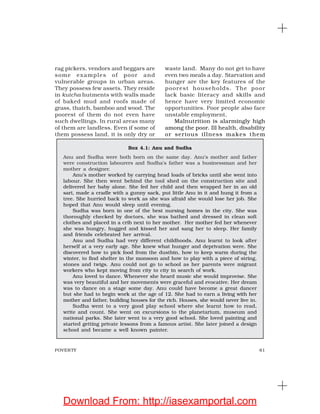
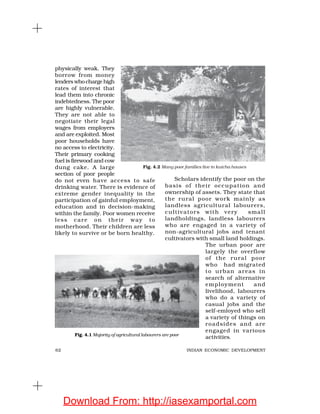
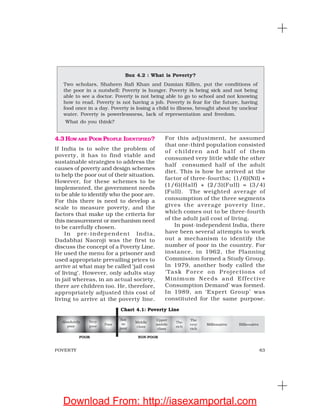
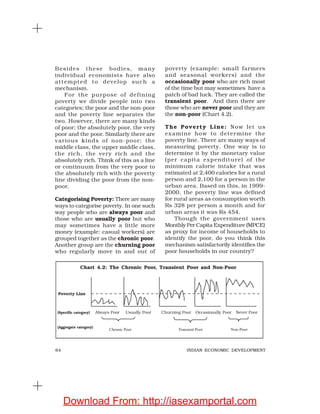
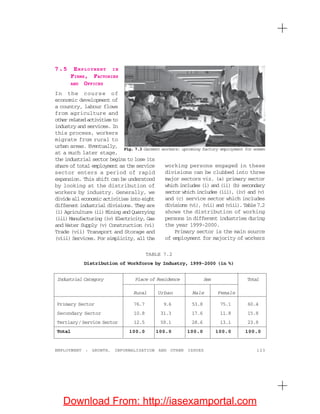
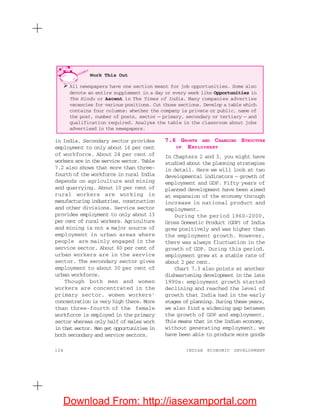
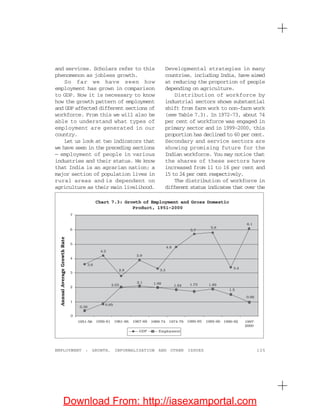
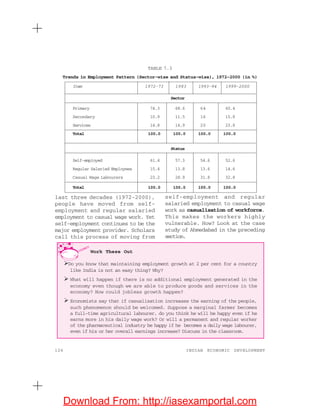
CO N T E N T S
F O R E W O R D iii
UNIT I : DEVELOPMENT POLICIES AND EXPERIENCE (1947-1990) 1-35
CHAPTER 1: INDIAN ECONOMY ON THE EVE OF INDEPENDENCE 3
– LOW LEVEL OF ECONOMIC DEVELOPMENT UNDER THE COLONIAL RULE 4
– AGRICULTURAL SECTOR 5
– INDUSTRIAL SECTOR 7
– FOREIGN TRADE 8
– DEMOGRAPHIC CONDITION 9
– OCCUPATIONAL STRUCTURE 10
– INFRASTRUCTURE 11
CHAPTER 2 : INDIAN ECONOMY 1950-1990 16
– THE GOALS OF FIVE YEAR PLANS 19
– AGRICULTURE 22
– INDUSTRY AND TRADE 27
– TRADE POLICY: IMPORT SUBSTITUTION 30
UNIT II : ECONOMIC REFORMS SINCE 1991 36-56
CHAPTER 3 : LIBERALISATION, PRIVATISATION AND GLOBALISATION : AN APPRAISAL 38
– BA C K G R O U N D 39
– LIBERALISATION 41
– PRIVATISATION 44
– GLOBALISATION 45
– INDIAN ECONOMY DURING REFORMS: AN ASSESSMENT 48
UNIT III: CURRENT CHALLENGES FACING THE INDIAN ECONOMY 57-178
CHAPTER 4 : POVERTY 59
– WHO ARE THE POOR? 60
– HOW ARE POOR PEOPLE IDENTIFIED? 63
– THE NUMBER OF POOR IN INDIA 66
Download From: http://iasexamportal.com
– WHAT CAUSES POVERTY? 68
– POLICIES AND PROGRAMMES TOWARDS POVERTY ALLEVIATION 72
– POVERTY ALLEVIATION PROGRAMMES — A CRITICAL ASSESSMENT 75
CHAPTER 5 : HUMAN CAPITAL FORMATION IN INDIA 82
– WHAT IS HUMAN CAPITAL? 84
– SOURCES OF HUMAN CAPITAL 84
– HUMAN CAPITAL AND HUMAN DEVELOPMENT 90
– HUMAN CAPITAL FORMATION IN INDIA: GREAT PROSPECTS 91
– EDUCATION SECTOR IN INDIA 92
– FUTURE PROSPECTS 94
CHAPTER 6 : RURAL DEVELOPMENT 99
– WHAT IS RURAL DEVELOPMENT? 100
– CREDIT AND MARKETING IN RURAL AREAS 101
– AGRICULTURAL MARKET SYSTEM 104
– DIVERSIFICATION INTO PRODUCTIVE ACTIVITIES 106
– SUSTAINABLE DEVELOPMENT AND ORGANIC FARMING 110
CHAPTER 7 : EMPLOYMENT: GROWTH, INFORMALISATION AND OTHER ISSUES 116
– WORKERS AND EMPLOYMENT 118
– PARTICIPATION OF PEOPLE IN EMPLOYMENT 119
– SELF-EMPLOYED AND HIRED WORKERS 120
– EMPLOYMENT IN FIRMS, FACTORIES AND OFFICES 123
– GROWTH AND CHANGING STRUCTURE OF EMPLOYMENT 124
– INFORMALISATION OF INDIAN WORKFORCE 127
– UNEMPLOYMENT 130
– GOVERNMENT AND EMPLOYMENT GENERATION 132
CHAPTER 8 : INFRASTRUCTURE 139
– WHAT IS INFRASTRUCTURE? 140
– RELEVANCE OF INFRASTRUCTURE 141
– THE STATE OF INFRASTRUCTURE IN INDIA 141
– ENERGY 144
– HEALTH 149
xii
Download From: http://iasexamportal.com
CHAPTER 9 : ENVIRONMENT AND SUSTAINABLE DEVELOPMENT 162
– ENVIRONMENT — DEFINITION AND FUNCTIONS 163
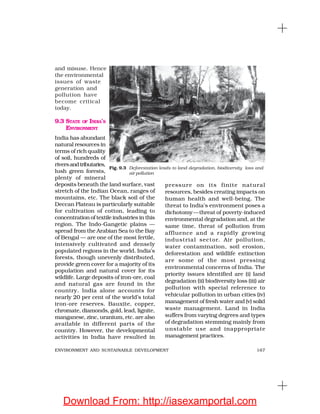
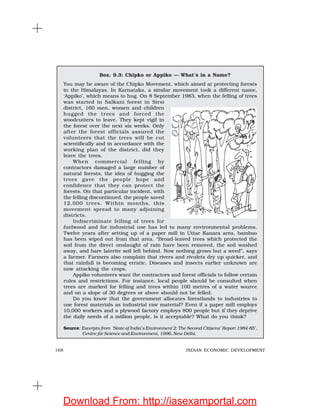
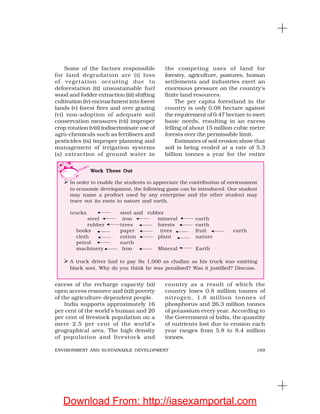
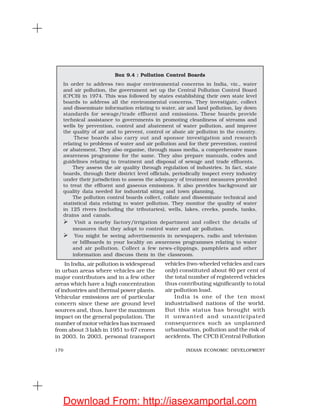
– STATE OF INDIA’S ENVIRONMENT 167
– SUSTAINABLE DEVELOPMENT 171
– STRATEGIES FOR SUSTAINABLE DEVELOPMENT 172
UNIT IV : DEVELOPMENT EXPERIENCES OF INDIA : A COMPARISON 179-197
WITH NEIGHBOURS
CHAPTER 10 : COMPARATIVE DEVELOPMENT EXPERIENCES OF 181
INDIA AND ITS NEIGHBOURS
– DEVELOPMENTAL PATH — A SNAPSHOT VIEW 182
– DEMOGRAPHIC INDICATORS 185
– GROSS DOMESTIC PRODUCT AND SECTORS 186
– INDICATORS OF HUMAN DEVELOPMENT 189
– DEVELOPMENT STRATEGIES — AN APPRAISAL 190
GL O S S A R Y 198-206
xiii
Download From: http://iasexamportal.com
DEVELOPMENT POLICIES AND EXPERIENCE
(1947-90)
UNIT
III
UNIT
I
Download From: http://iasexamportal.com
The two chapters in this unit give us an overview
of the state of the Indian economy as it was at the
eve of independence till after four decades of
planned development, which was a path that India
chose. This meant that the Government of India
had to take a series of steps such as the
establishment of the Planning Commission and
announcement of five year plans. An overview of
thegoalsoffiveyearplansandacriticalappraisal
of the merits and limitations of planned development
has been covered in this unit.
Download From: http://iasexamportal.com
After studying this chapter, the learners will
• become familiar with the state of the Indian economy in 1947, the
year of India’s Independence
• understand the factors that led to the underdevelopment and
stagnation of the Indian economy.
INDIAN ECONOMY
ON THE
EVE OF INDEPENDENCE
1
Download From: http://iasexamportal.com
4 INDIAN ECONOMIC DEVELOPMENT
1.1 INTRODUCTION
The primary objective of this book,
Indian Economic Development, is to
familiarise you with the basic features
of the Indian economy, and its
development, as it is today, in the
aftermath of Independence. However, it
is equally important to know something
about the country’s economic past even
as you learn about its present state and
future prospects. So, let us first look at
the state of India’s economy prior to the
country’s independence and form an
idea of the various considerations that
shaped India’s post-independence
development strategy.
The structure of India’s present-
day economy is not just of current
making; it has its roots steeped in
history, particularly in the period when
India was under British rule which
lasted for almost two centuries before
India finally won its independence on
15 August 1947. The sole purpose of
the British colonial rule in India was
to reduce the country to being a feeder
economy for Great Britain’s own
rapidly expanding modern industrial
base. An understanding of the
exploitative nature of this relationship
is essential for any assessment of the
kind and level of development which
the Indian economy has been able to
attain over the last six decades. 1.2
1.2 LOW LEVEL OF ECONOMIC
DEVELOPMENT UNDER THE
COLONIAL RULE
India had an independent economy
before the advent of the British rule.
Though agriculture was the main
source of livelihood for most people,
yet, the country’s economy was
characterised by various kinds of
manufacturing activities. India was
particularly well known for its
handicraft industries in the fields of
cotton and silk textiles, metal and
precious stone works etc. These
products enjoyed a worldwide market
based on the reputation of the fine
quality of material used and the high
standards of craftsmanship seen in all
imports from India.
Box 1.1: Textile Industry in Bengal
Muslin is a type of cotton textile which had its origin in Bengal, particularly,
places in and around Dhaka (spelled during the pre-independence period as
Dacca), now the capital city of Bangladesh. ‘Daccai Muslin’ had gained worldwide
fame as an exquisite type of cotton textile. The finest variety of muslin was
called malmal. Sometimes, foreign travellers also used to refer to it as malmal
shahi or malmal khas implying that it was worn by, or fit for, the royalty.
“India is the pivot of our Empire... If the Empire loses any other part of its
Dominion we can survive, but if we lose India, the sun of our Empire will have
set.”
Victor Alexander Vruce, the Viceroy of British India in 1894
Download From: http://iasexamportal.com
5INDIAN ECONOMY ON THE EVE OF INDEPENDENCE
The economic policies pursued by
the colonial government in India were
concerned more with the protection
and promotion of the economic
interests of their home country than
with the development of the Indian
economy. Such policies brought about
a fundamental change in the structure
of the Indian economy — transforming
the country into a net supplier of raw
materials and consumer of finished
industrial products from Britain.
Obviously, the colonial government
never made any sincere attempt to
estimate India’s national and per
capita income. Some individual
attempts which were made to measure
such incomes yielded conflicting and
inconsistent results. Among the
notable estimators — Dadabhai
Naoroji, William Digby, Findlay Shirras,
V.K.R.V. Rao and R.C. Desai — it was
Rao whose estimates of the national
and per capita incomes during the
colonial period were considered very
significant. However, most studies did
find that the country’s growth of
aggregate real output during the first
half of the twentieth century was less
than two per cent coupled with a
meagre half per cent growth in per
capita output per year.
1.3 AGRICULTURAL SECTOR
India’s economy under the British
colonial rule remained fundamentally
agrarian — about 85 per cent of the
country’s population lived mostly in
villages and derived livelihood directly
or indirectly from agriculture. However,
despite being the occupation of such
a large population, the agricultural
sector continued to experience
Fig. 1.1 India’s agricultural stagnation
under the British colonial rule
Box 1.2: Agriculture During
Pre-British India
The French traveller, Bernier, described
seventeenth century Bengal in the
following way: “The knowledge I have
acquired of Bengal in two visits inclines
me to believe that it is richer than Egypt.
It exports, in abundance, cottons and
silks, rice, sugar and butter. It produces
amply — for its own consumption —
wheat, vegetables, grains, fowls, ducks
and geese. It has immense herds of pigs
and flocks of sheep and goats. Fish of
every kind it has in profusion. From
rajmahal to the sea is an endless
number of canals, cut in bygone ages
from the Ganges by immense labour for
navigation and irrigation.”
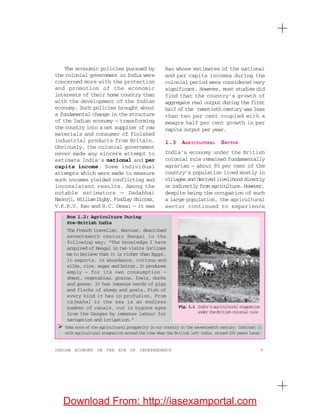
Take note of the agricultural prosperity in our country in the seventeenth century. Contrast it
with agricultural stagnation around the time when the British left India, around 200 years later.
Download From: http://iasexamportal.com
6 INDIAN ECONOMIC DEVELOPMENT
stagnation and, not infrequently,
unusual deterioration. Agricultural
productivity became incrementally
low though, in absolute terms, the
sector experienced some growth due
to the expansion of the aggregate area
under cultivation. This stagnation in
the agricultural sector was caused
mainly because of the various
systems of land settlement that
were introduced by the colonial
government. Particularly, under the
zamindari system which was
implemented in the then Bengal
Presidency comprising parts of India’s
present-day eastern states, the profit
accruing out of the agriculture sector
went to the zamindars instead of the
cultivators. However, a considerable
number of zamindars, and not just
the colonial government, did nothing
to improve the condition of
agriculture. The main interest of the
zamindars was only to collect rent
regardless of the economic condition
of the cultivators; this caused
immense misery and social tension
among the latter. To a very great
extent, the terms of the revenue
settlement were also responsible for
the zamindars adopting such an
attitude; dates for depositing specified
sums of revenue were fixed, failing
which the zamindars were to lose their
rights. Besides this, low levels of
technology, lack of irrigation facilities
and negligible use of fertilisers, all
added up to aggravate the plight of
the farmers and contributed to
the dismal level of agricultural
productivity. There was, of course,
some evidence of a relatively higher
yield of cash crops in certain areas of
the country due to commercialisation
of agriculture. But this could hardly
help farmers in improving their
economic condition as, instead of
producing food crops, now they were
Work These Out
Compare the map of British India with that of independent India and find
out the areas that became parts of Pakistan. Why were those parts so
important to India from the economic point of view? (Refer, to your
advantage, Dr Rajendra Prasad’s book, India Divided).
What were the various forms of revenue settlement adopted by the British
in India? Where did they implement them and to what effect? How far do
you think those settlements have a bearing on the current agricultural
scenario in India? (In your attempt to find answers to these questions, you
may refer to Ramesh Chandra Dutt’s Economic History of India, which comes
in three volumes, and B.H. Baden-Powell’s The Land Systems of British
India, also in two volumes. For better comprehension of the subject, you
can also try and develop an illustrated agrarian map of British India either
by hand or with the help of your school computer. Remember, nothing
helps better than an illustrated map to understand the subject at hand).
Download From: http://iasexamportal.com
7INDIAN ECONOMY ON THE EVE OF INDEPENDENCE
producing cash crops which were to
be ultimately used by British
industries back home. India’s
agricultural production received a
further set back due to the country’s
partition at the time of independence.
A sizeable portion of the undivided
country’s highly irrigated and fertile
land went to Pakistan; this had an
adverse impact upon India’s output
from the agriculture sector.
Particularly affected was India’s jute
industry since almost the whole of the
jute producing area became part of
East Pakistan (now Bangladesh).
India’s jute goods industry (in which
the country had enjoyed a world
monopoly so far), thus, suffered
heavily for lack of raw material.
1.4 INDUSTRIAL SECTOR
As in the case of agriculture, so also
in manufacturing, India could not
develop a sound industrial base under
the colonial rule. Even as the country’s
world famous handicraft industries
declined, no corresponding modern
industrial base was allowed to come
up to take pride of place so long
enjoyed by the former. The primary
motive of the colonial government
behind this policy of systematically de-
industrialising India was two-fold. The
intention was, first, to reduce India to
the status of a mere exporter of
important raw materials for the
upcoming modern industries in
Britain and, second, to turn India into
a sprawling market for the finished
products of those industries so that
their continued expansion could be
ensured to the maximum advantage of
their home country — Britain. In the
unfolding economic scenario, the
decline of the indigenous handicraft
industries created not only massive
unemployment in India but also a new
demand in the Indian consumer
market, which was now deprived of the
supply of locally made goods. This
demand was profitably met by the
increasing imports of cheap
manufactured goods from Britain.
During the second half of the
nineteenth century, modern industry
began to take root in India but its
progress remained very slow. Initially,
this development was confined to the
setting up of cotton and jute textile
mills. The cotton textile mills, mainly
dominated by Indians, were located in
the western parts of the country,
namely, Maharashtra and Gujarat,
while the jute mills dominated by the
foreigners were mainly concentrated in
Bengal. Subsequently, the iron and
steel industries began coming up in
the beginning of the twentieth century.
The Tata Iron and Steel Company
(TISCO) was incorporated in 1907. A
few other industries in the fields of
sugar, cement, paper etc. came up after
the Second World War.
However, there was hardly any
capital goods industry to help
promote further industrialisation in
India. Capital goods industry means
industries which can produce machine
tools which are, in turn, used for
producing articles for current
consumption. The establishment of a
few manufacturing units here and
Download From: http://iasexamportal.com
8 INDIAN ECONOMIC DEVELOPMENT
there was no substitute to the near
wholesale displacement of the
country’s traditional handicraft
industries. Furthermore, the growth
rate of the new industrial sector and
its contribution to the Gross Domestic
Product (GDP) remained very small.
Another significant drawback of the
new industrial sector was the very
limited area of operation of the public
sector. This sector remained confined
only to the railways, power generation,
communications, ports and some
other departmental undertakings.
1.5 FOREIGN TRADE
India has been an important trading
nation since ancient times. But the
restrictive policies of commodity
production, trade and tariff pursued
by the colonial government adversely
affected the structure, composition and
volume of India’s foreign trade.
Consequently, India became an
exporter of primary products such as
raw silk, cotton, wool, sugar, indigo,
jute etc. and an importer of finished
consumer goods like cotton, silk and
woollen clothes and capital goods like
light machinery produced in the
factories of Britain. For all practical
purposes, Britain maintained a
monopoly control over India’s exports
and imports. As a result, more than
half of India’s foreign trade was
restricted to Britain while the rest was
allowed with a few other countries like
China, Ceylon (Sri Lanka) and Persia
(Iran). The opening of the Suez Canal
further intensified British control over
India’s foreign trade (see Box 1.3).
The most important characteristic
of India’s foreign trade throughout the
colonial period was the generation of
a large export surplus. But this
surplus came at a huge cost to the
country’s economy. Several essential
commodities—food grains, clothes,
Work These Out
Prepare a list showing where and when other modern industries of India
were first set up. Can you also find out what the basic requirements are for
setting up any modern industry? What, for example, might have been the
reasons for the setting up of the Tata Iron and Steel Company at Jamshedpur,
which is now in the state of Jharkhand?
How many iron and steel factories are there in India at present? Are these
iron and steel factories among the best in the world or do you think that
these factories need restructuring and upgradation? If yes, how can this be
done? There is an argument that industries which are not strategic in nature
should not continue to be in the public sector. What is your view?
On a map of India, mark the cotton textiles, jute mills and textile mills that
existed at the time of independence.
Download From: http://iasexamportal.com
9INDIAN ECONOMY ON THE EVE OF INDEPENDENCE
kerosene etc. — became conspicuous
by their acute scarcity in the domestic
market. Furthermore, this export
surplus did not result in any flow of
goldorsilverintoIndia.Rather,thiswas
used to make payments for the
expenses incurred by an office set up
by the colonial government in Britain,
expenses on war, again fought by the
British government, and the import of
invisible items, all of which led to the
drain of Indian wealth.
1.6 DEMOGRAPHIC CONDITION
Various details about the population
of British India were first collected
through a census in 1881. Though
suffering from certain limitations, it
revealed the unevenness in India’s
population growth. Subsequently,
Fig.1.2 Suez Canal: Used as highway
between India and Britain
Box 1.3: Trade Through the Suez
Canal
Suez Canal is an artificial waterway
running from north to south across the
Isthmus of Suez in north-eastern
Egypt. It connects Port Said on the
Mediterranean Sea with the Gulf of
Suez, an arm of the Red Sea. The canal
provides a direct trade route for ships
operating between European or
American ports and ports located in
South Asia, East Africa and Oceania by
doing away with the need to sail around
Africa. Strategically and economically,
it is one of the most important
waterways in the world. Its opening in
1869 reduced the cost of transportation
and made access to the Indian market
easier.
Not to scale
Work These Out
Prepare a list of items that were exported from and imported into India during
the British rule.
Collect information from the Economic Survey for various years published
by the Ministry of Finance, Government of India, on various items of export
from India and its imports. Compare these with imports and exports from
the pre-independence era. Also find out the names of prominent ports which
now handle the bulk of India’s foreign trade.
Not to scale
Download From: http://iasexamportal.com
1 0 INDIAN ECONOMIC DEVELOPMENT
every ten years such census operations
were carried out. Before 1921, India
was in the first stage of demographic
transition. The second stage of
transition began after 1921. However,
neither the total population of India nor
the rate of population growth at this
stage was very high.
The various social development
indicators were also not quite
encouraging. The overall literacy level
was less than 16 per cent. Out of this,
the female literacy level was at a
negligible low of about seven per
cent. Public health facilities were
either unavailable to large chunks of
population or, when available, were
highly inadequate. Consequently,
water and air-borne diseases were
rampant and took a huge toll on
life. No wonder, the overall mortality
rate was very high and in that,
particularly, the infant mortality
rate was quite alarming—about 218
per thousand in contrast to the
present infant mortality rate of 63 per
thousand. Life expectancy was also
very low—32 years in contrast to the
present 63 years. In the absence of
reliabledata,itisdifficulttospecifythe
extent of poverty at that time but there
is no doubt that extensive poverty
prevailed in India during the colonial
period which contributed to the
worsening profile of India’s population
of the time.
1.7 OCCUPATIONAL STRUCTURE
During the colonial period, the
occupational structure of India, i.e.,
distribution of working persons across
different industries and sectors,
showed little sign of change. The
agricultural sector accounted for the
Fig. 1.3 Poverty, malnutrition and poor health facilities also cause the population to grow slowly
Download From: http://iasexamportal.com
1 1INDIAN ECONOMY ON THE EVE OF INDEPENDENCE
largest share of workforce, which
usually remained at a high of 70-75
per cent while the manufacturing and
the services sectors accounted for only
10 and 15-20 per cent respectively.
Another striking aspect was the
growing regional variation. Parts of the
then Madras Presidency (comprising
areas of the present-day states of Tamil
Nadu, Andhra Pradesh, Kerala and
Karnataka), Maharashtra and West
Bengal witnessed a decline in
the dependence of the workforce on
the agricultural sector with a
commensurate increase in the
manufacturing and the services
sectors. However, there had been an
increase in the share of workforce in
agriculture during the same time in
states such as Orissa, Rajasthan and
Punjab.
1.8 INFRASTRUCTURE
Under the colonial regime, basic
infrastructure such as railways, ports,
water transport, posts and telegraphs
did develop. However, the real motive
behind this development was not to
provide basic amenities to the people
but to subserve various colonial
interests. Roads constructed in India
prior to the advent of the British rule
were not fit for modern transport. The
colonial administration also could not
accomplish much on this front due to
a paucity of funds. The roads that were
built primarily served the purposes of
mobilising the army within India and
drawing out raw materials from the
countryside to the nearest railway
station or the port to send these to far
away England or other lucrative
foreign destinations. There always
remained an acute shortage of all-
weather roads to reach out to the rural
areas during the rainy season.
Naturally, therefore, people mostly
living in these areas suffered
grievously during natural calamities
and famines.
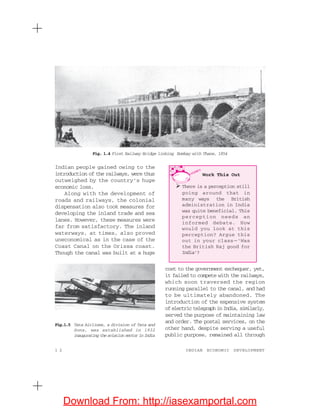
The British introduced the
railways in India in 1850 and it is
considered as one of their most
important contributions. The railways
affected the structure of the Indian
economy in two important ways. On
the one hand it enabled people to
undertake long distance travel and
thereby break geographical and
cultural barriers while, on the other
hand, it fostered commercialisation of
Indian agriculture which adversely
affected the comparative self-
sufficiency of the village economies in
India. The volume of India’s export
trade undoubtedly expanded but its
benefits rarely accrued to the Indian
people. The social benefits, which the
Work These Out
Can you find out the
reasons behind frequent
occurrence of famines in
India before independence?
You may read from Nobel
Laureate Amartya Sen’s
book, Poverty and Famines.
Prepare a pie chart for
the occupational structure
in India at the time of
independence.
Download From: http://iasexamportal.com
1 2 INDIAN ECONOMIC DEVELOPMENT
Indian people gained owing to the
introduction of the railways, were thus
outweighed by the country’s huge
economic loss.
Along with the development of
roads and railways, the colonial
dispensation also took measures for
developing the inland trade and sea
lanes. However, these measures were
far from satisfactory. The inland
waterways, at times, also proved
uneconomical as in the case of the
Coast Canal on the Orissa coast.
Though the canal was built at a huge
cost to the government exchequer, yet,
it failed to compete with the railways,
which soon traversed the region
running parallel to the canal, and had
to be ultimately abandoned. The
introduction of the expensive system
ofelectrictelegraphinIndia,similarly,
served the purpose of maintaining law
and order. The postal services, on the
other hand, despite serving a useful
public purpose, remained all through
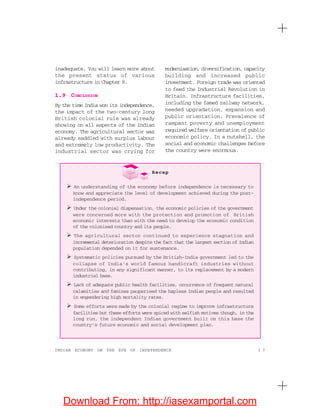
Fig.1.5 Tata Airlines, a division of Tata and
Sons, was established in 1932
inaugurating the aviation sector in India
Fig. 1.4 First Railway Bridge linking Bombay with Thane, 1854
Work This Out
There is a perception still
going around that in
many ways the British
administration in India
was quite beneficial. This
perception needs an
informed debate. How
would you look at this
perception? Argue this
out in your class —‘Was
the British Raj good for
India’?
Download From: http://iasexamportal.com
1 3INDIAN ECONOMY ON THE EVE OF INDEPENDENCE
inadequate. You will learn more about
the present status of various
infrastructure in Chapter 8.
1.9 CONCLUSION
By the time India won its independence,
the impact of the two-century long
British colonial rule was already
showing on all aspects of the Indian
economy. The agricultural sector was
already saddled with surplus labour
and extremely low productivity. The
industrial sector was crying for
modernisation, diversification, capacity
building and increased public
investment. Foreign trade was oriented
to feed the Industrial Revolution in
Britain. Infrastructure facilities,
including the famed railway network,
needed upgradation, expansion and
public orientation. Prevalence of
rampant poverty and unemployment
required welfare orientation of public
economic policy. In a nutshell, the
social and economic challenges before
the country were enormous.
Recap
An understanding of the economy before independence is necessary to
know and appreciate the level of development achieved during the post-
independence period.
Under the colonial dispensation, the economic policies of the government
were concerned more with the protection and promotion of British
economic interests than with the need to develop the economic condition
of the colonised country and its people.
The agricultural sector continued to experience stagnation and
incremental deterioration despite the fact that the largest section of Indian
population depended on it for sustenance.
Systematic policies pursued by the British-India government led to the
collapse of India’s world famous handicraft industries without
contributing, in any significant manner, to its replacement by a modern
industrial base.
Lack of adequate public health facilities, occurrence of frequent natural
calamities and famines pauperised the hapless Indian people and resulted
in engendering high mortality rates.
Some efforts were made by the colonial regime to improve infrastructure
facilities but these efforts were spiced with selfish motives though, in the
long run, the independent Indian government built on this base the
country’s future economic and social development plan.
Download From: http://iasexamportal.com
1 4 INDIAN ECONOMIC DEVELOPMENT
1. What was the focus of the economic policies pursued by the colonial
government in India? What were the impacts of these policies?
2. Name some notable economists who estimated India’s per capita
income during the colonial period.
3. What were the main causes of India’s agricultural stagnation during
the colonial period?
4. Name some modern industries which were in operation in our country
at the time of independence.
5. What was the two-fold motive behind the systematic de-
industrialisation effected by the British in pre-independent India?
6. The traditional handicrafts industries were ruined under the British
rule. Do you agree with this view? Give reasons in support of your
answer.
7. What objectives did the British intend to achieve through their
policies of infrastructure development in India?
8. Critically appraise some of the shortfalls of the industrial policy
pursued by the British colonial administration.
9. What do you understand by the drain of Indian wealth during the
colonial period?
10. Which is regarded as the defining year to mark the demographic
transition from its first to the second decisive stage?
11. Give a quantitative appraisal of India’s demographic profile during
the colonial period.
12. Highlight the salient features of India’s pre-independence occupational
structure.
13. Underscore some of India’s most crucial economic challenges at the
time of independence.
14. When was India’s first official census operation undertaken?
15. Indicate the volume and direction of trade at the time of
independence.
16. Were there any positive contributions made by the British in India?
Discuss.
EXERCISES
Download From: http://iasexamportal.com
1 5INDIAN ECONOMY ON THE EVE OF INDEPENDENCE
R E F E R E N C E S
SUGGESTED ADDITIONAL ACTIVITIES
1. Prepare a list of goods and services that were available to people in
pre-independence India in rural and urban areas. Compare it with
the consumption pattern of such goods and services by the people
today. Highlight the perceptible difference in the people’s standard
ofliving.
2. Find pictures of towns/villages, in your vicinity, of the pre-
independence period and compare these with their present scenario.
What changes can you mark? Are such changes for better or for
worse? Discuss.
3. Rally around your teacher and organise a group discussion on ‘Has
the zamindari system really been abolished in India’? If the
consensus is negative, then what measures would you think should
be taken to banish it and why?
4. Identify the major occupations followed by the people of our country
at the time of independence. What major occupations do the people
follow today? In the light of reform policies, how would you visualise
the occupational scenario in India 15 years from now—say, 2020?
BADEN-POWELL, B.H. 1892. The Land Systems of British India, Vols I, II and III.
Oxford Clarendon Press, Oxford.
BUCHANAN, D.H. 1966. Development of Capitalist Enterprise in India. Frank
Cass and Co, London.
CHANDRA, BIPAN. 1993. ‘The Colonial Legacy’ in Bimal Jalan (ed.), The Indian
Economy: Problems and Prospects. Penguin Books, New Delhi.
DUTT, R.C. 1963. Economic History of India, Vols. I and II. Ministry of
Information and Broadcasting, Government of India, New Delhi.
KUMAR, D. AND MEGHNAD DESAI (Eds.). 1983. Cambridge Economic History of
India. Cambridge University Press, Cambridge.
MILL, JAMES.1972. History of British India. Associated Publishing House, New
Delhi.
PRASAD, RAJENDRA. 1946. India Divided. Hind Kitabs, Bombay.
SEN, AMARTYA. 1999. Poverty and Famines. Oxford University Press, New Delhi.
Download From: http://iasexamportal.com
After studying this chapter, the learners will
• come to know the goals of India’s five year plans
• know about the development policies in different sectors such as
agriculture and industry from 1950-1990
• learn to think about the merits and limitations of a regulated economy.
Indian Economy
1950-1990
2
Download From: http://iasexamportal.com
17INDIAN ECONOMY 1950-1990
2.1 INTRODUCTION
On 15 August 1947, India woke to a
new dawn of freedom: finally we were
masters of our own destiny after
some two hundred years of British
rule; the job of nation building was
now in our own hands. The leaders
of independent India had to decide,
among other things, the type of
economic system most suitable for
our nation, a system which would
promote the welfare of all rather than
a few. There are different types of
economic systems (see Box 2.1) and
among them, socialism appealed to
Jawaharlal Nehru the most. However,
he was not in favour of the kind of
socialism established in the former
Soviet Union where all the means of
production, i.e., all the factories and
farms in the country, were owned by
the government. There was no private
property. It is not possible in a
democracy like India for the
government to change the ownership
pattern of land and other properties
of its citizens in the way that it was
done in the former Soviet Union.
Nehru, and many other leaders and
thinkers of the newly independent
India, sought an alternative to the
extreme versions of capitalism and
socialism. Basically sympathising with
the socialist outlook, they found the
answer in an economic system which,
in their view, combined the best
features of socialism without its
drawbacks. In this view, India would
be a ‘socialist’ society with a strong
public sector but also with private
property and democracy; the government
would ‘plan’ (see Box 2.2) for the
The central objective of Planning in India... is to initiate a process of
development which will raise the living standards and open out to the people
new opportunities for a richer and more varied life.
First Five Year Plan
Work These Out
Prepare a chart on the
different types of economic
systems prevalent in the
world. List out the countries
as capitalist, socialist and
mixed economy.
Plan a class trip to an
agriculture farm. Divide the
class into seven groups with
each group to plan a specific
goal, for example, the
purpose of the visit, money
expenditure involved, time
taken, resources, people
accompanying the group
and who need to be
contacted, possible places
of visit, possible questions
to be asked etc. Now, with
the help of your teacher,
compile these specific goals
and compare with long-term
goals of successful visit to
an agricultural farm.
Download From: http://iasexamportal.com
18 INDIAN ECONOMIC DEVELOPMENT
Box 2.1: Types of Economic Systems
Every society has to answer three questions
What goods and services should be produced in the country?
How should the goods and services be produced? Should producers use
more human labour or more capital (machines) for producing things?
How should the goods and services be distributed among people?
One answer to these questions is to depend on the market forces of
supply and demand. In a market economy, also called capitalism, only those
consumer goods will be produced that are in demand, i.e., goods that can
be sold profitably either in the domestic or in the foreign markets. If cars
are in demand, cars will be produced and if bicycles are in demand, bicycles
will be produced. If labour is cheaper than capital, more labour-intensive
methods of production will be used and vice-versa. In a capitalist society
the goods produced are distributed among people not on the basis of what
people need but on the basis of what people can afford and are willing to
purchase. This means that a sick person will be able to use the required
medicine only if he/she can afford to buy it; if they cannot afford the medicine
they will not be able to use it even if they need it urgently. Such a society
did not appeal to Jawaharlal Nehru, our first prime minister, for it meant
that the great majority of people of the country would be left behind without
the chance to improve their quality of life.
A socialist society answers the three questions in a totally different
manner. In a socialist society the government decides what goods are to be
produced in accordance with the needs of society. It is assumed that the
government knows what is good for the people of the country and so the
desires of individual consumers are not given much importance. The
government decides how goods are to be produced and how they should be
distributed. In principle, distribution under socialism is supposed to be based
on what people need and not on what they can afford to purchase. Unlike
under capitalism, for example, a socialist nation provides free health care
to the citizens who need it. Strictly, a socialist society has no private property
since everything is owned by the state. With the collapse of the Soviet system
in the last decades of the twentieth century, socialist economies in the former
Soviet Union and the socialist states in Eastern Europe ceased to exist.
Most economies are mixed economies, i.e., the government and the
market together answer the three questions of what to produce, how to
produce and how to distribute what is produced. In a mixed economy, the
market will provide whatever goods and services it can produce well, and
the government will provide essential goods and services which the market
fails to do.
Download From: http://iasexamportal.com
19INDIAN ECONOMY 1950-1990
economy with the private sector being
encouraged to be part of the plan effort.
The ‘Industrial Policy Resolution’ of
1948 and the Directive Principles of
the Indian Constitution reflected
this outlook. In 1950, the Planning
Commission was set up with the
Prime Minister as its Chairperson. The
era of five year plans had begun.
2.2 THE GOALS OF FIVE YEAR PLANS
A plan should have some clearly
specified goals. The goals of the five
year plans are: growth, modernisation,
self-reliance and equity. This does not
mean that all the plans have given
equal importance to all these goals.
Due to limited resources, a choice has
to be made in each plan about which
of the goals is to be given primary
importance. Nevertheless, the planners
have to ensure that, as far as possible,
the policies of the plans do not
contradict these four goals. Let us now
learn about the goals of planning in
some detail.
Growth: It refers to increase in the
country’s capacity to produce the
output of goods and services within
the country. It implies either a
larger stock of productive capital,
or a larger size of supporting
services like transport and
banking, or an increase in the
efficiency of productive capital and
services. A good indicator of
economic growth, in the language of
Box 2.2: What is a Plan?
A plan spells out how the resources of a nation should be put to use. It
should have some general goals as well as specific objectives which are to
be achieved within a specified period of time; in India plans are of five years
duration and are called five year plans (we borrowed this from the former
Soviet Union, the pioneer in national planning). Our plan documents not
only specify the objectives to be attained in the five years of a plan but also
what is to be achieved over a period of twenty years. This long-term plan is
called ‘perspective plan’. The five year plans are supposed to provide the
basis for the perspective plan.
It will be unrealistic to expect all the goals of a plan to be given equal
importance in all the plans. In fact the goals may actually be in conflict. For
example, the goal of introducing modern technology may be in conflict with
the goal of increasing employment if the technology reduces the need for
labour. The planners have to balance the goals, a very difficult job indeed.
We find different goals being emphasised in different plans in India.
Our five year plans do not spell out how much of each and every good
and service is to be produced. This is neither possible nor necessary (the
former Soviet Union tried to do this and failed). It is enough if the plan is
specific about the sectors where it plays a commanding role, for instance,
power generation and irrigation, while leaving the rest to the market.
Download From: http://iasexamportal.com
20 INDIAN ECONOMIC DEVELOPMENT
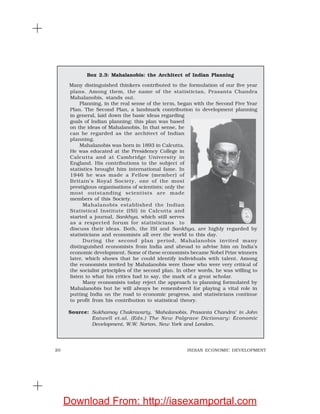
Box 2.3: Mahalanobis: the Architect of Indian Planning
Many distinguished thinkers contributed to the formulation of our five year
plans. Among them, the name of the statistician, Prasanta Chandra
Mahalanobis, stands out.
Planning, in the real sense of the term, began with the Second Five Year
Plan. The Second Plan, a landmark contribution to development planning
in general, laid down the basic ideas regarding
goals of Indian planning; this plan was based
on the ideas of Mahalanobis. In that sense, he
can be regarded as the architect of Indian
planning.
Mahalanobis was born in 1893 in Calcutta.
He was educated at the Presidency College in
Calcutta and at Cambridge University in
England. His contributions to the subject of
statistics brought him international fame. In
1946 he was made a Fellow (member) of
Britain’s Royal Society, one of the most
prestigious organisations of scientists; only the
most outstanding scientists are made
members of this Society.
Mahalanobis established the Indian
Statistical Institute (ISI) in Calcutta and
started a journal, Sankhya, which still serves
as a respected forum for statisticians to
discuss their ideas. Both, the ISI and Sankhya, are highly regarded by
statisticians and economists all over the world to this day.
During the second plan period, Mahalanobis invited many
distinguished economists from India and abroad to advise him on India’s
economic development. Some of these economists became Nobel Prize winners
later, which shows that he could identify individuals with talent. Among
the economists invited by Mahalanobis were those who were very critical of
the socialist principles of the second plan. In other words, he was willing to
listen to what his critics had to say, the mark of a great scholar.
Many economists today reject the approach to planning formulated by
Mahalanobis but he will always be remembered for playing a vital role in
putting India on the road to economic progress, and statisticians continue
to profit from his contribution to statistical theory.
Source: Sukhamoy Chakravarty, ‘Mahalanobis, Prasanta Chandra’ in John
Eatwell et.al, (Eds.) The New Palgrave Dictionary: Economic
Development, W.W. Norton, New York and London.
Download From: http://iasexamportal.com
21INDIAN ECONOMY 1950-1990
economics, is steady increase in the
Gross Domestic Product (GDP). The
GDP is the market value of all the
goods and services produced in the
country during a year. You can think
of the GDP as a cake: growth is
increase in the size of the cake. If the
cake is larger, more people can enjoy
it. It is necessary to produce more
goods and services if the people of
India are to enjoy (in the words of the
First Five Year Plan) a more rich and
varied life.
The GDP of a country is derived
from the different sector’s of the
economy, namely the agricultural
sector, the industrial sector and the
service sector. The contribution
made by each of these sectors makes
up the structural composition of
the economy. In some countries,
growth in agriculture contributes
more to the GDP growth, while in
some countries the growth in the
service sector contributes more to
GDP growth (see Box 2.4).
Modernisation: To increase the
production of goods and services
the producers have to adopt new
technology. For example, a farmer can
increase the output on the farm by
using new seed varieties instead of
using the old ones. Similarly, a factory
can increase output by using a new
type of machine. Adoption of new
technology is called modernisation.
However, modernisation does not
refer only to the use of new technology
but also to changes in social outlook
such as the recognition that women
should have the same rights as men.
In a traditional society, women are
supposed to remain at home while
men work. A modern society makes
use of the talents of women in the
work place — in banks, factories,
schools etc. — and such a society will
be more civilised and prosperous.
Self-reliance: A nation can promote
economic growth and modernisation
by using its own resources or by
using resources imported from other
nations. The first seven five year plans
gave importance to self-reliance
which means avoiding imports
of those goods which could be
Box 2.4: The Service Sector
As a country develops, it undergoes ‘structural change’. In the case of India,
the structural change is peculiar. Usually, with development, the share of
agriculture declines and the share of industry becomes dominant. At higher
levels of development, the service sector contributes more to the GDP than the
other two sectors. In India, the share of agriculture in the GDP was more than
50 per cent—as we would expect for a poor country. But by 1990 the share of
the service sector was 40.59 per cent, more than that of agriculture or industry,
like what we find in developed nations. This phenomenon of growing share of
the service sector was accelerated in the post 1991 period (this marked the
onset of globalisation in the country which will be discussed in a subsequent
chapter).
Download From: http://iasexamportal.com
22 INDIAN ECONOMIC DEVELOPMENT
produced in India itself. This policy
was considered a necessity in order
to reduce our dependence on foreign
countries, especially for food. It is
understandable that people who
were recently freed from foreign
domination should give importance
to self-reliance. Further, it was feared
that dependence on imported food
supplies, foreign technology and
foreign capital may make India’s
sovereignty vulnerable to foreign
interference in our policies.
Equity: Now growth, modernisation
and self-reliance, by themselves, may
not improve the kind of life which
people are living. A country can have
high growth, the most modern
technology developed in the country
itself, and also have most of its people
living in poverty. It is important to
ensure that the benefits of economic
prosperity reach the poor sections as
well instead of being enjoyed only by
the rich. So, in addition to growth,
modernisation and self-reliance,
equity is also important: every Indian
should be able to meet his or her basic
needs such as food, a decent house,
education and health care and
inequality in the distribution of wealth
should be reduced.
Let us now see how the first seven
five year plans, covering the period
1950-1990, attempted to attain these
four goals and the extent to which
they succeeded in doing so, with
reference to agriculture, industry
and trade. You will study the policies
and developmental issues taken up
after 1991 in Chapter 3.
2.3 AGRICULTURE
You have learnt in Chapter 1 that
during the colonial rule there was
neither growth nor equity in the
agricultural sector. The policy makers
of independent India had to address
these issues which they did through
land reforms and promoting the use
of ‘miracle seeds’ which ushered in a
revolution in Indian agriculture.
Land Reforms: At the time of
independence, the land tenure system
was characterised by intermediaries
Work These Out
Discuss in your class the changes in technology used for
(a) Production of food grains
(b) Packaging of products
(c) Mass communication.
Find out and prepare a list of items that India used to import and export
during 1950-51 and 1990-91.
(a) Observe the difference
(b) Do you see the impact of self-reliance? Discuss.
For getting these details you may refer to Economic Survey of the latest year.
Download From: http://iasexamportal.com
23INDIAN ECONOMY 1950-1990
(variously called zamindars, jagirdars
etc.) who merely collected rent from the
actual tillers of the soil without
contributing towards improvements
on the farm. The low productivity of
the agricultural sector forced India to
import food from the United States of
America (U.S.A.). Equity in agriculture
called for land reforms which primarily
refer to change in the ownership of
landholdings. Just a year after
independence, steps were taken to
abolish intermediaries and to make the
tillers the owners of land. The idea
behind this move was that ownership
of land would give incentives (see Box
2.5) to the tillers to invest in making
improvements provided sufficient
capital was made available to them.
Land ceiling was another policy to
promote equity in the agricultural
sector. This means fixing the maximum
size of land which could be owned by
an individual. The purpose of land
ceiling was to reduce the concentration
of land ownership in a few hands.
The abolition of intermediaries
meant that some 200 lakh tenants
came into direct contact with the
government — they were thus
freed from being exploited by the
zamindars. The ownership conferred
on tenants gave them the incentive to
increase output and this contributed
to growth in agriculture. However, the
goal of equity was not fully served
by abolition of intermediaries. In
some areas the former zamindars
Box 2.5: Ownership and Incentives
The policy of ‘land to the tiller’ is based on the idea that the cultivators will
take more interest — they will have more incentive — in increasing output if
they are the owners of the land. This is because ownership of land enables the
tiller to make profit from the increased output. Tenants do not have the incentive
to make improvements on land since it is the landowner who would benefit
more from higher output. The importance of ownership in providing incentives
is well illustrated by the carelessness with which farmers in the former Soviet
Union used to pack fruits for sale. It was not uncommon to see farmers packing
rotten fruits along with fresh fruits in the same box. Now, every farmer knows
that the rotten fruits will spoil the fresh fruits if they are packed together. This
will be a loss to the farmer since the fruits cannot be sold. So why did the
Soviet farmers do something which would so obviously result in loss for them?
The answer lies in the incentives facing the farmers. Since farmers in the
former Soviet Union did not own any land, they neither enjoyed the profits nor
suffered the losses. In the absence of ownership, there was no incentive on
the part of farmers to be efficient, which also explains the poor performance of
the agricultural sector in the Soviet Union despite availability of vast areas of
highly fertile land.
Source: Thomas Sowell, Basic Economics: A Citizen’s Guide to the Economy,
New York: Basic Books, 2004, Second Edition.
Download From: http://iasexamportal.com
24 INDIAN ECONOMIC DEVELOPMENT
continued to own large areas of land
by making use of some loopholes in
the legislation; there were cases where
tenants were evicted and the
landowners claimed to be self-
cultivators (the actual tillers), claiming
ownership of the land; and even when
the tillers got ownership of land, the
poorest of the agricultural labourers
(such as sharecroppers and landless
labourers) did not benefit from land
reforms.
The land ceiling legislation also
faced hurdles. The big landlords
challenged the legislation in the
courts, delaying its implementation.
They used this delay to register their
lands in the name of close relatives,
thereby escaping from the legislation.
The legislation also had a lot of
loopholes which were exploited by
the big landholders to retain their
land. Land reforms were successful
in Kerala and West Bengal because
these states had governments
committed to the policy of land to the
tiller. Unfortunately other states did
not have the same level of
commitment and vast inequality in
landholding continues to this day.
The GreenRevolution: At independence,
about 75 per cent of the country’s
population was dependent on
agriculture. Productivity in the
agricultural sector was very low
because of the use of old technology
and the absence of required
infrastructure for the vast majority of
farmers. India’s agriculture vitally
depends on the monsoon and if the
monsoon fell short the farmers were
in trouble unless they had access to
irrigation facilities which very few
had. The stagnation in agriculture
during the colonial rule was
permanently broken by the green
revolution: this refers to the large
increase in production of food grains
resulting from the use of high
yielding variety (HYV) seeds
especially for wheat and rice. The use
of these seeds required the use of
fertiliser and pesticide in the correct
quantities as well as regular supply
of water; the need for these inputs in
correct proportions is vital. The
farmers who could benefit from HYV
seeds required reliable irrigation
facilities as well as the financial
resources to purchase fertiliser and
pesticide. As a result, in the first phase
of the green revolution (approximately
mid 1960s upto mid 1970s), the use
of HYV seeds was restricted to the
more affluent states such as Punjab,
Andhra Pradesh and Tamil Nadu.
Further, the use of HYV seeds
primarily benefited the wheat-
growing regions only. In the second
phase of the green revolution
(mid-1970s to mid-1980s), the HYV
technology spread to a larger number
of states and benefited more variety
of crops. The spread of green
revolution technology enabled India
to achieve self-sufficiency in food
grains; we no longer had to be at the
mercy of America, or any other nation,
for meeting our nation’s food
requirements.
Growth in agricultural output is
important but it is not enough: if a
large proportion of this increase is
Download From: http://iasexamportal.com
25INDIAN ECONOMY 1950-1990
consumed by the farmers themselves
instead of being sold in the market,
the higher output will not make
much of a difference to the economy
as a whole. If, on the other hand, a
substantial amount of agricultural
produce is sold in the market by the
farmers, the higher output can make
a difference to the economy. The
portion of agricultural produce
which is sold in the market by the
farmers is called marketed surplus.
Fortunately, as pointed out by the
famous economist C.H. Hanumantha
Rao, a good proportion of the rice
and wheat produced during the
green revolution period (available as
marketed surplus) was sold by the
farmers in the market. As a result,
the price of food grains declined
relative to other items of consumption.
The low-income groups, who spend a
large percentage of their income on
food, benefited from this decline in
relative prices. The green revolution
enabled the government to procure
sufficient amount of food grains to
build a stock which could be used
in times of food shortage.
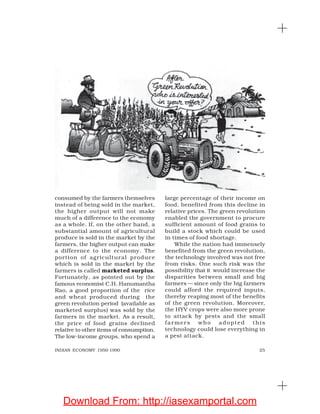
While the nation had immensely
benefited from the green revolution,
the technology involved was not free
from risks. One such risk was the
possibility that it would increase the
disparities between small and big
farmers — since only the big farmers
could afford the required inputs,
thereby reaping most of the benefits
of the green revolution. Moreover,
the HYV crops were also more prone
to attack by pests and the small
farmers who adopted this
technology could lose everything in
a pest attack.
Download From: http://iasexamportal.com
26 INDIAN ECONOMIC DEVELOPMENT
Fortunately, these fears did not
come true because of the steps taken
by the government. The government
provided loans at a low interest rate
to small farmers and subsidised
fertilisers so that small farmers could
also have access to the needed
inputs. Since the small farmers could
obtain the required inputs, the
output on small farms equalled the
output on large farms in the course
of time. As a result, the green
revolution benefited the small as well
as rich farmers. The risk of the small
farmers being ruined when pests
attack their crops was considerably
reduced by the services rendered by
research institutes established by the
government. You should note that
the green revolution would have
favoured the rich farmers only if the
state did not play an extensive role
in ensuring that the small farmer also
gains from the new technology.
The Debate Over Subsidies: The
economic justification of subsidies in
agriculture is, at present, a hotly
debated question. It is generally
agreed that it was necessary to use
subsidies to provide an incentive for
adoption of the new HYV technology
by farmers in general and small
farmers in particular. Any new
technology will be looked upon as
being risky by farmers. Subsidies
were, therefore, needed to encourage
farmers to test the new technology.
Some economists believe that once
the technology is found profitable
and is widely adopted, subsidies
should be phased out since their
purpose has been served. Further,
subsidies are meant to benefit the
farmers but a substantial amount of
fertiliser subsidy also benefits the
fertiliser industry; and among
farmers, the subsidy largely benefits
the farmers in the more prosperous
regions. Therefore, it is argued that
there is no case for continuing with
fertiliser subsidies; it does not benefit
the target group and it is a huge
burden on the government’s finances
(see also Box 2.6).
On the other hand, some believe
that the government should continue
with agricultural subsidies because
farming in India continues to be a
risky business. Most farmers are very
poor and they will not be able to
afford the required inputs without
subsidies. Eliminating subsidies will
increase the inequality between rich
and poor farmers and violate the goal
of equity. These experts argue that if
subsidies are largely benefiting the
fertiliser industry and big farmers,
the correct policy is not to abolish
subsidies but to take steps to ensure
that only the poor farmers enjoy the
benefits.
Thus, by the late 1960s, Indian
agricultural productivity had increased
sufficiently to enable the country to be
self-sufficient in food grains. This is an
achievement to be proud of. On the
negative side, some 65 per cent of the
country’s population continued to be
employed in agriculture even as late as
1990. Economists have found that as
Download From: http://iasexamportal.com
27INDIAN ECONOMY 1950-1990
a nation becomes more prosperous, the
proportion of GDP contributed by
agriculture as well as the proportion of
population working in the sector
declines considerably. In India,
between 1950 and 1990, the
proportion of GDP contributed by
agriculture declined significantly but
not the population depending on it
(67.5 per cent in 1950 to 64.9 per cent
by 1990). Why was such a large
proportion of the population engaged
in agriculture although agricultural
output could have grown with much
less people working in the sector? The
answer is that the industrial sector and
the service sector did not absorb the
people working in the agricultural
sector. Many economists call this an
important failure of our policies
followed during 1950-1990.
2.4 INDUSTRY AND TRADE
Economists have found that poor
nations can progress only if they have
a good industrial sector. Industry
provides employment which is more
stable than the employment in
agriculture; it promotes modernisation
and overall prosperity. It is for this
reason that the five year plans place
a lot of emphasis on industrial
development. You might have
studied in the previous chapter that,
at the time of independence, the
variety of industries was very narrow
Box 2.6: Prices as Signals
You would have learnt in an earlier class about how prices of goods are
determined in the market. It is important to understand that prices are signals
about the availability of goods. If a good becomes scarce, its price will rise and
those who use this good will have the incentive to make efficient decisions
about its use based on the price. If the price of water goes up because of lower
supply, people will have the incentive to use it with greater care; for example,
they may stop watering the garden to conserve water. We complain whenever
the price of petrol increases and blame it on the government. But the increase
in petrol price reflects greater scarcity and the price rise is a signal that less
petrol is available—this provides an incentive to use less petrol or look for
alternate fuels.
Some economists point out that subsidies do not allow prices to indicate
the supply of a good. When electricity and water are provided at a subsidised
rate or free, they will be used wastefully without any concern for their scarcity.
Farmers will cultivate water intensive crops if water is supplied free, although
the water resources in that region may be scarce and such crops will further
deplete the already scarce resources. If water is priced to reflect scarcity,
farmers will cultivate crops suitable to the region. Fertiliser and pesticide
subsidies result in overuse of resources which can be harmful to the
environment. Subsidies provide an incentive for wasteful use of resources.
Think about subsidies in terms of incentives and ask yourself whether it is
wise from the economic viewpoint to provide free electricity to farmers.
Download From: http://iasexamportal.com
28 INDIAN ECONOMIC DEVELOPMENT
— largely confined to cotton textiles
and jute. There were two well-
managed iron and steel firms — one
in Jamshedpur and the other in
Kolkata — but, obviously, we needed
to expand the industrial base with a
variety of industries if the economy
was to grow.
Market and State in Indian
Industrial Development: The big
question facing the policy makers was
— what should be the role of the
government and the private sector in
industrial development? At the time of
independence, Indian industrialists did
not have the capital to undertake
Work These Out
A group of students may visit an agricultural farm, prepare a case study on
the method of farming used, that is, types of seeds, fertilisers, machines,
means of irrigation, cost involved, marketable surplus and income earned.
It will be beneficial if the changes in cultivation methods could be collected
from an elderly member of the farming family
(a) Discuss the findings in your class.
(b) The different groups can then prepare a chart showing variations in
cost of production, productivity, use of seeds, fertilisers, means of
irrigation, time taken, marketable surplus and income of the family.
Collect newspaper cuttings related to the World Bank, International
Monetary Fund, World Trade Organisation (and meets of G7, G8, G10
countries). Discuss the views shared by the developed and developing
countries on farm subsidies.
Prepare pie charts on the occupational structure of the Indian economy
available in the following table.
Sector 1950–51 1990–91
Agriculture 72.1 66.8
Industry 10.7 12.7
Services 17.2 20.5
Study the arguments for and against agricultural subsidies. What is your
view on this issue?
Some economists argue that farmers in other countries, particularly
developed countries, are provided with high amount of subsidies and are
encouraged to export their produce to other countries. Do you think our
farmers will be able to compete with farmers from developed countries?
Discuss.
Download From: http://iasexamportal.com
29INDIAN ECONOMY 1950-1990
investment in industrial ventures
required for the development of our
economy; nor was the market big
enough to encourage industrialists to
undertake major projects even if they
had the capital to do so. It is principally
for these reasons that the state had to
play an extensive role in promoting the
industrial sector. In addition, the
decision to develop the Indian economy
on socialist lines led to the policy of the
state controlling the commanding
heights of the economy, as the Second
Five Year plan put it. This meant that
the state would have complete control
of those industries that were vital for
the economy. The policies of the private
sector would have to be complimentary
to those of the public sector, with the
public sector leading the way.
Industrial Policy Resolution 1956
(IPR 1956): In accordance with the
goal of the state controlling the
commanding heights of the economy,
the Industrial Policy Resolution of
1956 was adopted. This resolution
formed the basis of the Second Five
Year Plan, the plan which tried to
build the basis for a socialist pattern
of society. This resolution classified
industries into three categories. The
first category comprised industries
which would be exclusively owned by
the state; the second category
consisted of industries in which the
private sector could supplement the
efforts of the state sector, with the
state taking the sole responsibility for
starting new units; the third category
consisted of the remaining industries
which were to be in the private sector.
Although there was a category of
industries left to the private sector,
the sector was kept under state
control through a system of licenses.
No new industry was allowed unless
a license was obtained from the
government. This policy was used for
promoting industry in backward
regions; it was easier to obtain a
license if the industrial unit was
established in an economically
backward area. In addition, such
units were given certain concessions
such as tax benefits and electricity
at a lower tariff. The purpose of this
policy was to promote regional
equality.
Even an existing industry had to
obtain a license for expanding
output or for diversifying production
(producing a new variety of goods).
This was meant to ensure that the
quantity of goods produced was not
more than what the economy
required. License to expand
production was given only if the
government was convinced that the
economy required the larger
quantity of goods.
Small-scale Industry: In 1955, the
Village and Small-scale Industries
Committee, also called the Karve
Committee, noted the possibility of
using small-scale industries for
promoting rural development. A
‘small-scale industry’ is defined with
reference to the maximum invest-
ment allowed on the assets of a unit.
This limit has changed over a period
of time. In 1950 a small-scale
industrial unit was one which invested
Download From: http://iasexamportal.com
30 INDIAN ECONOMIC DEVELOPMENT
a maximum of rupees five lakh; at
present the maximum investment
allowed is rupees one crore.
It was believed that small-scale
industries are more ‘labour intensive’
i.e., they use more labour than the
large-scale industries and, therefore,
generate more employment. But these
industries cannot compete with the
big industrial firms; it is obvious that
development of small-scale industry
requires them to be shielded from the
large firms. For this purpose, the
production of a number of products
was reserved for the small-scale
industry; the criterion of reservation
being the ability of these units to
manufacture the goods. They were
also given concessions such as lower
excise duty and bank loans at lower
interest rates.
2.5 TRADE POLICY: IMPORT SUBSTITUTION
The industrial policy that we adopted
was closely related to the trade
policy. In the first seven plans,
trade was characterised by what
is commonly called an inward
looking trade strategy. Technically,
this strategy is called import
substitution. This policy aimed at
replacing or substituting imports
with domestic production. For
example, instead of importing
vehicles made in a foreign country,
industries would be encouraged to
produce them in India itself. In this
policy the government protected the
domestic industries from foreign
competition. Protection from imports
took two forms: tariffs and quotas.
Tariffs are a tax on imported goods;
they make imported goods more
expensive and discourage their use.
Quotas specify the quantity of goods
which can be imported. The effect of
tariffs and quotas is that they restrict
imports and, therefore, protect the
domestic firms from foreign
competition.
The policy of protection is based
on the notion that industries of
developing countries are not in a
position to compete against the
goods produced by more developed
economies. It is assumed that if the
domestic industries are protected
they will learn to compete in the
course of time. Our planners also
feared the possibility of foreign
exchange being spent on import of
luxury goods if no restrictions were
placed on imports. Nor was any
serious thought given to promote
exports until the mid-1980s.
Effect of Policies on Industrial
Development: The achievements of
India’s industrial sector during the
first seven plans are impressive
indeed. The proportion of GDP
contributed by the industrial
sector increased in the period from
11.8 per cent in 1950-51 to 24.6 per
cent in 1990-91. The rise in the
industry’s share of GDP is an
important indicator of development.
The six per cent annual growth rate
of the industrial sector during the
period is commendable. No longer
was Indian industry restricted largely
to cotton textiles and jute; in fact, the
industrial sector became well
Download From: http://iasexamportal.com
31INDIAN ECONOMY 1950-1990
diversified by 1990, largely due to
the public sector. The promotion
of small-scale industries gave
opportunities to those people who did
not have the capital to start large
firms to get into business. Protection
from foreign competition enabled the
development of indigenous industries
in the areas of electronics and
automobile sectors which otherwise
could not have developed.
In spite of the contribution made
by the public sector to the growth of
the Indian economy, some economists
are critical of the performance of
many public sector enterprises. It
was proposed at the beginning of this
chapter that initially public sector
was required in a big way. It is now
widely held that state enterprises
continued to produce certain goods
and services (often monopolising
them) although this was no longer
required. An example is the provision
of telecommunication service. The
government had the monopoly of this
service even after private sector firms
could also provide it. Due to the
absence of competition, even till the
late 1990s, one had to wait for a long
time to get a telephone connection.
Another instance could be the
establishment of Modern Bread, a
bread-manufacturing firm, as if the
Work These Out
Construct a pie chart for the following table on sectoral contribution to GDP
and discuss the difference in the contribution of the sectors in the light of
effects of development during 1950-91.
Sector 1950-51 1990-91
Agriculture 59.0 34.9
Industry 13.0 24.6
Services 28.0 40.5
Conduct a debate in your classroom on the usefulness of Public Sector
Undertakings (PSUs) by dividing the class into two groups. One group may
speak in favour of PSUs and the other group against the motion (involve as
many students as possible and encourage them to give examples).
Download From: http://iasexamportal.com
32 INDIAN ECONOMIC DEVELOPMENT
private sector could not manufacture
bread! In 2001 this firm was sold to
the private sector. The point is that
no distinction was made between (i)
what the public sector alone can do
and (ii) what the private sector can
also do. For example, even now only
the public sector can supply national
defense and free medical treatment
for poor patients. And even though
the private sector can manage hotels
well, yet, the government also runs
hotels. This has led some scholars to
argue that the state should get out
of areas which the private sector can
manage and the government may
concentrate its resources on
important services which the private
sector cannot provide.
Many public sector firms incurred
huge losses but continued to
function because it is very difficult,
almost impossible, to close a
government undertaking even if it is
a drain on the nation’s limited
resources. This does not mean that
private firms are always profitable
(indeed, quite a few of the public
sector firms were originally private
firms which were on the verge of
closure due to losses; they were then
nationalised to protect the jobs of the
workers). However, a loss-making
private firm will not waste resources
by being kept running despite the
losses.
The need to obtain a license to start
an industry was misused by
industrial houses; a big industrialist
would get a license not for starting a
new firm but to prevent competitors
from starting new firms. The excessive
regulation of what came to be called
the permit license raj prevented
certain firms from becoming more
efficient. More time was spent by
industrialists in trying to obtain a
license or lobby with the concerned
ministries rather than on thinking
about how to improve their products.
The protection from foreign
competition is also being criticised on
the ground that it continued even
after it proved to do more harm than
good. Due to restrictions on imports,
the Indian consumers had to
purchase whatever the Indian
producers produced. The producers
were aware that they had a captive
market; so they had no incentive to
improve the quality of their goods.
Why should they think of improving
quality when they could sell low
quality items at a high price?
Competition from imports forces our
producers to be more efficient.
Nevertheless, scholars point out
that the public sector is not meant
for earning profits but to promote the
welfare of the nation. The public
sector firms, on this view, should be
evaluated on the basis of the extent
to which they contribute to the welfare
of people and not on the profits they
earn. Regarding protection, some
economists hold that we should
protect our producers from foreign
competition as long as the rich
nations continue to do so. Owing to
all these conflicts, economists called
for a change in our policy. This,
alongwith other problems, led the
government to introduce a new
economic policy in 1991.
Download From: http://iasexamportal.com
33INDIAN ECONOMY 1950-1990
2.6 CONCLUSION
The progress of the Indian economy
during the first seven plans was
impressive indeed. Our industries
became far more diversified compared
to the situation at independence.
India became self- sufficient in food
production thanks to the green
revolution. Land reforms resulted in
abolition of the hated zamindari
system. However, many economists
became dissatisfied with the
performance of many public sector
enterprises. Excessive government
regulation prevented growth of
entrepreneurship. In the name of self-
reliance, our producers were
protected against foreign competition
and this did not give them the
incentive to improve the quality of
goods that they produced. Our
policies were ‘inward oriented’ and so
we failed to develop a strong export
sector. The need for reform of
economic policy was widely felt in the
context of changing global economic
scenario, and the new economic policy
was initiated in 1991 to make our
economy more efficient. This is the
subject of the next chapter.
Recap
After independence, India envisaged an economic system which combines
the best features of socialism and capitalism—this culminated in the mixed
economy model.
All the economic planning has been formulated through five year plans.
Common goals of five year plans are growth, modernisation, self-sufficiency
and equity.
The major policy initiatives in agriculture sector were land reforms and
green revolution. These initiatives helped India to become self-sufficient in
food grains production.
The proportion of people depending on agriculture did not decline as expected.
Policy initiatives in the industrial sector raised its contribution to GDP.
One of the major drawbacks in the industrial sector was the inefficient
functioning of the public sector as it started incurring losses leading to
drain on the nation’s limited resources.
Download From: http://iasexamportal.com
34 INDIAN ECONOMIC DEVELOPMENT
1. Define a plan.
2. Why did India opt for planning?
3. Why should plans have goals?
4. What are miracle seeds?
5. What is marketable surplus?
6. Explain the need and type of land reforms implemented in the
agriculture sector.
7. What is Green Revolution? Why was it implemented and how did
it benefit the farmers? Explain in brief.
8. Explain ‘growth with equity’ as a planning objective.
9. Does modernisation as a planning objective create contradiction
in the light of employment generation? Explain.
10. Why was it necessary for a developing country like India to follow
self-reliance as a planning objective?
11. What is sectoral composition of an economy? Is it necessary that
the service sector should contribute maximum to GDP of an
economy? Comment.
12. Why was public sector given a leading role in industrial
development during the planning period?
13. Explain the statement that green revolution enabled the
government to procure sufficient food grains to build its stocks
that could be used during times of shortage.
14. While subsidies encourage farmers to use new technology, they are
a huge burden on government finances. Discuss the usefulness of
subsidies in the light of this fact.
15. Why, despite the implementation of green revolution, 65 per cent
of our population continued to be engaged in the agriculture sector
till 1990?
16. Though public sector is very essential for industries, many public
sector undertakings incur huge losses and are a drain on the
economy’s resources. Discuss the usefulness of public sector
undertakings in the light of this fact.
EXERCISES
Download From: http://iasexamportal.com
35INDIAN ECONOMY 1950-1990
17. Explain how import substitution can protect domestic industry.
18. Why and how was private sector regulated under the IPR 1956?
19. Match the following:
1. Prime Minister A. Seeds that give large proportion of output
2. Gross Domestic B. Quantity of goods that can be imported
Product
3. Quota C. Chairperson of the planning commission
4. Land Reforms D. The money value of all the final goods
and services produced within the economy
in one year
5. HYV Seeds E. Improvements in the field of agriculture
to increase its productivity
6. Subsidy F. The monetary assistance given by
government for production
activities.
BHAGWATI, J. 1993. India in T ransition: Freeing the Economy. Oxford
University Press, Delhi.
DANDEKAR, V.M. 2004. Forty Years After Independence, in Bimal Jalan,
(Ed.). The Indian Economy: Problems and Prospects. Penguin, Delhi.
JOSHI, VIJAY. and I.M.D. LITTLE. 1996. India’s Economic Reforms 1991-2001.
Oxford University Press, Delhi.
MOHAN, RAKESH. 2004. Industrial Policy and Controls, in Bimal Jalan
(Ed.). The Indian Economy: Problems and Prospects. Penguin, Delhi.
RAO, C.H. HANUMANTHA. 2004. Agriculture: Policy and Performance, in Bimal
Jalan, (Ed.). The Indian Economy: Problems and Prospects. Penguin,
Delhi.
REFERENCES
Download From: http://iasexamportal.com
UNIT
II
ECONOMIC REFORMS
SINCE 1991
UNIT
III
UNIT
II
Download From: http://iasexamportal.com
After forty years of planned development, India
has been able to achieve a strong industrial base
and became self-sufficient in the production of food
grains. Nevertheless, a major segment of the
population continues to depend on agriculture for
its livelihood. In 1991, a crisis in the balance of
payments led to the introduction of economic
reforms in the country. This unit is an appraisal of
the reform process and its implications for India.
Download From: http://iasexamportal.com
After studying this chapter, the learners will
• understand the background of the reform policies introduced in India
in 1991
• understand the mechanism through which reform policies were
introduced
• comprehend the process of globalisation and its implications for India
• be aware of the impact of the reform process in various sectors.
LIBERALISATION, PRIVATISATION
AND
GLOBALISATION: AN APPRAISAL
3
Download From: http://iasexamportal.com
39LIBERALISATION, PRIVATISATION AND GLOBALISATION: AN APPRAISAL
3.1 INTRODUCTION
You have studied in the previous
chapter that, since independence,
India followed the mixed economy
framework by combining the
advantages of the market economic
system with those of the planned
economic system. Some scholars argue
that, over the years, this policy resulted
in the establishment of a variety of
rules and laws which were aimed at
controlling and regulating the
economy and instead ended up
hampering the process of growth and
development. Others state that India,
which started its developmental path
from near stagnation, has since been
able to achieve growth in savings,
developed a diversified industrial
sector which produces a variety of
goods and has experienced sustained
expansion of agricultural output
which has ensured food security.
In 1991, India met with an
economic crisis relating to its external
debt — the government was not
able to make repayments on its
borrowings from abroad; foreign
exchange reserves, which we
generally maintain to import petrol
and other important items, dropped
to levels that were not sufficient for
even a fortnight. The crisis was
further compounded by rising prices
of essential goods. All these led the
government to introduce a new set of
policy measures which changed the
direction of our developmental
strategies. In this chapter, we will
look at the background of the crisis,
measures that the government has
adopted and their impact on various
sectors of the economy.
3.2 BACKGROUND
The origin of the financial crisis can
be traced from the inefficient
management of the Indian economy
in the 1980s. We know that for
implementing various policies and
its general administration, the
government generates funds from
various sources such as taxation,
running of public sector enterprises
etc. When expenditure is more than
income, the government borrows to
finance the deficit from banks and
also from people within the country
and from international financial
institutions. When we import goods
like petroleum, we pay in dollars
which we earn from our exports.
Development policies required that
even though the revenues were
very low, the government had
to overshoot its revenue to meet
problems like unemployment, poverty
and population explosion. The
continued spending on development
programmes of the government did
not generate additional revenue.
Moreover, the government was not
There is a consensus in the world today that economic development is not all
and the GDP is not necessarily a measure of progress of a society.
K.R. Narayanan
Download From: http://iasexamportal.com
40 INDIAN ECONOMIC DEVELOPMENT
able to generate sufficiently from
internal sources such as taxation.
When the government was spending
a large share of its income on areas
which do not provide immediate
returns such as the social sector and
defence, there was a need to utilise the
rest of its revenue in a highly efficient
manner. The income from public
sector undertakings was also not very
high to meet the growing expenditure.
At times, our foreign exchange,
borrowed from other countries and
international financial institutions,
was spent on meeting consumption
needs. Neither was an attempt made
to reduce such profligate spending
nor sufficient attention was given to
boost exports to pay for the growing
imports.
In the late 1980s, government
expenditure began to exceed its
revenue by such large margins that
it became unsustainable. Prices of
many essential goods rose sharply.
Imports grew at a very high rate
without matching growth of exports.
As pointed out earlier, foreign
exchange reserves declined to a level
that was not adequate to finance
imports for more than two weeks.
There was also not sufficient foreign
exchange to pay the interest that
needs to be paid to international
lenders.
India approached the International
Bank for Reconstruction and
Development (IBRD), popularly
known as World Bank and the
International Monetary Fund (IMF),
and received $7 billion as loan to
manage the crisis. For availing the
loan, these international agencies
expected India to liberalise and open
up the economy by removing
restrictions on the private sector,
reduce the role of the government in
many areas and remove trade
restrictions.
India agreed to the conditionalities
of World Bank and IMF and
announced the New Economic Policy
(NEP). The NEP consisted of wide
ranging economic reforms. The
thrust of the policies was towards
creating a more competitive
environment in the economy and
removing the barriers to entry and
growth of firms. This set of policies
can broadly be classified into two
groups: the stabilisation measures
and the structural reform measures.
Stabilisation measures are short-
term measures, intended to correct
some of the weaknesses that have
developed in the balance of
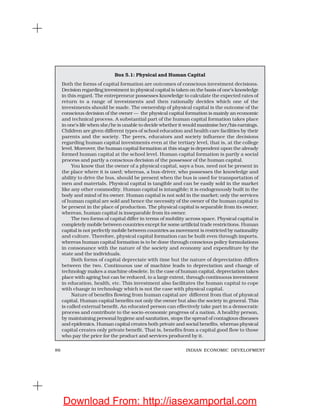
payments and to bring inflation
under control. In simple words, this
means that there was a need to
maintain sufficient foreign exchange
reserves and keep the rising prices
under control. On the other hand,
structural reform policies are long-term
measures, aimed at improving the
efficiency of the economy and increasing
its international competitiveness by
removing the rigidities in various
segments of the Indian economy. The
government initiated a variety of
policies which fall under three heads
viz., liberalisation, privatisation and
globalisation. The first two are policy
Download From: http://iasexamportal.com
41LIBERALISATION, PRIVATISATION AND GLOBALISATION: AN APPRAISAL
strategies and the last one is the
outcome of these strategies.
3.3 LIBERALISATION
As pointed out in the beginning,
rules and laws which were aimed at
regulating the economic activities
became major hindrances in growth
and development. Liberalisation was
introduced to put an end to these
restrictions and open up various
sectors of the economy. Though a few
liberalisation measures were
introduced in 1980s in areas of
industrial licensing, export-import
policy, technology upgradation,
fiscal policy and foreign investment,
reform policies initiated in 1991 were
more comprehensive. Let us study
some important areas such as the
industrial sector, financial sector, tax
reforms, foreign exchange markets
and trade and investment sectors
which received greater attention in
and after 1991.
Deregulation of Industrial Sector: In
India, regulatory mechanisms were
enforced in various ways (i) industrial
licensing underwhichevery entrepreneur
had to get permission from government
officials to start a firm, close a firm
or to decide the amount of goods
that could be produced (ii) private
sector was not allowed in many
industries (iii) some goods could be
produced only in small scale industries
and (iv) controls on price fixation and
distribution of selected industrial
products.
The reform policies introduced in
and after 1991 removed many of
these restrictions. Industrial
licensing was abolished for almost all
but product categories — alcohol,
cigarettes, hazardous chemicals
industrial explosives, electronics,
aerospace and drugs and pharma-
ceuticals. The only industries which
are now reserved for the public sector
are defence equipments, atomic
energy generation and railway
transport. Many goods produced by
small scale industries have now been
dereserved. In many industries, the
market has been allowed to
determine the prices.
Financial Sector Reforms:
Financial sector includes financial
institutions such as commercial
banks, investment banks, stock
exchange operations and foreign
exchange market. The financial
sector in India is controlled by the
Reserve Bank of India (RBI). You may
be aware that all the banks and other
financial institutions in India are
controlled through various norms
and regulations of the RBI. The RBI
decides the amount of money that
the banks can keep with themselves,
fixes interest rates, nature of lending
to various sectors etc. One of the
major aims of financial sector reforms
is to reduce the role of RBI from
regulator to facilitator of financial
sector. This means that the financial
sector may be allowed to take
decisions on many matters without
consulting the RBI.
Download From: http://iasexamportal.com
42 INDIAN ECONOMIC DEVELOPMENT
The reform policies led to the
establishment of private sector
banks, Indian as well as foreign.
Foreign investment limit in banks
was raised to around 50 per cent.
Those banks which fulfil certain
conditions have been given freedom
to set up new branches without the
approval of the RBI and rationalise
their existing branch networks.
Though banks have been given
permission to generate resources
from India and abroad, certain
aspects have been retained with the
RBI to safeguard the interests of the
account-holders and the nation.
Foreign Institutional Investors
(FII) such as merchant bankers,
mutual funds and pension funds are
now allowed to invest in Indian
financial markets.
Tax Reforms: Tax reforms are
concerned with the reforms in
government’s taxation and public
expenditure policies which are
collectively known as its fiscal
policy. There are two types of taxes:
direct and indirect. Direct taxes
consist of taxes on incomes of
individuals as well as profits of
business enterprises. Since 1991,
there has been a continuous
reduction in the taxes on individual
incomes as it was felt that high rates
of income tax were an important
reason for tax evasion. It is now
widely accepted that moderate rates
of income tax encourage savings and
voluntary disclosure of income. The
rate of corporation tax, which was
very high earlier, has been gradually
reduced. Efforts have also been made
to reform the indirect taxes, taxes
levied on commodities, in order to
facilitate the establishment of a
common national market for
goods and commodities. Another
component of reforms in this area is
simplification. In order to encourage
better compliance on the part of
taxpayers many procedures have
been simplified and the rates also
substantially lowered.
Foreign Exchange Reforms: The
first important reform in the external
sector was made in the foreign
exchange market. In 1991, as an
immediate measure to resolve the
balance of payments crisis, the rupee
was devalued against foreign
currencies. This led to an increase in
the inflow of foreign exchange. It also
set the tone to free the determination
of rupee value in the foreign
exchange market from government
control. Now, more often than not,
markets determine exchange rates
based on the demand and supply of
foreign exchange.
Trade and Investment Policy
Reforms: Liberalisation of trade and
investment regime was initiated to
increase international competitiveness
of industrial production and also
foreign investments and technology
into the economy. The aim was also
to promote the efficiency of the local
industries and the adoption of
modern technologies.
Download From: http://iasexamportal.com
43LIBERALISATION, PRIVATISATION AND GLOBALISATION: AN APPRAISAL
Work These Out
Give an example each of nationalised bank, private bank, private foreign
bank, FII and a mutual fund.
Visit a bank in your locality with your parents. Observe and find out the
functions it performs. Discuss the same with your classmates and prepare
a chart on it.
Classify the following as direct and indirect taxes: sales tax, custom duties,
property tax, death duties, VAT, income tax.
Find out from your parents if they pay taxes. If yes, why do they do so and
how?
Do you know that for a very long time countries used to keep silver and gold
as reserves to make payments abroad? Find out in what form do we keep
our foreign exchange reserves and find out from newspapers, magazines
and the Economic Survey how much foreign exchange reserves we have
today. Also find the foreign currency of the following countries and its rupee
exchange rate
Country Currency Value of 1(one) unit of foreign
currency in Indian rupee
U.S.A.
U.K.
Japan
China
Korea
Singapore
Germany
In order to protect domestic
industries, India was following a
regime of quantitative restrictions
on imports. This was encouraged
through tight control over imports
and by keeping the tariffs very high.
These policies reduced efficiency and
competitiveness which led to slow
growth of the manufacturing sector.
The trade policy reforms aimed at (i)
dismantlingofquantitative restrictions
on imports and exports (ii) reduction
of tariff rates and (iii) removal of
licensing procedures for imports.
Import licensing was abolished
except in case of hazardous and
environmentally sensitive industries.
Quantitative restrictions on imports of
manufactured consumer goods and
agricultural products were also fully
removed from April 2001. Export
duties have been removed to increase
the competitive position of Indian
goods in the international markets.
Download From: http://iasexamportal.com
44 INDIAN ECONOMIC DEVELOPMENT
3.4 PRIVATISATION
It implies shedding of the ownership
or management of a government
owned enterprise. Government
companies can be converted into
private companies in two ways (i) by
withdrawal of the government from
ownership and management of
public sector companies and or (ii) by
outright sale of public sector
companies.
Privatisation of the public sector
undertakings by selling off part of the
equity of PSUs to the public is known
as disinvestment. The purpose of the
sale, according to the government, was
mainly to improve financial discipline
and facilitate modernisation. It was also
envisaged that private capital and
managerial capabilities could be
effectively utilised to improve the
performance of the PSUs. The
Box 3.1: Navaratnas and Public Enterprise Policies
You must have read in your childhood about the famous Navaratnas or Nine
Jewels in the Imperial Court of King Vikramaditya who were eminent persons
of excellence in the fields of art, literature and knowledge. In 1996, in order to
improve efficiency, infuse professionalism and enable them to compete more
effectively in the liberalised global environment, the government chose nine
PSUs and declared them as navaratnas. They were given greater managerial
and operational autonomy, in taking various decisions to run the company
efficiently and thus increase their profits. Greater operational, financial and
managerial autonomy had also been granted to 97 other profit-making
enterprises referred to as mini ratnas.
The first set of navaratna companies included Indian Oil Corporation Ltd
(IOC), Bharat Petroleum Corporation Ltd (BPCL), Hindustan Petroleum
Corporation Ltd (HPCL), Oil and Natural Gas Corporation Ltd (ONGC), Steel
Authority of India Ltd (SAIL), Indian Petrochemicals Corporation Ltd (IPCL),
Bharat Heavy Electricals Ltd (BHEL), National Thermal Power Corporation
(NTPC) and Videsh Sanchar Nigam Ltd (VSNL). Later, two more PSUs — Gas
Authority of India Limited (GAIL) and Mahanagar Telephone Nigam Ltd
(MTNL)— were also given the same status.
Many of these profitable PSUs were originally formed during the 1950s
and 1960s when self-reliance was an important element of public policy. They
were set up with the intention of providing infrastructure and direct employment
to the public so that quality end-product reaches the masses at a nominal
cost and the companies themselves were made accountable to all stakeholders.
The granting of navaratna status resulted in better performance of these
companies. Scholars state that instead of facilitating navaratnas in their
expansion and enabling them to become global players, the government partly
privatised them through disinvesment. Of late, the government has decided
to retain the navaratnas in the public sector and enable them to expand
themselves in the global markets and raise resources by themselves from
financial markets.
Download From: http://iasexamportal.com
45LIBERALISATION, PRIVATISATION AND GLOBALISATION: AN APPRAISAL
government envisaged that privatisation
could provide strong impetus to the
inflow of FDI.
The government has also made
attempts to improve the efficiency of
PSUs by giving them autonomy in
taking managerial decisions. For
instance, some PSUs have been
granted special status as navaratnas
and mini ratnas (see Box 3.1).
3.5 GLOBALISATION
Globalisation is the outcome of the
policies of liberalisation and privati-
sation. Although globalisation is
generally understood to mean
integration of the economy of the
country with the world economy, it is a
complex phenomenon. It is an outcome
of the set of various policies that are
aimed at transforming the world
towards greater interdependence and
integration. It involves creation of
networks and activities transcending
economic, social and geographical
boundaries. Globalisation attempts to
establish links in such a way that the
happenings in India can be influenced
by events happening miles away. It is
turning the world into one whole or
creating a borderless world.
Outsourcing: This is one of the
important outcomes of the
globalisation process. In outsourcing,
a company hires regular service from
external sources, mostly from other
countries, which was previously
provided internally or from within the
country (like legal advice, computer
service, advertisement, security —
each provided by respective
departments of the company). As a
form of economic activity, outsourcing
has intensified, in recent times,
because of the growth of fast modes
of communication, particularly the
growth of Information Technology
(IT). Many of the services such as
voice-based business processes
(popularly known as BPO or
call centres), record keeping,
Work These Out
Some scholars refer to disinvestment as the wave of privatisation spreading
all over the world to improve the performance of public sector enterprises
whereas others call it as outright sale of public property to the vested
interests. What do you think?
Prepare a poster which contains 10-15 news clippings which you consider
as important and relating to navaratnas from newspapers. Also collect the
logos and advertisements of these PSUs. Put these on the notice board and
discuss them in the classroom.
Do you think only loss making companies should be privatised? Why?
Losses incurred by public sector undertakings are to be met out of the public
budget — do you agree with this statement? Discuss.
Download From: http://iasexamportal.com
46 INDIAN ECONOMIC DEVELOPMENT
accountancy, banking services,
music recording, film editing, book
transcription, clinical advice or even
teaching are being outsourced by
companies in developed countries to
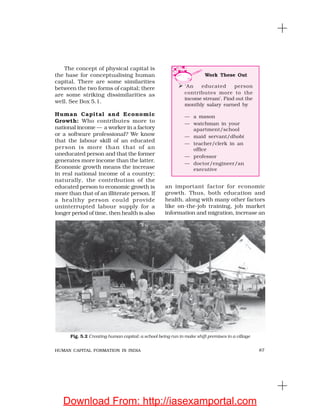
India. With the help of modern
telecommunication links including
the Internet, the text, voice and visual
data in respect of these services is
digitised and transmitted in real time
over continents and national
boundaries. Most multinational
corporations, and even small
companies, are outsourcing their
services to India where they can be
availed at a cheaper cost with
reasonable degree of skill and
accuracy. The low wage rates and
availability of skilled manpower in
India have made it a destination for
global outsourcing in the post-reform
period.
World Trade Organisation (WTO):
The WTO was founded in 1995 as
the successor organisation to the
General Agreement on Trade and
Tariff (GATT). GATT was established
in 1948 with 23 countries
as the global trade
organisation to administer
all multilateral trade
agreements by providing
equal opportunities to
all countries in the
international market for
trading purposes. WTO is
expected to establish a rule-
based trading regime in
which nations cannot place
arbitrary restrictions on
trade. In addition, its
purpose is also to enlarge
Box 3.2: Global Footprint!
Owing to globalisation, you might find many Indian companies expanding their
wings to many other countries. In 2000, Tata Tea surprised the world by
acquiring the UK based Tetley, the inventor of the tea bag, for Rs 1,870 crore.
In the year 2004, Tata steel bought the Singapore-based Nat steel for Rs 1,245
crore and Tata Motors completed the buyout of Daewoo’s heavy commercial
vehicle unit in South Korea for Rs 448 crore. Now VSNL is acquiring Tyco’s
undersea cable network for Rs 572 crore, which will control over 60,000 km
undersea cable network across three continents. The Tatas also plan to invest
Rs 8,800 crore in fertiliser, steel and power plants in Bangladesh.
Source: Business Today, 22 May 2005.
Fig. 3.1 Outsourcing: a new employment opportunity in big cities
Download From: http://iasexamportal.com
47LIBERALISATION, PRIVATISATION AND GLOBALISATION: AN APPRAISAL
production and trade of services, to
ensure optimum utilisation of world
resources and to protect the
environment. The WTO agreements
cover trade in goods as well as services
to facilitate international trade
(bilateral and multilateral) through
removal of tariff as well as non-tariff
barriers and providing greater market
access to all member countries.
As an important member of WTO,
India has been in the forefront of
framing fair global rules, regulations
and safeguards and advocating the
interests of the developing world.
India has kept its commitments
towards liberalisation of trade, made
in the WTO, by removing quantitative
restrictions on imports and reducing
tariff rates.
Work These Out
Many scholars argue that globalisation is a threat as it reduces the role of
the state in many sectors. Some counter argue that it is an opportunity as
it opens up markets to compete in and capture. Debate in the classroom.
Prepare a chart consisting of a list of five companies that have BPO services
in India, along with their turnover.
Read this excerpt of a news item from a daily newspaper describing
something that is now becoming increasingly common.
“On a morning, a few minutes before 7 A.M., Greeshma sat in front of
her computer with her headset on and said in accented English ‘Hello,
Daniella’. Seconds later, she gets the reply, ‘Hello, Greeshma’. The two chatted
excitedly before Greeshma said that ‘we will work on pronouns today’.
Nothing unusual about this chat except that Greeshma, 22, was in Kochi
and her student Daniella, 13, was at her home in Malibu, California. Using
a simulated whiteboard on their computers, connected by the Internet, and
a copy of Daniella’s textbook in front of Greeshma, she guides the teenager
through the intricacies of nouns, adjectives and verbs. Greeshma, who grew
up speaking Malayalam, was teaching Daniella English grammar,
comprehension and writing.”
How has this become possible? Why can’t Daniella get lessons in her
own country? Why is she getting English lessons from India, where
English is not the mother tongue?
India is benefiting from liberalisation and integration of world markets.
Do you agree?
Is employment in call centres sustainable? What kinds of skills should people
working in call centres acquire to get a regular income?
If the multinational companies outsource many services to countries like
India because of cheap manpower, what will happen to people living in the
countries where the companies are located? Discuss.
Download From: http://iasexamportal.com
48 INDIAN ECONOMIC DEVELOPMENT
Some scholars question the
usefulness of India being a member
of the WTO, as a major volume of
international trade occurs among the
developed nations. They also say that
while developed countries file
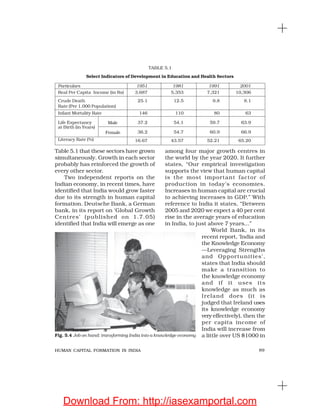
complaints over agricultural
subsidies given in their countries,
developing countries feel cheated as
they are forced to open up their
markets for developed countries but
are not allowed access to the markets
of developed countries. What do you
think?
3.6 IN D I A N EC O N O M Y DU R I N G
REFORMS: AN ASSESSMENT
The reform process has completed
one and a half decades since its
introduction. Let us now look at the
performance of the Indian economy
during this period. In economics,
growth of an economy is measured
by the Gross Domestic Product. Look
at Table 3.1. The table shows the
growth of GDP in different periods.
The growth of GDP increased from
5.6 per cent during 1980-91 to 6.4
per cent during 1992-2001. This
shows that there has been an
increase in the overall GDP growth
in the reform period. During the
reform period, the growth of
agriculture and industrial sectors
has declined whereas the growth of
service sector has gone up. This
indicates that the growth is mainly
driven by the growth in the service
sector. The Tenth Plan (2002-07) has
projected the GDP growth rate at
8 per cent. In order
to achieve such a
high growth rate, the
agriculture, industrial and
service sectors have to
grow at the rates of 4, 9.5
and 9.1 percentage points
respectively. However,
some scholars raise
apprehensions over the
projection of such high
rates of growth as
unsustainable.
The opening up of the
economy has led to rapid
increase in foreign direct
TABLE 3.1
Growth of GDP and Major Sectors (in %)
Sector 1980-91 1992- 2002-07
2001 (Tenth Plan
Projected)
Agriculture 3.6 3.3 4.0
Industry 7.1 6.5 9.5
Services 6.7 8.2 9.1
GDP 5.6 6.4 8.0
Source: Tenth Five Year Plan
Fig. 3.2 IT Industry is seen as a major contributor to India’s exports
Download From: http://iasexamportal.com
49LIBERALISATION, PRIVATISATION AND GLOBALISATION: AN APPRAISAL
investment and foreign exchange
reserves. The foreign investment, which
includes foreign direct investment
and foreign institutional investment,
has increased from about US $ 100
million in 1990-91 to US $ 150 billion
in 2003-04. There has been an
increase in the foreign exchange
reserves from about US $ 6 billion in
1990-91 to US $ 125 billion in
2004-05. At present, India is the sixth
largest foreign exchange reserve
holder in the world.
India is seen as a successful
exporter of auto parts, engineering
goods, IT software and textiles in the
reform period. Rising prices have
also been kept under control.
On the other hand, the reform
process has been widely criticised
for not being able to address some
of the basic problems facing our
economy esepecially in the areas of
employment, agriculture, industry,
infrastructure development and fiscal
management.
Growth and Employment: Though
the GDP growth rate has increased
in the reform period, scholars point
out that the reform-led growth has
not generated sufficient employment
Work These Out
In the previous chapter, you might have studied about subsidies in various
sectors including agriculture. Some scholars argue that subsidy in
agriculture should be removed to make the sector internationally competitive.
Do you agree? If so, how can it be done? Discuss in class.
Read the following passage and discuss in class.
Groundnut is a major oilseed crop in Andhra Pradesh. Mahadeva, who
was a farmer in Anantpur district of Andhra Pradesh, used to spend
Rs 1,500 for growing groundnut on his plot of half an acre. The cost included
expenditure on raw materials (seeds, fertilisers etc.), labour, bullock power
and machinery used. On an average, Mahadeva used to get two quintals of
groundnut, and each quintal was sold for Rs 1,000. Mahadeva, thus, was
spending Rs 1,500 and getting an income of Rs 2,000, Anantpur district is
a drought-prone area. As a result of economic reforms, the government did
not undertake any major irrigation project. Recently, groundnut crop in
Anantpur is facing problems due to crop disease. Research and extension
work has gone down due to lower government expenditure. Mahadeva and
his friends brought this matter repeatedly to the notice of the concerned
authorities, but failed. Subsidy was reduced on materials (seeds, fertilisers)
which increased Mahadeva’s cost of cultivation. Moreover, the local markets
were flooded with cheap imported edible oils, which was a result of removal
of restriction on imports. Mahadeva was not able to sell his groundnut in
the market as he was not getting the price to cover his cost.
Is a farmer like Mahadeva better off after reforms? Discuss in the class.
Download From: http://iasexamportal.com
50 INDIAN ECONOMIC DEVELOPMENT
opportunities in the country. You will
study the link between different
aspects of employment and growth in
the next unit.
Reforms in Agriculture: Reforms
have not been able to benefit
agriculture, where the growth rate
has been decelerating.
Public investment in agriculture
sector especially in infrastructure,
which includes irrigation, power, roads,
market linkages and research and
extension (which played a crucial role
in the Green Revolution), has been
reduced in the reform period. Further,
the removal of fertiliser subsidy has led
to increase in the cost of production,
which has severely affected the small
and marginal farmers. Moreover, since
the commencement of WTO, this sector
has been experiencing a number of
policy changes such as reduction in
import duties on agricultural products,
removal of minimum support price and
lifting of quantitative restrictions on
agricultural products; these have
adversely affected Indian farmers as
they now have to face increased
international competition.
Moreover, because of export-
oriented policy strategies in agriculture,
there has been a shift from production
for the domestic market towards
production for the export market
focusing on cash crops in lieu of
production of food grains. This puts
pressure on prices of food grains.
Reforms in Industry: Industrial
growth has also recorded a slowdown.
This is because of decreasing demand
of industrial products due to
various reasons such as cheaper
imports, inadequate investment in
infrastructure etc. In a globalised
world, developing countries are
compelled to open up their economies
to greater flow of goods and capital
from developed countries and
rendering their industries vulnerable to
imported goods. Cheaper imports
have, thus, replaced the demand
for domestic goods. Domestic
manufacturers are facing competition
from imports. The infrastructure
facilities, including power supply, have
remained inadequate due to lack of
investment. Globalisation is, thus, often
seen as creating conditions for the free
movement of goods and services from
foreign countries that adversely affect
the local industries and employment
opportunities in developing countries.
Moreover, a developing country
like India still does not have the
access to developed countries’
markets because of high non-tariff
barriers. For example, although all
quota restrictions on exports of
textiles and clothing have been
removed from our side, U.S.A. has
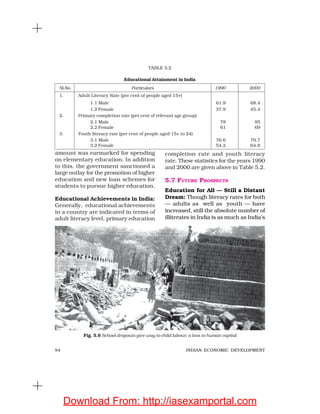
not removed their quota restriction
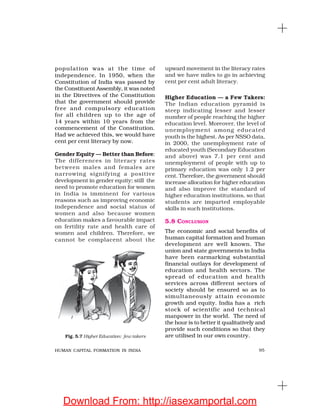
on import of textiles from India and
China!
Disinvestment: Every year, the
government fixes a target for
disinvestment of PSUs. For instance,
in 1991-92, it was targeted to
mobilise Rs 2,500 crore through
disinvestment. The government was
able to mobilise Rs 3,040 crore more
Download From: http://iasexamportal.com
51LIBERALISATION, PRIVATISATION AND GLOBALISATION: AN APPRAISAL
than the target. In 1998-99, the
target was Rs 5,000 crore whereas
the achievement was Rs 5,400 crore.
Critics point out that the assets of
PSUs have been undervalued and
sold to the private sector. This means
that there has been a substantial loss
to the government. Moreover, the
proceeds from disinvestment were
used to offset the shortage of
government revenues rather than
using it for the development of PSUs
and building social infrastructure in
the country.
Reforms and Fiscal Policies:
Economic reforms have placed limits
on the growth of public expenditure
especially in social sectors. The tax
reductions in the reform period,
aimed at yielding larger revenue and
to curb tax evasion, have not resulted
in increase in tax revenue for the
government. Also, the reform policies
involving tariff reduction have
curtailed the scope for raising
revenue through customs duties. In
order to attract foreign investment,
tax incentives were provided to
foreign investors which further
reduced the scope for raising tax
revenues. This has a negative impact
on developmental and welfare
expenditures.
3.7 CONCLUSION
The process of globalisation through
liberalisation and privatisation
policies has produced positive as well
as negative results both for India and
other countries. Some scholars argue
that globalisation should be seen as
an opportunity in terms of greater
access to global markets, high
technology and increased possibility
of large industries of developing
countries to become important
players in the international arena.
Box 3.3: Siricilla Tragedy!
As a part of liberalisation, privatisation and globalisation, the government
started to reform the power sector. The most important impact of these reforms
has been a steep hike in power tariff. Since the powerlooms, on which a large
number of industrial workers in cottage and small-scale sector depend, are
driven by power energy, the impact of high tariff on them has been very serious.
Further, while the power sector reforms have led to hike in tariffs, the power
producers have failed in providing quality power to the powerloom industry.
Since the wages of the powerloom workers are linked to the production of
cloth, power-cut means cut in wages of weavers who were already suffering
from hike in tariff. This led to a crisis in the livelihood of the weavers and fifty
powerloom workers committed suicide in a small town called ‘Siricilla’ in Andhra
Pradesh.
Do you think the power tariff should not be raised?
What would be your suggestions to improve the profitability of electricity
producing companies?
Download From: http://iasexamportal.com
52 INDIAN ECONOMIC DEVELOPMENT
On the contrary, the critics argue
that globalisation is a strategy of the
developed countries to expand their
markets in other countries. According
to them, it has compromised the
welfare and identity of people
belonging to poor countries. It has
further been pointed out that
market-driven globalisation has
widened the economic disparities
among nations and people.
Viewed from the Indian context,
some studies have stated that the
crisis that erupted in the early 1990s
was basically an outcome of the
deep-rooted inequalities in Indian
society and the economic reform
policies initiated as a response to the
crisis by the government, with
externally advised policy package,
further aggravated the inequalities.
Further, it has increased the income
and quality of consumption of only
high-income groups and the growth
has been concentrated only in
some select areas in the services
sector such as telecommunication,
information technology, finance,
entertainment, travel and hospitality
services, real estate and trade,
rather than vital sectors such as
agriculture and industry which
provide livelihoods to millions of
people in the country.
Recap
The economy was facing problems of declining foreign exchange, growing
imports without matching rise in exports and high inflation. India changed
its economic policies in 1991 due to a financial crisis and pressure from
international organisations like the World Bank and IMF.
In the domestic economy, major reforms were undertaken in the industrial
and financial sectors. Major external sector reforms included foreign
exchange deregulations and import liberalisation.
With a view to improving the performance of the public sector, there was a
consensus on reducing its role and opening it up to the private sector. This
was done through disinvestment and liberalisation measures.
Globalisation is the outcome of the policies of liberalisation and privatisation.
It means an integration of the economy of the country with the world
economy.
Outsourcing is an emerging business activity.
The objective of the WTO is to establish a rule based trade regime to ensure
optimum utilisation of world resources.
During the reforms, growth of agriculture and industry has gone down but
the service sector has registered growth.
Reforms have not benefited the agriculture sector. There has also been a
decline in public investment in this sector.
Industrial sector growth has slowed down due to availability of cheaper
imports and lower investment.
Download From: http://iasexamportal.com
53LIBERALISATION, PRIVATISATION AND GLOBALISATION: AN APPRAISAL
1. Why were reforms introduced in India?
2. How many countries are members of the WTO?
3. What is the most important function of RBI?
4. How was RBI controlling the commercial banks?
5. What do you understand by devaluation of rupee?
6. Distinguish between the following
(i) Strategic and Minority sale
(ii) Bilateral and Multi-lateral trade
(iii) Tariff and Non-tariff barriers.
7. Why are tariffs imposed?
8. What is the meaning of quantitative restrictions?
9. Those public sector undertakings which are making profits
should be privatised. Do you agree with this view? Why?
10. Do you think outsourcing is good for India? Why are developed
countries opposing it?
11. India has certain advantages which makes it a favourite
outsourcing destination. What are these advantages?
12. Do you think the navaratna policy of the government helps in
improving the performance of public sector undertakings in India?
How?
13. What are the major factors responsible for the high growth of the
service sector?
14. Agriculture sector appears to be adversely affected by the reform
process. Why?
15. Why has the industrial sector performed poorly in the reform pe-
riod?
16. Discuss economic reforms in India in the light of social justice
and welfare.
EXERCISES
Download From: http://iasexamportal.com
54 INDIAN ECONOMIC DEVELOPMENT
1. The table given below shows the GDP growth rate at 1993-94
prices. You have studied about the techniques of presentation
of data in your Statistics for Economics course. Draw a time
series line graph based on the data given in the table and interpret
the same.
Year GDP Growth Rate (%)
1991-92 1.3
1992-93 5.1
1993-94 5.9
1994-95 7.3
1996-97 7.8
1997-98 4.8
1998-99 6.5
2000-01 4.4
2001-02 5.8
2002-03 4.0
2. Observe around you — you will find State Electricity Boards
(SEBs), BSES and many public and private organisations sup-
plying electricity in a city and states. There are private buses on
roads along side the goverment bus services and so on
(i) What do you think about this dual system of the co-existence
of public and private sectors?
(ii) What are the merits and demerits of such a dual system?
Discuss.
3. With the help of your parents and grandparents prepare a list of
multinational companies that existed in India at the time of
independence. Now put a ( ) mark against those which are still
growing and a (× ) against those which do not exist any more. Are
there any companies whose names have changed? Find out the
new names, the country of origin, nature of product, logo and
prepare a chart for your class.
SUGGESTED ADDITIONAL ACTIVITIES
Download From: http://iasexamportal.com
55LIBERALISATION, PRIVATISATION AND GLOBALISATION: AN APPRAISAL
4. Give appropriate examples for the following
Nature of Product Name of a Foreign Company
Biscuits
Shoes
Computers
Cars
TV and Refrigerators
Stationery
Now find out if these companies which are mentioned above existed
in India before 1991 or came after the New Economic Policy. For this,
take the help of your teacher, parents, grandparents and shopkeepers.
5. Collect a few relevant newspaper cuttings on meetings organised
by WTO. Discuss the issues debated in these meetings and find
out how the organisation facilitates world trade.
6. Was it necessary for India to introduce economic reforms at the
behest of World Bank and International Monetary Fund? Was there
no alternative for the government to solve the balance of pay-
ments crisis? Discuss in the classroom.
Books
ACHARYA, S. 2003. India’s Economy: Some Issues and Answers. Academic
Foundation, New Delhi.
ALTERNATIVE SURVEY GROUP. 2005. Alternative Economic Survey, India 2004–05,
Diseqalising Growth. Daanish Books, Delhi.
AHLUWALIA, I.J. and I.M.D. LITTLE. 1998. India’s Economic Reforms and
Development. Oxford University Press, New Delhi.
BARDHAN, PRANAB. 1998. The Political Economy of Development in India.
Oxford University Press, Delhi.
BHADURI, AMIT and DEEPAK NAYYAR. 1996. The Intelligent Person’s Guide to
Liberalisation. Penguin, Delhi.
BHAGWATI, JAGDISH. 1992. India in Transition: Freeing the Economy. Oxford
University Press, Delhi.
REFERENCES
Download From: http://iasexamportal.com
56 INDIAN ECONOMIC DEVELOPMENT
BYRES, TERENCE J. 1997. The State, Development Planning and Liberalisation
in India. Oxford University Press, Delhi.
CHADHA, G.K. 1994. Policy Perspectives in Indian Economic Development.
Har-Anand, Delhi.
CHELLIAH, RAJA J. 1996. Towards Sustainable Growth: Essays in Fiscal and
Financial Sector Reforms in India. Oxford University Press, Delhi.
DEBROY, B. and RAHUL MUKHERJI (Eds.). 2004. The Political Economy of
Reforms. Bookwell Publication, New Delhi.
DREZE, JEAN and AMARTYA SEN. 1996. India: Economic Development and Social
Opportunity. Oxford University Press, Delhi.
DUTT, RUDDAR AND K.P.M. SUNDARAM. 2005. Indian Economy. S. Chand and
Company, New Delhi.
GUHA, ASHOK (Ed.) 1990. Economic Liberalisation, Industrial Structure and
Growth in India. Oxford University Press, Delhi.
JALAN, BIMAL. 1993. India’s Economic Crisis: The Way Ahead. Oxford
University Press, Delhi.
JALAN, BIMAL. 1996. India’s Economic Policy: Preparing for the Twenty First
Century. Viking, Delhi.
JOSHI,VIJAY and I.M.D. LITTLE. 1996. India’s Economic Reforms 1991-2001.
Oxford University Press, Delhi,
KAPILA, Uma. 2005. Understanding the Problems of Indian Economy.
Academic Foundation, New Delhi.
MAHAJAN, V.S. 1994. Indian Economy Towards 2000 A.D. Deep & Deep,
Delhi.
PAREKH, KIRIT and RADHAKRISHNA, 2002, India Development Report 2001-02.
Oxford University Press, New Delhi.
RAO, C.H. HANUMANTHA. and HANS LINNEMANN. 1996. Economic Reforms and
Poverty Alleviation in India, Sage Publication, Delhi.
SACHS, JEFFREY D., ASHUTOSH VARSHNEY and NIRUPAM BAJPAI.1999. India in the
Era of Economic Reforms. Oxford University Press, New Delhi.
Government Reports
Economic Survey 2005-06. Ministry of Finance, Government of India.
Tenth Five Year Plan 1997-2002. Vol. 1. Government of India, Planning
Commission, New Delhi.
Download From: http://iasexamportal.com
CURRENT CHALLENGES FACING THE
INDIAN ECONOMY
UNIT
III
UNIT
III
Download From: http://iasexamportal.com
Some of the most challenging issues facing India
today are poverty, development of rural India and
building infrastructure. We are a billion-strong
country today and our human capital is the biggest
asset; it needs investment in health and education.
We also need to understand the concept of
employment and the need for creating more
employment in our country. We will also look at
the implications of development on our environment
and call for sustainable development. There is a
need to critically assess government initiatives in
tackling all these issues each of which has been
taken up separately in this unit.
Download From: http://iasexamportal.com
After studying this chapter, the learners will
• understand the various attributes of poverty
• comprehend the diverse dimensions relating to the concept of poverty
• critically appreciate the way poverty is estimated
• appreciate and be able to assess existing poverty alleviation programmes.
POVERTY
4
Download From: http://iasexamportal.com
60 INDIAN ECONOMIC DEVELOPMENT
4.1 INTRODUCTION
In previous chapters, you have
studied the economic policies that
India has taken in the last five and a
half decades and the outcome of
these policies with relation to the
various developmental indicators.
Providing minimum basic needs to
the people and reduction of poverty
have been the major aims of
independent India. The pattern of
development that the successive five
year plans envisaged laid emphasis
on the upliftment of the poorest of
the poor (Antyodaya), integrating the
poor into the mainstream and
achieving a minimum standard of
living for all.
While addressing the Constituent
Assembly in 1947, Jawaharlal Nehru
had said, “This achievement
(Independence) is but a step, an
opening of opportunity, to the great
triumphs and achievements that
await us… the ending of poverty and
ignorance and disease and inequality
of opportunity.”
However we need to know where
we stand today. Poverty is not only a
challenge for India, as more than one-
fifth of the world’s poor live in India
alone; but also for the world, where
more than 260 million people are not
able to meet their basic needs.
Poverty has many faces, which
have been changing from place to
place and across time, and has been
described in many ways. Most often,
poverty is a situation that people
want to escape. So poverty is a call
to action — for the poor and the
wealthy alike — a call to change the
world so that many more may have
enough to eat, adequate shelter,
access to education and health,
protection from violence, and a voice
in what happens in their
communities.
To know what helps to reduce
poverty, what works and what does
not, what changes over time, poverty
has to be defined, measured and
studied — and even experienced. As
poverty has many dimensions, it has
to be looked at through a variety of
indicators — levels of income and
consumption, social indicators, and
indicators of vulnerability to risks
and of socio/political access.
4.2 WHO ARE THE POOR?
You would have noticed that in all
localities and neighbourhoods, both
in rural and urban areas, there are
some of us who are poor and some
who are rich. Read the story of Anu
and Sudha. Their lives are examples
of the two extremes (see Box 4.1).
There are also people who belong to
the many stages in between.
Push cart vendors, street
cobblers, women who string flowers,
No society can surely be flourishing and happy, of which the far greater
part of the members are poor and miserable.
Adam Smith
Download From: http://iasexamportal.com
61POVERTY
Box 4.1: Anu and Sudha
Anu and Sudha were both born on the same day. Anu’s mother and father
were construction labourers and Sudha’s father was a businessman and her
mother a designer.
Anu’s mother worked by carrying head loads of bricks until she went into
labour. She then went behind the tool shed on the construction site and
delivered her baby alone. She fed her child and then wrapped her in an old
sari, made a cradle with a gunny sack, put little Anu in it and hung it from a
tree. She hurried back to work as she was afraid she would lose her job. She
hoped that Anu would sleep until evening.
Sudha was born in one of the best nursing homes in the city. She was
thoroughly checked by doctors, she was bathed and dressed in clean soft
clothes and placed in a crib next to her mother. Her mother fed her whenever
she was hungry, hugged and kissed her and sang her to sleep. Her family
and friends celebrated her arrival.
Anu and Sudha had very different childhoods. Anu learnt to look after
herself at a very early age. She knew what hunger and deprivation were. She
discovered how to pick food from the dustbin, how to keep warm during the
winter, to find shelter in the monsoon and how to play with a piece of string,
stones and twigs. Anu could not go to school as her parents were migrant
workers who kept moving from city to city in search of work.
Anu loved to dance. Whenever she heard music she would improvise. She
was very beautiful and her movements were graceful and evocative. Her dream
was to dance on a stage some day. Anu could have become a great dancer
but she had to begin work at the age of 12. She had to earn a living with her
mother and father, building houses for the rich. Houses, she would never live in.
Sudha went to a very good play school where she learnt how to read,
write and count. She went on excursions to the planetarium, museum and
national parks. She later went to a very good school. She loved painting and
started getting private lessons from a famous artist. She later joined a design
school and became a well known painter.
rag pickers, vendors and beggars are
some examples of poor and
vulnerable groups in urban areas.
They possess few assets. They reside
in kutcha hutments with walls made
of baked mud and roofs made of
grass, thatch, bamboo and wood. The
poorest of them do not even have
such dwellings. In rural areas many
of them are landless. Even if some of
them possess land, it is only dry or
waste land. Many do not get to have
even two meals a day. Starvation and
hunger are the key features of the
poorest households. The poor
lack basic literacy and skills and
hence have very limited economic
opportunities. Poor people also face
unstable employment.
Malnutrition is alarmingly high
among the poor. Ill health, disability
or serious illness makes them
Download From: http://iasexamportal.com
62 INDIAN ECONOMIC DEVELOPMENT
physically weak. They
borrow from money
lenders who charge high
rates of interest that
lead them into chronic
indebtedness. The poor
are highly vulnerable.
They are not able to
negotiate their legal
wages from employers
and are exploited. Most
poor households have
no access to electricity.
Their primary cooking
fuel is firewood and cow
dung cake. A large
section of poor people
do not even have access to safe
drinking water. There is evidence of
extreme gender inequality in the
participation of gainful employment,
education and in decision-making
within the family. Poor women receive
less care on their way to
motherhood. Their children are less
likely to survive or be born healthy.
Scholars identify the poor on the
basis of their occupation and
ownership of assets. They state that
the rural poor work mainly as
landless agricultural labourers,
cultivators with very small
landholdings, landless labourers
who are engaged in a variety of
non-agricultural jobs and tenant
cultivators with small land holdings.
The urban poor are
largely the overflow
of the rural poor
who had migrated
to urban areas in
search of alternative
employment and
livelihood, labourers
who do a variety of
casual jobs and the
self-emloyed who sell
a variety of things on
roadsides and are
engaged in various
activities.
Fig. 4.2 Many poor families live in kutcha houses
Fig. 4.1 Majority of agricultural labourers are poor
Download From: http://iasexamportal.com
63POVERTY
4.3 HOW ARE POOR PEOPLE IDENTIFIED?
If India is to solve the problem of
poverty, it has to find viable and
sustainable strategies to address the
causes of poverty and design schemes
to help the poor out of their situation.
However, for these schemes to be
implemented, the government needs
to be able to identify who the poor are.
For this there is need to develop a
scale to measure poverty, and the
factors that make up the criteria for
this measurement or mechanism need
to be carefully chosen.
In pre-independent India,
Dadabhai Naoroji was the first to
discuss the concept of a Poverty Line.
He used the menu for a prisoner and
used appropriate prevailing prices to
arrive at what may be called ‘jail cost
of living’. However, only adults stay
in jail whereas, in an actual society,
there are children too. He, therefore,
appropriately adjusted this cost of
living to arrive at the poverty line.
For this adjustment, he assumed
that one-third population consisted
of children and half of them
consumed very little while the other
half consumed half of the adult
diet. This is how he arrived at the
factor of three-fourths; (1/6)(Nil) +
(1/6)(Half) + (2/3)(Full) = (3/4)
(Full). The weighted average of
consumption of the three segments
gives the average poverty line,
which comes out to be three-fourth
of the adult jail cost of living.
In post-independent India, there
have been several attempts to work
out a mechanism to identify the
number of poor in the country. For
instance, in 1962, the Planning
Commission formed a Study Group.
In 1979, another body called the
‘Task Force on Projections of
Minimum Needs and Effective
Consumption Demand’ was formed.
In 1989, an ‘Expert Group’ was
constituted for the same purpose.
Box 4.2 : What is Poverty?
Two scholars, Shaheen Rafi Khan and Damian Killen, put the conditions of
the poor in a nutshell: Poverty is hunger. Poverty is being sick and not being
able to see a doctor. Poverty is not being able to go to school and not knowing
how to read. Poverty is not having a job. Poverty is fear for the future, having
food once in a day. Poverty is losing a child to illness, brought about by unclear
water. Poverty is powerlessness, lack of representation and freedom.
What do you think?
Chart 4.1: Poverty Line
Download From: http://iasexamportal.com
64 INDIAN ECONOMIC DEVELOPMENT
Besides these bodies, many
individual economists have also
attempted to develop such a
mechanism.
For the purpose of defining
poverty we divide people into two
categories; the poor and the non-poor
and the poverty line separates the
two. However, there are many kinds
of poor; the absolutely poor, the very
poor and the poor. Similarly there are
various kinds of non-poor; the
middle class, the upper middle class,
the rich, the very rich and the
absolutely rich. Think of this as a line
or continuum from the very poor to
the absolutely rich with the poverty
line dividing the poor from the non-
poor.
Categorising Poverty: There are many
ways to categorise poverty. In one such
way people who are always poor and
those who are usually poor but who
may sometimes have a little more
money (example: casual workers) are
grouped together as the chronic poor.
Another group are the churning poor
who regularly move in and out of
poverty (example: small farmers
and seasonal workers) and the
occasionally poor who are rich most
of the time but may sometimes have a
patch of bad luck. They are called the
transient poor. And then there are
those who are never poor and they are
the non-poor (Chart 4.2).
The Poverty Line: Now let us
examine how to determine the
poverty line. There are many ways of
measuring poverty. One way is to
determine it by the monetary value
(per capita expenditure) of the
minimum calorie intake that was
estimated at 2,400 calories for a rural
person and 2,100 for a person in the
urban area. Based on this, in 1999-
2000, the poverty line was defined
for rural areas as consumption worth
Rs 328 per person a month and for
urban areas it was Rs 454.
Though the government uses
Monthly Per Capita Expenditure (MPCE)
as proxy for income of households to
identify the poor, do you think this
mechanism satisfactorily identifies the
poor households in our country?
Chart 4.2: The Chronic Poor, Transient Poor and Non-Poor
Download From: http://iasexamportal.com
65POVERTY
Scholars state that a major
problem with this mechanism is that
it groups all the poor together and
does not differentiate between the
very poor and the other poor. Though
this mechanism takes consumption
expenditure on food and a few select
items as proxy for income,
economists question its basis. This
mechanism is helpful in identifying
the poor as a group to be taken care
of by the government, but it would
be difficult to identify who among the
poor need help the most.
There are many factors, other
than income and assets, which are
associated with poverty; for instance,
the accessibility to basic education,
health care, drinking water and
sanitation. The mechanism for
determining the Poverty Line also
does not take into consideration
social factors that trigger and
perpetuate poverty such as illiteracy,
ill health, lack of access to resources,
discrimination or lack of civil and
political freedoms. The aim of poverty
alleviation schemes should be to
improve human lives by expanding
the range of things that a person
could be and could do, such as to be
healthy and well-nourished, to be
knowledgeable and participate in the
life of a community. From this point
of view, development is about
removing the obstacles to the things
that a person can do in life, such as
illiteracy, ill health, lack of access to
resources, or lack of civil and political
freedoms.
Though the government claims
that higher rate of growth, increase in
agricultural production, providing
employment in rural areas and
economic reform packages introduced
in the 1990s have resulted in a
decline in poverty levels, economists
raise doubts about the government’s
claim. They point out that the way the
data are collected, items that are
included in the consumption basket,
methodology followed to estimate the
poverty line and the number of poor
are manipulated to arrive at the
reduced figures of the number of poor
in India.
Due to various limitations in the
official estimation of poverty, scholars
have attempted to find alternative
methods. For instance, Amartya Sen,
noted Nobel Laureate, has developed
an index known as Sen Index. There
are other tools such as Poverty Gap
Index and Squared Poverty Gap. You
will learn about these tools in higher
classes.
Fig. 4.3 Safe drinking water and sanitation are
essential for all
Download From: http://iasexamportal.com
66 INDIAN ECONOMIC DEVELOPMENT
4.4 THE NUMBER OF POOR IN INDIA
When the number of poor is
estimated as the proportion of
people below the poverty line, it is
known as ‘Head Count Ratio’.
You might be interested in
knowing the total number of poor
persons residing in India. Where do
they reside and has their number or
proportion declined over the years or
not? When such a comparative
analysis of poor people is made
in terms of ratios and percentages,
we will have an idea of different
levels of poverty of people and
their distribution; between states and
over time.
The official data on poverty is made
available to the public by the Planning
Commission. It is estimated on the
basis of consumption expenditure data
collected by the National Sample Survey
Organisation (NSSO). Chart 4.3 shows
the number of poor and their
Chart 4.3: Trends in Poverty in India, 1973–2000
Number of Poor (in millions) Head Count Ratio (%)
Work These Out
In Sections 4.2 and 4.3, you will notice that the poor are identified not only
with income and expenditure related indicators but also with many other
items such as access to land, housing, education, health, sanitation. Also
to be considered is discriminatory practices. Discuss how an alternative
poverty line could be constructed in such a way that it includes all the
other indicators.
On the basis of the given definition for poverty line, find out whether people
who work as domestic help, dhobies and newspaper vendors etc. in your
locality/neighbourhood are above the poverty line or not.
Download From: http://iasexamportal.com
67POVERTY
proportion to the population in India
for the years 1973-2000. In 1973-74,
more than 321 million people were
below the poverty line. In 1999-
2000, this number has come down
to about 260 million. In terms of
proportion, in 1973-74, about 55
per cent of the total population was
below the poverty line. In 1999-
2000, it has fallen to 26 per cent. In
1973-74, more than 80 per cent of
the poor resided in rural areas and
in 1999-2000, this has come down
to about 75 per cent. This means
that more than three-fourth of the
poor in India reside in villages. Also
poverty, which was prevailing
predominantly in rural areas, has
shifted to urban areas.
In the 1990s, the absolute
number of poor in rural areas had
declined whereas the number of their
urban counterparts increased
marginally. The poverty ratio declined
continuously for both urban and
rural areas. From Chart 4.3, you will
notice that during 1973-2000, there
has been a decline in the number of
poor and their proportion but the
nature of decline in the two
parameters is not encouraging. The
ratio is declining much slower than
the absolute number of poor in the
country. You will also notice that
the gap between the absolute
number of poor in rural and urban
areas did not narrow down until the
early 1990s whereas in the case of
Chart 4.4: Population Below Poverty Line in Some Large States, 1973-2000 (%)
Note: Uttar Pradesh includes the present Uttaranchal; Madhya Pradesh includes
Chhattisgarh and Bihar includes Jharkhand
Download From: http://iasexamportal.com
68 INDIAN ECONOMIC DEVELOPMENT
problems, such as (i) low capital
formation (ii) lack of infrastructure
(iii) lack of demand (iv) pressure of
population (v) lack of social/welfare
nets.
In Chapter 1 you have read
about the British rule in India.
Although the final impact of the
British rule on Indian living
standards is still being debated, there
is no doubt that there was a
substantial negative impact on the
Indian economy and standard of
living of the people. There was
substantial de-industrialisation in
India under the British rule. Imports
of manufactured cotton cloth from
Lancashire in England displaced
much local production, and India
reverted to being an exporter of
cotton yarn, not cloth.
As over 70 per cent of Indians
were engaged in agriculture
throughout the British Raj period,
the impact on that sector was more
important on living standards than
anything else. British policies
involved sharply raising rural taxes
that enabled merchants and
moneylenders to become large
landowners. Under the British,
India began to export food grains
and, as a result, as many as 26
million people died in famines
between 1875 and 1900.
Britain’s main goals from the Raj
were to provide a market for British
exports, to have India service its
debt payments to Britain, and for
India to provide manpower for the
British imperial armies.
ratio the gap has remained the same
until 1999-2000.
The state level trends in poverty
are shown in Chart 4.4. It reveals that
five states — Uttar Pradesh, Bihar,
Madhya Pradesh, West Bengal and
Orissa — account for about 70 per
cent of India’s poor. You will also
notice that during 1973-74, about
half the population in most of these
large states was living below the
poverty line. In 1999-2000, only two
states — Bihar and Orissa — were left
near that same level. Though they also
reduced their share of poor, compared
to other states, their success is
marginal. If we look at Gujarat, it
reduced its people below the poverty
line from 48 per cent to 15 per cent
during 1973-2000. During this
period, West Bengal has been just as
successful; from nearly two-third, i.e.
63 per cent of the population below
the poverty line the same was reduced
to about 27 per cent.
4.5 WHAT CAUSES POVERTY?
Poverty is explained by individual
circumstances and/or charac-
teristics of poor people. Some
examples are (i)low levels of
education and skills (ii) infirmity, ill
health, sickness (iii) discrimination.
These can be caused as a result of
(i) social, economic and political
inequality (ii) social exclusion (iii)
unemployment (iv) indebtedness (v)
unequal distribution of wealth.
Aggregate poverty is just the sum of
individual poverty. Poverty is also
explained by general, economy-wide
Download From: http://iasexamportal.com
69POVERTY
TheBritishRaj impoverished
millions of people in India. Our
natural resources were
plundered, our industries
worked to produce goods at
low prices for the British and
our food grains were exported.
Many died due to famine and
hunger. In 1857-58, anger at
the overthrow of many local
leaders, extremely high taxes
imposed on peasants, and
other resentments boiled over
in a revolt against British rule
by the sepoys, Indian troops
commanded by the British.
Even today agriculture is
the princip al means of
livelihood and land is the primary
asset of rural people; ownership of
land is an important determinant of
material well-being and those who
own some land have a better chance
to improve their living conditions.
Sinceindependence, thegovernment
has attempted to redistribute land and
has taken land from those who have
large amounts to distribute it to those
who do not have any land, but work
on the land as wage labourers.
However, this move was successful
only to a limited extent as large
sections of agricultural workers were
not able to farm the small holdings
that they now possessed as they did
not have either money (assets) or
skills to make the land productive
and the land holdings were too small
to be viable.
A large section of the rural poor
in India are the small farmers. The
land that they have is, in general,
less fertile and dependent on
rains. Their survival depends on
subsistence crops and sometimes on
livestock. With the rapid growth of
population and without alternative
sources of employment, the per-head
availability of land for cultivation
has steadily declined leading to
fragmentation of land holdings. The
income from these small land
holdings is not sufficient to meet the
family’s basic requirements.
You must have heard about
farmers committing suicide due to
their inability to pay back the loans
that they have taken for cultivation
and other domestic needs as their
crops have failed due to drought or
other natural calamities (see Box 4.3).
The scheduled castes and
scheduled tribes are not able to
participate in the emerging employment
opportunities in different sectors of the
Fig. 4.4 Low quality self-employment sustains poverty
Download From: http://iasexamportal.com
70 INDIAN ECONOMIC DEVELOPMENT
urban and rural economy as they do not
have the necessary knowledge and skills
to do so.
The urban poor in India are
largely the overflow of the rural poor
who migrate to urban areas in search
of employment and a livelihood.
Industrialisation has not been able
to absorb all these people.
Most of the urban poor are
either unemployed or
intermittently employed as
casual labourers. Casual
labourers are among the most
vulnerable in society as they
have no job security, no
assets, limited skills, sparse
opportunities and no surplus
to sustain them.
Poverty is, therefore, also
closely related to nature of
employment. Unemployment or
under employment and the
casual and intermittent nature
of work in both rural and urban areas
that compels indebtedness, in turn,
reinforces poverty. Indebtedness is
one of the significant factors of
poverty.
A steep rise in the price of food
grains and other essential goods, at
Work These Out
When you go to the market, or visit religious places and historical monuments
you may often find women begging with their children. Spare a few moments
and speak to a few of them. Collect details about what made them to take
up this activity, where they live with their family members, number of meals
they are able to consume in a day, whether they possess any physical assets
and why they could not take up a job. Discuss the details that you have
collected in the classroom.
You will notice many poor households as described above in your own locality
or neighbourhood. Choose two or three such households and develop their
family profile which can include the details of occupation, literacy level,
ownership of assets and other information. Discuss them in class.
List the activities of people in rural and urban areas separately. You may
also list the activities of the non-poor. Compare the two and discuss in the
classroom why the poor are unable to take up such activities.
Fig. 4.5 Quality employment is still a dream for the poor
Download From: http://iasexamportal.com
71POVERTY
Box 4.3: Distress Among Cotton Farmers
Many small land owning farmers and farming households and weavers are descending
into poverty due to globalisation related shock and lack of perceived income earning
opportunities in relatively well performing states in India. Where households have
been able to sell assets, or borrow, or generate income from alternative employment
opportunities, the impact of such shocks may
be transient. However, if the household has no
assets to sell or no access to credit, or is able to
borrow only at exploitative rates of interest and
gets into a severe debt trap, the shocks can have
long duration ramification in terms of pushing
households below the poverty line. The worst
form of this crisis is suicides. The count reached
3,000 in Andhra Pradesh alone and is rising. In
December 2005, the Maharashtra government
admitted that over 1,000 farmers have committed
suicides in the state since 2001.
India has the largest area under cotton
cultivation in the world covering 8,300 hectares
in 2002–03. The low yield of 300 kg per hectare
pushes it into third position in production. High
production costs, low and unstable yields,
decline in world prices, global glut in production
due to subsidies by the U.S.A. and other
countries, and opening up of the domestic
market due to globalisation have increased the
exposure of farmers and led to agrarian distress
and suicides especially in the cotton belt of Andhra Pradesh and Maharashtra. The
issue is not one of profits and higher returns but that of the livelihood and survival
of millions of small and marginal farmers who are dependent on agriculture.
Scholars cite several factors that have led farmers to commit suicides (i) the
shift from traditional farming to the farming of high yielding commercial crops without
adequate technical support combined with withdrawal of the state in the area of
agricultural extension services in providing counselling on farm technologies,
problems faced, immediate remedial steps and lack of timely advice to farmers (ii)
decline in public investment in agriculture in the last two decades (iii) low rates of
germination of seeds provided by large global firms, spurious seeds and pesticides by
private agents (iv) crop failure, pest attack and drought (v) debt at very high interest
rate of 36 per cent to 120 per cent from private money lenders (vi) cheap imports
leading to decline in pricing and profits (vii) lack of access to water for crops which
forced the farmers to borrow money at exorbitant rates of interest to sink borewells
that failed.
Sources: Excerpted from A.K. Mehta and Sourabh Ghosh assited by Ritu Elwadhi,
“Globalisation, Loss of Livelihoods and Entry into Poverty,” Alternative Economic
Survey, India 2004-2005, Alternative Survey Group, Daanish Books, Delhi 2005
and P. Sainath, The swelling ‘Register of Deaths’, The Hindu, 29 December 2005.
Shantabai, wife of Neelakanta
Sitaram Khoke who committed
suicide in Yavatma, Maharashtra
Download From: http://iasexamportal.com
72 INDIAN ECONOMIC DEVELOPMENT
a rate higher than the price of luxury
goods, further intensifies the
hardship and deprivation of lower
income groups. The unequal
distribution of income and assets has
also led to the persistence of poverty
in India.
All this has created two distinct
groups in society: those who posses
the means of production and earn
good incomes and those who have
only their labour to trade for survival.
Over the years, the gap between the
rich and thepoor in India has widened.
Poverty is a multi-dimensional
challenge for India that needs to be
addressed on a war footing.
4.6 POLICIES AND PROGRAMMES
TOWARDS POVERTY ALLEVIATION
The Indian Constitution and five
year plans state social justice as
the primary objective of the
developmental strategies of the
government. To quote the First Five
Year Plan (1951-56), “the urge to
bring economic and social change
under present conditions comes from
the fact of poverty and inequalities in
income, wealth and opportunity”.
The Second Five Year Plan (1956-61)
also pointed out that “the benefits of
economic development must accrue
more and more to the relatively less
privileged classes of society”. One can
find, in all policy documents,
emphasis being laid on poverty
alleviation and that various
strategies need to be adopted by the
government for the same.
The government’s approach to
poverty reduction was of three
dimensions. The first one is growth-
oriented approach. It is based on the
expectation that the effects of
economic growth — rapid increase in
gross domestic product and per
capita income — would spread to all
sections of society and will trickle
down to the poor sections also. This
was the major focus of planning
in the 1950s and early 1960s.
It was felt that rapid industrial
development and transformation
of agriculture through green
revolution in select regions would
benefit the underdeveloped regions
and the more backward sections of
the community. You must have read
in Chapters 2 and 3 that the overall
growth and growth of agriculture
and industry have not been
impressive. Population growth has
resulted in a very low growth in per
capita incomes. The gap between
poor and rich has actually widened.
The Green Revolution exacerbated the
disparities regionally and between
large and small farmers. There was
unwillingness and inability to
redistribute land. Economists state
that the benefits of economic growth
have not trickled down to the poor.
While looking for alternatives to
specifically address the poor, policy
makers started thinking that
incomes and employment for the
poor could be raised through the
creation of incremental assets and by
means of work generation. This
could be achieved through specific
Download From: http://iasexamportal.com
73POVERTY
poverty alleviation programmes.
This second approach has been
initiated from the Third Five Year
Plan (1961-66) and progressively
enlarged since then. One of the noted
programmes initiated in the 1970s
was Food for Work.
The programmes that are being
implemented now are based on the
perspective of the Tenth Five Year
Plan (2002-2007) Expanding self-
employment programmes and wage
employment programmes are being
considered as the major ways of
addressing poverty. Examples of self-
employment programmes are Rural
Employment Generation Programme
(REGP), Prime Minister’s Rozgar
Yojana (PMRY) and Swarna Jayanti
Shahari Rozgar Yojana (SJSRY). The
first programme aims at creating self-
employment opportunities in rural areas
and small towns. The Khadi and Village
Industries Commissionisimplementingit.
Under this programme, one can get
financial assistance in the form of bank
loans to set up small industries. The
educated unemployed from low-
income families in rural and urban
areas can get financial help to set up
any kind of enterprise that generates
employment under PMRY. SJSRY
mainly aims at creating employment
oppor-tunities—both self-employment
and wage employment—in urban areas.
Earlier, under self-employment
programmes, financial assistance was
given to families or individuals. Since
Fig. 4.6 Wage employment under ‘food for work’ programme
Download From: http://iasexamportal.com
74 INDIAN ECONOMIC DEVELOPMENT
the 1990s, this approach has been
changed. Now those who wish to
benefit from these programmes are
encouraged to form self-help groups.
Initially they are encouraged to save
some money and lend among
themselves as small loans. Later,
through banks, the government
provides partial financial assistance
to SHGs which then decide whom
the loan is to be given to for self-
employment activities. Swarnajayanti
Gram Swarozgar Yojana (SGSY) is one
such programme.
The government has a variety of
programmes to generate wage
employment for the poor unskilled
people living in rural areas. Some of
them are National Food for Work
Programme (NFWP) and Sampoorna
Grameen Rozgar Yojana (SGRY). In
August 2005, the Parliament has
passed a new Act to provide
guaranteed wage employment to
every household whose adult
volunteer is to do unskilled manual
work for a minimum of 100 days in
a year. This Act is known as National
Rural Employment Guarantee
Act–2005. Under this Act all those
among the poor who are ready to
work at the minimum wage can
report for work in areas where this
programme is implemented.
The third approach to addressing
poverty is to provide minimum basic
amenities to the people. India was
among the pioneers in the world to
envisage that through public
expenditure on social consumption
needs — provision of food grains at
subsidised rates, education, health,
water supply and sanitation—
people’s living standard could be
improved. Programmes under this
approach are expected to supplement
the consumption of the poor, create
employment opportunities and bring
about improvements in health and
education. One can trace this
approach from the Fifth Five Year Plan,
“even with expanded employment
opportunities, the poor will not be able
to buy for themselves all the essential
goods and services. They have to be
supplemented up to at least certain
minimum standards by social
consumption and investment in the
form of essential food grains,
education, health, nutrition, drinking
water, housing, communications and
electricity.” Three major programmes
that aim at improving the food and
nutritional status of the poor are
Public Distribution System,
Integrated Child Development Scheme
and Midday Meal Scheme. Pradhan
Mantri Gram Sadak Yojana, Pradhan
Mantri Gramodaya Yojana, Valmiki
Ambedkar Awas Yojana are also
attempts in the same direction. It may
be essential to briefly state that India
has achieved satisfactory progress in
many aspects.
The government also has a variety
of other social security programmes
to help a few specific groups. National
Social Assistance Programme is one
such programme initiated by the
central government. Under this
programme, elderly people who do
not have anyone to take care of them
are given pension to sustain
themselves. Poor women who are
Download From: http://iasexamportal.com
75POVERTY
destitute and widows are also
covered under this scheme.
4.7 POVERTY ALLEVIATION
PROGRAMMES — A CRITICAL
ASSESSMENT
Efforts at poverty alleviation have borne
fruit in that for the first time since
independence, the percentage of
absolute poor in some states is now well
below the national average. Despite a
variety of approaches, programmes
and schemes to alleviate poverty;
hunger, malnourishment, illiteracy
and lack of basic amenities continue
to be a common feature in many
parts of India. Though the policy
towards poverty alleviation has
evolved in a progressive manner,
over the last five and a half decades,
it has not undergone any radical
transformation. You can find change
in nomenclature, integration or
mutations of programmes. However,
none resulted in any radical change
in the ownership of assets, process
of production and improvement of
basic amenities to the needy.
Scholars, while assessing these
programmes, state three major areas
of concern which prevent their
successful implementation. Due to
unequal distribution of land and
other assets, the benefits from direct
poverty alleviation programmes have
been appropriated by the non-poor.
Compared to the magnitude of
poverty, the amount of resources
Work These Out
Discuss and then develop a list of three employment opportunities that can
arise in coastal areas, deserts, hilly tribal areas, tribal areas under :
(i) Food for Work Programme and (ii) self-employment.
Many policy documents, five year plan documents, economic surveys are availa-
ble in the website of Planning Commission (www.planningcommission.nic.in).
Some of them could be available in your school or public library also. In
these documents, the initiatives taken by the government and their
evaluation are available. Read a few of them and discuss in the classroom.
In your area or neighbourhood, you will find developmental works such as
laying of roads, construction of buildings in government hospitals,
government schools etc. Visit such sites and prepare a two-three page report
on the nature of work, how many people are getting employed, wages paid to
the labourers etc.
You will also notice some poor women — widows, destitutes, elderly people
— receiving social security assistance. Develop profiles of a few such persons.
A profile can have their personal information, how they received assistance,
the nature of assistance, whether it is sufficient or not and what are the
activities they undertake.
Download From: http://iasexamportal.com
76 INDIAN ECONOMIC DEVELOPMENT
Box 4.4: Ramdas Korwa’s Road to Nowhere
Somehow, Ramdas Korwa of Rachketha village was not overjoyed to learn
that he was worth Rs l7.44 lakh to the government. Late in 1993, the
authorities decided to lay a three km road leading to Rachketha village in the
name of tribal development by allocating Rs 17.44 lakh towards the project.
Tribals constitute a 55 per cent majority in Surguja, one of India’s poorest
districts. And the Pahadi or Hill Korwas, who have been listed as a primitive
tribe by the government, fall in the bottom 5 per cent. Special efforts are
underway for their development which often involves large sums of money.
Just one centrally funded scheme, the Pahadi Korwa project, is worth Rs 42
crores over a five-year period.
There are around 15,000 Pahadi Korwas, the largest number of these in
Surguja. However, for political reasons, the main base of the project is in
Raigad district. There was just one small problem about building the Pahadi
Korwa Marg in Rachketha—the village is almost completely devoid of Pahadi
Korwas. Ramdas’s family is the only real exception.
‘It doesn’t matter if these don’t benefit the Pahadi Korwas in the least and
are completely useless. Out here, even if you put up a swimming pool and a
bungalow, you do it in the name of tribal development,’ says an NGO activist.
‘Nobody bothered to check whether there were really any Pahadi Korwas living
in Rachketha village’ and ‘there was already a kutcha road here,’ says
Ramavatar Korwa, son of Ramdas. ‘They just added lal mitti (red earth) to it.
Even today, after spending Rs 17.44 lakh, it is not a pucca road.’
Ramdas’s own demands are touchingly simple. ‘All I want is a little water,’
he says. ‘How can we have agriculture without water?’ When repeatedly
pressed, he adds: ‘Instead of spending Rs 17.44 lakh on that road, if they had
spent a few thousand on improving that damaged well on my land, wouldn’t
that have been better? Some improvement in the land is also necessary, but
let them start by giving us a little water.’
Ramdas’s problems were ignored. The government’s problem was ‘fulfilling
a target’. ‘If the money were simply put into bank fixed deposits, none of these
Pahadi Korwa families would ever have to work again. The interest alone would
make them very well off by Surguja’s standards’, says an official mockingly.
Nobody thought of asking Ramdas what he really needed, what his
problems were, or involving him in their solution. Instead, in his name, they
built a road he does not use, at a cost of Rs17.44 lakh. ‘Please do something
about my water problem, sir,’ says Ramdas Korwa as we set off across the
plain, journeying two km to reach his road to nowhere.
Source: Excerpted from P. Sainath, 1996, Everybody Loves a Good Drought:
Stories from India’s Poorest Districts, Penguin Books, New Delhi.
Download From: http://iasexamportal.com
77POVERTY
allocated for these programmes is not
sufficient. Moreover, these programmes
depend mainly on government and
bank officials for their implementation.
Since such officials are ill motivated,
inadequately trained, corruption prone
and vulnerable to pressure from a
variety of local elites, the resources are
inefficiently used and wasted. There
is also non-participation of local
level institutions in programme
implementation.
Government policies have also
failed to address the vast majority of
vulnerable people who are living on
or just above the poverty line. It also
reveals that high growth alone is not
sufficient to reduce poverty. Without
the active participation of the poor,
successful implementation of any
programme is not possible. Poverty
can effectively be eradicated only
when the poor start contributing to
growth by their active involvement
in the growth process. This is
possible through a process of social
mobilisation, encouraging poor
people to participate and get them
empowered. This will also help
create employment opportunities
which may lead to increase in levels
of income, skill development, health
and literacy. Moreover, it is necessary
to identify poverty stricken areas
and provide infrastructure such as
schools, roads, power, telecom, IT
services, training institutions etc.
4.8 CONCLUSION
We have travelled about six decades
since independence. The objective of
all our policies had been stated as
promoting rapid and balanced
economic development with equality
and social justice. Poverty alleviation
has always been accepted as one of
India’s main challenges by the
policy makers, regardless of which
government was in power. The
absolute number of poor in the country
has gone down and some states have
less proportion of poor than even the
national average. Yet, critics point out
that even though vast resources
have been allocated and spent, we
are still far from reaching the goal.
Fig. 4.7 Scrap collector: mismangament of
employment planning forces people to
take up very low paying jobs
Download From: http://iasexamportal.com
78 INDIAN ECONOMIC DEVELOPMENT
There is improvement in terms of per
capita income and average standard
of living; some progress towards
meeting the basic needs has been
made. But when compared to the
progress made by many other
countries, our performance has not
been impressive. Moreover, the fruits
of development have not reached all
sections of the population. Some
sections of people, some sectors of
the economy, some regions of the
country can compete even with
developed countries in terms of
social and economic development,
yet, there are many others who have
not been able to come out of the
vicious circle of poverty.
Recap
Reducing poverty has been one of the major objectives of India’s
developmental strategies.
The per capita consumption expenditure level which meets the average
per capita daily requirement of 2,400 calories in rural areas and 2,100
calories in urban areas, along with a minimum of non-food expenditure,
is called poverty line or absolute poverty.
When the number of poor and their proportion is compared, we will have
an idea of different levels of poverty of people and their distribution between
states and over time.
The number of poor in India and their proportion to total population has
declined substantially. For the first time in the 1990s, the absolute
number of poor has declined.
Majority of poor are residing in rural areas and engage themselves in
casual and unskilled jobs.
Income and expenditure oriented approaches do not take into account
many other attributes of the poor people.
Over the years, the government has been following three approaches to
reduce poverty in India: growth oriented development, specific poverty
alleviation programmes and meeting the minimum needs of the poor.
Government initiatives are yet to transform the ownership of assets,
processes of production and meet the basic amenities of the poor.
Download From: http://iasexamportal.com
79POVERTY
1. Define poverty.
2. What is meant by ‘Food for Work’ programme?
3. State an example each of self employment in rural and urban
areas.
4. How can creation of income earning assets address the problem
of poverty?
5. Briefly explain the three dimensional attack on poverty adopted
by the government.
6. What programmes has the government adopted to help the
elderly people and poor and destitute women?
7. Is there any relationship between unemployment and poverty?
Explain.
8. What is the difference between relative and absolute poverty?
9. Suppose you are from a poor family and you wish to get help from
the government to set up a petty shop. Under which scheme will
you apply for assistance and why?
10. Illustrate the difference between rural and urban poverty. Is it
correct to say that poverty has shifted from rural to urban areas?
Use the trends in poverty ratio to support your answer.
11. Explain the concept of relative poverty with the help of the
population below poverty line in some states of India.
12. Suppose you are a resident of a village, suggest a few measures
to tackle the problem of poverty.
1. Collect data from 30 persons of your locality regarding their daily
consumption of various commodities. Then rank the persons on
the basis of relatively better off and worse, to get the degree of
relative poverty.
EXERCISES
SUGGESTED ADDITIONAL ACTIVITIES
Download From: http://iasexamportal.com
80 INDIAN ECONOMIC DEVELOPMENT
2. Collect information and fill in the following table with the amount of
money spent in terms of rupees by four low income families on
various commodities. Analyse the research and find out which
family is relatively poor in comparison to the other families. Also
find out who are absolutely poor if the poverty line is fixed at an
expenditure of Rs 500 per month per person.
Commodities Family A Family B Family C Family D
Wheat/Rice
Vegetable Oil
Sugar
Electricity/
Lighting
Ghee
Clothes
House Rent
2. The following table shows the average monthly expenditure per
person on items of consumption in India and Delhi slums in terms
of percentage. ‘Rice and wheat’ in rural areas at 25 per cent
means that for every 100 rupees spent, Rs 25 goes towards the
purchase of rice and wheat alone. Read the table further and
answer the questions that follow.
Items Rural Urban Delhi Slums
Rice and wheat 25.0 35.9 28.7
Pulses and their products 5.7 6.1 9.9
Milk and milk products 17.4 14.1 10.3
Vegetables and fruits 15.1 12.7 19.6
Meat, fish and eggs 6.3 5.3 13.1
Sugar 3.3 3.8 4.0
Salt and spices 10.8 10.8 8.1
Other food items 16.5 11.3 6.4
Total: All food 100 100 100
Expenditure on food 62.9 72.2 72.8
items as a % of all items
• Compare the percentage of expenditure on food items among
different groups and their priorities.
• Do you think households in slums are depending more on cereals
and pulses?
• On which item do people living in different areas spend the least?
Compare them.
• Do you think that slum dwellers have given more emphasis to
meat, fish and eggs?
Download From: http://iasexamportal.com
81POVERTY
Books
DANDEKAR, V.M. and NILAKANTHA RATH. 1971. Poverty in India, Indian School
of Political Economy, Pune.
DREZE, JEAN. AMARTYA SEN & AKTHAR HUSAIN (Eds.). 1995. The Political Economy
of Hunger. Clarendon Press, Oxford.
NAOROJI, DADABHAI. 1996. Poverty and Un-British Rule in India, Publications
Division, Ministry of Information and Broadcasting, Government of
India, Second Edition, New Delhi.
SAINATH, P. 1996. Everybody Loves a Good Drought: Stories from India’s
Poorest Districts. Penguin Books, New Delhi.
SEN, AMARTYA. 1999. Poverty and Famines: An Essay on Entitlement and
Deprivation. Oxford University Press, New Delhi.
SUBRAMANIAM, S. (Ed.). 2001. India’s Development Experience: Selected
Writings of S. Guhan. Oxford University Press, New Delhi.
Articles
KUMAR, NAVEEN and S.C. AGGARWAL. 2003. ‘Pattern of Consumption and
Poverty in Delhi Slums.’ Economic and Political Weekly, December
13, pp. 5294-5300.
MINHAS, B.S., L.R. JAIN and S.D. TENDULKAR. 1991. ‘Declining Incidence of
Poverty in the 1980s — Evidence versus Artefacts,’ Economic and
Political Weekly, July 6-13.
Government Reports
Report of the Expert Group of the Estimation of Proportion and Number of
Poor, Perspective Planning Division, Planning Commission Government
of India, New Delhi, 1993.
Economic Survey 2004-05. Ministry of Finance, Government of India.
Tenth Five Year Plan 2002-2007, Vol. II: Sectoral Policies and Programmes,
Planning Commission, Government of India, New Delhi.
REFERENCES
Download From: http://iasexamportal.com
82 INDIAN ECONOMIC DEVELOPMENT
After studying this chapter, the learners will
• understand the concepts of Human Resources, Human Capital
Formation and Human Development
• have understood the links between investment in human capital,
economic growth and human development
• have understood the need for government spending on education and
health
• have learnt about the state of India’s educational attainment.
HUMAN CAPITAL
FORMATION IN INDIA
5
Download From: http://iasexamportal.com
83HUMAN CAPITAL FORMATION IN INDIA
5.1 INTRODUCTION
Think of one factor that has made a
great difference in the evolution of
mankind. Perhaps it is man’s capacity
to store and transmit knowledge
which he has been doing through
conversation, through songs and
through elaborate lectures. But man
soon found out that we need a good
deal of training and skill to do things
efficiently. We know that the labour
skill of an educated person is more
than that of an uneducated person
and hence the former is able to generate
more income than the latter and his
contribution to economic growth is,
consequently, more.
Education is sought not only as it
confers higher earning capacity on
people but also for its other highly
valued benefits: it gives one a better
social standing and pride; it enables
one to make better choices in life; it
provides knowledge to understand the
changes taking place in society; it also
stimulates innovations. Moreover,
the availability of educated labour
force facilitates adaptation of new
“... the wisdom of expending public and private funds on education is not to be
measured by its direct fruits alone. It will be profitable as a mere investment,
to give the masses of people much greater opportunities than they can generally
avail themselves of. For by this means many, who would have died unknown,
are enabled to get the start needed for bringing out their latent abilities”.
Alfred Marshall
Fig. 5.1 Adequate education and training to farmers can raise productivity in farms
Download From: http://iasexamportal.com
84 INDIAN ECONOMIC DEVELOPMENT
technologies. Economists have stressed
the need for expanding educational
opportunities in a nation as it
accelerates the development process.
5.2 WHAT IS HUMAN CAPITAL?
Just as a country can turn physical
resources like land into physical
capital like factories, similarly, it can
also turn human resources like
students into human capital like
engineers and doctors. Societies need
sufficient human capital in the first
place — in the form of competent
people who have themselves been
educated and trained as professors
and other professionals. In other
words, we need good human capital
to produce other human capital (say,
doctors, engineers...). This means that
we need investment in human capital
to produce more human capital out of
human resources.
Let us understand a little more of
what human capital means by posing
the following questions :
(i) What are the sources of human
capital?
(ii) Is there any relation between
human capital and economic
growth of a country?
(iii) Is the formation of human
capital linked to man’s all-round
development or, as it is now called,
human development?
(iv) What role can the government
play in human capital formation
in India?
5.3 SOURCES OF HUMAN CAPITAL
Investment in education is considered
as one of the main sources of human
capital. There are several other sources
as well. Investments in health, on- the-
job training, migration and information
are the other sources of human capital
formation.
Why do your parents spend money
on education? Spending on education
by individuals is similar to spending
on capital goods by companies with
the objective of increasing future
profits over a period of time. Likewise,
individuals invest in education with the
objective of increasing their future
income.
Like education, health is also
considered as an important input for
the development of a nation as much
as it is important for the development
of an individual.
Who can work better —a sick
person or a person with sound health?
A sick labourer without access to
medical facilities is compelled to
abstain from work and there is loss of
productivity. Hence, expenditure on
health is an important source of
human capital formation.
Work This Out
Take three families from
different strata (i) very poor
(ii) middle class and (iii)
affluent. Study the
expenditure pattern of the
families on education of
male and female children.
Download From: http://iasexamportal.com
85HUMAN CAPITAL FORMATION IN INDIA
Preventive medicine
(vaccination), curative
medicine (medical
intervention during
illness), social medi-
cine (spread of health
literacy) and provision
of clean drinking water
and good sanitation
are the various forms of health
expenditures. Health expenditure
directly increases the supply of healthy
labour force and is, thus, a source of
human capital formation.
Firms spend on
giving on-the-
job-training to
their workers.
This may take
different forms:
one, the workers
may be trained
in the firm itself under the supervision
of a skilled worker; two, the workers
may be sent for off-campus training.
In both these cases firms incur some
expenses. Firms will, thus, insist that
the workers should work for a specific
period of time, after their on-the-job
training, during which it can recover
the benefits of the enhanced
productivity owing to the training.
Expenditure regarding on-the-job
training is a source of human capital
formation as the return of such
expenditure in the form of enhanced
labour productivity is more than the
cost of it.
People migrate in search of jobs
that fetch them higher salaries than
what they may get in their native
places. Unemployment is the reason
for the rural-urban migration in India.
Technically qualified persons, like
engineers and doctors, migrate to other
countries because of higher salaries
that they may get in such countries.
Migration in both these cases involves
cost of transport, higher cost of living
in the migrated places and psychic
costs of living in a strange socio-
cultural setup. The enhanced earnings
in the new place outweigh the costs of
migration; hence, expenditure on
migration is also a source of human
capital formation.
People spend to acquire
information relating to the labour
market and other markets like
education and health. For example,
people want to know the level of salaries
associated with various types of jobs,
whether the educational institutions
provide the right type of employable
skills and at what cost. This information
is necessary to make decisions
regarding investments in human capital
as well as for efficient utilisation of the
acquired human capital stock.
Expenditure incurred for acquiring
information relating to the labour
market and other markets is also a
source of human capital formation.
Download From: http://iasexamportal.com
86 INDIAN ECONOMIC DEVELOPMENT
Box 5.1: Physical and Human Capital
Both the forms of capital formation are outcomes of conscious investment decisions.
Decision regarding investment in physical capital is taken on the basis of one’s knowledge
in this regard. The entrepreneur possesses knowledge to calculate the expected rates of
return to a range of investments and then rationally decides which one of the
investments should be made. The ownership of physical capital is the outcome of the
conscious decision of the owner — the physical capital formation is mainly an economic
and technical process. A substantial part of the human capital formation takes place
in one’s life when she/he is unable to decide whether it would maximise her/his earnings.
Children are given different types of school education and health care facilities by their
parents and the society. The peers, educators and society influence the decisions
regarding human capital investments even at the tertiary level, that is, at the college
level. Moreover, the human capital formation at this stage is dependent upon the already
formed human capital at the school level. Human capital formation is partly a social
process and partly a conscious decision of the possessor of the human capital.
You know that the owner of a physical capital, says a bus, need not be present in
the place where it is used; whereas, a bus-driver, who possesses the knowledge and
ability to drive the bus, should be present when the bus is used for transportation of
men and materials. Physical capital is tangible and can be easily sold in the market
like any other commodity. Human capital is intangible; it is endogenously built in the
body and mind of its owner. Human capital is not sold in the market; only the services
of human capital are sold and hence the necessity of the owner of the human capital to
be present in the place of production. The physical capital is separable from its owner,
whereas, human capital is inseparable from its owner.
The two forms of capital differ in terms of mobility across space. Physical capital is
completely mobile between countries except for some artificial trade restrictions. Human
capital is not perfectly mobile between countries as movement is restricted by nationality
and culture. Therefore, physical capital formation can be built even through imports,
whereas human capital formation is to be done through conscious policy formulations
in consonance with the nature of the society and economy and expenditure by the
state and the individuals.
Both forms of capital depreciate with time but the nature of depreciation differs
between the two. Continuous use of machine leads to depreciation and change of
technology makes a machine obsolete. In the case of human capital, depreciation takes
place with ageing but can be reduced, to a large extent, through continuous investment
in education, health, etc. This investment also facilitates the human capital to cope
with change in technology which is not the case with physical capital.
Nature of benefits flowing from human capital are different from that of physical
capital. Human capital benefits not only the owner but also the society in general. This
is called external benefit. An educated person can effectively take part in a democratic
process and contribute to the socio-economic progress of a nation. A healthy person,
by maintaining personal hygiene and sanitation, stops the spread of contagious diseases
and epidemics. Human capital creates both private and social benefits, whereas physical
capital creates only private benefit. That is, benefits from a capital good flow to those
who pay the price for the product and services produced by it.
Download From: http://iasexamportal.com
87HUMAN CAPITAL FORMATION IN INDIA
The concept of physical capital is
the base for conceptualising human
capital. There are some similarities
between the two forms of capital; there
are some striking dissimilarities as
well. See Box 5.1.
Human Capital and Economic
Growth: Who contributes more to
national income — a worker in a factory
or a software professional? We know
that the labour skill of an educated
person is more than that of an
uneducated person and that the former
generates more income than the latter.
Economic growth means the increase
in real national income of a country;
naturally, the contribution of the
educated person to economic growth is
more than that of an illiterate person. If
a healthy person could provide
uninterrupted labour supply for a
longer period of time, then health is also
an important factor for economic
growth. Thus, both education and
health, along with many other factors
like on-the-job training, job market
information and migration, increase an
Work These Out
‘An educated person
contributes more to the
income stream’. Find out the
monthly salary earned by
— a mason
— watchman in your
apartment/school
— maid servant/dhobi
— teacher/clerk in an
office
— professor
— doctor/engineer/an
executive
Fig. 5.2 Creating human capital: a school being run in make shift premises in a village
Download From: http://iasexamportal.com
88 INDIAN ECONOMIC DEVELOPMENT
individual’s income generating
capacity.
This enhanced productivity of
human beings or human capital
contributes substantially not only
towards increasing labour productivity
but also stimulates innovations
and creates ability to absorb new
technologies. Education provides
knowledge to understand changes in
society and scientific advancements,
thus, facilitate inventions and
innovations. Similarly, the availability
of educated labour force facilitates
adaptation to new technologies.
Empirical evidence to prove that
increase in human capital causes
economic growth is rather nebulous.
This may be because of measurement
problems. For example, education
measured in terms of years of
schooling, teacher-pupil ratio and
enrolment rates may not reflect the
quality of education; health services
measured in monetary terms, life
expectancy and mortality rates may
not reflect the true health status of the
people in a country. Using the
indicators mentioned above, an
analysis of improvement in education
and health sectors and growth in real
per capita income in both developing
and developed countries shows that
there is convergence in the measures
of human capital but no sign of
convergence of per capita real income.
In other words, the human capital
growth in developing countries has
been faster but the growth of per capita
real income has not been that fast.
There are reasons to believe that the
causality between human capital and
economic growth flows in either
directions. That is, higher income
causes building of high level of human
capital and vice versa, that is, high level
of human capital causes growth of
income.
India recognised the importance of
human capital in economic growth
long ago. The Seventh Five Year Plan
says, “Human resources development
(read human capital) has necessarily
to be assigned a key role in any
development strategy, particularly in
a country with a large population.
Trained and educated on sound lines,
a large population can itself become
an asset in accelerating economic
growth and in ensuring social change
in desired directions.”
It is difficult to establish a relation
of cause and effect from the growth of
human capital (education and health)
to economic growth but we can see in
Fig. 5.3 Scientific and technical manpower: a rich
ingredient of human capital
Download From: http://iasexamportal.com
89HUMAN CAPITAL FORMATION IN INDIA
Table 5.1 that these sectors have grown
simultaneously. Growth in each sector
probably has reinforced the growth of
every other sector.
Two independent reports on the
Indian economy, in recent times, have
identified that India would grow faster
due to its strength in human capital
formation. Deutsche Bank, a German
bank, in its report on ‘Global Growth
Centres’ (published on 1.7.05)
identified that India will emerge as one
among four major growth centres in
the world by the year 2020. It further
states, “Our empirical investigation
supports the view that human capital
is the most important factor of
production in today’s economies.
Increases in human capital are crucial
to achieving increases in GDP.” With
reference to India it states, “Between
2005 and 2020 we expect a 40 per cent
rise in the average years of education
in India, to just above 7 years...”
World Bank, in its
recent report, ‘India and
the Knowledge Economy
—Leveraging Strengths
and Opportunities’,
states that India should
make a transition to
the knowledge economy
and if it uses its
knowledge as much as
Ireland does (it is
judged that Ireland uses
its knowledge economy
very effectively), then the
per capita income of
India will increase from
a little over US $1000 in
TABLE 5.1
Select Indicators of Development in Education and Health Sectors
Particulars 1951 1981 1991 2001
Real Per Capita Income (in Rs) 3,687 5,353 7,321 10,306
Crude Death 25.1 12.5 9.8 8.1
Rate (Per 1,000 Population)
Infant Mortality Rate 146 110 80 63
Life Expectancy 37.2 54.1 59.7 63.9
at Birth (in Years)
36.2 54.7 60.9 66.9
16.67 43.57 52.21 65.20
Female
Male
Literacy Rate (%)
Fig. 5.4 Job on hand: transforming India into a knowledge economy
Download From: http://iasexamportal.com
90 INDIAN ECONOMIC DEVELOPMENT
2002 to US $ 3000 in 2020. It further
states that the Indian economy has all
the key ingredients for making this
transition, such as, a critical mass of
skilled workers, a well-functioning
democracy and a diversified science
and technology infrastructure. Thus
the two reports point out the fact that
further human capital formation in
India will move its economy to a higher
growth trajectory.
5.4 HUMAN CAPITAL AND HUMAN
DEVELOPMENT
The two terms sound similar but there
is a clear distinction between them.
Human capital considers education and
health as a means to increase labour
productivity. Human development is
based on the idea that education and
health are integral to human well-being
because only when people have the
ability to read and write and the ability
to lead a long and healthy life, they
will be able to make other choices
which they value. Human capital
treats human beings as a means to
an end; the end being the increase
in productivity. In this view, any
investment in education and health is
unproductive if it does not enhance
output of goods and services. In the
human development perspective,
human beings are ends in themselves.
Human welfare should be increased
through investments in education and
health even if such investments do not
result in higher labour productivity.
Therefore, basic education and basic
health are important in themselves,
irrespective of their contribution to
labour productivity. In such a view,
Box 5.2: India as a Knowledge Economy
The Indian software industry has been showing an impressive record over the
past decade. Entrepreneurs, bureaucrats and politicians are now advancing
views about how India can transform itself into a knowledge-based economy
by using information technology (IT). There have been some instances of villagers
using e-mail which are cited as examples of such transformation. Likewise,
e-governance is being projected as the way of the future. The value of IT depends
greatly on the existing level of economic development. IT can make existing
assets and processes more effective and efficient but, first of all, a basic
infrastructure needs to be developed.
Work This Out
If a construction worker,
maid-servant, dhobi or a
peon in school has absented
herself/himself for long due
to ill health, find out how it
has affected her/his
(i) job security
(ii) wage/salary
What could be the possible
reasons?
Download From: http://iasexamportal.com
91HUMAN CAPITAL FORMATION IN INDIA
every individual has a right to get basic
education and basic health care, that
is, every individual has a right to be
literate and lead a healthy life.
5.5 HUMAN CAPITAL FORMATION IN
INDIA: GREAT PROSPECTS
In this section we are going to analyse
human capital formation in India. We
have already learnt that human
capital formation is the outcome
of investments in education, health,
on-the-job training, migration and
information: of these education and
health are very important sources of
human capital formation. We know
that ours is a federal country with a
union government, state governments
and local governments (Municipal
Corporations, Municipalities and
Village Panchayats). The Constitution
of India mentions the functions to
be carried out by each level of
government. Accordingly, expendi-
tures on both education and health are
to be carried out simultaneously by all
the three tiers of the government.
Analysis of health sector is taken up
in the Chapter on infrastructure;
hence, we will analyse only the
education sector here.
Do you know who takes care of
education and health in India? Before
we take up the analysis of the education
sector in India, we will look into the need
for government intervention in
education and health sectors. We do
understand that education and health
care services create both private and
social benefits and this is the reason for
the existence of both private and public
institutions in the education and health
service markets. Expenditures on
education and health make substantial
long-term impact and they cannot be
easily reversed; hence, government
intervention is essential. For instance,
once a child is admitted to a school or
health care centre where the required
services are not provided, before the
decision is taken to shift the child to
another institution, substantial amount
of damage would have been done.
Moreover, individual consumers of these
services do not have complete
information about the quality of services
and their costs. In this situation, the
providers of education and health
services acquire monopoly power and
are involved in exploitation. The role of
government in this situation is to ensure
that the private providers of these
services adhere to the standards
stipulated by the government and
charge the correct price.
In India, the ministries of
education at the union and state level,
departments of education and various
organisations like National Council of
Educational Research and Training
(NCERT), University Grants Commission
(UGC) and All India Council of
Technical Education (AICTE) regulate
the education sector. Similarly, the
ministries of health at the union and
state level, departments of health and
various organisations like Indian
Council for Medical Research (ICMR)
regulate the health sector.
In a developing country like ours,
with a large section of the population
living below the poverty line, many of
Download From: http://iasexamportal.com
92 INDIAN ECONOMIC DEVELOPMENT
us cannot afford to access basic
education and health care facilities.
Moreover, a substantial section of our
people cannot afford to reach super
specialty health care and higher
education. Furthermore, when basic
education and health care is
considered as a right of the citizens,
then it is essential that the government
should provide education and health
services free of cost for the deserving
citizens and those from the socially
oppressed classes. Both, the union and
state governments, have been stepping
up expenditures in the education
sector over the years in order to fulfil
the objective of attaining cent per cent
literacy and considerably increase the
average educational attainment of
Indians.
things before the government. The
percentage of ‘education expenditure
of GDP’ expresses how much of
our income is being committed to
the development of education in
the country. During 1952-2002,
education expenditure as percentage
of total government expenditure
increased from 7.92 to 13.17 and as
percentage of GDP increased from
0.64 to 4.02. Throughout this period
the increase in education expenditure
has not been uniform and there has
been irregular rise and fall. To this if
we include the private expenditure
incurred by individuals and by
philanthropic institutions, the total
education expenditure should be
much higher.
Elementary education takes a
major share of total education
expenditure and the share of the
higher/tertiary education (institutions
of higher learning like colleges,
polytechnics and universities) is the
least. Though, on an average, the
government spends less on tertiary
education, ‘expenditure per student’ in
tertiary education is higher than that
of elementary. This does not mean that
financial resources should be
transferred from tertiary education to
elementary education. As we expand
school education, we need more
teachers who are trained in the higher
educational institutions; therefore,
expenditure on all levels of education
should be increased.
Thepercapitaeducation expenditure
differs considerably across states from
as high as Rs 3,440 in Lakshadweep
5.6 EDUCATION SECTOR IN INDIA
Growth in Government Expenditure
on Education: Do you know how
much the government spends on
education? This expenditure by the
government is expressed in two ways
(i) as a percentage of ‘total government
expenditure’ (ii) as a percentage of
Gross Domestic Product (GDP).
The percentage of ‘education
expenditure of total government
expenditure’ indicates the importance
of education in the scheme of
Work This Out
Identify the objectives and
functions of NCERT, UGC,
AICTE and ICMR.
Download From: http://iasexamportal.com
93HUMAN CAPITAL FORMATION IN INDIA
to as low as Rs 386 in Bihar. This
leads to differences in educational
opportunities and attainments across
states.
One can understand the inadequacy
of the expenditure on education
if we compare it with the desired
level of education expenditure
as recommended by the various
commissions. More than 40 years ago,
the Education Commission (1964–66)
had recommended that at least 6 per
cent of GDP be spent on education so
as to make a noticeable rate of
growth in educational achievements.
In December 2002, the
Government of India, through
the 86th Amendment of
the Constitution of India,
made free and compulsory
education a fundamental
right of all children in
the age group of 6-14
years. The Tapas Majumdar
Committee, appointed by the
Government of India in 1998,
estimated an expenditure of
around Rs 1.37 lakh crore
over 10 years (1998-99 to
2006-07) to bring all Indian children in
the age group of 6-14 years under the
purview of school education. Compared
to this desired level of education
expenditure of around 6 per cent of
GDP, the current level of a little over 4
per cent has been quite inadequate. In
principle, a goal of 6 per cent needs to
be reached—this has been accepted as
a must for the coming years.
In the Union Budget 2000-05, the
Government of India levied a 2 per cent
‘education cess’ on all union taxes. The
government estimated to get a revenue
of Rs 4,000-5,000 crore and the entire
Fig. 5.5 Investment in educational infrastructure is inevitable
Work These Out
Prepare case studies of dropouts at different levels of schooling, say
(i) Primary dropouts
(ii) Class VIII dropouts
(iii) Class X dropouts
Find out the causes and discuss in the class.
‘School dropouts are giving way to child labour’. Discuss how this is a loss
to human capital.
Download From: http://iasexamportal.com
94 INDIAN ECONOMIC DEVELOPMENT
TABLE 5.2
Educational Attainment in India
Sl.No. Particulars 1990 2000
1. Adult Literacy Rate (per cent of people aged 15+)
1.1 Male 61.9 68.4
1.2 Female 37.9 45.4
2. Primary completion rate (per cent of relevant age group)
2.1 Male 78 85
2.2 Female 61 69
3. Youth literacy rate (per cent of people aged 15+ to 24)
3.1 Male 76.6 79.7
3.2 Female 54.2 64.8
amount was earmarked for spending
on elementary education. In addition
to this, the government sanctioned a
large outlay for the promotion of higher
education and new loan schemes for
students to pursue higher education.
Educational Achievements in India:
Generally, educational achievements
in a country are indicated in terms of
adult literacy level, primary education
completion rate and youth literacy
rate. These statistics for the years 1990
and 2000 are given above in Table 5.2.
5.7 FUTURE PROSPECTS
Education for All — Still a Distant
Dream: Though literacy rates for both
— adults as well as youth — have
increased, still the absolute number of
illiterates in India is as much as India’s
Fig. 5.6 School dropouts give way to child labour: a loss to human capital
Download From: http://iasexamportal.com
95HUMAN CAPITAL FORMATION IN INDIA
population was at the time of
independence. In 1950, when the
Constitution of India was passed by
the Constituent Assembly, it was noted
in the Directives of the Constitution
that the government should provide
free and compulsory education
for all children up to the age of
14 years within 10 years from the
commencement of the Constitution.
Had we achieved this, we would have
cent per cent literacy by now.
Gender Equity — Better than Before:
The differences in literacy rates
between males and females are
narrowing signifying a positive
development in gender equity; still the
need to promote education for women
in India is imminent for various
reasons such as improving economic
independence and social status of
women and also because women
education makes a favourable impact
on fertility rate and health care of
women and children. Therefore, we
cannot be complacent about the
upward movement in the literacy rates
and we have miles to go in achieving
cent per cent adult literacy.
Higher Education — a Few Takers:
The Indian education pyramid is
steep indicating lesser and lesser
number of people reaching the higher
education level. Moreover, the level of
unemployment among educated
youth is the highest. As per NSSO data,
in 2000, the unemployment rate of
educated youth (Secondary Education
and above) was 7.1 per cent and
unemployment of people with up to
primary education was only 1.2 per
cent. Therefore, the government should
increase allocation for higher education
and also improve the standard of
higher education institutions, so that
students are imparted employable
skills in such institutions.
5.8 CONCLUSION
The economic and social benefits of
human capital formation and human
development are well known. The
union and state governments in India
have been earmarking substantial
financial outlays for development of
education and health sectors. The
spread of education and health
services across different sectors of
society should be ensured so as to
simultaneously attain economic
growth and equity. India has a rich
stock of scientific and technical
manpower in the world. The need of
the hour is to better it qualitatively and
provide such conditions so that they
are utilised in our own country.Fig. 5.7 Higher Education: few takers
Download From: http://iasexamportal.com
96 INDIAN ECONOMIC DEVELOPMENT
1. What are the two major sources of human capital in a country?
2. What are the indicators of educational achievement in a country?
3. Why do we observe regional differences in educational attainment
in India?
4. Bring out the differences between human capital and human
development.
5. How is human development a broader term as compared to human
capital?
6. What factors contribute to human capital formation?
Recap
Investments in education convert human beings into human capital; human
capital represents enhanced labour productivity, which is an acquired ability
and an outcome of deliberate investment decisions with an expectation that
it will increase future income sources.
Investments in education, on-the-job training, health, migration and
information are the sources of human capital formation.
The concept of physical capital is the base for conceptualising human capital.
There are some similarities as well as dissimilarities between the two forms
of capital formation.
Investment in human capital formation is considered as efficient and growth
enhancing.
Human development is based on the idea that education and health are
integral to human well-being because only when people have the ability to
read and write and the ability to lead a long and healthy life, will they be
able to make other choices which they value.
The percentage of ‘education expenditure of total government expenditure’
indicates the importance of education in the scheme of things before the
government.
EXERCISES
Download From: http://iasexamportal.com
97HUMAN CAPITAL FORMATION IN INDIA
7. Mention two government organisations each that regulate the health
and education sectors.
8. Education is considered an important input for the development of
a nation. How?
9. Discuss the following as a sources of human capital formation
(i) Health infrastructure
(ii) Expenditure on migration.
10. Establish the need for acquiring information relating to health and
education expenditure for the effective utilisation of human
resources.
11. How does investment in human capital contribute to growth?
12. ‘There is a downward trend in inequality world-wide with a rise in
the average education levels’. Comment.
13. Examine the role of education in the economic development of a
nation.
14. Explain how investment in education stimulates economic growth.
15. Bring out the need for on-the-job-training for a person.
16. Trace the relationship between human capital and economic growth.
17. Discuss the need for promoting women’s education in India.
18. Argue in favour of the need for different forms of government
intervention in education and health sectors.
19. What are the main problems of human capital formation in India?
20. In your view, is it essential for the government to regulate the fee
structure in education and health care institutions? If so, why?
1. Identify how Human Development Index is calculated. What is the
position of India in the World Human Development Index?
2. Is India going to be a knowledge based economy in the near future?
Discuss in the classroom.
3. Interpret the data given in Table 5.2.
4. As an educated person, what will be your contribution to the cause
of education? (Example ‘Each one — teach one’).
SUGGESTED ADDITIONAL ACTIVITIES
Download From: http://iasexamportal.com
98 INDIAN ECONOMIC DEVELOPMENT
5. Enlist the various sources that provide information regarding
education, health and labour.
6. Read the annual reports of Union Ministries of Human Resource
Development and Health and make summaries. Read the chapter
on social sector in the Economic Survey .
Books
BECKER, GARY S. 1964. Human Capital. 2nd Edition, Columbia University
Press, New York.
FREEMAN, RICHARD. 1976. The Overeducated American. Academic Press, New
York.
Government Reports
Education in India, Ministry of Human Resource Development, Government
of India (for recent years) for various years.
Annual Reports, Ministry of Human Resource Development, Government
of India.
Websites
www.education.nic.in
www.cbse.nic.in
www.ugc.ac.in
www.aicte.ernet.in
www.ncert.nic.in
www.finmin.nic.in
REFERENCES
Download From: http://iasexamportal.com
99RURAL DEVELOPMENT
After studying this chapter, the learners will
• understand rural development and the major issues associated with it
• appreciate how crucial the development of rural areas is for India’s overall
development
• understand the critical role of credit and marketing systems in rural
development
• learn about the importance of diversification of productive activities to
sustain livelihoods
• understand the significance of organic farming in sustainable
development.
RURAL
DEVELOPMENT
6
Download From: http://iasexamportal.com
100 INDIAN ECONOMIC DEVELOPMENT
6.1 INTRODUCTION
In Chapter 4, we studied how poverty
was a major challenge facing India. We
also came to know that the majority
of the poor live in rural areas where
they do not have access to the basic
necessities of life.
Agriculture is the major source of
livelihood in the rural sector. Mahatma
Gandhi once said that the real progress
of India did not mean simply the growth
and expansion of industrial urban
centres but mainly the development of
the villages. This idea of village
development being at the centre of the
overall development of the nation is
relevant even today. Why is this so?
Why should we attach such significance
to rural development when we see
around us fast growing cities with large
industries and modern information
technology hubs? It is because more
than two-third of India’s population
depends on agriculture that is not
productive enough to provide for them;
one-third of rural India still lives in
abject poverty. That is the reason why
we have to see a developed rural India
if our nation has to realise real progress.
What, then, does rural development
imply?
6.2 WHAT IS RURAL DEVELOPMENT?
Rural development is a comprehensive
term. It essentially focuses on action for
the development of areas that are lagging
behind in the overall development of the
village economy. Some of the areas
which are challenging and need fresh
initiatives for development in India
include
• Development of human resources
including
– literacy, more specifically, female
literacy, education and skill
development
– health, addressing both sanitation
and public health
• Land reforms
• Development of the productive
resources of each locality
• Infrastructure development like
electricity,irrigation,credit,marketing,
transport facilities including
constructionofvillageroadsandfeeder
roads to nearby highways, facilities for
agriculture research and extension,
and information dissemination
• Special measures for alleviation
of poverty and bringing about
significant improvement in the living
conditions of the weaker sections
of the population emphasising
access to productive employment
opportunities.
All this means that farming
communities have to be provided with
various means that help them increase
the productivity of grains, cereals,
vegetables and fruits. They also need
to be given opportunities to diversify
into various non-farm productive
activities such as food processing.
“Only the tillers of the soil live by the right. The rest form their train and eat
only the bread of dependence”.
Thiruvalluvar
Download From: http://iasexamportal.com
101RURAL DEVELOPMENT
Giving them better and more affordable
access to healthcare, sanitation facilities
at workplaces and homes and
education for all would also need to be
given top priority for rapid rural
development.
It was observed in an earlier chapter
that although the share of agriculture
sector’s contribution to GDP was on a
decline, the population dependent on
this sector did not show any significant
change. Further, after the initiation of
reforms, the growth rate of agriculture
sector decelerated to 2.3 per cent per
annum during the 1990s, which was
lower than the earlier years. Scholars
identify decline in public investment
since 1991 as the major reason for this.
They also argue that inadequate
infrastructure, lack of alternate
employment opportunities in the
industry or service sector, increasing
casualisation of employment etc.
further impede rural development. The
impact of this phenomenon can be seen
from the growing distress witnessed
among farmers across different parts of
India. Against this background, we will
critically look at some of the crucial
aspects of rural India like credit and
marketing systems, agricultural
diversification and the role of organic
farming in promoting sustainable
development.
6.3 CREDIT AND MARKETING IN RURAL
AREAS
Credit: Growth of rural economy
depends primarily on infusion of
capital, from time to time, to realise
higher productivity in agriculture and
non-agriculture sectors. As the time
gestation between crop sowing and
realisation of income after production
is quite long, farmers borrow
from various sources to meet their
initial investment on seeds, fertilisers,
implements and other family expenses
of marriage, death, religious ceremonies
etc.
At the time of independence,
moneylenders and traders exploited
small and marginal farmers and landless
labourers by lending to them on high
interest rates and by manipulating the
accounts to keep them in a debt-trap. A
major change occurred after 1969 when
India adopted social banking and multi-
agency approach to adequately meet the
needs of rural credit. Later, the National
Bank for Agriculture and Rural
Development (NBARD) was set up in
1982 as an apex body to coordinate the
activities of all institutions involved in
the rural financing system. The Green
Work These Out
On a monthly basis, go
through the newspapers of
your region and identify the
problems raised by them in
relation to rural areas and
the solutions offered. You
could also visit a nearby
village and identify the
problems faced by people
there.
Prepare a list of recent
schemes and their objectives
from the government website
http://www.rural.nic.in
Download From: http://iasexamportal.com
102 INDIAN ECONOMIC DEVELOPMENT
Box 6.1: The Poor Women’s Bank
‘Kudumbashree’ is a women-oriented community-based poverty reduction
programme being implemented in Kerala. In 1995, a thrift and credit society
was started as a small savings bank for poor women with the objective to
encourage savings. The thrift and credit society mobilised Rs 1 crore as thrift
savings. These societies have been acclaimed as the largest informal banks in
Asia in terms of participation and savings mobilised.
Source: www. kudumbashree.com. Visit this website and explore various other
initiatives undertaken by this organisation. Can you identify some factors
which contributed to their successes?
Revolution was a harbinger of major
changes in the credit system as it led to
the diversification of the portfolio of rural
credit towards production- oriented
lending.
The institutional structure of rural
banking today consists of a set of multi-
agency institutions, namely, commercial
banks, regional rural banks (RRBs),
cooperatives and land development
banks. The major aim of designing this
multi-agency system is to dispense
adequatecreditatcheaperrates.Recently,
Self-Help Groups (henceforth SHGs) have
emerged to fill the gap in the formal credit
system because the formal credit delivery
mechanism has not only proven
inadequate but has also not been fully
integrated into the overall rural social and
community development. Since some
kind of collateral is required, vast
proportion of poor rural households were
automatically out of the credit network.
The SHGs promote thrift in small
proportions by a minimum contribution
from each member. From the pooled
money, credit is given to the needy
members to be repayable in small
instalments at reasonable interest rates.
By March end 2003, more than seven
lakh SHGs had reportedly been credit
linked. Such credit provisions are
generally referred to as micro-credit
programmes. SHGs have helped in the
Work These Out
In your locality/neighbourhood, you might notice self-help groups providing
credit. Attend few meetings of such self-help groups. Write a report on the
profile of a self-help group. The profile may include — when it was started,
the number of members, amount of savings and type of credit they provide
and how borrowers use the loan.
You might also find that those who take a loan for starting self-employment
activities use it for other purposes. Interact with few such borrowers and
explore the possibilities of encouraging them to start self-employment
activities.
Download From: http://iasexamportal.com
103RURAL DEVELOPMENT
empowerment of women but the
borrowings are mainly confined to
consumption purposes and negligible
proportion is borrowed for agricultural
purposes.
Rural Banking — a Critical Appraisal:
Rapid expansion of the banking system
had a positive effect on rural farm and
non-farm output, income and
employment, especially after the green
revolution — it helped farmers to avail
services and credit facilities and a variety
of loans for meeting their prodution
needs. Famines became events of the
past; we have now achieved food security
which is reflected in the abundant buffer
stocks of grains. However, all is not well
with our banking system. This is largely
becauseofthechronic underperformance
of formal credit institutions and high
incidence of overdue instalments by the
farmers.
With the possible exception of the
commercial banks, other formal
institutions have failed to develop a
culture of deposit mobilisation —
lending to worthwhile borrowers and
effective loan recovery. Agriculture loan
default rates have been chronically high
and many studies reveal that about 50
per cent of the defaulters were
categorised as ‘wilful defaulters’ which
is a threat to the smooth functioning of
the banking system and needs to be
controlled.
Thus, the expansion and promotion
of the rural banking sector has taken
a backseat after reforms. To improve
the situation, banks need to change
their approach from just being lenders
to building up relationship banking
with the borrowers. Inculcating the
habit of thrift and efficient utilisation
of financial resources needs to be
enhanced among the farmers too.
Work These Out
In the last few years, you might have taken note — in your neighbourhood
if you are living in rural areas or read in the newspapers or seen on TV — of
farmers commiting suicides. Many such farmers had borrowed money for
farming and other purposes. It was found that when they were unable to
pay back due to crop failure, insufficient income and employment
opportunities, they took such steps. Collect information relating to such
cases and discuss in the classroom.
Visit banks that cater to rural areas. They may be primary agricultural
cooperative banks, land development banks, regional rural banks or district
cooperative banks. Collect details such as how many rural households
borrowed from them, amount generally borrowed, kinds of collateral used,
interest rates and dues.
If farmers who borrowed from cooperative banks could not pay back due to
crop failure and other reasons, their loans should be waived otherwise they
may take drastic decisions like committing suicides. Do you agree?
Download From: http://iasexamportal.com
104 INDIAN ECONOMIC DEVELOPMENT
6.4 AGRICULTURAL MARKET SYSTEM
Have you ever asked yourself how food
grains, vegetables and fruits that we
consume daily come from different parts
of the country? The mechanism
through which these goods reach
different places depends on the market
channels. Agricultural marketing is a
process that involves the assembling,
storage, processing, transportation,
packaging, grading and distribution of
different agricultural commodities
across the country.
Prior to independence, farmers,
while selling their produce to traders,
suffered from faulty weighing and
manipulation of accounts. Farmers
who did not have the required
information on prices prevailing in
markets were often forced to sell at low
prices. They also did not have proper
storage facilities to keep back their
produce for selling later at a better
price. Do you know that even today,
more than 10 per cent of goods
produced in farms are wasted due to
lack of storage? Therefore, state
intervention became necessary to
regulate the activities of the private
traders.
Let us discuss four such measures
that were initiated to improve the
marketing aspect. The first step was
regulation of markets to create orderly
and transparent marketing conditions.
By and large, this policy benefited
farmers as well as consumers. However,
there is still a need to develop about
27,000 rural periodic markets as
regulated market places to realise the
full potential of rural markets. Second
component is provision of physical
infrastructure facilities like roads,
railways, warehouses, godowns, cold
storages and processing units. The
current infrastructure facilities are quite
inadequate to meet the growing demand
and need to be improved. Cooperative
marketing, in realising fair prices for
farmers’ products, is the third aspect of
government initiative. The success of
milk cooperatives in transforming the
Fig. 6.1 Regulated market yards benefit farmers as well as consumers
Download From: http://iasexamportal.com
105RURAL DEVELOPMENT
social and economic landscape of
Gujarat and some other parts of the
country is testimony to the role of
cooperatives. However cooperatives have
received a setback during the recent past
due to inadequate coverage of farmer
members, lack of appropriate link
between marketing and processing
cooperatives and inefficient financial
management. The fourth element is the
policy instruments like (i) assurance of
minimum support prices (MSP) for 24
agricultural products (ii) maintenance
of buffer stocks of wheat and rice
by Food Corporation of India and
(iii) distribution of food grains and sugar
through PDS. These instruments are
aimed at protecting the income of the
farmers and providing foodgrains at a
subsidised rate to the poor. However,
despite government intervention, private
trade (by moneylenders, rural political
elites, big merchants and rich farmers)
predominates agricultural markets. The
quantity of agricultural products,
handled by the government agencies and
consumer cooperatives, constitutes
only 10 per cent while the rest is
handled by the private sector.
Agricultural marketing has come
a long way with the intervention of the
government in various forms. The
rapid commercialisation of agriculture
in the era of globalisation offers
tremendous opportunities for value
addition of agro-based products
through processing and this needs to
be encouraged apart from awareness
and training of the farmers to improve
their marketing ability.
Emerging Alternate Marketing
Channels: It has been realised that if
farmers directly sell their produce to
consumers, it increases their share in the
price paid by the consumers. Some
examples of these channels are Apni
Mandi (Punjab, Haryana, Rajasthan);
Hadaspar Mandi (Pune); Rythu Bazars
(vegetable and fruit market in Andhra
Pradesh) and Uzhavar Sandies (farmers
markets in Tamil Nadu). Further, several
national and multinational fast food
chains are increasingly entering into
contracts/alliances with farmers to
encourage them to cultivate farm
products (vegetables, fruits, etc.) of the
desired quality by providing them with
Work These Out
Visit a nearby vegetable and fruit market. Observe and identify different
characteristics of the market. Identify the place of origin of at least ten
different fruits and vegetables and distance travelled to reach the market.
Further, look at the modes of transport and its implication on prices.
Most small towns have regulated market yards. Farmers can go to these
markets and sell their produce. They can also store their goods in the yard.
Visit one regulated market yard; collect the details of its functioning, kind
of goods coming to the yard and how prices are fixed.
Download From: http://iasexamportal.com
106 INDIAN ECONOMIC DEVELOPMENT
not only seeds and other inputs but also
assured procurement of the produce at
pre-decided prices. Such arrangements
will help in reducing the price risks of
farmers and would also expand the
markets for farm products.
inadequate irrigation facilities, it
becomes difficult to find gainful
employment. Therefore expansion into
other sectors is essential to provide
supplementary gainful employment
and in realising higher levels of income
for rural people to overcome poverty
and other tribulations. Here the focus
will be only on allied activities, non-
farm employment and other emerging
alternatives of livelihood, though there
are many other options available for
providing sustainable livelihoods in
rural areas.
As agriculture is already
overcrowded, a major proportion of the
increasing labour force needs to find
alternate employment opportunities in
other non-farm sectors. Non-farm
economy has several segments in it;
some possess dynamic linkages that
permit healthy growth while others are6.5 DIVERSIFICATION INTO PRODUCTIVE
ACTIVITIES
Diversification includes two aspects:
one relates to diversification of crop
production and the other relates to a
shift of workforce from agriculture to
other allied activities (livestock, poultry,
fisheries etc.) and non-agriculture
sector. The need for diversification
arises from the fact that there is greater
risk in depending exclusively on
farming for livelihood. Diversification
towards new areas is necessary not
only to reduce the risk from agriculture
sector but also to provide productive
sustainable livelihood options to rural
people. Much of the agricultural
employment activities are concentrated
in the Kharif season. But during the
Rabi season, in areas where there are
Work This Out
Visit one such alternative
marketing system which farmers
in your locality, or in the
neighbourhood rural areas, use.
How are they different from
regulated market yards? Should
they be encouraged and supported
by the government? Why and how?
Discuss.
Fig. 6.2 Jaggery making is an allied activity
of the farming sector
Download From: http://iasexamportal.com
107RURAL DEVELOPMENT
in subsistence, low productivity
propositions. The dynamic sub-sectors
include agro-processing industries,
food processing industries, leather
industry, tourism, etc. Those sectors
which have the potential but seriously
lack infrastructure and other support
include traditional household-based
industries like pottery, crafts,
handlooms etc. Though majority of
rural women find employment in
agriculture with men looking for non-
farm employment, in recent times,
women have also
begun to look for non-
farm jobs (see Box 6.2).
Animal Husbandry:
In India, the farming
community uses the
mixed crop-livestock
farming system —
cattle, goats, fowl
are the widely held
species. Livestock
production provides
increased stability in
income, food security,
transport, fuel and
nutrition for the family without
disrupting other food-producing
activities. Today, livestock sector alone
provides alternate livelihood options to
over 70 million small and marginal
farmers including landless labourers. A
significant number of women also find
employment in the livestock sector.
Chart 6.1 shows the distribution of
livestock in India. Poultry accounts for
the largest share with 42 per cent
followed by others. Other animals which
include camels, asses, horses, ponies
Box 6.2: Tamil Nadu Women in Agriculture (TANWA)
Tamil Nadu Women in Agriculture (TANWA) is a project initiated in Tamil Nadu
to train women in latest agricultural techniques. It induces women to actively
participate in raising agricultural productivity and family income. At a Farm
Women’s Group in Thiruchirapalli, run by Anthoniammal, trained women are
successfully making and selling vermicompost and earning money from this
venture. Many other Farm Women’s Groups are creating savings in their group
by functioning like mini banks through a micro-credit system. With the
accumulated savings, they promote small-scale household activities like
mushroom cultivation, soap manufacture, doll making or other income-
generating activities.
Chart 6.1: Distribution of Livestock in India, 1997
Others
Download From: http://iasexamportal.com
108 INDIAN ECONOMIC DEVELOPMENT
and mules are in the lowest rung. India
had about 287 million cattle, including
90 million buffaloes, in 1997.
Performance of the Indian dairy sector
over the last three decades has been
quite impressive. Milk production in
the country has increased by more than
four times between 1960-2002. This
can be attributed mainly to the
successful implementation of
‘Operation Flood’ from 1966 onwards;
it is a system whereby all the farmers
can pool their milk produce according
to different grading (based on quality)
and the same is processed and
marketed to urban centres through
cooperatives. In this system the farmers
are assured of a fair price and income
from the supply of milk to urban
markets. Gujarat state is held as a
success story in the efficient
implementation of milk cooperatives
which has been emulated by many
states. Meat, eggs, wool and other by-
products are also emerging as
important productive sectors for
diversification.
Fisheries: The fishing community
regards the water body as ‘mother’ or
‘provider’. The water bodies consisting
of sea, oceans, rivers, lakes, natural
aquatic ponds, streams etc. are,
therefore, an integral and life-giving
source for the fishing community. In
India, after progressive increase in
budgetary allocations and introduction
of new technologies in fisheries and
aquaculture, the development of
fisheries has come a long way. Presently,
fish production from inland sources
contributes about 49 per cent to the
total fish production and the balance 51
per cent comes from the marine sector
(sea and oceans). Today total fish
production accounts for 1.4 per cent of
the total GDP. Among states, Kerala,
Gujarat, Maharashtra and Tamil Nadu
are the major producers of marine
products. The overall socio-economic
status of fishermen is comparatively
lower than that of other backward
sectors of our economy. Rampant
underemployment, low per capita
earnings, absence of mobility of labour
to other sectors and a high rate of
illiteracy and indebtedness are some of
the major problems faced by these
communities. Even though women are
not involved in active fishing, about 60
per cent of the workforce in export
marketing and 40 per cent in internal
marketing are women. There is a need
to increase credit facilities —cooperatives
and SHGs — for fisherwomen to meet
the working capital requirements for
marketing.
Horticulture: Blessed with a varying
climate and soil conditions, India has
Fig. 6.3 Sheep rearing — an important income
augmenting activity in rural areas
Download From: http://iasexamportal.com
109RURAL DEVELOPMENT
adopted growing of diverse horti-
cultural crops such as fruits,
vegetables, tuber crops, flowers,
medicinal and aromatic plants, spices
and plantation crops. These crops play
a vital role in providing food
and nutrition, besides addressing
employment concerns. The period
between 1991-2003 is also called an
effort to heralding a ‘Golden Revolution’
because during this period, the
planned investment in horticulture
became highly productive and the
sector emerged as a sustainable
livelihood option. India has emerged as
a world leader in producing a variety
of fruits like mangoes, bananas,
coconuts, cashew nuts and a number
of spices and is the second largest
producer of fruits and vegetables.
Economic condition of many farmers
engaged in horticulture has improved
and it has become a means of improving
livelihood for many unprivileged
classes too. Flower harvesting, nursery
maintenance, hybrid seed production
and tissue culture, propagation of fruits
and flowers and food processing are
highly remunerative employment
options for women in rural areas. It has
been estimated that this sector provides
employment to around 19 per cent of
the total labour force.
Though, in terms of numbers, our
livestock population is quite impressive
but its productivity is quite low
as compared to other
countries. It requires
improved technology
and promotion of good
breeds of animals to
enhance productivity.
Improved veterinary care
and credit facilities to
small and marginal
farmers and landless
labourers would enhance
sustainable livelihood
options through livestock
production. Production
of fisheries has already
increased substantially.Fig. 6.4 Poultry has the largest share of total livestock in India
Fig. 6.5 Women in rural households take up bee-
keeping as an entrepreneurial activity
Download From: http://iasexamportal.com
110 INDIAN ECONOMIC DEVELOPMENT
However problems related to over-
fishing and pollution need to be
regulated and controlled. Welfare
programmes for the fishing community
have to be reoriented in a manner which
can provide long-term gains and
sustenance of livelihoods. Horticulture
has emerged as a successful sustainable
livelihood option and needs to be
encouraged significantly. Enhancing its
role requires investment in infrastructure
like electricity, cold storage systems,
marketing linkages, small-scale
processing units and technology
improvement and dissemination.
Other Alternate Livelihood Options:
We know that IT has revolutionised
many sectors in the Indian economy.
There is broad consensus that IT will
play a critical role in achieving
sustainable development and food
security in the twenty-first century.
Many examples justify this
observation, such as the ability of
governments to predict areas of food
insecurity and vulnerability using
appropriate information and software
tools so that action can be taken to
prevent or reduce the likelihood of an
emergency. It also has a positive
impact on the agriculture sector as it
disseminates information regarding
emerging technologies and its
applications, prices, weather and soil
conditions for growing different crops
etc. Most importantly, it has ushered
in a knowledge economy that is a
thousand times more powerful than
the industrial revolution. Though IT is,
by itself, no catalyst of change but it
can act as a tool for releasing the
creative potential and knowledge
embedded in our people. It also has
potential of employment generation in
rural areas. Experiments with IT and
its application to rural development are
carried out in different parts of India
(see Box 6.3).
6.6 SUSTAINABLE DEVELOPMENT AND
ORGANIC FARMING
In recent years, awareness of the
harmful effect of chemical-based
fertilisers and pesticides on our health
is on a rise. Conventional agriculture
relies heavily on chemical fertilisers
and toxic pesticides etc., which enter
the food supply, penetrate the water
Box 6.3: Every Village — a Knowledge Centre
M.S. Swaminathan Research Foundation, an institution located in Chennai,
Tamil Nadu, with support from Sri Ratan Tata Trust, Mumbai, has established
the Jamshedji Tata National Virtual Academy for Rural Prosperity. The Academy
envisaged to identify a million grassroot knowledge workers who will be enlisted
as Fellows of the Academy. The programme provides an info-kiosk (PC with
Internet and video conferencing facility, scanner, photocopier, etc.) at a low
cost and trains the kiosk owner; the owner then provides different services
and tries to earn a reasonable income. The Government of India has decided
to join the alliance by providing financial support of Rs 100 crore.
Download From: http://iasexamportal.com
111RURAL DEVELOPMENT
sources, harm the livestock, deplete the
soil and devastate natural eco-systems.
Efforts in evolving technologies which
are eco-friendly are essential for
sustainable development and one such
technology which is eco-friendly is
organic farming. In short, organic
agriculture is a whole system of
farming that restores, maintains and
enhances the ecological balance. There
is an increasing demand for organically
grown food to enhance food safety
throughout the world (see Box 6.4).
Benefits of Organic Farming: Organic
agriculture offers a means to substitute
costlier agricultural inputs (such as
HYV seeds, chemical fertilisers,
pesticides etc.) with locally produced
organic inputs that are cheaper and
thereby generate good returns on
investment. Organic agriculture also
generates incomes through international
exports as the demand for organically
grown crops is on a rise. Studies across
countries have shown that organically
grown food has more nutritional value
than chemical farming thus providing
us with healthy foods. Since organic
farming requires more labour input
than conventional farming, India will
find organic farming an attractive
proposition. Finally, the produce is
pesticide-free and produced in an
environmentally sustainable way (see
Box 6.5).
Box 6.4: Organic Food
Organic food is growing in popularity across the world. Many countries have
around 10 per cent of their food system under organic farming. There are
many retail chains and supermarkets which are accorded with green status
to sell organic food. Moreover, organic foods command higher prices of around
10-100 per cent than conventional ones.
Box 6.5: Organically Produced Cotton in Maharashtra
In 1995, when Kisan Mehta of Prakruti (an NGO) first suggested that cotton,
the biggest user of chemical pesticides, could be grown organically, the then
Director of the Central Institute for Cotton Research, Nagpur, famously
remarked, “Do you want India to go naked?” At present, as many as 130
farmers have committed 1,200 hectares of land to grow cotton organically on
the International Federation of Organic Agriculture Movement’s standards.
The produce was later tested by the German Accredited Agency, AGRECO,
and found to be of high quality. Kisan Mehta feels that about 78 per cent of
Indian farmers are marginal farmers owning about less than 0.8 hectare but
accounting for 20 per cent of India’s cultivable land. Therefore, organic
agriculture is more profitable in terms of money and soil conservation in the
long run.
Source: Lyla Bavadam, A Green Alternative, Frontline, 29 July 2005.
Download From: http://iasexamportal.com
112 INDIAN ECONOMIC DEVELOPMENT
Popularising organic farming
requires awareness and willingness on
the part of farmers to adapt to new
technology. Inadequate infrastructure
and the problem of marketing the
products are major concerns which
need to be addressed apart from an
appropriate agriculture policy to
promote organic farming. It has been
observed that the yields from organic
farming are less than modern
agricultural farming in the initial years.
Therefore, small and marginal farmers
may find it difficult to adapt to large-
scale production. Organic produce may
also have more blemishes and a shorter
shelf life than sprayed produce.
Moreover choice in production of
off-season crops is quite limited in
organic farming. Nevertheless, organic
farming helps in sustainable
development of agriculture and India
has a clear advantage in producing
organic products for both domestic and
international markets.
6.7 CONCLUSION
It is clear that until and unless some
spectacular changes occur, the rural
sector might continue to remain
backward. There is a greater need today
to make rural areas more vibrant
through diversification into dairying,
poultry, fisheries, vegetables and fruits
and linking up the rural production
centres with the urban and foreign
(export) markets to realise higher
returns on the investments for the
products. Moreover, infrastructure
elements like credit and marketing,
farmer-friendly agricultural policies
and a constant appraisal and dialogue
between farmers’ groups and state
agricultural departments are essential
to realise the full potential of the sector.
Today we cannot look at the
environment and rural development as
two distinct subjects. There is need to
invent or procure alternate sets of eco-
friendly technologies that lead to
sustainable development in different
Work These Out
Make a list of five popular items that are organically produced in India.
Visit a nearby super market, vegetable shop and/or a departmental shop.
Identify a few products. Prepare a chart comparing a few goods that are
produced organically and in the normal way on the basis of their prices,
shelf life, quality and the kind of advertisement through which they are
popularised.
Visit a horticultural farm in the nearby locality. Collect the details of goods
that they cultivate on the farm. They could have diversified their cropping
patterns. Discuss with them the merits and demerits of the diversification.
Download From: http://iasexamportal.com
113RURAL DEVELOPMENT
circumstances. From these, each rural
community can choose whatever will
suit its purpose. First of all, then, we
need to learn from, and also try out
when found relevant, practices from
the available set of ‘best practice’
illustrations (which means success
stories of rural development
experiments that have already been
carried out in similar conditions in
different parts of India), to speed up
this process of ‘learning by doing’.
1. What do you mean by rural development? Bring out the key issues in
rural development.
2. Discuss the importance of credit in rural development.
3. Explain the role of micro-credit in meeting credit requirements of the
poor.
4. Explain the steps taken by the government in developing rural
markets.
5. Why is agricultural diversification essential for sustainable
livelihoods?
Recap
Rural development is quite a comprehensive term but it essentially means
a plan of action for the development of areas which are lagging behind in
socio-economic development.
There is a need for improving the quantity and quality of infrastructure
in rural areas such as banking, marketing, storage, transport and
communications etc. to realise its true potential.
Diversification towards new areas such as livestock, fisheries and other
non-agricultural activities is necessary not only to reduce the risk from
agriculture sector but also to provide productive sustainable livelihood
options to our rural people.
The importance of organic farming as an environmentally sustainable
production process is on a rise and needs to be promoted.
EXERCISES
Download From: http://iasexamportal.com
114 INDIAN ECONOMIC DEVELOPMENT
6. Critically evaluate the role of the rural banking system in the process
of rural development in India.
7. What do you mean by agricultural marketing?
8. Mention some obstacles that hinder the mechanism of agricultural
marketing.
9. What are the alternative channels available for agricultural
marketing? Give some examples.
10. Explain the term ‘Golden Revolution’.
11. Explain four measures taken by the government to improve
agricultural marketing.
12. Explain the role of non-farm employment in promoting rural
diversification.
13. Bring out the importance of animal husbandry, fisheries and
horticulture as a source of diversification.
14. ‘Information technology plays a very significant role in achieving
sustainable development and food security’ — comment.
15. What is organic farming and how does it promote sustainable
development?
16. Identify the benefits and limitations of organic farming.
17. Enlist some problems faced by farmers during the initial years of
organic farming.
ACHARYA, S.S. 2004. Agricultural Marketing, State of the Indian Farmer, a
Millennium Study, Academic Foundation, New Delhi.
ALAGH, Y.K. 2004. State of the Indian Farmer, a Millennium Study — an Overview.
Academic Foundation, New Delhi.
CHAWLA, N.K., M.P.G. KURUP and V. P. SHARMA. 2004. Animal Husbandry, State of
the Indian Farmer, a Millennium Study. Academic Foundation, New Delhi.
DEHADRAI, P.V. and Y.S. YADAV. 2004. Fisheries Development, State of the Indian
Farmer, a Millennium Study. Academic Foundation, New Delhi.
JALAN, BIMAL. (Ed.). 1992. The Indian Economy: Problems and Perspectives.
Penguin Publication, New Delhi.
REFERENCES
Download From: http://iasexamportal.com
115RURAL DEVELOPMENT
NARAYANAN, S. 2005. Organic Farming in India. NABARD Occasional Paper No:
38, Department of Agriculture and Rural Development, Mumbai.
SINGH, H.P., P.P. DUTTA and M. SUDHA. 2004. Horticulture Development, State of
the Indian Farmer, a Millennium Study. Academic Foundation, New Delhi.
SINGH, SURJIT and VIDYA SAGAR. 2004. Agricultural Credit in India: State of the
Indian Farmer, a Millennium Study. Academic Foundation, New Delhi.
SINHA, V.K. 1998. Challenges in Rural Development. Discovery Publishing
House, New Delhi.
TODARO, MICHAEL P. 1987. Economic Development in the Third World. Orient
Longman Ltd, Hyderabad.
TOPPO, E. 2004. Organic Vegetable Gardening: Grow Your Own Vegetables. Unit
for Labour Studies, Tata Institute of Social Sciences, Mumbai.
Government Reports
Successful Governance Initiatives and Best Practices: Experiences from Indian
States, Government of India in Coordination with Human Resource
Development Centre and UNDP, Planning Commission, Delhi, 2002.
Annual Reports, Ministry of Rural Development, Government of India, New
Delhi.
Download From: http://iasexamportal.com
116 INDIAN ECONOMIC DEVELOPMENT
After studying this chapter, the learners will
• understand a few basic concepts relating to employment such as
economic activity, worker, workforce and unemployment
• understand the nature of participation of men and women in various
economic activities in various sectors
• know the nature and extent of unemployment
• assess the initiatives taken by the government in generating employment
opportunities in various sectors and regions.
EMPLOYMENT : GROWTH,
INFORMALISATION
AND OTHER ISSUES
7
Download From: http://iasexamportal.com
117EMPLOYMENT : GROWTH, INFORMALISATION AND OTHER ISSUES
7.1 INTRODUCTION
People do a variety of work.
Some work on farms, in
factories, banks, shops and
many other workplaces; yet a
few others work at home. Work
at home includes not only
traditional work like weaving,
lace making or variety of
handicrafts but also modern
jobs like programming work in
the IT industry. Earlier factory
work meant working in
factories located in cities
whereas now technology has
enabled people to produce those
factory-based goods at home in
villages.
Why do people work? Work plays
an important role in our lives as
individuals and as members of society.
People work for ‘earning’ a living. Some
people get, or have, money by inheriting
it, not working for it. This does not
completely satisfy anybody. Being
employed in work gives us a sense of
self-worth and enables us to relate
ourselves meaningfully with others.
Every working person is actively
contributing to national income and
hence, the development of the country
by engaging in various economic
activities — that is the real meaning of
‘earning’ a living. We do not work only
for ourselves; we also have a sense of
accomplishment when we work to meet
the requirements of those who are
dependent on us. Having recognised
the importance of work, Mahatma
Gandhi insisted upon education and
training through a variety of works
including craft.
Studying about working people
gives us insights into the quality and
nature of employment in our country
and helps in understanding and
planning our human resources. It helps
us to analyse the contribution made by
different industries and sectors towards
national income. It also helps us to
address many social issues such as
exploitation of marginalised sections of
the society, child labour etc.
What I object to, is the ‘craze’ for machinery, not machinery as such. The
craze is for what they call labour-saving machinery. Men go on ‘saving labour’
till thousands are without work and thrown on the open streets to die of
starvation...
Mahatma Gandhi
Fig. 7.1 Multinational companies sell footballs
made in the houses of Jalandhar, Punjab
Download From: http://iasexamportal.com
118 INDIAN ECONOMIC DEVELOPMENT
7.2 WORKERS AND EMPLOYMENT
What is employment? Who is a worker?
When a farmer works on fields, he or
she produces food grains and raw
materials for industries. Cotton
becomes cloth in textile mills and in
powerlooms. Lorries transport goods
from one place to another. We know
that the total money value of all such
goods and services produced in a
country in a year is called its gross
domestic product for that year. When
we also consider what we pay for our
imports and get from our exports we
find that there is a net earning for the
country which may be positive (if we
have exported more in value terms than
imported) or negative (if imports
exceeded exports in value terms) or zero
(if exports and imports were of the same
value). When we add this earning (plus
or minus) from foreign transactions,
what we get is called the country’s gross
national product for that year.
Those activities which contribute to
the gross national product are called
economic activities. All those who are
engaged in economic activities, in
whatever capacity — high or low, are
workers. Even if some of them
temporarily abstain from work due to
illness, injury or other physical
disability,badweather,festivals,social
or religious functions, they are also
workers. Workers also include all those
who help the main workers in these
activities. We generally think of only
those who are paid by an employer for
their work as workers. This is not so.
Those who are self-employed are also
workers.
The nature of employment in India
is multifaceted. Some get employment
throughout the year; some others get
employed for only a few months in a
year. Many workers do not get fair
wages for their work. While estimating
the number of workers, all those who
are engaged in economic activities are
included as employed. You might be
interested in knowing the number of
people actively engaged in various
economic activities. During 1999-
2000, India had about a 400 million
strong workforce. Since majority of our
people reside in rural areas, the
proportion of workforce residing there
Work This Out
In your house or
neighbourhood, you might
come across many women
who, even though they
have technical degrees
and diplomas and also free
time to go to work, do not
go to work. Ask them the
reasons for not going to
work. List all of them and
discuss in the classroom
whether they should go for
work and why, and also
ways by which they could
be sent for work. Some
social scientists argue that
housewives working at
home without getting paid
for that work must also be
regarded as contributing to
the gross national product
and therefore, as engaged
in an economic activity.
Would you agree?
Download From: http://iasexamportal.com
119EMPLOYMENT : GROWTH, INFORMALISATION AND OTHER ISSUES
is higher. The rural workers constitute
about three-fourth of this 400 million.
Men form the majority of workforce in
India. About 70 per cent of the workers
are men and the rest are women (men
and women include child labourers in
respective sexes). Women workers
account for one-third of the rural
workforce whereas in urban areas,
they are just one-fifth of the workforce.
Women carry out works like cooking,
fetching water and fuelwood and
participate in farm labour. They are
not paid wages in cash or in the form
of grains; at times they are not paid at
all. For this reason, these women are
not categorised as workers.
Economists have argued that these
women should also be called workers.
7.3 PARTICIPATION OF PEOPLE IN
EM P L O Y M E N T
Worker-population ratio is an indicator
which is used for analysing the
employment situation in the country.
This ratio is useful in knowing the
proportion of population that is
actively contributing to the production
of goods and services of a country. If
the ratio is higher, it means that the
engagement of people is greater; if the
ratio for a country is medium, or low,
it means that a very high proportion
of its population is not involved
directly in economic activities.
You might have already studied,
in lower classes, the meaning of the
term ‘population’. Population is
defined as the total number of people
who reside in a particular locality at
a particular point of time. If you want
to know the worker-population ratio
for India, divide the total number of
workers in India by the population in
India and multiply it by 100, you will
get the worker-population ratio for
India.
If you look at Table 7.1, it shows
the different levels of participation of
people in economic activities. For
every 100 persons, about 40 (by
rounding off 39.5) are workers in
India. In urban areas, the proportion
is about 34 whereas in rural India, the
ratio is about 42. Why is there such a
difference? People in rural areas have
limited resources to earn a higher
income and participate more in the
employment market. Many do not go
to schools, colleges and other training
institutions. Even if some go, they
discontinue in the middle to join the
workforce; whereas, in urban areas, a
considerable section is able to study in
various educational institutions. Urban
people have a variety of employment
opportunities. They look for the
appropriate job to suit their
qualificationsandskills.Inruralareas,
people cannot stay at home as their
economic condition may not allow them
to do so.
TABLE 7.1
Worker-Population Ratio in India,
1999-2000
Sex Worker Population Ratio
Total Rural Urban
Men 52.7 53.1 51.8
Women 25.4 29.9 13.9
Total 39.5 41.7 33.7
Download From: http://iasexamportal.com
120 INDIAN ECONOMIC DEVELOPMENT
Compared to females, more males
are found to be working. The difference
in participation rates is very large in
urban areas: for every 100 urban
females, only about 14 are engaged in
some economic activities. In rural areas,
for every 100 rural women about 30
participate in the employment market.
Why are women, in general, and urban
women, in particular, not working? It
is common to find
that where men are
able to earn high
incomes, families
discourage female
members from
taking up jobs.
Going back to
what has already
been mentioned
above, many activi-
ties for the household
engaged in by women
are not recognised as
productive work.
This narrow defini-
tion of work leads to
non-recognition of
women’s work and, therefore, to the
underestimation of the number of
women workers in the country. Think
of the women actively engaged in many
activities within the house and at family
farms who are not paid for such work.
As they certainly contribute to the
maintenance of the household and
farms, do you think that their number
should be added to the number of
women workers?
7.4 SELF -E M P L O Y E D A N D HIRED
W O R K E R S
Does the worker-population ratio say
anything about workers’ status in
society or about the working
conditions? By knowing the status
with which a worker is placed in an
enterprise, it may be possible to know
one dimension — quality of employment
in a country. It also enables us to know
the attachment a worker has with his
Fig. 7.2 Brick-making: a form of casual work
Work These Out
Any study of employment
must start with a review
of the worker-population
ratios — why?
In some communities, you
might have noticed that
even if the males do not
earn a high income, they do
not send women to work.
Why?
Download From: http://iasexamportal.com
121EMPLOYMENT : GROWTH, INFORMALISATION AND OTHER ISSUES
or her job and the authority she or he
has over the enterprise and over other
co-workers.
Let us take three workers from the
construction industry — a cement shop
owner, a construction worker and a civil
engineer of a construction company. Since
thestatusofeachoneofthemisdifferent
from another, they are
also called differently.
Workers who own and
operate an enterprise to
earn their livelihood
are known as self-
employed. Thus the
cement shop owner is
self-employed. More than
halftheworkforceinIndia
belongs to this category.
The construction workers
are known as casual
wage labourers; they
account for 33 per cent
of India’s workforce.
Such labourers are
casually engaged in others’
farms and, in return, get a
remuneration for the work
done.Workerslikethecivil
engineer workingin the
construction company
account for 15 per cent of
India’s workforce. When a
worker is engaged by
someone or an enterprise
and paid his or her wages
onaregularbasis,theyare
known as regular salaried
employees.
Look at Chart 7.1:
you will notice that self-
employment is a major source of
livelihood for both men and women as
this category accounts for more than
50 per cent of the workforce in both
diagrams. Casual wage work is the
second major source for both men and
women, more so for the latter
(37 per cent). When it comes to regular
Chart 7.1 : Distribution of Employment
by Gender
Chart 7.2 : Distribution of Employment by Region
Urban Workers Rural Workers
Self-employed Regular Salaried Employees
Casual Wage Labourers
Male Workers Female Workers
Self-employed
Casual Wage Labourers
Regular Salaried Employees
8 %
3 7 %
5 1 %
1 8 %
3 1 %
5 5 %
Download From: http://iasexamportal.com
122 INDIAN ECONOMIC DEVELOPMENT
urban areas. In the latter, both self-
employed and regular wage salaried
jobs are greater. In the former, since
majority of those depending on farming
own plots of land and cultivate
independently, the share of self-
employed is greater.
The nature of work in urban areas
is different. Obviously everyone cannot
run factories, shops and offices of
various types. Moreover enterprises in
urban areas require workers on a
regular basis.
salaried employment, men are found to
be so engaged in greater proportion.
They form 18 per cent whereas women
form only 8 per cent. One of the reasons
could be skill requirement. Since regular
salaried jobs require skills and a higher
level of literacy, women might not have
been engaged to a great extent.
When we compare the distribution
of workforce in rural and urban areas
in Chart7.2youwillnoticethattheself-
employed and casual wage labourers
are found more in rural areas than in
Work These Out
We generally think that only those who are doing paid work regularly or
casually such as agricultural labourers, factory workers, those who work
in banks and other offices as assistants and clerks are workers. From the
above discussion, you must have understood that those who are self-
employed such as pavement vegetable vendors, professionals such as
lawyers, doctors and engineers are also workers. Mark (a), (b) and (c) against
self-employed, regular salaried employees and casual wage labourers
respectively:
1. Owner of a saloon
2. Worker in a rice mill who is paid on daily basis but employed regularly
3. Cashier in State Bank of India
4. Typist working in a state government office on a daily wage basis but
paid monthly
5. A handloom weaver
6. Loading worker in wholesale vegetable shop
7. Owner of a cool drinks shop which sells Pepsi, Coca Cola and Mirinda
8. Nurse in a private hospital who gets monthly salary and has been
working regularly for the past 5 years.
Economists point out that casual wage labourers are the most vulnerable
among the three categories. Could you locate who these workers are and
where they are found and why?
Can we say that the self-employed earn more than the casual wage labourers
or regular salaried employees? Identify a few other indicators of quality of
employment.
Download From: http://iasexamportal.com
123EMPLOYMENT : GROWTH, INFORMALISATION AND OTHER ISSUES
7.5 EMPLOYMENT IN
FIRMS, FACTORIES
AND OFFICES
In the course of
economic development of
a country, labour flows
from agriculture and
otherrelatedactivitiesto
industry and services. In
this process, workers
migrate from rural to
urban areas. Eventually,
at a much later stage,
the industrial sector begins to lose its
share of total employment as the service
sector enters a period of rapid
expansion. This shift can be understood
by looking at the distribution of
workers by industry. Generally, we
divide all economic activities into eight
different industrial divisions. They are
(i) Agriculture (ii) Mining and Quarrying
(iii) Manufacturing (iv) Electricity, Gas
and Water Supply (v) Construction (vi)
Trade (vii) Transport and Storage and
(viii) Services. For simplicity, all the
working persons engaged in these
divisions can be clubbed into three
major sectors viz. (a) primary sector
which includes (i) and (ii) (b) secondary
sector which includes (iii), (iv) and (v)
and (c) service sector which includes
divisions(vi),(vii)and(viii).Table7.2
shows the distribution of working
persons in different industries during
the year 1999-2000.
Primary sector is the main source
of employment for majority of workers
TABLE 7.2
Distribution of Workforce by Industry, 1999-2000 (in %)
Industrial Category Place of Residence Sex Total
Rural Urban Male Female
Primary Sector 76.7 9.6 53.8 75.1 60.4
Secondary Sector 10.8 31.3 17.6 11.8 15.8
Tertiary/Service Sector 12.5 59.1 28.6 13.1 23.8
Total 100.0 100.0 100.0 100.0 100.0
Fig. 7.3 Garment workers: upcoming factory employment for women
Download From: http://iasexamportal.com
124 INDIAN ECONOMIC DEVELOPMENT
in India. Secondary sector provides
employment to only about 16 per cent
of workforce. About 24 per cent of
workers are in the service sector. Table
7.2 also shows that more than three-
fourth of the workforce in rural India
depends on agriculture and mining
and quarrying. About 10 per cent of
rural workers are working in
manufacturing industries, construction
and other divisions. Service sector
provides employment to only about 13
per cent of rural workers. Agriculture
and mining is not a major source of
employment in urban areas where
people are mainly engaged in the
service sector. About 60 per cent of
urban workers are in the service
sector. The secondary sector gives
employment to about 30 per cent of
urban workforce.
Though both men and women
workers are concentrated in the
primary sector, women workers’
concentration is very high there. More
than three-fourth of the female
workforce is employed in the primary
sector whereas only half of males work
in that sector. Men get opportunities in
both secondary and service sectors.
7.6 GROWTH AND CHANGING STRUCTURE
OF EMPLOYMENT
In Chapters 2 and 3, you might have
studied about the planning strategies
in detail. Here we will look at two
developmental indicators — growth of
employment and GDP. Fifty years of
planned development have been aimed
at expansion of the economy through
increase in national product and
employment.
During the period 1960–2000,
Gross Domestic Product (GDP) of India
grew positively and was higher than
the employment growth. However,
there was always fluctuation in the
growth of GDP. During this period,
employment grew at a stable rate of
about 2 per cent.
Chart 7.3 also points at another
disheartening development in the late
1990s: employment growth started
declining and reached the level of
growth that India had in the early
stages of planning. During these years,
we also find a widening gap between
the growth of GDP and employment.
This means that in the Indian economy,
without generating employment, we
have been able to produce more goods
Work This Out
All newspapers have one section meant for job opportunities. Some also
devote an entire supplement in a day or every week like Opportunities in
The Hindu or Ascent in The Times of India. Many companies advertise
vacancies for various positions. Cut those sections. Develop a table which
contains four columns: whether the company is private or public, name of
the post, number of posts, sector — primary, secondary or tertiary — and
qualification required. Analyse the table in the classroom about jobs
advertised in the newspapers.
Download From: http://iasexamportal.com
125EMPLOYMENT : GROWTH, INFORMALISATION AND OTHER ISSUES
and services. Scholars refer to this
phenomenon as jobless growth.
So far we have seen how
employment has grown in comparison
to GDP. Now it is necessary to know
how the growth pattern of employment
and GDP affected different sections of
workforce. From this we will also be
able to understand what types of
employment are generated in our
country.
Let us look at two indicators that
we have seen in the preceding sections
— employment of people in various
industries and their status. We know
that India is an agrarian nation; a
major section of population lives in
rural areas and is dependent on
agriculture as their main livelihood.
Developmental strategies in many
countries, including India, have aimed
at reducing the proportion of people
depending on agriculture.
Distribution of workforce by
industrial sectors shows substantial
shift from farm work to non-farm work
(see Table 7.3). In 1972-73, about 74
per cent of workforce was engaged in
primary sector and in 1999-2000, this
proportion has declined to 60 per cent.
Secondary and service sectors are
showing promising future for the
Indian workforce. You may notice that
the shares of these sectors have
increased from 11 to 16 per cent and
15 to 24 per cent respectively.
The distribution of workforce in
different status indicates that over the
Chart 7.3: Growth of Employment and Gross Domestic
Product, 1951–2000
Download From: http://iasexamportal.com
126 INDIAN ECONOMIC DEVELOPMENT
last three decades (1972-2000),
people have moved from self-
employment and regular salaried
employment to casual wage work. Yet
self-employment continues to be the
major employment provider. Scholars
call this process of moving from
self-employment and regular
salaried employment to casual wage
work as casualisation of workforce.
This makes the workers highly
vulnerable. How? Look at the case
study of Ahmedabad in the preceding
section.
Item 1972-73 1983 1993-94 1999-2000
Sector
Primary 74.3 68.6 64 60.4
Secondary 10.9 11.5 16 15.8
Services 14.8 16.9 20 23.8
Total 100.0 100.0 100.0 100.0
Status
Self-employed 61.4 57.3 54.6 52.6
Regular Salaried Employees 15.4 13.8 13.6 14.6
Casual Wage Labourers 23.2 28.9 31.8 32.8
Total 100.0 100.0 100.0 100.0
TABLE 7.3
Trends in Employment Pattern (Sector-wise and Status-wise), 1972-2000 (in %)
Work These Out
Do you know that maintaining employment growth at 2 per cent for a country
like India is not an easy thing? Why?
What will happen if there is no additional employment generated in the
economy even though we are able to produce goods and services in the
economy? How could jobless growth happen?
Economists say that if casualisation increases the earning of the people,
such phenomenon should be welcomed. Suppose a marginal farmer becomes
a full-time agricultural labourer, do you think he will be happy even if he
earns more in his daily wage work? Or will a permanent and regular worker
of the pharmaceutical industry be happy if he becomes a daily wage labourer,
even if his or her overall earnings increase? Discuss in the classroom.
Download From: http://iasexamportal.com
127EMPLOYMENT : GROWTH, INFORMALISATION AND OTHER ISSUES
7.7 INFORMALISATION OF INDIAN
W O R K F O R C E
In the previous section we have found
that the proportion of casual labourers
has been increasing. One of the
objectives of development planning in
India, since India’s independence, has
been to provide decent livelihood to its
people. It has been envisaged that the
industrialisation strategy would bring
surplus workers from agriculture to
industry with better standard of living
as in developed countries. We have seen
in the preceding section, that even after
55 years of planned development,
three-fifth of Indian workforce depends
on farming as the major source of
livelihood.
Economists argue that, over the
years, the quality of employment has
been deteriorating. Even after working
for more than 10-20 years, why do some
workers not get maternity benefit,
provident fund, gratuity and pension?
Why does a person working in the
private sector get a lower salary as
compared to another person doing the
same work but in the public sector?
You may find that a small section
of Indian workforce is getting regular
income. The government, through its
labour laws, protects them in various
ways. This section of the workforce
forms trade unions, bargains with
employers for better wages and other
social security measures. Who are
they? To know this we classify
workforce into two categories: workers
in formal and informal sectors, which
are also referred to as organised and
unorganised sectors. All the public
sector establishments and those
private sector establishments which
employ 10 hired workers or more are
called formal sector establishments and
those who work in such establishments
are formal sector workers. All other
enterprises and workers working in
those enterprises form the informal
sector. Thus, informal sector includes
millions of farmers, agricultural
labourers, owners of small enterprises
and people working in those enterprises
as also the self-employed who do not
have any hired workers.
Those who are working in the formal
sector enjoy social security benefits.
Box 7.1: Formal Sector Employment
The information relating to employment in the formal sector is collected by the
Union Ministry of Labour through employment exchanges located in different
parts of the country. Do you know who is the major employer in the formal
sector in India? In 2001, out of about 28 million formal sector workers, about
20 million workers were employed by the public sector. Here also men form
the majority, as women constitute only about one-sixth of the formal sector
workforce. Economists point out that the reform process initiated in the early
1990s resulted in a decline in the number of workers employed in the formal
sector. What do you think?
Download From: http://iasexamportal.com
128 INDIAN ECONOMIC DEVELOPMENT
They earn more than those in the
informal sector. Developmental
planning envisaged that as the economy
grows, more and more workers would
become formal sector workers and the
proportion of workers engaged in the
informal sector would dwindle.
But what has happened in India?
Look at the following
chart which gives
the distribution of
workforce in formal
and informal sectors.
In Section 7.2, we
learnt that there are
about 400 million
workers in the country.
Look at Chart 7.4. There
are about 28 million
workers in the formal
sector. Can you
estimate the percentage
of people employed in
the formal sectors in the country? About
seven per cent (28/400×100)! Thus, the
rest 93 per cent are in the informal
sector. Out of 28 million formal sector
workers, only 4.8 million, that is, only
17 per cent (4.8/28×100) are women.
In the informal sector, male workers
account for 69 per cent of the workforce.
Chart 7.4: Workers in Formal/ Informal Sector, 1999-2000
Fig. 7.4 Road side vending: an increasing variety of informal sector employment
NumberofWorkers
(inmillions)
Download From: http://iasexamportal.com
129EMPLOYMENT : GROWTH, INFORMALISATION AND OTHER ISSUES
Box 7.2: Informalisation in Ahmedabad
Ahmedabad is a prosperous city with its wealth based on the produce of more
than 60 textile mills with a labour force of 1,50,000 workers employed in them.
These workers had, over the course of the century, acquired a certain degree
of income security. They had
secure jobs with a living
wage; they were covered by
social security schemes
protecting their health and
old age. They had a strong
trade union which not only
represented them in
disputes but also ran
activities for the welfare of
workers and their families.
In the early 1980s, textile
mills all over the country
began to close down. In some
places, such as Mumbai,
the mills closed rapidly. In
Ahmedabad, the process of
closure was long drawn out
and spread over 10 years.
Over this period, approximately over 80,000 permanent workers and over 50,000
non-permanent workers lost their jobs and were driven to the informal sector.
The city experienced an economic recession and public disturbances, especially
communal riots. A whole class of workers was thrown back from the middle
class into the informal sector, into poverty. There was widespread alcoholism
and suicides, children were withdrawn from school and sent to work.
Source: Renana Jhabvala, Ratna M. Sudarshan and Jeemol Unni (Ed.) Informal
Economy at Centre Stage: New Structures of Employment, Sage
Publications, New Delhi, 2003, pp.265.
Since the late 1970s, many
developing countries, including India,
started paying attention to enterprises
and workers in the informal sector as
employment in the formal sector is not
growing. Workers and enterprises in the
informal sector do not get regular income;
they do not have any protection or
regulation from the government. Workers
are dismissed without any compensation.
Technology used in the informal sector
enterprises is outdated; they also do not
maintain any accounts. Workers of this
sector live in slums and are squatters.
Of late, owing to the efforts of the
International Labour Organisation (ILO),
Change in the balance of power in a house: an
unemployed mill worker peeling garlic whereas his wife
has a new job of beedi rolling.
Download From: http://iasexamportal.com
130 INDIAN ECONOMIC DEVELOPMENT
the Indian government has initiated the
modernisation of informal sector
enterprisesandprovisionofsocialsecurity
measures to informal sector
workers.
7.8 UNEMPLOYMENT
You might have seen people
looking for jobs in
newspapers. Some look for
a job through friends
and relatives. In many
cities, you might find
people standing in some
select areas looking for
people to employ them
for that day’s work. Some
go to factories and offices
and give their bio-data
and ask whether there is any vacancy
in their factory or office. Many in
the rural areas do not go out and
Work These Out
Tick ( ) mark against those which are in the informal sector
Worker in a hotel which has seven hired workers and three family workers
A private school teacher in a school which has 25 teachers
A police constable
Nurse in a government hospital
Cycle-rickshaw puller
The owner of a textile shop employing nine workers
Driver of a bus company which has more than 10 buses with 20 drivers,
conductors and other workers
Civil engineer working in a construction company which has 10 workers
Computer operator in the state government office working on a temporary
basis
A clerk in the electricity office.
Fig. 7.5 Unemployed mill workers waiting for casual jobs
Download From: http://iasexamportal.com
131EMPLOYMENT : GROWTH, INFORMALISATION AND OTHER ISSUES
ask for a job but stay home when
there is no work. Some go to
employment exchanges and register
themselves for vacancies notified
through employment exchanges. NSSO
defines unemployment as a situation
in which all those who, owing to lack
of work, are not working but
either seek work through employment
exchanges, intermediaries, friends or
relatives or by making applications to
prospective employers or express their
willingness or availability for work
under the prevailing condition of work
and remunerations. There are a variety
of ways by which an unemployed
person is identified. Economists define
unemployed person as one who is not
able to get employment of even one
hour in half a day.
There are three sources of data on
unemployment : Reports of Census of
India, National Sample Survey
Organisation’s Reports of Employment
and Unemployment Situation and
Directorate General of
Employment and Training
Data of Registration with
Employment Exchanges.
Though they provide
different estimates of
unemployment, they do
provide us with the
attributes of the
unemployed and the
variety of unemployment
prevailing in our country.
Do we have different
types of unemployment
in our economy? The
situation described in the
first paragraph of this section is called
open unemployment. Economists call
unemployment prevailing in Indian
farms as disguised unemployment.
What is disguised unemployment?
Suppose a farmer has four acres of land
and he actually needs only two workers
and himself to carry out various
operations on his farm in a year, but if
he employs five workers and his family
members such as his wife and children,
this situation is known as disguised
unemployment. One study conducted
in the late 1950s showed about one-
third of agriculture workers in India as
disguisedly unemployed.
You may have noticed that many
people migrate to an urban area, pick
up a job and stay there for some time,
but come back to their home villages
as soon as the rainy season begins.
Why do they do so? This is because
work in agriculture is seasonal; there
are no employment opportunities in the
village for all months in the year. When
Fig. 7.6 Sugar cane cutters: disguised unemployment is common
in farm works
Download From: http://iasexamportal.com
132 INDIAN ECONOMIC DEVELOPMENT
there is no work to do on farms, men
go to urban areas and look for jobs.
This kind of unemployment is known
as seasonal unemployment. This is also
a common form of unemployment
prevailing in India.
Though we have witnessed slow
growth of employment, have you seen
people being unemployed over a very
long time? Scholars says that in India,
people cannot remain completely
unemployed for very long because their
desperate economic condition would
not allow them to be so. You will rather
find them being forced to accept jobs
that nobody else would do, unpleasant
or even dangerous jobs in unclean,
unhealthy surroundings. The
government has taken many
initiatives to generate acceptable
Fig. 7.7 Dam construction work is a direct way of employment
generation by the government
employment, ensuring at
least minimal safety and
job satisfaction, through
various measures. These
will be discussed in the
following section.
7.9 GOVERNMENT AND
EM P L O Y M E N T
GENERATION
Recently the government
passed an Act in
Parliament known as
the National Rural
Employment Guarantee
Act 2005. It promises 100
days of guaranteed
wage employment to
all adult members of rural
households who volunteer
to do unskilled manual work. The
families, which are living below poverty
line, will be covered under the scheme.
This scheme is one of the many measures
that the government implements to
generate employment for those who are
in need of jobs in rural areas.
Since independence, the Union and
state governments have played
an important role in generating
employment or creating opportunities for
employment generation. Their efforts can
be broadly categorised into two — direct
andindirect.Inthefirstcategory,asyou
have seen in the preceding section,
government employs people in various
departments for administrative
purposes. It also runs industries, hotels
and transport companies and hence
provides employment directly to workers.
Download From: http://iasexamportal.com
133EMPLOYMENT : GROWTH, INFORMALISATION AND OTHER ISSUES
When output of goods and services from
government enterprises increases, then
private enterprises that supply materials
to government enterprises will also raise
their output and hence increase the
number of employment opportunities in
the economy. For example, when a
government owned steel company
increasesitsoutput,itwillresultindirect
increase in employment in that
government company. Simultaneously,
private companies, which supply inputs
to the government steel company and
purchase steel from it, will also increase
their output and thus employment. This
is the indirect generation of employment
opportunities in the economy.
In Chapter 4, you would have
noticed that many programmes that
the government implements, aimed at
alleviating poverty, are through
employment generation. They are also
known as employment generation
programmes. All these programmes
aim at providing not only employment
but also services in areas such as
primary health, primary education,
rural shelter, rural drinking water,
nutrition, assistance for people to buy
income and employment generating
assets, development of community
assets by generating wage employment,
construction of houses and sanitation,
assistance for constructing houses,
laying of rural roads, development of
wastelands/degraded lands.
7.10 CONCLUSION
There has been a change in the
structure of workforce in India. Newly
emerging jobs are found mostly in the
service sector. The expansion of the
service sector and the advent of high
technology now frequently permit a
highly competitive existence for
efficient small scale and often
individual enterprises or specialist
workers side by side with the
multinationals. Outsourcing of work
is becoming a common practice. It
means that a big firm finds it
profitable to close down some of its
specialist departments (for example,
legal or computer programming or
customer service sections) and
hand over a large number of small
piecemeal jobs to very small
enterprises or specialist individuals,
sometimes situated even in other
countries. The traditional notion of the
modern factory or office, as a result,
has been altering in such a manner
that for many the home is becoming
the workplace. All of this change has
not gone in favour of the individual
worker. The nature of employment
has become more informal with only
limited availability of social security
measures to the workers. Moreover, in
the last two decades, there has been
rapid growth in the gross domestic
product, but without simultaneous
increase in employment oppor-
tunities. This has forced the
government to take up initiatives in
generating employment opportunities
particularly in the rural areas.
Download From: http://iasexamportal.com
134 INDIAN ECONOMIC DEVELOPMENT
1. Who is a worker?
2. Define worker-population ratio.
3. Are the following workers — a beggar, a thief, a smuggler, a gambler?
Why?
Recap
All those persons who are engaged in various economic activities and
hence contribute to national product are workers.
About two-fifth of the total population in the country is engaged in various
economic activities.
Men particularly rural men, form the major section of workforce in India.
Majority of workers in India are self-employed. Casual wage labourers
and regular salaried employees together account for less than half the
proportion of India’s workforce.
About three-fifth of India’s workforce depends on agriculture and other
allied activities as the major source of livelihood.
In recent years, the growth of employment has decelerated.
Post reforms, India has been witness to employment opportunities in the
service sector. These new jobs are found mostly in the informal sector
and the nature of jobs is also mostly casual.
Government is the major formal sector employer in the country.
Acquiring skills and undergoing training are important for getting
employment.
Disguised unemployment is a common form of unemployment in rural
India.
There has been a change in the structure of the workforce in India.
Through various schemes and policies, the government takes initiatives
to generate employment directly and indirectly.
EXERCISES
Download From: http://iasexamportal.com
135EMPLOYMENT : GROWTH, INFORMALISATION AND OTHER ISSUES
4. Find the odd man out (i) owner of a saloon (ii) a cobbler (iii) a cashier
in Mother Dairy (iv) a tuition master (v) transport operator
(vi) construction worker.
5. The newly emerging jobs are found mostly in the sector
(service/manufacturing).
6. An establishement with four hired workers is known as
(formal/informal) sector establishment.
7. Raj is going to school. When he is not in school, you will find him
working in his farm. Can you consider him as a worker? Why?
8. Compared to urban women, more rural women are found working.
Why?
9. Meena is a housewife. Besides taking care of household chores, she
works in the cloth shop which is owned and operated by her husband.
Can she be considered as a worker? Why?
10. Find the odd man out (i) rickshaw puller who works under a rick-
shaw owner (ii) mason (iii) mechanic shop worker (iv) shoeshine boy.
11. The following table shows distribution of workforce in India for the
year 1972-73. Analyse it and give reasons for the nature of workforce
distribution. You will notice that the data is pertaining to the situation
in India 30 years ago!
Place of Residence Workforce (in millions)
Male Female Total
Rural 125 69 195
Urban 32 7 39
12. The following table shows the population and worker population ratio
for India in 1999-2000. Can you estimate the workforce (urban and
total) for India?
Region Estimates of Worker Estimated
Population Population No. of Workers
(incrores) Ratio (incrores)
Rural 71.88 41.9 71.88 × 41.9 = 30.12
Urban 28.52 33.7 ?
Total 100.40 39.5 ?
100
Download From: http://iasexamportal.com
136 INDIAN ECONOMIC DEVELOPMENT
13. Why are regular salaried employees more in urban areas than in
rural areas?
14. Why are less women found in regular salaried employment?
15. Analyse the recent trends in sectoral distribution of workforce in India.
16. Compared to the 1970s, there has hardly been any change in the
distribution of workforce across various industries. Comment.
17. Do you think that in the last 50 years, employment generated in the
country is commensurate with the growth of GDP in India? How?
18. Is it necessary to generate employment in the formal sector rather
than in the informal sector? Why?
19. Victor is able to get work only for two hours in a day. Rest of the day,
he is looking for work. Is he unemployed? Why? What kind of jobs
could persons like Victor be doing?
20. You are residing in a village. If you are asked to advice the village
panchayat, what kinds of activities would you suggest for the
improvement of your village which would also generate employment.
21. Who is a casual wage labourer?
22. How will you know whether a worker is working in the informal sector?
1. Select a region, say a street or colony, and divide it into 3-4
sub-regions. Conduct a survey by which you can collect the details
of activity each person living there is engaged in. Derive the
worker-population ratio for all the regions. Interpret the results for
differences in worker-population ratio for the different sub-regions.
2. Suppose 3-4 groups of students are given different regions of a state.
One region is mainly engaged in cultivation of paddy. In another region,
coconut is the main plantation. The third region is a coastal region
where fishing is the main activity. The fourth region has a river nearby
with a lot of livestock rearing activities. Ask all the four groups to
develop a report on what kind of employment could be generated in
the four regions.
3. Visit the local library and ask for Employment News, a weekly published
by the Government of India. Go through each issue for the last two
months. There will be seven issues. Select 25 advertisements and
SUGGESTED ADDITIONAL ACTIVITIES
Download From: http://iasexamportal.com
137EMPLOYMENT : GROWTH, INFORMALISATION AND OTHER ISSUES
fill in the following table (expand the table as needed). Discuss the
nature of jobs in the classroom.
Items Advertisement 1 Advertisement 2
1. Name of Office
2. Department/company
3. Private/public/joint venture
4. Name of the post
5. Sector—primary/seconday/
service
6. Number of posts/vacancies
7. Qualification required
4. You might notice, in your locality, a variety of works being done by
the government, for example laying of roads, desilting of tanks,
construction of school buildings, hospital and other government
offices, construction of check dams and houses for the poor etc.
Prepare a critical assessment report on one such activity. The issues
covered could be the following (i) how the work was identified (ii)
amount sanctioned (iii) contribution of local people, if any (iv) number
of persons involved — both men and women (v) wages paid (vi) is it
really required in that area and other critical comments on the
implementation of the scheme under which the work is being carried
out.
5. In recent years, you may have noticed that many voluntary
organisations also take initiatives to generate employment in hilly
and dry land regions. If you find such initiatives in your locality, visit
and prepare a report.
CHADHA, G.K. and P.P. SAHU, 2002. ‘Post-reform Setbacks in Rural Employment:
Issues that need further scrutiny.’ Economic and Political Weekly, May
25, pp.1998-2026.
DESAI, S and M.B.DAS. 2004. ‘Is Employment Driving India’s Growth Surge’,
Economic and Political Weekly, July 3, pp. 3045-3051.
GHOSE, AJIT K. 1999. ‘Current Issues of Employment Policy in India.’ Economic
and Political Weekly, September 4, pp. 2592-2608.
HIRWAY, INDIRA. 2002. ‘Employment and Unemployment Situation in 1990s:
How Good are NSS Data.’ Economic and Political Weekly, May 25,
pp. 2027-2036.
R E F E R E N C E S
Download From: http://iasexamportal.com
138 INDIAN ECONOMIC DEVELOPMENT
JACOB, PAUL. 1986. ‘Concept of ‘work’ and estimates of ‘workforce’ — An
appraisal of the treatment of activities relating to non-marketed output,’
Sarvekshana, Vol.IX, No.4, April.
KULSHRESHTHA, A.C., GULAB SINGH, ALOK KAR and R.L. MISHRA. 2000. ‘Workforce in
the Indian National Accounts Statistics,’ The Journal of Income and Wealth,
Vol.22, No.2, July, pp. 3-39.
PRADHAN, B.K. and M.R.SALUJA. 1996. ‘Labour Statistics in India: A Review.’
Margin, July- September, Vol.28, Number 4, pp. 319-347.
RATH, NILAKANTHA. 2001. ‘Data on Employment, Unemployment and Education:
Where to go from here?’ Economic and Political Weekly, June 9,
pp. 2081-2087.
SUNDARAM, K. 2001. ‘Employment-Unemployment Situation in the Nineties:
Some Results from NSS 55th Round Survey’, Economic and Political
Weekly, March 17, pp. 931-940.
SUNDARAM, K. 2001. ‘Employment and Poverty in 1990s: Further Results from
NSS 55th Round Employment-Unemployment Survey, 1999-2000,’
Economic and Political Weekly, August 11, pp. 3039-3049.
VISARIA, PRAVIN. 1996. ‘Structure of the Indian Workforce, 1961-1994,’ The
Indian Journal of Labour Economics, Vol.39, No.4, pp. 725-740.
Government Reports
Annual Reports, Ministry of Labour, Government of India, Delhi.
Census of India 2001, Primary Census Abstract, Registrar General of Census
Operations, Ministry of Home Affairs, Government of India, Delhi.
Economic Survey, Ministry of Finance, Government of India.
Reports on Employment and Unemployment Situation in India, Ministry of
Statistics and Planning, Government of India.
Websites
www.censusofindia.nic.in
www.mspi.nic.in
Download From: http://iasexamportal.com
After studying this chapter, the learners will
• understand the main challenges India faces in the areas of social and
economic infrastructure
• know the role of infrastructure in economic development
• understand the role of energy as a critical component of infrastructure
• understand the problems and prospects of the energy and health sectors
• understand the health infrastructure of India.
INFRASTRUCTURE
8
Download From: http://iasexamportal.com
140 INDIAN ECONOMIC DEVELOPMENT
8.1 INTRODUCTION
Haveyoueverthoughtofwhysomestates
in India are performing much better than
others in certain areas? Why do Punjab,
Haryana and Himachal Pradesh prosper
in agriculture and horticulture? Why are
Maharashtra and Gujarat industrially
more advanced than others? How come
Kerala, popularly known as ‘God’s own
country’, has excelled in literacy, health
care and sanitation and also attracts
tourists in such large numbers? Why
does Karnataka’s information technology
industry attract world attention?
It is all because these states have
better infrastructure in the areas they
excel than other states of India. Some
have better irrigation facilities. Others
have better transportation facilities, or
are located near ports which makes raw
materials required for various
manufacturing industries easily
accessible. Cities like Bangalore in
Karnataka attract many multinational
companies because they provide
world-class communication facilities.
All these support structures, which
facilitate development of a country,
constitute its infrastructure. How
then does infrastructure facilitate
development?
8.2 WHAT IS INFRASTRUCTURE?
Infrastructure provides supporting
services in the main areas of industrial
and agricultural production, domestic
and foreign trade and commerce. These
services include roads, railways, ports,
airports, dams, power stations, oil and
gas pipelines, telecommunication
facilities, the country’s educational
system including schools and colleges,
health system including hospitals,
sanitary system including clean
drinking water facili-
ties and the monetary
system including
banks, insurance and
other financial institu-
tions. Some of these
facilities have a direct
impact on the working
of the system of
production while
others give indirect
support by building
the social sector of the
economy.
“Many things we need can wait, the child cannot. To him, we cannot say,
‘tomorrow’. His name is today.”
Gabrriella Mistral— Chilean poet
So is the Infrastructure.
Fig. 8.1 Roads are the missing link with growth
Download From: http://iasexamportal.com
141INFRASTRUCUTRE
Some divide infrastructure into two
categories — economic and social.
Infrastructure associated with energy,
transportation and communication are
included in the former category
whereas those related to education,
health and housing are included in the
latter.
speedy and large-scale
transport of seeds,
pesticides, fertilisers
and the produce by
making use of modern
roadways, railways and
shipping facilities.
Modern agriculture
also has to depend on
insurance and banking
facilities because of its
need to operate on a very
large scale.
Infrastructure contributes to
economic development of a country
both by increasing the productivity of
the factors of production and improving
the quality of life of its people.
Inadequate infrastructure can have
multiple adverse effects on health.
Improvements in water supply and
sanitation have a large impact by
reducing morbidity (meaning
proneness to fall ill) from major
waterborne diseases and reducing the
severity of disease when it occurs. In
addition to the obvious linkage between
water and sanitation and health,
the quality of transport and
communication infrastructure can
affect access to health care. Air pollution
and safety hazards connected to
transportation also affect morbidity,
particularly in densely populated areas.
8.4 THE STATE OF INFRASTRUCTURE IN
INDIA
Traditionally, the government has been
solely responsible for developing the
8.3 RELEVANCE OF INFRASTRUCTURE
Infrastructure is the support system on
which depends the efficient working of
a modern industrial economy. Modern
agriculture also largely depends on it for
Work This Out
In your locality or
neighbourhood you might
be using a variety of
infrastructure. List all of
them. Your locality may also
be requiring a few more.
List them separately.
Fig. 8.2 Schools: an important infrastructure for a nation
Download From: http://iasexamportal.com
142 INDIAN ECONOMIC DEVELOPMENT
country’s infrastructure. But it was
found that the government’s investment
in infrastructure was inadequate.
Today, the private sector by itself and
also in joint partnership with the public
sector, has started playing a very
important role in infrastructure
development.
A majority of our people live in rural
areas.Despitesomuchtechnicalprogress
in the world, rural women are still using
bio-fuels such as
crop residues, dung
and fuel wood to
meet their energy
requirement. They
walk long distances
to fetch fuel, water
and other basic
needs. The census
2001 shows that in
rural India only 56
per cent households
have an electricity
connection and 43
per cent still use
kerosene. About
90 per cent of the
rural households
use bio-fuels for
cooking. Tap water
availability is limited
to only 24 per cent
rural households.
About 76 per cent of
the population
drinks water from
open sources such
as wells, tanks,
ponds, lakes, rivers,
canals, etc. Another
study conducted by the National
Sample Survey Organisation noted that
by 1996, access to improved sanitation
in rural areas was only six per cent.
Look at Table 8.1 which shows the
state of some infrastructure in India in
comparison to a few other countries.
Though it is widely understood that
infrastructure is the foundation of
development, India is yet to wake up
to the call. India invests only 5 per cent
Fig. 8.3 Dams: temples of development
Fig. 8.4 Safe drinking water with pucca house: still a dream
Download From: http://iasexamportal.com
143INFRASTRUCUTRE
of its GDP on infrastructure, which is
far below that of China and Indonesia.
Some economists have projected
that India will become the third biggest
economy in the world a few decades
from now. For that to happen, India will
have to boost its infrastructure
investment. In any country, as the
income rises, the composition of
infrastructure requirements changes
significantly. For low-income countries,
basic infrastructure services like
irrigation, transport and power are
more important. As economies mature
and most of their basic consumption
demands are met, the share of
agriculture in the economy shrinks and
more service related infrastructure is
required. This is why the share of power
and telecommunication infrastructure
is greater in high-income countries.
Thus, development of infrastructure
and economic development go hand in
hand. Agriculture depends, to a
considerable extent, on the adequate
expansion and development of irrigation
facilities. Industrial progress depends
on the development of power and
electricity generation, transport and
communications. Obviously, if proper
attention is not paid to the development
of infrastructure, it is likely to act as a
TABLE 8.1
Some Infrastructure in India and other Countries, 2003
Country Investment in Access to Access to Mobile Users/ Phone Power
Infrastructure Safe Improved 1000 Lines/ Generation
as a % GDP Drinking Sanitation (%) People 1000 (kw 1000)
Water (%) People
China 20 75 38 66 113 230
Hong Kong 4 100 100 817 560 1630
India 5 84 28 4 33 107
Korea 7 92 63 583 449 1067
Pakistan 2 90 62 2 20 109
Singapore 5 100 100 684 528 1887
Indonesia 14 76 66 18 28 97
Source: World Development Report 2005, The World Bank, Washington DC, 2004.
Work These Out
While reading newspapers
you will come across terms
like Bharat nirman, Special
Purpose Vehicle (SPV),
Special Economic Zones
(SEZ), Build Operate
Transfer (BOT), Private
Public Partnership (PPP)
etc. Make a scrapbook of
news items containing
these terms. How are these
terms related to infras-
tructure?
Using the references at the
end of the chapter, collect
the details of other infras-
tructure.
Download From: http://iasexamportal.com
144 INDIAN ECONOMIC DEVELOPMENT
severe constraint on
economicdevelopment. In
this chapter the focus
will be on only two kinds of
infrastructure —those
associated with energy
and health.
8.5 ENERGY
Why do we need energy?
In what forms is it
available? Energy is a
critical aspect of the
development process of a
nation. It is, of course, essential for
industries. Now it is used on a large scale
in agriculture and related areas like
production and transportation of
fertilisers, pesticides and farm
equipment. It is required in houses for
cooking, household lighting and heating.
Can you think of producing a commodity
or service without using energy?
Sources of Energy: There are
commercial and non-commercial
sources of energy. Commercial sources
are coal, petroleum and electricity as
they are bought and sold. They account
for over 50 per cent of all energy sources
consumed in India. Non-commercial
sources of energy are firewood,
agricultural waste and dried dung.
These are non-commercial as they are
found in nature/forests.
While commercial sources of energy
are generally exhaustible (with the
exception of hydropower), non-
commercial sources are
generally renewable.
More than 60 per cent
of Indian households
depend on traditional
sources of energy for
meeting their regular
cooking and heating
needs.
N o n - c o n v e n t i o n a l
Sources of Energy: Both
commercial and non-
commercial sources of
energy are known as
Fig. 8.6 Bullock carts still play a crucial role in rural
transportation market
Fig.8.5 Fuel wood is the major source of energy
Download From: http://iasexamportal.com
145INFRASTRUCUTRE
conventional sources of
energy. There are three
other sources of energy
which are commonly
termed as non-conventional
sources — solar energy,
wind energy and tidal
power. Being a tropical
country, India has almost
unlimited potential for
producing all three types of
energy if some appropriate
cost effective technologies
that are already available
are used. Even cheaper
technologies can be developed.
Consumption Pattern of Commercial
Energy: At present, commercial energy
consumption makes up about 65 per
cent of the total energy consumed in
India. This includes coal with the
largest share of 55 per cent, followed
by oil at 31 per cent, natural gas at 11
per cent and hydro energy at 3 per cent.
Non-commercial energy sources
consisting of firewood, cow dung and
agricultural wastes account for over
30 per cent of the total energy
consumption. The critical feature
of India’s energy sector, and its
linkages to the economy, is the import-
dependence on crude and petroleum
products, which is likely to grow to more
than 100 per cent in the near future.
The sectoral pattern of consumption
of commercial energy is given in Table
8.2. The transport sector was the largest
consumer of commercial energy in
1953-54. However, there has been
continuous fall in the share of the
transport sector while the share of the
industrial sector has been increasing.
The share of oil and gas is highest
among all commercial energy
consumption. With the rapid rate ofFig. 8.7 Wind mill : another source of generating
power
Fig. 8.8 Solar energy has great prospects
Download From: http://iasexamportal.com
146 INDIAN ECONOMIC DEVELOPMENT
economic growth, there has been a
corresponding increase in the use of
energy.
Power/Electricity: The most visible
form of energy, which is often identified
with progress in modern civilization, is
power, commonly called electricity; it is
one of the most critical components of
infrastructure that determines the
economic development of a country. The
growth rate of demand for power is
generally higher than the GDP growth
rate. Studies point that in order to have
8 per cent GDP growth per annum,
power supply needs to grow around 12
per cent annually.
Electricity is a secondary form of
energy produced from primary energy
resources including coal, hydro-
carbons, hydro energy, nuclear energy,
renewable energy etc. Primary energy
consumption takes into account the
direct andindirectconsumption of fuels.
It cannot give a complete picture in
respect of the ultimate consumption of
energy by consumers. The secondary
sources in India consist of coal, oil,
electricity and natural gas.
In India, in 2003-
04, thermal sources
accounted for almost
70 per cent of the
power generation
capacity. Hydro, wind
and nuclear sources
accounted for 28 and 2.4
per cent respectively.
India’s energy policy
encourages two energy
sources — hydel and
wind — as they do not rely
on fossil fuel and, hence,
TABLE 8.2
Trends in Sectoral Share of Commercial Energy Consumption (in %)
Sector 1953-54 1970-71 1990-91 1996-97
Household 10 12 12 12
Agriculture 01 03 08 09
Industries 40 50 45 42
Transport 28 22 22 22
Others 5 07 13 15
Total 100 100 100 100
Chart 8.1: Different Sources of Engery
Source: Ninth Five year Plan, Vol. II Chapter 6, Planning Commission, Government of India, New Delhi.
Download From: http://iasexamportal.com
147INFRASTRUCUTRE
avoid carbon emissions. This has
resulted in faster growth of electricity
produced from these two sources.
Atomic energy is an important
source of electric power; it has
environmental advantages and is also
likely to be economical in the long run.
At present, nuclear energy accounts for
only 2.4 per cent of total primary
energy consumption, against a global
average of 13 per cent. This is far
too low.
Some Challenges in the Power
Sector: Electricity generated by
various power stations is not
consumed entirely by ultimate
consumers; a part is consumed by
power station auxiliaries. Also, while
transmitting power, a portion is lost in
transmission. What we get in our
houses, offices and factories is the net
availability.
Some of the challenges that India’s
power sector faces today are (i) India’s
installed capacity to generate electricity
is not sufficient to feed an annual
economic growth of 7 per cent. In order
to meet the growing demand for
electricity, between 2000 and 2012,
India needs to add 1,00,000 MW of new
capacity, whereas, at present, India is
able to add only 20,000 MW a year.
Even the installed capacity is under-
utilised because plants are not run
properly (ii) State Electricity Boards
(SEBs), which distribute electricity,
incur losses which exceed Rs 500
Box 8.1: Making a Difference
Thane city is acquiring a brand new image — an environment friendly make
over. Large-scale use of solar energy, which was considered a somewhat far-
fetched concept, has brought in real benefits and results in cost and energy
saving. It is being applied to heat water, power traffic lights and advertising
hoardings. And leading this unique experiment is the Thane Municipal
Corporation. It has made compulsory for all new buildings in the city to install
solar water heating system. (Appeared in the column, Making a Difference,
Outlook, 01 August 2005).
Can you suggest such other ideas to use non-conventional energy in a better
way?
Work These Out
Among other sources of
energy, you would have
noticed that a marginal share
of energy comes from nuclear
power. Why? Scholars point
out that with rising oil and
coal costs, nuclear power is
the best option. Discuss or
debate in your class.
Solar energy, wind power
and power produced from
tides are going to be future
sources of energy. What are
their comparative merits
and demerits? Discuss in
the class.
Download From: http://iasexamportal.com
148 INDIAN ECONOMIC DEVELOPMENT
billion. This is due to transmission and
distribution losses, wrong pricing of
electricity and other inefficiencies.
Some scholars also say that
distribution of electricity to farmers is
the main reason for the losses;
electricity is also stolen in different
areas which also adds to the woes of
SEBs (iii) private sector power
generators are yet to play their role in a
major way; same is the case with
Box 8.2: Power Distribution: The Case of Delhi
Since independence, power management in the capital has changed hands
four times. The Delhi State Electricity Board (DSEB) was set up in 1951.
This was succeeded by the Delhi Electric Supply Undertaking (DESU) in
1958. The Delhi Vidyut Board (DVB) came into existence as SEB in February
1997. Now it rests with two leading power majors of the country following the
privatisation of the DVB. Reliance Energy Ltd owned BSES manages power
distribution in two-thirds of Delhi through its two companies (known as
DISCOMS): south and west areas are handled by BSES Rajdhani Power
Limited whereas BSES Yamuna Power Limited looks after central and east
areas. The Tata Power-owned NDPL distributes power to the north and the
north-west of the capital. Both the discoms further have 23 (220 KV) grids
between them to supply power to the approximately 28 lakh consumers in the
capital area. The tariff structure and other regulatory issues are monitored by
the Delhi Electricity Regulatory Commission (DERC). Though it was
expected that there will be greater improvement in power distribution and the
consumers will benefit in a major way, experience shows unsatisfactory results.
Box 8.3: Saving Energy : Promoting the Case of Compact Fluorescent
Lamps (CFL)
According to the Bureau of Energy Efficiency (BEE), CFLs consume 80 per
cent less power as compared to ordinary bulbs. As put by a CFL manufacturer,
Indo-Asian, replacement of one million 100-watt bulbs with 20 watt CFLs can
save 80 megawatt in power generation. This amounts to saving Rs 400 crore
at the rate of institution cost of Rs 5 crore per megawatt.
Source: Use Common Sense to Solve Power Crisis, by Naresh Minocha in Tehelka,
01 October 2005.
foreign investors (iv) there is general
public unrest due to high power tariffs
and prolonged power cuts in different
parts of the country (v) thermal power
plants which are the mainstay of India’s
power sector are facing shortage of raw
material and coal supplies.
Thus, continued economic
development and population growth
are driving the demand for energy faster
than what India is producing currently.
Download From: http://iasexamportal.com
149INFRASTRUCUTRE
More public investment, better research
and development efforts, exploration,
technological innovation and use of
renewable energy sources can ensure
additional supply of electricity. Though
the private sector has made some
progress, it is necessary to tap this
sector to come forward and produce
power on a large scale. One also has to
appreciate the efforts made in this
regard. For example, India is already
the world’s fifth largest producer of
wind power, with more than 95 per cent
investments coming from the private
sector. Greater reliance on renewable
energy resources offers enormous
economic, social and environmental
benefits.
8.6 HEALTH
Health is not only absence of disease
but also the ability to realise one’s
Work These Out
What kind of energy do you use in your house? Find out from your parents
the amount they spend in a month on different types of energy.
Who supplies power to you and where is it generated? Can you think of
other cheaper alternative sources which could help in lighting your house
or cooking food or for travelling to far away places?
Look at the following table. Do you think energy consumption is an effective
indicator of development?
Country Per Capita Income Per Capita Consumption of
(in US dollars) in Energy (kg of oil equivalent)
2003 (ppp) in 2001
India 2,880 515
Indonesia 3,210 729
Egypt 3,940 737
U.K. 27,650 3982
Japan 28,620 4099
U.S.A. 37,500 7996
Source: World Development Report 2005 and World Development Indicators 2004.
Find out how power is distributed in your area/state. Also find out the total
electricity demand of your city and how it is being met.
You might notice people using variety of methods to save electricity and
other energy. For instance, while using the gas stove, some suggestions are
made by gas agencies for using the gas efficiently and economically. Discuss
them with your parents and the elderly, note down the points and discuss
them in class.
Download From: http://iasexamportal.com
150 INDIAN ECONOMIC DEVELOPMENT
potential. It is a yardstick of one’s well
being. Health is the holistic process
related to the overall growth and
development of the nation. Though the
twentieth century has seen a global
transformation in human health
unmatched in history, it may be
difficult to define the health status of a
nation in terms of a single set of
measures. Generally scholars assess
people’s health by taking into account
indicators like infant mortality and
maternal mortality rates, life expectancy
and nutrition levels, along with the
incidence of communicable and non-
communicable diseases.
Development of health infrastructure
ensures a country of healthy manpower
for production of goods and services. In
recent times, scholars argue that people
are entitled to health care facilities. It is
the responsibility of the government to
ensure the right to healthy living. Health
infrastructure includes hospitals,
doctors, nurses and other para-medical
professionals, beds, equipment required
in hospitals and a well-developed
pharmaceutical industry. It is also true
that mere presence of health
infrastructure is not sufficient to have
healthy people: the same should be
accessible to all the people. Since, the
initial stages of planned development,
policy-makers envisaged that no
individual should fail to secure medical
care, curative and preventive, because of
the inability to pay for it. But are we able
to achieve this vision? Before we discuss
various health infrastructure, let us
discuss the status of health in India.
State of Health Infrastructure: The
government has the constitutional
obligation to guide and regulate all
Fig. 8.9 Health infrastructure is still lacking in large parts of the country
Download From: http://iasexamportal.com
151INFRASTRUCUTRE
health related issues such as medical
education, adulteration of food, drugs
and poisons, medical profession,
vital statistics, mental deficiency
and lunacy. The Union Government
evolves broad policies and plans
through the Central Council of Health
andFamilyWelfare.Itcollectsinformation
and renders financial and technical
assistance to state governments, union
territories and other bodies for
implementation of important health
programmes in the country.
Over the years, India has built up a
vast health infrastructure and
manpower at different levels. At the
village level, a variety of hospitals have
been set up by the government. India
also has a large number of hospitals run
by voluntary agencies and the private
sector. These hospitals are manned by
professionals and para-medical
professionals trained in medical,
pharmacy and nursing colleges.
Since independence, there has been
a significant expansion in the physical
provision of health services. During
1951-2000, the number of hospitals
and dispensaries increased from 9,300
to 43,300 and hospital beds from 1.2
to 7.2 million (see Table 8.3); during
1951-99, nursing personnel increased
from 0.18 to 8.7 lakh and allopathic
doctors from 0.62 to 5.0 lakh.
Expansion of health infrastructure has
resulted in the eradication of smallpox,
guinea worms and the near eradication
of polio and leprosy.
Private Sector Health Infrastructure:
In recent times, while the public health
sector has not been so successful in
delivering the goods about which we
will study more in the next section,
private sector has grown by leaps and
bounds. More than 70 per cent of the
hospitals in India are run by the private
sector; they control nearly two-fifth of
beds available in the hospitals. Nearly
60 per cent of dispensaries are run by
the same private sector. They provide
healthcare for 80 per cent of out-
patients and 46 per cent of in-patients.
In recent times, private sector has
been playing a dominant role in medical
education and training, medical
technology anddiagnostics,manufacture
and sale of pharmaceuticals, hospital
construction and the provision of
medical services. In 2001-02, there
were more than 13 lakh medical
enterprises employing 22 lakh people;
more than 80 per cent of them are single
person owned, and operated by one
TABLE 8.3
Public Health Infrastructure in India,
1951-2000
Item 1951 1981 2000
Hospitals 2694 6805 15888
Hospital/ 117000 504538 719861
dispensary
beds
Dispensaries 6600 16745 23065
PHCs 725 9115 22842
Subcentres - 84736 137311
CHCs - 761 3043
Source: National Commission on Macroeconomics
and Health, Ministry of Health and
Family Welfare, Government of India,
New Delhi, 2005.
Download From: http://iasexamportal.com
152 INDIAN ECONOMIC DEVELOPMENT
Box 8.5: Health System in India
India’s health infrastructure and health care is made up of a three-tier system
—primary, secondary and tertiary. Primary health care includes education
concerning prevailing health problems and methods of identifying, preventing
and controlling them; promotion of food supply and proper nutrition and
adequate supply of water and basic sanitation; maternal and child health
care; immunisation against major infectious diseases and injuries; promotion
of mental health and provision of essential drugs.
Auxiliary Nursing Midwife
(ANM) is the first person who
provides primary healthcare in
rural areas. In order to provide
primary health care, hospitals
have been set up in villages and
small towns which are generally
manned by a single doctor, a
nurse and a limited quantity of
medicines. They are known as
Primary Health Centres (PHC),
Community Health Centres
(CHC) and sub-centres. When
the condition of a patient is not
managed by PHCs, they are
referred to secondary or tertiary hospitals. Hospitals which have better facilities
for surgery, X-ray, Electro Cardio Gram (ECG) are called secondary health
care institutions. They function both as primary health
care provider and also provide better healthcare facilities.
They are mostly located in district headquarters and in
big towns. All those hospitals which have advanced level
equipment and medicines and undertake all the
complicated health problems, which could not be
managed by primary and secondary hospitals, come
under the tertiary sector.
The tertiary sector also includes many premier
institutes which not only impart quality medical
education and conduct research but also provide
specialised health care. Some of them are — All India
Institute of Medical Science, New Delhi; Post Graduate Institute, Chandigarh;
Jawaharlal Institute of Postgraduate Medical Education and Research,
Pondicherry; National Institute of Mental Health and Neuro Sciences, Bangalore
and All India Institute of Hygiene and Public Health, Kolkata.
Source: Report of the National Commission on Macroeconomics and Health, 2005.
Polio drops being
given to an infant
A health awareness meeting in progress
Download From: http://iasexamportal.com
153INFRASTRUCUTRE
Box 8.6: Medical Tourism — A great opportunity
You might have seen and heard on TV news or read in newspapers about
foreigners flocking to India for surgeries, liver transplants, dental and even
cosmetic care. Why? Because our health services combine latest medical
technologies with qualified professionals and is cheaper for foreigners as
compared to costs of similar health care services in their own countries. In
the year 2004-05, as many as 1,50,000 foreigners visited India for medical
treatment. And this figure is likely to increase by 15 per cent each year. Experts
predict that by 2012 India could earn more than 100 billion rupees through
such ‘medical tourism’. Health infrastructure can be upgraded to attract
more foreigners to India.
person occasionally employing a hired
worker. Scholars point out that the
private sector in India has grown
independently without any major
regulation; some private practitioners
are not even registered doctors and are
known as quacks.
Since the 1990s, owing to
liberalisation measures, many non-
resident Indians and industrial and
pharmaceutical companies have set up
state-of-the-art super-specialty hospitals
toattractIndia’srichandmedicaltourists
Box 8.7: Community and Non-Profit Organisations in Healthcare
One of the important aspects of a good healthcare system is community
participation. It functions with the idea that the people can be trained and
involved in primary healthcare system. This method is already being used in
some parts of our country. SEWA in Ahmedabad and ACCORD in Nilgiris
could be the examples of some such NGOs working in India. Trade unions
have built alternative health care services for their members and also to give
low-cost and rational care to people from nearby villages. The most well-known
and pioneering initiative in this regard has been Shahid Hospital, built in
1983 and sustained by the workers of CMSS (Chhattisgarh Mines Shramik
Sangh) in Durg, Madhya Pradesh. A few attempts have also been made by
rural organisations to build alternative healthcare initiatives. One example
is in Thane, Maharashtra, where in the context of a tribal people’s
organisation, Kashtakari Sangathan, trains women health workers at the village
level to treat simple illnesses at minimal cost.
(see Box 8.6). But since the poor can
depend only on government hospitals,
the role of government in providing
healthcare remains important.
Indian Systems of Medicine (ISM):
It includes six systems: Ayurveda,
Yoga, Unani, Siddha, Naturopathy and
Homeopathy (AYUSH). At present there
are 3,004 ISM hospitals, 23,028
dispensaries and as many as 6,11,431
registered practitioners in India. But
little has been done to set up a
Download From: http://iasexamportal.com
154 INDIAN ECONOMIC DEVELOPMENT
framework to standardise education or
to promote research. ISM has huge
potential and can solve a large part of
our health care problems because they
are effective, safe and inexpensive.
Indicators of Health and Health
Infrastructure—A Critical Appraisal:
As pointed out earlier, the health status
of a country can be assessed through
indicators such as infant mortality and
maternal mortality rates, life expectancy
and nutrition levels, along with the
incidence of communicable and non-
communicable diseases. Some of the
health indicators, and India’s position,
are given in Table 8.4. Scholars argue
that there is greater scope for the role
of government in the health sector. For
instance, the table shows expenditure
on health sector as five per cent of total
GDP. This is abysmally low as
compared to other countries, both
developed and developing.
One study points out that India has
about 17 per cent of the world’s
population but it bears a frightening 20
per cent of the global burden of diseases
(GBD). GBD is an indicator used by
experts to gauge the number of people
dying prematurely due to a particular
disease as well as the number of years
spent by them in a state of ‘disability’
owing to the disease.
In India, more than half of GBD is
accounted for by communicable diseases
such as diarrhoea, malaria and
tuberculosis. Every year around five lakh
children die of water-borne diseases. The
danger of AIDS is also looming large.
Malnutrition and inadequate supply of
vaccines lead to the death of 2.2 million
children every year.
At present, less than 20 per cent of
the population utilises public health
facilities. One study has pointed out
that only 38 per cent of the PHCs have
the required number of doctors and
TABLE 8.4
Indicators of Health in India in Comparison with other Countries
Indicator India China USA Sri Lanka
Infant Mortality Rate/1,000 live births 68 30 2 8
Under-5 mortality /1,000 live-births 87 37 8 15
Birth by skilled attendants 43 97 99 97
Fully immunised 67 84 93 99
Health expenditure as % of GDP 4.8 5.8 14.6 3.7
Government share of total 21.3 33.7 44.9 48.7
expenditure (%)
Government health spending to 4.4 10 23.1 6
total government spending (%)
Per capita spending in international dollars 96 261 5274 131
Source: World Health Report 2005
Download From: http://iasexamportal.com
155INFRASTRUCUTRE
only 30 per cent of the PHCs have
sufficient stock of medicines.
Urban-Rural and Poor-Rich Divide:
Though 70 per cent of India’s
population lives in rural areas, only
one-fifth of its hospitals are located in
rural areas. Rural India has only about
half the number of dispensaries. Out
of about 7 lakh beds, roughly 11 per
cent are available in rural areas. Thus,
people living in rural areas do not have
sufficient medical infrastructure. This
has led to differences in the health
status of people. As far as hospitals are
concerned, there are only 0.36
hospitals for every one lakh people in
rural areas while urban areas have 3.6
Work These Out
Visit the primary hospitals located in your area or neighbourhood. Also
collect the details of the number of private hospitals, medical laboratories,
scan centres, medical shops and other such facilities in your locality.
Debate in the class on the topic — ‘Should we build an army of tais (mid-
wives) to take care of the poor, who cannot afford the services of the thou-
sands of medical graduates who pass out of our medical colleges every year?’
A study estimates that medical costs alone push down 2.2 per cent of the
population below the poverty line each year. How?
Visit a few hospitals in your locality. Find out the number of children
receiving immunisation from them. Ask the hospital staff about the number
of children immunised 5 years ago. Discuss the details in class.
Two students — Leena Talukdar (16) and Sushanta Mahanta (16) of Assam —
have developed a herbal mosquito repellent ‘jag’ using a few locally available
medicinal plants — paddy straw, husk and dried garbage. Their experiment
has been successful (Shodh Yatra (innovation), Yojana, September 2005). If
you know anyone whose innovative methods improve the health status of
people or if you know someone who has a knowledge of medicinal plants
and heals the ailments of people, speak to them and bring them to class or
collect information about why and how they treat ailments. Share this with
your class. You can also write to local newspapers or magazines.
Do you think Indian cities could be provided with world-class health
infrastructure so that they will become attractive for medical tourists? Or
should the government concentrate on providing health infrastructure for
people in rural areas? What should be the priority of the government?
Debate.
Find out NGOs working in your area in the field of healthcare. Collect
information about their activities and discuss in the classroom.
Download From: http://iasexamportal.com
156 INDIAN ECONOMIC DEVELOPMENT
hospitals for the same number of
people. The PHCs located in rural areas
do not offer even X-ray or blood testing
facilities which, for a city dweller,
constitutes basic healthcare. States like
Bihar, Madhya Pradesh, Rajasthan and
Uttar Pradesh are relatively lagging
behind in health care facilities. In the
rural areas, the percentage of people
who have no access to proper care has
risen from 15 in 1986 to 24 in 2003.
Villagers have no access to
any specialised medical care like
paediatrics, gynaecology, anaesthesia
and obstetrics. Even though 165
recognised medical colleges produce
12,000 medical graduates every year,
the shortage of doctors in rural areas
persists. While one-fifth of these doctor
graduates leave the country for better
monetary prospects, many others opt
for private hospitals which are mostly
located in urban areas.
The poorest 20 per cent of Indians
living in both urban and rural areas
spend 12 per cent of their income on
healthcare while the rich spend only 2
per cent. What happens when the poor
fall sick? Many have to sell their land
or even pledge their children to afford
treatment. Since government-run
hospitals do not provide sufficient
Fig.8.10 Despite availing of various healthcare measures, maternal health is cause for concern
Work These Out
The overall health status of the country has certainly improved through
the years. Life expectancy has gone up, infant mortality rate has come down.
Small pox has been eradicated and the goal to eradicate leprosy and polio
looks achievable. But these statistics seem good only when you look at them
in isolation. Compare these with the rest of the world. What do you find?
Observe your class for a month and find out why some students remain
absent. If it is due to health problems then find out what kind of medical
problem they had. Collect the details of the problem, the nature of treatment
they took and the amount of money their parents spent on their treatment.
Discuss the information in class.
Download From: http://iasexamportal.com
157INFRASTRUCUTRE
facilities, the poor are driven to private
hospitals which makes them indebted
forever. Or else they opt to die.
Women’s Health: Women constitute
about half the total population in India.
They suffer many disadvantages as
compared to men in the areas of
education, participation in economic
activities and health care. The
deterioration in the child sex ratio in the
country from 945 in 1991 to 927, as
revealed by the census of 2001, points
to the growing incidence of female
foeticide in the country. Close to
3,00,000 girls under the age of 15 are
not only married but have already borne
children at least once. More than 50 per
cent of married women between the age
group of 15 and 49 have anaemia and
nutritional anaemia caused by iron
deficiency, which has contributed to 19
per cent of maternal deaths. Abortions
are also a major cause of maternal
morbidity and mortality in India.
Health is a vital public good and a
basic human right. All citizens can get
better health facilities if public health
services are decentralised. Success in
the long-term battle against diseases
depends on education and efficient
health infrastructure. It is, therefore,
critical to create awareness on health
and hygiene and provide efficient
systems. The role of telecom and IT
sectors cannot be neglected in this
process. The effectiveness of healthcare
programmes also rests on primary
healthcare. The ultimate goal should
be to help people move towards a
better quality of life. Private-public
partnership can effectively ensure
reliability, quality and affordability of
both drugs and medicare. There is a
sharp divide between the urban and
rural healthcare in India. If we
continue to ignore this deepening
divide, we run the risk of destabilising
the socio- economic fabric of our
country. In order to provide basic
healthcare to all, accessibility and
affordability need to be integrated in
our basic health infrastructure.
8.7 CONCLUSION
Infrastructure, both economic and social,
is essential for the development of a
country. As a support system, it directly
influences all economic activities by
increasing the productivity of the factors
of production and improving the quality
of life. In the last six decades of
independence, India has made
considerable progress in building
infrastructure, nevertheless, its
distributionisuneven.Manypartsofrural
India are yet to get good roads,
telecommunication facilities, electricity,
schools and hospitals. As India moves
towards modernisation, the increase in
demand for quality infrastrucutre,
keeping in view their environmental
impact, will have to be addressed. The
reform policies by providing various
concessions and incentives, aim at
attractingtheprivatesectoringeneraland
foreign investors in particular. While
assessingthetwoinfrastructure—energy
and health — it is clear that there is scope
for equal access to infrastructure for all.
Download From: http://iasexamportal.com
158 INDIAN ECONOMIC DEVELOPMENT
Recap
Infrastructure is a network of physical facilities and public services
and with this social infrastructure is equally important to support it.
It is an important base for economic development of the country.
Infrastructure needs to be upgraded from time to time to maintain
high economic growth rate. Better infrastructural facilities have
attracted more foreign investments and tourists to India recently.
It is important to develop rural infrastructural facilities.
Public and private partnership is required to bring in huge funds for
infrastructural development.
Energy is very vital for rapid economic growth. There is a big gap between
consumer demand and supply of electricity in India.
Non-conventional sources of energy can be of great support to meet
shortage of energy.
The power sector is facing a number of problems at generation,
transmission and distribution levels.
Health is a yardstick of human well-being, physical as well as mental.
There has been significant expansion in physical provision of health
services and improvements in health indicators since independence.
Public health system and facilities are not sufficient for the bulk of the
population.
There is a wide gap between rural-urban areas and between poor and
rich in utilising health care facilities.
Women’s health across the country has become a matter of great
concern with reports of increasing cases of female foeticide and
mortality.
Regulated private sector health services can improve the situation and,
at the same time, NGOs and community participation are very
important in providing health care facilities and spreading health
awareness.
Natural systems of medicine have to be explored and used to support
public health. There is a great scope of advancement of medical tourism
in India.
Download From: http://iasexamportal.com
159INFRASTRUCUTRE
1. Explain the term ‘infrastructure’.
2. Explain the two categories into which infrastructure is divided. How
are both interdependent?
3. How do infrastructure facilities boost production?
4. Infrastructure contributes to the economic development of a country.
Do you agree? Explain.
5. What is the state of rural infrastructure in India?
6. What is the significance of ‘energy’? Differentiate between commercial
and non-commercial sources of energy.
7. What are the three basic sources of generating power?
8. What do you mean by transmission and distribution losses? How can
they be reduced?
9. What are the various non-commercial sources of energy?
10. Justify that energy crisis can be overcome with the use of renewable
sources of energy.
11. How has the consumption pattern of energy changed over the years?
12. How are the rates of consumption of energy and economic growth
connected?
13. What problems are being faced by the power sector in India?
14. Discuss the reforms which have been initiated recently to meet the
energy crisis in India.
15. What are the main characteristics of health of the people of our
country?
16. What is a ‘global burden of disease’?
17. Discuss the main drawbacks of our health care system.
18. How has women’s health become a matter of great concern?
19. Describe the meaning of public health. Discuss the major public health
measures undertaken by the state in recent years to control diseases.
20. List out the six systems of Indian medicine.
21. How can we increase the effectiveness of health care programmes?
EXERCISES
Download From: http://iasexamportal.com
160 INDIAN ECONOMIC DEVELOPMENT
1. Did you know that to bring a megawatt of electricity to your homes,
30-40 million rupees are spent? Building a new power plant would
cost millions. Isn’t this reason enough for you to begin conserving
energy in your house? Electricity saved is money saved; in fact, it is
worth much more than electricity generated. Every time your
electricity bill reaches home, you realise there is no need for so many
lights and fans around you. All you have to do is be slightly more
alert and careful. And the best thing is, you can start right away.
Involve the rest of your family in this effort and see the difference.
Note down the monthly consumption of electricity in your house. See
the difference in the bill amount after you apply energy saving tactics.
2. Find out what infrastructure projects are in progress in your area.
Then, find out
(i) The budget allotted for the project.
(ii) The sources of its financing.
(iii) How much employment will it generate?
(iv) What will be the overall benefits after its completion?
(v) How long will it take to be completed?
(vi) Company/companies engaged in the project.
3. Visit any nearby thermal power station/hydro-power station/nuclear
power plant. Observe how these plants work.
4. The class can be divided into groups to make a survey of energy use
in their neighbourhood. The aim of the survey should be to find out
which particular fuel is most used in the neighbourhood and the
quantity in which it is used. Graphs can be made by the different
groups and compared to find out possible reason for preference of
one particular fuel.
5. Study the life and work of Dr Homi Bhaba, the architect of modern
India’s energy establishments.
6. Hold a classroom discussion or debate on — ‘warring nations make
for an unhealthy world, so do warped attitudes and closed minds
make for mental ill-health’.
Books
JALAN, BIMAL (Ed.). The Indian Economy — Problems and Prospects. Penguin
Books, Delhi, 1993.
SUGGESTED ADDITIONAL ACTIVITIES
REFERENCES
Download From: http://iasexamportal.com
161INFRASTRUCUTRE
KALAM, A.P.J. ABDUL WITH Y.S. RAJAN. 2002. India 2020: A Vision for the New
Millennium. Penguin Books, Delhi.
PARIKH, KIRIT S. AND RADHAKRISHNA (Eds.). 2005. India Development Report
2004-05. Oxford University Press, Delhi.
Government Reports
The World Health Report 2002. Reducing Risks, Promoting Healthy Life,
World Health Organisation, Geneva.
Report of the National Commission on Macroeconomics and Health, Ministry
of Health and Family Welfare, Government of India, New Delhi, 2005.
Tenth Five Year Plan, Vol.2, Planning Commission, Government of India,
New Delhi.
The India Infrastructure Report: Policy Imperatives for Growth and Welfare
1996. Expert Group on the Commercialisaton of Infrastructure Projects.
Vols.1, 2 and 3 Ministry of Finance. Government of India, New Delhi.
World Development Report 2004. The World Bank, Washington DC.
India Infrastructure Report 2004. Oxford University Press, New Delhi.
Economic Survey 2004-2005. Ministry of Finance, Government of India.
Websites
On energy related issues:
www.pcra.org
www.bee-india.com
www.edugreen.teri.res.in
http://powermin.nic.in
On health related issues:
http://www.aiims.edu
http://www.whoindia.org
http://mohfw.nic.in
www.apollohospitalsgroup.com
Download From: http://iasexamportal.com
162 INDIAN ECONOMIC DEVELOPMENT
After studying this chapter, the learners will
• understand the concept of environment
• analyse the causes and effects of ‘environmental degradation’ and ‘resource
depletion’
• understand the nature of environmental challenges facing India
• relate environmental issues to the larger context of sustainable
development.
ENVIRONMENT AND
SUSTAINABLE DEVELOPMENT
9
Download From: http://iasexamportal.com
163ENVIRONMENT AND SUSTAINABLE DEVELOPMENT
9.1 INTRODUCTION
In the earlier chapters we have
discussed the main economic issues
faced by the Indian economy. The
economic development that we have
achieved so far has come at a very heavy
price — at the cost of environmental
quality. As we step into an era of
globalisation that promises higher
economic growth, we have to bear in
mind the adverse consequences of the
past development path on our
environment and consciously choose a
path of sustainable development. To
understand the unsustainable path of
development that we have taken and
the challenges of sustainable
development, we have to first
understand the significance and
contribution of environment to
economic development. With this in
mind, this chapter is divided into three
sections. The first part deals with the
functions and role of environment. The
second section discusses the state of
India’s environment and the third
section deals with steps and strategies
to achieve sustainable development.
9.2 ENVIRONMENT — DEFINITION AND
FUNCTIONS
Environment is defined as the total
planetary inheritance and the totality
of all resources. It includes all the biotic
and abiotic factors that influence each
other. While all living elements —the
birds, animals and plants, forests,
fisheries etc.—are biotic elements,
abiotic elements include air, water, land
etc. Rocks and sunlight are all
examples of abiotic elements of the
environment.Astudyoftheenvironment
then calls for a study of the inter-
relationship between these biotic and
abiotic components of the environment.
Functions of the Environment: The
environment performs four vital
functions (i) it supplies resources:
resources here include both renewable
and non-renewable resources.
Renewable resources are those which
can be used without the possibility of
the resource becoming depleted or
exhausted. That is, a continuous
supply of the resource remains
available. Examples of renewable
resources are the trees in the forests and
the fishes in the ocean. Non-renewable
resources, on the other hand, are those
which get exhausted with extraction
and use, for example, fossil fuel (ii) it
assimilates waste (iii) it sustains life by
providing genetic and bio diversity and
(iv) it also provides aesthetic services
like scenery etc.
The environment is able to perform
these functions without any interruption
as long as the demand on these
The environment, left to itself, can continue to support life for millions of
years. The single most unstable and potentially disruptive element in the
scheme is the human species. Human beings, with modern technology, have
the capacity to bring about, intentionally or unintentionally, far-reaching
and irreversible changes in the enviornment.
Anonymous
Download From: http://iasexamportal.com
164 INDIAN ECONOMIC DEVELOPMENT
Work These Out
Why has water become an economic commodity? Discuss.
Fill in the following table with some common types of diseases and illnesses
that are caused due to air, water and noise pollution.
functions is within its carrying
capacity. This implies that the resource
extraction is not above the rate of
regeneration of the resource and the
wastes generated are within the
assimilating capacity of the
environment. When this is not so, the
environment fails to perform its third
and vital function of life sustenance and
this results in an
environmental crisis. This
is the situation today
all over the world. The
rising population of the
developing countries and
the affluent consumption
and production standards
of the developed world have
placed a huge stress on the
environment in terms of its
first two functions. Many
resources have become
extinct and the wastes
generated are beyond the
absorptive capacity of the
environment. Absorptive
capacity means the ability
of the environment to
absorb degradation. The result — we
are today at the threshold of
environmental crisis. The past
development has polluted and dried up
rivers and other aquifers making water
an economic good. Besides, the
intensive and extensive extraction of
both renewable and non-renewable
resources has exhausted some of these
Air Pollution Water Pollution Noise Pollution
Asthma Cholera
Fig. 9.1 Water bodies: small, snow-fed Himalayan streams are
the few fresh-water sources that remain unpolluted.
Download From: http://iasexamportal.com
165ENVIRONMENT AND SUSTAINABLE DEVELOPMENT
vital resources and we are compelled
to spend huge amounts on technology
and research to explore new resources.
Added to these are the health costs of
degraded environmental quality —
decline in air and water quality (seventy
per cent of water in India is polluted)
have resulted in increased incidence of
respiratory and water-borne diseases.
Hence the expenditure on health is also
rising. To make matters worse, global
environmental issues such as global
warming and ozone depletion also
contribute to increased financial
commitments for the government.
Box 9.1: Global Warming
Global warming is a gradual increase in the average temperature of the earth’s
lower atmosphere as a result of the increase in greenhouse gases since the
Industrial Revolution. Much of the recent observed and projected global
warming is human-induced. It is caused by man-made increases in carbon
dioxide and other greenhouse gases through the burning of fossil fuels and
deforestation. Adding carbon dioxide, methane and such other gases (that
have the potential to absorb heat) to the atmosphere with no other changes
will make our planet’s surface warmer. The atmospheric concentrations of
carbon dioxide and CH4
have increased by 31 per cent and 149 per cent
respectively above pre-industrial levels since 1750. During the past century,
the atmospheric temperature has risen by 1.1°F (0.6°C) and sea level has
risen several inches. Some of the longer-term results of global warming are
melting of polar ice with a resulting rise in sea level and coastal flooding;
disruption of drinking water supplies dependent on snow melts; extinction of
species as ecological niches disappear; more frequent tropical storms; and an
increased incidence of tropical diseases.
Among factors that may be contributing to global warming are the burning
of coal and petroleum products (sources of carbon dioxide, methane, nitrous
oxide, ozone); deforestation, which increases the amount of carbon dioxide in
the atmosphere; methane gas released in animal waste; and increased cattle
production, which contributes to deforestation, methane production, and use
of fossil fuels. A UN Conference on Climate Change, held in Kyoto, Japan, in
1997, resulted in an international agreement to fight global warming which
called for reductions in emissions of greenhouse gases by industrialised nations.
Source: www.wikipedia.org
Thus, it is clear that the opportunity
costs of negative environmental
impacts are high.
The biggest question that arises is:
are environmental problems new to this
century? If so, why? The answer to this
question requires some elaboration. In
the early days when civilisation just
began, or before this phenomenal
increase in population, and before
countries took to industrialisation, the
demand for environmental resources
and services was much less than their
supply. This meant that pollution was
within the absorptive capacity of the
Download From: http://iasexamportal.com
166 INDIAN ECONOMIC DEVELOPMENT
Box 9.2: Ozone Depletion
Ozone depletion refers to the phenomenon of reductions in the amount of ozone
in the stratosphere. The problem of ozone depletion is caused by high levels
of chlorine and bromine compounds in the stratosphere. The origins of these
compounds are chlorofluorocarbons (CFC), used as cooling substances in air-
conditioners and refrigerators, or as aerosol propellants, and
bromofluorocarbons (halons), used in fire extinguishers. As a result of depletion
of the ozone layer, more ultraviolet (UV) radiation comes to Earth and causes
damage to living organisms. UV radiation seems responsible for skin cancer
in humans; it also lowers production of phytoplankton and thus affects other
aquatic organisms. It can also influence the growth of terrestrial plants. A
reduction of approximately 5 per cent in the ozone layer was detected from
1979 to 1990. Since the ozone layer prevents most harmful wavelengths of
ultraviolet light from passing through the Earth’s atmosphere, observed and
projected decreases in ozone have generated worldwide concern. This led to
the adoption of the Montreal Protocol banning the use of chlorofluorocarbon
(CFC) compounds, as well as other ozone depleting chemicals such as carbon
tetrachloride, trichloroethane (also known as methyl chloroform), and bromine
compounds known as halons.
Source: www.ceu.hu
environment and the rate of resource
extraction was less than the rate of
regeneration of these resources. Hence
environmental problems did not arise.
But with population explosion and with
the advent of industrial revolution
to meet the growing needs of the
expanding population, things
changed. The result was that the
demand for resources for both
production and consumption
went beyond the rate of
regeneration of the resources; the
pressure on the absorptive
capacity of the environment
increased tremendously — this
trend continues even today. Thus
what has happened is a reversal
of supply-demand relationship
for environmental quality — we
are now faced with increased
demand for environmental
resources and services but their
supply is limited due to overuse
Fig. 9.2 Damodar Valley is one of India’s most
industrialised regions. Pollutants from the heavy
industries along the banks of the Damodar river
are converting it into an ecological disaster
Download From: http://iasexamportal.com
167ENVIRONMENT AND SUSTAINABLE DEVELOPMENT
and misuse. Hence
the environmental
issues of waste
generation and
pollution have
become critical
today.
9.3 STATE OF INDIA’S
ENVIRONMENT
India has abundant
natural resources in
terms of rich quality
of soil, hundreds of
riversandtributaries,
lush green forests,
plenty of mineral
deposits beneath the land surface, vast
stretch of the Indian Ocean, ranges of
mountains, etc. The black soil of the
Deccan Plateau is particularly suitable
for cultivation of cotton, leading to
concentration of textile industries in this
region. The Indo-Gangetic plains —
spread from the Arabian Sea to the Bay
of Bengal — are one of the most fertile,
intensively cultivated and densely
populated regions in the world. India’s
forests, though unevenly distributed,
provide green cover for a majority of its
population and natural cover for its
wildlife. Large deposits of iron-ore, coal
and natural gas are found in the
country. India alone accounts for
nearly 20 per cent of the world’s total
iron-ore reserves. Bauxite, copper,
chromate, diamonds, gold, lead, lignite,
manganese, zinc, uranium, etc. are also
available in different parts of the
country. However, the developmental
activities in India have resulted in
pressure on its finite natural
resources, besides creating impacts on
human health and well-being. The
threat to India’s environment poses a
dichotomy—threat of poverty-induced
environmental degradation and, at the
same time, threat of pollution from
affluence and a rapidly growing
industrial sector. Air pollution,
water contamination, soil erosion,
deforestation and wildlife extinction
are some of the most pressing
environmental concerns of India. The
priority issues identified are (i) land
degradation (ii) biodiversity loss (iii) air
pollution with special reference to
vehicular pollution in urban cities (iv)
management of fresh water and (v) solid
waste management. Land in India
suffers from varying degrees and types
of degradation stemming mainly from
unstable use and inappropriate
management practices.
Fig. 9.3 Deforestation leads to land degradation, biodiversity loss and
air pollution
Download From: http://iasexamportal.com
168 INDIAN ECONOMIC DEVELOPMENT
Box. 9.3: Chipko or Appiko — What’s in a Name?
You may be aware of the Chipko Movement, which aimed at protecting forests
in the Himalayas. In Karnataka, a similar movement took a different name,
‘Appiko’, which means to hug. On 8 September 1983, when the felling of trees
was started in Salkani forest in Sirsi
district, 160 men, women and children
hugged the trees and forced the
woodcutters to leave. They kept vigil in
the forest over the next six weeks. Only
after the forest officials assured the
volunteers that the trees will be cut
scientifically and in accordance with the
working plan of the district, did they
leave the trees.
When commercial felling by
contractors damaged a large number of
natural forests, the idea of hugging the
trees gave the people hope and
confidence that they can protect the
forests. On that particular incident, with
the felling discontinued, the people saved
12,000 trees. Within months, this
movement spread to many adjoining
districts.
Indiscriminate felling of trees for
fuelwood and for industrial use has led to many environmental problems.
Twelve years after setting up of a paper mill in Uttar Kanara area, bamboo
has been wiped out from that area. “Broad-leaved trees which protected the
soil from the direct onslaught of rain have been removed, the soil washed
away, and bare laterite soil left behind. Now nothing grows but a weed”, says
a farmer. Farmers also complain that rivers and rivulets dry up quicker, and
that rainfall is becoming erratic. Diseases and insects earlier unknown are
now attacking the crops.
Appiko volunteers want the contractors and forest officials to follow certain
rules and restrictions. For instance, local people should be consulted when
trees are marked for felling and trees within 100 metres of a water source
and on a slope of 30 degrees or above should not be felled.
Do you know that the government allocates forestlands to industries to
use forest materials as industrial raw material? Even if a paper mill employs
10,000 workers and a plywood factory employs 800 people but if they deprive
the daily needs of a million people, is it acceptable? What do you think?
Source: Excerpts from ‘State of India’s Environment 2: The Second Citizens’ Report 1984-85’,
Centre for Science and Environment, 1996, New Delhi.
Download From: http://iasexamportal.com
169ENVIRONMENT AND SUSTAINABLE DEVELOPMENT
Work These Out
In order to enable the students to appreciate the contribution of environment
to economic development, the following game can be introduced. One student
may name a product used by any enterprise and the other student may
trace out its roots to nature and earth.
trucks steel and rubber
steel iron mineral earth
rubber trees forests earth
books paper trees fruit earth
cloth cotton plant nature
petrol earth
machinery Iron Mineral Earth
A truck driver had to pay Rs 1,000 as challan as his truck was emitting
black soot. Why do you think he was penalised? Was it justified? Discuss.
Some of the factors responsible
for land degradation are (i) loss
of vegetation occuring due to
deforestation (ii) unsustainable fuel
wood and fodder extraction (iii) shifting
cultivation (iv) encroachment into forest
lands (v) forest fires and over grazing
(vi) non-adoption of adequate soil
conservation measures (vii) improper
crop rotation (viii) indiscriminate use of
agro-chemicals such as fertilisers and
pesticides (ix) improper planning and
management of irrigation systems
(x) extraction of ground water in
the competing uses of land for
forestry, agriculture, pastures, human
settlements and industries exert an
enormous pressure on the country’s
finite land resources.
The per capita forestland in the
country is only 0.08 hectare against
the requirement of 0.47 hectare to meet
basic needs, resulting in an excess
felling of about 15 million cubic metre
forests over the permissible limit.
Estimates of soil erosion show that
soil is being eroded at a rate of 5.3
billion tonnes a year for the entire
excess of the recharge capacity (xi)
open access resource and (xii) poverty
of the agriculture-dependent people.
India supports approximately 16
per cent of the world’s human and 20
per cent of livestock population on a
mere 2.5 per cent of the world’s
geographical area. The high density
of population and livestock and
country as a result of which the
country loses 0.8 million tonnes of
nitrogen, 1.8 million tonnes of
phosphorus and 26.3 million tonnes
of potassium every year. According to
the Government of India, the quantity
of nutrients lost due to erosion each
year ranges from 5.8 to 8.4 million
tonnes.
Download From: http://iasexamportal.com
170 INDIAN ECONOMIC DEVELOPMENT
Box 9.4 : Pollution Control Boards
In order to address two major environmental concerns in India, viz., water
and air pollution, the government set up the Central Pollution Control Board
(CPCB) in 1974. This was followed by states establishing their own state level
boards to address all the environmental concerns. They investigate, collect
and disseminate information relating to water, air and land pollution, lay down
standards for sewage/trade effluent and emissions. These boards provide
technical assistance to governments in promoting cleanliness of streams and
wells by prevention, control and abatement of water pollution, and improve
the quality of air and to prevent, control or abate air pollution in the country.
These boards also carry out and sponsor investigation and research
relating to problems of water and air pollution and for their prevention, control
or abatement. They also organise, through mass media, a comprehensive mass
awareness programme for the same. They also prepare manuals, codes and
guidelines relating to treatment and disposal of sewage and trade effluents.
They assess the air quality through regulation of industries. In fact, state
boards, through their district level officials, periodically inspect every industry
under their jurisdiction to assess the adequacy of treatment measures provided
to treat the effluent and gaseous emissions. It also provides background air
quality data needed for industrial siting and town planning.
The pollution control boards collect, collate and disseminate technical and
statistical data relating to water pollution. They monitor the quality of water
in 125 rivers (including the tributaries), wells, lakes, creeks, ponds, tanks,
drains and canals.
Visit a nearby factory/irrigation department and collect the details of
measures that they adopt to control water and air pollution.
You might be seeing advertisements in newspapers, radio and television
or billboards in your locality on awareness programmes relating to water
and air pollution. Collect a few news-clippings, pamphlets and other
information and discuss them in the classroom.
In India, air pollution is widespread
in urban areas where vehicles are the
major contributors and in a few other
areas which have a high concentration
of industries and thermal power plants.
Vehicular emissions are of particular
concern since these are ground level
sources and, thus, have the maximum
impact on the general population. The
number of motor vehicles has increased
from about 3 lakh in 1951 to 67 crores
in 2003. In 2003, personal transport
vehicles (two-wheeled vehicles and cars
only) constituted about 80 per cent of
the total number of registered vehicles
thus contributing significantly to total
air pollution load.
India is one of the ten most
industrialised nations of the world.
But this status has brought with
it unwanted and unanticipated
consequences such as unplanned
urbanisation, pollution and the risk of
accidents. The CPCB (Central Pollution
Download From: http://iasexamportal.com
171ENVIRONMENT AND SUSTAINABLE DEVELOPMENT
Control Board) has identified seventeen
categories of industries (large
and medium scale) as significantly
polluting.
allow all future generations to have a
potential average quality of life that is
at least as high as that which is being
enjoyed by the current generation. The
concept of sustainable development
was emphasised by the United Nations
Conference on Environment and
Development (UNCED), which defined
it as: ‘Development that meets the need
of the present generation without
compromising the ability of the future
generation to meet their own needs’.
Read the definition again. You will
notice that the term ‘need’ and the
phrase ‘future generations’ in the
definition are the catch phrases. The
use of the concept ‘needs’ in the
definition is linked to distribution of
resources. The seminal report — Our
Common Future— that gave the above
definition explained sustainable
development as ‘meeting the basic
needs of all and extending to all the
opportunity to satisfy their aspirations
for a better life’. Meeting the needs of
all requires redistributing resources
and is hence a moral issue.
Edward Barbier defined sustainable
development as one which is directly
concerned with increasing the material
standard of living of the poor at
the grass root level — this can be
quantitatively measured in terms of
increased income, real income,
educational services, health care,
sanitation, water supply etc. In more
specific terms, sustainable development
aims at decreasing the absolute poverty
of the poor by providing lasting and
secure livelihoods that minimise
resource depletion, environmental
The above points highlight the
challenges to India’s environment. The
various measures adopted by the
Ministry of Environment and the
central and state pollution control
boards may not yield reward unless
we consciously adopt a path of
sustainable development. The concern
for future generations alone can make
development last forever. Development
to enhance our current living styles,
without concern for posterity, will
deplete resources and degrade
environment at a pace that is bound to
result in both environmental and
economic crisis.
9.4. SUSTAINABLE DEVELOPMENT
Environment and economy are
interdependent and need each other.
Hence, development that ignores its
repercussions on the environment will
destroy the environment that sustains
life forms. What is needed is sustainable
development: development that will
Work This Out
You can see a column on the
measure of air pollution in
any national daily. Cut out
the news item a week before
Diwali, on the day of Diwali
and two days after Diwali.
Do you observe a significant
difference in the value?
Discuss in your class.
Download From: http://iasexamportal.com
172 INDIAN ECONOMIC DEVELOPMENT
degradation, cultural disruption and
social instability. Sustainable
development is, in this sense, a
development that meets the basic needs
of all, particularly the poor majority, for
employment, food, energy, water,
housing, and ensures growth of
agriculture, manufacturing, power and
services to meet these needs.
The Brundtland Commission
emphasises on protecting the future
generation. This is in line with the
argument of the environmentalists who
emphasise that we have a moral
obligation to hand over the planet earth
in good order to the future generation;
that is, the present generation should
bequeath a better environment to the
future generation. At least we should
leave to the next generation a stock of
‘quality of life’ assets no less than what
we have inherited.
The present generation should
promote development that enhances
the natural and built environment in
ways that are compatible with
(i) conservation of natural assets
(ii) preservation of the regenerative
capacity of the world’s natural
ecological system (iii) avoiding the
imposition of added costs or risks on
future generations.
According to Herman Daly, a leading
environmental economist, to achieve
sustainable development, the following
needs to be done (i) limiting the human
population to a level within the carrying
capacity of the environment. The carrying
capacity of the environment is like a ‘
plimsoll line’ of the ship which is its load
limit mark. In the absence of the plimsoll
line for the economy, human scale grows
beyond the carrying capacity of the earth
and deviates from sustainable
development (ii) technological progress
should be input efficient and not input
consuming (iii) renewable resources
should be extracted on a sustainable
basis, that is, rate of extraction should
not exceed rate of regeneration (iv) for
non-renewableresourcesrateofdepletion
should not exceed the rate of creation
of renewable substitutes and
(v) inefficiencies arising from pollution
should be corrected.
9.5 STRATEGIES FOR SUSTAINABLE
DEVELOPMENT
Use of Non-conventional Sources of
Energy: India, as you know, is hugely
dependent on thermal and hydro
power plants to meet its power
needs. Both of these have adverse
environmental impacts. Thermal
power plants emit large quantities of
carbon dioxide which is a green house
gas. It also produces fly ash which, if
not used properly, can cause pollution
of water bodies, land and other
components of the environment.
Hydroelectric projects inundate forests
and interfere with the natural flow of
water in catchment areas and the river
basins. Wind power and solar rays are
good examples of conventional but
cleaner and greener technologies which
can be effectively used to replace
thermal and hydro-power.
LPG, Gobar Gas in Rural Areas:
Households in rural areas generally use
wood, dung cake or other biomass as
Download From: http://iasexamportal.com
173ENVIRONMENT AND SUSTAINABLE DEVELOPMENT
fuel. This practice has several adverse
implications like deforestation,
reduction in green cover, wastage of
cattle dung and air pollution. To rectify
the situation, subsidised LPG is being
provided. In addition, gobar gas plants
are being provided through easy loans
and subsidy. As far as liquefied
petroleum gas (LPG) is concerned, it is
a clean fuel — it reduces household
pollution to a large extent. Also, energy
wastage is minimised. For the gobar
gas plant to function, cattle dung is fed
to the plant and gas is produced which
is used as fuel while the slurry which
is left over is a very good organic
fertiliser and soil conditioner.
CNG in Urban Areas: In Delhi, the use of
Compressed Natural Gas (CNG) as fuel in
public transport system has significantly
lowered air pollution and the air has
become cleaner in the last few years.
Wind Power: In areas where speed of
wind is usually high, wind mills can
provide electricity without any adverse
impact on the environment. Wind
turbines move with the wind and
electricity is generated. No doubt, the
initial cost is high. But the benefits are
such that the high cost gets easily
absorbed.
Work This Out
In Delhi buses and other
public transport vehicles
use CNG as fuel instead of
petrol or diesel; some
vehicles use convertible
engines; solar energy is
being used to light up the
streets. What do you think
about these changes?
Organise a debate in class
on the need for sustainable
development in India.
Fig.9.4 Gobar Gas Plant uses cattle dung to produce energy
Download From: http://iasexamportal.com
174 INDIAN ECONOMIC DEVELOPMENT
Solar Power through Photovoltaic
Cells: India is naturally endowed with
a large quantity of solar energy in the
form of sunlight. We use it in different
ways. For example, we dry our clothes,
grains, other agricultural products as
well as various items made for daily use.
We also use sunlight to warm ourselves
in winter. Plants use solar energy to
perform photosynthesis. Now, with the
help of photovoltaic cells, solar energy
can be converted into electricity. These
cells use special kind of materials to
capture solar energy and then convert
the energy into electricity. This
technology is extremely useful for remote
areas and for places where supply of
power through grid or power lines is
either not possible or proves very costly.
This technique is also totally free from
pollution.
Mini-hydel Plants: In mountainous
regions, streams can be found almost
everywhere. A large percentage of such
streams are perennial. Mini-hydel
plants use the energy of such streams
to move small turbines. The turbines
generate electricity which can be used
locally. Such power plants are more or
less environment-friendly as they do not
change the land use pattern in areas
where they are located; they generate
enough power to meet local demands.
This means that they can also do away
with the need for large scale
transmission towers and cables and
avoid transmission loss.
Traditional Knowledge and
Practices: Traditionally, Indian people
have been close to their environment.
They have been more a component of
the environment and not its controller.
If we look back at our agriculture
system, healthcare system, housing,
transport etc., we find that all practices
have been environment friendly. Only
recently have we drifted away from the
traditional systems and caused large
scale damage to the environment and
also our rural heritage. Now, it is time
to go back. One apt example is in
healthcare. India is very much
privileged to have about 15,000 species
of plants which have medicinal
properties. About 8,000 of these are in
regular use in various systems of
treatment including the folk tradition.
With the sudden onslaught of the
western system of treatment, we were
ignoring our traditional systems such
as Ayurveda, Unani, Tibetan and folk
systems. These healthcare systems are
in great demand again for treating
chromic health problems. Now a days
every cosmetic produce — hair oil,
toothpaste, body lotion, face cream and
what not — is herbal in composition.
Not only are these products environment
friendly, they are relatively free from side
effects and do not involve large-scale
industrial and chemical processing.
Biocomposting: In our quest to
increase agricultural production
during the last five decades or so, we
almost totally neglected the use of
compost and completely switched over
to chemical fertilisers. The result is that
large tracts of productive land have
been adversely affected, water bodies
including ground water system have
suffered due to chemical contamination
Download From: http://iasexamportal.com
175ENVIRONMENT AND SUSTAINABLE DEVELOPMENT
and demand for irrigation has been
going up year after year.
Farmers, in large numbers all over
the country, have again started using
compost made from organic wastes of
different types. In certain parts of the
country, cattle are maintained only
because they produce dung which is
an important fertiliser and soil
conditioner.
Earthworms can convert organic
matter into compost faster than the
normal composting process. This
process is now being widely used.
Indirectly, the civic authorities are
benefited too as they have to dispose
reduced quantity of waste.
Biopest Control: With the advent of
green revolution, the entire country
entered into a frenzy to use more and
more chemical pesticides for higher
yield. Soon, the adverse impacts began
to show; food products were
contaminated, soil, water bodies and
even ground water were polluted with
pesticides. Even milk, meat and fishes
were found to be contaminated.
To meet this challenge, efforts are
on to bring in better methods of pest
control. One such step is the use of
pesticides based on plant products.
Neem trees are proving to be quite
useful. Several types of pest controlling
chemicals have been isolated from neem
and these are being used. Mixed
cropping and growing different crops
in consecutive years on the same land
have also helped farmers.
In addition, awareness is spreading
about various animals and birds which
help in controlling pests. For example,
snakes are one of the prime group of
animals which prey upon rats, mice and
various other pests. Similarly, large
varieties of birds, for example, owls and
peacocks, prey upon vermin and pests.
If these are allowed to dwell around the
agricultural areas, they can clear large
varieties of pests including insects.
Lizards are also important in this
regard. We need to know their value and
save them.
Sustainable development has
become a catch phrase today. It is
‘indeed’ a paradigm shift in
development thinking. Though it has
been interpreted in a number of ways,
adherence to this path ensures lasting
development and non-declining welfare
for all.
9.6 CONCLUSION
Economic development, which aimed at
increasing the production of goods and
services to meet the needs of a rising
population, puts greater pressure on
the environment. In the initial stages
of development, the demand for
environmental resources was less than
that of supply. Now the world is
faced with increased demand for
environmental resources but their
supply is limited due to overuse and
misuse. Sustainable development aims
at promoting the kind of development
that minimises environmental problems
and meets the needs of the present
generation without compromising the
ability of the future generation to meet
their own needs.
Download From: http://iasexamportal.com
176 INDIAN ECONOMIC DEVELOPMENT
1. What is meant by environment?
2. What happens when the rate of resource extraction exceeds that of
their regeneration?
3. Classify the following into renewable and non-renewable resources
(i) trees (ii) fish (iii) petroleum (iv) coal (v) iron-ore (vi) water.
4. Two major environmental issues facing the world today are ____________
and _____________.
5. How do the following factors contribute to the environmental crisis
in India? What problem do they pose for the government?
(i) Rising population
(ii) Air pollution
EXERCISES
Recap
Environment performs four functions: supplies resources, assimilates
wastes, sustains life by providing genetic and bio diversity and provides
aesthetic services.
Population explosion, affluent consumption and production have placed
a huge stress on the environment.
Developmental activities in India have put immense pressure on its finite
natural resources, besides creating impact on human health and
well-being.
The threat to India’s environment is of two dimensions —threat of poverty
induced environmental degradation and the threat of pollution from
affluence and a rapidly growing industrial sector.
Though the government, through various measures, attempts to safeguard
the environment, it is also necessary to adopt a path of sustainable
development.
Sustainable development is development that meets the need of the present
generation without compromising the ability of the future generation to
meet their own needs.
Promotion of natural resources, conservation, preserving regenerative
capacity of ecological system and avoiding the imposition of environmental
risks on future generations would lead to sustainable development.
Download From: http://iasexamportal.com
177ENVIRONMENT AND SUSTAINABLE DEVELOPMENT
(iii) Water contamination
(iv) Affluent consumption standards
(v) Illiteracy
(vi) Industrialisation
(vii) Urbanisation
(viii) Reduction of forest coverage
(ix) Poaching
(x) Global warming.
6. What are the functions of the environment?
7. Identify six factors contributing to land degradation in India.
8. Explain how the opportunity costs of negative environmental impact
are high.
9. Outline the steps involved in attaining sustainable development in India.
10. India has abundant natural resources —substantiate the statement.
11. Is environmental crisis a recent phenomenon? If so, why?
12. Give two instances of
(a) Overuse of environmental resources
(b) Misuse of environmental resources.
13. State any four pressing environmental concerns of India. Correction
for environmental damages involves opportunity costs — explain.
14. Explain the supply-demand reversal of environmental resources.
15. Account for the current environmental crisis.
16. Highlight any two serious adverse environmental consequences of
development in India. India’s environmental problems pose a dichotomy
— they are poverty induced and, at the same time, due to affluence in
living standards — is this true?
17. What is sustainable development?
18. Keeping in view your locality, describe any four strategies of sustainable
development.
19. Explain the relevance of intergenerational equity in the definition of
sustainable development.
1. Suppose 70 lakh cars are added every year to the roads of metropolitans.
Which type of resources do you think are undergoing depletion? Discuss.
2. Make a list of items that can be recycled.
SUGGESTED ADDITIONAL ACTIVITIES
Download From: http://iasexamportal.com
178 INDIAN ECONOMIC DEVELOPMENT
3. Prepare a chart on the causes and remedies of soil erosion in India.
4. How does population explosion contribute to the environmental crisis?
Debate in the classroom.
5. The nation has to pay heavily for correcting environmental damages —
discuss.
6. A paper factory is to be set up in your village. Arrange a role play
consisting of an activist, an industrialist and a group of villagers.
BOOKS
AGARWAL, ANIL and SUNITA NARAIN. 1996. Global Warming in an Unequal World.
Centre for Science and Environment, Reprint Edition, New Delhi.
BHARUCHA, E. 2005. Textbook of Environmental Studies for Undergraduate
Courses, Universities Press (India) Pvt Ltd.
CENTRE FOR SCIENCE AND ENVIRONMENT. 1996. State of India’s Environment
1: The First Citizens’ Report 1982. Reprint Edition, New Delhi.
CENTRE FOR SCIENCE AND ENVIRONMENT. 1996. State of India’s Environment
2: The Second Citizens’ Report 1985, Reprint Edition, New Delhi.
KARPAGAM, M. 2001.Environmental Economics: A Textbook. Sterling Publishers,
New Delhi.
RAJAGOPALAN, R. 2005. Environmental Studies: From Crisis to Cure. Oxford
University Press, New Delhi.
SCHUMACHER, E.F. Small is Beautiful. Abacus Publishers, New York.
Journals
Scientific American, India, Special Issue, September 2005
Down to Earth, Centre for Science and Environment, New Delhi.
Websites
http://envfor.nic.in
http://cpcb.nic.in
http://www.cseindia.org
REFERENCES
Download From: http://iasexamportal.com
DEVELOPMENT EXPERIENCES OF INDIA: A COMPARISON
WITH NEIGHBOURS
UNIT
III
UNIT
IV
Download From: http://iasexamportal.com
In today’s globalised world, where geographical
boundaries are slowly becoming meaningless, it
is important for neighbouring countries in the
developing world to understand the development
strategies being pursued by their neighbours. This
is more so because they share the relatively limited
economic space in world markets. In this unit, we
will compare India’s developmental experiences
with two of its important and strategic neighbours
— Pakistan and China.
Download From: http://iasexamportal.com
After studying this chapter, the learners will
• figure out comparative trends in various economic and human
development indicators of India and its neighbours, China and Pakistan
• assess the strategies that these countries have adopted to reach their
present state of development.
COMPARATIVE
DEVELOPMENT EXPERIENCES OF INDIA
AND ITS NEIGHBOURS
10
Download From: http://iasexamportal.com
182 INDIAN ECONOMIC DEVELOPMENT
10.1 INTRODUCTION
In the preceding units we studied the
developmental experience of India in
detail. We also studied the kind of
policies India adopted, which had
varying impacts in different sectors.
Over the last two decades or so, the
economic transformation that is taking
place in different countries across the
world, partly because of the process
of globalisation, has both short as well
as long-term implications for each
country, including India. In the post-
Cold War world, nations have been
primarily trying to adopt various
means which will strengthen their own
domestic economies. To this effect,
they are forming regional and global
economic groupings such as the
SAARC, European Union, ASEAN,
G-8, G-20 etc. In addition, there is also
an increasing eagerness on the parts
of various nations to try and
understand the developmental
processes pursued by their
neighbouring nations as it allows them
to better comprehend their own
strengths and weaknesses vis-à-vis
their neighbours. In the unfolding
process of globalisation, this is
particularly considered essential by
developing countries as they face
competition not only from developed
nations but also amongst themselves
in the relatively limited economic space
enjoyed by the developing world.
Besides, an understanding of the other
economies in our neighbourhood is
also required as all major common
economic activities in the region
impinge on overall human
development in a shared environment.
In this chapter we will compare the
developmental strategies pursued by
India and the largest two of its
neighbouring economies—Pakistan
and China. It has to be remembered,
however, that apart from the
similarities in their physical
endowments, there is little in common
between the political power setup of
India, the largest democracy of the
world which is wedded to a secular and
deeply liberal Constitution for over half
a century, and the authoritarian
militarist political power structure of
Pakistan or the command economy of
China that has only recently started
moving towards a more liberal
restructuring.
10.2 DE V E L O P M E N T A L PA T H — A
SNAPSHOT VIEW
Do you know that India, Pakistan and
China have many similarities in their
developmental strategies? All the three
nations have started towards their
developmental path at the same time.
While India and Pakistan became
independent nations in 1947, People’s
Republic of China was established in
1949. In a speech at that time,
Geography has made us neighbours. History has made us friends. Economics
has made us partners, and necessity has made us allies. Those whom God has
so joined together, let no man put asunder.
John F. Kennedy
Download From: http://iasexamportal.com
183COMPARATIVE DEVELOPMENT EXPERIENCES OF INDIA AND ITS NEIGHBOURS
Jawaharlal Nehru had said, “these new
and revolutionary changes in China
and India, even though they differ in
content, symbolise the new spirit of
Asia and new vitality which is finding
expression in the countries in Asia.”
All the three countries had started
planning their development strategies
in similar ways. While India
announced its first Five Year Plan for
1951-56, Pakistan announced its first
five year plan, called, the Medium Term
Plan, in 1956. China announced its
First Five Year Plan in 1953. Till 1998,
Pakistan had eight five year plans
whereas China’s tenth five year period
is 2001-06. The current planning in
India is based on Tenth Five Year Plan
(2002-07). India and Pakistan
adopted similar strategies such as
creating a large public sector and
raising public expenditure on social
development. Till the 1980s, all the
three countries had similar growth
rates and per capita incomes. Where
do they stand today in comparison to
one another? Before we answer this
question let us trace the historical path
of developmental policies in China and
Pakistan. After studying the last three
units, we already know what policies
India has been adopting since its
independence.
China: After the establishment of
People’s Republic of China under one-
partyrule,allthecriticalsectorsofthe
economy, enterprises and lands owned
and operated by individuals were
brought under government control.
The Great Leap Forward (GLF)
campaign initiated in 1958 aimed at
industrialising the country on a
massive scale. People were encouraged
to set up industries in their backyards.
In rural areas, communes were
started. Under the Commune system,
people collectively cultivated lands. In
1958, there were 26,000 communes
covering almost all the farm
population.
GLF campaign met with many
problems. A severe drought caused
havoc in China killing about 30 million
people. When Russia had conflicts with
China, it withdrew its professionals
who had earlier been sent to China to
help in the industrialisation process.
In 1965, Mao introduced the Great
Proletarian Cultural Revolution
(1966-76) under which students and
professionals were sent to work and
learn from the countryside.
The present-day fast industrial
growth in China can be traced back to
the reforms introduced in 1978. China
introduced reforms in phases. In the
initial phase, reforms were initiated in
agriculture, foreign trade and
investment sectors. In agriculture, for
instance, commune lands were divided
into small plots which were allocated
(for use not ownership) to individual
households. They were allowed to keep
all income from the land after paying
stipulated taxes. In the later phase,
reforms were initiated in the industrial
sector. Private sector firms, in general,
and township and village enterprises,
i.e. those enterprises which were owned
and operated by local collectives, in
particular, were allowed to produce
Download From: http://iasexamportal.com
184 INDIAN ECONOMIC DEVELOPMENT
goods. At this stage, enterprises owned
by government (known as State Owned
Enterprises—SOEs), which we, in
India, call public sector enterprises,
were made to face competition. The
reform process also involved dual
pricing. This means fixing the prices in
two ways; farmers and industrial units
were required to buy and sell fixed
quantities of inputs and outputs on the
basis of prices fixed by the government
and the rest were purchased and sold
at market prices. Over the years, as
production increased, the proportion of
goods or inputs transacted in the
market was also increased. In order to
attract foreign investors, special
economic zones were set up.
Pakistan: While looking at various
economic policies that Pakistan
adopted, you will notice many
similarities with India. Pakistan also
follows the mixed economy model with
co-existence of public and private
sectors. In the late 1950s and 1960s,
Pakistan introduced a variety of
regulated policy framework (for import
substitution industrialisation). The
policy combined tariff protection for
manufacturing of consumer goods
together with direct import controls on
competing imports. The introduction of
Green Revolution led to mechanisation
and increase in public investment in
infrastructure in select areas, which
finally led to a rise in the production of
foodgrains. This changed the agrarian
structure dramatically. In the 1970s,
nationalisation of capital goods
industries took place. Pakistan then
shifted its policy orientation in the late
1970s and 1980s when the major
thrust areas were denationalisation
and encouragement to private sector.
During this period, Pakistan also
received financial support from western
nations and remittances from
Fig. 10.1 Wagah Border is not only a tourist place but also used for
trade between India and Pakistan
Download From: http://iasexamportal.com
185COMPARATIVE DEVELOPMENT EXPERIENCES OF INDIA AND ITS NEIGHBOURS
continuously increasing outflow of
emigrants to the Middle-east. This
helped the country in stimulating
economic growth. The then government
also offered incentives to the private
sector. All this created a conducive
climate for new investments. In 1988,
reforms were initiated in the country.
Having studied a brief outline of
the developmental strategies of China
and Pakistan, let us now compare
some of the developmental indicators
of India, China and Pakistan.
10.3 DEMOGRAPHIC INDICATORS
If we look at the global population, out
of every six persons living in this
world, one is an Indian and another
Chinese. We shall compare some
demographic indicators of India,
China and Pakistan. The population
of Pakistan is very small and accounts
for roughly about one-tenth of China
or India.
Though China is the largest nation
among the three, its density is the
lowest though geographically it
occupies the largest area. Table 10.1
also shows the population growth as
being highest in Pakistan, followed by
India and China. Scholars point out the
one-child norm introduced in China in
the late 1970s as the major reason for
low population growth. They also state
that this measure led to a decline in the
sex ratio, the proportion of females per
1000 males. However, from the table,
you will notice that the sex ratio is low
and biased against females in all the
three countries. Scholars cite son-
preference prevailing in all these
countries as the reason. In recent times,
all the three countries are adopting
various measures to improve the
situation. One-child norm and the
resultant arrest in the growth of
population also have other
implications. For instance, after a few
decades, in China, there will be more
elderly people in proportion proportion
to young people. This will force China
to take steps to provide social security
measures with fewer workers.
The fertility rate is also low in
China and very high in Pakistan.
Urbanisation is high in both Pakistan
and China with India having 28 per
cent of its people living in urban areas.
TABLE 10.1
Select Demographic Indicators, 2000-01
Country Estimated Annual Density Sex Fertility Urbanisation
Population Growth of (per sq. km) Ratio Rate
(inmillions) Population
(1990-2003)
India 1103.6 1.7 358 933 3.0 27.8
China 1303.7 1.0 138 937(*) 1.8 36.1
Pakistan 162.4 2.5 193 922 5.1 33.4
Note: (*) data exclude population of Hong Kong, Macao and Taiwan Provinces.
Download From: http://iasexamportal.com
186 INDIAN ECONOMIC DEVELOPMENT
10.4 GROSS DOMESTIC
P R O D U C T A N D
SE C T O R S
One of the much-
talked issues around
the world about China
is its growth of Gross
Domestic Product.
China has the second
largest GDP (PPP) of
$7.2 trillion whereas
India’s GDP (PPP) is
$3.3 trillion and
Pakistan’s GDP is
roughly about 10 per
cent of India’s GDP.
W h e n m a n y
developed countries
werefindingitdifficult
to maintain a growth
rate of even 5 per cent, China was able
to maintain near double-digit growth
for more than two decades as can be
seen from Table 10.2. Also notice that
in the 1980s Pakistan was ahead of
India; China was having double-digit
growth and India was at the bottom.
In the 1990s, there is a marginal
TABLE 10.2
Growth of Gross Domestic Product (%),
1980-2003
Country 1980-90 1990-2002/3
India 5.7 5.8
China 10.3 9.7
Pakistan 6.3 3.6
Work These Out
Does India follow any population stabilisation measures? If so, collect the
details and discuss in the classroom. You may refer to the latest Economic
Survery, annual reports or websites of Ministry of Health and Family Welfare
(http://mohfw.nic.in).
Scholars find son-preference as a common phenomenon in many developing
countries including India, China and Pakistan. Do you find this phenomenon
in your family or neighbourhood? Why do people practice discrimination between
male and female children? What do you think about it? Discuss in the
classroom.
(Nottoscale)
Fig. 10.2 Land use and agriculture in India, China and Pakistan
(Nottoscale)
Download From: http://iasexamportal.com
187COMPARATIVE DEVELOPMENT EXPERIENCES OF INDIA AND ITS NEIGHBOURS
decline in India and China’s growth
rates whereas Pakistan met with
drastic decline at 3.6 per cent. Some
scholars hold the reform processes
introduced in 1988 in Pakistan and
political instability as the reason
behind this trend. We will study in a
later section which sector contributed
to this trend in these countries.
First, look at how people engaged in
different sectors contribute to Gross
Domestic Product. It was pointed out in
the previous section that China and
Pakistan have more proportion of
urban people than India. In China,
due to topographic and
climatic conditions,
the area suitable for
cultivation is relatively
small — only about 10
per cent of its total land
area.Thetotalcultivable
area in China accounts
for 40 per cent of the
cultivable area in India.
Until the 1980s, more
than 80 per cent of the
people in China were
dependent on farming
as their sole source
of livelihood. Since
then, the government
encouraged people
to leave their fields
and pursue other
activities such as
handicrafts, commerce
and transport. In 2000,
with 54 per cent of
its workforce engaged
in agriculture, its
contribution to GDP in China is 15 per
cent (see Table 10.3).
In both India and Pakistan, the
contribution of agriculture to GDP is
the same, at 23 per cent, but the
proportion of workforce that works in
this sector is more in India. In
Pakistan, about 49 per cent of people
work in agriculture whereas in India
it is 60 per cent. The sectoral share of
output and employment also shows
that in all the three economies, the
industry and service sectors have less
proportion of workforce but contribute
more in terms of output. In China,
Fig. 10.3 Industry in India, China and Pakistan.
(Nottoscale)
Download From: http://iasexamportal.com
188 INDIAN ECONOMIC DEVELOPMENT
manufacturing contributes the
highest to GDP at 53 per cent whereas
in India and Pakistan, it is the service
sector which contributes the highest.
In both these countries, service sector
accounts for more than 50 per cent
of GDP.
In the normal course of
development, countries first shift their
employment and output from
agriculture to manufacturing and then
to services. This is what is happening
in China as can be seen from Table
10.4. The proportion of workforce
engaged in manufacturing in India
and Pakistan were low at 16 and 18
per cent respectively. The contribution
of industries to GDP is also just equal
to or marginally higher than the
output from agriculture. In India and
Pakistan, the shift is taking place
directly to the service sector.
Thus, in both India and Pakistan,
the service sector is emerging as a
major player of development. It
contributes more to GDP and, at the
same time, emerges as a prospective
employer. If we look at the proportion
of workforce in the1980s, Pakistan
was faster in shifting its workforce to
service sector than India and China.
In the 1980s, India, China and
Pakistan employed 17, 12 and 27 per
cent of its workforce in the service
sector respectively. In 2000, it has
reached the level of 24, 19 and 37 per
cent respectively.
In the last two decades, the growth
of agriculture sector, which employs
the largest proportion of workforce in
all the three countries, has declined.
In the industrial sector, China has
maintained a double-digit growth rate
TABLE 10.3
Sectoral Share of Employment and GDP (%)
Sector Contribution to GDP (2003) Distribution of Workforce
India China Pakistan India China Pakistan
(2000) (1997) (2000)
Agriculture 23 15 23 60 54 49
Industry 26 53 23 16 27 18
Service 51 32 54 24 19 37
Total 100 100 100 100 100 100
Work These Out
Do you think it is necessary
for India and Pakistan to
concentrate on the manu-
facturing sector as China
does? Why?
Scholars argue that the
service sector should not be
considered as an engine of
growth whereas India and
Pakistan have raised their
share of output mainly in
this sector only. What do
you think?
Download From: http://iasexamportal.com
189COMPARATIVE DEVELOPMENT EXPERIENCES OF INDIA AND ITS NEIGHBOURS
whereas for India and Pakistan growth
rate has declined. In the case of service
sector, India has been able to raise its
rate of growth in the 1990s while
China and Pakistan reduced their
service sector growth. Thus, China’s
growth is mainly contributed by the
manufacturing sector and India’s
growth by service sector. During this
period, Pakistan has shown
deceleration in all the three sectors.
10.5 INDICATORS OF HUMAN DEVELOPMENT
You might have studied about the
importance of human development
indicators in the lower classes and the
position of many developed and
developing countries. Let us look how
India, China and Pakistan have
performed in some of the select
indicators of human development.
Look at Table 10.5.
TABLE 10.4
Trends in Output Growth in Different Sectors, 1980-2003
Country 1980-90 1990-2002/03
Agriculture Industry Service Agriculture Industry Service
India 3.1 7.4 6.9 2.7 6.6 7.9
China 5.9 10.8 13.5 3.9 11.8 8.8
Pakistan 4 7.7 6.8 3.7 3.9 4.3
TABLE 10.5
Some Select Indicators of Human Development, 2003
Items India China Pakistan
Human Development Index (Value) 0.602 0.755 0.527
Rank 127 85 135
Life expectancy at birth (Years) 63.3 71.6 63.0
Adult literacy rate (% aged 15 and above) 61.0 90.9 48.7
GDP per capita (PPP US$) 2,892 5,003 2,097
People below poverty line 34.7 16.6 13.4
Infant Mortality Rate 63 30 81
Maternal Mortality Rate 540 56 500
Population with sustainable access to improved
sanitation (%) 30 44 54
Population with sustainable access to an improved
water source (%) 86 77 90
Population undernourished (% of total) 21 11 20
Source: Human Development Report 2005
Download From: http://iasexamportal.com
190 INDIAN ECONOMIC DEVELOPMENT
If we compare the indices given in
the Table, you will find that China is
moving ahead of India and Pakistan.
This is true for many indicators —
income indicator such as GDP per
capita, or proportion of population
below poverty line or health
indicators such as mortality rates,
access to sanitation, literacy, life
expectancy or malnourishment.
Pakistan is ahead of India in reducing
proportion of people below the poverty
line and also its performance in
education, sanitation and access to
water is better than India. But neither
of these two countries have been able
to save women from maternal
mortality. In China, for one lakh births,
only 50 women die whereas in India
and Pakistan, more than 500 women
die. Surprisingly India and Pakistan
are ahead of China in providing
improved water sources. You will
notice that for the proportion of people
below the international poverty rate of
$1 a day, both China and Pakistan are
in similar positions whereas the
proportion is almost two times higher
for India. Find out for yourself how
these differences occur.
In dealing with or making
judgements on such questions,
however, we should also note a
problem with using the human
development indicators given above
with conviction. This occurs because
these are all extremely important
indicators; but these are not
sufficient. Along with these, we also
need what may be called ‘liberty
indicators’. One such indicator has
actually been added as a measure of
‘the extent of democratic participation
in social and political decision-
making’ but it has not been given any
extra weight. Some obvious ‘liberty
indicators’ like measures of ‘the extent
of Constitutional protection given to
rights of citizens’ or ‘the extent of
constitutional protection of the
Independence of the Judiciary and the
Rule of Law’ have not even been
introduced so far. Without including
these (and perhaps some more) and
giving them overriding importance in
the list, the construction of a human
development index may be said to be
incomplete and its usefulness limited.
10.6 DEVELOPMENT STRATEGIES — AN
APPRAISAL
It is common to find developmental
strategies of a country as a model to
others for lessons and guidance for
their own development. It is
particularly evident after the
introduction of the reform process in
different parts of the world. In order to
learn from economic performance of
our neighbouring countries, it is
necessary to have an understanding of
the roots of their successes and
failures. It is also necessary to
distinguish between, and contrast, the
different phases of their strategies.
Though different countries go through
their development phases differently,
let us take the initiation of reforms as
a point of reference. We know that
reforms were initiated in China in
1978, Pakistan in 1988 and India in
1991. Let us briefly assess their
Download From: http://iasexamportal.com
191COMPARATIVE DEVELOPMENT EXPERIENCES OF INDIA AND ITS NEIGHBOURS
achievements and failures in pre and
post reform periods.
Why did China introduce
structural reforms in 1978? China did
not have any compulsion to introduce
reforms as dictated by the World Bank
and International Monetary Fund to
India and Pakistan. The new
leadership at that time in China was
not happy with the slow pace of growth
and lack of modernisation in the
Chinese economy under the Maoist
rule. They felt that Maoist vision of
economic development based on
decentralisation, self sufficiency and
shunning of foreign technology, goods
and capital had failed. Despite
extensive land reforms, collectivisation,
the Great Leap Forward and other
initiatives, the per capita grain output
in 1978 was the same as it was in the
mid-1950s.
It was found that establishment of
infrastructure in the areas of
education and health, land reforms,
long existence of decentralised
planning and existence of small
enterprises had helped positively in
improving the social and income
indicators in the post reform period.
Before the introduction of reforms,
there had already been massive
extension of basic health services in
rural areas. Through the commune
system, there was more equitable
distribution of food grains. Experts
also point out that each reform
measure was first implemented at a
smaller level and then extended on a
massive scale. The experimentation
under decentralised government
enabled to assess the economic, social
and political costs of success or failure.
For instance, when reforms were made
in agriculture, as pointed out earlier
by handing over plots of land to
individuals for cultivation, it brought
prosperity to a vast number of poor
people. It created conditions for the
subsequent phenomenal growth in
rural industries and built up a strong
support base for more reforms.
Scholars quote many such examples
on how reform measures led to rapid
growth in China.
Scholars argue that in Pakistan
the reform process led to worsening of
all the economic indicators. We have
seen in an earlier section that
compared to 1980s, the growth rate
of GDP and its sectoral constituents
have fallen in the 1990s.
Though the data on international
poverty line for Pakistan is quite
healthy, scholars using the official
data of Pakistan indicate rising
poverty there. The proportion of poor
in 1960s was more than 40 per cent
which declined to 25 per cent in 1980s
and started rising again in 1990s. The
reasons for the slow-down of growth
and re-emergence of poverty in
Pakistan’s economy, as scholars put
it, are (i) agricultural growth and food
supply situation were based not on
an institutionalised process of
technical change but on good harvest.
When there was a good harvest, the
economy was in good condition, when
it was not, the economic indicators
showed stagnation or negative trends
(ii) you will recall that India had to
borrow from the IMF and World Bank
to set right its balance of payments
Download From: http://iasexamportal.com
192 INDIAN ECONOMIC DEVELOPMENT
Work This Out
There is a general perception going around in India that there is sudden
increase in dumping of Chinese goods into India which will have
implications for manufacturing sector in India and also that we do not
engage ourselves in trading with our neighbouring nations. Look at the
following table, which shows exports from India to, and imports from,
Pakistan and China. Interpret the results and discuss in the classroom.
From newspapers and websites and listening to news, collect the details
of goods and services transacted in trading with our neighbours. In order
to get detailed information relating to international trade, you can log on
to the website: http:// dgft.delhi.nic.in.
Country Exports (Rs. in crores) Imports (Rs. in crores)
2003-2004 2004-2005 Rate of 2003-2004 2004-2005 Rate of
Growth (%) Growth (%)
Pakistan 1320 2270 72 265 430 60
China 13600 20600 52 18600 30300 60
Download From: http://iasexamportal.com
193COMPARATIVE DEVELOPMENT EXPERIENCES OF INDIA AND ITS NEIGHBOURS
crisis; foreign exchange is an essential
component for any country and it is
important to know how it can be
earned. If a country is able to build up
its foreign exchange earnings by
sustainable export of manufactured
goods, it need not worry. In Pakistan
most foreign exchange earnings came
from remittances from Pakistani
workers in the Middle-east and the
exports of highly volatile agricultural
products; there was also growing
dependence on foreign loans on the
one hand and increasing difficulty in
paying back the loans on the other.
However, as stated in the ‘One Year
Performance of the (Pakistan)
Government’ for the year August
2004–2005, the Pakistan economy has
been witnessing GDP growth at about
8 per cent for three consecutive years
(2002–2005). All the three sectors,
agriculture, manufacturing and
service, have contributed to this trend.
Besides facing high rates of inflation
and rapid privatisation, the government
is increasing the expenditure on
various areas that can reduce poverty.
10.7 CONCLUSION
What are we learning from the
developmental experiences of our
neighbours? India, China and
Pakistan have travelled more than five
decades of developmental path with
varied results. Till the late 1970s, all
of them were maintaining the same
level of low development. The last
three decades have taken these
countries to different levels. India,
with democratic institutions,
performed moderately, but a majority
of its people still depend on
agriculture. Infrastructure is lacking
in many parts of the country. It is yet
to raise the level of living of more than
one-fourth of its population that lives
below the poverty line. Scholars are of
the opinion that political instability,
over-dependence on remittances
and foreign aid along with volatile
performance of agriculture sector are
the reasons for the slowdown of the
Pakistan economy. Yet, in the recent
past, it is hoping to improve the
situation by maintaining high rates of
GDP growth. It is also a great
challenge for Pakistan to recover from
the devastating earthquake in 2005,
which took the lives of nearly 75,000
people and also resulted in enormous
loss to property. In China, the lack of
political freedom and its implications
for human rights are major concerns;
yet, in the last three decades, it used
the ‘market system without losing
political commitment’ and succeeded
in raising the level of growth alongwith
alleviation of poverty. You will also
notice that unlike India and Pakistan,
which are attempting to privatise their
public sector enterprises, China has
used the market mechanism to ‘create
additional social and economic
opportunities’. By retaining collective
ownership of land and allowing
individuals to cultivate lands, China
has ensured social security in rural
areas. Public intervention in providing
social infrastructure even prior to
reforms has brought about positive
results in human development
indicators in China.
Download From: http://iasexamportal.com
194 INDIAN ECONOMIC DEVELOPMENT
Recap
With the unfolding of the globalisation process, developing countries
are keen to understand the developmental processes pursued by their
neighbours as they face competition from developed nations as also
amongst themselves.
India, Pakistan and China have similar physical endowments but
totally different political systems.
All the three countries follow the five-year plan pattern of development.
However, the structures established to implement developmental
policies are quite different.
Till the early 1980s, the developmental indicators of all the three
countries, such as growth rates and sectoral contribution towards
national income, were similar.
Reforms were introduced in 1978 in China, in 1988 in Pakistan and in
1991 in India.
China introduced structural reforms on its own initiative while they
were forced upon India and Pakistan by international agencies.
The impact of policy measures were different in these countries — for
instance, one-child norm has arrested the population growth in China
whereas in India and Pakistan, a major change is yet to take place.
Even after fifty years of planned development, majority of the workforce
in all the countries depends on agriculture. The dependency is greater
in India.
Though China has followed the classical development pattern of
gradual shift from agriculture to manufacturing and then to services,
India and Pakistan’s shift has been directly from agriculture to service
sector.
China’s industrial sector has maintained a high growth rate while it
is not so in both India and Pakistan.
China is ahead of India and Pakistan on many human development
indicators. However these improvements were attributed not to the
reform process but the strategies that China adopted in the pre-reform
period.
While assessing the developmental indicators, one also has to consider
the liberty indicators.
Download From: http://iasexamportal.com
195COMPARATIVE DEVELOPMENT EXPERIENCES OF INDIA AND ITS NEIGHBOURS
1. Mention some examples of regional and economic groupings.
2. What are the various means by which countries are trying to
strengthen their own domestic economies?
3. What similar developmental strategies have India and Pakistan
followed for their respective developmental paths?
4. Explain the Great Leap Forward campaign of China as initiated in
1958.
5. China’s rapid industrial growth can be traced back to its reforms in
1978. Do you agree? Elucidate.
6. Describe the path of developmental initiatives taken by Pakistan
for its economic development.
7. What is the important implication of the ‘one child norm’ in China?
8. Mention the salient demographic indicators of China, Pakistan and
India.
9. Compare and contrast India and China’s sectoral contribution
towards GDP in 2003. What does it indicate?
10. Mention the various indicators of human development.
11. Define the liberty indicator. Give some examples of liberty indicators.
12. Evaluate the various factors that led to the rapid growth in economic
development in China.
13. Group the following features pertaining to the economies of India,
China and Pakistan under three heads
• One-child norm
• Low fertility rate
• High degree of urbanisation
• Mixed economy
• Very high fertility rate
• Large population
• High density of population
• Growth due to manufacturing sector
• Growth due to service sector.
EXERCISES
Download From: http://iasexamportal.com
196 INDIAN ECONOMIC DEVELOPMENT
14. Give reasons for the slow growth and re-emergence of poverty in
Pakistan.
15. Compare and contrast the development of India, China and Pakistan
with respect to some salient human development indicators.
16. Comment on the growth rate trends witnessed in China and India
in the last two decades.
17. Fill in the blanks
(a) First Five Year Plan of ________________ commenced in the
year 1956. (Pakistan/China)
(b) Maternal mortality rate is high in _____________. (China/
Pakistan)
(c) Proportion of people below poverty line is more in __________.
(India/Pakistan)
(d) Reforms in ______________ were introduced in 1978. (China/
Pakistan)
1. Organise a class debate on the issue of free trade between India
and China and India and Pakistan.
2. You are aware that cheap Chinese goods are available in the market,
for example, toys, electronic goods, clothes, batteries etc. Do you
think that these products are comparable in quality and price with
their Indian counterparts? Do they create a threat to our domestic
producers? Discuss.
3. Do you think India can introduce the one-child norm like China to
reduce population growth? Organise a debate on the policies that
India can follow to reduce population growth.
4. China’s growth is mainly contributed by the manufacturing sector
and India’s growth by the service sector—prepare a chart showing
the relevance of this statement with respect to the structural
changes in the last decade in the respective countries.
5. How is China able to lead in all the Human Development Indicators?
Discuss in the classroom. Use Human Development Report of the
latest year.
SUGGESTED ADDITIONAL ACTIVITIES
Download From: http://iasexamportal.com
197COMPARATIVE DEVELOPMENT EXPERIENCES OF INDIA AND ITS NEIGHBOURS
Books
DREZE, JEAN AND AMARTYA SEN. 1996. India: Economic Development and Social
Opportunity. Oxford University Press, Delhi.
Articles
RAY, ALOK. 2002. ‘The Chinese Economic Miracle: Lessons to be Learnt.’
Economic and Political Weekly, September 14, pp. 3835-3848.
ZAIDI, S. AKBAR. 1999. ‘Is Poverty now a Permanent Phenomenon in Pakistan?’
Economic and Political Weekly, October 9, pp. 2943-2951.
Government Reports
Human Development Report 2005, United Nations Development Programme,
Oxford University Press, Oxford.
Pakistan: National Human Development Report 2003, United Nations
Development Programme, Second Impression 2004.
World Development Report 2005, The World Bank, published by Oxford
University Press, New York.
Labour Market Indicators, 3rd Edition, International Labour Organisation,
Geneva.
Websites
www.stats.gov.cn
www.statpak.gov.pk
www.un.org
www.ilo.org
www.planningcommission.nic.in
www.dgft.delhi.nic.in
R E F E R E N C E S
Download From: http://iasexamportal.com

Economics" Class - 11"

  • 1.
    CO N TE N T S F O R E W O R D iii UNIT I : DEVELOPMENT POLICIES AND EXPERIENCE (1947-1990) 1-35 CHAPTER 1: INDIAN ECONOMY ON THE EVE OF INDEPENDENCE 3 – LOW LEVEL OF ECONOMIC DEVELOPMENT UNDER THE COLONIAL RULE 4 – AGRICULTURAL SECTOR 5 – INDUSTRIAL SECTOR 7 – FOREIGN TRADE 8 – DEMOGRAPHIC CONDITION 9 – OCCUPATIONAL STRUCTURE 10 – INFRASTRUCTURE 11 CHAPTER 2 : INDIAN ECONOMY 1950-1990 16 – THE GOALS OF FIVE YEAR PLANS 19 – AGRICULTURE 22 – INDUSTRY AND TRADE 27 – TRADE POLICY: IMPORT SUBSTITUTION 30 UNIT II : ECONOMIC REFORMS SINCE 1991 36-56 CHAPTER 3 : LIBERALISATION, PRIVATISATION AND GLOBALISATION : AN APPRAISAL 38 – BA C K G R O U N D 39 – LIBERALISATION 41 – PRIVATISATION 44 – GLOBALISATION 45 – INDIAN ECONOMY DURING REFORMS: AN ASSESSMENT 48 UNIT III: CURRENT CHALLENGES FACING THE INDIAN ECONOMY 57-178 CHAPTER 4 : POVERTY 59 – WHO ARE THE POOR? 60 – HOW ARE POOR PEOPLE IDENTIFIED? 63 – THE NUMBER OF POOR IN INDIA 66 Download From: http://iasexamportal.com
  • 2.
    – WHAT CAUSESPOVERTY? 68 – POLICIES AND PROGRAMMES TOWARDS POVERTY ALLEVIATION 72 – POVERTY ALLEVIATION PROGRAMMES — A CRITICAL ASSESSMENT 75 CHAPTER 5 : HUMAN CAPITAL FORMATION IN INDIA 82 – WHAT IS HUMAN CAPITAL? 84 – SOURCES OF HUMAN CAPITAL 84 – HUMAN CAPITAL AND HUMAN DEVELOPMENT 90 – HUMAN CAPITAL FORMATION IN INDIA: GREAT PROSPECTS 91 – EDUCATION SECTOR IN INDIA 92 – FUTURE PROSPECTS 94 CHAPTER 6 : RURAL DEVELOPMENT 99 – WHAT IS RURAL DEVELOPMENT? 100 – CREDIT AND MARKETING IN RURAL AREAS 101 – AGRICULTURAL MARKET SYSTEM 104 – DIVERSIFICATION INTO PRODUCTIVE ACTIVITIES 106 – SUSTAINABLE DEVELOPMENT AND ORGANIC FARMING 110 CHAPTER 7 : EMPLOYMENT: GROWTH, INFORMALISATION AND OTHER ISSUES 116 – WORKERS AND EMPLOYMENT 118 – PARTICIPATION OF PEOPLE IN EMPLOYMENT 119 – SELF-EMPLOYED AND HIRED WORKERS 120 – EMPLOYMENT IN FIRMS, FACTORIES AND OFFICES 123 – GROWTH AND CHANGING STRUCTURE OF EMPLOYMENT 124 – INFORMALISATION OF INDIAN WORKFORCE 127 – UNEMPLOYMENT 130 – GOVERNMENT AND EMPLOYMENT GENERATION 132 CHAPTER 8 : INFRASTRUCTURE 139 – WHAT IS INFRASTRUCTURE? 140 – RELEVANCE OF INFRASTRUCTURE 141 – THE STATE OF INFRASTRUCTURE IN INDIA 141 – ENERGY 144 – HEALTH 149 xii Download From: http://iasexamportal.com
  • 3.
    CHAPTER 9 :ENVIRONMENT AND SUSTAINABLE DEVELOPMENT 162 – ENVIRONMENT — DEFINITION AND FUNCTIONS 163 – STATE OF INDIA’S ENVIRONMENT 167 – SUSTAINABLE DEVELOPMENT 171 – STRATEGIES FOR SUSTAINABLE DEVELOPMENT 172 UNIT IV : DEVELOPMENT EXPERIENCES OF INDIA : A COMPARISON 179-197 WITH NEIGHBOURS CHAPTER 10 : COMPARATIVE DEVELOPMENT EXPERIENCES OF 181 INDIA AND ITS NEIGHBOURS – DEVELOPMENTAL PATH — A SNAPSHOT VIEW 182 – DEMOGRAPHIC INDICATORS 185 – GROSS DOMESTIC PRODUCT AND SECTORS 186 – INDICATORS OF HUMAN DEVELOPMENT 189 – DEVELOPMENT STRATEGIES — AN APPRAISAL 190 GL O S S A R Y 198-206 xiii Download From: http://iasexamportal.com
  • 4.
    DEVELOPMENT POLICIES ANDEXPERIENCE (1947-90) UNIT III UNIT I Download From: http://iasexamportal.com
  • 5.
    The two chaptersin this unit give us an overview of the state of the Indian economy as it was at the eve of independence till after four decades of planned development, which was a path that India chose. This meant that the Government of India had to take a series of steps such as the establishment of the Planning Commission and announcement of five year plans. An overview of thegoalsoffiveyearplansandacriticalappraisal of the merits and limitations of planned development has been covered in this unit. Download From: http://iasexamportal.com
  • 6.
    After studying thischapter, the learners will • become familiar with the state of the Indian economy in 1947, the year of India’s Independence • understand the factors that led to the underdevelopment and stagnation of the Indian economy. INDIAN ECONOMY ON THE EVE OF INDEPENDENCE 1 Download From: http://iasexamportal.com
  • 7.
    4 INDIAN ECONOMICDEVELOPMENT 1.1 INTRODUCTION The primary objective of this book, Indian Economic Development, is to familiarise you with the basic features of the Indian economy, and its development, as it is today, in the aftermath of Independence. However, it is equally important to know something about the country’s economic past even as you learn about its present state and future prospects. So, let us first look at the state of India’s economy prior to the country’s independence and form an idea of the various considerations that shaped India’s post-independence development strategy. The structure of India’s present- day economy is not just of current making; it has its roots steeped in history, particularly in the period when India was under British rule which lasted for almost two centuries before India finally won its independence on 15 August 1947. The sole purpose of the British colonial rule in India was to reduce the country to being a feeder economy for Great Britain’s own rapidly expanding modern industrial base. An understanding of the exploitative nature of this relationship is essential for any assessment of the kind and level of development which the Indian economy has been able to attain over the last six decades. 1.2 1.2 LOW LEVEL OF ECONOMIC DEVELOPMENT UNDER THE COLONIAL RULE India had an independent economy before the advent of the British rule. Though agriculture was the main source of livelihood for most people, yet, the country’s economy was characterised by various kinds of manufacturing activities. India was particularly well known for its handicraft industries in the fields of cotton and silk textiles, metal and precious stone works etc. These products enjoyed a worldwide market based on the reputation of the fine quality of material used and the high standards of craftsmanship seen in all imports from India. Box 1.1: Textile Industry in Bengal Muslin is a type of cotton textile which had its origin in Bengal, particularly, places in and around Dhaka (spelled during the pre-independence period as Dacca), now the capital city of Bangladesh. ‘Daccai Muslin’ had gained worldwide fame as an exquisite type of cotton textile. The finest variety of muslin was called malmal. Sometimes, foreign travellers also used to refer to it as malmal shahi or malmal khas implying that it was worn by, or fit for, the royalty. “India is the pivot of our Empire... If the Empire loses any other part of its Dominion we can survive, but if we lose India, the sun of our Empire will have set.” Victor Alexander Vruce, the Viceroy of British India in 1894 Download From: http://iasexamportal.com
  • 8.
    5INDIAN ECONOMY ONTHE EVE OF INDEPENDENCE The economic policies pursued by the colonial government in India were concerned more with the protection and promotion of the economic interests of their home country than with the development of the Indian economy. Such policies brought about a fundamental change in the structure of the Indian economy — transforming the country into a net supplier of raw materials and consumer of finished industrial products from Britain. Obviously, the colonial government never made any sincere attempt to estimate India’s national and per capita income. Some individual attempts which were made to measure such incomes yielded conflicting and inconsistent results. Among the notable estimators — Dadabhai Naoroji, William Digby, Findlay Shirras, V.K.R.V. Rao and R.C. Desai — it was Rao whose estimates of the national and per capita incomes during the colonial period were considered very significant. However, most studies did find that the country’s growth of aggregate real output during the first half of the twentieth century was less than two per cent coupled with a meagre half per cent growth in per capita output per year. 1.3 AGRICULTURAL SECTOR India’s economy under the British colonial rule remained fundamentally agrarian — about 85 per cent of the country’s population lived mostly in villages and derived livelihood directly or indirectly from agriculture. However, despite being the occupation of such a large population, the agricultural sector continued to experience Fig. 1.1 India’s agricultural stagnation under the British colonial rule Box 1.2: Agriculture During Pre-British India The French traveller, Bernier, described seventeenth century Bengal in the following way: “The knowledge I have acquired of Bengal in two visits inclines me to believe that it is richer than Egypt. It exports, in abundance, cottons and silks, rice, sugar and butter. It produces amply — for its own consumption — wheat, vegetables, grains, fowls, ducks and geese. It has immense herds of pigs and flocks of sheep and goats. Fish of every kind it has in profusion. From rajmahal to the sea is an endless number of canals, cut in bygone ages from the Ganges by immense labour for navigation and irrigation.” Take note of the agricultural prosperity in our country in the seventeenth century. Contrast it with agricultural stagnation around the time when the British left India, around 200 years later. Download From: http://iasexamportal.com
  • 9.
    6 INDIAN ECONOMICDEVELOPMENT stagnation and, not infrequently, unusual deterioration. Agricultural productivity became incrementally low though, in absolute terms, the sector experienced some growth due to the expansion of the aggregate area under cultivation. This stagnation in the agricultural sector was caused mainly because of the various systems of land settlement that were introduced by the colonial government. Particularly, under the zamindari system which was implemented in the then Bengal Presidency comprising parts of India’s present-day eastern states, the profit accruing out of the agriculture sector went to the zamindars instead of the cultivators. However, a considerable number of zamindars, and not just the colonial government, did nothing to improve the condition of agriculture. The main interest of the zamindars was only to collect rent regardless of the economic condition of the cultivators; this caused immense misery and social tension among the latter. To a very great extent, the terms of the revenue settlement were also responsible for the zamindars adopting such an attitude; dates for depositing specified sums of revenue were fixed, failing which the zamindars were to lose their rights. Besides this, low levels of technology, lack of irrigation facilities and negligible use of fertilisers, all added up to aggravate the plight of the farmers and contributed to the dismal level of agricultural productivity. There was, of course, some evidence of a relatively higher yield of cash crops in certain areas of the country due to commercialisation of agriculture. But this could hardly help farmers in improving their economic condition as, instead of producing food crops, now they were Work These Out Compare the map of British India with that of independent India and find out the areas that became parts of Pakistan. Why were those parts so important to India from the economic point of view? (Refer, to your advantage, Dr Rajendra Prasad’s book, India Divided). What were the various forms of revenue settlement adopted by the British in India? Where did they implement them and to what effect? How far do you think those settlements have a bearing on the current agricultural scenario in India? (In your attempt to find answers to these questions, you may refer to Ramesh Chandra Dutt’s Economic History of India, which comes in three volumes, and B.H. Baden-Powell’s The Land Systems of British India, also in two volumes. For better comprehension of the subject, you can also try and develop an illustrated agrarian map of British India either by hand or with the help of your school computer. Remember, nothing helps better than an illustrated map to understand the subject at hand). Download From: http://iasexamportal.com
  • 10.
    7INDIAN ECONOMY ONTHE EVE OF INDEPENDENCE producing cash crops which were to be ultimately used by British industries back home. India’s agricultural production received a further set back due to the country’s partition at the time of independence. A sizeable portion of the undivided country’s highly irrigated and fertile land went to Pakistan; this had an adverse impact upon India’s output from the agriculture sector. Particularly affected was India’s jute industry since almost the whole of the jute producing area became part of East Pakistan (now Bangladesh). India’s jute goods industry (in which the country had enjoyed a world monopoly so far), thus, suffered heavily for lack of raw material. 1.4 INDUSTRIAL SECTOR As in the case of agriculture, so also in manufacturing, India could not develop a sound industrial base under the colonial rule. Even as the country’s world famous handicraft industries declined, no corresponding modern industrial base was allowed to come up to take pride of place so long enjoyed by the former. The primary motive of the colonial government behind this policy of systematically de- industrialising India was two-fold. The intention was, first, to reduce India to the status of a mere exporter of important raw materials for the upcoming modern industries in Britain and, second, to turn India into a sprawling market for the finished products of those industries so that their continued expansion could be ensured to the maximum advantage of their home country — Britain. In the unfolding economic scenario, the decline of the indigenous handicraft industries created not only massive unemployment in India but also a new demand in the Indian consumer market, which was now deprived of the supply of locally made goods. This demand was profitably met by the increasing imports of cheap manufactured goods from Britain. During the second half of the nineteenth century, modern industry began to take root in India but its progress remained very slow. Initially, this development was confined to the setting up of cotton and jute textile mills. The cotton textile mills, mainly dominated by Indians, were located in the western parts of the country, namely, Maharashtra and Gujarat, while the jute mills dominated by the foreigners were mainly concentrated in Bengal. Subsequently, the iron and steel industries began coming up in the beginning of the twentieth century. The Tata Iron and Steel Company (TISCO) was incorporated in 1907. A few other industries in the fields of sugar, cement, paper etc. came up after the Second World War. However, there was hardly any capital goods industry to help promote further industrialisation in India. Capital goods industry means industries which can produce machine tools which are, in turn, used for producing articles for current consumption. The establishment of a few manufacturing units here and Download From: http://iasexamportal.com
  • 11.
    8 INDIAN ECONOMICDEVELOPMENT there was no substitute to the near wholesale displacement of the country’s traditional handicraft industries. Furthermore, the growth rate of the new industrial sector and its contribution to the Gross Domestic Product (GDP) remained very small. Another significant drawback of the new industrial sector was the very limited area of operation of the public sector. This sector remained confined only to the railways, power generation, communications, ports and some other departmental undertakings. 1.5 FOREIGN TRADE India has been an important trading nation since ancient times. But the restrictive policies of commodity production, trade and tariff pursued by the colonial government adversely affected the structure, composition and volume of India’s foreign trade. Consequently, India became an exporter of primary products such as raw silk, cotton, wool, sugar, indigo, jute etc. and an importer of finished consumer goods like cotton, silk and woollen clothes and capital goods like light machinery produced in the factories of Britain. For all practical purposes, Britain maintained a monopoly control over India’s exports and imports. As a result, more than half of India’s foreign trade was restricted to Britain while the rest was allowed with a few other countries like China, Ceylon (Sri Lanka) and Persia (Iran). The opening of the Suez Canal further intensified British control over India’s foreign trade (see Box 1.3). The most important characteristic of India’s foreign trade throughout the colonial period was the generation of a large export surplus. But this surplus came at a huge cost to the country’s economy. Several essential commodities—food grains, clothes, Work These Out Prepare a list showing where and when other modern industries of India were first set up. Can you also find out what the basic requirements are for setting up any modern industry? What, for example, might have been the reasons for the setting up of the Tata Iron and Steel Company at Jamshedpur, which is now in the state of Jharkhand? How many iron and steel factories are there in India at present? Are these iron and steel factories among the best in the world or do you think that these factories need restructuring and upgradation? If yes, how can this be done? There is an argument that industries which are not strategic in nature should not continue to be in the public sector. What is your view? On a map of India, mark the cotton textiles, jute mills and textile mills that existed at the time of independence. Download From: http://iasexamportal.com
  • 12.
    9INDIAN ECONOMY ONTHE EVE OF INDEPENDENCE kerosene etc. — became conspicuous by their acute scarcity in the domestic market. Furthermore, this export surplus did not result in any flow of goldorsilverintoIndia.Rather,thiswas used to make payments for the expenses incurred by an office set up by the colonial government in Britain, expenses on war, again fought by the British government, and the import of invisible items, all of which led to the drain of Indian wealth. 1.6 DEMOGRAPHIC CONDITION Various details about the population of British India were first collected through a census in 1881. Though suffering from certain limitations, it revealed the unevenness in India’s population growth. Subsequently, Fig.1.2 Suez Canal: Used as highway between India and Britain Box 1.3: Trade Through the Suez Canal Suez Canal is an artificial waterway running from north to south across the Isthmus of Suez in north-eastern Egypt. It connects Port Said on the Mediterranean Sea with the Gulf of Suez, an arm of the Red Sea. The canal provides a direct trade route for ships operating between European or American ports and ports located in South Asia, East Africa and Oceania by doing away with the need to sail around Africa. Strategically and economically, it is one of the most important waterways in the world. Its opening in 1869 reduced the cost of transportation and made access to the Indian market easier. Not to scale Work These Out Prepare a list of items that were exported from and imported into India during the British rule. Collect information from the Economic Survey for various years published by the Ministry of Finance, Government of India, on various items of export from India and its imports. Compare these with imports and exports from the pre-independence era. Also find out the names of prominent ports which now handle the bulk of India’s foreign trade. Not to scale Download From: http://iasexamportal.com
  • 13.
    1 0 INDIANECONOMIC DEVELOPMENT every ten years such census operations were carried out. Before 1921, India was in the first stage of demographic transition. The second stage of transition began after 1921. However, neither the total population of India nor the rate of population growth at this stage was very high. The various social development indicators were also not quite encouraging. The overall literacy level was less than 16 per cent. Out of this, the female literacy level was at a negligible low of about seven per cent. Public health facilities were either unavailable to large chunks of population or, when available, were highly inadequate. Consequently, water and air-borne diseases were rampant and took a huge toll on life. No wonder, the overall mortality rate was very high and in that, particularly, the infant mortality rate was quite alarming—about 218 per thousand in contrast to the present infant mortality rate of 63 per thousand. Life expectancy was also very low—32 years in contrast to the present 63 years. In the absence of reliabledata,itisdifficulttospecifythe extent of poverty at that time but there is no doubt that extensive poverty prevailed in India during the colonial period which contributed to the worsening profile of India’s population of the time. 1.7 OCCUPATIONAL STRUCTURE During the colonial period, the occupational structure of India, i.e., distribution of working persons across different industries and sectors, showed little sign of change. The agricultural sector accounted for the Fig. 1.3 Poverty, malnutrition and poor health facilities also cause the population to grow slowly Download From: http://iasexamportal.com
  • 14.
    1 1INDIAN ECONOMYON THE EVE OF INDEPENDENCE largest share of workforce, which usually remained at a high of 70-75 per cent while the manufacturing and the services sectors accounted for only 10 and 15-20 per cent respectively. Another striking aspect was the growing regional variation. Parts of the then Madras Presidency (comprising areas of the present-day states of Tamil Nadu, Andhra Pradesh, Kerala and Karnataka), Maharashtra and West Bengal witnessed a decline in the dependence of the workforce on the agricultural sector with a commensurate increase in the manufacturing and the services sectors. However, there had been an increase in the share of workforce in agriculture during the same time in states such as Orissa, Rajasthan and Punjab. 1.8 INFRASTRUCTURE Under the colonial regime, basic infrastructure such as railways, ports, water transport, posts and telegraphs did develop. However, the real motive behind this development was not to provide basic amenities to the people but to subserve various colonial interests. Roads constructed in India prior to the advent of the British rule were not fit for modern transport. The colonial administration also could not accomplish much on this front due to a paucity of funds. The roads that were built primarily served the purposes of mobilising the army within India and drawing out raw materials from the countryside to the nearest railway station or the port to send these to far away England or other lucrative foreign destinations. There always remained an acute shortage of all- weather roads to reach out to the rural areas during the rainy season. Naturally, therefore, people mostly living in these areas suffered grievously during natural calamities and famines. The British introduced the railways in India in 1850 and it is considered as one of their most important contributions. The railways affected the structure of the Indian economy in two important ways. On the one hand it enabled people to undertake long distance travel and thereby break geographical and cultural barriers while, on the other hand, it fostered commercialisation of Indian agriculture which adversely affected the comparative self- sufficiency of the village economies in India. The volume of India’s export trade undoubtedly expanded but its benefits rarely accrued to the Indian people. The social benefits, which the Work These Out Can you find out the reasons behind frequent occurrence of famines in India before independence? You may read from Nobel Laureate Amartya Sen’s book, Poverty and Famines. Prepare a pie chart for the occupational structure in India at the time of independence. Download From: http://iasexamportal.com
  • 15.
    1 2 INDIANECONOMIC DEVELOPMENT Indian people gained owing to the introduction of the railways, were thus outweighed by the country’s huge economic loss. Along with the development of roads and railways, the colonial dispensation also took measures for developing the inland trade and sea lanes. However, these measures were far from satisfactory. The inland waterways, at times, also proved uneconomical as in the case of the Coast Canal on the Orissa coast. Though the canal was built at a huge cost to the government exchequer, yet, it failed to compete with the railways, which soon traversed the region running parallel to the canal, and had to be ultimately abandoned. The introduction of the expensive system ofelectrictelegraphinIndia,similarly, served the purpose of maintaining law and order. The postal services, on the other hand, despite serving a useful public purpose, remained all through Fig.1.5 Tata Airlines, a division of Tata and Sons, was established in 1932 inaugurating the aviation sector in India Fig. 1.4 First Railway Bridge linking Bombay with Thane, 1854 Work This Out There is a perception still going around that in many ways the British administration in India was quite beneficial. This perception needs an informed debate. How would you look at this perception? Argue this out in your class —‘Was the British Raj good for India’? Download From: http://iasexamportal.com
  • 16.
    1 3INDIAN ECONOMYON THE EVE OF INDEPENDENCE inadequate. You will learn more about the present status of various infrastructure in Chapter 8. 1.9 CONCLUSION By the time India won its independence, the impact of the two-century long British colonial rule was already showing on all aspects of the Indian economy. The agricultural sector was already saddled with surplus labour and extremely low productivity. The industrial sector was crying for modernisation, diversification, capacity building and increased public investment. Foreign trade was oriented to feed the Industrial Revolution in Britain. Infrastructure facilities, including the famed railway network, needed upgradation, expansion and public orientation. Prevalence of rampant poverty and unemployment required welfare orientation of public economic policy. In a nutshell, the social and economic challenges before the country were enormous. Recap An understanding of the economy before independence is necessary to know and appreciate the level of development achieved during the post- independence period. Under the colonial dispensation, the economic policies of the government were concerned more with the protection and promotion of British economic interests than with the need to develop the economic condition of the colonised country and its people. The agricultural sector continued to experience stagnation and incremental deterioration despite the fact that the largest section of Indian population depended on it for sustenance. Systematic policies pursued by the British-India government led to the collapse of India’s world famous handicraft industries without contributing, in any significant manner, to its replacement by a modern industrial base. Lack of adequate public health facilities, occurrence of frequent natural calamities and famines pauperised the hapless Indian people and resulted in engendering high mortality rates. Some efforts were made by the colonial regime to improve infrastructure facilities but these efforts were spiced with selfish motives though, in the long run, the independent Indian government built on this base the country’s future economic and social development plan. Download From: http://iasexamportal.com
  • 17.
    1 4 INDIANECONOMIC DEVELOPMENT 1. What was the focus of the economic policies pursued by the colonial government in India? What were the impacts of these policies? 2. Name some notable economists who estimated India’s per capita income during the colonial period. 3. What were the main causes of India’s agricultural stagnation during the colonial period? 4. Name some modern industries which were in operation in our country at the time of independence. 5. What was the two-fold motive behind the systematic de- industrialisation effected by the British in pre-independent India? 6. The traditional handicrafts industries were ruined under the British rule. Do you agree with this view? Give reasons in support of your answer. 7. What objectives did the British intend to achieve through their policies of infrastructure development in India? 8. Critically appraise some of the shortfalls of the industrial policy pursued by the British colonial administration. 9. What do you understand by the drain of Indian wealth during the colonial period? 10. Which is regarded as the defining year to mark the demographic transition from its first to the second decisive stage? 11. Give a quantitative appraisal of India’s demographic profile during the colonial period. 12. Highlight the salient features of India’s pre-independence occupational structure. 13. Underscore some of India’s most crucial economic challenges at the time of independence. 14. When was India’s first official census operation undertaken? 15. Indicate the volume and direction of trade at the time of independence. 16. Were there any positive contributions made by the British in India? Discuss. EXERCISES Download From: http://iasexamportal.com
  • 18.
    1 5INDIAN ECONOMYON THE EVE OF INDEPENDENCE R E F E R E N C E S SUGGESTED ADDITIONAL ACTIVITIES 1. Prepare a list of goods and services that were available to people in pre-independence India in rural and urban areas. Compare it with the consumption pattern of such goods and services by the people today. Highlight the perceptible difference in the people’s standard ofliving. 2. Find pictures of towns/villages, in your vicinity, of the pre- independence period and compare these with their present scenario. What changes can you mark? Are such changes for better or for worse? Discuss. 3. Rally around your teacher and organise a group discussion on ‘Has the zamindari system really been abolished in India’? If the consensus is negative, then what measures would you think should be taken to banish it and why? 4. Identify the major occupations followed by the people of our country at the time of independence. What major occupations do the people follow today? In the light of reform policies, how would you visualise the occupational scenario in India 15 years from now—say, 2020? BADEN-POWELL, B.H. 1892. The Land Systems of British India, Vols I, II and III. Oxford Clarendon Press, Oxford. BUCHANAN, D.H. 1966. Development of Capitalist Enterprise in India. Frank Cass and Co, London. CHANDRA, BIPAN. 1993. ‘The Colonial Legacy’ in Bimal Jalan (ed.), The Indian Economy: Problems and Prospects. Penguin Books, New Delhi. DUTT, R.C. 1963. Economic History of India, Vols. I and II. Ministry of Information and Broadcasting, Government of India, New Delhi. KUMAR, D. AND MEGHNAD DESAI (Eds.). 1983. Cambridge Economic History of India. Cambridge University Press, Cambridge. MILL, JAMES.1972. History of British India. Associated Publishing House, New Delhi. PRASAD, RAJENDRA. 1946. India Divided. Hind Kitabs, Bombay. SEN, AMARTYA. 1999. Poverty and Famines. Oxford University Press, New Delhi. Download From: http://iasexamportal.com
  • 19.
    After studying thischapter, the learners will • come to know the goals of India’s five year plans • know about the development policies in different sectors such as agriculture and industry from 1950-1990 • learn to think about the merits and limitations of a regulated economy. Indian Economy 1950-1990 2 Download From: http://iasexamportal.com
  • 20.
    17INDIAN ECONOMY 1950-1990 2.1INTRODUCTION On 15 August 1947, India woke to a new dawn of freedom: finally we were masters of our own destiny after some two hundred years of British rule; the job of nation building was now in our own hands. The leaders of independent India had to decide, among other things, the type of economic system most suitable for our nation, a system which would promote the welfare of all rather than a few. There are different types of economic systems (see Box 2.1) and among them, socialism appealed to Jawaharlal Nehru the most. However, he was not in favour of the kind of socialism established in the former Soviet Union where all the means of production, i.e., all the factories and farms in the country, were owned by the government. There was no private property. It is not possible in a democracy like India for the government to change the ownership pattern of land and other properties of its citizens in the way that it was done in the former Soviet Union. Nehru, and many other leaders and thinkers of the newly independent India, sought an alternative to the extreme versions of capitalism and socialism. Basically sympathising with the socialist outlook, they found the answer in an economic system which, in their view, combined the best features of socialism without its drawbacks. In this view, India would be a ‘socialist’ society with a strong public sector but also with private property and democracy; the government would ‘plan’ (see Box 2.2) for the The central objective of Planning in India... is to initiate a process of development which will raise the living standards and open out to the people new opportunities for a richer and more varied life. First Five Year Plan Work These Out Prepare a chart on the different types of economic systems prevalent in the world. List out the countries as capitalist, socialist and mixed economy. Plan a class trip to an agriculture farm. Divide the class into seven groups with each group to plan a specific goal, for example, the purpose of the visit, money expenditure involved, time taken, resources, people accompanying the group and who need to be contacted, possible places of visit, possible questions to be asked etc. Now, with the help of your teacher, compile these specific goals and compare with long-term goals of successful visit to an agricultural farm. Download From: http://iasexamportal.com
  • 21.
    18 INDIAN ECONOMICDEVELOPMENT Box 2.1: Types of Economic Systems Every society has to answer three questions What goods and services should be produced in the country? How should the goods and services be produced? Should producers use more human labour or more capital (machines) for producing things? How should the goods and services be distributed among people? One answer to these questions is to depend on the market forces of supply and demand. In a market economy, also called capitalism, only those consumer goods will be produced that are in demand, i.e., goods that can be sold profitably either in the domestic or in the foreign markets. If cars are in demand, cars will be produced and if bicycles are in demand, bicycles will be produced. If labour is cheaper than capital, more labour-intensive methods of production will be used and vice-versa. In a capitalist society the goods produced are distributed among people not on the basis of what people need but on the basis of what people can afford and are willing to purchase. This means that a sick person will be able to use the required medicine only if he/she can afford to buy it; if they cannot afford the medicine they will not be able to use it even if they need it urgently. Such a society did not appeal to Jawaharlal Nehru, our first prime minister, for it meant that the great majority of people of the country would be left behind without the chance to improve their quality of life. A socialist society answers the three questions in a totally different manner. In a socialist society the government decides what goods are to be produced in accordance with the needs of society. It is assumed that the government knows what is good for the people of the country and so the desires of individual consumers are not given much importance. The government decides how goods are to be produced and how they should be distributed. In principle, distribution under socialism is supposed to be based on what people need and not on what they can afford to purchase. Unlike under capitalism, for example, a socialist nation provides free health care to the citizens who need it. Strictly, a socialist society has no private property since everything is owned by the state. With the collapse of the Soviet system in the last decades of the twentieth century, socialist economies in the former Soviet Union and the socialist states in Eastern Europe ceased to exist. Most economies are mixed economies, i.e., the government and the market together answer the three questions of what to produce, how to produce and how to distribute what is produced. In a mixed economy, the market will provide whatever goods and services it can produce well, and the government will provide essential goods and services which the market fails to do. Download From: http://iasexamportal.com
  • 22.
    19INDIAN ECONOMY 1950-1990 economywith the private sector being encouraged to be part of the plan effort. The ‘Industrial Policy Resolution’ of 1948 and the Directive Principles of the Indian Constitution reflected this outlook. In 1950, the Planning Commission was set up with the Prime Minister as its Chairperson. The era of five year plans had begun. 2.2 THE GOALS OF FIVE YEAR PLANS A plan should have some clearly specified goals. The goals of the five year plans are: growth, modernisation, self-reliance and equity. This does not mean that all the plans have given equal importance to all these goals. Due to limited resources, a choice has to be made in each plan about which of the goals is to be given primary importance. Nevertheless, the planners have to ensure that, as far as possible, the policies of the plans do not contradict these four goals. Let us now learn about the goals of planning in some detail. Growth: It refers to increase in the country’s capacity to produce the output of goods and services within the country. It implies either a larger stock of productive capital, or a larger size of supporting services like transport and banking, or an increase in the efficiency of productive capital and services. A good indicator of economic growth, in the language of Box 2.2: What is a Plan? A plan spells out how the resources of a nation should be put to use. It should have some general goals as well as specific objectives which are to be achieved within a specified period of time; in India plans are of five years duration and are called five year plans (we borrowed this from the former Soviet Union, the pioneer in national planning). Our plan documents not only specify the objectives to be attained in the five years of a plan but also what is to be achieved over a period of twenty years. This long-term plan is called ‘perspective plan’. The five year plans are supposed to provide the basis for the perspective plan. It will be unrealistic to expect all the goals of a plan to be given equal importance in all the plans. In fact the goals may actually be in conflict. For example, the goal of introducing modern technology may be in conflict with the goal of increasing employment if the technology reduces the need for labour. The planners have to balance the goals, a very difficult job indeed. We find different goals being emphasised in different plans in India. Our five year plans do not spell out how much of each and every good and service is to be produced. This is neither possible nor necessary (the former Soviet Union tried to do this and failed). It is enough if the plan is specific about the sectors where it plays a commanding role, for instance, power generation and irrigation, while leaving the rest to the market. Download From: http://iasexamportal.com
  • 23.
    20 INDIAN ECONOMICDEVELOPMENT Box 2.3: Mahalanobis: the Architect of Indian Planning Many distinguished thinkers contributed to the formulation of our five year plans. Among them, the name of the statistician, Prasanta Chandra Mahalanobis, stands out. Planning, in the real sense of the term, began with the Second Five Year Plan. The Second Plan, a landmark contribution to development planning in general, laid down the basic ideas regarding goals of Indian planning; this plan was based on the ideas of Mahalanobis. In that sense, he can be regarded as the architect of Indian planning. Mahalanobis was born in 1893 in Calcutta. He was educated at the Presidency College in Calcutta and at Cambridge University in England. His contributions to the subject of statistics brought him international fame. In 1946 he was made a Fellow (member) of Britain’s Royal Society, one of the most prestigious organisations of scientists; only the most outstanding scientists are made members of this Society. Mahalanobis established the Indian Statistical Institute (ISI) in Calcutta and started a journal, Sankhya, which still serves as a respected forum for statisticians to discuss their ideas. Both, the ISI and Sankhya, are highly regarded by statisticians and economists all over the world to this day. During the second plan period, Mahalanobis invited many distinguished economists from India and abroad to advise him on India’s economic development. Some of these economists became Nobel Prize winners later, which shows that he could identify individuals with talent. Among the economists invited by Mahalanobis were those who were very critical of the socialist principles of the second plan. In other words, he was willing to listen to what his critics had to say, the mark of a great scholar. Many economists today reject the approach to planning formulated by Mahalanobis but he will always be remembered for playing a vital role in putting India on the road to economic progress, and statisticians continue to profit from his contribution to statistical theory. Source: Sukhamoy Chakravarty, ‘Mahalanobis, Prasanta Chandra’ in John Eatwell et.al, (Eds.) The New Palgrave Dictionary: Economic Development, W.W. Norton, New York and London. Download From: http://iasexamportal.com
  • 24.
    21INDIAN ECONOMY 1950-1990 economics,is steady increase in the Gross Domestic Product (GDP). The GDP is the market value of all the goods and services produced in the country during a year. You can think of the GDP as a cake: growth is increase in the size of the cake. If the cake is larger, more people can enjoy it. It is necessary to produce more goods and services if the people of India are to enjoy (in the words of the First Five Year Plan) a more rich and varied life. The GDP of a country is derived from the different sector’s of the economy, namely the agricultural sector, the industrial sector and the service sector. The contribution made by each of these sectors makes up the structural composition of the economy. In some countries, growth in agriculture contributes more to the GDP growth, while in some countries the growth in the service sector contributes more to GDP growth (see Box 2.4). Modernisation: To increase the production of goods and services the producers have to adopt new technology. For example, a farmer can increase the output on the farm by using new seed varieties instead of using the old ones. Similarly, a factory can increase output by using a new type of machine. Adoption of new technology is called modernisation. However, modernisation does not refer only to the use of new technology but also to changes in social outlook such as the recognition that women should have the same rights as men. In a traditional society, women are supposed to remain at home while men work. A modern society makes use of the talents of women in the work place — in banks, factories, schools etc. — and such a society will be more civilised and prosperous. Self-reliance: A nation can promote economic growth and modernisation by using its own resources or by using resources imported from other nations. The first seven five year plans gave importance to self-reliance which means avoiding imports of those goods which could be Box 2.4: The Service Sector As a country develops, it undergoes ‘structural change’. In the case of India, the structural change is peculiar. Usually, with development, the share of agriculture declines and the share of industry becomes dominant. At higher levels of development, the service sector contributes more to the GDP than the other two sectors. In India, the share of agriculture in the GDP was more than 50 per cent—as we would expect for a poor country. But by 1990 the share of the service sector was 40.59 per cent, more than that of agriculture or industry, like what we find in developed nations. This phenomenon of growing share of the service sector was accelerated in the post 1991 period (this marked the onset of globalisation in the country which will be discussed in a subsequent chapter). Download From: http://iasexamportal.com
  • 25.
    22 INDIAN ECONOMICDEVELOPMENT produced in India itself. This policy was considered a necessity in order to reduce our dependence on foreign countries, especially for food. It is understandable that people who were recently freed from foreign domination should give importance to self-reliance. Further, it was feared that dependence on imported food supplies, foreign technology and foreign capital may make India’s sovereignty vulnerable to foreign interference in our policies. Equity: Now growth, modernisation and self-reliance, by themselves, may not improve the kind of life which people are living. A country can have high growth, the most modern technology developed in the country itself, and also have most of its people living in poverty. It is important to ensure that the benefits of economic prosperity reach the poor sections as well instead of being enjoyed only by the rich. So, in addition to growth, modernisation and self-reliance, equity is also important: every Indian should be able to meet his or her basic needs such as food, a decent house, education and health care and inequality in the distribution of wealth should be reduced. Let us now see how the first seven five year plans, covering the period 1950-1990, attempted to attain these four goals and the extent to which they succeeded in doing so, with reference to agriculture, industry and trade. You will study the policies and developmental issues taken up after 1991 in Chapter 3. 2.3 AGRICULTURE You have learnt in Chapter 1 that during the colonial rule there was neither growth nor equity in the agricultural sector. The policy makers of independent India had to address these issues which they did through land reforms and promoting the use of ‘miracle seeds’ which ushered in a revolution in Indian agriculture. Land Reforms: At the time of independence, the land tenure system was characterised by intermediaries Work These Out Discuss in your class the changes in technology used for (a) Production of food grains (b) Packaging of products (c) Mass communication. Find out and prepare a list of items that India used to import and export during 1950-51 and 1990-91. (a) Observe the difference (b) Do you see the impact of self-reliance? Discuss. For getting these details you may refer to Economic Survey of the latest year. Download From: http://iasexamportal.com
  • 26.
    23INDIAN ECONOMY 1950-1990 (variouslycalled zamindars, jagirdars etc.) who merely collected rent from the actual tillers of the soil without contributing towards improvements on the farm. The low productivity of the agricultural sector forced India to import food from the United States of America (U.S.A.). Equity in agriculture called for land reforms which primarily refer to change in the ownership of landholdings. Just a year after independence, steps were taken to abolish intermediaries and to make the tillers the owners of land. The idea behind this move was that ownership of land would give incentives (see Box 2.5) to the tillers to invest in making improvements provided sufficient capital was made available to them. Land ceiling was another policy to promote equity in the agricultural sector. This means fixing the maximum size of land which could be owned by an individual. The purpose of land ceiling was to reduce the concentration of land ownership in a few hands. The abolition of intermediaries meant that some 200 lakh tenants came into direct contact with the government — they were thus freed from being exploited by the zamindars. The ownership conferred on tenants gave them the incentive to increase output and this contributed to growth in agriculture. However, the goal of equity was not fully served by abolition of intermediaries. In some areas the former zamindars Box 2.5: Ownership and Incentives The policy of ‘land to the tiller’ is based on the idea that the cultivators will take more interest — they will have more incentive — in increasing output if they are the owners of the land. This is because ownership of land enables the tiller to make profit from the increased output. Tenants do not have the incentive to make improvements on land since it is the landowner who would benefit more from higher output. The importance of ownership in providing incentives is well illustrated by the carelessness with which farmers in the former Soviet Union used to pack fruits for sale. It was not uncommon to see farmers packing rotten fruits along with fresh fruits in the same box. Now, every farmer knows that the rotten fruits will spoil the fresh fruits if they are packed together. This will be a loss to the farmer since the fruits cannot be sold. So why did the Soviet farmers do something which would so obviously result in loss for them? The answer lies in the incentives facing the farmers. Since farmers in the former Soviet Union did not own any land, they neither enjoyed the profits nor suffered the losses. In the absence of ownership, there was no incentive on the part of farmers to be efficient, which also explains the poor performance of the agricultural sector in the Soviet Union despite availability of vast areas of highly fertile land. Source: Thomas Sowell, Basic Economics: A Citizen’s Guide to the Economy, New York: Basic Books, 2004, Second Edition. Download From: http://iasexamportal.com
  • 27.
    24 INDIAN ECONOMICDEVELOPMENT continued to own large areas of land by making use of some loopholes in the legislation; there were cases where tenants were evicted and the landowners claimed to be self- cultivators (the actual tillers), claiming ownership of the land; and even when the tillers got ownership of land, the poorest of the agricultural labourers (such as sharecroppers and landless labourers) did not benefit from land reforms. The land ceiling legislation also faced hurdles. The big landlords challenged the legislation in the courts, delaying its implementation. They used this delay to register their lands in the name of close relatives, thereby escaping from the legislation. The legislation also had a lot of loopholes which were exploited by the big landholders to retain their land. Land reforms were successful in Kerala and West Bengal because these states had governments committed to the policy of land to the tiller. Unfortunately other states did not have the same level of commitment and vast inequality in landholding continues to this day. The GreenRevolution: At independence, about 75 per cent of the country’s population was dependent on agriculture. Productivity in the agricultural sector was very low because of the use of old technology and the absence of required infrastructure for the vast majority of farmers. India’s agriculture vitally depends on the monsoon and if the monsoon fell short the farmers were in trouble unless they had access to irrigation facilities which very few had. The stagnation in agriculture during the colonial rule was permanently broken by the green revolution: this refers to the large increase in production of food grains resulting from the use of high yielding variety (HYV) seeds especially for wheat and rice. The use of these seeds required the use of fertiliser and pesticide in the correct quantities as well as regular supply of water; the need for these inputs in correct proportions is vital. The farmers who could benefit from HYV seeds required reliable irrigation facilities as well as the financial resources to purchase fertiliser and pesticide. As a result, in the first phase of the green revolution (approximately mid 1960s upto mid 1970s), the use of HYV seeds was restricted to the more affluent states such as Punjab, Andhra Pradesh and Tamil Nadu. Further, the use of HYV seeds primarily benefited the wheat- growing regions only. In the second phase of the green revolution (mid-1970s to mid-1980s), the HYV technology spread to a larger number of states and benefited more variety of crops. The spread of green revolution technology enabled India to achieve self-sufficiency in food grains; we no longer had to be at the mercy of America, or any other nation, for meeting our nation’s food requirements. Growth in agricultural output is important but it is not enough: if a large proportion of this increase is Download From: http://iasexamportal.com
  • 28.
    25INDIAN ECONOMY 1950-1990 consumedby the farmers themselves instead of being sold in the market, the higher output will not make much of a difference to the economy as a whole. If, on the other hand, a substantial amount of agricultural produce is sold in the market by the farmers, the higher output can make a difference to the economy. The portion of agricultural produce which is sold in the market by the farmers is called marketed surplus. Fortunately, as pointed out by the famous economist C.H. Hanumantha Rao, a good proportion of the rice and wheat produced during the green revolution period (available as marketed surplus) was sold by the farmers in the market. As a result, the price of food grains declined relative to other items of consumption. The low-income groups, who spend a large percentage of their income on food, benefited from this decline in relative prices. The green revolution enabled the government to procure sufficient amount of food grains to build a stock which could be used in times of food shortage. While the nation had immensely benefited from the green revolution, the technology involved was not free from risks. One such risk was the possibility that it would increase the disparities between small and big farmers — since only the big farmers could afford the required inputs, thereby reaping most of the benefits of the green revolution. Moreover, the HYV crops were also more prone to attack by pests and the small farmers who adopted this technology could lose everything in a pest attack. Download From: http://iasexamportal.com
  • 29.
    26 INDIAN ECONOMICDEVELOPMENT Fortunately, these fears did not come true because of the steps taken by the government. The government provided loans at a low interest rate to small farmers and subsidised fertilisers so that small farmers could also have access to the needed inputs. Since the small farmers could obtain the required inputs, the output on small farms equalled the output on large farms in the course of time. As a result, the green revolution benefited the small as well as rich farmers. The risk of the small farmers being ruined when pests attack their crops was considerably reduced by the services rendered by research institutes established by the government. You should note that the green revolution would have favoured the rich farmers only if the state did not play an extensive role in ensuring that the small farmer also gains from the new technology. The Debate Over Subsidies: The economic justification of subsidies in agriculture is, at present, a hotly debated question. It is generally agreed that it was necessary to use subsidies to provide an incentive for adoption of the new HYV technology by farmers in general and small farmers in particular. Any new technology will be looked upon as being risky by farmers. Subsidies were, therefore, needed to encourage farmers to test the new technology. Some economists believe that once the technology is found profitable and is widely adopted, subsidies should be phased out since their purpose has been served. Further, subsidies are meant to benefit the farmers but a substantial amount of fertiliser subsidy also benefits the fertiliser industry; and among farmers, the subsidy largely benefits the farmers in the more prosperous regions. Therefore, it is argued that there is no case for continuing with fertiliser subsidies; it does not benefit the target group and it is a huge burden on the government’s finances (see also Box 2.6). On the other hand, some believe that the government should continue with agricultural subsidies because farming in India continues to be a risky business. Most farmers are very poor and they will not be able to afford the required inputs without subsidies. Eliminating subsidies will increase the inequality between rich and poor farmers and violate the goal of equity. These experts argue that if subsidies are largely benefiting the fertiliser industry and big farmers, the correct policy is not to abolish subsidies but to take steps to ensure that only the poor farmers enjoy the benefits. Thus, by the late 1960s, Indian agricultural productivity had increased sufficiently to enable the country to be self-sufficient in food grains. This is an achievement to be proud of. On the negative side, some 65 per cent of the country’s population continued to be employed in agriculture even as late as 1990. Economists have found that as Download From: http://iasexamportal.com
  • 30.
    27INDIAN ECONOMY 1950-1990 anation becomes more prosperous, the proportion of GDP contributed by agriculture as well as the proportion of population working in the sector declines considerably. In India, between 1950 and 1990, the proportion of GDP contributed by agriculture declined significantly but not the population depending on it (67.5 per cent in 1950 to 64.9 per cent by 1990). Why was such a large proportion of the population engaged in agriculture although agricultural output could have grown with much less people working in the sector? The answer is that the industrial sector and the service sector did not absorb the people working in the agricultural sector. Many economists call this an important failure of our policies followed during 1950-1990. 2.4 INDUSTRY AND TRADE Economists have found that poor nations can progress only if they have a good industrial sector. Industry provides employment which is more stable than the employment in agriculture; it promotes modernisation and overall prosperity. It is for this reason that the five year plans place a lot of emphasis on industrial development. You might have studied in the previous chapter that, at the time of independence, the variety of industries was very narrow Box 2.6: Prices as Signals You would have learnt in an earlier class about how prices of goods are determined in the market. It is important to understand that prices are signals about the availability of goods. If a good becomes scarce, its price will rise and those who use this good will have the incentive to make efficient decisions about its use based on the price. If the price of water goes up because of lower supply, people will have the incentive to use it with greater care; for example, they may stop watering the garden to conserve water. We complain whenever the price of petrol increases and blame it on the government. But the increase in petrol price reflects greater scarcity and the price rise is a signal that less petrol is available—this provides an incentive to use less petrol or look for alternate fuels. Some economists point out that subsidies do not allow prices to indicate the supply of a good. When electricity and water are provided at a subsidised rate or free, they will be used wastefully without any concern for their scarcity. Farmers will cultivate water intensive crops if water is supplied free, although the water resources in that region may be scarce and such crops will further deplete the already scarce resources. If water is priced to reflect scarcity, farmers will cultivate crops suitable to the region. Fertiliser and pesticide subsidies result in overuse of resources which can be harmful to the environment. Subsidies provide an incentive for wasteful use of resources. Think about subsidies in terms of incentives and ask yourself whether it is wise from the economic viewpoint to provide free electricity to farmers. Download From: http://iasexamportal.com
  • 31.
    28 INDIAN ECONOMICDEVELOPMENT — largely confined to cotton textiles and jute. There were two well- managed iron and steel firms — one in Jamshedpur and the other in Kolkata — but, obviously, we needed to expand the industrial base with a variety of industries if the economy was to grow. Market and State in Indian Industrial Development: The big question facing the policy makers was — what should be the role of the government and the private sector in industrial development? At the time of independence, Indian industrialists did not have the capital to undertake Work These Out A group of students may visit an agricultural farm, prepare a case study on the method of farming used, that is, types of seeds, fertilisers, machines, means of irrigation, cost involved, marketable surplus and income earned. It will be beneficial if the changes in cultivation methods could be collected from an elderly member of the farming family (a) Discuss the findings in your class. (b) The different groups can then prepare a chart showing variations in cost of production, productivity, use of seeds, fertilisers, means of irrigation, time taken, marketable surplus and income of the family. Collect newspaper cuttings related to the World Bank, International Monetary Fund, World Trade Organisation (and meets of G7, G8, G10 countries). Discuss the views shared by the developed and developing countries on farm subsidies. Prepare pie charts on the occupational structure of the Indian economy available in the following table. Sector 1950–51 1990–91 Agriculture 72.1 66.8 Industry 10.7 12.7 Services 17.2 20.5 Study the arguments for and against agricultural subsidies. What is your view on this issue? Some economists argue that farmers in other countries, particularly developed countries, are provided with high amount of subsidies and are encouraged to export their produce to other countries. Do you think our farmers will be able to compete with farmers from developed countries? Discuss. Download From: http://iasexamportal.com
  • 32.
    29INDIAN ECONOMY 1950-1990 investmentin industrial ventures required for the development of our economy; nor was the market big enough to encourage industrialists to undertake major projects even if they had the capital to do so. It is principally for these reasons that the state had to play an extensive role in promoting the industrial sector. In addition, the decision to develop the Indian economy on socialist lines led to the policy of the state controlling the commanding heights of the economy, as the Second Five Year plan put it. This meant that the state would have complete control of those industries that were vital for the economy. The policies of the private sector would have to be complimentary to those of the public sector, with the public sector leading the way. Industrial Policy Resolution 1956 (IPR 1956): In accordance with the goal of the state controlling the commanding heights of the economy, the Industrial Policy Resolution of 1956 was adopted. This resolution formed the basis of the Second Five Year Plan, the plan which tried to build the basis for a socialist pattern of society. This resolution classified industries into three categories. The first category comprised industries which would be exclusively owned by the state; the second category consisted of industries in which the private sector could supplement the efforts of the state sector, with the state taking the sole responsibility for starting new units; the third category consisted of the remaining industries which were to be in the private sector. Although there was a category of industries left to the private sector, the sector was kept under state control through a system of licenses. No new industry was allowed unless a license was obtained from the government. This policy was used for promoting industry in backward regions; it was easier to obtain a license if the industrial unit was established in an economically backward area. In addition, such units were given certain concessions such as tax benefits and electricity at a lower tariff. The purpose of this policy was to promote regional equality. Even an existing industry had to obtain a license for expanding output or for diversifying production (producing a new variety of goods). This was meant to ensure that the quantity of goods produced was not more than what the economy required. License to expand production was given only if the government was convinced that the economy required the larger quantity of goods. Small-scale Industry: In 1955, the Village and Small-scale Industries Committee, also called the Karve Committee, noted the possibility of using small-scale industries for promoting rural development. A ‘small-scale industry’ is defined with reference to the maximum invest- ment allowed on the assets of a unit. This limit has changed over a period of time. In 1950 a small-scale industrial unit was one which invested Download From: http://iasexamportal.com
  • 33.
    30 INDIAN ECONOMICDEVELOPMENT a maximum of rupees five lakh; at present the maximum investment allowed is rupees one crore. It was believed that small-scale industries are more ‘labour intensive’ i.e., they use more labour than the large-scale industries and, therefore, generate more employment. But these industries cannot compete with the big industrial firms; it is obvious that development of small-scale industry requires them to be shielded from the large firms. For this purpose, the production of a number of products was reserved for the small-scale industry; the criterion of reservation being the ability of these units to manufacture the goods. They were also given concessions such as lower excise duty and bank loans at lower interest rates. 2.5 TRADE POLICY: IMPORT SUBSTITUTION The industrial policy that we adopted was closely related to the trade policy. In the first seven plans, trade was characterised by what is commonly called an inward looking trade strategy. Technically, this strategy is called import substitution. This policy aimed at replacing or substituting imports with domestic production. For example, instead of importing vehicles made in a foreign country, industries would be encouraged to produce them in India itself. In this policy the government protected the domestic industries from foreign competition. Protection from imports took two forms: tariffs and quotas. Tariffs are a tax on imported goods; they make imported goods more expensive and discourage their use. Quotas specify the quantity of goods which can be imported. The effect of tariffs and quotas is that they restrict imports and, therefore, protect the domestic firms from foreign competition. The policy of protection is based on the notion that industries of developing countries are not in a position to compete against the goods produced by more developed economies. It is assumed that if the domestic industries are protected they will learn to compete in the course of time. Our planners also feared the possibility of foreign exchange being spent on import of luxury goods if no restrictions were placed on imports. Nor was any serious thought given to promote exports until the mid-1980s. Effect of Policies on Industrial Development: The achievements of India’s industrial sector during the first seven plans are impressive indeed. The proportion of GDP contributed by the industrial sector increased in the period from 11.8 per cent in 1950-51 to 24.6 per cent in 1990-91. The rise in the industry’s share of GDP is an important indicator of development. The six per cent annual growth rate of the industrial sector during the period is commendable. No longer was Indian industry restricted largely to cotton textiles and jute; in fact, the industrial sector became well Download From: http://iasexamportal.com
  • 34.
    31INDIAN ECONOMY 1950-1990 diversifiedby 1990, largely due to the public sector. The promotion of small-scale industries gave opportunities to those people who did not have the capital to start large firms to get into business. Protection from foreign competition enabled the development of indigenous industries in the areas of electronics and automobile sectors which otherwise could not have developed. In spite of the contribution made by the public sector to the growth of the Indian economy, some economists are critical of the performance of many public sector enterprises. It was proposed at the beginning of this chapter that initially public sector was required in a big way. It is now widely held that state enterprises continued to produce certain goods and services (often monopolising them) although this was no longer required. An example is the provision of telecommunication service. The government had the monopoly of this service even after private sector firms could also provide it. Due to the absence of competition, even till the late 1990s, one had to wait for a long time to get a telephone connection. Another instance could be the establishment of Modern Bread, a bread-manufacturing firm, as if the Work These Out Construct a pie chart for the following table on sectoral contribution to GDP and discuss the difference in the contribution of the sectors in the light of effects of development during 1950-91. Sector 1950-51 1990-91 Agriculture 59.0 34.9 Industry 13.0 24.6 Services 28.0 40.5 Conduct a debate in your classroom on the usefulness of Public Sector Undertakings (PSUs) by dividing the class into two groups. One group may speak in favour of PSUs and the other group against the motion (involve as many students as possible and encourage them to give examples). Download From: http://iasexamportal.com
  • 35.
    32 INDIAN ECONOMICDEVELOPMENT private sector could not manufacture bread! In 2001 this firm was sold to the private sector. The point is that no distinction was made between (i) what the public sector alone can do and (ii) what the private sector can also do. For example, even now only the public sector can supply national defense and free medical treatment for poor patients. And even though the private sector can manage hotels well, yet, the government also runs hotels. This has led some scholars to argue that the state should get out of areas which the private sector can manage and the government may concentrate its resources on important services which the private sector cannot provide. Many public sector firms incurred huge losses but continued to function because it is very difficult, almost impossible, to close a government undertaking even if it is a drain on the nation’s limited resources. This does not mean that private firms are always profitable (indeed, quite a few of the public sector firms were originally private firms which were on the verge of closure due to losses; they were then nationalised to protect the jobs of the workers). However, a loss-making private firm will not waste resources by being kept running despite the losses. The need to obtain a license to start an industry was misused by industrial houses; a big industrialist would get a license not for starting a new firm but to prevent competitors from starting new firms. The excessive regulation of what came to be called the permit license raj prevented certain firms from becoming more efficient. More time was spent by industrialists in trying to obtain a license or lobby with the concerned ministries rather than on thinking about how to improve their products. The protection from foreign competition is also being criticised on the ground that it continued even after it proved to do more harm than good. Due to restrictions on imports, the Indian consumers had to purchase whatever the Indian producers produced. The producers were aware that they had a captive market; so they had no incentive to improve the quality of their goods. Why should they think of improving quality when they could sell low quality items at a high price? Competition from imports forces our producers to be more efficient. Nevertheless, scholars point out that the public sector is not meant for earning profits but to promote the welfare of the nation. The public sector firms, on this view, should be evaluated on the basis of the extent to which they contribute to the welfare of people and not on the profits they earn. Regarding protection, some economists hold that we should protect our producers from foreign competition as long as the rich nations continue to do so. Owing to all these conflicts, economists called for a change in our policy. This, alongwith other problems, led the government to introduce a new economic policy in 1991. Download From: http://iasexamportal.com
  • 36.
    33INDIAN ECONOMY 1950-1990 2.6CONCLUSION The progress of the Indian economy during the first seven plans was impressive indeed. Our industries became far more diversified compared to the situation at independence. India became self- sufficient in food production thanks to the green revolution. Land reforms resulted in abolition of the hated zamindari system. However, many economists became dissatisfied with the performance of many public sector enterprises. Excessive government regulation prevented growth of entrepreneurship. In the name of self- reliance, our producers were protected against foreign competition and this did not give them the incentive to improve the quality of goods that they produced. Our policies were ‘inward oriented’ and so we failed to develop a strong export sector. The need for reform of economic policy was widely felt in the context of changing global economic scenario, and the new economic policy was initiated in 1991 to make our economy more efficient. This is the subject of the next chapter. Recap After independence, India envisaged an economic system which combines the best features of socialism and capitalism—this culminated in the mixed economy model. All the economic planning has been formulated through five year plans. Common goals of five year plans are growth, modernisation, self-sufficiency and equity. The major policy initiatives in agriculture sector were land reforms and green revolution. These initiatives helped India to become self-sufficient in food grains production. The proportion of people depending on agriculture did not decline as expected. Policy initiatives in the industrial sector raised its contribution to GDP. One of the major drawbacks in the industrial sector was the inefficient functioning of the public sector as it started incurring losses leading to drain on the nation’s limited resources. Download From: http://iasexamportal.com
  • 37.
    34 INDIAN ECONOMICDEVELOPMENT 1. Define a plan. 2. Why did India opt for planning? 3. Why should plans have goals? 4. What are miracle seeds? 5. What is marketable surplus? 6. Explain the need and type of land reforms implemented in the agriculture sector. 7. What is Green Revolution? Why was it implemented and how did it benefit the farmers? Explain in brief. 8. Explain ‘growth with equity’ as a planning objective. 9. Does modernisation as a planning objective create contradiction in the light of employment generation? Explain. 10. Why was it necessary for a developing country like India to follow self-reliance as a planning objective? 11. What is sectoral composition of an economy? Is it necessary that the service sector should contribute maximum to GDP of an economy? Comment. 12. Why was public sector given a leading role in industrial development during the planning period? 13. Explain the statement that green revolution enabled the government to procure sufficient food grains to build its stocks that could be used during times of shortage. 14. While subsidies encourage farmers to use new technology, they are a huge burden on government finances. Discuss the usefulness of subsidies in the light of this fact. 15. Why, despite the implementation of green revolution, 65 per cent of our population continued to be engaged in the agriculture sector till 1990? 16. Though public sector is very essential for industries, many public sector undertakings incur huge losses and are a drain on the economy’s resources. Discuss the usefulness of public sector undertakings in the light of this fact. EXERCISES Download From: http://iasexamportal.com
  • 38.
    35INDIAN ECONOMY 1950-1990 17.Explain how import substitution can protect domestic industry. 18. Why and how was private sector regulated under the IPR 1956? 19. Match the following: 1. Prime Minister A. Seeds that give large proportion of output 2. Gross Domestic B. Quantity of goods that can be imported Product 3. Quota C. Chairperson of the planning commission 4. Land Reforms D. The money value of all the final goods and services produced within the economy in one year 5. HYV Seeds E. Improvements in the field of agriculture to increase its productivity 6. Subsidy F. The monetary assistance given by government for production activities. BHAGWATI, J. 1993. India in T ransition: Freeing the Economy. Oxford University Press, Delhi. DANDEKAR, V.M. 2004. Forty Years After Independence, in Bimal Jalan, (Ed.). The Indian Economy: Problems and Prospects. Penguin, Delhi. JOSHI, VIJAY. and I.M.D. LITTLE. 1996. India’s Economic Reforms 1991-2001. Oxford University Press, Delhi. MOHAN, RAKESH. 2004. Industrial Policy and Controls, in Bimal Jalan (Ed.). The Indian Economy: Problems and Prospects. Penguin, Delhi. RAO, C.H. HANUMANTHA. 2004. Agriculture: Policy and Performance, in Bimal Jalan, (Ed.). The Indian Economy: Problems and Prospects. Penguin, Delhi. REFERENCES Download From: http://iasexamportal.com
  • 39.
  • 40.
    After forty yearsof planned development, India has been able to achieve a strong industrial base and became self-sufficient in the production of food grains. Nevertheless, a major segment of the population continues to depend on agriculture for its livelihood. In 1991, a crisis in the balance of payments led to the introduction of economic reforms in the country. This unit is an appraisal of the reform process and its implications for India. Download From: http://iasexamportal.com
  • 41.
    After studying thischapter, the learners will • understand the background of the reform policies introduced in India in 1991 • understand the mechanism through which reform policies were introduced • comprehend the process of globalisation and its implications for India • be aware of the impact of the reform process in various sectors. LIBERALISATION, PRIVATISATION AND GLOBALISATION: AN APPRAISAL 3 Download From: http://iasexamportal.com
  • 42.
    39LIBERALISATION, PRIVATISATION ANDGLOBALISATION: AN APPRAISAL 3.1 INTRODUCTION You have studied in the previous chapter that, since independence, India followed the mixed economy framework by combining the advantages of the market economic system with those of the planned economic system. Some scholars argue that, over the years, this policy resulted in the establishment of a variety of rules and laws which were aimed at controlling and regulating the economy and instead ended up hampering the process of growth and development. Others state that India, which started its developmental path from near stagnation, has since been able to achieve growth in savings, developed a diversified industrial sector which produces a variety of goods and has experienced sustained expansion of agricultural output which has ensured food security. In 1991, India met with an economic crisis relating to its external debt — the government was not able to make repayments on its borrowings from abroad; foreign exchange reserves, which we generally maintain to import petrol and other important items, dropped to levels that were not sufficient for even a fortnight. The crisis was further compounded by rising prices of essential goods. All these led the government to introduce a new set of policy measures which changed the direction of our developmental strategies. In this chapter, we will look at the background of the crisis, measures that the government has adopted and their impact on various sectors of the economy. 3.2 BACKGROUND The origin of the financial crisis can be traced from the inefficient management of the Indian economy in the 1980s. We know that for implementing various policies and its general administration, the government generates funds from various sources such as taxation, running of public sector enterprises etc. When expenditure is more than income, the government borrows to finance the deficit from banks and also from people within the country and from international financial institutions. When we import goods like petroleum, we pay in dollars which we earn from our exports. Development policies required that even though the revenues were very low, the government had to overshoot its revenue to meet problems like unemployment, poverty and population explosion. The continued spending on development programmes of the government did not generate additional revenue. Moreover, the government was not There is a consensus in the world today that economic development is not all and the GDP is not necessarily a measure of progress of a society. K.R. Narayanan Download From: http://iasexamportal.com
  • 43.
    40 INDIAN ECONOMICDEVELOPMENT able to generate sufficiently from internal sources such as taxation. When the government was spending a large share of its income on areas which do not provide immediate returns such as the social sector and defence, there was a need to utilise the rest of its revenue in a highly efficient manner. The income from public sector undertakings was also not very high to meet the growing expenditure. At times, our foreign exchange, borrowed from other countries and international financial institutions, was spent on meeting consumption needs. Neither was an attempt made to reduce such profligate spending nor sufficient attention was given to boost exports to pay for the growing imports. In the late 1980s, government expenditure began to exceed its revenue by such large margins that it became unsustainable. Prices of many essential goods rose sharply. Imports grew at a very high rate without matching growth of exports. As pointed out earlier, foreign exchange reserves declined to a level that was not adequate to finance imports for more than two weeks. There was also not sufficient foreign exchange to pay the interest that needs to be paid to international lenders. India approached the International Bank for Reconstruction and Development (IBRD), popularly known as World Bank and the International Monetary Fund (IMF), and received $7 billion as loan to manage the crisis. For availing the loan, these international agencies expected India to liberalise and open up the economy by removing restrictions on the private sector, reduce the role of the government in many areas and remove trade restrictions. India agreed to the conditionalities of World Bank and IMF and announced the New Economic Policy (NEP). The NEP consisted of wide ranging economic reforms. The thrust of the policies was towards creating a more competitive environment in the economy and removing the barriers to entry and growth of firms. This set of policies can broadly be classified into two groups: the stabilisation measures and the structural reform measures. Stabilisation measures are short- term measures, intended to correct some of the weaknesses that have developed in the balance of payments and to bring inflation under control. In simple words, this means that there was a need to maintain sufficient foreign exchange reserves and keep the rising prices under control. On the other hand, structural reform policies are long-term measures, aimed at improving the efficiency of the economy and increasing its international competitiveness by removing the rigidities in various segments of the Indian economy. The government initiated a variety of policies which fall under three heads viz., liberalisation, privatisation and globalisation. The first two are policy Download From: http://iasexamportal.com
  • 44.
    41LIBERALISATION, PRIVATISATION ANDGLOBALISATION: AN APPRAISAL strategies and the last one is the outcome of these strategies. 3.3 LIBERALISATION As pointed out in the beginning, rules and laws which were aimed at regulating the economic activities became major hindrances in growth and development. Liberalisation was introduced to put an end to these restrictions and open up various sectors of the economy. Though a few liberalisation measures were introduced in 1980s in areas of industrial licensing, export-import policy, technology upgradation, fiscal policy and foreign investment, reform policies initiated in 1991 were more comprehensive. Let us study some important areas such as the industrial sector, financial sector, tax reforms, foreign exchange markets and trade and investment sectors which received greater attention in and after 1991. Deregulation of Industrial Sector: In India, regulatory mechanisms were enforced in various ways (i) industrial licensing underwhichevery entrepreneur had to get permission from government officials to start a firm, close a firm or to decide the amount of goods that could be produced (ii) private sector was not allowed in many industries (iii) some goods could be produced only in small scale industries and (iv) controls on price fixation and distribution of selected industrial products. The reform policies introduced in and after 1991 removed many of these restrictions. Industrial licensing was abolished for almost all but product categories — alcohol, cigarettes, hazardous chemicals industrial explosives, electronics, aerospace and drugs and pharma- ceuticals. The only industries which are now reserved for the public sector are defence equipments, atomic energy generation and railway transport. Many goods produced by small scale industries have now been dereserved. In many industries, the market has been allowed to determine the prices. Financial Sector Reforms: Financial sector includes financial institutions such as commercial banks, investment banks, stock exchange operations and foreign exchange market. The financial sector in India is controlled by the Reserve Bank of India (RBI). You may be aware that all the banks and other financial institutions in India are controlled through various norms and regulations of the RBI. The RBI decides the amount of money that the banks can keep with themselves, fixes interest rates, nature of lending to various sectors etc. One of the major aims of financial sector reforms is to reduce the role of RBI from regulator to facilitator of financial sector. This means that the financial sector may be allowed to take decisions on many matters without consulting the RBI. Download From: http://iasexamportal.com
  • 45.
    42 INDIAN ECONOMICDEVELOPMENT The reform policies led to the establishment of private sector banks, Indian as well as foreign. Foreign investment limit in banks was raised to around 50 per cent. Those banks which fulfil certain conditions have been given freedom to set up new branches without the approval of the RBI and rationalise their existing branch networks. Though banks have been given permission to generate resources from India and abroad, certain aspects have been retained with the RBI to safeguard the interests of the account-holders and the nation. Foreign Institutional Investors (FII) such as merchant bankers, mutual funds and pension funds are now allowed to invest in Indian financial markets. Tax Reforms: Tax reforms are concerned with the reforms in government’s taxation and public expenditure policies which are collectively known as its fiscal policy. There are two types of taxes: direct and indirect. Direct taxes consist of taxes on incomes of individuals as well as profits of business enterprises. Since 1991, there has been a continuous reduction in the taxes on individual incomes as it was felt that high rates of income tax were an important reason for tax evasion. It is now widely accepted that moderate rates of income tax encourage savings and voluntary disclosure of income. The rate of corporation tax, which was very high earlier, has been gradually reduced. Efforts have also been made to reform the indirect taxes, taxes levied on commodities, in order to facilitate the establishment of a common national market for goods and commodities. Another component of reforms in this area is simplification. In order to encourage better compliance on the part of taxpayers many procedures have been simplified and the rates also substantially lowered. Foreign Exchange Reforms: The first important reform in the external sector was made in the foreign exchange market. In 1991, as an immediate measure to resolve the balance of payments crisis, the rupee was devalued against foreign currencies. This led to an increase in the inflow of foreign exchange. It also set the tone to free the determination of rupee value in the foreign exchange market from government control. Now, more often than not, markets determine exchange rates based on the demand and supply of foreign exchange. Trade and Investment Policy Reforms: Liberalisation of trade and investment regime was initiated to increase international competitiveness of industrial production and also foreign investments and technology into the economy. The aim was also to promote the efficiency of the local industries and the adoption of modern technologies. Download From: http://iasexamportal.com
  • 46.
    43LIBERALISATION, PRIVATISATION ANDGLOBALISATION: AN APPRAISAL Work These Out Give an example each of nationalised bank, private bank, private foreign bank, FII and a mutual fund. Visit a bank in your locality with your parents. Observe and find out the functions it performs. Discuss the same with your classmates and prepare a chart on it. Classify the following as direct and indirect taxes: sales tax, custom duties, property tax, death duties, VAT, income tax. Find out from your parents if they pay taxes. If yes, why do they do so and how? Do you know that for a very long time countries used to keep silver and gold as reserves to make payments abroad? Find out in what form do we keep our foreign exchange reserves and find out from newspapers, magazines and the Economic Survey how much foreign exchange reserves we have today. Also find the foreign currency of the following countries and its rupee exchange rate Country Currency Value of 1(one) unit of foreign currency in Indian rupee U.S.A. U.K. Japan China Korea Singapore Germany In order to protect domestic industries, India was following a regime of quantitative restrictions on imports. This was encouraged through tight control over imports and by keeping the tariffs very high. These policies reduced efficiency and competitiveness which led to slow growth of the manufacturing sector. The trade policy reforms aimed at (i) dismantlingofquantitative restrictions on imports and exports (ii) reduction of tariff rates and (iii) removal of licensing procedures for imports. Import licensing was abolished except in case of hazardous and environmentally sensitive industries. Quantitative restrictions on imports of manufactured consumer goods and agricultural products were also fully removed from April 2001. Export duties have been removed to increase the competitive position of Indian goods in the international markets. Download From: http://iasexamportal.com
  • 47.
    44 INDIAN ECONOMICDEVELOPMENT 3.4 PRIVATISATION It implies shedding of the ownership or management of a government owned enterprise. Government companies can be converted into private companies in two ways (i) by withdrawal of the government from ownership and management of public sector companies and or (ii) by outright sale of public sector companies. Privatisation of the public sector undertakings by selling off part of the equity of PSUs to the public is known as disinvestment. The purpose of the sale, according to the government, was mainly to improve financial discipline and facilitate modernisation. It was also envisaged that private capital and managerial capabilities could be effectively utilised to improve the performance of the PSUs. The Box 3.1: Navaratnas and Public Enterprise Policies You must have read in your childhood about the famous Navaratnas or Nine Jewels in the Imperial Court of King Vikramaditya who were eminent persons of excellence in the fields of art, literature and knowledge. In 1996, in order to improve efficiency, infuse professionalism and enable them to compete more effectively in the liberalised global environment, the government chose nine PSUs and declared them as navaratnas. They were given greater managerial and operational autonomy, in taking various decisions to run the company efficiently and thus increase their profits. Greater operational, financial and managerial autonomy had also been granted to 97 other profit-making enterprises referred to as mini ratnas. The first set of navaratna companies included Indian Oil Corporation Ltd (IOC), Bharat Petroleum Corporation Ltd (BPCL), Hindustan Petroleum Corporation Ltd (HPCL), Oil and Natural Gas Corporation Ltd (ONGC), Steel Authority of India Ltd (SAIL), Indian Petrochemicals Corporation Ltd (IPCL), Bharat Heavy Electricals Ltd (BHEL), National Thermal Power Corporation (NTPC) and Videsh Sanchar Nigam Ltd (VSNL). Later, two more PSUs — Gas Authority of India Limited (GAIL) and Mahanagar Telephone Nigam Ltd (MTNL)— were also given the same status. Many of these profitable PSUs were originally formed during the 1950s and 1960s when self-reliance was an important element of public policy. They were set up with the intention of providing infrastructure and direct employment to the public so that quality end-product reaches the masses at a nominal cost and the companies themselves were made accountable to all stakeholders. The granting of navaratna status resulted in better performance of these companies. Scholars state that instead of facilitating navaratnas in their expansion and enabling them to become global players, the government partly privatised them through disinvesment. Of late, the government has decided to retain the navaratnas in the public sector and enable them to expand themselves in the global markets and raise resources by themselves from financial markets. Download From: http://iasexamportal.com
  • 48.
    45LIBERALISATION, PRIVATISATION ANDGLOBALISATION: AN APPRAISAL government envisaged that privatisation could provide strong impetus to the inflow of FDI. The government has also made attempts to improve the efficiency of PSUs by giving them autonomy in taking managerial decisions. For instance, some PSUs have been granted special status as navaratnas and mini ratnas (see Box 3.1). 3.5 GLOBALISATION Globalisation is the outcome of the policies of liberalisation and privati- sation. Although globalisation is generally understood to mean integration of the economy of the country with the world economy, it is a complex phenomenon. It is an outcome of the set of various policies that are aimed at transforming the world towards greater interdependence and integration. It involves creation of networks and activities transcending economic, social and geographical boundaries. Globalisation attempts to establish links in such a way that the happenings in India can be influenced by events happening miles away. It is turning the world into one whole or creating a borderless world. Outsourcing: This is one of the important outcomes of the globalisation process. In outsourcing, a company hires regular service from external sources, mostly from other countries, which was previously provided internally or from within the country (like legal advice, computer service, advertisement, security — each provided by respective departments of the company). As a form of economic activity, outsourcing has intensified, in recent times, because of the growth of fast modes of communication, particularly the growth of Information Technology (IT). Many of the services such as voice-based business processes (popularly known as BPO or call centres), record keeping, Work These Out Some scholars refer to disinvestment as the wave of privatisation spreading all over the world to improve the performance of public sector enterprises whereas others call it as outright sale of public property to the vested interests. What do you think? Prepare a poster which contains 10-15 news clippings which you consider as important and relating to navaratnas from newspapers. Also collect the logos and advertisements of these PSUs. Put these on the notice board and discuss them in the classroom. Do you think only loss making companies should be privatised? Why? Losses incurred by public sector undertakings are to be met out of the public budget — do you agree with this statement? Discuss. Download From: http://iasexamportal.com
  • 49.
    46 INDIAN ECONOMICDEVELOPMENT accountancy, banking services, music recording, film editing, book transcription, clinical advice or even teaching are being outsourced by companies in developed countries to India. With the help of modern telecommunication links including the Internet, the text, voice and visual data in respect of these services is digitised and transmitted in real time over continents and national boundaries. Most multinational corporations, and even small companies, are outsourcing their services to India where they can be availed at a cheaper cost with reasonable degree of skill and accuracy. The low wage rates and availability of skilled manpower in India have made it a destination for global outsourcing in the post-reform period. World Trade Organisation (WTO): The WTO was founded in 1995 as the successor organisation to the General Agreement on Trade and Tariff (GATT). GATT was established in 1948 with 23 countries as the global trade organisation to administer all multilateral trade agreements by providing equal opportunities to all countries in the international market for trading purposes. WTO is expected to establish a rule- based trading regime in which nations cannot place arbitrary restrictions on trade. In addition, its purpose is also to enlarge Box 3.2: Global Footprint! Owing to globalisation, you might find many Indian companies expanding their wings to many other countries. In 2000, Tata Tea surprised the world by acquiring the UK based Tetley, the inventor of the tea bag, for Rs 1,870 crore. In the year 2004, Tata steel bought the Singapore-based Nat steel for Rs 1,245 crore and Tata Motors completed the buyout of Daewoo’s heavy commercial vehicle unit in South Korea for Rs 448 crore. Now VSNL is acquiring Tyco’s undersea cable network for Rs 572 crore, which will control over 60,000 km undersea cable network across three continents. The Tatas also plan to invest Rs 8,800 crore in fertiliser, steel and power plants in Bangladesh. Source: Business Today, 22 May 2005. Fig. 3.1 Outsourcing: a new employment opportunity in big cities Download From: http://iasexamportal.com
  • 50.
    47LIBERALISATION, PRIVATISATION ANDGLOBALISATION: AN APPRAISAL production and trade of services, to ensure optimum utilisation of world resources and to protect the environment. The WTO agreements cover trade in goods as well as services to facilitate international trade (bilateral and multilateral) through removal of tariff as well as non-tariff barriers and providing greater market access to all member countries. As an important member of WTO, India has been in the forefront of framing fair global rules, regulations and safeguards and advocating the interests of the developing world. India has kept its commitments towards liberalisation of trade, made in the WTO, by removing quantitative restrictions on imports and reducing tariff rates. Work These Out Many scholars argue that globalisation is a threat as it reduces the role of the state in many sectors. Some counter argue that it is an opportunity as it opens up markets to compete in and capture. Debate in the classroom. Prepare a chart consisting of a list of five companies that have BPO services in India, along with their turnover. Read this excerpt of a news item from a daily newspaper describing something that is now becoming increasingly common. “On a morning, a few minutes before 7 A.M., Greeshma sat in front of her computer with her headset on and said in accented English ‘Hello, Daniella’. Seconds later, she gets the reply, ‘Hello, Greeshma’. The two chatted excitedly before Greeshma said that ‘we will work on pronouns today’. Nothing unusual about this chat except that Greeshma, 22, was in Kochi and her student Daniella, 13, was at her home in Malibu, California. Using a simulated whiteboard on their computers, connected by the Internet, and a copy of Daniella’s textbook in front of Greeshma, she guides the teenager through the intricacies of nouns, adjectives and verbs. Greeshma, who grew up speaking Malayalam, was teaching Daniella English grammar, comprehension and writing.” How has this become possible? Why can’t Daniella get lessons in her own country? Why is she getting English lessons from India, where English is not the mother tongue? India is benefiting from liberalisation and integration of world markets. Do you agree? Is employment in call centres sustainable? What kinds of skills should people working in call centres acquire to get a regular income? If the multinational companies outsource many services to countries like India because of cheap manpower, what will happen to people living in the countries where the companies are located? Discuss. Download From: http://iasexamportal.com
  • 51.
    48 INDIAN ECONOMICDEVELOPMENT Some scholars question the usefulness of India being a member of the WTO, as a major volume of international trade occurs among the developed nations. They also say that while developed countries file complaints over agricultural subsidies given in their countries, developing countries feel cheated as they are forced to open up their markets for developed countries but are not allowed access to the markets of developed countries. What do you think? 3.6 IN D I A N EC O N O M Y DU R I N G REFORMS: AN ASSESSMENT The reform process has completed one and a half decades since its introduction. Let us now look at the performance of the Indian economy during this period. In economics, growth of an economy is measured by the Gross Domestic Product. Look at Table 3.1. The table shows the growth of GDP in different periods. The growth of GDP increased from 5.6 per cent during 1980-91 to 6.4 per cent during 1992-2001. This shows that there has been an increase in the overall GDP growth in the reform period. During the reform period, the growth of agriculture and industrial sectors has declined whereas the growth of service sector has gone up. This indicates that the growth is mainly driven by the growth in the service sector. The Tenth Plan (2002-07) has projected the GDP growth rate at 8 per cent. In order to achieve such a high growth rate, the agriculture, industrial and service sectors have to grow at the rates of 4, 9.5 and 9.1 percentage points respectively. However, some scholars raise apprehensions over the projection of such high rates of growth as unsustainable. The opening up of the economy has led to rapid increase in foreign direct TABLE 3.1 Growth of GDP and Major Sectors (in %) Sector 1980-91 1992- 2002-07 2001 (Tenth Plan Projected) Agriculture 3.6 3.3 4.0 Industry 7.1 6.5 9.5 Services 6.7 8.2 9.1 GDP 5.6 6.4 8.0 Source: Tenth Five Year Plan Fig. 3.2 IT Industry is seen as a major contributor to India’s exports Download From: http://iasexamportal.com
  • 52.
    49LIBERALISATION, PRIVATISATION ANDGLOBALISATION: AN APPRAISAL investment and foreign exchange reserves. The foreign investment, which includes foreign direct investment and foreign institutional investment, has increased from about US $ 100 million in 1990-91 to US $ 150 billion in 2003-04. There has been an increase in the foreign exchange reserves from about US $ 6 billion in 1990-91 to US $ 125 billion in 2004-05. At present, India is the sixth largest foreign exchange reserve holder in the world. India is seen as a successful exporter of auto parts, engineering goods, IT software and textiles in the reform period. Rising prices have also been kept under control. On the other hand, the reform process has been widely criticised for not being able to address some of the basic problems facing our economy esepecially in the areas of employment, agriculture, industry, infrastructure development and fiscal management. Growth and Employment: Though the GDP growth rate has increased in the reform period, scholars point out that the reform-led growth has not generated sufficient employment Work These Out In the previous chapter, you might have studied about subsidies in various sectors including agriculture. Some scholars argue that subsidy in agriculture should be removed to make the sector internationally competitive. Do you agree? If so, how can it be done? Discuss in class. Read the following passage and discuss in class. Groundnut is a major oilseed crop in Andhra Pradesh. Mahadeva, who was a farmer in Anantpur district of Andhra Pradesh, used to spend Rs 1,500 for growing groundnut on his plot of half an acre. The cost included expenditure on raw materials (seeds, fertilisers etc.), labour, bullock power and machinery used. On an average, Mahadeva used to get two quintals of groundnut, and each quintal was sold for Rs 1,000. Mahadeva, thus, was spending Rs 1,500 and getting an income of Rs 2,000, Anantpur district is a drought-prone area. As a result of economic reforms, the government did not undertake any major irrigation project. Recently, groundnut crop in Anantpur is facing problems due to crop disease. Research and extension work has gone down due to lower government expenditure. Mahadeva and his friends brought this matter repeatedly to the notice of the concerned authorities, but failed. Subsidy was reduced on materials (seeds, fertilisers) which increased Mahadeva’s cost of cultivation. Moreover, the local markets were flooded with cheap imported edible oils, which was a result of removal of restriction on imports. Mahadeva was not able to sell his groundnut in the market as he was not getting the price to cover his cost. Is a farmer like Mahadeva better off after reforms? Discuss in the class. Download From: http://iasexamportal.com
  • 53.
    50 INDIAN ECONOMICDEVELOPMENT opportunities in the country. You will study the link between different aspects of employment and growth in the next unit. Reforms in Agriculture: Reforms have not been able to benefit agriculture, where the growth rate has been decelerating. Public investment in agriculture sector especially in infrastructure, which includes irrigation, power, roads, market linkages and research and extension (which played a crucial role in the Green Revolution), has been reduced in the reform period. Further, the removal of fertiliser subsidy has led to increase in the cost of production, which has severely affected the small and marginal farmers. Moreover, since the commencement of WTO, this sector has been experiencing a number of policy changes such as reduction in import duties on agricultural products, removal of minimum support price and lifting of quantitative restrictions on agricultural products; these have adversely affected Indian farmers as they now have to face increased international competition. Moreover, because of export- oriented policy strategies in agriculture, there has been a shift from production for the domestic market towards production for the export market focusing on cash crops in lieu of production of food grains. This puts pressure on prices of food grains. Reforms in Industry: Industrial growth has also recorded a slowdown. This is because of decreasing demand of industrial products due to various reasons such as cheaper imports, inadequate investment in infrastructure etc. In a globalised world, developing countries are compelled to open up their economies to greater flow of goods and capital from developed countries and rendering their industries vulnerable to imported goods. Cheaper imports have, thus, replaced the demand for domestic goods. Domestic manufacturers are facing competition from imports. The infrastructure facilities, including power supply, have remained inadequate due to lack of investment. Globalisation is, thus, often seen as creating conditions for the free movement of goods and services from foreign countries that adversely affect the local industries and employment opportunities in developing countries. Moreover, a developing country like India still does not have the access to developed countries’ markets because of high non-tariff barriers. For example, although all quota restrictions on exports of textiles and clothing have been removed from our side, U.S.A. has not removed their quota restriction on import of textiles from India and China! Disinvestment: Every year, the government fixes a target for disinvestment of PSUs. For instance, in 1991-92, it was targeted to mobilise Rs 2,500 crore through disinvestment. The government was able to mobilise Rs 3,040 crore more Download From: http://iasexamportal.com
  • 54.
    51LIBERALISATION, PRIVATISATION ANDGLOBALISATION: AN APPRAISAL than the target. In 1998-99, the target was Rs 5,000 crore whereas the achievement was Rs 5,400 crore. Critics point out that the assets of PSUs have been undervalued and sold to the private sector. This means that there has been a substantial loss to the government. Moreover, the proceeds from disinvestment were used to offset the shortage of government revenues rather than using it for the development of PSUs and building social infrastructure in the country. Reforms and Fiscal Policies: Economic reforms have placed limits on the growth of public expenditure especially in social sectors. The tax reductions in the reform period, aimed at yielding larger revenue and to curb tax evasion, have not resulted in increase in tax revenue for the government. Also, the reform policies involving tariff reduction have curtailed the scope for raising revenue through customs duties. In order to attract foreign investment, tax incentives were provided to foreign investors which further reduced the scope for raising tax revenues. This has a negative impact on developmental and welfare expenditures. 3.7 CONCLUSION The process of globalisation through liberalisation and privatisation policies has produced positive as well as negative results both for India and other countries. Some scholars argue that globalisation should be seen as an opportunity in terms of greater access to global markets, high technology and increased possibility of large industries of developing countries to become important players in the international arena. Box 3.3: Siricilla Tragedy! As a part of liberalisation, privatisation and globalisation, the government started to reform the power sector. The most important impact of these reforms has been a steep hike in power tariff. Since the powerlooms, on which a large number of industrial workers in cottage and small-scale sector depend, are driven by power energy, the impact of high tariff on them has been very serious. Further, while the power sector reforms have led to hike in tariffs, the power producers have failed in providing quality power to the powerloom industry. Since the wages of the powerloom workers are linked to the production of cloth, power-cut means cut in wages of weavers who were already suffering from hike in tariff. This led to a crisis in the livelihood of the weavers and fifty powerloom workers committed suicide in a small town called ‘Siricilla’ in Andhra Pradesh. Do you think the power tariff should not be raised? What would be your suggestions to improve the profitability of electricity producing companies? Download From: http://iasexamportal.com
  • 55.
    52 INDIAN ECONOMICDEVELOPMENT On the contrary, the critics argue that globalisation is a strategy of the developed countries to expand their markets in other countries. According to them, it has compromised the welfare and identity of people belonging to poor countries. It has further been pointed out that market-driven globalisation has widened the economic disparities among nations and people. Viewed from the Indian context, some studies have stated that the crisis that erupted in the early 1990s was basically an outcome of the deep-rooted inequalities in Indian society and the economic reform policies initiated as a response to the crisis by the government, with externally advised policy package, further aggravated the inequalities. Further, it has increased the income and quality of consumption of only high-income groups and the growth has been concentrated only in some select areas in the services sector such as telecommunication, information technology, finance, entertainment, travel and hospitality services, real estate and trade, rather than vital sectors such as agriculture and industry which provide livelihoods to millions of people in the country. Recap The economy was facing problems of declining foreign exchange, growing imports without matching rise in exports and high inflation. India changed its economic policies in 1991 due to a financial crisis and pressure from international organisations like the World Bank and IMF. In the domestic economy, major reforms were undertaken in the industrial and financial sectors. Major external sector reforms included foreign exchange deregulations and import liberalisation. With a view to improving the performance of the public sector, there was a consensus on reducing its role and opening it up to the private sector. This was done through disinvestment and liberalisation measures. Globalisation is the outcome of the policies of liberalisation and privatisation. It means an integration of the economy of the country with the world economy. Outsourcing is an emerging business activity. The objective of the WTO is to establish a rule based trade regime to ensure optimum utilisation of world resources. During the reforms, growth of agriculture and industry has gone down but the service sector has registered growth. Reforms have not benefited the agriculture sector. There has also been a decline in public investment in this sector. Industrial sector growth has slowed down due to availability of cheaper imports and lower investment. Download From: http://iasexamportal.com
  • 56.
    53LIBERALISATION, PRIVATISATION ANDGLOBALISATION: AN APPRAISAL 1. Why were reforms introduced in India? 2. How many countries are members of the WTO? 3. What is the most important function of RBI? 4. How was RBI controlling the commercial banks? 5. What do you understand by devaluation of rupee? 6. Distinguish between the following (i) Strategic and Minority sale (ii) Bilateral and Multi-lateral trade (iii) Tariff and Non-tariff barriers. 7. Why are tariffs imposed? 8. What is the meaning of quantitative restrictions? 9. Those public sector undertakings which are making profits should be privatised. Do you agree with this view? Why? 10. Do you think outsourcing is good for India? Why are developed countries opposing it? 11. India has certain advantages which makes it a favourite outsourcing destination. What are these advantages? 12. Do you think the navaratna policy of the government helps in improving the performance of public sector undertakings in India? How? 13. What are the major factors responsible for the high growth of the service sector? 14. Agriculture sector appears to be adversely affected by the reform process. Why? 15. Why has the industrial sector performed poorly in the reform pe- riod? 16. Discuss economic reforms in India in the light of social justice and welfare. EXERCISES Download From: http://iasexamportal.com
  • 57.
    54 INDIAN ECONOMICDEVELOPMENT 1. The table given below shows the GDP growth rate at 1993-94 prices. You have studied about the techniques of presentation of data in your Statistics for Economics course. Draw a time series line graph based on the data given in the table and interpret the same. Year GDP Growth Rate (%) 1991-92 1.3 1992-93 5.1 1993-94 5.9 1994-95 7.3 1996-97 7.8 1997-98 4.8 1998-99 6.5 2000-01 4.4 2001-02 5.8 2002-03 4.0 2. Observe around you — you will find State Electricity Boards (SEBs), BSES and many public and private organisations sup- plying electricity in a city and states. There are private buses on roads along side the goverment bus services and so on (i) What do you think about this dual system of the co-existence of public and private sectors? (ii) What are the merits and demerits of such a dual system? Discuss. 3. With the help of your parents and grandparents prepare a list of multinational companies that existed in India at the time of independence. Now put a ( ) mark against those which are still growing and a (× ) against those which do not exist any more. Are there any companies whose names have changed? Find out the new names, the country of origin, nature of product, logo and prepare a chart for your class. SUGGESTED ADDITIONAL ACTIVITIES Download From: http://iasexamportal.com
  • 58.
    55LIBERALISATION, PRIVATISATION ANDGLOBALISATION: AN APPRAISAL 4. Give appropriate examples for the following Nature of Product Name of a Foreign Company Biscuits Shoes Computers Cars TV and Refrigerators Stationery Now find out if these companies which are mentioned above existed in India before 1991 or came after the New Economic Policy. For this, take the help of your teacher, parents, grandparents and shopkeepers. 5. Collect a few relevant newspaper cuttings on meetings organised by WTO. Discuss the issues debated in these meetings and find out how the organisation facilitates world trade. 6. Was it necessary for India to introduce economic reforms at the behest of World Bank and International Monetary Fund? Was there no alternative for the government to solve the balance of pay- ments crisis? Discuss in the classroom. Books ACHARYA, S. 2003. India’s Economy: Some Issues and Answers. Academic Foundation, New Delhi. ALTERNATIVE SURVEY GROUP. 2005. Alternative Economic Survey, India 2004–05, Diseqalising Growth. Daanish Books, Delhi. AHLUWALIA, I.J. and I.M.D. LITTLE. 1998. India’s Economic Reforms and Development. Oxford University Press, New Delhi. BARDHAN, PRANAB. 1998. The Political Economy of Development in India. Oxford University Press, Delhi. BHADURI, AMIT and DEEPAK NAYYAR. 1996. The Intelligent Person’s Guide to Liberalisation. Penguin, Delhi. BHAGWATI, JAGDISH. 1992. India in Transition: Freeing the Economy. Oxford University Press, Delhi. REFERENCES Download From: http://iasexamportal.com
  • 59.
    56 INDIAN ECONOMICDEVELOPMENT BYRES, TERENCE J. 1997. The State, Development Planning and Liberalisation in India. Oxford University Press, Delhi. CHADHA, G.K. 1994. Policy Perspectives in Indian Economic Development. Har-Anand, Delhi. CHELLIAH, RAJA J. 1996. Towards Sustainable Growth: Essays in Fiscal and Financial Sector Reforms in India. Oxford University Press, Delhi. DEBROY, B. and RAHUL MUKHERJI (Eds.). 2004. The Political Economy of Reforms. Bookwell Publication, New Delhi. DREZE, JEAN and AMARTYA SEN. 1996. India: Economic Development and Social Opportunity. Oxford University Press, Delhi. DUTT, RUDDAR AND K.P.M. SUNDARAM. 2005. Indian Economy. S. Chand and Company, New Delhi. GUHA, ASHOK (Ed.) 1990. Economic Liberalisation, Industrial Structure and Growth in India. Oxford University Press, Delhi. JALAN, BIMAL. 1993. India’s Economic Crisis: The Way Ahead. Oxford University Press, Delhi. JALAN, BIMAL. 1996. India’s Economic Policy: Preparing for the Twenty First Century. Viking, Delhi. JOSHI,VIJAY and I.M.D. LITTLE. 1996. India’s Economic Reforms 1991-2001. Oxford University Press, Delhi, KAPILA, Uma. 2005. Understanding the Problems of Indian Economy. Academic Foundation, New Delhi. MAHAJAN, V.S. 1994. Indian Economy Towards 2000 A.D. Deep & Deep, Delhi. PAREKH, KIRIT and RADHAKRISHNA, 2002, India Development Report 2001-02. Oxford University Press, New Delhi. RAO, C.H. HANUMANTHA. and HANS LINNEMANN. 1996. Economic Reforms and Poverty Alleviation in India, Sage Publication, Delhi. SACHS, JEFFREY D., ASHUTOSH VARSHNEY and NIRUPAM BAJPAI.1999. India in the Era of Economic Reforms. Oxford University Press, New Delhi. Government Reports Economic Survey 2005-06. Ministry of Finance, Government of India. Tenth Five Year Plan 1997-2002. Vol. 1. Government of India, Planning Commission, New Delhi. Download From: http://iasexamportal.com
  • 60.
    CURRENT CHALLENGES FACINGTHE INDIAN ECONOMY UNIT III UNIT III Download From: http://iasexamportal.com
  • 61.
    Some of themost challenging issues facing India today are poverty, development of rural India and building infrastructure. We are a billion-strong country today and our human capital is the biggest asset; it needs investment in health and education. We also need to understand the concept of employment and the need for creating more employment in our country. We will also look at the implications of development on our environment and call for sustainable development. There is a need to critically assess government initiatives in tackling all these issues each of which has been taken up separately in this unit. Download From: http://iasexamportal.com
  • 62.
    After studying thischapter, the learners will • understand the various attributes of poverty • comprehend the diverse dimensions relating to the concept of poverty • critically appreciate the way poverty is estimated • appreciate and be able to assess existing poverty alleviation programmes. POVERTY 4 Download From: http://iasexamportal.com
  • 63.
    60 INDIAN ECONOMICDEVELOPMENT 4.1 INTRODUCTION In previous chapters, you have studied the economic policies that India has taken in the last five and a half decades and the outcome of these policies with relation to the various developmental indicators. Providing minimum basic needs to the people and reduction of poverty have been the major aims of independent India. The pattern of development that the successive five year plans envisaged laid emphasis on the upliftment of the poorest of the poor (Antyodaya), integrating the poor into the mainstream and achieving a minimum standard of living for all. While addressing the Constituent Assembly in 1947, Jawaharlal Nehru had said, “This achievement (Independence) is but a step, an opening of opportunity, to the great triumphs and achievements that await us… the ending of poverty and ignorance and disease and inequality of opportunity.” However we need to know where we stand today. Poverty is not only a challenge for India, as more than one- fifth of the world’s poor live in India alone; but also for the world, where more than 260 million people are not able to meet their basic needs. Poverty has many faces, which have been changing from place to place and across time, and has been described in many ways. Most often, poverty is a situation that people want to escape. So poverty is a call to action — for the poor and the wealthy alike — a call to change the world so that many more may have enough to eat, adequate shelter, access to education and health, protection from violence, and a voice in what happens in their communities. To know what helps to reduce poverty, what works and what does not, what changes over time, poverty has to be defined, measured and studied — and even experienced. As poverty has many dimensions, it has to be looked at through a variety of indicators — levels of income and consumption, social indicators, and indicators of vulnerability to risks and of socio/political access. 4.2 WHO ARE THE POOR? You would have noticed that in all localities and neighbourhoods, both in rural and urban areas, there are some of us who are poor and some who are rich. Read the story of Anu and Sudha. Their lives are examples of the two extremes (see Box 4.1). There are also people who belong to the many stages in between. Push cart vendors, street cobblers, women who string flowers, No society can surely be flourishing and happy, of which the far greater part of the members are poor and miserable. Adam Smith Download From: http://iasexamportal.com
  • 64.
    61POVERTY Box 4.1: Anuand Sudha Anu and Sudha were both born on the same day. Anu’s mother and father were construction labourers and Sudha’s father was a businessman and her mother a designer. Anu’s mother worked by carrying head loads of bricks until she went into labour. She then went behind the tool shed on the construction site and delivered her baby alone. She fed her child and then wrapped her in an old sari, made a cradle with a gunny sack, put little Anu in it and hung it from a tree. She hurried back to work as she was afraid she would lose her job. She hoped that Anu would sleep until evening. Sudha was born in one of the best nursing homes in the city. She was thoroughly checked by doctors, she was bathed and dressed in clean soft clothes and placed in a crib next to her mother. Her mother fed her whenever she was hungry, hugged and kissed her and sang her to sleep. Her family and friends celebrated her arrival. Anu and Sudha had very different childhoods. Anu learnt to look after herself at a very early age. She knew what hunger and deprivation were. She discovered how to pick food from the dustbin, how to keep warm during the winter, to find shelter in the monsoon and how to play with a piece of string, stones and twigs. Anu could not go to school as her parents were migrant workers who kept moving from city to city in search of work. Anu loved to dance. Whenever she heard music she would improvise. She was very beautiful and her movements were graceful and evocative. Her dream was to dance on a stage some day. Anu could have become a great dancer but she had to begin work at the age of 12. She had to earn a living with her mother and father, building houses for the rich. Houses, she would never live in. Sudha went to a very good play school where she learnt how to read, write and count. She went on excursions to the planetarium, museum and national parks. She later went to a very good school. She loved painting and started getting private lessons from a famous artist. She later joined a design school and became a well known painter. rag pickers, vendors and beggars are some examples of poor and vulnerable groups in urban areas. They possess few assets. They reside in kutcha hutments with walls made of baked mud and roofs made of grass, thatch, bamboo and wood. The poorest of them do not even have such dwellings. In rural areas many of them are landless. Even if some of them possess land, it is only dry or waste land. Many do not get to have even two meals a day. Starvation and hunger are the key features of the poorest households. The poor lack basic literacy and skills and hence have very limited economic opportunities. Poor people also face unstable employment. Malnutrition is alarmingly high among the poor. Ill health, disability or serious illness makes them Download From: http://iasexamportal.com
  • 65.
    62 INDIAN ECONOMICDEVELOPMENT physically weak. They borrow from money lenders who charge high rates of interest that lead them into chronic indebtedness. The poor are highly vulnerable. They are not able to negotiate their legal wages from employers and are exploited. Most poor households have no access to electricity. Their primary cooking fuel is firewood and cow dung cake. A large section of poor people do not even have access to safe drinking water. There is evidence of extreme gender inequality in the participation of gainful employment, education and in decision-making within the family. Poor women receive less care on their way to motherhood. Their children are less likely to survive or be born healthy. Scholars identify the poor on the basis of their occupation and ownership of assets. They state that the rural poor work mainly as landless agricultural labourers, cultivators with very small landholdings, landless labourers who are engaged in a variety of non-agricultural jobs and tenant cultivators with small land holdings. The urban poor are largely the overflow of the rural poor who had migrated to urban areas in search of alternative employment and livelihood, labourers who do a variety of casual jobs and the self-emloyed who sell a variety of things on roadsides and are engaged in various activities. Fig. 4.2 Many poor families live in kutcha houses Fig. 4.1 Majority of agricultural labourers are poor Download From: http://iasexamportal.com
  • 66.
    63POVERTY 4.3 HOW AREPOOR PEOPLE IDENTIFIED? If India is to solve the problem of poverty, it has to find viable and sustainable strategies to address the causes of poverty and design schemes to help the poor out of their situation. However, for these schemes to be implemented, the government needs to be able to identify who the poor are. For this there is need to develop a scale to measure poverty, and the factors that make up the criteria for this measurement or mechanism need to be carefully chosen. In pre-independent India, Dadabhai Naoroji was the first to discuss the concept of a Poverty Line. He used the menu for a prisoner and used appropriate prevailing prices to arrive at what may be called ‘jail cost of living’. However, only adults stay in jail whereas, in an actual society, there are children too. He, therefore, appropriately adjusted this cost of living to arrive at the poverty line. For this adjustment, he assumed that one-third population consisted of children and half of them consumed very little while the other half consumed half of the adult diet. This is how he arrived at the factor of three-fourths; (1/6)(Nil) + (1/6)(Half) + (2/3)(Full) = (3/4) (Full). The weighted average of consumption of the three segments gives the average poverty line, which comes out to be three-fourth of the adult jail cost of living. In post-independent India, there have been several attempts to work out a mechanism to identify the number of poor in the country. For instance, in 1962, the Planning Commission formed a Study Group. In 1979, another body called the ‘Task Force on Projections of Minimum Needs and Effective Consumption Demand’ was formed. In 1989, an ‘Expert Group’ was constituted for the same purpose. Box 4.2 : What is Poverty? Two scholars, Shaheen Rafi Khan and Damian Killen, put the conditions of the poor in a nutshell: Poverty is hunger. Poverty is being sick and not being able to see a doctor. Poverty is not being able to go to school and not knowing how to read. Poverty is not having a job. Poverty is fear for the future, having food once in a day. Poverty is losing a child to illness, brought about by unclear water. Poverty is powerlessness, lack of representation and freedom. What do you think? Chart 4.1: Poverty Line Download From: http://iasexamportal.com
  • 67.
    64 INDIAN ECONOMICDEVELOPMENT Besides these bodies, many individual economists have also attempted to develop such a mechanism. For the purpose of defining poverty we divide people into two categories; the poor and the non-poor and the poverty line separates the two. However, there are many kinds of poor; the absolutely poor, the very poor and the poor. Similarly there are various kinds of non-poor; the middle class, the upper middle class, the rich, the very rich and the absolutely rich. Think of this as a line or continuum from the very poor to the absolutely rich with the poverty line dividing the poor from the non- poor. Categorising Poverty: There are many ways to categorise poverty. In one such way people who are always poor and those who are usually poor but who may sometimes have a little more money (example: casual workers) are grouped together as the chronic poor. Another group are the churning poor who regularly move in and out of poverty (example: small farmers and seasonal workers) and the occasionally poor who are rich most of the time but may sometimes have a patch of bad luck. They are called the transient poor. And then there are those who are never poor and they are the non-poor (Chart 4.2). The Poverty Line: Now let us examine how to determine the poverty line. There are many ways of measuring poverty. One way is to determine it by the monetary value (per capita expenditure) of the minimum calorie intake that was estimated at 2,400 calories for a rural person and 2,100 for a person in the urban area. Based on this, in 1999- 2000, the poverty line was defined for rural areas as consumption worth Rs 328 per person a month and for urban areas it was Rs 454. Though the government uses Monthly Per Capita Expenditure (MPCE) as proxy for income of households to identify the poor, do you think this mechanism satisfactorily identifies the poor households in our country? Chart 4.2: The Chronic Poor, Transient Poor and Non-Poor Download From: http://iasexamportal.com
  • 68.
    65POVERTY Scholars state thata major problem with this mechanism is that it groups all the poor together and does not differentiate between the very poor and the other poor. Though this mechanism takes consumption expenditure on food and a few select items as proxy for income, economists question its basis. This mechanism is helpful in identifying the poor as a group to be taken care of by the government, but it would be difficult to identify who among the poor need help the most. There are many factors, other than income and assets, which are associated with poverty; for instance, the accessibility to basic education, health care, drinking water and sanitation. The mechanism for determining the Poverty Line also does not take into consideration social factors that trigger and perpetuate poverty such as illiteracy, ill health, lack of access to resources, discrimination or lack of civil and political freedoms. The aim of poverty alleviation schemes should be to improve human lives by expanding the range of things that a person could be and could do, such as to be healthy and well-nourished, to be knowledgeable and participate in the life of a community. From this point of view, development is about removing the obstacles to the things that a person can do in life, such as illiteracy, ill health, lack of access to resources, or lack of civil and political freedoms. Though the government claims that higher rate of growth, increase in agricultural production, providing employment in rural areas and economic reform packages introduced in the 1990s have resulted in a decline in poverty levels, economists raise doubts about the government’s claim. They point out that the way the data are collected, items that are included in the consumption basket, methodology followed to estimate the poverty line and the number of poor are manipulated to arrive at the reduced figures of the number of poor in India. Due to various limitations in the official estimation of poverty, scholars have attempted to find alternative methods. For instance, Amartya Sen, noted Nobel Laureate, has developed an index known as Sen Index. There are other tools such as Poverty Gap Index and Squared Poverty Gap. You will learn about these tools in higher classes. Fig. 4.3 Safe drinking water and sanitation are essential for all Download From: http://iasexamportal.com
  • 69.
    66 INDIAN ECONOMICDEVELOPMENT 4.4 THE NUMBER OF POOR IN INDIA When the number of poor is estimated as the proportion of people below the poverty line, it is known as ‘Head Count Ratio’. You might be interested in knowing the total number of poor persons residing in India. Where do they reside and has their number or proportion declined over the years or not? When such a comparative analysis of poor people is made in terms of ratios and percentages, we will have an idea of different levels of poverty of people and their distribution; between states and over time. The official data on poverty is made available to the public by the Planning Commission. It is estimated on the basis of consumption expenditure data collected by the National Sample Survey Organisation (NSSO). Chart 4.3 shows the number of poor and their Chart 4.3: Trends in Poverty in India, 1973–2000 Number of Poor (in millions) Head Count Ratio (%) Work These Out In Sections 4.2 and 4.3, you will notice that the poor are identified not only with income and expenditure related indicators but also with many other items such as access to land, housing, education, health, sanitation. Also to be considered is discriminatory practices. Discuss how an alternative poverty line could be constructed in such a way that it includes all the other indicators. On the basis of the given definition for poverty line, find out whether people who work as domestic help, dhobies and newspaper vendors etc. in your locality/neighbourhood are above the poverty line or not. Download From: http://iasexamportal.com
  • 70.
    67POVERTY proportion to thepopulation in India for the years 1973-2000. In 1973-74, more than 321 million people were below the poverty line. In 1999- 2000, this number has come down to about 260 million. In terms of proportion, in 1973-74, about 55 per cent of the total population was below the poverty line. In 1999- 2000, it has fallen to 26 per cent. In 1973-74, more than 80 per cent of the poor resided in rural areas and in 1999-2000, this has come down to about 75 per cent. This means that more than three-fourth of the poor in India reside in villages. Also poverty, which was prevailing predominantly in rural areas, has shifted to urban areas. In the 1990s, the absolute number of poor in rural areas had declined whereas the number of their urban counterparts increased marginally. The poverty ratio declined continuously for both urban and rural areas. From Chart 4.3, you will notice that during 1973-2000, there has been a decline in the number of poor and their proportion but the nature of decline in the two parameters is not encouraging. The ratio is declining much slower than the absolute number of poor in the country. You will also notice that the gap between the absolute number of poor in rural and urban areas did not narrow down until the early 1990s whereas in the case of Chart 4.4: Population Below Poverty Line in Some Large States, 1973-2000 (%) Note: Uttar Pradesh includes the present Uttaranchal; Madhya Pradesh includes Chhattisgarh and Bihar includes Jharkhand Download From: http://iasexamportal.com
  • 71.
    68 INDIAN ECONOMICDEVELOPMENT problems, such as (i) low capital formation (ii) lack of infrastructure (iii) lack of demand (iv) pressure of population (v) lack of social/welfare nets. In Chapter 1 you have read about the British rule in India. Although the final impact of the British rule on Indian living standards is still being debated, there is no doubt that there was a substantial negative impact on the Indian economy and standard of living of the people. There was substantial de-industrialisation in India under the British rule. Imports of manufactured cotton cloth from Lancashire in England displaced much local production, and India reverted to being an exporter of cotton yarn, not cloth. As over 70 per cent of Indians were engaged in agriculture throughout the British Raj period, the impact on that sector was more important on living standards than anything else. British policies involved sharply raising rural taxes that enabled merchants and moneylenders to become large landowners. Under the British, India began to export food grains and, as a result, as many as 26 million people died in famines between 1875 and 1900. Britain’s main goals from the Raj were to provide a market for British exports, to have India service its debt payments to Britain, and for India to provide manpower for the British imperial armies. ratio the gap has remained the same until 1999-2000. The state level trends in poverty are shown in Chart 4.4. It reveals that five states — Uttar Pradesh, Bihar, Madhya Pradesh, West Bengal and Orissa — account for about 70 per cent of India’s poor. You will also notice that during 1973-74, about half the population in most of these large states was living below the poverty line. In 1999-2000, only two states — Bihar and Orissa — were left near that same level. Though they also reduced their share of poor, compared to other states, their success is marginal. If we look at Gujarat, it reduced its people below the poverty line from 48 per cent to 15 per cent during 1973-2000. During this period, West Bengal has been just as successful; from nearly two-third, i.e. 63 per cent of the population below the poverty line the same was reduced to about 27 per cent. 4.5 WHAT CAUSES POVERTY? Poverty is explained by individual circumstances and/or charac- teristics of poor people. Some examples are (i)low levels of education and skills (ii) infirmity, ill health, sickness (iii) discrimination. These can be caused as a result of (i) social, economic and political inequality (ii) social exclusion (iii) unemployment (iv) indebtedness (v) unequal distribution of wealth. Aggregate poverty is just the sum of individual poverty. Poverty is also explained by general, economy-wide Download From: http://iasexamportal.com
  • 72.
    69POVERTY TheBritishRaj impoverished millions ofpeople in India. Our natural resources were plundered, our industries worked to produce goods at low prices for the British and our food grains were exported. Many died due to famine and hunger. In 1857-58, anger at the overthrow of many local leaders, extremely high taxes imposed on peasants, and other resentments boiled over in a revolt against British rule by the sepoys, Indian troops commanded by the British. Even today agriculture is the princip al means of livelihood and land is the primary asset of rural people; ownership of land is an important determinant of material well-being and those who own some land have a better chance to improve their living conditions. Sinceindependence, thegovernment has attempted to redistribute land and has taken land from those who have large amounts to distribute it to those who do not have any land, but work on the land as wage labourers. However, this move was successful only to a limited extent as large sections of agricultural workers were not able to farm the small holdings that they now possessed as they did not have either money (assets) or skills to make the land productive and the land holdings were too small to be viable. A large section of the rural poor in India are the small farmers. The land that they have is, in general, less fertile and dependent on rains. Their survival depends on subsistence crops and sometimes on livestock. With the rapid growth of population and without alternative sources of employment, the per-head availability of land for cultivation has steadily declined leading to fragmentation of land holdings. The income from these small land holdings is not sufficient to meet the family’s basic requirements. You must have heard about farmers committing suicide due to their inability to pay back the loans that they have taken for cultivation and other domestic needs as their crops have failed due to drought or other natural calamities (see Box 4.3). The scheduled castes and scheduled tribes are not able to participate in the emerging employment opportunities in different sectors of the Fig. 4.4 Low quality self-employment sustains poverty Download From: http://iasexamportal.com
  • 73.
    70 INDIAN ECONOMICDEVELOPMENT urban and rural economy as they do not have the necessary knowledge and skills to do so. The urban poor in India are largely the overflow of the rural poor who migrate to urban areas in search of employment and a livelihood. Industrialisation has not been able to absorb all these people. Most of the urban poor are either unemployed or intermittently employed as casual labourers. Casual labourers are among the most vulnerable in society as they have no job security, no assets, limited skills, sparse opportunities and no surplus to sustain them. Poverty is, therefore, also closely related to nature of employment. Unemployment or under employment and the casual and intermittent nature of work in both rural and urban areas that compels indebtedness, in turn, reinforces poverty. Indebtedness is one of the significant factors of poverty. A steep rise in the price of food grains and other essential goods, at Work These Out When you go to the market, or visit religious places and historical monuments you may often find women begging with their children. Spare a few moments and speak to a few of them. Collect details about what made them to take up this activity, where they live with their family members, number of meals they are able to consume in a day, whether they possess any physical assets and why they could not take up a job. Discuss the details that you have collected in the classroom. You will notice many poor households as described above in your own locality or neighbourhood. Choose two or three such households and develop their family profile which can include the details of occupation, literacy level, ownership of assets and other information. Discuss them in class. List the activities of people in rural and urban areas separately. You may also list the activities of the non-poor. Compare the two and discuss in the classroom why the poor are unable to take up such activities. Fig. 4.5 Quality employment is still a dream for the poor Download From: http://iasexamportal.com
  • 74.
    71POVERTY Box 4.3: DistressAmong Cotton Farmers Many small land owning farmers and farming households and weavers are descending into poverty due to globalisation related shock and lack of perceived income earning opportunities in relatively well performing states in India. Where households have been able to sell assets, or borrow, or generate income from alternative employment opportunities, the impact of such shocks may be transient. However, if the household has no assets to sell or no access to credit, or is able to borrow only at exploitative rates of interest and gets into a severe debt trap, the shocks can have long duration ramification in terms of pushing households below the poverty line. The worst form of this crisis is suicides. The count reached 3,000 in Andhra Pradesh alone and is rising. In December 2005, the Maharashtra government admitted that over 1,000 farmers have committed suicides in the state since 2001. India has the largest area under cotton cultivation in the world covering 8,300 hectares in 2002–03. The low yield of 300 kg per hectare pushes it into third position in production. High production costs, low and unstable yields, decline in world prices, global glut in production due to subsidies by the U.S.A. and other countries, and opening up of the domestic market due to globalisation have increased the exposure of farmers and led to agrarian distress and suicides especially in the cotton belt of Andhra Pradesh and Maharashtra. The issue is not one of profits and higher returns but that of the livelihood and survival of millions of small and marginal farmers who are dependent on agriculture. Scholars cite several factors that have led farmers to commit suicides (i) the shift from traditional farming to the farming of high yielding commercial crops without adequate technical support combined with withdrawal of the state in the area of agricultural extension services in providing counselling on farm technologies, problems faced, immediate remedial steps and lack of timely advice to farmers (ii) decline in public investment in agriculture in the last two decades (iii) low rates of germination of seeds provided by large global firms, spurious seeds and pesticides by private agents (iv) crop failure, pest attack and drought (v) debt at very high interest rate of 36 per cent to 120 per cent from private money lenders (vi) cheap imports leading to decline in pricing and profits (vii) lack of access to water for crops which forced the farmers to borrow money at exorbitant rates of interest to sink borewells that failed. Sources: Excerpted from A.K. Mehta and Sourabh Ghosh assited by Ritu Elwadhi, “Globalisation, Loss of Livelihoods and Entry into Poverty,” Alternative Economic Survey, India 2004-2005, Alternative Survey Group, Daanish Books, Delhi 2005 and P. Sainath, The swelling ‘Register of Deaths’, The Hindu, 29 December 2005. Shantabai, wife of Neelakanta Sitaram Khoke who committed suicide in Yavatma, Maharashtra Download From: http://iasexamportal.com
  • 75.
    72 INDIAN ECONOMICDEVELOPMENT a rate higher than the price of luxury goods, further intensifies the hardship and deprivation of lower income groups. The unequal distribution of income and assets has also led to the persistence of poverty in India. All this has created two distinct groups in society: those who posses the means of production and earn good incomes and those who have only their labour to trade for survival. Over the years, the gap between the rich and thepoor in India has widened. Poverty is a multi-dimensional challenge for India that needs to be addressed on a war footing. 4.6 POLICIES AND PROGRAMMES TOWARDS POVERTY ALLEVIATION The Indian Constitution and five year plans state social justice as the primary objective of the developmental strategies of the government. To quote the First Five Year Plan (1951-56), “the urge to bring economic and social change under present conditions comes from the fact of poverty and inequalities in income, wealth and opportunity”. The Second Five Year Plan (1956-61) also pointed out that “the benefits of economic development must accrue more and more to the relatively less privileged classes of society”. One can find, in all policy documents, emphasis being laid on poverty alleviation and that various strategies need to be adopted by the government for the same. The government’s approach to poverty reduction was of three dimensions. The first one is growth- oriented approach. It is based on the expectation that the effects of economic growth — rapid increase in gross domestic product and per capita income — would spread to all sections of society and will trickle down to the poor sections also. This was the major focus of planning in the 1950s and early 1960s. It was felt that rapid industrial development and transformation of agriculture through green revolution in select regions would benefit the underdeveloped regions and the more backward sections of the community. You must have read in Chapters 2 and 3 that the overall growth and growth of agriculture and industry have not been impressive. Population growth has resulted in a very low growth in per capita incomes. The gap between poor and rich has actually widened. The Green Revolution exacerbated the disparities regionally and between large and small farmers. There was unwillingness and inability to redistribute land. Economists state that the benefits of economic growth have not trickled down to the poor. While looking for alternatives to specifically address the poor, policy makers started thinking that incomes and employment for the poor could be raised through the creation of incremental assets and by means of work generation. This could be achieved through specific Download From: http://iasexamportal.com
  • 76.
    73POVERTY poverty alleviation programmes. Thissecond approach has been initiated from the Third Five Year Plan (1961-66) and progressively enlarged since then. One of the noted programmes initiated in the 1970s was Food for Work. The programmes that are being implemented now are based on the perspective of the Tenth Five Year Plan (2002-2007) Expanding self- employment programmes and wage employment programmes are being considered as the major ways of addressing poverty. Examples of self- employment programmes are Rural Employment Generation Programme (REGP), Prime Minister’s Rozgar Yojana (PMRY) and Swarna Jayanti Shahari Rozgar Yojana (SJSRY). The first programme aims at creating self- employment opportunities in rural areas and small towns. The Khadi and Village Industries Commissionisimplementingit. Under this programme, one can get financial assistance in the form of bank loans to set up small industries. The educated unemployed from low- income families in rural and urban areas can get financial help to set up any kind of enterprise that generates employment under PMRY. SJSRY mainly aims at creating employment oppor-tunities—both self-employment and wage employment—in urban areas. Earlier, under self-employment programmes, financial assistance was given to families or individuals. Since Fig. 4.6 Wage employment under ‘food for work’ programme Download From: http://iasexamportal.com
  • 77.
    74 INDIAN ECONOMICDEVELOPMENT the 1990s, this approach has been changed. Now those who wish to benefit from these programmes are encouraged to form self-help groups. Initially they are encouraged to save some money and lend among themselves as small loans. Later, through banks, the government provides partial financial assistance to SHGs which then decide whom the loan is to be given to for self- employment activities. Swarnajayanti Gram Swarozgar Yojana (SGSY) is one such programme. The government has a variety of programmes to generate wage employment for the poor unskilled people living in rural areas. Some of them are National Food for Work Programme (NFWP) and Sampoorna Grameen Rozgar Yojana (SGRY). In August 2005, the Parliament has passed a new Act to provide guaranteed wage employment to every household whose adult volunteer is to do unskilled manual work for a minimum of 100 days in a year. This Act is known as National Rural Employment Guarantee Act–2005. Under this Act all those among the poor who are ready to work at the minimum wage can report for work in areas where this programme is implemented. The third approach to addressing poverty is to provide minimum basic amenities to the people. India was among the pioneers in the world to envisage that through public expenditure on social consumption needs — provision of food grains at subsidised rates, education, health, water supply and sanitation— people’s living standard could be improved. Programmes under this approach are expected to supplement the consumption of the poor, create employment opportunities and bring about improvements in health and education. One can trace this approach from the Fifth Five Year Plan, “even with expanded employment opportunities, the poor will not be able to buy for themselves all the essential goods and services. They have to be supplemented up to at least certain minimum standards by social consumption and investment in the form of essential food grains, education, health, nutrition, drinking water, housing, communications and electricity.” Three major programmes that aim at improving the food and nutritional status of the poor are Public Distribution System, Integrated Child Development Scheme and Midday Meal Scheme. Pradhan Mantri Gram Sadak Yojana, Pradhan Mantri Gramodaya Yojana, Valmiki Ambedkar Awas Yojana are also attempts in the same direction. It may be essential to briefly state that India has achieved satisfactory progress in many aspects. The government also has a variety of other social security programmes to help a few specific groups. National Social Assistance Programme is one such programme initiated by the central government. Under this programme, elderly people who do not have anyone to take care of them are given pension to sustain themselves. Poor women who are Download From: http://iasexamportal.com
  • 78.
    75POVERTY destitute and widowsare also covered under this scheme. 4.7 POVERTY ALLEVIATION PROGRAMMES — A CRITICAL ASSESSMENT Efforts at poverty alleviation have borne fruit in that for the first time since independence, the percentage of absolute poor in some states is now well below the national average. Despite a variety of approaches, programmes and schemes to alleviate poverty; hunger, malnourishment, illiteracy and lack of basic amenities continue to be a common feature in many parts of India. Though the policy towards poverty alleviation has evolved in a progressive manner, over the last five and a half decades, it has not undergone any radical transformation. You can find change in nomenclature, integration or mutations of programmes. However, none resulted in any radical change in the ownership of assets, process of production and improvement of basic amenities to the needy. Scholars, while assessing these programmes, state three major areas of concern which prevent their successful implementation. Due to unequal distribution of land and other assets, the benefits from direct poverty alleviation programmes have been appropriated by the non-poor. Compared to the magnitude of poverty, the amount of resources Work These Out Discuss and then develop a list of three employment opportunities that can arise in coastal areas, deserts, hilly tribal areas, tribal areas under : (i) Food for Work Programme and (ii) self-employment. Many policy documents, five year plan documents, economic surveys are availa- ble in the website of Planning Commission (www.planningcommission.nic.in). Some of them could be available in your school or public library also. In these documents, the initiatives taken by the government and their evaluation are available. Read a few of them and discuss in the classroom. In your area or neighbourhood, you will find developmental works such as laying of roads, construction of buildings in government hospitals, government schools etc. Visit such sites and prepare a two-three page report on the nature of work, how many people are getting employed, wages paid to the labourers etc. You will also notice some poor women — widows, destitutes, elderly people — receiving social security assistance. Develop profiles of a few such persons. A profile can have their personal information, how they received assistance, the nature of assistance, whether it is sufficient or not and what are the activities they undertake. Download From: http://iasexamportal.com
  • 79.
    76 INDIAN ECONOMICDEVELOPMENT Box 4.4: Ramdas Korwa’s Road to Nowhere Somehow, Ramdas Korwa of Rachketha village was not overjoyed to learn that he was worth Rs l7.44 lakh to the government. Late in 1993, the authorities decided to lay a three km road leading to Rachketha village in the name of tribal development by allocating Rs 17.44 lakh towards the project. Tribals constitute a 55 per cent majority in Surguja, one of India’s poorest districts. And the Pahadi or Hill Korwas, who have been listed as a primitive tribe by the government, fall in the bottom 5 per cent. Special efforts are underway for their development which often involves large sums of money. Just one centrally funded scheme, the Pahadi Korwa project, is worth Rs 42 crores over a five-year period. There are around 15,000 Pahadi Korwas, the largest number of these in Surguja. However, for political reasons, the main base of the project is in Raigad district. There was just one small problem about building the Pahadi Korwa Marg in Rachketha—the village is almost completely devoid of Pahadi Korwas. Ramdas’s family is the only real exception. ‘It doesn’t matter if these don’t benefit the Pahadi Korwas in the least and are completely useless. Out here, even if you put up a swimming pool and a bungalow, you do it in the name of tribal development,’ says an NGO activist. ‘Nobody bothered to check whether there were really any Pahadi Korwas living in Rachketha village’ and ‘there was already a kutcha road here,’ says Ramavatar Korwa, son of Ramdas. ‘They just added lal mitti (red earth) to it. Even today, after spending Rs 17.44 lakh, it is not a pucca road.’ Ramdas’s own demands are touchingly simple. ‘All I want is a little water,’ he says. ‘How can we have agriculture without water?’ When repeatedly pressed, he adds: ‘Instead of spending Rs 17.44 lakh on that road, if they had spent a few thousand on improving that damaged well on my land, wouldn’t that have been better? Some improvement in the land is also necessary, but let them start by giving us a little water.’ Ramdas’s problems were ignored. The government’s problem was ‘fulfilling a target’. ‘If the money were simply put into bank fixed deposits, none of these Pahadi Korwa families would ever have to work again. The interest alone would make them very well off by Surguja’s standards’, says an official mockingly. Nobody thought of asking Ramdas what he really needed, what his problems were, or involving him in their solution. Instead, in his name, they built a road he does not use, at a cost of Rs17.44 lakh. ‘Please do something about my water problem, sir,’ says Ramdas Korwa as we set off across the plain, journeying two km to reach his road to nowhere. Source: Excerpted from P. Sainath, 1996, Everybody Loves a Good Drought: Stories from India’s Poorest Districts, Penguin Books, New Delhi. Download From: http://iasexamportal.com
  • 80.
    77POVERTY allocated for theseprogrammes is not sufficient. Moreover, these programmes depend mainly on government and bank officials for their implementation. Since such officials are ill motivated, inadequately trained, corruption prone and vulnerable to pressure from a variety of local elites, the resources are inefficiently used and wasted. There is also non-participation of local level institutions in programme implementation. Government policies have also failed to address the vast majority of vulnerable people who are living on or just above the poverty line. It also reveals that high growth alone is not sufficient to reduce poverty. Without the active participation of the poor, successful implementation of any programme is not possible. Poverty can effectively be eradicated only when the poor start contributing to growth by their active involvement in the growth process. This is possible through a process of social mobilisation, encouraging poor people to participate and get them empowered. This will also help create employment opportunities which may lead to increase in levels of income, skill development, health and literacy. Moreover, it is necessary to identify poverty stricken areas and provide infrastructure such as schools, roads, power, telecom, IT services, training institutions etc. 4.8 CONCLUSION We have travelled about six decades since independence. The objective of all our policies had been stated as promoting rapid and balanced economic development with equality and social justice. Poverty alleviation has always been accepted as one of India’s main challenges by the policy makers, regardless of which government was in power. The absolute number of poor in the country has gone down and some states have less proportion of poor than even the national average. Yet, critics point out that even though vast resources have been allocated and spent, we are still far from reaching the goal. Fig. 4.7 Scrap collector: mismangament of employment planning forces people to take up very low paying jobs Download From: http://iasexamportal.com
  • 81.
    78 INDIAN ECONOMICDEVELOPMENT There is improvement in terms of per capita income and average standard of living; some progress towards meeting the basic needs has been made. But when compared to the progress made by many other countries, our performance has not been impressive. Moreover, the fruits of development have not reached all sections of the population. Some sections of people, some sectors of the economy, some regions of the country can compete even with developed countries in terms of social and economic development, yet, there are many others who have not been able to come out of the vicious circle of poverty. Recap Reducing poverty has been one of the major objectives of India’s developmental strategies. The per capita consumption expenditure level which meets the average per capita daily requirement of 2,400 calories in rural areas and 2,100 calories in urban areas, along with a minimum of non-food expenditure, is called poverty line or absolute poverty. When the number of poor and their proportion is compared, we will have an idea of different levels of poverty of people and their distribution between states and over time. The number of poor in India and their proportion to total population has declined substantially. For the first time in the 1990s, the absolute number of poor has declined. Majority of poor are residing in rural areas and engage themselves in casual and unskilled jobs. Income and expenditure oriented approaches do not take into account many other attributes of the poor people. Over the years, the government has been following three approaches to reduce poverty in India: growth oriented development, specific poverty alleviation programmes and meeting the minimum needs of the poor. Government initiatives are yet to transform the ownership of assets, processes of production and meet the basic amenities of the poor. Download From: http://iasexamportal.com
  • 82.
    79POVERTY 1. Define poverty. 2.What is meant by ‘Food for Work’ programme? 3. State an example each of self employment in rural and urban areas. 4. How can creation of income earning assets address the problem of poverty? 5. Briefly explain the three dimensional attack on poverty adopted by the government. 6. What programmes has the government adopted to help the elderly people and poor and destitute women? 7. Is there any relationship between unemployment and poverty? Explain. 8. What is the difference between relative and absolute poverty? 9. Suppose you are from a poor family and you wish to get help from the government to set up a petty shop. Under which scheme will you apply for assistance and why? 10. Illustrate the difference between rural and urban poverty. Is it correct to say that poverty has shifted from rural to urban areas? Use the trends in poverty ratio to support your answer. 11. Explain the concept of relative poverty with the help of the population below poverty line in some states of India. 12. Suppose you are a resident of a village, suggest a few measures to tackle the problem of poverty. 1. Collect data from 30 persons of your locality regarding their daily consumption of various commodities. Then rank the persons on the basis of relatively better off and worse, to get the degree of relative poverty. EXERCISES SUGGESTED ADDITIONAL ACTIVITIES Download From: http://iasexamportal.com
  • 83.
    80 INDIAN ECONOMICDEVELOPMENT 2. Collect information and fill in the following table with the amount of money spent in terms of rupees by four low income families on various commodities. Analyse the research and find out which family is relatively poor in comparison to the other families. Also find out who are absolutely poor if the poverty line is fixed at an expenditure of Rs 500 per month per person. Commodities Family A Family B Family C Family D Wheat/Rice Vegetable Oil Sugar Electricity/ Lighting Ghee Clothes House Rent 2. The following table shows the average monthly expenditure per person on items of consumption in India and Delhi slums in terms of percentage. ‘Rice and wheat’ in rural areas at 25 per cent means that for every 100 rupees spent, Rs 25 goes towards the purchase of rice and wheat alone. Read the table further and answer the questions that follow. Items Rural Urban Delhi Slums Rice and wheat 25.0 35.9 28.7 Pulses and their products 5.7 6.1 9.9 Milk and milk products 17.4 14.1 10.3 Vegetables and fruits 15.1 12.7 19.6 Meat, fish and eggs 6.3 5.3 13.1 Sugar 3.3 3.8 4.0 Salt and spices 10.8 10.8 8.1 Other food items 16.5 11.3 6.4 Total: All food 100 100 100 Expenditure on food 62.9 72.2 72.8 items as a % of all items • Compare the percentage of expenditure on food items among different groups and their priorities. • Do you think households in slums are depending more on cereals and pulses? • On which item do people living in different areas spend the least? Compare them. • Do you think that slum dwellers have given more emphasis to meat, fish and eggs? Download From: http://iasexamportal.com
  • 84.
    81POVERTY Books DANDEKAR, V.M. andNILAKANTHA RATH. 1971. Poverty in India, Indian School of Political Economy, Pune. DREZE, JEAN. AMARTYA SEN & AKTHAR HUSAIN (Eds.). 1995. The Political Economy of Hunger. Clarendon Press, Oxford. NAOROJI, DADABHAI. 1996. Poverty and Un-British Rule in India, Publications Division, Ministry of Information and Broadcasting, Government of India, Second Edition, New Delhi. SAINATH, P. 1996. Everybody Loves a Good Drought: Stories from India’s Poorest Districts. Penguin Books, New Delhi. SEN, AMARTYA. 1999. Poverty and Famines: An Essay on Entitlement and Deprivation. Oxford University Press, New Delhi. SUBRAMANIAM, S. (Ed.). 2001. India’s Development Experience: Selected Writings of S. Guhan. Oxford University Press, New Delhi. Articles KUMAR, NAVEEN and S.C. AGGARWAL. 2003. ‘Pattern of Consumption and Poverty in Delhi Slums.’ Economic and Political Weekly, December 13, pp. 5294-5300. MINHAS, B.S., L.R. JAIN and S.D. TENDULKAR. 1991. ‘Declining Incidence of Poverty in the 1980s — Evidence versus Artefacts,’ Economic and Political Weekly, July 6-13. Government Reports Report of the Expert Group of the Estimation of Proportion and Number of Poor, Perspective Planning Division, Planning Commission Government of India, New Delhi, 1993. Economic Survey 2004-05. Ministry of Finance, Government of India. Tenth Five Year Plan 2002-2007, Vol. II: Sectoral Policies and Programmes, Planning Commission, Government of India, New Delhi. REFERENCES Download From: http://iasexamportal.com
  • 85.
    82 INDIAN ECONOMICDEVELOPMENT After studying this chapter, the learners will • understand the concepts of Human Resources, Human Capital Formation and Human Development • have understood the links between investment in human capital, economic growth and human development • have understood the need for government spending on education and health • have learnt about the state of India’s educational attainment. HUMAN CAPITAL FORMATION IN INDIA 5 Download From: http://iasexamportal.com
  • 86.
    83HUMAN CAPITAL FORMATIONIN INDIA 5.1 INTRODUCTION Think of one factor that has made a great difference in the evolution of mankind. Perhaps it is man’s capacity to store and transmit knowledge which he has been doing through conversation, through songs and through elaborate lectures. But man soon found out that we need a good deal of training and skill to do things efficiently. We know that the labour skill of an educated person is more than that of an uneducated person and hence the former is able to generate more income than the latter and his contribution to economic growth is, consequently, more. Education is sought not only as it confers higher earning capacity on people but also for its other highly valued benefits: it gives one a better social standing and pride; it enables one to make better choices in life; it provides knowledge to understand the changes taking place in society; it also stimulates innovations. Moreover, the availability of educated labour force facilitates adaptation of new “... the wisdom of expending public and private funds on education is not to be measured by its direct fruits alone. It will be profitable as a mere investment, to give the masses of people much greater opportunities than they can generally avail themselves of. For by this means many, who would have died unknown, are enabled to get the start needed for bringing out their latent abilities”. Alfred Marshall Fig. 5.1 Adequate education and training to farmers can raise productivity in farms Download From: http://iasexamportal.com
  • 87.
    84 INDIAN ECONOMICDEVELOPMENT technologies. Economists have stressed the need for expanding educational opportunities in a nation as it accelerates the development process. 5.2 WHAT IS HUMAN CAPITAL? Just as a country can turn physical resources like land into physical capital like factories, similarly, it can also turn human resources like students into human capital like engineers and doctors. Societies need sufficient human capital in the first place — in the form of competent people who have themselves been educated and trained as professors and other professionals. In other words, we need good human capital to produce other human capital (say, doctors, engineers...). This means that we need investment in human capital to produce more human capital out of human resources. Let us understand a little more of what human capital means by posing the following questions : (i) What are the sources of human capital? (ii) Is there any relation between human capital and economic growth of a country? (iii) Is the formation of human capital linked to man’s all-round development or, as it is now called, human development? (iv) What role can the government play in human capital formation in India? 5.3 SOURCES OF HUMAN CAPITAL Investment in education is considered as one of the main sources of human capital. There are several other sources as well. Investments in health, on- the- job training, migration and information are the other sources of human capital formation. Why do your parents spend money on education? Spending on education by individuals is similar to spending on capital goods by companies with the objective of increasing future profits over a period of time. Likewise, individuals invest in education with the objective of increasing their future income. Like education, health is also considered as an important input for the development of a nation as much as it is important for the development of an individual. Who can work better —a sick person or a person with sound health? A sick labourer without access to medical facilities is compelled to abstain from work and there is loss of productivity. Hence, expenditure on health is an important source of human capital formation. Work This Out Take three families from different strata (i) very poor (ii) middle class and (iii) affluent. Study the expenditure pattern of the families on education of male and female children. Download From: http://iasexamportal.com
  • 88.
    85HUMAN CAPITAL FORMATIONIN INDIA Preventive medicine (vaccination), curative medicine (medical intervention during illness), social medi- cine (spread of health literacy) and provision of clean drinking water and good sanitation are the various forms of health expenditures. Health expenditure directly increases the supply of healthy labour force and is, thus, a source of human capital formation. Firms spend on giving on-the- job-training to their workers. This may take different forms: one, the workers may be trained in the firm itself under the supervision of a skilled worker; two, the workers may be sent for off-campus training. In both these cases firms incur some expenses. Firms will, thus, insist that the workers should work for a specific period of time, after their on-the-job training, during which it can recover the benefits of the enhanced productivity owing to the training. Expenditure regarding on-the-job training is a source of human capital formation as the return of such expenditure in the form of enhanced labour productivity is more than the cost of it. People migrate in search of jobs that fetch them higher salaries than what they may get in their native places. Unemployment is the reason for the rural-urban migration in India. Technically qualified persons, like engineers and doctors, migrate to other countries because of higher salaries that they may get in such countries. Migration in both these cases involves cost of transport, higher cost of living in the migrated places and psychic costs of living in a strange socio- cultural setup. The enhanced earnings in the new place outweigh the costs of migration; hence, expenditure on migration is also a source of human capital formation. People spend to acquire information relating to the labour market and other markets like education and health. For example, people want to know the level of salaries associated with various types of jobs, whether the educational institutions provide the right type of employable skills and at what cost. This information is necessary to make decisions regarding investments in human capital as well as for efficient utilisation of the acquired human capital stock. Expenditure incurred for acquiring information relating to the labour market and other markets is also a source of human capital formation. Download From: http://iasexamportal.com
  • 89.
    86 INDIAN ECONOMICDEVELOPMENT Box 5.1: Physical and Human Capital Both the forms of capital formation are outcomes of conscious investment decisions. Decision regarding investment in physical capital is taken on the basis of one’s knowledge in this regard. The entrepreneur possesses knowledge to calculate the expected rates of return to a range of investments and then rationally decides which one of the investments should be made. The ownership of physical capital is the outcome of the conscious decision of the owner — the physical capital formation is mainly an economic and technical process. A substantial part of the human capital formation takes place in one’s life when she/he is unable to decide whether it would maximise her/his earnings. Children are given different types of school education and health care facilities by their parents and the society. The peers, educators and society influence the decisions regarding human capital investments even at the tertiary level, that is, at the college level. Moreover, the human capital formation at this stage is dependent upon the already formed human capital at the school level. Human capital formation is partly a social process and partly a conscious decision of the possessor of the human capital. You know that the owner of a physical capital, says a bus, need not be present in the place where it is used; whereas, a bus-driver, who possesses the knowledge and ability to drive the bus, should be present when the bus is used for transportation of men and materials. Physical capital is tangible and can be easily sold in the market like any other commodity. Human capital is intangible; it is endogenously built in the body and mind of its owner. Human capital is not sold in the market; only the services of human capital are sold and hence the necessity of the owner of the human capital to be present in the place of production. The physical capital is separable from its owner, whereas, human capital is inseparable from its owner. The two forms of capital differ in terms of mobility across space. Physical capital is completely mobile between countries except for some artificial trade restrictions. Human capital is not perfectly mobile between countries as movement is restricted by nationality and culture. Therefore, physical capital formation can be built even through imports, whereas human capital formation is to be done through conscious policy formulations in consonance with the nature of the society and economy and expenditure by the state and the individuals. Both forms of capital depreciate with time but the nature of depreciation differs between the two. Continuous use of machine leads to depreciation and change of technology makes a machine obsolete. In the case of human capital, depreciation takes place with ageing but can be reduced, to a large extent, through continuous investment in education, health, etc. This investment also facilitates the human capital to cope with change in technology which is not the case with physical capital. Nature of benefits flowing from human capital are different from that of physical capital. Human capital benefits not only the owner but also the society in general. This is called external benefit. An educated person can effectively take part in a democratic process and contribute to the socio-economic progress of a nation. A healthy person, by maintaining personal hygiene and sanitation, stops the spread of contagious diseases and epidemics. Human capital creates both private and social benefits, whereas physical capital creates only private benefit. That is, benefits from a capital good flow to those who pay the price for the product and services produced by it. Download From: http://iasexamportal.com
  • 90.
    87HUMAN CAPITAL FORMATIONIN INDIA The concept of physical capital is the base for conceptualising human capital. There are some similarities between the two forms of capital; there are some striking dissimilarities as well. See Box 5.1. Human Capital and Economic Growth: Who contributes more to national income — a worker in a factory or a software professional? We know that the labour skill of an educated person is more than that of an uneducated person and that the former generates more income than the latter. Economic growth means the increase in real national income of a country; naturally, the contribution of the educated person to economic growth is more than that of an illiterate person. If a healthy person could provide uninterrupted labour supply for a longer period of time, then health is also an important factor for economic growth. Thus, both education and health, along with many other factors like on-the-job training, job market information and migration, increase an Work These Out ‘An educated person contributes more to the income stream’. Find out the monthly salary earned by — a mason — watchman in your apartment/school — maid servant/dhobi — teacher/clerk in an office — professor — doctor/engineer/an executive Fig. 5.2 Creating human capital: a school being run in make shift premises in a village Download From: http://iasexamportal.com
  • 91.
    88 INDIAN ECONOMICDEVELOPMENT individual’s income generating capacity. This enhanced productivity of human beings or human capital contributes substantially not only towards increasing labour productivity but also stimulates innovations and creates ability to absorb new technologies. Education provides knowledge to understand changes in society and scientific advancements, thus, facilitate inventions and innovations. Similarly, the availability of educated labour force facilitates adaptation to new technologies. Empirical evidence to prove that increase in human capital causes economic growth is rather nebulous. This may be because of measurement problems. For example, education measured in terms of years of schooling, teacher-pupil ratio and enrolment rates may not reflect the quality of education; health services measured in monetary terms, life expectancy and mortality rates may not reflect the true health status of the people in a country. Using the indicators mentioned above, an analysis of improvement in education and health sectors and growth in real per capita income in both developing and developed countries shows that there is convergence in the measures of human capital but no sign of convergence of per capita real income. In other words, the human capital growth in developing countries has been faster but the growth of per capita real income has not been that fast. There are reasons to believe that the causality between human capital and economic growth flows in either directions. That is, higher income causes building of high level of human capital and vice versa, that is, high level of human capital causes growth of income. India recognised the importance of human capital in economic growth long ago. The Seventh Five Year Plan says, “Human resources development (read human capital) has necessarily to be assigned a key role in any development strategy, particularly in a country with a large population. Trained and educated on sound lines, a large population can itself become an asset in accelerating economic growth and in ensuring social change in desired directions.” It is difficult to establish a relation of cause and effect from the growth of human capital (education and health) to economic growth but we can see in Fig. 5.3 Scientific and technical manpower: a rich ingredient of human capital Download From: http://iasexamportal.com
  • 92.
    89HUMAN CAPITAL FORMATIONIN INDIA Table 5.1 that these sectors have grown simultaneously. Growth in each sector probably has reinforced the growth of every other sector. Two independent reports on the Indian economy, in recent times, have identified that India would grow faster due to its strength in human capital formation. Deutsche Bank, a German bank, in its report on ‘Global Growth Centres’ (published on 1.7.05) identified that India will emerge as one among four major growth centres in the world by the year 2020. It further states, “Our empirical investigation supports the view that human capital is the most important factor of production in today’s economies. Increases in human capital are crucial to achieving increases in GDP.” With reference to India it states, “Between 2005 and 2020 we expect a 40 per cent rise in the average years of education in India, to just above 7 years...” World Bank, in its recent report, ‘India and the Knowledge Economy —Leveraging Strengths and Opportunities’, states that India should make a transition to the knowledge economy and if it uses its knowledge as much as Ireland does (it is judged that Ireland uses its knowledge economy very effectively), then the per capita income of India will increase from a little over US $1000 in TABLE 5.1 Select Indicators of Development in Education and Health Sectors Particulars 1951 1981 1991 2001 Real Per Capita Income (in Rs) 3,687 5,353 7,321 10,306 Crude Death 25.1 12.5 9.8 8.1 Rate (Per 1,000 Population) Infant Mortality Rate 146 110 80 63 Life Expectancy 37.2 54.1 59.7 63.9 at Birth (in Years) 36.2 54.7 60.9 66.9 16.67 43.57 52.21 65.20 Female Male Literacy Rate (%) Fig. 5.4 Job on hand: transforming India into a knowledge economy Download From: http://iasexamportal.com
  • 93.
    90 INDIAN ECONOMICDEVELOPMENT 2002 to US $ 3000 in 2020. It further states that the Indian economy has all the key ingredients for making this transition, such as, a critical mass of skilled workers, a well-functioning democracy and a diversified science and technology infrastructure. Thus the two reports point out the fact that further human capital formation in India will move its economy to a higher growth trajectory. 5.4 HUMAN CAPITAL AND HUMAN DEVELOPMENT The two terms sound similar but there is a clear distinction between them. Human capital considers education and health as a means to increase labour productivity. Human development is based on the idea that education and health are integral to human well-being because only when people have the ability to read and write and the ability to lead a long and healthy life, they will be able to make other choices which they value. Human capital treats human beings as a means to an end; the end being the increase in productivity. In this view, any investment in education and health is unproductive if it does not enhance output of goods and services. In the human development perspective, human beings are ends in themselves. Human welfare should be increased through investments in education and health even if such investments do not result in higher labour productivity. Therefore, basic education and basic health are important in themselves, irrespective of their contribution to labour productivity. In such a view, Box 5.2: India as a Knowledge Economy The Indian software industry has been showing an impressive record over the past decade. Entrepreneurs, bureaucrats and politicians are now advancing views about how India can transform itself into a knowledge-based economy by using information technology (IT). There have been some instances of villagers using e-mail which are cited as examples of such transformation. Likewise, e-governance is being projected as the way of the future. The value of IT depends greatly on the existing level of economic development. IT can make existing assets and processes more effective and efficient but, first of all, a basic infrastructure needs to be developed. Work This Out If a construction worker, maid-servant, dhobi or a peon in school has absented herself/himself for long due to ill health, find out how it has affected her/his (i) job security (ii) wage/salary What could be the possible reasons? Download From: http://iasexamportal.com
  • 94.
    91HUMAN CAPITAL FORMATIONIN INDIA every individual has a right to get basic education and basic health care, that is, every individual has a right to be literate and lead a healthy life. 5.5 HUMAN CAPITAL FORMATION IN INDIA: GREAT PROSPECTS In this section we are going to analyse human capital formation in India. We have already learnt that human capital formation is the outcome of investments in education, health, on-the-job training, migration and information: of these education and health are very important sources of human capital formation. We know that ours is a federal country with a union government, state governments and local governments (Municipal Corporations, Municipalities and Village Panchayats). The Constitution of India mentions the functions to be carried out by each level of government. Accordingly, expendi- tures on both education and health are to be carried out simultaneously by all the three tiers of the government. Analysis of health sector is taken up in the Chapter on infrastructure; hence, we will analyse only the education sector here. Do you know who takes care of education and health in India? Before we take up the analysis of the education sector in India, we will look into the need for government intervention in education and health sectors. We do understand that education and health care services create both private and social benefits and this is the reason for the existence of both private and public institutions in the education and health service markets. Expenditures on education and health make substantial long-term impact and they cannot be easily reversed; hence, government intervention is essential. For instance, once a child is admitted to a school or health care centre where the required services are not provided, before the decision is taken to shift the child to another institution, substantial amount of damage would have been done. Moreover, individual consumers of these services do not have complete information about the quality of services and their costs. In this situation, the providers of education and health services acquire monopoly power and are involved in exploitation. The role of government in this situation is to ensure that the private providers of these services adhere to the standards stipulated by the government and charge the correct price. In India, the ministries of education at the union and state level, departments of education and various organisations like National Council of Educational Research and Training (NCERT), University Grants Commission (UGC) and All India Council of Technical Education (AICTE) regulate the education sector. Similarly, the ministries of health at the union and state level, departments of health and various organisations like Indian Council for Medical Research (ICMR) regulate the health sector. In a developing country like ours, with a large section of the population living below the poverty line, many of Download From: http://iasexamportal.com
  • 95.
    92 INDIAN ECONOMICDEVELOPMENT us cannot afford to access basic education and health care facilities. Moreover, a substantial section of our people cannot afford to reach super specialty health care and higher education. Furthermore, when basic education and health care is considered as a right of the citizens, then it is essential that the government should provide education and health services free of cost for the deserving citizens and those from the socially oppressed classes. Both, the union and state governments, have been stepping up expenditures in the education sector over the years in order to fulfil the objective of attaining cent per cent literacy and considerably increase the average educational attainment of Indians. things before the government. The percentage of ‘education expenditure of GDP’ expresses how much of our income is being committed to the development of education in the country. During 1952-2002, education expenditure as percentage of total government expenditure increased from 7.92 to 13.17 and as percentage of GDP increased from 0.64 to 4.02. Throughout this period the increase in education expenditure has not been uniform and there has been irregular rise and fall. To this if we include the private expenditure incurred by individuals and by philanthropic institutions, the total education expenditure should be much higher. Elementary education takes a major share of total education expenditure and the share of the higher/tertiary education (institutions of higher learning like colleges, polytechnics and universities) is the least. Though, on an average, the government spends less on tertiary education, ‘expenditure per student’ in tertiary education is higher than that of elementary. This does not mean that financial resources should be transferred from tertiary education to elementary education. As we expand school education, we need more teachers who are trained in the higher educational institutions; therefore, expenditure on all levels of education should be increased. Thepercapitaeducation expenditure differs considerably across states from as high as Rs 3,440 in Lakshadweep 5.6 EDUCATION SECTOR IN INDIA Growth in Government Expenditure on Education: Do you know how much the government spends on education? This expenditure by the government is expressed in two ways (i) as a percentage of ‘total government expenditure’ (ii) as a percentage of Gross Domestic Product (GDP). The percentage of ‘education expenditure of total government expenditure’ indicates the importance of education in the scheme of Work This Out Identify the objectives and functions of NCERT, UGC, AICTE and ICMR. Download From: http://iasexamportal.com
  • 96.
    93HUMAN CAPITAL FORMATIONIN INDIA to as low as Rs 386 in Bihar. This leads to differences in educational opportunities and attainments across states. One can understand the inadequacy of the expenditure on education if we compare it with the desired level of education expenditure as recommended by the various commissions. More than 40 years ago, the Education Commission (1964–66) had recommended that at least 6 per cent of GDP be spent on education so as to make a noticeable rate of growth in educational achievements. In December 2002, the Government of India, through the 86th Amendment of the Constitution of India, made free and compulsory education a fundamental right of all children in the age group of 6-14 years. The Tapas Majumdar Committee, appointed by the Government of India in 1998, estimated an expenditure of around Rs 1.37 lakh crore over 10 years (1998-99 to 2006-07) to bring all Indian children in the age group of 6-14 years under the purview of school education. Compared to this desired level of education expenditure of around 6 per cent of GDP, the current level of a little over 4 per cent has been quite inadequate. In principle, a goal of 6 per cent needs to be reached—this has been accepted as a must for the coming years. In the Union Budget 2000-05, the Government of India levied a 2 per cent ‘education cess’ on all union taxes. The government estimated to get a revenue of Rs 4,000-5,000 crore and the entire Fig. 5.5 Investment in educational infrastructure is inevitable Work These Out Prepare case studies of dropouts at different levels of schooling, say (i) Primary dropouts (ii) Class VIII dropouts (iii) Class X dropouts Find out the causes and discuss in the class. ‘School dropouts are giving way to child labour’. Discuss how this is a loss to human capital. Download From: http://iasexamportal.com
  • 97.
    94 INDIAN ECONOMICDEVELOPMENT TABLE 5.2 Educational Attainment in India Sl.No. Particulars 1990 2000 1. Adult Literacy Rate (per cent of people aged 15+) 1.1 Male 61.9 68.4 1.2 Female 37.9 45.4 2. Primary completion rate (per cent of relevant age group) 2.1 Male 78 85 2.2 Female 61 69 3. Youth literacy rate (per cent of people aged 15+ to 24) 3.1 Male 76.6 79.7 3.2 Female 54.2 64.8 amount was earmarked for spending on elementary education. In addition to this, the government sanctioned a large outlay for the promotion of higher education and new loan schemes for students to pursue higher education. Educational Achievements in India: Generally, educational achievements in a country are indicated in terms of adult literacy level, primary education completion rate and youth literacy rate. These statistics for the years 1990 and 2000 are given above in Table 5.2. 5.7 FUTURE PROSPECTS Education for All — Still a Distant Dream: Though literacy rates for both — adults as well as youth — have increased, still the absolute number of illiterates in India is as much as India’s Fig. 5.6 School dropouts give way to child labour: a loss to human capital Download From: http://iasexamportal.com
  • 98.
    95HUMAN CAPITAL FORMATIONIN INDIA population was at the time of independence. In 1950, when the Constitution of India was passed by the Constituent Assembly, it was noted in the Directives of the Constitution that the government should provide free and compulsory education for all children up to the age of 14 years within 10 years from the commencement of the Constitution. Had we achieved this, we would have cent per cent literacy by now. Gender Equity — Better than Before: The differences in literacy rates between males and females are narrowing signifying a positive development in gender equity; still the need to promote education for women in India is imminent for various reasons such as improving economic independence and social status of women and also because women education makes a favourable impact on fertility rate and health care of women and children. Therefore, we cannot be complacent about the upward movement in the literacy rates and we have miles to go in achieving cent per cent adult literacy. Higher Education — a Few Takers: The Indian education pyramid is steep indicating lesser and lesser number of people reaching the higher education level. Moreover, the level of unemployment among educated youth is the highest. As per NSSO data, in 2000, the unemployment rate of educated youth (Secondary Education and above) was 7.1 per cent and unemployment of people with up to primary education was only 1.2 per cent. Therefore, the government should increase allocation for higher education and also improve the standard of higher education institutions, so that students are imparted employable skills in such institutions. 5.8 CONCLUSION The economic and social benefits of human capital formation and human development are well known. The union and state governments in India have been earmarking substantial financial outlays for development of education and health sectors. The spread of education and health services across different sectors of society should be ensured so as to simultaneously attain economic growth and equity. India has a rich stock of scientific and technical manpower in the world. The need of the hour is to better it qualitatively and provide such conditions so that they are utilised in our own country.Fig. 5.7 Higher Education: few takers Download From: http://iasexamportal.com
  • 99.
    96 INDIAN ECONOMICDEVELOPMENT 1. What are the two major sources of human capital in a country? 2. What are the indicators of educational achievement in a country? 3. Why do we observe regional differences in educational attainment in India? 4. Bring out the differences between human capital and human development. 5. How is human development a broader term as compared to human capital? 6. What factors contribute to human capital formation? Recap Investments in education convert human beings into human capital; human capital represents enhanced labour productivity, which is an acquired ability and an outcome of deliberate investment decisions with an expectation that it will increase future income sources. Investments in education, on-the-job training, health, migration and information are the sources of human capital formation. The concept of physical capital is the base for conceptualising human capital. There are some similarities as well as dissimilarities between the two forms of capital formation. Investment in human capital formation is considered as efficient and growth enhancing. Human development is based on the idea that education and health are integral to human well-being because only when people have the ability to read and write and the ability to lead a long and healthy life, will they be able to make other choices which they value. The percentage of ‘education expenditure of total government expenditure’ indicates the importance of education in the scheme of things before the government. EXERCISES Download From: http://iasexamportal.com
  • 100.
    97HUMAN CAPITAL FORMATIONIN INDIA 7. Mention two government organisations each that regulate the health and education sectors. 8. Education is considered an important input for the development of a nation. How? 9. Discuss the following as a sources of human capital formation (i) Health infrastructure (ii) Expenditure on migration. 10. Establish the need for acquiring information relating to health and education expenditure for the effective utilisation of human resources. 11. How does investment in human capital contribute to growth? 12. ‘There is a downward trend in inequality world-wide with a rise in the average education levels’. Comment. 13. Examine the role of education in the economic development of a nation. 14. Explain how investment in education stimulates economic growth. 15. Bring out the need for on-the-job-training for a person. 16. Trace the relationship between human capital and economic growth. 17. Discuss the need for promoting women’s education in India. 18. Argue in favour of the need for different forms of government intervention in education and health sectors. 19. What are the main problems of human capital formation in India? 20. In your view, is it essential for the government to regulate the fee structure in education and health care institutions? If so, why? 1. Identify how Human Development Index is calculated. What is the position of India in the World Human Development Index? 2. Is India going to be a knowledge based economy in the near future? Discuss in the classroom. 3. Interpret the data given in Table 5.2. 4. As an educated person, what will be your contribution to the cause of education? (Example ‘Each one — teach one’). SUGGESTED ADDITIONAL ACTIVITIES Download From: http://iasexamportal.com
  • 101.
    98 INDIAN ECONOMICDEVELOPMENT 5. Enlist the various sources that provide information regarding education, health and labour. 6. Read the annual reports of Union Ministries of Human Resource Development and Health and make summaries. Read the chapter on social sector in the Economic Survey . Books BECKER, GARY S. 1964. Human Capital. 2nd Edition, Columbia University Press, New York. FREEMAN, RICHARD. 1976. The Overeducated American. Academic Press, New York. Government Reports Education in India, Ministry of Human Resource Development, Government of India (for recent years) for various years. Annual Reports, Ministry of Human Resource Development, Government of India. Websites www.education.nic.in www.cbse.nic.in www.ugc.ac.in www.aicte.ernet.in www.ncert.nic.in www.finmin.nic.in REFERENCES Download From: http://iasexamportal.com
  • 102.
    99RURAL DEVELOPMENT After studyingthis chapter, the learners will • understand rural development and the major issues associated with it • appreciate how crucial the development of rural areas is for India’s overall development • understand the critical role of credit and marketing systems in rural development • learn about the importance of diversification of productive activities to sustain livelihoods • understand the significance of organic farming in sustainable development. RURAL DEVELOPMENT 6 Download From: http://iasexamportal.com
  • 103.
    100 INDIAN ECONOMICDEVELOPMENT 6.1 INTRODUCTION In Chapter 4, we studied how poverty was a major challenge facing India. We also came to know that the majority of the poor live in rural areas where they do not have access to the basic necessities of life. Agriculture is the major source of livelihood in the rural sector. Mahatma Gandhi once said that the real progress of India did not mean simply the growth and expansion of industrial urban centres but mainly the development of the villages. This idea of village development being at the centre of the overall development of the nation is relevant even today. Why is this so? Why should we attach such significance to rural development when we see around us fast growing cities with large industries and modern information technology hubs? It is because more than two-third of India’s population depends on agriculture that is not productive enough to provide for them; one-third of rural India still lives in abject poverty. That is the reason why we have to see a developed rural India if our nation has to realise real progress. What, then, does rural development imply? 6.2 WHAT IS RURAL DEVELOPMENT? Rural development is a comprehensive term. It essentially focuses on action for the development of areas that are lagging behind in the overall development of the village economy. Some of the areas which are challenging and need fresh initiatives for development in India include • Development of human resources including – literacy, more specifically, female literacy, education and skill development – health, addressing both sanitation and public health • Land reforms • Development of the productive resources of each locality • Infrastructure development like electricity,irrigation,credit,marketing, transport facilities including constructionofvillageroadsandfeeder roads to nearby highways, facilities for agriculture research and extension, and information dissemination • Special measures for alleviation of poverty and bringing about significant improvement in the living conditions of the weaker sections of the population emphasising access to productive employment opportunities. All this means that farming communities have to be provided with various means that help them increase the productivity of grains, cereals, vegetables and fruits. They also need to be given opportunities to diversify into various non-farm productive activities such as food processing. “Only the tillers of the soil live by the right. The rest form their train and eat only the bread of dependence”. Thiruvalluvar Download From: http://iasexamportal.com
  • 104.
    101RURAL DEVELOPMENT Giving thembetter and more affordable access to healthcare, sanitation facilities at workplaces and homes and education for all would also need to be given top priority for rapid rural development. It was observed in an earlier chapter that although the share of agriculture sector’s contribution to GDP was on a decline, the population dependent on this sector did not show any significant change. Further, after the initiation of reforms, the growth rate of agriculture sector decelerated to 2.3 per cent per annum during the 1990s, which was lower than the earlier years. Scholars identify decline in public investment since 1991 as the major reason for this. They also argue that inadequate infrastructure, lack of alternate employment opportunities in the industry or service sector, increasing casualisation of employment etc. further impede rural development. The impact of this phenomenon can be seen from the growing distress witnessed among farmers across different parts of India. Against this background, we will critically look at some of the crucial aspects of rural India like credit and marketing systems, agricultural diversification and the role of organic farming in promoting sustainable development. 6.3 CREDIT AND MARKETING IN RURAL AREAS Credit: Growth of rural economy depends primarily on infusion of capital, from time to time, to realise higher productivity in agriculture and non-agriculture sectors. As the time gestation between crop sowing and realisation of income after production is quite long, farmers borrow from various sources to meet their initial investment on seeds, fertilisers, implements and other family expenses of marriage, death, religious ceremonies etc. At the time of independence, moneylenders and traders exploited small and marginal farmers and landless labourers by lending to them on high interest rates and by manipulating the accounts to keep them in a debt-trap. A major change occurred after 1969 when India adopted social banking and multi- agency approach to adequately meet the needs of rural credit. Later, the National Bank for Agriculture and Rural Development (NBARD) was set up in 1982 as an apex body to coordinate the activities of all institutions involved in the rural financing system. The Green Work These Out On a monthly basis, go through the newspapers of your region and identify the problems raised by them in relation to rural areas and the solutions offered. You could also visit a nearby village and identify the problems faced by people there. Prepare a list of recent schemes and their objectives from the government website http://www.rural.nic.in Download From: http://iasexamportal.com
  • 105.
    102 INDIAN ECONOMICDEVELOPMENT Box 6.1: The Poor Women’s Bank ‘Kudumbashree’ is a women-oriented community-based poverty reduction programme being implemented in Kerala. In 1995, a thrift and credit society was started as a small savings bank for poor women with the objective to encourage savings. The thrift and credit society mobilised Rs 1 crore as thrift savings. These societies have been acclaimed as the largest informal banks in Asia in terms of participation and savings mobilised. Source: www. kudumbashree.com. Visit this website and explore various other initiatives undertaken by this organisation. Can you identify some factors which contributed to their successes? Revolution was a harbinger of major changes in the credit system as it led to the diversification of the portfolio of rural credit towards production- oriented lending. The institutional structure of rural banking today consists of a set of multi- agency institutions, namely, commercial banks, regional rural banks (RRBs), cooperatives and land development banks. The major aim of designing this multi-agency system is to dispense adequatecreditatcheaperrates.Recently, Self-Help Groups (henceforth SHGs) have emerged to fill the gap in the formal credit system because the formal credit delivery mechanism has not only proven inadequate but has also not been fully integrated into the overall rural social and community development. Since some kind of collateral is required, vast proportion of poor rural households were automatically out of the credit network. The SHGs promote thrift in small proportions by a minimum contribution from each member. From the pooled money, credit is given to the needy members to be repayable in small instalments at reasonable interest rates. By March end 2003, more than seven lakh SHGs had reportedly been credit linked. Such credit provisions are generally referred to as micro-credit programmes. SHGs have helped in the Work These Out In your locality/neighbourhood, you might notice self-help groups providing credit. Attend few meetings of such self-help groups. Write a report on the profile of a self-help group. The profile may include — when it was started, the number of members, amount of savings and type of credit they provide and how borrowers use the loan. You might also find that those who take a loan for starting self-employment activities use it for other purposes. Interact with few such borrowers and explore the possibilities of encouraging them to start self-employment activities. Download From: http://iasexamportal.com
  • 106.
    103RURAL DEVELOPMENT empowerment ofwomen but the borrowings are mainly confined to consumption purposes and negligible proportion is borrowed for agricultural purposes. Rural Banking — a Critical Appraisal: Rapid expansion of the banking system had a positive effect on rural farm and non-farm output, income and employment, especially after the green revolution — it helped farmers to avail services and credit facilities and a variety of loans for meeting their prodution needs. Famines became events of the past; we have now achieved food security which is reflected in the abundant buffer stocks of grains. However, all is not well with our banking system. This is largely becauseofthechronic underperformance of formal credit institutions and high incidence of overdue instalments by the farmers. With the possible exception of the commercial banks, other formal institutions have failed to develop a culture of deposit mobilisation — lending to worthwhile borrowers and effective loan recovery. Agriculture loan default rates have been chronically high and many studies reveal that about 50 per cent of the defaulters were categorised as ‘wilful defaulters’ which is a threat to the smooth functioning of the banking system and needs to be controlled. Thus, the expansion and promotion of the rural banking sector has taken a backseat after reforms. To improve the situation, banks need to change their approach from just being lenders to building up relationship banking with the borrowers. Inculcating the habit of thrift and efficient utilisation of financial resources needs to be enhanced among the farmers too. Work These Out In the last few years, you might have taken note — in your neighbourhood if you are living in rural areas or read in the newspapers or seen on TV — of farmers commiting suicides. Many such farmers had borrowed money for farming and other purposes. It was found that when they were unable to pay back due to crop failure, insufficient income and employment opportunities, they took such steps. Collect information relating to such cases and discuss in the classroom. Visit banks that cater to rural areas. They may be primary agricultural cooperative banks, land development banks, regional rural banks or district cooperative banks. Collect details such as how many rural households borrowed from them, amount generally borrowed, kinds of collateral used, interest rates and dues. If farmers who borrowed from cooperative banks could not pay back due to crop failure and other reasons, their loans should be waived otherwise they may take drastic decisions like committing suicides. Do you agree? Download From: http://iasexamportal.com
  • 107.
    104 INDIAN ECONOMICDEVELOPMENT 6.4 AGRICULTURAL MARKET SYSTEM Have you ever asked yourself how food grains, vegetables and fruits that we consume daily come from different parts of the country? The mechanism through which these goods reach different places depends on the market channels. Agricultural marketing is a process that involves the assembling, storage, processing, transportation, packaging, grading and distribution of different agricultural commodities across the country. Prior to independence, farmers, while selling their produce to traders, suffered from faulty weighing and manipulation of accounts. Farmers who did not have the required information on prices prevailing in markets were often forced to sell at low prices. They also did not have proper storage facilities to keep back their produce for selling later at a better price. Do you know that even today, more than 10 per cent of goods produced in farms are wasted due to lack of storage? Therefore, state intervention became necessary to regulate the activities of the private traders. Let us discuss four such measures that were initiated to improve the marketing aspect. The first step was regulation of markets to create orderly and transparent marketing conditions. By and large, this policy benefited farmers as well as consumers. However, there is still a need to develop about 27,000 rural periodic markets as regulated market places to realise the full potential of rural markets. Second component is provision of physical infrastructure facilities like roads, railways, warehouses, godowns, cold storages and processing units. The current infrastructure facilities are quite inadequate to meet the growing demand and need to be improved. Cooperative marketing, in realising fair prices for farmers’ products, is the third aspect of government initiative. The success of milk cooperatives in transforming the Fig. 6.1 Regulated market yards benefit farmers as well as consumers Download From: http://iasexamportal.com
  • 108.
    105RURAL DEVELOPMENT social andeconomic landscape of Gujarat and some other parts of the country is testimony to the role of cooperatives. However cooperatives have received a setback during the recent past due to inadequate coverage of farmer members, lack of appropriate link between marketing and processing cooperatives and inefficient financial management. The fourth element is the policy instruments like (i) assurance of minimum support prices (MSP) for 24 agricultural products (ii) maintenance of buffer stocks of wheat and rice by Food Corporation of India and (iii) distribution of food grains and sugar through PDS. These instruments are aimed at protecting the income of the farmers and providing foodgrains at a subsidised rate to the poor. However, despite government intervention, private trade (by moneylenders, rural political elites, big merchants and rich farmers) predominates agricultural markets. The quantity of agricultural products, handled by the government agencies and consumer cooperatives, constitutes only 10 per cent while the rest is handled by the private sector. Agricultural marketing has come a long way with the intervention of the government in various forms. The rapid commercialisation of agriculture in the era of globalisation offers tremendous opportunities for value addition of agro-based products through processing and this needs to be encouraged apart from awareness and training of the farmers to improve their marketing ability. Emerging Alternate Marketing Channels: It has been realised that if farmers directly sell their produce to consumers, it increases their share in the price paid by the consumers. Some examples of these channels are Apni Mandi (Punjab, Haryana, Rajasthan); Hadaspar Mandi (Pune); Rythu Bazars (vegetable and fruit market in Andhra Pradesh) and Uzhavar Sandies (farmers markets in Tamil Nadu). Further, several national and multinational fast food chains are increasingly entering into contracts/alliances with farmers to encourage them to cultivate farm products (vegetables, fruits, etc.) of the desired quality by providing them with Work These Out Visit a nearby vegetable and fruit market. Observe and identify different characteristics of the market. Identify the place of origin of at least ten different fruits and vegetables and distance travelled to reach the market. Further, look at the modes of transport and its implication on prices. Most small towns have regulated market yards. Farmers can go to these markets and sell their produce. They can also store their goods in the yard. Visit one regulated market yard; collect the details of its functioning, kind of goods coming to the yard and how prices are fixed. Download From: http://iasexamportal.com
  • 109.
    106 INDIAN ECONOMICDEVELOPMENT not only seeds and other inputs but also assured procurement of the produce at pre-decided prices. Such arrangements will help in reducing the price risks of farmers and would also expand the markets for farm products. inadequate irrigation facilities, it becomes difficult to find gainful employment. Therefore expansion into other sectors is essential to provide supplementary gainful employment and in realising higher levels of income for rural people to overcome poverty and other tribulations. Here the focus will be only on allied activities, non- farm employment and other emerging alternatives of livelihood, though there are many other options available for providing sustainable livelihoods in rural areas. As agriculture is already overcrowded, a major proportion of the increasing labour force needs to find alternate employment opportunities in other non-farm sectors. Non-farm economy has several segments in it; some possess dynamic linkages that permit healthy growth while others are6.5 DIVERSIFICATION INTO PRODUCTIVE ACTIVITIES Diversification includes two aspects: one relates to diversification of crop production and the other relates to a shift of workforce from agriculture to other allied activities (livestock, poultry, fisheries etc.) and non-agriculture sector. The need for diversification arises from the fact that there is greater risk in depending exclusively on farming for livelihood. Diversification towards new areas is necessary not only to reduce the risk from agriculture sector but also to provide productive sustainable livelihood options to rural people. Much of the agricultural employment activities are concentrated in the Kharif season. But during the Rabi season, in areas where there are Work This Out Visit one such alternative marketing system which farmers in your locality, or in the neighbourhood rural areas, use. How are they different from regulated market yards? Should they be encouraged and supported by the government? Why and how? Discuss. Fig. 6.2 Jaggery making is an allied activity of the farming sector Download From: http://iasexamportal.com
  • 110.
    107RURAL DEVELOPMENT in subsistence,low productivity propositions. The dynamic sub-sectors include agro-processing industries, food processing industries, leather industry, tourism, etc. Those sectors which have the potential but seriously lack infrastructure and other support include traditional household-based industries like pottery, crafts, handlooms etc. Though majority of rural women find employment in agriculture with men looking for non- farm employment, in recent times, women have also begun to look for non- farm jobs (see Box 6.2). Animal Husbandry: In India, the farming community uses the mixed crop-livestock farming system — cattle, goats, fowl are the widely held species. Livestock production provides increased stability in income, food security, transport, fuel and nutrition for the family without disrupting other food-producing activities. Today, livestock sector alone provides alternate livelihood options to over 70 million small and marginal farmers including landless labourers. A significant number of women also find employment in the livestock sector. Chart 6.1 shows the distribution of livestock in India. Poultry accounts for the largest share with 42 per cent followed by others. Other animals which include camels, asses, horses, ponies Box 6.2: Tamil Nadu Women in Agriculture (TANWA) Tamil Nadu Women in Agriculture (TANWA) is a project initiated in Tamil Nadu to train women in latest agricultural techniques. It induces women to actively participate in raising agricultural productivity and family income. At a Farm Women’s Group in Thiruchirapalli, run by Anthoniammal, trained women are successfully making and selling vermicompost and earning money from this venture. Many other Farm Women’s Groups are creating savings in their group by functioning like mini banks through a micro-credit system. With the accumulated savings, they promote small-scale household activities like mushroom cultivation, soap manufacture, doll making or other income- generating activities. Chart 6.1: Distribution of Livestock in India, 1997 Others Download From: http://iasexamportal.com
  • 111.
    108 INDIAN ECONOMICDEVELOPMENT and mules are in the lowest rung. India had about 287 million cattle, including 90 million buffaloes, in 1997. Performance of the Indian dairy sector over the last three decades has been quite impressive. Milk production in the country has increased by more than four times between 1960-2002. This can be attributed mainly to the successful implementation of ‘Operation Flood’ from 1966 onwards; it is a system whereby all the farmers can pool their milk produce according to different grading (based on quality) and the same is processed and marketed to urban centres through cooperatives. In this system the farmers are assured of a fair price and income from the supply of milk to urban markets. Gujarat state is held as a success story in the efficient implementation of milk cooperatives which has been emulated by many states. Meat, eggs, wool and other by- products are also emerging as important productive sectors for diversification. Fisheries: The fishing community regards the water body as ‘mother’ or ‘provider’. The water bodies consisting of sea, oceans, rivers, lakes, natural aquatic ponds, streams etc. are, therefore, an integral and life-giving source for the fishing community. In India, after progressive increase in budgetary allocations and introduction of new technologies in fisheries and aquaculture, the development of fisheries has come a long way. Presently, fish production from inland sources contributes about 49 per cent to the total fish production and the balance 51 per cent comes from the marine sector (sea and oceans). Today total fish production accounts for 1.4 per cent of the total GDP. Among states, Kerala, Gujarat, Maharashtra and Tamil Nadu are the major producers of marine products. The overall socio-economic status of fishermen is comparatively lower than that of other backward sectors of our economy. Rampant underemployment, low per capita earnings, absence of mobility of labour to other sectors and a high rate of illiteracy and indebtedness are some of the major problems faced by these communities. Even though women are not involved in active fishing, about 60 per cent of the workforce in export marketing and 40 per cent in internal marketing are women. There is a need to increase credit facilities —cooperatives and SHGs — for fisherwomen to meet the working capital requirements for marketing. Horticulture: Blessed with a varying climate and soil conditions, India has Fig. 6.3 Sheep rearing — an important income augmenting activity in rural areas Download From: http://iasexamportal.com
  • 112.
    109RURAL DEVELOPMENT adopted growingof diverse horti- cultural crops such as fruits, vegetables, tuber crops, flowers, medicinal and aromatic plants, spices and plantation crops. These crops play a vital role in providing food and nutrition, besides addressing employment concerns. The period between 1991-2003 is also called an effort to heralding a ‘Golden Revolution’ because during this period, the planned investment in horticulture became highly productive and the sector emerged as a sustainable livelihood option. India has emerged as a world leader in producing a variety of fruits like mangoes, bananas, coconuts, cashew nuts and a number of spices and is the second largest producer of fruits and vegetables. Economic condition of many farmers engaged in horticulture has improved and it has become a means of improving livelihood for many unprivileged classes too. Flower harvesting, nursery maintenance, hybrid seed production and tissue culture, propagation of fruits and flowers and food processing are highly remunerative employment options for women in rural areas. It has been estimated that this sector provides employment to around 19 per cent of the total labour force. Though, in terms of numbers, our livestock population is quite impressive but its productivity is quite low as compared to other countries. It requires improved technology and promotion of good breeds of animals to enhance productivity. Improved veterinary care and credit facilities to small and marginal farmers and landless labourers would enhance sustainable livelihood options through livestock production. Production of fisheries has already increased substantially.Fig. 6.4 Poultry has the largest share of total livestock in India Fig. 6.5 Women in rural households take up bee- keeping as an entrepreneurial activity Download From: http://iasexamportal.com
  • 113.
    110 INDIAN ECONOMICDEVELOPMENT However problems related to over- fishing and pollution need to be regulated and controlled. Welfare programmes for the fishing community have to be reoriented in a manner which can provide long-term gains and sustenance of livelihoods. Horticulture has emerged as a successful sustainable livelihood option and needs to be encouraged significantly. Enhancing its role requires investment in infrastructure like electricity, cold storage systems, marketing linkages, small-scale processing units and technology improvement and dissemination. Other Alternate Livelihood Options: We know that IT has revolutionised many sectors in the Indian economy. There is broad consensus that IT will play a critical role in achieving sustainable development and food security in the twenty-first century. Many examples justify this observation, such as the ability of governments to predict areas of food insecurity and vulnerability using appropriate information and software tools so that action can be taken to prevent or reduce the likelihood of an emergency. It also has a positive impact on the agriculture sector as it disseminates information regarding emerging technologies and its applications, prices, weather and soil conditions for growing different crops etc. Most importantly, it has ushered in a knowledge economy that is a thousand times more powerful than the industrial revolution. Though IT is, by itself, no catalyst of change but it can act as a tool for releasing the creative potential and knowledge embedded in our people. It also has potential of employment generation in rural areas. Experiments with IT and its application to rural development are carried out in different parts of India (see Box 6.3). 6.6 SUSTAINABLE DEVELOPMENT AND ORGANIC FARMING In recent years, awareness of the harmful effect of chemical-based fertilisers and pesticides on our health is on a rise. Conventional agriculture relies heavily on chemical fertilisers and toxic pesticides etc., which enter the food supply, penetrate the water Box 6.3: Every Village — a Knowledge Centre M.S. Swaminathan Research Foundation, an institution located in Chennai, Tamil Nadu, with support from Sri Ratan Tata Trust, Mumbai, has established the Jamshedji Tata National Virtual Academy for Rural Prosperity. The Academy envisaged to identify a million grassroot knowledge workers who will be enlisted as Fellows of the Academy. The programme provides an info-kiosk (PC with Internet and video conferencing facility, scanner, photocopier, etc.) at a low cost and trains the kiosk owner; the owner then provides different services and tries to earn a reasonable income. The Government of India has decided to join the alliance by providing financial support of Rs 100 crore. Download From: http://iasexamportal.com
  • 114.
    111RURAL DEVELOPMENT sources, harmthe livestock, deplete the soil and devastate natural eco-systems. Efforts in evolving technologies which are eco-friendly are essential for sustainable development and one such technology which is eco-friendly is organic farming. In short, organic agriculture is a whole system of farming that restores, maintains and enhances the ecological balance. There is an increasing demand for organically grown food to enhance food safety throughout the world (see Box 6.4). Benefits of Organic Farming: Organic agriculture offers a means to substitute costlier agricultural inputs (such as HYV seeds, chemical fertilisers, pesticides etc.) with locally produced organic inputs that are cheaper and thereby generate good returns on investment. Organic agriculture also generates incomes through international exports as the demand for organically grown crops is on a rise. Studies across countries have shown that organically grown food has more nutritional value than chemical farming thus providing us with healthy foods. Since organic farming requires more labour input than conventional farming, India will find organic farming an attractive proposition. Finally, the produce is pesticide-free and produced in an environmentally sustainable way (see Box 6.5). Box 6.4: Organic Food Organic food is growing in popularity across the world. Many countries have around 10 per cent of their food system under organic farming. There are many retail chains and supermarkets which are accorded with green status to sell organic food. Moreover, organic foods command higher prices of around 10-100 per cent than conventional ones. Box 6.5: Organically Produced Cotton in Maharashtra In 1995, when Kisan Mehta of Prakruti (an NGO) first suggested that cotton, the biggest user of chemical pesticides, could be grown organically, the then Director of the Central Institute for Cotton Research, Nagpur, famously remarked, “Do you want India to go naked?” At present, as many as 130 farmers have committed 1,200 hectares of land to grow cotton organically on the International Federation of Organic Agriculture Movement’s standards. The produce was later tested by the German Accredited Agency, AGRECO, and found to be of high quality. Kisan Mehta feels that about 78 per cent of Indian farmers are marginal farmers owning about less than 0.8 hectare but accounting for 20 per cent of India’s cultivable land. Therefore, organic agriculture is more profitable in terms of money and soil conservation in the long run. Source: Lyla Bavadam, A Green Alternative, Frontline, 29 July 2005. Download From: http://iasexamportal.com
  • 115.
    112 INDIAN ECONOMICDEVELOPMENT Popularising organic farming requires awareness and willingness on the part of farmers to adapt to new technology. Inadequate infrastructure and the problem of marketing the products are major concerns which need to be addressed apart from an appropriate agriculture policy to promote organic farming. It has been observed that the yields from organic farming are less than modern agricultural farming in the initial years. Therefore, small and marginal farmers may find it difficult to adapt to large- scale production. Organic produce may also have more blemishes and a shorter shelf life than sprayed produce. Moreover choice in production of off-season crops is quite limited in organic farming. Nevertheless, organic farming helps in sustainable development of agriculture and India has a clear advantage in producing organic products for both domestic and international markets. 6.7 CONCLUSION It is clear that until and unless some spectacular changes occur, the rural sector might continue to remain backward. There is a greater need today to make rural areas more vibrant through diversification into dairying, poultry, fisheries, vegetables and fruits and linking up the rural production centres with the urban and foreign (export) markets to realise higher returns on the investments for the products. Moreover, infrastructure elements like credit and marketing, farmer-friendly agricultural policies and a constant appraisal and dialogue between farmers’ groups and state agricultural departments are essential to realise the full potential of the sector. Today we cannot look at the environment and rural development as two distinct subjects. There is need to invent or procure alternate sets of eco- friendly technologies that lead to sustainable development in different Work These Out Make a list of five popular items that are organically produced in India. Visit a nearby super market, vegetable shop and/or a departmental shop. Identify a few products. Prepare a chart comparing a few goods that are produced organically and in the normal way on the basis of their prices, shelf life, quality and the kind of advertisement through which they are popularised. Visit a horticultural farm in the nearby locality. Collect the details of goods that they cultivate on the farm. They could have diversified their cropping patterns. Discuss with them the merits and demerits of the diversification. Download From: http://iasexamportal.com
  • 116.
    113RURAL DEVELOPMENT circumstances. Fromthese, each rural community can choose whatever will suit its purpose. First of all, then, we need to learn from, and also try out when found relevant, practices from the available set of ‘best practice’ illustrations (which means success stories of rural development experiments that have already been carried out in similar conditions in different parts of India), to speed up this process of ‘learning by doing’. 1. What do you mean by rural development? Bring out the key issues in rural development. 2. Discuss the importance of credit in rural development. 3. Explain the role of micro-credit in meeting credit requirements of the poor. 4. Explain the steps taken by the government in developing rural markets. 5. Why is agricultural diversification essential for sustainable livelihoods? Recap Rural development is quite a comprehensive term but it essentially means a plan of action for the development of areas which are lagging behind in socio-economic development. There is a need for improving the quantity and quality of infrastructure in rural areas such as banking, marketing, storage, transport and communications etc. to realise its true potential. Diversification towards new areas such as livestock, fisheries and other non-agricultural activities is necessary not only to reduce the risk from agriculture sector but also to provide productive sustainable livelihood options to our rural people. The importance of organic farming as an environmentally sustainable production process is on a rise and needs to be promoted. EXERCISES Download From: http://iasexamportal.com
  • 117.
    114 INDIAN ECONOMICDEVELOPMENT 6. Critically evaluate the role of the rural banking system in the process of rural development in India. 7. What do you mean by agricultural marketing? 8. Mention some obstacles that hinder the mechanism of agricultural marketing. 9. What are the alternative channels available for agricultural marketing? Give some examples. 10. Explain the term ‘Golden Revolution’. 11. Explain four measures taken by the government to improve agricultural marketing. 12. Explain the role of non-farm employment in promoting rural diversification. 13. Bring out the importance of animal husbandry, fisheries and horticulture as a source of diversification. 14. ‘Information technology plays a very significant role in achieving sustainable development and food security’ — comment. 15. What is organic farming and how does it promote sustainable development? 16. Identify the benefits and limitations of organic farming. 17. Enlist some problems faced by farmers during the initial years of organic farming. ACHARYA, S.S. 2004. Agricultural Marketing, State of the Indian Farmer, a Millennium Study, Academic Foundation, New Delhi. ALAGH, Y.K. 2004. State of the Indian Farmer, a Millennium Study — an Overview. Academic Foundation, New Delhi. CHAWLA, N.K., M.P.G. KURUP and V. P. SHARMA. 2004. Animal Husbandry, State of the Indian Farmer, a Millennium Study. Academic Foundation, New Delhi. DEHADRAI, P.V. and Y.S. YADAV. 2004. Fisheries Development, State of the Indian Farmer, a Millennium Study. Academic Foundation, New Delhi. JALAN, BIMAL. (Ed.). 1992. The Indian Economy: Problems and Perspectives. Penguin Publication, New Delhi. REFERENCES Download From: http://iasexamportal.com
  • 118.
    115RURAL DEVELOPMENT NARAYANAN, S.2005. Organic Farming in India. NABARD Occasional Paper No: 38, Department of Agriculture and Rural Development, Mumbai. SINGH, H.P., P.P. DUTTA and M. SUDHA. 2004. Horticulture Development, State of the Indian Farmer, a Millennium Study. Academic Foundation, New Delhi. SINGH, SURJIT and VIDYA SAGAR. 2004. Agricultural Credit in India: State of the Indian Farmer, a Millennium Study. Academic Foundation, New Delhi. SINHA, V.K. 1998. Challenges in Rural Development. Discovery Publishing House, New Delhi. TODARO, MICHAEL P. 1987. Economic Development in the Third World. Orient Longman Ltd, Hyderabad. TOPPO, E. 2004. Organic Vegetable Gardening: Grow Your Own Vegetables. Unit for Labour Studies, Tata Institute of Social Sciences, Mumbai. Government Reports Successful Governance Initiatives and Best Practices: Experiences from Indian States, Government of India in Coordination with Human Resource Development Centre and UNDP, Planning Commission, Delhi, 2002. Annual Reports, Ministry of Rural Development, Government of India, New Delhi. Download From: http://iasexamportal.com
  • 119.
    116 INDIAN ECONOMICDEVELOPMENT After studying this chapter, the learners will • understand a few basic concepts relating to employment such as economic activity, worker, workforce and unemployment • understand the nature of participation of men and women in various economic activities in various sectors • know the nature and extent of unemployment • assess the initiatives taken by the government in generating employment opportunities in various sectors and regions. EMPLOYMENT : GROWTH, INFORMALISATION AND OTHER ISSUES 7 Download From: http://iasexamportal.com
  • 120.
    117EMPLOYMENT : GROWTH,INFORMALISATION AND OTHER ISSUES 7.1 INTRODUCTION People do a variety of work. Some work on farms, in factories, banks, shops and many other workplaces; yet a few others work at home. Work at home includes not only traditional work like weaving, lace making or variety of handicrafts but also modern jobs like programming work in the IT industry. Earlier factory work meant working in factories located in cities whereas now technology has enabled people to produce those factory-based goods at home in villages. Why do people work? Work plays an important role in our lives as individuals and as members of society. People work for ‘earning’ a living. Some people get, or have, money by inheriting it, not working for it. This does not completely satisfy anybody. Being employed in work gives us a sense of self-worth and enables us to relate ourselves meaningfully with others. Every working person is actively contributing to national income and hence, the development of the country by engaging in various economic activities — that is the real meaning of ‘earning’ a living. We do not work only for ourselves; we also have a sense of accomplishment when we work to meet the requirements of those who are dependent on us. Having recognised the importance of work, Mahatma Gandhi insisted upon education and training through a variety of works including craft. Studying about working people gives us insights into the quality and nature of employment in our country and helps in understanding and planning our human resources. It helps us to analyse the contribution made by different industries and sectors towards national income. It also helps us to address many social issues such as exploitation of marginalised sections of the society, child labour etc. What I object to, is the ‘craze’ for machinery, not machinery as such. The craze is for what they call labour-saving machinery. Men go on ‘saving labour’ till thousands are without work and thrown on the open streets to die of starvation... Mahatma Gandhi Fig. 7.1 Multinational companies sell footballs made in the houses of Jalandhar, Punjab Download From: http://iasexamportal.com
  • 121.
    118 INDIAN ECONOMICDEVELOPMENT 7.2 WORKERS AND EMPLOYMENT What is employment? Who is a worker? When a farmer works on fields, he or she produces food grains and raw materials for industries. Cotton becomes cloth in textile mills and in powerlooms. Lorries transport goods from one place to another. We know that the total money value of all such goods and services produced in a country in a year is called its gross domestic product for that year. When we also consider what we pay for our imports and get from our exports we find that there is a net earning for the country which may be positive (if we have exported more in value terms than imported) or negative (if imports exceeded exports in value terms) or zero (if exports and imports were of the same value). When we add this earning (plus or minus) from foreign transactions, what we get is called the country’s gross national product for that year. Those activities which contribute to the gross national product are called economic activities. All those who are engaged in economic activities, in whatever capacity — high or low, are workers. Even if some of them temporarily abstain from work due to illness, injury or other physical disability,badweather,festivals,social or religious functions, they are also workers. Workers also include all those who help the main workers in these activities. We generally think of only those who are paid by an employer for their work as workers. This is not so. Those who are self-employed are also workers. The nature of employment in India is multifaceted. Some get employment throughout the year; some others get employed for only a few months in a year. Many workers do not get fair wages for their work. While estimating the number of workers, all those who are engaged in economic activities are included as employed. You might be interested in knowing the number of people actively engaged in various economic activities. During 1999- 2000, India had about a 400 million strong workforce. Since majority of our people reside in rural areas, the proportion of workforce residing there Work This Out In your house or neighbourhood, you might come across many women who, even though they have technical degrees and diplomas and also free time to go to work, do not go to work. Ask them the reasons for not going to work. List all of them and discuss in the classroom whether they should go for work and why, and also ways by which they could be sent for work. Some social scientists argue that housewives working at home without getting paid for that work must also be regarded as contributing to the gross national product and therefore, as engaged in an economic activity. Would you agree? Download From: http://iasexamportal.com
  • 122.
    119EMPLOYMENT : GROWTH,INFORMALISATION AND OTHER ISSUES is higher. The rural workers constitute about three-fourth of this 400 million. Men form the majority of workforce in India. About 70 per cent of the workers are men and the rest are women (men and women include child labourers in respective sexes). Women workers account for one-third of the rural workforce whereas in urban areas, they are just one-fifth of the workforce. Women carry out works like cooking, fetching water and fuelwood and participate in farm labour. They are not paid wages in cash or in the form of grains; at times they are not paid at all. For this reason, these women are not categorised as workers. Economists have argued that these women should also be called workers. 7.3 PARTICIPATION OF PEOPLE IN EM P L O Y M E N T Worker-population ratio is an indicator which is used for analysing the employment situation in the country. This ratio is useful in knowing the proportion of population that is actively contributing to the production of goods and services of a country. If the ratio is higher, it means that the engagement of people is greater; if the ratio for a country is medium, or low, it means that a very high proportion of its population is not involved directly in economic activities. You might have already studied, in lower classes, the meaning of the term ‘population’. Population is defined as the total number of people who reside in a particular locality at a particular point of time. If you want to know the worker-population ratio for India, divide the total number of workers in India by the population in India and multiply it by 100, you will get the worker-population ratio for India. If you look at Table 7.1, it shows the different levels of participation of people in economic activities. For every 100 persons, about 40 (by rounding off 39.5) are workers in India. In urban areas, the proportion is about 34 whereas in rural India, the ratio is about 42. Why is there such a difference? People in rural areas have limited resources to earn a higher income and participate more in the employment market. Many do not go to schools, colleges and other training institutions. Even if some go, they discontinue in the middle to join the workforce; whereas, in urban areas, a considerable section is able to study in various educational institutions. Urban people have a variety of employment opportunities. They look for the appropriate job to suit their qualificationsandskills.Inruralareas, people cannot stay at home as their economic condition may not allow them to do so. TABLE 7.1 Worker-Population Ratio in India, 1999-2000 Sex Worker Population Ratio Total Rural Urban Men 52.7 53.1 51.8 Women 25.4 29.9 13.9 Total 39.5 41.7 33.7 Download From: http://iasexamportal.com
  • 123.
    120 INDIAN ECONOMICDEVELOPMENT Compared to females, more males are found to be working. The difference in participation rates is very large in urban areas: for every 100 urban females, only about 14 are engaged in some economic activities. In rural areas, for every 100 rural women about 30 participate in the employment market. Why are women, in general, and urban women, in particular, not working? It is common to find that where men are able to earn high incomes, families discourage female members from taking up jobs. Going back to what has already been mentioned above, many activi- ties for the household engaged in by women are not recognised as productive work. This narrow defini- tion of work leads to non-recognition of women’s work and, therefore, to the underestimation of the number of women workers in the country. Think of the women actively engaged in many activities within the house and at family farms who are not paid for such work. As they certainly contribute to the maintenance of the household and farms, do you think that their number should be added to the number of women workers? 7.4 SELF -E M P L O Y E D A N D HIRED W O R K E R S Does the worker-population ratio say anything about workers’ status in society or about the working conditions? By knowing the status with which a worker is placed in an enterprise, it may be possible to know one dimension — quality of employment in a country. It also enables us to know the attachment a worker has with his Fig. 7.2 Brick-making: a form of casual work Work These Out Any study of employment must start with a review of the worker-population ratios — why? In some communities, you might have noticed that even if the males do not earn a high income, they do not send women to work. Why? Download From: http://iasexamportal.com
  • 124.
    121EMPLOYMENT : GROWTH,INFORMALISATION AND OTHER ISSUES or her job and the authority she or he has over the enterprise and over other co-workers. Let us take three workers from the construction industry — a cement shop owner, a construction worker and a civil engineer of a construction company. Since thestatusofeachoneofthemisdifferent from another, they are also called differently. Workers who own and operate an enterprise to earn their livelihood are known as self- employed. Thus the cement shop owner is self-employed. More than halftheworkforceinIndia belongs to this category. The construction workers are known as casual wage labourers; they account for 33 per cent of India’s workforce. Such labourers are casually engaged in others’ farms and, in return, get a remuneration for the work done.Workerslikethecivil engineer workingin the construction company account for 15 per cent of India’s workforce. When a worker is engaged by someone or an enterprise and paid his or her wages onaregularbasis,theyare known as regular salaried employees. Look at Chart 7.1: you will notice that self- employment is a major source of livelihood for both men and women as this category accounts for more than 50 per cent of the workforce in both diagrams. Casual wage work is the second major source for both men and women, more so for the latter (37 per cent). When it comes to regular Chart 7.1 : Distribution of Employment by Gender Chart 7.2 : Distribution of Employment by Region Urban Workers Rural Workers Self-employed Regular Salaried Employees Casual Wage Labourers Male Workers Female Workers Self-employed Casual Wage Labourers Regular Salaried Employees 8 % 3 7 % 5 1 % 1 8 % 3 1 % 5 5 % Download From: http://iasexamportal.com
  • 125.
    122 INDIAN ECONOMICDEVELOPMENT urban areas. In the latter, both self- employed and regular wage salaried jobs are greater. In the former, since majority of those depending on farming own plots of land and cultivate independently, the share of self- employed is greater. The nature of work in urban areas is different. Obviously everyone cannot run factories, shops and offices of various types. Moreover enterprises in urban areas require workers on a regular basis. salaried employment, men are found to be so engaged in greater proportion. They form 18 per cent whereas women form only 8 per cent. One of the reasons could be skill requirement. Since regular salaried jobs require skills and a higher level of literacy, women might not have been engaged to a great extent. When we compare the distribution of workforce in rural and urban areas in Chart7.2youwillnoticethattheself- employed and casual wage labourers are found more in rural areas than in Work These Out We generally think that only those who are doing paid work regularly or casually such as agricultural labourers, factory workers, those who work in banks and other offices as assistants and clerks are workers. From the above discussion, you must have understood that those who are self- employed such as pavement vegetable vendors, professionals such as lawyers, doctors and engineers are also workers. Mark (a), (b) and (c) against self-employed, regular salaried employees and casual wage labourers respectively: 1. Owner of a saloon 2. Worker in a rice mill who is paid on daily basis but employed regularly 3. Cashier in State Bank of India 4. Typist working in a state government office on a daily wage basis but paid monthly 5. A handloom weaver 6. Loading worker in wholesale vegetable shop 7. Owner of a cool drinks shop which sells Pepsi, Coca Cola and Mirinda 8. Nurse in a private hospital who gets monthly salary and has been working regularly for the past 5 years. Economists point out that casual wage labourers are the most vulnerable among the three categories. Could you locate who these workers are and where they are found and why? Can we say that the self-employed earn more than the casual wage labourers or regular salaried employees? Identify a few other indicators of quality of employment. Download From: http://iasexamportal.com
  • 126.
    123EMPLOYMENT : GROWTH,INFORMALISATION AND OTHER ISSUES 7.5 EMPLOYMENT IN FIRMS, FACTORIES AND OFFICES In the course of economic development of a country, labour flows from agriculture and otherrelatedactivitiesto industry and services. In this process, workers migrate from rural to urban areas. Eventually, at a much later stage, the industrial sector begins to lose its share of total employment as the service sector enters a period of rapid expansion. This shift can be understood by looking at the distribution of workers by industry. Generally, we divide all economic activities into eight different industrial divisions. They are (i) Agriculture (ii) Mining and Quarrying (iii) Manufacturing (iv) Electricity, Gas and Water Supply (v) Construction (vi) Trade (vii) Transport and Storage and (viii) Services. For simplicity, all the working persons engaged in these divisions can be clubbed into three major sectors viz. (a) primary sector which includes (i) and (ii) (b) secondary sector which includes (iii), (iv) and (v) and (c) service sector which includes divisions(vi),(vii)and(viii).Table7.2 shows the distribution of working persons in different industries during the year 1999-2000. Primary sector is the main source of employment for majority of workers TABLE 7.2 Distribution of Workforce by Industry, 1999-2000 (in %) Industrial Category Place of Residence Sex Total Rural Urban Male Female Primary Sector 76.7 9.6 53.8 75.1 60.4 Secondary Sector 10.8 31.3 17.6 11.8 15.8 Tertiary/Service Sector 12.5 59.1 28.6 13.1 23.8 Total 100.0 100.0 100.0 100.0 100.0 Fig. 7.3 Garment workers: upcoming factory employment for women Download From: http://iasexamportal.com
  • 127.
    124 INDIAN ECONOMICDEVELOPMENT in India. Secondary sector provides employment to only about 16 per cent of workforce. About 24 per cent of workers are in the service sector. Table 7.2 also shows that more than three- fourth of the workforce in rural India depends on agriculture and mining and quarrying. About 10 per cent of rural workers are working in manufacturing industries, construction and other divisions. Service sector provides employment to only about 13 per cent of rural workers. Agriculture and mining is not a major source of employment in urban areas where people are mainly engaged in the service sector. About 60 per cent of urban workers are in the service sector. The secondary sector gives employment to about 30 per cent of urban workforce. Though both men and women workers are concentrated in the primary sector, women workers’ concentration is very high there. More than three-fourth of the female workforce is employed in the primary sector whereas only half of males work in that sector. Men get opportunities in both secondary and service sectors. 7.6 GROWTH AND CHANGING STRUCTURE OF EMPLOYMENT In Chapters 2 and 3, you might have studied about the planning strategies in detail. Here we will look at two developmental indicators — growth of employment and GDP. Fifty years of planned development have been aimed at expansion of the economy through increase in national product and employment. During the period 1960–2000, Gross Domestic Product (GDP) of India grew positively and was higher than the employment growth. However, there was always fluctuation in the growth of GDP. During this period, employment grew at a stable rate of about 2 per cent. Chart 7.3 also points at another disheartening development in the late 1990s: employment growth started declining and reached the level of growth that India had in the early stages of planning. During these years, we also find a widening gap between the growth of GDP and employment. This means that in the Indian economy, without generating employment, we have been able to produce more goods Work This Out All newspapers have one section meant for job opportunities. Some also devote an entire supplement in a day or every week like Opportunities in The Hindu or Ascent in The Times of India. Many companies advertise vacancies for various positions. Cut those sections. Develop a table which contains four columns: whether the company is private or public, name of the post, number of posts, sector — primary, secondary or tertiary — and qualification required. Analyse the table in the classroom about jobs advertised in the newspapers. Download From: http://iasexamportal.com
  • 128.
    125EMPLOYMENT : GROWTH,INFORMALISATION AND OTHER ISSUES and services. Scholars refer to this phenomenon as jobless growth. So far we have seen how employment has grown in comparison to GDP. Now it is necessary to know how the growth pattern of employment and GDP affected different sections of workforce. From this we will also be able to understand what types of employment are generated in our country. Let us look at two indicators that we have seen in the preceding sections — employment of people in various industries and their status. We know that India is an agrarian nation; a major section of population lives in rural areas and is dependent on agriculture as their main livelihood. Developmental strategies in many countries, including India, have aimed at reducing the proportion of people depending on agriculture. Distribution of workforce by industrial sectors shows substantial shift from farm work to non-farm work (see Table 7.3). In 1972-73, about 74 per cent of workforce was engaged in primary sector and in 1999-2000, this proportion has declined to 60 per cent. Secondary and service sectors are showing promising future for the Indian workforce. You may notice that the shares of these sectors have increased from 11 to 16 per cent and 15 to 24 per cent respectively. The distribution of workforce in different status indicates that over the Chart 7.3: Growth of Employment and Gross Domestic Product, 1951–2000 Download From: http://iasexamportal.com
  • 129.
    126 INDIAN ECONOMICDEVELOPMENT last three decades (1972-2000), people have moved from self- employment and regular salaried employment to casual wage work. Yet self-employment continues to be the major employment provider. Scholars call this process of moving from self-employment and regular salaried employment to casual wage work as casualisation of workforce. This makes the workers highly vulnerable. How? Look at the case study of Ahmedabad in the preceding section. Item 1972-73 1983 1993-94 1999-2000 Sector Primary 74.3 68.6 64 60.4 Secondary 10.9 11.5 16 15.8 Services 14.8 16.9 20 23.8 Total 100.0 100.0 100.0 100.0 Status Self-employed 61.4 57.3 54.6 52.6 Regular Salaried Employees 15.4 13.8 13.6 14.6 Casual Wage Labourers 23.2 28.9 31.8 32.8 Total 100.0 100.0 100.0 100.0 TABLE 7.3 Trends in Employment Pattern (Sector-wise and Status-wise), 1972-2000 (in %) Work These Out Do you know that maintaining employment growth at 2 per cent for a country like India is not an easy thing? Why? What will happen if there is no additional employment generated in the economy even though we are able to produce goods and services in the economy? How could jobless growth happen? Economists say that if casualisation increases the earning of the people, such phenomenon should be welcomed. Suppose a marginal farmer becomes a full-time agricultural labourer, do you think he will be happy even if he earns more in his daily wage work? Or will a permanent and regular worker of the pharmaceutical industry be happy if he becomes a daily wage labourer, even if his or her overall earnings increase? Discuss in the classroom. Download From: http://iasexamportal.com
  • 130.
    127EMPLOYMENT : GROWTH,INFORMALISATION AND OTHER ISSUES 7.7 INFORMALISATION OF INDIAN W O R K F O R C E In the previous section we have found that the proportion of casual labourers has been increasing. One of the objectives of development planning in India, since India’s independence, has been to provide decent livelihood to its people. It has been envisaged that the industrialisation strategy would bring surplus workers from agriculture to industry with better standard of living as in developed countries. We have seen in the preceding section, that even after 55 years of planned development, three-fifth of Indian workforce depends on farming as the major source of livelihood. Economists argue that, over the years, the quality of employment has been deteriorating. Even after working for more than 10-20 years, why do some workers not get maternity benefit, provident fund, gratuity and pension? Why does a person working in the private sector get a lower salary as compared to another person doing the same work but in the public sector? You may find that a small section of Indian workforce is getting regular income. The government, through its labour laws, protects them in various ways. This section of the workforce forms trade unions, bargains with employers for better wages and other social security measures. Who are they? To know this we classify workforce into two categories: workers in formal and informal sectors, which are also referred to as organised and unorganised sectors. All the public sector establishments and those private sector establishments which employ 10 hired workers or more are called formal sector establishments and those who work in such establishments are formal sector workers. All other enterprises and workers working in those enterprises form the informal sector. Thus, informal sector includes millions of farmers, agricultural labourers, owners of small enterprises and people working in those enterprises as also the self-employed who do not have any hired workers. Those who are working in the formal sector enjoy social security benefits. Box 7.1: Formal Sector Employment The information relating to employment in the formal sector is collected by the Union Ministry of Labour through employment exchanges located in different parts of the country. Do you know who is the major employer in the formal sector in India? In 2001, out of about 28 million formal sector workers, about 20 million workers were employed by the public sector. Here also men form the majority, as women constitute only about one-sixth of the formal sector workforce. Economists point out that the reform process initiated in the early 1990s resulted in a decline in the number of workers employed in the formal sector. What do you think? Download From: http://iasexamportal.com
  • 131.
    128 INDIAN ECONOMICDEVELOPMENT They earn more than those in the informal sector. Developmental planning envisaged that as the economy grows, more and more workers would become formal sector workers and the proportion of workers engaged in the informal sector would dwindle. But what has happened in India? Look at the following chart which gives the distribution of workforce in formal and informal sectors. In Section 7.2, we learnt that there are about 400 million workers in the country. Look at Chart 7.4. There are about 28 million workers in the formal sector. Can you estimate the percentage of people employed in the formal sectors in the country? About seven per cent (28/400×100)! Thus, the rest 93 per cent are in the informal sector. Out of 28 million formal sector workers, only 4.8 million, that is, only 17 per cent (4.8/28×100) are women. In the informal sector, male workers account for 69 per cent of the workforce. Chart 7.4: Workers in Formal/ Informal Sector, 1999-2000 Fig. 7.4 Road side vending: an increasing variety of informal sector employment NumberofWorkers (inmillions) Download From: http://iasexamportal.com
  • 132.
    129EMPLOYMENT : GROWTH,INFORMALISATION AND OTHER ISSUES Box 7.2: Informalisation in Ahmedabad Ahmedabad is a prosperous city with its wealth based on the produce of more than 60 textile mills with a labour force of 1,50,000 workers employed in them. These workers had, over the course of the century, acquired a certain degree of income security. They had secure jobs with a living wage; they were covered by social security schemes protecting their health and old age. They had a strong trade union which not only represented them in disputes but also ran activities for the welfare of workers and their families. In the early 1980s, textile mills all over the country began to close down. In some places, such as Mumbai, the mills closed rapidly. In Ahmedabad, the process of closure was long drawn out and spread over 10 years. Over this period, approximately over 80,000 permanent workers and over 50,000 non-permanent workers lost their jobs and were driven to the informal sector. The city experienced an economic recession and public disturbances, especially communal riots. A whole class of workers was thrown back from the middle class into the informal sector, into poverty. There was widespread alcoholism and suicides, children were withdrawn from school and sent to work. Source: Renana Jhabvala, Ratna M. Sudarshan and Jeemol Unni (Ed.) Informal Economy at Centre Stage: New Structures of Employment, Sage Publications, New Delhi, 2003, pp.265. Since the late 1970s, many developing countries, including India, started paying attention to enterprises and workers in the informal sector as employment in the formal sector is not growing. Workers and enterprises in the informal sector do not get regular income; they do not have any protection or regulation from the government. Workers are dismissed without any compensation. Technology used in the informal sector enterprises is outdated; they also do not maintain any accounts. Workers of this sector live in slums and are squatters. Of late, owing to the efforts of the International Labour Organisation (ILO), Change in the balance of power in a house: an unemployed mill worker peeling garlic whereas his wife has a new job of beedi rolling. Download From: http://iasexamportal.com
  • 133.
    130 INDIAN ECONOMICDEVELOPMENT the Indian government has initiated the modernisation of informal sector enterprisesandprovisionofsocialsecurity measures to informal sector workers. 7.8 UNEMPLOYMENT You might have seen people looking for jobs in newspapers. Some look for a job through friends and relatives. In many cities, you might find people standing in some select areas looking for people to employ them for that day’s work. Some go to factories and offices and give their bio-data and ask whether there is any vacancy in their factory or office. Many in the rural areas do not go out and Work These Out Tick ( ) mark against those which are in the informal sector Worker in a hotel which has seven hired workers and three family workers A private school teacher in a school which has 25 teachers A police constable Nurse in a government hospital Cycle-rickshaw puller The owner of a textile shop employing nine workers Driver of a bus company which has more than 10 buses with 20 drivers, conductors and other workers Civil engineer working in a construction company which has 10 workers Computer operator in the state government office working on a temporary basis A clerk in the electricity office. Fig. 7.5 Unemployed mill workers waiting for casual jobs Download From: http://iasexamportal.com
  • 134.
    131EMPLOYMENT : GROWTH,INFORMALISATION AND OTHER ISSUES ask for a job but stay home when there is no work. Some go to employment exchanges and register themselves for vacancies notified through employment exchanges. NSSO defines unemployment as a situation in which all those who, owing to lack of work, are not working but either seek work through employment exchanges, intermediaries, friends or relatives or by making applications to prospective employers or express their willingness or availability for work under the prevailing condition of work and remunerations. There are a variety of ways by which an unemployed person is identified. Economists define unemployed person as one who is not able to get employment of even one hour in half a day. There are three sources of data on unemployment : Reports of Census of India, National Sample Survey Organisation’s Reports of Employment and Unemployment Situation and Directorate General of Employment and Training Data of Registration with Employment Exchanges. Though they provide different estimates of unemployment, they do provide us with the attributes of the unemployed and the variety of unemployment prevailing in our country. Do we have different types of unemployment in our economy? The situation described in the first paragraph of this section is called open unemployment. Economists call unemployment prevailing in Indian farms as disguised unemployment. What is disguised unemployment? Suppose a farmer has four acres of land and he actually needs only two workers and himself to carry out various operations on his farm in a year, but if he employs five workers and his family members such as his wife and children, this situation is known as disguised unemployment. One study conducted in the late 1950s showed about one- third of agriculture workers in India as disguisedly unemployed. You may have noticed that many people migrate to an urban area, pick up a job and stay there for some time, but come back to their home villages as soon as the rainy season begins. Why do they do so? This is because work in agriculture is seasonal; there are no employment opportunities in the village for all months in the year. When Fig. 7.6 Sugar cane cutters: disguised unemployment is common in farm works Download From: http://iasexamportal.com
  • 135.
    132 INDIAN ECONOMICDEVELOPMENT there is no work to do on farms, men go to urban areas and look for jobs. This kind of unemployment is known as seasonal unemployment. This is also a common form of unemployment prevailing in India. Though we have witnessed slow growth of employment, have you seen people being unemployed over a very long time? Scholars says that in India, people cannot remain completely unemployed for very long because their desperate economic condition would not allow them to be so. You will rather find them being forced to accept jobs that nobody else would do, unpleasant or even dangerous jobs in unclean, unhealthy surroundings. The government has taken many initiatives to generate acceptable Fig. 7.7 Dam construction work is a direct way of employment generation by the government employment, ensuring at least minimal safety and job satisfaction, through various measures. These will be discussed in the following section. 7.9 GOVERNMENT AND EM P L O Y M E N T GENERATION Recently the government passed an Act in Parliament known as the National Rural Employment Guarantee Act 2005. It promises 100 days of guaranteed wage employment to all adult members of rural households who volunteer to do unskilled manual work. The families, which are living below poverty line, will be covered under the scheme. This scheme is one of the many measures that the government implements to generate employment for those who are in need of jobs in rural areas. Since independence, the Union and state governments have played an important role in generating employment or creating opportunities for employment generation. Their efforts can be broadly categorised into two — direct andindirect.Inthefirstcategory,asyou have seen in the preceding section, government employs people in various departments for administrative purposes. It also runs industries, hotels and transport companies and hence provides employment directly to workers. Download From: http://iasexamportal.com
  • 136.
    133EMPLOYMENT : GROWTH,INFORMALISATION AND OTHER ISSUES When output of goods and services from government enterprises increases, then private enterprises that supply materials to government enterprises will also raise their output and hence increase the number of employment opportunities in the economy. For example, when a government owned steel company increasesitsoutput,itwillresultindirect increase in employment in that government company. Simultaneously, private companies, which supply inputs to the government steel company and purchase steel from it, will also increase their output and thus employment. This is the indirect generation of employment opportunities in the economy. In Chapter 4, you would have noticed that many programmes that the government implements, aimed at alleviating poverty, are through employment generation. They are also known as employment generation programmes. All these programmes aim at providing not only employment but also services in areas such as primary health, primary education, rural shelter, rural drinking water, nutrition, assistance for people to buy income and employment generating assets, development of community assets by generating wage employment, construction of houses and sanitation, assistance for constructing houses, laying of rural roads, development of wastelands/degraded lands. 7.10 CONCLUSION There has been a change in the structure of workforce in India. Newly emerging jobs are found mostly in the service sector. The expansion of the service sector and the advent of high technology now frequently permit a highly competitive existence for efficient small scale and often individual enterprises or specialist workers side by side with the multinationals. Outsourcing of work is becoming a common practice. It means that a big firm finds it profitable to close down some of its specialist departments (for example, legal or computer programming or customer service sections) and hand over a large number of small piecemeal jobs to very small enterprises or specialist individuals, sometimes situated even in other countries. The traditional notion of the modern factory or office, as a result, has been altering in such a manner that for many the home is becoming the workplace. All of this change has not gone in favour of the individual worker. The nature of employment has become more informal with only limited availability of social security measures to the workers. Moreover, in the last two decades, there has been rapid growth in the gross domestic product, but without simultaneous increase in employment oppor- tunities. This has forced the government to take up initiatives in generating employment opportunities particularly in the rural areas. Download From: http://iasexamportal.com
  • 137.
    134 INDIAN ECONOMICDEVELOPMENT 1. Who is a worker? 2. Define worker-population ratio. 3. Are the following workers — a beggar, a thief, a smuggler, a gambler? Why? Recap All those persons who are engaged in various economic activities and hence contribute to national product are workers. About two-fifth of the total population in the country is engaged in various economic activities. Men particularly rural men, form the major section of workforce in India. Majority of workers in India are self-employed. Casual wage labourers and regular salaried employees together account for less than half the proportion of India’s workforce. About three-fifth of India’s workforce depends on agriculture and other allied activities as the major source of livelihood. In recent years, the growth of employment has decelerated. Post reforms, India has been witness to employment opportunities in the service sector. These new jobs are found mostly in the informal sector and the nature of jobs is also mostly casual. Government is the major formal sector employer in the country. Acquiring skills and undergoing training are important for getting employment. Disguised unemployment is a common form of unemployment in rural India. There has been a change in the structure of the workforce in India. Through various schemes and policies, the government takes initiatives to generate employment directly and indirectly. EXERCISES Download From: http://iasexamportal.com
  • 138.
    135EMPLOYMENT : GROWTH,INFORMALISATION AND OTHER ISSUES 4. Find the odd man out (i) owner of a saloon (ii) a cobbler (iii) a cashier in Mother Dairy (iv) a tuition master (v) transport operator (vi) construction worker. 5. The newly emerging jobs are found mostly in the sector (service/manufacturing). 6. An establishement with four hired workers is known as (formal/informal) sector establishment. 7. Raj is going to school. When he is not in school, you will find him working in his farm. Can you consider him as a worker? Why? 8. Compared to urban women, more rural women are found working. Why? 9. Meena is a housewife. Besides taking care of household chores, she works in the cloth shop which is owned and operated by her husband. Can she be considered as a worker? Why? 10. Find the odd man out (i) rickshaw puller who works under a rick- shaw owner (ii) mason (iii) mechanic shop worker (iv) shoeshine boy. 11. The following table shows distribution of workforce in India for the year 1972-73. Analyse it and give reasons for the nature of workforce distribution. You will notice that the data is pertaining to the situation in India 30 years ago! Place of Residence Workforce (in millions) Male Female Total Rural 125 69 195 Urban 32 7 39 12. The following table shows the population and worker population ratio for India in 1999-2000. Can you estimate the workforce (urban and total) for India? Region Estimates of Worker Estimated Population Population No. of Workers (incrores) Ratio (incrores) Rural 71.88 41.9 71.88 × 41.9 = 30.12 Urban 28.52 33.7 ? Total 100.40 39.5 ? 100 Download From: http://iasexamportal.com
  • 139.
    136 INDIAN ECONOMICDEVELOPMENT 13. Why are regular salaried employees more in urban areas than in rural areas? 14. Why are less women found in regular salaried employment? 15. Analyse the recent trends in sectoral distribution of workforce in India. 16. Compared to the 1970s, there has hardly been any change in the distribution of workforce across various industries. Comment. 17. Do you think that in the last 50 years, employment generated in the country is commensurate with the growth of GDP in India? How? 18. Is it necessary to generate employment in the formal sector rather than in the informal sector? Why? 19. Victor is able to get work only for two hours in a day. Rest of the day, he is looking for work. Is he unemployed? Why? What kind of jobs could persons like Victor be doing? 20. You are residing in a village. If you are asked to advice the village panchayat, what kinds of activities would you suggest for the improvement of your village which would also generate employment. 21. Who is a casual wage labourer? 22. How will you know whether a worker is working in the informal sector? 1. Select a region, say a street or colony, and divide it into 3-4 sub-regions. Conduct a survey by which you can collect the details of activity each person living there is engaged in. Derive the worker-population ratio for all the regions. Interpret the results for differences in worker-population ratio for the different sub-regions. 2. Suppose 3-4 groups of students are given different regions of a state. One region is mainly engaged in cultivation of paddy. In another region, coconut is the main plantation. The third region is a coastal region where fishing is the main activity. The fourth region has a river nearby with a lot of livestock rearing activities. Ask all the four groups to develop a report on what kind of employment could be generated in the four regions. 3. Visit the local library and ask for Employment News, a weekly published by the Government of India. Go through each issue for the last two months. There will be seven issues. Select 25 advertisements and SUGGESTED ADDITIONAL ACTIVITIES Download From: http://iasexamportal.com
  • 140.
    137EMPLOYMENT : GROWTH,INFORMALISATION AND OTHER ISSUES fill in the following table (expand the table as needed). Discuss the nature of jobs in the classroom. Items Advertisement 1 Advertisement 2 1. Name of Office 2. Department/company 3. Private/public/joint venture 4. Name of the post 5. Sector—primary/seconday/ service 6. Number of posts/vacancies 7. Qualification required 4. You might notice, in your locality, a variety of works being done by the government, for example laying of roads, desilting of tanks, construction of school buildings, hospital and other government offices, construction of check dams and houses for the poor etc. Prepare a critical assessment report on one such activity. The issues covered could be the following (i) how the work was identified (ii) amount sanctioned (iii) contribution of local people, if any (iv) number of persons involved — both men and women (v) wages paid (vi) is it really required in that area and other critical comments on the implementation of the scheme under which the work is being carried out. 5. In recent years, you may have noticed that many voluntary organisations also take initiatives to generate employment in hilly and dry land regions. If you find such initiatives in your locality, visit and prepare a report. CHADHA, G.K. and P.P. SAHU, 2002. ‘Post-reform Setbacks in Rural Employment: Issues that need further scrutiny.’ Economic and Political Weekly, May 25, pp.1998-2026. DESAI, S and M.B.DAS. 2004. ‘Is Employment Driving India’s Growth Surge’, Economic and Political Weekly, July 3, pp. 3045-3051. GHOSE, AJIT K. 1999. ‘Current Issues of Employment Policy in India.’ Economic and Political Weekly, September 4, pp. 2592-2608. HIRWAY, INDIRA. 2002. ‘Employment and Unemployment Situation in 1990s: How Good are NSS Data.’ Economic and Political Weekly, May 25, pp. 2027-2036. R E F E R E N C E S Download From: http://iasexamportal.com
  • 141.
    138 INDIAN ECONOMICDEVELOPMENT JACOB, PAUL. 1986. ‘Concept of ‘work’ and estimates of ‘workforce’ — An appraisal of the treatment of activities relating to non-marketed output,’ Sarvekshana, Vol.IX, No.4, April. KULSHRESHTHA, A.C., GULAB SINGH, ALOK KAR and R.L. MISHRA. 2000. ‘Workforce in the Indian National Accounts Statistics,’ The Journal of Income and Wealth, Vol.22, No.2, July, pp. 3-39. PRADHAN, B.K. and M.R.SALUJA. 1996. ‘Labour Statistics in India: A Review.’ Margin, July- September, Vol.28, Number 4, pp. 319-347. RATH, NILAKANTHA. 2001. ‘Data on Employment, Unemployment and Education: Where to go from here?’ Economic and Political Weekly, June 9, pp. 2081-2087. SUNDARAM, K. 2001. ‘Employment-Unemployment Situation in the Nineties: Some Results from NSS 55th Round Survey’, Economic and Political Weekly, March 17, pp. 931-940. SUNDARAM, K. 2001. ‘Employment and Poverty in 1990s: Further Results from NSS 55th Round Employment-Unemployment Survey, 1999-2000,’ Economic and Political Weekly, August 11, pp. 3039-3049. VISARIA, PRAVIN. 1996. ‘Structure of the Indian Workforce, 1961-1994,’ The Indian Journal of Labour Economics, Vol.39, No.4, pp. 725-740. Government Reports Annual Reports, Ministry of Labour, Government of India, Delhi. Census of India 2001, Primary Census Abstract, Registrar General of Census Operations, Ministry of Home Affairs, Government of India, Delhi. Economic Survey, Ministry of Finance, Government of India. Reports on Employment and Unemployment Situation in India, Ministry of Statistics and Planning, Government of India. Websites www.censusofindia.nic.in www.mspi.nic.in Download From: http://iasexamportal.com
  • 142.
    After studying thischapter, the learners will • understand the main challenges India faces in the areas of social and economic infrastructure • know the role of infrastructure in economic development • understand the role of energy as a critical component of infrastructure • understand the problems and prospects of the energy and health sectors • understand the health infrastructure of India. INFRASTRUCTURE 8 Download From: http://iasexamportal.com
  • 143.
    140 INDIAN ECONOMICDEVELOPMENT 8.1 INTRODUCTION Haveyoueverthoughtofwhysomestates in India are performing much better than others in certain areas? Why do Punjab, Haryana and Himachal Pradesh prosper in agriculture and horticulture? Why are Maharashtra and Gujarat industrially more advanced than others? How come Kerala, popularly known as ‘God’s own country’, has excelled in literacy, health care and sanitation and also attracts tourists in such large numbers? Why does Karnataka’s information technology industry attract world attention? It is all because these states have better infrastructure in the areas they excel than other states of India. Some have better irrigation facilities. Others have better transportation facilities, or are located near ports which makes raw materials required for various manufacturing industries easily accessible. Cities like Bangalore in Karnataka attract many multinational companies because they provide world-class communication facilities. All these support structures, which facilitate development of a country, constitute its infrastructure. How then does infrastructure facilitate development? 8.2 WHAT IS INFRASTRUCTURE? Infrastructure provides supporting services in the main areas of industrial and agricultural production, domestic and foreign trade and commerce. These services include roads, railways, ports, airports, dams, power stations, oil and gas pipelines, telecommunication facilities, the country’s educational system including schools and colleges, health system including hospitals, sanitary system including clean drinking water facili- ties and the monetary system including banks, insurance and other financial institu- tions. Some of these facilities have a direct impact on the working of the system of production while others give indirect support by building the social sector of the economy. “Many things we need can wait, the child cannot. To him, we cannot say, ‘tomorrow’. His name is today.” Gabrriella Mistral— Chilean poet So is the Infrastructure. Fig. 8.1 Roads are the missing link with growth Download From: http://iasexamportal.com
  • 144.
    141INFRASTRUCUTRE Some divide infrastructureinto two categories — economic and social. Infrastructure associated with energy, transportation and communication are included in the former category whereas those related to education, health and housing are included in the latter. speedy and large-scale transport of seeds, pesticides, fertilisers and the produce by making use of modern roadways, railways and shipping facilities. Modern agriculture also has to depend on insurance and banking facilities because of its need to operate on a very large scale. Infrastructure contributes to economic development of a country both by increasing the productivity of the factors of production and improving the quality of life of its people. Inadequate infrastructure can have multiple adverse effects on health. Improvements in water supply and sanitation have a large impact by reducing morbidity (meaning proneness to fall ill) from major waterborne diseases and reducing the severity of disease when it occurs. In addition to the obvious linkage between water and sanitation and health, the quality of transport and communication infrastructure can affect access to health care. Air pollution and safety hazards connected to transportation also affect morbidity, particularly in densely populated areas. 8.4 THE STATE OF INFRASTRUCTURE IN INDIA Traditionally, the government has been solely responsible for developing the 8.3 RELEVANCE OF INFRASTRUCTURE Infrastructure is the support system on which depends the efficient working of a modern industrial economy. Modern agriculture also largely depends on it for Work This Out In your locality or neighbourhood you might be using a variety of infrastructure. List all of them. Your locality may also be requiring a few more. List them separately. Fig. 8.2 Schools: an important infrastructure for a nation Download From: http://iasexamportal.com
  • 145.
    142 INDIAN ECONOMICDEVELOPMENT country’s infrastructure. But it was found that the government’s investment in infrastructure was inadequate. Today, the private sector by itself and also in joint partnership with the public sector, has started playing a very important role in infrastructure development. A majority of our people live in rural areas.Despitesomuchtechnicalprogress in the world, rural women are still using bio-fuels such as crop residues, dung and fuel wood to meet their energy requirement. They walk long distances to fetch fuel, water and other basic needs. The census 2001 shows that in rural India only 56 per cent households have an electricity connection and 43 per cent still use kerosene. About 90 per cent of the rural households use bio-fuels for cooking. Tap water availability is limited to only 24 per cent rural households. About 76 per cent of the population drinks water from open sources such as wells, tanks, ponds, lakes, rivers, canals, etc. Another study conducted by the National Sample Survey Organisation noted that by 1996, access to improved sanitation in rural areas was only six per cent. Look at Table 8.1 which shows the state of some infrastructure in India in comparison to a few other countries. Though it is widely understood that infrastructure is the foundation of development, India is yet to wake up to the call. India invests only 5 per cent Fig. 8.3 Dams: temples of development Fig. 8.4 Safe drinking water with pucca house: still a dream Download From: http://iasexamportal.com
  • 146.
    143INFRASTRUCUTRE of its GDPon infrastructure, which is far below that of China and Indonesia. Some economists have projected that India will become the third biggest economy in the world a few decades from now. For that to happen, India will have to boost its infrastructure investment. In any country, as the income rises, the composition of infrastructure requirements changes significantly. For low-income countries, basic infrastructure services like irrigation, transport and power are more important. As economies mature and most of their basic consumption demands are met, the share of agriculture in the economy shrinks and more service related infrastructure is required. This is why the share of power and telecommunication infrastructure is greater in high-income countries. Thus, development of infrastructure and economic development go hand in hand. Agriculture depends, to a considerable extent, on the adequate expansion and development of irrigation facilities. Industrial progress depends on the development of power and electricity generation, transport and communications. Obviously, if proper attention is not paid to the development of infrastructure, it is likely to act as a TABLE 8.1 Some Infrastructure in India and other Countries, 2003 Country Investment in Access to Access to Mobile Users/ Phone Power Infrastructure Safe Improved 1000 Lines/ Generation as a % GDP Drinking Sanitation (%) People 1000 (kw 1000) Water (%) People China 20 75 38 66 113 230 Hong Kong 4 100 100 817 560 1630 India 5 84 28 4 33 107 Korea 7 92 63 583 449 1067 Pakistan 2 90 62 2 20 109 Singapore 5 100 100 684 528 1887 Indonesia 14 76 66 18 28 97 Source: World Development Report 2005, The World Bank, Washington DC, 2004. Work These Out While reading newspapers you will come across terms like Bharat nirman, Special Purpose Vehicle (SPV), Special Economic Zones (SEZ), Build Operate Transfer (BOT), Private Public Partnership (PPP) etc. Make a scrapbook of news items containing these terms. How are these terms related to infras- tructure? Using the references at the end of the chapter, collect the details of other infras- tructure. Download From: http://iasexamportal.com
  • 147.
    144 INDIAN ECONOMICDEVELOPMENT severe constraint on economicdevelopment. In this chapter the focus will be on only two kinds of infrastructure —those associated with energy and health. 8.5 ENERGY Why do we need energy? In what forms is it available? Energy is a critical aspect of the development process of a nation. It is, of course, essential for industries. Now it is used on a large scale in agriculture and related areas like production and transportation of fertilisers, pesticides and farm equipment. It is required in houses for cooking, household lighting and heating. Can you think of producing a commodity or service without using energy? Sources of Energy: There are commercial and non-commercial sources of energy. Commercial sources are coal, petroleum and electricity as they are bought and sold. They account for over 50 per cent of all energy sources consumed in India. Non-commercial sources of energy are firewood, agricultural waste and dried dung. These are non-commercial as they are found in nature/forests. While commercial sources of energy are generally exhaustible (with the exception of hydropower), non- commercial sources are generally renewable. More than 60 per cent of Indian households depend on traditional sources of energy for meeting their regular cooking and heating needs. N o n - c o n v e n t i o n a l Sources of Energy: Both commercial and non- commercial sources of energy are known as Fig. 8.6 Bullock carts still play a crucial role in rural transportation market Fig.8.5 Fuel wood is the major source of energy Download From: http://iasexamportal.com
  • 148.
    145INFRASTRUCUTRE conventional sources of energy.There are three other sources of energy which are commonly termed as non-conventional sources — solar energy, wind energy and tidal power. Being a tropical country, India has almost unlimited potential for producing all three types of energy if some appropriate cost effective technologies that are already available are used. Even cheaper technologies can be developed. Consumption Pattern of Commercial Energy: At present, commercial energy consumption makes up about 65 per cent of the total energy consumed in India. This includes coal with the largest share of 55 per cent, followed by oil at 31 per cent, natural gas at 11 per cent and hydro energy at 3 per cent. Non-commercial energy sources consisting of firewood, cow dung and agricultural wastes account for over 30 per cent of the total energy consumption. The critical feature of India’s energy sector, and its linkages to the economy, is the import- dependence on crude and petroleum products, which is likely to grow to more than 100 per cent in the near future. The sectoral pattern of consumption of commercial energy is given in Table 8.2. The transport sector was the largest consumer of commercial energy in 1953-54. However, there has been continuous fall in the share of the transport sector while the share of the industrial sector has been increasing. The share of oil and gas is highest among all commercial energy consumption. With the rapid rate ofFig. 8.7 Wind mill : another source of generating power Fig. 8.8 Solar energy has great prospects Download From: http://iasexamportal.com
  • 149.
    146 INDIAN ECONOMICDEVELOPMENT economic growth, there has been a corresponding increase in the use of energy. Power/Electricity: The most visible form of energy, which is often identified with progress in modern civilization, is power, commonly called electricity; it is one of the most critical components of infrastructure that determines the economic development of a country. The growth rate of demand for power is generally higher than the GDP growth rate. Studies point that in order to have 8 per cent GDP growth per annum, power supply needs to grow around 12 per cent annually. Electricity is a secondary form of energy produced from primary energy resources including coal, hydro- carbons, hydro energy, nuclear energy, renewable energy etc. Primary energy consumption takes into account the direct andindirectconsumption of fuels. It cannot give a complete picture in respect of the ultimate consumption of energy by consumers. The secondary sources in India consist of coal, oil, electricity and natural gas. In India, in 2003- 04, thermal sources accounted for almost 70 per cent of the power generation capacity. Hydro, wind and nuclear sources accounted for 28 and 2.4 per cent respectively. India’s energy policy encourages two energy sources — hydel and wind — as they do not rely on fossil fuel and, hence, TABLE 8.2 Trends in Sectoral Share of Commercial Energy Consumption (in %) Sector 1953-54 1970-71 1990-91 1996-97 Household 10 12 12 12 Agriculture 01 03 08 09 Industries 40 50 45 42 Transport 28 22 22 22 Others 5 07 13 15 Total 100 100 100 100 Chart 8.1: Different Sources of Engery Source: Ninth Five year Plan, Vol. II Chapter 6, Planning Commission, Government of India, New Delhi. Download From: http://iasexamportal.com
  • 150.
    147INFRASTRUCUTRE avoid carbon emissions.This has resulted in faster growth of electricity produced from these two sources. Atomic energy is an important source of electric power; it has environmental advantages and is also likely to be economical in the long run. At present, nuclear energy accounts for only 2.4 per cent of total primary energy consumption, against a global average of 13 per cent. This is far too low. Some Challenges in the Power Sector: Electricity generated by various power stations is not consumed entirely by ultimate consumers; a part is consumed by power station auxiliaries. Also, while transmitting power, a portion is lost in transmission. What we get in our houses, offices and factories is the net availability. Some of the challenges that India’s power sector faces today are (i) India’s installed capacity to generate electricity is not sufficient to feed an annual economic growth of 7 per cent. In order to meet the growing demand for electricity, between 2000 and 2012, India needs to add 1,00,000 MW of new capacity, whereas, at present, India is able to add only 20,000 MW a year. Even the installed capacity is under- utilised because plants are not run properly (ii) State Electricity Boards (SEBs), which distribute electricity, incur losses which exceed Rs 500 Box 8.1: Making a Difference Thane city is acquiring a brand new image — an environment friendly make over. Large-scale use of solar energy, which was considered a somewhat far- fetched concept, has brought in real benefits and results in cost and energy saving. It is being applied to heat water, power traffic lights and advertising hoardings. And leading this unique experiment is the Thane Municipal Corporation. It has made compulsory for all new buildings in the city to install solar water heating system. (Appeared in the column, Making a Difference, Outlook, 01 August 2005). Can you suggest such other ideas to use non-conventional energy in a better way? Work These Out Among other sources of energy, you would have noticed that a marginal share of energy comes from nuclear power. Why? Scholars point out that with rising oil and coal costs, nuclear power is the best option. Discuss or debate in your class. Solar energy, wind power and power produced from tides are going to be future sources of energy. What are their comparative merits and demerits? Discuss in the class. Download From: http://iasexamportal.com
  • 151.
    148 INDIAN ECONOMICDEVELOPMENT billion. This is due to transmission and distribution losses, wrong pricing of electricity and other inefficiencies. Some scholars also say that distribution of electricity to farmers is the main reason for the losses; electricity is also stolen in different areas which also adds to the woes of SEBs (iii) private sector power generators are yet to play their role in a major way; same is the case with Box 8.2: Power Distribution: The Case of Delhi Since independence, power management in the capital has changed hands four times. The Delhi State Electricity Board (DSEB) was set up in 1951. This was succeeded by the Delhi Electric Supply Undertaking (DESU) in 1958. The Delhi Vidyut Board (DVB) came into existence as SEB in February 1997. Now it rests with two leading power majors of the country following the privatisation of the DVB. Reliance Energy Ltd owned BSES manages power distribution in two-thirds of Delhi through its two companies (known as DISCOMS): south and west areas are handled by BSES Rajdhani Power Limited whereas BSES Yamuna Power Limited looks after central and east areas. The Tata Power-owned NDPL distributes power to the north and the north-west of the capital. Both the discoms further have 23 (220 KV) grids between them to supply power to the approximately 28 lakh consumers in the capital area. The tariff structure and other regulatory issues are monitored by the Delhi Electricity Regulatory Commission (DERC). Though it was expected that there will be greater improvement in power distribution and the consumers will benefit in a major way, experience shows unsatisfactory results. Box 8.3: Saving Energy : Promoting the Case of Compact Fluorescent Lamps (CFL) According to the Bureau of Energy Efficiency (BEE), CFLs consume 80 per cent less power as compared to ordinary bulbs. As put by a CFL manufacturer, Indo-Asian, replacement of one million 100-watt bulbs with 20 watt CFLs can save 80 megawatt in power generation. This amounts to saving Rs 400 crore at the rate of institution cost of Rs 5 crore per megawatt. Source: Use Common Sense to Solve Power Crisis, by Naresh Minocha in Tehelka, 01 October 2005. foreign investors (iv) there is general public unrest due to high power tariffs and prolonged power cuts in different parts of the country (v) thermal power plants which are the mainstay of India’s power sector are facing shortage of raw material and coal supplies. Thus, continued economic development and population growth are driving the demand for energy faster than what India is producing currently. Download From: http://iasexamportal.com
  • 152.
    149INFRASTRUCUTRE More public investment,better research and development efforts, exploration, technological innovation and use of renewable energy sources can ensure additional supply of electricity. Though the private sector has made some progress, it is necessary to tap this sector to come forward and produce power on a large scale. One also has to appreciate the efforts made in this regard. For example, India is already the world’s fifth largest producer of wind power, with more than 95 per cent investments coming from the private sector. Greater reliance on renewable energy resources offers enormous economic, social and environmental benefits. 8.6 HEALTH Health is not only absence of disease but also the ability to realise one’s Work These Out What kind of energy do you use in your house? Find out from your parents the amount they spend in a month on different types of energy. Who supplies power to you and where is it generated? Can you think of other cheaper alternative sources which could help in lighting your house or cooking food or for travelling to far away places? Look at the following table. Do you think energy consumption is an effective indicator of development? Country Per Capita Income Per Capita Consumption of (in US dollars) in Energy (kg of oil equivalent) 2003 (ppp) in 2001 India 2,880 515 Indonesia 3,210 729 Egypt 3,940 737 U.K. 27,650 3982 Japan 28,620 4099 U.S.A. 37,500 7996 Source: World Development Report 2005 and World Development Indicators 2004. Find out how power is distributed in your area/state. Also find out the total electricity demand of your city and how it is being met. You might notice people using variety of methods to save electricity and other energy. For instance, while using the gas stove, some suggestions are made by gas agencies for using the gas efficiently and economically. Discuss them with your parents and the elderly, note down the points and discuss them in class. Download From: http://iasexamportal.com
  • 153.
    150 INDIAN ECONOMICDEVELOPMENT potential. It is a yardstick of one’s well being. Health is the holistic process related to the overall growth and development of the nation. Though the twentieth century has seen a global transformation in human health unmatched in history, it may be difficult to define the health status of a nation in terms of a single set of measures. Generally scholars assess people’s health by taking into account indicators like infant mortality and maternal mortality rates, life expectancy and nutrition levels, along with the incidence of communicable and non- communicable diseases. Development of health infrastructure ensures a country of healthy manpower for production of goods and services. In recent times, scholars argue that people are entitled to health care facilities. It is the responsibility of the government to ensure the right to healthy living. Health infrastructure includes hospitals, doctors, nurses and other para-medical professionals, beds, equipment required in hospitals and a well-developed pharmaceutical industry. It is also true that mere presence of health infrastructure is not sufficient to have healthy people: the same should be accessible to all the people. Since, the initial stages of planned development, policy-makers envisaged that no individual should fail to secure medical care, curative and preventive, because of the inability to pay for it. But are we able to achieve this vision? Before we discuss various health infrastructure, let us discuss the status of health in India. State of Health Infrastructure: The government has the constitutional obligation to guide and regulate all Fig. 8.9 Health infrastructure is still lacking in large parts of the country Download From: http://iasexamportal.com
  • 154.
    151INFRASTRUCUTRE health related issuessuch as medical education, adulteration of food, drugs and poisons, medical profession, vital statistics, mental deficiency and lunacy. The Union Government evolves broad policies and plans through the Central Council of Health andFamilyWelfare.Itcollectsinformation and renders financial and technical assistance to state governments, union territories and other bodies for implementation of important health programmes in the country. Over the years, India has built up a vast health infrastructure and manpower at different levels. At the village level, a variety of hospitals have been set up by the government. India also has a large number of hospitals run by voluntary agencies and the private sector. These hospitals are manned by professionals and para-medical professionals trained in medical, pharmacy and nursing colleges. Since independence, there has been a significant expansion in the physical provision of health services. During 1951-2000, the number of hospitals and dispensaries increased from 9,300 to 43,300 and hospital beds from 1.2 to 7.2 million (see Table 8.3); during 1951-99, nursing personnel increased from 0.18 to 8.7 lakh and allopathic doctors from 0.62 to 5.0 lakh. Expansion of health infrastructure has resulted in the eradication of smallpox, guinea worms and the near eradication of polio and leprosy. Private Sector Health Infrastructure: In recent times, while the public health sector has not been so successful in delivering the goods about which we will study more in the next section, private sector has grown by leaps and bounds. More than 70 per cent of the hospitals in India are run by the private sector; they control nearly two-fifth of beds available in the hospitals. Nearly 60 per cent of dispensaries are run by the same private sector. They provide healthcare for 80 per cent of out- patients and 46 per cent of in-patients. In recent times, private sector has been playing a dominant role in medical education and training, medical technology anddiagnostics,manufacture and sale of pharmaceuticals, hospital construction and the provision of medical services. In 2001-02, there were more than 13 lakh medical enterprises employing 22 lakh people; more than 80 per cent of them are single person owned, and operated by one TABLE 8.3 Public Health Infrastructure in India, 1951-2000 Item 1951 1981 2000 Hospitals 2694 6805 15888 Hospital/ 117000 504538 719861 dispensary beds Dispensaries 6600 16745 23065 PHCs 725 9115 22842 Subcentres - 84736 137311 CHCs - 761 3043 Source: National Commission on Macroeconomics and Health, Ministry of Health and Family Welfare, Government of India, New Delhi, 2005. Download From: http://iasexamportal.com
  • 155.
    152 INDIAN ECONOMICDEVELOPMENT Box 8.5: Health System in India India’s health infrastructure and health care is made up of a three-tier system —primary, secondary and tertiary. Primary health care includes education concerning prevailing health problems and methods of identifying, preventing and controlling them; promotion of food supply and proper nutrition and adequate supply of water and basic sanitation; maternal and child health care; immunisation against major infectious diseases and injuries; promotion of mental health and provision of essential drugs. Auxiliary Nursing Midwife (ANM) is the first person who provides primary healthcare in rural areas. In order to provide primary health care, hospitals have been set up in villages and small towns which are generally manned by a single doctor, a nurse and a limited quantity of medicines. They are known as Primary Health Centres (PHC), Community Health Centres (CHC) and sub-centres. When the condition of a patient is not managed by PHCs, they are referred to secondary or tertiary hospitals. Hospitals which have better facilities for surgery, X-ray, Electro Cardio Gram (ECG) are called secondary health care institutions. They function both as primary health care provider and also provide better healthcare facilities. They are mostly located in district headquarters and in big towns. All those hospitals which have advanced level equipment and medicines and undertake all the complicated health problems, which could not be managed by primary and secondary hospitals, come under the tertiary sector. The tertiary sector also includes many premier institutes which not only impart quality medical education and conduct research but also provide specialised health care. Some of them are — All India Institute of Medical Science, New Delhi; Post Graduate Institute, Chandigarh; Jawaharlal Institute of Postgraduate Medical Education and Research, Pondicherry; National Institute of Mental Health and Neuro Sciences, Bangalore and All India Institute of Hygiene and Public Health, Kolkata. Source: Report of the National Commission on Macroeconomics and Health, 2005. Polio drops being given to an infant A health awareness meeting in progress Download From: http://iasexamportal.com
  • 156.
    153INFRASTRUCUTRE Box 8.6: MedicalTourism — A great opportunity You might have seen and heard on TV news or read in newspapers about foreigners flocking to India for surgeries, liver transplants, dental and even cosmetic care. Why? Because our health services combine latest medical technologies with qualified professionals and is cheaper for foreigners as compared to costs of similar health care services in their own countries. In the year 2004-05, as many as 1,50,000 foreigners visited India for medical treatment. And this figure is likely to increase by 15 per cent each year. Experts predict that by 2012 India could earn more than 100 billion rupees through such ‘medical tourism’. Health infrastructure can be upgraded to attract more foreigners to India. person occasionally employing a hired worker. Scholars point out that the private sector in India has grown independently without any major regulation; some private practitioners are not even registered doctors and are known as quacks. Since the 1990s, owing to liberalisation measures, many non- resident Indians and industrial and pharmaceutical companies have set up state-of-the-art super-specialty hospitals toattractIndia’srichandmedicaltourists Box 8.7: Community and Non-Profit Organisations in Healthcare One of the important aspects of a good healthcare system is community participation. It functions with the idea that the people can be trained and involved in primary healthcare system. This method is already being used in some parts of our country. SEWA in Ahmedabad and ACCORD in Nilgiris could be the examples of some such NGOs working in India. Trade unions have built alternative health care services for their members and also to give low-cost and rational care to people from nearby villages. The most well-known and pioneering initiative in this regard has been Shahid Hospital, built in 1983 and sustained by the workers of CMSS (Chhattisgarh Mines Shramik Sangh) in Durg, Madhya Pradesh. A few attempts have also been made by rural organisations to build alternative healthcare initiatives. One example is in Thane, Maharashtra, where in the context of a tribal people’s organisation, Kashtakari Sangathan, trains women health workers at the village level to treat simple illnesses at minimal cost. (see Box 8.6). But since the poor can depend only on government hospitals, the role of government in providing healthcare remains important. Indian Systems of Medicine (ISM): It includes six systems: Ayurveda, Yoga, Unani, Siddha, Naturopathy and Homeopathy (AYUSH). At present there are 3,004 ISM hospitals, 23,028 dispensaries and as many as 6,11,431 registered practitioners in India. But little has been done to set up a Download From: http://iasexamportal.com
  • 157.
    154 INDIAN ECONOMICDEVELOPMENT framework to standardise education or to promote research. ISM has huge potential and can solve a large part of our health care problems because they are effective, safe and inexpensive. Indicators of Health and Health Infrastructure—A Critical Appraisal: As pointed out earlier, the health status of a country can be assessed through indicators such as infant mortality and maternal mortality rates, life expectancy and nutrition levels, along with the incidence of communicable and non- communicable diseases. Some of the health indicators, and India’s position, are given in Table 8.4. Scholars argue that there is greater scope for the role of government in the health sector. For instance, the table shows expenditure on health sector as five per cent of total GDP. This is abysmally low as compared to other countries, both developed and developing. One study points out that India has about 17 per cent of the world’s population but it bears a frightening 20 per cent of the global burden of diseases (GBD). GBD is an indicator used by experts to gauge the number of people dying prematurely due to a particular disease as well as the number of years spent by them in a state of ‘disability’ owing to the disease. In India, more than half of GBD is accounted for by communicable diseases such as diarrhoea, malaria and tuberculosis. Every year around five lakh children die of water-borne diseases. The danger of AIDS is also looming large. Malnutrition and inadequate supply of vaccines lead to the death of 2.2 million children every year. At present, less than 20 per cent of the population utilises public health facilities. One study has pointed out that only 38 per cent of the PHCs have the required number of doctors and TABLE 8.4 Indicators of Health in India in Comparison with other Countries Indicator India China USA Sri Lanka Infant Mortality Rate/1,000 live births 68 30 2 8 Under-5 mortality /1,000 live-births 87 37 8 15 Birth by skilled attendants 43 97 99 97 Fully immunised 67 84 93 99 Health expenditure as % of GDP 4.8 5.8 14.6 3.7 Government share of total 21.3 33.7 44.9 48.7 expenditure (%) Government health spending to 4.4 10 23.1 6 total government spending (%) Per capita spending in international dollars 96 261 5274 131 Source: World Health Report 2005 Download From: http://iasexamportal.com
  • 158.
    155INFRASTRUCUTRE only 30 percent of the PHCs have sufficient stock of medicines. Urban-Rural and Poor-Rich Divide: Though 70 per cent of India’s population lives in rural areas, only one-fifth of its hospitals are located in rural areas. Rural India has only about half the number of dispensaries. Out of about 7 lakh beds, roughly 11 per cent are available in rural areas. Thus, people living in rural areas do not have sufficient medical infrastructure. This has led to differences in the health status of people. As far as hospitals are concerned, there are only 0.36 hospitals for every one lakh people in rural areas while urban areas have 3.6 Work These Out Visit the primary hospitals located in your area or neighbourhood. Also collect the details of the number of private hospitals, medical laboratories, scan centres, medical shops and other such facilities in your locality. Debate in the class on the topic — ‘Should we build an army of tais (mid- wives) to take care of the poor, who cannot afford the services of the thou- sands of medical graduates who pass out of our medical colleges every year?’ A study estimates that medical costs alone push down 2.2 per cent of the population below the poverty line each year. How? Visit a few hospitals in your locality. Find out the number of children receiving immunisation from them. Ask the hospital staff about the number of children immunised 5 years ago. Discuss the details in class. Two students — Leena Talukdar (16) and Sushanta Mahanta (16) of Assam — have developed a herbal mosquito repellent ‘jag’ using a few locally available medicinal plants — paddy straw, husk and dried garbage. Their experiment has been successful (Shodh Yatra (innovation), Yojana, September 2005). If you know anyone whose innovative methods improve the health status of people or if you know someone who has a knowledge of medicinal plants and heals the ailments of people, speak to them and bring them to class or collect information about why and how they treat ailments. Share this with your class. You can also write to local newspapers or magazines. Do you think Indian cities could be provided with world-class health infrastructure so that they will become attractive for medical tourists? Or should the government concentrate on providing health infrastructure for people in rural areas? What should be the priority of the government? Debate. Find out NGOs working in your area in the field of healthcare. Collect information about their activities and discuss in the classroom. Download From: http://iasexamportal.com
  • 159.
    156 INDIAN ECONOMICDEVELOPMENT hospitals for the same number of people. The PHCs located in rural areas do not offer even X-ray or blood testing facilities which, for a city dweller, constitutes basic healthcare. States like Bihar, Madhya Pradesh, Rajasthan and Uttar Pradesh are relatively lagging behind in health care facilities. In the rural areas, the percentage of people who have no access to proper care has risen from 15 in 1986 to 24 in 2003. Villagers have no access to any specialised medical care like paediatrics, gynaecology, anaesthesia and obstetrics. Even though 165 recognised medical colleges produce 12,000 medical graduates every year, the shortage of doctors in rural areas persists. While one-fifth of these doctor graduates leave the country for better monetary prospects, many others opt for private hospitals which are mostly located in urban areas. The poorest 20 per cent of Indians living in both urban and rural areas spend 12 per cent of their income on healthcare while the rich spend only 2 per cent. What happens when the poor fall sick? Many have to sell their land or even pledge their children to afford treatment. Since government-run hospitals do not provide sufficient Fig.8.10 Despite availing of various healthcare measures, maternal health is cause for concern Work These Out The overall health status of the country has certainly improved through the years. Life expectancy has gone up, infant mortality rate has come down. Small pox has been eradicated and the goal to eradicate leprosy and polio looks achievable. But these statistics seem good only when you look at them in isolation. Compare these with the rest of the world. What do you find? Observe your class for a month and find out why some students remain absent. If it is due to health problems then find out what kind of medical problem they had. Collect the details of the problem, the nature of treatment they took and the amount of money their parents spent on their treatment. Discuss the information in class. Download From: http://iasexamportal.com
  • 160.
    157INFRASTRUCUTRE facilities, the poorare driven to private hospitals which makes them indebted forever. Or else they opt to die. Women’s Health: Women constitute about half the total population in India. They suffer many disadvantages as compared to men in the areas of education, participation in economic activities and health care. The deterioration in the child sex ratio in the country from 945 in 1991 to 927, as revealed by the census of 2001, points to the growing incidence of female foeticide in the country. Close to 3,00,000 girls under the age of 15 are not only married but have already borne children at least once. More than 50 per cent of married women between the age group of 15 and 49 have anaemia and nutritional anaemia caused by iron deficiency, which has contributed to 19 per cent of maternal deaths. Abortions are also a major cause of maternal morbidity and mortality in India. Health is a vital public good and a basic human right. All citizens can get better health facilities if public health services are decentralised. Success in the long-term battle against diseases depends on education and efficient health infrastructure. It is, therefore, critical to create awareness on health and hygiene and provide efficient systems. The role of telecom and IT sectors cannot be neglected in this process. The effectiveness of healthcare programmes also rests on primary healthcare. The ultimate goal should be to help people move towards a better quality of life. Private-public partnership can effectively ensure reliability, quality and affordability of both drugs and medicare. There is a sharp divide between the urban and rural healthcare in India. If we continue to ignore this deepening divide, we run the risk of destabilising the socio- economic fabric of our country. In order to provide basic healthcare to all, accessibility and affordability need to be integrated in our basic health infrastructure. 8.7 CONCLUSION Infrastructure, both economic and social, is essential for the development of a country. As a support system, it directly influences all economic activities by increasing the productivity of the factors of production and improving the quality of life. In the last six decades of independence, India has made considerable progress in building infrastructure, nevertheless, its distributionisuneven.Manypartsofrural India are yet to get good roads, telecommunication facilities, electricity, schools and hospitals. As India moves towards modernisation, the increase in demand for quality infrastrucutre, keeping in view their environmental impact, will have to be addressed. The reform policies by providing various concessions and incentives, aim at attractingtheprivatesectoringeneraland foreign investors in particular. While assessingthetwoinfrastructure—energy and health — it is clear that there is scope for equal access to infrastructure for all. Download From: http://iasexamportal.com
  • 161.
    158 INDIAN ECONOMICDEVELOPMENT Recap Infrastructure is a network of physical facilities and public services and with this social infrastructure is equally important to support it. It is an important base for economic development of the country. Infrastructure needs to be upgraded from time to time to maintain high economic growth rate. Better infrastructural facilities have attracted more foreign investments and tourists to India recently. It is important to develop rural infrastructural facilities. Public and private partnership is required to bring in huge funds for infrastructural development. Energy is very vital for rapid economic growth. There is a big gap between consumer demand and supply of electricity in India. Non-conventional sources of energy can be of great support to meet shortage of energy. The power sector is facing a number of problems at generation, transmission and distribution levels. Health is a yardstick of human well-being, physical as well as mental. There has been significant expansion in physical provision of health services and improvements in health indicators since independence. Public health system and facilities are not sufficient for the bulk of the population. There is a wide gap between rural-urban areas and between poor and rich in utilising health care facilities. Women’s health across the country has become a matter of great concern with reports of increasing cases of female foeticide and mortality. Regulated private sector health services can improve the situation and, at the same time, NGOs and community participation are very important in providing health care facilities and spreading health awareness. Natural systems of medicine have to be explored and used to support public health. There is a great scope of advancement of medical tourism in India. Download From: http://iasexamportal.com
  • 162.
    159INFRASTRUCUTRE 1. Explain theterm ‘infrastructure’. 2. Explain the two categories into which infrastructure is divided. How are both interdependent? 3. How do infrastructure facilities boost production? 4. Infrastructure contributes to the economic development of a country. Do you agree? Explain. 5. What is the state of rural infrastructure in India? 6. What is the significance of ‘energy’? Differentiate between commercial and non-commercial sources of energy. 7. What are the three basic sources of generating power? 8. What do you mean by transmission and distribution losses? How can they be reduced? 9. What are the various non-commercial sources of energy? 10. Justify that energy crisis can be overcome with the use of renewable sources of energy. 11. How has the consumption pattern of energy changed over the years? 12. How are the rates of consumption of energy and economic growth connected? 13. What problems are being faced by the power sector in India? 14. Discuss the reforms which have been initiated recently to meet the energy crisis in India. 15. What are the main characteristics of health of the people of our country? 16. What is a ‘global burden of disease’? 17. Discuss the main drawbacks of our health care system. 18. How has women’s health become a matter of great concern? 19. Describe the meaning of public health. Discuss the major public health measures undertaken by the state in recent years to control diseases. 20. List out the six systems of Indian medicine. 21. How can we increase the effectiveness of health care programmes? EXERCISES Download From: http://iasexamportal.com
  • 163.
    160 INDIAN ECONOMICDEVELOPMENT 1. Did you know that to bring a megawatt of electricity to your homes, 30-40 million rupees are spent? Building a new power plant would cost millions. Isn’t this reason enough for you to begin conserving energy in your house? Electricity saved is money saved; in fact, it is worth much more than electricity generated. Every time your electricity bill reaches home, you realise there is no need for so many lights and fans around you. All you have to do is be slightly more alert and careful. And the best thing is, you can start right away. Involve the rest of your family in this effort and see the difference. Note down the monthly consumption of electricity in your house. See the difference in the bill amount after you apply energy saving tactics. 2. Find out what infrastructure projects are in progress in your area. Then, find out (i) The budget allotted for the project. (ii) The sources of its financing. (iii) How much employment will it generate? (iv) What will be the overall benefits after its completion? (v) How long will it take to be completed? (vi) Company/companies engaged in the project. 3. Visit any nearby thermal power station/hydro-power station/nuclear power plant. Observe how these plants work. 4. The class can be divided into groups to make a survey of energy use in their neighbourhood. The aim of the survey should be to find out which particular fuel is most used in the neighbourhood and the quantity in which it is used. Graphs can be made by the different groups and compared to find out possible reason for preference of one particular fuel. 5. Study the life and work of Dr Homi Bhaba, the architect of modern India’s energy establishments. 6. Hold a classroom discussion or debate on — ‘warring nations make for an unhealthy world, so do warped attitudes and closed minds make for mental ill-health’. Books JALAN, BIMAL (Ed.). The Indian Economy — Problems and Prospects. Penguin Books, Delhi, 1993. SUGGESTED ADDITIONAL ACTIVITIES REFERENCES Download From: http://iasexamportal.com
  • 164.
    161INFRASTRUCUTRE KALAM, A.P.J. ABDULWITH Y.S. RAJAN. 2002. India 2020: A Vision for the New Millennium. Penguin Books, Delhi. PARIKH, KIRIT S. AND RADHAKRISHNA (Eds.). 2005. India Development Report 2004-05. Oxford University Press, Delhi. Government Reports The World Health Report 2002. Reducing Risks, Promoting Healthy Life, World Health Organisation, Geneva. Report of the National Commission on Macroeconomics and Health, Ministry of Health and Family Welfare, Government of India, New Delhi, 2005. Tenth Five Year Plan, Vol.2, Planning Commission, Government of India, New Delhi. The India Infrastructure Report: Policy Imperatives for Growth and Welfare 1996. Expert Group on the Commercialisaton of Infrastructure Projects. Vols.1, 2 and 3 Ministry of Finance. Government of India, New Delhi. World Development Report 2004. The World Bank, Washington DC. India Infrastructure Report 2004. Oxford University Press, New Delhi. Economic Survey 2004-2005. Ministry of Finance, Government of India. Websites On energy related issues: www.pcra.org www.bee-india.com www.edugreen.teri.res.in http://powermin.nic.in On health related issues: http://www.aiims.edu http://www.whoindia.org http://mohfw.nic.in www.apollohospitalsgroup.com Download From: http://iasexamportal.com
  • 165.
    162 INDIAN ECONOMICDEVELOPMENT After studying this chapter, the learners will • understand the concept of environment • analyse the causes and effects of ‘environmental degradation’ and ‘resource depletion’ • understand the nature of environmental challenges facing India • relate environmental issues to the larger context of sustainable development. ENVIRONMENT AND SUSTAINABLE DEVELOPMENT 9 Download From: http://iasexamportal.com
  • 166.
    163ENVIRONMENT AND SUSTAINABLEDEVELOPMENT 9.1 INTRODUCTION In the earlier chapters we have discussed the main economic issues faced by the Indian economy. The economic development that we have achieved so far has come at a very heavy price — at the cost of environmental quality. As we step into an era of globalisation that promises higher economic growth, we have to bear in mind the adverse consequences of the past development path on our environment and consciously choose a path of sustainable development. To understand the unsustainable path of development that we have taken and the challenges of sustainable development, we have to first understand the significance and contribution of environment to economic development. With this in mind, this chapter is divided into three sections. The first part deals with the functions and role of environment. The second section discusses the state of India’s environment and the third section deals with steps and strategies to achieve sustainable development. 9.2 ENVIRONMENT — DEFINITION AND FUNCTIONS Environment is defined as the total planetary inheritance and the totality of all resources. It includes all the biotic and abiotic factors that influence each other. While all living elements —the birds, animals and plants, forests, fisheries etc.—are biotic elements, abiotic elements include air, water, land etc. Rocks and sunlight are all examples of abiotic elements of the environment.Astudyoftheenvironment then calls for a study of the inter- relationship between these biotic and abiotic components of the environment. Functions of the Environment: The environment performs four vital functions (i) it supplies resources: resources here include both renewable and non-renewable resources. Renewable resources are those which can be used without the possibility of the resource becoming depleted or exhausted. That is, a continuous supply of the resource remains available. Examples of renewable resources are the trees in the forests and the fishes in the ocean. Non-renewable resources, on the other hand, are those which get exhausted with extraction and use, for example, fossil fuel (ii) it assimilates waste (iii) it sustains life by providing genetic and bio diversity and (iv) it also provides aesthetic services like scenery etc. The environment is able to perform these functions without any interruption as long as the demand on these The environment, left to itself, can continue to support life for millions of years. The single most unstable and potentially disruptive element in the scheme is the human species. Human beings, with modern technology, have the capacity to bring about, intentionally or unintentionally, far-reaching and irreversible changes in the enviornment. Anonymous Download From: http://iasexamportal.com
  • 167.
    164 INDIAN ECONOMICDEVELOPMENT Work These Out Why has water become an economic commodity? Discuss. Fill in the following table with some common types of diseases and illnesses that are caused due to air, water and noise pollution. functions is within its carrying capacity. This implies that the resource extraction is not above the rate of regeneration of the resource and the wastes generated are within the assimilating capacity of the environment. When this is not so, the environment fails to perform its third and vital function of life sustenance and this results in an environmental crisis. This is the situation today all over the world. The rising population of the developing countries and the affluent consumption and production standards of the developed world have placed a huge stress on the environment in terms of its first two functions. Many resources have become extinct and the wastes generated are beyond the absorptive capacity of the environment. Absorptive capacity means the ability of the environment to absorb degradation. The result — we are today at the threshold of environmental crisis. The past development has polluted and dried up rivers and other aquifers making water an economic good. Besides, the intensive and extensive extraction of both renewable and non-renewable resources has exhausted some of these Air Pollution Water Pollution Noise Pollution Asthma Cholera Fig. 9.1 Water bodies: small, snow-fed Himalayan streams are the few fresh-water sources that remain unpolluted. Download From: http://iasexamportal.com
  • 168.
    165ENVIRONMENT AND SUSTAINABLEDEVELOPMENT vital resources and we are compelled to spend huge amounts on technology and research to explore new resources. Added to these are the health costs of degraded environmental quality — decline in air and water quality (seventy per cent of water in India is polluted) have resulted in increased incidence of respiratory and water-borne diseases. Hence the expenditure on health is also rising. To make matters worse, global environmental issues such as global warming and ozone depletion also contribute to increased financial commitments for the government. Box 9.1: Global Warming Global warming is a gradual increase in the average temperature of the earth’s lower atmosphere as a result of the increase in greenhouse gases since the Industrial Revolution. Much of the recent observed and projected global warming is human-induced. It is caused by man-made increases in carbon dioxide and other greenhouse gases through the burning of fossil fuels and deforestation. Adding carbon dioxide, methane and such other gases (that have the potential to absorb heat) to the atmosphere with no other changes will make our planet’s surface warmer. The atmospheric concentrations of carbon dioxide and CH4 have increased by 31 per cent and 149 per cent respectively above pre-industrial levels since 1750. During the past century, the atmospheric temperature has risen by 1.1°F (0.6°C) and sea level has risen several inches. Some of the longer-term results of global warming are melting of polar ice with a resulting rise in sea level and coastal flooding; disruption of drinking water supplies dependent on snow melts; extinction of species as ecological niches disappear; more frequent tropical storms; and an increased incidence of tropical diseases. Among factors that may be contributing to global warming are the burning of coal and petroleum products (sources of carbon dioxide, methane, nitrous oxide, ozone); deforestation, which increases the amount of carbon dioxide in the atmosphere; methane gas released in animal waste; and increased cattle production, which contributes to deforestation, methane production, and use of fossil fuels. A UN Conference on Climate Change, held in Kyoto, Japan, in 1997, resulted in an international agreement to fight global warming which called for reductions in emissions of greenhouse gases by industrialised nations. Source: www.wikipedia.org Thus, it is clear that the opportunity costs of negative environmental impacts are high. The biggest question that arises is: are environmental problems new to this century? If so, why? The answer to this question requires some elaboration. In the early days when civilisation just began, or before this phenomenal increase in population, and before countries took to industrialisation, the demand for environmental resources and services was much less than their supply. This meant that pollution was within the absorptive capacity of the Download From: http://iasexamportal.com
  • 169.
    166 INDIAN ECONOMICDEVELOPMENT Box 9.2: Ozone Depletion Ozone depletion refers to the phenomenon of reductions in the amount of ozone in the stratosphere. The problem of ozone depletion is caused by high levels of chlorine and bromine compounds in the stratosphere. The origins of these compounds are chlorofluorocarbons (CFC), used as cooling substances in air- conditioners and refrigerators, or as aerosol propellants, and bromofluorocarbons (halons), used in fire extinguishers. As a result of depletion of the ozone layer, more ultraviolet (UV) radiation comes to Earth and causes damage to living organisms. UV radiation seems responsible for skin cancer in humans; it also lowers production of phytoplankton and thus affects other aquatic organisms. It can also influence the growth of terrestrial plants. A reduction of approximately 5 per cent in the ozone layer was detected from 1979 to 1990. Since the ozone layer prevents most harmful wavelengths of ultraviolet light from passing through the Earth’s atmosphere, observed and projected decreases in ozone have generated worldwide concern. This led to the adoption of the Montreal Protocol banning the use of chlorofluorocarbon (CFC) compounds, as well as other ozone depleting chemicals such as carbon tetrachloride, trichloroethane (also known as methyl chloroform), and bromine compounds known as halons. Source: www.ceu.hu environment and the rate of resource extraction was less than the rate of regeneration of these resources. Hence environmental problems did not arise. But with population explosion and with the advent of industrial revolution to meet the growing needs of the expanding population, things changed. The result was that the demand for resources for both production and consumption went beyond the rate of regeneration of the resources; the pressure on the absorptive capacity of the environment increased tremendously — this trend continues even today. Thus what has happened is a reversal of supply-demand relationship for environmental quality — we are now faced with increased demand for environmental resources and services but their supply is limited due to overuse Fig. 9.2 Damodar Valley is one of India’s most industrialised regions. Pollutants from the heavy industries along the banks of the Damodar river are converting it into an ecological disaster Download From: http://iasexamportal.com
  • 170.
    167ENVIRONMENT AND SUSTAINABLEDEVELOPMENT and misuse. Hence the environmental issues of waste generation and pollution have become critical today. 9.3 STATE OF INDIA’S ENVIRONMENT India has abundant natural resources in terms of rich quality of soil, hundreds of riversandtributaries, lush green forests, plenty of mineral deposits beneath the land surface, vast stretch of the Indian Ocean, ranges of mountains, etc. The black soil of the Deccan Plateau is particularly suitable for cultivation of cotton, leading to concentration of textile industries in this region. The Indo-Gangetic plains — spread from the Arabian Sea to the Bay of Bengal — are one of the most fertile, intensively cultivated and densely populated regions in the world. India’s forests, though unevenly distributed, provide green cover for a majority of its population and natural cover for its wildlife. Large deposits of iron-ore, coal and natural gas are found in the country. India alone accounts for nearly 20 per cent of the world’s total iron-ore reserves. Bauxite, copper, chromate, diamonds, gold, lead, lignite, manganese, zinc, uranium, etc. are also available in different parts of the country. However, the developmental activities in India have resulted in pressure on its finite natural resources, besides creating impacts on human health and well-being. The threat to India’s environment poses a dichotomy—threat of poverty-induced environmental degradation and, at the same time, threat of pollution from affluence and a rapidly growing industrial sector. Air pollution, water contamination, soil erosion, deforestation and wildlife extinction are some of the most pressing environmental concerns of India. The priority issues identified are (i) land degradation (ii) biodiversity loss (iii) air pollution with special reference to vehicular pollution in urban cities (iv) management of fresh water and (v) solid waste management. Land in India suffers from varying degrees and types of degradation stemming mainly from unstable use and inappropriate management practices. Fig. 9.3 Deforestation leads to land degradation, biodiversity loss and air pollution Download From: http://iasexamportal.com
  • 171.
    168 INDIAN ECONOMICDEVELOPMENT Box. 9.3: Chipko or Appiko — What’s in a Name? You may be aware of the Chipko Movement, which aimed at protecting forests in the Himalayas. In Karnataka, a similar movement took a different name, ‘Appiko’, which means to hug. On 8 September 1983, when the felling of trees was started in Salkani forest in Sirsi district, 160 men, women and children hugged the trees and forced the woodcutters to leave. They kept vigil in the forest over the next six weeks. Only after the forest officials assured the volunteers that the trees will be cut scientifically and in accordance with the working plan of the district, did they leave the trees. When commercial felling by contractors damaged a large number of natural forests, the idea of hugging the trees gave the people hope and confidence that they can protect the forests. On that particular incident, with the felling discontinued, the people saved 12,000 trees. Within months, this movement spread to many adjoining districts. Indiscriminate felling of trees for fuelwood and for industrial use has led to many environmental problems. Twelve years after setting up of a paper mill in Uttar Kanara area, bamboo has been wiped out from that area. “Broad-leaved trees which protected the soil from the direct onslaught of rain have been removed, the soil washed away, and bare laterite soil left behind. Now nothing grows but a weed”, says a farmer. Farmers also complain that rivers and rivulets dry up quicker, and that rainfall is becoming erratic. Diseases and insects earlier unknown are now attacking the crops. Appiko volunteers want the contractors and forest officials to follow certain rules and restrictions. For instance, local people should be consulted when trees are marked for felling and trees within 100 metres of a water source and on a slope of 30 degrees or above should not be felled. Do you know that the government allocates forestlands to industries to use forest materials as industrial raw material? Even if a paper mill employs 10,000 workers and a plywood factory employs 800 people but if they deprive the daily needs of a million people, is it acceptable? What do you think? Source: Excerpts from ‘State of India’s Environment 2: The Second Citizens’ Report 1984-85’, Centre for Science and Environment, 1996, New Delhi. Download From: http://iasexamportal.com
  • 172.
    169ENVIRONMENT AND SUSTAINABLEDEVELOPMENT Work These Out In order to enable the students to appreciate the contribution of environment to economic development, the following game can be introduced. One student may name a product used by any enterprise and the other student may trace out its roots to nature and earth. trucks steel and rubber steel iron mineral earth rubber trees forests earth books paper trees fruit earth cloth cotton plant nature petrol earth machinery Iron Mineral Earth A truck driver had to pay Rs 1,000 as challan as his truck was emitting black soot. Why do you think he was penalised? Was it justified? Discuss. Some of the factors responsible for land degradation are (i) loss of vegetation occuring due to deforestation (ii) unsustainable fuel wood and fodder extraction (iii) shifting cultivation (iv) encroachment into forest lands (v) forest fires and over grazing (vi) non-adoption of adequate soil conservation measures (vii) improper crop rotation (viii) indiscriminate use of agro-chemicals such as fertilisers and pesticides (ix) improper planning and management of irrigation systems (x) extraction of ground water in the competing uses of land for forestry, agriculture, pastures, human settlements and industries exert an enormous pressure on the country’s finite land resources. The per capita forestland in the country is only 0.08 hectare against the requirement of 0.47 hectare to meet basic needs, resulting in an excess felling of about 15 million cubic metre forests over the permissible limit. Estimates of soil erosion show that soil is being eroded at a rate of 5.3 billion tonnes a year for the entire excess of the recharge capacity (xi) open access resource and (xii) poverty of the agriculture-dependent people. India supports approximately 16 per cent of the world’s human and 20 per cent of livestock population on a mere 2.5 per cent of the world’s geographical area. The high density of population and livestock and country as a result of which the country loses 0.8 million tonnes of nitrogen, 1.8 million tonnes of phosphorus and 26.3 million tonnes of potassium every year. According to the Government of India, the quantity of nutrients lost due to erosion each year ranges from 5.8 to 8.4 million tonnes. Download From: http://iasexamportal.com
  • 173.
    170 INDIAN ECONOMICDEVELOPMENT Box 9.4 : Pollution Control Boards In order to address two major environmental concerns in India, viz., water and air pollution, the government set up the Central Pollution Control Board (CPCB) in 1974. This was followed by states establishing their own state level boards to address all the environmental concerns. They investigate, collect and disseminate information relating to water, air and land pollution, lay down standards for sewage/trade effluent and emissions. These boards provide technical assistance to governments in promoting cleanliness of streams and wells by prevention, control and abatement of water pollution, and improve the quality of air and to prevent, control or abate air pollution in the country. These boards also carry out and sponsor investigation and research relating to problems of water and air pollution and for their prevention, control or abatement. They also organise, through mass media, a comprehensive mass awareness programme for the same. They also prepare manuals, codes and guidelines relating to treatment and disposal of sewage and trade effluents. They assess the air quality through regulation of industries. In fact, state boards, through their district level officials, periodically inspect every industry under their jurisdiction to assess the adequacy of treatment measures provided to treat the effluent and gaseous emissions. It also provides background air quality data needed for industrial siting and town planning. The pollution control boards collect, collate and disseminate technical and statistical data relating to water pollution. They monitor the quality of water in 125 rivers (including the tributaries), wells, lakes, creeks, ponds, tanks, drains and canals. Visit a nearby factory/irrigation department and collect the details of measures that they adopt to control water and air pollution. You might be seeing advertisements in newspapers, radio and television or billboards in your locality on awareness programmes relating to water and air pollution. Collect a few news-clippings, pamphlets and other information and discuss them in the classroom. In India, air pollution is widespread in urban areas where vehicles are the major contributors and in a few other areas which have a high concentration of industries and thermal power plants. Vehicular emissions are of particular concern since these are ground level sources and, thus, have the maximum impact on the general population. The number of motor vehicles has increased from about 3 lakh in 1951 to 67 crores in 2003. In 2003, personal transport vehicles (two-wheeled vehicles and cars only) constituted about 80 per cent of the total number of registered vehicles thus contributing significantly to total air pollution load. India is one of the ten most industrialised nations of the world. But this status has brought with it unwanted and unanticipated consequences such as unplanned urbanisation, pollution and the risk of accidents. The CPCB (Central Pollution Download From: http://iasexamportal.com
  • 174.
    171ENVIRONMENT AND SUSTAINABLEDEVELOPMENT Control Board) has identified seventeen categories of industries (large and medium scale) as significantly polluting. allow all future generations to have a potential average quality of life that is at least as high as that which is being enjoyed by the current generation. The concept of sustainable development was emphasised by the United Nations Conference on Environment and Development (UNCED), which defined it as: ‘Development that meets the need of the present generation without compromising the ability of the future generation to meet their own needs’. Read the definition again. You will notice that the term ‘need’ and the phrase ‘future generations’ in the definition are the catch phrases. The use of the concept ‘needs’ in the definition is linked to distribution of resources. The seminal report — Our Common Future— that gave the above definition explained sustainable development as ‘meeting the basic needs of all and extending to all the opportunity to satisfy their aspirations for a better life’. Meeting the needs of all requires redistributing resources and is hence a moral issue. Edward Barbier defined sustainable development as one which is directly concerned with increasing the material standard of living of the poor at the grass root level — this can be quantitatively measured in terms of increased income, real income, educational services, health care, sanitation, water supply etc. In more specific terms, sustainable development aims at decreasing the absolute poverty of the poor by providing lasting and secure livelihoods that minimise resource depletion, environmental The above points highlight the challenges to India’s environment. The various measures adopted by the Ministry of Environment and the central and state pollution control boards may not yield reward unless we consciously adopt a path of sustainable development. The concern for future generations alone can make development last forever. Development to enhance our current living styles, without concern for posterity, will deplete resources and degrade environment at a pace that is bound to result in both environmental and economic crisis. 9.4. SUSTAINABLE DEVELOPMENT Environment and economy are interdependent and need each other. Hence, development that ignores its repercussions on the environment will destroy the environment that sustains life forms. What is needed is sustainable development: development that will Work This Out You can see a column on the measure of air pollution in any national daily. Cut out the news item a week before Diwali, on the day of Diwali and two days after Diwali. Do you observe a significant difference in the value? Discuss in your class. Download From: http://iasexamportal.com
  • 175.
    172 INDIAN ECONOMICDEVELOPMENT degradation, cultural disruption and social instability. Sustainable development is, in this sense, a development that meets the basic needs of all, particularly the poor majority, for employment, food, energy, water, housing, and ensures growth of agriculture, manufacturing, power and services to meet these needs. The Brundtland Commission emphasises on protecting the future generation. This is in line with the argument of the environmentalists who emphasise that we have a moral obligation to hand over the planet earth in good order to the future generation; that is, the present generation should bequeath a better environment to the future generation. At least we should leave to the next generation a stock of ‘quality of life’ assets no less than what we have inherited. The present generation should promote development that enhances the natural and built environment in ways that are compatible with (i) conservation of natural assets (ii) preservation of the regenerative capacity of the world’s natural ecological system (iii) avoiding the imposition of added costs or risks on future generations. According to Herman Daly, a leading environmental economist, to achieve sustainable development, the following needs to be done (i) limiting the human population to a level within the carrying capacity of the environment. The carrying capacity of the environment is like a ‘ plimsoll line’ of the ship which is its load limit mark. In the absence of the plimsoll line for the economy, human scale grows beyond the carrying capacity of the earth and deviates from sustainable development (ii) technological progress should be input efficient and not input consuming (iii) renewable resources should be extracted on a sustainable basis, that is, rate of extraction should not exceed rate of regeneration (iv) for non-renewableresourcesrateofdepletion should not exceed the rate of creation of renewable substitutes and (v) inefficiencies arising from pollution should be corrected. 9.5 STRATEGIES FOR SUSTAINABLE DEVELOPMENT Use of Non-conventional Sources of Energy: India, as you know, is hugely dependent on thermal and hydro power plants to meet its power needs. Both of these have adverse environmental impacts. Thermal power plants emit large quantities of carbon dioxide which is a green house gas. It also produces fly ash which, if not used properly, can cause pollution of water bodies, land and other components of the environment. Hydroelectric projects inundate forests and interfere with the natural flow of water in catchment areas and the river basins. Wind power and solar rays are good examples of conventional but cleaner and greener technologies which can be effectively used to replace thermal and hydro-power. LPG, Gobar Gas in Rural Areas: Households in rural areas generally use wood, dung cake or other biomass as Download From: http://iasexamportal.com
  • 176.
    173ENVIRONMENT AND SUSTAINABLEDEVELOPMENT fuel. This practice has several adverse implications like deforestation, reduction in green cover, wastage of cattle dung and air pollution. To rectify the situation, subsidised LPG is being provided. In addition, gobar gas plants are being provided through easy loans and subsidy. As far as liquefied petroleum gas (LPG) is concerned, it is a clean fuel — it reduces household pollution to a large extent. Also, energy wastage is minimised. For the gobar gas plant to function, cattle dung is fed to the plant and gas is produced which is used as fuel while the slurry which is left over is a very good organic fertiliser and soil conditioner. CNG in Urban Areas: In Delhi, the use of Compressed Natural Gas (CNG) as fuel in public transport system has significantly lowered air pollution and the air has become cleaner in the last few years. Wind Power: In areas where speed of wind is usually high, wind mills can provide electricity without any adverse impact on the environment. Wind turbines move with the wind and electricity is generated. No doubt, the initial cost is high. But the benefits are such that the high cost gets easily absorbed. Work This Out In Delhi buses and other public transport vehicles use CNG as fuel instead of petrol or diesel; some vehicles use convertible engines; solar energy is being used to light up the streets. What do you think about these changes? Organise a debate in class on the need for sustainable development in India. Fig.9.4 Gobar Gas Plant uses cattle dung to produce energy Download From: http://iasexamportal.com
  • 177.
    174 INDIAN ECONOMICDEVELOPMENT Solar Power through Photovoltaic Cells: India is naturally endowed with a large quantity of solar energy in the form of sunlight. We use it in different ways. For example, we dry our clothes, grains, other agricultural products as well as various items made for daily use. We also use sunlight to warm ourselves in winter. Plants use solar energy to perform photosynthesis. Now, with the help of photovoltaic cells, solar energy can be converted into electricity. These cells use special kind of materials to capture solar energy and then convert the energy into electricity. This technology is extremely useful for remote areas and for places where supply of power through grid or power lines is either not possible or proves very costly. This technique is also totally free from pollution. Mini-hydel Plants: In mountainous regions, streams can be found almost everywhere. A large percentage of such streams are perennial. Mini-hydel plants use the energy of such streams to move small turbines. The turbines generate electricity which can be used locally. Such power plants are more or less environment-friendly as they do not change the land use pattern in areas where they are located; they generate enough power to meet local demands. This means that they can also do away with the need for large scale transmission towers and cables and avoid transmission loss. Traditional Knowledge and Practices: Traditionally, Indian people have been close to their environment. They have been more a component of the environment and not its controller. If we look back at our agriculture system, healthcare system, housing, transport etc., we find that all practices have been environment friendly. Only recently have we drifted away from the traditional systems and caused large scale damage to the environment and also our rural heritage. Now, it is time to go back. One apt example is in healthcare. India is very much privileged to have about 15,000 species of plants which have medicinal properties. About 8,000 of these are in regular use in various systems of treatment including the folk tradition. With the sudden onslaught of the western system of treatment, we were ignoring our traditional systems such as Ayurveda, Unani, Tibetan and folk systems. These healthcare systems are in great demand again for treating chromic health problems. Now a days every cosmetic produce — hair oil, toothpaste, body lotion, face cream and what not — is herbal in composition. Not only are these products environment friendly, they are relatively free from side effects and do not involve large-scale industrial and chemical processing. Biocomposting: In our quest to increase agricultural production during the last five decades or so, we almost totally neglected the use of compost and completely switched over to chemical fertilisers. The result is that large tracts of productive land have been adversely affected, water bodies including ground water system have suffered due to chemical contamination Download From: http://iasexamportal.com
  • 178.
    175ENVIRONMENT AND SUSTAINABLEDEVELOPMENT and demand for irrigation has been going up year after year. Farmers, in large numbers all over the country, have again started using compost made from organic wastes of different types. In certain parts of the country, cattle are maintained only because they produce dung which is an important fertiliser and soil conditioner. Earthworms can convert organic matter into compost faster than the normal composting process. This process is now being widely used. Indirectly, the civic authorities are benefited too as they have to dispose reduced quantity of waste. Biopest Control: With the advent of green revolution, the entire country entered into a frenzy to use more and more chemical pesticides for higher yield. Soon, the adverse impacts began to show; food products were contaminated, soil, water bodies and even ground water were polluted with pesticides. Even milk, meat and fishes were found to be contaminated. To meet this challenge, efforts are on to bring in better methods of pest control. One such step is the use of pesticides based on plant products. Neem trees are proving to be quite useful. Several types of pest controlling chemicals have been isolated from neem and these are being used. Mixed cropping and growing different crops in consecutive years on the same land have also helped farmers. In addition, awareness is spreading about various animals and birds which help in controlling pests. For example, snakes are one of the prime group of animals which prey upon rats, mice and various other pests. Similarly, large varieties of birds, for example, owls and peacocks, prey upon vermin and pests. If these are allowed to dwell around the agricultural areas, they can clear large varieties of pests including insects. Lizards are also important in this regard. We need to know their value and save them. Sustainable development has become a catch phrase today. It is ‘indeed’ a paradigm shift in development thinking. Though it has been interpreted in a number of ways, adherence to this path ensures lasting development and non-declining welfare for all. 9.6 CONCLUSION Economic development, which aimed at increasing the production of goods and services to meet the needs of a rising population, puts greater pressure on the environment. In the initial stages of development, the demand for environmental resources was less than that of supply. Now the world is faced with increased demand for environmental resources but their supply is limited due to overuse and misuse. Sustainable development aims at promoting the kind of development that minimises environmental problems and meets the needs of the present generation without compromising the ability of the future generation to meet their own needs. Download From: http://iasexamportal.com
  • 179.
    176 INDIAN ECONOMICDEVELOPMENT 1. What is meant by environment? 2. What happens when the rate of resource extraction exceeds that of their regeneration? 3. Classify the following into renewable and non-renewable resources (i) trees (ii) fish (iii) petroleum (iv) coal (v) iron-ore (vi) water. 4. Two major environmental issues facing the world today are ____________ and _____________. 5. How do the following factors contribute to the environmental crisis in India? What problem do they pose for the government? (i) Rising population (ii) Air pollution EXERCISES Recap Environment performs four functions: supplies resources, assimilates wastes, sustains life by providing genetic and bio diversity and provides aesthetic services. Population explosion, affluent consumption and production have placed a huge stress on the environment. Developmental activities in India have put immense pressure on its finite natural resources, besides creating impact on human health and well-being. The threat to India’s environment is of two dimensions —threat of poverty induced environmental degradation and the threat of pollution from affluence and a rapidly growing industrial sector. Though the government, through various measures, attempts to safeguard the environment, it is also necessary to adopt a path of sustainable development. Sustainable development is development that meets the need of the present generation without compromising the ability of the future generation to meet their own needs. Promotion of natural resources, conservation, preserving regenerative capacity of ecological system and avoiding the imposition of environmental risks on future generations would lead to sustainable development. Download From: http://iasexamportal.com
  • 180.
    177ENVIRONMENT AND SUSTAINABLEDEVELOPMENT (iii) Water contamination (iv) Affluent consumption standards (v) Illiteracy (vi) Industrialisation (vii) Urbanisation (viii) Reduction of forest coverage (ix) Poaching (x) Global warming. 6. What are the functions of the environment? 7. Identify six factors contributing to land degradation in India. 8. Explain how the opportunity costs of negative environmental impact are high. 9. Outline the steps involved in attaining sustainable development in India. 10. India has abundant natural resources —substantiate the statement. 11. Is environmental crisis a recent phenomenon? If so, why? 12. Give two instances of (a) Overuse of environmental resources (b) Misuse of environmental resources. 13. State any four pressing environmental concerns of India. Correction for environmental damages involves opportunity costs — explain. 14. Explain the supply-demand reversal of environmental resources. 15. Account for the current environmental crisis. 16. Highlight any two serious adverse environmental consequences of development in India. India’s environmental problems pose a dichotomy — they are poverty induced and, at the same time, due to affluence in living standards — is this true? 17. What is sustainable development? 18. Keeping in view your locality, describe any four strategies of sustainable development. 19. Explain the relevance of intergenerational equity in the definition of sustainable development. 1. Suppose 70 lakh cars are added every year to the roads of metropolitans. Which type of resources do you think are undergoing depletion? Discuss. 2. Make a list of items that can be recycled. SUGGESTED ADDITIONAL ACTIVITIES Download From: http://iasexamportal.com
  • 181.
    178 INDIAN ECONOMICDEVELOPMENT 3. Prepare a chart on the causes and remedies of soil erosion in India. 4. How does population explosion contribute to the environmental crisis? Debate in the classroom. 5. The nation has to pay heavily for correcting environmental damages — discuss. 6. A paper factory is to be set up in your village. Arrange a role play consisting of an activist, an industrialist and a group of villagers. BOOKS AGARWAL, ANIL and SUNITA NARAIN. 1996. Global Warming in an Unequal World. Centre for Science and Environment, Reprint Edition, New Delhi. BHARUCHA, E. 2005. Textbook of Environmental Studies for Undergraduate Courses, Universities Press (India) Pvt Ltd. CENTRE FOR SCIENCE AND ENVIRONMENT. 1996. State of India’s Environment 1: The First Citizens’ Report 1982. Reprint Edition, New Delhi. CENTRE FOR SCIENCE AND ENVIRONMENT. 1996. State of India’s Environment 2: The Second Citizens’ Report 1985, Reprint Edition, New Delhi. KARPAGAM, M. 2001.Environmental Economics: A Textbook. Sterling Publishers, New Delhi. RAJAGOPALAN, R. 2005. Environmental Studies: From Crisis to Cure. Oxford University Press, New Delhi. SCHUMACHER, E.F. Small is Beautiful. Abacus Publishers, New York. Journals Scientific American, India, Special Issue, September 2005 Down to Earth, Centre for Science and Environment, New Delhi. Websites http://envfor.nic.in http://cpcb.nic.in http://www.cseindia.org REFERENCES Download From: http://iasexamportal.com
  • 182.
    DEVELOPMENT EXPERIENCES OFINDIA: A COMPARISON WITH NEIGHBOURS UNIT III UNIT IV Download From: http://iasexamportal.com
  • 183.
    In today’s globalisedworld, where geographical boundaries are slowly becoming meaningless, it is important for neighbouring countries in the developing world to understand the development strategies being pursued by their neighbours. This is more so because they share the relatively limited economic space in world markets. In this unit, we will compare India’s developmental experiences with two of its important and strategic neighbours — Pakistan and China. Download From: http://iasexamportal.com
  • 184.
    After studying thischapter, the learners will • figure out comparative trends in various economic and human development indicators of India and its neighbours, China and Pakistan • assess the strategies that these countries have adopted to reach their present state of development. COMPARATIVE DEVELOPMENT EXPERIENCES OF INDIA AND ITS NEIGHBOURS 10 Download From: http://iasexamportal.com
  • 185.
    182 INDIAN ECONOMICDEVELOPMENT 10.1 INTRODUCTION In the preceding units we studied the developmental experience of India in detail. We also studied the kind of policies India adopted, which had varying impacts in different sectors. Over the last two decades or so, the economic transformation that is taking place in different countries across the world, partly because of the process of globalisation, has both short as well as long-term implications for each country, including India. In the post- Cold War world, nations have been primarily trying to adopt various means which will strengthen their own domestic economies. To this effect, they are forming regional and global economic groupings such as the SAARC, European Union, ASEAN, G-8, G-20 etc. In addition, there is also an increasing eagerness on the parts of various nations to try and understand the developmental processes pursued by their neighbouring nations as it allows them to better comprehend their own strengths and weaknesses vis-à-vis their neighbours. In the unfolding process of globalisation, this is particularly considered essential by developing countries as they face competition not only from developed nations but also amongst themselves in the relatively limited economic space enjoyed by the developing world. Besides, an understanding of the other economies in our neighbourhood is also required as all major common economic activities in the region impinge on overall human development in a shared environment. In this chapter we will compare the developmental strategies pursued by India and the largest two of its neighbouring economies—Pakistan and China. It has to be remembered, however, that apart from the similarities in their physical endowments, there is little in common between the political power setup of India, the largest democracy of the world which is wedded to a secular and deeply liberal Constitution for over half a century, and the authoritarian militarist political power structure of Pakistan or the command economy of China that has only recently started moving towards a more liberal restructuring. 10.2 DE V E L O P M E N T A L PA T H — A SNAPSHOT VIEW Do you know that India, Pakistan and China have many similarities in their developmental strategies? All the three nations have started towards their developmental path at the same time. While India and Pakistan became independent nations in 1947, People’s Republic of China was established in 1949. In a speech at that time, Geography has made us neighbours. History has made us friends. Economics has made us partners, and necessity has made us allies. Those whom God has so joined together, let no man put asunder. John F. Kennedy Download From: http://iasexamportal.com
  • 186.
    183COMPARATIVE DEVELOPMENT EXPERIENCESOF INDIA AND ITS NEIGHBOURS Jawaharlal Nehru had said, “these new and revolutionary changes in China and India, even though they differ in content, symbolise the new spirit of Asia and new vitality which is finding expression in the countries in Asia.” All the three countries had started planning their development strategies in similar ways. While India announced its first Five Year Plan for 1951-56, Pakistan announced its first five year plan, called, the Medium Term Plan, in 1956. China announced its First Five Year Plan in 1953. Till 1998, Pakistan had eight five year plans whereas China’s tenth five year period is 2001-06. The current planning in India is based on Tenth Five Year Plan (2002-07). India and Pakistan adopted similar strategies such as creating a large public sector and raising public expenditure on social development. Till the 1980s, all the three countries had similar growth rates and per capita incomes. Where do they stand today in comparison to one another? Before we answer this question let us trace the historical path of developmental policies in China and Pakistan. After studying the last three units, we already know what policies India has been adopting since its independence. China: After the establishment of People’s Republic of China under one- partyrule,allthecriticalsectorsofthe economy, enterprises and lands owned and operated by individuals were brought under government control. The Great Leap Forward (GLF) campaign initiated in 1958 aimed at industrialising the country on a massive scale. People were encouraged to set up industries in their backyards. In rural areas, communes were started. Under the Commune system, people collectively cultivated lands. In 1958, there were 26,000 communes covering almost all the farm population. GLF campaign met with many problems. A severe drought caused havoc in China killing about 30 million people. When Russia had conflicts with China, it withdrew its professionals who had earlier been sent to China to help in the industrialisation process. In 1965, Mao introduced the Great Proletarian Cultural Revolution (1966-76) under which students and professionals were sent to work and learn from the countryside. The present-day fast industrial growth in China can be traced back to the reforms introduced in 1978. China introduced reforms in phases. In the initial phase, reforms were initiated in agriculture, foreign trade and investment sectors. In agriculture, for instance, commune lands were divided into small plots which were allocated (for use not ownership) to individual households. They were allowed to keep all income from the land after paying stipulated taxes. In the later phase, reforms were initiated in the industrial sector. Private sector firms, in general, and township and village enterprises, i.e. those enterprises which were owned and operated by local collectives, in particular, were allowed to produce Download From: http://iasexamportal.com
  • 187.
    184 INDIAN ECONOMICDEVELOPMENT goods. At this stage, enterprises owned by government (known as State Owned Enterprises—SOEs), which we, in India, call public sector enterprises, were made to face competition. The reform process also involved dual pricing. This means fixing the prices in two ways; farmers and industrial units were required to buy and sell fixed quantities of inputs and outputs on the basis of prices fixed by the government and the rest were purchased and sold at market prices. Over the years, as production increased, the proportion of goods or inputs transacted in the market was also increased. In order to attract foreign investors, special economic zones were set up. Pakistan: While looking at various economic policies that Pakistan adopted, you will notice many similarities with India. Pakistan also follows the mixed economy model with co-existence of public and private sectors. In the late 1950s and 1960s, Pakistan introduced a variety of regulated policy framework (for import substitution industrialisation). The policy combined tariff protection for manufacturing of consumer goods together with direct import controls on competing imports. The introduction of Green Revolution led to mechanisation and increase in public investment in infrastructure in select areas, which finally led to a rise in the production of foodgrains. This changed the agrarian structure dramatically. In the 1970s, nationalisation of capital goods industries took place. Pakistan then shifted its policy orientation in the late 1970s and 1980s when the major thrust areas were denationalisation and encouragement to private sector. During this period, Pakistan also received financial support from western nations and remittances from Fig. 10.1 Wagah Border is not only a tourist place but also used for trade between India and Pakistan Download From: http://iasexamportal.com
  • 188.
    185COMPARATIVE DEVELOPMENT EXPERIENCESOF INDIA AND ITS NEIGHBOURS continuously increasing outflow of emigrants to the Middle-east. This helped the country in stimulating economic growth. The then government also offered incentives to the private sector. All this created a conducive climate for new investments. In 1988, reforms were initiated in the country. Having studied a brief outline of the developmental strategies of China and Pakistan, let us now compare some of the developmental indicators of India, China and Pakistan. 10.3 DEMOGRAPHIC INDICATORS If we look at the global population, out of every six persons living in this world, one is an Indian and another Chinese. We shall compare some demographic indicators of India, China and Pakistan. The population of Pakistan is very small and accounts for roughly about one-tenth of China or India. Though China is the largest nation among the three, its density is the lowest though geographically it occupies the largest area. Table 10.1 also shows the population growth as being highest in Pakistan, followed by India and China. Scholars point out the one-child norm introduced in China in the late 1970s as the major reason for low population growth. They also state that this measure led to a decline in the sex ratio, the proportion of females per 1000 males. However, from the table, you will notice that the sex ratio is low and biased against females in all the three countries. Scholars cite son- preference prevailing in all these countries as the reason. In recent times, all the three countries are adopting various measures to improve the situation. One-child norm and the resultant arrest in the growth of population also have other implications. For instance, after a few decades, in China, there will be more elderly people in proportion proportion to young people. This will force China to take steps to provide social security measures with fewer workers. The fertility rate is also low in China and very high in Pakistan. Urbanisation is high in both Pakistan and China with India having 28 per cent of its people living in urban areas. TABLE 10.1 Select Demographic Indicators, 2000-01 Country Estimated Annual Density Sex Fertility Urbanisation Population Growth of (per sq. km) Ratio Rate (inmillions) Population (1990-2003) India 1103.6 1.7 358 933 3.0 27.8 China 1303.7 1.0 138 937(*) 1.8 36.1 Pakistan 162.4 2.5 193 922 5.1 33.4 Note: (*) data exclude population of Hong Kong, Macao and Taiwan Provinces. Download From: http://iasexamportal.com
  • 189.
    186 INDIAN ECONOMICDEVELOPMENT 10.4 GROSS DOMESTIC P R O D U C T A N D SE C T O R S One of the much- talked issues around the world about China is its growth of Gross Domestic Product. China has the second largest GDP (PPP) of $7.2 trillion whereas India’s GDP (PPP) is $3.3 trillion and Pakistan’s GDP is roughly about 10 per cent of India’s GDP. W h e n m a n y developed countries werefindingitdifficult to maintain a growth rate of even 5 per cent, China was able to maintain near double-digit growth for more than two decades as can be seen from Table 10.2. Also notice that in the 1980s Pakistan was ahead of India; China was having double-digit growth and India was at the bottom. In the 1990s, there is a marginal TABLE 10.2 Growth of Gross Domestic Product (%), 1980-2003 Country 1980-90 1990-2002/3 India 5.7 5.8 China 10.3 9.7 Pakistan 6.3 3.6 Work These Out Does India follow any population stabilisation measures? If so, collect the details and discuss in the classroom. You may refer to the latest Economic Survery, annual reports or websites of Ministry of Health and Family Welfare (http://mohfw.nic.in). Scholars find son-preference as a common phenomenon in many developing countries including India, China and Pakistan. Do you find this phenomenon in your family or neighbourhood? Why do people practice discrimination between male and female children? What do you think about it? Discuss in the classroom. (Nottoscale) Fig. 10.2 Land use and agriculture in India, China and Pakistan (Nottoscale) Download From: http://iasexamportal.com
  • 190.
    187COMPARATIVE DEVELOPMENT EXPERIENCESOF INDIA AND ITS NEIGHBOURS decline in India and China’s growth rates whereas Pakistan met with drastic decline at 3.6 per cent. Some scholars hold the reform processes introduced in 1988 in Pakistan and political instability as the reason behind this trend. We will study in a later section which sector contributed to this trend in these countries. First, look at how people engaged in different sectors contribute to Gross Domestic Product. It was pointed out in the previous section that China and Pakistan have more proportion of urban people than India. In China, due to topographic and climatic conditions, the area suitable for cultivation is relatively small — only about 10 per cent of its total land area.Thetotalcultivable area in China accounts for 40 per cent of the cultivable area in India. Until the 1980s, more than 80 per cent of the people in China were dependent on farming as their sole source of livelihood. Since then, the government encouraged people to leave their fields and pursue other activities such as handicrafts, commerce and transport. In 2000, with 54 per cent of its workforce engaged in agriculture, its contribution to GDP in China is 15 per cent (see Table 10.3). In both India and Pakistan, the contribution of agriculture to GDP is the same, at 23 per cent, but the proportion of workforce that works in this sector is more in India. In Pakistan, about 49 per cent of people work in agriculture whereas in India it is 60 per cent. The sectoral share of output and employment also shows that in all the three economies, the industry and service sectors have less proportion of workforce but contribute more in terms of output. In China, Fig. 10.3 Industry in India, China and Pakistan. (Nottoscale) Download From: http://iasexamportal.com
  • 191.
    188 INDIAN ECONOMICDEVELOPMENT manufacturing contributes the highest to GDP at 53 per cent whereas in India and Pakistan, it is the service sector which contributes the highest. In both these countries, service sector accounts for more than 50 per cent of GDP. In the normal course of development, countries first shift their employment and output from agriculture to manufacturing and then to services. This is what is happening in China as can be seen from Table 10.4. The proportion of workforce engaged in manufacturing in India and Pakistan were low at 16 and 18 per cent respectively. The contribution of industries to GDP is also just equal to or marginally higher than the output from agriculture. In India and Pakistan, the shift is taking place directly to the service sector. Thus, in both India and Pakistan, the service sector is emerging as a major player of development. It contributes more to GDP and, at the same time, emerges as a prospective employer. If we look at the proportion of workforce in the1980s, Pakistan was faster in shifting its workforce to service sector than India and China. In the 1980s, India, China and Pakistan employed 17, 12 and 27 per cent of its workforce in the service sector respectively. In 2000, it has reached the level of 24, 19 and 37 per cent respectively. In the last two decades, the growth of agriculture sector, which employs the largest proportion of workforce in all the three countries, has declined. In the industrial sector, China has maintained a double-digit growth rate TABLE 10.3 Sectoral Share of Employment and GDP (%) Sector Contribution to GDP (2003) Distribution of Workforce India China Pakistan India China Pakistan (2000) (1997) (2000) Agriculture 23 15 23 60 54 49 Industry 26 53 23 16 27 18 Service 51 32 54 24 19 37 Total 100 100 100 100 100 100 Work These Out Do you think it is necessary for India and Pakistan to concentrate on the manu- facturing sector as China does? Why? Scholars argue that the service sector should not be considered as an engine of growth whereas India and Pakistan have raised their share of output mainly in this sector only. What do you think? Download From: http://iasexamportal.com
  • 192.
    189COMPARATIVE DEVELOPMENT EXPERIENCESOF INDIA AND ITS NEIGHBOURS whereas for India and Pakistan growth rate has declined. In the case of service sector, India has been able to raise its rate of growth in the 1990s while China and Pakistan reduced their service sector growth. Thus, China’s growth is mainly contributed by the manufacturing sector and India’s growth by service sector. During this period, Pakistan has shown deceleration in all the three sectors. 10.5 INDICATORS OF HUMAN DEVELOPMENT You might have studied about the importance of human development indicators in the lower classes and the position of many developed and developing countries. Let us look how India, China and Pakistan have performed in some of the select indicators of human development. Look at Table 10.5. TABLE 10.4 Trends in Output Growth in Different Sectors, 1980-2003 Country 1980-90 1990-2002/03 Agriculture Industry Service Agriculture Industry Service India 3.1 7.4 6.9 2.7 6.6 7.9 China 5.9 10.8 13.5 3.9 11.8 8.8 Pakistan 4 7.7 6.8 3.7 3.9 4.3 TABLE 10.5 Some Select Indicators of Human Development, 2003 Items India China Pakistan Human Development Index (Value) 0.602 0.755 0.527 Rank 127 85 135 Life expectancy at birth (Years) 63.3 71.6 63.0 Adult literacy rate (% aged 15 and above) 61.0 90.9 48.7 GDP per capita (PPP US$) 2,892 5,003 2,097 People below poverty line 34.7 16.6 13.4 Infant Mortality Rate 63 30 81 Maternal Mortality Rate 540 56 500 Population with sustainable access to improved sanitation (%) 30 44 54 Population with sustainable access to an improved water source (%) 86 77 90 Population undernourished (% of total) 21 11 20 Source: Human Development Report 2005 Download From: http://iasexamportal.com
  • 193.
    190 INDIAN ECONOMICDEVELOPMENT If we compare the indices given in the Table, you will find that China is moving ahead of India and Pakistan. This is true for many indicators — income indicator such as GDP per capita, or proportion of population below poverty line or health indicators such as mortality rates, access to sanitation, literacy, life expectancy or malnourishment. Pakistan is ahead of India in reducing proportion of people below the poverty line and also its performance in education, sanitation and access to water is better than India. But neither of these two countries have been able to save women from maternal mortality. In China, for one lakh births, only 50 women die whereas in India and Pakistan, more than 500 women die. Surprisingly India and Pakistan are ahead of China in providing improved water sources. You will notice that for the proportion of people below the international poverty rate of $1 a day, both China and Pakistan are in similar positions whereas the proportion is almost two times higher for India. Find out for yourself how these differences occur. In dealing with or making judgements on such questions, however, we should also note a problem with using the human development indicators given above with conviction. This occurs because these are all extremely important indicators; but these are not sufficient. Along with these, we also need what may be called ‘liberty indicators’. One such indicator has actually been added as a measure of ‘the extent of democratic participation in social and political decision- making’ but it has not been given any extra weight. Some obvious ‘liberty indicators’ like measures of ‘the extent of Constitutional protection given to rights of citizens’ or ‘the extent of constitutional protection of the Independence of the Judiciary and the Rule of Law’ have not even been introduced so far. Without including these (and perhaps some more) and giving them overriding importance in the list, the construction of a human development index may be said to be incomplete and its usefulness limited. 10.6 DEVELOPMENT STRATEGIES — AN APPRAISAL It is common to find developmental strategies of a country as a model to others for lessons and guidance for their own development. It is particularly evident after the introduction of the reform process in different parts of the world. In order to learn from economic performance of our neighbouring countries, it is necessary to have an understanding of the roots of their successes and failures. It is also necessary to distinguish between, and contrast, the different phases of their strategies. Though different countries go through their development phases differently, let us take the initiation of reforms as a point of reference. We know that reforms were initiated in China in 1978, Pakistan in 1988 and India in 1991. Let us briefly assess their Download From: http://iasexamportal.com
  • 194.
    191COMPARATIVE DEVELOPMENT EXPERIENCESOF INDIA AND ITS NEIGHBOURS achievements and failures in pre and post reform periods. Why did China introduce structural reforms in 1978? China did not have any compulsion to introduce reforms as dictated by the World Bank and International Monetary Fund to India and Pakistan. The new leadership at that time in China was not happy with the slow pace of growth and lack of modernisation in the Chinese economy under the Maoist rule. They felt that Maoist vision of economic development based on decentralisation, self sufficiency and shunning of foreign technology, goods and capital had failed. Despite extensive land reforms, collectivisation, the Great Leap Forward and other initiatives, the per capita grain output in 1978 was the same as it was in the mid-1950s. It was found that establishment of infrastructure in the areas of education and health, land reforms, long existence of decentralised planning and existence of small enterprises had helped positively in improving the social and income indicators in the post reform period. Before the introduction of reforms, there had already been massive extension of basic health services in rural areas. Through the commune system, there was more equitable distribution of food grains. Experts also point out that each reform measure was first implemented at a smaller level and then extended on a massive scale. The experimentation under decentralised government enabled to assess the economic, social and political costs of success or failure. For instance, when reforms were made in agriculture, as pointed out earlier by handing over plots of land to individuals for cultivation, it brought prosperity to a vast number of poor people. It created conditions for the subsequent phenomenal growth in rural industries and built up a strong support base for more reforms. Scholars quote many such examples on how reform measures led to rapid growth in China. Scholars argue that in Pakistan the reform process led to worsening of all the economic indicators. We have seen in an earlier section that compared to 1980s, the growth rate of GDP and its sectoral constituents have fallen in the 1990s. Though the data on international poverty line for Pakistan is quite healthy, scholars using the official data of Pakistan indicate rising poverty there. The proportion of poor in 1960s was more than 40 per cent which declined to 25 per cent in 1980s and started rising again in 1990s. The reasons for the slow-down of growth and re-emergence of poverty in Pakistan’s economy, as scholars put it, are (i) agricultural growth and food supply situation were based not on an institutionalised process of technical change but on good harvest. When there was a good harvest, the economy was in good condition, when it was not, the economic indicators showed stagnation or negative trends (ii) you will recall that India had to borrow from the IMF and World Bank to set right its balance of payments Download From: http://iasexamportal.com
  • 195.
    192 INDIAN ECONOMICDEVELOPMENT Work This Out There is a general perception going around in India that there is sudden increase in dumping of Chinese goods into India which will have implications for manufacturing sector in India and also that we do not engage ourselves in trading with our neighbouring nations. Look at the following table, which shows exports from India to, and imports from, Pakistan and China. Interpret the results and discuss in the classroom. From newspapers and websites and listening to news, collect the details of goods and services transacted in trading with our neighbours. In order to get detailed information relating to international trade, you can log on to the website: http:// dgft.delhi.nic.in. Country Exports (Rs. in crores) Imports (Rs. in crores) 2003-2004 2004-2005 Rate of 2003-2004 2004-2005 Rate of Growth (%) Growth (%) Pakistan 1320 2270 72 265 430 60 China 13600 20600 52 18600 30300 60 Download From: http://iasexamportal.com
  • 196.
    193COMPARATIVE DEVELOPMENT EXPERIENCESOF INDIA AND ITS NEIGHBOURS crisis; foreign exchange is an essential component for any country and it is important to know how it can be earned. If a country is able to build up its foreign exchange earnings by sustainable export of manufactured goods, it need not worry. In Pakistan most foreign exchange earnings came from remittances from Pakistani workers in the Middle-east and the exports of highly volatile agricultural products; there was also growing dependence on foreign loans on the one hand and increasing difficulty in paying back the loans on the other. However, as stated in the ‘One Year Performance of the (Pakistan) Government’ for the year August 2004–2005, the Pakistan economy has been witnessing GDP growth at about 8 per cent for three consecutive years (2002–2005). All the three sectors, agriculture, manufacturing and service, have contributed to this trend. Besides facing high rates of inflation and rapid privatisation, the government is increasing the expenditure on various areas that can reduce poverty. 10.7 CONCLUSION What are we learning from the developmental experiences of our neighbours? India, China and Pakistan have travelled more than five decades of developmental path with varied results. Till the late 1970s, all of them were maintaining the same level of low development. The last three decades have taken these countries to different levels. India, with democratic institutions, performed moderately, but a majority of its people still depend on agriculture. Infrastructure is lacking in many parts of the country. It is yet to raise the level of living of more than one-fourth of its population that lives below the poverty line. Scholars are of the opinion that political instability, over-dependence on remittances and foreign aid along with volatile performance of agriculture sector are the reasons for the slowdown of the Pakistan economy. Yet, in the recent past, it is hoping to improve the situation by maintaining high rates of GDP growth. It is also a great challenge for Pakistan to recover from the devastating earthquake in 2005, which took the lives of nearly 75,000 people and also resulted in enormous loss to property. In China, the lack of political freedom and its implications for human rights are major concerns; yet, in the last three decades, it used the ‘market system without losing political commitment’ and succeeded in raising the level of growth alongwith alleviation of poverty. You will also notice that unlike India and Pakistan, which are attempting to privatise their public sector enterprises, China has used the market mechanism to ‘create additional social and economic opportunities’. By retaining collective ownership of land and allowing individuals to cultivate lands, China has ensured social security in rural areas. Public intervention in providing social infrastructure even prior to reforms has brought about positive results in human development indicators in China. Download From: http://iasexamportal.com
  • 197.
    194 INDIAN ECONOMICDEVELOPMENT Recap With the unfolding of the globalisation process, developing countries are keen to understand the developmental processes pursued by their neighbours as they face competition from developed nations as also amongst themselves. India, Pakistan and China have similar physical endowments but totally different political systems. All the three countries follow the five-year plan pattern of development. However, the structures established to implement developmental policies are quite different. Till the early 1980s, the developmental indicators of all the three countries, such as growth rates and sectoral contribution towards national income, were similar. Reforms were introduced in 1978 in China, in 1988 in Pakistan and in 1991 in India. China introduced structural reforms on its own initiative while they were forced upon India and Pakistan by international agencies. The impact of policy measures were different in these countries — for instance, one-child norm has arrested the population growth in China whereas in India and Pakistan, a major change is yet to take place. Even after fifty years of planned development, majority of the workforce in all the countries depends on agriculture. The dependency is greater in India. Though China has followed the classical development pattern of gradual shift from agriculture to manufacturing and then to services, India and Pakistan’s shift has been directly from agriculture to service sector. China’s industrial sector has maintained a high growth rate while it is not so in both India and Pakistan. China is ahead of India and Pakistan on many human development indicators. However these improvements were attributed not to the reform process but the strategies that China adopted in the pre-reform period. While assessing the developmental indicators, one also has to consider the liberty indicators. Download From: http://iasexamportal.com
  • 198.
    195COMPARATIVE DEVELOPMENT EXPERIENCESOF INDIA AND ITS NEIGHBOURS 1. Mention some examples of regional and economic groupings. 2. What are the various means by which countries are trying to strengthen their own domestic economies? 3. What similar developmental strategies have India and Pakistan followed for their respective developmental paths? 4. Explain the Great Leap Forward campaign of China as initiated in 1958. 5. China’s rapid industrial growth can be traced back to its reforms in 1978. Do you agree? Elucidate. 6. Describe the path of developmental initiatives taken by Pakistan for its economic development. 7. What is the important implication of the ‘one child norm’ in China? 8. Mention the salient demographic indicators of China, Pakistan and India. 9. Compare and contrast India and China’s sectoral contribution towards GDP in 2003. What does it indicate? 10. Mention the various indicators of human development. 11. Define the liberty indicator. Give some examples of liberty indicators. 12. Evaluate the various factors that led to the rapid growth in economic development in China. 13. Group the following features pertaining to the economies of India, China and Pakistan under three heads • One-child norm • Low fertility rate • High degree of urbanisation • Mixed economy • Very high fertility rate • Large population • High density of population • Growth due to manufacturing sector • Growth due to service sector. EXERCISES Download From: http://iasexamportal.com
  • 199.
    196 INDIAN ECONOMICDEVELOPMENT 14. Give reasons for the slow growth and re-emergence of poverty in Pakistan. 15. Compare and contrast the development of India, China and Pakistan with respect to some salient human development indicators. 16. Comment on the growth rate trends witnessed in China and India in the last two decades. 17. Fill in the blanks (a) First Five Year Plan of ________________ commenced in the year 1956. (Pakistan/China) (b) Maternal mortality rate is high in _____________. (China/ Pakistan) (c) Proportion of people below poverty line is more in __________. (India/Pakistan) (d) Reforms in ______________ were introduced in 1978. (China/ Pakistan) 1. Organise a class debate on the issue of free trade between India and China and India and Pakistan. 2. You are aware that cheap Chinese goods are available in the market, for example, toys, electronic goods, clothes, batteries etc. Do you think that these products are comparable in quality and price with their Indian counterparts? Do they create a threat to our domestic producers? Discuss. 3. Do you think India can introduce the one-child norm like China to reduce population growth? Organise a debate on the policies that India can follow to reduce population growth. 4. China’s growth is mainly contributed by the manufacturing sector and India’s growth by the service sector—prepare a chart showing the relevance of this statement with respect to the structural changes in the last decade in the respective countries. 5. How is China able to lead in all the Human Development Indicators? Discuss in the classroom. Use Human Development Report of the latest year. SUGGESTED ADDITIONAL ACTIVITIES Download From: http://iasexamportal.com
  • 200.
    197COMPARATIVE DEVELOPMENT EXPERIENCESOF INDIA AND ITS NEIGHBOURS Books DREZE, JEAN AND AMARTYA SEN. 1996. India: Economic Development and Social Opportunity. Oxford University Press, Delhi. Articles RAY, ALOK. 2002. ‘The Chinese Economic Miracle: Lessons to be Learnt.’ Economic and Political Weekly, September 14, pp. 3835-3848. ZAIDI, S. AKBAR. 1999. ‘Is Poverty now a Permanent Phenomenon in Pakistan?’ Economic and Political Weekly, October 9, pp. 2943-2951. Government Reports Human Development Report 2005, United Nations Development Programme, Oxford University Press, Oxford. Pakistan: National Human Development Report 2003, United Nations Development Programme, Second Impression 2004. World Development Report 2005, The World Bank, published by Oxford University Press, New York. Labour Market Indicators, 3rd Edition, International Labour Organisation, Geneva. Websites www.stats.gov.cn www.statpak.gov.pk www.un.org www.ilo.org www.planningcommission.nic.in www.dgft.delhi.nic.in R E F E R E N C E S Download From: http://iasexamportal.com