Properties of Minerals:
        Luster
   The way light reflects off of the
        surface of a mineral
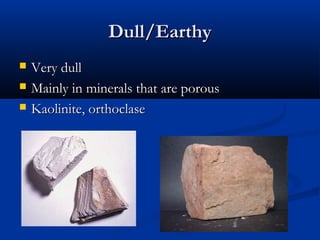
Dull/Earthy
   Very dull
   Mainly in minerals that are porous
   Kaolinite, orthoclase
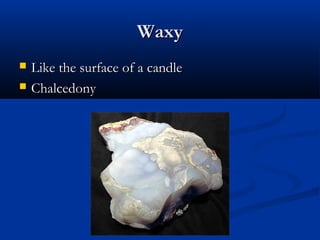
Waxy
   Like the surface of a candle
   Chalcedony
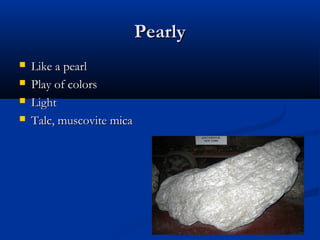
Pearly
   Like a pearl
   Play of colors
   Light
   Talc, muscovite mica
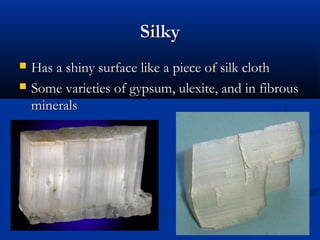
Silky
   Has a shiny surface like a piece of silk cloth
   Some varieties of gypsum, ulexite, and in fibrous
    minerals
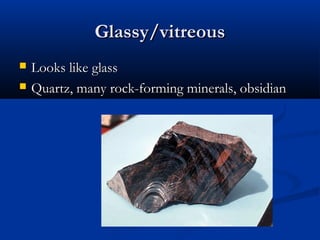
Glassy/vitreous
   Looks like glass
   Quartz, many rock-forming minerals, obsidian
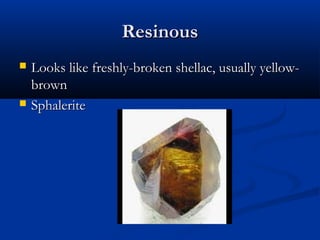
Resinous
   Looks like freshly-broken shellac, usually yellow-
    brown
   Sphalerite
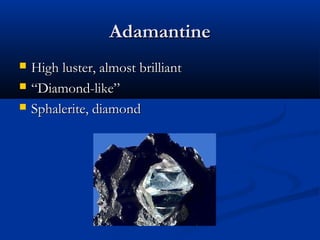
Adamantine
   High luster, almost brilliant
   “Diamond-like”
   Sphalerite, diamond
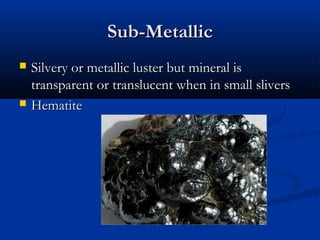
Sub-Metallic
   Silvery or metallic luster but mineral is
    transparent or translucent when in small slivers
   Hematite
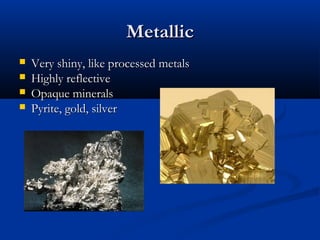
Metallic
   Very shiny, like processed metals
   Highly reflective
   Opaque minerals
   Pyrite, gold, silver
Other words describing luster
   Shiny
   Sparkly
   Shimmering
   Opalescent
   Frosted
   Milky
Properties of Minerals:
    Transparency
   Light transmitted through minerals
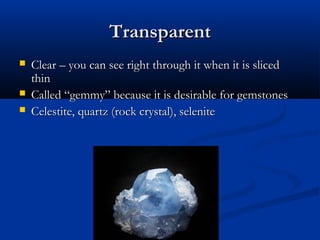
Transparent
   Clear – you can see right through it when it is sliced
    thin
   Called “gemmy” because it is desirable for gemstones
   Celestite, quartz (rock crystal), selenite
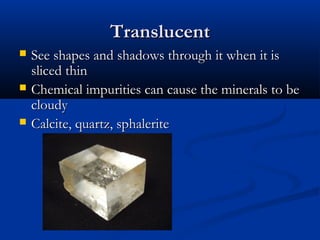
Translucent
   See shapes and shadows through it when it is
    sliced thin
   Chemical impurities can cause the minerals to be
    cloudy
   Calcite, quartz, sphalerite
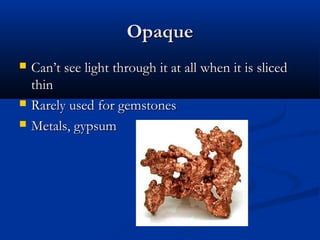
Opaque
   Can’t see light through it at all when it is sliced
    thin
   Rarely used for gemstones
   Metals, gypsum
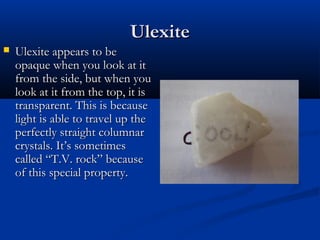
Ulexite
   Ulexite appears to be
    opaque when you look at it
    from the side, but when you
    look at it from the top, it is
    transparent. This is because
    light is able to travel up the
    perfectly straight columnar
    crystals. It’s sometimes
    called “T.V. rock” because
    of this special property.

Mineral Luster and Transparency

  • 1.
    Properties of Minerals: Luster The way light reflects off of the surface of a mineral
  • 2.
    Dull/Earthy  Very dull  Mainly in minerals that are porous  Kaolinite, orthoclase
  • 3.
    Waxy  Like the surface of a candle  Chalcedony
  • 4.
    Pearly  Like a pearl  Play of colors  Light  Talc, muscovite mica
  • 5.
    Silky  Has a shiny surface like a piece of silk cloth  Some varieties of gypsum, ulexite, and in fibrous minerals
  • 6.
    Glassy/vitreous  Looks like glass  Quartz, many rock-forming minerals, obsidian
  • 7.
    Resinous  Looks like freshly-broken shellac, usually yellow- brown  Sphalerite
  • 8.
    Adamantine  High luster, almost brilliant  “Diamond-like”  Sphalerite, diamond
  • 9.
    Sub-Metallic  Silvery or metallic luster but mineral is transparent or translucent when in small slivers  Hematite
  • 10.
    Metallic  Very shiny, like processed metals  Highly reflective  Opaque minerals  Pyrite, gold, silver
  • 11.
    Other words describingluster  Shiny  Sparkly  Shimmering  Opalescent  Frosted  Milky
  • 12.
    Properties of Minerals: Transparency Light transmitted through minerals
  • 13.
    Transparent  Clear – you can see right through it when it is sliced thin  Called “gemmy” because it is desirable for gemstones  Celestite, quartz (rock crystal), selenite
  • 14.
    Translucent  See shapes and shadows through it when it is sliced thin  Chemical impurities can cause the minerals to be cloudy  Calcite, quartz, sphalerite
  • 15.
    Opaque  Can’t see light through it at all when it is sliced thin  Rarely used for gemstones  Metals, gypsum
  • 16.
    Ulexite  Ulexite appears to be opaque when you look at it from the side, but when you look at it from the top, it is transparent. This is because light is able to travel up the perfectly straight columnar crystals. It’s sometimes called “T.V. rock” because of this special property.