MINERAL EXPLORATION
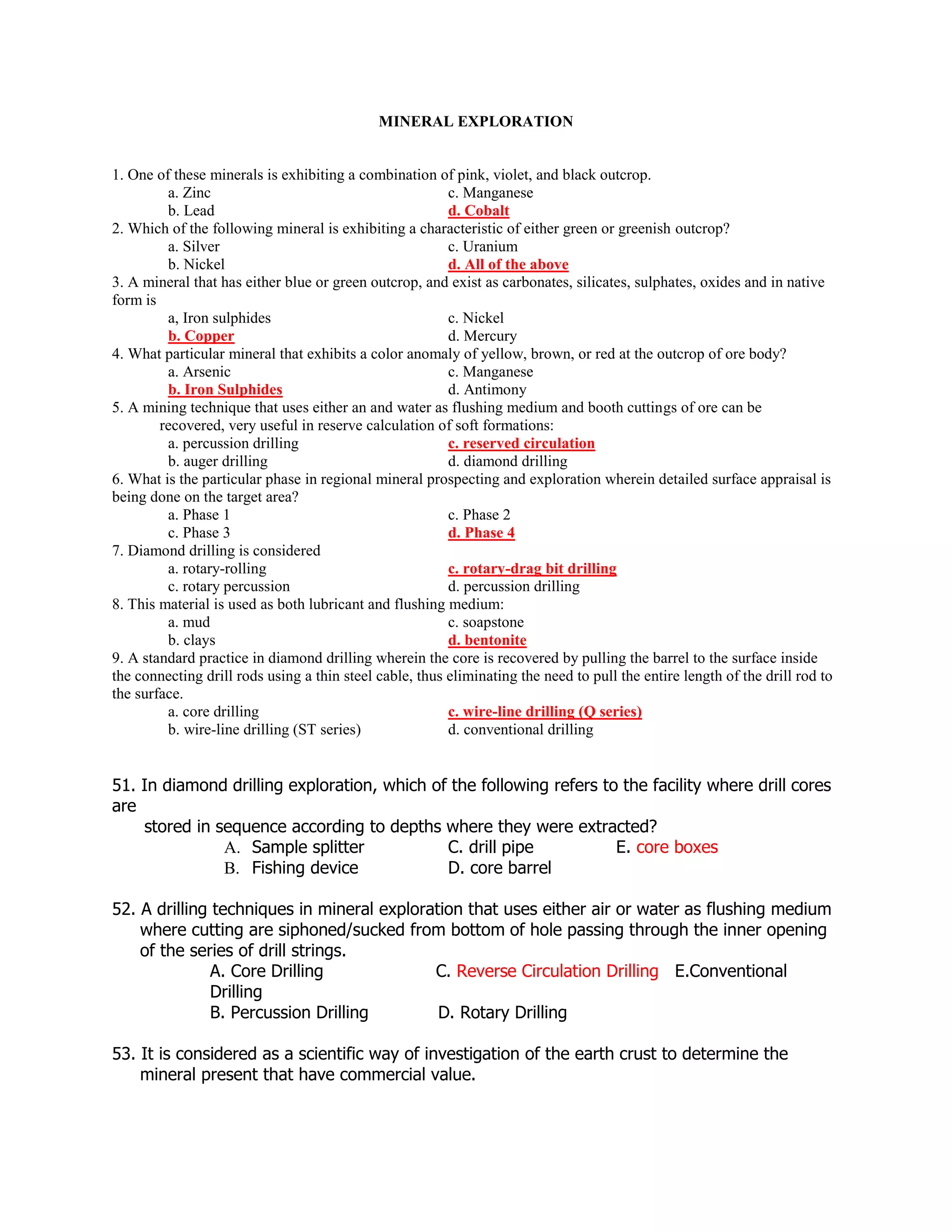
1. One of these minerals is exhibiting a combination of pink, violet, and black outcrop.
a. Zinc c. Manganese
b. Lead d. Cobalt
2. Which of the following mineral is exhibiting a characteristic of either green or greenish outcrop?
a. Silver c. Uranium
b. Nickel d. All of the above
3. A mineral that has either blue or green outcrop, and exist as carbonates, silicates, sulphates, oxides and in native
form is
a, Iron sulphides c. Nickel
b. Copper d. Mercury
4. What particular mineral that exhibits a color anomaly of yellow, brown, or red at the outcrop of ore body?
a. Arsenic c. Manganese
b. Iron Sulphides d. Antimony
5. A mining technique that uses either an and water as flushing medium and booth cuttings of ore can be
recovered, very useful in reserve calculation of soft formations:
a. percussion drilling c. reserved circulation
b. auger drilling d. diamond drilling
6. What is the particular phase in regional mineral prospecting and exploration wherein detailed surface appraisal is
being done on the target area?
a. Phase 1 c. Phase 2
c. Phase 3 d. Phase 4
7. Diamond drilling is considered
a. rotary-rolling c. rotary-drag bit drilling
c. rotary percussion d. percussion drilling
8. This material is used as both lubricant and flushing medium:
a. mud c. soapstone
b. clays d. bentonite
9. A standard practice in diamond drilling wherein the core is recovered by pulling the barrel to the surface inside
the connecting drill rods using a thin steel cable, thus eliminating the need to pull the entire length of the drill rod to
the surface.
a. core drilling c. wire-line drilling (Q series)
b. wire-line drilling (ST series) d. conventional drilling
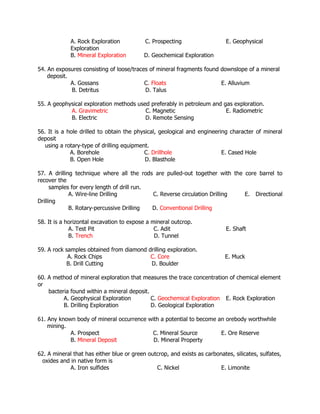
51. In diamond drilling exploration, which of the following refers to the facility where drill cores
are
stored in sequence according to depths where they were extracted?
A. Sample splitter C. drill pipe E. core boxes
B. Fishing device D. core barrel
52. A drilling techniques in mineral exploration that uses either air or water as flushing medium
where cutting are siphoned/sucked from bottom of hole passing through the inner opening
of the series of drill strings.
A. Core Drilling C. Reverse Circulation Drilling E.Conventional
Drilling
B. Percussion Drilling D. Rotary Drilling
53. It is considered as a scientific way of investigation of the earth crust to determine the
mineral present that have commercial value.
A. Rock Exploration C. Prospecting E. Geophysical
Exploration
B. Mineral Exploration D. Geochemical Exploration
54. An exposures consisting of loose/traces of mineral fragments found downslope of a mineral
deposit.
A. Gossans C. Floats E. Alluvium
B. Detritus D. Talus
55. A geophysical exploration methods used preferably in petroleum and gas exploration.
A. Gravimetric C. Magnetic E. Radiometric
B. Electric D. Remote Sensing
56. It is a hole drilled to obtain the physical, geological and engineering character of mineral
deposit
using a rotary-type of drilling equipment.
A. Borehole C. Drillhole E. Cased Hole
B. Open Hole D. Blasthole
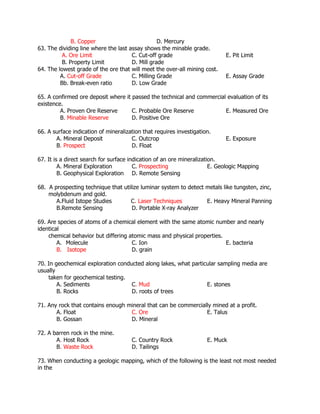
57. A drilling technique where all the rods are pulled-out together with the core barrel to
recover the
samples for every length of drill run.
A. Wire-line Drilling C. Reverse circulation Drilling E. Directional
Drilling
B. Rotary-percussive Drilling D. Conventional Drilling
58. It is a horizontal excavation to expose a mineral outcrop.
A. Test Pit C. Adit E. Shaft
B. Trench D. Tunnel
59. A rock samples obtained from diamond drilling exploration.
A. Rock Chips C. Core E. Muck
B. Drill Cutting D. Boulder
60. A method of mineral exploration that measures the trace concentration of chemical element
or
bacteria found within a mineral deposit.
A. Geophysical Exploration C. Geochemical Exploration E. Rock Exploration
B. Drilling Exploration D. Geological Exploration
61. Any known body of mineral occurrence with a potential to become an orebody worthwhile
mining.
A. Prospect C. Mineral Source E. Ore Reserve
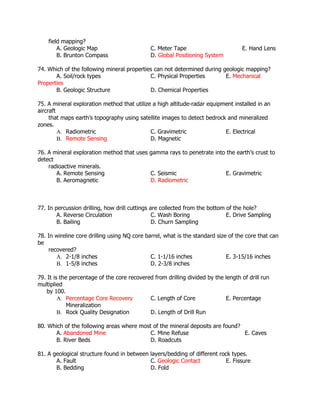
B. Mineral Deposit D. Mineral Property
62. A mineral that has either blue or green outcrop, and exists as carbonates, silicates, sulfates,
oxides and in native form is
A. Iron sulfides C. Nickel E. Limonite
B. Copper D. Mercury
63. The dividing line where the last assay shows the minable grade.
A. Ore Limit C. Cut-off grade E. Pit Limit
B. Property Limit D. Mill grade
64. The lowest grade of the ore that will meet the over-all mining cost.
A. Cut-off Grade C. Milling Grade E. Assay Grade
Bb. Break-even ratio D. Low Grade
65. A confirmed ore deposit where it passed the technical and commercial evaluation of its
existence.
A. Proven Ore Reserve C. Probable Ore Reserve E. Measured Ore
B. Minable Reserve D. Positive Ore
66. A surface indication of mineralization that requires investigation.
A. Mineral Deposit C. Outcrop E. Exposure
B. Prospect D. Float
67. It is a direct search for surface indication of an ore mineralization.
A. Mineral Exploration C. Prospecting E. Geologic Mapping
B. Geophysical Exploration D. Remote Sensing
68. A prospecting technique that utilize luminar system to detect metals like tungsten, zinc,
molybdenum and gold.
A.Fluid Istope Studies C. Laser Techniques E. Heavy Mineral Panning
B.Remote Sensing D. Portable X-ray Analyzer
69. Are species of atoms of a chemical element with the same atomic number and nearly
identical
chemical behavior but differing atomic mass and physical properties.
A. Molecule C. Ion E. bacteria
B. Isotope D. grain
70. In geochemical exploration conducted along lakes, what particular sampling media are
usually
taken for geochemical testing.
A. Sediments C. Mud E. stones
B. Rocks D. roots of trees
71. Any rock that contains enough mineral that can be commercially mined at a profit.
A. Float C. Ore E. Talus
B. Gossan D. Mineral
72. A barren rock in the mine.
A. Host Rock C. Country Rock E. Muck
B. Waste Rock D. Tailings
73. When conducting a geologic mapping, which of the following is the least not most needed
in the
field mapping?
A. Geologic Map C. Meter Tape E. Hand Lens
B. Brunton Compass D. Global Positioning System
74. Which of the following mineral properties can not determined during geologic mapping?
A. Soil/rock types C. Physical Properties E. Mechanical
Properties
B. Geologic Structure D. Chemical Properties
75. A mineral exploration method that utilize a high altitude-radar equipment installed in an
aircraft
that maps earth’s topography using satellite images to detect bedrock and mineralized
zones.
A. Radiometric C. Gravimetric E. Electrical
B. Remote Sensing D. Magnetic
76. A mineral exploration method that uses gamma rays to penetrate into the earth’s crust to
detect
radioactive minerals.
A. Remote Sensing C. Seismic E. Gravimetric
B. Aeromagnetic D. Radiometric
77. In percussion drilling, how drill cuttings are collected from the bottom of the hole?
A. Reverse Circulation C. Wash Boring E. Drive Sampling
B. Bailing D. Churn Sampling
78. In wireline core drilling using NQ core barrel, what is the standard size of the core that can
be
recovered?
A. 2-1/8 inches C. 1-1/16 inches E. 3-15/16 inches
B. 1-5/8 inches D. 2-3/8 inches
79. It is the percentage of the core recovered from drilling divided by the length of drill run
multiplied
by 100.
A. Percentage Core Recovery C. Length of Core E. Percentage
Mineralization
B. Rock Quality Designation D. Length of Drill Run
80. Which of the following areas where most of the mineral deposits are found?
A. Abandoned Mine C. Mine Refuse E. Caves
B. River Beds D. Roadcuts
81. A geological structure found in between layers/bedding of different rock types.
A. Fault C. Geologic Contact E. Fissure
B. Bedding D. Fold
82. The physical property of a mineral that can be detected by holding a piece of copper in one
hand
and holding a piece of amber on the other hand and the copper is felt colder.
A. Transparency C. Luster E. Cleavage
B. Heat Conductivity D. Streak
83. A sampling technique that is required to further determine the mining and metallurgical
properties
like grade of the ore.
A. Grab Sampling C. Channel Sampling E. Random Sampling
B. Bulk Sampling D. Muck Sampling
84. An ore deposit where tonnage and grade of the ore are computed partly from specific
measurements, samples or production data, and partly from projections for a reasonable
distance
on geologic evidence.
A. Indicated Ore C. Inferred Ore E. Probable Ore
B. Measured Ore D. Prospective Ore
85. In locating drillholes by grid system, what is the standard distance of holes in drilling a
porphyry
copper deposit.
A. 100.00 meters C. 150.00 meters E. 175.00 meters
B. 75.00 meters D. 50.00 meters
86. Based on the result of the mineral exploration, the explored deposit was economically and
technically evaluated and results showed the following:
Mining & Milling Cost = $ 3.00/ton
Overhead Expenses = $ 1.00/ton
Miscellaneous Expenses = $ 0.60/ton
Depreciation & Amortization = $ 0.85/ton
Grade of the Ore = 0.60 % Cu
Concentrator Recovery = 90%
Return of Investment (ROI) before income taxes = $0.30/ton
Market Price of Cu = $ 2.10/lb
Compute the expected profit per ton of ore.
A. $ 12.33/ton C. $ 19.45/ton E. $ 15.98/ton
B. $ 10.45/ton D. $ 11.02/ton
87. Using the above information, what is the cut-off grade of the copper ore:
A. 0.21% Cu C. 0.34% Cu E. 0.15% Cu
B. 0.25% Cu D. 0.22% Cu
88. Sultan Energy Corporation plan to mine its 2000-acre coal prospect located in Daguma,
North
Cotabato. The deposits consist of bituminous coal ideal as fuel for the new Alto Coal-fired
Power
Plant in Maasim, Sarangani. Drilling results conducted showed that the coal seam has an
average
thickness of about 60 inches. The company intend to mined the coal by “Room-and-Pillar” .
If the
mining recovery factor is about 85%, determine the total tonnage of
the coal in-place.
A. 26,394,498 MT C. 23,234,003 MT E. 21,194,321 MT
B. 22,504,123 MT D. 15,016,950 MT
89. A newly-opened mine was explored for its nickel/cobalt deposit in Homonhon Island,
Eastern
Samar. The exploration results showed that the mine had a total minable reserve of 125
million MT
of ore. What is the life of the mine in years if the daily production 16,000 MT/day?
A. 20 years C. 23 years E. 25 years
B. 21 years D. 24 years
90. An exploration drilling method where drilling is performed by “raising and dropping” of the
chisel-
type bit.
A. Rotary drilling C. Percussion drilling E. Diamond core drilling
B. Rotary-percussion D. Churn drilling
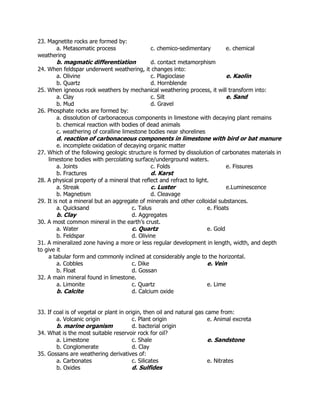
91. Magnetite rocks are formed by:
A. Metasomatic process C. chemico-sedimentary E. chemical weathering
B. magmatic differentiation D. contact metamorphism
92. Phosphate rocks are formed by:
A. dissolution of carbonaceous components in limestone with decaying plant remains
B. chemical reaction with bodies of dead animals
C. weathering of coralline limestone bodies near shorelines
D. reaction of carbonaceous components in limestone with bird or bat manure
E. incomplete oxidation of decaying organic matter
93. In mineral exploration drilling, what is the maximum depth of holes considered shallow.
A. 150 meters C. 100 meters E. 300 meters
B. 200 meters D. 500 meters
94. What is the most important factor that contributes mainly to quality of coal formation.
A. type of vegetable matter where coal originates
B. magnitude of heat and pressure
C. the weight of external load
D. the type of foreign matter components in coal
E. the type of bacteria present
95. A geophysical exploration method ideal to detect gold and uranium ores.
A. Gravity C. Electrical E. Seismic
B. Magnetic D. Remote sensing
96. What type of geophysical exploration method that uses the density of rocks in identifying
the type
of ore buried beneath the surface.
A. Seismic C. Electrical E. Gravity
B. Magnetic D. Remote sensing
97. A most common mineral in the earth’s crust.
A. Water C. Quartz E. Gold
B. Feldspar D. Olivine
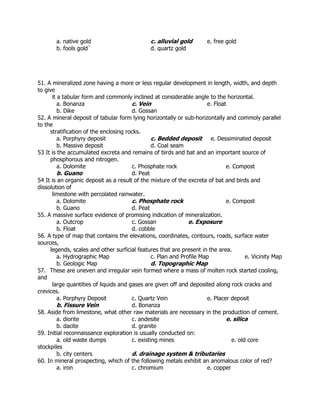
98. A mineralized zone having a more or less regular development in length, width, and depth
to give it
a tabular form and commonly inclined at considerably angle to the horizontal.
A. Bonanza C. Dike E. Vein
B. Float D. Gossan
99. A main mineral found in limestone.
A. Limonite C. Quartz E. Lime
B. Calcite D. Calcium oxide
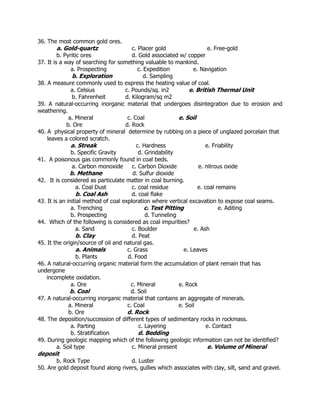
100. The most common gold ores.
A. Gold-quartz C. Placer gold E. Free-gold
B. Pyritic ores D. Gold associated w/ copper
GOOD LUCK AND GOD BLESS……..
MINING ENGINEERING BOARD EXAMINATION
TEST QUESTIONS
PROSPECTING & MINERAL EXPLORATION
MULTIPE CHOICE: Select the correct letter that answers the following sentences.
DATE OF EXAM: August 6, 2002
1. Which of the following indicate a ferrogenous outcrop?
A. gossan C. hanging wall e. overburden
B. dike D. horse
2. Geochemical prospecting is used to trace metals usually contained in:
A. waste dump samples C. wind samples E. fauna
samples
B. oil samples D. water or stream sediment samples
3. The most effective, detailed and widely used method of exploration applied in developing or
delineating an orebody for the purpose of defining ore reserves is called:
A. geo-biology C. trenching E. diamond drilling
B. geo-chemistry D. airborne exploration
4. Initial reconnaissance exploration is usually conducted on:
A. old waste dumps C. existing mines E. city centers
B. drainage system & tributaries D. old ore stockpiles
5. A cylindrical chamber for receiving and retaining rock samples as diamond drilling progresses
is called:
A. core box storage C. drill pipe E. fishing device
B. core barrel D. sample splitter
6. It is a system of preserving diamond drill core samples for future references but at the same
time provide adequate sample for geologic interpretation and for the purpose of establishing
the grade of the mineral or minerals contained therein:
A. total core assaying C. thin sectioning E. core polishing
B. total core storage D. core splitting
7. Which of the following hand sampling procedures is the most accurate results to the smallest
possible error?
A. cut sampling C. channel sampling E. random sampling
B. chip sampling D. grab sampling
8. A new mining project has just completed its exploration through diamond drilling. In the
pre-feasibility study, the following mineral resources were established initially:
Positive ore reserve - 100 million MT at 0.55% Cu
Probable ore reserve - 300 million MT at 0.45% Cu
Possible ore reserve - 300 milling MT at 0.40% Cu
As the Mine Exploration Engineer designated to initially prepare a preliminary assessment of
the reserve, what is the calculated or theoretical ore reserve at this stage?
A. 300 million MT at 0.46& Cu
B. 700 million MT at 0.44% Cu
C. 400 million MT at 0.46% Cu
D. 500 million MT at 0.65% Cu
E. 100 million MT at 0.55% Cu
DATE OF EXAM : August 12, 2003
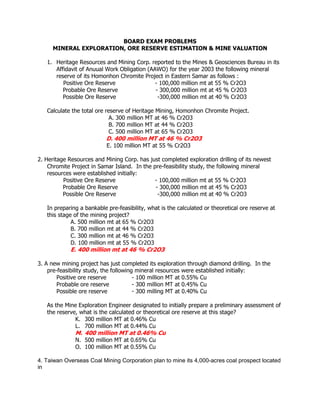
1. Heritage Resources and Mining Corp. has just completed exploration drilling of its newest
Chromite Project in Samar Island. In the pre-feasibility study, the following mineral
resources were established initially:
Positive Ore Reserve - 100,000 million mt at 55 % Cr2O3
Probable Ore Reserve - 300,000 million mt at 45 % Cr2O3
Possible Ore Reserve -300,000 million mt at 40 % Cr2O3
In preparing a bankable pre-feasibility, what is the calculated or theoretical ore reserve at
this stage of the mining project?
A. 500 million mt at 65 % Cr2O3
B. 700 million mt at 44 % Cr2O3
C. 300 million mt at 46 % Cr2O3
D. 100 million mt at 55 % Cr2O3
E. 400 million mt at 46 % Cr2O3
2. Which of the following indicate a ferruginous outcrop?
A. Gossan C. dike E. Hanging wall
B. Overburden D. Horse
3. Which of the following parameters that must be considered in evaluating as mineral deposit
is
feasible to mine or not?
A. cost of establishing and maintaining social responsibility
B. price of the metal commodity
C. ore reserves and applicable mining methods
D. all of these
E. environmental effects during and after mining
4. Which of the following geophysical methods is sensitive to dessiminated mineralization that
do not
produce resistivity anomaly?
A. seismic C. electromagnetic E. none of t he above
B. telluric D. Induced Polarization (IP)
5. In evaluating mineral deposits, positive ore reserve are sometimes referred to what?
A. inferred ore reserve C. geologic ore reserve E. measured ore
reserve
B. possible ore reserve D. probable ore reserve
6. The best and most widely used exploration method in developing an established area of
mineralization or anomaly is :
A. geostatistical analysis C. geophysics E. geochemistry
B. Induce Polarization (IP) D. core drilling
7. The most effective, detailed and widely used exploration method in developing or delineating
the vertical and lateral extent of mineralization for the purpose of blocking ore reserves is
called what?
A. diamond drilling exploration
B. airborne exploration
C. geophysical exploration
D. geobotany exploration
E. geochemical exploration
8. In coal deposition, what does strata mean?
A. country rock C. host rock E. karst formation
B. beams or bars D. beds or layers
9. Geochemical prospecting is used to trace metals usually contained in?
A. oil samples C. waste dump samples E. water or stream
sediment
B. flora samples D. wind samples samples
10. A cylindrical chamber for receiving and retaining rock samples as diamond drilling
progresses at depth is called:
A.drill pipe C. core barrel E. core box storage
B. sample splitter D. fishing device
11. The exploration method highly applicable in locating and determining the thickness of wet
shears, clays, or gravels is called:
A. magnetic C. polarity E. resistivity
B. gravity D. telluric
12. Which of the following refers to the solid petroleum that occurs as a component of shale?
A. coke C. coal E. bitumen
B. kerogene D. carbon pigment
13. In diamond drilling, the very fine and slimey samples collected are called what?
A. chip samples C. core samples E. sludge samples
B. blasthole cone samples D. drill cuttings samples
14. In diamond drilling, what do you call the method of recovering cores by pulling the core
barrel to the surface using a thin steel cable passing through the drill rods, thus eliminating
the need to pull all the rods to the surface.
A. wireline drilling
B. percussion drilling
C. auger drilling
D. rotary drilling
E. conventional diamond drilling
15. In mineral prospecting, which of the following metals exhibit an anomalous color of red?
A. mercury C. arsenic E. silver
B. gold D. copper
16. In diamond drilling, what do you call the solid samples recovered from the core barrel?
A. drill cutting C. core samples E. blasthole cones
B. sludge samples D. chip samples
17. Which of the following geophysical prospecting methods is best applicable to copper sulfide
minerals?
A. titration C. Induced polarization E. remote sensing
B. atomic absorption D. Magnetometer survey
18. The best and cheapest geophysical method of establishing the lateral extensions of deposits
that are shallow occurring is by:
A. trenching C. wireline drilling E. diamond drilling
B. aerial magnetometer D. none of these
19. Which of the following does not belong in the set?
A. core C. drilling dust` E. drill cuttings
B. drill bit D. sludge
20. Aerial magnetometer survey is best applicable in prospecting for what type of mineral
deposits?
A. coal deposits C. iron deposits E. calcite deposit
B. silica sand D. limestone deposits
DATE OF EXAM : AUGUST 10, 2004
1. Which of the following is not a deterrent in the quality of coal?
A. low heating value
B. high sulfur content
C. high heating value
D. high chlorine content
E. high moisture content
2. In coal deposition, what does strata mean?
A. beds or layers C. host rock E. karst formation
B. country rock D. mother formation
3. In diamond drilling of heavily brecciated formations, which of the following is used to control
water losses due to seepages and improve drilling water circulation and better sludge
collection.
A. soapstone C. barite E. paint pigment
B. lateritic mud D. bentonite
4. Which of the following exploration or development methods is best and widely used in
establishing the area, depth and thickness of mineralization? It is also used to gather data
for ore reserve estimation and technical information essential in mine planning and design.
A. core drilling C. geochemistry E. induce polarization (IP)
B. geostatistical analysis D. geophysics
5. A high grade gold vein was sampled by channel sampling and showed the following analysis:
SAMPLE NO. WIDTH (cm) ASSAY (GMT)
1. 15 3.0
2. 12 3.5
3. 10 5.1
4. 12 5.5
5. 15 6.0
6. 15 6.3
7. 18 7.3
8. 17 8.8
9. 19 8.5
10. 18 9.0
Assuming that the samples were taken at regular intervals, what is the average grade of the
gold vein?
A. 7.58 gmt C. 8.58 gmt E. 4.58 gmt
B. 5.58 gmt D. 6.58 gmt
6. What is a mineral resource that was established only based on one dimension, usually
surface interpretations and using very limited samples and measurements?
A. mineable ore reserve C. geologic ore reserve E. none of the above
B. measure ore reserve D. positive ore reserve
7. Which of the following diamond drilling methods refers to the recovery of core samples from
the bottom of drillholes without necessarily retrieving the drill rods/pipes and core barrel to
the surface or hole collar?
A.classical diamond drilling C. magnetic drilling E. wireline
drilling
B. fishing device drilling D. conventional diamond drilling
8. Which of the following geophysical prospecting methods is not useful in identifying whether
groundwater deposit is ionic or metallic in nature?
A. induced polarization C. resistivity E. none of the above
B. electromagnetic D. seismic
DATE OF EXAM : AUGUST 16, 2005
1. Which of the following exploration methods is best applicable to developing the lateral and
vertical extent of deep-seated orebodies?
A. dogholing C. test pitting E. induced
polarization
B. diamond drilling D. trenching
2. Which of the following ore reserve categories based in four dimensions, ; length, width,
depth and
grade?
A. geologic ore reserve C. measured ore reserve E. probable ore reserve
B. possible ore reserve D. positive ore reserve
3. Which of the following grade prediction techniques allows the lowest margin error in
estimation?
A. geostatiscal methods C. classical statistics E. geometric methods
B. distance weighing D. inverse distance weighing
4. Which of the following refers to the worthless material that is associated the valuable
minerals within an orebody or deposits?
A. oreshoot C. paystreak E. gangue
B. nava D. bonanza
5. It refers to the tonnage per cubic meter volume of material.
A. ore reserve C. swell factor E. mine head
B. mill head D. tonnage factor
6. In coal deposition, what does strata mean?
A. beds or layers C. host rock E. bedrock
B. country rock D. karst formation
7. In mineral prospecting, which of the following metals exhibit an anomalous color of red?
A. iron C. chromium E. mercury
B. arsenic D. silver
8. The brownish and often rusty outcrop of an iron or other limonitic deposits is called what?
A. window C. gob E. gossan
B. aggregate D. outcrop
9. Which of the following diamond drilling methods refers to the recovery of core samples from
the
bottom of drillholes without necessarily retrieving the drill rods/pipes and core barrel to the
surface
on hole collar?
A. magnetic drilling C. conventional diamond drilling E. glory hole
drilling
B. wireline drilling D. reverse circulation drilling
10. Which of the following geophysical prospecting methods most applicable and cheapest
method in
establishing the lateral extensions of mineral deposits that are shallow occurring?
A. diamond drilling C. trenching E. wireline drilling
B. aerial magnetometer D. seismic survey
11. Which of the following mineral resource information is based on limited dimensions and
relies
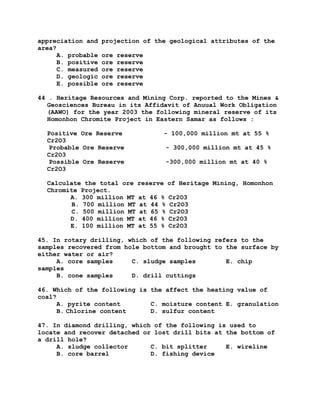
mainly on the estimators appreciation and projection of the geological attributes of the
area?
A. probable ore reserve C. measured ore reserve E. possible ore
reserve
B. positive ore reserve D. geologic ore reserve
12 . Heritage Resources and Mining Corp. reported to the Mines & Geosciences Bureau in its
Affidavit of Anuual Work Obligation (AAWO) for the year 2003 the following mineral reserve
of its Homonhon Chromite Project in Eastern Samar as follows :
Positive Ore Reserve - 100,000 million mt at 55 % Cr2O3
Probable Ore Reserve - 300,000 million mt at 45 % Cr2O3
Possible Ore Reserve -300,000 million mt at 40 % Cr2O3
Calculate the total ore reserve of Heritage Mining, Homonhon Chromite Project.
A. 300 million MT at 46 % Cr2O3
B. 700 million MT at 44 % Cr2O3
C. 500 million MT at 65 % Cr2O3
D. 400 million MT at 46 % Cr2O3
E. 100 million MT at 55 % Cr2O3
13. In diamond dirlling, which of the following refers to the very fine and slimey samples that
are
brought up to the surface by drilling water collected in settling basins?
A. core samples C. sludge samples E. chip samples
B. cone samples D. drill cuttings
14. Which of the following is the most important quality specification of coal?
A. Heating value C. moisture E. granulation
B. Chlorine content D. sulfur content
15. In diamond drilling, which of the following is used to locate and recover detached or lost
drill bits at
the bottom of a drill hole?
A. sludge collector C. bit splitter E. wireline
B. core barrel D. fishing device
16. The quality of coal is measured by which of the following parameters?
A. color C. BTU value E. specific gravity
B. moisture content D. density
17. Which of the following geophysical methods is sensitive to dessiminated mineralization that
do not
produce resistivity anomaly?
A. electromagnetic C. geochemistry E. induced
polarization
B. telluric D. seismic
18. In diamond drilling, what is the diameter of cores drilled by PQ diamond bits?
A. 50 mm C. 100 mm E. 70mm
B. 90 mm D. 10 mm
19. Induced polarization method is best applicable in locating sulfide minerals in which of the
following
areas?
A. areas with on-going mine development
B. open pit areas undergoing pit stripping
C. areas not yet disturbed by mine development
D. areas that have been used as waste dumps of open pit mines
E. housing areas under development
20. In diamond drilling exploration, which of the following refers to the facility where drill cores
are
stored in sequence according to depths where they were extracted?
C. Sample splitter C. drill pipe E. core boxes
D. Fishing device D. core barrel
DATE OF EXAM : AUGUST 8, 2006
1. Which of the following exploration method is best and widely used in establishing area,
depth and
thickness of mineralization? It is also used to gather data for ore reserves estimation and
technical
information essential in mine planning and design.g equipment intended for mineral or rock
exploration.
A. geostatistical analysis C. geophysics E. geochemistry
B. core drilling D. induced polarization
2. Which of the following is the most important quality specification of coal?
A. Heating value C. granulation E. sulfur content
B. Chlorine content D. moisture content
3. The measure of coal is expressed in terms of what?
A. BTU C. specific gravity E. carbon content
B. chlorine content D. moisture content
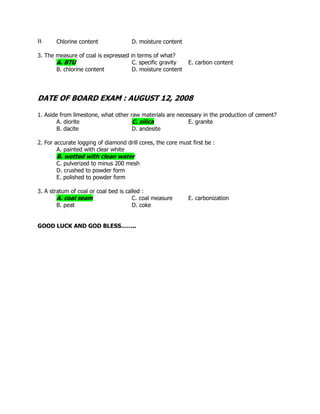
DATE OF BOARD EXAM : AUGUST 12, 2008
1. Aside from limestone, what other raw materials are necessary in the production of cement?
A. diorite C. silica E. granite
B. dacite D. andesite
2. For accurate logging of diamond drill cores, the core must first be :
A. painted with clear white
B. wetted with clean water
C. pulverized to minus 200 mesh
D. crushed to powder form
E. polished to powder form
3. A stratum of coal or coal bed is called :
A. coal seam C. coal measure E. carbonization
B. peat D. coke
GOOD LUCK AND GOD BLESS……..
MINING ENGINEERING BOARD EXAMINATION
TEST QUESTIONS
PROSPECTING & MINERAL EXPLORATION
MULTIPE CHOICE: Select the correct letter that answers the following sentences.
DATE OF EXAM: August 6, 2002
1. Which of the following indicate a ferrogenous outcrop?
A. gossan C. hanging wall e. overburden
B. dike D. horse
2. Geochemical prospecting is used to trace metals usually contained in:
A. waste dump samples C. wind samples E. fauna samples
B. oil samples D. water or stream sediment samples
3. The most effective, detailed and widely used method of exploration applied in developing or
delineating an orebody for the purpose of defining ore reserves is called:
A. geo-biology C. trenching E. diamond drilling
B. geo-chemistry D. airborne exploration
4. Initial reconnaissance exploration is usually conducted on:
A. old waste dumps C. existing mines E. city centers
B. drainage system & tributaries D. old ore stockpiles
5. A cylindrical chamber for receiving and retaining rock samples as diamond drilling progresses
is called:
A. core box storage C. drill pipe E. fishing device
B. core barrel D. sample splitter
6. It is a system of preserving diamond drill core samples for future references but at the same
time provide adequate sample for geologic interpretation and for the purpose of establishing
the grade of the mineral or minerals contained therein:
A. total core assaying C. thin sectioning E. core polishing
B. total core storage D. core splitting
7. Which of the following hand sampling procedure is the most accurate results to the smallest
possible error?
A. cut sampling C. channel sampling E. random sampling
B. chip sampling D. grab sampling
8. A new mining project has just completed its exploration through diamond drilling. In the
pre-feasibility study, the following mineral resources were established initially:
Positive ore reserve - 100 million MT at 0.55% Cu
Probable ore reserve - 300 million MT at 0.45% Cu
Possible ore reserve - 300 milling MT at 0.40% Cu
As the Mine Exploration Engineer designated to initially prepare a preliminary assessment of the
reserve, what is the calculated or theoretical ore reserve at this stage?
A. 300 million MT at 0.46& Cu
B. 700 million MT at 0.44% Cu
C. 400 million MT at 0.46% Cu
D. 500 million MT at 0.65% Cu
E. 100 million MT at 0.55% Cu
DATE OF EXAM : August 12, 2003
1. Heritage Resources and Mining Corp. has just completed exploration drilling of its newest
Chromite Project in Samar Island. In the pre-feasibility study, the following mineral resources
were established initially:
Positive Ore Reserve - 100,000 million mt at 55 % Cr2O3
Probable Ore Reserve - 300,000 million mt at 45 % Cr2O3
Possible Ore Reserve -300,000 million mt at 40 % Cr2O3
In preparing a bankable pre-feasibility, what is the calculated or theoretical ore reserve at this
stage of the mining project?
A. 500 million mt at 65 % Cr2O3
B. 700 million mt at 44 % Cr2O3
C. 300 million mt at 46 % Cr2O3
D. 100 million mt at 55 % Cr2O3
E. 400 million mt at 46 % Cr2O3
2. Which of the following indicate a ferruginous outcrop?
A. Gossan C. dike E. Hanging wall
B. Overburden D. Horse
3. Which of the following parameters that must be considered in evaluating as mineral deposit
is
feasible to mine or not?
A. cost of establishing and maintaining social responsibility
B. price of the metal commodity
C. ore reserves and applicable mining methods
D. all of these
E. environmental effects during and after mining
4. Which of the following geophysical methods is sensitive to dessiminated mineralization that
do not
produce resistivity anomaly?
A. seismic C. electromagnetic E. none of t he above
B. telluric D. Induced Polarization (IP)
5. In evaluating mineral deposits, positive ore reserve are sometimes referred to what?
A. inferred ore reserve C. geologic ore reserve E. measured ore
reserve
B. possible ore reserve D. probable ore reserve
6. The best and most widely used exploration method in developing an established area of
mineralization or anomaly is :
A. geostatistical analysis C. geophysics E. geochemistry
B. Induce Polarization (IP) D. core drilling
7. The most effective, detailed and widely used exploration method in developing or delineating
the vertical and lateral extent of mineralization for the purpose of blocking ore reserves is called
what?
A. diamond drilling exploration
B. airborne exploration
C. geophysical exploration
D. geobotany exploration
E. geochemical exploration
8. In coal deposition, what does strata mean?
A. country rock C. host rock E. karst formation
B. beams or bars D. beds or layers
9. Geochemical prospecting is used to trace metals usually contained in?
A. oil samples C. waste dump samples E. water or stream sediment
B. flora samples D. wind samples samples
10. A cylindrical chamber for receiving and retaining rock samples as diamond drilling
progresses at depth is called:
A.drill pipe C. core barrel E. core box storage
B. sample splitter D. fishing device
11. The exploration method highly applicable in locating and determining the thickness of wet
shears, clays, or gravels is called:
A. magnetic C. polarity E. resistivity
B. gravity D. telluric
12. Which of the following refers to the solid petroleum that occurs as a component of shale?
A. coke C. coal E. bitumen
B. kerogene D. carbon pigment
13. In diamond drilling, the very fine and slimey samples collected are called what?
A. chip samples C. core samples E. sludge samples
B. blasthole cone samples D. drill cuttings samples
14. In diamond drilling, what do you call the method of recovering cores by pulling the core
barrel to the surface using a thin steel cable passing through the drill rods, thus eliminating the
need to pull all the rods to the surface.
A. wireline drilling
B. percussion drilling
C. auger drilling
D. rotary drilling
E. conventional diamond drilling
15. In mineral prospecting, which of the following metals exhibit an anomalous color of red?
A. mercury C. arsenic E. silver
B. gold D. copper
16. In diamond drilling, what do you call the solid samples recovered from the core barrel?
A. drill cutting C. core samples E. blasthole cones
B. sludge samples D. chip samples
17. Which of the following geophysical prospecting methods is best applicable to copper sulfide
minerals?
A. titration C. Induced polarization E. remote sensing
B. atomic absorption D. Magnetometer survey
18. The best and cheapest geophysical method of establishing the lateral extensions of deposits
that are shallow occurring is by:
A. trenching C. wireline drilling E. diamond drilling
B. aerial magnetometer D. none of these
19. Which of the following does not belong in the set?
A. core C. drilling dust` E. drill cuttings
B. drill bit D. sludge
20. Aerial magnetometer survey is best applicable in prospecting for what type of mineral
deposits?
A. coal deposits C. iron deposits E. calcite deposit
B. silica sand D. limestone deposits
DATE OF EXAM : AUGUST 10, 2004
1. Which of the following is not a deterrent in the quality of coal?
A. low heating value
B. high sulfur content
C. high heating value
D. high chlorine content
E. high moisture content
2. In coal deposition, what does strata mean?
A. beds or layers C. host rock E. karst formation
B. country rock D. mother formation
3. In diamond drilling of heavily brecciated formations, which of the following is used to control
water losses due to seepages and improve drilling water circulation and better sludge collection.
A. soapstone C. barite E. paint pigment
B. lateritic mud D. bentonite
4. Which of the following exploration or development methods is best and widely used in
establishing the area, depth and thickness of mineralization? It is also used to gather data for
ore reserve estimation and technical information essential in mine planning and design.
A. core drilling C. geochemistry E. induce polarization (IP)
B. geostatistical analysis D. geophysics
5. A high grade gold vein was sampled by channel sampling and showed the following analysis:
SAMPLE NO. WIDTH (cm) ASSAY (GMT)
1. 15 3.0
2. 12 3.5
3. 10 5.1
4. 12 5.5
5. 15 6.0
6. 15 6.3
7. 18 7.3
8. 17 8.8
9. 19 8.5
10. 18 9.0
Assuming that the samples were taken at regular intervals, what is the average grade of the
gold vein?
A. 7.58 gmt C. 8.58 gmt E. 4.58 gmt
B. 5.58 gmt D. 6.58 gmt
6. What is a mineral resource that was established only based on one dimension, usually
surface interpretations and using very limited samples and measurements?
A. mineable ore reserve C. geologic ore reserve E. none of the above
B. measure ore reserve D. positive ore reserve
7. Which of the following diamond drilling methods refers to the recovery of core samples from
the bottom of drillholes without necessarily retrieving the drill rods/pipes and core barrel to the
surface or hole collar?
A.classical diamond drilling C. magnetic drilling E. wireline drilling
B. fishing device drilling D. conventional diamond drilling
8. Which of the following geophysical prospecting methods is not useful in identifying whether
groundwater deposit is ionic or metallic in nature?
A. induced polarization C. resistivity E. none of the above
B. electromagnetic D. seismic
DATE OF EXAM : AUGUST 16, 2005
1. Which of the following exploration methods is best applicable to developing the lateral and
vertical extent of deep-seated orebodies?
A. dogholing C. test pitting E. induced polarization
B. diamond drilling D. trenching
2. Which of the following ore reserve categories based in four dimensions, ; length, width,
depth and
grade?
A. geologic ore reserve C. measured ore reserve E. probable ore reserve
B. possible ore reserve D. positive ore reserve
3. Which of the following grade prediction techniques allows the lowest margin error in
estimation?
A. geostatiscal methods C. classical statistics E. geometric methods
B. distance weighing D. inverse distance weighing
4. Which of the following refers to the worthless material that is associated the valuable
minerals within an orebody or deposits?
A. oreshoot C. paystreak E. gangue
B. nava D. bonanza
5. It refers to the tonnage per cubic meter volume of material.
A. ore reserve C. swell factor E. mine head
B. mill head D. tonnage factor
6. In coal deposition, what does strata mean?
A. beds or layers C. host rock E. bedrock
B. country rock D. karst formation
7. In mineral prospecting, which of the following metals exhibit an anomalous color of red?
A. iron C. chromium E. mercury
B. arsenic D. silver
8. The brownish and often rusty outcrop of an iron or other limonitic deposits is called what?
A. window C. gob E. gossan
B. aggregate D. outcrop
9. Which of the following diamond drilling methods refers to the recovery of core samples from
the
bottom of drillholes without necessarily retrieving the drill rods/pipes and core barrel to the
surface
on hole collar?
A. magnetic drilling C. conventional diamond drilling E. glory hole drilling
B. wireline drilling D. reverse circulation drilling
10. Which of the following geophysical prospecting methods most applicable and cheapest
method in
establishing the lateral extensions of mineral deposits that are shallow occurring?
A. diamond drilling C. trenching E. wireline drilling
B. aerial magnetometer D. seismic survey
11. Which of the following mineral resource information is based on limited dimensions and
relies
mainly on the estimators appreciation and projection of the geological attributes of the
area?
A. probable ore reserve C. measured ore reserve E. possible ore reserve
B. positive ore reserve D. geologic ore reserve
12 . Heritage Resources and Mining Corp. reported to the Mines & Geosciences Bureau in its
Affidavit of Anuual Work Obligation (AAWO) for the year 2003 the following mineral reserve of
its Homonhon Chromite Project in Eastern Samar as follows :
Positive Ore Reserve - 100,000 million mt at 55 % Cr2O3
Probable Ore Reserve - 300,000 million mt at 45 % Cr2O3
Possible Ore Reserve -300,000 million mt at 40 % Cr2O3
Calculate the total ore reserve of Heritage Mining, Homonhon Chromite Project.
A. 300 million MT at 46 % Cr2O3
B. 700 million MT at 44 % Cr2O3
C. 500 million MT at 65 % Cr2O3
D. 400 million MT at 46 % Cr2O3
E. 100 million MT at 55 % Cr2O3
13. In diamond drilling, which of the following refers to the very fine and slimey samples that
are
brought up to the surface by drilling water collected in settling basins?
A. core samples C. sludge samples E. chip samples
B. cone samples D. drill cuttings
14. Which of the following is the most important quality specification of coal?
A. Heating value C. moisture E. granulation
B. Chlorine content D. sulfur content
15. In diamond drilling, which of the following is used to locate and recover detached or lost
drill bits at
the bottom of a drill hole?
A. sludge collector C. bit splitter E. wireline
B. core barrel D. fishing device
16. The quality of coal is measured by which of the following parameters?
A. color C. BTU value E. specific gravity
B. moisture content D. density
17. Which of the following geophysical methods is sensitive to dessiminated mineralization that
do not
produce resistivity anomaly?
A. electromagnetic C. geochemistry E. induced polarization
B. telluric D. seismic
18. In diamond drilling, what is the diameter of cores drilled by PQ diamond bits?
A. 50 mm C. 100 mm E. 70mm
B. 90 mm D. 10 mm
19. Induced polarization method is best applicable in locating sulfide minerals in which of the
following
areas?
A. areas with on-going mine development
B. open pit areas undergoing pit stripping
C. areas not yet disturbed by mine development
D. areas that have been used as waste dumps of open pit mines
E. housing areas under development
20. In diamond drilling exploration, which of the following refers to the facility where drill cores
are
stored in sequence according to depths where they were extracted?
A. Sample splitter C. drill pipe E. core boxes
B. Fishing device D. core barrel
DATE OF EXAM : AUGUST 8, 2006
1. Which of the following exploration method is best and widely used in establishing area,
depth and
thickness of mineralization? It is also used to gather data for ore reserves estimation and
technical
information essential in mine planning and designing equipment intended for mineral or rock
exploration.
A. geostatistical analysis C. geophysics E. geochemistry
B. core drilling D. induced polarization
2. Which of the following is the most important quality specification of coal?
A. Heating value C. granulation E. sulfur content
B. Chlorine content D. moisture content
3. The measure of coal is expressed in terms of what?
A. BTU C. specific gravity E. carbon content
B. chlorine content D. moisture content
DATE OF BOARD EXAM : AUGUST 12, 2008
1. Aside from limestone, what other raw materials are necessary in the production of cement?
A. diorite C. silica E. granite
B. dacite D. andesite
2. For accurate logging of diamond drill cores, the core must first be :
A. painted with clear white
B. wetted with clean water
C. pulverized to minus 200 mesh
D. crushed to powder form
E. polished to powder form
3. A stratum of coal or coal bed is called :
A. coal seam C. coal measure E. carbonization
B. peat D. coke
GOOD LUCK AND GOD BLESS……..
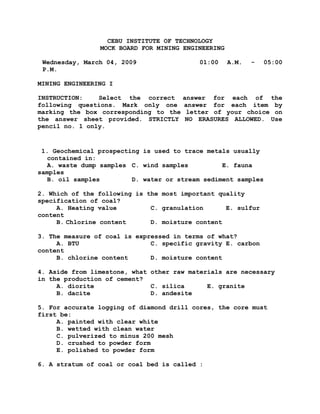
CEBU INSTITUTE OF TECHNOLOGY
MOCK BOARD FOR MINING ENGINEERING
Wednesday, March 04, 2009 01:00 A.M. - 05:00
P.M.
MINING ENGINEERING I
INSTRUCTION: Select the correct answer for each of the
following questions. Mark only one answer for each item by
marking the box corresponding to the letter of your choice on
the answer sheet provided. STRICTLY NO ERASURES ALLOWED. Use
pencil no. 1 only.
1. Geochemical prospecting is used to trace metals usually
contained in:
A. waste dump samples C. wind samples E. fauna
samples
B. oil samples D. water or stream sediment samples
2. Which of the following is the most important quality
specification of coal?
A. Heating value C. granulation E. sulfur
content
B. Chlorine content D. moisture content
3. The measure of coal is expressed in terms of what?
A. BTU C. specific gravity E. carbon
content
B. chlorine content D. moisture content
4. Aside from limestone, what other raw materials are necessary
in the production of cement?
A. diorite C. silica E. granite
B. dacite D. andesite
5. For accurate logging of diamond drill cores, the core must
first be:
A. painted with clear white
B. wetted with clean water
C. pulverized to minus 200 mesh
D. crushed to powder form
E. polished to powder form
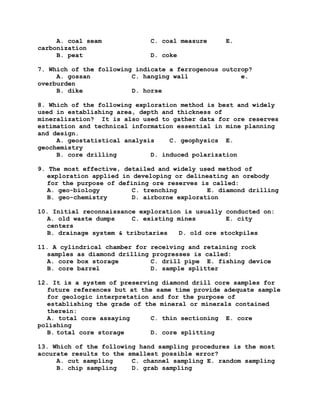
6. A stratum of coal or coal bed is called :
A. coal seam C. coal measure E.
carbonization
B. peat D. coke
7. Which of the following indicate a ferrogenous outcrop?
A. gossan C. hanging wall e.
overburden
B. dike D. horse
8. Which of the following exploration method is best and widely
used in establishing area, depth and thickness of
mineralization? It is also used to gather data for ore reserves
estimation and technical information essential in mine planning
and design.
A. geostatistical analysis C. geophysics E.
geochemistry
B. core drilling D. induced polarization
9. The most effective, detailed and widely used method of
exploration applied in developing or delineating an orebody
for the purpose of defining ore reserves is called:
A. geo-biology C. trenching E. diamond drilling
B. geo-chemistry D. airborne exploration
10. Initial reconnaissance exploration is usually conducted on:
A. old waste dumps C. existing mines E. city
centers
B. drainage system & tributaries D. old ore stockpiles
11. A cylindrical chamber for receiving and retaining rock
samples as diamond drilling progresses is called:
A. core box storage C. drill pipe E. fishing device
B. core barrel D. sample splitter
12. It is a system of preserving diamond drill core samples for
future references but at the same time provide adequate sample
for geologic interpretation and for the purpose of
establishing the grade of the mineral or minerals contained
therein:
A. total core assaying C. thin sectioning E. core
polishing
B. total core storage D. core splitting
13. Which of the following hand sampling procedures is the most
accurate results to the smallest possible error?
A. cut sampling C. channel sampling E. random sampling
B. chip sampling D. grab sampling
14. A new mining project has just completed its exploration
through diamond drilling. In the pre-feasibility study, the
following mineral resources were established initially:
Positive ore reserve - 100 million MT at 0.55% Cu
Probable ore reserve - 300 million MT at 0.45% Cu
Possible ore reserve - 300 milling MT at 0.40% Cu
As the Mine Exploration Engineer designated to initially
prepare a preliminary assessment of the reserve, what is the
calculated or theoretical ore reserve at this stage?
F. 300 million MT at 0.46& Cu
G. 700 million MT at 0.44% Cu
H. 400 million MT at 0.46% Cu
I. 500 million MT at 0.65% Cu
J. 100 million MT at 0.55% Cu
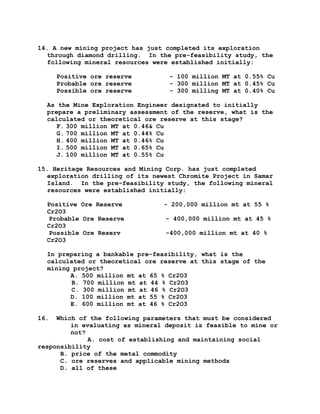
15. Heritage Resources and Mining Corp. has just completed
exploration drilling of its newest Chromite Project in Samar
Island. In the pre-feasibility study, the following mineral
resources were established initially:
Positive Ore Reserve - 200,000 million mt at 55 %
Cr2O3
Probable Ore Reserve - 400,000 million mt at 45 %
Cr2O3
Possible Ore Reserv -400,000 million mt at 40 %
Cr2O3
In preparing a bankable pre-feasibility, what is the
calculated or theoretical ore reserve at this stage of the
mining project?
A. 500 million mt at 65 % Cr2O3
B. 700 million mt at 44 % Cr2O3
C. 300 million mt at 46 % Cr2O3
D. 100 million mt at 55 % Cr2O3
E. 600 million mt at 46 % Cr2O3
16. Which of the following parameters that must be considered
in evaluating as mineral deposit is feasible to mine or
not?
A. cost of establishing and maintaining social
responsibility
B. price of the metal commodity
C. ore reserves and applicable mining methods
D. all of these
E. environmental effects during and after mining
17. Which of the following geophysical methods is sensitive to
disseminated mineralization that do not produce resistivity
anomaly?
A. seismic C. electromagnetic E. none of the
above
B. telluric D. Induced Polarization (IP)
18. In evaluating mineral deposits, positive ore reserve is
sometimes referred to what?
A. inferred ore reserve
B. possible ore reserve
C. geologic ore reserve
D. probable ore reserve
E. measured ore reserve
19. The best and most widely used exploration method in
developing an established area of mineralization or anomaly
is:
A. geostatistical analysis C. geophysics E.
geochemistry
B. Induce Polarization (IP) D. core drilling
20. In coal deposition, what does strata mean?
A. country rock C. host rock E. karst
formation
B. beams or bars D. beds or layers
21. The exploration method highly applicable in locating and
determining the thickness of wet shears, clays, or gravels is
called:
A. magnetic C. polarity E. resistivity
B. gravity D. telluric
22. Which of the following refers to the solid petroleum that
occurs as a component of shale?
A. coke C. coal E. bitumen
B. kerogene D. carbon pigment
23. In diamond drilling, the very fine and slimey samples
collected are called what?
A. chip samples C. core samples E. sludge
samples
B. blasthole cone samples D. drill cuttings samples
24. In diamond drilling, what do you call the method of
recovering cores by pulling the core barrel to the surface
using a thin steel cable passing through the drill rods, thus
eliminating the need to pull all the rods to the surface?
A. wireline drilling
B. percussion drilling
C. auger drilling
D. rotary drilling
E. conventional diamond drilling
25. In mineral prospecting, which of the following metals
exhibit an anomalous color of red?
A. mercury C. arsenic E. silver
B. gold D. copper
26. In diamond drilling, what do you call the solid samples
recovered from the core barrel?
A. drill cutting C. core samples E. blasthole
cones
B. sludge samples D. chip samples
27. Which of the following geophysical prospecting methods is
best applicable to copper sulfide minerals?
A. titration C. Induced polarization E. remote
sensing
B. atomic absorption D. Magnetometer survey
28. The best and cheapest geophysical method of establishing the
lateral extensions of deposits that are shallow occurring is
by:
A. trenching C. wireline drilling E. diamond
drilling
B. aerial magnetometer D. none of these
29. Which of the following does not belong in the set?
A. core C. drilling dust E. drill cuttings
B. drill bit D. sludge
30. Aerial magnetometer survey is best applicable in prospecting
for what type of mineral deposits?
A. coal deposits C. iron deposits E. calcite
deposit
B. silica sand D. limestone deposits
31. Which of the following is not a deterrent in the quality of
coal?
A. low heating value
B. high sulfur content
C. high heating value
D. high chlorine content
E. high moisture content
32. In diamond drilling of heavily brecciated formations, which
of the following is used to control water losses due to
seepages and improve drilling water circulation and better
sludge collection.
A. soapstone C. barite E. paint
pigment
B. lateritic mud D. bentonite
33. A high grade gold vein was sampled by channel sampling and
showed the following analysis:
SAMPLE NO. WIDTH (cm) ASSAY (GMT)
1. 15 3.0
2. 12 3.5
3. 10 5.1
4. 12 5.5
5. 15 6.0
6. 15 6.3
7. 18 7.3
8. 17 8.8
9. 19 8.5
10. 18 9.0
Assuming that the samples were taken at regular intervals,
what is the average grade of the gold vein?
A. 7.58 gmt C. 8.58 gmt E. 4.58 gmt
B. 5.58 gmt D. 6.58 gmt
34. What is a mineral resource that was established only based
on one dimension, usually surface interpretations and using
very limited samples and measurements?
A. mineable ore reserve
B. measure ore reserve
C. geologic ore reserve
D. positive ore reserve
E. none of the above
35. Which of the following geophysical prospecting methods is
not useful in identifying whether groundwater deposit is ionic
or metallic in nature?
A. induced polarization C. resistivity E. none of the
above
B. electromagnetic D. seismic
36. Which of the following exploration methods is best
applicable to developing the lateral and vertical extent of
deep-seated orebodies?
A. dogholing C. test pitting E. induced
polarization
B. diamond drilling D. trenching
37. Which of the following ore reserve categories based in four
dimensions; length, width, depth and grade?
A. geologic ore reserve
B. possible ore reserve
C. measured ore reserve
D. positive ore reserve
E. probable ore reserve
38. Which of the following grade prediction techniques allows
the lowest margin error in estimation?
A. geostatiscal methods
B. distance weighing
C. classical statistics
D. inverse distance weighing
E. geometric methods
39. Which of the following refers to the worthless material that
is associated the valuable minerals within an orebody or
deposits?
A. oreshoot C. paystreak E. gangue
B. nava D. bonanza
40. It refers to the tonnage per cubic meter volume of material.
A. ore reserve C. swell factor E. mine head
B. mill head D. tonnage factor
41. The brownish and often rusty outcrop of an iron or other
limonitic deposits is called what?
A. window C. gob E. gossan
B. aggregate D. outcrop
42. Which of the following geophysical prospecting methods most
applicable for oil and gas deposits?
A. diamond drilling C. trenching E. wireline
drilling
B. aerial magnetometer D. seismic survey
43. Which of the following mineral resource information is based
on limited dimensions and relies mainly on the estimators
appreciation and projection of the geological attributes of the
area?
A. probable ore reserve
B. positive ore reserve
C. measured ore reserve
D. geologic ore reserve
E. possible ore reserve
44 . Heritage Resources and Mining Corp. reported to the Mines &
Geosciences Bureau in its Affidavit of Anuual Work Obligation
(AAWO) for the year 2003 the following mineral reserve of its
Homonhon Chromite Project in Eastern Samar as follows :
Positive Ore Reserve - 100,000 million mt at 55 %
Cr2O3
Probable Ore Reserve - 300,000 million mt at 45 %
Cr2O3
Possible Ore Reserve -300,000 million mt at 40 %
Cr2O3
Calculate the total ore reserve of Heritage Mining, Homonhon
Chromite Project.
A. 300 million MT at 46 % Cr2O3
B. 700 million MT at 44 % Cr2O3
C. 500 million MT at 65 % Cr2O3
D. 400 million MT at 46 % Cr2O3
E. 100 million MT at 55 % Cr2O3
45. In rotary drilling, which of the following refers to the
samples recovered from hole bottom and brought to the surface by
either water or air?
A. core samples C. sludge samples E. chip
samples
B. cone samples D. drill cuttings
46. Which of the following is the affect the heating value of
coal?
A. pyrite content C. moisture content E. granulation
B. Chlorine content D. sulfur content
47. In diamond drilling, which of the following is used to
locate and recover detached or lost drill bits at the bottom of
a drill hole?
A. sludge collector C. bit splitter E. wireline
B. core barrel D. fishing device
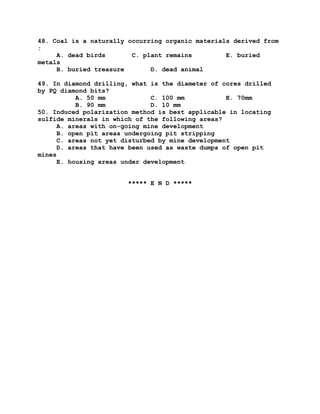
48. Coal is a naturally occurring organic materials derived from
:
A. dead birds C. plant remains E. buried
metals
B. buried treasure D. dead animal
49. In diamond drilling, what is the diameter of cores drilled
by PQ diamond bits?
A. 50 mm C. 100 mm E. 70mm
B. 90 mm D. 10 mm
50. Induced polarization method is best applicable in locating
sulfide minerals in which of the following areas?
A. areas with on-going mine development
B. open pit areas undergoing pit stripping
C. areas not yet disturbed by mine development
D. areas that have been used as waste dumps of open pit
mines
E. housing areas under development
***** E N D *****
BOARD EXAMINATION QUESTIONS
MINERAL SAMPLING AND ORE RESERVE ESTIMATION
1. A confirmed ore deposit where it passed the technical and commercial evaluation of
its existence.
a. Proven Ore Reserve c. Probable Ore Reserve e. Measured Ore
b. Minable Reserve d. Positive Ore
2. In percussion drilling, how drill cuttings are collected from the bottom of the hole?
a. Reverse Circulation c. Wash Boring e. Drive Sampling
b. Bailing d. Churn Sampling
3. A sampling technique that is required to further determine the mining and
metallurgical properties
like grade of the ore.
a. Grab Sampling c. Channel Sampling e. Random
Sampling
b. Bulk Sampling d. Muck Sampling
4. An ore deposit where tonnage and grade of the ore are computed partly from specific
measurements, samples or production data, and partly from projections for a
reasonable distance
on geologic evidence.
C. Indicated Ore c. Positive Ore e. Probable
Ore
D. Measured Ore d. Prospective Ore
5. When can be a gangue minerals become an “ore” ?
a. Increase of volume of the deposit
b. Increase in price of the metal in local and world market
c. Increase in grade of the ore
d. Selection of an ideal mining method and ore processing
e. High production capacity
6. A type of ore reserve which contain sufficient technical and economic studies that
have been out
to justify extraction at the time of determination and under specified conditions.
a. Measure Ore Reserve c. Probable Ore Reserve e. Inferred Ore
Reserve
b. Indicative Ore Reserve d. Proven Ore Reserve
7. It is a method of ore reserve estimation that involves the application of mathematics
of random functions to the reconnaissance of mineral deposits.
a. Kriging c. Triangular Method e. Area method
b. Geostatistics d. Inverse Distance Weighting
8. A rock samples obtained from diamond drilling exploration.
a. Rock Chips c. Core e. Muck
b. Drill Cutting d. Boulder
9. The lowest grade of the ore that will meet the over-all mining cost.
a. Cut-off Grade c. Milling Grade e. Assay Grade
b. Break-even ratio d. Low Grade
10. In core drilling, what is name of the drill accessory that collect rocks core samples at
the bottom
of the hole during drilling operation?
a. Drill Casing c. Drill Rod e. Core Barrel
b. Split spoon sampler d. Suction Hose
11. It consists of chips or pulverized rock produced by the action of the bit during
drilling.
a. Core c. Sludge e. Drill Residue
b. Drilling cuttings d. Slurry
12. Aside from the core and drill cuttings, it is another form of sample obtained when
doing drilling
sampling.
a. Sludge c. flush-out water e. filter cake
b. Slurry d. drilling mud
13. A positive ore reserve is synonymous to:
a. Measured Ore c. Possible Ore e. Indicative Ore
b. Probable Ore d. Inferred Ore
14. It refers to the representative portion of a universe/population or mineral mass/body.
It can be
an element or portion, unit or element.
a. Matter c. Atom e. Isotope
b. Sample d. Ion
15. An act of enriching or improvising that is introducing or removing values from) the
samples for
test purposes either intentionally or accidentally.
a. Salting c. High-grading e. assaying
b. Upgrading d. coning & quartering
16. It measures the relative variations or deviation of sample values from the mean.
This is also
known as the coefficient of uniformity.
a. sampling error c. mode e. high grading
b. variation d. coefficient of variation
17. In sampling, the number or size of sample depends upon the nature of the deposit.
In general it
require fewer samples compared to heterogenous deposits.
a. homogeneous deposit c. Ore e. gangue
b. irregular deposit d. mineral
18. Which of the following is not a non-probability sampling?
a. systematic sampling c. quota sampling e. accidental sampling
b. incidental sampling d. purposive sampling
19. Which of the following is not a probability sampling?
a. simple random samplingc. systematic sampling e. statistical sampling
b. multi-stage sampling d. purposive sampling
20. The two (2) types of dump/stockpile sampling are:
a. stratified & random sampling
b. trenching & test pitting
c. channeling & trenching
d. test pitting & grabbing
e. none of the above
21. The isopach method of ore reserve estimation relies mainly in:
a. specific gravity c. contour e. density
b. drillholes d. statistical data
22. It is a statistical method of ore reserve estimation.
a. Polygon method c. triangular method e. area method
b. cross-sectional method d. Inverse distance weighting
23. Break even means:
a. systematic sampling c. quota sampling e. accidental sampling
b. incidental sampling d. purposive sampling
24. Which of the following valuation parameters is necessary in evaluating whether a
mineral deposit
is feasible to develop or not?
a. ore reserve and applicable mining method
b. environmental effects and expense during and after mining
c. cost of establishing and maintaining social acceptability
d. cost of establishing and maintaining social acceptability
e. all of the above
25. In diamond drilling, the very fine and slimey samples that are brought up to the
surface by
drilling water and collected in settling basins.
a. chip samples c. core samples e. flush-out samples
b. drill cuttings d. sludge sample
26. Which of the following sampling method is most applicable in sampling vein-type
deposits?
a. grab sampling c. coning and quartering e. channel sampling
b. random sampling d. auger sampling
27. Which of the following grade prediction techniques allows the lowest margin of error
in
estimation?
a. area method c. geostatistical methods e. classical
statistics
b. geometric method d. linear programming method
28. Which of the following ore reserve categories is based on four (4) dimensions, i.e.
length, width,
depth and grade?
a. geologic ore reserves c. measured ore reserves e. probable
reserves
b. possible ore reserves d. positive ore reserve
29. Which of the following mineral resource information is based on limited dimensions
and relies
mainly on the estimators appreciation and projection of the geological attributes of
the area?
a. geologic ore reserves c. measured ore reserves e. probable
reserves
b. possible ore reserves d. positive ore reserve
30. It is a system of preserving diamond drill core samples for future reference but at the
same time
provide adequate sample for geologic interpretation and for the purpose of
establishing the grade
of the minerals contained therein.
a. total core assaying c. thin sectioning e. core polishing
b. total core storage d. core splitting
31. A cylindrical chamber for receiving & retaining rock samples as diamond drilling
progresses is called: a. core box c. drill pipe e. split
tubes
b. core barrel d. sample splitter
32. Which of the following hand sampling procedures is the most accurate or the results
to the
smallest possible error?
a. cut sampling c. channel sampling e. muck sampling
b. chip sampling d. grab sampling
33. A sampling method to further determine the mining and metallurgical properties of
the deposit
such as: ore grade, rock hardness & strength, grain size of mineral, etc.
a. cut sampling c. channel sampling e. muck sampling
b. bulk sampling d. grab sampling
34. A method of collecting samples obtained from percussion drilling.
a. flush-out c. suction e. driving split tubes
b. bailing d. wash boring
35. Which of the following subsurface sampling method that collects core samples from
a core barrel
attached to a diamond bit?
a. churn drilling c. core drilling e.
trenching
b. auger boring d. test pitting
36. A sampling tool used to collect rock chips samples obtained from percussion drilling.
a. casing c. core barrel e. bailer
b. thin-walled sampler d. split spoon sampler
37. A sampling tool used to collect alluvial soils containing mineral fragments.
a. casing c. core barrel e. bailer
b. thin-walled sampler d. split spoon sampler
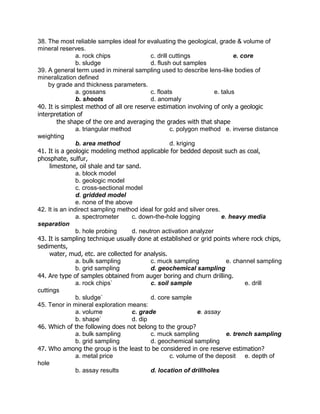
38. The most reliable samples ideal for evaluating the geological, grade & volume of
mineral reserves.
a. rock chips c. drill cuttings e. core
b. sludge d. flush out samples
39. A general term used in mineral sampling used to describe lens-like bodies of
mineralization defined
by grade and thickness parameters.
a. gossans c. floats e. talus
b. shoots d. anomaly
40. It is simplest method of all ore reserve estimation involving of only a geologic
interpretation of
the shape of the ore and averaging the grades with that shape
a. triangular method c. polygon method e. inverse distance
weighting
b. area method d. kriging
41. It is a geologic modeling method applicable for bedded deposit such as coal,
phosphate, sulfur,
limestone, oil shale and tar sand.
a. block model
b. geologic model
c. cross-sectional model
d. gridded model
e. none of the above
42. It is an indirect sampling method ideal for gold and silver ores.
a. spectrometer c. down-the-hole logging e. heavy media
separation
b. hole probing d. neutron activation analyzer
43. It is sampling technique usually done at established or grid points where rock chips,
sediments,
water, mud, etc. are collected for analysis.
a. bulk sampling c. muck sampling e. channel sampling
b. grid sampling d. geochemical sampling
44. Are type of samples obtained from auger boring and churn drilling.
a. rock chips` c. soil sample e. drill
cuttings
b. sludge` d. core sample
45. Tenor in mineral exploration means:
a. volume c. grade e. assay
b. shape` d. dip
46. Which of the following does not belong to the group?
a. bulk sampling c. muck sampling e. trench sampling
b. grid sampling d. geochemical sampling
47. Who among the group is the least to be considered in ore reserve estimation?
a. metal price c. volume of the deposit e. depth of
hole
b. assay results d. location of drillholes
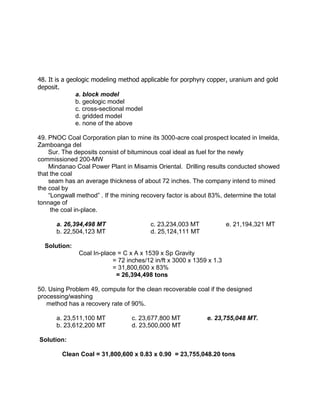
48. It is a geologic modeling method applicable for porphyry copper, uranium and gold
deposit.
a. block model
b. geologic model
c. cross-sectional model
d. gridded model
e. none of the above
49. PNOC Coal Corporation plan to mine its 3000-acre coal prospect located in Imelda,
Zamboanga del
Sur. The deposits consist of bituminous coal ideal as fuel for the newly
commissioned 200-MW
Mindanao Coal Power Plant in Misamis Oriental. Drilling results conducted showed
that the coal
seam has an average thickness of about 72 inches. The company intend to mined
the coal by
“Longwall method” . If the mining recovery factor is about 83%, determine the total
tonnage of
the coal in-place.
a. 26,394,498 MT c. 23,234,003 MT e. 21,194,321 MT
b. 22,504,123 MT d. 25,124,111 MT
Solution:
Coal In-place = C x A x 1539 x Sp Gravity
= 72 inches/12 in/ft x 3000 x 1359 x 1.3
= 31,800,600 x 83%
= 26,394,498 tons
50. Using Problem 49, compute for the clean recoverable coal if the designed
processing/washing
method has a recovery rate of 90%.
a. 23,511,100 MT c. 23,677,800 MT e. 23,755,048 MT.
b. 23,612,200 MT d. 23,500,000 MT
Solution:
Clean Coal = 31,800,600 x 0.83 x 0.90 = 23,755,048.20 tons
51. Again in Problem 49, determine the total revenues of clean coal if the buying price is
P2,500.00/MT.
a. P50,387,500,000.00 c. P 59,387,620,500.00 e. P
52,074,500,000.00
b. P 51,188,800,000.00 d. P 59,176,612,300.00
Solution: Total Revenue = 23,755,048.20 tons x P 2,500/MT
= P 59,387,620,500.00
52. A newly-opened mine was explored for its nickel/cobalt deposit in Nonoc
Island,Surigao, Mindanao
The exploration results showed that the mine had a total proven ore reserve of
123,590,000 metric
tons of ore. What is the life of the mine in years if the daily production 15,000
MT/day?
a. 20 years c. 23 years e. 25 years
b. 21 years d. 24 years
Solution:
Life of the Mine = 123,590,000 MT
15,000 MT
= 8,239.33 x 1year
365 days
= 22.5 years or 23 years
53. Based on the result of the mineral exploration, the explored deposit was
economically and
technically evaluated and results showed the following:
Mining & Milling Cost = $ 1.80/ton
Overhead Expenses = $ 0.50/ton
Miscellaneous Expenses = $ 0.30/ton
Depreciation & Amortization = $ 0.45/ton
Grade of the Ore = 0.70 % Cu
Concentrator Recovery = 90%
Return of Investment(ROI) before income taxes = $0.22/ton
Market Price of Cu = $ 0.85/lb
Compute the expected profit per ton of ore.
C. $ 0.33/ton c. $ 8.63/ton e. $ 0.98/ton
D. $ 0.45/ton d. $ 1.02/ton
Solution:
Total Cost/ton = Mining/Milling Cost + Overhead + Misc + Depre/Amor + ROI
= $1.80 + $ 0.50 + $ 0.30 + $0.45 + $0.22 = $ 3.27
Revenue/Ton = 2000lbs/ton x 0.007 = 14 lbs x $0.85lb/ton = $11.9/ton
Profit/ton = $ 11.9/ton - $3.27/ton = $ 8.63/ton
54. Using the above information, what is the cut-off grade of the copper ore:
a. 0.21% Cu c. 0.34% Cu e. 0.19% Cu
b. 0.25% Cu d. 0.22% Cu
Solution:
Cut-off Grade = $ 3.27/ton = 4.27 lbs (4.27lbs/2000lbs/ton)
$0.85/lb x 0.90 or 0.21% Cu
55. Sagitarrius Mines reported to the Mines & Geosciences Bureau (MGB) for its
Affidavit of Annual
Work Obligation (AAWO) for the year 2009 the following mineral reserves of its
Tampakan
Copper-Gold Project in South Cotabato as follows:
Positive Ore Reserves 100 Million MT at 55 % CuFeS2
Probable Ore Reserves 300 Million MT at 45% CuFeS2
Possible Ore Reserves 300 Million MT at 40% CuFeS2
Based on the traditional and conventional valuation method, calculate the total ore
reserve of Sagitarrius Mines of its Tampakan Project
a. 400 million at 46% CuFeS2 d. 100 million at 55% CuFeS2
b. 300 million at 46% CuFeS2 e. 500 million at 65% CuFeS2
c. 700 million at 44% CuFeS2
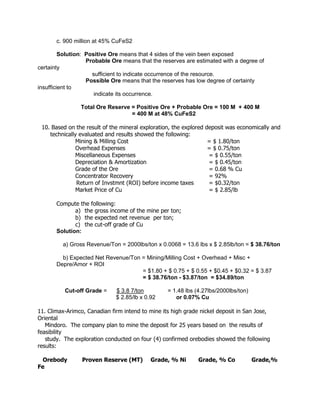
Solution: Positive Ore means that 4 sides of the vein been exposed
Probable Ore means that the reserves are estimated with a degree
of certainty
sufficient to indicate occurrence of the resource.
Possible Ore means that the reserves has low degree of certainty
insufficient to
indicate its occurrence.
Total Ore Reserve = Positive Ore + Probable Ore = 100 M + 300 M
= 400 M at 46% CuFeS2
56. A high grade gold vein was sampled by channel sampling and showed the following
assays:
SAMPLE NO. WIDTH (CM) ASSAY (GMT)
1. 15 3.0
2. 12 3.5
3. 10 5.1
4. 12 5.5
5. 15 6.0
6. 15 6.3
7. 18 7.3
8. 17 8.8
9. 19 8.5
10 18 9.0
Assuming that the samples were taken at regular intervals, what is the average
grade of the gold vein?
a. 7.58 GMT c. 4.58 GMT e. 6.58 GMT
b. 8.58 GMT d. 5.58 GMT
57. A mining property is divided into grid in preparation for exploration drilling of eleven
(11) drillholes.
The distance between grid points are 2.000 feet apart. The drilling results revealed
the following:
Drillhole No. Vein Thickness (ft)
1 4.7
2 3.3
3 5.1
4 4.9
5 4.8
6 4.9
7 5.4
8 5.0
9 4.3
10 4.5
11 5.7
7
6
5
11
10
9
8
Using the above drawn polygon, compute average thickness of the vein
a. 4.52 ft. c. 4.66 ft e. 4.78 ft
b. 3.93 ft d. 5.11 ft.
Solution:
Average thickness = 4.7 + 3.3 + 5.1 + 4.9 + 4.8 + 4.9 + 5.4 +5.0 + 4.3 +
4.5 + 5.7
11
= 4.78 ft
58. Using Problem 48, compute the total tonnage of the ore deposit by polygon
method if the ore weighs 0.15 ton/cu ft.
a. 17,265,000 tons c. 17,400,228 tons e. 15,090,000 tons
b. 15,200,000 tons d. 16,300,000 tons
Solution:
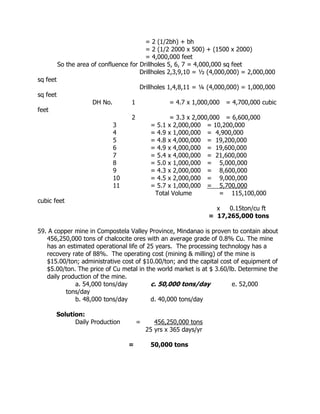
Thus, the area of confluence is = 2 triangles + 1 rectangle
1
2 3 4
1
9
8
2
5
6
2,000
1,500
500
= 2 (1/2bh) + bh
= 2 (1/2 2000 x 500) + (1500 x 2000)
= 4,000,000 feet
So the area of confluence for Drillholes 5, 6, 7 = 4,000,000 sq feet
Drillholes 2,3,9,10 = ½ (4,000,000) = 2,000,000
sq feet
Drillholes 1,4,8,11 = ¼ (4,000,000) = 1,000,000
sq feet
DH No. 1 = 4.7 x 1,000,000 = 4,700,000 cubic
feet
2 = 3.3 x 2,000,000 = 6,600,000
3 = 5.1 x 2,000,000 = 10,200,000
4 = 4.9 x 1,000,000 = 4,900,000
5 = 4.8 x 4,000,000 = 19,200,000
6 = 4.9 x 4,000,000 = 19,600,000
7 = 5.4 x 4,000,000 = 21,600,000
8 = 5.0 x 1,000,000 = 5,000,000
9 = 4.3 x 2,000,000 = 8,600,000
10 = 4.5 x 2,000,000 = 9,000,000
11 = 5.7 x 1,000,000 = 5,700,000
Total Volume = 115,100,000
cubic feet
x 0.15ton/cu ft
= 17,265,000 tons
59. A copper mine in Compostela Valley Province, Mindanao is proven to contain about
456,250,000 tons of chalcocite ores with an average grade of 0.8% Cu. The mine
has an estimated operational life of 25 years. The processing technology has a
recovery rate of 88%. The operating cost (mining & milling) of the mine is
$15.00/ton; administrative cost of $10.00/ton; and the capital cost of equipment of
$5.00/ton. The price of Cu metal in the world market is at $ 3.60/lb. Determine the
daily production of the mine.
a. 54,000 tons/day c. 50,000 tons/day e. 52,000
tons/day
b. 48,000 tons/day d. 40,000 tons/day
Solution:
Daily Production = 456,250,000 tons
25 yrs x 365 days/yr
= 50,000 tons
BOARD EXAM QUESTIONAIRES
MINERAL PROSPECTING & EXPLORATION
MULTIPE CHOICE: Select the correct letters that answer the following sentences.
1. A drilling techniques in mineral exploration that uses either air or water as flushing medium
where cutting are siphoned/sucked from bottom of hole passing through the inner opening
of the series of drill strings.
a. Core Drilling c. Reverse Circulation Drilling e. Jet Piercing
b. Percussion Drilling d. Rotary Drilling
2. This material are considered as clay that can be used as both drilling lubricant and flushing
medium.
a. Muds c. Soapstone e. Sulfactant
b. Clays d. Bentonite
3. A geophysical exploration methods used preferably in petroleum and gas exploration.
a. Gravimetric c. Magnetic e. Radiometric
b. Electric d. Remote Sensing
6. It is a hole drilled to obtain the physical, geological and engineering character of mineral
deposit
using a rotary-type of drilling equipment.
a. Borehole c. Drillhole e. Open Hole
b. Percussion Hole d. Blasthole
7. A drilling technique where rods are pulled-out together with the core barrel to recover the
samples
for every length of drill run.
a. Wire-line Drilling c. Reverse circulation Drilling e. Directional
Drilling
b. Rotary-percussive Drilling d. Conventional Drilling
8. A method of mineral exploration that measures the trace concentration of chemical element
or
bacteria found within a mineral deposit.
a. Geophysical Exploration c. Geochemical Exploration e. Rock Exploration
b. Drilling Exploration d. Geological Exploration
9. Geologic Mapping is an activity of what exploration technique:
a. Geologic Exploration c. Drilling Exploration e. Mineral Exploration
b. Geophysical Exploration d. Geochemical Exploration
10. In geochemical exploration conducted along lakes, what particular sampling media are
usually
taken for geochemical testing.
a. Sediments c. Mud e. stones
b. Rocks d. roots of trees
11. Any disintegrated rock found at the toe of slope that does not contain mineral present for
further
investigation.
a. Float c. Ore e. Talus
b. Gossan d. Bonanza
12. A barren rock in the mine.
a. Host Rock c. Country Rock e. Muck
b. Waste Rock d. Tailing
13. A field activity conducted by geologist or engineer to trace, locate and record surficial
geological
information plotted on maps.
a. Reconnaissance Mapping c. U/G Geologic Mapping e. None of the
above
b. Surface Geologic Mappingd. Field Traverse Mapping
14. When conducting a geologic mapping, which of the following is the least not most needed
in the
field mapping?
a. Geologic Map c. Meter Tape e. Hand Lens
b. Brunton Compass d. Global Positioning System
15. Which of the following mineral properties can not determined during geologic mapping?
a. Soil/rock types c. Physical Properties e. Mechanical
Properties
b. Geologic Structure d. Chemical Properties
16. A mineral exploration method that utilize a high altitude-radar equipment installed in an
aircraft
that maps earth’s topography using satellite images to detect bedrock and mineralized
zones.
C. Radiometric c. Gravimetric e. Electrical
D. Remote Sensing d. Magnetic
17. A mineral exploration method that uses gamma rays to penetrate into the earth’s crust to
detect
radioactive minerals.
a. Remote Sensing c. Seismic e. Gravimetric
b. Aeromagnetic d. Radiometric
18. A hybrid form of drilling methods that combines separately percussive and rotational actions
using
either drag bits or tricone roller bits.
a. Rotary Drilling c. Diamond Core Drilling e. Rotary-Percussive
Drilling
b. Percussion Drilling d. Churn Drilling
19. What is the most important task to be accomplished in core drilling?
a. Rock Core c. Deep of hole e. Size of the hole
b. Rapid advance of footage d. Sludges
20. In wireline core drilling using NQ core barrel, what is the standard size of the core that can
be
recovered?
C. 55 mm c. 25 mm e. 45 mm
D. 75 mm d. 100 mm
21. It is the percentage of the core recovered from drilling divided by the length of drill run
multiplied
by 100.
C. Percentage Core Recovery c. Length of Core e. Percentage
Mineralization
D. Rock Quality Designation d. Length of Drill Run
22. Porphyry/dessiminated copper are formed by :
a. Chemico-sedimentary c. Contact Metamorphism e. Weathering
b. Magmatic Differentiation d. Biological Origin
23. Which of the following areas where most of the mineral deposits are found?
a. Abandoned Mine c. Mine Refuse e. Caves
b. River Beds d. Roadcuts
24. A geological structure found in between layers/bedding of different rock types.
a. Fault c. Geologic Contact e. Fissure
b. Bedding d. Fold
25. The physical property of a mineral that can be detected by holding a piece of copper in one
hand
and holding a piece of amber on the other hand and the copper is felt colder.
C. Transparency c. Luster e. Cleavage
D. Heat Conductivity d. Streak
26. In locating drillholes by grid system, what is the standard distance of holes in drilling a
porphyry
copper deposit.
a. 100.00 meters c. 150.00 meters e. 175.00 meters
b. 75.00 meters d. 50.00 meters
27. Geochemical prospecting is used to trace metals usually contained in?
copper deposit.
a. waste dump samples c. Flora samples e. Oil samples
b. wind samples d. Water or stream sediment samples
28. Which of the following is a product of rotary drilling?
a. Core c. Drill cuttings e. Return water
b. Sludge d. Rock chips
29. An exploration drilling method where drilling is performed by “raising and dropping” of the
chisel-
type bit.
a. Rotary drilling c. Percussion drilling e. Diamond core drilling
b. Rotary-percussion d. Churn drilling
30. A flushing medium now widely used in drilling exploration in rugged terrain.
a. Water c. Bentonite e. Soapstone
b. Compressed air d. Clay
31. When a sediments changes/transform into sedimentary rocks, it undergoes the process of:
a. Weathering and erosion c. Solidification e. Melting
b. Cementation and compaction d. Sedimentation
32. When metamorphic rocks changes to sedimentary rocks, what are factors involved:
a. heat and pressure c. temperature and pressure e. water pressure
b. external load d. tectonic and volcanic movements
33. Magnetite rocks are formed by:
a. Metasomatic process c. chemico-sedimentary e. chemical
weathering
b. magmatic differentiation d. contact metamorphism
34. When feldspar underwent weathering, it changes into:
a. Olivine c. Plagioclase e. Kaolin
b. Quartz d. Hornblende
35. When igneous rock weathers by mechanical weathering process, it will transform into:
a. Clay c. Silt e. Sand
b. Mud d. Gravel
36. Phosphate rocks are formed by:
a. dissolution of carbonaceous components in limestone with decaying plant remains
b. chemical reaction with bodies of dead animals
c. weathering of coralline limestone bodies near shorelines
d. reaction of carbonaceous components in limestone with bird or bat manure
e. incomplete oxidation of decaying organic matter
37. Which of the following geologic structure is formed by dissolution of carbonates materials in
limestone bodies with percolating surface/underground waters.
a. Joints c. Folds e. Fissures
b. Fractures d. Karst
38. A physical property of a mineral that reflect and refract to light.
a. Streak c. Luster e.Luminescence
b. Magnetism d. Cleavage
39. What component of the local coal that lessens or lowers the quality and demand for
industrial
usage particularly for fuel combustion?
a. High sulfur content c. Clay impurities e. methane gas
content
b. Low heating value (btu) d. Organic matter origin
40. A type of coal that represent the initial, unconsolidated stage in the coal development.
a. Subbituminous c. Anthracite e. Peat
b. Bituminous d. Lignite
41. In mineral exploration drilling, what is the maximum depth of holes considered shallow.
a. 150 meters c. 100 meters e. 300 meters
b. 200 meters d. 500 meters
42. What is the most important factor that contributes mainly to quality of coal formation.
a. type of vegetable matter where coal originates
b. magnitude of heat and pressure
c. the weight of external load
d. the type of foreign matter components in coal
e. the type of bacteria present
43. A geophysical exploration method ideal to detect gold and uranium ores.
a. Gravity c. Electrical e. Seismic
b. Magnetic d. Remote sensing
44. What type of geophysical exploration method that uses the density of rocks in identifying
the type
of ore buried beneath the surface.
a. Seismic c. Electrical e. Gravity
b. Magnetic d. Remote sensing
45. Uranium and thorium are detected by:
a. Aeromagnetic c. Electromagnetic e. Radiometric
b. Remote sensing d. Seismic
46. It is not a mineral but an aggregate of minerals and other colloidal substances.
a. Quicksand c. Talus e. Floats
b. Clay d. Aggregates
47. A main mineral found in limestone.
a. Limonite c. Quartz e. Lime
b. Calcite d. Calcium oxide
48. If coal is of vegetal or plant in origin, then oil and natural gas came from:
a. Volcanic origin c. Plant origin e. Animal excreta
b. marine organism d. bacterial origin
49. What is the most suitable reservoir rock for oil?
a. Limestone c. Shale e. Sandstone
b. Conglomerate d. Clay
50. In mineral exploration drilling for gold, magnetite sand and laterite deposit containing nickel
and
cobalt ores, what is the most ideal drilling methods to be used?
a. wireline core drilling c. rotary drilling e. conventional drilling
b. rotary-percussion d. reverse circulation drilling
51. The most common gold ores.
a. Gold-quartz c. Placer gold e. Free-gold
b. Pyritic ores d. Gold associated w/ copper
52. A drilling method used in coal/mineral exploration where the drill rods and core barrel are
left
behind inside the hole and the inner tube core barrel containing the core is pulled out to
the
surface to recover the core samples.
a. Reverse Circulation drilling c. churn drilling e. auger boring
b. Wire-line drilling d. Conventional drilling
53. A measure commonly used to express the heating value of coal.
a. Celsius c. Pounds/sq. in2 e. British Thermal Unit
b. Fahrenheit d. Kilogram/sq m2
54. A physical property of mineral determine by rubbing on a piece of unglazed porcelain that
leaves a colored scratch.
a. Streak c. Hardness e. Friability
b. Specific Gravity d. Grindability
55. A poisonous gas commonly found in coal beds.
a. Carbon monoxide c. Carbon Dioxide e. nitrous oxide
b. Methane d. Sulfur dioxide
56. It is considered as particulate matter in coal burning.
a. Coal Dust c. coal residue e. coal remains
b. Coal Ash d. coal flake
57. It defines the extent, type, rank and quantity of coal deposit.
a. Geologic Mapping c. Coal Exploration e. Geochemical Prospecting
b. Coal Sampling d. Coal Reserve Estimation
58. It is total length of coal/rock samples recovered divided by the total drilling run
multiplied by 100%.
a. % Core Recovery c. Length of core
b. Drill run d. Rock Quality Designation
59. It is considered as impurities in coal due to emission of toxic SO3 gas.
a. Phosphorous c. Iron e. Sulfur
b. Lime d. Aluminum
60. It the origin/source of oil and natural gas.
a. Animals c. Grass e. Leaves
b. Plants d. Food
61. Subbituminous coal has an average heating value of:
a. 3,000 Btu c. 10,000 Btu e. 15,000 Btu
b. 5,000 Btu d. 12,000 Btu
62. A drilling techniques that preferably uses water as flushing medium to bring the cuttings
from the
bottom of the hole through the annulus.
a. Conventional Rotary Drilling c. Reverse Circulation Drilling e. Churn Drilling
b. Diamond Core Drilling d. Auger Boring
63. A natural-occurring organic material form the accumulation of plant remain that has
undergone
incomplete oxidation.
a. Ore c. Mineral e. Rock
b. Coal d. Soil
64. A type of coal that is considered low grade and in rank.
a. Lignite c. Bituminous e. Subbituminous
b. Peat d. Anthracite
65. A natural-occurring inorganic material that contains an aggregate of minerals.
a. Mineral c. Coal e. Soil
b. Ore d. Rock
66. The deposition/succession of the different types of sedimentary rocks in a rockmass.
a. Parting c. Layering e. Contact
b. Stratification d. Bedding
67. A flammable gas commonly found in coal beds.
a. Carbon monoxide c. Carbon Dioxide e. nitrous oxide
b. Methane d. Sulfur dioxide
68. An environment considered as an ideal location of coal formation.
a. Forestland c. Marshland e. Rain Forest
b. Farmland d. Wetland
69. A portion of organic matter which is driven off as a gas.
a. Fixed Carbon c. Calorific Value e. Chlorine
b. Volatile Matter d. Agglomerating Character
70. Heat produced by coal combustion.
a. Calorific Value c. Volatile Heat e. Thermal Heat
b. Flue Gas d. Intense Heat
71. Are gold deposit found along rivers, gullies which associates with clay, silt, sand and gravel.
a. native gold c. alluvial gold e. placer gold
b. fools gold` d. quartz gold
72. In placer gold, what are the ranges of its carat content?
a. 13-15 carat` c. 22-24 carat e. 16-17 carat
b. 18-22 carat d. 10-12 carat
73. Which of the following does not belong to ultramafic rocks where magnetite sand came
from?
a. Andesite c. Diorite e. Dunite
b. Basalt d. Shale
74. Which of the following geologic feature that provide suspicion of the presence of minerals?
a. alteration zone c. slickenside e. ground subsidence
b. gouges d. soil creeping
75. When can be a mineral become an ore ?
a. mining boom c. high metal value e. blending
b. high grade d. mineral processing
76. A mineral deposit of tabular form lying horizontally or sub-horizontally and commonly
parallel to the
stratification of the enclosing rocks.
a. Porphyry/Dessiminate deposit c. Bedded deposit e. placer deposit
b. vein-type deposit d. magmatic deposit
77. The best geophysical exploration method suited in searching for porphyry copper.
a. Induced Polarization c. Remote Sensing e. Electrical Georesistivity
b. Electromagnetic d. Laser Techniques
78. Which of the following mineral that possess radioactive characteristics.
a. Augite c. Bornite e. uranium
b. Pyrolusite d. Chalcocite
79. A mineral that exhibit sky-blue or blackish blue when exposed as outcrop.
a. Malachite c. Azurite e. Chlacocite
b. Cuprite d. Pyrolusite
80. A particular phase in regional mineral prospecting and exploration wherein detailed surface
appraisal is being done on the target area.
a. Phase 1 c. Phase 2 e. Phase 5
b. Phase 3 d. Phase 4
81. A type of map that contains the elevations, coordinates, contours, roads, surface water
sources,
legends, scales and other surficial features that are present in the area.
a. Hydrographic Map c. Plan and Profile Map e. Vicinity Map
b. Geologic Map d. Topographic Map
82. These are uneven and irregular vein formed where a mass of molten rock started cooling,
and
large quantities of liquids and gases are given off and deposited along rock cracks and
crevices.
a. Porphyry Deposit c. Quartz Vein e. Placer deposit
b. Fissure Vein d. Bonanza
83. Aside from limestone, what other raw materials are necessary in the production of cement.
a. diorite c. andesite e. silica
b. dacite d. granite
84. For accurate logging of diamond drill cores, the core must first be:
a. painted with clear while c. crushed to powder form e. polished with
powder form
b. wetted with clean water d. pulverized to minus 200 mesh
85. Aerial magnetometer surveys are best applicable in exploration which of the following
mineral
deposits?
a. calcite deposit c. iron deposit e. silica deposit
b. limestone d. coal deposit
86. In diamond core drilling, which of the following devices is used to locate and recover
detachec or
lost drill rods or bits at the bottom of the hole?
a. bit splitter c. fishing tap device e. bailer
b. overshot assembly d. core barrel
87. The most effective, detailed and widely used method of exploration applied in developing or
delineating an orebody for the purpose of defining ore reserves is called?
a. airborne exploration c. trenching e. conventional rotary drilling
b. diamond core drilling d. churn drilling
88. Which of the following does not belong to the group?
a. drill core c. drill bit e. drill cutting
b. drilling dust d. sludge
89. In mapping and interpretation, rivers, creeks or streams are usually surface impressions of
which
of the following?
a. fault c. syncline e. dome
b. anticline d. placer deposit
90. Which of the following exploration methods is best applicable to developing a lateral and
vertical
extent of deep seated orebodies?
a. laser techniques c. remote sensing e. seismic surveys
b. test pitting d. diamond core drilling
91. In coal deposition, what does strata mean?
a. bedding c. country rock e. geologic contact
b. beds or layers d. slickenside
92. In mineral prospecting, which of the following metals exhibit an anomalous color of red?
a. iron c. chromium e. copper
b. arsenic d. mercury
93. An exploration method highly applicable in locating and determining thickness of wet
shears,
clays , sand and gravels is called?
a. seismic c. gravity e. resistivity
b. remote sensing d. magnetic
94. Are two of the best suited exploration methods for mining exploration.
a. magnetic & electrical c. seismic & radiometric e. gravity & magnetic
b. seismic & gravimetric d. electrical & remote sensing
95. In wireline core drilling, what is the standard size of the core using a double tube PQ core
barrel
E. 55 mm c. 25 mm e. 45 mm
F. 75 mm d. 100 mm
96. In reverse circulation drilling, the fine samples siphoned of:
a. blasthole cone c. sludge sample e. Drill cutting
b. chip samples d. Core sample
97. In mineral exploration, it consist of detonating a charge of explosives and measures the
reflection
and refraction of artificial earthquake waves set-up by a shock of the explosive explosion.
a. magnetic c. electrical e. gravity
b. remote sensing d. seismic
98. It is a drilling exploration method where samples are collected by bailing.
a. core drilling c. churn e. percussion
b. direct rotary d. reverse circulation
99. Which of the following are not used as fluids in drilling exploration?
a. compressed air c. bentonite e. polymers
b. water d. polyphosphate
100. It is a system of preserving diamond drill core samples for future references but at the
same time
provide adequate samples for geologic interpretation and for the purpose of establishing
the grade
of the mineral or minerals contained therein.
a. core assaying c. core storage e. thin sectioning
b. core polishing d. core splitting
BOARD EXAM QUESTIONS
MINERAL PROSPECTING
MULTIPE CHOICE: Select the correct letters that answer the following sentences.
1. It is considered as a scientific way of investigation of the earth crust to determine the mineral
present that have commercial value.
a. Rock Exploration c. Prospecting e. Geophysical
Exploration
b. Mineral Exploration d. Geochemical Exploration
2. An exposures consisting of loose/traces of mineral fragments found downslope of a mineral
deposit.
a. gossans c. Floats e. Alluvium
b. Detritus d. Talus
3. It is a horizontal excavation to expose a mineral outcrop.
a. Test Pit c. Adit e. Shaft
b. Trench d. Tunnel
4. A ferruginous deposit filling the upper part of some mineral veins forming a superficial cover
over
masses of pyrite. It consist mainly of hydrated iron oxide and has resulted from removal of
sulfur as
well as copper and other sulfides originally present.
a. Country Rock c. Outcrops e. Floats
b. Gossans d. Exposures
5. Any known body of mineral occurrence with a potential to become an orebody worthwhile
mining.
a. Prospect c. Mineral Source e. Ore Reserve
b. Mineral Deposit d. Mineral Property
6. A surface indication of mineralization that requires investigation.
a. Mineral Deposit c. Outcrop e. Exposure
b. Prospect d. Float
7. A field activity to be conducted by a prospector in search for minerals based on field/library
research.
a. Induced Polarization c. Prospecting e. Geologic Mapping
b. Geophysical Exploration d. Remote Sensing
8. It is a direct search for surface indication of an ore mineralization.
a. Mineral Exploration c. Fossicking e. Geologic Mapping
b. Geophysical Exploration d. Remote Sensing
9. A prospecting technique that utilize luminar system to detect metals like tungsten, zinc,
molybdenum and gold.
a. Fluid Isotope Studies c. Laser Techniques e. Heavy Mineral
Panning
b. Remote Sensing d. Portable X-ray Analyzer
10. Are naturally-occurring substances that have its corresponding physical and chemical
properties.
a. Ore c. Gangue e. Host Rock
b. Mineral d. Country Rock
11. Aerial photo geologic mapping is an activity of what exploration technique:
a. Prospecting c. Drilling Exploration e. Mineral Exploration
b. Geophysical Exploration d. Geochemical Exploration
12. Any rock that contains enough mineral that can be commercially mined at a profit.
a. Float c. Ore e. Talus
b. Gossan d. Mineral
13. A barren rock in the mine.
a. Host Rock c. Country Rock e. Muck
b. Waste Rock d. Tailing
14. A field activity conducted by geologist or engineer to trace, locate and record surficial
geological
information plotted on maps.
c. Reconnaissance Mapping c. U/G Geologic Mapping e. None of the
above
d. Surface Geologic Mapping d. Field Traverse Mapping
15. When conducting a geologic mapping, which of the following is the least not most needed
in the
field mapping?
a. Geologic Map c. Meter Tape e. Hand Lens
b. Brunton Compass d. Global Positioning System
16. Which of the following mineral properties can not determined during geologic mapping?
a. Soil/rock types c. Physical Properties e. Mechanical
Properties
b. Geologic Structure d. Chemical Properties
17. It is the percentage of the core recovered from drilling divided by the length of drill run
multiplied
by 100.
E. Percentage Core Recovery c. Length of Core e. Percentage
Mineralization
F. Rock Quality Designation d. Length of Drill Run
18. Which of the following areas where most of the mineral deposits are found?
a. Abandoned Mine c. Mine Refuse e. Caves
b. River Beds d. Roadcuts
19. A geological structure found in between layers/bedding of different rock types.
a. Fault c. Geologic Contact e. Fissure
b. Bedding d. Fold
20. Aside from gouges and displacement, what is another identifying element of a faultline.
E. Joint c. Luster e. Cleavage
F. Slickenslides d. Streak
21. When a sediments changes/transform into sedimentary rocks, it undergoes the process of:
a. Weathering and erosion c. Solidification e. Melting
b. Cementation and compaction d. Sedimentation
22. When metamorphic rocks changes to sedimentary rocks, what are factors involved:
a. heat and pressure c. temperature and pressure e. water
pressure
b. external load d. tectonic and volcanic movements
23. Magnetite rocks are formed by:
a. Metasomatic process c. chemico-sedimentary e. chemical
weathering
b. magmatic differentiation d. contact metamorphism
24. When feldspar underwent weathering, it changes into:
a. Olivine c. Plagioclase e. Kaolin
b. Quartz d. Hornblende
25. When igneous rock weathers by mechanical weathering process, it will transform into:
a. Clay c. Silt e. Sand
b. Mud d. Gravel
26. Phosphate rocks are formed by:
a. dissolution of carbonaceous components in limestone with decaying plant remains
b. chemical reaction with bodies of dead animals
c. weathering of coralline limestone bodies near shorelines
d. reaction of carbonaceous components in limestone with bird or bat manure
e. incomplete oxidation of decaying organic matter
27. Which of the following geologic structure is formed by dissolution of carbonates materials in
limestone bodies with percolating surface/underground waters.
a. Joints c. Folds e. Fissures
b. Fractures d. Karst
28. A physical property of a mineral that reflect and refract to light.
a. Streak c. Luster e.Luminescence
b. Magnetism d. Cleavage
29. It is not a mineral but an aggregate of minerals and other colloidal substances.
a. Quicksand c. Talus e. Floats
b. Clay d. Aggregates
30. A most common mineral in the earth’s crust.
a. Water c. Quartz e. Gold
b. Feldspar d. Olivine
31. A mineralized zone having a more or less regular development in length, width, and depth
to give it
a tabular form and commonly inclined at considerably angle to the horizontal.
a. Cobbles c. Dike e. Vein
b. Float d. Gossan
32. A main mineral found in limestone.
a. Limonite c. Quartz e. Lime
b. Calcite d. Calcium oxide
33. If coal is of vegetal or plant in origin, then oil and natural gas came from:
a. Volcanic origin c. Plant origin e. Animal excreta
b. marine organism d. bacterial origin
34. What is the most suitable reservoir rock for oil?
a. Limestone c. Shale e. Sandstone
b. Conglomerate d. Clay
35. Gossans are weathering derivatives of:
a. Carbonates c. Silicates e. Nitrates
b. Oxides d. Sulfides
36. The most common gold ores.
a. Gold-quartz c. Placer gold e. Free-gold
b. Pyritic ores d. Gold associated w/ copper
37. It is a way of searching for something valuable to mankind.
a. Prospecting c. Expedition e. Navigation
b. Exploration d. Sampling
38. A measure commonly used to express the heating value of coal.
a. Celsius c. Pounds/sq. in2 e. British Thermal Unit
b. Fahrenheit d. Kilogram/sq m2
39. A natural-occurring inorganic material that undergoes disintegration due to erosion and
weathering.
a. Mineral c. Coal e. Soil
b. Ore d. Rock
40. A physical property of mineral determine by rubbing on a piece of unglazed porcelain that
leaves a colored scratch.
a. Streak c. Hardness e. Friability
b. Specific Gravity d. Grindability
41. A poisonous gas commonly found in coal beds.
a. Carbon monoxide c. Carbon Dioxide e. nitrous oxide
b. Methane d. Sulfur dioxide
42. It is considered as particulate matter in coal burning.
a. Coal Dust c. coal residue e. coal remains
b. Coal Ash d. coal flake
43. It is an initial method of coal exploration where vertical excavation to expose coal seams.
a. Trenching c. Test Pitting e. Aditing
b. Prospecting d. Tunneling
44. Which of the following is considered as coal impurities?
a. Sand c. Boulder e. Ash
b. Clay d. Peat
45. It the origin/source of oil and natural gas.
a. Animals c. Grass e. Leaves
b. Plants d. Food
46. A natural-occurring organic material form the accumulation of plant remain that has
undergone
incomplete oxidation.
a. Ore c. Mineral e. Rock
b. Coal d. Soil
47. A natural-occurring inorganic material that contains an aggregate of minerals.
a. Mineral c. Coal e. Soil
b. Ore d. Rock
48. The deposition/succession of different types of sedimentary rocks in rockmass.
a. Parting c. Layering e. Contact
b. Stratification d. Bedding
49. During geologic mapping which of the following geologic information can not be identified?
a. Soil type c. Mineral present e. Volume of Mineral
deposit
b. Rock Type d. Luster
50. Are gold deposit found along rivers, gullies which associates with clay, silt, sand and gravel.
a. native gold c. alluvial gold e. free gold
b. fools gold` d. quartz gold
51. A mineralized zone having a more or less regular development in length, width, and depth
to give
it a tabular form and commonly inclined at considerable angle to the horizontal.
a. Bonanza c. Vein e. Float
b. Dike d. Gossan
52. A mineral deposit of tabular form lying horizontally or sub-horizontally and commoly parallel
to the
stratification of the enclosing rocks.
a. Porphyry deposit c. Bedded deposit e. Dessiminated deposit
b. Massive deposit d. Coal seam
53 It is the accumulated excreta and remains of birds and bat and an important source of
phosphorous and nitrogen.
a. Dolomite c. Phosphate rock e. Compost
b. Guano d. Peat
54 It is an organic deposit as a result of the mixture of the excreta of bat and birds and
dissolution of
limestone with percolated rainwater.
a. Dolomite c. Phosphate rock e. Compost
b. Guano d. Peat
55. A massive surface evidence of promising indication of mineralization.
a. Outcrop c. Gossan e. Exposure
b. Float d. cobble
56. A type of map that contains the elevations, coordinates, contours, roads, surface water
sources,
legends, scales and other surficial features that are present in the area.
a. Hydrographic Map c. Plan and Profile Map e. Vicinity Map
b. Geologic Map d. Topographic Map
57. These are uneven and irregular vein formed where a mass of molten rock started cooling,
and
large quantities of liquids and gases are given off and deposited along rock cracks and
crevices.
a. Porphyry Deposit c. Quartz Vein e. Placer deposit
b. Fissure Vein d. Bonanza
58. Aside from limestone, what other raw materials are necessary in the production of cement.
a. diorite c. andesite e. silica
b. dacite d. granite
59. Initial reconnaissance exploration is usually conducted on:
a. old waste dumps c. existing mines e. old core
stockpiles
b. city centers d. drainage system & tributaries
60. In mineral prospecting, which of the following metals exhibit an anomalous color of red?
a. iron c. chromium e. copper
b. arsenic d. mercury
1. Mineral resource with tonnage, grade and mineral content estimated with a reasonable level of
confidence
a. Inferred b. Indicated
c. Measures d. Probable
2. The best adaptable geophysical method in search of oil is
a. Magnetic b. Radioactive
c. Seismic d. Electric
3. All minerals yield positive gravity anomaly except
a. Chromite b. Magnetite
c. Barite d. None of the above
4. Which is not a gangue mineral
a. Quartz b. Barite
c. Gypsum d. None of the above
5. A mineralized rock that is too lean in ore minerals to yield a profit
a. Gangue b. Waste
c. Protore d. Protolith
6. All are essential in reporting deposit types to PSE except
a. Transparency b. Materiality
c. None of the above d. Competence
7. Lowest grade, or quality, of mineralized material that qualifies as economically mineable and
available in a given deposit
a. Threshold b. Cut-off grade
c. Mineral resource d. Mineral reserve
8. PMRC stands for
a. Philippine Mineral Reserve Code b. Philippine Mineral Resource Code
c. Philippine Mineral Reporting Council d. None of the above
9. It is one of the main principle in reporting of deposit type to PSE that is defined as sufficient
information, clear & unambiguous presentation of data, not misleading to the readers of the
“Public Report”
a. Competence b. Informative
c. Transparency d. Materiality
10. Exploration technique which involves measurement of the electrical conductivity of the
sulfide minerals is called _________ geophysical study/survey
a. Magnetic b. Seismic
c. Induced Polarization d. Radioactive
11. Mineral resource with tonnage, grade and mineral content estimated with a low level of
confidence
a. Inferred b. Estimated
c. Guess d. Indicated
12. Magnetic geophysical method is applicable in searching for what commodity
a. Chromite b. Nickel
c. Magnetite d. All of the above
13. LIDAR stands for
a. Light Detection and Ranging b. Light Delivery and Ranging
c. Light Detection and Reading d. None of the above
14. It is the earliest and oldest form of remote sensing
a. Satellite Imagery b. Aerial Photography
c. RADAR d. Ground truthing
15. In mineral prospecting, heavy metals in the subsurface can best be detected by ___________
techniques
a. Magnetics b. Radioactive
c. Thermal d. Gravity
16. Remote sensing is the science and art of extracting information from an object, area or
phenomenon using a device without
a. coming into contact with the object, area,
or phenomenon
b. seeing the object, area, or phenomenon
c. a source of illumination directed towards
the object, area, or phenomenon
d. None of the above
17. Coarser sediments are taken in sampling for
a. Gold b. Copper
c. Lead d. Zinc
18. A relatively mobile element or gas that occurs in close association with an element or
commodity
a. Trace Element b. Mobile Element
c. Index Element d. Pathfinder Element
19. Ore formed within the earth
a. Supergene b. Endore
c. Supragene d. Hypogene
20. Defined as geophysical and geochemical properties differ from surrounding areas
a. Mineralization b. Anomaly
c. Outlier d. Alteration
21. In geologic mapping, well-rounded rock floats along streams usually indicate
a. Distal source b. Proximal source
c. No source d. None of the above
22. It is the process of examining, classifying, describing the core or rock cuttings extracted
during the drilling.
a. Rock identification b. Core mapping
c. Core logging d. Drilling
23. Which commodity is not under the guidelines of PMRC
a. Mercury b. Limestone
c. Oil and Gas d. Coal
24. In a 1:10,000 scale, one cm on the map represents
a. 1000 meters b. 100 meters
c. 2000 meters d. 10000 meters
25. It is the non-valuable portion of ore
a. Gangue b. Waste
c. Tailings d. Tills
26. He/she is a member of PSEM, GSP or PSME, duly accredited by the professional
organization to w/c he/she belongs or a “ROPO” included in the list promulgated
a. Accredited Person b. Competent Person
c. Credible Person d. Professional
27. ROPO stands for
a. Recognized Overseas Professional
Organization
b. Recognized Overseas Professional Office
c. Recognized Overseas People Organization d. None of the above
28. Defined as concentration or occurrence of material of intrinsic economic interest in or on the
Earth’s crust in such form, quality and quantity that there are reasonable prospects for eventual
economic extraction
a. Positive Ore b. Mineral Reserve
c. Mineral Resource d. Mineable Ore
29. The following are measured and determined in geophysical survey except
a. Magnetism b. Density
c. Chemical composition d. Radioactivity
30. Method of extracting solid core from depth, for examination at the surface.
a. Test Pitting b. Auger drilling
c. Percussion drilling d. Diamond drilling
31. All are true about gravity method except
a. Measures density of underlying materials b. relatively cheap, non-invasive, non-
destructive remote sensing method
c. Used in mapping structures such as faults d. None of the above
32. GIS stands for
a. Geological Informative System b. Geographic Information System
c. Guided Information System d. None of the above
33. Unit of the average content of an element in the earth’s crust
a. Ore b. Clarke
c. Concentrate d. Abundant
34. It is the economically mineable part of a Measured and/or Indicated Mineral Resource
a. Mineable resource b. Mineable ore
c. Ore reserve d. Extractable ore
35. Which method is applicable for detecting deep-seated mineral deposits
a. Gravity b. Trenching
c. Seismic d. Radioactive
36. The physical property is not being looked into in seismic surveying
a. Density b. Conductivity
c. Elastic moduli d. None of the above
37. The following geophysical surveys may be used in the exploration for volcanogenic massive
sulfide deposits except:
a. Magnetics b. Gravity
c. Electromagnetic d. None of the above
38. Chromite-bearing peridotite will likely register a
a. Gravity low, magnetic low b. Gravity low, magnetic high
c. Gravity High, magnetic low d. Gravity high, magnetic high
39. In igneous rocks, magnetic property decreases with increasing silica content. This statement
is
a. True b. No conclusions drawn
c. False d. Uncertain
40. Seismic velocity decreases with density. This statement is:
a. True b. No conclusions drawn
c. False d. Uncertain
41. The following geological properties may be obtainable from borehole core logging except
a. Lithology b. Texture
c. Formation thickness d. None of the above
42. Unit being used in magnetic survey
a. Milligal b. Gauss
c. Ohm d. None of the above
43. The value of a mineral resource is traditionally defined by which factor
a. profitability b. available mining technology
c. available metallurgical technology d. All of the above
44. Salt domes may likely register in gravity survey as
a. positive b. negative
c. neutral d. b and c
45. Which geophysical survey may be used to detect faults
a. Gravity b. Seismic
c. Magnetic d. All of the above
46. Remote sensing method that uses radio waves to determine the distance (ranging), angle, or
velocity of objects
a. LIDAR b. SONAR
c. RADAR d. Thermal Imaging
47. All licensed geologists and mining engineers are qualified in reporting exploration results
under the PMRC. This statement is
a. True b. False
c. No conclusions drawn d. Uncertain
48. What was the name of the Filipino geologist who was involved in the Bre-X Scandal
a. Michael Dela Torre b. Michael De Guzman
c. Jeffrey Malampaya d. Robert Dela Cruz
49. Rocks or minerals that are mined, processed & delivered at a profit
a. Reserve b. Resource
c. Ore d. Commodity
50.Refers to data consolidation & interpretation to explain the geology and mineralization
controls
a. Geological mapping b. Drilling
c. Geological modelling d. None of the above
BOARD EXAM PROBLEMS
MINERAL EXPLORATION, ORE RESERVE ESTIMATION & MINE VALUATION
1. Heritage Resources and Mining Corp. reported to the Mines & Geosciences Bureau in its
Affidavit of Anuual Work Obligation (AAWO) for the year 2003 the following mineral
reserve of its Homonhon Chromite Project in Eastern Samar as follows :
Positive Ore Reserve - 100,000 million mt at 55 % Cr2O3
Probable Ore Reserve - 300,000 million mt at 45 % Cr2O3
Possible Ore Reserve -300,000 million mt at 40 % Cr2O3
Calculate the total ore reserve of Heritage Mining, Homonhon Chromite Project.
A. 300 million MT at 46 % Cr2O3
B. 700 million MT at 44 % Cr2O3
C. 500 million MT at 65 % Cr2O3
D. 400 million MT at 46 % Cr2O3
E. 100 million MT at 55 % Cr2O3
2. Heritage Resources and Mining Corp. has just completed exploration drilling of its newest
Chromite Project in Samar Island. In the pre-feasibility study, the following mineral
resources were established initially:
Positive Ore Reserve - 100,000 million mt at 55 % Cr2O3
Probable Ore Reserve - 300,000 million mt at 45 % Cr2O3
Possible Ore Reserve -300,000 million mt at 40 % Cr2O3
In preparing a bankable pre-feasibility, what is the calculated or theoretical ore reserve at
this stage of the mining project?
A. 500 million mt at 65 % Cr2O3
B. 700 million mt at 44 % Cr2O3
C. 300 million mt at 46 % Cr2O3
D. 100 million mt at 55 % Cr2O3
E. 400 million mt at 46 % Cr2O3
3. A new mining project has just completed its exploration through diamond drilling. In the
pre-feasibility study, the following mineral resources were established initially:
Positive ore reserve - 100 million MT at 0.55% Cu
Probable ore reserve - 300 million MT at 0.45% Cu
Possible ore reserve - 300 milling MT at 0.40% Cu
As the Mine Exploration Engineer designated to initially prepare a preliminary assessment of
the reserve, what is the calculated or theoretical ore reserve at this stage?
K. 300 million MT at 0.46% Cu
L. 700 million MT at 0.44% Cu
M. 400 million MT at 0.46% Cu
N. 500 million MT at 0.65% Cu
O. 100 million MT at 0.55% Cu
4. Taiwan Overseas Coal Mining Corporation plan to mine its 4,000-acres coal prospect located
in
Imelda, Zamboanga del Sur. The deposits consist of bituminous coal to supply the coal
requirement
of the new Alto Coal Thermal Power Plant in Maasim, Sarangani Province. Drilling results
conducted showed that the coal seam has an average thickness of about 72 inches. The
company
intend to mined the coal by “Longwall method” . If the mining recovery factor is about 83%
and its
processing efficiency is about 90 %. Determine the following:
a) determine the gross tonnage of the deposit if mined?
b) the expected clean coal that will be supplied/delivered to his client.
c) total revenues of clean coal if the buying price os P 2,500.00/ton
Solution:
a) Coal In-place = C x A x 1539 x Sp Gravity
= 72 inches/12 in/ft x 4000 x 1359 x 1.3
= 31,800,600 x 83%
= 42,400,800 tons
b) Clean Coal = 42,400,800 x 0.83 x 0.90 = 31,673,397.60 tons
c) Total Revenue = 31,673,397.60 tons x P 2,500/MT
= P 79,183,494,000.00
5.0 A copper deposit located in Negros Island was explored by Dynamic Geoenvironmental
Specialist,
Inc. The property was divided into grid at 2,000 meters between drillholes which consist of
initially
8 drillholes to determine its initial volume and grade in preparation for detailed exploration
drilling.
Based on the results of the preliminary drilling, the following information were obtained, to
wit:
Drillhole Nos. Vein Thickness (mtrs)
1 4.3
2 3.9
3 4.1
4 4.8
5 4.5
6 4.0
7 5.4
8 5.0
5
4
8
7
6
Compute the following:
a) average thickness of the vein;
b) total tonnage of the ore deposit using any of the manual methods of ore
reserve
estimations considering the ore weighs 0.15 ton/m3;
c) If the results of the economic and technical analysis showed the following
results:
Selling price of refined Cu metal = $ 3.49/lb
Average grade of the ore = 0.15%
Processing Recovery = 85%
Mining/Milling/Smelting cost = $ 12.00/ton
c-1 what is the net profit per ton
c.2 what is its cut-off grade
c-3 life of mine if the daily production is 500 tons/day for 2 operating shifts.
6. Initial surface field sampling conducted on copper-gold deposit reveals the following data:
Sample Vein Width Cu Assay Au Assay
Number (inches) (%) (g/ton)
1 21.2 16.8% 3.4
2 33.2 26.3 1.5
3 56.4 17.1 12.4
4 45.3 9.2 18.8
5 72.1 8.9 9.9
6 45.3 10.0 11.2
Compute for the following:
a) average width of the vein;
b) average assay of Cu, in grams/ton
c) average assay of Au, in %
d) compute the estimated volume of reserves using triangle method assuming that
the total land area is 500 hectares
7. San Miguel Energy Corporation newly acquired the Daguma Coal Field in Tiboli, South
Cotabato. It
1 2
3
2,000 m
reported to the Department of Energy the initial results of coal exploration data coming from
the
former owner, Alto Power Corporation. The initial results of the subbituminous coal reserves
showed the following:
Measured Coal Reserves :150,000,000 MT
Indicated Coal Reserves :300,000,000 MT
Inferred Coal Reserves :245,000,000 MT
Compute for the following:
a) what is the estimated coal reserves of the Daguma property?
b) what is the present minable coal reserve that can be tap immediately to
supply the needed requirement of its newly acquired Masinloc Power Plant?
c) How long will the deposit lasted if the daily requirement of the coal fired
power plant is 40,000 metric tons per day of clean coal?
d) If the mining recovery of the mine is 88% and its processing efficiency is
90%, what is the actual daily tonnage of the mine can to attain the daily
requirements of the power plant.
a) Total Estimated Reserves = Measured + Indicated + Inferred
= 150 M + 300 M + 245 M
= 695 M MT
b) Minable Reserve = 150,000,000 MT (measured reserved)
c) Life of the Mine = 150,000,000 MT
40,000/day
= 2,970 days or 8.14 years
d) Daily Tonnage Production of Coal In-Place = 40,000 MT
0.88 x 0.90
= 50,505 MT
8. Semirara Coal Corp. located in Semirara Island, Caluya, Antique planned to expand its
open pit mining operation of their newly found coal prospect about 20 kms east of the
existing mine pit. The new coal deposit is about 500 hectares of high grade bituminous
coal. Based on drilling exploration conducted in 1990, it has an average thickness of
120 inches but its only 85% of the deposit can be considered for mining due to the
remaining 15% of coal deposit contain high sulfur content. SCC obtained a new loan
from DBP to improve its processing plant thus increasing its clean coal recovery to 88%.
Compute the following:
a) Total Minable coal tonnage, in place
b) Total recoverable tonnage of clean coal
c) Total revenues of clean if the selling price is at P 2,850.00/ton
d) If the remaining 15% of the coal deposit containing high sulfur content will be
mined
but a penalty equivalent to 1.5% of the value will be deducted, how much is
additional revenue expected by the mining company.
Solution:
Given:
Type of Coal : Bituminous
Seam Thickness : 120 inches
Area of Prospect : 500 hectares
Mining Method : Open pit
Recovery Factor : 85%
Processing : 88%
Specific Gravity : 1.32
1 hectare : 2.471 acre
Buying Price of Coal : P 2,850.00/ton
a) Total Minable Coal=(120in) (500 ha x 2.47/acre/hax0.85)(1359)(1.32)=3,631,336.03
tons 12in/ft
b) Total Recoverable Clean Coal = 3,086,635.62 tons x 0.88
= 2,716,239.35 tons
c) Total Revenue = P2,850 x 2,716,239.35 tons = P 7,741,282,148.00
d) Revenue from 15% Deposit w/ high S content
Minable Coal = ( 120in) x (500x2.471x0.15)x 1359 x 1.32
12in/ft
= 544,700.40 tons
Clean Coal = 544,700.40 tons x 0.88 = 479,336.35 tons
= 479,336.35 tons x P 2,850/ton = P 1,366,108,603.
= P1,366,108,603 - (P1,366,108,603 x 1.5%)
= P1,366,108,603 – P 20,491,629.05
= P 1,345,616,974.00
Over-all Total = P 7,741,282,148.00 + P 1,345,616,974.00
Revenue = P 9,086,899,122.00
9. Oceana Gold reported to the Mines & Geosciences Bureau (MGB) for its Affidavit of Annual
Work Obligation (AAWO) for the year 2009 the following mineral reserves of its Didipio
Copper-
Gold Project in Nueva Viscaya as follows:
Positive Ore Reserves 100 Million MT at 55 % CuFeS2
Probable Ore Reserves 300 Million MT at 41% CuFeS2
Possible Ore Reserves 300 Million MT at 40% CuFeS2
Based on the traditional and conventional estimation method, calculate the present total ore
reserve of Oceana Gold of its Didipio Project
a. 400 million at 48% CuFeS2 d. 100 million at 65% CuFeS2
b. 500 million at 42% CuFeS2 e. 500 million at 67% CuFeS2
c. 900 million at 45% CuFeS2
Solution: Positive Ore means that 4 sides of the vein been exposed
Probable Ore means that the reserves are estimated with a degree of
certainty
sufficient to indicate occurrence of the resource.
Possible Ore means that the reserves has low degree of certainty
insufficient to
indicate its occurrence.
Total Ore Reserve = Positive Ore + Probable Ore = 100 M + 400 M
= 400 M at 48% CuFeS2
10. Based on the result of the mineral exploration, the explored deposit was economically and
technically evaluated and results showed the following:
Mining & Milling Cost = $ 1.80/ton
Overhead Expenses = $ 0.75/ton
Miscellaneous Expenses = $ 0.55/ton
Depreciation & Amortization = $ 0.45/ton
Grade of the Ore = 0.68 % Cu
Concentrator Recovery = 92%
Return of Invstmnt (ROI) before income taxes = $0.32/ton
Market Price of Cu = $ 2.85/lb
Compute the following:
a) the gross income of the mine per ton;
b) the expected net revenue per ton;
c) the cut-off grade of Cu
Solution:
a) Gross Revenue/Ton = 2000lbs/ton x 0.0068 = 13.6 lbs x $ 2.85lb/ton = $ 38.76/ton
b) Expected Net Revenue/Ton = Mining/Milling Cost + Overhead + Misc +
Depre/Amor + ROI
= $1.80 + $ 0.75 + $ 0.55 + $0.45 + $0.32 = $ 3.87
= $ 38.76/ton - $3.87/ton = $34.89/ton
Cut-off Grade = $ 3.8 7/ton = 1.48 lbs (4.27lbs/2000lbs/ton)
$ 2.85/lb x 0.92 or 0.07% Cu
11. Climax-Arimco, Canadian firm intend to mine its high grade nickel deposit in San Jose,
Oriental
Mindoro. The company plan to mine the deposit for 25 years based on the results of
feasibility
study. The exploration conducted on four (4) confirmed orebodies showed the following
results:
Orebody Proven Reserve (MT) Grade, % Ni Grade, % Co Grade,%
Fe
Pulag 100,000,000 12.20 5.50 48.75
Nasipit 75,000,000 10.50 4.30 42.00
Casablanca 154,000,000 7.10 3.40 38.00
Dao 120,000,000 6.50 2.85 41.55
Calculate the following:
a) What is the total volume of the deposit in metric tons assuming an specific gravity of
2.7 and density of rock/mineral is 2.0;
b) What is average grade of Ni, Co and Fe of the entire deposits;
c) What is the daily tonnage production considering a 24-hour continuous mine
operation if the life of mine is 25 years;
d) If the four (4) orebodies are mined simultaneously, how many tons will be taken
from each
orebody to attain the daily mine production?
Solution:
a) Total Volume = 100,000,000 + 75.000,000 + 154,000,000 + 120,000,000=
449,000,000
Tonnage factor = 2000 lb/ton
Sp Gr (rock) X 62.4 lb/ft3
= 2000 lb/ton
2.7 x 62.4 lbs/ft3
= 11.87
Volume of Ore = volume
Tonnage factor
= 449,000,000
11.87
= 37,826,453.24
Tonnes of Ore = volume (cu mtrs) x density (tonnes/m3)
= 37,935,000 x 2.0
= 75,652,906.49 MT
b) Average Grade of Ni, Co, and Fe
Ni = total grade Co = 18.55/4 = 3.71% Fe = 199.95/4 =
39.99%
5
= 43.45/4 = 8.69%
c) What is daily tonnage production of the mine considering a 24-hour operation?
Daily Production = total estimated tonnage
Life of the mine
= 75,652,906.49 MT
25 yrs x 12mo/yr x 30days/mo
= 8,406 metric tons/day
d) If the orebodies are mine simultaneously, how many tons of ore are to be taken from
each
orebody to attain the daily mine production?
Pulag = 100,000,000 So in Pulag = 8,406 x 22.27 %
449,000,00 = 1,872 MT
= 22.27 %
Nasipit = 75,000,000 Nasipit = 8,406 x 16.70 %
449,000,000 = 1,403 MT
= 16.70 %
Casablanca = 154,000,000 Casablanca = 8,406 x 34.30 %
449,000,000 = 3,304 MT
= 34.30%
Dao = 120,000,000 Dao = 8,406 x 26.72 %
449,000,000 = 2,246 MT
= 26.72 %
12. A copper mine in Compostela Valley Province, Mindanao is proven to contain about
456,250,000 tons of chalcocite ores with an average grade of 0.8% Cu. The mine has an
estimated operational life of 25 years. The processing technology has a recovery rate of
88%. The operating cost (mining & milling) of the mine is $15.00/ton; administrative cost
of $10.00/ton; and the capital cost of equipment of $5.00/ton. The price of Cu metal in the
world market is at $ 3.60/lb. Determine the daily production of the mine.
Daily Production = 456,250,000 tons
25 yrs x 365 days/yr
= 50,000 tons
13. A steeply dipping and almost vertical gold vein 3.6 meters was encountered at depth 150
meters below surface to a strike length of 400 meters until it was intercepted by a younger
intrusive formation. The same gold vein was intercepted at elevation 800 meters at about
the same coordinates as at 150 meters and followed it to a length of 400 meters until it was
cut by the same intrusive. Assuming a consistent thickness of the vein, how much ore
reserve is there if the material has a specific gravity of 2.5.
Elev. 150 400 m
400 m
Elev. 550 400m
Ore Reserve = 400m x 400m x 3.6m x 2.5 MT/m3
= 1,440,000MT
14. A mineral deposit is to be analyzed for mining based upon the following information:
Selling price of refined metal = $0.75/lb
Average ore grade = 0.5%
Recovery of metal from ore after processing, smelting & refining = 85%
Mining/milling/smelting/refining costs in dollar/ton of ore = $6.50
Can the mining property be considered profitable using the above information?
Solution:
1) Pounds of metal per ton of ore = (0.005)(2000) = 10lbs
2) Recovery after processing = (10lb)(0.85) = 8.5lbs
3) Selling Price of refined metal recovered per ton of ore = (8.5)($0.75) =
$6.375
Since the costs of mining and processing ($6.50) exceed the value of metal recovered
($6.375) on a per ton basis, the property can not be considered profitable using the present
costs.
15. A coal mine owns ten blocks (1,000 hectares/block) of coal concession underlain by a 2-
meter thick
coal seam with a specific gravity of 1.25 of export quality. The coal deposit can be mined
by room-and-pillar at 50% extraction but the coal has to be washed. The buyers want to
sign a long term coal supply contract for 5 million tons of washed coal a year for 20 years.
What is the minimum recovery that has to be achieved at the washing plant?
Solution:
Reserves = 10 blocks x 1000 has/block x 10,000m2/ha x 2m x 1.25
tons/m3
= 250,000,000 tons
Production = 50% of Reserves
= 0.50 x 250,000,000
= 125,000,000
Sales = 5,000,000 tons/year x 20 years
= 100,000,000 tons
% Recovery = Total Sales
Production
= 100,000,000 tons
125,000,000 x 100
% Recovery = 80%
16. You are the owner of a coal mine with a contract to supply 900,000 tons of clean coal per
year to a power plant. How much coal do you have to mine per day if your washing plant
that produces clean coal has a recovery of only 60% and your mine can operate only 300
days a year?
Solution:
Recovery = Clean coal produced
Mine Production
Mine Production = Clean coal produced
Recovery
Mine Production = 900,000 tons/year
0.60
= 1,500,000 tons/yr x 1 yr/300 days
Mine Production = 5,000 tons/day
17. How many days per year will a local coal mine producing 1,000 tons/day have to operate
to supply a power plant requiring 1 Million tons a year which 70% imported:
Solution:
Total Coal Requirement = 1,000,000 tons/year
Imported (70%) = 700,000 tons/year
Local (30%) = 300,000 tons/year
Let N = no. of days to operate per year
N = Local coal requirement/year
Production /day
= 300,000,000 tons/year
10,000 tons/day
N = 30 days
18. A coal basin underlain by 1.0 meter thick continuous horizontal coal seam is open for
concession applications. What is the minimum number of blocks one has to apply to
supply the 25-year requirement of a 300-MW power plant which requires 1 Million tons of
run-of-mine coal a year assuming a specific gravity of 1.25 for the coal as mined? One
block consisting of 1000 hectares and a mining recovery of 100%.
Solution:
Total requirement = 1,000,000 tons/yr x 25 yrs
= 25,000,000 tons
Tonnage/block = 1000 has/block x 10,000 m2/has x 1.0 m
= 10,000,000 cu.m/block x 1.25 tons/cu.m
= 12,500,000 tons/block
No. of blocks = 25,000,000 tons
12,500,000 tons/block
= 2 blocks
19. Climax-Arimco discovered from its exploration activity on rich-mineral province of
Mindoro Occidental a nickel deposit estimated to contain 450,253,000 MT of complex nickel
ores. The result of the exploration and pre-feasibility showed the following information:
a) Buying Price of Ni metal = $ 3.80/lb
b) Buying Price of Co metal = $ 2.10/lb
c) Buying Price of Fe = $ 1.50/lb
d) Average Grade of Ni ore = 45%
e) Average Grade of Co ore = 25%
g) Average Grade of Fe ore = 25%
h) Concentrator Recovery = 80%
i) % Recovery of Ni metal from ferro-smelting = 70%
j) % Recovery of Co metals from ferro-smelting = 20%
k) % Recovery of Fe metal from ferro-smelting = 10%
l) Mining & Milling cost, $/ton ore = $8.56
m) Ferro-Smelting cost, $/ton ore = $ 2.80
As Mining Engineer tasks to conduct valuation of the mine, solve the following:
a) your recommendation/s to Climax-Arimco Management whether to mine or not the
deposit
by showing computation as basis of your recommendation;
b) total value of the entire Ni-Co-Fe deposit based on the current value of the metals.
Solution:
a) Total Cost of Mining, Milling, Smelting = $ 8.56 + $ 2.80 = $ 11.36 / ton
Gross Profit / Ton, Ni = 2,000 lbs/ton x 0.45 x 0.80 x 0.70 = 504 lbs x $ 3.80/lb
= $ 1,915.20/ton
Gross Profit / Ton, Co = 2,000 lbs/ton x 0.25 x 0.80 x 0.20 = 80 lbs x $ 2.10/lb
= $ 168.00/ton
Gross Profit / Ton, Fe = 2,000 lbs/ton x 0.25 x 0.80 x 0.10 = 40 lbs x $ 1.50/lb
= $ 60.00/ton
TOTAL GROSS PROFIT / TON = $ 2,143.20/ton
NET PROFIT / TON = $ 2,143.20 / ton - $ 11.36 / ton
= $ 2,131.84
Recommendation: Mine the deposit
Total Volume of Concentrate Recovered after Milling = 450,253,000 MT x 80%
= 360,202,400 MT
Total Volume of Metal Present in the Concentrate:
Nickel = 360,202,400 MT x 45% x 70%
= 113,463,756 MT
Cobalt = 360,202,400 MT x 25% x 20%
= 18,010,120 MT
Iron = 360,202,400 MT x 25% x 10%
= 9,005,060 MT
Total Value of Nickel = 113,463,756 MT x 2,240 lbs/MT x $ 3.80/lb
= $ 965,803,491,100.00
Total Value of Cobalt = 18,010,120 MT x 2,240 lbs/MT x $ 2.10/lb
= $ 84,719.604,480
Total Value of Iron = 9,005,060 MT x 2,240 lbs/MT x $ 1.50/lb
= 30,257,001,600
TOTAL VALUE OF DEPOSIT = $ 1,080,780,097,000
20. After a thorough study by Climax-Arimco, they found a three (3) huge orebodies and the
management intend to mine the deposit for 25 years. The management found out that the
explored deposit was economically and technically evaluated with the following results:
A. Additional Financial Analysis:
Overhead Expenses = $ 4.95/ton
Miscellaneous Expenses = $ 3.30/ton
Depreciation & Amortization = $ 2.45/ton
Return of Investmnt(ROI) before income taxes = $ 1.22/ton
Buying Price of Nickel = $ 2.80/lb
Specific Gravity of Ni Ore = 2.1
Cycle Time (Mine-Mill-Mine) = 30 minutes
B. Technical Analysis:
Orebody Proven Reserve (MT) Grade,% Ni Grade, % Co Grade,
% Fe
Lantoy 200,000,000 55 25 22
Nasipit 150,000,000 45 40 13
Lubuaga 50,253,000 64 24 10
Calculate the following:
a) Average grade of Ni, Co and Fe of the minable ores;
b) What is the daily tonnage production of the mine considering a 24-hour operation?
c) What is the net profit/ton of nickel considering being the primary mineral?
a) Average Grade, Ni = 55% + 45% + 64%
3
= 54.67 %
Average Grade, Co = 25% + 40% + 24%
3
= 89 %
Average Grade, Fe = 22% + 13% + 10%
3
= 15 %
b) Daily Tonnage Production = 450,253,000 MT x 1 yr
25 yrs x 365 days
= 49,343.00 MT/day
c) Gross Profit / ton = 2,000 lbs/ton x 0.5467 x $ 2.80 / lb
= $ 3,061.52 / ton
Total Expenses = Overhead + Misc. + Depreciation/Amortization + ROI
= $ 4.95 + $ 3.30 + $ 2.45 + $ 1.22
= $ 11.92 / ton
Net Profit of Ni per Ton = $ 3,061.52 / ton - $ 11.92 / ton
= $ 3,049.60/ton

Mineral Exploration and Prospecting .docx

  • 1.
    MINERAL EXPLORATION 1. Oneof these minerals is exhibiting a combination of pink, violet, and black outcrop. a. Zinc c. Manganese b. Lead d. Cobalt 2. Which of the following mineral is exhibiting a characteristic of either green or greenish outcrop? a. Silver c. Uranium b. Nickel d. All of the above 3. A mineral that has either blue or green outcrop, and exist as carbonates, silicates, sulphates, oxides and in native form is a, Iron sulphides c. Nickel b. Copper d. Mercury 4. What particular mineral that exhibits a color anomaly of yellow, brown, or red at the outcrop of ore body? a. Arsenic c. Manganese b. Iron Sulphides d. Antimony 5. A mining technique that uses either an and water as flushing medium and booth cuttings of ore can be recovered, very useful in reserve calculation of soft formations: a. percussion drilling c. reserved circulation b. auger drilling d. diamond drilling 6. What is the particular phase in regional mineral prospecting and exploration wherein detailed surface appraisal is being done on the target area? a. Phase 1 c. Phase 2 c. Phase 3 d. Phase 4 7. Diamond drilling is considered a. rotary-rolling c. rotary-drag bit drilling c. rotary percussion d. percussion drilling 8. This material is used as both lubricant and flushing medium: a. mud c. soapstone b. clays d. bentonite 9. A standard practice in diamond drilling wherein the core is recovered by pulling the barrel to the surface inside the connecting drill rods using a thin steel cable, thus eliminating the need to pull the entire length of the drill rod to the surface. a. core drilling c. wire-line drilling (Q series) b. wire-line drilling (ST series) d. conventional drilling 51. In diamond drilling exploration, which of the following refers to the facility where drill cores are stored in sequence according to depths where they were extracted? A. Sample splitter C. drill pipe E. core boxes B. Fishing device D. core barrel 52. A drilling techniques in mineral exploration that uses either air or water as flushing medium where cutting are siphoned/sucked from bottom of hole passing through the inner opening of the series of drill strings. A. Core Drilling C. Reverse Circulation Drilling E.Conventional Drilling B. Percussion Drilling D. Rotary Drilling 53. It is considered as a scientific way of investigation of the earth crust to determine the mineral present that have commercial value.
  • 2.
    A. Rock ExplorationC. Prospecting E. Geophysical Exploration B. Mineral Exploration D. Geochemical Exploration 54. An exposures consisting of loose/traces of mineral fragments found downslope of a mineral deposit. A. Gossans C. Floats E. Alluvium B. Detritus D. Talus 55. A geophysical exploration methods used preferably in petroleum and gas exploration. A. Gravimetric C. Magnetic E. Radiometric B. Electric D. Remote Sensing 56. It is a hole drilled to obtain the physical, geological and engineering character of mineral deposit using a rotary-type of drilling equipment. A. Borehole C. Drillhole E. Cased Hole B. Open Hole D. Blasthole 57. A drilling technique where all the rods are pulled-out together with the core barrel to recover the samples for every length of drill run. A. Wire-line Drilling C. Reverse circulation Drilling E. Directional Drilling B. Rotary-percussive Drilling D. Conventional Drilling 58. It is a horizontal excavation to expose a mineral outcrop. A. Test Pit C. Adit E. Shaft B. Trench D. Tunnel 59. A rock samples obtained from diamond drilling exploration. A. Rock Chips C. Core E. Muck B. Drill Cutting D. Boulder 60. A method of mineral exploration that measures the trace concentration of chemical element or bacteria found within a mineral deposit. A. Geophysical Exploration C. Geochemical Exploration E. Rock Exploration B. Drilling Exploration D. Geological Exploration 61. Any known body of mineral occurrence with a potential to become an orebody worthwhile mining. A. Prospect C. Mineral Source E. Ore Reserve B. Mineral Deposit D. Mineral Property 62. A mineral that has either blue or green outcrop, and exists as carbonates, silicates, sulfates, oxides and in native form is A. Iron sulfides C. Nickel E. Limonite
  • 3.
    B. Copper D.Mercury 63. The dividing line where the last assay shows the minable grade. A. Ore Limit C. Cut-off grade E. Pit Limit B. Property Limit D. Mill grade 64. The lowest grade of the ore that will meet the over-all mining cost. A. Cut-off Grade C. Milling Grade E. Assay Grade Bb. Break-even ratio D. Low Grade 65. A confirmed ore deposit where it passed the technical and commercial evaluation of its existence. A. Proven Ore Reserve C. Probable Ore Reserve E. Measured Ore B. Minable Reserve D. Positive Ore 66. A surface indication of mineralization that requires investigation. A. Mineral Deposit C. Outcrop E. Exposure B. Prospect D. Float 67. It is a direct search for surface indication of an ore mineralization. A. Mineral Exploration C. Prospecting E. Geologic Mapping B. Geophysical Exploration D. Remote Sensing 68. A prospecting technique that utilize luminar system to detect metals like tungsten, zinc, molybdenum and gold. A.Fluid Istope Studies C. Laser Techniques E. Heavy Mineral Panning B.Remote Sensing D. Portable X-ray Analyzer 69. Are species of atoms of a chemical element with the same atomic number and nearly identical chemical behavior but differing atomic mass and physical properties. A. Molecule C. Ion E. bacteria B. Isotope D. grain 70. In geochemical exploration conducted along lakes, what particular sampling media are usually taken for geochemical testing. A. Sediments C. Mud E. stones B. Rocks D. roots of trees 71. Any rock that contains enough mineral that can be commercially mined at a profit. A. Float C. Ore E. Talus B. Gossan D. Mineral 72. A barren rock in the mine. A. Host Rock C. Country Rock E. Muck B. Waste Rock D. Tailings 73. When conducting a geologic mapping, which of the following is the least not most needed in the
  • 4.
    field mapping? A. GeologicMap C. Meter Tape E. Hand Lens B. Brunton Compass D. Global Positioning System 74. Which of the following mineral properties can not determined during geologic mapping? A. Soil/rock types C. Physical Properties E. Mechanical Properties B. Geologic Structure D. Chemical Properties 75. A mineral exploration method that utilize a high altitude-radar equipment installed in an aircraft that maps earth’s topography using satellite images to detect bedrock and mineralized zones. A. Radiometric C. Gravimetric E. Electrical B. Remote Sensing D. Magnetic 76. A mineral exploration method that uses gamma rays to penetrate into the earth’s crust to detect radioactive minerals. A. Remote Sensing C. Seismic E. Gravimetric B. Aeromagnetic D. Radiometric 77. In percussion drilling, how drill cuttings are collected from the bottom of the hole? A. Reverse Circulation C. Wash Boring E. Drive Sampling B. Bailing D. Churn Sampling 78. In wireline core drilling using NQ core barrel, what is the standard size of the core that can be recovered? A. 2-1/8 inches C. 1-1/16 inches E. 3-15/16 inches B. 1-5/8 inches D. 2-3/8 inches 79. It is the percentage of the core recovered from drilling divided by the length of drill run multiplied by 100. A. Percentage Core Recovery C. Length of Core E. Percentage Mineralization B. Rock Quality Designation D. Length of Drill Run 80. Which of the following areas where most of the mineral deposits are found? A. Abandoned Mine C. Mine Refuse E. Caves B. River Beds D. Roadcuts 81. A geological structure found in between layers/bedding of different rock types. A. Fault C. Geologic Contact E. Fissure B. Bedding D. Fold
  • 5.
    82. The physicalproperty of a mineral that can be detected by holding a piece of copper in one hand and holding a piece of amber on the other hand and the copper is felt colder. A. Transparency C. Luster E. Cleavage B. Heat Conductivity D. Streak 83. A sampling technique that is required to further determine the mining and metallurgical properties like grade of the ore. A. Grab Sampling C. Channel Sampling E. Random Sampling B. Bulk Sampling D. Muck Sampling 84. An ore deposit where tonnage and grade of the ore are computed partly from specific measurements, samples or production data, and partly from projections for a reasonable distance on geologic evidence. A. Indicated Ore C. Inferred Ore E. Probable Ore B. Measured Ore D. Prospective Ore 85. In locating drillholes by grid system, what is the standard distance of holes in drilling a porphyry copper deposit. A. 100.00 meters C. 150.00 meters E. 175.00 meters B. 75.00 meters D. 50.00 meters 86. Based on the result of the mineral exploration, the explored deposit was economically and technically evaluated and results showed the following: Mining & Milling Cost = $ 3.00/ton Overhead Expenses = $ 1.00/ton Miscellaneous Expenses = $ 0.60/ton Depreciation & Amortization = $ 0.85/ton Grade of the Ore = 0.60 % Cu Concentrator Recovery = 90% Return of Investment (ROI) before income taxes = $0.30/ton Market Price of Cu = $ 2.10/lb Compute the expected profit per ton of ore. A. $ 12.33/ton C. $ 19.45/ton E. $ 15.98/ton B. $ 10.45/ton D. $ 11.02/ton 87. Using the above information, what is the cut-off grade of the copper ore: A. 0.21% Cu C. 0.34% Cu E. 0.15% Cu B. 0.25% Cu D. 0.22% Cu
  • 6.
    88. Sultan EnergyCorporation plan to mine its 2000-acre coal prospect located in Daguma, North Cotabato. The deposits consist of bituminous coal ideal as fuel for the new Alto Coal-fired Power Plant in Maasim, Sarangani. Drilling results conducted showed that the coal seam has an average thickness of about 60 inches. The company intend to mined the coal by “Room-and-Pillar” . If the mining recovery factor is about 85%, determine the total tonnage of the coal in-place. A. 26,394,498 MT C. 23,234,003 MT E. 21,194,321 MT B. 22,504,123 MT D. 15,016,950 MT 89. A newly-opened mine was explored for its nickel/cobalt deposit in Homonhon Island, Eastern Samar. The exploration results showed that the mine had a total minable reserve of 125 million MT of ore. What is the life of the mine in years if the daily production 16,000 MT/day? A. 20 years C. 23 years E. 25 years B. 21 years D. 24 years 90. An exploration drilling method where drilling is performed by “raising and dropping” of the chisel- type bit. A. Rotary drilling C. Percussion drilling E. Diamond core drilling B. Rotary-percussion D. Churn drilling 91. Magnetite rocks are formed by: A. Metasomatic process C. chemico-sedimentary E. chemical weathering B. magmatic differentiation D. contact metamorphism 92. Phosphate rocks are formed by: A. dissolution of carbonaceous components in limestone with decaying plant remains B. chemical reaction with bodies of dead animals C. weathering of coralline limestone bodies near shorelines D. reaction of carbonaceous components in limestone with bird or bat manure E. incomplete oxidation of decaying organic matter 93. In mineral exploration drilling, what is the maximum depth of holes considered shallow. A. 150 meters C. 100 meters E. 300 meters B. 200 meters D. 500 meters 94. What is the most important factor that contributes mainly to quality of coal formation. A. type of vegetable matter where coal originates B. magnitude of heat and pressure C. the weight of external load D. the type of foreign matter components in coal
  • 7.
    E. the typeof bacteria present 95. A geophysical exploration method ideal to detect gold and uranium ores. A. Gravity C. Electrical E. Seismic B. Magnetic D. Remote sensing 96. What type of geophysical exploration method that uses the density of rocks in identifying the type of ore buried beneath the surface. A. Seismic C. Electrical E. Gravity B. Magnetic D. Remote sensing 97. A most common mineral in the earth’s crust. A. Water C. Quartz E. Gold B. Feldspar D. Olivine 98. A mineralized zone having a more or less regular development in length, width, and depth to give it a tabular form and commonly inclined at considerably angle to the horizontal. A. Bonanza C. Dike E. Vein B. Float D. Gossan 99. A main mineral found in limestone. A. Limonite C. Quartz E. Lime B. Calcite D. Calcium oxide 100. The most common gold ores. A. Gold-quartz C. Placer gold E. Free-gold B. Pyritic ores D. Gold associated w/ copper GOOD LUCK AND GOD BLESS……..
  • 8.
    MINING ENGINEERING BOARDEXAMINATION TEST QUESTIONS PROSPECTING & MINERAL EXPLORATION MULTIPE CHOICE: Select the correct letter that answers the following sentences. DATE OF EXAM: August 6, 2002 1. Which of the following indicate a ferrogenous outcrop? A. gossan C. hanging wall e. overburden B. dike D. horse 2. Geochemical prospecting is used to trace metals usually contained in: A. waste dump samples C. wind samples E. fauna samples B. oil samples D. water or stream sediment samples 3. The most effective, detailed and widely used method of exploration applied in developing or delineating an orebody for the purpose of defining ore reserves is called: A. geo-biology C. trenching E. diamond drilling B. geo-chemistry D. airborne exploration 4. Initial reconnaissance exploration is usually conducted on: A. old waste dumps C. existing mines E. city centers B. drainage system & tributaries D. old ore stockpiles 5. A cylindrical chamber for receiving and retaining rock samples as diamond drilling progresses is called: A. core box storage C. drill pipe E. fishing device B. core barrel D. sample splitter 6. It is a system of preserving diamond drill core samples for future references but at the same time provide adequate sample for geologic interpretation and for the purpose of establishing the grade of the mineral or minerals contained therein: A. total core assaying C. thin sectioning E. core polishing B. total core storage D. core splitting 7. Which of the following hand sampling procedures is the most accurate results to the smallest possible error? A. cut sampling C. channel sampling E. random sampling B. chip sampling D. grab sampling 8. A new mining project has just completed its exploration through diamond drilling. In the pre-feasibility study, the following mineral resources were established initially: Positive ore reserve - 100 million MT at 0.55% Cu
  • 9.
    Probable ore reserve- 300 million MT at 0.45% Cu Possible ore reserve - 300 milling MT at 0.40% Cu As the Mine Exploration Engineer designated to initially prepare a preliminary assessment of the reserve, what is the calculated or theoretical ore reserve at this stage? A. 300 million MT at 0.46& Cu B. 700 million MT at 0.44% Cu C. 400 million MT at 0.46% Cu D. 500 million MT at 0.65% Cu E. 100 million MT at 0.55% Cu DATE OF EXAM : August 12, 2003 1. Heritage Resources and Mining Corp. has just completed exploration drilling of its newest Chromite Project in Samar Island. In the pre-feasibility study, the following mineral resources were established initially: Positive Ore Reserve - 100,000 million mt at 55 % Cr2O3 Probable Ore Reserve - 300,000 million mt at 45 % Cr2O3 Possible Ore Reserve -300,000 million mt at 40 % Cr2O3 In preparing a bankable pre-feasibility, what is the calculated or theoretical ore reserve at this stage of the mining project? A. 500 million mt at 65 % Cr2O3 B. 700 million mt at 44 % Cr2O3 C. 300 million mt at 46 % Cr2O3 D. 100 million mt at 55 % Cr2O3 E. 400 million mt at 46 % Cr2O3 2. Which of the following indicate a ferruginous outcrop? A. Gossan C. dike E. Hanging wall B. Overburden D. Horse 3. Which of the following parameters that must be considered in evaluating as mineral deposit is feasible to mine or not? A. cost of establishing and maintaining social responsibility B. price of the metal commodity C. ore reserves and applicable mining methods D. all of these E. environmental effects during and after mining 4. Which of the following geophysical methods is sensitive to dessiminated mineralization that do not produce resistivity anomaly? A. seismic C. electromagnetic E. none of t he above B. telluric D. Induced Polarization (IP)
  • 10.
    5. In evaluatingmineral deposits, positive ore reserve are sometimes referred to what? A. inferred ore reserve C. geologic ore reserve E. measured ore reserve B. possible ore reserve D. probable ore reserve 6. The best and most widely used exploration method in developing an established area of mineralization or anomaly is : A. geostatistical analysis C. geophysics E. geochemistry B. Induce Polarization (IP) D. core drilling 7. The most effective, detailed and widely used exploration method in developing or delineating the vertical and lateral extent of mineralization for the purpose of blocking ore reserves is called what? A. diamond drilling exploration B. airborne exploration C. geophysical exploration D. geobotany exploration E. geochemical exploration 8. In coal deposition, what does strata mean? A. country rock C. host rock E. karst formation B. beams or bars D. beds or layers 9. Geochemical prospecting is used to trace metals usually contained in? A. oil samples C. waste dump samples E. water or stream sediment B. flora samples D. wind samples samples 10. A cylindrical chamber for receiving and retaining rock samples as diamond drilling progresses at depth is called: A.drill pipe C. core barrel E. core box storage B. sample splitter D. fishing device 11. The exploration method highly applicable in locating and determining the thickness of wet shears, clays, or gravels is called: A. magnetic C. polarity E. resistivity B. gravity D. telluric 12. Which of the following refers to the solid petroleum that occurs as a component of shale? A. coke C. coal E. bitumen B. kerogene D. carbon pigment 13. In diamond drilling, the very fine and slimey samples collected are called what? A. chip samples C. core samples E. sludge samples B. blasthole cone samples D. drill cuttings samples
  • 11.
    14. In diamonddrilling, what do you call the method of recovering cores by pulling the core barrel to the surface using a thin steel cable passing through the drill rods, thus eliminating the need to pull all the rods to the surface. A. wireline drilling B. percussion drilling C. auger drilling D. rotary drilling E. conventional diamond drilling 15. In mineral prospecting, which of the following metals exhibit an anomalous color of red? A. mercury C. arsenic E. silver B. gold D. copper 16. In diamond drilling, what do you call the solid samples recovered from the core barrel? A. drill cutting C. core samples E. blasthole cones B. sludge samples D. chip samples 17. Which of the following geophysical prospecting methods is best applicable to copper sulfide minerals? A. titration C. Induced polarization E. remote sensing B. atomic absorption D. Magnetometer survey 18. The best and cheapest geophysical method of establishing the lateral extensions of deposits that are shallow occurring is by: A. trenching C. wireline drilling E. diamond drilling B. aerial magnetometer D. none of these 19. Which of the following does not belong in the set? A. core C. drilling dust` E. drill cuttings B. drill bit D. sludge 20. Aerial magnetometer survey is best applicable in prospecting for what type of mineral deposits? A. coal deposits C. iron deposits E. calcite deposit B. silica sand D. limestone deposits DATE OF EXAM : AUGUST 10, 2004 1. Which of the following is not a deterrent in the quality of coal? A. low heating value B. high sulfur content C. high heating value D. high chlorine content
  • 12.
    E. high moisturecontent 2. In coal deposition, what does strata mean? A. beds or layers C. host rock E. karst formation B. country rock D. mother formation 3. In diamond drilling of heavily brecciated formations, which of the following is used to control water losses due to seepages and improve drilling water circulation and better sludge collection. A. soapstone C. barite E. paint pigment B. lateritic mud D. bentonite 4. Which of the following exploration or development methods is best and widely used in establishing the area, depth and thickness of mineralization? It is also used to gather data for ore reserve estimation and technical information essential in mine planning and design. A. core drilling C. geochemistry E. induce polarization (IP) B. geostatistical analysis D. geophysics 5. A high grade gold vein was sampled by channel sampling and showed the following analysis: SAMPLE NO. WIDTH (cm) ASSAY (GMT) 1. 15 3.0 2. 12 3.5 3. 10 5.1 4. 12 5.5 5. 15 6.0 6. 15 6.3 7. 18 7.3 8. 17 8.8 9. 19 8.5 10. 18 9.0 Assuming that the samples were taken at regular intervals, what is the average grade of the gold vein? A. 7.58 gmt C. 8.58 gmt E. 4.58 gmt B. 5.58 gmt D. 6.58 gmt 6. What is a mineral resource that was established only based on one dimension, usually surface interpretations and using very limited samples and measurements? A. mineable ore reserve C. geologic ore reserve E. none of the above B. measure ore reserve D. positive ore reserve 7. Which of the following diamond drilling methods refers to the recovery of core samples from the bottom of drillholes without necessarily retrieving the drill rods/pipes and core barrel to the surface or hole collar? A.classical diamond drilling C. magnetic drilling E. wireline drilling B. fishing device drilling D. conventional diamond drilling 8. Which of the following geophysical prospecting methods is not useful in identifying whether
  • 13.
    groundwater deposit isionic or metallic in nature? A. induced polarization C. resistivity E. none of the above B. electromagnetic D. seismic DATE OF EXAM : AUGUST 16, 2005 1. Which of the following exploration methods is best applicable to developing the lateral and vertical extent of deep-seated orebodies? A. dogholing C. test pitting E. induced polarization B. diamond drilling D. trenching 2. Which of the following ore reserve categories based in four dimensions, ; length, width, depth and grade? A. geologic ore reserve C. measured ore reserve E. probable ore reserve B. possible ore reserve D. positive ore reserve 3. Which of the following grade prediction techniques allows the lowest margin error in estimation? A. geostatiscal methods C. classical statistics E. geometric methods B. distance weighing D. inverse distance weighing 4. Which of the following refers to the worthless material that is associated the valuable minerals within an orebody or deposits? A. oreshoot C. paystreak E. gangue B. nava D. bonanza 5. It refers to the tonnage per cubic meter volume of material. A. ore reserve C. swell factor E. mine head B. mill head D. tonnage factor 6. In coal deposition, what does strata mean? A. beds or layers C. host rock E. bedrock B. country rock D. karst formation 7. In mineral prospecting, which of the following metals exhibit an anomalous color of red? A. iron C. chromium E. mercury B. arsenic D. silver 8. The brownish and often rusty outcrop of an iron or other limonitic deposits is called what? A. window C. gob E. gossan B. aggregate D. outcrop
  • 14.
    9. Which ofthe following diamond drilling methods refers to the recovery of core samples from the bottom of drillholes without necessarily retrieving the drill rods/pipes and core barrel to the surface on hole collar? A. magnetic drilling C. conventional diamond drilling E. glory hole drilling B. wireline drilling D. reverse circulation drilling 10. Which of the following geophysical prospecting methods most applicable and cheapest method in establishing the lateral extensions of mineral deposits that are shallow occurring? A. diamond drilling C. trenching E. wireline drilling B. aerial magnetometer D. seismic survey 11. Which of the following mineral resource information is based on limited dimensions and relies mainly on the estimators appreciation and projection of the geological attributes of the area? A. probable ore reserve C. measured ore reserve E. possible ore reserve B. positive ore reserve D. geologic ore reserve 12 . Heritage Resources and Mining Corp. reported to the Mines & Geosciences Bureau in its Affidavit of Anuual Work Obligation (AAWO) for the year 2003 the following mineral reserve of its Homonhon Chromite Project in Eastern Samar as follows : Positive Ore Reserve - 100,000 million mt at 55 % Cr2O3 Probable Ore Reserve - 300,000 million mt at 45 % Cr2O3 Possible Ore Reserve -300,000 million mt at 40 % Cr2O3 Calculate the total ore reserve of Heritage Mining, Homonhon Chromite Project. A. 300 million MT at 46 % Cr2O3 B. 700 million MT at 44 % Cr2O3 C. 500 million MT at 65 % Cr2O3 D. 400 million MT at 46 % Cr2O3 E. 100 million MT at 55 % Cr2O3 13. In diamond dirlling, which of the following refers to the very fine and slimey samples that are brought up to the surface by drilling water collected in settling basins? A. core samples C. sludge samples E. chip samples B. cone samples D. drill cuttings 14. Which of the following is the most important quality specification of coal?
  • 15.
    A. Heating valueC. moisture E. granulation B. Chlorine content D. sulfur content 15. In diamond drilling, which of the following is used to locate and recover detached or lost drill bits at the bottom of a drill hole? A. sludge collector C. bit splitter E. wireline B. core barrel D. fishing device 16. The quality of coal is measured by which of the following parameters? A. color C. BTU value E. specific gravity B. moisture content D. density 17. Which of the following geophysical methods is sensitive to dessiminated mineralization that do not produce resistivity anomaly? A. electromagnetic C. geochemistry E. induced polarization B. telluric D. seismic 18. In diamond drilling, what is the diameter of cores drilled by PQ diamond bits? A. 50 mm C. 100 mm E. 70mm B. 90 mm D. 10 mm 19. Induced polarization method is best applicable in locating sulfide minerals in which of the following areas? A. areas with on-going mine development B. open pit areas undergoing pit stripping C. areas not yet disturbed by mine development D. areas that have been used as waste dumps of open pit mines E. housing areas under development 20. In diamond drilling exploration, which of the following refers to the facility where drill cores are stored in sequence according to depths where they were extracted? C. Sample splitter C. drill pipe E. core boxes D. Fishing device D. core barrel DATE OF EXAM : AUGUST 8, 2006
  • 16.
    1. Which ofthe following exploration method is best and widely used in establishing area, depth and thickness of mineralization? It is also used to gather data for ore reserves estimation and technical information essential in mine planning and design.g equipment intended for mineral or rock exploration. A. geostatistical analysis C. geophysics E. geochemistry B. core drilling D. induced polarization 2. Which of the following is the most important quality specification of coal? A. Heating value C. granulation E. sulfur content B. Chlorine content D. moisture content 3. The measure of coal is expressed in terms of what? A. BTU C. specific gravity E. carbon content B. chlorine content D. moisture content DATE OF BOARD EXAM : AUGUST 12, 2008 1. Aside from limestone, what other raw materials are necessary in the production of cement? A. diorite C. silica E. granite B. dacite D. andesite 2. For accurate logging of diamond drill cores, the core must first be : A. painted with clear white B. wetted with clean water C. pulverized to minus 200 mesh D. crushed to powder form E. polished to powder form 3. A stratum of coal or coal bed is called : A. coal seam C. coal measure E. carbonization B. peat D. coke GOOD LUCK AND GOD BLESS……..
  • 17.
    MINING ENGINEERING BOARDEXAMINATION TEST QUESTIONS PROSPECTING & MINERAL EXPLORATION MULTIPE CHOICE: Select the correct letter that answers the following sentences. DATE OF EXAM: August 6, 2002 1. Which of the following indicate a ferrogenous outcrop? A. gossan C. hanging wall e. overburden B. dike D. horse 2. Geochemical prospecting is used to trace metals usually contained in: A. waste dump samples C. wind samples E. fauna samples B. oil samples D. water or stream sediment samples 3. The most effective, detailed and widely used method of exploration applied in developing or delineating an orebody for the purpose of defining ore reserves is called: A. geo-biology C. trenching E. diamond drilling B. geo-chemistry D. airborne exploration 4. Initial reconnaissance exploration is usually conducted on: A. old waste dumps C. existing mines E. city centers B. drainage system & tributaries D. old ore stockpiles 5. A cylindrical chamber for receiving and retaining rock samples as diamond drilling progresses is called: A. core box storage C. drill pipe E. fishing device B. core barrel D. sample splitter 6. It is a system of preserving diamond drill core samples for future references but at the same time provide adequate sample for geologic interpretation and for the purpose of establishing the grade of the mineral or minerals contained therein: A. total core assaying C. thin sectioning E. core polishing B. total core storage D. core splitting 7. Which of the following hand sampling procedure is the most accurate results to the smallest possible error? A. cut sampling C. channel sampling E. random sampling B. chip sampling D. grab sampling 8. A new mining project has just completed its exploration through diamond drilling. In the pre-feasibility study, the following mineral resources were established initially: Positive ore reserve - 100 million MT at 0.55% Cu Probable ore reserve - 300 million MT at 0.45% Cu
  • 18.
    Possible ore reserve- 300 milling MT at 0.40% Cu As the Mine Exploration Engineer designated to initially prepare a preliminary assessment of the reserve, what is the calculated or theoretical ore reserve at this stage? A. 300 million MT at 0.46& Cu B. 700 million MT at 0.44% Cu C. 400 million MT at 0.46% Cu D. 500 million MT at 0.65% Cu E. 100 million MT at 0.55% Cu DATE OF EXAM : August 12, 2003 1. Heritage Resources and Mining Corp. has just completed exploration drilling of its newest Chromite Project in Samar Island. In the pre-feasibility study, the following mineral resources were established initially: Positive Ore Reserve - 100,000 million mt at 55 % Cr2O3 Probable Ore Reserve - 300,000 million mt at 45 % Cr2O3 Possible Ore Reserve -300,000 million mt at 40 % Cr2O3 In preparing a bankable pre-feasibility, what is the calculated or theoretical ore reserve at this stage of the mining project? A. 500 million mt at 65 % Cr2O3 B. 700 million mt at 44 % Cr2O3 C. 300 million mt at 46 % Cr2O3 D. 100 million mt at 55 % Cr2O3 E. 400 million mt at 46 % Cr2O3 2. Which of the following indicate a ferruginous outcrop? A. Gossan C. dike E. Hanging wall B. Overburden D. Horse 3. Which of the following parameters that must be considered in evaluating as mineral deposit is feasible to mine or not? A. cost of establishing and maintaining social responsibility B. price of the metal commodity C. ore reserves and applicable mining methods D. all of these E. environmental effects during and after mining 4. Which of the following geophysical methods is sensitive to dessiminated mineralization that do not produce resistivity anomaly? A. seismic C. electromagnetic E. none of t he above B. telluric D. Induced Polarization (IP) 5. In evaluating mineral deposits, positive ore reserve are sometimes referred to what?
  • 19.
    A. inferred orereserve C. geologic ore reserve E. measured ore reserve B. possible ore reserve D. probable ore reserve 6. The best and most widely used exploration method in developing an established area of mineralization or anomaly is : A. geostatistical analysis C. geophysics E. geochemistry B. Induce Polarization (IP) D. core drilling 7. The most effective, detailed and widely used exploration method in developing or delineating the vertical and lateral extent of mineralization for the purpose of blocking ore reserves is called what? A. diamond drilling exploration B. airborne exploration C. geophysical exploration D. geobotany exploration E. geochemical exploration 8. In coal deposition, what does strata mean? A. country rock C. host rock E. karst formation B. beams or bars D. beds or layers 9. Geochemical prospecting is used to trace metals usually contained in? A. oil samples C. waste dump samples E. water or stream sediment B. flora samples D. wind samples samples 10. A cylindrical chamber for receiving and retaining rock samples as diamond drilling progresses at depth is called: A.drill pipe C. core barrel E. core box storage B. sample splitter D. fishing device 11. The exploration method highly applicable in locating and determining the thickness of wet shears, clays, or gravels is called: A. magnetic C. polarity E. resistivity B. gravity D. telluric 12. Which of the following refers to the solid petroleum that occurs as a component of shale? A. coke C. coal E. bitumen B. kerogene D. carbon pigment 13. In diamond drilling, the very fine and slimey samples collected are called what? A. chip samples C. core samples E. sludge samples B. blasthole cone samples D. drill cuttings samples 14. In diamond drilling, what do you call the method of recovering cores by pulling the core barrel to the surface using a thin steel cable passing through the drill rods, thus eliminating the need to pull all the rods to the surface. A. wireline drilling B. percussion drilling
  • 20.
    C. auger drilling D.rotary drilling E. conventional diamond drilling 15. In mineral prospecting, which of the following metals exhibit an anomalous color of red? A. mercury C. arsenic E. silver B. gold D. copper 16. In diamond drilling, what do you call the solid samples recovered from the core barrel? A. drill cutting C. core samples E. blasthole cones B. sludge samples D. chip samples 17. Which of the following geophysical prospecting methods is best applicable to copper sulfide minerals? A. titration C. Induced polarization E. remote sensing B. atomic absorption D. Magnetometer survey 18. The best and cheapest geophysical method of establishing the lateral extensions of deposits that are shallow occurring is by: A. trenching C. wireline drilling E. diamond drilling B. aerial magnetometer D. none of these 19. Which of the following does not belong in the set? A. core C. drilling dust` E. drill cuttings B. drill bit D. sludge 20. Aerial magnetometer survey is best applicable in prospecting for what type of mineral deposits? A. coal deposits C. iron deposits E. calcite deposit B. silica sand D. limestone deposits DATE OF EXAM : AUGUST 10, 2004 1. Which of the following is not a deterrent in the quality of coal? A. low heating value B. high sulfur content C. high heating value D. high chlorine content E. high moisture content 2. In coal deposition, what does strata mean? A. beds or layers C. host rock E. karst formation
  • 21.
    B. country rockD. mother formation 3. In diamond drilling of heavily brecciated formations, which of the following is used to control water losses due to seepages and improve drilling water circulation and better sludge collection. A. soapstone C. barite E. paint pigment B. lateritic mud D. bentonite 4. Which of the following exploration or development methods is best and widely used in establishing the area, depth and thickness of mineralization? It is also used to gather data for ore reserve estimation and technical information essential in mine planning and design. A. core drilling C. geochemistry E. induce polarization (IP) B. geostatistical analysis D. geophysics 5. A high grade gold vein was sampled by channel sampling and showed the following analysis: SAMPLE NO. WIDTH (cm) ASSAY (GMT) 1. 15 3.0 2. 12 3.5 3. 10 5.1 4. 12 5.5 5. 15 6.0 6. 15 6.3 7. 18 7.3 8. 17 8.8 9. 19 8.5 10. 18 9.0 Assuming that the samples were taken at regular intervals, what is the average grade of the gold vein? A. 7.58 gmt C. 8.58 gmt E. 4.58 gmt B. 5.58 gmt D. 6.58 gmt 6. What is a mineral resource that was established only based on one dimension, usually surface interpretations and using very limited samples and measurements? A. mineable ore reserve C. geologic ore reserve E. none of the above B. measure ore reserve D. positive ore reserve 7. Which of the following diamond drilling methods refers to the recovery of core samples from the bottom of drillholes without necessarily retrieving the drill rods/pipes and core barrel to the surface or hole collar? A.classical diamond drilling C. magnetic drilling E. wireline drilling B. fishing device drilling D. conventional diamond drilling 8. Which of the following geophysical prospecting methods is not useful in identifying whether groundwater deposit is ionic or metallic in nature? A. induced polarization C. resistivity E. none of the above B. electromagnetic D. seismic
  • 22.
    DATE OF EXAM: AUGUST 16, 2005 1. Which of the following exploration methods is best applicable to developing the lateral and vertical extent of deep-seated orebodies? A. dogholing C. test pitting E. induced polarization B. diamond drilling D. trenching 2. Which of the following ore reserve categories based in four dimensions, ; length, width, depth and grade? A. geologic ore reserve C. measured ore reserve E. probable ore reserve B. possible ore reserve D. positive ore reserve 3. Which of the following grade prediction techniques allows the lowest margin error in estimation? A. geostatiscal methods C. classical statistics E. geometric methods B. distance weighing D. inverse distance weighing 4. Which of the following refers to the worthless material that is associated the valuable minerals within an orebody or deposits? A. oreshoot C. paystreak E. gangue B. nava D. bonanza 5. It refers to the tonnage per cubic meter volume of material. A. ore reserve C. swell factor E. mine head B. mill head D. tonnage factor 6. In coal deposition, what does strata mean? A. beds or layers C. host rock E. bedrock B. country rock D. karst formation 7. In mineral prospecting, which of the following metals exhibit an anomalous color of red? A. iron C. chromium E. mercury B. arsenic D. silver 8. The brownish and often rusty outcrop of an iron or other limonitic deposits is called what? A. window C. gob E. gossan B. aggregate D. outcrop 9. Which of the following diamond drilling methods refers to the recovery of core samples from the bottom of drillholes without necessarily retrieving the drill rods/pipes and core barrel to the surface on hole collar? A. magnetic drilling C. conventional diamond drilling E. glory hole drilling B. wireline drilling D. reverse circulation drilling
  • 23.
    10. Which ofthe following geophysical prospecting methods most applicable and cheapest method in establishing the lateral extensions of mineral deposits that are shallow occurring? A. diamond drilling C. trenching E. wireline drilling B. aerial magnetometer D. seismic survey 11. Which of the following mineral resource information is based on limited dimensions and relies mainly on the estimators appreciation and projection of the geological attributes of the area? A. probable ore reserve C. measured ore reserve E. possible ore reserve B. positive ore reserve D. geologic ore reserve 12 . Heritage Resources and Mining Corp. reported to the Mines & Geosciences Bureau in its Affidavit of Anuual Work Obligation (AAWO) for the year 2003 the following mineral reserve of its Homonhon Chromite Project in Eastern Samar as follows : Positive Ore Reserve - 100,000 million mt at 55 % Cr2O3 Probable Ore Reserve - 300,000 million mt at 45 % Cr2O3 Possible Ore Reserve -300,000 million mt at 40 % Cr2O3 Calculate the total ore reserve of Heritage Mining, Homonhon Chromite Project. A. 300 million MT at 46 % Cr2O3 B. 700 million MT at 44 % Cr2O3 C. 500 million MT at 65 % Cr2O3 D. 400 million MT at 46 % Cr2O3 E. 100 million MT at 55 % Cr2O3 13. In diamond drilling, which of the following refers to the very fine and slimey samples that are brought up to the surface by drilling water collected in settling basins? A. core samples C. sludge samples E. chip samples B. cone samples D. drill cuttings 14. Which of the following is the most important quality specification of coal? A. Heating value C. moisture E. granulation B. Chlorine content D. sulfur content 15. In diamond drilling, which of the following is used to locate and recover detached or lost drill bits at the bottom of a drill hole? A. sludge collector C. bit splitter E. wireline B. core barrel D. fishing device 16. The quality of coal is measured by which of the following parameters?
  • 24.
    A. color C.BTU value E. specific gravity B. moisture content D. density 17. Which of the following geophysical methods is sensitive to dessiminated mineralization that do not produce resistivity anomaly? A. electromagnetic C. geochemistry E. induced polarization B. telluric D. seismic 18. In diamond drilling, what is the diameter of cores drilled by PQ diamond bits? A. 50 mm C. 100 mm E. 70mm B. 90 mm D. 10 mm 19. Induced polarization method is best applicable in locating sulfide minerals in which of the following areas? A. areas with on-going mine development B. open pit areas undergoing pit stripping C. areas not yet disturbed by mine development D. areas that have been used as waste dumps of open pit mines E. housing areas under development 20. In diamond drilling exploration, which of the following refers to the facility where drill cores are stored in sequence according to depths where they were extracted? A. Sample splitter C. drill pipe E. core boxes B. Fishing device D. core barrel DATE OF EXAM : AUGUST 8, 2006 1. Which of the following exploration method is best and widely used in establishing area, depth and thickness of mineralization? It is also used to gather data for ore reserves estimation and technical information essential in mine planning and designing equipment intended for mineral or rock exploration. A. geostatistical analysis C. geophysics E. geochemistry B. core drilling D. induced polarization 2. Which of the following is the most important quality specification of coal? A. Heating value C. granulation E. sulfur content
  • 25.
    B. Chlorine contentD. moisture content 3. The measure of coal is expressed in terms of what? A. BTU C. specific gravity E. carbon content B. chlorine content D. moisture content DATE OF BOARD EXAM : AUGUST 12, 2008 1. Aside from limestone, what other raw materials are necessary in the production of cement? A. diorite C. silica E. granite B. dacite D. andesite 2. For accurate logging of diamond drill cores, the core must first be : A. painted with clear white B. wetted with clean water C. pulverized to minus 200 mesh D. crushed to powder form E. polished to powder form 3. A stratum of coal or coal bed is called : A. coal seam C. coal measure E. carbonization B. peat D. coke GOOD LUCK AND GOD BLESS……..
  • 26.
    CEBU INSTITUTE OFTECHNOLOGY MOCK BOARD FOR MINING ENGINEERING Wednesday, March 04, 2009 01:00 A.M. - 05:00 P.M. MINING ENGINEERING I INSTRUCTION: Select the correct answer for each of the following questions. Mark only one answer for each item by marking the box corresponding to the letter of your choice on the answer sheet provided. STRICTLY NO ERASURES ALLOWED. Use pencil no. 1 only. 1. Geochemical prospecting is used to trace metals usually contained in: A. waste dump samples C. wind samples E. fauna samples B. oil samples D. water or stream sediment samples 2. Which of the following is the most important quality specification of coal? A. Heating value C. granulation E. sulfur content B. Chlorine content D. moisture content 3. The measure of coal is expressed in terms of what? A. BTU C. specific gravity E. carbon content B. chlorine content D. moisture content 4. Aside from limestone, what other raw materials are necessary in the production of cement? A. diorite C. silica E. granite B. dacite D. andesite 5. For accurate logging of diamond drill cores, the core must first be: A. painted with clear white B. wetted with clean water C. pulverized to minus 200 mesh D. crushed to powder form E. polished to powder form 6. A stratum of coal or coal bed is called :
  • 27.
    A. coal seamC. coal measure E. carbonization B. peat D. coke 7. Which of the following indicate a ferrogenous outcrop? A. gossan C. hanging wall e. overburden B. dike D. horse 8. Which of the following exploration method is best and widely used in establishing area, depth and thickness of mineralization? It is also used to gather data for ore reserves estimation and technical information essential in mine planning and design. A. geostatistical analysis C. geophysics E. geochemistry B. core drilling D. induced polarization 9. The most effective, detailed and widely used method of exploration applied in developing or delineating an orebody for the purpose of defining ore reserves is called: A. geo-biology C. trenching E. diamond drilling B. geo-chemistry D. airborne exploration 10. Initial reconnaissance exploration is usually conducted on: A. old waste dumps C. existing mines E. city centers B. drainage system & tributaries D. old ore stockpiles 11. A cylindrical chamber for receiving and retaining rock samples as diamond drilling progresses is called: A. core box storage C. drill pipe E. fishing device B. core barrel D. sample splitter 12. It is a system of preserving diamond drill core samples for future references but at the same time provide adequate sample for geologic interpretation and for the purpose of establishing the grade of the mineral or minerals contained therein: A. total core assaying C. thin sectioning E. core polishing B. total core storage D. core splitting 13. Which of the following hand sampling procedures is the most accurate results to the smallest possible error? A. cut sampling C. channel sampling E. random sampling B. chip sampling D. grab sampling
  • 28.
    14. A newmining project has just completed its exploration through diamond drilling. In the pre-feasibility study, the following mineral resources were established initially: Positive ore reserve - 100 million MT at 0.55% Cu Probable ore reserve - 300 million MT at 0.45% Cu Possible ore reserve - 300 milling MT at 0.40% Cu As the Mine Exploration Engineer designated to initially prepare a preliminary assessment of the reserve, what is the calculated or theoretical ore reserve at this stage? F. 300 million MT at 0.46& Cu G. 700 million MT at 0.44% Cu H. 400 million MT at 0.46% Cu I. 500 million MT at 0.65% Cu J. 100 million MT at 0.55% Cu 15. Heritage Resources and Mining Corp. has just completed exploration drilling of its newest Chromite Project in Samar Island. In the pre-feasibility study, the following mineral resources were established initially: Positive Ore Reserve - 200,000 million mt at 55 % Cr2O3 Probable Ore Reserve - 400,000 million mt at 45 % Cr2O3 Possible Ore Reserv -400,000 million mt at 40 % Cr2O3 In preparing a bankable pre-feasibility, what is the calculated or theoretical ore reserve at this stage of the mining project? A. 500 million mt at 65 % Cr2O3 B. 700 million mt at 44 % Cr2O3 C. 300 million mt at 46 % Cr2O3 D. 100 million mt at 55 % Cr2O3 E. 600 million mt at 46 % Cr2O3 16. Which of the following parameters that must be considered in evaluating as mineral deposit is feasible to mine or not? A. cost of establishing and maintaining social responsibility B. price of the metal commodity C. ore reserves and applicable mining methods D. all of these
  • 29.
    E. environmental effectsduring and after mining 17. Which of the following geophysical methods is sensitive to disseminated mineralization that do not produce resistivity anomaly? A. seismic C. electromagnetic E. none of the above B. telluric D. Induced Polarization (IP) 18. In evaluating mineral deposits, positive ore reserve is sometimes referred to what? A. inferred ore reserve B. possible ore reserve C. geologic ore reserve D. probable ore reserve E. measured ore reserve 19. The best and most widely used exploration method in developing an established area of mineralization or anomaly is: A. geostatistical analysis C. geophysics E. geochemistry B. Induce Polarization (IP) D. core drilling 20. In coal deposition, what does strata mean? A. country rock C. host rock E. karst formation B. beams or bars D. beds or layers 21. The exploration method highly applicable in locating and determining the thickness of wet shears, clays, or gravels is called: A. magnetic C. polarity E. resistivity B. gravity D. telluric 22. Which of the following refers to the solid petroleum that occurs as a component of shale? A. coke C. coal E. bitumen B. kerogene D. carbon pigment 23. In diamond drilling, the very fine and slimey samples collected are called what? A. chip samples C. core samples E. sludge samples B. blasthole cone samples D. drill cuttings samples
  • 30.
    24. In diamonddrilling, what do you call the method of recovering cores by pulling the core barrel to the surface using a thin steel cable passing through the drill rods, thus eliminating the need to pull all the rods to the surface? A. wireline drilling B. percussion drilling C. auger drilling D. rotary drilling E. conventional diamond drilling 25. In mineral prospecting, which of the following metals exhibit an anomalous color of red? A. mercury C. arsenic E. silver B. gold D. copper 26. In diamond drilling, what do you call the solid samples recovered from the core barrel? A. drill cutting C. core samples E. blasthole cones B. sludge samples D. chip samples 27. Which of the following geophysical prospecting methods is best applicable to copper sulfide minerals? A. titration C. Induced polarization E. remote sensing B. atomic absorption D. Magnetometer survey 28. The best and cheapest geophysical method of establishing the lateral extensions of deposits that are shallow occurring is by: A. trenching C. wireline drilling E. diamond drilling B. aerial magnetometer D. none of these 29. Which of the following does not belong in the set? A. core C. drilling dust E. drill cuttings B. drill bit D. sludge 30. Aerial magnetometer survey is best applicable in prospecting for what type of mineral deposits? A. coal deposits C. iron deposits E. calcite deposit B. silica sand D. limestone deposits 31. Which of the following is not a deterrent in the quality of coal? A. low heating value
  • 31.
    B. high sulfurcontent C. high heating value D. high chlorine content E. high moisture content 32. In diamond drilling of heavily brecciated formations, which of the following is used to control water losses due to seepages and improve drilling water circulation and better sludge collection. A. soapstone C. barite E. paint pigment B. lateritic mud D. bentonite 33. A high grade gold vein was sampled by channel sampling and showed the following analysis: SAMPLE NO. WIDTH (cm) ASSAY (GMT) 1. 15 3.0 2. 12 3.5 3. 10 5.1 4. 12 5.5 5. 15 6.0 6. 15 6.3 7. 18 7.3 8. 17 8.8 9. 19 8.5 10. 18 9.0 Assuming that the samples were taken at regular intervals, what is the average grade of the gold vein? A. 7.58 gmt C. 8.58 gmt E. 4.58 gmt B. 5.58 gmt D. 6.58 gmt 34. What is a mineral resource that was established only based on one dimension, usually surface interpretations and using very limited samples and measurements? A. mineable ore reserve B. measure ore reserve C. geologic ore reserve D. positive ore reserve E. none of the above 35. Which of the following geophysical prospecting methods is not useful in identifying whether groundwater deposit is ionic or metallic in nature? A. induced polarization C. resistivity E. none of the above B. electromagnetic D. seismic
  • 32.
    36. Which ofthe following exploration methods is best applicable to developing the lateral and vertical extent of deep-seated orebodies? A. dogholing C. test pitting E. induced polarization B. diamond drilling D. trenching 37. Which of the following ore reserve categories based in four dimensions; length, width, depth and grade? A. geologic ore reserve B. possible ore reserve C. measured ore reserve D. positive ore reserve E. probable ore reserve 38. Which of the following grade prediction techniques allows the lowest margin error in estimation? A. geostatiscal methods B. distance weighing C. classical statistics D. inverse distance weighing E. geometric methods 39. Which of the following refers to the worthless material that is associated the valuable minerals within an orebody or deposits? A. oreshoot C. paystreak E. gangue B. nava D. bonanza 40. It refers to the tonnage per cubic meter volume of material. A. ore reserve C. swell factor E. mine head B. mill head D. tonnage factor 41. The brownish and often rusty outcrop of an iron or other limonitic deposits is called what? A. window C. gob E. gossan B. aggregate D. outcrop 42. Which of the following geophysical prospecting methods most applicable for oil and gas deposits? A. diamond drilling C. trenching E. wireline drilling B. aerial magnetometer D. seismic survey 43. Which of the following mineral resource information is based on limited dimensions and relies mainly on the estimators
  • 33.
    appreciation and projectionof the geological attributes of the area? A. probable ore reserve B. positive ore reserve C. measured ore reserve D. geologic ore reserve E. possible ore reserve 44 . Heritage Resources and Mining Corp. reported to the Mines & Geosciences Bureau in its Affidavit of Anuual Work Obligation (AAWO) for the year 2003 the following mineral reserve of its Homonhon Chromite Project in Eastern Samar as follows : Positive Ore Reserve - 100,000 million mt at 55 % Cr2O3 Probable Ore Reserve - 300,000 million mt at 45 % Cr2O3 Possible Ore Reserve -300,000 million mt at 40 % Cr2O3 Calculate the total ore reserve of Heritage Mining, Homonhon Chromite Project. A. 300 million MT at 46 % Cr2O3 B. 700 million MT at 44 % Cr2O3 C. 500 million MT at 65 % Cr2O3 D. 400 million MT at 46 % Cr2O3 E. 100 million MT at 55 % Cr2O3 45. In rotary drilling, which of the following refers to the samples recovered from hole bottom and brought to the surface by either water or air? A. core samples C. sludge samples E. chip samples B. cone samples D. drill cuttings 46. Which of the following is the affect the heating value of coal? A. pyrite content C. moisture content E. granulation B. Chlorine content D. sulfur content 47. In diamond drilling, which of the following is used to locate and recover detached or lost drill bits at the bottom of a drill hole? A. sludge collector C. bit splitter E. wireline B. core barrel D. fishing device
  • 34.
    48. Coal isa naturally occurring organic materials derived from : A. dead birds C. plant remains E. buried metals B. buried treasure D. dead animal 49. In diamond drilling, what is the diameter of cores drilled by PQ diamond bits? A. 50 mm C. 100 mm E. 70mm B. 90 mm D. 10 mm 50. Induced polarization method is best applicable in locating sulfide minerals in which of the following areas? A. areas with on-going mine development B. open pit areas undergoing pit stripping C. areas not yet disturbed by mine development D. areas that have been used as waste dumps of open pit mines E. housing areas under development ***** E N D *****
  • 35.
    BOARD EXAMINATION QUESTIONS MINERALSAMPLING AND ORE RESERVE ESTIMATION 1. A confirmed ore deposit where it passed the technical and commercial evaluation of its existence. a. Proven Ore Reserve c. Probable Ore Reserve e. Measured Ore b. Minable Reserve d. Positive Ore 2. In percussion drilling, how drill cuttings are collected from the bottom of the hole? a. Reverse Circulation c. Wash Boring e. Drive Sampling b. Bailing d. Churn Sampling 3. A sampling technique that is required to further determine the mining and metallurgical properties like grade of the ore. a. Grab Sampling c. Channel Sampling e. Random Sampling b. Bulk Sampling d. Muck Sampling 4. An ore deposit where tonnage and grade of the ore are computed partly from specific measurements, samples or production data, and partly from projections for a reasonable distance on geologic evidence. C. Indicated Ore c. Positive Ore e. Probable Ore D. Measured Ore d. Prospective Ore 5. When can be a gangue minerals become an “ore” ? a. Increase of volume of the deposit b. Increase in price of the metal in local and world market c. Increase in grade of the ore d. Selection of an ideal mining method and ore processing e. High production capacity 6. A type of ore reserve which contain sufficient technical and economic studies that have been out to justify extraction at the time of determination and under specified conditions. a. Measure Ore Reserve c. Probable Ore Reserve e. Inferred Ore Reserve b. Indicative Ore Reserve d. Proven Ore Reserve 7. It is a method of ore reserve estimation that involves the application of mathematics of random functions to the reconnaissance of mineral deposits. a. Kriging c. Triangular Method e. Area method b. Geostatistics d. Inverse Distance Weighting 8. A rock samples obtained from diamond drilling exploration. a. Rock Chips c. Core e. Muck b. Drill Cutting d. Boulder 9. The lowest grade of the ore that will meet the over-all mining cost. a. Cut-off Grade c. Milling Grade e. Assay Grade b. Break-even ratio d. Low Grade
  • 36.
    10. In coredrilling, what is name of the drill accessory that collect rocks core samples at the bottom of the hole during drilling operation? a. Drill Casing c. Drill Rod e. Core Barrel b. Split spoon sampler d. Suction Hose 11. It consists of chips or pulverized rock produced by the action of the bit during drilling. a. Core c. Sludge e. Drill Residue b. Drilling cuttings d. Slurry 12. Aside from the core and drill cuttings, it is another form of sample obtained when doing drilling sampling. a. Sludge c. flush-out water e. filter cake b. Slurry d. drilling mud 13. A positive ore reserve is synonymous to: a. Measured Ore c. Possible Ore e. Indicative Ore b. Probable Ore d. Inferred Ore 14. It refers to the representative portion of a universe/population or mineral mass/body. It can be an element or portion, unit or element. a. Matter c. Atom e. Isotope b. Sample d. Ion 15. An act of enriching or improvising that is introducing or removing values from) the samples for test purposes either intentionally or accidentally. a. Salting c. High-grading e. assaying b. Upgrading d. coning & quartering 16. It measures the relative variations or deviation of sample values from the mean. This is also known as the coefficient of uniformity. a. sampling error c. mode e. high grading b. variation d. coefficient of variation 17. In sampling, the number or size of sample depends upon the nature of the deposit. In general it require fewer samples compared to heterogenous deposits. a. homogeneous deposit c. Ore e. gangue b. irregular deposit d. mineral 18. Which of the following is not a non-probability sampling? a. systematic sampling c. quota sampling e. accidental sampling b. incidental sampling d. purposive sampling 19. Which of the following is not a probability sampling? a. simple random samplingc. systematic sampling e. statistical sampling
  • 37.
    b. multi-stage samplingd. purposive sampling 20. The two (2) types of dump/stockpile sampling are: a. stratified & random sampling b. trenching & test pitting c. channeling & trenching d. test pitting & grabbing e. none of the above 21. The isopach method of ore reserve estimation relies mainly in: a. specific gravity c. contour e. density b. drillholes d. statistical data 22. It is a statistical method of ore reserve estimation. a. Polygon method c. triangular method e. area method b. cross-sectional method d. Inverse distance weighting 23. Break even means: a. systematic sampling c. quota sampling e. accidental sampling b. incidental sampling d. purposive sampling 24. Which of the following valuation parameters is necessary in evaluating whether a mineral deposit is feasible to develop or not? a. ore reserve and applicable mining method b. environmental effects and expense during and after mining c. cost of establishing and maintaining social acceptability d. cost of establishing and maintaining social acceptability e. all of the above 25. In diamond drilling, the very fine and slimey samples that are brought up to the surface by drilling water and collected in settling basins. a. chip samples c. core samples e. flush-out samples b. drill cuttings d. sludge sample 26. Which of the following sampling method is most applicable in sampling vein-type deposits? a. grab sampling c. coning and quartering e. channel sampling b. random sampling d. auger sampling 27. Which of the following grade prediction techniques allows the lowest margin of error in estimation? a. area method c. geostatistical methods e. classical statistics b. geometric method d. linear programming method 28. Which of the following ore reserve categories is based on four (4) dimensions, i.e. length, width, depth and grade? a. geologic ore reserves c. measured ore reserves e. probable reserves b. possible ore reserves d. positive ore reserve
  • 38.
    29. Which ofthe following mineral resource information is based on limited dimensions and relies mainly on the estimators appreciation and projection of the geological attributes of the area? a. geologic ore reserves c. measured ore reserves e. probable reserves b. possible ore reserves d. positive ore reserve 30. It is a system of preserving diamond drill core samples for future reference but at the same time provide adequate sample for geologic interpretation and for the purpose of establishing the grade of the minerals contained therein. a. total core assaying c. thin sectioning e. core polishing b. total core storage d. core splitting 31. A cylindrical chamber for receiving & retaining rock samples as diamond drilling progresses is called: a. core box c. drill pipe e. split tubes b. core barrel d. sample splitter 32. Which of the following hand sampling procedures is the most accurate or the results to the smallest possible error? a. cut sampling c. channel sampling e. muck sampling b. chip sampling d. grab sampling 33. A sampling method to further determine the mining and metallurgical properties of the deposit such as: ore grade, rock hardness & strength, grain size of mineral, etc. a. cut sampling c. channel sampling e. muck sampling b. bulk sampling d. grab sampling 34. A method of collecting samples obtained from percussion drilling. a. flush-out c. suction e. driving split tubes b. bailing d. wash boring 35. Which of the following subsurface sampling method that collects core samples from a core barrel attached to a diamond bit? a. churn drilling c. core drilling e. trenching b. auger boring d. test pitting 36. A sampling tool used to collect rock chips samples obtained from percussion drilling. a. casing c. core barrel e. bailer b. thin-walled sampler d. split spoon sampler 37. A sampling tool used to collect alluvial soils containing mineral fragments. a. casing c. core barrel e. bailer b. thin-walled sampler d. split spoon sampler
  • 39.
    38. The mostreliable samples ideal for evaluating the geological, grade & volume of mineral reserves. a. rock chips c. drill cuttings e. core b. sludge d. flush out samples 39. A general term used in mineral sampling used to describe lens-like bodies of mineralization defined by grade and thickness parameters. a. gossans c. floats e. talus b. shoots d. anomaly 40. It is simplest method of all ore reserve estimation involving of only a geologic interpretation of the shape of the ore and averaging the grades with that shape a. triangular method c. polygon method e. inverse distance weighting b. area method d. kriging 41. It is a geologic modeling method applicable for bedded deposit such as coal, phosphate, sulfur, limestone, oil shale and tar sand. a. block model b. geologic model c. cross-sectional model d. gridded model e. none of the above 42. It is an indirect sampling method ideal for gold and silver ores. a. spectrometer c. down-the-hole logging e. heavy media separation b. hole probing d. neutron activation analyzer 43. It is sampling technique usually done at established or grid points where rock chips, sediments, water, mud, etc. are collected for analysis. a. bulk sampling c. muck sampling e. channel sampling b. grid sampling d. geochemical sampling 44. Are type of samples obtained from auger boring and churn drilling. a. rock chips` c. soil sample e. drill cuttings b. sludge` d. core sample 45. Tenor in mineral exploration means: a. volume c. grade e. assay b. shape` d. dip 46. Which of the following does not belong to the group? a. bulk sampling c. muck sampling e. trench sampling b. grid sampling d. geochemical sampling 47. Who among the group is the least to be considered in ore reserve estimation? a. metal price c. volume of the deposit e. depth of hole b. assay results d. location of drillholes
  • 40.
    48. It isa geologic modeling method applicable for porphyry copper, uranium and gold deposit. a. block model b. geologic model c. cross-sectional model d. gridded model e. none of the above 49. PNOC Coal Corporation plan to mine its 3000-acre coal prospect located in Imelda, Zamboanga del Sur. The deposits consist of bituminous coal ideal as fuel for the newly commissioned 200-MW Mindanao Coal Power Plant in Misamis Oriental. Drilling results conducted showed that the coal seam has an average thickness of about 72 inches. The company intend to mined the coal by “Longwall method” . If the mining recovery factor is about 83%, determine the total tonnage of the coal in-place. a. 26,394,498 MT c. 23,234,003 MT e. 21,194,321 MT b. 22,504,123 MT d. 25,124,111 MT Solution: Coal In-place = C x A x 1539 x Sp Gravity = 72 inches/12 in/ft x 3000 x 1359 x 1.3 = 31,800,600 x 83% = 26,394,498 tons 50. Using Problem 49, compute for the clean recoverable coal if the designed processing/washing method has a recovery rate of 90%. a. 23,511,100 MT c. 23,677,800 MT e. 23,755,048 MT. b. 23,612,200 MT d. 23,500,000 MT Solution: Clean Coal = 31,800,600 x 0.83 x 0.90 = 23,755,048.20 tons
  • 41.
    51. Again inProblem 49, determine the total revenues of clean coal if the buying price is P2,500.00/MT. a. P50,387,500,000.00 c. P 59,387,620,500.00 e. P 52,074,500,000.00 b. P 51,188,800,000.00 d. P 59,176,612,300.00 Solution: Total Revenue = 23,755,048.20 tons x P 2,500/MT = P 59,387,620,500.00 52. A newly-opened mine was explored for its nickel/cobalt deposit in Nonoc Island,Surigao, Mindanao The exploration results showed that the mine had a total proven ore reserve of 123,590,000 metric tons of ore. What is the life of the mine in years if the daily production 15,000 MT/day? a. 20 years c. 23 years e. 25 years b. 21 years d. 24 years Solution: Life of the Mine = 123,590,000 MT 15,000 MT = 8,239.33 x 1year 365 days = 22.5 years or 23 years 53. Based on the result of the mineral exploration, the explored deposit was economically and technically evaluated and results showed the following: Mining & Milling Cost = $ 1.80/ton Overhead Expenses = $ 0.50/ton Miscellaneous Expenses = $ 0.30/ton Depreciation & Amortization = $ 0.45/ton Grade of the Ore = 0.70 % Cu Concentrator Recovery = 90% Return of Investment(ROI) before income taxes = $0.22/ton Market Price of Cu = $ 0.85/lb Compute the expected profit per ton of ore. C. $ 0.33/ton c. $ 8.63/ton e. $ 0.98/ton D. $ 0.45/ton d. $ 1.02/ton Solution: Total Cost/ton = Mining/Milling Cost + Overhead + Misc + Depre/Amor + ROI = $1.80 + $ 0.50 + $ 0.30 + $0.45 + $0.22 = $ 3.27
  • 42.
    Revenue/Ton = 2000lbs/tonx 0.007 = 14 lbs x $0.85lb/ton = $11.9/ton Profit/ton = $ 11.9/ton - $3.27/ton = $ 8.63/ton 54. Using the above information, what is the cut-off grade of the copper ore: a. 0.21% Cu c. 0.34% Cu e. 0.19% Cu b. 0.25% Cu d. 0.22% Cu Solution: Cut-off Grade = $ 3.27/ton = 4.27 lbs (4.27lbs/2000lbs/ton) $0.85/lb x 0.90 or 0.21% Cu 55. Sagitarrius Mines reported to the Mines & Geosciences Bureau (MGB) for its Affidavit of Annual Work Obligation (AAWO) for the year 2009 the following mineral reserves of its Tampakan Copper-Gold Project in South Cotabato as follows: Positive Ore Reserves 100 Million MT at 55 % CuFeS2 Probable Ore Reserves 300 Million MT at 45% CuFeS2 Possible Ore Reserves 300 Million MT at 40% CuFeS2 Based on the traditional and conventional valuation method, calculate the total ore reserve of Sagitarrius Mines of its Tampakan Project a. 400 million at 46% CuFeS2 d. 100 million at 55% CuFeS2 b. 300 million at 46% CuFeS2 e. 500 million at 65% CuFeS2 c. 700 million at 44% CuFeS2 Solution: Positive Ore means that 4 sides of the vein been exposed Probable Ore means that the reserves are estimated with a degree of certainty sufficient to indicate occurrence of the resource. Possible Ore means that the reserves has low degree of certainty insufficient to indicate its occurrence. Total Ore Reserve = Positive Ore + Probable Ore = 100 M + 300 M = 400 M at 46% CuFeS2 56. A high grade gold vein was sampled by channel sampling and showed the following assays: SAMPLE NO. WIDTH (CM) ASSAY (GMT) 1. 15 3.0
  • 43.
    2. 12 3.5 3.10 5.1 4. 12 5.5 5. 15 6.0 6. 15 6.3 7. 18 7.3 8. 17 8.8 9. 19 8.5 10 18 9.0 Assuming that the samples were taken at regular intervals, what is the average grade of the gold vein? a. 7.58 GMT c. 4.58 GMT e. 6.58 GMT b. 8.58 GMT d. 5.58 GMT 57. A mining property is divided into grid in preparation for exploration drilling of eleven (11) drillholes. The distance between grid points are 2.000 feet apart. The drilling results revealed the following: Drillhole No. Vein Thickness (ft) 1 4.7 2 3.3 3 5.1 4 4.9 5 4.8 6 4.9 7 5.4 8 5.0 9 4.3 10 4.5 11 5.7 7 6 5 11 10 9 8
  • 44.
    Using the abovedrawn polygon, compute average thickness of the vein a. 4.52 ft. c. 4.66 ft e. 4.78 ft b. 3.93 ft d. 5.11 ft. Solution: Average thickness = 4.7 + 3.3 + 5.1 + 4.9 + 4.8 + 4.9 + 5.4 +5.0 + 4.3 + 4.5 + 5.7 11 = 4.78 ft 58. Using Problem 48, compute the total tonnage of the ore deposit by polygon method if the ore weighs 0.15 ton/cu ft. a. 17,265,000 tons c. 17,400,228 tons e. 15,090,000 tons b. 15,200,000 tons d. 16,300,000 tons Solution: Thus, the area of confluence is = 2 triangles + 1 rectangle 1 2 3 4 1 9 8 2 5 6 2,000 1,500 500
  • 45.
    = 2 (1/2bh)+ bh = 2 (1/2 2000 x 500) + (1500 x 2000) = 4,000,000 feet So the area of confluence for Drillholes 5, 6, 7 = 4,000,000 sq feet Drillholes 2,3,9,10 = ½ (4,000,000) = 2,000,000 sq feet Drillholes 1,4,8,11 = ¼ (4,000,000) = 1,000,000 sq feet DH No. 1 = 4.7 x 1,000,000 = 4,700,000 cubic feet 2 = 3.3 x 2,000,000 = 6,600,000 3 = 5.1 x 2,000,000 = 10,200,000 4 = 4.9 x 1,000,000 = 4,900,000 5 = 4.8 x 4,000,000 = 19,200,000 6 = 4.9 x 4,000,000 = 19,600,000 7 = 5.4 x 4,000,000 = 21,600,000 8 = 5.0 x 1,000,000 = 5,000,000 9 = 4.3 x 2,000,000 = 8,600,000 10 = 4.5 x 2,000,000 = 9,000,000 11 = 5.7 x 1,000,000 = 5,700,000 Total Volume = 115,100,000 cubic feet x 0.15ton/cu ft = 17,265,000 tons 59. A copper mine in Compostela Valley Province, Mindanao is proven to contain about 456,250,000 tons of chalcocite ores with an average grade of 0.8% Cu. The mine has an estimated operational life of 25 years. The processing technology has a recovery rate of 88%. The operating cost (mining & milling) of the mine is $15.00/ton; administrative cost of $10.00/ton; and the capital cost of equipment of $5.00/ton. The price of Cu metal in the world market is at $ 3.60/lb. Determine the daily production of the mine. a. 54,000 tons/day c. 50,000 tons/day e. 52,000 tons/day b. 48,000 tons/day d. 40,000 tons/day Solution: Daily Production = 456,250,000 tons 25 yrs x 365 days/yr = 50,000 tons
  • 46.
    BOARD EXAM QUESTIONAIRES MINERALPROSPECTING & EXPLORATION MULTIPE CHOICE: Select the correct letters that answer the following sentences. 1. A drilling techniques in mineral exploration that uses either air or water as flushing medium where cutting are siphoned/sucked from bottom of hole passing through the inner opening of the series of drill strings. a. Core Drilling c. Reverse Circulation Drilling e. Jet Piercing b. Percussion Drilling d. Rotary Drilling 2. This material are considered as clay that can be used as both drilling lubricant and flushing medium. a. Muds c. Soapstone e. Sulfactant b. Clays d. Bentonite 3. A geophysical exploration methods used preferably in petroleum and gas exploration. a. Gravimetric c. Magnetic e. Radiometric b. Electric d. Remote Sensing 6. It is a hole drilled to obtain the physical, geological and engineering character of mineral deposit using a rotary-type of drilling equipment. a. Borehole c. Drillhole e. Open Hole b. Percussion Hole d. Blasthole 7. A drilling technique where rods are pulled-out together with the core barrel to recover the samples for every length of drill run. a. Wire-line Drilling c. Reverse circulation Drilling e. Directional Drilling b. Rotary-percussive Drilling d. Conventional Drilling 8. A method of mineral exploration that measures the trace concentration of chemical element or bacteria found within a mineral deposit. a. Geophysical Exploration c. Geochemical Exploration e. Rock Exploration b. Drilling Exploration d. Geological Exploration 9. Geologic Mapping is an activity of what exploration technique: a. Geologic Exploration c. Drilling Exploration e. Mineral Exploration b. Geophysical Exploration d. Geochemical Exploration 10. In geochemical exploration conducted along lakes, what particular sampling media are usually taken for geochemical testing. a. Sediments c. Mud e. stones b. Rocks d. roots of trees 11. Any disintegrated rock found at the toe of slope that does not contain mineral present for further investigation. a. Float c. Ore e. Talus b. Gossan d. Bonanza 12. A barren rock in the mine.
  • 47.
    a. Host Rockc. Country Rock e. Muck b. Waste Rock d. Tailing 13. A field activity conducted by geologist or engineer to trace, locate and record surficial geological information plotted on maps. a. Reconnaissance Mapping c. U/G Geologic Mapping e. None of the above b. Surface Geologic Mappingd. Field Traverse Mapping 14. When conducting a geologic mapping, which of the following is the least not most needed in the field mapping? a. Geologic Map c. Meter Tape e. Hand Lens b. Brunton Compass d. Global Positioning System 15. Which of the following mineral properties can not determined during geologic mapping? a. Soil/rock types c. Physical Properties e. Mechanical Properties b. Geologic Structure d. Chemical Properties 16. A mineral exploration method that utilize a high altitude-radar equipment installed in an aircraft that maps earth’s topography using satellite images to detect bedrock and mineralized zones. C. Radiometric c. Gravimetric e. Electrical D. Remote Sensing d. Magnetic 17. A mineral exploration method that uses gamma rays to penetrate into the earth’s crust to detect radioactive minerals. a. Remote Sensing c. Seismic e. Gravimetric b. Aeromagnetic d. Radiometric 18. A hybrid form of drilling methods that combines separately percussive and rotational actions using either drag bits or tricone roller bits. a. Rotary Drilling c. Diamond Core Drilling e. Rotary-Percussive Drilling b. Percussion Drilling d. Churn Drilling 19. What is the most important task to be accomplished in core drilling? a. Rock Core c. Deep of hole e. Size of the hole b. Rapid advance of footage d. Sludges 20. In wireline core drilling using NQ core barrel, what is the standard size of the core that can be recovered? C. 55 mm c. 25 mm e. 45 mm D. 75 mm d. 100 mm 21. It is the percentage of the core recovered from drilling divided by the length of drill run multiplied by 100. C. Percentage Core Recovery c. Length of Core e. Percentage Mineralization
  • 48.
    D. Rock QualityDesignation d. Length of Drill Run 22. Porphyry/dessiminated copper are formed by : a. Chemico-sedimentary c. Contact Metamorphism e. Weathering b. Magmatic Differentiation d. Biological Origin 23. Which of the following areas where most of the mineral deposits are found? a. Abandoned Mine c. Mine Refuse e. Caves b. River Beds d. Roadcuts 24. A geological structure found in between layers/bedding of different rock types. a. Fault c. Geologic Contact e. Fissure b. Bedding d. Fold 25. The physical property of a mineral that can be detected by holding a piece of copper in one hand and holding a piece of amber on the other hand and the copper is felt colder. C. Transparency c. Luster e. Cleavage D. Heat Conductivity d. Streak 26. In locating drillholes by grid system, what is the standard distance of holes in drilling a porphyry copper deposit. a. 100.00 meters c. 150.00 meters e. 175.00 meters b. 75.00 meters d. 50.00 meters 27. Geochemical prospecting is used to trace metals usually contained in? copper deposit. a. waste dump samples c. Flora samples e. Oil samples b. wind samples d. Water or stream sediment samples 28. Which of the following is a product of rotary drilling? a. Core c. Drill cuttings e. Return water b. Sludge d. Rock chips 29. An exploration drilling method where drilling is performed by “raising and dropping” of the chisel- type bit. a. Rotary drilling c. Percussion drilling e. Diamond core drilling b. Rotary-percussion d. Churn drilling 30. A flushing medium now widely used in drilling exploration in rugged terrain. a. Water c. Bentonite e. Soapstone b. Compressed air d. Clay 31. When a sediments changes/transform into sedimentary rocks, it undergoes the process of: a. Weathering and erosion c. Solidification e. Melting b. Cementation and compaction d. Sedimentation 32. When metamorphic rocks changes to sedimentary rocks, what are factors involved: a. heat and pressure c. temperature and pressure e. water pressure b. external load d. tectonic and volcanic movements 33. Magnetite rocks are formed by: a. Metasomatic process c. chemico-sedimentary e. chemical weathering b. magmatic differentiation d. contact metamorphism 34. When feldspar underwent weathering, it changes into: a. Olivine c. Plagioclase e. Kaolin b. Quartz d. Hornblende
  • 49.
    35. When igneousrock weathers by mechanical weathering process, it will transform into: a. Clay c. Silt e. Sand b. Mud d. Gravel 36. Phosphate rocks are formed by: a. dissolution of carbonaceous components in limestone with decaying plant remains b. chemical reaction with bodies of dead animals c. weathering of coralline limestone bodies near shorelines d. reaction of carbonaceous components in limestone with bird or bat manure e. incomplete oxidation of decaying organic matter 37. Which of the following geologic structure is formed by dissolution of carbonates materials in limestone bodies with percolating surface/underground waters. a. Joints c. Folds e. Fissures b. Fractures d. Karst 38. A physical property of a mineral that reflect and refract to light. a. Streak c. Luster e.Luminescence b. Magnetism d. Cleavage 39. What component of the local coal that lessens or lowers the quality and demand for industrial usage particularly for fuel combustion? a. High sulfur content c. Clay impurities e. methane gas content b. Low heating value (btu) d. Organic matter origin 40. A type of coal that represent the initial, unconsolidated stage in the coal development. a. Subbituminous c. Anthracite e. Peat b. Bituminous d. Lignite 41. In mineral exploration drilling, what is the maximum depth of holes considered shallow. a. 150 meters c. 100 meters e. 300 meters b. 200 meters d. 500 meters 42. What is the most important factor that contributes mainly to quality of coal formation. a. type of vegetable matter where coal originates b. magnitude of heat and pressure c. the weight of external load d. the type of foreign matter components in coal e. the type of bacteria present 43. A geophysical exploration method ideal to detect gold and uranium ores. a. Gravity c. Electrical e. Seismic b. Magnetic d. Remote sensing 44. What type of geophysical exploration method that uses the density of rocks in identifying the type of ore buried beneath the surface. a. Seismic c. Electrical e. Gravity b. Magnetic d. Remote sensing 45. Uranium and thorium are detected by: a. Aeromagnetic c. Electromagnetic e. Radiometric b. Remote sensing d. Seismic 46. It is not a mineral but an aggregate of minerals and other colloidal substances. a. Quicksand c. Talus e. Floats b. Clay d. Aggregates
  • 50.
    47. A mainmineral found in limestone. a. Limonite c. Quartz e. Lime b. Calcite d. Calcium oxide 48. If coal is of vegetal or plant in origin, then oil and natural gas came from: a. Volcanic origin c. Plant origin e. Animal excreta b. marine organism d. bacterial origin 49. What is the most suitable reservoir rock for oil? a. Limestone c. Shale e. Sandstone b. Conglomerate d. Clay 50. In mineral exploration drilling for gold, magnetite sand and laterite deposit containing nickel and cobalt ores, what is the most ideal drilling methods to be used? a. wireline core drilling c. rotary drilling e. conventional drilling b. rotary-percussion d. reverse circulation drilling 51. The most common gold ores. a. Gold-quartz c. Placer gold e. Free-gold b. Pyritic ores d. Gold associated w/ copper 52. A drilling method used in coal/mineral exploration where the drill rods and core barrel are left behind inside the hole and the inner tube core barrel containing the core is pulled out to the surface to recover the core samples. a. Reverse Circulation drilling c. churn drilling e. auger boring b. Wire-line drilling d. Conventional drilling 53. A measure commonly used to express the heating value of coal. a. Celsius c. Pounds/sq. in2 e. British Thermal Unit b. Fahrenheit d. Kilogram/sq m2 54. A physical property of mineral determine by rubbing on a piece of unglazed porcelain that leaves a colored scratch. a. Streak c. Hardness e. Friability b. Specific Gravity d. Grindability 55. A poisonous gas commonly found in coal beds. a. Carbon monoxide c. Carbon Dioxide e. nitrous oxide b. Methane d. Sulfur dioxide 56. It is considered as particulate matter in coal burning. a. Coal Dust c. coal residue e. coal remains b. Coal Ash d. coal flake 57. It defines the extent, type, rank and quantity of coal deposit. a. Geologic Mapping c. Coal Exploration e. Geochemical Prospecting b. Coal Sampling d. Coal Reserve Estimation 58. It is total length of coal/rock samples recovered divided by the total drilling run multiplied by 100%. a. % Core Recovery c. Length of core b. Drill run d. Rock Quality Designation 59. It is considered as impurities in coal due to emission of toxic SO3 gas. a. Phosphorous c. Iron e. Sulfur
  • 51.
    b. Lime d.Aluminum 60. It the origin/source of oil and natural gas. a. Animals c. Grass e. Leaves b. Plants d. Food 61. Subbituminous coal has an average heating value of: a. 3,000 Btu c. 10,000 Btu e. 15,000 Btu b. 5,000 Btu d. 12,000 Btu 62. A drilling techniques that preferably uses water as flushing medium to bring the cuttings from the bottom of the hole through the annulus. a. Conventional Rotary Drilling c. Reverse Circulation Drilling e. Churn Drilling b. Diamond Core Drilling d. Auger Boring 63. A natural-occurring organic material form the accumulation of plant remain that has undergone incomplete oxidation. a. Ore c. Mineral e. Rock b. Coal d. Soil 64. A type of coal that is considered low grade and in rank. a. Lignite c. Bituminous e. Subbituminous b. Peat d. Anthracite 65. A natural-occurring inorganic material that contains an aggregate of minerals. a. Mineral c. Coal e. Soil b. Ore d. Rock 66. The deposition/succession of the different types of sedimentary rocks in a rockmass. a. Parting c. Layering e. Contact b. Stratification d. Bedding 67. A flammable gas commonly found in coal beds. a. Carbon monoxide c. Carbon Dioxide e. nitrous oxide b. Methane d. Sulfur dioxide 68. An environment considered as an ideal location of coal formation. a. Forestland c. Marshland e. Rain Forest b. Farmland d. Wetland 69. A portion of organic matter which is driven off as a gas. a. Fixed Carbon c. Calorific Value e. Chlorine b. Volatile Matter d. Agglomerating Character 70. Heat produced by coal combustion. a. Calorific Value c. Volatile Heat e. Thermal Heat b. Flue Gas d. Intense Heat 71. Are gold deposit found along rivers, gullies which associates with clay, silt, sand and gravel. a. native gold c. alluvial gold e. placer gold b. fools gold` d. quartz gold 72. In placer gold, what are the ranges of its carat content? a. 13-15 carat` c. 22-24 carat e. 16-17 carat b. 18-22 carat d. 10-12 carat 73. Which of the following does not belong to ultramafic rocks where magnetite sand came from? a. Andesite c. Diorite e. Dunite
  • 52.
    b. Basalt d.Shale 74. Which of the following geologic feature that provide suspicion of the presence of minerals? a. alteration zone c. slickenside e. ground subsidence b. gouges d. soil creeping 75. When can be a mineral become an ore ? a. mining boom c. high metal value e. blending b. high grade d. mineral processing 76. A mineral deposit of tabular form lying horizontally or sub-horizontally and commonly parallel to the stratification of the enclosing rocks. a. Porphyry/Dessiminate deposit c. Bedded deposit e. placer deposit b. vein-type deposit d. magmatic deposit 77. The best geophysical exploration method suited in searching for porphyry copper. a. Induced Polarization c. Remote Sensing e. Electrical Georesistivity b. Electromagnetic d. Laser Techniques 78. Which of the following mineral that possess radioactive characteristics. a. Augite c. Bornite e. uranium b. Pyrolusite d. Chalcocite 79. A mineral that exhibit sky-blue or blackish blue when exposed as outcrop. a. Malachite c. Azurite e. Chlacocite b. Cuprite d. Pyrolusite 80. A particular phase in regional mineral prospecting and exploration wherein detailed surface appraisal is being done on the target area. a. Phase 1 c. Phase 2 e. Phase 5 b. Phase 3 d. Phase 4 81. A type of map that contains the elevations, coordinates, contours, roads, surface water sources, legends, scales and other surficial features that are present in the area. a. Hydrographic Map c. Plan and Profile Map e. Vicinity Map b. Geologic Map d. Topographic Map 82. These are uneven and irregular vein formed where a mass of molten rock started cooling, and large quantities of liquids and gases are given off and deposited along rock cracks and crevices. a. Porphyry Deposit c. Quartz Vein e. Placer deposit b. Fissure Vein d. Bonanza 83. Aside from limestone, what other raw materials are necessary in the production of cement. a. diorite c. andesite e. silica b. dacite d. granite 84. For accurate logging of diamond drill cores, the core must first be: a. painted with clear while c. crushed to powder form e. polished with powder form b. wetted with clean water d. pulverized to minus 200 mesh 85. Aerial magnetometer surveys are best applicable in exploration which of the following mineral deposits? a. calcite deposit c. iron deposit e. silica deposit
  • 53.
    b. limestone d.coal deposit 86. In diamond core drilling, which of the following devices is used to locate and recover detachec or lost drill rods or bits at the bottom of the hole? a. bit splitter c. fishing tap device e. bailer b. overshot assembly d. core barrel 87. The most effective, detailed and widely used method of exploration applied in developing or delineating an orebody for the purpose of defining ore reserves is called? a. airborne exploration c. trenching e. conventional rotary drilling b. diamond core drilling d. churn drilling 88. Which of the following does not belong to the group? a. drill core c. drill bit e. drill cutting b. drilling dust d. sludge 89. In mapping and interpretation, rivers, creeks or streams are usually surface impressions of which of the following? a. fault c. syncline e. dome b. anticline d. placer deposit 90. Which of the following exploration methods is best applicable to developing a lateral and vertical extent of deep seated orebodies? a. laser techniques c. remote sensing e. seismic surveys b. test pitting d. diamond core drilling 91. In coal deposition, what does strata mean? a. bedding c. country rock e. geologic contact b. beds or layers d. slickenside 92. In mineral prospecting, which of the following metals exhibit an anomalous color of red? a. iron c. chromium e. copper b. arsenic d. mercury 93. An exploration method highly applicable in locating and determining thickness of wet shears, clays , sand and gravels is called? a. seismic c. gravity e. resistivity b. remote sensing d. magnetic 94. Are two of the best suited exploration methods for mining exploration. a. magnetic & electrical c. seismic & radiometric e. gravity & magnetic b. seismic & gravimetric d. electrical & remote sensing 95. In wireline core drilling, what is the standard size of the core using a double tube PQ core barrel E. 55 mm c. 25 mm e. 45 mm F. 75 mm d. 100 mm 96. In reverse circulation drilling, the fine samples siphoned of: a. blasthole cone c. sludge sample e. Drill cutting b. chip samples d. Core sample 97. In mineral exploration, it consist of detonating a charge of explosives and measures the reflection and refraction of artificial earthquake waves set-up by a shock of the explosive explosion. a. magnetic c. electrical e. gravity
  • 54.
    b. remote sensingd. seismic 98. It is a drilling exploration method where samples are collected by bailing. a. core drilling c. churn e. percussion b. direct rotary d. reverse circulation 99. Which of the following are not used as fluids in drilling exploration? a. compressed air c. bentonite e. polymers b. water d. polyphosphate 100. It is a system of preserving diamond drill core samples for future references but at the same time provide adequate samples for geologic interpretation and for the purpose of establishing the grade of the mineral or minerals contained therein. a. core assaying c. core storage e. thin sectioning b. core polishing d. core splitting
  • 55.
    BOARD EXAM QUESTIONS MINERALPROSPECTING MULTIPE CHOICE: Select the correct letters that answer the following sentences. 1. It is considered as a scientific way of investigation of the earth crust to determine the mineral present that have commercial value. a. Rock Exploration c. Prospecting e. Geophysical Exploration b. Mineral Exploration d. Geochemical Exploration 2. An exposures consisting of loose/traces of mineral fragments found downslope of a mineral deposit. a. gossans c. Floats e. Alluvium b. Detritus d. Talus 3. It is a horizontal excavation to expose a mineral outcrop. a. Test Pit c. Adit e. Shaft b. Trench d. Tunnel 4. A ferruginous deposit filling the upper part of some mineral veins forming a superficial cover over masses of pyrite. It consist mainly of hydrated iron oxide and has resulted from removal of sulfur as well as copper and other sulfides originally present. a. Country Rock c. Outcrops e. Floats b. Gossans d. Exposures 5. Any known body of mineral occurrence with a potential to become an orebody worthwhile mining. a. Prospect c. Mineral Source e. Ore Reserve b. Mineral Deposit d. Mineral Property 6. A surface indication of mineralization that requires investigation. a. Mineral Deposit c. Outcrop e. Exposure b. Prospect d. Float 7. A field activity to be conducted by a prospector in search for minerals based on field/library research. a. Induced Polarization c. Prospecting e. Geologic Mapping b. Geophysical Exploration d. Remote Sensing 8. It is a direct search for surface indication of an ore mineralization. a. Mineral Exploration c. Fossicking e. Geologic Mapping b. Geophysical Exploration d. Remote Sensing 9. A prospecting technique that utilize luminar system to detect metals like tungsten, zinc, molybdenum and gold. a. Fluid Isotope Studies c. Laser Techniques e. Heavy Mineral Panning b. Remote Sensing d. Portable X-ray Analyzer 10. Are naturally-occurring substances that have its corresponding physical and chemical properties. a. Ore c. Gangue e. Host Rock b. Mineral d. Country Rock
  • 56.
    11. Aerial photogeologic mapping is an activity of what exploration technique: a. Prospecting c. Drilling Exploration e. Mineral Exploration b. Geophysical Exploration d. Geochemical Exploration 12. Any rock that contains enough mineral that can be commercially mined at a profit. a. Float c. Ore e. Talus b. Gossan d. Mineral 13. A barren rock in the mine. a. Host Rock c. Country Rock e. Muck b. Waste Rock d. Tailing 14. A field activity conducted by geologist or engineer to trace, locate and record surficial geological information plotted on maps. c. Reconnaissance Mapping c. U/G Geologic Mapping e. None of the above d. Surface Geologic Mapping d. Field Traverse Mapping 15. When conducting a geologic mapping, which of the following is the least not most needed in the field mapping? a. Geologic Map c. Meter Tape e. Hand Lens b. Brunton Compass d. Global Positioning System 16. Which of the following mineral properties can not determined during geologic mapping? a. Soil/rock types c. Physical Properties e. Mechanical Properties b. Geologic Structure d. Chemical Properties 17. It is the percentage of the core recovered from drilling divided by the length of drill run multiplied by 100. E. Percentage Core Recovery c. Length of Core e. Percentage Mineralization F. Rock Quality Designation d. Length of Drill Run 18. Which of the following areas where most of the mineral deposits are found? a. Abandoned Mine c. Mine Refuse e. Caves b. River Beds d. Roadcuts 19. A geological structure found in between layers/bedding of different rock types. a. Fault c. Geologic Contact e. Fissure b. Bedding d. Fold 20. Aside from gouges and displacement, what is another identifying element of a faultline. E. Joint c. Luster e. Cleavage F. Slickenslides d. Streak 21. When a sediments changes/transform into sedimentary rocks, it undergoes the process of: a. Weathering and erosion c. Solidification e. Melting b. Cementation and compaction d. Sedimentation 22. When metamorphic rocks changes to sedimentary rocks, what are factors involved: a. heat and pressure c. temperature and pressure e. water pressure b. external load d. tectonic and volcanic movements
  • 57.
    23. Magnetite rocksare formed by: a. Metasomatic process c. chemico-sedimentary e. chemical weathering b. magmatic differentiation d. contact metamorphism 24. When feldspar underwent weathering, it changes into: a. Olivine c. Plagioclase e. Kaolin b. Quartz d. Hornblende 25. When igneous rock weathers by mechanical weathering process, it will transform into: a. Clay c. Silt e. Sand b. Mud d. Gravel 26. Phosphate rocks are formed by: a. dissolution of carbonaceous components in limestone with decaying plant remains b. chemical reaction with bodies of dead animals c. weathering of coralline limestone bodies near shorelines d. reaction of carbonaceous components in limestone with bird or bat manure e. incomplete oxidation of decaying organic matter 27. Which of the following geologic structure is formed by dissolution of carbonates materials in limestone bodies with percolating surface/underground waters. a. Joints c. Folds e. Fissures b. Fractures d. Karst 28. A physical property of a mineral that reflect and refract to light. a. Streak c. Luster e.Luminescence b. Magnetism d. Cleavage 29. It is not a mineral but an aggregate of minerals and other colloidal substances. a. Quicksand c. Talus e. Floats b. Clay d. Aggregates 30. A most common mineral in the earth’s crust. a. Water c. Quartz e. Gold b. Feldspar d. Olivine 31. A mineralized zone having a more or less regular development in length, width, and depth to give it a tabular form and commonly inclined at considerably angle to the horizontal. a. Cobbles c. Dike e. Vein b. Float d. Gossan 32. A main mineral found in limestone. a. Limonite c. Quartz e. Lime b. Calcite d. Calcium oxide 33. If coal is of vegetal or plant in origin, then oil and natural gas came from: a. Volcanic origin c. Plant origin e. Animal excreta b. marine organism d. bacterial origin 34. What is the most suitable reservoir rock for oil? a. Limestone c. Shale e. Sandstone b. Conglomerate d. Clay 35. Gossans are weathering derivatives of: a. Carbonates c. Silicates e. Nitrates b. Oxides d. Sulfides
  • 58.
    36. The mostcommon gold ores. a. Gold-quartz c. Placer gold e. Free-gold b. Pyritic ores d. Gold associated w/ copper 37. It is a way of searching for something valuable to mankind. a. Prospecting c. Expedition e. Navigation b. Exploration d. Sampling 38. A measure commonly used to express the heating value of coal. a. Celsius c. Pounds/sq. in2 e. British Thermal Unit b. Fahrenheit d. Kilogram/sq m2 39. A natural-occurring inorganic material that undergoes disintegration due to erosion and weathering. a. Mineral c. Coal e. Soil b. Ore d. Rock 40. A physical property of mineral determine by rubbing on a piece of unglazed porcelain that leaves a colored scratch. a. Streak c. Hardness e. Friability b. Specific Gravity d. Grindability 41. A poisonous gas commonly found in coal beds. a. Carbon monoxide c. Carbon Dioxide e. nitrous oxide b. Methane d. Sulfur dioxide 42. It is considered as particulate matter in coal burning. a. Coal Dust c. coal residue e. coal remains b. Coal Ash d. coal flake 43. It is an initial method of coal exploration where vertical excavation to expose coal seams. a. Trenching c. Test Pitting e. Aditing b. Prospecting d. Tunneling 44. Which of the following is considered as coal impurities? a. Sand c. Boulder e. Ash b. Clay d. Peat 45. It the origin/source of oil and natural gas. a. Animals c. Grass e. Leaves b. Plants d. Food 46. A natural-occurring organic material form the accumulation of plant remain that has undergone incomplete oxidation. a. Ore c. Mineral e. Rock b. Coal d. Soil 47. A natural-occurring inorganic material that contains an aggregate of minerals. a. Mineral c. Coal e. Soil b. Ore d. Rock 48. The deposition/succession of different types of sedimentary rocks in rockmass. a. Parting c. Layering e. Contact b. Stratification d. Bedding 49. During geologic mapping which of the following geologic information can not be identified? a. Soil type c. Mineral present e. Volume of Mineral deposit b. Rock Type d. Luster 50. Are gold deposit found along rivers, gullies which associates with clay, silt, sand and gravel.
  • 59.
    a. native goldc. alluvial gold e. free gold b. fools gold` d. quartz gold 51. A mineralized zone having a more or less regular development in length, width, and depth to give it a tabular form and commonly inclined at considerable angle to the horizontal. a. Bonanza c. Vein e. Float b. Dike d. Gossan 52. A mineral deposit of tabular form lying horizontally or sub-horizontally and commoly parallel to the stratification of the enclosing rocks. a. Porphyry deposit c. Bedded deposit e. Dessiminated deposit b. Massive deposit d. Coal seam 53 It is the accumulated excreta and remains of birds and bat and an important source of phosphorous and nitrogen. a. Dolomite c. Phosphate rock e. Compost b. Guano d. Peat 54 It is an organic deposit as a result of the mixture of the excreta of bat and birds and dissolution of limestone with percolated rainwater. a. Dolomite c. Phosphate rock e. Compost b. Guano d. Peat 55. A massive surface evidence of promising indication of mineralization. a. Outcrop c. Gossan e. Exposure b. Float d. cobble 56. A type of map that contains the elevations, coordinates, contours, roads, surface water sources, legends, scales and other surficial features that are present in the area. a. Hydrographic Map c. Plan and Profile Map e. Vicinity Map b. Geologic Map d. Topographic Map 57. These are uneven and irregular vein formed where a mass of molten rock started cooling, and large quantities of liquids and gases are given off and deposited along rock cracks and crevices. a. Porphyry Deposit c. Quartz Vein e. Placer deposit b. Fissure Vein d. Bonanza 58. Aside from limestone, what other raw materials are necessary in the production of cement. a. diorite c. andesite e. silica b. dacite d. granite 59. Initial reconnaissance exploration is usually conducted on: a. old waste dumps c. existing mines e. old core stockpiles b. city centers d. drainage system & tributaries 60. In mineral prospecting, which of the following metals exhibit an anomalous color of red? a. iron c. chromium e. copper
  • 60.
  • 61.
    1. Mineral resourcewith tonnage, grade and mineral content estimated with a reasonable level of confidence a. Inferred b. Indicated c. Measures d. Probable 2. The best adaptable geophysical method in search of oil is a. Magnetic b. Radioactive c. Seismic d. Electric 3. All minerals yield positive gravity anomaly except a. Chromite b. Magnetite c. Barite d. None of the above 4. Which is not a gangue mineral a. Quartz b. Barite c. Gypsum d. None of the above 5. A mineralized rock that is too lean in ore minerals to yield a profit a. Gangue b. Waste c. Protore d. Protolith 6. All are essential in reporting deposit types to PSE except a. Transparency b. Materiality c. None of the above d. Competence 7. Lowest grade, or quality, of mineralized material that qualifies as economically mineable and available in a given deposit a. Threshold b. Cut-off grade c. Mineral resource d. Mineral reserve 8. PMRC stands for a. Philippine Mineral Reserve Code b. Philippine Mineral Resource Code c. Philippine Mineral Reporting Council d. None of the above 9. It is one of the main principle in reporting of deposit type to PSE that is defined as sufficient information, clear & unambiguous presentation of data, not misleading to the readers of the “Public Report” a. Competence b. Informative c. Transparency d. Materiality 10. Exploration technique which involves measurement of the electrical conductivity of the sulfide minerals is called _________ geophysical study/survey a. Magnetic b. Seismic c. Induced Polarization d. Radioactive 11. Mineral resource with tonnage, grade and mineral content estimated with a low level of confidence a. Inferred b. Estimated c. Guess d. Indicated 12. Magnetic geophysical method is applicable in searching for what commodity a. Chromite b. Nickel c. Magnetite d. All of the above 13. LIDAR stands for a. Light Detection and Ranging b. Light Delivery and Ranging c. Light Detection and Reading d. None of the above 14. It is the earliest and oldest form of remote sensing
  • 62.
    a. Satellite Imageryb. Aerial Photography c. RADAR d. Ground truthing 15. In mineral prospecting, heavy metals in the subsurface can best be detected by ___________ techniques a. Magnetics b. Radioactive c. Thermal d. Gravity 16. Remote sensing is the science and art of extracting information from an object, area or phenomenon using a device without a. coming into contact with the object, area, or phenomenon b. seeing the object, area, or phenomenon c. a source of illumination directed towards the object, area, or phenomenon d. None of the above 17. Coarser sediments are taken in sampling for a. Gold b. Copper c. Lead d. Zinc 18. A relatively mobile element or gas that occurs in close association with an element or commodity a. Trace Element b. Mobile Element c. Index Element d. Pathfinder Element 19. Ore formed within the earth a. Supergene b. Endore c. Supragene d. Hypogene 20. Defined as geophysical and geochemical properties differ from surrounding areas a. Mineralization b. Anomaly c. Outlier d. Alteration 21. In geologic mapping, well-rounded rock floats along streams usually indicate a. Distal source b. Proximal source c. No source d. None of the above 22. It is the process of examining, classifying, describing the core or rock cuttings extracted during the drilling. a. Rock identification b. Core mapping c. Core logging d. Drilling 23. Which commodity is not under the guidelines of PMRC a. Mercury b. Limestone c. Oil and Gas d. Coal 24. In a 1:10,000 scale, one cm on the map represents a. 1000 meters b. 100 meters c. 2000 meters d. 10000 meters 25. It is the non-valuable portion of ore a. Gangue b. Waste c. Tailings d. Tills 26. He/she is a member of PSEM, GSP or PSME, duly accredited by the professional organization to w/c he/she belongs or a “ROPO” included in the list promulgated a. Accredited Person b. Competent Person c. Credible Person d. Professional
  • 63.
    27. ROPO standsfor a. Recognized Overseas Professional Organization b. Recognized Overseas Professional Office c. Recognized Overseas People Organization d. None of the above 28. Defined as concentration or occurrence of material of intrinsic economic interest in or on the Earth’s crust in such form, quality and quantity that there are reasonable prospects for eventual economic extraction a. Positive Ore b. Mineral Reserve c. Mineral Resource d. Mineable Ore 29. The following are measured and determined in geophysical survey except a. Magnetism b. Density c. Chemical composition d. Radioactivity 30. Method of extracting solid core from depth, for examination at the surface. a. Test Pitting b. Auger drilling c. Percussion drilling d. Diamond drilling 31. All are true about gravity method except a. Measures density of underlying materials b. relatively cheap, non-invasive, non- destructive remote sensing method c. Used in mapping structures such as faults d. None of the above 32. GIS stands for a. Geological Informative System b. Geographic Information System c. Guided Information System d. None of the above 33. Unit of the average content of an element in the earth’s crust a. Ore b. Clarke c. Concentrate d. Abundant 34. It is the economically mineable part of a Measured and/or Indicated Mineral Resource a. Mineable resource b. Mineable ore c. Ore reserve d. Extractable ore 35. Which method is applicable for detecting deep-seated mineral deposits a. Gravity b. Trenching c. Seismic d. Radioactive 36. The physical property is not being looked into in seismic surveying a. Density b. Conductivity c. Elastic moduli d. None of the above 37. The following geophysical surveys may be used in the exploration for volcanogenic massive sulfide deposits except: a. Magnetics b. Gravity c. Electromagnetic d. None of the above 38. Chromite-bearing peridotite will likely register a a. Gravity low, magnetic low b. Gravity low, magnetic high c. Gravity High, magnetic low d. Gravity high, magnetic high 39. In igneous rocks, magnetic property decreases with increasing silica content. This statement is a. True b. No conclusions drawn c. False d. Uncertain 40. Seismic velocity decreases with density. This statement is:
  • 64.
    a. True b.No conclusions drawn c. False d. Uncertain 41. The following geological properties may be obtainable from borehole core logging except a. Lithology b. Texture c. Formation thickness d. None of the above 42. Unit being used in magnetic survey a. Milligal b. Gauss c. Ohm d. None of the above 43. The value of a mineral resource is traditionally defined by which factor a. profitability b. available mining technology c. available metallurgical technology d. All of the above 44. Salt domes may likely register in gravity survey as a. positive b. negative c. neutral d. b and c 45. Which geophysical survey may be used to detect faults a. Gravity b. Seismic c. Magnetic d. All of the above 46. Remote sensing method that uses radio waves to determine the distance (ranging), angle, or velocity of objects a. LIDAR b. SONAR c. RADAR d. Thermal Imaging 47. All licensed geologists and mining engineers are qualified in reporting exploration results under the PMRC. This statement is a. True b. False c. No conclusions drawn d. Uncertain 48. What was the name of the Filipino geologist who was involved in the Bre-X Scandal a. Michael Dela Torre b. Michael De Guzman c. Jeffrey Malampaya d. Robert Dela Cruz 49. Rocks or minerals that are mined, processed & delivered at a profit a. Reserve b. Resource c. Ore d. Commodity 50.Refers to data consolidation & interpretation to explain the geology and mineralization controls a. Geological mapping b. Drilling c. Geological modelling d. None of the above
  • 65.
    BOARD EXAM PROBLEMS MINERALEXPLORATION, ORE RESERVE ESTIMATION & MINE VALUATION 1. Heritage Resources and Mining Corp. reported to the Mines & Geosciences Bureau in its Affidavit of Anuual Work Obligation (AAWO) for the year 2003 the following mineral reserve of its Homonhon Chromite Project in Eastern Samar as follows : Positive Ore Reserve - 100,000 million mt at 55 % Cr2O3 Probable Ore Reserve - 300,000 million mt at 45 % Cr2O3 Possible Ore Reserve -300,000 million mt at 40 % Cr2O3 Calculate the total ore reserve of Heritage Mining, Homonhon Chromite Project. A. 300 million MT at 46 % Cr2O3 B. 700 million MT at 44 % Cr2O3 C. 500 million MT at 65 % Cr2O3 D. 400 million MT at 46 % Cr2O3 E. 100 million MT at 55 % Cr2O3 2. Heritage Resources and Mining Corp. has just completed exploration drilling of its newest Chromite Project in Samar Island. In the pre-feasibility study, the following mineral resources were established initially: Positive Ore Reserve - 100,000 million mt at 55 % Cr2O3 Probable Ore Reserve - 300,000 million mt at 45 % Cr2O3 Possible Ore Reserve -300,000 million mt at 40 % Cr2O3 In preparing a bankable pre-feasibility, what is the calculated or theoretical ore reserve at this stage of the mining project? A. 500 million mt at 65 % Cr2O3 B. 700 million mt at 44 % Cr2O3 C. 300 million mt at 46 % Cr2O3 D. 100 million mt at 55 % Cr2O3 E. 400 million mt at 46 % Cr2O3 3. A new mining project has just completed its exploration through diamond drilling. In the pre-feasibility study, the following mineral resources were established initially: Positive ore reserve - 100 million MT at 0.55% Cu Probable ore reserve - 300 million MT at 0.45% Cu Possible ore reserve - 300 milling MT at 0.40% Cu As the Mine Exploration Engineer designated to initially prepare a preliminary assessment of the reserve, what is the calculated or theoretical ore reserve at this stage? K. 300 million MT at 0.46% Cu L. 700 million MT at 0.44% Cu M. 400 million MT at 0.46% Cu N. 500 million MT at 0.65% Cu O. 100 million MT at 0.55% Cu 4. Taiwan Overseas Coal Mining Corporation plan to mine its 4,000-acres coal prospect located in
  • 66.
    Imelda, Zamboanga delSur. The deposits consist of bituminous coal to supply the coal requirement of the new Alto Coal Thermal Power Plant in Maasim, Sarangani Province. Drilling results conducted showed that the coal seam has an average thickness of about 72 inches. The company intend to mined the coal by “Longwall method” . If the mining recovery factor is about 83% and its processing efficiency is about 90 %. Determine the following: a) determine the gross tonnage of the deposit if mined? b) the expected clean coal that will be supplied/delivered to his client. c) total revenues of clean coal if the buying price os P 2,500.00/ton Solution: a) Coal In-place = C x A x 1539 x Sp Gravity = 72 inches/12 in/ft x 4000 x 1359 x 1.3 = 31,800,600 x 83% = 42,400,800 tons b) Clean Coal = 42,400,800 x 0.83 x 0.90 = 31,673,397.60 tons c) Total Revenue = 31,673,397.60 tons x P 2,500/MT = P 79,183,494,000.00 5.0 A copper deposit located in Negros Island was explored by Dynamic Geoenvironmental Specialist, Inc. The property was divided into grid at 2,000 meters between drillholes which consist of initially 8 drillholes to determine its initial volume and grade in preparation for detailed exploration drilling. Based on the results of the preliminary drilling, the following information were obtained, to wit: Drillhole Nos. Vein Thickness (mtrs) 1 4.3 2 3.9 3 4.1 4 4.8 5 4.5 6 4.0 7 5.4 8 5.0 5 4 8 7 6
  • 67.
    Compute the following: a)average thickness of the vein; b) total tonnage of the ore deposit using any of the manual methods of ore reserve estimations considering the ore weighs 0.15 ton/m3; c) If the results of the economic and technical analysis showed the following results: Selling price of refined Cu metal = $ 3.49/lb Average grade of the ore = 0.15% Processing Recovery = 85% Mining/Milling/Smelting cost = $ 12.00/ton c-1 what is the net profit per ton c.2 what is its cut-off grade c-3 life of mine if the daily production is 500 tons/day for 2 operating shifts. 6. Initial surface field sampling conducted on copper-gold deposit reveals the following data: Sample Vein Width Cu Assay Au Assay Number (inches) (%) (g/ton) 1 21.2 16.8% 3.4 2 33.2 26.3 1.5 3 56.4 17.1 12.4 4 45.3 9.2 18.8 5 72.1 8.9 9.9 6 45.3 10.0 11.2 Compute for the following: a) average width of the vein; b) average assay of Cu, in grams/ton c) average assay of Au, in % d) compute the estimated volume of reserves using triangle method assuming that the total land area is 500 hectares 7. San Miguel Energy Corporation newly acquired the Daguma Coal Field in Tiboli, South Cotabato. It 1 2 3 2,000 m
  • 68.
    reported to theDepartment of Energy the initial results of coal exploration data coming from the former owner, Alto Power Corporation. The initial results of the subbituminous coal reserves showed the following: Measured Coal Reserves :150,000,000 MT Indicated Coal Reserves :300,000,000 MT Inferred Coal Reserves :245,000,000 MT Compute for the following: a) what is the estimated coal reserves of the Daguma property? b) what is the present minable coal reserve that can be tap immediately to supply the needed requirement of its newly acquired Masinloc Power Plant? c) How long will the deposit lasted if the daily requirement of the coal fired power plant is 40,000 metric tons per day of clean coal? d) If the mining recovery of the mine is 88% and its processing efficiency is 90%, what is the actual daily tonnage of the mine can to attain the daily requirements of the power plant. a) Total Estimated Reserves = Measured + Indicated + Inferred = 150 M + 300 M + 245 M = 695 M MT b) Minable Reserve = 150,000,000 MT (measured reserved) c) Life of the Mine = 150,000,000 MT 40,000/day = 2,970 days or 8.14 years d) Daily Tonnage Production of Coal In-Place = 40,000 MT 0.88 x 0.90 = 50,505 MT 8. Semirara Coal Corp. located in Semirara Island, Caluya, Antique planned to expand its open pit mining operation of their newly found coal prospect about 20 kms east of the existing mine pit. The new coal deposit is about 500 hectares of high grade bituminous coal. Based on drilling exploration conducted in 1990, it has an average thickness of 120 inches but its only 85% of the deposit can be considered for mining due to the remaining 15% of coal deposit contain high sulfur content. SCC obtained a new loan from DBP to improve its processing plant thus increasing its clean coal recovery to 88%. Compute the following: a) Total Minable coal tonnage, in place b) Total recoverable tonnage of clean coal c) Total revenues of clean if the selling price is at P 2,850.00/ton d) If the remaining 15% of the coal deposit containing high sulfur content will be mined but a penalty equivalent to 1.5% of the value will be deducted, how much is additional revenue expected by the mining company. Solution:
  • 69.
    Given: Type of Coal: Bituminous Seam Thickness : 120 inches Area of Prospect : 500 hectares Mining Method : Open pit Recovery Factor : 85% Processing : 88% Specific Gravity : 1.32 1 hectare : 2.471 acre Buying Price of Coal : P 2,850.00/ton a) Total Minable Coal=(120in) (500 ha x 2.47/acre/hax0.85)(1359)(1.32)=3,631,336.03 tons 12in/ft b) Total Recoverable Clean Coal = 3,086,635.62 tons x 0.88 = 2,716,239.35 tons c) Total Revenue = P2,850 x 2,716,239.35 tons = P 7,741,282,148.00 d) Revenue from 15% Deposit w/ high S content Minable Coal = ( 120in) x (500x2.471x0.15)x 1359 x 1.32 12in/ft = 544,700.40 tons Clean Coal = 544,700.40 tons x 0.88 = 479,336.35 tons = 479,336.35 tons x P 2,850/ton = P 1,366,108,603. = P1,366,108,603 - (P1,366,108,603 x 1.5%) = P1,366,108,603 – P 20,491,629.05 = P 1,345,616,974.00 Over-all Total = P 7,741,282,148.00 + P 1,345,616,974.00 Revenue = P 9,086,899,122.00 9. Oceana Gold reported to the Mines & Geosciences Bureau (MGB) for its Affidavit of Annual Work Obligation (AAWO) for the year 2009 the following mineral reserves of its Didipio Copper- Gold Project in Nueva Viscaya as follows: Positive Ore Reserves 100 Million MT at 55 % CuFeS2 Probable Ore Reserves 300 Million MT at 41% CuFeS2 Possible Ore Reserves 300 Million MT at 40% CuFeS2 Based on the traditional and conventional estimation method, calculate the present total ore reserve of Oceana Gold of its Didipio Project a. 400 million at 48% CuFeS2 d. 100 million at 65% CuFeS2 b. 500 million at 42% CuFeS2 e. 500 million at 67% CuFeS2
  • 70.
    c. 900 millionat 45% CuFeS2 Solution: Positive Ore means that 4 sides of the vein been exposed Probable Ore means that the reserves are estimated with a degree of certainty sufficient to indicate occurrence of the resource. Possible Ore means that the reserves has low degree of certainty insufficient to indicate its occurrence. Total Ore Reserve = Positive Ore + Probable Ore = 100 M + 400 M = 400 M at 48% CuFeS2 10. Based on the result of the mineral exploration, the explored deposit was economically and technically evaluated and results showed the following: Mining & Milling Cost = $ 1.80/ton Overhead Expenses = $ 0.75/ton Miscellaneous Expenses = $ 0.55/ton Depreciation & Amortization = $ 0.45/ton Grade of the Ore = 0.68 % Cu Concentrator Recovery = 92% Return of Invstmnt (ROI) before income taxes = $0.32/ton Market Price of Cu = $ 2.85/lb Compute the following: a) the gross income of the mine per ton; b) the expected net revenue per ton; c) the cut-off grade of Cu Solution: a) Gross Revenue/Ton = 2000lbs/ton x 0.0068 = 13.6 lbs x $ 2.85lb/ton = $ 38.76/ton b) Expected Net Revenue/Ton = Mining/Milling Cost + Overhead + Misc + Depre/Amor + ROI = $1.80 + $ 0.75 + $ 0.55 + $0.45 + $0.32 = $ 3.87 = $ 38.76/ton - $3.87/ton = $34.89/ton Cut-off Grade = $ 3.8 7/ton = 1.48 lbs (4.27lbs/2000lbs/ton) $ 2.85/lb x 0.92 or 0.07% Cu 11. Climax-Arimco, Canadian firm intend to mine its high grade nickel deposit in San Jose, Oriental Mindoro. The company plan to mine the deposit for 25 years based on the results of feasibility study. The exploration conducted on four (4) confirmed orebodies showed the following results: Orebody Proven Reserve (MT) Grade, % Ni Grade, % Co Grade,% Fe
  • 71.
    Pulag 100,000,000 12.205.50 48.75 Nasipit 75,000,000 10.50 4.30 42.00 Casablanca 154,000,000 7.10 3.40 38.00 Dao 120,000,000 6.50 2.85 41.55 Calculate the following: a) What is the total volume of the deposit in metric tons assuming an specific gravity of 2.7 and density of rock/mineral is 2.0; b) What is average grade of Ni, Co and Fe of the entire deposits; c) What is the daily tonnage production considering a 24-hour continuous mine operation if the life of mine is 25 years; d) If the four (4) orebodies are mined simultaneously, how many tons will be taken from each orebody to attain the daily mine production? Solution: a) Total Volume = 100,000,000 + 75.000,000 + 154,000,000 + 120,000,000= 449,000,000 Tonnage factor = 2000 lb/ton Sp Gr (rock) X 62.4 lb/ft3 = 2000 lb/ton 2.7 x 62.4 lbs/ft3 = 11.87 Volume of Ore = volume Tonnage factor = 449,000,000 11.87 = 37,826,453.24 Tonnes of Ore = volume (cu mtrs) x density (tonnes/m3) = 37,935,000 x 2.0 = 75,652,906.49 MT b) Average Grade of Ni, Co, and Fe Ni = total grade Co = 18.55/4 = 3.71% Fe = 199.95/4 = 39.99% 5 = 43.45/4 = 8.69% c) What is daily tonnage production of the mine considering a 24-hour operation? Daily Production = total estimated tonnage Life of the mine = 75,652,906.49 MT
  • 72.
    25 yrs x12mo/yr x 30days/mo = 8,406 metric tons/day d) If the orebodies are mine simultaneously, how many tons of ore are to be taken from each orebody to attain the daily mine production? Pulag = 100,000,000 So in Pulag = 8,406 x 22.27 % 449,000,00 = 1,872 MT = 22.27 % Nasipit = 75,000,000 Nasipit = 8,406 x 16.70 % 449,000,000 = 1,403 MT = 16.70 % Casablanca = 154,000,000 Casablanca = 8,406 x 34.30 % 449,000,000 = 3,304 MT = 34.30% Dao = 120,000,000 Dao = 8,406 x 26.72 % 449,000,000 = 2,246 MT = 26.72 % 12. A copper mine in Compostela Valley Province, Mindanao is proven to contain about 456,250,000 tons of chalcocite ores with an average grade of 0.8% Cu. The mine has an estimated operational life of 25 years. The processing technology has a recovery rate of 88%. The operating cost (mining & milling) of the mine is $15.00/ton; administrative cost of $10.00/ton; and the capital cost of equipment of $5.00/ton. The price of Cu metal in the world market is at $ 3.60/lb. Determine the daily production of the mine. Daily Production = 456,250,000 tons 25 yrs x 365 days/yr = 50,000 tons 13. A steeply dipping and almost vertical gold vein 3.6 meters was encountered at depth 150 meters below surface to a strike length of 400 meters until it was intercepted by a younger intrusive formation. The same gold vein was intercepted at elevation 800 meters at about the same coordinates as at 150 meters and followed it to a length of 400 meters until it was cut by the same intrusive. Assuming a consistent thickness of the vein, how much ore reserve is there if the material has a specific gravity of 2.5. Elev. 150 400 m 400 m Elev. 550 400m
  • 73.
    Ore Reserve =400m x 400m x 3.6m x 2.5 MT/m3 = 1,440,000MT 14. A mineral deposit is to be analyzed for mining based upon the following information: Selling price of refined metal = $0.75/lb Average ore grade = 0.5% Recovery of metal from ore after processing, smelting & refining = 85% Mining/milling/smelting/refining costs in dollar/ton of ore = $6.50 Can the mining property be considered profitable using the above information? Solution: 1) Pounds of metal per ton of ore = (0.005)(2000) = 10lbs 2) Recovery after processing = (10lb)(0.85) = 8.5lbs 3) Selling Price of refined metal recovered per ton of ore = (8.5)($0.75) = $6.375 Since the costs of mining and processing ($6.50) exceed the value of metal recovered ($6.375) on a per ton basis, the property can not be considered profitable using the present costs. 15. A coal mine owns ten blocks (1,000 hectares/block) of coal concession underlain by a 2- meter thick coal seam with a specific gravity of 1.25 of export quality. The coal deposit can be mined by room-and-pillar at 50% extraction but the coal has to be washed. The buyers want to sign a long term coal supply contract for 5 million tons of washed coal a year for 20 years. What is the minimum recovery that has to be achieved at the washing plant? Solution: Reserves = 10 blocks x 1000 has/block x 10,000m2/ha x 2m x 1.25 tons/m3 = 250,000,000 tons Production = 50% of Reserves = 0.50 x 250,000,000 = 125,000,000 Sales = 5,000,000 tons/year x 20 years = 100,000,000 tons % Recovery = Total Sales Production = 100,000,000 tons 125,000,000 x 100 % Recovery = 80% 16. You are the owner of a coal mine with a contract to supply 900,000 tons of clean coal per year to a power plant. How much coal do you have to mine per day if your washing plant
  • 74.
    that produces cleancoal has a recovery of only 60% and your mine can operate only 300 days a year? Solution: Recovery = Clean coal produced Mine Production Mine Production = Clean coal produced Recovery Mine Production = 900,000 tons/year 0.60 = 1,500,000 tons/yr x 1 yr/300 days Mine Production = 5,000 tons/day 17. How many days per year will a local coal mine producing 1,000 tons/day have to operate to supply a power plant requiring 1 Million tons a year which 70% imported: Solution: Total Coal Requirement = 1,000,000 tons/year Imported (70%) = 700,000 tons/year Local (30%) = 300,000 tons/year Let N = no. of days to operate per year N = Local coal requirement/year Production /day = 300,000,000 tons/year 10,000 tons/day N = 30 days 18. A coal basin underlain by 1.0 meter thick continuous horizontal coal seam is open for concession applications. What is the minimum number of blocks one has to apply to supply the 25-year requirement of a 300-MW power plant which requires 1 Million tons of run-of-mine coal a year assuming a specific gravity of 1.25 for the coal as mined? One block consisting of 1000 hectares and a mining recovery of 100%. Solution: Total requirement = 1,000,000 tons/yr x 25 yrs = 25,000,000 tons Tonnage/block = 1000 has/block x 10,000 m2/has x 1.0 m = 10,000,000 cu.m/block x 1.25 tons/cu.m = 12,500,000 tons/block No. of blocks = 25,000,000 tons 12,500,000 tons/block = 2 blocks
  • 75.
    19. Climax-Arimco discoveredfrom its exploration activity on rich-mineral province of Mindoro Occidental a nickel deposit estimated to contain 450,253,000 MT of complex nickel ores. The result of the exploration and pre-feasibility showed the following information: a) Buying Price of Ni metal = $ 3.80/lb b) Buying Price of Co metal = $ 2.10/lb c) Buying Price of Fe = $ 1.50/lb d) Average Grade of Ni ore = 45% e) Average Grade of Co ore = 25% g) Average Grade of Fe ore = 25% h) Concentrator Recovery = 80% i) % Recovery of Ni metal from ferro-smelting = 70% j) % Recovery of Co metals from ferro-smelting = 20% k) % Recovery of Fe metal from ferro-smelting = 10% l) Mining & Milling cost, $/ton ore = $8.56 m) Ferro-Smelting cost, $/ton ore = $ 2.80 As Mining Engineer tasks to conduct valuation of the mine, solve the following: a) your recommendation/s to Climax-Arimco Management whether to mine or not the deposit by showing computation as basis of your recommendation; b) total value of the entire Ni-Co-Fe deposit based on the current value of the metals. Solution: a) Total Cost of Mining, Milling, Smelting = $ 8.56 + $ 2.80 = $ 11.36 / ton Gross Profit / Ton, Ni = 2,000 lbs/ton x 0.45 x 0.80 x 0.70 = 504 lbs x $ 3.80/lb = $ 1,915.20/ton Gross Profit / Ton, Co = 2,000 lbs/ton x 0.25 x 0.80 x 0.20 = 80 lbs x $ 2.10/lb = $ 168.00/ton Gross Profit / Ton, Fe = 2,000 lbs/ton x 0.25 x 0.80 x 0.10 = 40 lbs x $ 1.50/lb = $ 60.00/ton TOTAL GROSS PROFIT / TON = $ 2,143.20/ton NET PROFIT / TON = $ 2,143.20 / ton - $ 11.36 / ton = $ 2,131.84 Recommendation: Mine the deposit Total Volume of Concentrate Recovered after Milling = 450,253,000 MT x 80%
  • 76.
    = 360,202,400 MT TotalVolume of Metal Present in the Concentrate: Nickel = 360,202,400 MT x 45% x 70% = 113,463,756 MT Cobalt = 360,202,400 MT x 25% x 20% = 18,010,120 MT Iron = 360,202,400 MT x 25% x 10% = 9,005,060 MT Total Value of Nickel = 113,463,756 MT x 2,240 lbs/MT x $ 3.80/lb = $ 965,803,491,100.00 Total Value of Cobalt = 18,010,120 MT x 2,240 lbs/MT x $ 2.10/lb = $ 84,719.604,480 Total Value of Iron = 9,005,060 MT x 2,240 lbs/MT x $ 1.50/lb = 30,257,001,600 TOTAL VALUE OF DEPOSIT = $ 1,080,780,097,000 20. After a thorough study by Climax-Arimco, they found a three (3) huge orebodies and the management intend to mine the deposit for 25 years. The management found out that the explored deposit was economically and technically evaluated with the following results: A. Additional Financial Analysis: Overhead Expenses = $ 4.95/ton Miscellaneous Expenses = $ 3.30/ton Depreciation & Amortization = $ 2.45/ton Return of Investmnt(ROI) before income taxes = $ 1.22/ton Buying Price of Nickel = $ 2.80/lb Specific Gravity of Ni Ore = 2.1 Cycle Time (Mine-Mill-Mine) = 30 minutes B. Technical Analysis: Orebody Proven Reserve (MT) Grade,% Ni Grade, % Co Grade, % Fe Lantoy 200,000,000 55 25 22 Nasipit 150,000,000 45 40 13 Lubuaga 50,253,000 64 24 10 Calculate the following: a) Average grade of Ni, Co and Fe of the minable ores;
  • 77.
    b) What isthe daily tonnage production of the mine considering a 24-hour operation? c) What is the net profit/ton of nickel considering being the primary mineral? a) Average Grade, Ni = 55% + 45% + 64% 3 = 54.67 % Average Grade, Co = 25% + 40% + 24% 3 = 89 % Average Grade, Fe = 22% + 13% + 10% 3 = 15 % b) Daily Tonnage Production = 450,253,000 MT x 1 yr 25 yrs x 365 days = 49,343.00 MT/day c) Gross Profit / ton = 2,000 lbs/ton x 0.5467 x $ 2.80 / lb = $ 3,061.52 / ton Total Expenses = Overhead + Misc. + Depreciation/Amortization + ROI = $ 4.95 + $ 3.30 + $ 2.45 + $ 1.22 = $ 11.92 / ton Net Profit of Ni per Ton = $ 3,061.52 / ton - $ 11.92 / ton = $ 3,049.60/ton