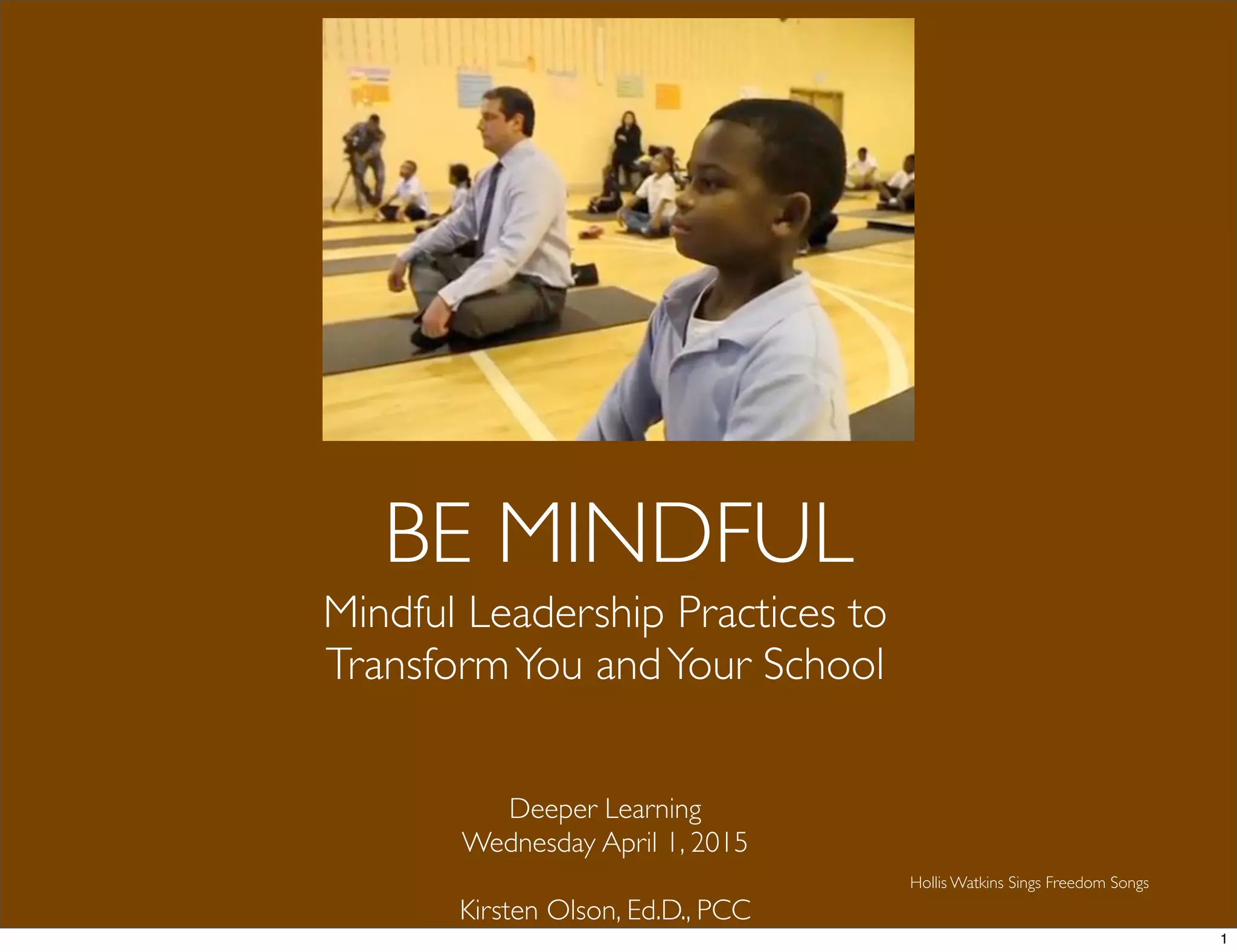
BE MINDFUL
Mindful Leadership Practices to
TransformYou andYour School
Deeper Learning
Wednesday April 1, 2015
Kirsten Olson, Ed.D., PCC
Hollis Watkins Sings Freedom Songs
1
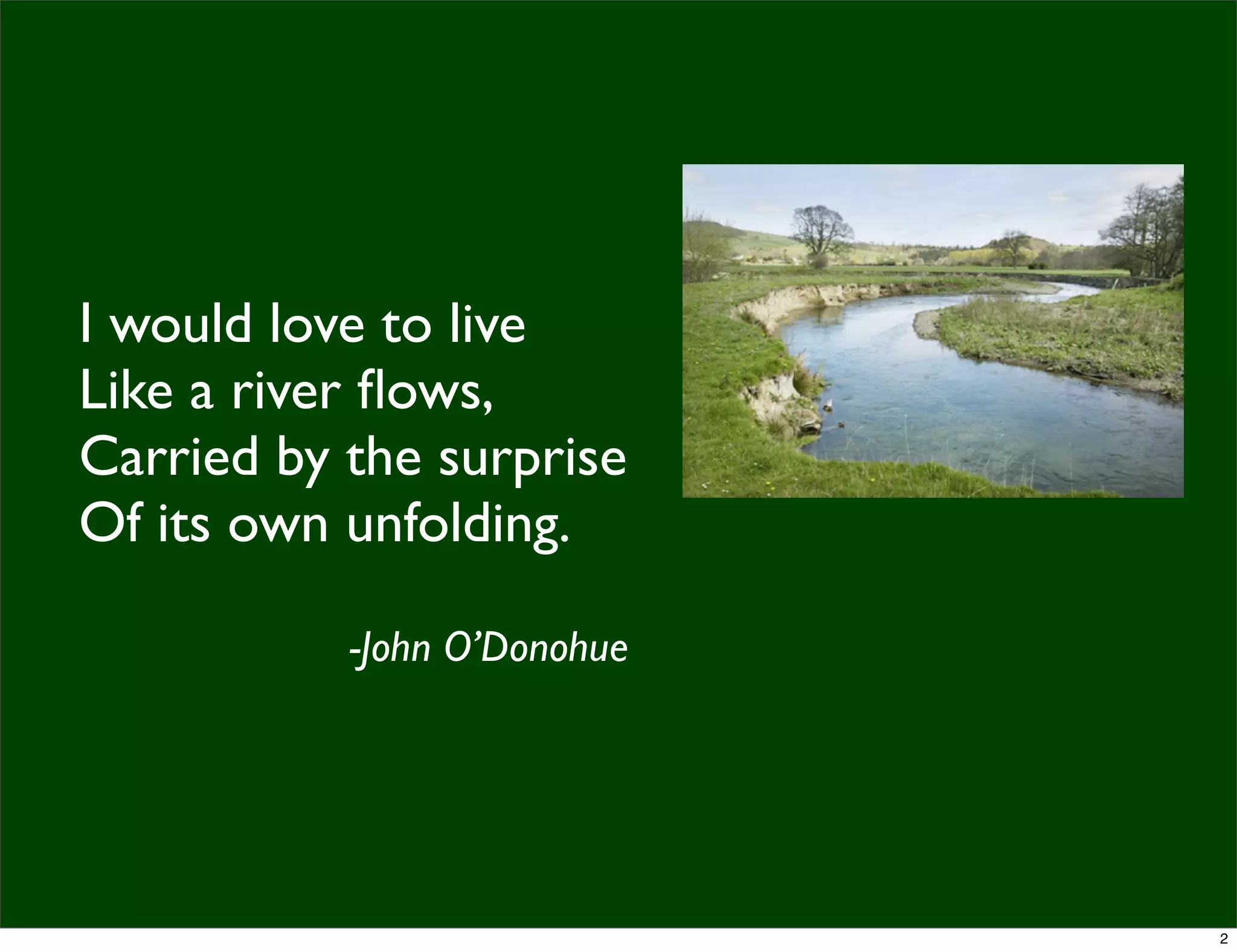
I would love to live
Like a river flows,
Carried by the surprise
Of its own unfolding.
-John O’Donohue
2
GOALS OF SESSION
• The Leader’s Dilemma
• What is mindfulness? Why does it work?
• A Little Bit of Research
• Effectiveness for Leaders (but still too little in education)
• How do you practice?
• Let’s do some practicing
• Steps to begin...
3
Who are we?
Who’s in the room?
Why did you chose this session?
4
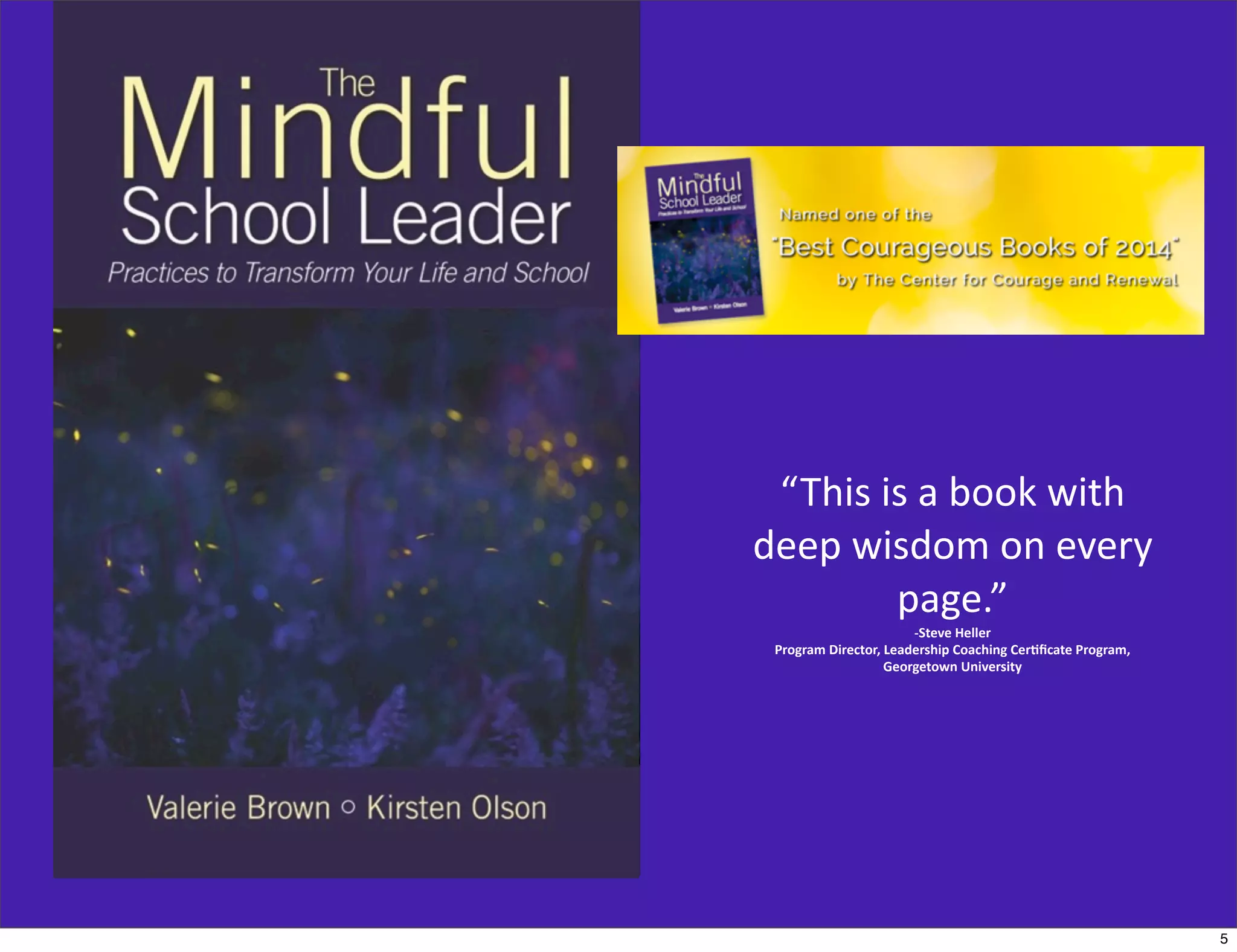
“This	
  is	
  a	
  book	
  with	
  
deep	
  wisdom	
  on	
  every	
  
page.”	
  
-­‐Steve	
  Heller
Program	
  Director,	
  Leadership	
  Coaching	
  Cer:ficate	
  Program,	
  
Georgetown	
  University	
  	
  
5
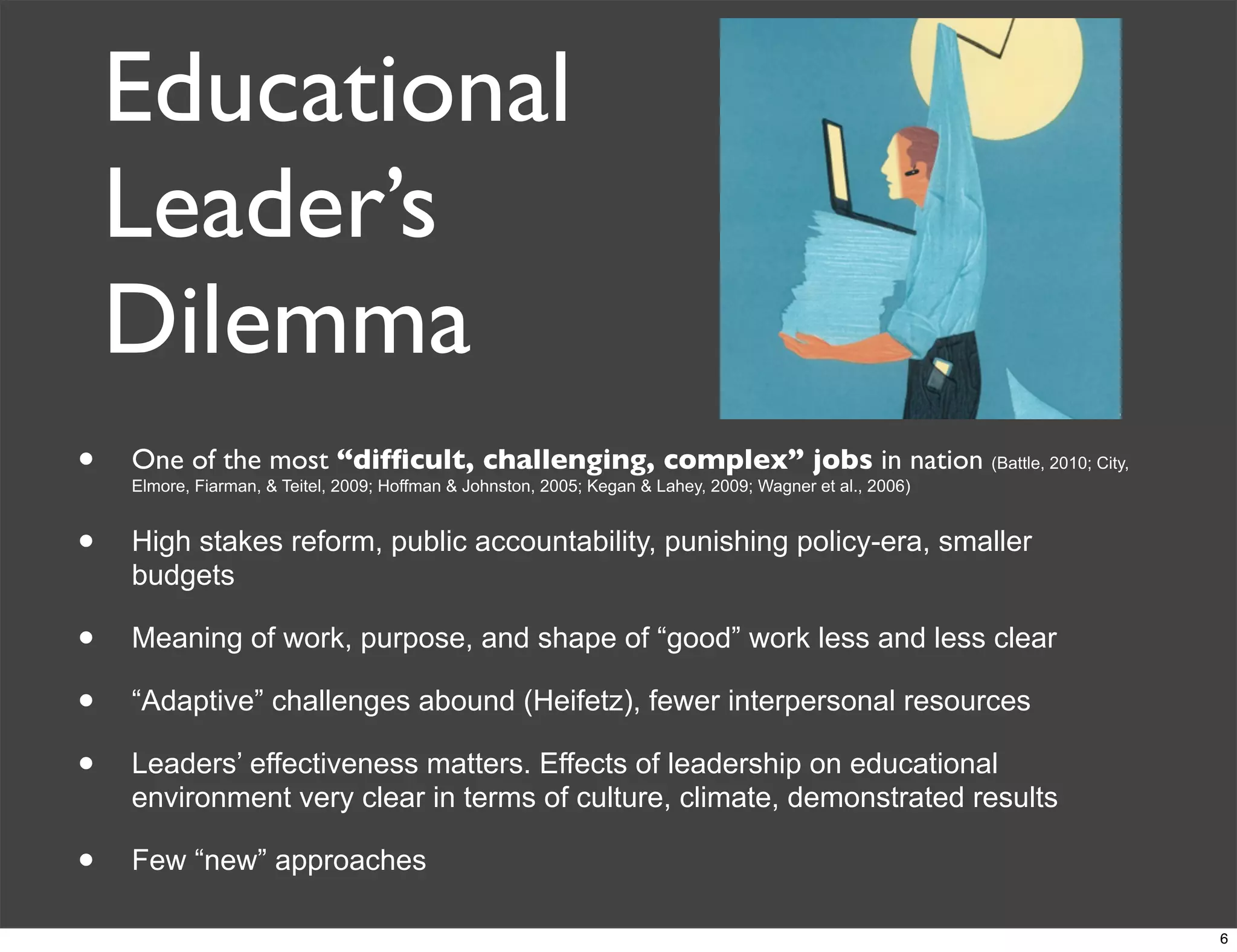
Educational
Leader’s
Dilemma
• One of the most “difficult, challenging, complex” jobs in nation (Battle, 2010; City,
Elmore, Fiarman, & Teitel, 2009; Hoffman & Johnston, 2005; Kegan & Lahey, 2009; Wagner et al., 2006)
• High stakes reform, public accountability, punishing policy-era, smaller
budgets
• Meaning of work, purpose, and shape of “good” work less and less clear
• “Adaptive” challenges abound (Heifetz), fewer interpersonal resources
• Leaders’ effectiveness matters. Effects of leadership on educational
environment very clear in terms of culture, climate, demonstrated results
• Few “new” approaches
6
Our
overloaded
world
• Increased Task Switching
• Increased Rumination, Stress, and Worry
• Challenged Attention Skills
• The Expanding Science of the Brain
• Neuroplasticity: the brain’s ability to change and
grow throughout our life span
7
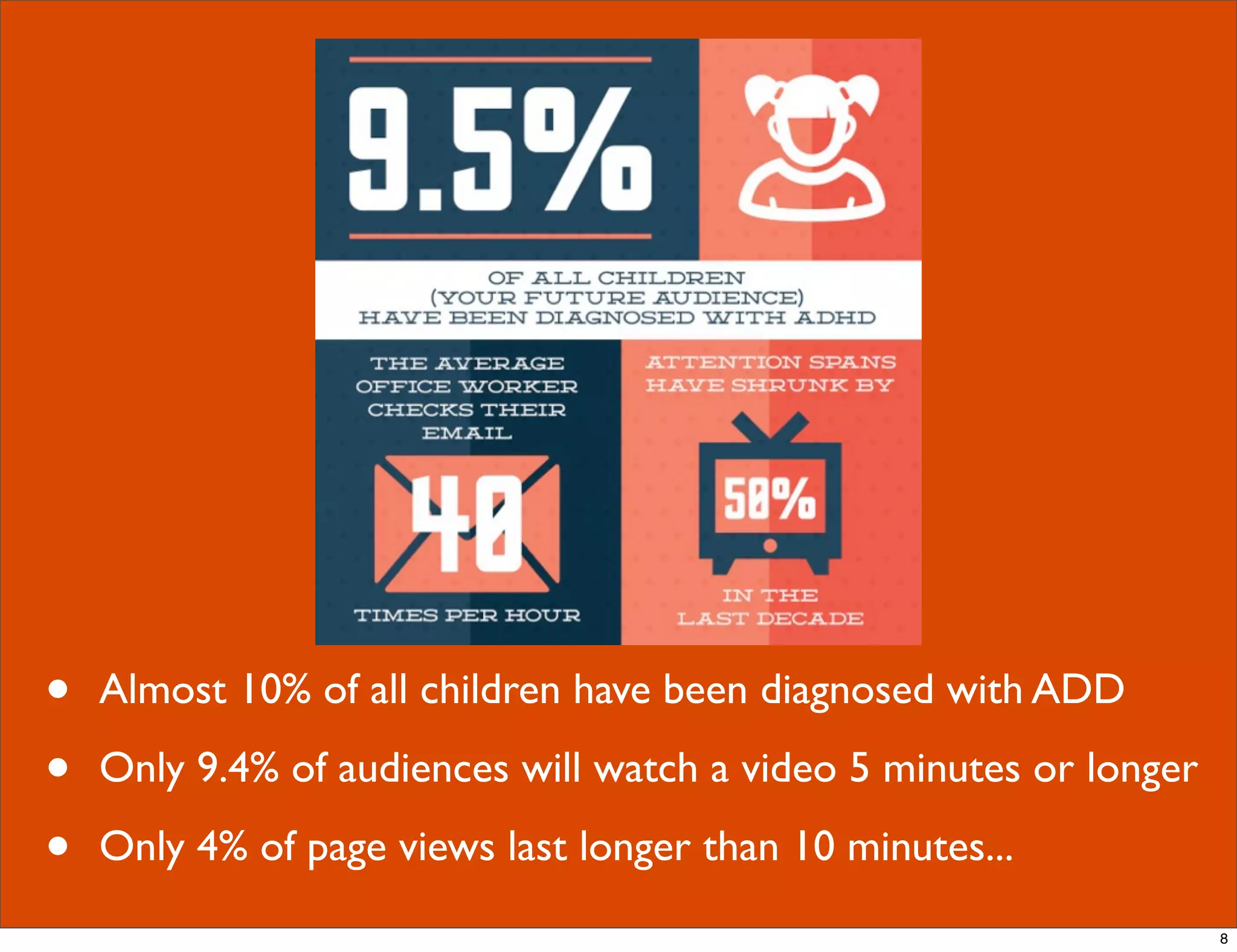
• Almost 10% of all children have been diagnosed with ADD
• Only 9.4% of audiences will watch a video 5 minutes or longer
• Only 4% of page views last longer than 10 minutes...
8
 
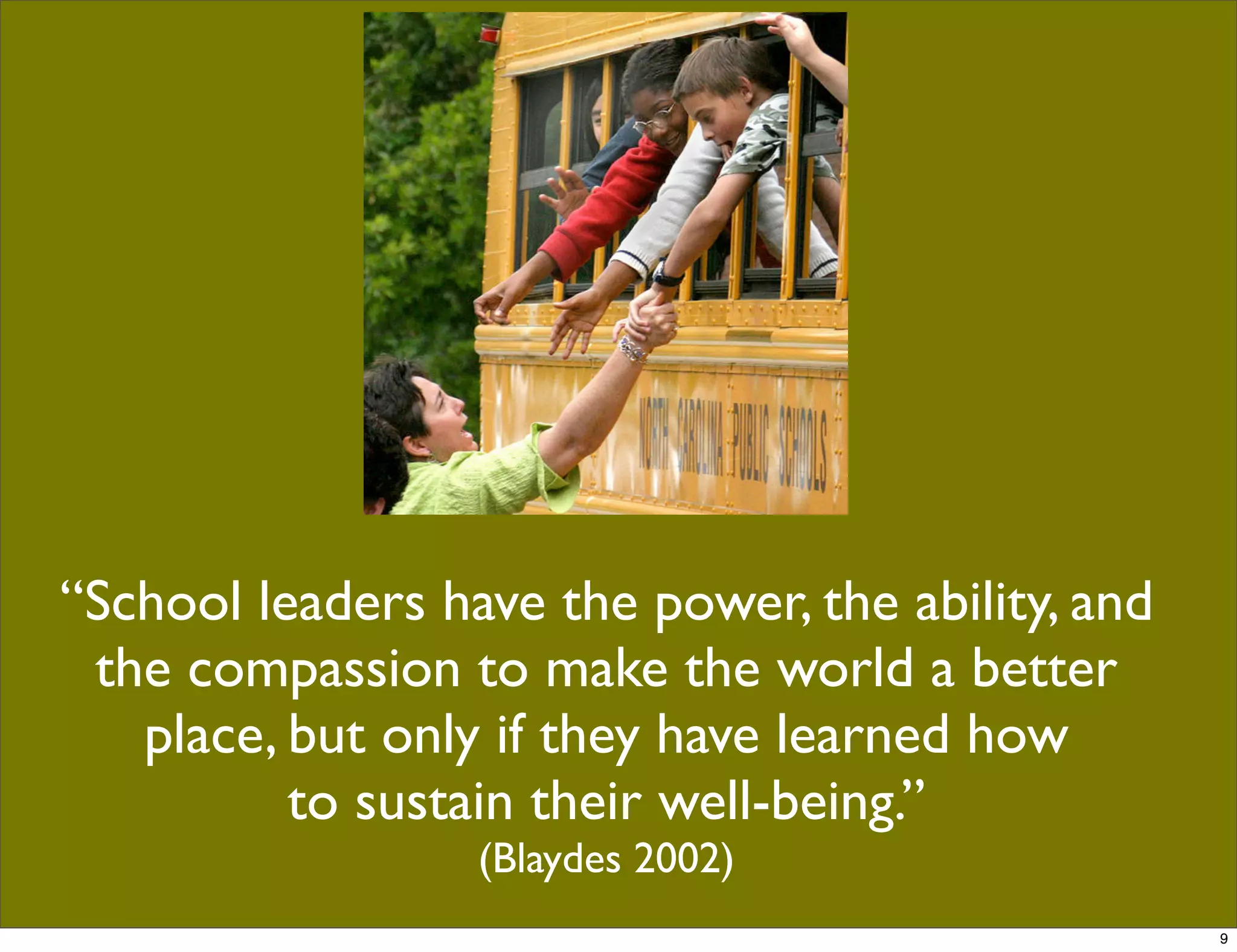
“School leaders have the power, the ability, and
the compassion to make the world a better
place, but only if they have learned how
to sustain their well-being.”
(Blaydes 2002)
9
WHY MINDFULNESS?
“Just Breathe” by Julie Bayer Salzman (2015)
10
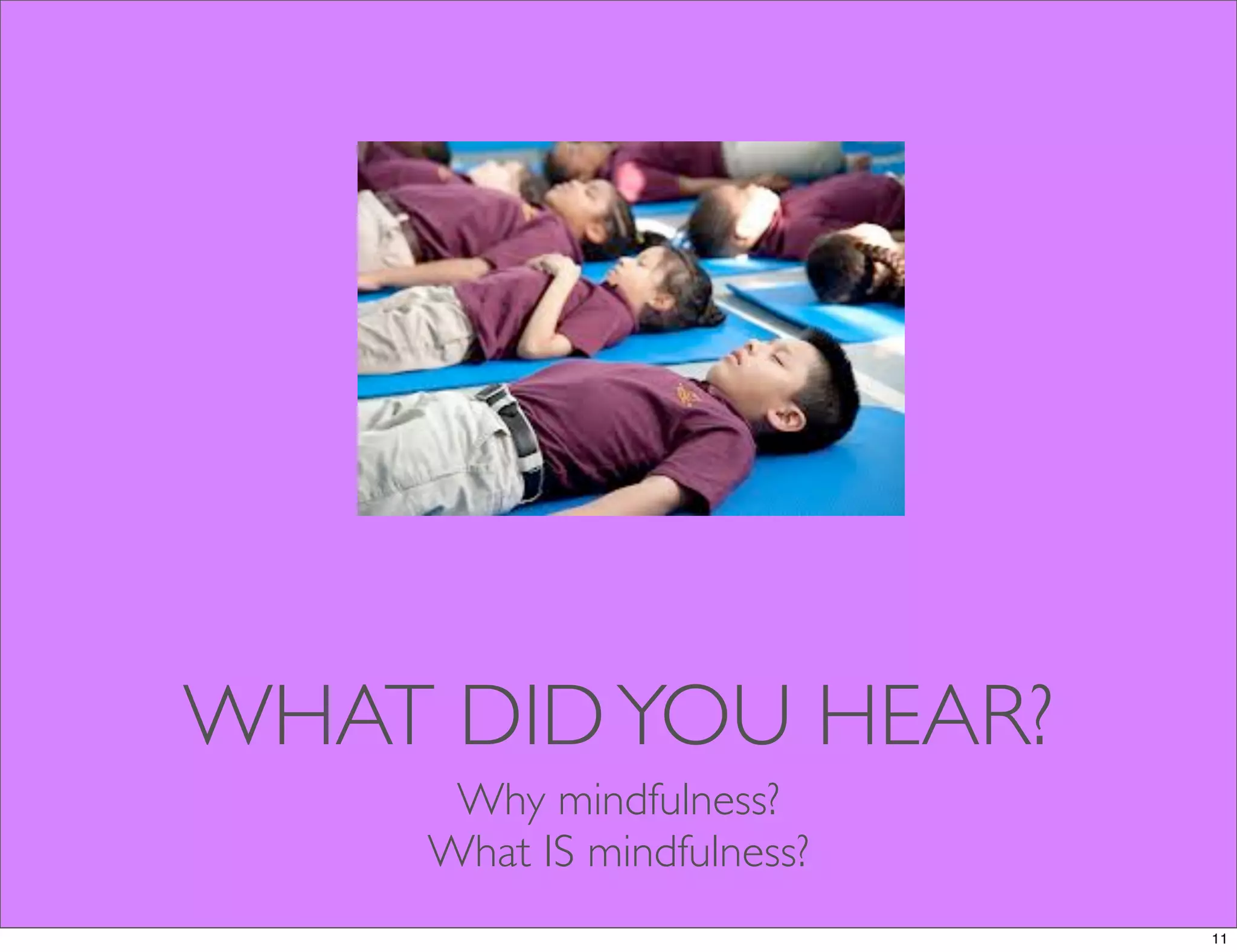
WHAT DIDYOU HEAR?
Why mindfulness?
What IS mindfulness?
11
MINDFULNESS DEFINED
• “Awareness of one’s conduct, and the quality of relationships,
inwardly and outwardly, and their potential to cause harm, are
intrinsic elements of mindfulness” (KZ, 2012)
• “Mindfulness in everyday life is the ultimate challenge and
practice.” (KZ, 2012)
12
13
What DidYou Hear?
14
How mindful are you? Take the test...
Mindful Attention Awareness Scale (MAAS)
15
Practice Pause
• Breathe, Breathe
16
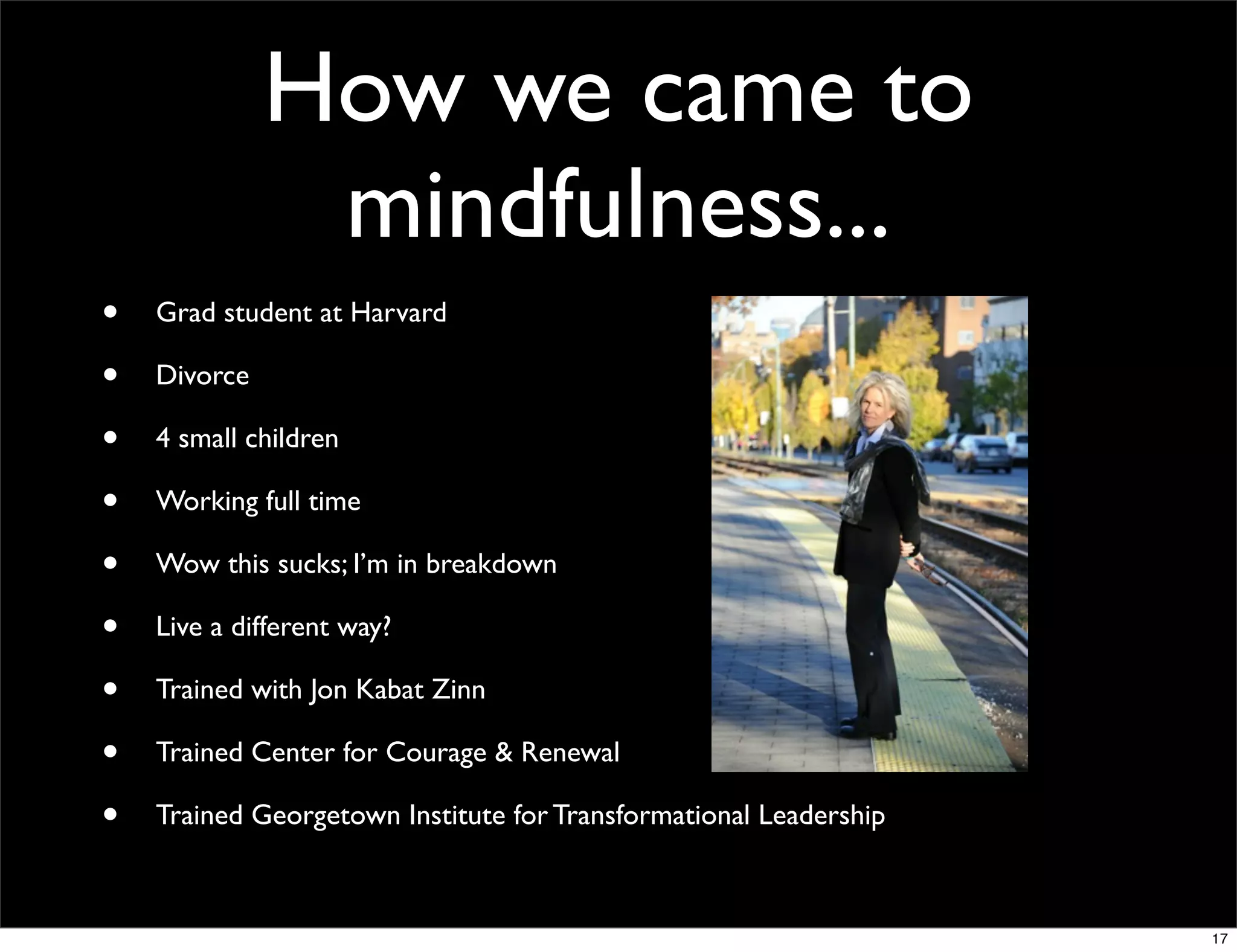
How we came to
mindfulness...
• Grad student at Harvard
• Divorce
• 4 small children
• Working full time
• Wow this sucks; I’m in breakdown
• Live a different way?
• Trained with Jon Kabat Zinn
• Trained Center for Courage & Renewal
• Trained Georgetown Institute for Transformational Leadership
17
My Story
• Admitted, NJ & PA/Lawyer-Lobbyist
• Landed the ‘dream job’, representing 25,000 lawyers
• The Big Turn: Solo travel to India (1990) and worldwide
• Divorce & Multiple Miscarriages
• Met Thich Nhat Hanh, 1995, Ordained 2003
• Trained Kundalini yoga, 1999
• Trained Center for Mindfulness, 2008 and 2013
• Trained Center for Courage & Renewal, 2009
• Trained Institute for Transformational Leadership, 2011
18
Our work together
19
EXPLOSION OF RESEARCH
Explosion of clinical research on the effectiveness of
mindfulness: more and more in education
20
WHO’S PRACTICING
MINDFULNESS IN SCHOOLS?http://www.mindfulnet.org/page7.htm
http://www.huffingtonpost.com/news/mindfulness-in-schools/
Mindful Schools estimates it has taught or had influence
on at least 75K school-age students in last 3 years
21
PRE-K
AND BEYOND...
• Hundreds of peer-reviewed studies demonstrating clinical effectiveness...
• Black, D. S. & Fernando, R. (2013). Mindfulness training and classroom
behavior among lower-income and ethnic minority elementary school
children. Journal of Child and Family Studies.
• Program lasts 5 weeks, 3 sessions per week, focuses on practices that help students
pay attention, build empathy and self-awareness, improve self-control, and reduce stress
• 400 students evaluated
• Immediately after the program ended, student behavior improved significantly in 4
areas measured—paying attention, self-control, classroom participation, and
respect for others—and these gains were maintained 7 weeks later
22
EXPLOSION OF
MINDFULNESS PROGRAMS
FORTEACHERS IN SCHOOLS
Abundant clinical evidence of efficacy
Programs for teachers reaching
thousands of per year
23
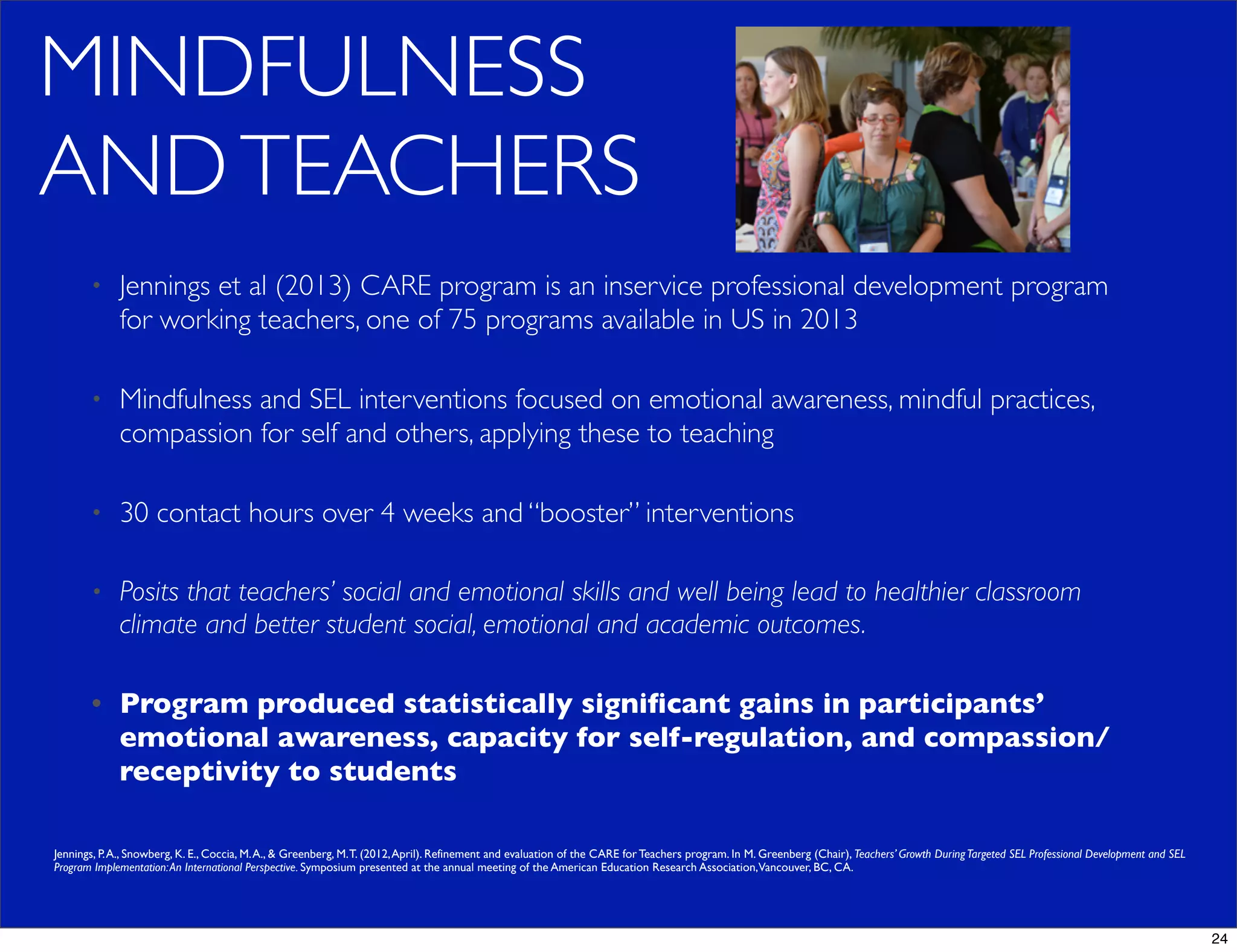
MINDFULNESS
ANDTEACHERS
• Jennings et al (2013) CARE program is an inservice professional development program
for working teachers, one of 75 programs available in US in 2013
• Mindfulness and SEL interventions focused on emotional awareness, mindful practices,
compassion for self and others, applying these to teaching
• 30 contact hours over 4 weeks and “booster” interventions
• Posits that teachers’ social and emotional skills and well being lead to healthier classroom
climate and better student social, emotional and academic outcomes.
• Program produced statistically significant gains in participants’
emotional awareness, capacity for self-regulation, and compassion/
receptivity to students
Jennings, P.A., Snowberg, K. E., Coccia, M.A., & Greenberg, M.T. (2012,April). Refinement and evaluation of the CARE for Teachers program. In M. Greenberg (Chair), Teachers’ Growth DuringTargeted SEL Professional Development and SEL
Program Implementation:An International Perspective. Symposium presented at the annual meeting of the American Education Research Association,Vancouver, BC, CA.
24
Text
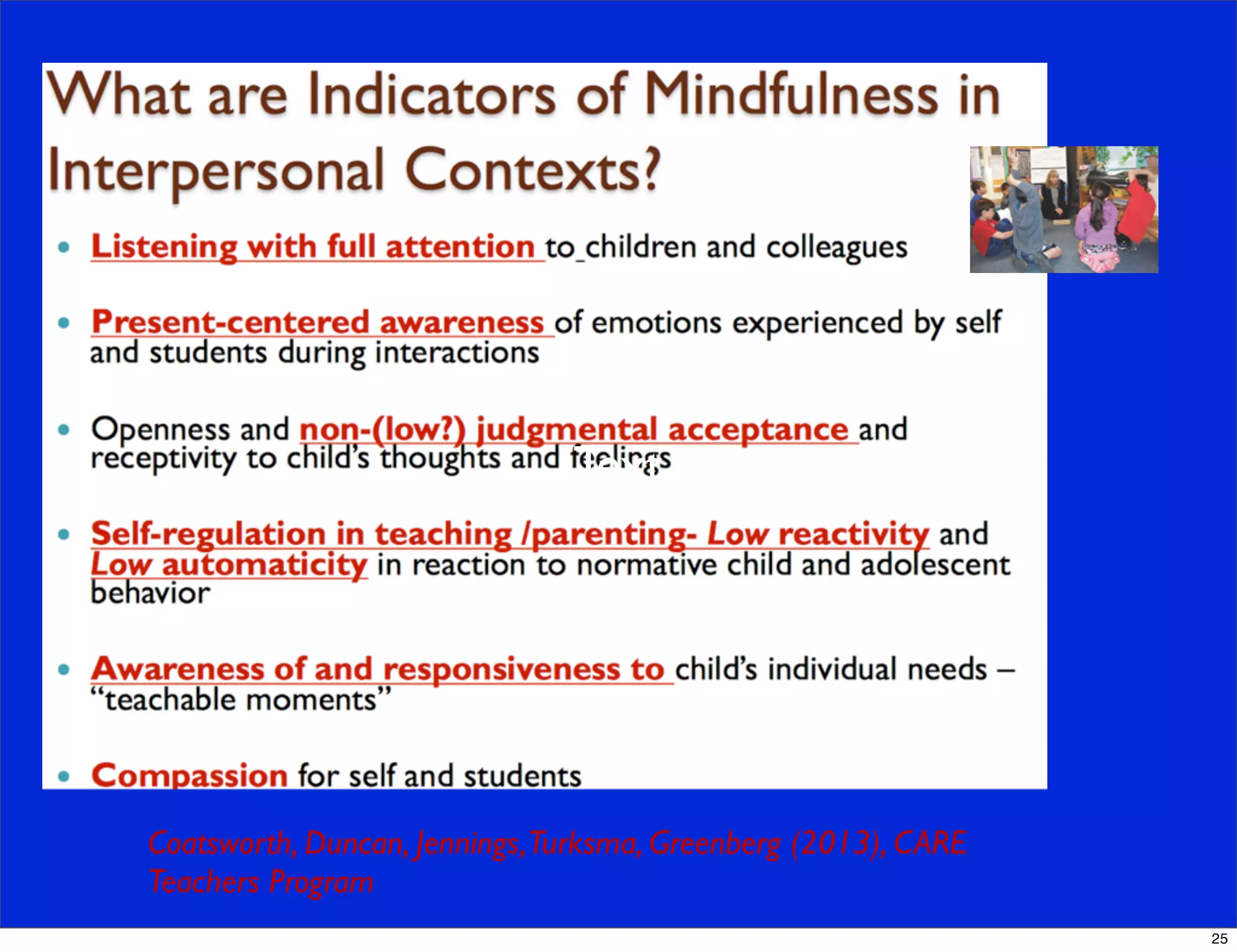
Coatsworth, Duncan, Jennings,Turksma, Greenberg (2013), CARE
Teachers Program
25
26
27
28
29
GLOBAL,WORLDWIDE
MOVEMENT
Wake Up Schools
30
Underinvestment in leadership renewal is a central feature of
our work, although positions have become more challenging
than they have ever been.
WHAT ABOUT EDUCATIONAL LEADERS?
31
Dearth of Practices for
Educational Leaders
Stress Indicators
Educational Leaders:
-89% feel overwhelmed;
-84% neglect to take care of themselves in the midst of stress;
-80% scold themselves when they perform less than perfectly;
-Jerry Murphy,
Harvard Graduate School of Education, 2011
32
WHAT ARETHE CONDITIONS
OFYOUR LEADERSHIP?
• Draw a sketch of your daily leadership life...
• Find a partner and describe to each other
• Switch
33
DRAGO SEVERSON (2012)
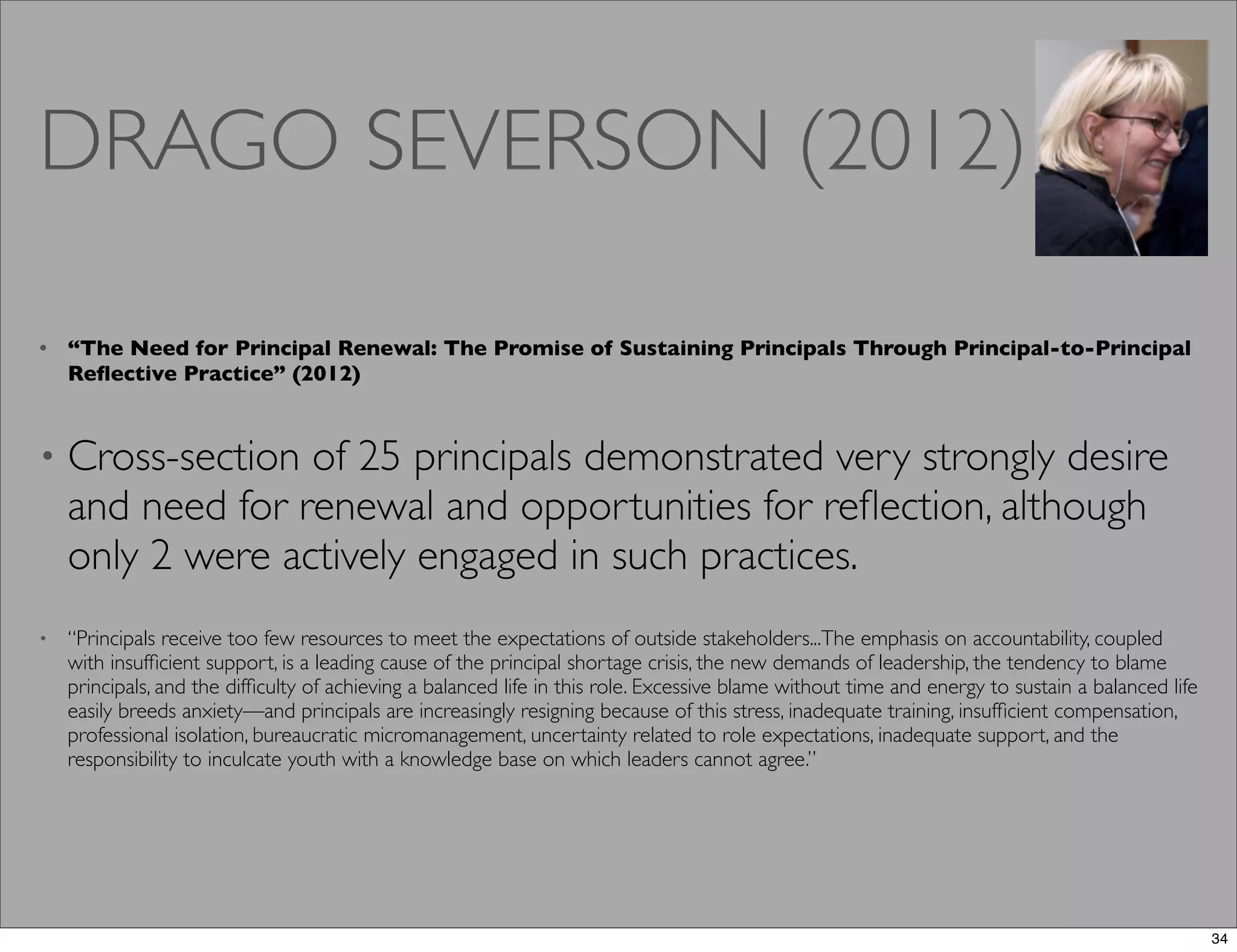
• “The Need for Principal Renewal: The Promise of Sustaining Principals Through Principal-to-Principal
Reflective Practice” (2012)
• Cross-section of 25 principals demonstrated very strongly desire
and need for renewal and opportunities for reflection, although
only 2 were actively engaged in such practices.
• “Principals receive too few resources to meet the expectations of outside stakeholders...The emphasis on accountability, coupled
with insufficient support, is a leading cause of the principal shortage crisis, the new demands of leadership, the tendency to blame
principals, and the difficulty of achieving a balanced life in this role. Excessive blame without time and energy to sustain a balanced life
easily breeds anxiety—and principals are increasingly resigning because of this stress, inadequate training, insufficient compensation,
professional isolation, bureaucratic micromanagement, uncertainty related to role expectations, inadequate support, and the
responsibility to inculcate youth with a knowledge base on which leaders cannot agree.”
34
MINDFULNESS
AND
LEADERSHIP
• Improved ability to notice and slow down or stop automatic reactions
• Increased capacity to respond to complex and difficult situations
• Ability to see situations more clearly, or many dimensions of a situation
• More creative in designing solutions to complex dilemmas
• More balance and resilience
35
Hoy Mindfulness Scale
for Educational Leaders
Hoy and Gage, 2003
36
(2013) Mindful Leaders in Highly Effective
Schools: Mixed Method
Application of Hoy’s M-Scale
• 149 public schools in Texas, interviewed top 10% of
principals identified as mindful
• Principal mindfulness made “statistically significant
independent contribution to to variance on
student achievement”
• Kearney, Kelsey, Herrington (2013)
37
Practice Pause
• Breathe
38
GETTING STARTED...
Let’s breathe...
39
40
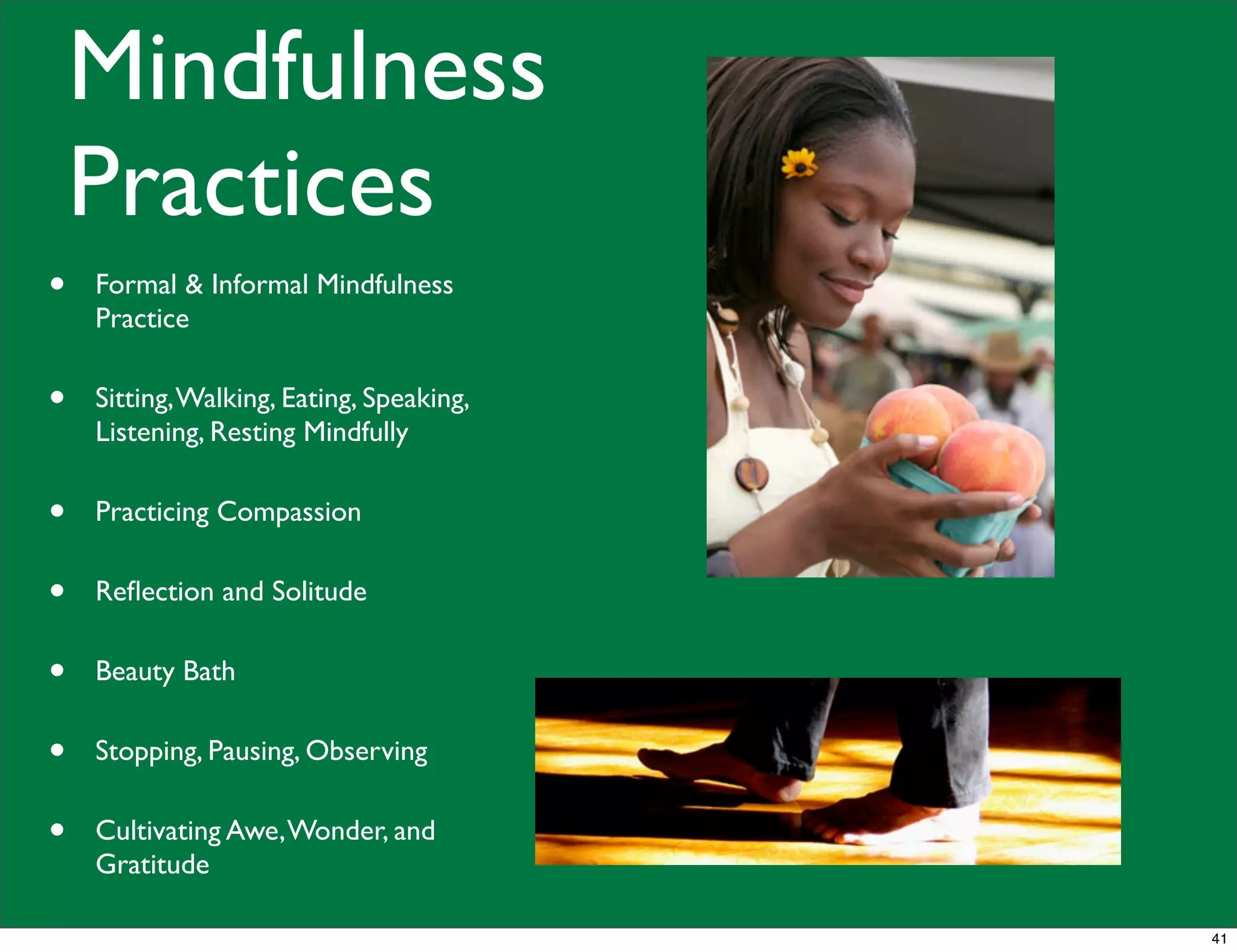
Mindfulness
Practices
• Formal & Informal Mindfulness
Practice
• Sitting,Walking, Eating, Speaking,
Listening, Resting Mindfully
• Practicing Compassion
• Reflection and Solitude
• Beauty Bath
• Stopping, Pausing, Observing
• Cultivating Awe,Wonder, and
Gratitude
41
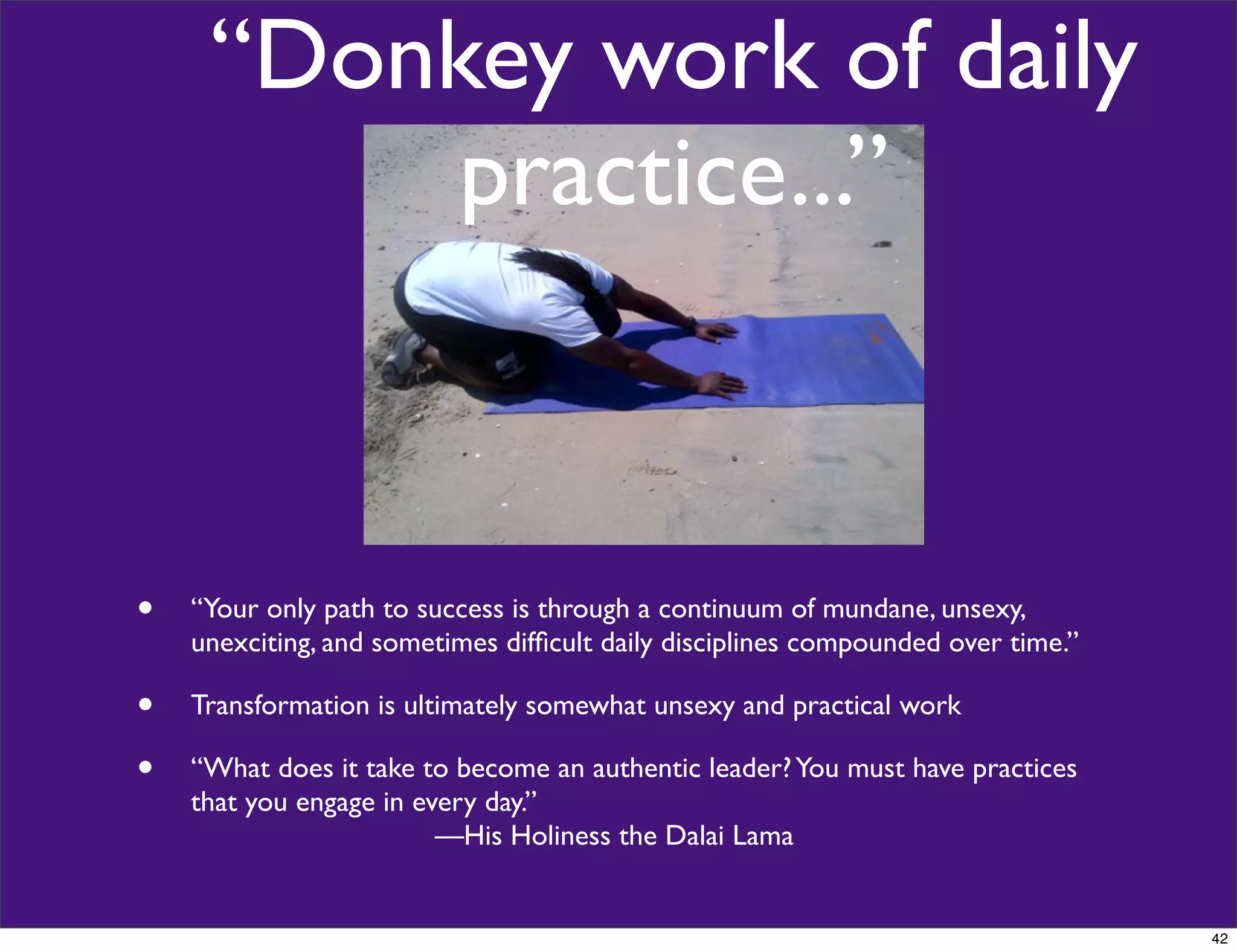
“Donkey work of daily
practice...”
• “Your only path to success is through a continuum of mundane, unsexy,
unexciting, and sometimes difficult daily disciplines compounded over time.”
• Transformation is ultimately somewhat unsexy and practical work
• “What does it take to become an authentic leader?You must have practices
that you engage in every day.”
—His Holiness the Dalai Lama
42
Questions?
Thoughts?
43
Mindful Speaking and
Listening
44
“Being listened to is so close to being loved that
most of us can’t tell the difference.”
David Oxberg
45
Tell a Story About a Workplace
Challenge• IN PAIRS: 4 minutes to describe; 3
minutes open questions; 1 minute
appreciation and noticing
• Speaker: sit in your truth
• Practice self-awareness
• Practice kindness,“be on your own side”
• Stay in your body when speaking; be
present to what you are saying
• Speak your truth
• Listener: Hear your partner into truth
• Kind eyes, receptive
• No fixing, saving, or advising
• Turn to wonder if the going gets tough
• Offer open questions and supportive
mirroring
46
What did you
experience?
47
Authentic Leaders:
True toYourself,True to Others
Trustworthy relationships translate into
more effective, wholehearted leaders,
teams and results
—Center for Courage & Renewal
Academy of Leaders
48
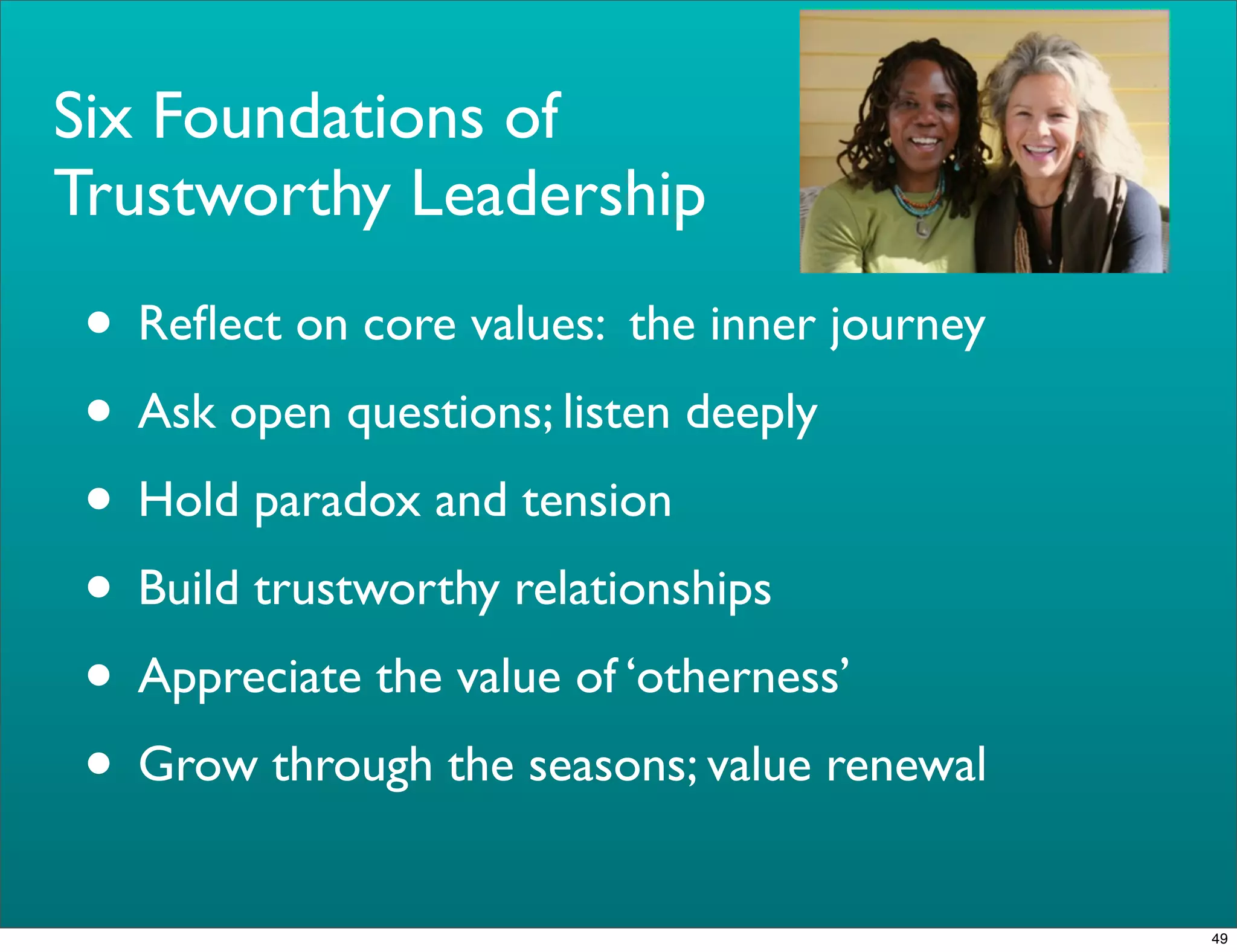
Six Foundations of
Trustworthy Leadership
• Reflect on core values: the inner journey
• Ask open questions; listen deeply
• Hold paradox and tension
• Build trustworthy relationships
• Appreciate the value of ‘otherness’
• Grow through the seasons; value renewal
49
What’s a practice you’d
like to explore?
50
A few words to close...
51
We’d love to hear from you!
Valerie Brown
Lead Smart Coaching
valeriebrown95@gmail.com
www.leadsmartcoaching.com
Kirsten Olson
Old Sow Coaching and
Consulting
kirsten@oldsow.net
www.oldsowconsulting.org
52

Mindful Leadership for Educators

  • 1.
    BE MINDFUL Mindful LeadershipPractices to TransformYou andYour School Deeper Learning Wednesday April 1, 2015 Kirsten Olson, Ed.D., PCC Hollis Watkins Sings Freedom Songs 1
  • 2.
    I would loveto live Like a river flows, Carried by the surprise Of its own unfolding. -John O’Donohue 2
  • 3.
    GOALS OF SESSION •The Leader’s Dilemma • What is mindfulness? Why does it work? • A Little Bit of Research • Effectiveness for Leaders (but still too little in education) • How do you practice? • Let’s do some practicing • Steps to begin... 3
  • 4.
    Who are we? Who’sin the room? Why did you chose this session? 4
  • 5.
    “This  is  a  book  with   deep  wisdom  on  every   page.”   -­‐Steve  Heller Program  Director,  Leadership  Coaching  Cer:ficate  Program,   Georgetown  University     5
  • 6.
    Educational Leader’s Dilemma • One ofthe most “difficult, challenging, complex” jobs in nation (Battle, 2010; City, Elmore, Fiarman, & Teitel, 2009; Hoffman & Johnston, 2005; Kegan & Lahey, 2009; Wagner et al., 2006) • High stakes reform, public accountability, punishing policy-era, smaller budgets • Meaning of work, purpose, and shape of “good” work less and less clear • “Adaptive” challenges abound (Heifetz), fewer interpersonal resources • Leaders’ effectiveness matters. Effects of leadership on educational environment very clear in terms of culture, climate, demonstrated results • Few “new” approaches 6
  • 7.
    Our overloaded world • Increased TaskSwitching • Increased Rumination, Stress, and Worry • Challenged Attention Skills • The Expanding Science of the Brain • Neuroplasticity: the brain’s ability to change and grow throughout our life span 7
  • 8.
    • Almost 10%of all children have been diagnosed with ADD • Only 9.4% of audiences will watch a video 5 minutes or longer • Only 4% of page views last longer than 10 minutes... 8
  • 9.
      “School leaders havethe power, the ability, and the compassion to make the world a better place, but only if they have learned how to sustain their well-being.” (Blaydes 2002) 9
  • 10.
    WHY MINDFULNESS? “Just Breathe”by Julie Bayer Salzman (2015) 10
  • 11.
    WHAT DIDYOU HEAR? Whymindfulness? What IS mindfulness? 11
  • 12.
    MINDFULNESS DEFINED • “Awarenessof one’s conduct, and the quality of relationships, inwardly and outwardly, and their potential to cause harm, are intrinsic elements of mindfulness” (KZ, 2012) • “Mindfulness in everyday life is the ultimate challenge and practice.” (KZ, 2012) 12
  • 13.
  • 14.
  • 15.
    How mindful areyou? Take the test... Mindful Attention Awareness Scale (MAAS) 15
  • 16.
  • 17.
    How we cameto mindfulness... • Grad student at Harvard • Divorce • 4 small children • Working full time • Wow this sucks; I’m in breakdown • Live a different way? • Trained with Jon Kabat Zinn • Trained Center for Courage & Renewal • Trained Georgetown Institute for Transformational Leadership 17
  • 18.
    My Story • Admitted,NJ & PA/Lawyer-Lobbyist • Landed the ‘dream job’, representing 25,000 lawyers • The Big Turn: Solo travel to India (1990) and worldwide • Divorce & Multiple Miscarriages • Met Thich Nhat Hanh, 1995, Ordained 2003 • Trained Kundalini yoga, 1999 • Trained Center for Mindfulness, 2008 and 2013 • Trained Center for Courage & Renewal, 2009 • Trained Institute for Transformational Leadership, 2011 18
  • 19.
  • 20.
    EXPLOSION OF RESEARCH Explosionof clinical research on the effectiveness of mindfulness: more and more in education 20
  • 21.
    WHO’S PRACTICING MINDFULNESS INSCHOOLS?http://www.mindfulnet.org/page7.htm http://www.huffingtonpost.com/news/mindfulness-in-schools/ Mindful Schools estimates it has taught or had influence on at least 75K school-age students in last 3 years 21
  • 22.
    PRE-K AND BEYOND... • Hundredsof peer-reviewed studies demonstrating clinical effectiveness... • Black, D. S. & Fernando, R. (2013). Mindfulness training and classroom behavior among lower-income and ethnic minority elementary school children. Journal of Child and Family Studies. • Program lasts 5 weeks, 3 sessions per week, focuses on practices that help students pay attention, build empathy and self-awareness, improve self-control, and reduce stress • 400 students evaluated • Immediately after the program ended, student behavior improved significantly in 4 areas measured—paying attention, self-control, classroom participation, and respect for others—and these gains were maintained 7 weeks later 22
  • 23.
    EXPLOSION OF MINDFULNESS PROGRAMS FORTEACHERSIN SCHOOLS Abundant clinical evidence of efficacy Programs for teachers reaching thousands of per year 23
  • 24.
    MINDFULNESS ANDTEACHERS • Jennings etal (2013) CARE program is an inservice professional development program for working teachers, one of 75 programs available in US in 2013 • Mindfulness and SEL interventions focused on emotional awareness, mindful practices, compassion for self and others, applying these to teaching • 30 contact hours over 4 weeks and “booster” interventions • Posits that teachers’ social and emotional skills and well being lead to healthier classroom climate and better student social, emotional and academic outcomes. • Program produced statistically significant gains in participants’ emotional awareness, capacity for self-regulation, and compassion/ receptivity to students Jennings, P.A., Snowberg, K. E., Coccia, M.A., & Greenberg, M.T. (2012,April). Refinement and evaluation of the CARE for Teachers program. In M. Greenberg (Chair), Teachers’ Growth DuringTargeted SEL Professional Development and SEL Program Implementation:An International Perspective. Symposium presented at the annual meeting of the American Education Research Association,Vancouver, BC, CA. 24
  • 25.
    Text Coatsworth, Duncan, Jennings,Turksma,Greenberg (2013), CARE Teachers Program 25
  • 26.
  • 27.
  • 28.
  • 29.
  • 30.
  • 31.
    Underinvestment in leadershiprenewal is a central feature of our work, although positions have become more challenging than they have ever been. WHAT ABOUT EDUCATIONAL LEADERS? 31
  • 32.
    Dearth of Practicesfor Educational Leaders Stress Indicators Educational Leaders: -89% feel overwhelmed; -84% neglect to take care of themselves in the midst of stress; -80% scold themselves when they perform less than perfectly; -Jerry Murphy, Harvard Graduate School of Education, 2011 32
  • 33.
    WHAT ARETHE CONDITIONS OFYOURLEADERSHIP? • Draw a sketch of your daily leadership life... • Find a partner and describe to each other • Switch 33
  • 34.
    DRAGO SEVERSON (2012) •“The Need for Principal Renewal: The Promise of Sustaining Principals Through Principal-to-Principal Reflective Practice” (2012) • Cross-section of 25 principals demonstrated very strongly desire and need for renewal and opportunities for reflection, although only 2 were actively engaged in such practices. • “Principals receive too few resources to meet the expectations of outside stakeholders...The emphasis on accountability, coupled with insufficient support, is a leading cause of the principal shortage crisis, the new demands of leadership, the tendency to blame principals, and the difficulty of achieving a balanced life in this role. Excessive blame without time and energy to sustain a balanced life easily breeds anxiety—and principals are increasingly resigning because of this stress, inadequate training, insufficient compensation, professional isolation, bureaucratic micromanagement, uncertainty related to role expectations, inadequate support, and the responsibility to inculcate youth with a knowledge base on which leaders cannot agree.” 34
  • 35.
    MINDFULNESS AND LEADERSHIP • Improved abilityto notice and slow down or stop automatic reactions • Increased capacity to respond to complex and difficult situations • Ability to see situations more clearly, or many dimensions of a situation • More creative in designing solutions to complex dilemmas • More balance and resilience 35
  • 36.
    Hoy Mindfulness Scale forEducational Leaders Hoy and Gage, 2003 36
  • 37.
    (2013) Mindful Leadersin Highly Effective Schools: Mixed Method Application of Hoy’s M-Scale • 149 public schools in Texas, interviewed top 10% of principals identified as mindful • Principal mindfulness made “statistically significant independent contribution to to variance on student achievement” • Kearney, Kelsey, Herrington (2013) 37
  • 38.
  • 39.
  • 40.
  • 41.
    Mindfulness Practices • Formal &Informal Mindfulness Practice • Sitting,Walking, Eating, Speaking, Listening, Resting Mindfully • Practicing Compassion • Reflection and Solitude • Beauty Bath • Stopping, Pausing, Observing • Cultivating Awe,Wonder, and Gratitude 41
  • 42.
    “Donkey work ofdaily practice...” • “Your only path to success is through a continuum of mundane, unsexy, unexciting, and sometimes difficult daily disciplines compounded over time.” • Transformation is ultimately somewhat unsexy and practical work • “What does it take to become an authentic leader?You must have practices that you engage in every day.” —His Holiness the Dalai Lama 42
  • 43.
  • 44.
  • 45.
    “Being listened tois so close to being loved that most of us can’t tell the difference.” David Oxberg 45
  • 46.
    Tell a StoryAbout a Workplace Challenge• IN PAIRS: 4 minutes to describe; 3 minutes open questions; 1 minute appreciation and noticing • Speaker: sit in your truth • Practice self-awareness • Practice kindness,“be on your own side” • Stay in your body when speaking; be present to what you are saying • Speak your truth • Listener: Hear your partner into truth • Kind eyes, receptive • No fixing, saving, or advising • Turn to wonder if the going gets tough • Offer open questions and supportive mirroring 46
  • 47.
  • 48.
    Authentic Leaders: True toYourself,Trueto Others Trustworthy relationships translate into more effective, wholehearted leaders, teams and results —Center for Courage & Renewal Academy of Leaders 48
  • 49.
    Six Foundations of TrustworthyLeadership • Reflect on core values: the inner journey • Ask open questions; listen deeply • Hold paradox and tension • Build trustworthy relationships • Appreciate the value of ‘otherness’ • Grow through the seasons; value renewal 49
  • 50.
    What’s a practiceyou’d like to explore? 50
  • 51.
    A few wordsto close... 51
  • 52.
    We’d love tohear from you! Valerie Brown Lead Smart Coaching valeriebrown95@gmail.com www.leadsmartcoaching.com Kirsten Olson Old Sow Coaching and Consulting kirsten@oldsow.net www.oldsowconsulting.org 52