Well-Being
and Creativity
at Home and
in the
Classroom
DISCOVERING
MINDFULNESS
Morgan Appel, Director
Department of Education and BehavioralSciences
Extended Studies and Public Programs
DOWNLOAD THIS PRESENTATION
This presentation and a host of related materials
and resources may be accessed directly using Slide
Share (https://www.slideshare.net/).
Just search my name andyou will be there in a
flash!
Mindfulness is a state of active,
open attention on the present.
When you're mindful, you carefully
observe your thoughts and
feelings without judging them
good or bad. Instead of letting
your life pass you by, mindfulness
means living in the moment and
awakening to your current
experience, rather than dwelling
on the past or anticipating the
future.
LIVE IN THE PRESENT
Psychology Today, 2017
We tend to
believe in the
idea that the
best is yet to
come. As a
result, we often
neglect that
which is right
in front of us.
Anxieties over
an uncertain
future and a
fondness for
the past may
inadvertently
cause us to
ignore what is
right in front of
us and to truly
immerse
ourselves in
the present.
FUTURE
OBSESSED,
PAST
STRESSED
Creating a presentation about living in the moment and being
hyper aware of the present feels a bit counterintuitive—like
planning to be spontaneous in the future.
I am not a mindfulness trainer in any sense of the word, but do
understand its significance in education as we employ tenets of
positive psychology in support of the affective needs of
increasingly diverse students.
One expert suggests that our students come to us in all sorts of
states (excited, anxious, preoccupied, just to name a few). And
if we view the classroom as an orchestra, we all have to tune
our instruments before we can begin to play. I tend to think of
mindfulness a bit like this.
DO YOU MIND EXPLAINING?
 Part of Positive Psychology: the scientific study of the strengths that
enable individuals and communities to thrive. The field is founded on
the belief that people want to lead meaningful and fulfilling lives, to
cultivate what is best within themselves, and to enhance their
experiences of love, work, and play. The Science of Happiness.
 Has much in common with and complements the Social Emotional
Learning Movement (that works from the outside in—Mindfulness,
conversely, works from the inside out: interiority)
 Mindfulness is not obscure, exotic or an ‘add on’. It is something we
(all of us) already can do, and goes by several different names.
Mindfulness techniques can be engaged to enhance these innate
qualities so that we are able to live in the present and be aware.
MORE ABOUT MINDFULNESS
Source: Mindful.org
 You don’t have to change. It isn’t about who you want to be, but
rather who you are, and focusing on who you are in the
immediate (intentionality of awareness and attention)
 Mindfulness (and flow, as you will see) serves as a catalyst for
creativity and innovation. It is about being aware (meta-
awareness) of perceptions and judgments
 Awareness enables us to move away from binary dualism
(like/dislike; is/is not; among others) and to better see fine
gradations
 Mindfulness is ‘brain-compatible’: impacts Executive Functioning
(planning, working memory, attention, problem solving, verbal
reasoning, inhibition, mental flexibility, multi-tasking and
initiation of monitoring) and regulation of emotions and behavior
MORE ABOUT MINDFULNESS
Source: Meiklejohn, et. al., 2012., Mindful.org
Mindfulness is
the basic
innate human
ability to be
fully present,
aware of where
we are and
what we’re
doing, and not
overly reactive
or overwhelmed
by what’s going
on around us.
Mindful.org
WE
ALREADY
ARE
MINDFUL
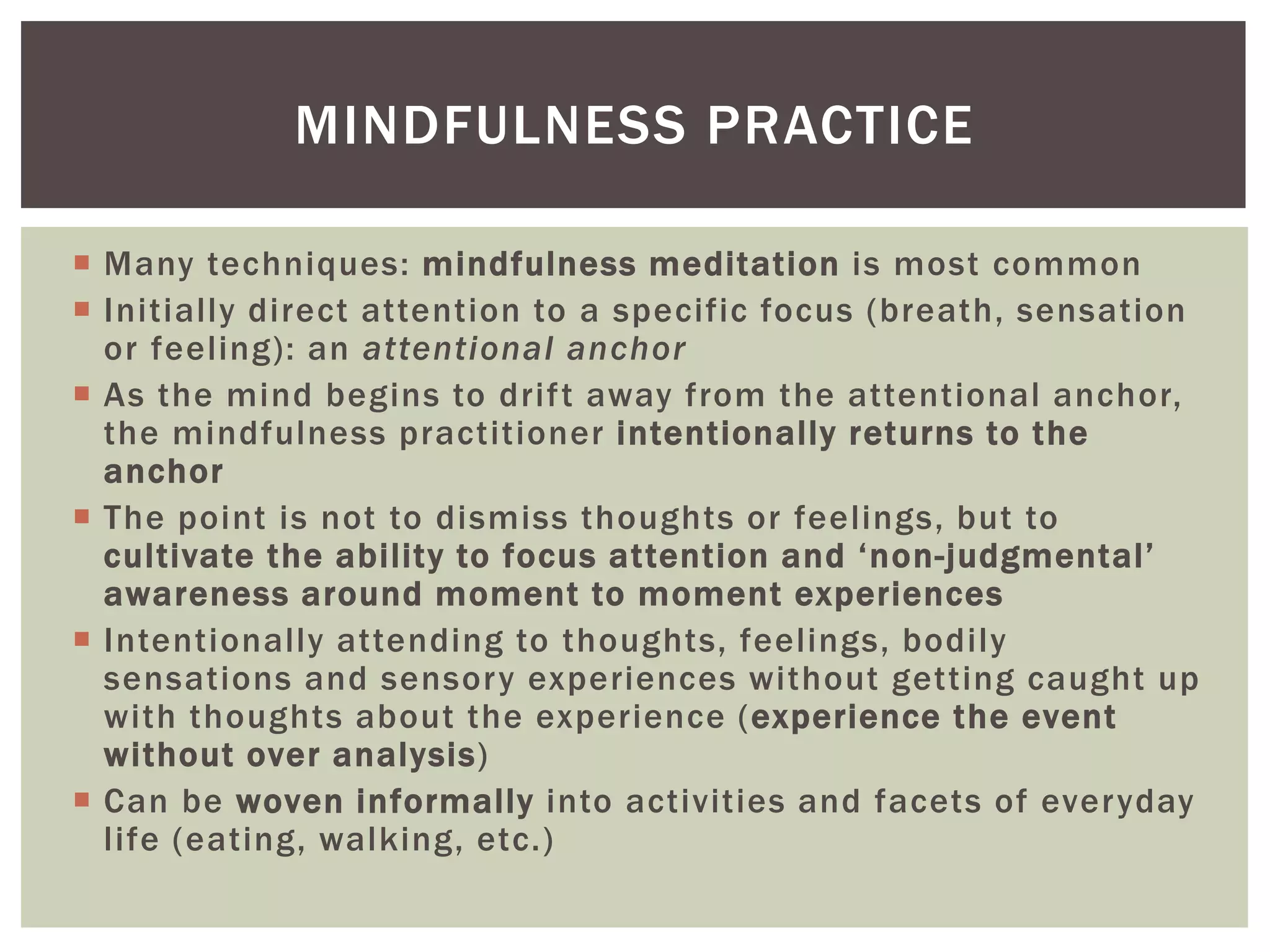
 Many techniques: mindfulness meditation is most common
 Initially direct attention to a specific focus (breath, sensation
or feeling): an attentional anchor
 As the mind begins to drift away from the attentional anchor,
the mindfulness practitioner intentionally returns to the
anchor
 The point is not to dismiss thoughts or feelings, but to
cultivate the ability to focus attention and ‘non-judgmental’
awareness around moment to moment experiences
 Intentionally attending to thoughts, feelings, bodily
sensations and sensory experiences without getting caught up
with thoughts about the experience (experience the event
without over analysis)
 Can be woven informally into activities and facets of everyday
life (eating, walking, etc.)
MINDFULNESS PRACTICE
The present moment is the only
time over which we have
dominion.
– Thích Nhất Hạnh
FOR YOUR CONSIDERATION
 Inner Kids Program (the new ABCs: Attention, Balance,
Compassion)
 Inner Resilience Program (cultivate inner lives by integrating
SEL and contemplative practice)
 Learning to BREATHE (using mindfulness-based stress
reduction programming)
 Mindfulness in Schools Project (based in England,
incorporates a variety of foci, including health and well being)
 Mindful Schools (SF Bay Area) – integrates mindfulness in K-
12 schools through direct work with teachers and pupils
 MIND Up: focuses on well being as a catalyst for academic
success
WHAT IT LOOKS LIKE IN SCHOOLS
Meiklejohn, et. al., 2012
 Reduced rates of absenteeism, rule infractions and suspensions
 Decreases in blood pressure for adolescents with elevated rates
 Decreased state and trait anxieties; enhanced social skills and improved
academic performance
 Higher quality sleep and increased self-esteem
 Improvements in emotional regulation; decreases in tiredness, aches and
pains; higher levels of social competence
 Reduced off-task behavior and increase academic behavior for behaviorally
challenged students
 Enhanced behavioral regulation and metacognition, higher levels of
executive control/functioning overall
 Reduction in problematic responses to stress (rumination; intrusive
thoughts; emotional arousal; among others)
EFFECTS: MINDFULNESS IN SCHOOLS
Greatergood.berkeley.edu
We know intuitively
that if you do not feel
a sense of confidence,
competence and
solace, it is virtually
impossibleto
concentrate on
anything else.
Neurochemistry
suggests that when we
are anxious or stressed,
adrenaline and cortisol
compels us to focus on
an immediate perceived
threat.
Enduring a seemingly
endless cycle of what
ifs makes creativity
and enthusiasm take a
back seat to anxiety
and fear. Mindfulness
helps us to attend to
living in our own heads
and oft rescue us from
progressive downward
spirals.
MIND
OVER
MATTER
MINDFULNESS ADJACENT: FLOW
STIMULATING LEARNING THROUGH FLOW
• Mihaly Csíkszentmihályi (1975, 1990)—also part of
positive psychology
• A Zen-like, intensive state in which an individual
becomes completely emerged in an experience
• “In the groove,” OPTIMAL EXPERIENCE, “In the zone”
• Time stops (almost a meditative state) or flies
• “Seeing the seams of the baseball” or “seeing the Matrix”
• Losing oneself so that one is so focused, s/he is unaware
of distractions, even bodily needs
• A universal and cross-cultural experience
• Connectivity between emotion, motivation and
internalization
TOWARD A STATE OF ‘FLOW’
 Balance between individual’s ability and level of difficulty in
the challenge (cannot be too easy or difficult or flow cannot
occur).
 Goals should be clear. Expectations are foreseen and goals
are attainable.
 High degree of concentration in a limited field of attention—
person should be able to focus and become deeply engaged
in the activity.
 A loss of self-consciousness is experienced (unaware of self
and what the self is doing).
 Sense of time transcendence (subjective experience of time
is altered—passes quickly/slowly/slow motion)
 Emerges from our neurochemistry and primal functions
(survival, solving problems, etc.)
ESTABLISHING FLOW
When in the flow state,
the brain is actively
seeking out information
from multiple sources
to engage in problem
solving activities.
That is where motivation,
Persistence and creativity
make their homes.
That is FLOW.
FLOW
 A ‘state’ of being
 Relationship with activity
 Indirectly practiced in
pursuit of an objective
 Attention to task
 Not something that can be
taught, but can be
influenced by activities
undertaken
 Cannot be scheduled (a
channel)
MINDFULNESS
 An ability that can be
cultivated
 Relationship with mind
 Directly practiced through
meditation
 Redirection of attention
inwards
 Taught using specific
techniques (intentionality)
 May enable/interrupt flow
state, but the reverse is not
true
MINDFULNESS AND FLOW:
TWO SIDES OF THE SAME COIN
You can do both,
but can you
really immerse
yourself in the
experience of
both?
Getting lost in
your playing and
forgetting the
existence of the
popcorn is
FLOW.
Pushing the
guitar to one
side to
concentrate on
every kernel and
savor each bite
is eating
MINDFULLY.
MINDFULNESS
VERSUS FLOW:
POPCORN AND
GUITARS
 Slow Things Down
 Set Kids Up for Success
 Stress is Contagious
 Mindful Play
 Mindful Dinnertime
 Mindful Brushing of Teeth
 Avoid the ‘Red Zone’ of Extreme Thought
 Reduce Emotional Flooding, so Brain can Process
 Help Children Befriend Themselves
 Practice Mindfulness as a Means to Regulate Emotion
MINDFULNESS AT HOME:
WHAT PARENTS CAN DO TO HELP
Mindful.org, Kidsmatter.edu.au
Part of the joy
associated with
the art of
painting lies in
the sensory
experience: the
smell and
texture of paint
and brush. The
visual
sensation of a
messy palette.
The scrape of
the brush
against canvas
and an entry
point for Flow.
MINDFUL
PAINTING
A wide variety of mindfulness resources can be
found at the Center for Mindfulness at UC San
Diego Health:
https://health.ucsd.edu/specialties/mindfulnes
s/resources/pages/default.aspx
Also includes a variety of videos available
through UCSD TV.
RESOURCES FOR PARENTS
QUESTIONS/COMMENTS
Morgan Appel
Director
Department of Education and Behavioral Sciences
UC San Diego Extension
9500 Gilman Dr., MC 0170-N
La Jolla, California
858-534-9273
858-534-9256 (FAX)
mappel@ucsd.edu
CONTACT INFORMATION

Discovering Mindfulness: Well Being and Creativity in the Classroom

  • 1.
    Well-Being and Creativity at Homeand in the Classroom DISCOVERING MINDFULNESS Morgan Appel, Director Department of Education and BehavioralSciences Extended Studies and Public Programs
  • 2.
    DOWNLOAD THIS PRESENTATION Thispresentation and a host of related materials and resources may be accessed directly using Slide Share (https://www.slideshare.net/). Just search my name andyou will be there in a flash!
  • 3.
    Mindfulness is astate of active, open attention on the present. When you're mindful, you carefully observe your thoughts and feelings without judging them good or bad. Instead of letting your life pass you by, mindfulness means living in the moment and awakening to your current experience, rather than dwelling on the past or anticipating the future. LIVE IN THE PRESENT Psychology Today, 2017
  • 4.
    We tend to believein the idea that the best is yet to come. As a result, we often neglect that which is right in front of us. Anxieties over an uncertain future and a fondness for the past may inadvertently cause us to ignore what is right in front of us and to truly immerse ourselves in the present. FUTURE OBSESSED, PAST STRESSED
  • 5.
    Creating a presentationabout living in the moment and being hyper aware of the present feels a bit counterintuitive—like planning to be spontaneous in the future. I am not a mindfulness trainer in any sense of the word, but do understand its significance in education as we employ tenets of positive psychology in support of the affective needs of increasingly diverse students. One expert suggests that our students come to us in all sorts of states (excited, anxious, preoccupied, just to name a few). And if we view the classroom as an orchestra, we all have to tune our instruments before we can begin to play. I tend to think of mindfulness a bit like this. DO YOU MIND EXPLAINING?
  • 6.
     Part ofPositive Psychology: the scientific study of the strengths that enable individuals and communities to thrive. The field is founded on the belief that people want to lead meaningful and fulfilling lives, to cultivate what is best within themselves, and to enhance their experiences of love, work, and play. The Science of Happiness.  Has much in common with and complements the Social Emotional Learning Movement (that works from the outside in—Mindfulness, conversely, works from the inside out: interiority)  Mindfulness is not obscure, exotic or an ‘add on’. It is something we (all of us) already can do, and goes by several different names. Mindfulness techniques can be engaged to enhance these innate qualities so that we are able to live in the present and be aware. MORE ABOUT MINDFULNESS Source: Mindful.org
  • 7.
     You don’thave to change. It isn’t about who you want to be, but rather who you are, and focusing on who you are in the immediate (intentionality of awareness and attention)  Mindfulness (and flow, as you will see) serves as a catalyst for creativity and innovation. It is about being aware (meta- awareness) of perceptions and judgments  Awareness enables us to move away from binary dualism (like/dislike; is/is not; among others) and to better see fine gradations  Mindfulness is ‘brain-compatible’: impacts Executive Functioning (planning, working memory, attention, problem solving, verbal reasoning, inhibition, mental flexibility, multi-tasking and initiation of monitoring) and regulation of emotions and behavior MORE ABOUT MINDFULNESS Source: Meiklejohn, et. al., 2012., Mindful.org
  • 8.
    Mindfulness is the basic innatehuman ability to be fully present, aware of where we are and what we’re doing, and not overly reactive or overwhelmed by what’s going on around us. Mindful.org WE ALREADY ARE MINDFUL
  • 9.
     Many techniques:mindfulness meditation is most common  Initially direct attention to a specific focus (breath, sensation or feeling): an attentional anchor  As the mind begins to drift away from the attentional anchor, the mindfulness practitioner intentionally returns to the anchor  The point is not to dismiss thoughts or feelings, but to cultivate the ability to focus attention and ‘non-judgmental’ awareness around moment to moment experiences  Intentionally attending to thoughts, feelings, bodily sensations and sensory experiences without getting caught up with thoughts about the experience (experience the event without over analysis)  Can be woven informally into activities and facets of everyday life (eating, walking, etc.) MINDFULNESS PRACTICE
  • 10.
    The present momentis the only time over which we have dominion. – Thích Nhất Hạnh FOR YOUR CONSIDERATION
  • 11.
     Inner KidsProgram (the new ABCs: Attention, Balance, Compassion)  Inner Resilience Program (cultivate inner lives by integrating SEL and contemplative practice)  Learning to BREATHE (using mindfulness-based stress reduction programming)  Mindfulness in Schools Project (based in England, incorporates a variety of foci, including health and well being)  Mindful Schools (SF Bay Area) – integrates mindfulness in K- 12 schools through direct work with teachers and pupils  MIND Up: focuses on well being as a catalyst for academic success WHAT IT LOOKS LIKE IN SCHOOLS Meiklejohn, et. al., 2012
  • 12.
     Reduced ratesof absenteeism, rule infractions and suspensions  Decreases in blood pressure for adolescents with elevated rates  Decreased state and trait anxieties; enhanced social skills and improved academic performance  Higher quality sleep and increased self-esteem  Improvements in emotional regulation; decreases in tiredness, aches and pains; higher levels of social competence  Reduced off-task behavior and increase academic behavior for behaviorally challenged students  Enhanced behavioral regulation and metacognition, higher levels of executive control/functioning overall  Reduction in problematic responses to stress (rumination; intrusive thoughts; emotional arousal; among others) EFFECTS: MINDFULNESS IN SCHOOLS Greatergood.berkeley.edu
  • 13.
    We know intuitively thatif you do not feel a sense of confidence, competence and solace, it is virtually impossibleto concentrate on anything else. Neurochemistry suggests that when we are anxious or stressed, adrenaline and cortisol compels us to focus on an immediate perceived threat. Enduring a seemingly endless cycle of what ifs makes creativity and enthusiasm take a back seat to anxiety and fear. Mindfulness helps us to attend to living in our own heads and oft rescue us from progressive downward spirals. MIND OVER MATTER
  • 14.
  • 15.
    STIMULATING LEARNING THROUGHFLOW • Mihaly Csíkszentmihályi (1975, 1990)—also part of positive psychology • A Zen-like, intensive state in which an individual becomes completely emerged in an experience • “In the groove,” OPTIMAL EXPERIENCE, “In the zone” • Time stops (almost a meditative state) or flies • “Seeing the seams of the baseball” or “seeing the Matrix” • Losing oneself so that one is so focused, s/he is unaware of distractions, even bodily needs • A universal and cross-cultural experience • Connectivity between emotion, motivation and internalization
  • 16.
    TOWARD A STATEOF ‘FLOW’  Balance between individual’s ability and level of difficulty in the challenge (cannot be too easy or difficult or flow cannot occur).  Goals should be clear. Expectations are foreseen and goals are attainable.  High degree of concentration in a limited field of attention— person should be able to focus and become deeply engaged in the activity.  A loss of self-consciousness is experienced (unaware of self and what the self is doing).  Sense of time transcendence (subjective experience of time is altered—passes quickly/slowly/slow motion)  Emerges from our neurochemistry and primal functions (survival, solving problems, etc.)
  • 17.
    ESTABLISHING FLOW When inthe flow state, the brain is actively seeking out information from multiple sources to engage in problem solving activities. That is where motivation, Persistence and creativity make their homes. That is FLOW.
  • 18.
    FLOW  A ‘state’of being  Relationship with activity  Indirectly practiced in pursuit of an objective  Attention to task  Not something that can be taught, but can be influenced by activities undertaken  Cannot be scheduled (a channel) MINDFULNESS  An ability that can be cultivated  Relationship with mind  Directly practiced through meditation  Redirection of attention inwards  Taught using specific techniques (intentionality)  May enable/interrupt flow state, but the reverse is not true MINDFULNESS AND FLOW: TWO SIDES OF THE SAME COIN
  • 19.
    You can doboth, but can you really immerse yourself in the experience of both? Getting lost in your playing and forgetting the existence of the popcorn is FLOW. Pushing the guitar to one side to concentrate on every kernel and savor each bite is eating MINDFULLY. MINDFULNESS VERSUS FLOW: POPCORN AND GUITARS
  • 20.
     Slow ThingsDown  Set Kids Up for Success  Stress is Contagious  Mindful Play  Mindful Dinnertime  Mindful Brushing of Teeth  Avoid the ‘Red Zone’ of Extreme Thought  Reduce Emotional Flooding, so Brain can Process  Help Children Befriend Themselves  Practice Mindfulness as a Means to Regulate Emotion MINDFULNESS AT HOME: WHAT PARENTS CAN DO TO HELP Mindful.org, Kidsmatter.edu.au
  • 21.
    Part of thejoy associated with the art of painting lies in the sensory experience: the smell and texture of paint and brush. The visual sensation of a messy palette. The scrape of the brush against canvas and an entry point for Flow. MINDFUL PAINTING
  • 22.
    A wide varietyof mindfulness resources can be found at the Center for Mindfulness at UC San Diego Health: https://health.ucsd.edu/specialties/mindfulnes s/resources/pages/default.aspx Also includes a variety of videos available through UCSD TV. RESOURCES FOR PARENTS
  • 23.
  • 24.
    Morgan Appel Director Department ofEducation and Behavioral Sciences UC San Diego Extension 9500 Gilman Dr., MC 0170-N La Jolla, California 858-534-9273 858-534-9256 (FAX) mappel@ucsd.edu CONTACT INFORMATION