MIND READER COMPUTER
Guided by: Presented by:
V P Vinturaj Raees Nihal
Lecturer In Electronic S5 El, Roll No: 27
Dept of EL, GPTC kasaragod 1
CONTENT
 INTRODUCTION
 WHAT IS MIND READING ?
 WHY MIND READING ?
 HOW DOES IT WORK ?
 APPLICATION
 ADVANTAGES AND USES
 DISADVANTAGES AND PROBLEMS
 CONCLUSION
 REFERENCE
Dept of EL, GPTC kasaragod 2
INTRODUCTION
 People express their mental states, including
emotions, thoughts and desires, all the time
through facial expression, vocal nuances and
gestures. This is true when they are
interacting with machines.
 Mind reading machine is co-ordination of
human psychology and computer techniques.
 Some equipment are used to gather data and
then analyzed. To use those data for further
prediction of mind is known as theory of
mind reading.
Dept of EL, GPTC kasaragod 3
 The ability to attribute mental states to others
from their behavior and to use that
knowledge to guide our own actions and
predict those of others is know as theory of
mind or Mind Reading.
 Existing human-computer interfaces are
mind –blind, oblivious to the user’s mental
states and intentions.
 Even they do not take the initiative, like the
now retired Microsoft Paperclip, they are
often misguided and irrelevant and simply
frustrate the user.
Dept of EL, GPTC kasaragod 4
WHAT IS MIND READING?
 Drawing inspirational from psychology,
computer vision and machine learning has
developed mind reading machine computers.
 Using a digital video camera, the
mindreading computer system analyzes a
person’s underlying mental state.
 Prior knowledge of how particular mental
states are expressed in the faces is combined
with analysis of facial expressions and head
gestures occurring in real-time, its very use
full for future.
Dept of EL, GPTC kasaragod 5
 Software from Nevenvision identifies 24
feature points on the face and tracks them
in real time.
 The relationship between observable head
and facial displays and the corresponding
hidden mental states over time is modeled
using Dynamic Bayesian Networks.
Dept of EL, GPTC kasaragod 6
WHY MIND READING?
 The Mind Reading computer system presents
information about mental state as easily as a
keyboard and mouse present text and
commands.
 Current projects in Cambridge are
considering further inputs such as body
postures and gestures to improve the
interference.
 We are also looking at the use of mind
reading to supporting on-line shopping and
learning systems.
Dept of EL, GPTC kasaragod 7
 The mind reading computer system may also
be used to monitor and suggest
improvements in human-human interaction.
 The Affective Computing Group at the MIT
media laboratory is developing an emotional-
social intelligence prosthesis that explores
new technologies to augment and improve
people’s social interactions and
communication skills.
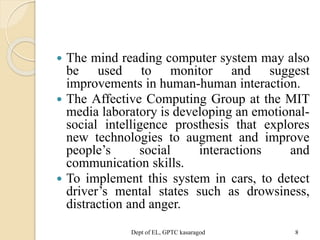
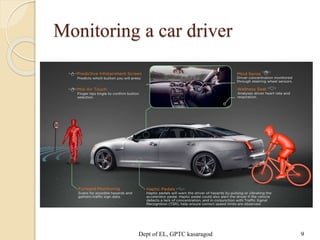
 To implement this system in cars, to detect
driver’s mental states such as drowsiness,
distraction and anger.
Dept of EL, GPTC kasaragod 8
Monitoring a car driver
Dept of EL, GPTC kasaragod 9
HOW DOES IT WORK ?
Futuristic Head Band:
 The mind reading actually involves
measuring the volume and oxygen level of
the blood around the subject’s brain using
technology called functional near-infrared
spectroscopy(FNIRS).
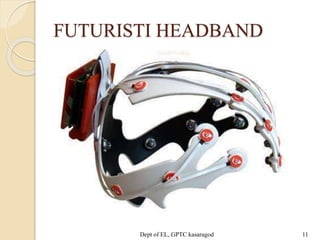
 The user wear’s a futuristic head band that
sends light in that spectrum into the
tissues of the head where it is absorbed by
active, blood filled tissues.
Dept of EL, GPTC kasaragod 10
FUTURISTI HEADBAND
Dept of EL, GPTC kasaragod 11
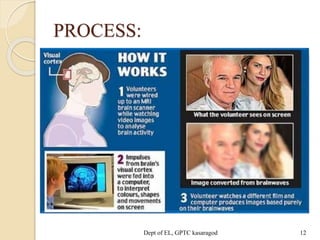
PROCESS:
Dept of EL, GPTC kasaragod 12
 The result are often compared to an MRI,
but can be gathered with light weight,
non-invasive equipments.
 Wearing the FNIRS sensor, experimental
subject were asked to count the number of
squares on a rotating on screen cube and
to perform other tasks.
 Measuring mental workload, frustration
and distraction is typically limited to
qualitatively observing computer users.
Dept of EL, GPTC kasaragod 14
 Preliminary result show that using
buttonised sensor.
 Biological signals arise when reading or
speaking to oneself with or without actual
lip or facial movement.
Dept of EL, GPTC kasaragod 14
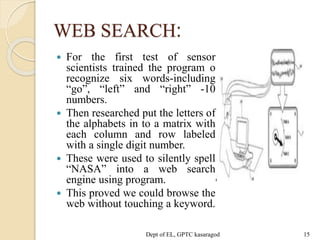
WEB SEARCH:
 For the first test of sensor
scientists trained the program o
recognize six words-including
“go”, “left” and “right” -10
numbers.
 Then researched put the letters of
the alphabets in to a matrix with
each column and row labeled
with a single digit number.
 These were used to silently spell
“NASA” into a web search
engine using program.
 This proved we could browse the
web without touching a keyword.
Dept of EL, GPTC kasaragod 15
1.NEUROSCIENCE
 It deals with anatomy and molecular
biology of neurons.
 A neurons is a nerve cell that is the basic
building block of the nervous system.
Neurons are specialized to transmit
information through the body.
 It is done by measuring oxygen level of
blood using FNIRS.
Dept of EL, GPTC kasaragod 16
2. TECHNIQUES:
Facial effect detection
it is done using hidden Markov Model,
Neural Network processing or active
appearance model.
Emotional classification
classification by Pual Ekman Anger, Fear,
Happiness, Disgust, Sadness, Surprise.
Dept of EL, GPTC kasaragod 17
Facial Electromyography:
it is used to measure electrical activity of
the facial muscles. Muscles used are
“corruguators surpercilii muscle” and
others.
Galvanic Skin Response:
it is a measure of skin conductivity,
which is dependent on how moist the skin
is.
Dept of EL, GPTC kasaragod 19
Blood volume pulse:
 it is measured by process called
photoplethysmography.
 it produce a graphic indicating blood flow
through the extremities.
Dept of EL, GPTC kasaragod 19
APPLICATION
1. Mind –reading computers could ‘save
your life’
2. Emergency
3. Control robots by brain power
4. Mind-reading Technology speeds Ahead
5. The mind-reading computer that could
communicate with coma patients
Dept of EL, GPTC kasaragod 20
Mind-reading computers could ‘save
your life’
 Devices allowing people o write letters or
play pinball using just the power of their
brains have become a major draw at the
world’s biggest-high tech fair.
 Scientists are researching ways to monitor
motorist’s brain wave to improve reaction
time in crash.
Dept of EL, GPTC kasaragod 21
EMERGENCY
 In an emergency stop situation, the brain
activity kicks in on average around 200
milliseconds before even an alert driver can
hit the brake.
 There is no question of braking
automatically for a driver – “we would never
take away that kind of control,” said
Tangermann.
 Using this brain-wave monitoring
technology, a car can also tell whether the
driver is drowsy or not, potentially warning
him or her to take a break.
Dept of EL, GPTC kasaragod 22
CONTROL ROBOTS BY BRAIN
POWER:
 Another device allows users to control
robots by brain power. The small box has
lights flashing at different frequencies at
the four points of the compass.
 The user concentrates on the
corresponding light, depending on
whether he wants the robot to move up,
down, left or right and the brainwaves
generated by viewing that frequency are
monitored and the robot is controlled.
Dept of EL, GPTC kasaragod 23
MIND–READING TECHNOLOGY
SPEEDS AHEAD
 By scanning blogs of brain activity,
scientist may be able to decode people’s
thoughts, dreams and intention by Kerri
Smith and Nature Magazine.
 Jack Gallant perches on the edge of the
swivel chair in his lab at the university of
California, Berkeley, fixated on the screen
of a computer that is trying to decode
someone’s thoughts.
Dept of EL, GPTC kasaragod 24
THE MIND-READING COMPUTER
THAT COULD COMMUNCATE WITH
COMA PATIENTS:
 Canadian researchers have developing a
mind- reading computer that could help
communicate with people in a coma.
 The University of Western Ontario
researchers used Neuroimaging to read
human thoughts via brain activity when they
are conveying specific ‘yes’ or ‘no’ answers.
 The team say their research could lead to
dramatic new ways of attempting to
communicate with patients vegetative state.
Dept of EL, GPTC kasaragod 25
ADVANTAGES AND USES
 Can read minds
 Helps paralytic patients
 Helps Handicapped patients
 Help comma patients
 Help people who can’t speak
 Can be used for military purposes and sting
operations
 Can be combined with consoles and used for
mind gaming, robotic and stuff.
 Eliminate the capability to lie
Dept of EL, GPTC kasaragod 26
 This device doesn’t give your MIND BULLETS
(apologies to tenacious D) but it does allow people
who can’t use other wheelchairs get around easier.
 The system could send commands to rovers on the
planets, help injured astronauts control machines, or
aid disabled people.
 The finding raises issues about the applications of
such tools for screening suspected terrorists as well as
for predicting future dangerousness more generally.
 The day when computers will be able to recognize the
smallest units in the English language-the 40-odd
basic sounds ( or phonemes out of which all words or
verbalized thoughts can be constructed.
Dept of EL, GPTC kasaragod 27
DISADVANTAGES AND
PROBLEMS
 Breach in privacy
 Can extract, through an individual, an
important, secure and confidential
information of individual, state or even a
country
 If developed or used by sinners, can be
highly dangerous
 Eavesdropping
 No way to neutralize this technology
Dept of EL, GPTC kasaragod 28
 Nor is society deal with the ethical and practical
problems posed by the system that classifies and
categorizes people based on oxygen flow, genetics
and environmental factors that are correlated as
much as poverty as with future criminality.
 In the case, neuroscience may produce reliable
behavior predictions. But until then, we should
take the lessons of science fiction to heart when
deciding how to use new predictive techniques.
 Max Planck institute, neuroscience and bioscience
are not at a point where we can reliably predict
human behavior
Dept of EL, GPTC kasaragod 29
CONCLUSION:
 Tufts universities researchers have begun a
three years research project which, if
successful, will allow computers to respond
to the brain activity of the computers users.
 Users wear a futuristic looking head bands to
shine light on their foreheads and then
perform a serious of increasingly difficult
task while the device reads what parts of the
brain are absorbing the light that info is then
transferred to the computer and from there
the computer and just its interface and
functions to each individual.
Dept of EL, GPTC kasaragod 30
REFERENCES:
 blog.marcelotoldo.org/2007/10
 PPT presentation of Anjali Agarwal
 Google search engine
Dept of EL, GPTC kasaragod 31
THANK YOU

Mind reading computer

  • 1.
    MIND READER COMPUTER Guidedby: Presented by: V P Vinturaj Raees Nihal Lecturer In Electronic S5 El, Roll No: 27 Dept of EL, GPTC kasaragod 1
  • 2.
    CONTENT  INTRODUCTION  WHATIS MIND READING ?  WHY MIND READING ?  HOW DOES IT WORK ?  APPLICATION  ADVANTAGES AND USES  DISADVANTAGES AND PROBLEMS  CONCLUSION  REFERENCE Dept of EL, GPTC kasaragod 2
  • 3.
    INTRODUCTION  People expresstheir mental states, including emotions, thoughts and desires, all the time through facial expression, vocal nuances and gestures. This is true when they are interacting with machines.  Mind reading machine is co-ordination of human psychology and computer techniques.  Some equipment are used to gather data and then analyzed. To use those data for further prediction of mind is known as theory of mind reading. Dept of EL, GPTC kasaragod 3
  • 4.
     The abilityto attribute mental states to others from their behavior and to use that knowledge to guide our own actions and predict those of others is know as theory of mind or Mind Reading.  Existing human-computer interfaces are mind –blind, oblivious to the user’s mental states and intentions.  Even they do not take the initiative, like the now retired Microsoft Paperclip, they are often misguided and irrelevant and simply frustrate the user. Dept of EL, GPTC kasaragod 4
  • 5.
    WHAT IS MINDREADING?  Drawing inspirational from psychology, computer vision and machine learning has developed mind reading machine computers.  Using a digital video camera, the mindreading computer system analyzes a person’s underlying mental state.  Prior knowledge of how particular mental states are expressed in the faces is combined with analysis of facial expressions and head gestures occurring in real-time, its very use full for future. Dept of EL, GPTC kasaragod 5
  • 6.
     Software fromNevenvision identifies 24 feature points on the face and tracks them in real time.  The relationship between observable head and facial displays and the corresponding hidden mental states over time is modeled using Dynamic Bayesian Networks. Dept of EL, GPTC kasaragod 6
  • 7.
    WHY MIND READING? The Mind Reading computer system presents information about mental state as easily as a keyboard and mouse present text and commands.  Current projects in Cambridge are considering further inputs such as body postures and gestures to improve the interference.  We are also looking at the use of mind reading to supporting on-line shopping and learning systems. Dept of EL, GPTC kasaragod 7
  • 8.
     The mindreading computer system may also be used to monitor and suggest improvements in human-human interaction.  The Affective Computing Group at the MIT media laboratory is developing an emotional- social intelligence prosthesis that explores new technologies to augment and improve people’s social interactions and communication skills.  To implement this system in cars, to detect driver’s mental states such as drowsiness, distraction and anger. Dept of EL, GPTC kasaragod 8
  • 9.
    Monitoring a cardriver Dept of EL, GPTC kasaragod 9
  • 10.
    HOW DOES ITWORK ? Futuristic Head Band:  The mind reading actually involves measuring the volume and oxygen level of the blood around the subject’s brain using technology called functional near-infrared spectroscopy(FNIRS).  The user wear’s a futuristic head band that sends light in that spectrum into the tissues of the head where it is absorbed by active, blood filled tissues. Dept of EL, GPTC kasaragod 10
  • 11.
    FUTURISTI HEADBAND Dept ofEL, GPTC kasaragod 11
  • 12.
    PROCESS: Dept of EL,GPTC kasaragod 12
  • 13.
     The resultare often compared to an MRI, but can be gathered with light weight, non-invasive equipments.  Wearing the FNIRS sensor, experimental subject were asked to count the number of squares on a rotating on screen cube and to perform other tasks.  Measuring mental workload, frustration and distraction is typically limited to qualitatively observing computer users. Dept of EL, GPTC kasaragod 14
  • 14.
     Preliminary resultshow that using buttonised sensor.  Biological signals arise when reading or speaking to oneself with or without actual lip or facial movement. Dept of EL, GPTC kasaragod 14
  • 15.
    WEB SEARCH:  Forthe first test of sensor scientists trained the program o recognize six words-including “go”, “left” and “right” -10 numbers.  Then researched put the letters of the alphabets in to a matrix with each column and row labeled with a single digit number.  These were used to silently spell “NASA” into a web search engine using program.  This proved we could browse the web without touching a keyword. Dept of EL, GPTC kasaragod 15
  • 16.
    1.NEUROSCIENCE  It dealswith anatomy and molecular biology of neurons.  A neurons is a nerve cell that is the basic building block of the nervous system. Neurons are specialized to transmit information through the body.  It is done by measuring oxygen level of blood using FNIRS. Dept of EL, GPTC kasaragod 16
  • 17.
    2. TECHNIQUES: Facial effectdetection it is done using hidden Markov Model, Neural Network processing or active appearance model. Emotional classification classification by Pual Ekman Anger, Fear, Happiness, Disgust, Sadness, Surprise. Dept of EL, GPTC kasaragod 17
  • 18.
    Facial Electromyography: it isused to measure electrical activity of the facial muscles. Muscles used are “corruguators surpercilii muscle” and others. Galvanic Skin Response: it is a measure of skin conductivity, which is dependent on how moist the skin is. Dept of EL, GPTC kasaragod 19
  • 19.
    Blood volume pulse: it is measured by process called photoplethysmography.  it produce a graphic indicating blood flow through the extremities. Dept of EL, GPTC kasaragod 19
  • 20.
    APPLICATION 1. Mind –readingcomputers could ‘save your life’ 2. Emergency 3. Control robots by brain power 4. Mind-reading Technology speeds Ahead 5. The mind-reading computer that could communicate with coma patients Dept of EL, GPTC kasaragod 20
  • 21.
    Mind-reading computers could‘save your life’  Devices allowing people o write letters or play pinball using just the power of their brains have become a major draw at the world’s biggest-high tech fair.  Scientists are researching ways to monitor motorist’s brain wave to improve reaction time in crash. Dept of EL, GPTC kasaragod 21
  • 22.
    EMERGENCY  In anemergency stop situation, the brain activity kicks in on average around 200 milliseconds before even an alert driver can hit the brake.  There is no question of braking automatically for a driver – “we would never take away that kind of control,” said Tangermann.  Using this brain-wave monitoring technology, a car can also tell whether the driver is drowsy or not, potentially warning him or her to take a break. Dept of EL, GPTC kasaragod 22
  • 23.
    CONTROL ROBOTS BYBRAIN POWER:  Another device allows users to control robots by brain power. The small box has lights flashing at different frequencies at the four points of the compass.  The user concentrates on the corresponding light, depending on whether he wants the robot to move up, down, left or right and the brainwaves generated by viewing that frequency are monitored and the robot is controlled. Dept of EL, GPTC kasaragod 23
  • 24.
    MIND–READING TECHNOLOGY SPEEDS AHEAD By scanning blogs of brain activity, scientist may be able to decode people’s thoughts, dreams and intention by Kerri Smith and Nature Magazine.  Jack Gallant perches on the edge of the swivel chair in his lab at the university of California, Berkeley, fixated on the screen of a computer that is trying to decode someone’s thoughts. Dept of EL, GPTC kasaragod 24
  • 25.
    THE MIND-READING COMPUTER THATCOULD COMMUNCATE WITH COMA PATIENTS:  Canadian researchers have developing a mind- reading computer that could help communicate with people in a coma.  The University of Western Ontario researchers used Neuroimaging to read human thoughts via brain activity when they are conveying specific ‘yes’ or ‘no’ answers.  The team say their research could lead to dramatic new ways of attempting to communicate with patients vegetative state. Dept of EL, GPTC kasaragod 25
  • 26.
    ADVANTAGES AND USES Can read minds  Helps paralytic patients  Helps Handicapped patients  Help comma patients  Help people who can’t speak  Can be used for military purposes and sting operations  Can be combined with consoles and used for mind gaming, robotic and stuff.  Eliminate the capability to lie Dept of EL, GPTC kasaragod 26
  • 27.
     This devicedoesn’t give your MIND BULLETS (apologies to tenacious D) but it does allow people who can’t use other wheelchairs get around easier.  The system could send commands to rovers on the planets, help injured astronauts control machines, or aid disabled people.  The finding raises issues about the applications of such tools for screening suspected terrorists as well as for predicting future dangerousness more generally.  The day when computers will be able to recognize the smallest units in the English language-the 40-odd basic sounds ( or phonemes out of which all words or verbalized thoughts can be constructed. Dept of EL, GPTC kasaragod 27
  • 28.
    DISADVANTAGES AND PROBLEMS  Breachin privacy  Can extract, through an individual, an important, secure and confidential information of individual, state or even a country  If developed or used by sinners, can be highly dangerous  Eavesdropping  No way to neutralize this technology Dept of EL, GPTC kasaragod 28
  • 29.
     Nor issociety deal with the ethical and practical problems posed by the system that classifies and categorizes people based on oxygen flow, genetics and environmental factors that are correlated as much as poverty as with future criminality.  In the case, neuroscience may produce reliable behavior predictions. But until then, we should take the lessons of science fiction to heart when deciding how to use new predictive techniques.  Max Planck institute, neuroscience and bioscience are not at a point where we can reliably predict human behavior Dept of EL, GPTC kasaragod 29
  • 30.
    CONCLUSION:  Tufts universitiesresearchers have begun a three years research project which, if successful, will allow computers to respond to the brain activity of the computers users.  Users wear a futuristic looking head bands to shine light on their foreheads and then perform a serious of increasingly difficult task while the device reads what parts of the brain are absorbing the light that info is then transferred to the computer and from there the computer and just its interface and functions to each individual. Dept of EL, GPTC kasaragod 30
  • 31.
    REFERENCES:  blog.marcelotoldo.org/2007/10  PPTpresentation of Anjali Agarwal  Google search engine Dept of EL, GPTC kasaragod 31
  • 32.