Small Diameter Borescopes

        Advanced Inspection Technologies
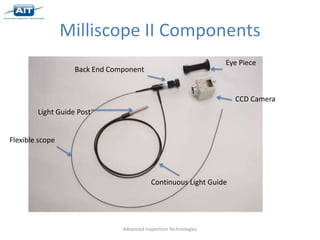
Milliscope II Components
                                                                  Eye Piece
                   Back End Component


                                                                    CCD Camera
        Light Guide Post


Flexible scope


                                           Continuous Light Guide


                               Advanced Inspection Technologies
Milliscope II
•   Available Diameters 0.4 To 4.0mm
•   Available Lengths Up To 5 Meters
•   Probes Are Interchangeable With Back-ends
•   Can Be Used With Any Existing Light Source
•   Can Be Used With Any Existing CCD Camera
    (1/2 Preferred)


                   Advanced Inspection Technologies
Milliscope Options
• Rigid, Flexible Semi Flexible
• 0°, 16°, 30°, 70°, 90° And 100° Direction Of
  View
• Milliwand Option
• Mirror Tubes
• High Magnification Back-ends
• Ocular Viewer

                  Advanced Inspection Technologies
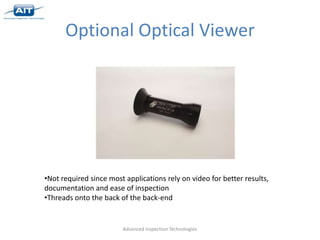
Optional Optical Viewer


•Not required since most applications rely on video for better results,
documentation and ease of inspection
•Threads onto the back of the back-end


                        Advanced Inspection Technologies
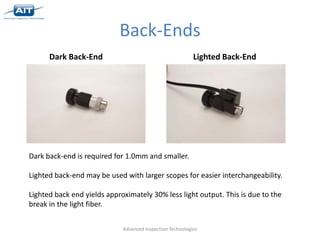
Back-Ends
      Dark Back-End                                        Lighted Back-End


Dark back-end is required for 1.0mm and smaller.

Lighted back-end may be used with larger scopes for easier interchangeability.

Lighted back end yields approximately 30% less light output. This is due to the
break in the light fiber.


                             Advanced Inspection Technologies
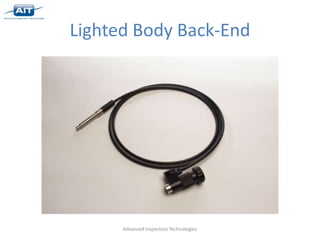
Lighted Body Back-End


      Advanced Inspection Technologies
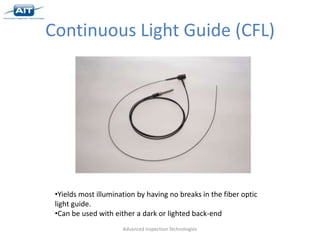
Continuous Light Guide (CFL)


 •Yields most illumination by having no breaks in the fiber optic
 light guide.
 •Can be used with either a dark or lighted back-end
                      Advanced Inspection Technologies
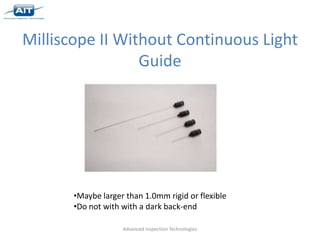
Milliscope II Without Continuous Light
                 Guide


       •Maybe larger than 1.0mm rigid or flexible
       •Do not with with a dark back-end

                    Advanced Inspection Technologies
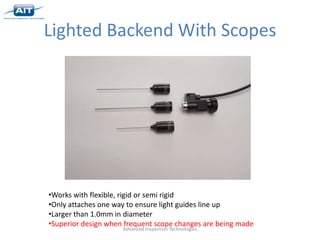
Lighted Backend With Scopes


•Works with flexible, rigid or semi rigid
•Only attaches one way to ensure light guides line up
•Larger than 1.0mm in diameter
•Superior design when frequent scope changes are being made
                     Advanced Inspection Technologies
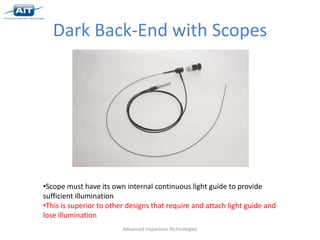
Dark Back-End with Scopes


•Scope must have its own internal continuous light guide to provide
sufficient illumination
•This is superior to other designs that require and attach light guide and
lose illumination
                         Advanced Inspection Technologies
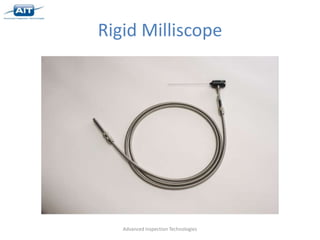
Rigid Milliscope


   Advanced Inspection Technologies
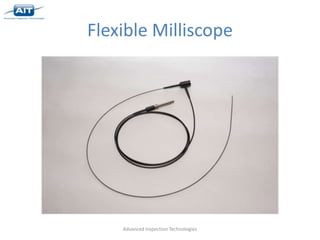
Flexible Milliscope


    Advanced Inspection Technologies
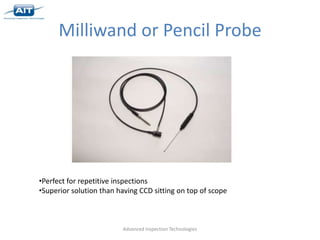
Milliwand or Pencil Probe


•Perfect for repetitive inspections
•Superior solution than having CCD sitting on top of scope


                         Advanced Inspection Technologies
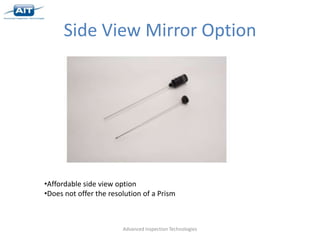
Side View Mirror Option


•Affordable side view option
•Does not offer the resolution of a Prism


                        Advanced Inspection Technologies
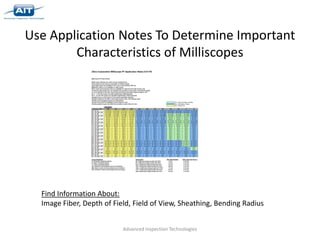
Use Application Notes To Determine Important
        Characteristics of Milliscopes


  Find Information About:
  Image Fiber, Depth of Field, Field of View, Sheathing, Bending Radius


                           Advanced Inspection Technologies
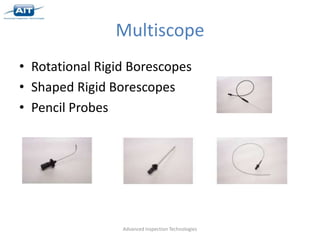
Multiscope
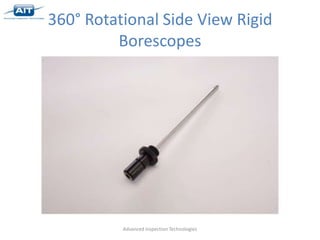
• Rotational Rigid Borescopes
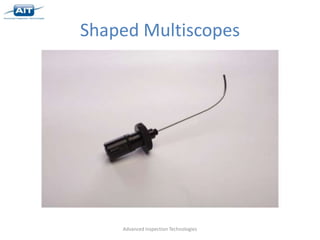
• Shaped Rigid Borescopes
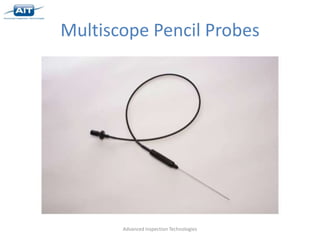
• Pencil Probes


                 Advanced Inspection Technologies
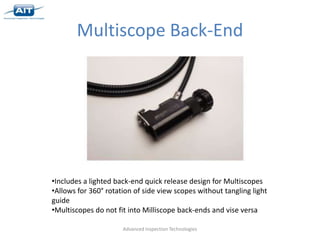
Multiscope Back-End


•Includes a lighted back-end quick release design for Multiscopes
•Allows for 360° rotation of side view scopes without tangling light
guide
•Multiscopes do not fit into Milliscope back-ends and vise versa

                      Advanced Inspection Technologies
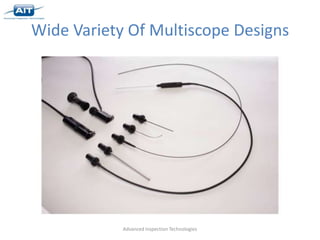
Wide Variety Of Multiscope Designs


            Advanced Inspection Technologies
Multiscope Pencil Probes


       Advanced Inspection Technologies
Shaped Multiscopes


    Advanced Inspection Technologies
360° Rotational Side View Rigid
         Borescopes


          Advanced Inspection Technologies
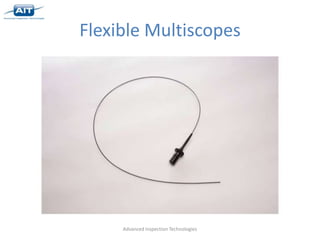
Flexible Multiscopes


     Advanced Inspection Technologies
When Do You Choose A Milliscope
        Versus A Multiscope?
• Typically You Will Choose A Milliscope Design
• Multiscope is Useful For:
  1.   Rotational Requirements
  2.   Existing Multiscope Platform
  3.   Special Shaped Probes
  4.   Multiscopes tend to be larger diameter, i.e. 1.0mm and larger


                          Advanced Inspection Technologies
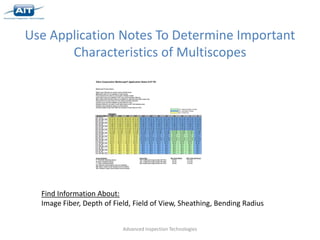
Use Application Notes To Determine Important
       Characteristics of Multiscopes


  Find Information About:
  Image Fiber, Depth of Field, Field of View, Sheathing, Bending Radius


                           Advanced Inspection Technologies
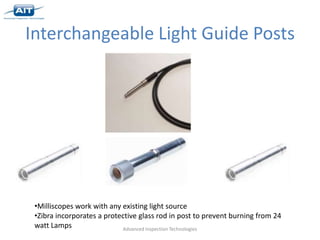
Interchangeable Light Guide Posts


 •Milliscopes work with any existing light source
 •Zibra incorporates a protective glass rod in post to prevent burning from 24
 watt Lamps                 Advanced Inspection Technologies
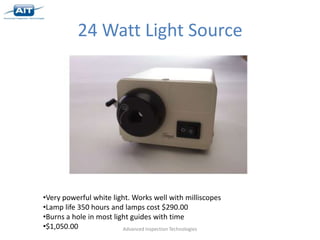
24 Watt Light Source


•Very powerful white light. Works well with milliscopes
•Lamp life 350 hours and lamps cost $290.00
•Burns a hole in most light guides with time
•$1,050.00               Advanced Inspection Technologies
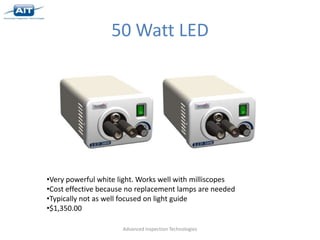
50 Watt LED


•Very powerful white light. Works well with milliscopes
•Cost effective because no replacement lamps are needed
•Typically not as well focused on light guide
•$1,350.00

                      Advanced Inspection Technologies
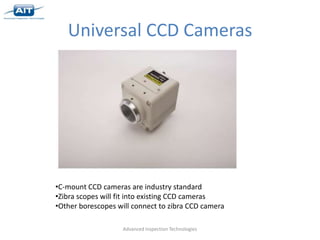
Universal CCD Cameras


•C-mount CCD cameras are industry standard
•Zibra scopes will fit into existing CCD cameras
•Other borescopes will connect to zibra CCD camera

                   Advanced Inspection Technologies
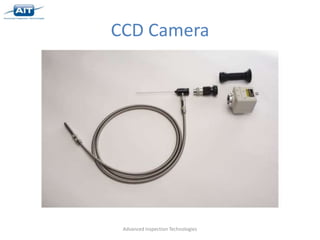
CCD Camera


 Advanced Inspection Technologies
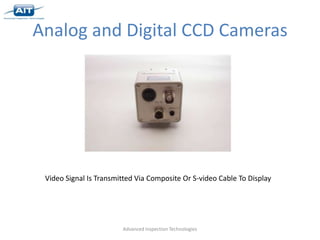
Analog and Digital CCD Cameras


 Video Signal Is Transmitted Via Composite Or S-video Cable To Display


                        Advanced Inspection Technologies
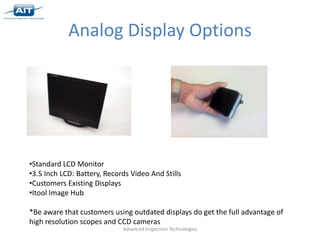
Analog Display Options


•Standard LCD Monitor
•3.5 Inch LCD: Battery, Records Video And Stills
•Customers Existing Displays
•Itool Image Hub

*Be aware that customers using outdated displays do get the full advantage of
high resolution scopes and CCD cameras
                             Advanced Inspection Technologies
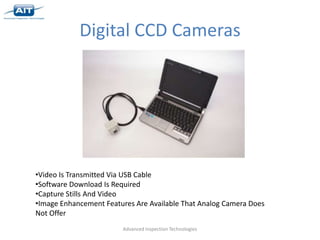
Digital CCD Cameras


•Video Is Transmitted Via USB Cable
•Software Download Is Required
•Capture Stills And Video
•Image Enhancement Features Are Available That Analog Camera Does
Not Offer
                        Advanced Inspection Technologies
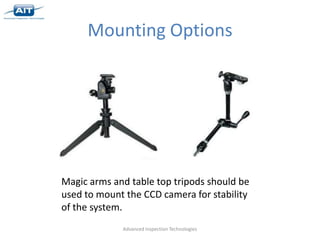
Mounting Options


Magic arms and table top tripods should be
used to mount the CCD camera for stability
of the system.
             Advanced Inspection Technologies
Borescopes 101: Basic Concepts
•   Image Guide
•   Light Guide
•   Fiber Optic Image Pixels
•   Rigid Borescopes
•   Semi Rigid Borescopes
•   Flexible Borescopes
•   Quartz Fibers Versus Leached Image Guide
•   Bending Radius
•   CCD Camera
•   C-Mount Fitting
•   Color Temperature
•   Depth Of Field
•   Field Of View
•   Direction Of View


                           Advanced Inspection Technologies
Fiber Optic Image Guide
                 Fiber Optic Light Guide
•Glass like fibers that transmit light through individual fiber
optic strands
•Image guide requires that the individual fibers be aligned or
coherent
•Each strand is approximately 10,000 microns (about 1/10th the
size of a human hair)
•An image fiber bundle may contain as many as 30,000
individual fibers or pixels
•Broken fibers are seen as black dots on image

•A fiber optic light guide can be randomly aligned
•Broken fibers may result in weak light output


                                Advanced Inspection Technologies
Rigid, Semi Rigid or Flexible?
• A True rigid borescope is made with a gradient
  lens system or Object lens System – Will be
  damaged with bending
• A Semi Rigid borescope is manufactured with
  a fiber optic bundle and will allow some
  flexing before breaking
• A flexible borescope is manufactured with
  either a quartz or leach fiber optic image
  guide and has a significant bending radius

                 Advanced Inspection Technologies
Quartz Versus Leached Image Guides
• Leached image guides have a greater bending
  radius and tend to be more durable than quartz.
  Typically found in our 2.4mm ITC fiberscope.
• Quartz image guides have a reduced bending
  radius and offer greater resolution than a leached
  image guide. Typically found in small diameter
  fiberscopes.
• Bending radius is the radius that a flexible scope
  can be bent before damage occurs to the scope.
                   Advanced Inspection Technologies
Video Knowledge
• Charged Coupled Device (CCD)
• C-mount lenses provide a male thread which
  mates with a female thread on the camera.
• Color temperature is measured in degrees Kelvin.
  The sun is 6500K which produces a brilliant white
  light and perfect to distinguish colors and fine
  details. A high color temperature light source is
  needed for acceptable video quality with small
  diameter Borescopes.
                  Advanced Inspection Technologies
Borescope Optics
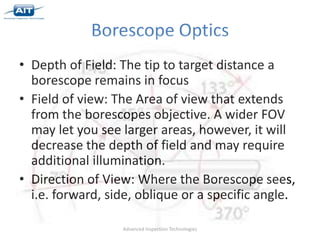
• Depth of Field: The tip to target distance a
  borescope remains in focus
• Field of view: The Area of view that extends
  from the borescopes objective. A wider FOV
  may let you see larger areas, however, it will
  decrease the depth of field and may require
  additional illumination.
• Direction of View: Where the Borescope sees,
  i.e. forward, side, oblique or a specific angle.

                  Advanced Inspection Technologies

Milliscope ii 2012

  • 1.
    Small Diameter Borescopes Advanced Inspection Technologies
  • 2.
    Milliscope II Components Eye Piece Back End Component CCD Camera Light Guide Post Flexible scope Continuous Light Guide Advanced Inspection Technologies
  • 3.
    Milliscope II • Available Diameters 0.4 To 4.0mm • Available Lengths Up To 5 Meters • Probes Are Interchangeable With Back-ends • Can Be Used With Any Existing Light Source • Can Be Used With Any Existing CCD Camera (1/2 Preferred) Advanced Inspection Technologies
  • 4.
    Milliscope Options • Rigid,Flexible Semi Flexible • 0°, 16°, 30°, 70°, 90° And 100° Direction Of View • Milliwand Option • Mirror Tubes • High Magnification Back-ends • Ocular Viewer Advanced Inspection Technologies
  • 5.
    Optional Optical Viewer •Notrequired since most applications rely on video for better results, documentation and ease of inspection •Threads onto the back of the back-end Advanced Inspection Technologies
  • 6.
    Back-Ends Dark Back-End Lighted Back-End Dark back-end is required for 1.0mm and smaller. Lighted back-end may be used with larger scopes for easier interchangeability. Lighted back end yields approximately 30% less light output. This is due to the break in the light fiber. Advanced Inspection Technologies
  • 7.
    Lighted Body Back-End Advanced Inspection Technologies
  • 8.
    Continuous Light Guide(CFL) •Yields most illumination by having no breaks in the fiber optic light guide. •Can be used with either a dark or lighted back-end Advanced Inspection Technologies
  • 9.
    Milliscope II WithoutContinuous Light Guide •Maybe larger than 1.0mm rigid or flexible •Do not with with a dark back-end Advanced Inspection Technologies
  • 10.
    Lighted Backend WithScopes •Works with flexible, rigid or semi rigid •Only attaches one way to ensure light guides line up •Larger than 1.0mm in diameter •Superior design when frequent scope changes are being made Advanced Inspection Technologies
  • 11.
    Dark Back-End withScopes •Scope must have its own internal continuous light guide to provide sufficient illumination •This is superior to other designs that require and attach light guide and lose illumination Advanced Inspection Technologies
  • 12.
    Rigid Milliscope Advanced Inspection Technologies
  • 13.
    Flexible Milliscope Advanced Inspection Technologies
  • 14.
    Milliwand or PencilProbe •Perfect for repetitive inspections •Superior solution than having CCD sitting on top of scope Advanced Inspection Technologies
  • 15.
    Side View MirrorOption •Affordable side view option •Does not offer the resolution of a Prism Advanced Inspection Technologies
  • 16.
    Use Application NotesTo Determine Important Characteristics of Milliscopes Find Information About: Image Fiber, Depth of Field, Field of View, Sheathing, Bending Radius Advanced Inspection Technologies
  • 17.
    Multiscope • Rotational RigidBorescopes • Shaped Rigid Borescopes • Pencil Probes Advanced Inspection Technologies
  • 18.
    Multiscope Back-End •Includes alighted back-end quick release design for Multiscopes •Allows for 360° rotation of side view scopes without tangling light guide •Multiscopes do not fit into Milliscope back-ends and vise versa Advanced Inspection Technologies
  • 19.
    Wide Variety OfMultiscope Designs Advanced Inspection Technologies
  • 20.
    Multiscope Pencil Probes Advanced Inspection Technologies
  • 21.
    Shaped Multiscopes Advanced Inspection Technologies
  • 22.
    360° Rotational SideView Rigid Borescopes Advanced Inspection Technologies
  • 23.
    Flexible Multiscopes Advanced Inspection Technologies
  • 24.
    When Do YouChoose A Milliscope Versus A Multiscope? • Typically You Will Choose A Milliscope Design • Multiscope is Useful For: 1. Rotational Requirements 2. Existing Multiscope Platform 3. Special Shaped Probes 4. Multiscopes tend to be larger diameter, i.e. 1.0mm and larger Advanced Inspection Technologies
  • 25.
    Use Application NotesTo Determine Important Characteristics of Multiscopes Find Information About: Image Fiber, Depth of Field, Field of View, Sheathing, Bending Radius Advanced Inspection Technologies
  • 26.
    Interchangeable Light GuidePosts •Milliscopes work with any existing light source •Zibra incorporates a protective glass rod in post to prevent burning from 24 watt Lamps Advanced Inspection Technologies
  • 27.
    24 Watt LightSource •Very powerful white light. Works well with milliscopes •Lamp life 350 hours and lamps cost $290.00 •Burns a hole in most light guides with time •$1,050.00 Advanced Inspection Technologies
  • 28.
    50 Watt LED •Verypowerful white light. Works well with milliscopes •Cost effective because no replacement lamps are needed •Typically not as well focused on light guide •$1,350.00 Advanced Inspection Technologies
  • 29.
    Universal CCD Cameras •C-mountCCD cameras are industry standard •Zibra scopes will fit into existing CCD cameras •Other borescopes will connect to zibra CCD camera Advanced Inspection Technologies
  • 30.
    CCD Camera AdvancedInspection Technologies
  • 31.
    Analog and DigitalCCD Cameras Video Signal Is Transmitted Via Composite Or S-video Cable To Display Advanced Inspection Technologies
  • 32.
    Analog Display Options •StandardLCD Monitor •3.5 Inch LCD: Battery, Records Video And Stills •Customers Existing Displays •Itool Image Hub *Be aware that customers using outdated displays do get the full advantage of high resolution scopes and CCD cameras Advanced Inspection Technologies
  • 33.
    Digital CCD Cameras •VideoIs Transmitted Via USB Cable •Software Download Is Required •Capture Stills And Video •Image Enhancement Features Are Available That Analog Camera Does Not Offer Advanced Inspection Technologies
  • 34.
    Mounting Options Magic armsand table top tripods should be used to mount the CCD camera for stability of the system. Advanced Inspection Technologies
  • 35.
    Borescopes 101: BasicConcepts • Image Guide • Light Guide • Fiber Optic Image Pixels • Rigid Borescopes • Semi Rigid Borescopes • Flexible Borescopes • Quartz Fibers Versus Leached Image Guide • Bending Radius • CCD Camera • C-Mount Fitting • Color Temperature • Depth Of Field • Field Of View • Direction Of View Advanced Inspection Technologies
  • 36.
    Fiber Optic ImageGuide Fiber Optic Light Guide •Glass like fibers that transmit light through individual fiber optic strands •Image guide requires that the individual fibers be aligned or coherent •Each strand is approximately 10,000 microns (about 1/10th the size of a human hair) •An image fiber bundle may contain as many as 30,000 individual fibers or pixels •Broken fibers are seen as black dots on image •A fiber optic light guide can be randomly aligned •Broken fibers may result in weak light output Advanced Inspection Technologies
  • 37.
    Rigid, Semi Rigidor Flexible? • A True rigid borescope is made with a gradient lens system or Object lens System – Will be damaged with bending • A Semi Rigid borescope is manufactured with a fiber optic bundle and will allow some flexing before breaking • A flexible borescope is manufactured with either a quartz or leach fiber optic image guide and has a significant bending radius Advanced Inspection Technologies
  • 38.
    Quartz Versus LeachedImage Guides • Leached image guides have a greater bending radius and tend to be more durable than quartz. Typically found in our 2.4mm ITC fiberscope. • Quartz image guides have a reduced bending radius and offer greater resolution than a leached image guide. Typically found in small diameter fiberscopes. • Bending radius is the radius that a flexible scope can be bent before damage occurs to the scope. Advanced Inspection Technologies
  • 39.
    Video Knowledge • ChargedCoupled Device (CCD) • C-mount lenses provide a male thread which mates with a female thread on the camera. • Color temperature is measured in degrees Kelvin. The sun is 6500K which produces a brilliant white light and perfect to distinguish colors and fine details. A high color temperature light source is needed for acceptable video quality with small diameter Borescopes. Advanced Inspection Technologies
  • 40.
    Borescope Optics • Depthof Field: The tip to target distance a borescope remains in focus • Field of view: The Area of view that extends from the borescopes objective. A wider FOV may let you see larger areas, however, it will decrease the depth of field and may require additional illumination. • Direction of View: Where the Borescope sees, i.e. forward, side, oblique or a specific angle. Advanced Inspection Technologies