FUJINON(EUROPE)GmbH
Binoculars Department
For all who want to see more of
the world
Binoculars from Fujinon
• Manufacturing experience since 1947
• Patented lens design and coating technology
• Still using own factories and quality management
• ISO 9001 / ISO14000 / RoHS-compliant / CE certified
• Proven performance in the hands of many demanding
professionals all around the world
• Image stabilization via electronic sensors or gyroscopes
• Floatable marine binoculars
• Largest binocular aperture on world market.
The Fujinon difference
FUJINON(EUROPE)GmbH
Binoculars Department
Binoculars Basics
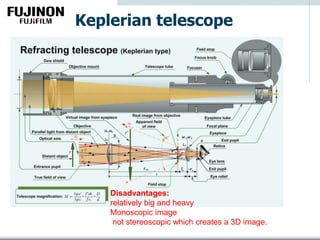
Keplerian telescope
Disadvantages:
relatively big and heavy
Monoscopic image
not stereoscopic which creates a 3D image.
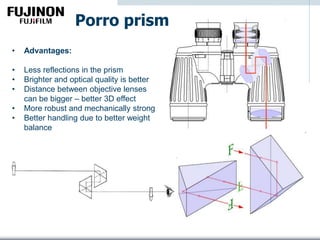
Porro prism
• Advantages:
• Less reflections in the prism
• Brighter and optical quality is better
• Distance between objective lenses
can be bigger – better 3D effect
• More robust and mechanically strong
• Better handling due to better weight
balance
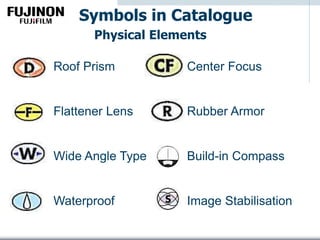
Roof Prism
Flattener Lens
Wide Angle Type
Waterproof
Symbols in Catalogue
Physical Elements
Center Focus
Rubber Armor
Build-in Compass
Image Stabilisation
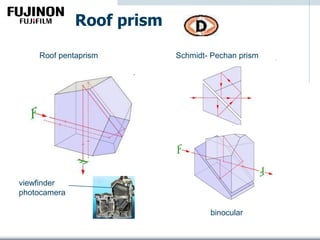
Roof prism
Roof pentaprism Schmidt- Pechan prism
viewfinder
photocamera
binocular
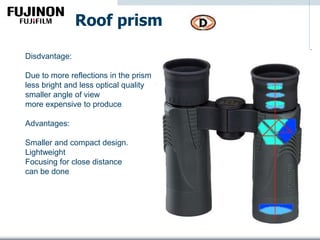
Roof prism
Disdvantage:
Due to more reflections in the prism
less bright and less optical quality
smaller angle of view
more expensive to produce
Advantages:
Smaller and compact design.
Lightweight
Focusing for close distance
can be done
Flattener optic
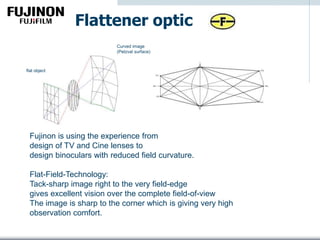
Fujinon is using the experience from
design of TV and Cine lenses to
design binoculars with reduced field curvature.
Flat-Field-Technology:
Tack-sharp image right to the very field-edge
gives excellent vision over the complete field-of-view
The image is sharp to the corner which is giving very high
observation comfort.
flat object
Curved image
(Petzval surface)
Flattener optic
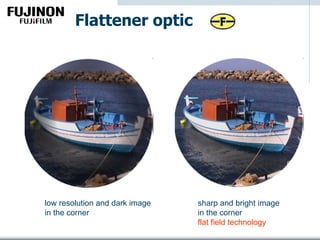
sharp and bright image
in the corner
flat field technology
low resolution and dark image
in the corner
Wide angle type
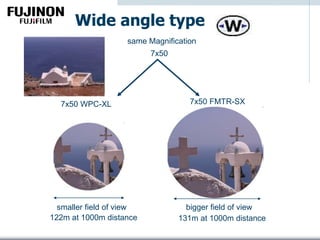
same Magnification
smaller field of view bigger field of view
7x50
7x50 FMTR-SX7x50 WPC-XL
131m at 1000m distance122m at 1000m distance
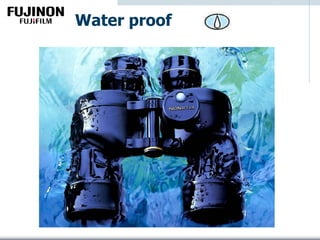
Water proof
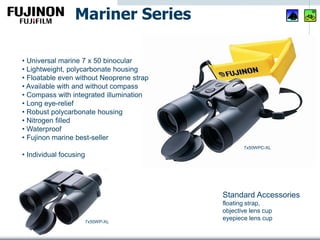
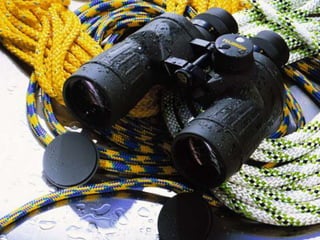
• Universal marine 7 x 50 binocular
• Lightweight, polycarbonate housing
• Floatable even without Neoprene strap
• Available with and without compass
• Compass with integrated illumination
• Long eye-relief
• Robust polycarbonate housing
• Nitrogen filled
• Waterproof
• Fujinon marine best-seller
• Individual focusing
Mariner Series
Standard Accessories
floating strap,
objective lens cup
eyepiece lens cup
7x50WPC-XL
7x50WP-XL
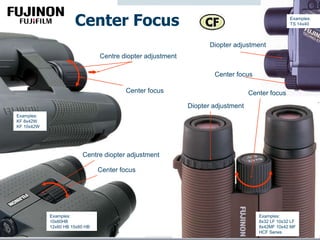
Center Focus
Center focus
Diopter adjustment
Examples:
8x32 LF 10x32 LF
8x42MF 10x42 MF
HCF Series
Center focus
Examples:
10x60HB
12x60 HB 15x60 HB
Centre diopter adjustment
Center focus
Examples:
KF 8x42W
KF 10x42W
Examples:
TS 14x40
Centre diopter adjustment
Center focus
Diopter adjustment
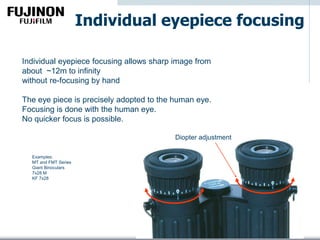
Individual eyepiece focusing
Individual eyepiece focusing allows sharp image from
about ~12m to infinity
without re-focusing by hand
The eye piece is precisely adopted to the human eye.
Focusing is done with the human eye.
No quicker focus is possible.
Examples:
MT and FMT Series
Giant Binoculars
7x28 M
KF 7x28
Diopter adjustment
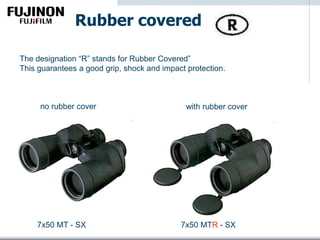
Rubber covered
The designation “R” stands for Rubber Covered”
This guarantees a good grip, shock and impact protection.
7x50 MT - SX 7x50 MTR - SX
no rubber cover with rubber cover
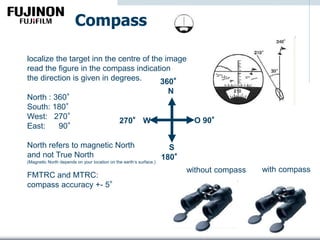
Compass
localize the target inn the centre of the image
read the figure in the compass indication
the direction is given in degrees.
North : 360°
South: 180°
West: 270°
East: 90°
North refers to magnetic North
and not True North
(Magnetic North depends on your location on the earth‘s surface.)
FMTRC and MTRC:
compass accuracy +- 5°
360°
N
S
180°
270° W O 90°
without compass with compass
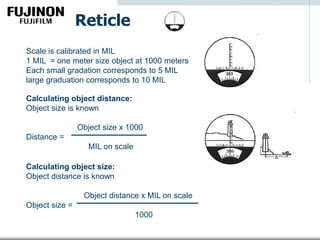
Reticle
Scale is calibrated in MIL
1 MIL = one meter size object at 1000 meters
Each small gradation corresponds to 5 MIL
large graduation corresponds to 10 MIL
Calculating object distance:
Object size is known
Object size x 1000
Distance =
MIL on scale
Calculating object size:
Object distance is known
Object distance x MIL on scale
Object size =
1000
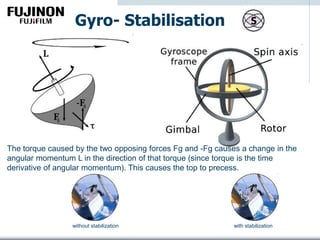
Gyro- Stabilisation
The torque caused by the two opposing forces Fg and -Fg causes a change in the
angular momentum L in the direction of that torque (since torque is the time
derivative of angular momentum). This causes the top to precess.
without stabilization with stabilization
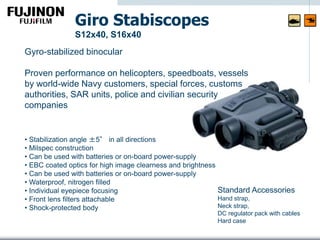
Gyro-stabilized binocular
Proven performance on helicopters, speedboats, vessels
by world-wide Navy customers, special forces, customs
authorities, SAR units, police and civilian security
companies
Giro Stabiscopes
S12x40, S16x40
• Stabilization angle ±5° in all directions
• Milspec construction
• Can be used with batteries or on-board power-supply
• EBC coated optics for high image clearness and brightness
• Can be used with batteries or on-board power-supply
• Waterproof, nitrogen filled
• Individual eyepiece focusing
• Front lens filters attachable
• Shock-protected body
Standard Accessories
Hand strap,
Neck strap,
DC regulator pack with cables
Hard case
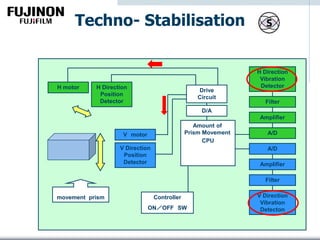
Techno- Stabilisation
V motor
V Direction
Position
Detector
H motor H Direction
Position
Detector
V Direction
Vibration
Detecton
H Direction
Vibration
Detector
Controller
ON/OFF SW
movement prism
D/A
Filter
Filter
Amplifier
Amplifier
A/D
A/D
CPU
Drive
Circuit
Amount of
Prism Movement
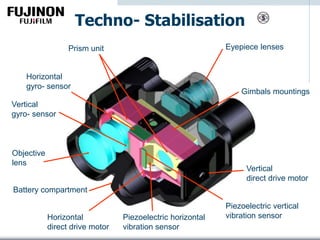
Techno- Stabilisation
Eyepiece lenses
Gimbals mountings
Vertical
direct drive motor
Piezoelectric vertical
vibration sensorHorizontal
direct drive motor
Piezoelectric horizontal
vibration sensor
Battery compartment
Objective
lens
Vertical
gyro- sensor
Horizontal
gyro- sensor
Prism unit
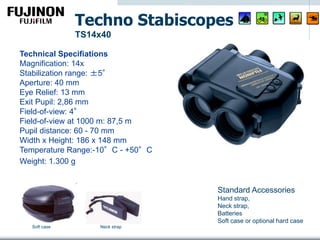
Technical Specifiations
Magnification: 14x
Stabilization range: ±5°
Aperture: 40 mm
Eye Relief: 13 mm
Exit Pupil: 2,86 mm
Field-of-view: 4°
Field-of-view at 1000 m: 87,5 m
Pupil distance: 60 - 70 mm
Width x Height: 186 x 148 mm
Temperature Range:-10°C - +50°C
Weight: 1.300 g
Techno Stabiscopes
TS14x40
Standard Accessories
Hand strap,
Neck strap,
Batteries
Soft case or optional hard case
Neck strapSoft case
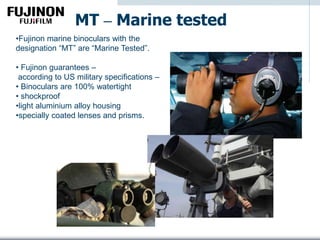
MT – Marine tested
•Fujinon marine binoculars with the
designation “MT” are “Marine Tested”.
• Fujinon guarantees –
according to US military specifications –
• Binoculars are 100% watertight
• shockproof
•light aluminium alloy housing
•specially coated lenses and prisms.
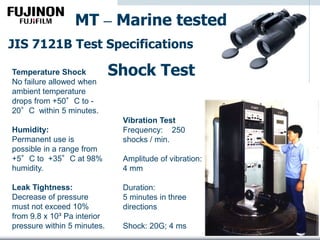
Temperature Shock
No failure allowed when
ambient temperature
drops from +50°C to -
20°C within 5 minutes.
Humidity:
Permanent use is
possible in a range from
+5°C to +35°C at 98%
humidity.
Leak Tightness:
Decrease of pressure
must not exceed 10%
from 9.8 x 10³ Pa interior
pressure within 5 minutes.
MT – Marine tested
JIS 7121B Test Specifications
Shock Test
Vibration Test
Frequency: 250
shocks / min.
Amplitude of vibration:
4 mm
Duration:
5 minutes in three
directions
Shock: 20G; 4 ms
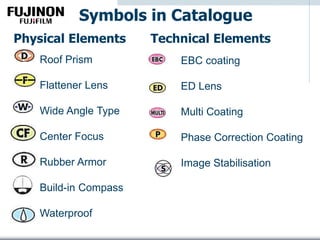
EBC coating
ED Lens
Multi Coating
Phase Correction Coating
Image Stabilisation
Roof Prism
Flattener Lens
Wide Angle Type
Center Focus
Rubber Armor
Build-in Compass
Waterproof
Symbols in Catalogue
Physical Elements Technical Elements
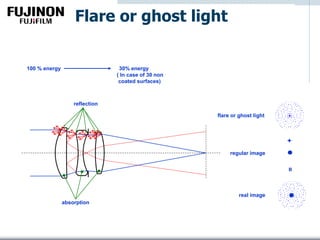
regular image
flare or ghost light
real image
+
=
absorption
100 % energy 30% energy
( In case of 30 non
coated surfaces)
reflection
Flare or ghost light
AA
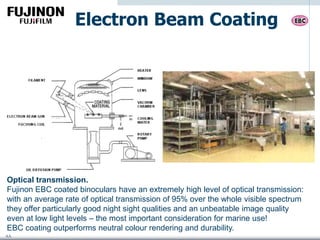
Electron Beam Coating
Optical transmission.
Fujinon EBC coated binoculars have an extremely high level of optical transmission:
with an average rate of optical transmission of 95% over the whole visible spectrum
they offer particularly good night sight qualities and an unbeatable image quality
even at low light levels – the most important consideration for marine use!
EBC coating outperforms neutral colour rendering and durability.
AA
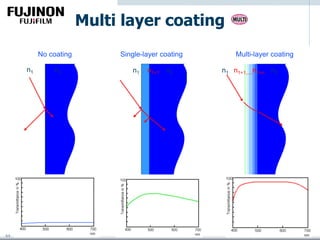
No coating
n1 n2
Multi-layer coating
n1 n1+1.....n1+n n2n1 n1+1 n2
Single-layer coating
Multi layer coating
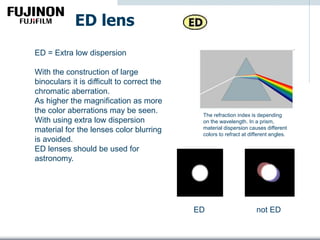
ED lens
ED = Extra low dispersion
With the construction of large
binoculars it is difficult to correct the
chromatic aberration.
As higher the magnification as more
the color aberrations may be seen.
With using extra low dispersion
material for the lenses color blurring
is avoided.
ED lenses should be used for
astronomy.
The refraction index is depending
on the wavelength. In a prism,
material dispersion causes different
colors to refract at different angles.
not EDED
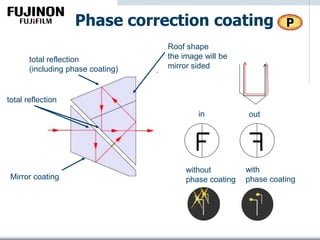
Phase correction coating
total reflection
(including phase coating)
Roof shape
the image will be
mirror sided
Mirror coating
total reflection
in out
without
phase coating
with
phase coating
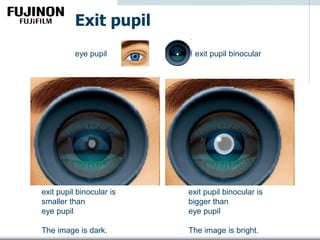
Exit pupil
exit pupil binocular is
smaller than
eye pupil
The image is dark.
exit pupil binocular is
bigger than
eye pupil
The image is bright.
exit pupil binoculareye pupil
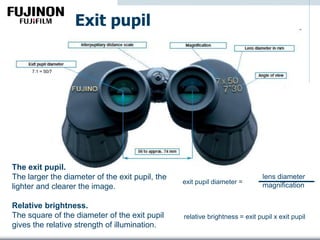
Exit pupil
exit pupil diameter =
lens diameter
magnification
The exit pupil.
The larger the diameter of the exit pupil, the
lighter and clearer the image.
Relative brightness.
The square of the diameter of the exit pupil
gives the relative strength of illumination.
7.1 = 50/7
relative brightness = exit pupil x exit pupil
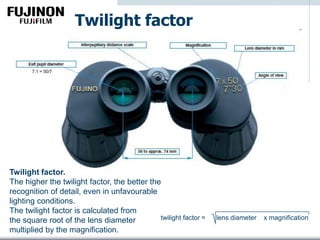
Twilight factor
Twilight factor.
The higher the twilight factor, the better the
recognition of detail, even in unfavourable
lighting conditions.
The twilight factor is calculated from
the square root of the lens diameter
multiplied by the magnification.
7.1 = 50/7
twilight factor = lens diameter x magnification
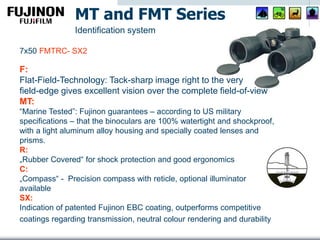
F:
Flat-Field-Technology: Tack-sharp image right to the very
field-edge gives excellent vision over the complete field-of-view
MT:
“Marine Tested”: Fujinon guarantees – according to US military
specifications – that the binoculars are 100% watertight and shockproof,
with a light aluminum alloy housing and specially coated lenses and
prisms.
R:
„Rubber Covered“ for shock protection and good ergonomics
C:
„Compass“ - Precision compass with reticle, optional illuminator
available
SX:
Indication of patented Fujinon EBC coating, outperforms competitive
coatings regarding transmission, neutral colour rendering and durability
MT and FMT Series
Identification system
7x50 FMTRC- SX2
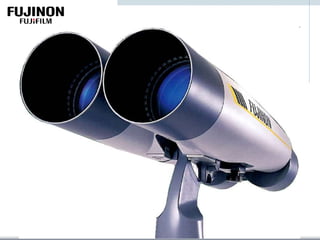
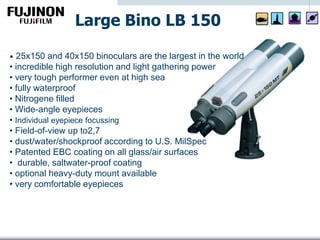
• 25x150 and 40x150 binoculars are the largest in the world
• incredible high resolution and light gathering power
• very tough performer even at high sea
• fully waterproof
• Nitrogene filled
• Wide-angle eyepieces
• Individual eyepiece focussing
• Field-of-view up to2,7
• dust/water/shockproof according to U.S. MilSpec
• Patented EBC coating on all glass/air surfaces
• durable, saltwater-proof coating
• optional heavy-duty mount available
• very comfortable eyepieces
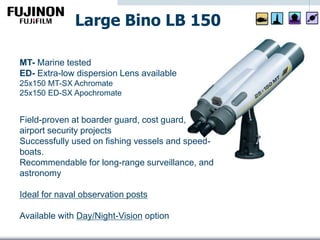
Large Bino LB 150
Field-proven at boarder guard, cost guard,
airport security projects
Successfully used on fishing vessels and speed-
boats.
Recommendable for long-range surveillance, and
astronomy
Ideal for naval observation posts
Available with Day/Night-Vision option
MT- Marine tested
ED- Extra-low dispersion Lens available
25x150 MT-SX Achromate
25x150 ED-SX Apochromate
Large Bino LB 150
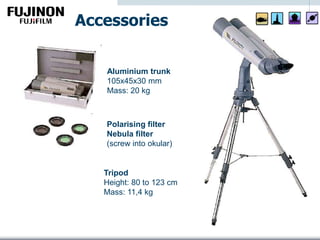
Polarising filter
Nebula filter
(screw into okular)
Aluminium trunk
105x45x30 mm
Mass: 20 kg
Tripod
Height: 80 to 123 cm
Mass: 11,4 kg
Accessories
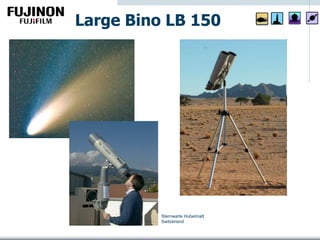
Large Bino LB 150
Sternwarte Hubelmatt
Switzerland
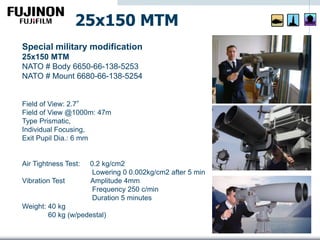
Special military modification
25x150 MTM
NATO # Body 6650-66-138-5253
NATO # Mount 6680-66-138-5254
25x150 MTM
Field of View: 2.7°
Field of View @1000m: 47m
Type Prismatic,
Individual Focusing,
Exit Pupil Dia.: 6 mm
Air Tightness Test: 0.2 kg/cm2
Lowering 0 0.002kg/cm2 after 5 min
Vibration Test Amplitude 4mm
Frequency 250 c/min
Duration 5 minutes
Weight: 40 kg
60 kg (w/pedestal)
FUJINON(EUROPE)GmbH
Binoculars & Night Vision Sales
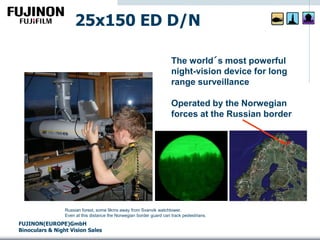
The world´s most powerful
night-vision device for long
range surveillance
Operated by the Norwegian
forces at the Russian border
Russian forest, some 9kms away from Svanvik watchtower.
Even at this distance the Norwegian border guard can track pedestrians.
25x150 ED D/N
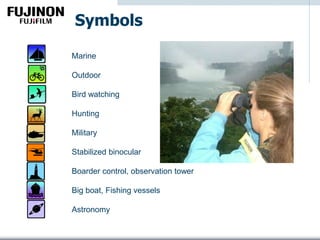
Symbols
Marine
Outdoor
Bird watching
Hunting
Military
Stabilized binocular
Boarder control, observation tower
Big boat, Fishing vessels
Astronomy
FUJINON(EUROPE)GmbH
Binoculars Department
Bino presentation2015

Bino presentation2015

  • 1.
    FUJINON(EUROPE)GmbH Binoculars Department For allwho want to see more of the world Binoculars from Fujinon
  • 2.
    • Manufacturing experiencesince 1947 • Patented lens design and coating technology • Still using own factories and quality management • ISO 9001 / ISO14000 / RoHS-compliant / CE certified • Proven performance in the hands of many demanding professionals all around the world • Image stabilization via electronic sensors or gyroscopes • Floatable marine binoculars • Largest binocular aperture on world market. The Fujinon difference
  • 3.
  • 4.
    Keplerian telescope Disadvantages: relatively bigand heavy Monoscopic image not stereoscopic which creates a 3D image.
  • 5.
    Porro prism • Advantages: •Less reflections in the prism • Brighter and optical quality is better • Distance between objective lenses can be bigger – better 3D effect • More robust and mechanically strong • Better handling due to better weight balance
  • 6.
    Roof Prism Flattener Lens WideAngle Type Waterproof Symbols in Catalogue Physical Elements Center Focus Rubber Armor Build-in Compass Image Stabilisation
  • 7.
    Roof prism Roof pentaprismSchmidt- Pechan prism viewfinder photocamera binocular
  • 8.
    Roof prism Disdvantage: Due tomore reflections in the prism less bright and less optical quality smaller angle of view more expensive to produce Advantages: Smaller and compact design. Lightweight Focusing for close distance can be done
  • 9.
    Flattener optic Fujinon isusing the experience from design of TV and Cine lenses to design binoculars with reduced field curvature. Flat-Field-Technology: Tack-sharp image right to the very field-edge gives excellent vision over the complete field-of-view The image is sharp to the corner which is giving very high observation comfort. flat object Curved image (Petzval surface)
  • 10.
    Flattener optic sharp andbright image in the corner flat field technology low resolution and dark image in the corner
  • 11.
    Wide angle type sameMagnification smaller field of view bigger field of view 7x50 7x50 FMTR-SX7x50 WPC-XL 131m at 1000m distance122m at 1000m distance
  • 12.
  • 13.
    • Universal marine7 x 50 binocular • Lightweight, polycarbonate housing • Floatable even without Neoprene strap • Available with and without compass • Compass with integrated illumination • Long eye-relief • Robust polycarbonate housing • Nitrogen filled • Waterproof • Fujinon marine best-seller • Individual focusing Mariner Series Standard Accessories floating strap, objective lens cup eyepiece lens cup 7x50WPC-XL 7x50WP-XL
  • 14.
    Center Focus Center focus Diopteradjustment Examples: 8x32 LF 10x32 LF 8x42MF 10x42 MF HCF Series Center focus Examples: 10x60HB 12x60 HB 15x60 HB Centre diopter adjustment Center focus Examples: KF 8x42W KF 10x42W Examples: TS 14x40 Centre diopter adjustment Center focus Diopter adjustment
  • 15.
    Individual eyepiece focusing Individualeyepiece focusing allows sharp image from about ~12m to infinity without re-focusing by hand The eye piece is precisely adopted to the human eye. Focusing is done with the human eye. No quicker focus is possible. Examples: MT and FMT Series Giant Binoculars 7x28 M KF 7x28 Diopter adjustment
  • 16.
    Rubber covered The designation“R” stands for Rubber Covered” This guarantees a good grip, shock and impact protection. 7x50 MT - SX 7x50 MTR - SX no rubber cover with rubber cover
  • 17.
    Compass localize the targetinn the centre of the image read the figure in the compass indication the direction is given in degrees. North : 360° South: 180° West: 270° East: 90° North refers to magnetic North and not True North (Magnetic North depends on your location on the earth‘s surface.) FMTRC and MTRC: compass accuracy +- 5° 360° N S 180° 270° W O 90° without compass with compass
  • 18.
    Reticle Scale is calibratedin MIL 1 MIL = one meter size object at 1000 meters Each small gradation corresponds to 5 MIL large graduation corresponds to 10 MIL Calculating object distance: Object size is known Object size x 1000 Distance = MIL on scale Calculating object size: Object distance is known Object distance x MIL on scale Object size = 1000
  • 19.
    Gyro- Stabilisation The torquecaused by the two opposing forces Fg and -Fg causes a change in the angular momentum L in the direction of that torque (since torque is the time derivative of angular momentum). This causes the top to precess. without stabilization with stabilization
  • 20.
    Gyro-stabilized binocular Proven performanceon helicopters, speedboats, vessels by world-wide Navy customers, special forces, customs authorities, SAR units, police and civilian security companies Giro Stabiscopes S12x40, S16x40 • Stabilization angle ±5° in all directions • Milspec construction • Can be used with batteries or on-board power-supply • EBC coated optics for high image clearness and brightness • Can be used with batteries or on-board power-supply • Waterproof, nitrogen filled • Individual eyepiece focusing • Front lens filters attachable • Shock-protected body Standard Accessories Hand strap, Neck strap, DC regulator pack with cables Hard case
  • 21.
    Techno- Stabilisation V motor VDirection Position Detector H motor H Direction Position Detector V Direction Vibration Detecton H Direction Vibration Detector Controller ON/OFF SW movement prism D/A Filter Filter Amplifier Amplifier A/D A/D CPU Drive Circuit Amount of Prism Movement
  • 22.
    Techno- Stabilisation Eyepiece lenses Gimbalsmountings Vertical direct drive motor Piezoelectric vertical vibration sensorHorizontal direct drive motor Piezoelectric horizontal vibration sensor Battery compartment Objective lens Vertical gyro- sensor Horizontal gyro- sensor Prism unit
  • 23.
    Technical Specifiations Magnification: 14x Stabilizationrange: ±5° Aperture: 40 mm Eye Relief: 13 mm Exit Pupil: 2,86 mm Field-of-view: 4° Field-of-view at 1000 m: 87,5 m Pupil distance: 60 - 70 mm Width x Height: 186 x 148 mm Temperature Range:-10°C - +50°C Weight: 1.300 g Techno Stabiscopes TS14x40 Standard Accessories Hand strap, Neck strap, Batteries Soft case or optional hard case Neck strapSoft case
  • 24.
    MT – Marinetested •Fujinon marine binoculars with the designation “MT” are “Marine Tested”. • Fujinon guarantees – according to US military specifications – • Binoculars are 100% watertight • shockproof •light aluminium alloy housing •specially coated lenses and prisms.
  • 25.
    Temperature Shock No failureallowed when ambient temperature drops from +50°C to - 20°C within 5 minutes. Humidity: Permanent use is possible in a range from +5°C to +35°C at 98% humidity. Leak Tightness: Decrease of pressure must not exceed 10% from 9.8 x 10³ Pa interior pressure within 5 minutes. MT – Marine tested JIS 7121B Test Specifications Shock Test Vibration Test Frequency: 250 shocks / min. Amplitude of vibration: 4 mm Duration: 5 minutes in three directions Shock: 20G; 4 ms
  • 26.
    EBC coating ED Lens MultiCoating Phase Correction Coating Image Stabilisation Roof Prism Flattener Lens Wide Angle Type Center Focus Rubber Armor Build-in Compass Waterproof Symbols in Catalogue Physical Elements Technical Elements
  • 27.
    regular image flare orghost light real image + = absorption 100 % energy 30% energy ( In case of 30 non coated surfaces) reflection Flare or ghost light
  • 28.
    AA Electron Beam Coating Opticaltransmission. Fujinon EBC coated binoculars have an extremely high level of optical transmission: with an average rate of optical transmission of 95% over the whole visible spectrum they offer particularly good night sight qualities and an unbeatable image quality even at low light levels – the most important consideration for marine use! EBC coating outperforms neutral colour rendering and durability.
  • 29.
    AA No coating n1 n2 Multi-layercoating n1 n1+1.....n1+n n2n1 n1+1 n2 Single-layer coating Multi layer coating
  • 30.
    ED lens ED =Extra low dispersion With the construction of large binoculars it is difficult to correct the chromatic aberration. As higher the magnification as more the color aberrations may be seen. With using extra low dispersion material for the lenses color blurring is avoided. ED lenses should be used for astronomy. The refraction index is depending on the wavelength. In a prism, material dispersion causes different colors to refract at different angles. not EDED
  • 31.
    Phase correction coating totalreflection (including phase coating) Roof shape the image will be mirror sided Mirror coating total reflection in out without phase coating with phase coating
  • 32.
    Exit pupil exit pupilbinocular is smaller than eye pupil The image is dark. exit pupil binocular is bigger than eye pupil The image is bright. exit pupil binoculareye pupil
  • 33.
    Exit pupil exit pupildiameter = lens diameter magnification The exit pupil. The larger the diameter of the exit pupil, the lighter and clearer the image. Relative brightness. The square of the diameter of the exit pupil gives the relative strength of illumination. 7.1 = 50/7 relative brightness = exit pupil x exit pupil
  • 34.
    Twilight factor Twilight factor. Thehigher the twilight factor, the better the recognition of detail, even in unfavourable lighting conditions. The twilight factor is calculated from the square root of the lens diameter multiplied by the magnification. 7.1 = 50/7 twilight factor = lens diameter x magnification
  • 35.
    F: Flat-Field-Technology: Tack-sharp imageright to the very field-edge gives excellent vision over the complete field-of-view MT: “Marine Tested”: Fujinon guarantees – according to US military specifications – that the binoculars are 100% watertight and shockproof, with a light aluminum alloy housing and specially coated lenses and prisms. R: „Rubber Covered“ for shock protection and good ergonomics C: „Compass“ - Precision compass with reticle, optional illuminator available SX: Indication of patented Fujinon EBC coating, outperforms competitive coatings regarding transmission, neutral colour rendering and durability MT and FMT Series Identification system 7x50 FMTRC- SX2
  • 37.
    • 25x150 and40x150 binoculars are the largest in the world • incredible high resolution and light gathering power • very tough performer even at high sea • fully waterproof • Nitrogene filled • Wide-angle eyepieces • Individual eyepiece focussing • Field-of-view up to2,7 • dust/water/shockproof according to U.S. MilSpec • Patented EBC coating on all glass/air surfaces • durable, saltwater-proof coating • optional heavy-duty mount available • very comfortable eyepieces Large Bino LB 150
  • 38.
    Field-proven at boarderguard, cost guard, airport security projects Successfully used on fishing vessels and speed- boats. Recommendable for long-range surveillance, and astronomy Ideal for naval observation posts Available with Day/Night-Vision option MT- Marine tested ED- Extra-low dispersion Lens available 25x150 MT-SX Achromate 25x150 ED-SX Apochromate Large Bino LB 150
  • 39.
    Polarising filter Nebula filter (screwinto okular) Aluminium trunk 105x45x30 mm Mass: 20 kg Tripod Height: 80 to 123 cm Mass: 11,4 kg Accessories
  • 40.
    Large Bino LB150 Sternwarte Hubelmatt Switzerland
  • 41.
    Special military modification 25x150MTM NATO # Body 6650-66-138-5253 NATO # Mount 6680-66-138-5254 25x150 MTM Field of View: 2.7° Field of View @1000m: 47m Type Prismatic, Individual Focusing, Exit Pupil Dia.: 6 mm Air Tightness Test: 0.2 kg/cm2 Lowering 0 0.002kg/cm2 after 5 min Vibration Test Amplitude 4mm Frequency 250 c/min Duration 5 minutes Weight: 40 kg 60 kg (w/pedestal)
  • 42.
    FUJINON(EUROPE)GmbH Binoculars & NightVision Sales The world´s most powerful night-vision device for long range surveillance Operated by the Norwegian forces at the Russian border Russian forest, some 9kms away from Svanvik watchtower. Even at this distance the Norwegian border guard can track pedestrians. 25x150 ED D/N
  • 43.
    Symbols Marine Outdoor Bird watching Hunting Military Stabilized binocular Boardercontrol, observation tower Big boat, Fishing vessels Astronomy
  • 44.