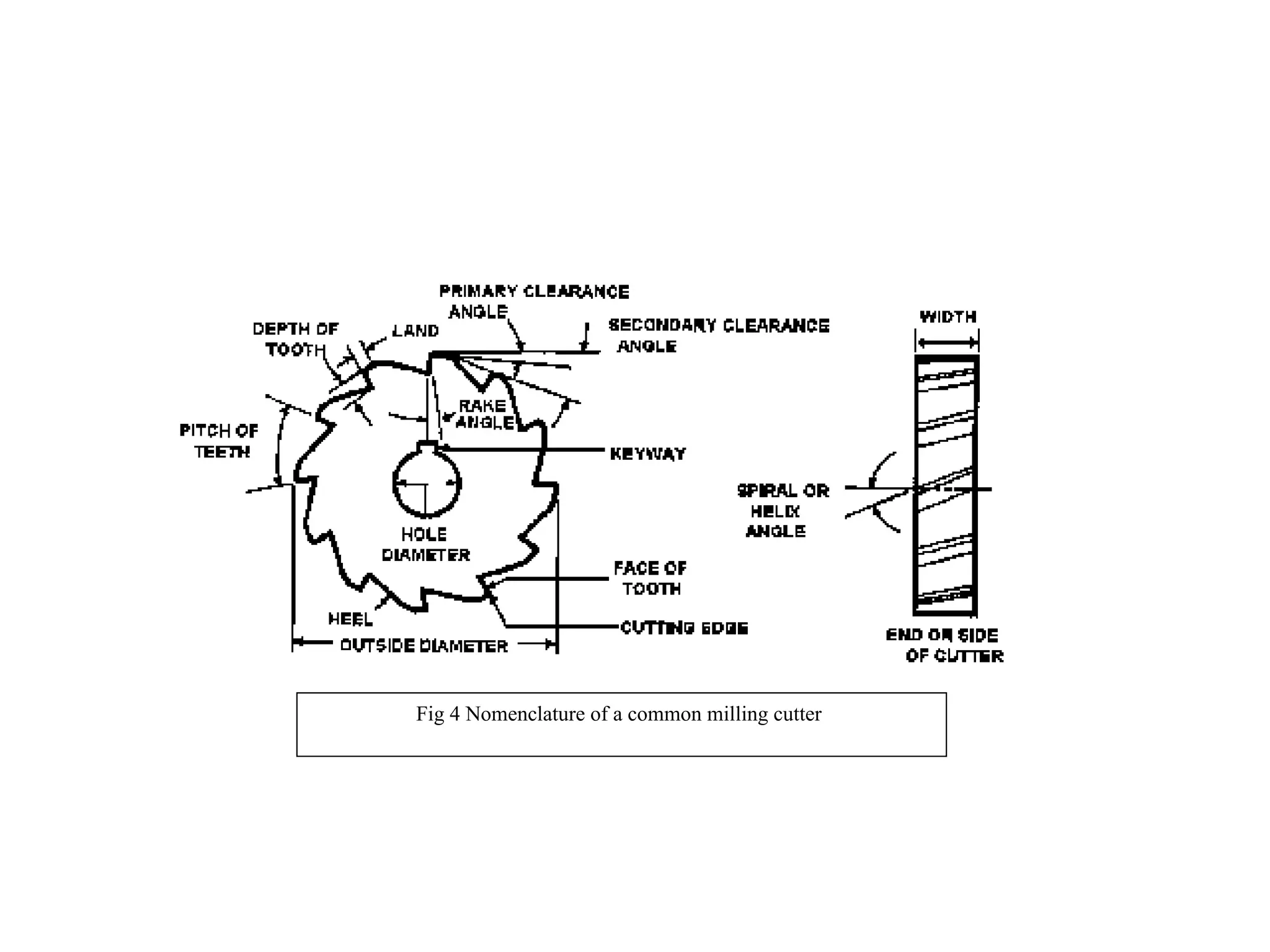
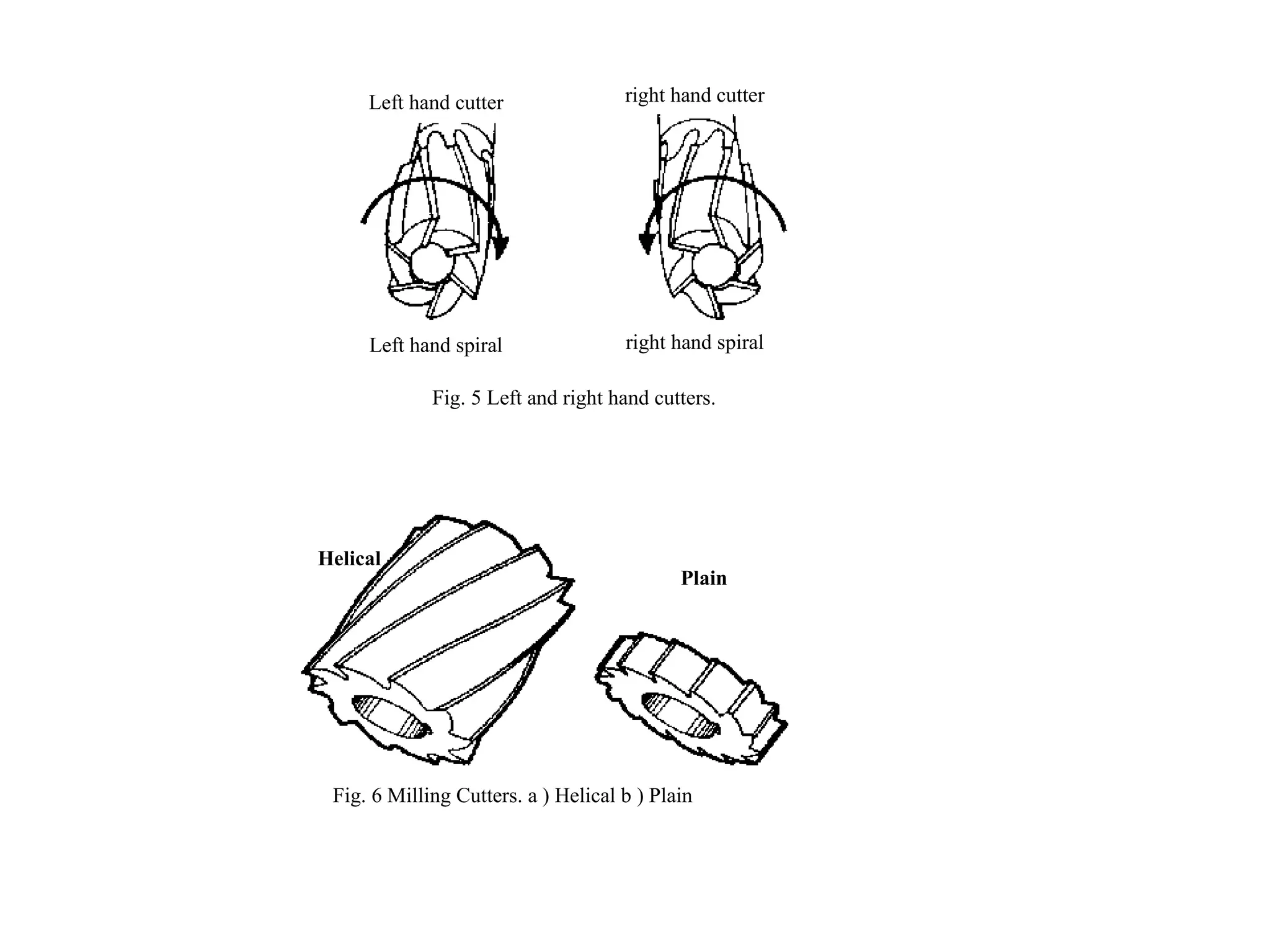
Left hand spiralright hand spiral
Left hand cutter right hand cutter
Fig. 5 Left and right hand cutters.
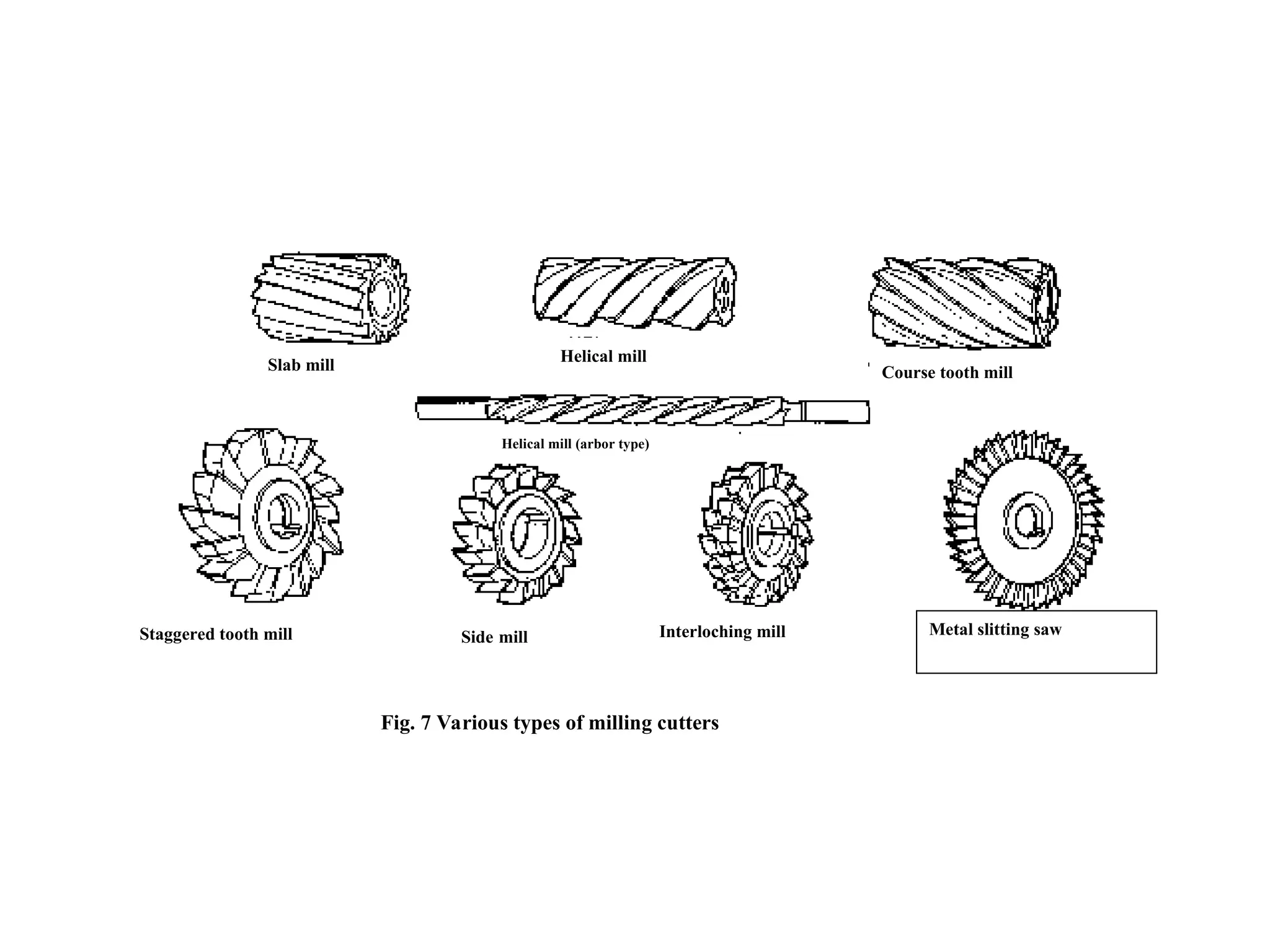
Helical
Plain
Fig. 6 Milling Cutters. a ) Helical b ) Plain
8.
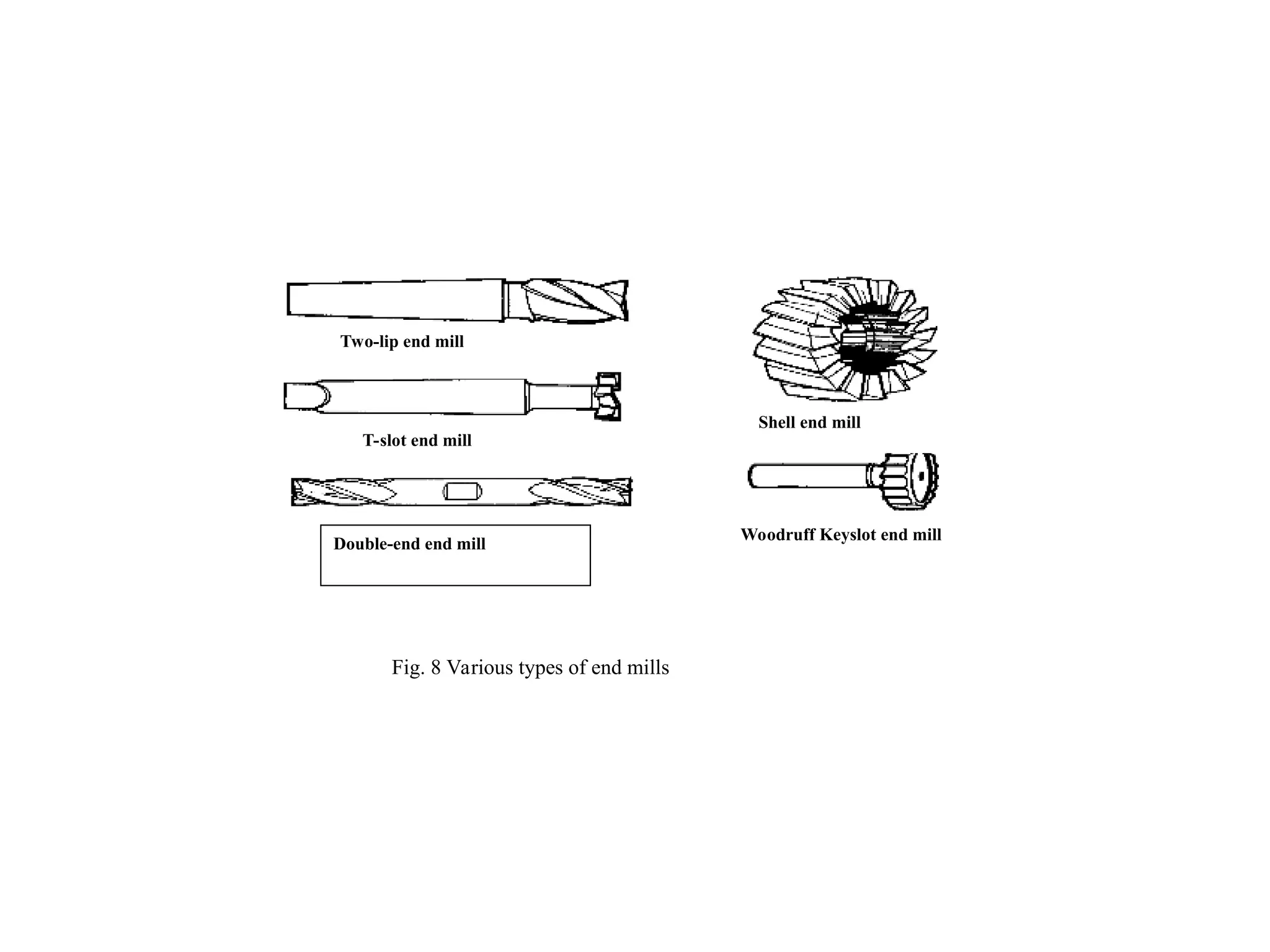
Slab mill Coursetooth mill
Helical mill
Staggered tooth mill Side mill Interloching mill Metal slitting saw
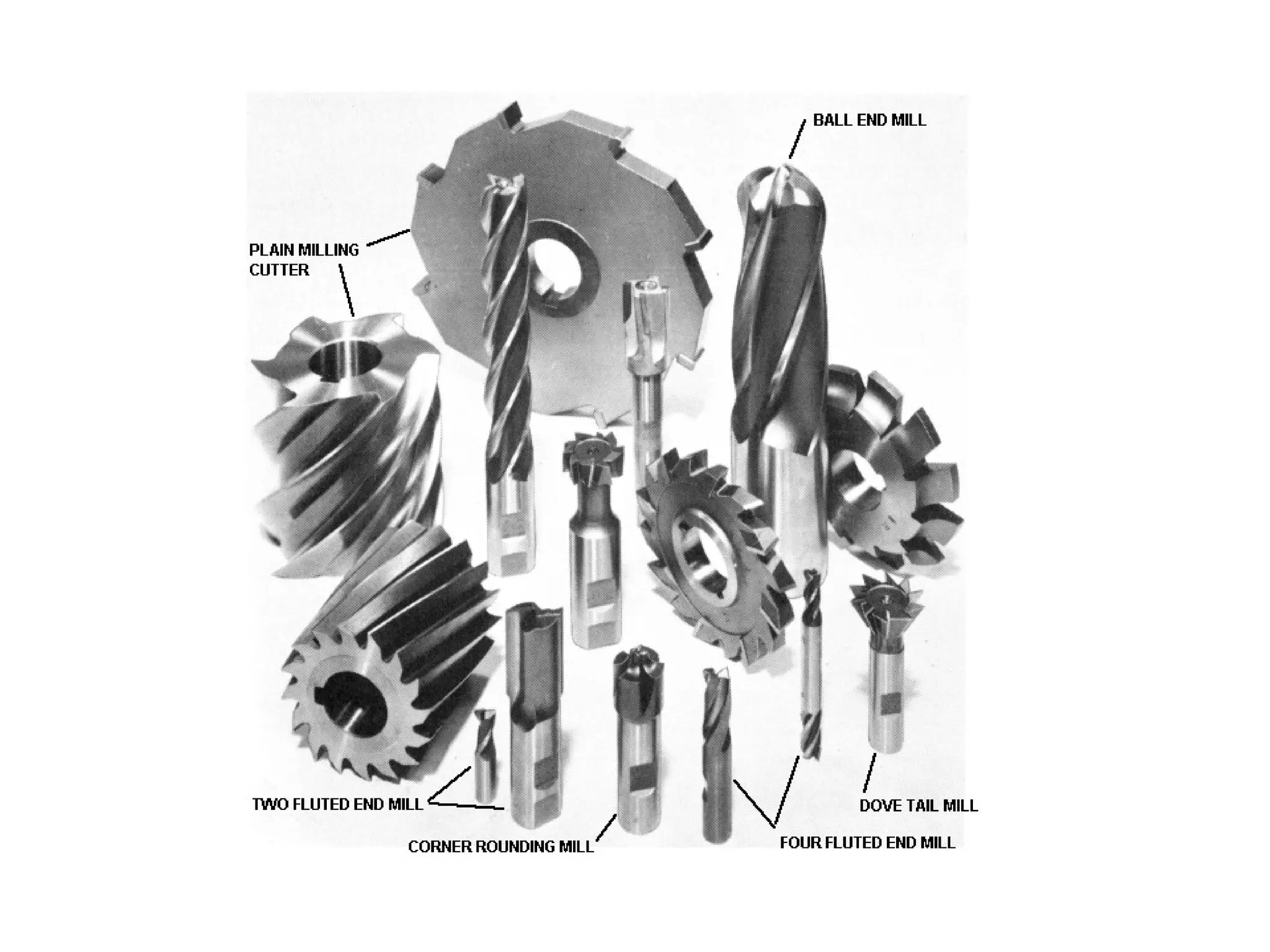
Fig. 7 Various types of milling cutters
Helical mill (arbor type)
9.
Fig. 8 Varioustypes of end mills
Woodruff Keyslot end mill
Double-end end mill
Two-lip end mill
Shell end mill
T-slot end mill
10.
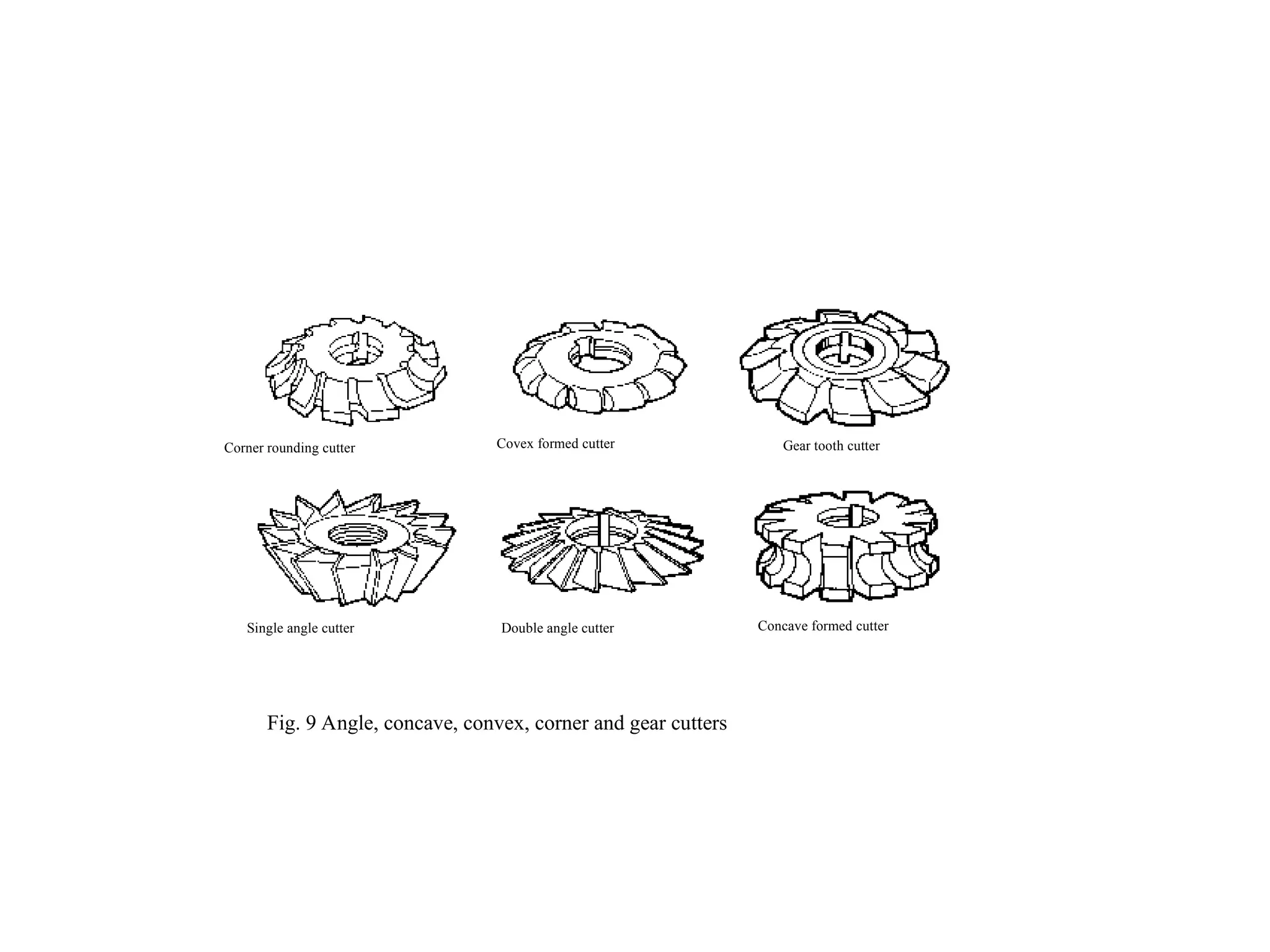
Fig. 9 Angle,concave, convex, corner and gear cutters
Corner rounding cutter Covex formed cutter Gear tooth cutter
Single angle cutter Double angle cutter Concave formed cutter
11.
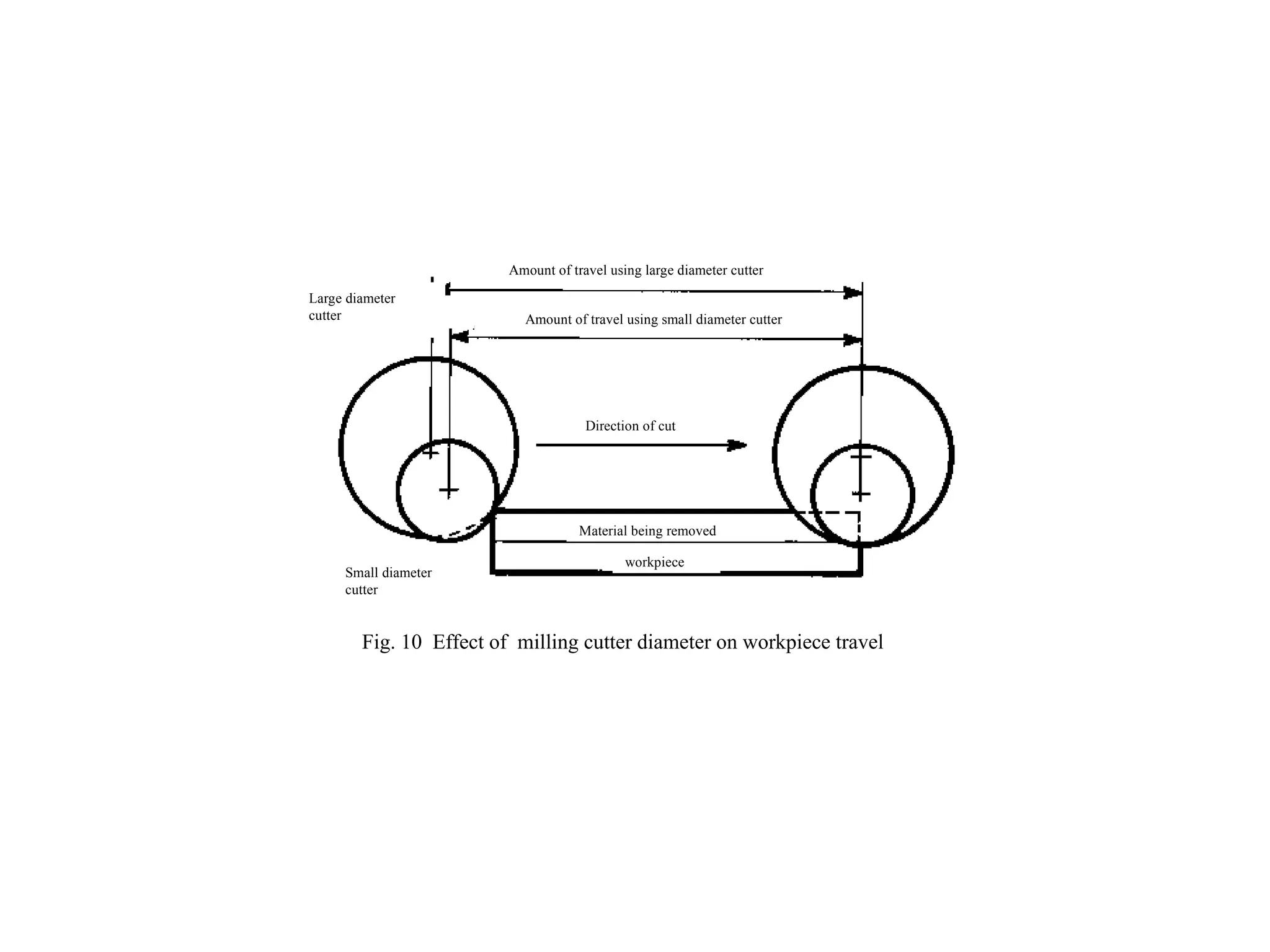
Fig. 10 Effectof milling cutter diameter on workpiece travel
Large diameter
cutter
Amount of travel using large diameter cutter
Direction of cut
Material being removed
workpiece
Small diameter
cutter
Amount of travel using small diameter cutter
12.
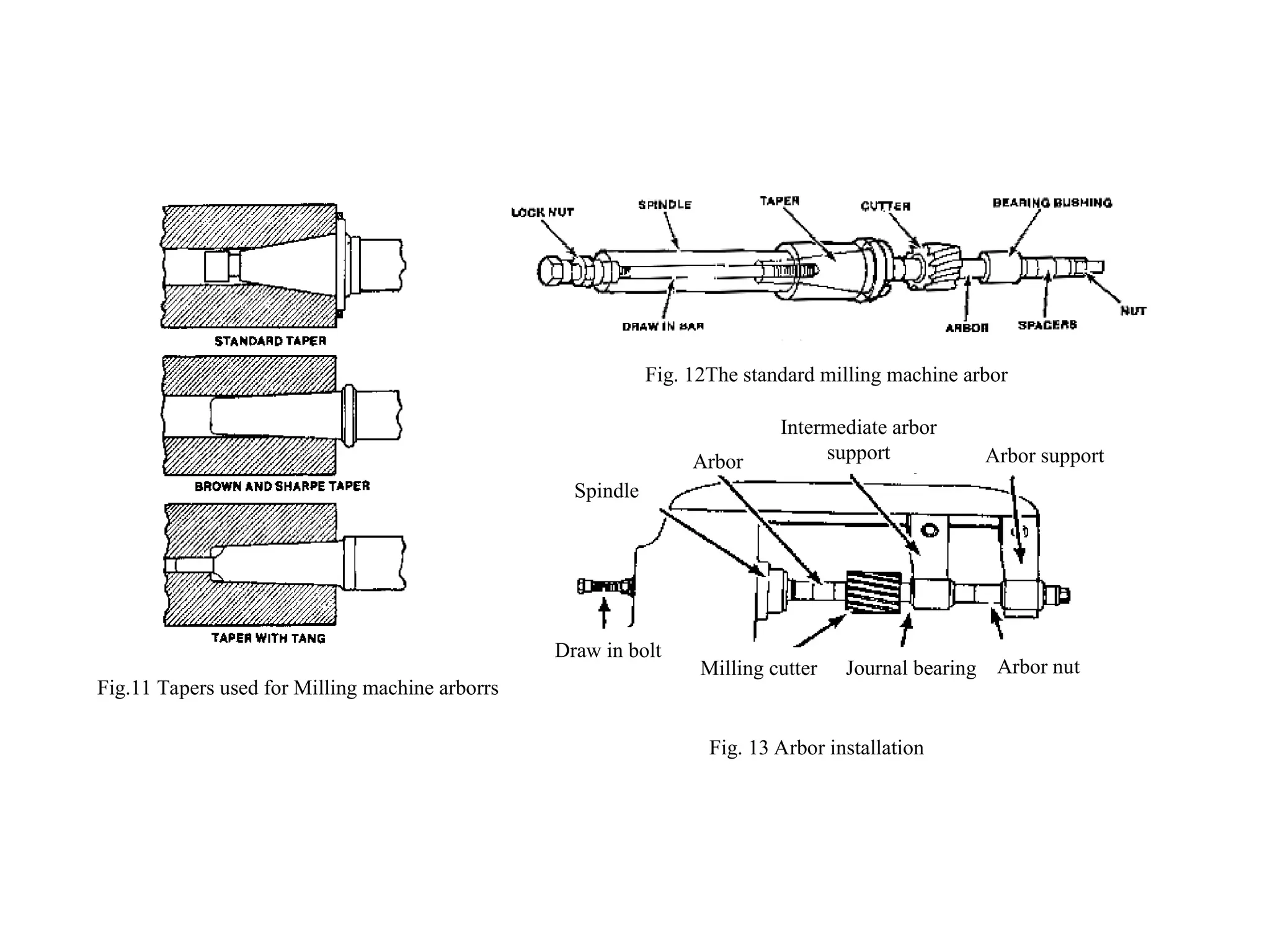
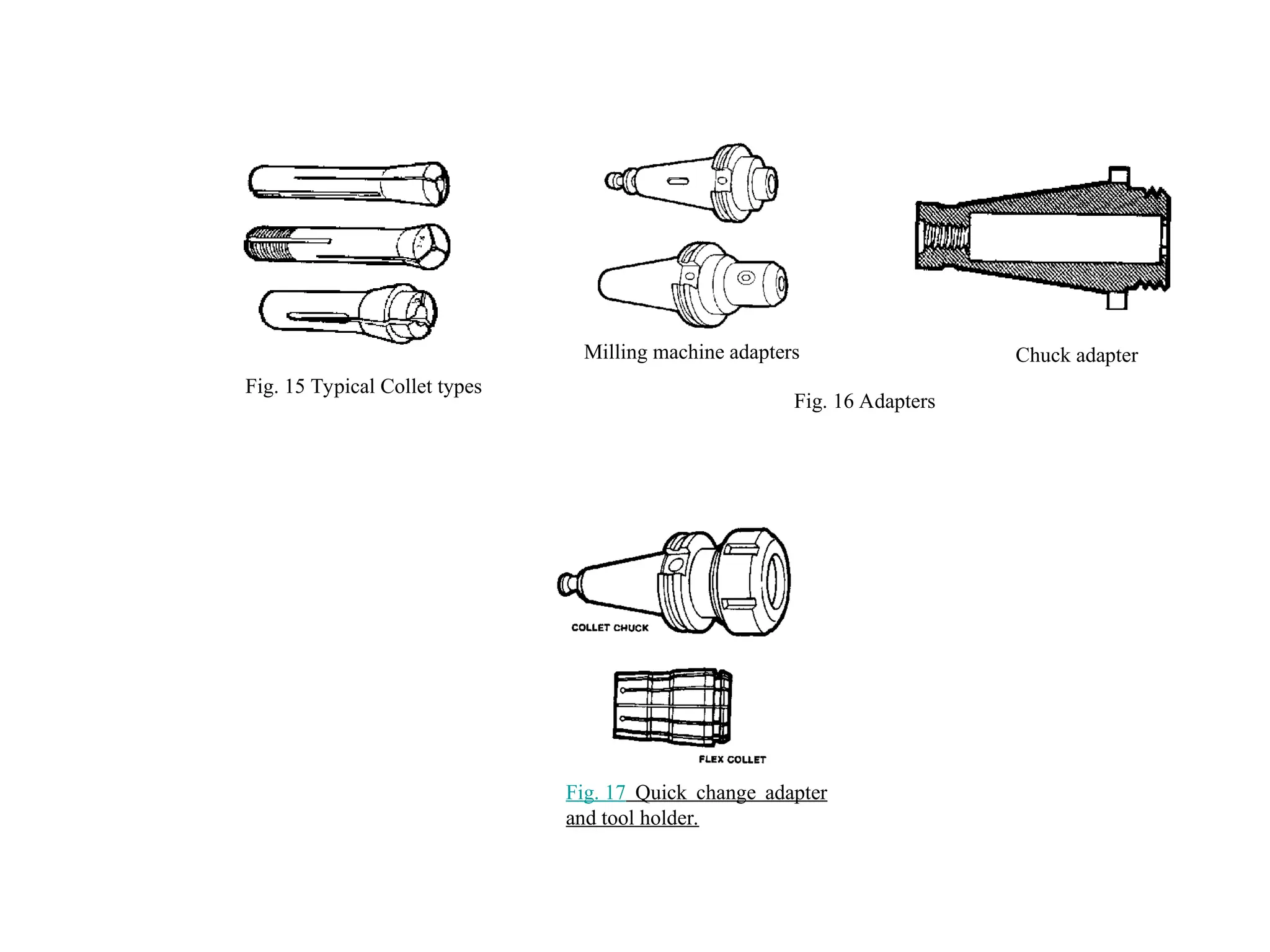
Fig.11 Tapers usedfor Milling machine arborrs
Fig. 12The standard milling machine arbor
Arbor
Intermediate arbor
support Arbor support
Spindle
Draw in bolt
Milling cutter Journal bearing Arbor nut
Fig. 13 Arbor installation
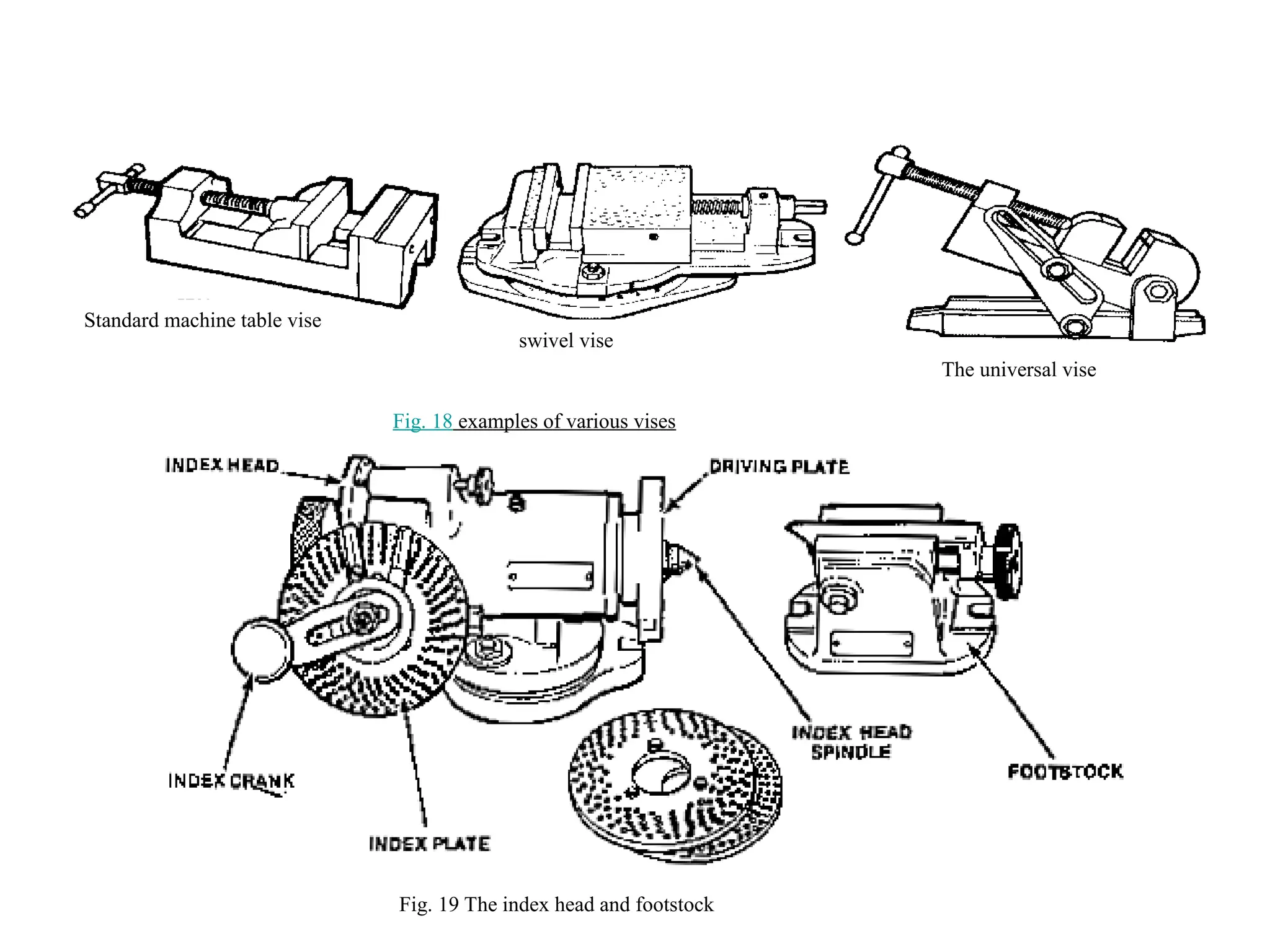
Fig. 18 examplesof various vises
swivel vise
Standard machine table vise
The universal vise
Fig. 19 The index head and footstock
16.
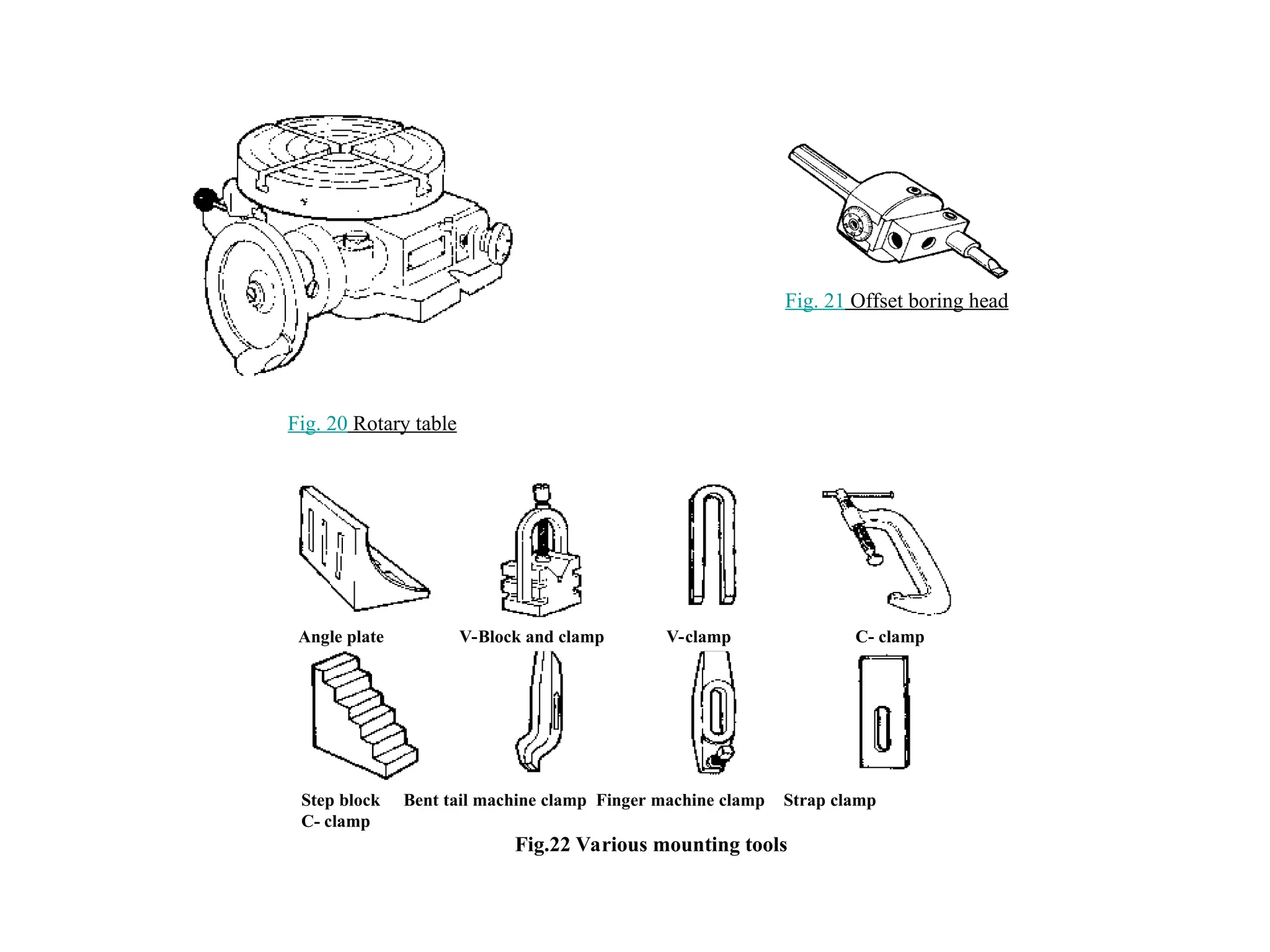
Fig. 20 Rotarytable
Fig. 21 Offset boring head
Angle plate V-Block and clamp V-clamp C- clamp
Step block Bent tail machine clamp Finger machine clamp Strap clamp
C- clamp
Fig.22 Various mounting tools
17.
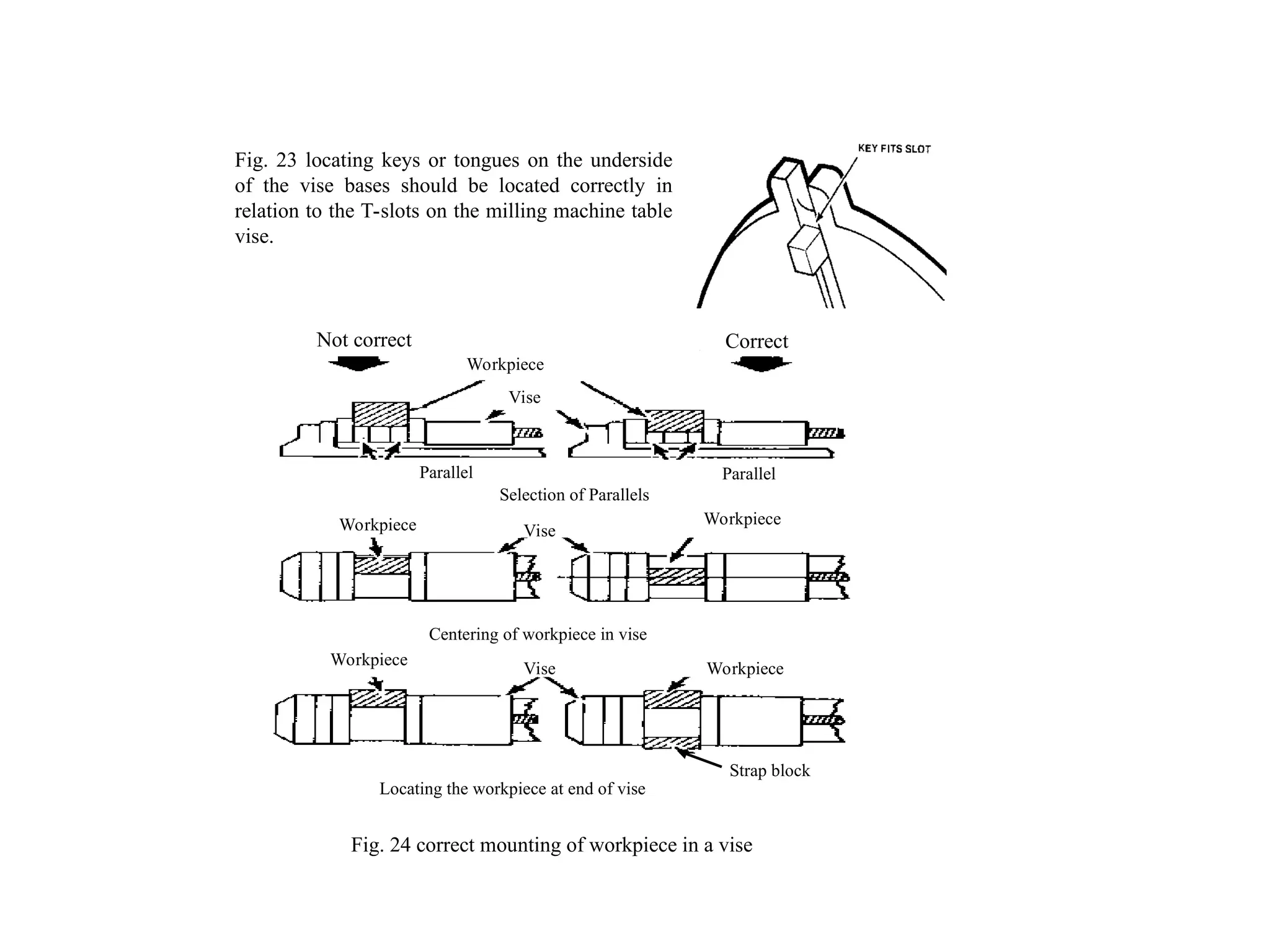
Not correct Correct
Workpiece
ParallelParallel
Selection of Parallels
Vise
Workpiece Workpiece
Centering of workpiece in vise
Locating the workpiece at end of vise
Fig. 24 correct mounting of workpiece in a vise
Strap block
Workpiece
Workpiece
Vise
Vise
Fig. 23 locating keys or tongues on the underside
of the vise bases should be located correctly in
relation to the T-slots on the milling machine table
vise.
18.
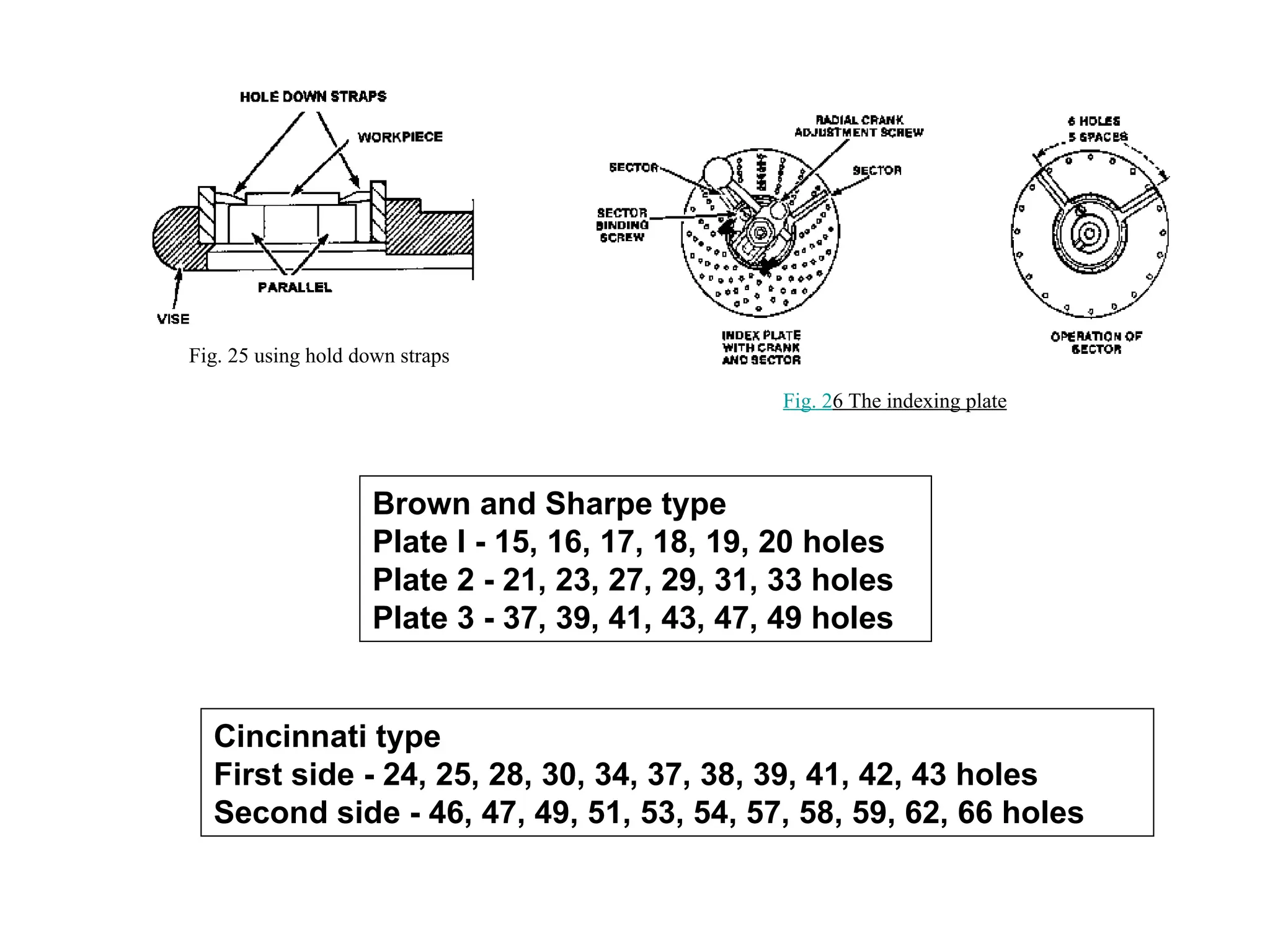
Fig. 25 usinghold down straps
Fig. 26 The indexing plate
Brown and Sharpe type
Plate I - 15, 16, 17, 18, 19, 20 holes
Plate 2 - 21, 23, 27, 29, 31, 33 holes
Plate 3 - 37, 39, 41, 43, 47, 49 holes
Cincinnati type
First side - 24, 25, 28, 30, 34, 37, 38, 39, 41, 42, 43 holes
Second side - 46, 47, 49, 51, 53, 54, 57, 58, 59, 62, 66 holes
19.
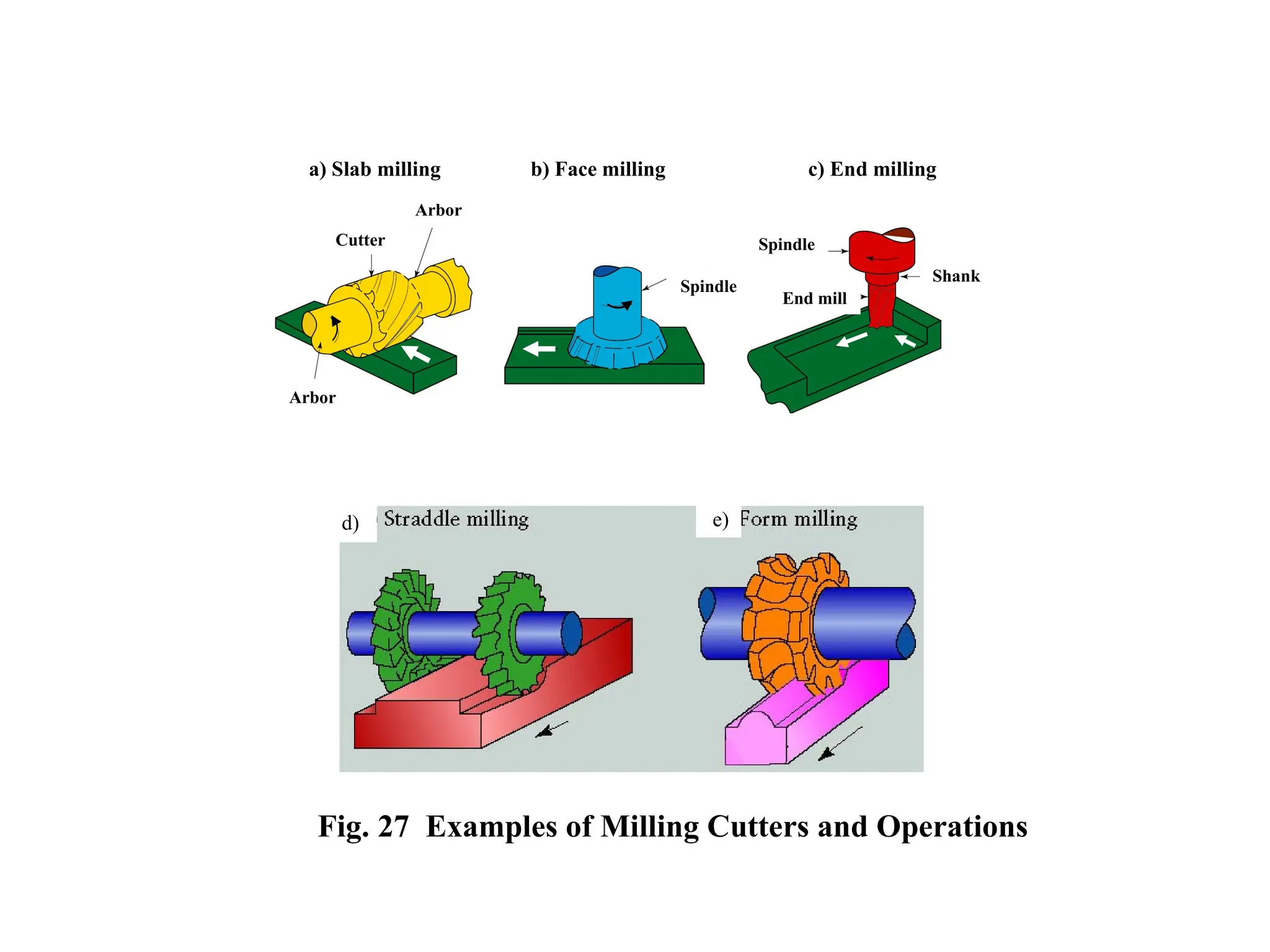
a) Slab millingb) Face milling c) End milling
Arbor
Arbor
Cutter
Spindle
Spindle
Shank
End mill
Fig. 27 Examples of Milling Cutters and Operations
d) e)
20.
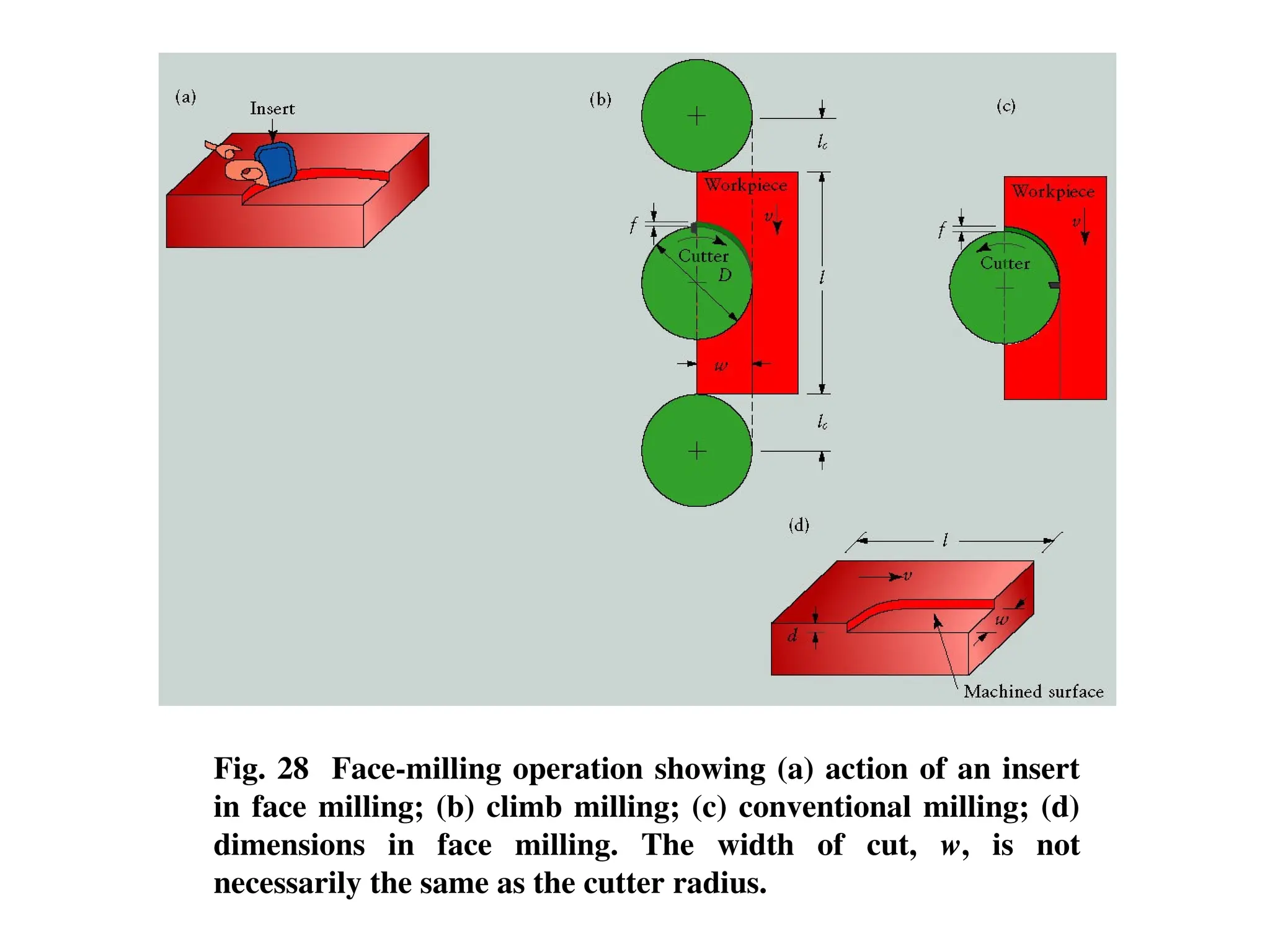
Fig. 28 Face-millingoperation showing (a) action of an insert
in face milling; (b) climb milling; (c) conventional milling; (d)
dimensions in face milling. The width of cut, w, is not
necessarily the same as the cutter radius.
21.
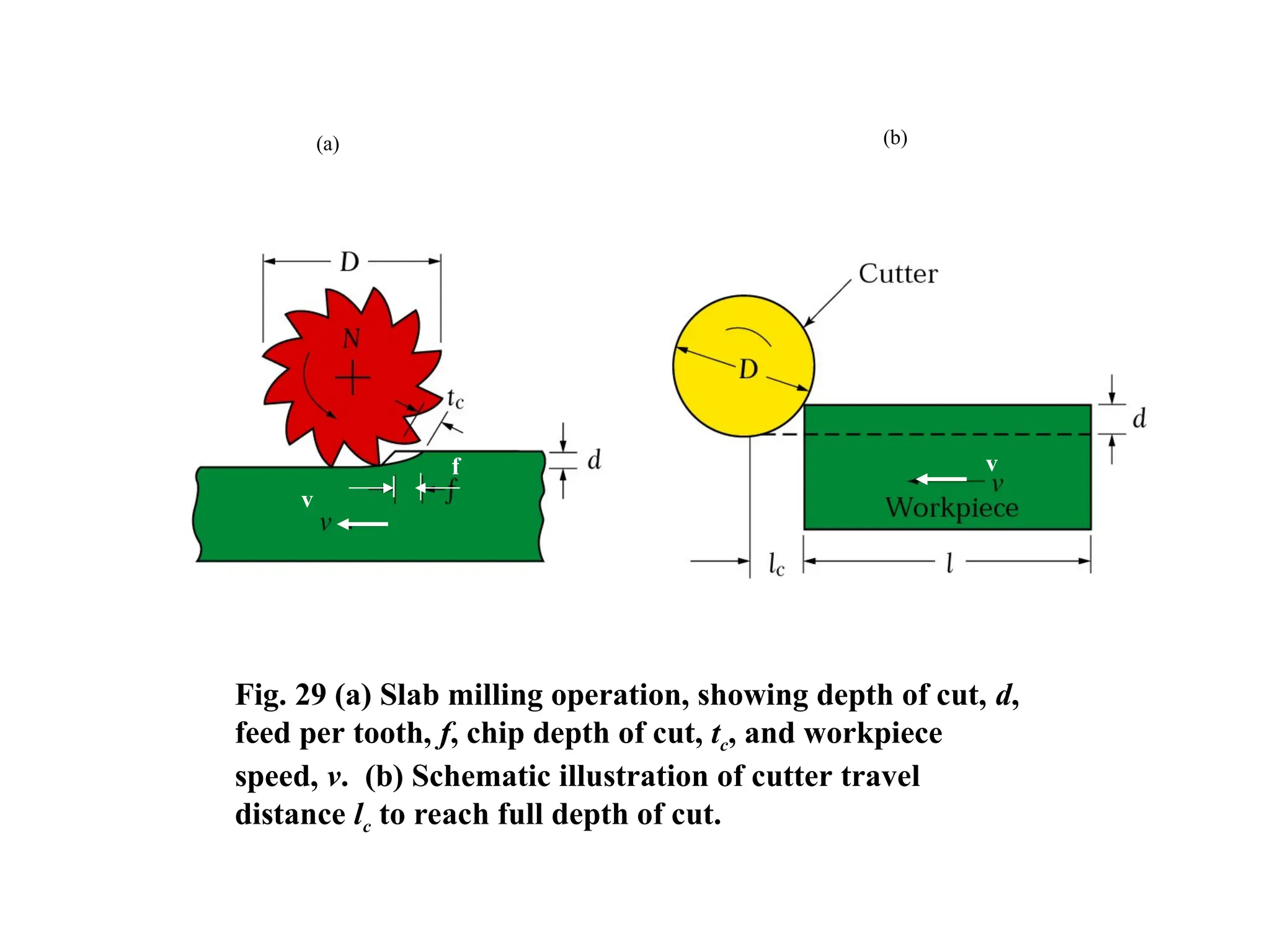
Fig. 29 (a)Slab milling operation, showing depth of cut, d,
feed per tooth, f, chip depth of cut, tc, and workpiece
speed, v. (b) Schematic illustration of cutter travel
distance lc to reach full depth of cut.
f v
v
(a) (b)
22.
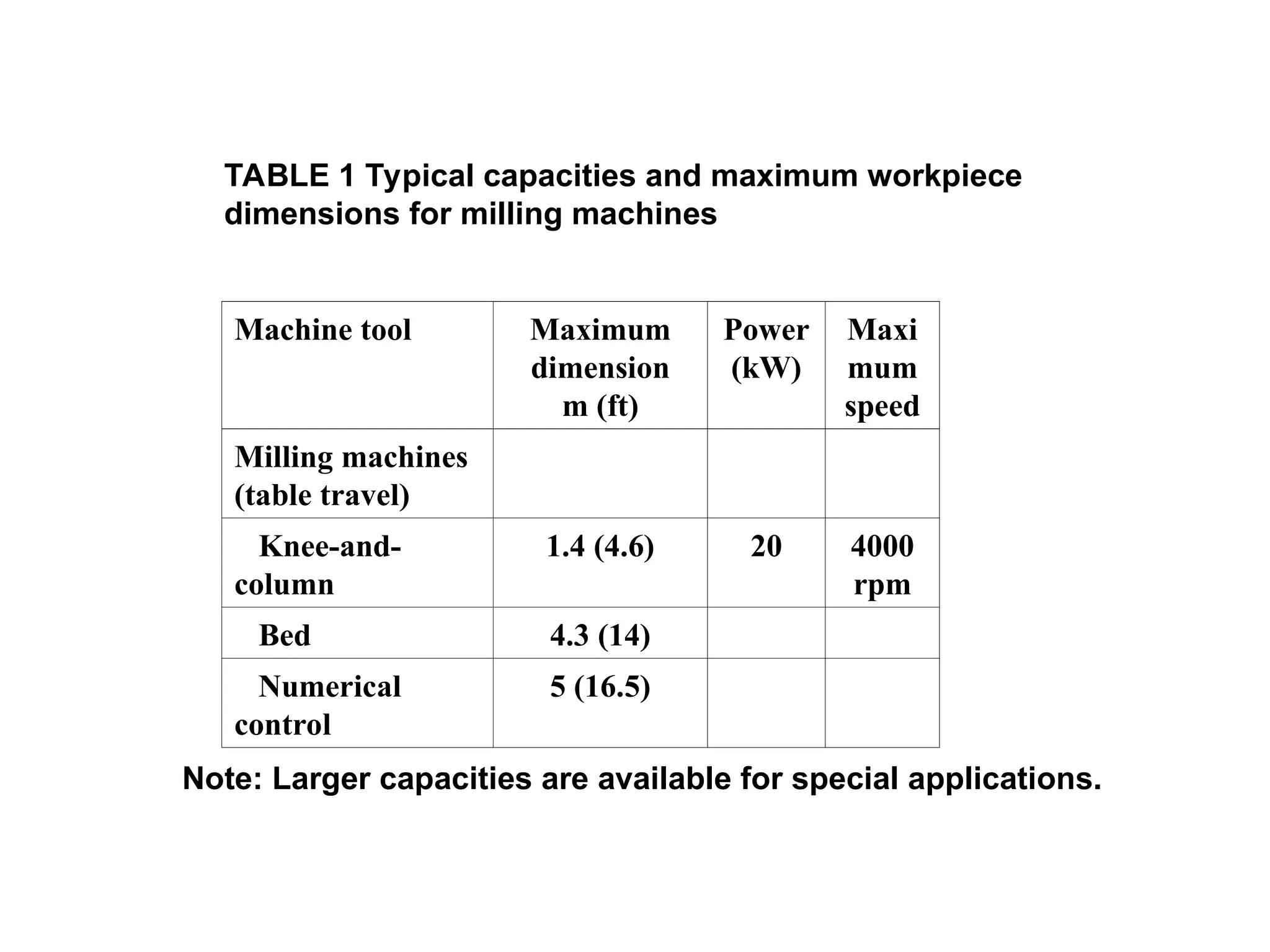
TABLE 1 Typicalcapacities and maximum workpiece
dimensions for milling machines
Machine tool Maximum
dimension
m (ft)
Power
(kW)
Maxi
mum
speed
Milling machines
(table travel)
Knee-and-
column
1.4 (4.6) 20 4000
rpm
Bed 4.3 (14)
Numerical
control
5 (16.5)
Note: Larger capacities are available for special applications.
23.
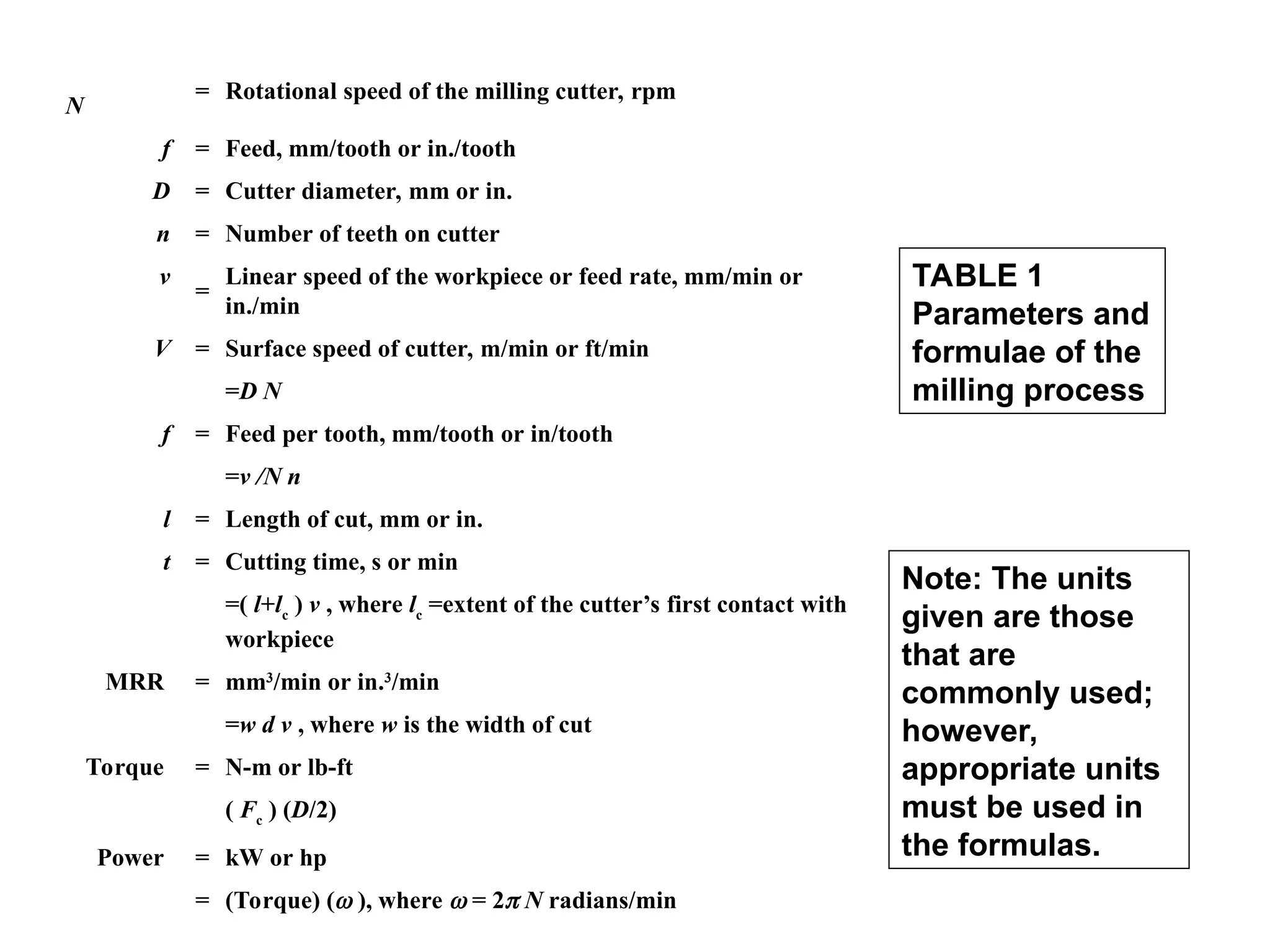
TABLE 1
Parameters and
formulaeof the
milling process
N
= Rotational speed of the milling cutter, rpm
f = Feed, mm/tooth or in./tooth
D = Cutter diameter, mm or in.
n = Number of teeth on cutter
v
=
Linear speed of the workpiece or feed rate, mm/min or
in./min
V = Surface speed of cutter, m/min or ft/min
=D N
f = Feed per tooth, mm/tooth or in/tooth
=v /N n
l = Length of cut, mm or in.
t = Cutting time, s or min
=( l+lc
) v , where lc
=extent of the cutter’s first contact with
workpiece
MRR = mm3
/min or in.3
/min
=w d v , where w is the width of cut
Torque = N-m or lb-ft
( Fc
) (D/2)
Power = kW or hp
= (Torque) ( ), where = 2 N radians/min
Note: The units
given are those
that are
commonly used;
however,
appropriate units
must be used in
the formulas.
24.
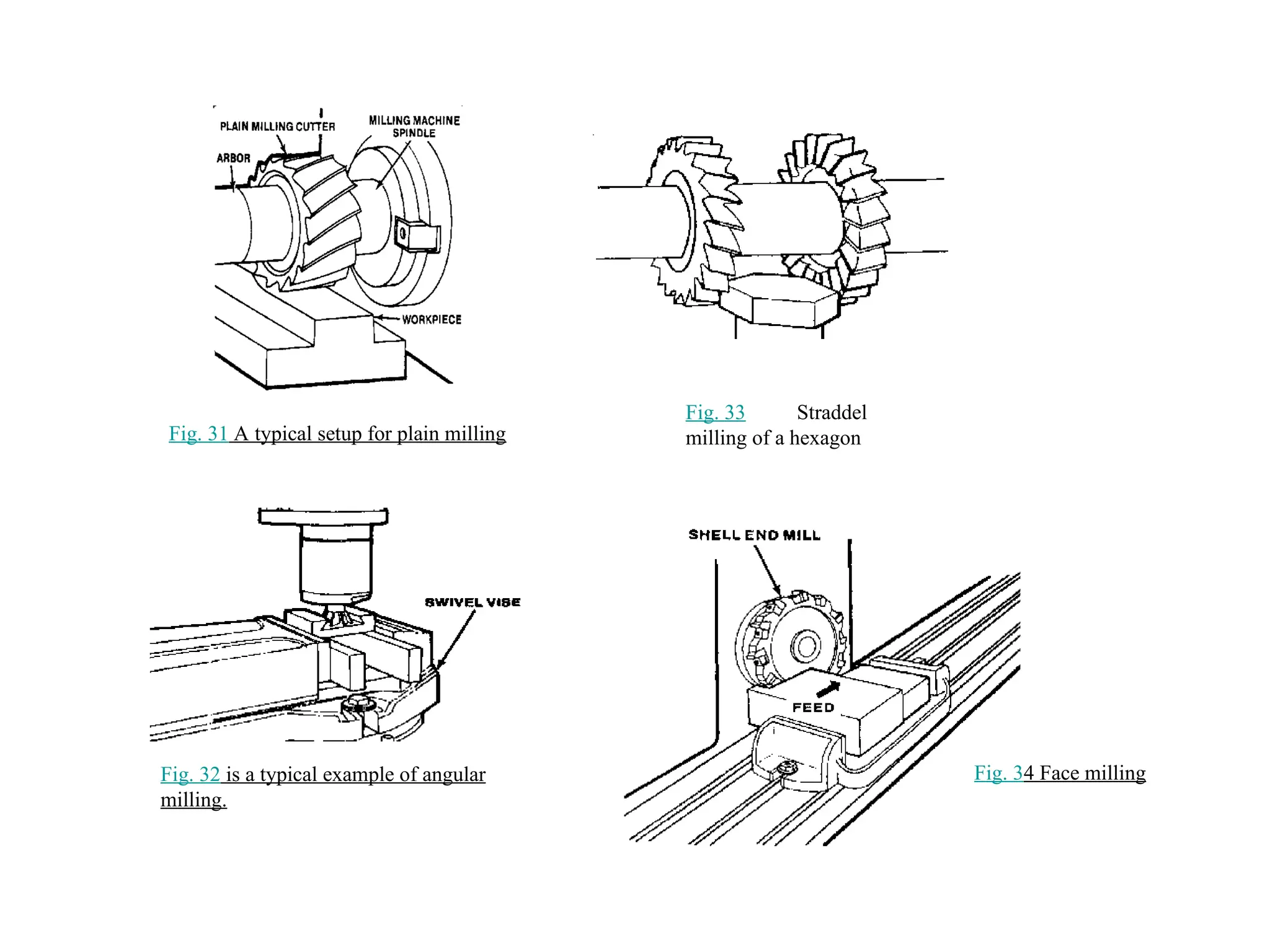
Fig. 31 Atypical setup for plain milling
Fig. 32 is a typical example of angular
milling.
Fig. 33 Straddel
milling of a hexagon
Fig. 34 Face milling
25.
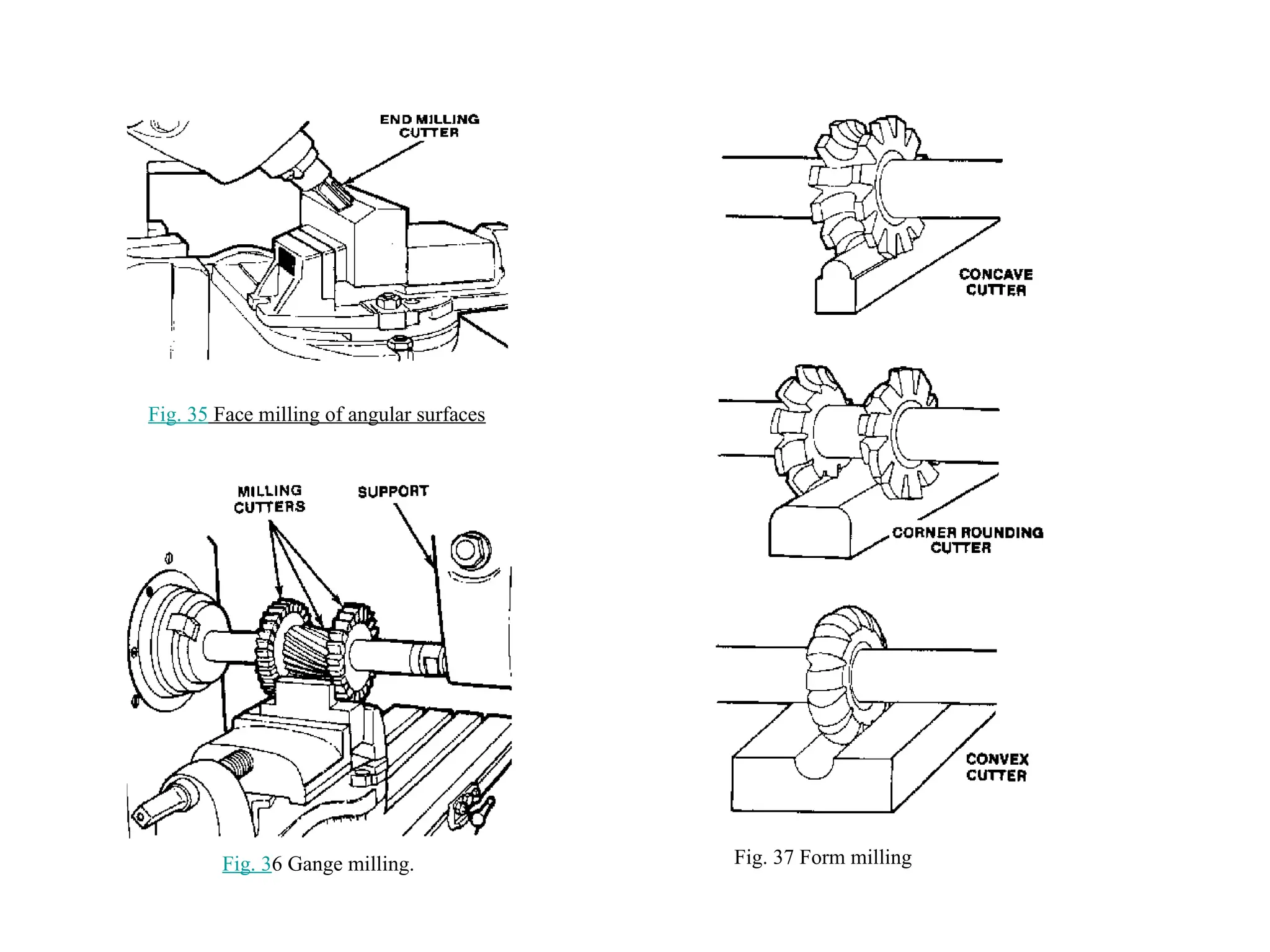
Fig. 35 Facemilling of angular surfaces
Fig. 36 Gange milling. Fig. 37 Form milling
26.
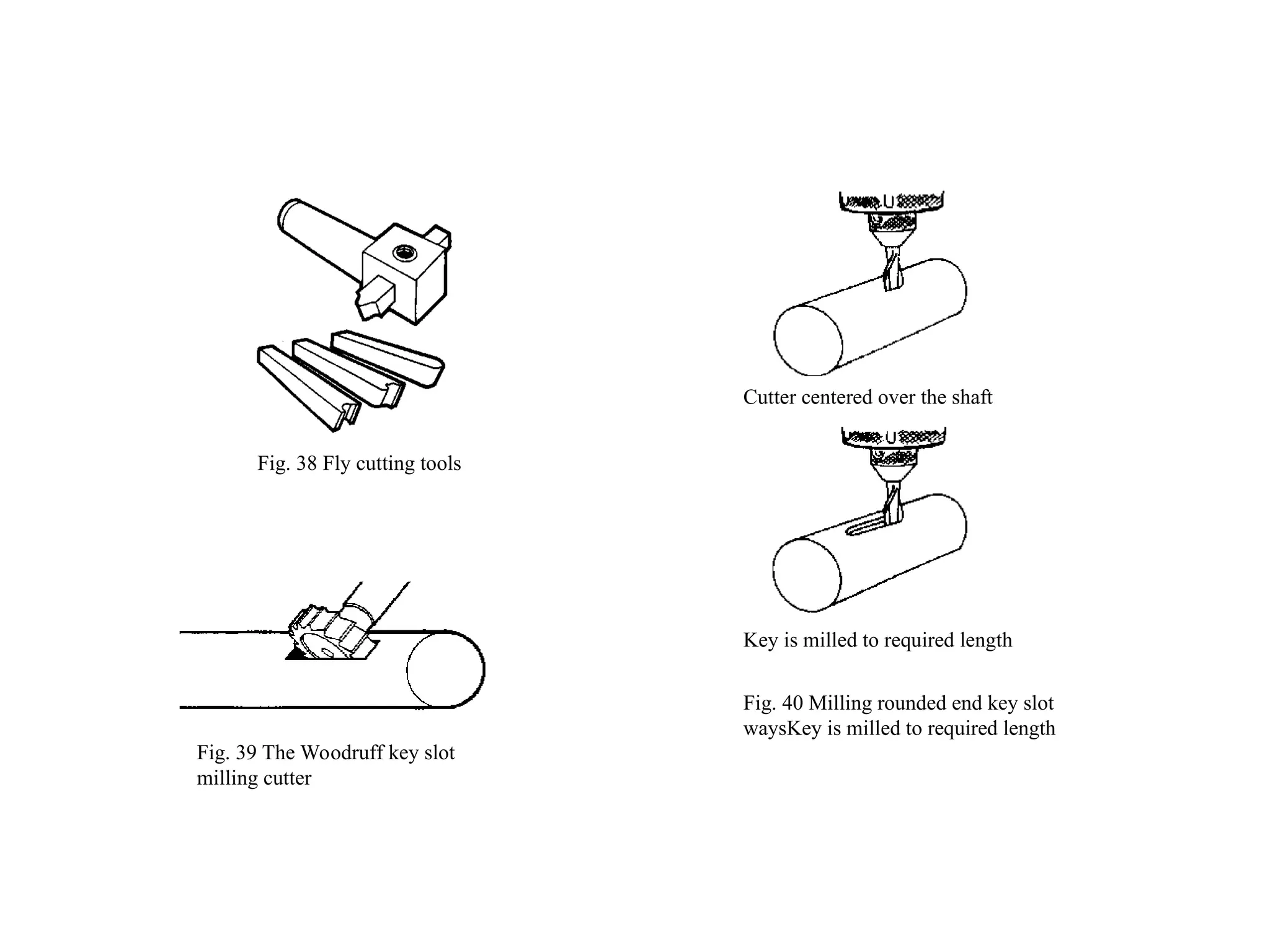
Fig. 38 Flycutting tools
Fig. 39 The Woodruff key slot
milling cutter
Key is milled to required length
Cutter centered over the shaft
Fig. 40 Milling rounded end key slot
waysKey is milled to required length
27.
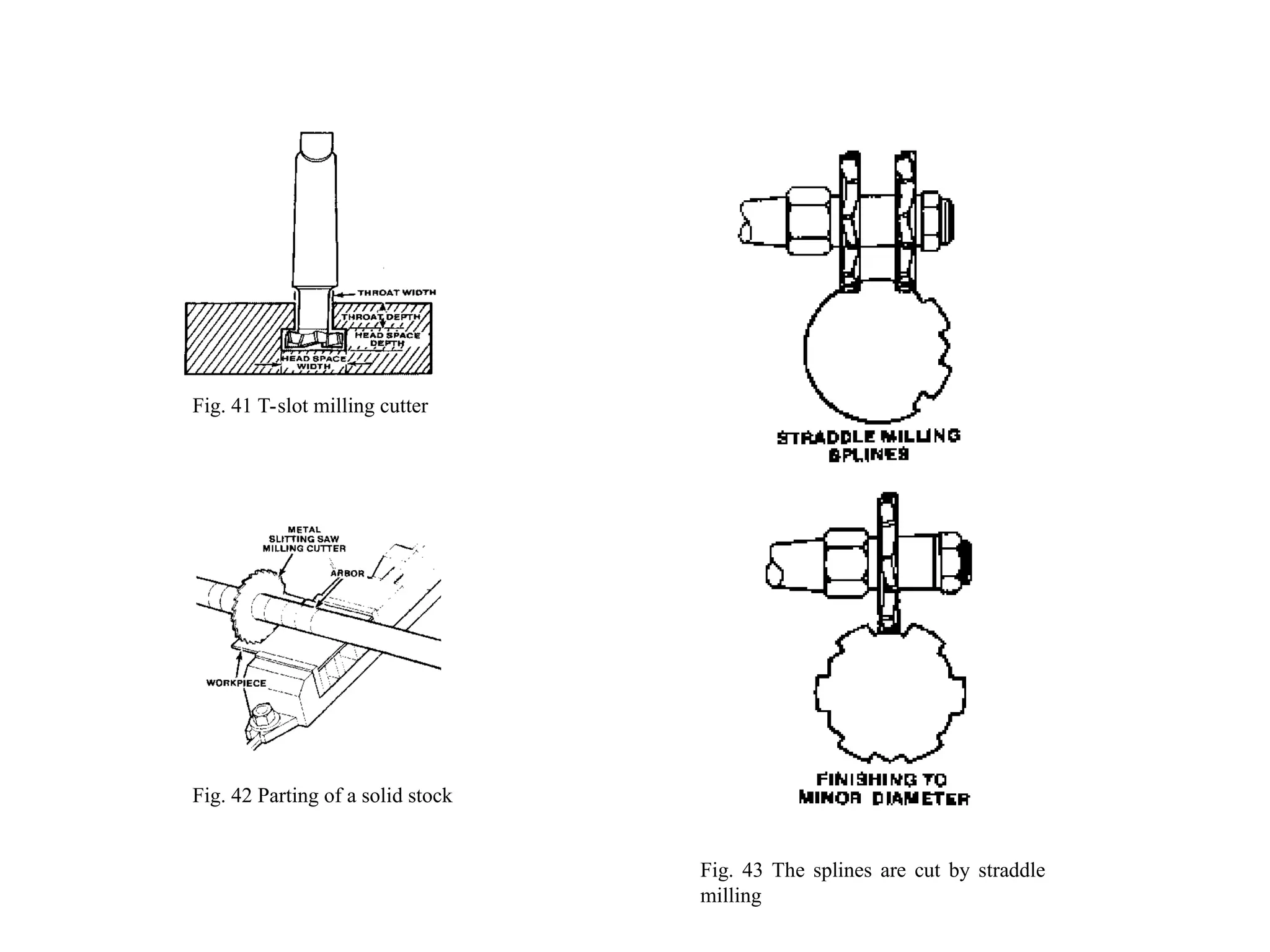
Fig. 41 T-slotmilling cutter
Fig. 42 Parting of a solid stock
Fig. 43 The splines are cut by straddle
milling