Migrating .NET apps to
Cloud Foundry
A Strategy For Enterprises
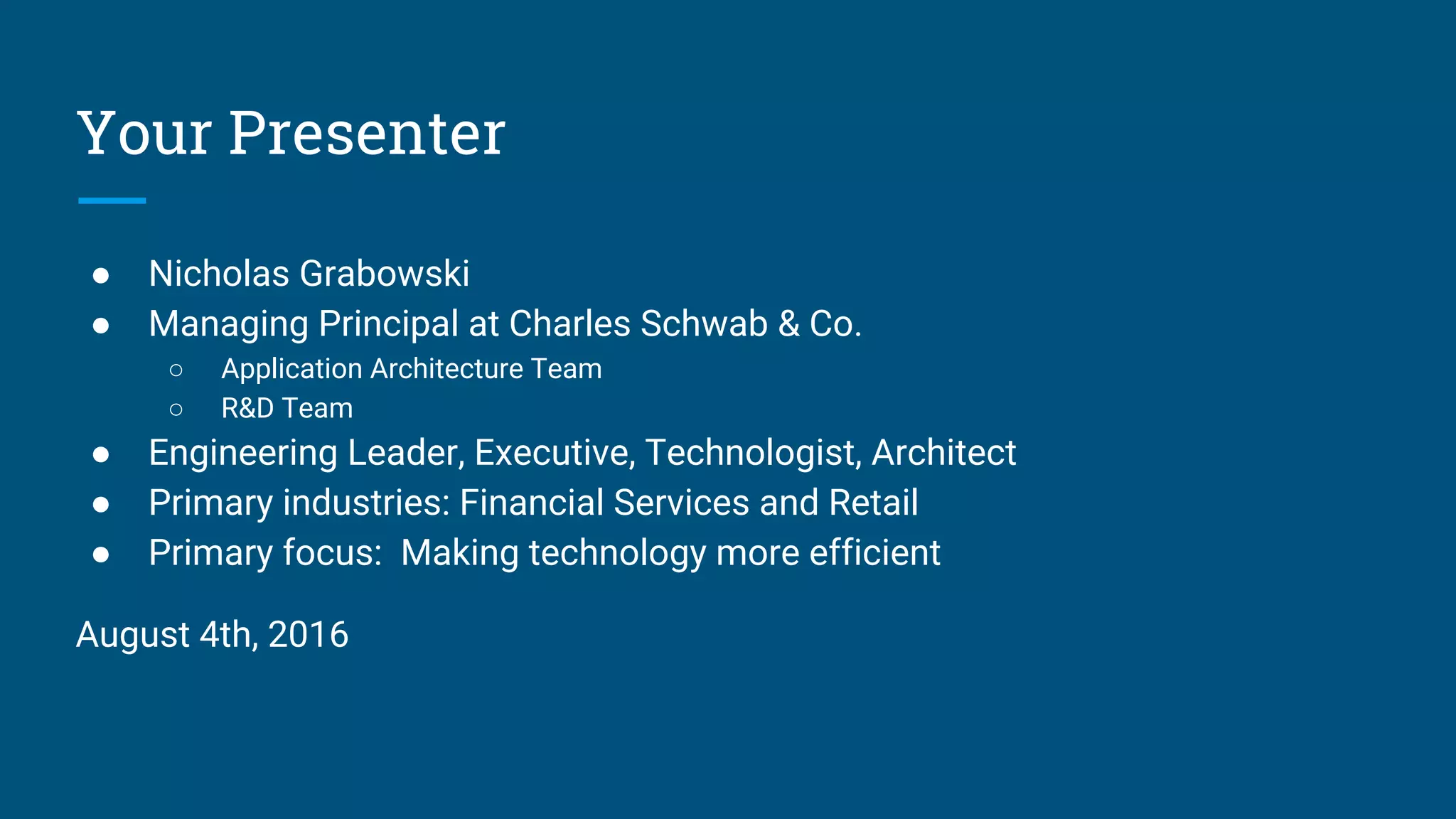
Your Presenter
● Nicholas Grabowski
● Managing Principal at Charles Schwab & Co.
○ Application Architecture Team
○ R&D Team
● Engineering Leader, Executive, Technologist, Architect
● Primary industries: Financial Services and Retail
● Primary focus: Making technology more efficient
August 4th, 2016
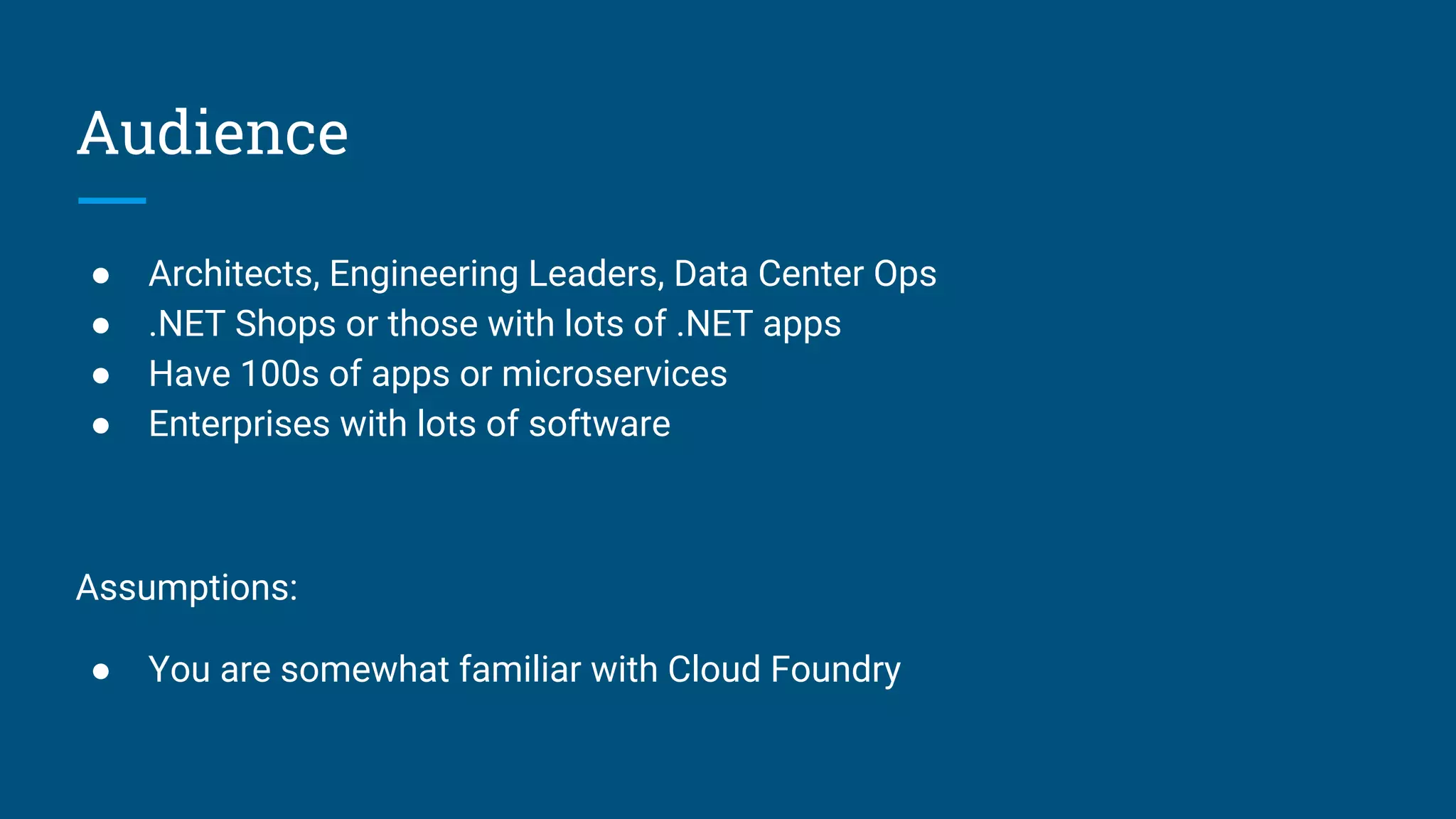
Audience
● Architects, Engineering Leaders, Data Center Ops
● .NET Shops or those with lots of .NET apps
● Have 100s of apps or microservices
● Enterprises with lots of software
Assumptions:
● You are somewhat familiar with Cloud Foundry
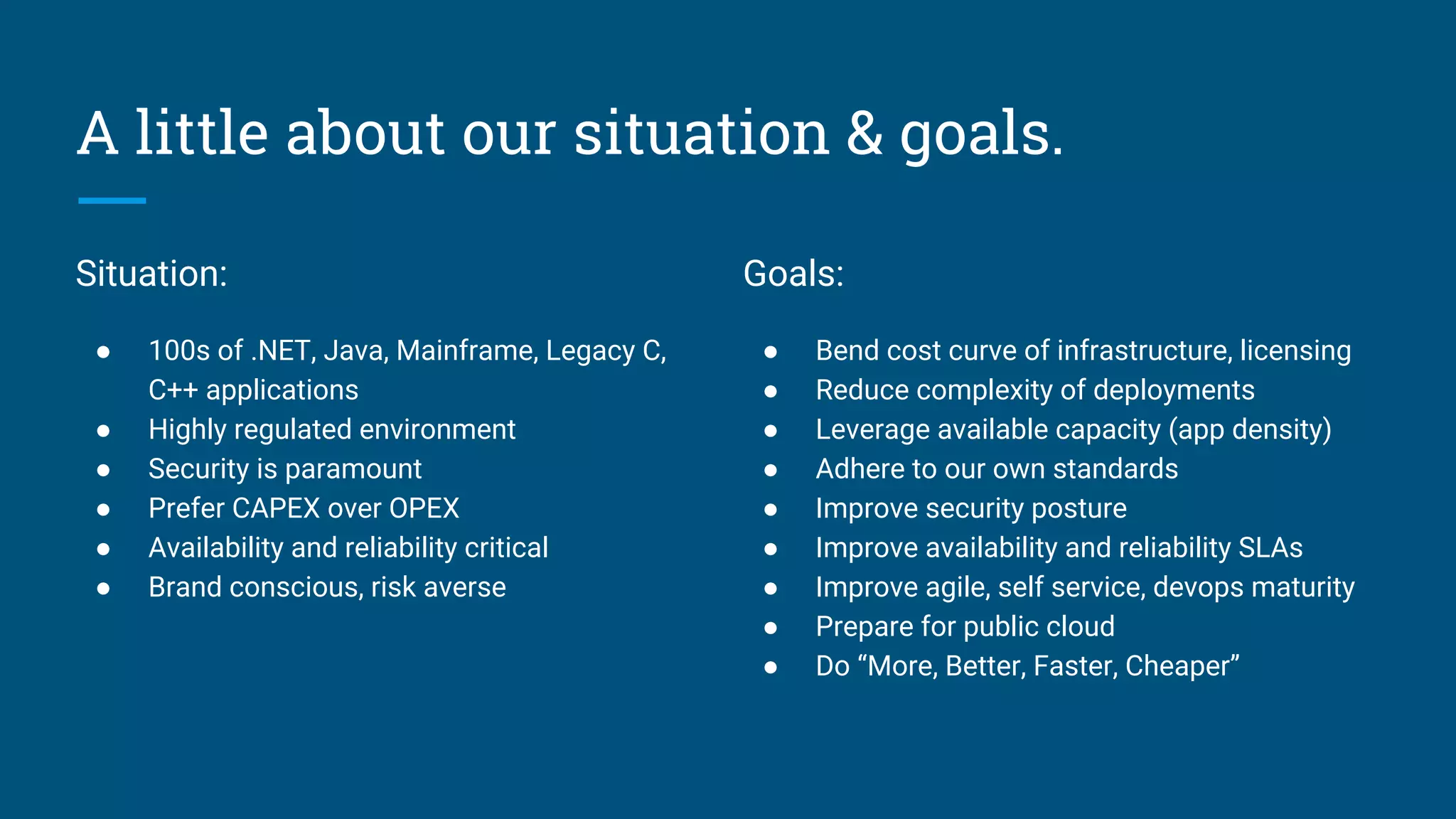
A little about our situation & goals.
Situation:
● 100s of .NET, Java, Mainframe, Legacy C,
C++ applications
● Highly regulated environment
● Security is paramount
● Prefer CAPEX over OPEX
● Availability and reliability critical
● Brand conscious, risk averse
Goals:
● Bend cost curve of infrastructure, licensing
● Reduce complexity of deployments
● Leverage available capacity (app density)
● Adhere to our own standards
● Improve security posture
● Improve availability and reliability SLAs
● Improve agile, self service, devops maturity
● Prepare for public cloud
● Do “More, Better, Faster, Cheaper”
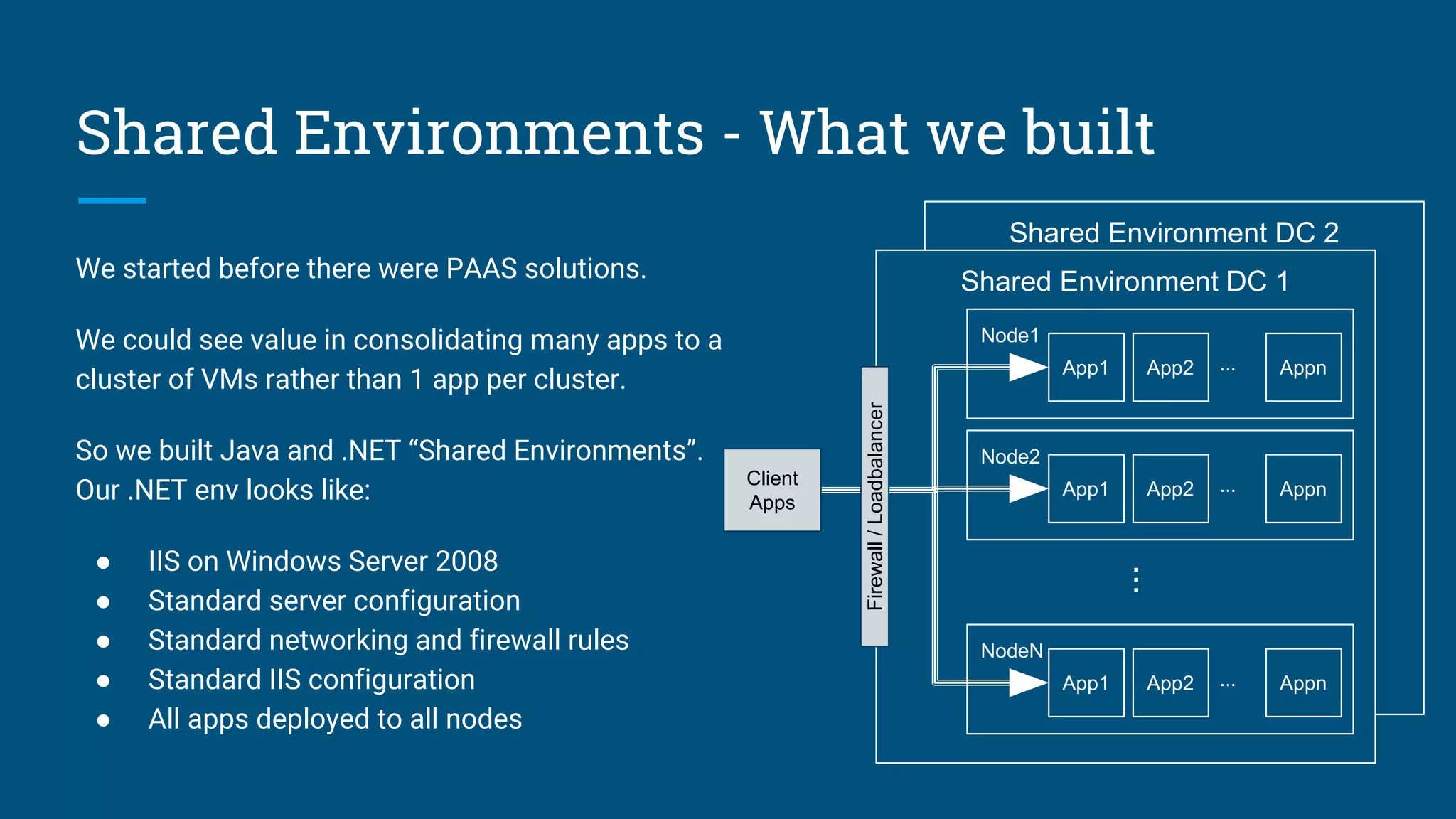
Shared Environments - What we built
We started before there were PAAS solutions.
We could see value in consolidating many apps to a
cluster of VMs rather than 1 app per cluster.
So we built Java and .NET “Shared Environments”.
Our .NET env looks like:
● IIS on Windows Server 2008
● Standard server configuration
● Standard networking and firewall rules
● Standard IIS configuration
● All apps deployed to all nodes
Shared Environment DC 2
Shared Environment DC 1
Node1
App1 App2 Appn...
Node2
App1 App2 Appn...
NodeN
App1 App2 Appn...
...
Firewall/Loadbalancer
Client
Apps
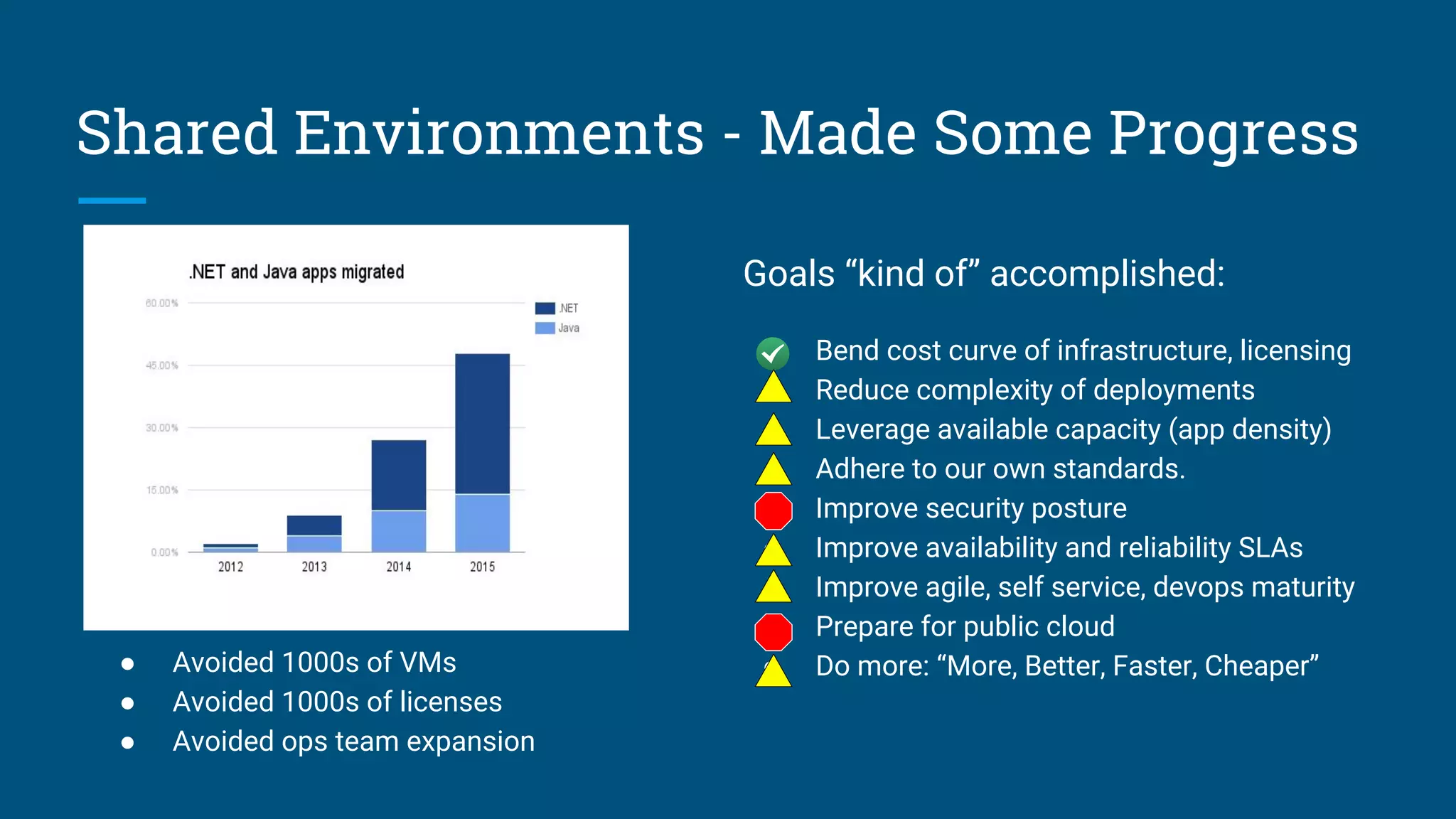
Shared Environments - Made Some Progress
Goals “kind of” accomplished:
● Bend cost curve of infrastructure, licensing
● Reduce complexity of deployments
● Leverage available capacity (app density)
● Adhere to our own standards.
● Improve security posture
● Improve availability and reliability SLAs
● Improve agile, self service, devops maturity
● Prepare for public cloud
● Do more: “More, Better, Faster, Cheaper”● Avoided 1000s of VMs
● Avoided 1000s of licenses
● Avoided ops team expansion
Shared Environment DC 2
Shared Environment DC 1
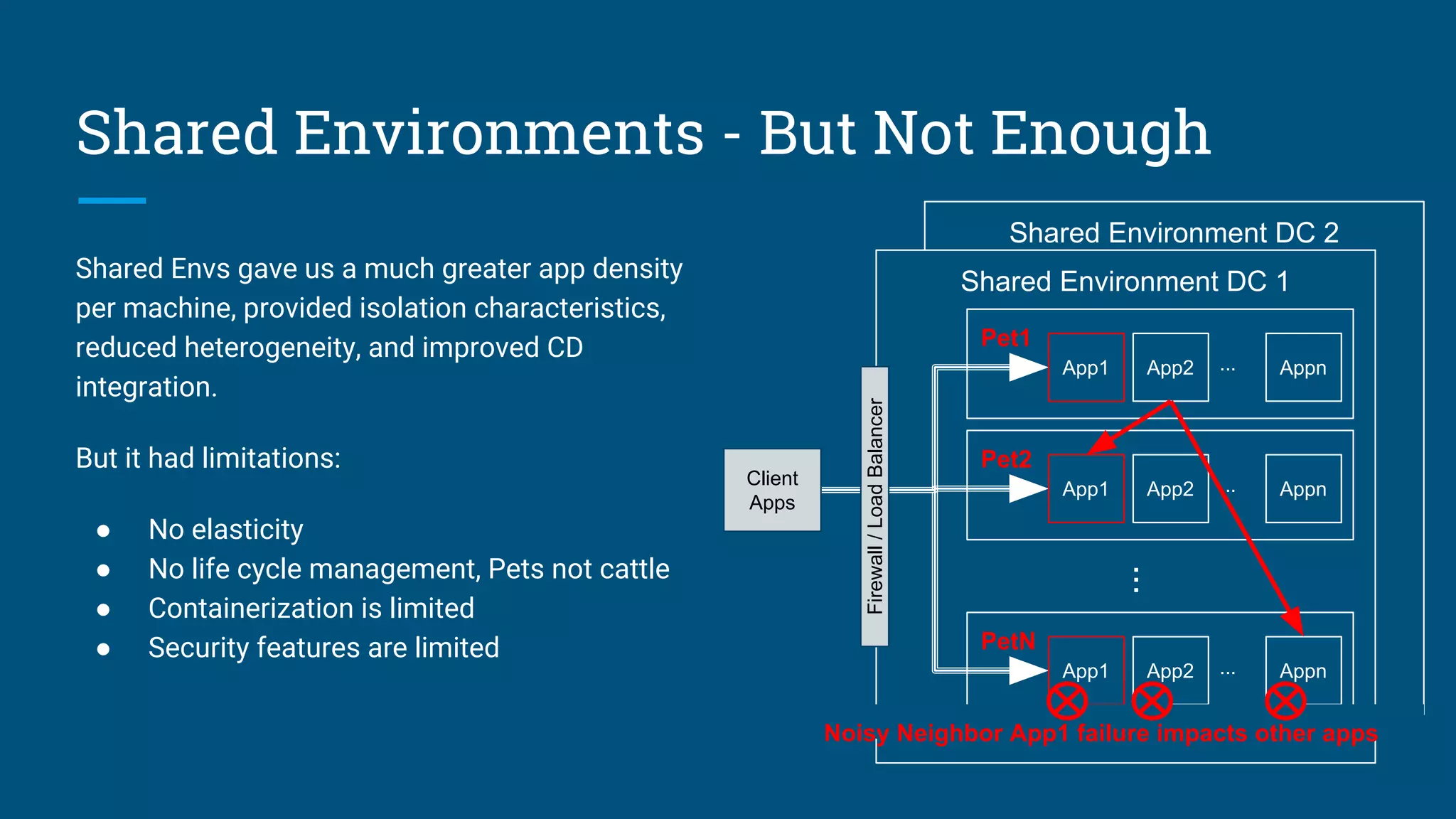
Shared Environments - But Not Enough
Shared Envs gave us a much greater app density
per machine, provided isolation characteristics,
reduced heterogeneity, and improved CD
integration.
But it had limitations:
● No elasticity
● No life cycle management, Pets not cattle
● Containerization is limited
● Security features are limited
Pet1
App1 App2 Appn...
Pet2
App1 App2 Appn...
PetN
App1 App2 Appn...
...
Firewall/LoadBalancer
Client
Apps
Noisy Neighbor App1 failure impacts other apps
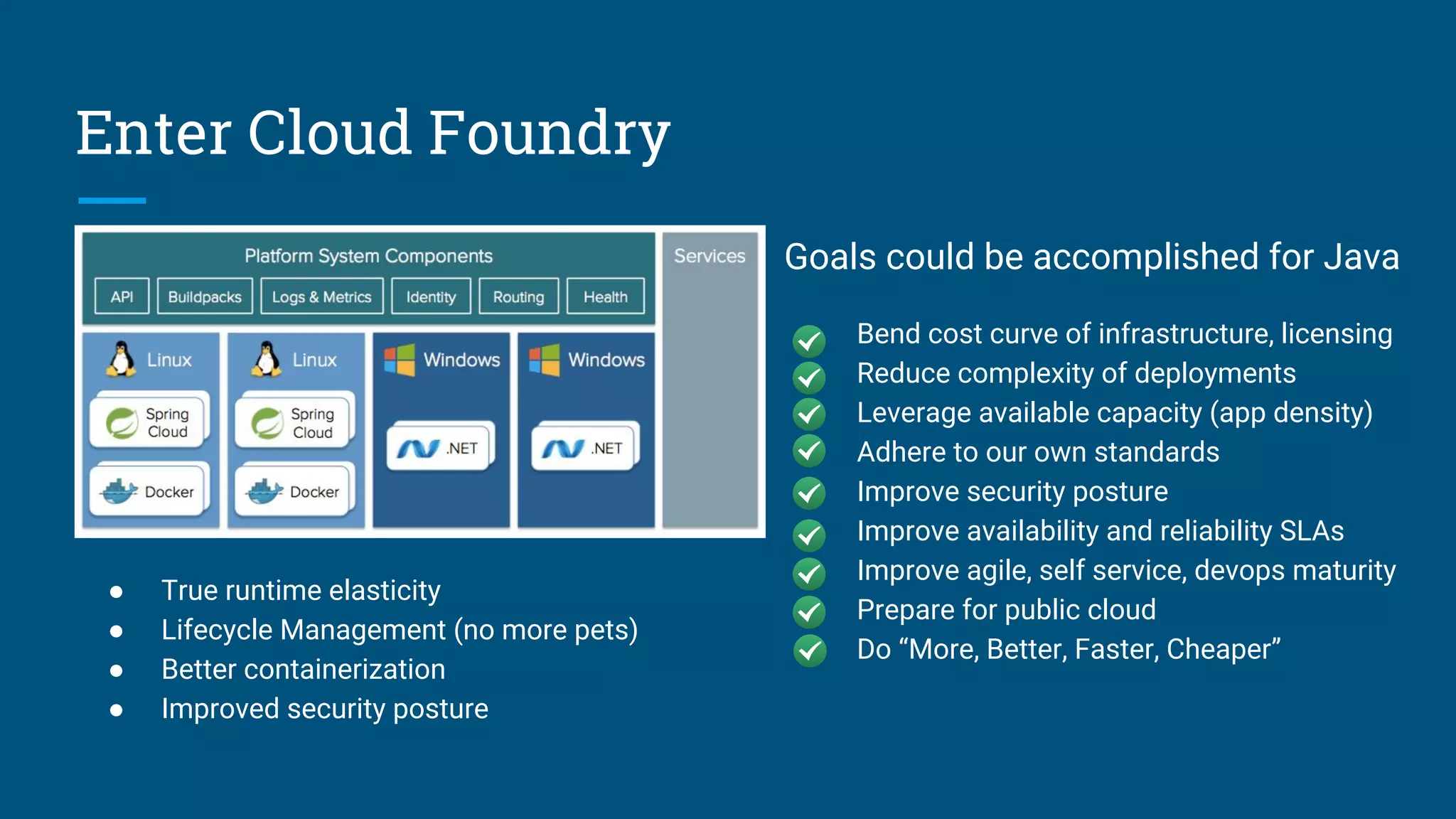
Enter Cloud Foundry
● True runtime elasticity
● Lifecycle Management (no more pets)
● Better containerization
● Improved security posture
Goals could be accomplished for Java
● Bend cost curve of infrastructure, licensing
● Reduce complexity of deployments
● Leverage available capacity (app density)
● Adhere to our own standards
● Improve security posture
● Improve availability and reliability SLAs
● Improve agile, self service, devops maturity
● Prepare for public cloud
● Do “More, Better, Faster, Cheaper”
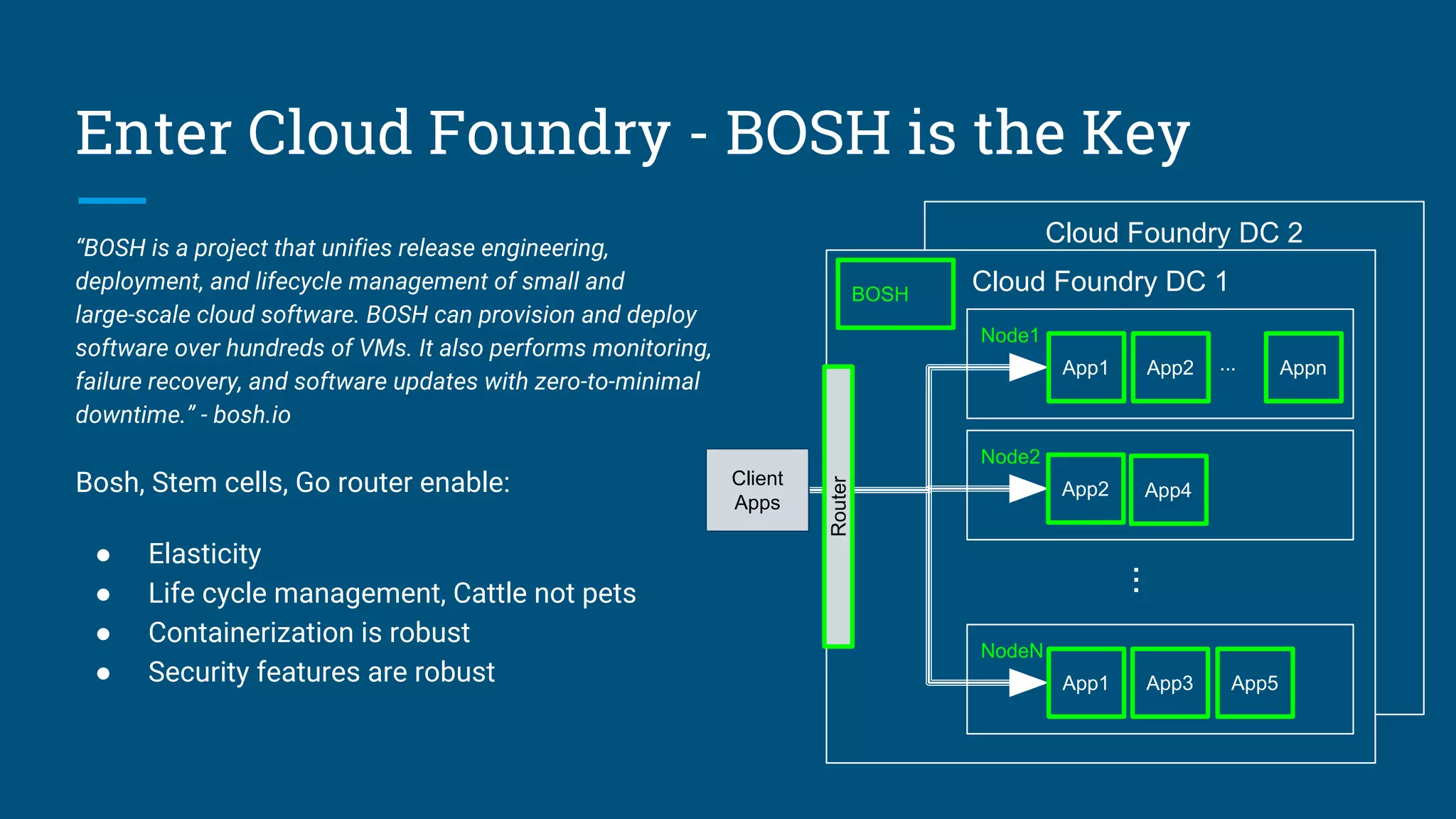
Enter Cloud Foundry - BOSH is the Key
“BOSH is a project that unifies release engineering,
deployment, and lifecycle management of small and
large-scale cloud software. BOSH can provision and deploy
software over hundreds of VMs. It also performs monitoring,
failure recovery, and software updates with zero-to-minimal
downtime.” - bosh.io
Bosh, Stem cells, Go router enable:
● Elasticity
● Life cycle management, Cattle not pets
● Containerization is robust
● Security features are robust
Cloud Foundry DC 2
Cloud Foundry DC 1
Node1
App1 App2 Appn...
Node2
App2
NodeN
App1 App3
...
Router
Client
Apps
BOSH
App4
App5
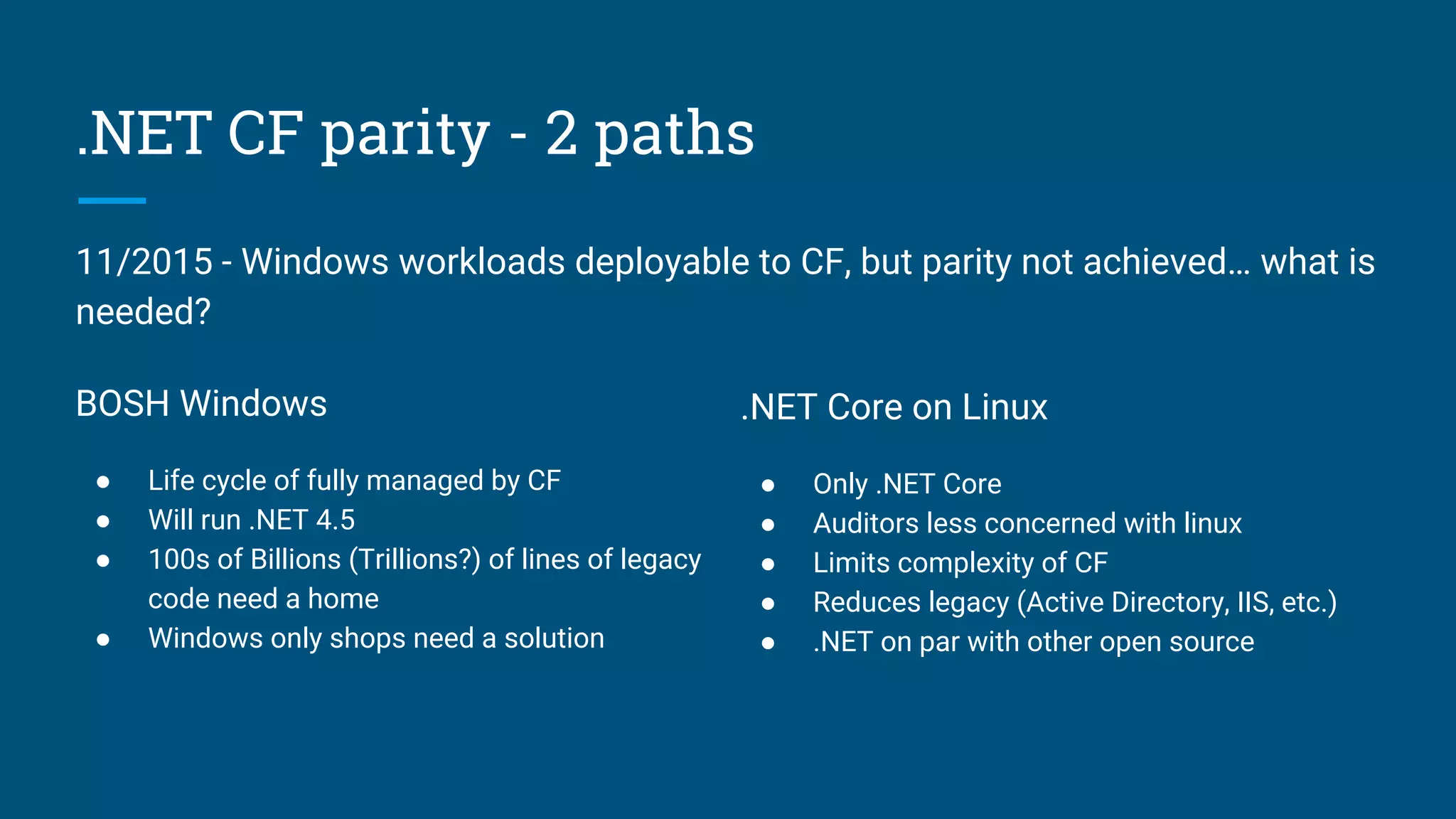
.NET CF parity - 2 paths
BOSH Windows
● Life cycle of fully managed by CF
● Will run .NET 4.5
● 100s of Billions (Trillions?) of lines of legacy
code need a home
● Windows only shops need a solution
.NET Core on Linux
● Only .NET Core
● Auditors less concerned with linux
● Limits complexity of CF
● Reduces legacy (Active Directory, IIS, etc.)
● .NET on par with other open source
11/2015 - Windows workloads deployable to CF, but parity not achieved… what is
needed?
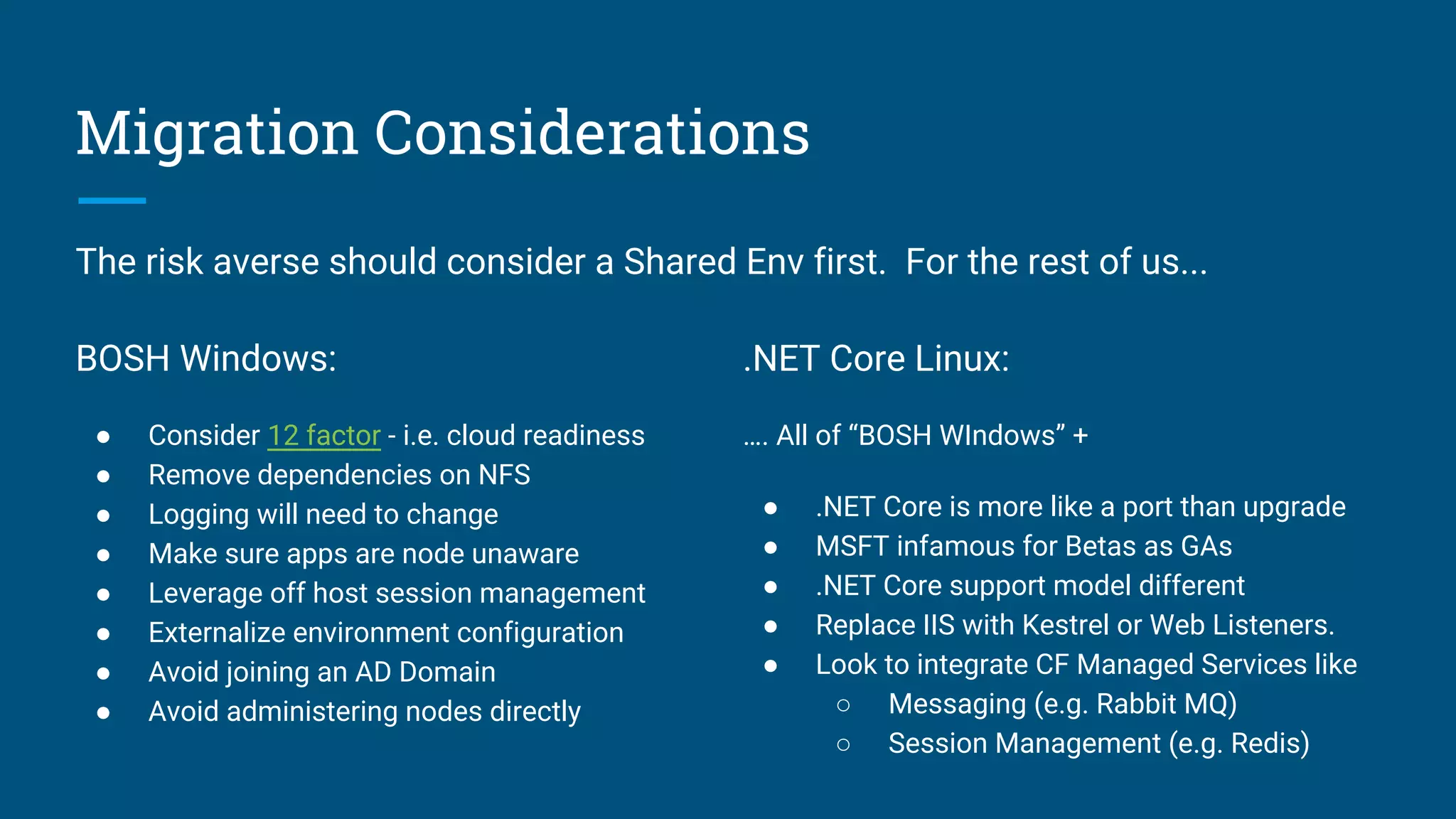
Migration Considerations
BOSH Windows:
● Consider 12 factor - i.e. cloud readiness
● Remove dependencies on NFS
● Logging will need to change
● Make sure apps are node unaware
● Leverage off host session management
● Externalize environment configuration
● Avoid joining an AD Domain
● Avoid administering nodes directly
.NET Core Linux:
…. All of “BOSH WIndows” +
● .NET Core is more like a port than upgrade
● MSFT infamous for Betas as GAs
● .NET Core support model different
● Replace IIS with Kestrel or Web Listeners.
● Look to integrate CF Managed Services like
○ Messaging (e.g. Rabbit MQ)
○ Session Management (e.g. Redis)
The risk averse should consider a Shared Env first. For the rest of us...
Thanks
Contact me at:
● nicholas.grabowski@schwab.com
● ng@ngsoft.org
● http://www.linkedin.com/in/ngsoft
Shameless Recruiting Plug:
● Are you a solutions or enterprise architect?
● Are you a developer who wants to be an architect?
● Interested in working with the latest technology?
If so, Charles Schwab has an endless supply of multi million
dollar challenges?
http://jobs.schwab.com/

Migrating .NET Apps to CF, A Strategy for Enterprises

  • 1.
    Migrating .NET appsto Cloud Foundry A Strategy For Enterprises
  • 2.
    Your Presenter ● NicholasGrabowski ● Managing Principal at Charles Schwab & Co. ○ Application Architecture Team ○ R&D Team ● Engineering Leader, Executive, Technologist, Architect ● Primary industries: Financial Services and Retail ● Primary focus: Making technology more efficient August 4th, 2016
  • 3.
    Audience ● Architects, EngineeringLeaders, Data Center Ops ● .NET Shops or those with lots of .NET apps ● Have 100s of apps or microservices ● Enterprises with lots of software Assumptions: ● You are somewhat familiar with Cloud Foundry
  • 4.
    A little aboutour situation & goals. Situation: ● 100s of .NET, Java, Mainframe, Legacy C, C++ applications ● Highly regulated environment ● Security is paramount ● Prefer CAPEX over OPEX ● Availability and reliability critical ● Brand conscious, risk averse Goals: ● Bend cost curve of infrastructure, licensing ● Reduce complexity of deployments ● Leverage available capacity (app density) ● Adhere to our own standards ● Improve security posture ● Improve availability and reliability SLAs ● Improve agile, self service, devops maturity ● Prepare for public cloud ● Do “More, Better, Faster, Cheaper”
  • 5.
    Shared Environments -What we built We started before there were PAAS solutions. We could see value in consolidating many apps to a cluster of VMs rather than 1 app per cluster. So we built Java and .NET “Shared Environments”. Our .NET env looks like: ● IIS on Windows Server 2008 ● Standard server configuration ● Standard networking and firewall rules ● Standard IIS configuration ● All apps deployed to all nodes Shared Environment DC 2 Shared Environment DC 1 Node1 App1 App2 Appn... Node2 App1 App2 Appn... NodeN App1 App2 Appn... ... Firewall/Loadbalancer Client Apps
  • 6.
    Shared Environments -Made Some Progress Goals “kind of” accomplished: ● Bend cost curve of infrastructure, licensing ● Reduce complexity of deployments ● Leverage available capacity (app density) ● Adhere to our own standards. ● Improve security posture ● Improve availability and reliability SLAs ● Improve agile, self service, devops maturity ● Prepare for public cloud ● Do more: “More, Better, Faster, Cheaper”● Avoided 1000s of VMs ● Avoided 1000s of licenses ● Avoided ops team expansion
  • 7.
    Shared Environment DC2 Shared Environment DC 1 Shared Environments - But Not Enough Shared Envs gave us a much greater app density per machine, provided isolation characteristics, reduced heterogeneity, and improved CD integration. But it had limitations: ● No elasticity ● No life cycle management, Pets not cattle ● Containerization is limited ● Security features are limited Pet1 App1 App2 Appn... Pet2 App1 App2 Appn... PetN App1 App2 Appn... ... Firewall/LoadBalancer Client Apps Noisy Neighbor App1 failure impacts other apps
  • 8.
    Enter Cloud Foundry ●True runtime elasticity ● Lifecycle Management (no more pets) ● Better containerization ● Improved security posture Goals could be accomplished for Java ● Bend cost curve of infrastructure, licensing ● Reduce complexity of deployments ● Leverage available capacity (app density) ● Adhere to our own standards ● Improve security posture ● Improve availability and reliability SLAs ● Improve agile, self service, devops maturity ● Prepare for public cloud ● Do “More, Better, Faster, Cheaper”
  • 9.
    Enter Cloud Foundry- BOSH is the Key “BOSH is a project that unifies release engineering, deployment, and lifecycle management of small and large-scale cloud software. BOSH can provision and deploy software over hundreds of VMs. It also performs monitoring, failure recovery, and software updates with zero-to-minimal downtime.” - bosh.io Bosh, Stem cells, Go router enable: ● Elasticity ● Life cycle management, Cattle not pets ● Containerization is robust ● Security features are robust Cloud Foundry DC 2 Cloud Foundry DC 1 Node1 App1 App2 Appn... Node2 App2 NodeN App1 App3 ... Router Client Apps BOSH App4 App5
  • 10.
    .NET CF parity- 2 paths BOSH Windows ● Life cycle of fully managed by CF ● Will run .NET 4.5 ● 100s of Billions (Trillions?) of lines of legacy code need a home ● Windows only shops need a solution .NET Core on Linux ● Only .NET Core ● Auditors less concerned with linux ● Limits complexity of CF ● Reduces legacy (Active Directory, IIS, etc.) ● .NET on par with other open source 11/2015 - Windows workloads deployable to CF, but parity not achieved… what is needed?
  • 11.
    Migration Considerations BOSH Windows: ●Consider 12 factor - i.e. cloud readiness ● Remove dependencies on NFS ● Logging will need to change ● Make sure apps are node unaware ● Leverage off host session management ● Externalize environment configuration ● Avoid joining an AD Domain ● Avoid administering nodes directly .NET Core Linux: …. All of “BOSH WIndows” + ● .NET Core is more like a port than upgrade ● MSFT infamous for Betas as GAs ● .NET Core support model different ● Replace IIS with Kestrel or Web Listeners. ● Look to integrate CF Managed Services like ○ Messaging (e.g. Rabbit MQ) ○ Session Management (e.g. Redis) The risk averse should consider a Shared Env first. For the rest of us...
  • 12.
    Thanks Contact me at: ●nicholas.grabowski@schwab.com ● ng@ngsoft.org ● http://www.linkedin.com/in/ngsoft Shameless Recruiting Plug: ● Are you a solutions or enterprise architect? ● Are you a developer who wants to be an architect? ● Interested in working with the latest technology? If so, Charles Schwab has an endless supply of multi million dollar challenges? http://jobs.schwab.com/