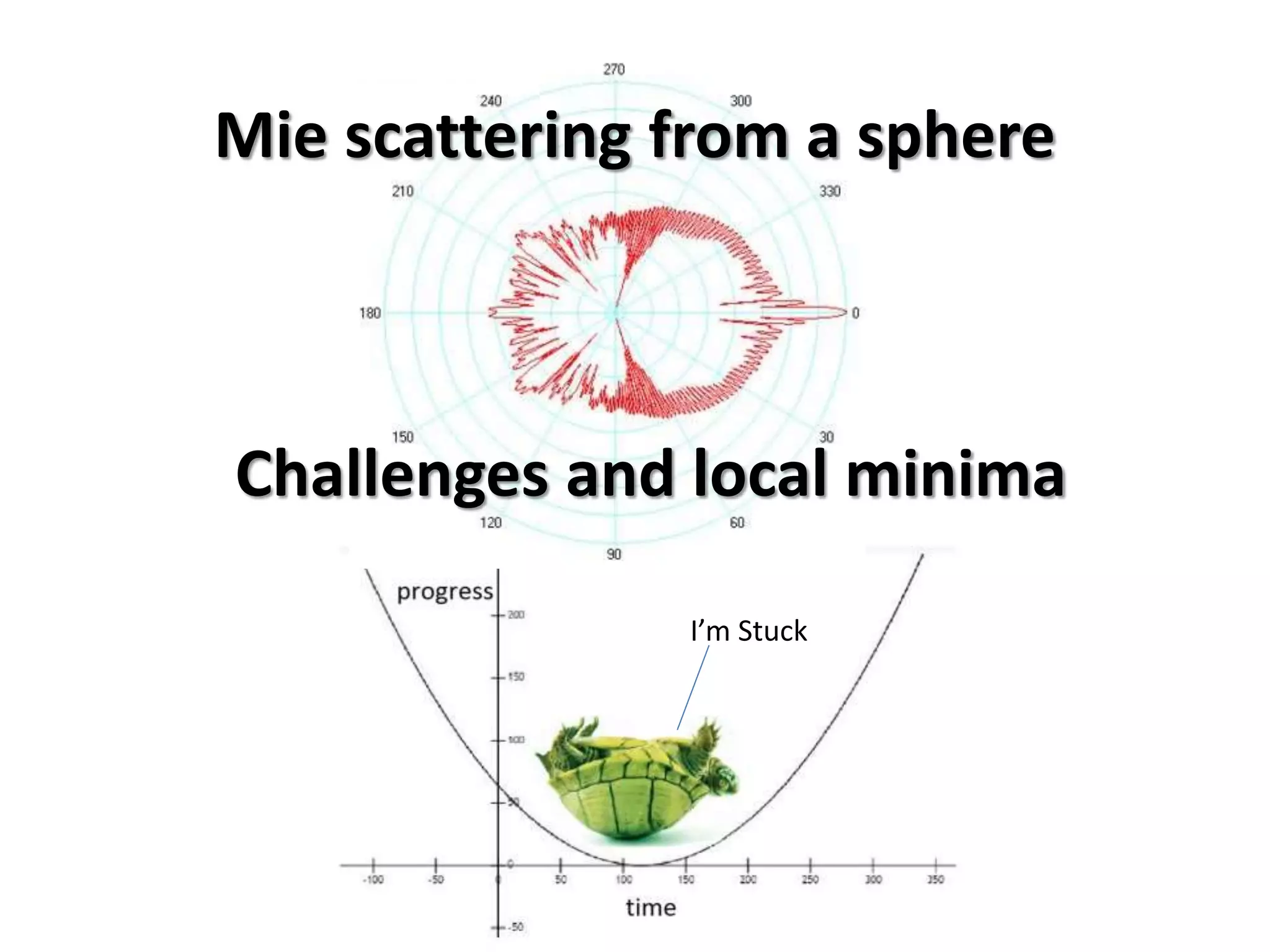
Mie scattering from a sphere
Challenges and local minima
I’m Stuck
Overview
• Region of interest in the beam
•Computation region behind the sphere
•Electric field vs Intensity
Region of interest in the beam
First slice of the matrix
Only the front part of the beam interacts with the sphere
Region of interest in the beam
Fourier Transform
Gaussian beam
Plane wave
components
Region of interest in the beam
Plane wave
components
If we add the scattering due to all the plane waves we
are looking at the scattering due to the whole
Gaussian beam. It is just a time averaging.
Region of interest in the beam
First slice of the matrix
2d Gaussian matrix
Region of interest in the beam
Fourier Transform
…
But these are not 3d plane waves!
Discrete Inverse Fourier Transform in 3D
Computation region behind the sphere
Where the matrix F is of dimension NXMXP
The propagation direction of the plane waves are perpendicular to the plane:
A 2D example
Computation region behind the sphere
u=1
v=1
u=1
v=2
u=2
v=1
u=2
v=2
M=2
N=2
Wavefront : xu/N + yv/M = 0
Propagation direction : xv/M – yu/N = 0
x/2+y/2=0
x+y/2=0
x/2+y=0
x+y=0
Propagation direction of wave
Wavefront
Extrapolating to 3D by analogy
Computation region behind the sphere
0
We see that the plane waves propagate in different skewed
directions
Computation region behind the sphere
Component plane waves
Plane of
computation
Resultant
intensity
The two planes cut and
we can compute the
resultant intensity
Computation region behind the sphere
Component plane waves
Plane of
computation
Here the two computation
planes do not cut and so we
are doomed!
The component plane
waves can be very skewed
in general.
Electric field vs Intensity
If the beam is not linearly polarized, we need to break the
beam into components and carry out the analysis separately
for each polarization.
E
Ex
Ez
Ey x
z
y
But if we proceed with only intensity, we cannot decompose
the beam into different polarizations
Electric field vs Intensity
On Fourier Transform the constant vector or polarization
remains intact.
3D Discrete Fourier Transform
Electric field vs Intensity
Fourier Transform
Plane wave
components
Gaussian beam
Electric field vs Intensity
90o
Physically possible polarization
Computed polarization
For electromagnetic waves the
electric field should be
perpendicular to the direction
of propagation.
Thank You
Wake up! Its over!

Mie scattering from a sphere

  • 1.
    Mie scattering froma sphere Challenges and local minima I’m Stuck
  • 2.
    Overview • Region ofinterest in the beam •Computation region behind the sphere •Electric field vs Intensity
  • 3.
    Region of interestin the beam First slice of the matrix Only the front part of the beam interacts with the sphere
  • 4.
    Region of interestin the beam Fourier Transform Gaussian beam Plane wave components
  • 5.
    Region of interestin the beam Plane wave components If we add the scattering due to all the plane waves we are looking at the scattering due to the whole Gaussian beam. It is just a time averaging.
  • 6.
    Region of interestin the beam First slice of the matrix 2d Gaussian matrix
  • 7.
    Region of interestin the beam Fourier Transform … But these are not 3d plane waves!
  • 8.
    Discrete Inverse FourierTransform in 3D Computation region behind the sphere Where the matrix F is of dimension NXMXP The propagation direction of the plane waves are perpendicular to the plane:
  • 9.
    A 2D example Computationregion behind the sphere u=1 v=1 u=1 v=2 u=2 v=1 u=2 v=2 M=2 N=2 Wavefront : xu/N + yv/M = 0 Propagation direction : xv/M – yu/N = 0 x/2+y/2=0 x+y/2=0 x/2+y=0 x+y=0 Propagation direction of wave Wavefront
  • 10.
    Extrapolating to 3Dby analogy Computation region behind the sphere 0 We see that the plane waves propagate in different skewed directions
  • 11.
    Computation region behindthe sphere Component plane waves Plane of computation Resultant intensity The two planes cut and we can compute the resultant intensity
  • 12.
    Computation region behindthe sphere Component plane waves Plane of computation Here the two computation planes do not cut and so we are doomed! The component plane waves can be very skewed in general.
  • 13.
    Electric field vsIntensity If the beam is not linearly polarized, we need to break the beam into components and carry out the analysis separately for each polarization. E Ex Ez Ey x z y But if we proceed with only intensity, we cannot decompose the beam into different polarizations
  • 14.
  • 15.
    Electric field vsIntensity On Fourier Transform the constant vector or polarization remains intact. 3D Discrete Fourier Transform
  • 16.
    Electric field vsIntensity Fourier Transform Plane wave components Gaussian beam
  • 17.
    Electric field vsIntensity 90o Physically possible polarization Computed polarization For electromagnetic waves the electric field should be perpendicular to the direction of propagation.
  • 18.