TRANSIT-ORIENTED
DEVELOPMENT ZONING
STUDY
Council Operations, Intergovernmental Relations &
Public Transportation Committee
11/21/2023
Cuyahoga County Planning Commission
Mary Cierebiej, AICP, Executive Director
Patrick Hewitt, AICP, Planning Manager
Sean Kidd, Planning Intern
Daniel Meaney, GISP, Manager, Information & Research
Kevin Leeson, Planner
Liam Leveto, GIS Technician
Laura Mendez Ortiz, AICP, Planner
Luke Ols, Cleveland Foundation Fellow
Maureen Riley, Planner
Micah Stryker, AICP, Senior Planner
Paul Triolo, Planner
Greater Cleveland Regional Transit Authority
Maribeth Feke, AICP, Directory of Programming & Planning
Mandy Metcalf, Planning Team Lead
Joey Warnkin, Planner II
City of Cleveland
Matthew Moss, Manager, Strategic Initiatives
City of Shaker Heights
Joyce Braverman, Director of Planning
Daniel Feinstein, Senior Planner, Zoning Administrator
City of Fairview Park
Mary Kay Costello, Director of Public Service & Development
Megan Otter, Community Development Planner
City of North Olmsted
Max Upton, Director of Community & Economic Development
TODAY
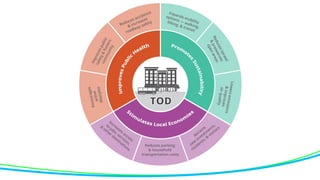
What is Transit-Oriented Development (TOD)
The TOD Zoning Study
Work to Date
Phase 1: State of TOD
Phase 2: Analysis of TOD Zoning
Phase 3: Best Practices & Model Codes
Moving Forward
Phase 4: Financing TOD
Next Steps
WHAT IS TOD
Transit-oriented development includes a mix of commercial,
residential, office, and entertainment centered around or
located near a transit station. Dense, walkable, mixed-use
development near transit attracts people and adds to
vibrant, connected communities.
"
"
-- Federal Transit Administration
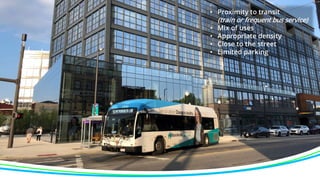
• Proximity to transit
(train or frequent bus service)
• Mix of uses
• Appropriate density
• Close to the street
• Limited parking
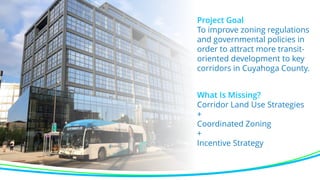
Project Goal
To improve zoning regulations
and governmental policies in
order to attract more transit-
oriented development to key
corridors in Cuyahoga County.
What Is Missing?
Corridor Land Use Strategies
+
Coordinated Zoning
+
Incentive Strategy
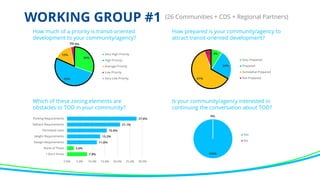
WORKING GROUP #1
30%
52%
15%
3% 0%
Very High Priority
High Priority
Average Priority
Low Priority
Very Low Priority
How much of a priority is transit-oriented
development to your community/agency?
How prepared is your community/agency to
attract transit-oriented development?
9%
24%
61%
6%
Very Prepared
Prepared
Somewhat Prepared
Not Prepared
Which of these zoning elements are
obstacles to TOD in your community?
Is your community/agency interested in
continuing the conversation about TOD?
100%
0%
Yes
No
27.6%
21.1%
15.8%
13.2%
11.8%
2.6%
7.9%
0.0% 5.0% 10.0% 15.0% 20.0% 25.0% 30.0%
Parking Requirements
Setback Requirements
Permitted Uses
Height Requirements
Design Requirements
None of These

I Don't Know
(26 Communities + CDS + Regional Partners)
TOD ZONING STUDY
State of TOD in
Cuyahoga
County
Analysis of TOD
Zoning
Best Practices
and Model TOD
Zoning
TOD Financing
Strategies
Describe the
importance of
TOD
Identify and
quantify TOD
corridors and
TOD examples
Analyze whether
existing zoning
along transit
lines allows TOD
and identify
target areas for
future
investment
Develop best
practices and
model zoning
for TOD that can
be adopted by
individual
municipalities
Identify TOD
financing
mechanisms
and incentives
used in other
communities
PUBLICATIONS
1a
1b
1c
1 2 3
COMPLETED WORK
GCRTA: TOD
Guidelines
(2007)
GCRTA: TOD
Best Practices
(2007)
NOACA:
Regional TOD
Scorecard &
Implementation
Plan (2016)
GCRTA: Priority
Corridor
Update (2021)
Design criteria
for good transit-
oriented
development
Lessons learned
from other
regions
Land use
typologies along
major transit
lines
Updated priority
corridors for
rapid transit
improvements
GCRTA and
Cleveland: 25
Connects (2021)
BRT plan and
zoning review
for West 25th
corridor
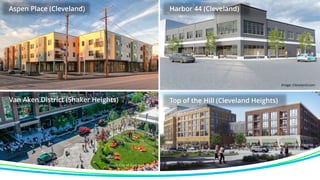
PHASE 1
State of TOD
Van Aken District (Shaker Heights) Top of the Hill (Cleveland Heights)
Harbor 44 (Cleveland)
Aspen Place (Cleveland)
Image: Cleveland.com
Image: City of Cleveland Heights
Image: City of Shaker Heights
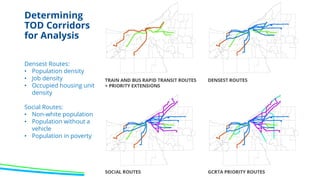
Determining
TOD Corridors
for Analysis
Densest Routes:
• Population density
• Job density
• Occupied housing unit
density
Social Routes:
• Non-white population
• Population without a
vehicle
• Population in poverty
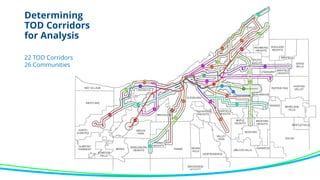
Determining
TOD Corridors
for Analysis
22 TOD Corridors
26 Communities
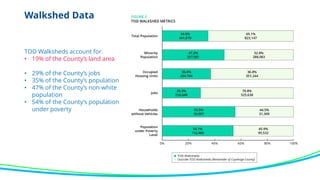
Walkshed Data
TOD Walksheds account for:
• 19% of the County’s land area
• 29% of the County’s jobs
• 35% of the County’s population
• 47% of the County’s non-white
population
• 54% of the County’s population
under poverty
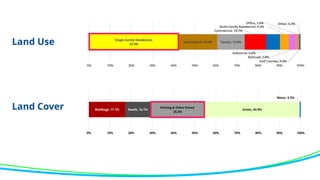
Land Use
Land Cover
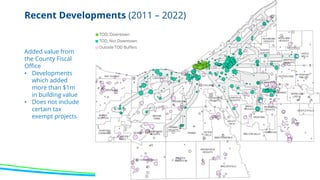
Recent Developments (2011 – 2022)
Added value from
the County Fiscal
Office
• Developments
which added
more than $1m
in building value
• Does not include
certain tax
exempt projects
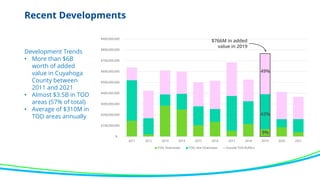
Recent Developments
Development Trends
• More than $6B
worth of added
value in Cuyahoga
County between
2011 and 2021
• Almost $3.5B in TOD
areas (57% of total)
• Average of $310M in
TOD areas annually
$-
$100,000,000
$200,000,000
$300,000,000
$400,000,000
$500,000,000
$600,000,000
$700,000,000
$800,000,000
$900,000,000
2011 2012 2013 2014 2015 2016 2017 2018 2019 2020 2021
TOD, Downtown TOD, Not Downtown Outside TOD Buffers
$766M in added
value in 2019
49%
42%
9%
PHASE 2
Analysis of TOD Zoning
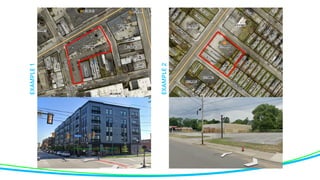
EXAMPLE
2
EXAMPLE
1
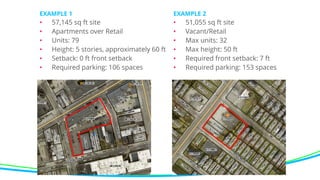
EXAMPLE 2
• 51,055 sq ft site
• Vacant/Retail
• Max units: 32
• Max height: 50 ft
• Required front setback: 7 ft
• Required parking: 153 spaces
EXAMPLE 1
• 57,145 sq ft site
• Apartments over Retail
• Units: 79
• Height: 5 stories, approximately 60 ft
• Setback: 0 ft front setback
• Required parking: 106 spaces
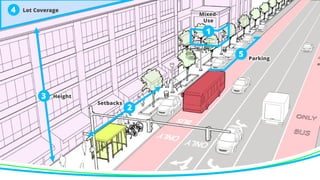
3
2
1
5
Height
Setbacks
Mixed-
Use
Parking
4 Lot Coverage
ZONING ANALYSIS
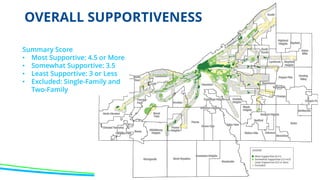
OVERALL SUPPORTIVENESS
Summary Score
• Most Supportive: 4.5 or More
• Somewhat Supportive: 3.5
• Least Supportive: 3 or Less
• Excluded: Single-Family and
Two-Family
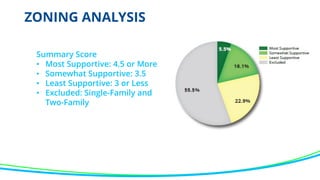
ZONING ANALYSIS
Summary Score
• Most Supportive: 4.5 or More
• Somewhat Supportive: 3.5
• Least Supportive: 3 or Less
• Excluded: Single-Family and
Two-Family
PHASE 3
Best Practices & Model Code
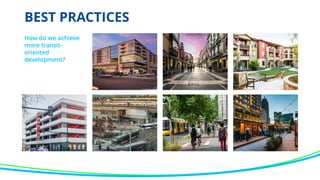
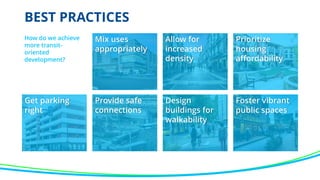
BEST PRACTICES
How do we achieve
more transit-
oriented
development?
BEST PRACTICES
How do we achieve
more transit-
oriented
development?
Get parking
right
Provide safe
connections
Design
buildings for
walkability
Foster vibrant
public spaces
Mix uses
appropriately
Allow for
increased
density
Prioritize
housing
affordability
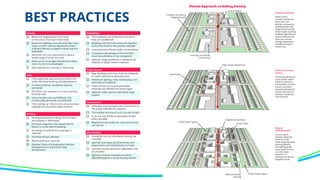
BEST PRACTICES
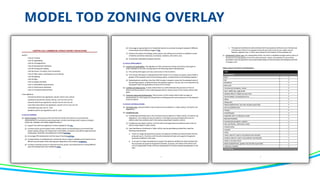
MODEL TOD ZONING OVERLAY
PHASE 4
Next Steps & Financing TOD
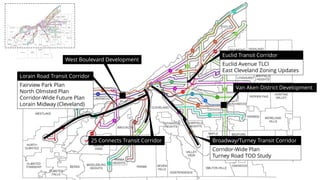
Lorain Road Transit Corridor
Fairview Park Plan
North Olmsted Plan
Corridor-Wide Future Plan
Lorain Midway (Cleveland)
25 Connects Transit Corridor Broadway/Turney Transit Corridor
Corridor-Wide Plan
Turney Road TOD Study
Van Aken District Development
West Boulevard Development
Euclid Transit Corridor
Euclid Avenue TLCI
East Cleveland Zoning Updates
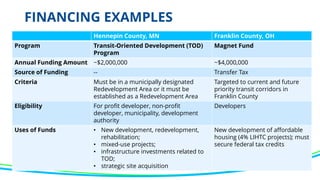
FINANCING EXAMPLES
Hennepin County, MN Franklin County, OH
Program Transit-Oriented Development (TOD)
Program
Magnet Fund
Annual Funding Amount ~$2,000,000 ~$4,000,000
Source of Funding -- Transfer Tax
Criteria Must be in a municipally designated
Redevelopment Area or it must be
established as a Redevelopment Area
Targeted to current and future
priority transit corridors in
Franklin County
Eligibility For profit developer, non-profit
developer, municipality, development
authority
Developers
Uses of Funds • New development, redevelopment,
rehabilitation;
• mixed-use projects;
• infrastructure investments related to
TOD;
• strategic site acquisition
New development of affordable
housing (4% LIHTC projects); must
secure federal tax credits
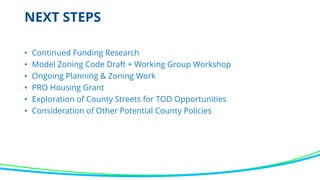
• Continued Funding Research
• Model Zoning Code Draft + Working Group Workshop
• Ongoing Planning & Zoning Work
• PRO Housing Grant
• Exploration of County Streets for TOD Opportunities
• Consideration of Other Potential County Policies
NEXT STEPS
TOD UPDATES
• Visit us for updates on the project:
www.CountyPlanning.us/TOD
WORKING GROUP #1
30%
52%
15%
3% 0%
Very High Priority
High Priority
Average Priority
Low Priority
Very Low Priority
How much of a priority is transit-oriented
development to your community/agency?
How prepared is your community/agency to
attract transit-oriented development?
9%
24%
61%
6%
Very Prepared
Prepared
Somewhat Prepared
Not Prepared
Which of these zoning elements are
obstacles to TOD in your community?
Is your community/agency interested in
continuing the conversation about TOD?
100%
0%
Yes
No
27.6%
21.1%
15.8%
13.2%
11.8%
2.6%
7.9%
0.0% 5.0% 10.0% 15.0% 20.0% 25.0% 30.0%
Parking Requirements
Setback Requirements
Permitted Uses
Height Requirements
Design Requirements
None of These
I Don't Know
(26 Communities + CDS + Regional Partners)
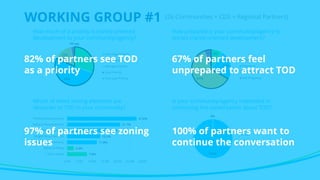
82% of partners see TOD
as a priority
67% of partners feel
unprepared to attract TOD
97% of partners see zoning
issues
100% of partners want to
continue the conversation
THANK YOU

Transit-Oriented Development Zoning Study

  • 1.
    TRANSIT-ORIENTED DEVELOPMENT ZONING STUDY Council Operations,Intergovernmental Relations & Public Transportation Committee 11/21/2023
  • 2.
    Cuyahoga County PlanningCommission Mary Cierebiej, AICP, Executive Director Patrick Hewitt, AICP, Planning Manager Sean Kidd, Planning Intern Daniel Meaney, GISP, Manager, Information & Research Kevin Leeson, Planner Liam Leveto, GIS Technician Laura Mendez Ortiz, AICP, Planner Luke Ols, Cleveland Foundation Fellow Maureen Riley, Planner Micah Stryker, AICP, Senior Planner Paul Triolo, Planner Greater Cleveland Regional Transit Authority Maribeth Feke, AICP, Directory of Programming & Planning Mandy Metcalf, Planning Team Lead Joey Warnkin, Planner II City of Cleveland Matthew Moss, Manager, Strategic Initiatives City of Shaker Heights Joyce Braverman, Director of Planning Daniel Feinstein, Senior Planner, Zoning Administrator City of Fairview Park Mary Kay Costello, Director of Public Service & Development Megan Otter, Community Development Planner City of North Olmsted Max Upton, Director of Community & Economic Development
  • 3.
    TODAY What is Transit-OrientedDevelopment (TOD) The TOD Zoning Study Work to Date Phase 1: State of TOD Phase 2: Analysis of TOD Zoning Phase 3: Best Practices & Model Codes Moving Forward Phase 4: Financing TOD Next Steps
  • 4.
    WHAT IS TOD Transit-orienteddevelopment includes a mix of commercial, residential, office, and entertainment centered around or located near a transit station. Dense, walkable, mixed-use development near transit attracts people and adds to vibrant, connected communities. " " -- Federal Transit Administration
  • 5.
    • Proximity totransit (train or frequent bus service) • Mix of uses • Appropriate density • Close to the street • Limited parking
  • 6.
    Project Goal To improvezoning regulations and governmental policies in order to attract more transit- oriented development to key corridors in Cuyahoga County. What Is Missing? Corridor Land Use Strategies + Coordinated Zoning + Incentive Strategy
  • 7.
    WORKING GROUP #1 30% 52% 15% 3%0% Very High Priority High Priority Average Priority Low Priority Very Low Priority How much of a priority is transit-oriented development to your community/agency? How prepared is your community/agency to attract transit-oriented development? 9% 24% 61% 6% Very Prepared Prepared Somewhat Prepared Not Prepared Which of these zoning elements are obstacles to TOD in your community? Is your community/agency interested in continuing the conversation about TOD? 100% 0% Yes No 27.6% 21.1% 15.8% 13.2% 11.8% 2.6% 7.9% 0.0% 5.0% 10.0% 15.0% 20.0% 25.0% 30.0% Parking Requirements Setback Requirements Permitted Uses Height Requirements Design Requirements None of These I Don't Know (26 Communities + CDS + Regional Partners)
  • 8.
    TOD ZONING STUDY Stateof TOD in Cuyahoga County Analysis of TOD Zoning Best Practices and Model TOD Zoning TOD Financing Strategies Describe the importance of TOD Identify and quantify TOD corridors and TOD examples Analyze whether existing zoning along transit lines allows TOD and identify target areas for future investment Develop best practices and model zoning for TOD that can be adopted by individual municipalities Identify TOD financing mechanisms and incentives used in other communities
  • 9.
  • 10.
    COMPLETED WORK GCRTA: TOD Guidelines (2007) GCRTA:TOD Best Practices (2007) NOACA: Regional TOD Scorecard & Implementation Plan (2016) GCRTA: Priority Corridor Update (2021) Design criteria for good transit- oriented development Lessons learned from other regions Land use typologies along major transit lines Updated priority corridors for rapid transit improvements GCRTA and Cleveland: 25 Connects (2021) BRT plan and zoning review for West 25th corridor
  • 11.
  • 12.
    Van Aken District(Shaker Heights) Top of the Hill (Cleveland Heights) Harbor 44 (Cleveland) Aspen Place (Cleveland) Image: Cleveland.com Image: City of Cleveland Heights Image: City of Shaker Heights
  • 14.
    Determining TOD Corridors for Analysis DensestRoutes: • Population density • Job density • Occupied housing unit density Social Routes: • Non-white population • Population without a vehicle • Population in poverty
  • 15.
    Determining TOD Corridors for Analysis 22TOD Corridors 26 Communities
  • 16.
    Walkshed Data TOD Walkshedsaccount for: • 19% of the County’s land area • 29% of the County’s jobs • 35% of the County’s population • 47% of the County’s non-white population • 54% of the County’s population under poverty
  • 17.
  • 18.
    Recent Developments (2011– 2022) Added value from the County Fiscal Office • Developments which added more than $1m in building value • Does not include certain tax exempt projects
  • 19.
    Recent Developments Development Trends •More than $6B worth of added value in Cuyahoga County between 2011 and 2021 • Almost $3.5B in TOD areas (57% of total) • Average of $310M in TOD areas annually $- $100,000,000 $200,000,000 $300,000,000 $400,000,000 $500,000,000 $600,000,000 $700,000,000 $800,000,000 $900,000,000 2011 2012 2013 2014 2015 2016 2017 2018 2019 2020 2021 TOD, Downtown TOD, Not Downtown Outside TOD Buffers $766M in added value in 2019 49% 42% 9%
  • 20.
  • 21.
  • 22.
    EXAMPLE 2 • 51,055sq ft site • Vacant/Retail • Max units: 32 • Max height: 50 ft • Required front setback: 7 ft • Required parking: 153 spaces EXAMPLE 1 • 57,145 sq ft site • Apartments over Retail • Units: 79 • Height: 5 stories, approximately 60 ft • Setback: 0 ft front setback • Required parking: 106 spaces
  • 23.
  • 24.
  • 25.
    OVERALL SUPPORTIVENESS Summary Score •Most Supportive: 4.5 or More • Somewhat Supportive: 3.5 • Least Supportive: 3 or Less • Excluded: Single-Family and Two-Family
  • 26.
    ZONING ANALYSIS Summary Score •Most Supportive: 4.5 or More • Somewhat Supportive: 3.5 • Least Supportive: 3 or Less • Excluded: Single-Family and Two-Family
  • 27.
  • 28.
    BEST PRACTICES How dowe achieve more transit- oriented development?
  • 29.
    BEST PRACTICES How dowe achieve more transit- oriented development? Get parking right Provide safe connections Design buildings for walkability Foster vibrant public spaces Mix uses appropriately Allow for increased density Prioritize housing affordability
  • 30.
  • 31.
  • 32.
    PHASE 4 Next Steps& Financing TOD
  • 33.
    Lorain Road TransitCorridor Fairview Park Plan North Olmsted Plan Corridor-Wide Future Plan Lorain Midway (Cleveland) 25 Connects Transit Corridor Broadway/Turney Transit Corridor Corridor-Wide Plan Turney Road TOD Study Van Aken District Development West Boulevard Development Euclid Transit Corridor Euclid Avenue TLCI East Cleveland Zoning Updates
  • 34.
    FINANCING EXAMPLES Hennepin County,MN Franklin County, OH Program Transit-Oriented Development (TOD) Program Magnet Fund Annual Funding Amount ~$2,000,000 ~$4,000,000 Source of Funding -- Transfer Tax Criteria Must be in a municipally designated Redevelopment Area or it must be established as a Redevelopment Area Targeted to current and future priority transit corridors in Franklin County Eligibility For profit developer, non-profit developer, municipality, development authority Developers Uses of Funds • New development, redevelopment, rehabilitation; • mixed-use projects; • infrastructure investments related to TOD; • strategic site acquisition New development of affordable housing (4% LIHTC projects); must secure federal tax credits
  • 35.
    • Continued FundingResearch • Model Zoning Code Draft + Working Group Workshop • Ongoing Planning & Zoning Work • PRO Housing Grant • Exploration of County Streets for TOD Opportunities • Consideration of Other Potential County Policies NEXT STEPS
  • 36.
    TOD UPDATES • Visitus for updates on the project: www.CountyPlanning.us/TOD
  • 37.
    WORKING GROUP #1 30% 52% 15% 3%0% Very High Priority High Priority Average Priority Low Priority Very Low Priority How much of a priority is transit-oriented development to your community/agency? How prepared is your community/agency to attract transit-oriented development? 9% 24% 61% 6% Very Prepared Prepared Somewhat Prepared Not Prepared Which of these zoning elements are obstacles to TOD in your community? Is your community/agency interested in continuing the conversation about TOD? 100% 0% Yes No 27.6% 21.1% 15.8% 13.2% 11.8% 2.6% 7.9% 0.0% 5.0% 10.0% 15.0% 20.0% 25.0% 30.0% Parking Requirements Setback Requirements Permitted Uses Height Requirements Design Requirements None of These I Don't Know (26 Communities + CDS + Regional Partners) 82% of partners see TOD as a priority 67% of partners feel unprepared to attract TOD 97% of partners see zoning issues 100% of partners want to continue the conversation
  • 38.