1. God is HOLY. Leviticus
teaches about the holiness of
God and His requirements
for fellowship with Him
2. The sacrifices established
in the tabernacle provided a
means for a sinful people to
APPROACH a holy God.
3. Holy days were created to for
 the Israelites as times to meet
 with him. They commemorated
 God’s works and were prophetic
 pictures of his plan still to unfold.

 Passover                            Feast of Trumpets
 Unleavened Bread                    Day of Atonement
 Firstfruits                         Feast of Booths
                    Feast of Weeks
General Info
• Purposes
  – To remind the people of what God did for them:
    miracle, victory, provision
  – To rest (sabbath)
  – To give thanks through offerings
  – To repent and offer sacrifices
  – To read the Scriptures
Passover
• Background
  – Commemorates God’s deliverance
    of Israel out of slavery in Egypt.
  – Pesach means to “pass over.”
  – In biblical times, Passover was commemorated
    with a sacrifice.
  – Today, it is commemorated with
    a meal.
Passover
• Yeshua (Jesus)
  – Jesus was crucified as the “Lamb of God who
    takes away the sin of the world” (John 1:29).
  – The Lord’s Supper is a remembrance of his
    sacrifice as the perfect Passover Lamb.
Unleavened Bread
• Background
  – This unleavened bread (matzah) is made in a
    hurry without yeast.
  – This represents
    how the Lord
    brought the
    Israelites out of
    Egypt in haste.

                           Matzah being broken
Unleavened Bread
• Yeshua (Jesus)
  – Matzah is a picture of Jesus, the only human
    without sin.
  – Jesus said that the “bread of God is he who comes
    down from heaven and gives life to the world”
    (John 6:23).
  – Jesus declared, “I am the bread of life. He who
    comes to me will never go hungry” (John 6:35).
Firstfruits
• Background
  – Firstfruits are offerings given for the spring barley
    harvest.
  – The first ripe sheaf (firstfruits) of barley was
    offered to the Lord as an act of dedicating the
    harvest to him.
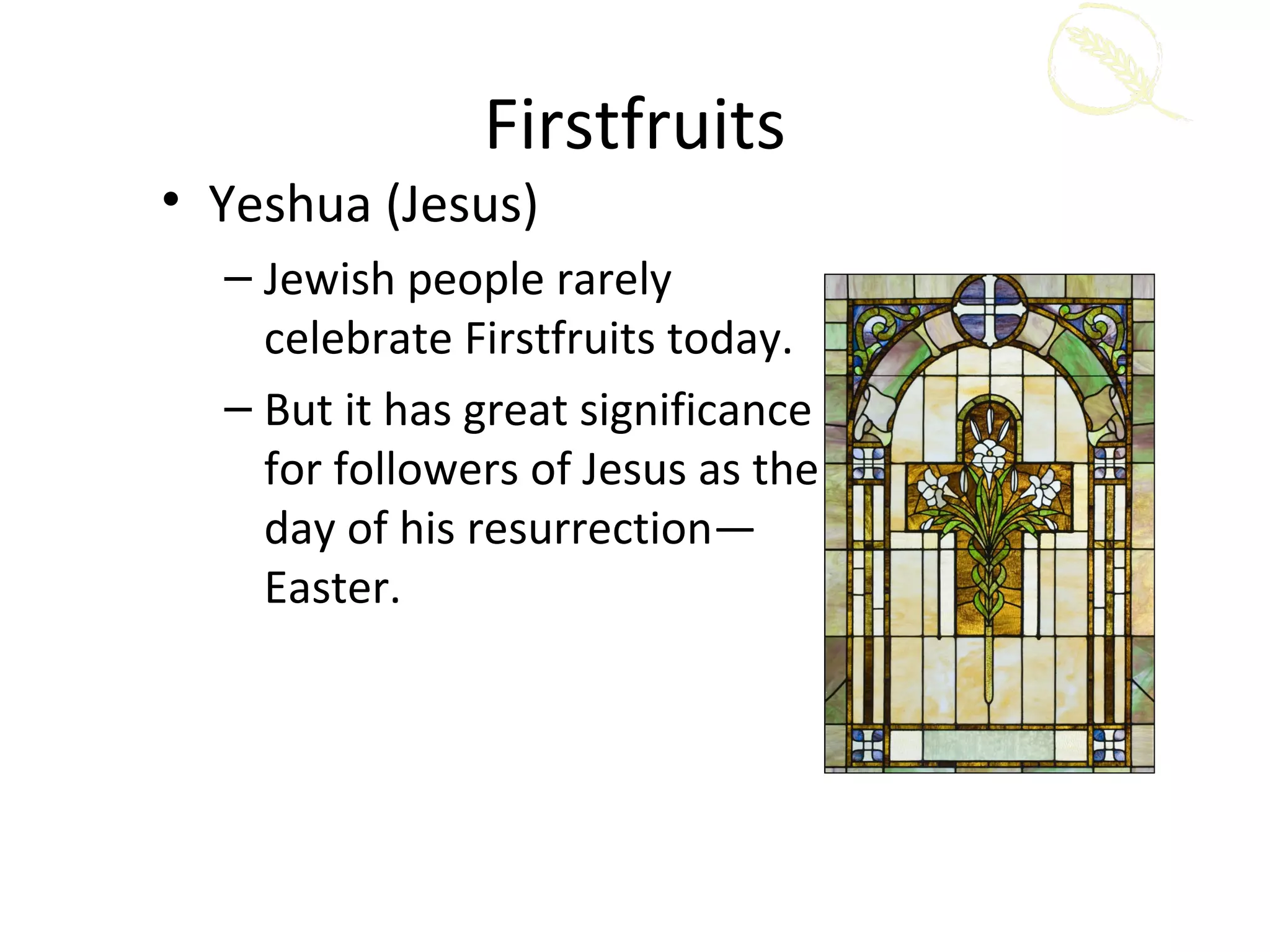
Firstfruits
• Yeshua (Jesus)
  – Jewish people rarely
    celebrate Firstfruits today.
  – But it has great significance
    for followers of Jesus as the
    day of his resurrection—
    Easter.
Firstfruits
• Yeshua (Jesus)
      – Jesus rose on the third day of Passover
        season, the day of Firstfruits
        (Luke 24:46-47).
      – Jesus’ resurrection gave new meaning to
        this agricultural holiday.
      – Jesus’ resurrection is the promise of the
        future resurrection of believers
        (1 Corinthians 15:20-23).
Feast of Weeks
• Background
  – An offering of grain of the summer wheat harvest
    was presented to the Lord to show joy and
    thankfulness.
  – Commemorates the giving of the Law
  – Celebrated 50 days after Passover
    (the day after seven weeks or
    seven Sabbaths)
Feast of Weeks
• Yeshua (Jesus)
  – Then the sound of a
    mighty wind filled the
    house and tongues of fire
    came to rest on the
    disciples, and they were
    filled with the Holy Spirit.
  – Acts 2


                  Pentecost (detail) by Jean Restout, 1732
Feast of Trumpets
• Background
  – Marks the beginning of the civil
    new year.
  – Rosh HaShanah means “the beginning of the
    year.”
  – In biblical times, it was a day of rest
    and offerings.
  – It is commemorated with trumpet blasts.
Feast of Trumpets
• Background
  – Rosh HaShanah, the Ten Days of Repentance that
    follow it, and
    then Yom Kippur make up the
    High Holy Days.
  – Jewish tradition says that God writes every
    person’s words, deeds, and thoughts in the Book
    of Life, which he opens on Rosh HaShanah.
Feast of Trumpets
• Background
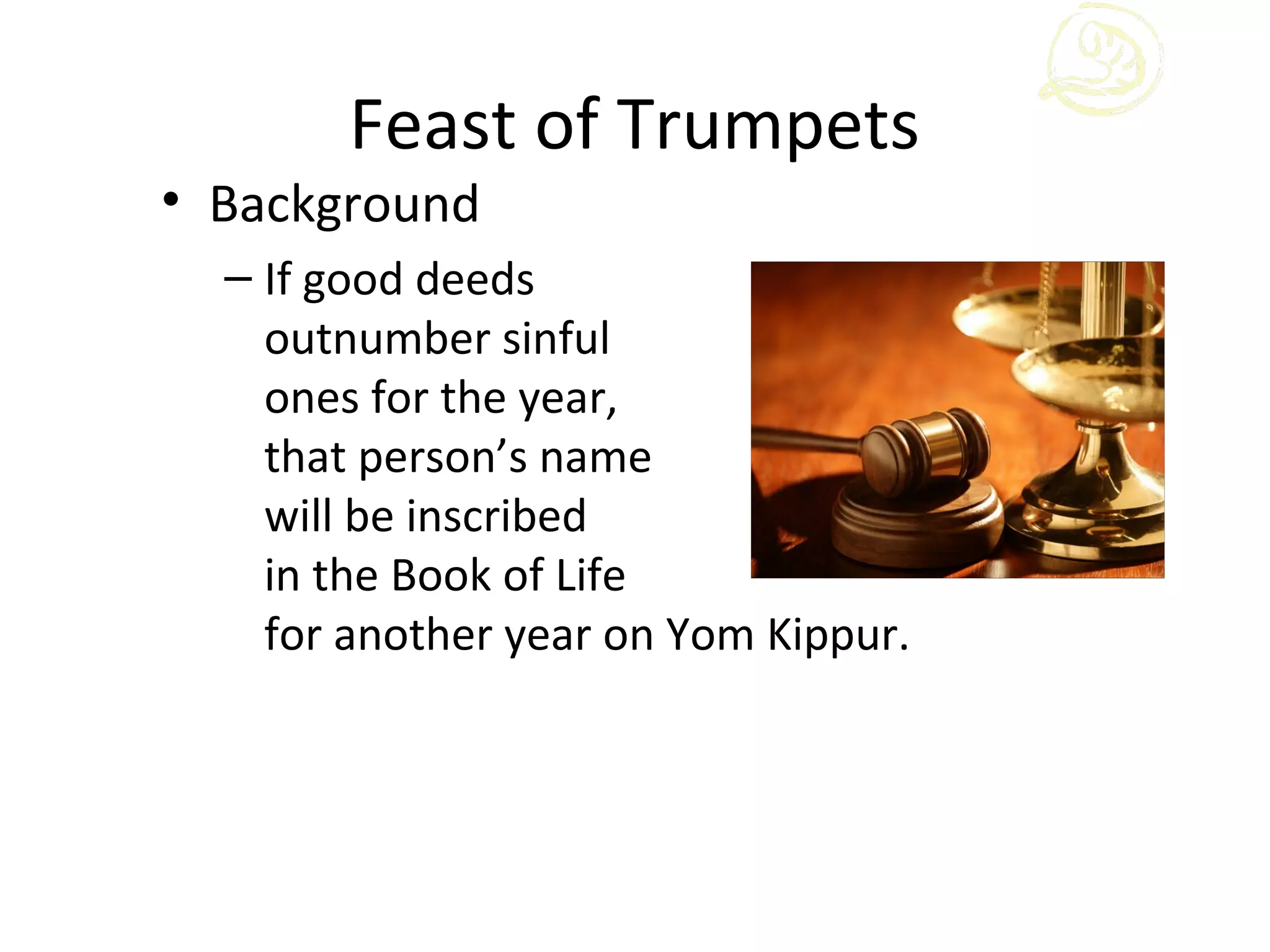
  – If good deeds
    outnumber sinful
    ones for the year,
    that person’s name
    will be inscribed
    in the Book of Life
    for another year on Yom Kippur.
Feast of Trumpets
• Yeshua (Jesus)
  – Rosh HaShanah is sometimes referred to as
    the Day of Judgment.
  – Jesus said he has authority to judge people
    (John 5:24-27).
  – Paul called Jesus the judge of “the living and
    the dead” (2 Timothy 4:1).
  – God does have a book of life, the Lamb’s
    Book of Life.
Feast of Trumpets
• Yeshua (Jesus)
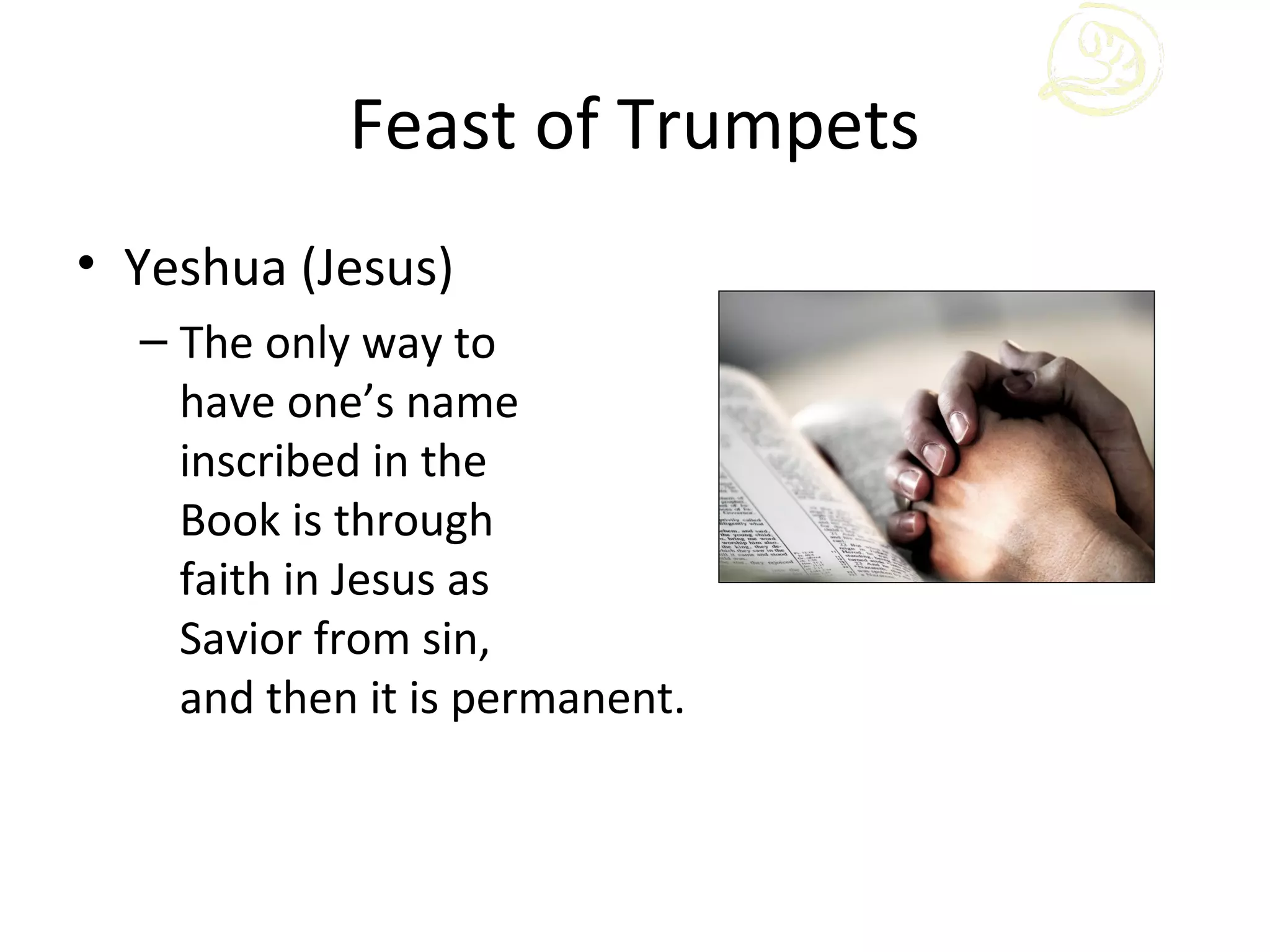
  – The only way to
    have one’s name
    inscribed in the
    Book is through
    faith in Jesus as
    Savior from sin,
    and then it is permanent.
Day of Atonement
• Background
  – The day the high priest made atonement for
    sin
  – The most solemn Jewish holy day
  – Yom means “day”; Kippur means “atonement”
    or “covering.”
  – Atonement means the reconciliation
    of God and man.
Day of Atonement
• Background
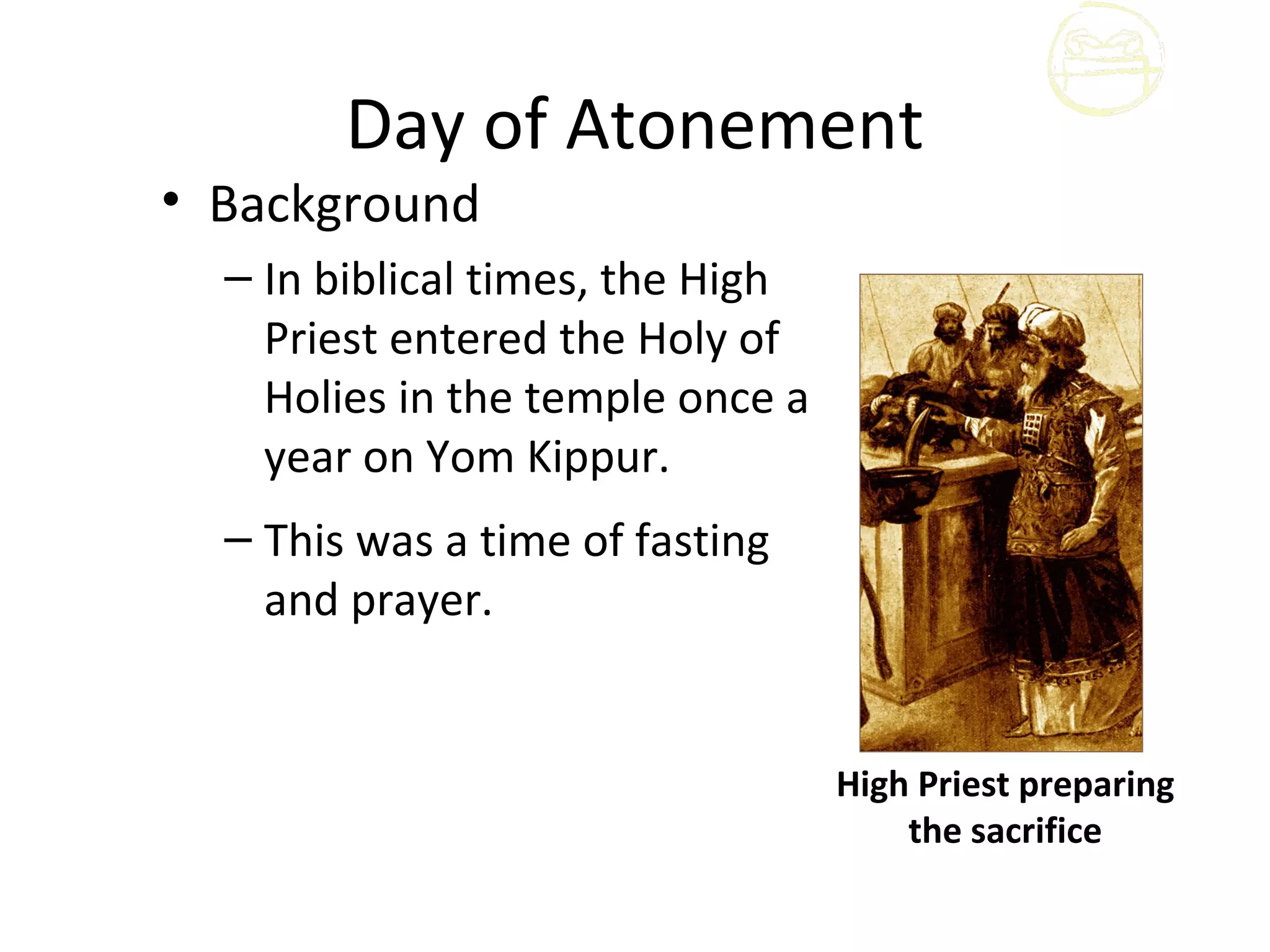
  – In biblical times, the High
    Priest entered the Holy of
    Holies in the temple once a
    year on Yom Kippur.
  – This was a time of fasting
    and prayer.


                                  High Priest preparing
                                      the sacrifice
Day of Atonement
• Background
  – The High Priest offered the
    blood sacrifice of atonement
    on behalf of the people.
  – This was an animal sacrifice
    to pay for
    his sins and the sins
    of the people.

                                   High Priest preparing
                                       the sacrifice
Day of Atonement
• Background
  – When the high priest was finished with the
    atonement sacrifice, a goat was released into the
    wilderness.
  – This “scapegoat” carried Israel’s sins away, never
    to return.
Day of Atonement
• Yeshua (Jesus)
  – The Holy of Holies
     in the temple was
    separated from the
    congregation by a
    thick veil from floor
    to ceiling.
  – When Jesus died on the cross, the veil was
    ripped from top to bottom.
Day of Atonement
• Yeshua (Jesus)
  – Christ came as high priest and entered the Holy of
    Holies (heaven itself) once for all, by his own
    blood, having obtained eternal redemption
    (Hebrews 9:12).
  – Believers in Jesus accept his sacrifice on the cross
    as the final atonement
    for sin.
Feast of Booths
• Background
  – Commemorates the 40-year wilderness
    journey
  – To remember God’s faithfulness and
    protection during the journey
  – During the Israelites’ 40-year wilderness
    journey, they dwelt in temporary shelters, or
    booths.
  – On this holiday, the Israelites were to build
    and dwell in booths for seven days to
    remember how they had lived under God’s
    care in the wilderness.
Feast of Booths
• Yeshua (Jesus)
  – Two ceremonies were part of the
    last day:
       •   2. People carrying torches marched around the
           temple, then set these lights around the walls of
           the temple, symbolizing how Messiah would be a
           light to the Gentiles.
Feast of Booths
• Yeshua (Jesus)
  – When Jesus
    attended this feast,
    on the last day,
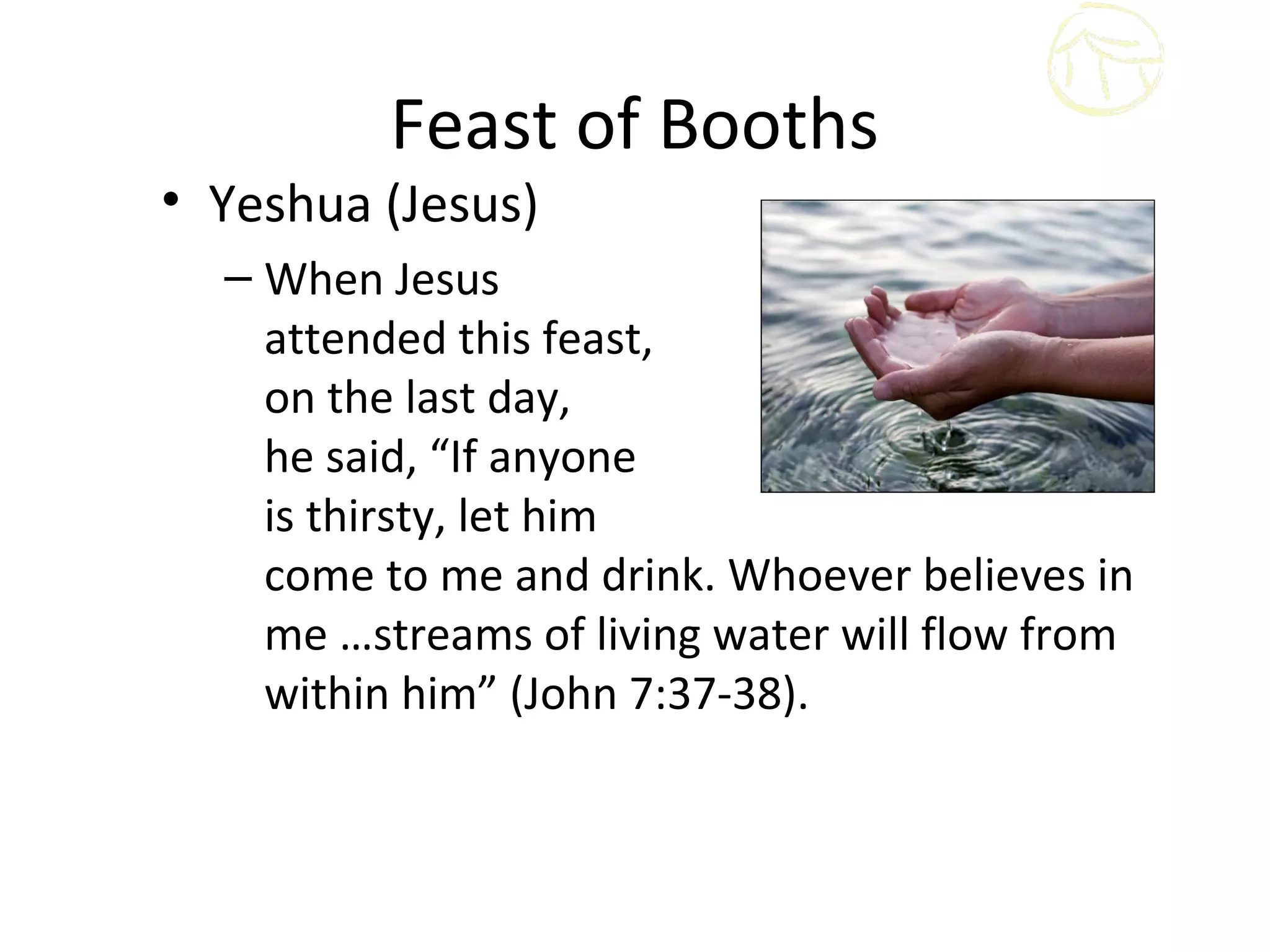
    he said, “If anyone
    is thirsty, let him
    come to me and drink. Whoever believes in
    me …streams of living water will flow from
    within him” (John 7:37-38).
Feast of Booths
• Yeshua (Jesus)
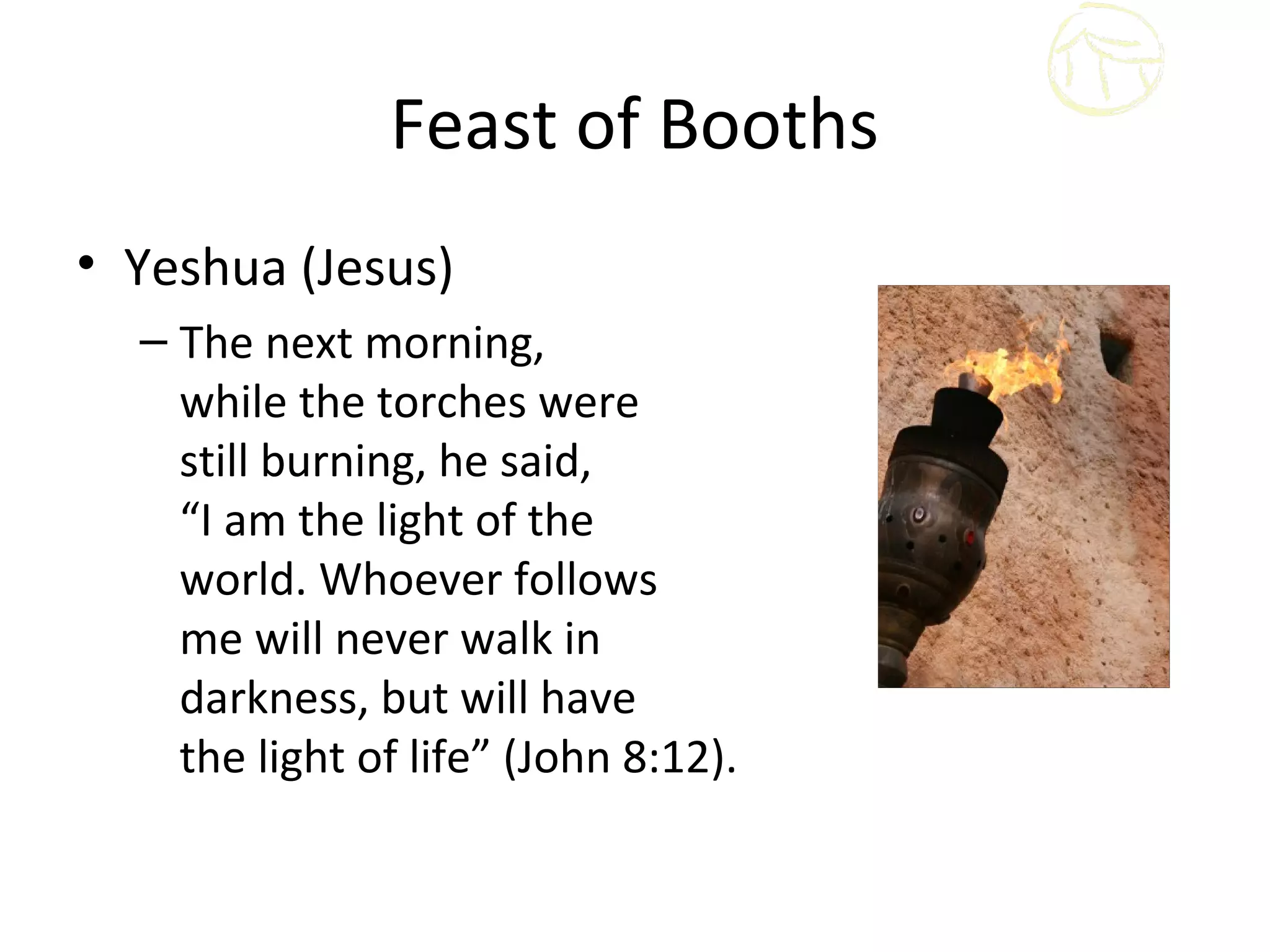
  – The next morning,
    while the torches were
    still burning, he said,
    “I am the light of the
    world. Whoever follows
    me will never walk in
    darkness, but will have
    the light of life” (John 8:12).
Feast of Booths
• Yeshua (Jesus)
  – This feast represents the final harvest when all
    nations will share in the joy and blessings of
    God’s kingdom.
  – During that time, all believers will celebrate
    this feast (Zechariah 14:16).
Final thoughts on the Holy Days

– Some believe the four spring holidays –Passover,
  Unleavened Bread, Firstfruits, and Weeks–were
  fulfilled in Messiah’s first coming.
– The three autumn holidays–Trumpets, Day of
  Atonement, and Booths–will be fulfilled at his
  second coming.
4. Covenant. God PROMISES
to pour out his blessings to
those who kept his commands.
5. Leviticus anticipates the
perfect work CHRIST would
accomplish. Christ fulfills the
demands of the law. The rituals
cannot actually remove sin.
Christ’s sacrifice was
permanent and perfect.

Walking with god leviticus

  • 2.
    1. God isHOLY. Leviticus teaches about the holiness of God and His requirements for fellowship with Him
  • 3.
    2. The sacrificesestablished in the tabernacle provided a means for a sinful people to APPROACH a holy God.
  • 6.
    3. Holy dayswere created to for the Israelites as times to meet with him. They commemorated God’s works and were prophetic pictures of his plan still to unfold. Passover Feast of Trumpets Unleavened Bread Day of Atonement Firstfruits Feast of Booths Feast of Weeks
  • 7.
    General Info • Purposes – To remind the people of what God did for them: miracle, victory, provision – To rest (sabbath) – To give thanks through offerings – To repent and offer sacrifices – To read the Scriptures
  • 8.
    Passover • Background – Commemorates God’s deliverance of Israel out of slavery in Egypt. – Pesach means to “pass over.” – In biblical times, Passover was commemorated with a sacrifice. – Today, it is commemorated with a meal.
  • 9.
    Passover • Yeshua (Jesus) – Jesus was crucified as the “Lamb of God who takes away the sin of the world” (John 1:29). – The Lord’s Supper is a remembrance of his sacrifice as the perfect Passover Lamb.
  • 10.
    Unleavened Bread • Background – This unleavened bread (matzah) is made in a hurry without yeast. – This represents how the Lord brought the Israelites out of Egypt in haste. Matzah being broken
  • 11.
    Unleavened Bread • Yeshua(Jesus) – Matzah is a picture of Jesus, the only human without sin. – Jesus said that the “bread of God is he who comes down from heaven and gives life to the world” (John 6:23). – Jesus declared, “I am the bread of life. He who comes to me will never go hungry” (John 6:35).
  • 12.
    Firstfruits • Background – Firstfruits are offerings given for the spring barley harvest. – The first ripe sheaf (firstfruits) of barley was offered to the Lord as an act of dedicating the harvest to him.
  • 13.
    Firstfruits • Yeshua (Jesus) – Jewish people rarely celebrate Firstfruits today. – But it has great significance for followers of Jesus as the day of his resurrection— Easter.
  • 14.
    Firstfruits • Yeshua (Jesus) – Jesus rose on the third day of Passover season, the day of Firstfruits (Luke 24:46-47). – Jesus’ resurrection gave new meaning to this agricultural holiday. – Jesus’ resurrection is the promise of the future resurrection of believers (1 Corinthians 15:20-23).
  • 15.
    Feast of Weeks •Background – An offering of grain of the summer wheat harvest was presented to the Lord to show joy and thankfulness. – Commemorates the giving of the Law – Celebrated 50 days after Passover (the day after seven weeks or seven Sabbaths)
  • 16.
    Feast of Weeks •Yeshua (Jesus) – Then the sound of a mighty wind filled the house and tongues of fire came to rest on the disciples, and they were filled with the Holy Spirit. – Acts 2 Pentecost (detail) by Jean Restout, 1732
  • 17.
    Feast of Trumpets •Background – Marks the beginning of the civil new year. – Rosh HaShanah means “the beginning of the year.” – In biblical times, it was a day of rest and offerings. – It is commemorated with trumpet blasts.
  • 18.
    Feast of Trumpets •Background – Rosh HaShanah, the Ten Days of Repentance that follow it, and then Yom Kippur make up the High Holy Days. – Jewish tradition says that God writes every person’s words, deeds, and thoughts in the Book of Life, which he opens on Rosh HaShanah.
  • 19.
    Feast of Trumpets •Background – If good deeds outnumber sinful ones for the year, that person’s name will be inscribed in the Book of Life for another year on Yom Kippur.
  • 20.
    Feast of Trumpets •Yeshua (Jesus) – Rosh HaShanah is sometimes referred to as the Day of Judgment. – Jesus said he has authority to judge people (John 5:24-27). – Paul called Jesus the judge of “the living and the dead” (2 Timothy 4:1). – God does have a book of life, the Lamb’s Book of Life.
  • 21.
    Feast of Trumpets •Yeshua (Jesus) – The only way to have one’s name inscribed in the Book is through faith in Jesus as Savior from sin, and then it is permanent.
  • 22.
    Day of Atonement •Background – The day the high priest made atonement for sin – The most solemn Jewish holy day – Yom means “day”; Kippur means “atonement” or “covering.” – Atonement means the reconciliation of God and man.
  • 23.
    Day of Atonement •Background – In biblical times, the High Priest entered the Holy of Holies in the temple once a year on Yom Kippur. – This was a time of fasting and prayer. High Priest preparing the sacrifice
  • 24.
    Day of Atonement •Background – The High Priest offered the blood sacrifice of atonement on behalf of the people. – This was an animal sacrifice to pay for his sins and the sins of the people. High Priest preparing the sacrifice
  • 25.
    Day of Atonement •Background – When the high priest was finished with the atonement sacrifice, a goat was released into the wilderness. – This “scapegoat” carried Israel’s sins away, never to return.
  • 26.
    Day of Atonement •Yeshua (Jesus) – The Holy of Holies in the temple was separated from the congregation by a thick veil from floor to ceiling. – When Jesus died on the cross, the veil was ripped from top to bottom.
  • 27.
    Day of Atonement •Yeshua (Jesus) – Christ came as high priest and entered the Holy of Holies (heaven itself) once for all, by his own blood, having obtained eternal redemption (Hebrews 9:12). – Believers in Jesus accept his sacrifice on the cross as the final atonement for sin.
  • 28.
    Feast of Booths •Background – Commemorates the 40-year wilderness journey – To remember God’s faithfulness and protection during the journey – During the Israelites’ 40-year wilderness journey, they dwelt in temporary shelters, or booths. – On this holiday, the Israelites were to build and dwell in booths for seven days to remember how they had lived under God’s care in the wilderness.
  • 29.
    Feast of Booths •Yeshua (Jesus) – Two ceremonies were part of the last day: • 2. People carrying torches marched around the temple, then set these lights around the walls of the temple, symbolizing how Messiah would be a light to the Gentiles.
  • 30.
    Feast of Booths •Yeshua (Jesus) – When Jesus attended this feast, on the last day, he said, “If anyone is thirsty, let him come to me and drink. Whoever believes in me …streams of living water will flow from within him” (John 7:37-38).
  • 31.
    Feast of Booths •Yeshua (Jesus) – The next morning, while the torches were still burning, he said, “I am the light of the world. Whoever follows me will never walk in darkness, but will have the light of life” (John 8:12).
  • 32.
    Feast of Booths •Yeshua (Jesus) – This feast represents the final harvest when all nations will share in the joy and blessings of God’s kingdom. – During that time, all believers will celebrate this feast (Zechariah 14:16).
  • 33.
    Final thoughts onthe Holy Days – Some believe the four spring holidays –Passover, Unleavened Bread, Firstfruits, and Weeks–were fulfilled in Messiah’s first coming. – The three autumn holidays–Trumpets, Day of Atonement, and Booths–will be fulfilled at his second coming.
  • 34.
    4. Covenant. GodPROMISES to pour out his blessings to those who kept his commands.
  • 35.
    5. Leviticus anticipatesthe perfect work CHRIST would accomplish. Christ fulfills the demands of the law. The rituals cannot actually remove sin. Christ’s sacrifice was permanent and perfect.

Editor's Notes

  • #9 Since the destruction of the temple in Jerusalem in AD 70, the sacrifice has no longer been part of this holiday.
  • #10 1 Corinthians 5:7
  • #17 Acts 2
  • #21 Revelation 21:27
  • #22 John 10:27-30; Revelations 20:15
  • #26 Leviticus 16:8-10, 20-22, 29-34
  • #27 Luke 23:44-46
  • #28 Romans 3:21-25
  • #30 Isaiah 49:6