Daniel MacLennan (dsmaclen)
Microsoft’s Online Business 
29% of U.S. web searches 
12% worldwide 
Over 5 billion per month 
Yahoo! partnership 
Cortana 
Siri
The Numbers 
6 
5 
4 
3 
2 
1 
0 
-1 
-2 
-3 
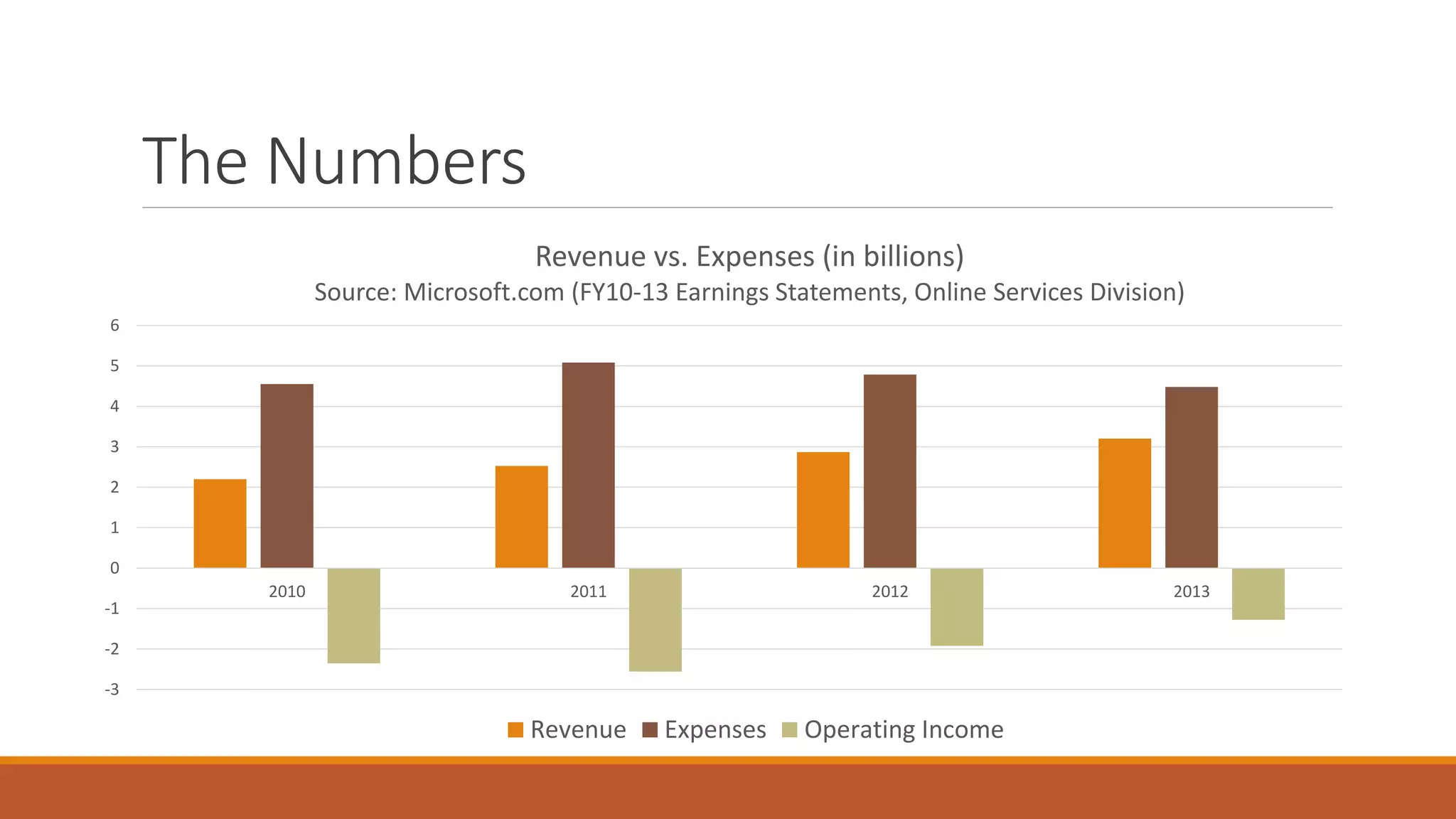
Revenue vs. Expenses (in billions) 
Source: Microsoft.com (FY10-13 Earnings Statements, Online Services Division) 
2010 2011 2012 2013 
Revenue Expenses Operating Income
History 
1995: 
MSN.com 
launches 
1998: MSN 
Search 
introduced 
2005: MSN 
builds its 
own web 
index 
2006: 
Windows 
Live Search 
replaces 
MSN 
2009: 
Microsoft 
launches 
Bing 
2009: Bing 
partners 
with 
Yahoo! 
2013: Bing 
partners 
with Apple 
on Siri
Competitors
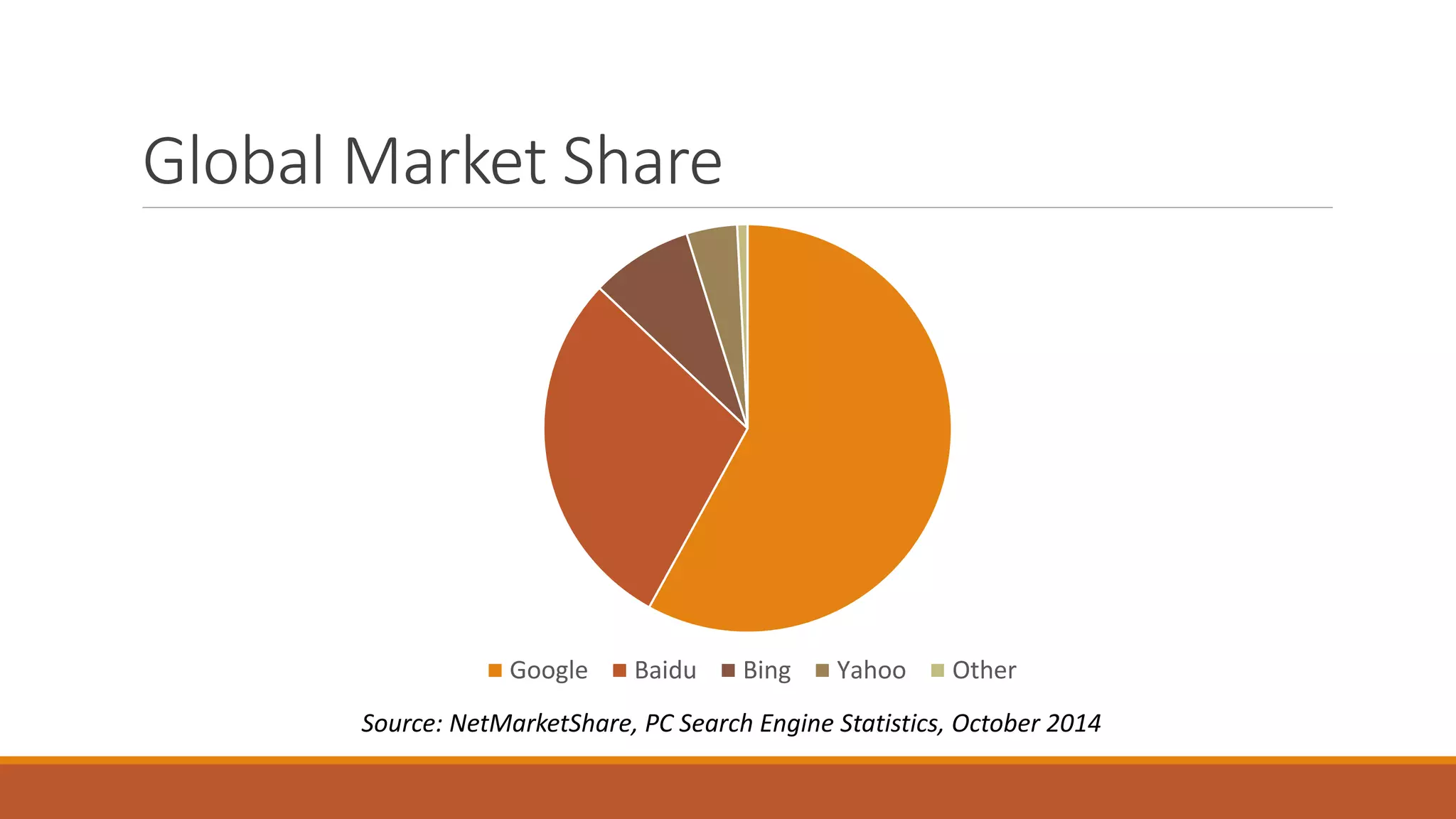
Global Market Share 
Google Baidu Bing Yahoo Other 
Source: NetMarketShare, PC Search Engine Statistics, October 2014
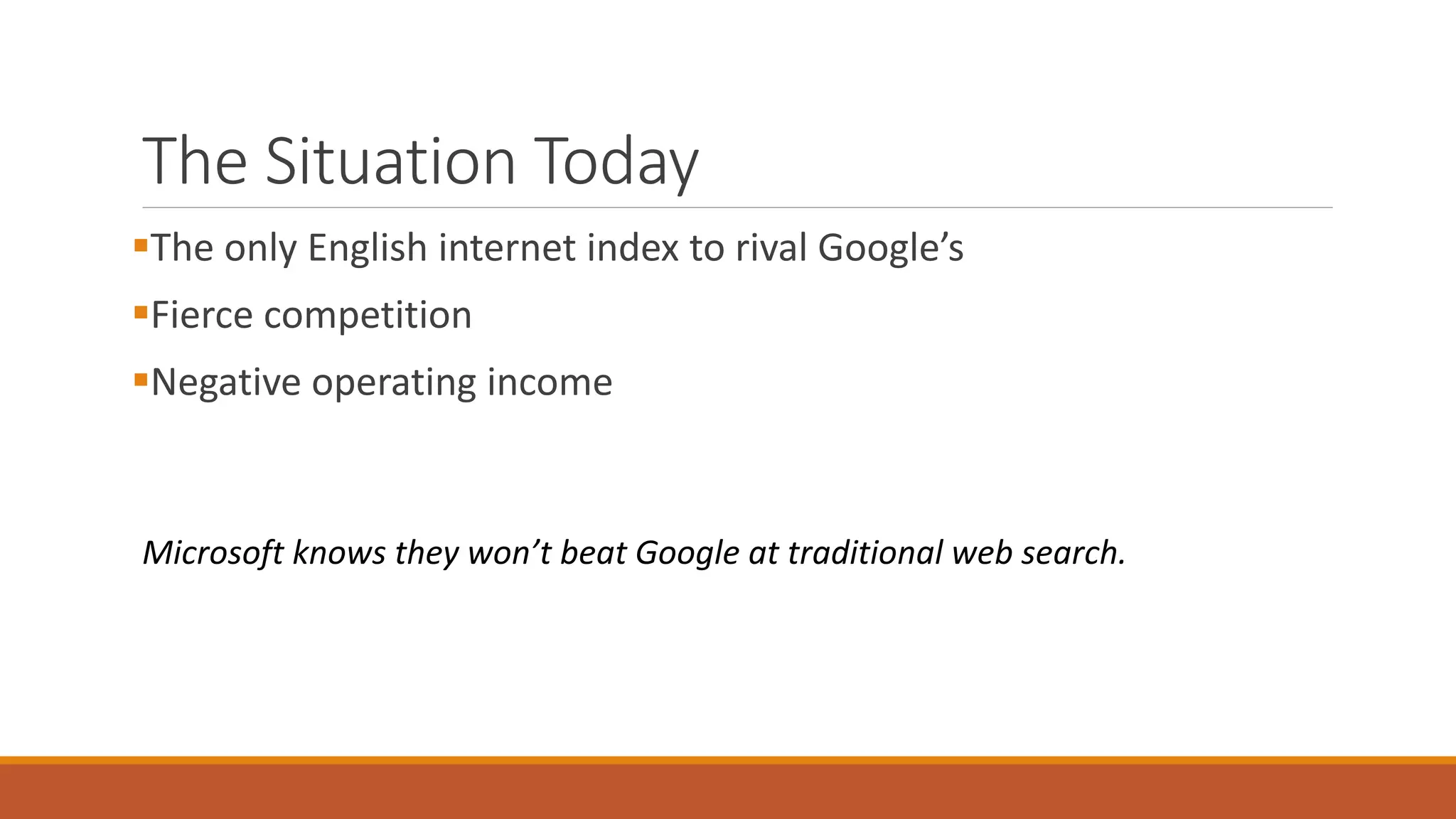
The Situation Today 
The only English internet index to rival Google’s 
Fierce competition 
Negative operating income 
Microsoft knows they won’t beat Google at traditional web search.
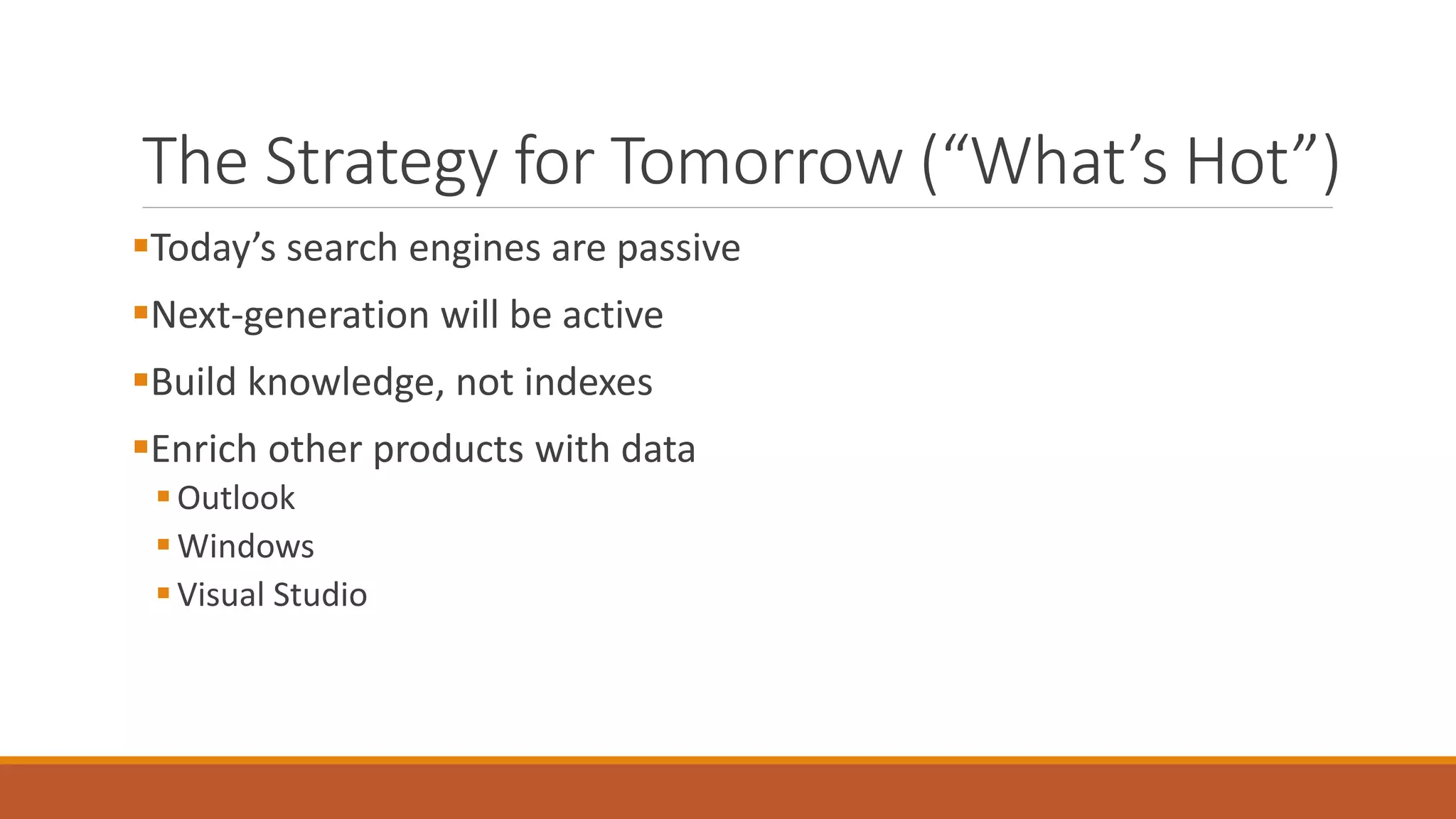
The Strategy for Tomorrow (“What’s Hot”) 
Today’s search engines are passive 
Next-generation will be active 
Build knowledge, not indexes 
Enrich other products with data 
 Outlook 
 Windows 
 Visual Studio
Story 
“The next generation of technology will be built on 
information and machine learning.” 
“When I get an email, I shouldn’t have to ask what the 
Internet already knows.” 
“Google makes money from lost, not found.” 
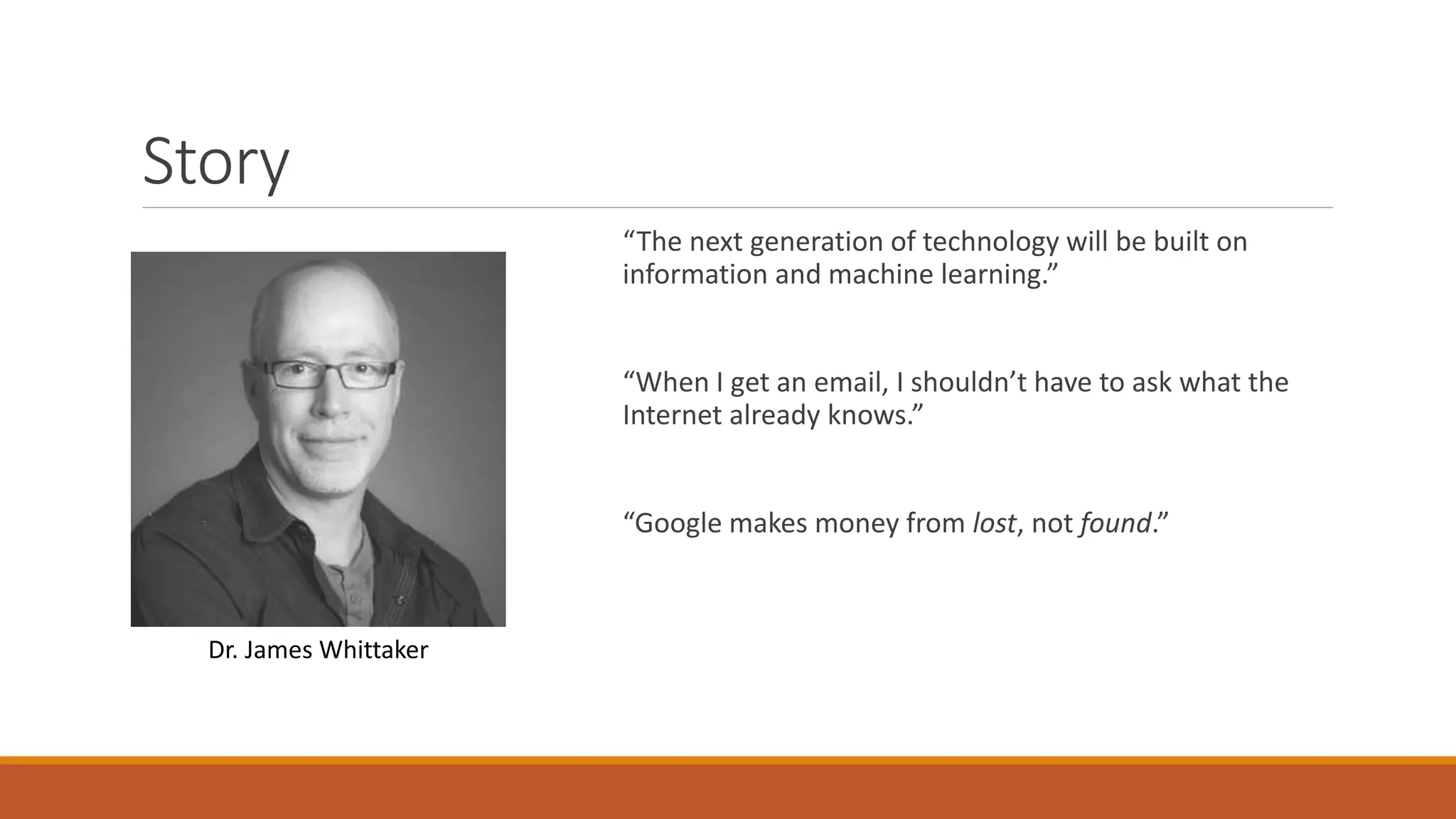
Dr. James Whittaker
Secret Sauce 
Long-term vision 
Aggressive research 
Persistence
Buy or Sell? 
Unimpressive numbers 
Great vision does not imply great execution 
Online services are critical for long-term success 
Buy low, sell high…
Questions?

Microsoft presentation (EECS441, dsmaclen)

  • 1.
  • 2.
    Microsoft’s Online Business 29% of U.S. web searches 12% worldwide Over 5 billion per month Yahoo! partnership Cortana Siri
  • 3.
    The Numbers 6 5 4 3 2 1 0 -1 -2 -3 Revenue vs. Expenses (in billions) Source: Microsoft.com (FY10-13 Earnings Statements, Online Services Division) 2010 2011 2012 2013 Revenue Expenses Operating Income
  • 4.
    History 1995: MSN.com launches 1998: MSN Search introduced 2005: MSN builds its own web index 2006: Windows Live Search replaces MSN 2009: Microsoft launches Bing 2009: Bing partners with Yahoo! 2013: Bing partners with Apple on Siri
  • 5.
  • 6.
    Global Market Share Google Baidu Bing Yahoo Other Source: NetMarketShare, PC Search Engine Statistics, October 2014
  • 7.
    The Situation Today The only English internet index to rival Google’s Fierce competition Negative operating income Microsoft knows they won’t beat Google at traditional web search.
  • 8.
    The Strategy forTomorrow (“What’s Hot”) Today’s search engines are passive Next-generation will be active Build knowledge, not indexes Enrich other products with data  Outlook  Windows  Visual Studio
  • 9.
    Story “The nextgeneration of technology will be built on information and machine learning.” “When I get an email, I shouldn’t have to ask what the Internet already knows.” “Google makes money from lost, not found.” Dr. James Whittaker
  • 10.
    Secret Sauce Long-termvision Aggressive research Persistence
  • 11.
    Buy or Sell? Unimpressive numbers Great vision does not imply great execution Online services are critical for long-term success Buy low, sell high…
  • 12.

Editor's Notes

  • #2 I worked as an intern at Microsoft, for the ads team. Today, I’m going to talk about Microsoft online services. Bing and MSN. (I’m concentrating more on Bing) Why is this part? Internet changed world past 25 (communication, information, decisions) I believe again next 10,25 years. Microsoft part of that transformation, presentation about.
  • #3 What does Microsoft’s online services do? Microsoft handles about 30% of US web searches. (18% from Bing and 11% from Yahoo.) 5 Billion per month. That’s about 2000 per second. Bing is not longer limited just to traditional web searches. Bing powers both Cortana (the Windows phone digital assistant) and now Siri, the iPhone equivalent.
  • #4 This is the most depressing view of Microsoft’s online services—the financials. Expenses (2nd bar) have exceeded revenue (1st bar) for the past several years, leading to a negative operating income. Optimistically, the amount of money lost each year is slowly decreasing, as revenue increases and expenses decrease.
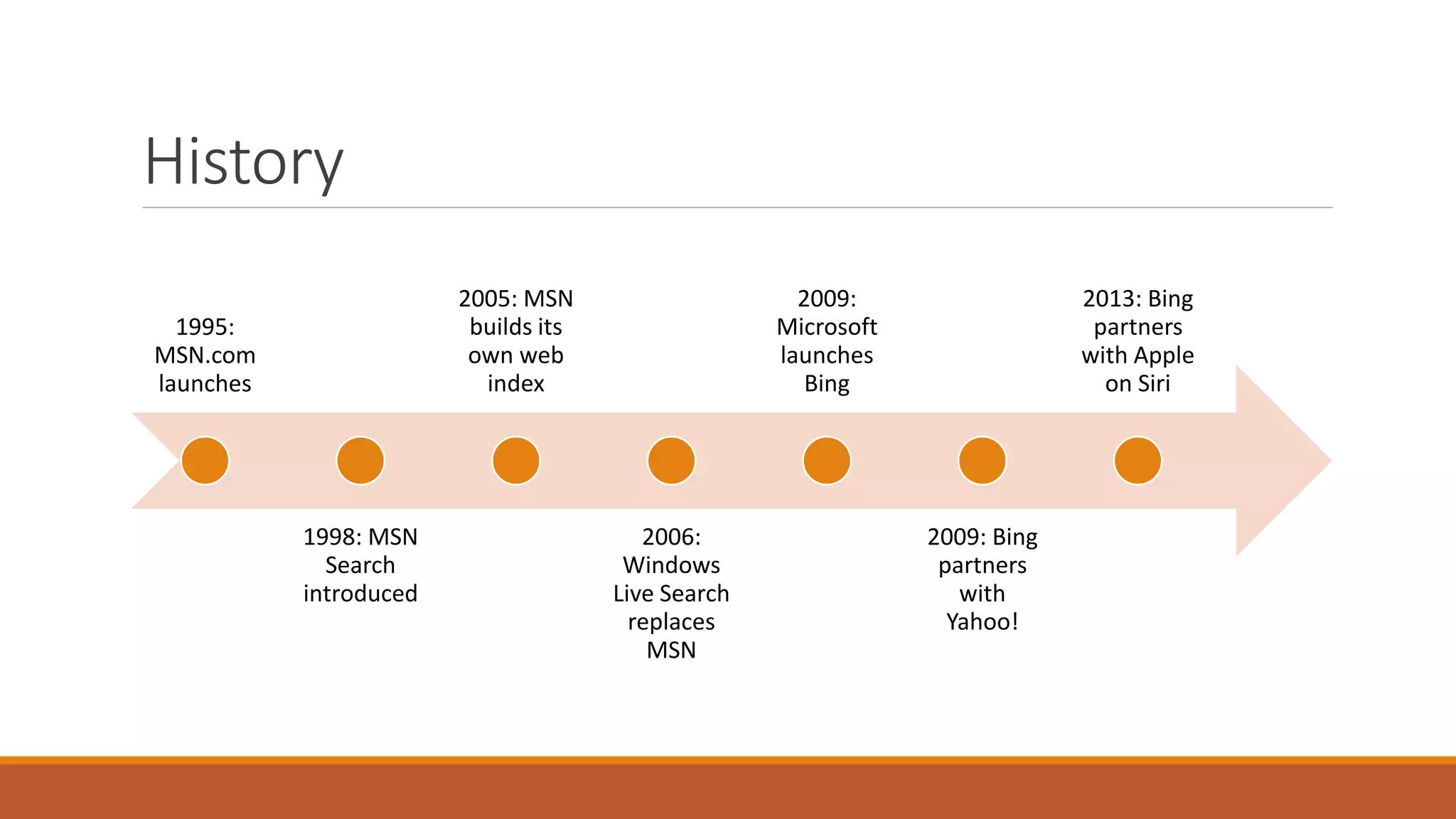
  • #5 (I won’t go over all the items in detail, but will focus on two of them) 1998: Microsoft launches its first search service the same year Google is founded 2009: Microsoft re-brands its search product as “Bing” and nearly doubles its US market share since then
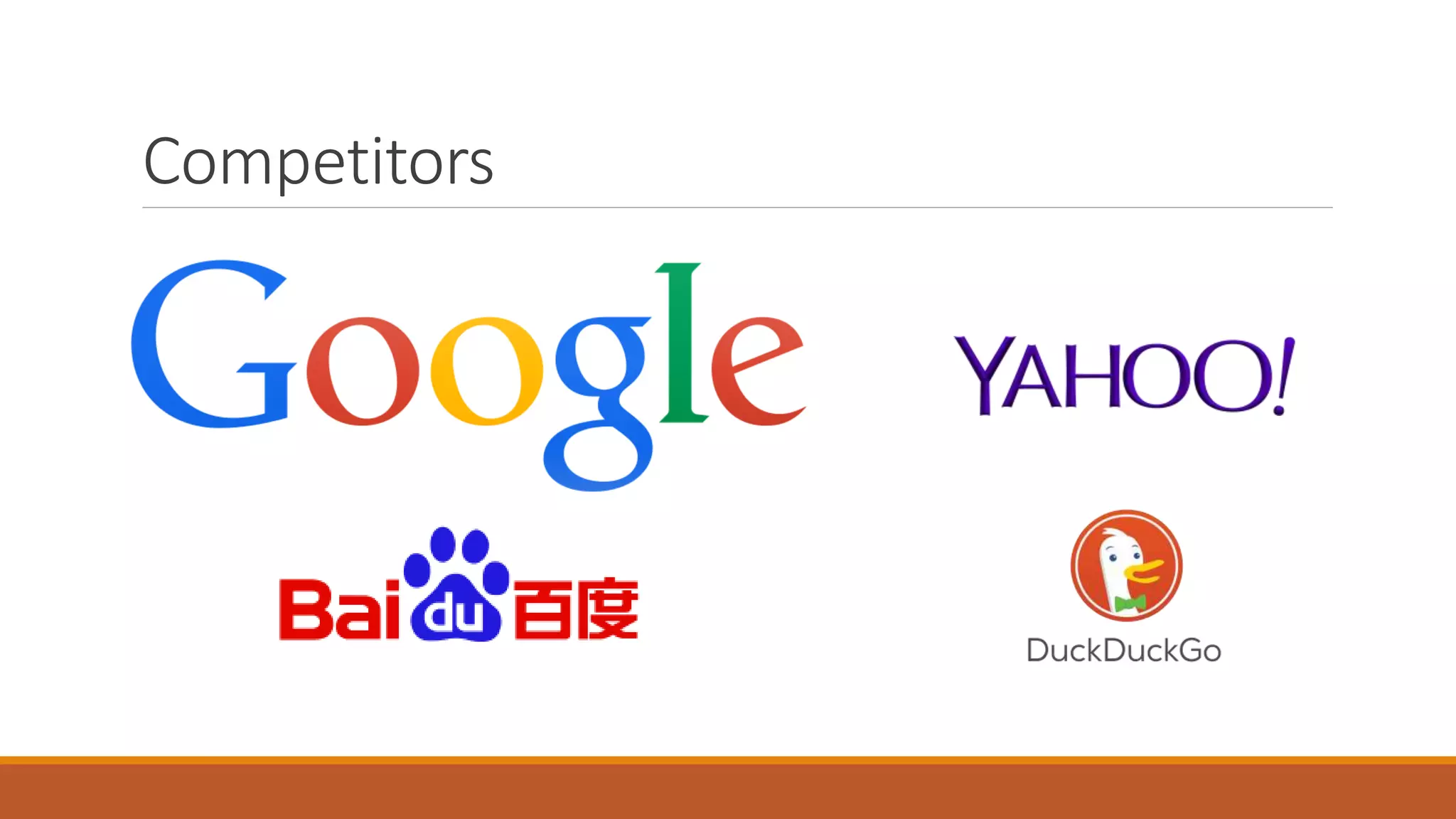
  • #6 Obviously elephant room Google. Built brand fast, reliable. Yahoo! Isn’t as much of a threat. Baidu China, but very little English. Other small players like DuckDuckGo are in niche markets. (Privacy in this case.) This leaves Bing as the challenger to Google for the foreseeable future. (Apple
  • #7 These are the international market share statistics. They are worse for Bing than the US numbers, but give a better idea of global competition.
  • #8 So where does that leave Microsoft today? What’s their strategic position? They’re have the only English web index that comes even close to Google’s (others like Ask use aggregated results or much smaller indexes) They have really fierce competition. And, in most people’s opinion, they’re not doing particularly well. They’re losing money But here’s the thing: Microsoft knows it won’t beat Google (in terms of market share) at traditional web search. In fact, I would suggest they aren’t even trying to.
  • #9 Microsoft has to focus on the long-term. Today, search engines provide us with data when we ask for it. Tomorrow, that won’t happen. There is enough information and technologies that can use that information for the Internet’s knowledge to be brought directly to us. No more searching for everything. Example? When you get an email from a friend about eating at Angelo’s, you shouldn’t have to use Bing/Google to figure out where it is, when it’s open, and what kind of food they serve. Microsoft is focusing on building knowledge, not indexes. (There’s a key difference there. Knowledge deals with the relationship between different entities. I.e., the Michigan Theater is located on Catherine St in Ann Arbor. Not just text in a file copied from their website that mentions the address.) Microsoft is already using this knowledge to enhance its other products, like Outlook, Windows, and Visual Studio. They are developing a plug-in for visual studio that analyzes the code you’ve written and helps you find the appropriate algorithms to use, etc. Similar plugins for Outlook that try to “guess” what you want to know based on your emails/calendar.
  • #10 (I will say this before the quotations have appeared) This is Dr. James Whittaker. Quick bio: He was a professor at the Florida Institute of Technology Then an architect at Microsoft Then a director & tech evangelist at Google After becoming frustrated with Google’s focus on ads and Google+, he returned to Microsoft Dr. Whittaker gave one of the “spotlight” presentations to Microsoft interns last Summer, about the future of the Internet. Three things really stood out to me: First, he said <1>. Most of us. 1 Yottabyte. Trillion terabytes. Quadrillion gigabytes. Second, he talked about the shift from passive to active searching that I mentioned earlier. He predicted this would end in the next few years. <Second quotation>. Example from an email his daughter sent him Finally, he said that Microsoft’s business model puts it in the best position to be the leader of the transformation. Why? <Third quotation> Google makes money on advertisements; they make money on “lost.” “They would be happy if you searched all day.” Microsoft, by contrast, has a business model for Office/Windows that solely prioritizes making the best product.
  • #11 What is the secret sauce of Microsoft? Long-term vision Aggressive research Microsoft Research (MSR) is one of the largest corporate research institutions, much larger than the Google counterpart GoogleX Amazing products are coming out of MSR like Satori (knowledge base) and Cosmos (big data handler) Some of you attended Peter Lee’s presentation last week in Stamps Auditorium. (Lee is a Umich grad and head of Microsoft Research.) (He gave a demo of some of these things.) Incredible persistence Taking on the problem of understanding the world’s information is a huge task, especially with Google as competition. Years of research, development, and investment are needed in a product that, even now, doesn’t make money. A doggedness and determination is critical to winning the end-game. (5-10 years from now)
  • #12 (This is sort of my conclusion slide. The number of slides and their content is more or less fixed by Soloway.) Bing/Microsoft online services isn’t its own stock, but what’s the general picture? Is it going up or down? Really hard to say… Numbers aren’t good, but Bing will play a larger role in Microsoft than just making money. Decent plan for the future, but who knows if they can execute it? Bing/online services are key strategically to Microsoft. Following the old saying “buy low, sell high”, maybe now is the time to buy?