By
    Evelyn Matz
Brandon Kulibert
    Sharon Nett
        Deb Fry
 Personal  information manager
 Available with Microsoft Office Suite, or as
  a separate application
 Often used as an e-mail application it also
  includes:
   a calendar
   task manager
   web browsing
   contact business manager
   a journal
   note taking
                                                 2
 Ribbon   interface in all views

 Contact   cards

 Grouping


 Improved   To Do bar

    “People Pane” and Social Networking
    features

                                           3
Business   Contact Manager

Consolidate   Customer Information

Create   custom tabs and apply filters

Link   and track e-mails

                                          4
Share  customer information with
 colleagues

Synchronize Business Contacts with
 Outlook, SharePoint, or Windows Live
 Contacts

Manage   sales activities
                                        5
 Manage large volumes and multiple e-mail
 accounts

 Customize common tasks and make
 scheduling a breeze

 Search   to easily find what you’re looking
 for


                                                6
 Create  e-mail messages that capture
  attention and are received by intended
  audience
 Stayconnected to your social and business
  networks
 Receive     voice mail previews

 Initiate   live conversations

                                              7
 http://office.microsoft.com/en-us/outlook-
 help/video-take-a-tour-of-outlook-2010-
 VA102057878.aspx?CTT=3


                                               8
9
10
11
2


    4
            3


        1

                12
13
Send e-mail


              14
15
16
   http://office.microsoft.com/en-us/outlook/top-10-
    reasons-to-try-outlook-2010-HA101631728.aspx

   http://office.microsoft.com/en-us/outlook-
    help/redir/va102057878.aspx

   http://office.microsoft.com/en-us/outlook/outlook-2010-
    with-business-contact-manager-features-and-benefits-
    HA101808863.aspx

   http://office.microsoft.com/en-us/outlook-help/basic-
    tasks-in-outlook-2010-
    HA101829999.aspx#_Toc260824060
                                                              17

Microsoft outlook 2010

  • 1.
    By Evelyn Matz Brandon Kulibert Sharon Nett Deb Fry
  • 2.
     Personal information manager  Available with Microsoft Office Suite, or as a separate application  Often used as an e-mail application it also includes:  a calendar  task manager  web browsing  contact business manager  a journal  note taking 2
  • 3.
     Ribbon interface in all views  Contact cards  Grouping  Improved To Do bar  “People Pane” and Social Networking features 3
  • 4.
    Business Contact Manager Consolidate Customer Information Create custom tabs and apply filters Link and track e-mails 4
  • 5.
    Share customerinformation with colleagues Synchronize Business Contacts with Outlook, SharePoint, or Windows Live Contacts Manage sales activities 5
  • 6.
     Manage largevolumes and multiple e-mail accounts  Customize common tasks and make scheduling a breeze  Search to easily find what you’re looking for 6
  • 7.
     Create e-mail messages that capture attention and are received by intended audience  Stayconnected to your social and business networks  Receive voice mail previews  Initiate live conversations 7
  • 8.
  • 9.
  • 10.
  • 11.
  • 12.
    2 4 3 1 12
  • 13.
  • 14.
  • 15.
  • 16.
  • 17.
    http://office.microsoft.com/en-us/outlook/top-10- reasons-to-try-outlook-2010-HA101631728.aspx  http://office.microsoft.com/en-us/outlook- help/redir/va102057878.aspx  http://office.microsoft.com/en-us/outlook/outlook-2010- with-business-contact-manager-features-and-benefits- HA101808863.aspx  http://office.microsoft.com/en-us/outlook-help/basic- tasks-in-outlook-2010- HA101829999.aspx#_Toc260824060 17

Editor's Notes

  • #3 Outlook is a personal information manager from Microsoft.Available as a separate application, they offer a free trial period before you purchase, or it comes as part of the Microsoft Suite.Often Outlook is used as an e-mail application and it also includes a calendar, task manager, contact manager, business manager, note taking, a journal, and web browsing.
  • #4 Features1 Ribbon interface in all views.2 Contact cards– to show pop up details of all message participants or user contact records.3 Grouping – grouping of conversations includes messages from all folders and optionally from separate accounts.4 Improved To Do Bar– for example, shows how many appointments are not shown when space is limited.5 People Pane and Social Networking features– Facebook and Blogging
  • #5 Business Contact Manager provides powerful customer and contact management to improve the effectiveness of your business. Consolidate customer information. Keeps all information related to your contacts, including e-mail messages, appointments, and documents in a single place. Lets you manage all your organizations customer information within Outlook.Create custom tabs and apply filters to show only those contacts relevant to your business needs.Link and track e-mails. You can automatically link e-mail received from or sent to each customer.
  • #6 1 Share customer information with colleagues. Create Share contact and sales information with those in your team who need it. When a potential customer calls, your staff has the information they need.2 Synchronize business contacts with Outlook, SharePoint, or Windows Live Contacts. View and edit your business contacts form anywhere you can access Outlook Contacts.3 Manage sales activities. You can manage sales leads, stay on top of sales opportunities, identify your top customers and products, Forecast sales and prioritize tasks using the dashboard, Analyze your data using any of the 72 predefined reports.
  • #7 1 Manage multiple e-mail accounts from one place. Synchronize e-mail accounts from services such as Hotmail, Gmail, or just about any other provider to Outlook 2010. Manage large volumes of e-mail with ease. Conversation View in Outlook 2010 improves the tracking of e-mail conversations—reducing information overload—and helps you manage large amounts of e-mail with ease.2 Customize common tasks into a single-click command. Create and save custom actions in a new way with Quick Steps. Make scheduling a breeze. With the E-mail Calendar feature, you can send your schedule to others so they can quickly find time for your next appointment, and the new Schedule View provides a horizontal display of multiple calendars.3 Search to easily find what you're looking for. The enhanced Search Tools provide you with ways to quickly find and manage large quantities of e-mail, calendar, and contact items.
  • #8 6 Create e-mail messages that capture attention. Dynamic graphics and picture editing tools include SmartArt™ graphics, Office themes, and Styles. Ensure that your e-mail messages get to the intended audience. With the new MailTips feature, you’re alerted when you are about to send e-mail to a large distribution list, to someone who is out of the office or to individuals outside the organization. Exchange Server 2010 and IT staff administration is required for setup7 Stay connected with your personal and business networks. Use Outlook Social Connector to get additional information about people, such as mutual friends and other social information, while staying better connected to your social and business circles. Requires either SharePoint Server 2010 or a Windows Live account9Receive voice mail previews in your inbox. With Outlook 2010 and new technology in Exchange Server 2010, a voice-to-text preview of a recorded voice message is sent along with the voice mail recording directly to your inbox. (An appropriate device and Internet connection are required. Outlook Mobile is not included in Office 2010 applications or suites or Office Web Apps. Outlook Mobile comes pre-installed on Windows phones )(Windows Mobile 6.5 or later).10 Initiate live conversations from Outlook.By using Office Communicator, Lync, or your instant messaging applicationyou can start a voice call without leaving Outlook. (Instant messaging and presence requires one of the following: Microsoft Lync Server 2010 with Microsoft Lync 2010; Microsoft Office Communications Server 2007 R2 with Microsoft Office Communicator 2007 R2; Windows Live Messenger, or another instant messaging application that supports IMessenger. Voice calls require Microsoft Lync Server 2010 with Microsoft Lync 2010; Office Communications Server 2007 R2 with Office Communicator 2007 R2, or an instant messaging Office Communications Server 2007 R2 with Office Communicator 2007 R2 or an instant messaging application that supports IMessengerAdvanced)
  • #9 Whether you are new to Microsoft Outlook or upgrading from a previous version, this video takes you on a quick tour of Outlook 2010. This overview explores the most commonly used features, new features, and the improved ribbon and user interface found in Outlook 2010.
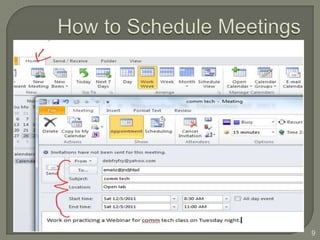
  • #10 To schedule a new meeting. In Calendar, on the Home tab, in the New group, click New Meeting.Add contactsFill out subject, location, Start and end date and time.Fill in description or comments. Click Send
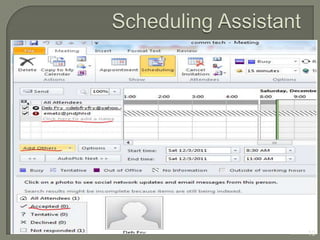
  • #11 On the Meeting tab, in the Show group, click Scheduling Assistant.The Scheduling Assistant helps you find the best time for your meeting.Click Add Others, and then click Add from Address Book.You can track who has accepted or declined or responded.Click send.
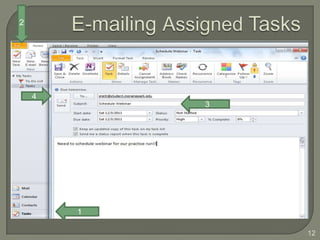
  • #12 In Tasks, on the Home tab, in the New group, click New TaskIn the Subject box, type a name for the task. You can add more detail in the task body.On the Task tab, in the Actions group, click Save & Close.
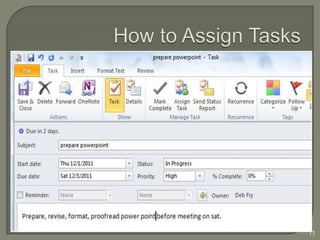
  • #13 Click Task in Navigation Pane.In Home Tab,New group, click New TaskIn the Task Tab, manage task group, click Assign TaskFill out contact information.Click Send.
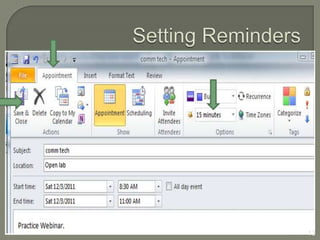
  • #14 For appointments or meetingsIn an open item, on the Appointment or Meeting tab, in the Options group, in the Reminder drop-down list, select the amount of time before the appointment or meeting when you want the reminder to appear. To turn a reminder off, select None. Save and close.
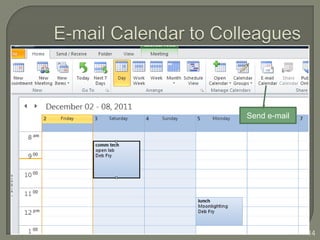
  • #15 Click calendar in the navigation PaneChoose how you want to arrange, day, week, month.Click e-mail calendar in the Share group
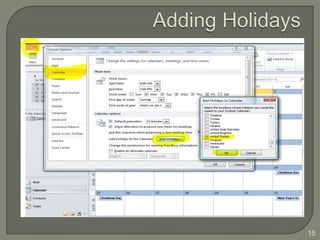
  • #16 Click File Tab ,click Options, and then click Calendar.Under Calendar options, click Add Holidays.Select the check box next to each country/region whose holidays you want to add to your calendar, and then click OK.
  • #17 We will answer question now.You can view our PowerPoint at Slideshare.netA survey will be sent out to all attendees as well as a link to view our PowerPointPlease take time to complete the survey, your time is appreciated.Thank you for attending our webinar.