Microsoft Azure Cloud for
Solution Architects
Roy Kim
@roykimtoronto
roykimtoronto@gmail.com
September 2015
About me
 7+ years design and developing SharePoint
solutions.
 13+ career on the Microsoft technology stack for
enterprise.
 Worked for Deloitte, PwC, Infusion, Accenture
 .NET, JavaScript, Office 365, Azure
 Certification: 70-532 Developing MS Azure Solutions
 U of T computer science
A
g
e
n
d
a
 Azure Overview
 Design and Prototyping
 Scalability and Performance
 Commentary
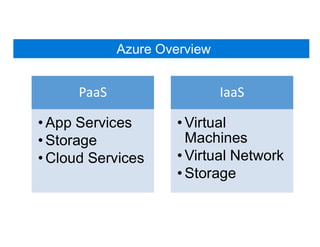
Azure Overview
PaaS
• App Services
• Storage
• Cloud Services
IaaS
• Virtual
Machines
• Virtual Network
• Storage
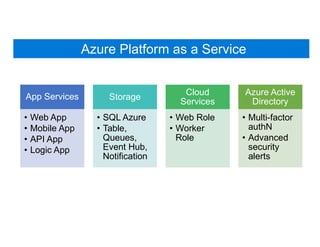
Azure Platform as a Service
App Services
• Web App
• Mobile App
• API App
• Logic App
Storage
• SQL Azure
• Table,
Queues,
Event Hub,
Notification
Cloud
Services
• Web Role
• Worker
Role
Azure Active
Directory
• Multi-factor
authN
• Advanced
security
alerts
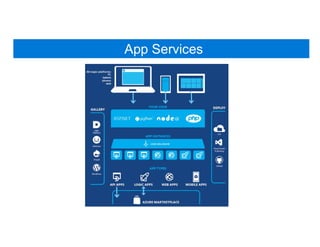
App Services
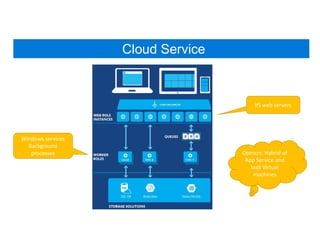
Cloud Service
IIS web servers
Windows services
Background
processes Opinion: Hybrid of
App Service and
IaaS Virtual
machines
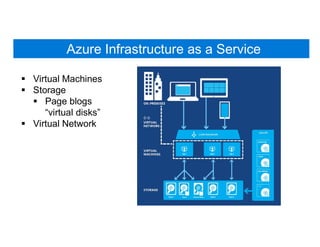
Azure Infrastructure as a Service
 Virtual Machines
 Storage
 Page blogs
“virtual disks”
 Virtual Network
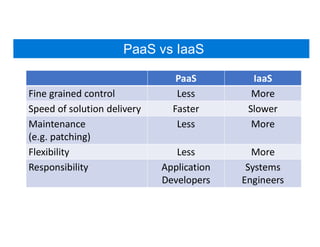
PaaS vs IaaS
PaaS IaaS
Fine grained control Less More
Speed of solution delivery Faster Slower
Maintenance
(e.g. patching)
Less More
Flexibility Less More
Responsibility Application
Developers
Systems
Engineers
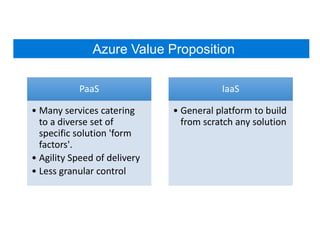
Azure Value Proposition
PaaS
• Many services catering
to a diverse set of
specific solution 'form
factors'.
• Agility Speed of delivery
• Less granular control
IaaS
• General platform to build
from scratch any solution
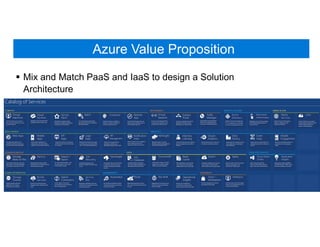
Azure Value Proposition
 Mix and Match PaaS and IaaS to design a Solution
Architecture
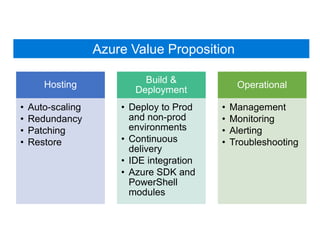
Azure Value Proposition
Hosting
• Auto-scaling
• Redundancy
• Patching
• Restore
Build &
Deployment
• Deploy to Prod
and non-prod
environments
• Continuous
delivery
• IDE integration
• Azure SDK and
PowerShell
modules
Operational
• Management
• Monitoring
• Alerting
• Troubleshooting
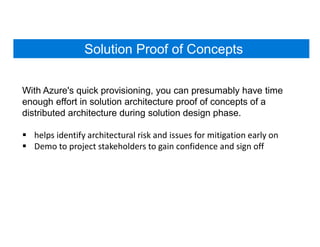
Solution Proof of Concepts
With Azure's quick provisioning, you can presumably have time
enough effort in solution architecture proof of concepts of a
distributed architecture during solution design phase.
 helps identify architectural risk and issues for mitigation early on
 Demo to project stakeholders to gain confidence and sign off
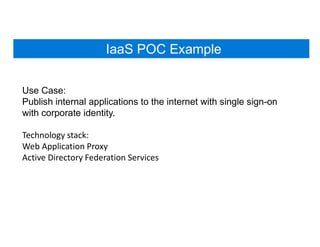
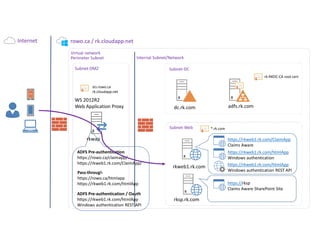
IaaS POC Example
Use Case:
Publish internal applications to the internet with single sign-on
with corporate identity.
Technology stack:
Web Application Proxy
Active Directory Federation Services
dc.rk.com adfs.rk.com
rkweb1.rk.com
https://rkweb1.rk.com/ClaimApp
Claims Aware
Subnet-DMZ
Subnet-Web
Virtual network
WS 2012R2
Web Application Proxy
Perimeter Subnet
rowo.ca / rk.cloudapp.netInternet
rkwap
Subnet-DC
https://rkweb1.rk.com/htmlApp
Windows authentication
https://rkweb1.rk.com/htmlApp
Windows authentication REST API
rk-RKDC-CA root cert
sts.rowo.ca
rk.cloudapp.net
Internal Subnet/Network
*.rk.com
ADFS Pre-authentication
https://rowo.ca/claimapp/
https://rkweb1.rk.com/ClaimApp/
Pass-through
https://rowo.ca/htmlapp
https://rkweb1.rk.com/htmlApp
ADFS Pre-authentication / Oauth
https://rkweb1.rk.com/htmlApp
Windows authentication REST API
rksp.rk.com
https://rksp
Claims Aware SharePoint Site
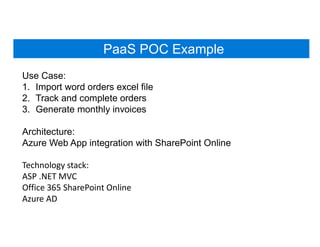
PaaS POC Example
Use Case:
1. Import word orders excel file
2. Track and complete orders
3. Generate monthly invoices
Architecture:
Azure Web App integration with SharePoint Online
Technology stack:
ASP .NET MVC
Office 365 SharePoint Online
Azure AD
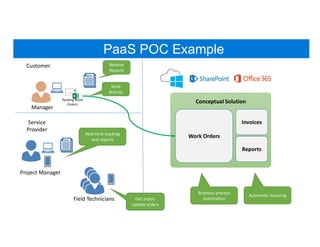
Conceptual Solution
Field Technicians
Project Manager
Manager
Work Orders
Invoices
Reports
Pending Work
Orders
Receive
Reports
Get orders
Update orders
Send
directly
Real-time tracking
and reports
Business process
automation
Automatic invoicing
Service
Provider
Customer
PaaS POC Example
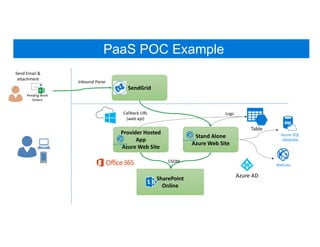
SharePoint
Online
Stand Alone
Azure Web Site
Provider Hosted
App
Azure Web Site
Pending Work
Orders
Send Email &
attachment
PaaS POC Example
SendGrid
Azure AD
Inbound Parse
Callback URL
(web api)
Table
Azure Website
Azure Website
CSOM
Azure SQL
database
Logs
WebJobs
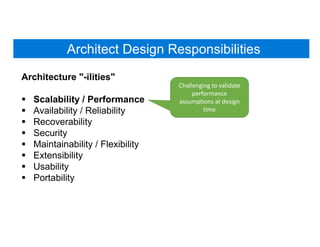
Architect Design Responsibilities
Architecture "-ilities"
 Scalability / Performance
 Availability / Reliability
 Recoverability
 Security
 Maintainability / Flexibility
 Extensibility
 Usability
 Portability
Challenging to validate
performance
assumptions at design
time
Designing for Performance
Scalability/performance
 User load, backend load and data volume assumptions can
have high variability
 Determining scalability and server resources needs based on
workload model
 What to specific conditions to monitor? How architecture is to
respond?
 What can generally happen is that, these challenges are
covered by a set of assumptions, risks/mitigation in the design
document.
 Can you really confidently promise specific SLA to the
business?
 3 second response time, 99.9% uptime, business continuity
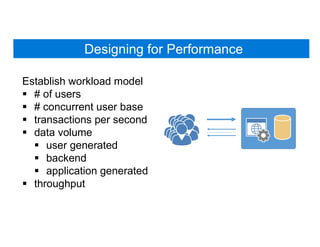
Designing for Performance
Establish workload model
 # of users
 # concurrent user base
 transactions per second
 data volume
 user generated
 backend
 application generated
 throughput
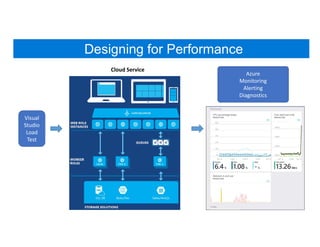
Designing for Performance
Visual
Studio
Load
Test
Azure
Monitoring
Alerting
Diagnostics
Cloud Service
Designing for Performance
Aligning to Service Level Agreement or Service Level
Objectives
 Expected response time
 Throughput
 Capacity
 Server Resources Usage
 Uptime
Key Take Away Vision
 Rapidly prototype, build and deploy solutions
leveraging Azure.
 Independence from infrastructure teams for needed
resources for design prototyping.
Call To Action
Resources
 Microsoft Azure Documentation
https://azure.microsoft.com/en-us/documentation
 Try Azure as a Free Trial $250 credit for 30 days
or use your MSDN subscription if you have one
https://azure.microsoft.com/en-us/pricing/free-trial/
 Microsoft Virtual Academy
 Blogs from Azure subject matter experts
Questions
Feel free to contact!
• @roykimtoronto
• roykimtoronto@gmail.com
• www.roykim.ca

Microsoft Azure For Solutions Architects

  • 1.
    Microsoft Azure Cloudfor Solution Architects Roy Kim @roykimtoronto roykimtoronto@gmail.com September 2015
  • 2.
    About me  7+years design and developing SharePoint solutions.  13+ career on the Microsoft technology stack for enterprise.  Worked for Deloitte, PwC, Infusion, Accenture  .NET, JavaScript, Office 365, Azure  Certification: 70-532 Developing MS Azure Solutions  U of T computer science
  • 3.
    A g e n d a  Azure Overview Design and Prototyping  Scalability and Performance  Commentary
  • 4.
    Azure Overview PaaS • AppServices • Storage • Cloud Services IaaS • Virtual Machines • Virtual Network • Storage
  • 5.
    Azure Platform asa Service App Services • Web App • Mobile App • API App • Logic App Storage • SQL Azure • Table, Queues, Event Hub, Notification Cloud Services • Web Role • Worker Role Azure Active Directory • Multi-factor authN • Advanced security alerts
  • 6.
  • 7.
    Cloud Service IIS webservers Windows services Background processes Opinion: Hybrid of App Service and IaaS Virtual machines
  • 8.
    Azure Infrastructure asa Service  Virtual Machines  Storage  Page blogs “virtual disks”  Virtual Network
  • 9.
    PaaS vs IaaS PaaSIaaS Fine grained control Less More Speed of solution delivery Faster Slower Maintenance (e.g. patching) Less More Flexibility Less More Responsibility Application Developers Systems Engineers
  • 10.
    Azure Value Proposition PaaS •Many services catering to a diverse set of specific solution 'form factors'. • Agility Speed of delivery • Less granular control IaaS • General platform to build from scratch any solution
  • 11.
    Azure Value Proposition Mix and Match PaaS and IaaS to design a Solution Architecture
  • 12.
    Azure Value Proposition Hosting •Auto-scaling • Redundancy • Patching • Restore Build & Deployment • Deploy to Prod and non-prod environments • Continuous delivery • IDE integration • Azure SDK and PowerShell modules Operational • Management • Monitoring • Alerting • Troubleshooting
  • 13.
    Solution Proof ofConcepts With Azure's quick provisioning, you can presumably have time enough effort in solution architecture proof of concepts of a distributed architecture during solution design phase.  helps identify architectural risk and issues for mitigation early on  Demo to project stakeholders to gain confidence and sign off
  • 14.
    IaaS POC Example UseCase: Publish internal applications to the internet with single sign-on with corporate identity. Technology stack: Web Application Proxy Active Directory Federation Services
  • 15.
    dc.rk.com adfs.rk.com rkweb1.rk.com https://rkweb1.rk.com/ClaimApp Claims Aware Subnet-DMZ Subnet-Web Virtualnetwork WS 2012R2 Web Application Proxy Perimeter Subnet rowo.ca / rk.cloudapp.netInternet rkwap Subnet-DC https://rkweb1.rk.com/htmlApp Windows authentication https://rkweb1.rk.com/htmlApp Windows authentication REST API rk-RKDC-CA root cert sts.rowo.ca rk.cloudapp.net Internal Subnet/Network *.rk.com ADFS Pre-authentication https://rowo.ca/claimapp/ https://rkweb1.rk.com/ClaimApp/ Pass-through https://rowo.ca/htmlapp https://rkweb1.rk.com/htmlApp ADFS Pre-authentication / Oauth https://rkweb1.rk.com/htmlApp Windows authentication REST API rksp.rk.com https://rksp Claims Aware SharePoint Site
  • 16.
    PaaS POC Example UseCase: 1. Import word orders excel file 2. Track and complete orders 3. Generate monthly invoices Architecture: Azure Web App integration with SharePoint Online Technology stack: ASP .NET MVC Office 365 SharePoint Online Azure AD
  • 17.
    Conceptual Solution Field Technicians ProjectManager Manager Work Orders Invoices Reports Pending Work Orders Receive Reports Get orders Update orders Send directly Real-time tracking and reports Business process automation Automatic invoicing Service Provider Customer PaaS POC Example
  • 18.
    SharePoint Online Stand Alone Azure WebSite Provider Hosted App Azure Web Site Pending Work Orders Send Email & attachment PaaS POC Example SendGrid Azure AD Inbound Parse Callback URL (web api) Table Azure Website Azure Website CSOM Azure SQL database Logs WebJobs
  • 19.
    Architect Design Responsibilities Architecture"-ilities"  Scalability / Performance  Availability / Reliability  Recoverability  Security  Maintainability / Flexibility  Extensibility  Usability  Portability Challenging to validate performance assumptions at design time
  • 20.
    Designing for Performance Scalability/performance User load, backend load and data volume assumptions can have high variability  Determining scalability and server resources needs based on workload model  What to specific conditions to monitor? How architecture is to respond?  What can generally happen is that, these challenges are covered by a set of assumptions, risks/mitigation in the design document.  Can you really confidently promise specific SLA to the business?  3 second response time, 99.9% uptime, business continuity
  • 21.
    Designing for Performance Establishworkload model  # of users  # concurrent user base  transactions per second  data volume  user generated  backend  application generated  throughput
  • 22.
  • 23.
    Designing for Performance Aligningto Service Level Agreement or Service Level Objectives  Expected response time  Throughput  Capacity  Server Resources Usage  Uptime
  • 24.
    Key Take AwayVision  Rapidly prototype, build and deploy solutions leveraging Azure.  Independence from infrastructure teams for needed resources for design prototyping.
  • 25.
    Call To Action Resources Microsoft Azure Documentation https://azure.microsoft.com/en-us/documentation  Try Azure as a Free Trial $250 credit for 30 days or use your MSDN subscription if you have one https://azure.microsoft.com/en-us/pricing/free-trial/  Microsoft Virtual Academy  Blogs from Azure subject matter experts
  • 26.
    Questions Feel free tocontact! • @roykimtoronto • roykimtoronto@gmail.com • www.roykim.ca