ALBERTSONS
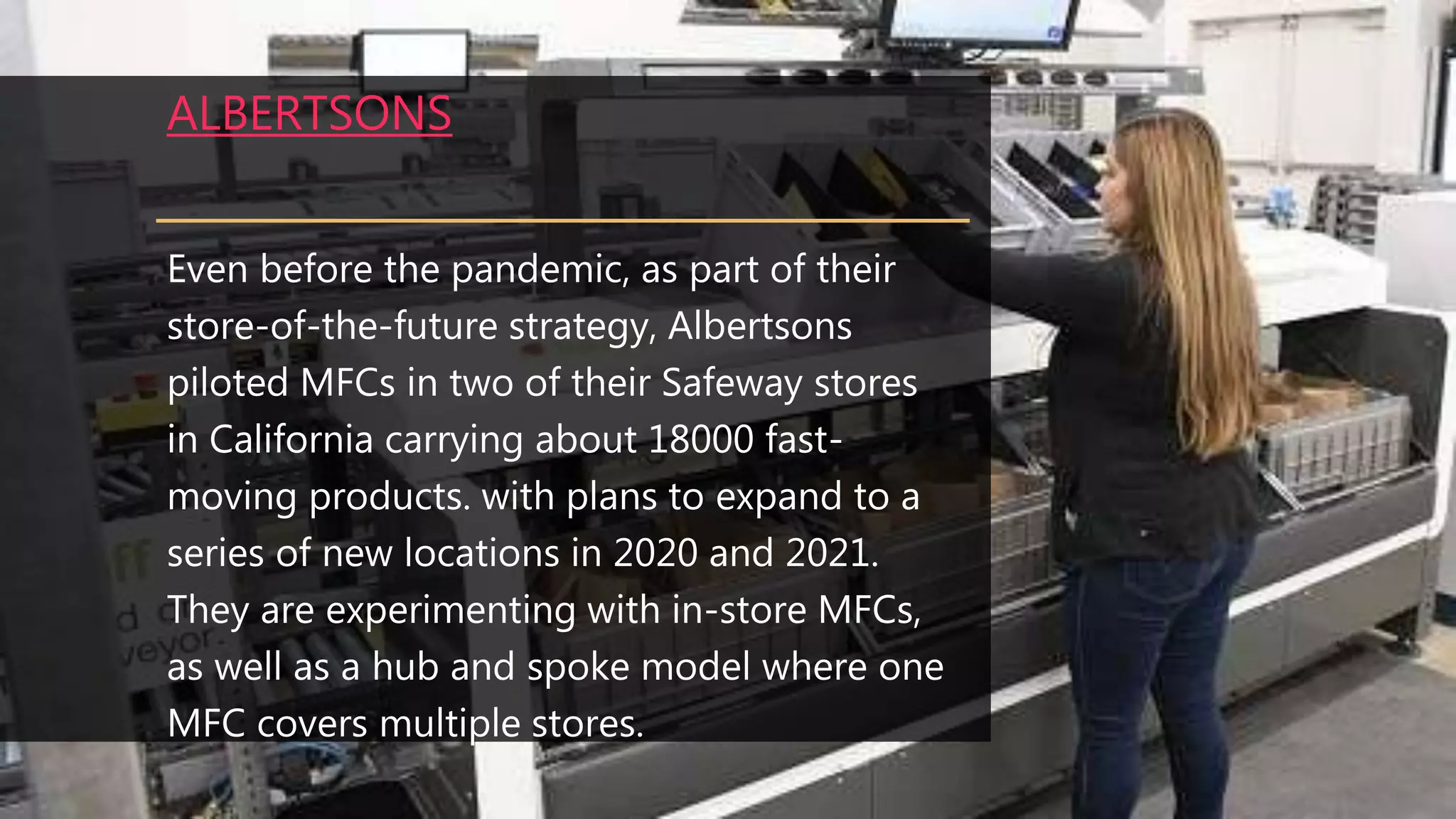
Even before the pandemic, as part of their
store-of-the-future strategy, Albertsons
piloted MFCs in two of their Safeway stores
in California carrying about 18000 fast-
moving products. with plans to expand to a
series of new locations in 2020 and 2021.
They are experimenting with in-store MFCs,
as well as a hub and spoke model where one
MFC covers multiple stores.
LOBLAWS
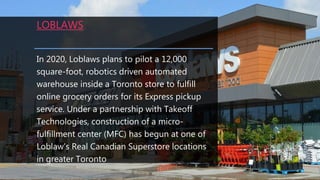
In 2020, Loblaws plans to pilot a 12,000
square-foot, robotics driven automated
warehouse inside a Toronto store to fulfill
online grocery orders for its Express pickup
service. Under a partnership with Takeoff
Technologies, construction of a micro-
fulfillment center (MFC) has begun at one of
Loblaw’s Real Canadian Superstore locations
in greater Toronto
SHOPRITE
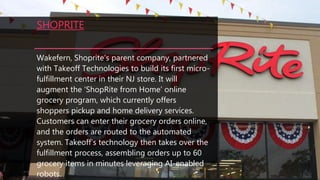
Wakefern, Shoprite’s parent company, partnered
with Takeoff Technologies to build its first micro-
fulfillment center in their NJ store. It will
augment the ‘ShopRite from Home’ online
grocery program, which currently offers
shoppers pickup and home delivery services.
Customers can enter their grocery orders online,
and the orders are routed to the automated
system. Takeoff’s technology then takes over the
fulfillment process, assembling orders up to 60
grocery items in minutes leveraging AI-enabled
robots.
KROGER
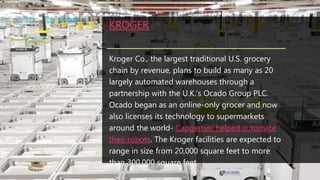
Kroger Co., the largest traditional U.S. grocery
chain by revenue, plans to build as many as 20
largely automated warehouses through a
partnership with the U.K.’s Ocado Group PLC.
Ocado began as an online-only grocer and now
also licenses its technology to supermarkets
around the world- Capgemini helped automate
their robots. The Kroger facilities are expected to
range in size from 20,000 square feet to more
than 300,000 square feet.
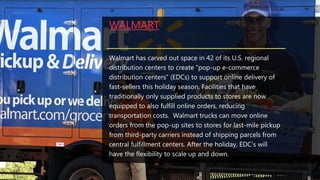
WALMART
Walmart has carved out space in 42 of its U.S. regional
distribution centers to create “pop-up e-commerce
distribution centers” (EDCs) to support online delivery of
fast-sellers this holiday season. Facilities that have
traditionally only supplied products to stores are now
equipped to also fulfill online orders, reducing
transportation costs. Walmart trucks can move online
orders from the pop-up sites to stores for last-mile pickup
from third-party carriers instead of shipping parcels from
central fulfillment centers. After the holiday, EDC’s will
have the flexibility to scale up and down.
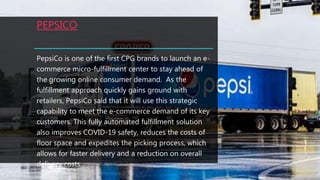
PEPSICO
PepsiCo is one of the first CPG brands to launch an e-
commerce micro-fulfillment center to stay ahead of
the growing online consumer demand. As the
fulfillment approach quickly gains ground with
retailers, PepsiCo said that it will use this strategic
capability to meet the e-commerce demand of its key
customers. This fully automated fulfillment solution
also improves COVID-19 safety, reduces the costs of
floor space and expedites the picking process, which
allows for faster delivery and a reduction on overall
delivery costs.

Micro-fulfillment centers

  • 1.
    ALBERTSONS Even before thepandemic, as part of their store-of-the-future strategy, Albertsons piloted MFCs in two of their Safeway stores in California carrying about 18000 fast- moving products. with plans to expand to a series of new locations in 2020 and 2021. They are experimenting with in-store MFCs, as well as a hub and spoke model where one MFC covers multiple stores.
  • 2.
    LOBLAWS In 2020, Loblawsplans to pilot a 12,000 square-foot, robotics driven automated warehouse inside a Toronto store to fulfill online grocery orders for its Express pickup service. Under a partnership with Takeoff Technologies, construction of a micro- fulfillment center (MFC) has begun at one of Loblaw’s Real Canadian Superstore locations in greater Toronto
  • 3.
    SHOPRITE Wakefern, Shoprite’s parentcompany, partnered with Takeoff Technologies to build its first micro- fulfillment center in their NJ store. It will augment the ‘ShopRite from Home’ online grocery program, which currently offers shoppers pickup and home delivery services. Customers can enter their grocery orders online, and the orders are routed to the automated system. Takeoff’s technology then takes over the fulfillment process, assembling orders up to 60 grocery items in minutes leveraging AI-enabled robots.
  • 4.
    KROGER Kroger Co., thelargest traditional U.S. grocery chain by revenue, plans to build as many as 20 largely automated warehouses through a partnership with the U.K.’s Ocado Group PLC. Ocado began as an online-only grocer and now also licenses its technology to supermarkets around the world- Capgemini helped automate their robots. The Kroger facilities are expected to range in size from 20,000 square feet to more than 300,000 square feet.
  • 5.
    WALMART Walmart has carvedout space in 42 of its U.S. regional distribution centers to create “pop-up e-commerce distribution centers” (EDCs) to support online delivery of fast-sellers this holiday season. Facilities that have traditionally only supplied products to stores are now equipped to also fulfill online orders, reducing transportation costs. Walmart trucks can move online orders from the pop-up sites to stores for last-mile pickup from third-party carriers instead of shipping parcels from central fulfillment centers. After the holiday, EDC’s will have the flexibility to scale up and down.
  • 6.
    PEPSICO PepsiCo is oneof the first CPG brands to launch an e- commerce micro-fulfillment center to stay ahead of the growing online consumer demand. As the fulfillment approach quickly gains ground with retailers, PepsiCo said that it will use this strategic capability to meet the e-commerce demand of its key customers. This fully automated fulfillment solution also improves COVID-19 safety, reduces the costs of floor space and expedites the picking process, which allows for faster delivery and a reduction on overall delivery costs.