Are Grocery Store
Workers in Trouble?
eCommerce, New Food Delivery Channels
and the Future of Food Retail in the U.S.
Chris Benner, UC Santa Cruz
With
Sarah Mason, UC Santa Cruz
Chris Tilly, UCLA
Françoise Carre, UMass Boston
“The main reason for the
shift, analysts say, is simple:
Americans are increasingly
shopping online..”
• ~$750 billion industry
• Employs more than
3.2 million people
• Average wage of
~$15/hour
• Only part of retail
with significant union
presence
Retail is 10% of all
U.S. Employment
Grocery is Largest
Share of Retail
Food and beverage
stores
20%
General merchandise
stores
19%
Motor vehicle and
parts dealers
13%
Clothing and clothing
accessories stores
8%
Building material and
garden supply stores
8%
Health and personal
care stores
7%
Gasoline stations

6%
Miscellaneous store
retailers
5%
Nonstore retailers
4%
Sporting goods,
hobby, book, and
music stores
4%
Furniture and home
furnishings stores
3%
Electronics and
appliance stores
3%
Employment, Retail Sub-sectors, 2019
• A few large firms
dominate the
industry…
• But many strong
regional players and
specialty markets
• Generally
technological
laggard except for
leading firms
Wal-Mart
26%
Kroger
10%
Albertsons
5%
Ahold-Delhaize
4%
Publix
3%
HEB
2%
Meijer
2%
Whole Foods
2%
Target
2%
Trader Joe's
1%
Others
43%
Market Share of Leading Food Retailers in the U.S. in 2017
With growth of eCommerce  Key questions
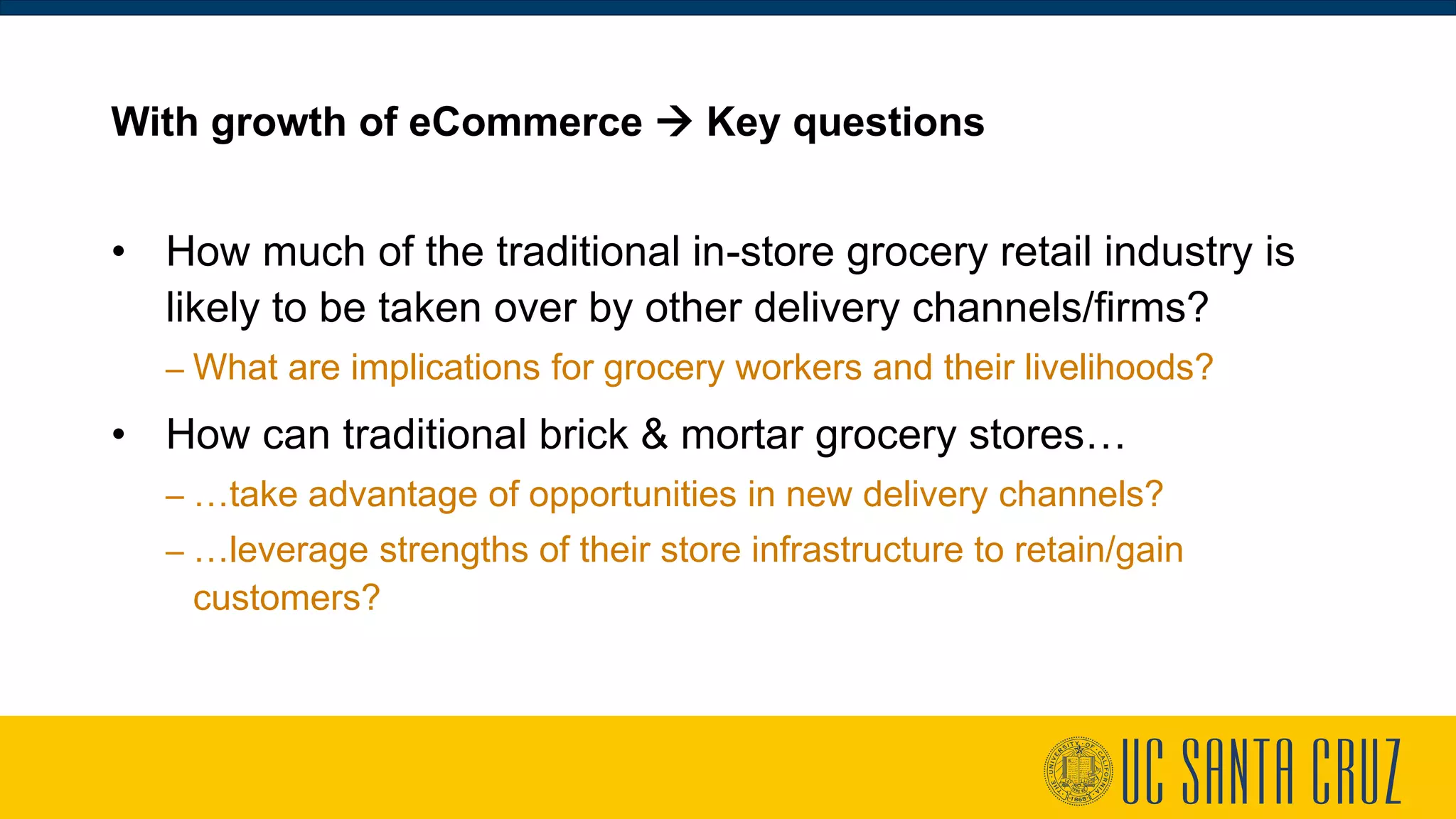
• How much of the traditional in-store grocery retail industry is
likely to be taken over by other delivery channels/firms?
– What are implications for grocery workers and their livelihoods?
• How can traditional brick & mortar grocery stores…
– …take advantage of opportunities in new delivery channels?
– …leverage strengths of their store infrastructure to retain/gain
customers?
Background & Context of Study
• Part of multi-sector study looking at technology
and future of work
• Designed to identify broad trends, be forward
looking
• Based on secondary data and ~60 interviews
with:
– Industry analysts
– Technology developers
– Retail executives—operations and technology officers
• Work in progress…
Grocery eCommerce is actually 3 key processes…
Online Order Fulfillment
Food to
customers’
home
…that are now adding paid jobs, instead of consumer self-service
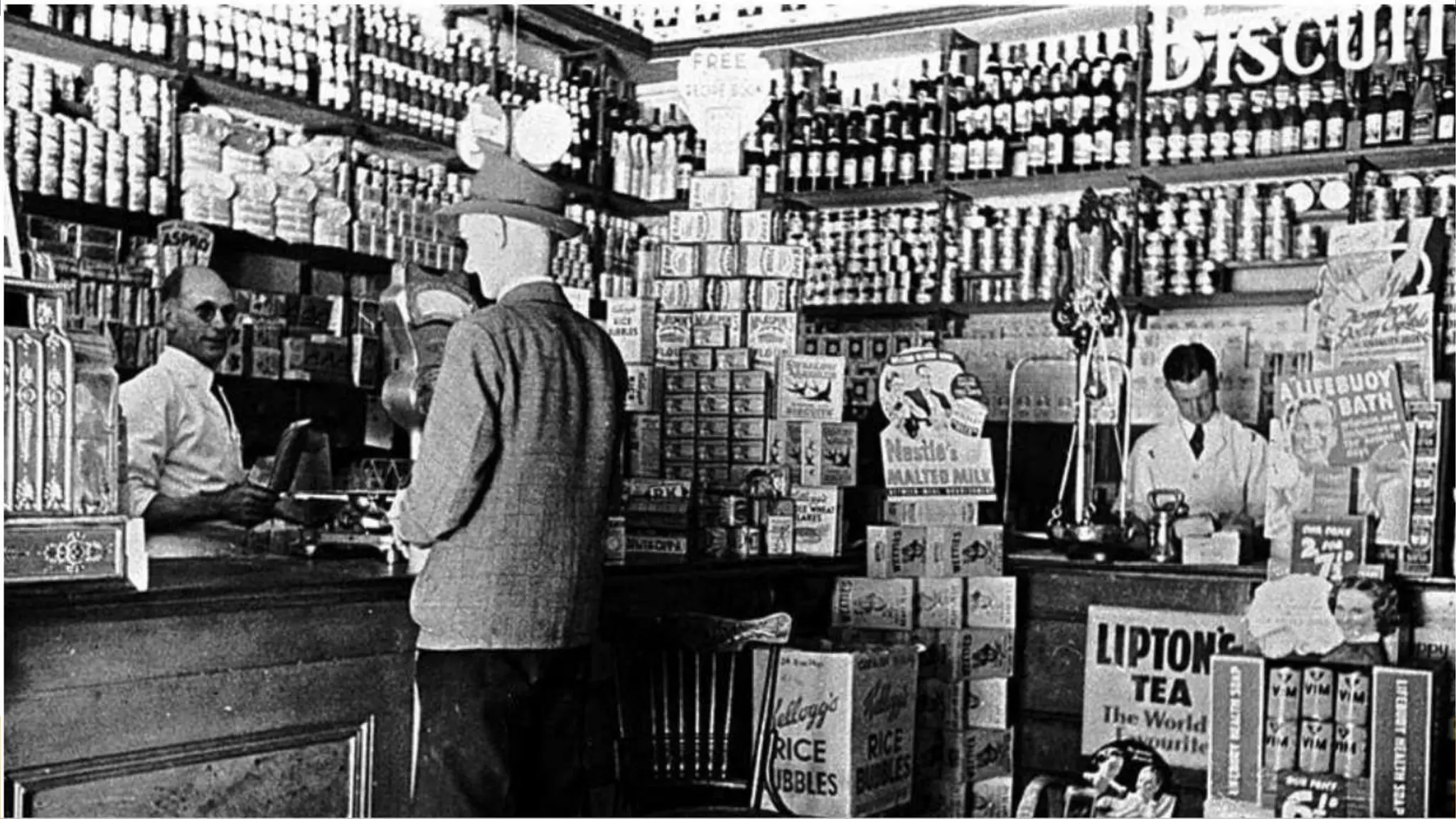
● Long, slow development
until Amazon purchased
Whole Foods in 2017
● Instacart was major
beneficiary, for awhile…
● Major players are now all
investing significantly in
on-line ordering
1996
1989
2012
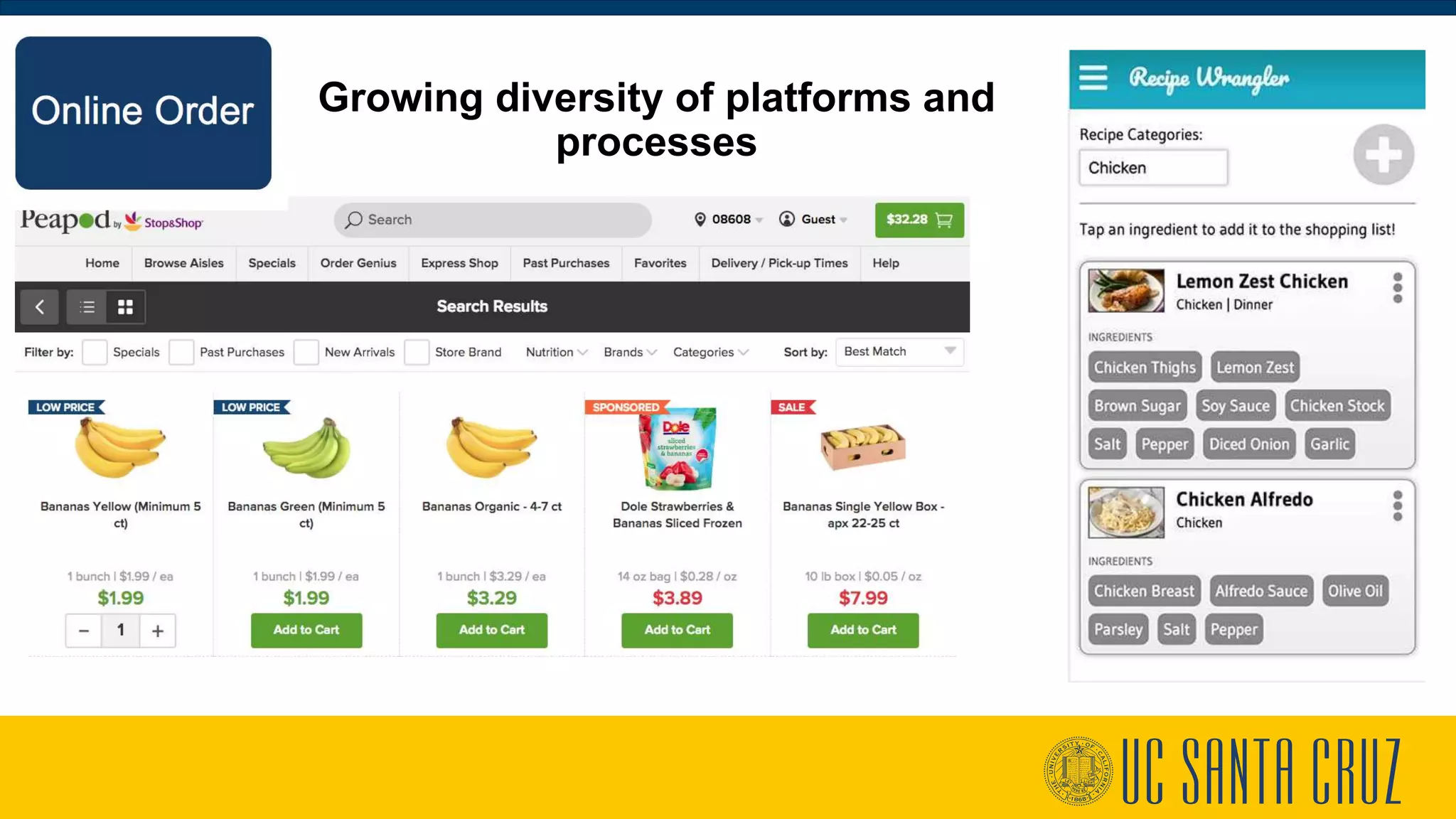
Growing diversity of platforms and
processes
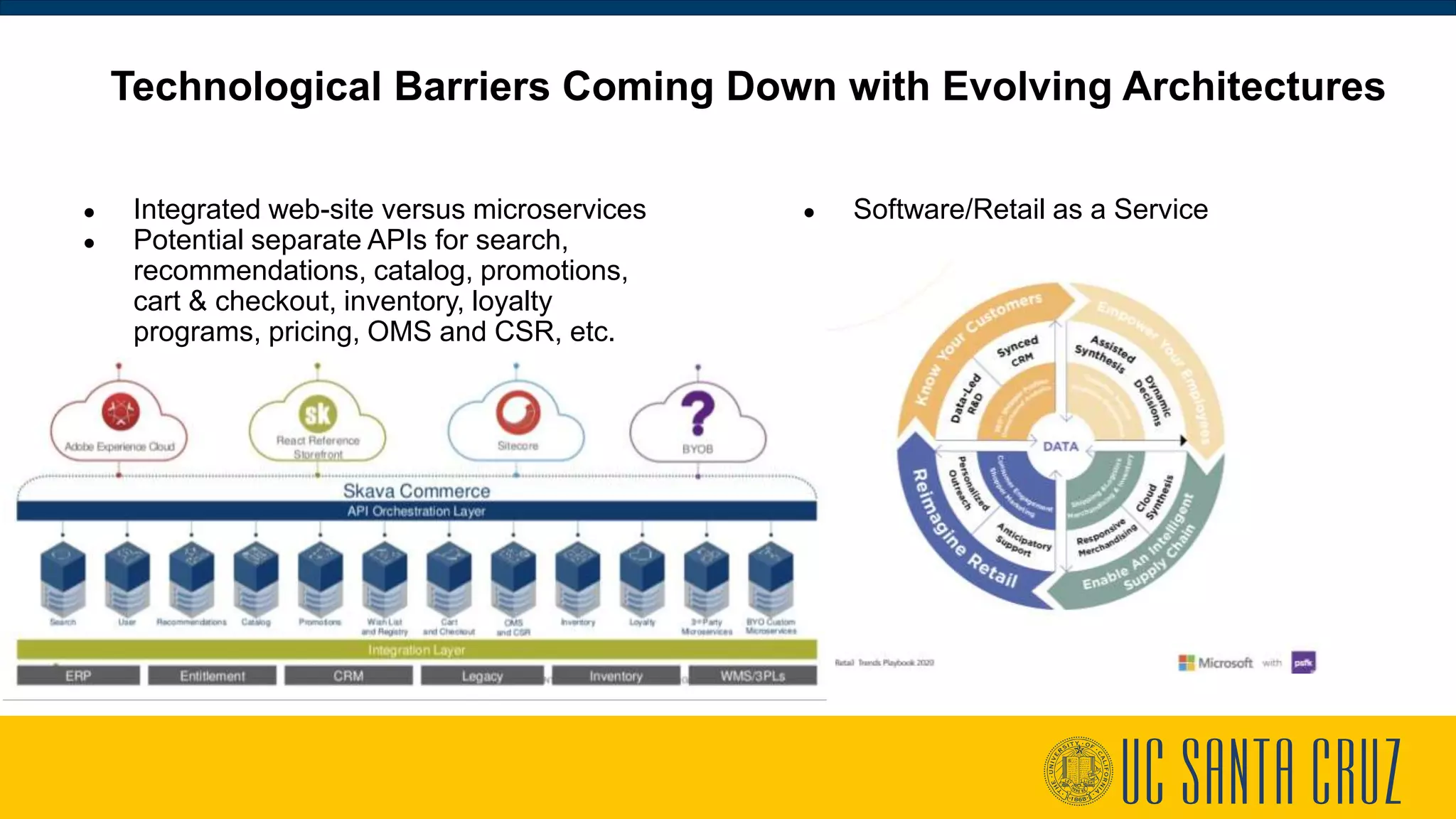
Technological Barriers Coming Down with Evolving Architectures
● Integrated web-site versus microservices
● Potential separate APIs for search,
recommendations, catalog, promotions,
cart & checkout, inventory, loyalty
programs, pricing, OMS and CSR, etc.
● Software/Retail as a Service
E-Commerce still small part of food store sales
0.0%
1.0%
2.0%
3.0%
4.0%
5.0%
6.0%
7.0%
8.0%
9.0%
1998 1999 2000 2001 2002 2003 2004 2005 2006 2007 2008 2009 2010 2011 2012 2013 2014 2015 2016
Percent E-Commerce, All Retail Trade and Sub-categories
All
Misc.
Clothing
Motor vehicle & parts
Sporting goods & hobbies
Electronics and appliance
Furniture/Home Furnishings
Building mats. & supplies
Food and Beverage
General merch.
Not Shown: Non-Store Retailers
1.4%
2.8%
8.5%
14.1%
16.9%
18.3%
22.5%
29.6%
32.7%
16.8%
24.3%
28.0%
31.8%
30.8%
31.8%
54.2%
0.0% 10.0% 20.0% 30.0% 40.0% 50.0% 60.0%
Other
Ordering kiosks
In-store mobile product scanning
Store-supported home delivery
Third-party vendor home delivery
(e.g. Instacart, MyWebGrocer)
Curbside delivery
Click & Collect
Mobile shopping apps
Source: Progressive Grocer, "85th Annual Report of the Grocery Industry", April, 2018
What Omnichannel Services Do You Offer?
2018
2017
• Most eCommerce
does not bypass
brick & mortar
stores
• Omnichannel—
multiple ways of
interacting with
customers
Many barriers to ordering on-line
● User interface challenges
● Consumer selection preferences
● Inventory/substitution hassles
● Internal organizational tensions
(operations, technology)
● Additional costs
A few companies are seeing rapid
growth (off a small base), but industry
wide, roll-out will be slower
Option 1: Store-based fulfillment
● Dominant model today
● Walmart claims to now
employ over 35,000 pickers
in their stores
● Expensive, doesn’t scale
● Niche customers or stop-
gap measure until market
demand justifies greater
investment
Option 2: Micro-fulfillment Center
● Convert portion of
existing store footprint to
semi-automated
fulfillment
● Multiple partnerships
beginning to roll out
● Relatively low barriers to
entry: ~$3 million
investment and 2 months
Option 3: Warehouse fulfillment Center
● UK company with very
advanced technology
● Partnership with
Kroger’s to build 20
FCs
● Much more expensive
and requires higher
volume to be profitable
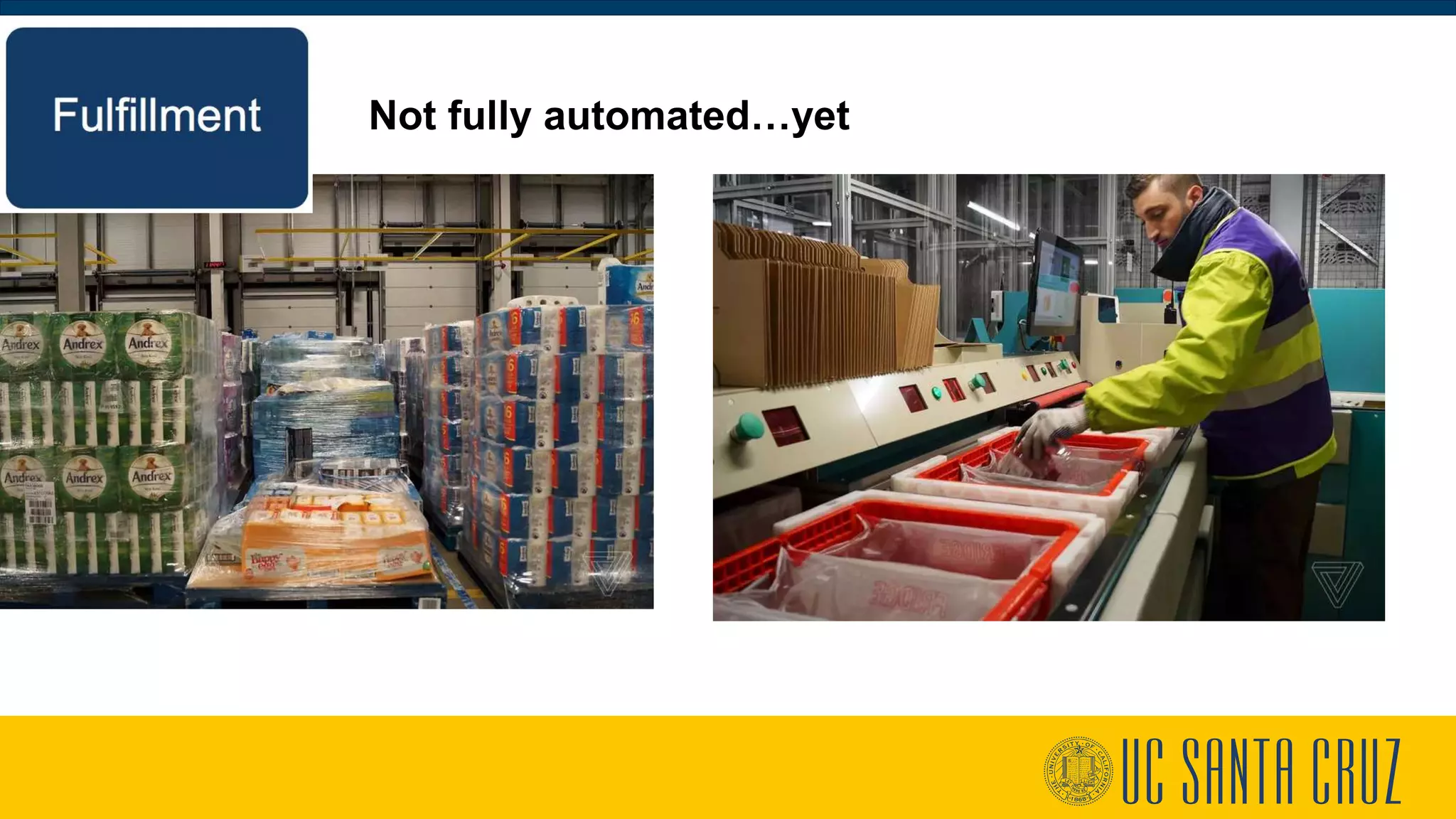
Not fully automated…yet
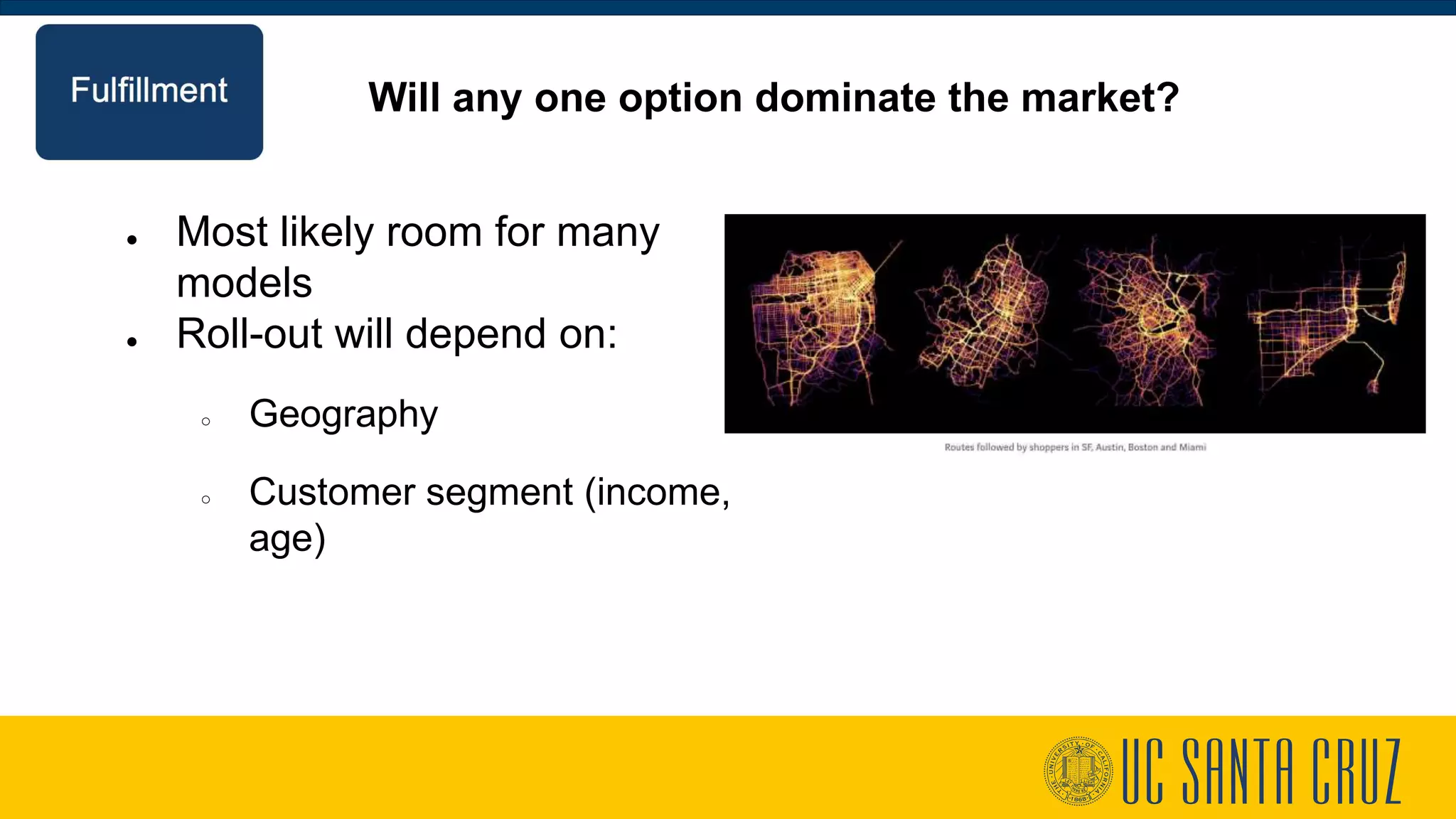
Will any one option dominate the market?
● Most likely room for many
models
● Roll-out will depend on:
○ Geography
○ Customer segment (income,
age)
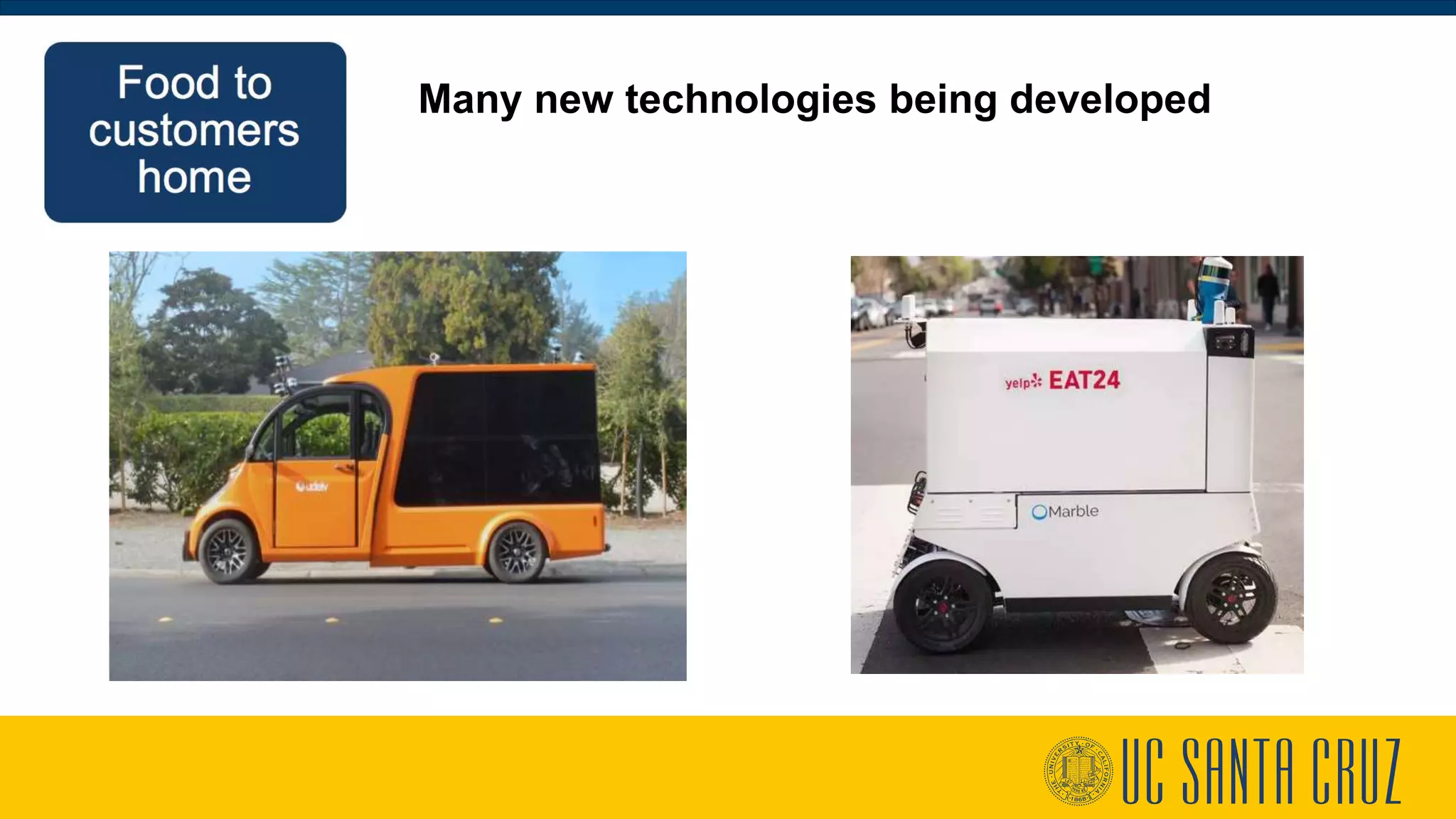
Many new technologies being developed
Alphabet Wing
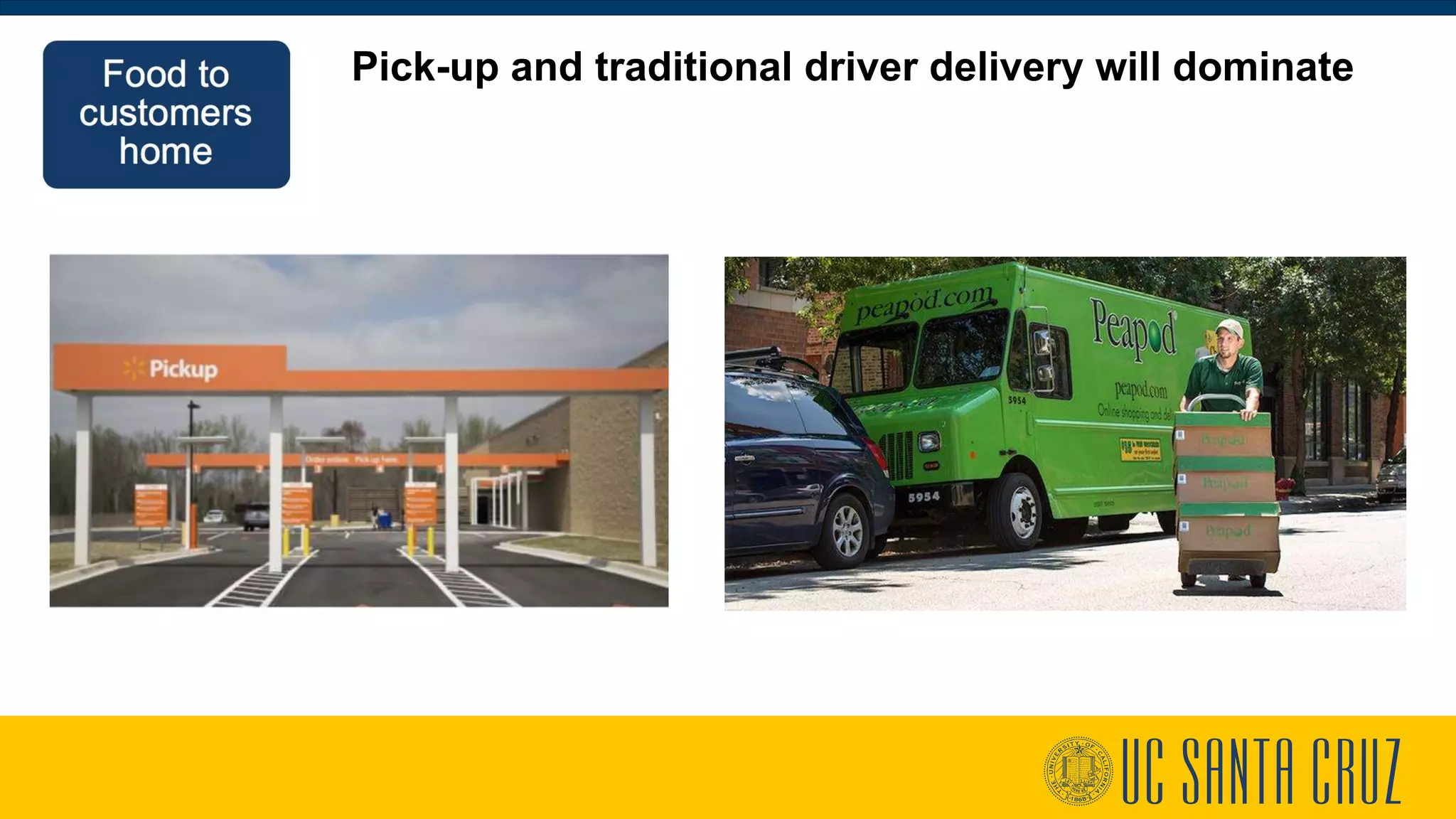
Pick-up and traditional driver delivery will dominate
New Prepared Food Home Delivery Platforms
Conclusions
● Impacts on existing grocery store
jobs will be modest
○ Fewer cashiers, more pickers
● Grocery stores are here to stay
● Many of the new jobs (drivers
especially) have poor wages and
working conditions
Conclusions
● Substantial opportunities for
existing grocery stores
○ Location and existing real
estate matters
● High-road and low-road
options both expanding
cbenner@ucsc.edu
Thank you!

Are Grocery Workers In Trouble?

  • 1.
    Are Grocery Store Workersin Trouble? eCommerce, New Food Delivery Channels and the Future of Food Retail in the U.S. Chris Benner, UC Santa Cruz With Sarah Mason, UC Santa Cruz Chris Tilly, UCLA Françoise Carre, UMass Boston
  • 2.
    “The main reasonfor the shift, analysts say, is simple: Americans are increasingly shopping online..”
  • 4.
    • ~$750 billionindustry • Employs more than 3.2 million people • Average wage of ~$15/hour • Only part of retail with significant union presence Retail is 10% of all U.S. Employment Grocery is Largest Share of Retail Food and beverage stores 20% General merchandise stores 19% Motor vehicle and parts dealers 13% Clothing and clothing accessories stores 8% Building material and garden supply stores 8% Health and personal care stores 7% Gasoline stations 6% Miscellaneous store retailers 5% Nonstore retailers 4% Sporting goods, hobby, book, and music stores 4% Furniture and home furnishings stores 3% Electronics and appliance stores 3% Employment, Retail Sub-sectors, 2019
  • 5.
    • A fewlarge firms dominate the industry… • But many strong regional players and specialty markets • Generally technological laggard except for leading firms Wal-Mart 26% Kroger 10% Albertsons 5% Ahold-Delhaize 4% Publix 3% HEB 2% Meijer 2% Whole Foods 2% Target 2% Trader Joe's 1% Others 43% Market Share of Leading Food Retailers in the U.S. in 2017
  • 6.
    With growth ofeCommerce  Key questions • How much of the traditional in-store grocery retail industry is likely to be taken over by other delivery channels/firms? – What are implications for grocery workers and their livelihoods? • How can traditional brick & mortar grocery stores… – …take advantage of opportunities in new delivery channels? – …leverage strengths of their store infrastructure to retain/gain customers?
  • 7.
    Background & Contextof Study • Part of multi-sector study looking at technology and future of work • Designed to identify broad trends, be forward looking • Based on secondary data and ~60 interviews with: – Industry analysts – Technology developers – Retail executives—operations and technology officers • Work in progress…
  • 8.
    Grocery eCommerce isactually 3 key processes… Online Order Fulfillment Food to customers’ home …that are now adding paid jobs, instead of consumer self-service
  • 11.
    ● Long, slowdevelopment until Amazon purchased Whole Foods in 2017 ● Instacart was major beneficiary, for awhile… ● Major players are now all investing significantly in on-line ordering 1996 1989 2012
  • 12.
    Growing diversity ofplatforms and processes
  • 15.
    Technological Barriers ComingDown with Evolving Architectures ● Integrated web-site versus microservices ● Potential separate APIs for search, recommendations, catalog, promotions, cart & checkout, inventory, loyalty programs, pricing, OMS and CSR, etc. ● Software/Retail as a Service
  • 17.
    E-Commerce still smallpart of food store sales 0.0% 1.0% 2.0% 3.0% 4.0% 5.0% 6.0% 7.0% 8.0% 9.0% 1998 1999 2000 2001 2002 2003 2004 2005 2006 2007 2008 2009 2010 2011 2012 2013 2014 2015 2016 Percent E-Commerce, All Retail Trade and Sub-categories All Misc. Clothing Motor vehicle & parts Sporting goods & hobbies Electronics and appliance Furniture/Home Furnishings Building mats. & supplies Food and Beverage General merch. Not Shown: Non-Store Retailers
  • 18.
    1.4% 2.8% 8.5% 14.1% 16.9% 18.3% 22.5% 29.6% 32.7% 16.8% 24.3% 28.0% 31.8% 30.8% 31.8% 54.2% 0.0% 10.0% 20.0%30.0% 40.0% 50.0% 60.0% Other Ordering kiosks In-store mobile product scanning Store-supported home delivery Third-party vendor home delivery (e.g. Instacart, MyWebGrocer) Curbside delivery Click & Collect Mobile shopping apps Source: Progressive Grocer, "85th Annual Report of the Grocery Industry", April, 2018 What Omnichannel Services Do You Offer? 2018 2017 • Most eCommerce does not bypass brick & mortar stores • Omnichannel— multiple ways of interacting with customers
  • 19.
    Many barriers toordering on-line ● User interface challenges ● Consumer selection preferences ● Inventory/substitution hassles ● Internal organizational tensions (operations, technology) ● Additional costs A few companies are seeing rapid growth (off a small base), but industry wide, roll-out will be slower
  • 20.
    Option 1: Store-basedfulfillment ● Dominant model today ● Walmart claims to now employ over 35,000 pickers in their stores ● Expensive, doesn’t scale ● Niche customers or stop- gap measure until market demand justifies greater investment
  • 21.
    Option 2: Micro-fulfillmentCenter ● Convert portion of existing store footprint to semi-automated fulfillment ● Multiple partnerships beginning to roll out ● Relatively low barriers to entry: ~$3 million investment and 2 months
  • 22.
    Option 3: Warehousefulfillment Center ● UK company with very advanced technology ● Partnership with Kroger’s to build 20 FCs ● Much more expensive and requires higher volume to be profitable
  • 23.
  • 25.
    Will any oneoption dominate the market?
  • 26.
    Will any oneoption dominate the market? ● Most likely room for many models ● Roll-out will depend on: ○ Geography ○ Customer segment (income, age)
  • 27.
    Many new technologiesbeing developed
  • 28.
  • 31.
    Pick-up and traditionaldriver delivery will dominate
  • 33.
    New Prepared FoodHome Delivery Platforms
  • 34.
    Conclusions ● Impacts onexisting grocery store jobs will be modest ○ Fewer cashiers, more pickers ● Grocery stores are here to stay ● Many of the new jobs (drivers especially) have poor wages and working conditions
  • 35.
    Conclusions ● Substantial opportunitiesfor existing grocery stores ○ Location and existing real estate matters ● High-road and low-road options both expanding
  • 36.

Editor's Notes

  • #3 https://www.washingtonpost.com/business/2019/04/10/retail-apocalypse-now-analysts-say-more-us-stores-could-be-doomed/?noredirect=on&utm_term=.e7c747e3664c
  • #6 https://brandongaille.com/27-retail-grocery-industry-statistics-trends-analysis/
  • #11 https://en.wikipedia.org/wiki/Piggly_Wiggly#/media/File:Piggly-wiggly.jpg