1
Carl McInerney Limited 2021. All rights reserved
Research and curation by Carl McInerney
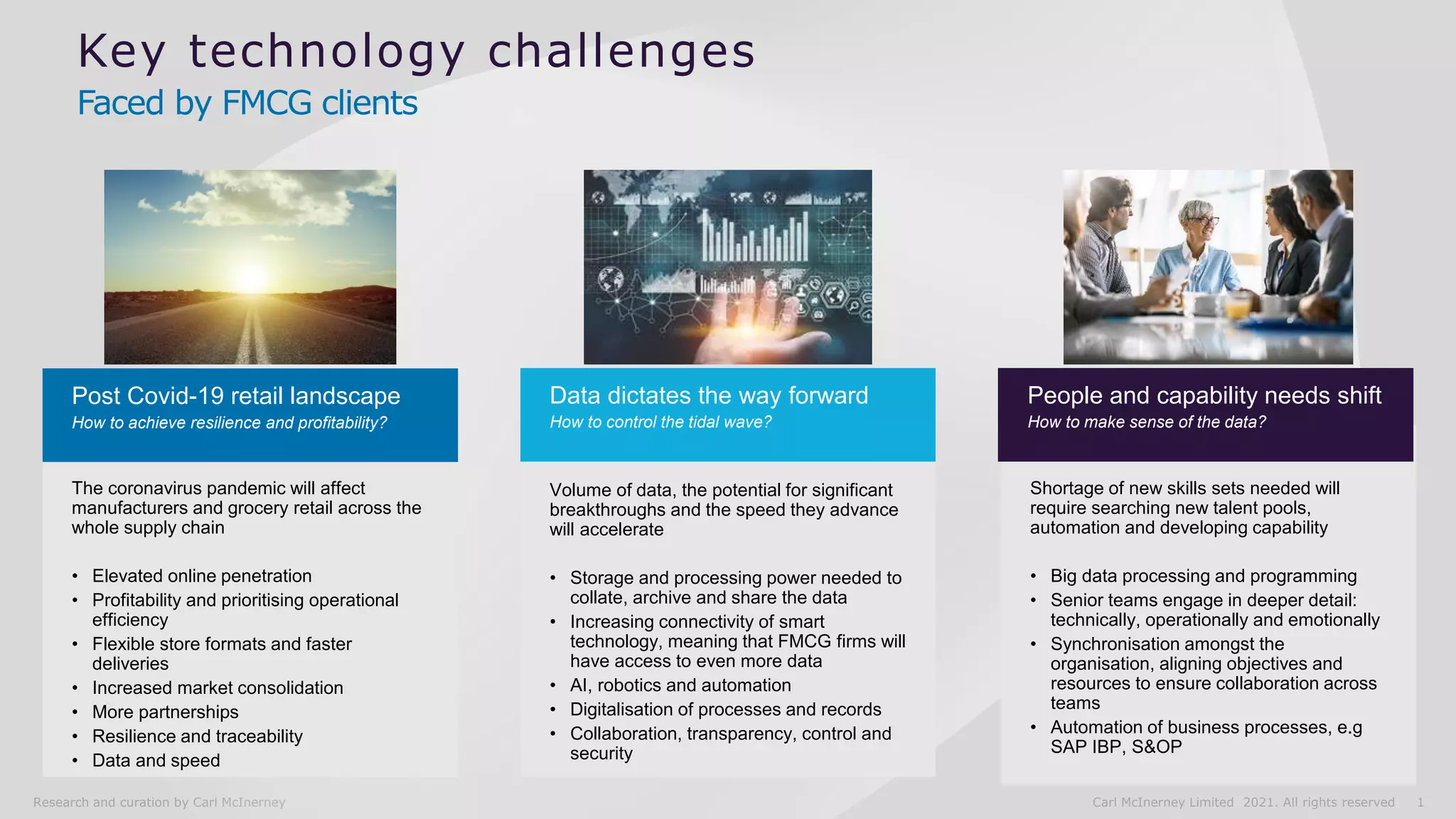
Key technology challenges
Faced by FMCG clients
The coronavirus pandemic will affect
manufacturers and grocery retail across the
whole supply chain
• Elevated online penetration
• Profitability and prioritising operational
efficiency
• Flexible store formats and faster
deliveries
• Increased market consolidation
• More partnerships
• Resilience and traceability
• Data and speed
Volume of data, the potential for significant
breakthroughs and the speed they advance
will accelerate
• Storage and processing power needed to
collate, archive and share the data
• Increasing connectivity of smart
technology, meaning that FMCG firms will
have access to even more data
• AI, robotics and automation
• Digitalisation of processes and records
• Collaboration, transparency, control and
security
Data dictates the way forward
How to control the tidal wave?
Shortage of new skills sets needed will
require searching new talent pools,
automation and developing capability
• Big data processing and programming
• Senior teams engage in deeper detail:
technically, operationally and emotionally
• Synchronisation amongst the
organisation, aligning objectives and
resources to ensure collaboration across
teams
• Automation of business processes, e.g
SAP IBP, S&OP
Post Covid-19 retail landscape
How to achieve resilience and profitability?
People and capability needs shift
How to make sense of the data?
2
Carl McInerney Limited 2021. All rights reserved
Research and curation by Carl McInerney
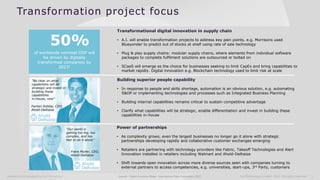
Transformation project focus
Power of partnerships
• As complexity grows, even the largest businesses no longer go it alone with strategic
partnerships developing rapidly and collaborative customer exchanges emerging
• Retailers are partnering with technology providers like Fabric, Takeoff Technologies and Alert
Innovation installed in retailers including Walmart and Ahold-Delhaize
• Shift towards open innovation across more diverse sources seen with companies turning to
external partners to access competencies, e.g. universities, start-ups, 3rd Party, customers
Transformational digital innovation in supply chain
• A.I. will enable transformation projects to address key pain points, e.g. Morrisons used
Blueyonder to predict out of stocks at shelf using rate of sale technology
• Plug & play supply chains: modular supply chains, where elements from individual software
packages to complete fulfilment solutions are outsourced or bolted on
• SCaaS will emerge as the choice for businesses seeking to limit CapEx and bring capabilities to
market rapidly. Digital innovation e.g. Blockchain technology used to limit risk at scale
Building superior people capability
• In response to people and skills shortage, automation is an obvious solution, e.g. automating
S&OP or implementing technologies and processes such as Integrated Business Planning
• Building internal capabilities remains critical to sustain competitive advantage
• Clarify what capabilities will be strategic, enable differentiation and invest in building these
capabilities in-house
Source: 1Digital Economy Model, International Data Corporation (IDC)
“Our world is
getting too big, too
complex, and too
fast to do it alone”
Frans Muller, CEO,
Ahold-Delhaize
50%
of worldwide nominal GDP will
be driven by digitally
transformed companies by
20231
“Be clear on what
capabilities will be
strategic and invest in
building these
capabilities
in-house, now”
Farhan Siddiqi, CDO,
Ahold-Delhaize
3
Carl McInerney Limited 2021. All rights reserved
Research and curation by Carl McInerney
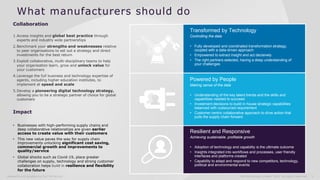
What manufacturers should do
Transformed by Technology
Controlling the data
• Fully developed and coordinated transformation strategy,
coupled with a data-driven approach
• Empowered to extract insight and act decisively
• The right partners selected, having a deep understanding of
your challenges
Powered by People
Making sense of the data
• Understanding of the key talent trends and the skills and
capabilities needed to succeed
• Investment decisions to build in-house strategic capabilities
balanced with outsourced requirement
• Customer centric collaborative approach to drive action that
pulls the supply chain forward
Resilient and Responsive
Achieving sustainable, profitable growth
• Adoption of technology and capability is the ultimate outcome
• Insights integrated into workflows and processes, user friendly
interfaces and platforms created
• Capability to adapt and respond to new competitors, technology,
political and environmental events
Collaboration
1.Access insights and global best practice through
experts and industry wide partnerships
2.Benchmark your strengths and weaknesses relative
to peer organisations to set out a strategy and direct
investments for the best return
3.Exploit collaborative, multi-disciplinary teams to help
your organisation learn, grow and unlock value for
your customers
4.Leverage the full business and technology expertise of
agents, including higher education institutes, to
implement at speed and scale
5.Develop a pioneering digital technology strategy,
allowing you to be a strategic partner of choice for global
customers
Impact
• Businesses with high-performing supply chains and
deep collaborative relationships are given earlier
access to create value with their customers
• This new value paves the way for supply chain
improvements unlocking significant cost saving,
commercial growth and improvements to
quality/service
• Global shocks such as Covid-19, place greater
challenges on supply, technology and strong customer
collaboration helps build in resilience and flexibility
for the future

Technology challenge faced by consumer goods organisations

  • 1.
    1 Carl McInerney Limited2021. All rights reserved Research and curation by Carl McInerney Key technology challenges Faced by FMCG clients The coronavirus pandemic will affect manufacturers and grocery retail across the whole supply chain • Elevated online penetration • Profitability and prioritising operational efficiency • Flexible store formats and faster deliveries • Increased market consolidation • More partnerships • Resilience and traceability • Data and speed Volume of data, the potential for significant breakthroughs and the speed they advance will accelerate • Storage and processing power needed to collate, archive and share the data • Increasing connectivity of smart technology, meaning that FMCG firms will have access to even more data • AI, robotics and automation • Digitalisation of processes and records • Collaboration, transparency, control and security Data dictates the way forward How to control the tidal wave? Shortage of new skills sets needed will require searching new talent pools, automation and developing capability • Big data processing and programming • Senior teams engage in deeper detail: technically, operationally and emotionally • Synchronisation amongst the organisation, aligning objectives and resources to ensure collaboration across teams • Automation of business processes, e.g SAP IBP, S&OP Post Covid-19 retail landscape How to achieve resilience and profitability? People and capability needs shift How to make sense of the data?
  • 2.
    2 Carl McInerney Limited2021. All rights reserved Research and curation by Carl McInerney Transformation project focus Power of partnerships • As complexity grows, even the largest businesses no longer go it alone with strategic partnerships developing rapidly and collaborative customer exchanges emerging • Retailers are partnering with technology providers like Fabric, Takeoff Technologies and Alert Innovation installed in retailers including Walmart and Ahold-Delhaize • Shift towards open innovation across more diverse sources seen with companies turning to external partners to access competencies, e.g. universities, start-ups, 3rd Party, customers Transformational digital innovation in supply chain • A.I. will enable transformation projects to address key pain points, e.g. Morrisons used Blueyonder to predict out of stocks at shelf using rate of sale technology • Plug & play supply chains: modular supply chains, where elements from individual software packages to complete fulfilment solutions are outsourced or bolted on • SCaaS will emerge as the choice for businesses seeking to limit CapEx and bring capabilities to market rapidly. Digital innovation e.g. Blockchain technology used to limit risk at scale Building superior people capability • In response to people and skills shortage, automation is an obvious solution, e.g. automating S&OP or implementing technologies and processes such as Integrated Business Planning • Building internal capabilities remains critical to sustain competitive advantage • Clarify what capabilities will be strategic, enable differentiation and invest in building these capabilities in-house Source: 1Digital Economy Model, International Data Corporation (IDC) “Our world is getting too big, too complex, and too fast to do it alone” Frans Muller, CEO, Ahold-Delhaize 50% of worldwide nominal GDP will be driven by digitally transformed companies by 20231 “Be clear on what capabilities will be strategic and invest in building these capabilities in-house, now” Farhan Siddiqi, CDO, Ahold-Delhaize
  • 3.
    3 Carl McInerney Limited2021. All rights reserved Research and curation by Carl McInerney What manufacturers should do Transformed by Technology Controlling the data • Fully developed and coordinated transformation strategy, coupled with a data-driven approach • Empowered to extract insight and act decisively • The right partners selected, having a deep understanding of your challenges Powered by People Making sense of the data • Understanding of the key talent trends and the skills and capabilities needed to succeed • Investment decisions to build in-house strategic capabilities balanced with outsourced requirement • Customer centric collaborative approach to drive action that pulls the supply chain forward Resilient and Responsive Achieving sustainable, profitable growth • Adoption of technology and capability is the ultimate outcome • Insights integrated into workflows and processes, user friendly interfaces and platforms created • Capability to adapt and respond to new competitors, technology, political and environmental events Collaboration 1.Access insights and global best practice through experts and industry wide partnerships 2.Benchmark your strengths and weaknesses relative to peer organisations to set out a strategy and direct investments for the best return 3.Exploit collaborative, multi-disciplinary teams to help your organisation learn, grow and unlock value for your customers 4.Leverage the full business and technology expertise of agents, including higher education institutes, to implement at speed and scale 5.Develop a pioneering digital technology strategy, allowing you to be a strategic partner of choice for global customers Impact • Businesses with high-performing supply chains and deep collaborative relationships are given earlier access to create value with their customers • This new value paves the way for supply chain improvements unlocking significant cost saving, commercial growth and improvements to quality/service • Global shocks such as Covid-19, place greater challenges on supply, technology and strong customer collaboration helps build in resilience and flexibility for the future