APRIL 2019
M&A Technology Update
Smart Cities
THE GLOBAL MID-MARKET SPECIALIST
The rise of the on-demand economy fuels
smart city innovation
As the recent announcements of Uber, Lyft and Postmates’ IPOs along with DoorDash’s latest fundraise at an
impressive $6Bn valuation remind us, the on-demand economy has taken the world by storm.
This disruptive way to deliver goods and services at the consumers’ will has given birth to a new set of asset-light
technology companies that act as intermediaries between service providers and end users, leveraging existing
resources and infrastructure to optimize the way goods and services are delivered and consumed.
These innovative upstarts have shaken traditional businesses to their core, permanently altering consumer
habits and expectations. Research from UPS and Capgemini shows that 75% of online consumers are willing to
pay a premium for express delivery services, reaching 4.6% of total order value for same day fulfillment. (FIG 2)
Moreover, patience levels are increasingly wearing thin at online checkouts, with 26% of consumers abandoning
their carts due to lengthy shipping times.
Consumers’ new expectations of immediacy have
forced established companies to fundamentally
rethink their business models and value propositions.
The result is that 51% of global retailers offered same-
day delivery in 2018, a three-fold increase from 2017; by
the end of 2019, the figure is expected to jump to 65%.
Meanwhile, fast food stalwarts such as McDonald’s and
Subway have joined food delivery platforms such as Uber
Eats and Doordash, and globally, registered taxis have
signed onto apps like Mytaxi to compete with ride-hailing
start-ups.
Companies are also incorporating the latest technologies
into their transportation and logistics systems to
facilitate seamless movement. Initiatives range from
automated factory production to autonomous truck
warehouse delivery, robotic warehouse picking, and
predictive shipping whereby goods are dispatched from
warehouses to retail and online supply chains based
on anticipated demand. However, last mile delivery—a
product’s journey from warehouse shelf to customer
doorstep—is proving to be the most challenging to
optimize. This key component in the delivery chain
is typically the most expensive and time-consuming,
accounting for a hefty 53% of the total shipping costs.
On-demand economy outpaces supporting infrastructure
Ride hailing apps
create more traffic &
congestion
Food delivery apps
interfere with service
to walk-in clients
Office and residential
buildings are flooded with
delivery service packages
Autonomous Vehicles
are limited by strong
regulations
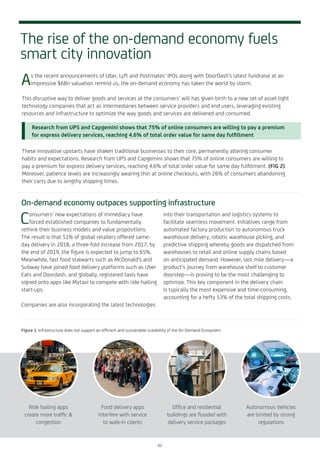
Figure 1: Infrastructure does not support an efficient and sustainable scalability of the On-Demand Ecosystem
Research from UPS and Capgemini shows that 75% of online consumers are willing to pay a premium
for express delivery services, reaching 4.6% of total order value for same day fulfillment
02
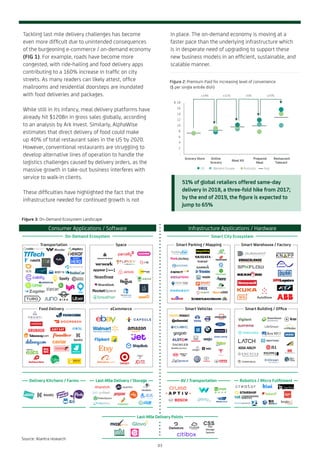
Figure 3: On-Demand Ecosystem Landscape
Consumer Applications / Software Infrastructure Applications / Hardware
On-Demand Ecosystem Smart City Ecosystem
Delivery Kitchens / Farms AV / TransportationLast-Mile Delivery / Storage Robotics / Micro Fulfilment
Transportation Smart Parking / Mapping
Food Delivery Smart Vehicles
Space Smart Warehouse / Factory
eCommerce Smart Building / Office
Last-Mile Delivery Points
Tackling last mile delivery challenges has become
even more difficult due to unintended consequences
of the burgeoning e-commerce / on-demand economy
(FIG 1). For example, roads have become more
congested, with ride-hailing and food delivery apps
contributing to a 160% increase in traffic on city
streets. As many readers can likely attest, office
mailrooms and residential doorsteps are inundated
with food deliveries and packages.
While still in its infancy, meal delivery platforms have
already hit $120Bn in gross sales globally, according
to an analysis by Ark Invest. Similarly, AlphaWise
estimates that direct delivery of food could make
up 40% of total restaurant sales in the US by 2020.
However, conventional restaurants are struggling to
develop alternative lines of operation to handle the
logistics challenges caused by delivery orders, as the
massive growth in take-out business interferes with
service to walk-in clients.
These difficulties have highlighted the fact that the
infrastructure needed for continued growth is not
+14% +11% +5% +25%
Restaurant
Take-out
Alantra Partners, S.A. has its registered office at Calle de José Ortega y Gasset, number 29, 28006 Madrid, with Tax Identification Number
A81862724 and registered with the Spanish Companies Registry of Madrid, Volume 12.530, Sheet 163, Section 8, Page number M-199956.
© Alantra Partners, S.A. 2018
alantra.com
Austria & CEE
Belgium
China
France
Germany
Greece
India
Ireland
Italy
Latin America
Mexico
Netherlands
Nordics
Portugal
Spain
Switzerland
United Kingdom
United States
THE GLOBAL MID-MARKET SPECIALIST
Grocery Store Online
Grocery
Meal Kit
Prepared
Meal
US Western Europe Australia Avg
-
2
4
6
8
10
12
14
16
18$
Figure 2: Premium Paid for increasing level of convenience
($ per single entrée dish)
51% of global retailers offered same-day
delivery in 2018, a three-fold hike from 2017;
by the end of 2019, the figure is expected to
jump to 65%
in place. The on-demand economy is moving at a
faster pace than the underlying infrastructure which
is in desperate need of upgrading to support these
new business models in an efficient, sustainable, and
scalable manner.
Source: Alantra research
03
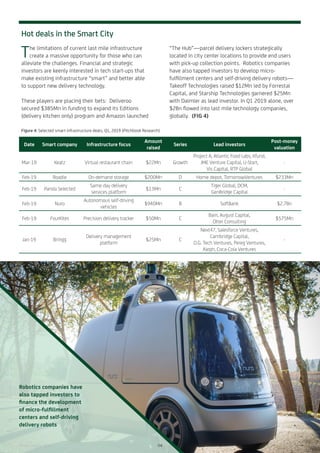
Figure 4: Selected smart infrastructure deals, Q1, 2019 (Pitchbook Research)
The limitations of current last mile infrastructure
create a massive opportunity for those who can
alleviate the challenges. Financial and strategic
investors are keenly interested in tech start-ups that
make existing infrastructure “smart” and better able
to support new delivery technology.
These players are placing their bets: Deliveroo
secured $385Mn in funding to expand its Editions
(delivery kitchen only) program and Amazon launched
“The Hub”—parcel delivery lockers strategically
located in city center locations to provide end users
with pick-up collection points. Robotics companies
have also tapped investors to develop micro-
fulfillment centers and self-driving delivery robots—
Takeoff Technologies raised $12Mn led by Forrestal
Capital, and Starship Technologies garnered $25Mn
with Daimler as lead investor. In Q1 2019 alone, over
$2Bn flowed into last mile technology companies,
globally. (FIG 4)
Hot deals in the Smart City
Date Smart company Infrastructure focus
Amount
raised
Series Lead investors
Post-money
valuation
Mar-19 Keatz Virtual restaurant chain $22Mn Growth
Project A, Atlantic Food Labs, Kfund,
JME Venture Capital, U-Start,
Vis Capital, RTP Global
-
Feb-19 Roadie On-demand storage $200Mn D Home depot, TomorrowVentures $233Mn
Feb-19 Panda Selected
Same day delivery
services platform
$13Mn C
Tiger Global, DCM,
GenBridge Capital
-
Feb-19 Nuro
Autonomous self-driving
vehicles
$940Mn B SoftBank $2.7Bn
Feb-19 FourKites Precision delivery tracker $50Mn C
Bain, August Capital,
Otter Consulting
$575Mn
Jan-19 Bringg
Delivery management
platform
$25Mn C
Next47, Salesforce Ventures,
Cambridge Capital,
O.G. Tech Ventures, Pereg Ventures,
Aleph, Coca-Cola Ventures
-
Robotics companies have
also tapped investors to
finance the development
of micro-fulfillment
centers and self-driving
delivery robots
Photo source: Nuro 04
Technology firms’ deep understanding of market dynamics and fast-paced
mentality make them the right candidates to drive smart city innovation
Thanks to increased connectivity, instant
communication, and established infrastructure
systems, new technologies are being adopted at
an exponential rate. In the past, we would have
looked to incumbent companies to fill any gaps
in consumer needs, such as last mile delivery
solutions. However, they have proven too slow and
bureaucratic to respond seamlessly and efficiently
to demanding consumer expectations. The mantle
has been passed to a new generation of technology
companies who have not only the skills and prowess,
but also the requisite culture and understanding to
fulfill the requirements of an on-demand economy.
The emergence of these companies helps explain
why tech firms are leading the M&A deal-making that
has been unleashed in this area over the past few
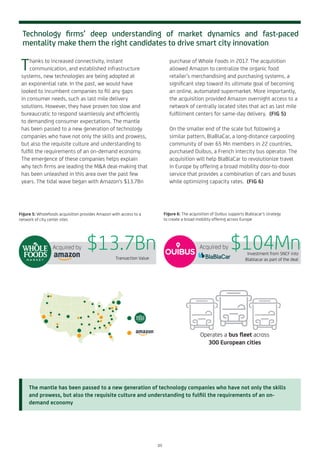
years. The tidal wave began with Amazon’s $13.7Bn
purchase of Whole Foods in 2017. The acquisition
allowed Amazon to centralize the organic food
retailer’s merchandising and purchasing systems, a
significant step toward its ultimate goal of becoming
an online, automated supermarket. More importantly,
the acquisition provided Amazon overnight access to a
network of centrally located sites that act as last mile
fulfillment centers for same-day delivery. (FIG 5)
On the smaller end of the scale but following a
similar pattern, BlaBlaCar, a long-distance carpooling
community of over 65 Mn members in 22 countries,
purchased Ouibus, a French intercity bus operator. The
acquisition will help BlaBlaCar to revolutionize travel
in Europe by offering a broad mobility door-to-door
service that provides a combination of cars and buses
while optimizing capacity rates. (FIG 6)
The mantle has been passed to a new generation of technology companies who have not only the skills
and prowess, but also the requisite culture and understanding to fulfill the requirements of an on-
demand economy
Figure 5: Wholefoods acquisition provides Amazon with access to a
network of city center sites
Acquired by
Transaction Value
$13.7Bn Acquired by
Investment from SNCF into
Blablacar as part of the deal
$104Mn
Figure 6: The acquisition of Ouibus supports Blablacar’s strategy
to create a broad mobility offering across Europe
Operates a bus fleet across
300 European cities
05
The trend of start-ups and entrenched technology
firms buying traditional businesses to achieve
scale and deploy their technology at a faster rate will
remain a major theme. The availability of large pools
of capital will continue to oil the acquisition wheels,
and ever larger funds are expected to come to market
to meet the needs of the on-demand economy.
Interest rates may be rising, but are still at historic
lows. Softbank’s $100Bn Vision Fund is seen as a
bellwether to other tech investors raising larger funds
to jockey for the best opportunities. Overall, there
were 45 super venture capital funds raised in 2018
(+150% increase vs. 2017), and a total of $73.7Bn
was spread across 4,119 deals as of the third quarter
last year.
In recent years, these changing market dynamics have
allowed a growing number of disruptive technology-
Readily available capital fuels significant investment in disruptive start-ups to
follow non-traditional growth paths and gain market dominance
enabled companies to follow the untraditional growth
path of acquiring much larger, traditional businesses
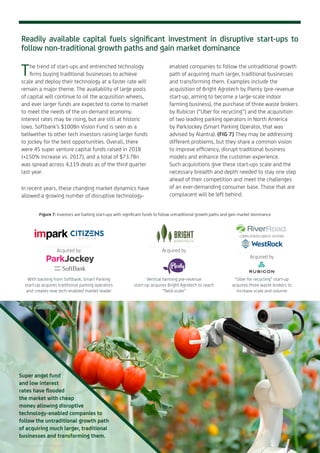
and transforming them. Examples include the
acquisition of Bright Agrotech by Plenty (pre-revenue
start-up, aiming to become a large-scale indoor
farming business), the purchase of three waste brokers
by Rubicon (“Uber for recycling”) and the acquisition
of two leading parking operators in North America
by ParkJockey (Smart Parking Operator, that was
advised by Alantra). (FIG 7) They may be addressing
different problems, but they share a common vision
to improve efficiency, disrupt traditional business
models and enhance the customer experience.
Such acquisitions give these start-ups scale and the
necessary breadth and depth needed to stay one step
ahead of their competition and meet the challenges
of an ever-demanding consumer base. Those that are
complacent will be left behind.
Figure 7: Investors are fuelling start-ups with significant funds to follow untraditional growth paths and gain market dominance
Acquired by
Vertical farming pre-revenue
start-up acquires Bright Agrotech to reach
“field-scale”
Acquired by
“Uber for recycling” start-up
acquires three waste brokers to
increase scale and volume
COMPUTERIZED WASTE SYSTEMS
Super angel fund
and low interest
rates have flooded
the market with cheap
money allowing disruptive
technology-enabled companies to
follow the untraditional growth path
of acquiring much larger, traditional
businesses and transforming them.
With backing from Softbank, Smart Parking
start-up acquires traditional parking operators
and creates new tech-enabled market leader
Acquired by
Photo source: Shutterstock 06
Case study:
The Creation of a Parking Unicorn
ParkJockey, which was advised by Alantra, is one of
the most recent M&A deals in the smart city space
The company deployed significant funding from
SoftBank and Mubadala Capital to buy two
traditional North American parking operators – Citizens
Parking Inc. (US based with over 900 locations) and
Imperial Parking Corporation (aka Impark, one of North
America’s largest parking operators with 3,600 plus
parking locations in key markets such as San Francisco
and Seattle). The acquisitions pole vault ParkJockey,
a next-generation parking technology platform, into
a national brand. Launched in 2013, the group which
is led by a highly skilled and entrepreneurial team,
developed a novel and cutting-edge approach to the
age-old problems of parking. They utilize proprietary
software and best-in-class hardware to help commercial
real estate owners better monetize parking lots as well
as optimize parking experiences for customers. They
can tap into services such as automatic license plate
recognition and pay as you go apps or those that find
parking spaces more efficiently.
“After meeting ParkJockey, we quickly realized that their
technology and vision had the potential to revolutionize
the parking industry and we did not hesitate to jump
on board to help them achieve their ambitious plans,”
said John Emery, head of Alantra’s technology team.
“This transaction is a great example of a trend that
we are currently seeing in the market – Traditional
businesses are no longer leading the transition from the
Old Economy to the New/Smart Economy. The focus
has shifted to technology-centric businesses that have
a deep understanding of new market developments
and dynamics, as well as a fast-paced mentality
and execution capabilities to speed this transition.
ParkJockey’s technology, unique vision and highly skilled
team, made them the perfect candidate to lead the
transition of two legacy parking real estate businesses
into a smart city champion.”
Alantra’s in-depth experience played a crucial role in
helping ParkJockey to secure funding from leading global
investors and support the purchase of Citizen Parking
and Imperial Parking.
Alantra coordinated several simultaneous and complex
workstreams including two buy-side M&A processes and
capital raise discussions to finance both acquisitions.
By effectively positioning the company and building
a robust, multi-scenario operating model, Alantra
supported ParkJockey’s vision to dramatically transform
the parking and logistics sectors.
From day one, we
found Alantra to be
more than a financial
advisor. The team’s
support and judgment were
instrumental in executing on our
big vision. This was a complex and
unique transaction and we found the
Alantra team to be true business partners
that remained by our side throughout the
entire process.”
ARI OJALVO,
CEO OF PARKJOCKEY
Photo source: Shutterstock 07
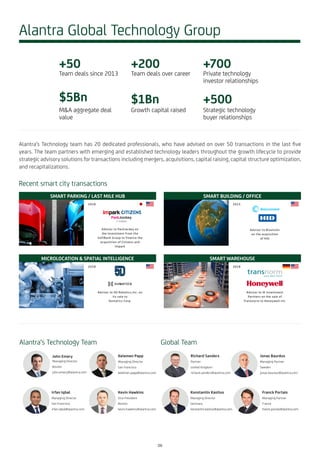
Alantra’s Technology team has 20 dedicated professionals, who have advised on over 50 transactions in the last five
years. The team partners with emerging and established technology leaders throughout the growth lifecycle to provide
strategic advisory solutions for transactions including mergers, acquisitions, capital raising, capital structure optimization,
and recapitalizations.
Alantra Global Technology Group
+50
Team deals since 2013
$5Bn
M&A aggregate deal
value
+200
Team deals over career
$1Bn
Growth capital raised
+700
Private technology
investor relationships
+500
Strategic technology
buyer relationships
John Emery
Managing Director
Boston
john.emery@alantra.com
Alantra‘s Technology Team
Irfan Iqbal
Managing Director
San Francisco
irfan.iqbal@alantra.com
Kevin Hawkins
Vice President
Boston
kevin.hawkins@alantra.com
Global Team
Kelemen Papp
Managing Director
San Francisco
kelemen.papp@alantra.com
Richard Sanders
Partner
United Kingdom
richard.sanders@alantra.com
Konstantin Kastius
Managing Director
Germany
konstantin.kastius@alantra.com
Franck Portais
Managing Partner
France
franck.portais@alantra.com
Jonas Bauréus
Managing Partner
Sweden
jonas.baureus@alantra.com
Recent smart city transactions
SMART PARKING / LAST MILE HUB
Advisor to ParkJockey on
the investment from the
SoftBank Group to finance the
acquisition of Citizens and
Impark
2018
SMART WAREHOUSE
Advisor to IK Investment
Partners on the sale of
Transnorm to Honeywell Int.
2018
MICROLOCATION & SPATIAL INTELLIGENCE
Advisor to 5D Robotics,Inc. on
its sale to
Humatics Corp.
2018
SMART BUILDING / OFFICE
Advisor to Bluvision
on the acquisition
of HID
2015
08
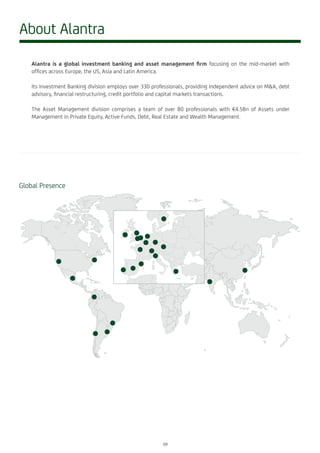
About Alantra
Global Presence
Alantra is a global investment banking and asset management firm focusing on the mid-market with
offices across Europe, the US, Asia and Latin America.
Its Investment Banking division employs over 330 professionals, providing independent advice on M&A, debt
advisory, financial restructuring, credit portfolio and capital markets transactions.
The Asset Management division comprises a team of over 80 professionals with €4.5Bn of Assets under
Management in Private Equity, Active Funds, Debt, Real Estate and Wealth Management.
09
Alantra Partners, S.A. has its registered office at Calle de José Ortega y Gasset, number 29, 28006 Madrid, with Tax Identification Number
A81862724 and registered with the Spanish Companies Registry of Madrid, Volume 12.530, Sheet 163, Section 8, Page number M-199956.
© Alantra Partners, S.A. 2019
alantra.com
Austria & CEE
Belgium
China
France
Germany
Greece
India
Ireland
Italy
Latin America
Mexico
Netherlands
Nordics
Portugal
Spain
Switzerland
United Kingdom
United States
THE GLOBAL MID-MARKET SPECIALIST

Alantra Smart City Review

  • 1.
    APRIL 2019 M&A TechnologyUpdate Smart Cities THE GLOBAL MID-MARKET SPECIALIST
  • 2.
    The rise ofthe on-demand economy fuels smart city innovation As the recent announcements of Uber, Lyft and Postmates’ IPOs along with DoorDash’s latest fundraise at an impressive $6Bn valuation remind us, the on-demand economy has taken the world by storm. This disruptive way to deliver goods and services at the consumers’ will has given birth to a new set of asset-light technology companies that act as intermediaries between service providers and end users, leveraging existing resources and infrastructure to optimize the way goods and services are delivered and consumed. These innovative upstarts have shaken traditional businesses to their core, permanently altering consumer habits and expectations. Research from UPS and Capgemini shows that 75% of online consumers are willing to pay a premium for express delivery services, reaching 4.6% of total order value for same day fulfillment. (FIG 2) Moreover, patience levels are increasingly wearing thin at online checkouts, with 26% of consumers abandoning their carts due to lengthy shipping times. Consumers’ new expectations of immediacy have forced established companies to fundamentally rethink their business models and value propositions. The result is that 51% of global retailers offered same- day delivery in 2018, a three-fold increase from 2017; by the end of 2019, the figure is expected to jump to 65%. Meanwhile, fast food stalwarts such as McDonald’s and Subway have joined food delivery platforms such as Uber Eats and Doordash, and globally, registered taxis have signed onto apps like Mytaxi to compete with ride-hailing start-ups. Companies are also incorporating the latest technologies into their transportation and logistics systems to facilitate seamless movement. Initiatives range from automated factory production to autonomous truck warehouse delivery, robotic warehouse picking, and predictive shipping whereby goods are dispatched from warehouses to retail and online supply chains based on anticipated demand. However, last mile delivery—a product’s journey from warehouse shelf to customer doorstep—is proving to be the most challenging to optimize. This key component in the delivery chain is typically the most expensive and time-consuming, accounting for a hefty 53% of the total shipping costs. On-demand economy outpaces supporting infrastructure Ride hailing apps create more traffic & congestion Food delivery apps interfere with service to walk-in clients Office and residential buildings are flooded with delivery service packages Autonomous Vehicles are limited by strong regulations Figure 1: Infrastructure does not support an efficient and sustainable scalability of the On-Demand Ecosystem Research from UPS and Capgemini shows that 75% of online consumers are willing to pay a premium for express delivery services, reaching 4.6% of total order value for same day fulfillment 02
  • 3.
    Figure 3: On-DemandEcosystem Landscape Consumer Applications / Software Infrastructure Applications / Hardware On-Demand Ecosystem Smart City Ecosystem Delivery Kitchens / Farms AV / TransportationLast-Mile Delivery / Storage Robotics / Micro Fulfilment Transportation Smart Parking / Mapping Food Delivery Smart Vehicles Space Smart Warehouse / Factory eCommerce Smart Building / Office Last-Mile Delivery Points Tackling last mile delivery challenges has become even more difficult due to unintended consequences of the burgeoning e-commerce / on-demand economy (FIG 1). For example, roads have become more congested, with ride-hailing and food delivery apps contributing to a 160% increase in traffic on city streets. As many readers can likely attest, office mailrooms and residential doorsteps are inundated with food deliveries and packages. While still in its infancy, meal delivery platforms have already hit $120Bn in gross sales globally, according to an analysis by Ark Invest. Similarly, AlphaWise estimates that direct delivery of food could make up 40% of total restaurant sales in the US by 2020. However, conventional restaurants are struggling to develop alternative lines of operation to handle the logistics challenges caused by delivery orders, as the massive growth in take-out business interferes with service to walk-in clients. These difficulties have highlighted the fact that the infrastructure needed for continued growth is not +14% +11% +5% +25% Restaurant Take-out Alantra Partners, S.A. has its registered office at Calle de José Ortega y Gasset, number 29, 28006 Madrid, with Tax Identification Number A81862724 and registered with the Spanish Companies Registry of Madrid, Volume 12.530, Sheet 163, Section 8, Page number M-199956. © Alantra Partners, S.A. 2018 alantra.com Austria & CEE Belgium China France Germany Greece India Ireland Italy Latin America Mexico Netherlands Nordics Portugal Spain Switzerland United Kingdom United States THE GLOBAL MID-MARKET SPECIALIST Grocery Store Online Grocery Meal Kit Prepared Meal US Western Europe Australia Avg - 2 4 6 8 10 12 14 16 18$ Figure 2: Premium Paid for increasing level of convenience ($ per single entrée dish) 51% of global retailers offered same-day delivery in 2018, a three-fold hike from 2017; by the end of 2019, the figure is expected to jump to 65% in place. The on-demand economy is moving at a faster pace than the underlying infrastructure which is in desperate need of upgrading to support these new business models in an efficient, sustainable, and scalable manner. Source: Alantra research 03
  • 4.
    Figure 4: Selectedsmart infrastructure deals, Q1, 2019 (Pitchbook Research) The limitations of current last mile infrastructure create a massive opportunity for those who can alleviate the challenges. Financial and strategic investors are keenly interested in tech start-ups that make existing infrastructure “smart” and better able to support new delivery technology. These players are placing their bets: Deliveroo secured $385Mn in funding to expand its Editions (delivery kitchen only) program and Amazon launched “The Hub”—parcel delivery lockers strategically located in city center locations to provide end users with pick-up collection points. Robotics companies have also tapped investors to develop micro- fulfillment centers and self-driving delivery robots— Takeoff Technologies raised $12Mn led by Forrestal Capital, and Starship Technologies garnered $25Mn with Daimler as lead investor. In Q1 2019 alone, over $2Bn flowed into last mile technology companies, globally. (FIG 4) Hot deals in the Smart City Date Smart company Infrastructure focus Amount raised Series Lead investors Post-money valuation Mar-19 Keatz Virtual restaurant chain $22Mn Growth Project A, Atlantic Food Labs, Kfund, JME Venture Capital, U-Start, Vis Capital, RTP Global - Feb-19 Roadie On-demand storage $200Mn D Home depot, TomorrowVentures $233Mn Feb-19 Panda Selected Same day delivery services platform $13Mn C Tiger Global, DCM, GenBridge Capital - Feb-19 Nuro Autonomous self-driving vehicles $940Mn B SoftBank $2.7Bn Feb-19 FourKites Precision delivery tracker $50Mn C Bain, August Capital, Otter Consulting $575Mn Jan-19 Bringg Delivery management platform $25Mn C Next47, Salesforce Ventures, Cambridge Capital, O.G. Tech Ventures, Pereg Ventures, Aleph, Coca-Cola Ventures - Robotics companies have also tapped investors to finance the development of micro-fulfillment centers and self-driving delivery robots Photo source: Nuro 04
  • 5.
    Technology firms’ deepunderstanding of market dynamics and fast-paced mentality make them the right candidates to drive smart city innovation Thanks to increased connectivity, instant communication, and established infrastructure systems, new technologies are being adopted at an exponential rate. In the past, we would have looked to incumbent companies to fill any gaps in consumer needs, such as last mile delivery solutions. However, they have proven too slow and bureaucratic to respond seamlessly and efficiently to demanding consumer expectations. The mantle has been passed to a new generation of technology companies who have not only the skills and prowess, but also the requisite culture and understanding to fulfill the requirements of an on-demand economy. The emergence of these companies helps explain why tech firms are leading the M&A deal-making that has been unleashed in this area over the past few years. The tidal wave began with Amazon’s $13.7Bn purchase of Whole Foods in 2017. The acquisition allowed Amazon to centralize the organic food retailer’s merchandising and purchasing systems, a significant step toward its ultimate goal of becoming an online, automated supermarket. More importantly, the acquisition provided Amazon overnight access to a network of centrally located sites that act as last mile fulfillment centers for same-day delivery. (FIG 5) On the smaller end of the scale but following a similar pattern, BlaBlaCar, a long-distance carpooling community of over 65 Mn members in 22 countries, purchased Ouibus, a French intercity bus operator. The acquisition will help BlaBlaCar to revolutionize travel in Europe by offering a broad mobility door-to-door service that provides a combination of cars and buses while optimizing capacity rates. (FIG 6) The mantle has been passed to a new generation of technology companies who have not only the skills and prowess, but also the requisite culture and understanding to fulfill the requirements of an on- demand economy Figure 5: Wholefoods acquisition provides Amazon with access to a network of city center sites Acquired by Transaction Value $13.7Bn Acquired by Investment from SNCF into Blablacar as part of the deal $104Mn Figure 6: The acquisition of Ouibus supports Blablacar’s strategy to create a broad mobility offering across Europe Operates a bus fleet across 300 European cities 05
  • 6.
    The trend ofstart-ups and entrenched technology firms buying traditional businesses to achieve scale and deploy their technology at a faster rate will remain a major theme. The availability of large pools of capital will continue to oil the acquisition wheels, and ever larger funds are expected to come to market to meet the needs of the on-demand economy. Interest rates may be rising, but are still at historic lows. Softbank’s $100Bn Vision Fund is seen as a bellwether to other tech investors raising larger funds to jockey for the best opportunities. Overall, there were 45 super venture capital funds raised in 2018 (+150% increase vs. 2017), and a total of $73.7Bn was spread across 4,119 deals as of the third quarter last year. In recent years, these changing market dynamics have allowed a growing number of disruptive technology- Readily available capital fuels significant investment in disruptive start-ups to follow non-traditional growth paths and gain market dominance enabled companies to follow the untraditional growth path of acquiring much larger, traditional businesses and transforming them. Examples include the acquisition of Bright Agrotech by Plenty (pre-revenue start-up, aiming to become a large-scale indoor farming business), the purchase of three waste brokers by Rubicon (“Uber for recycling”) and the acquisition of two leading parking operators in North America by ParkJockey (Smart Parking Operator, that was advised by Alantra). (FIG 7) They may be addressing different problems, but they share a common vision to improve efficiency, disrupt traditional business models and enhance the customer experience. Such acquisitions give these start-ups scale and the necessary breadth and depth needed to stay one step ahead of their competition and meet the challenges of an ever-demanding consumer base. Those that are complacent will be left behind. Figure 7: Investors are fuelling start-ups with significant funds to follow untraditional growth paths and gain market dominance Acquired by Vertical farming pre-revenue start-up acquires Bright Agrotech to reach “field-scale” Acquired by “Uber for recycling” start-up acquires three waste brokers to increase scale and volume COMPUTERIZED WASTE SYSTEMS Super angel fund and low interest rates have flooded the market with cheap money allowing disruptive technology-enabled companies to follow the untraditional growth path of acquiring much larger, traditional businesses and transforming them. With backing from Softbank, Smart Parking start-up acquires traditional parking operators and creates new tech-enabled market leader Acquired by Photo source: Shutterstock 06
  • 7.
    Case study: The Creationof a Parking Unicorn ParkJockey, which was advised by Alantra, is one of the most recent M&A deals in the smart city space The company deployed significant funding from SoftBank and Mubadala Capital to buy two traditional North American parking operators – Citizens Parking Inc. (US based with over 900 locations) and Imperial Parking Corporation (aka Impark, one of North America’s largest parking operators with 3,600 plus parking locations in key markets such as San Francisco and Seattle). The acquisitions pole vault ParkJockey, a next-generation parking technology platform, into a national brand. Launched in 2013, the group which is led by a highly skilled and entrepreneurial team, developed a novel and cutting-edge approach to the age-old problems of parking. They utilize proprietary software and best-in-class hardware to help commercial real estate owners better monetize parking lots as well as optimize parking experiences for customers. They can tap into services such as automatic license plate recognition and pay as you go apps or those that find parking spaces more efficiently. “After meeting ParkJockey, we quickly realized that their technology and vision had the potential to revolutionize the parking industry and we did not hesitate to jump on board to help them achieve their ambitious plans,” said John Emery, head of Alantra’s technology team. “This transaction is a great example of a trend that we are currently seeing in the market – Traditional businesses are no longer leading the transition from the Old Economy to the New/Smart Economy. The focus has shifted to technology-centric businesses that have a deep understanding of new market developments and dynamics, as well as a fast-paced mentality and execution capabilities to speed this transition. ParkJockey’s technology, unique vision and highly skilled team, made them the perfect candidate to lead the transition of two legacy parking real estate businesses into a smart city champion.” Alantra’s in-depth experience played a crucial role in helping ParkJockey to secure funding from leading global investors and support the purchase of Citizen Parking and Imperial Parking. Alantra coordinated several simultaneous and complex workstreams including two buy-side M&A processes and capital raise discussions to finance both acquisitions. By effectively positioning the company and building a robust, multi-scenario operating model, Alantra supported ParkJockey’s vision to dramatically transform the parking and logistics sectors. From day one, we found Alantra to be more than a financial advisor. The team’s support and judgment were instrumental in executing on our big vision. This was a complex and unique transaction and we found the Alantra team to be true business partners that remained by our side throughout the entire process.” ARI OJALVO, CEO OF PARKJOCKEY Photo source: Shutterstock 07
  • 8.
    Alantra’s Technology teamhas 20 dedicated professionals, who have advised on over 50 transactions in the last five years. The team partners with emerging and established technology leaders throughout the growth lifecycle to provide strategic advisory solutions for transactions including mergers, acquisitions, capital raising, capital structure optimization, and recapitalizations. Alantra Global Technology Group +50 Team deals since 2013 $5Bn M&A aggregate deal value +200 Team deals over career $1Bn Growth capital raised +700 Private technology investor relationships +500 Strategic technology buyer relationships John Emery Managing Director Boston john.emery@alantra.com Alantra‘s Technology Team Irfan Iqbal Managing Director San Francisco irfan.iqbal@alantra.com Kevin Hawkins Vice President Boston kevin.hawkins@alantra.com Global Team Kelemen Papp Managing Director San Francisco kelemen.papp@alantra.com Richard Sanders Partner United Kingdom richard.sanders@alantra.com Konstantin Kastius Managing Director Germany konstantin.kastius@alantra.com Franck Portais Managing Partner France franck.portais@alantra.com Jonas Bauréus Managing Partner Sweden jonas.baureus@alantra.com Recent smart city transactions SMART PARKING / LAST MILE HUB Advisor to ParkJockey on the investment from the SoftBank Group to finance the acquisition of Citizens and Impark 2018 SMART WAREHOUSE Advisor to IK Investment Partners on the sale of Transnorm to Honeywell Int. 2018 MICROLOCATION & SPATIAL INTELLIGENCE Advisor to 5D Robotics,Inc. on its sale to Humatics Corp. 2018 SMART BUILDING / OFFICE Advisor to Bluvision on the acquisition of HID 2015 08
  • 9.
    About Alantra Global Presence Alantrais a global investment banking and asset management firm focusing on the mid-market with offices across Europe, the US, Asia and Latin America. Its Investment Banking division employs over 330 professionals, providing independent advice on M&A, debt advisory, financial restructuring, credit portfolio and capital markets transactions. The Asset Management division comprises a team of over 80 professionals with €4.5Bn of Assets under Management in Private Equity, Active Funds, Debt, Real Estate and Wealth Management. 09
  • 10.
    Alantra Partners, S.A.has its registered office at Calle de José Ortega y Gasset, number 29, 28006 Madrid, with Tax Identification Number A81862724 and registered with the Spanish Companies Registry of Madrid, Volume 12.530, Sheet 163, Section 8, Page number M-199956. © Alantra Partners, S.A. 2019 alantra.com Austria & CEE Belgium China France Germany Greece India Ireland Italy Latin America Mexico Netherlands Nordics Portugal Spain Switzerland United Kingdom United States THE GLOBAL MID-MARKET SPECIALIST