a revolution in medical science ….
Micro
Electronic
Capsule
BY KANAV MANSOTRA
Introduction
• A “Microelectronic pill” is a basically a multichannel sensor used for
remote biomedical measurements using micro technology.
• This has been developed for the internal study and detection of diseases
and abnormalities in the gastrointestinal (GI) tract where restricted
access prevents the use of traditional endoscope.
• The measurement parameters for detection include real – time remote
recording of temperature, pH, conductivity and dissolved oxygen in the GI
tract.
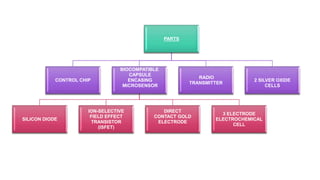
PARTS
CONTROL CHIP
BIOCOMPATIBLE
CAPSULE
ENCASING
MICROSENSOR
SILICON DIODE
ION-SELECTIVE
FIELD EFFECT
TRANSISTOR
(ISFET)
DIRECT
CONTACT GOLD
ELECTRODE
3 ELECTRODE
ELECTROCHEMICAL
CELL
RADIO
TRANSMITTER
2 SILVER OXIDE
CELLS
• It measures the body core temperature.
• Also compensates with the temperature induced signal changes in other
sensors.
• It also identifies local changes associated with Tissue Inflammation & Ulcers.
Silicon Diode
 The ISFET measures pH.
 It can reveal pathological conditions associated with abnormal pH levels
 These abnormalities include :
 Pancreatic disease
 Hypertension
 Inflammatory bowel disease
 The activity of fermenting bacteria
 The level of acid excretion
 Reflux of oesophagus
 Effect of GI specific drugs on target
 organs.
Ion-selective Field Effect Transistor (ISFET)
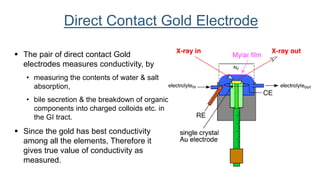
 The pair of direct contact Gold
electrodes measures conductivity, by
• measuring the contents of water & salt
absorption,
• bile secretion & the breakdown of organic
components into charged colloids etc. in
the GI tract.
 Since the gold has best conductivity
among all the elements, Therefore it
gives true value of conductivity as
measured.
Direct Contact Gold Electrode
• The three electrode electrochemical cell detects the level of dissolved oxygen
in solution.
• It measures the oxygen gradient from the proximal to the distal GI Tract
• It investigates :
 Growth of aerobic or bacterial infection
 Formation of radicals causing cellular injury & pathophysiological
conditions like inflammation & Gastric ulceration.
 It develops 1st generation enzymes linked with amperometric biosensors.
3 Electrode Electrochemical Cell
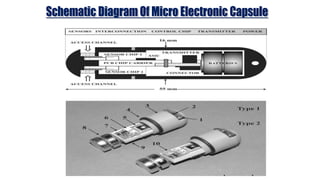
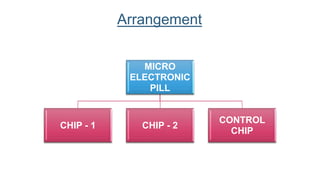
MICRO
ELECTRONIC
PILL
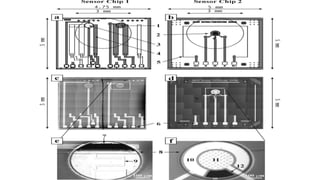
CHIP - 1 CHIP - 2
CONTROL
CHIP
Arrangement
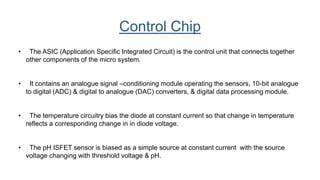
• The ASIC (Application Specific Integrated Circuit) is the control unit that connects together
other components of the micro system.
• It contains an analogue signal –conditioning module operating the sensors, 10-bit analogue
to digital (ADC) & digital to analogue (DAC) converters, & digital data processing module.
• The temperature circuitry bias the diode at constant current so that change in temperature
reflects a corresponding change in in diode voltage.
• The pH ISFET sensor is biased as a simple source at constant current with the source
voltage changing with threshold voltage & pH.
Control Chip
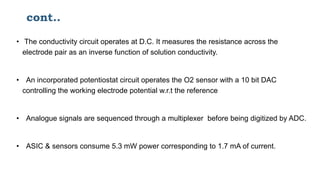
cont..
• The conductivity circuit operates at D.C. It measures the resistance across the
electrode pair as an inverse function of solution conductivity.
• An incorporated potentiostat circuit operates the O2 sensor with a 10 bit DAC
controlling the working electrode potential w.r.t the reference
• Analogue signals are sequenced through a multiplexer before being digitized by ADC.
• ASIC & sensors consume 5.3 mW power corresponding to 1.7 mA of current.
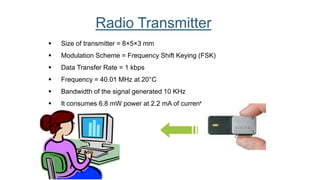
 Size of transmitter = 8×5×3 mm
 Modulation Scheme = Frequency Shift Keying (FSK)
 Data Transfer Rate = 1 kbps
 Frequency = 40.01 MHz at 20°C
 Bandwidth of the signal generated 10 KHz
 It consumes 6.8 mW power at 2.2 mA of current.
Radio Transmitter
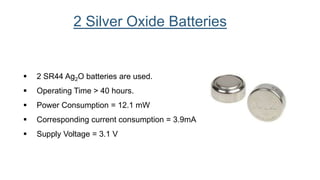
 2 SR44 Ag2O batteries are used.
 Operating Time > 40 hours.
 Power Consumption = 12.1 mW
 Corresponding current consumption = 3.9mA
 Supply Voltage = 3.1 V
2 Silver Oxide Batteries
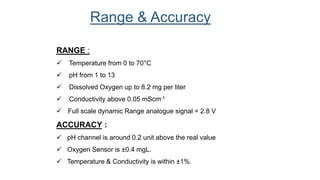
RANGE :
 Temperature from 0 to 70°C
 pH from 1 to 13
 Dissolved Oxygen up to 8.2 mg per liter
 Conductivity above 0.05 mScm-1
 Full scale dynamic Range analogue signal = 2.8 V
ACCURACY :
 pH channel is around 0.2 unit above the real value
 Oxygen Sensor is ±0.4 mgL.
 Temperature & Conductivity is within ±1%.
Range & Accuracy
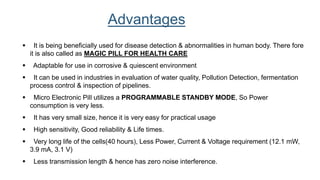
 It is being beneficially used for disease detection & abnormalities in human body. There fore
it is also called as MAGIC PILL FOR HEALTH CARE
 Adaptable for use in corrosive & quiescent environment
 It can be used in industries in evaluation of water quality, Pollution Detection, fermentation
process control & inspection of pipelines.
 Micro Electronic Pill utilizes a PROGRAMMABLE STANDBY MODE, So Power
consumption is very less.
 It has very small size, hence it is very easy for practical usage
 High sensitivity, Good reliability & Life times.
 Very long life of the cells(40 hours), Less Power, Current & Voltage requirement (12.1 mW,
3.9 mA, 3.1 V)
 Less transmission length & hence has zero noise interference.
Advantages
 It cannot perform ultrasound & impedance tomography.
 Cannot detect radiation abnormalities
 Cannot perform radiation treatment associated with cancer & chronic
inflammation.
 Micro Electronic Pills are expensive & are not available in many countries.
 Still its size is not digestible to small babies
 Further research are being carried out to remove its draw backs.
Limitations (The Dark Side)
WEB REFERENCE:-
1. http://ubimon.doc.ic.ac.uk/bsn/public/Jon_Cooper.pdf
2. http://citeseerx.ist.psu.edu
3. http://www.forumsains.com
BOOK REFERENCE:-
1. S. Mackay and B. Jacobson, "Endoradiosonde," Nature, vol. 179, pp. 1239-
1240, 1957.
2. H. S. Wolff, "The radio pill," New Scientist, vol 12, pp. 419-421, 1961.
Reference
Thank You

Microelectroniccapsule

  • 1.
    a revolution inmedical science …. Micro Electronic Capsule BY KANAV MANSOTRA
  • 2.
    Introduction • A “Microelectronicpill” is a basically a multichannel sensor used for remote biomedical measurements using micro technology. • This has been developed for the internal study and detection of diseases and abnormalities in the gastrointestinal (GI) tract where restricted access prevents the use of traditional endoscope. • The measurement parameters for detection include real – time remote recording of temperature, pH, conductivity and dissolved oxygen in the GI tract.
  • 3.
    PARTS CONTROL CHIP BIOCOMPATIBLE CAPSULE ENCASING MICROSENSOR SILICON DIODE ION-SELECTIVE FIELDEFFECT TRANSISTOR (ISFET) DIRECT CONTACT GOLD ELECTRODE 3 ELECTRODE ELECTROCHEMICAL CELL RADIO TRANSMITTER 2 SILVER OXIDE CELLS
  • 5.
    • It measuresthe body core temperature. • Also compensates with the temperature induced signal changes in other sensors. • It also identifies local changes associated with Tissue Inflammation & Ulcers. Silicon Diode
  • 6.
     The ISFETmeasures pH.  It can reveal pathological conditions associated with abnormal pH levels  These abnormalities include :  Pancreatic disease  Hypertension  Inflammatory bowel disease  The activity of fermenting bacteria  The level of acid excretion  Reflux of oesophagus  Effect of GI specific drugs on target  organs. Ion-selective Field Effect Transistor (ISFET)
  • 7.
     The pairof direct contact Gold electrodes measures conductivity, by • measuring the contents of water & salt absorption, • bile secretion & the breakdown of organic components into charged colloids etc. in the GI tract.  Since the gold has best conductivity among all the elements, Therefore it gives true value of conductivity as measured. Direct Contact Gold Electrode
  • 8.
    • The threeelectrode electrochemical cell detects the level of dissolved oxygen in solution. • It measures the oxygen gradient from the proximal to the distal GI Tract • It investigates :  Growth of aerobic or bacterial infection  Formation of radicals causing cellular injury & pathophysiological conditions like inflammation & Gastric ulceration.  It develops 1st generation enzymes linked with amperometric biosensors. 3 Electrode Electrochemical Cell
  • 9.
    MICRO ELECTRONIC PILL CHIP - 1CHIP - 2 CONTROL CHIP Arrangement
  • 11.
    • The ASIC(Application Specific Integrated Circuit) is the control unit that connects together other components of the micro system. • It contains an analogue signal –conditioning module operating the sensors, 10-bit analogue to digital (ADC) & digital to analogue (DAC) converters, & digital data processing module. • The temperature circuitry bias the diode at constant current so that change in temperature reflects a corresponding change in in diode voltage. • The pH ISFET sensor is biased as a simple source at constant current with the source voltage changing with threshold voltage & pH. Control Chip
  • 12.
    cont.. • The conductivitycircuit operates at D.C. It measures the resistance across the electrode pair as an inverse function of solution conductivity. • An incorporated potentiostat circuit operates the O2 sensor with a 10 bit DAC controlling the working electrode potential w.r.t the reference • Analogue signals are sequenced through a multiplexer before being digitized by ADC. • ASIC & sensors consume 5.3 mW power corresponding to 1.7 mA of current.
  • 13.
     Size oftransmitter = 8×5×3 mm  Modulation Scheme = Frequency Shift Keying (FSK)  Data Transfer Rate = 1 kbps  Frequency = 40.01 MHz at 20°C  Bandwidth of the signal generated 10 KHz  It consumes 6.8 mW power at 2.2 mA of current. Radio Transmitter
  • 15.
     2 SR44Ag2O batteries are used.  Operating Time > 40 hours.  Power Consumption = 12.1 mW  Corresponding current consumption = 3.9mA  Supply Voltage = 3.1 V 2 Silver Oxide Batteries
  • 16.
    RANGE :  Temperaturefrom 0 to 70°C  pH from 1 to 13  Dissolved Oxygen up to 8.2 mg per liter  Conductivity above 0.05 mScm-1  Full scale dynamic Range analogue signal = 2.8 V ACCURACY :  pH channel is around 0.2 unit above the real value  Oxygen Sensor is ±0.4 mgL.  Temperature & Conductivity is within ±1%. Range & Accuracy
  • 17.
     It isbeing beneficially used for disease detection & abnormalities in human body. There fore it is also called as MAGIC PILL FOR HEALTH CARE  Adaptable for use in corrosive & quiescent environment  It can be used in industries in evaluation of water quality, Pollution Detection, fermentation process control & inspection of pipelines.  Micro Electronic Pill utilizes a PROGRAMMABLE STANDBY MODE, So Power consumption is very less.  It has very small size, hence it is very easy for practical usage  High sensitivity, Good reliability & Life times.  Very long life of the cells(40 hours), Less Power, Current & Voltage requirement (12.1 mW, 3.9 mA, 3.1 V)  Less transmission length & hence has zero noise interference. Advantages
  • 18.
     It cannotperform ultrasound & impedance tomography.  Cannot detect radiation abnormalities  Cannot perform radiation treatment associated with cancer & chronic inflammation.  Micro Electronic Pills are expensive & are not available in many countries.  Still its size is not digestible to small babies  Further research are being carried out to remove its draw backs. Limitations (The Dark Side)
  • 19.
    WEB REFERENCE:- 1. http://ubimon.doc.ic.ac.uk/bsn/public/Jon_Cooper.pdf 2.http://citeseerx.ist.psu.edu 3. http://www.forumsains.com BOOK REFERENCE:- 1. S. Mackay and B. Jacobson, "Endoradiosonde," Nature, vol. 179, pp. 1239- 1240, 1957. 2. H. S. Wolff, "The radio pill," New Scientist, vol 12, pp. 419-421, 1961. Reference
  • 20.