


WELCOME
TO OUR
PRESENTATION
-Presented by –
Group -3
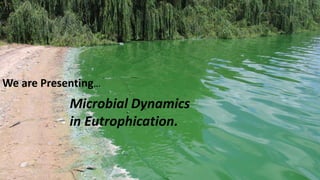
We are Presenting…
Microbial Dynamics
in Eutrophication.
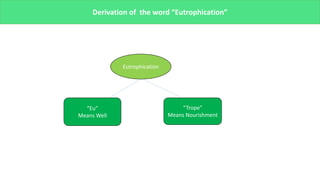
Eutrophication
“Eu”
Means Well
“Trope”
Means Nourishment
Derivation of the word “Eutrophication”
 From that sense Eutrophication refers to the over Nitrogen , Phosphorus and carbon in the water
bodies.
 From another sense eutrophication is the ultimate consequence of bacterial decomposition of
the green lives and further scarcity of oxygen and suffocation as well.
What is eutrophication ?
Types of Eutrophication
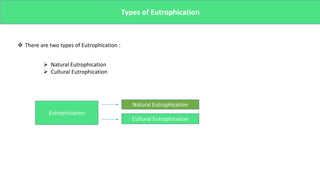
 There are two types of Eutrophication :
 Natural Eutrophication
 Cultural Eutrophication
Eutrophication
Natural Eutrophication
Cultural Eutrophication
Natural Eutrophication
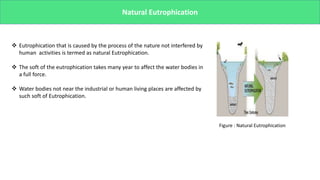
 Eutrophication that is caused by the process of the nature not interfered by
human activities is termed as natural Eutrophication.
 The soft of the eutrophication takes many year to affect the water bodies in
a full force.
 Water bodies not near the industrial or human living places are affected by
such soft of Eutrophication.
Figure : Natural Eutrophication
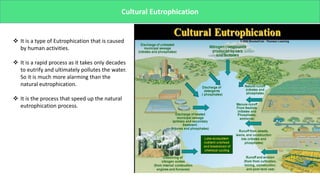
Cultural Eutrophication
 It is a type of Eutrophication that is caused
by human activities.
 It is a rapid process as it takes only decades
to eutrify and ultimately pollutes the water.
So it is much more alarming than the
natural eutrophication.
 It is the process that speed up the natural
eutrophication process.
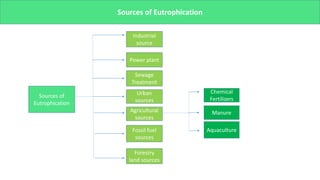
Sources of Eutrophication
Sources of
Eutrophication
Industrial
source
Power plant
Sewage
Treatment
Urban
sources
Agricultural
sources
Fossil fuel
sources
Forestry
land sources
Chemical
Fertilizers
Manure
Aquaculture
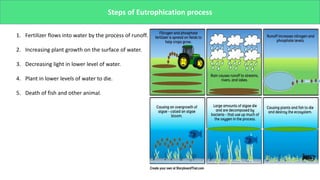
Steps of Eutrophication process
1. Fertilizer flows into water by the process of runoff.
2. Increasing plant growth on the surface of water.
3. Decreasing light in lower level of water.
4. Plant in lower levels of water to die.
5. Death of fish and other animal.
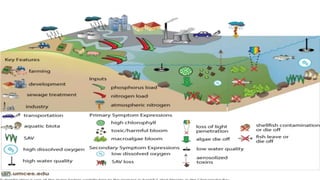
Ecological impacts
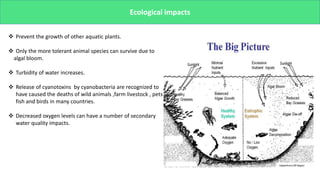
 Prevent the growth of other aquatic plants.
 Only the more tolerant animal species can survive due to
algal bloom.
 Turbidity of water increases.
 Release of cyanotoxins by cyanobacteria are recognized to
have caused the deaths of wild animals ,farm livestock , pets
fish and birds in many countries.
 Decreased oxygen levels can have a number of secondary
water quality impacts.
World’s Scenario of Eutrophication
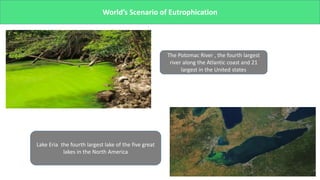
The Potomac River , the fourth largest
river along the Atlantic coast and 21
largest in the United states
Lake Eria the fourth largest lake of the five great
lakes in the North America
World’s Scenario of Eutrophication
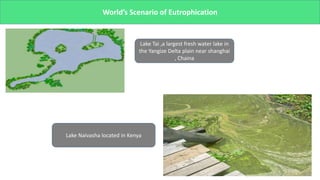
Lake Tai ,a largest fresh water lake in
the Yangize Delta plain near shanghai
, Chaina
Lake Naivasha located in Kenya
Bangladesh’s Scenario of Eutrophication
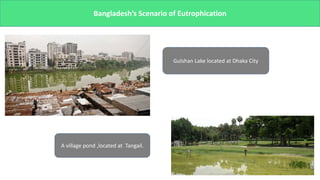
Gulshan Lake located at Dhaka City
A village pond ,located at Tangail.
 Fertilization balance for nitrogen and phosphorus.
 Prevention of erosion of sloping soil.
 Precise irrigation management and soil moisture control.
 Reuse and recycling of water in agriculture.
 Development of short living species of macrophytes.
Steps will be taken to protect healthy microbes –
THANKS A LOT
Group Members
SL No Names Roll No
1 Md.Mehedi hasan 17SES021
2 Nabila Nur Ena 17SES023
3 Maidul Islam 17SES024
4 Md.Naimur Rahman 17SES025
5 Md.Sumon Ali 17SES026
6 Aklima Akter 17SES027
HAVE YOU ANY QUESTION ?

Microbial Dynamics in Eutrophication

  • 1.
  • 2.
    We are Presenting… MicrobialDynamics in Eutrophication.
  • 4.
  • 5.
     From thatsense Eutrophication refers to the over Nitrogen , Phosphorus and carbon in the water bodies.  From another sense eutrophication is the ultimate consequence of bacterial decomposition of the green lives and further scarcity of oxygen and suffocation as well. What is eutrophication ?
  • 6.
    Types of Eutrophication There are two types of Eutrophication :  Natural Eutrophication  Cultural Eutrophication Eutrophication Natural Eutrophication Cultural Eutrophication
  • 7.
    Natural Eutrophication  Eutrophicationthat is caused by the process of the nature not interfered by human activities is termed as natural Eutrophication.  The soft of the eutrophication takes many year to affect the water bodies in a full force.  Water bodies not near the industrial or human living places are affected by such soft of Eutrophication. Figure : Natural Eutrophication
  • 8.
    Cultural Eutrophication  Itis a type of Eutrophication that is caused by human activities.  It is a rapid process as it takes only decades to eutrify and ultimately pollutes the water. So it is much more alarming than the natural eutrophication.  It is the process that speed up the natural eutrophication process.
  • 9.
    Sources of Eutrophication Sourcesof Eutrophication Industrial source Power plant Sewage Treatment Urban sources Agricultural sources Fossil fuel sources Forestry land sources Chemical Fertilizers Manure Aquaculture
  • 11.
    Steps of Eutrophicationprocess 1. Fertilizer flows into water by the process of runoff. 2. Increasing plant growth on the surface of water. 3. Decreasing light in lower level of water. 4. Plant in lower levels of water to die. 5. Death of fish and other animal.
  • 12.
    Ecological impacts  Preventthe growth of other aquatic plants.  Only the more tolerant animal species can survive due to algal bloom.  Turbidity of water increases.  Release of cyanotoxins by cyanobacteria are recognized to have caused the deaths of wild animals ,farm livestock , pets fish and birds in many countries.  Decreased oxygen levels can have a number of secondary water quality impacts.
  • 13.
    World’s Scenario ofEutrophication The Potomac River , the fourth largest river along the Atlantic coast and 21 largest in the United states Lake Eria the fourth largest lake of the five great lakes in the North America
  • 14.
    World’s Scenario ofEutrophication Lake Tai ,a largest fresh water lake in the Yangize Delta plain near shanghai , Chaina Lake Naivasha located in Kenya
  • 15.
    Bangladesh’s Scenario ofEutrophication Gulshan Lake located at Dhaka City A village pond ,located at Tangail.
  • 16.
     Fertilization balancefor nitrogen and phosphorus.  Prevention of erosion of sloping soil.  Precise irrigation management and soil moisture control.  Reuse and recycling of water in agriculture.  Development of short living species of macrophytes. Steps will be taken to protect healthy microbes –
  • 17.
  • 18.
    Group Members SL NoNames Roll No 1 Md.Mehedi hasan 17SES021 2 Nabila Nur Ena 17SES023 3 Maidul Islam 17SES024 4 Md.Naimur Rahman 17SES025 5 Md.Sumon Ali 17SES026 6 Aklima Akter 17SES027
  • 19.