JOURNAL CLUB PRSENTATION
- PREPARED BY:
MRS. MAMPY ACHARJEE
2ND
SEM M.SC NURSING.
Introduction:
stress is fact of everyday life and is known as either as a reaction or as a
stimulus. .As reaction the meaning of stress is specific changes that human
biological system is experiencing as stimulus is related to environment events
that cause those changes. Sources of stress are called as stressors these are
biological, chemical, microbial, psychological, developmental, socio cultural,
and environmental. Occupational stress is the harmful emotional and physical
reactions resulting from the interactions between the worker and her/his work
environment where the demands of the job exceed the worker’s capabilities and
resources.
The effects of occupational stress are considered to be devastating to both employees
and employers. Nursing is described as a stressful-profession and nurses are exposed
to a great number of stressors in their working environment. According to the
Occupational Health and Safety Survey of the American Nurses Association (ANA),
the main concern for the nursing staff with regard to health and safety in the work
environment is the acute or chronic effect of stress. Intensive care or critical care
nursing is a nursing discipline that focuses on aring for patients that have critical and
life threatening conditionsOccupational stress significantly reduces brain functions
such as memory, concentration and learning and impairs the immune system, all of
which are central to effective performance at work. It may also be manifested as
ineffective coping patterns, impaired thought processes or disrupted relationships
which renders the nurse incompetent and prone to errors in their clinical decision
making and practice. Occupational stress reduces productivity, increases management
pressures and makes people ill in many ways, evidence of which is still increasing .
PROBLEM STATEMENT:
Effectiveness of education module on stress management in
reduction of occupational stress among nurses working in intensive
care units at RGGGH at Chennai”.
ONJECTIVES OF THE STUDY:
1. To assess existing level of occupational stress among nurses working in intensive
care units.
2. To assess the effectiveness of education module on reduction of occupational
stress among nurses working in intensive care units in RGGGH at Chennai.
3. To find out the association between occupational stress and selected demographic
variables.
ASSUMPTION:
1. Nurses working in intensive care units may have high occupational stress
2. Nurses working in intensive care units may have some knowledge regarding the management of stress.
3. Nurses working in intensive care units may reduce their occupational stress after administering
education module
RESEARCH HYPOTHESIS
 H1: There will be statistically difference between the pre test level of occupational stress and post test
scores.
 H2: There will be statistically association between post test levels of occupational stress with selected
demographic variables
DELIMITATION OF THE STUDY
1. The study is limited to nurses with a minimum of 3years experience in intensive
2. The study is limited to a sample size of 60.
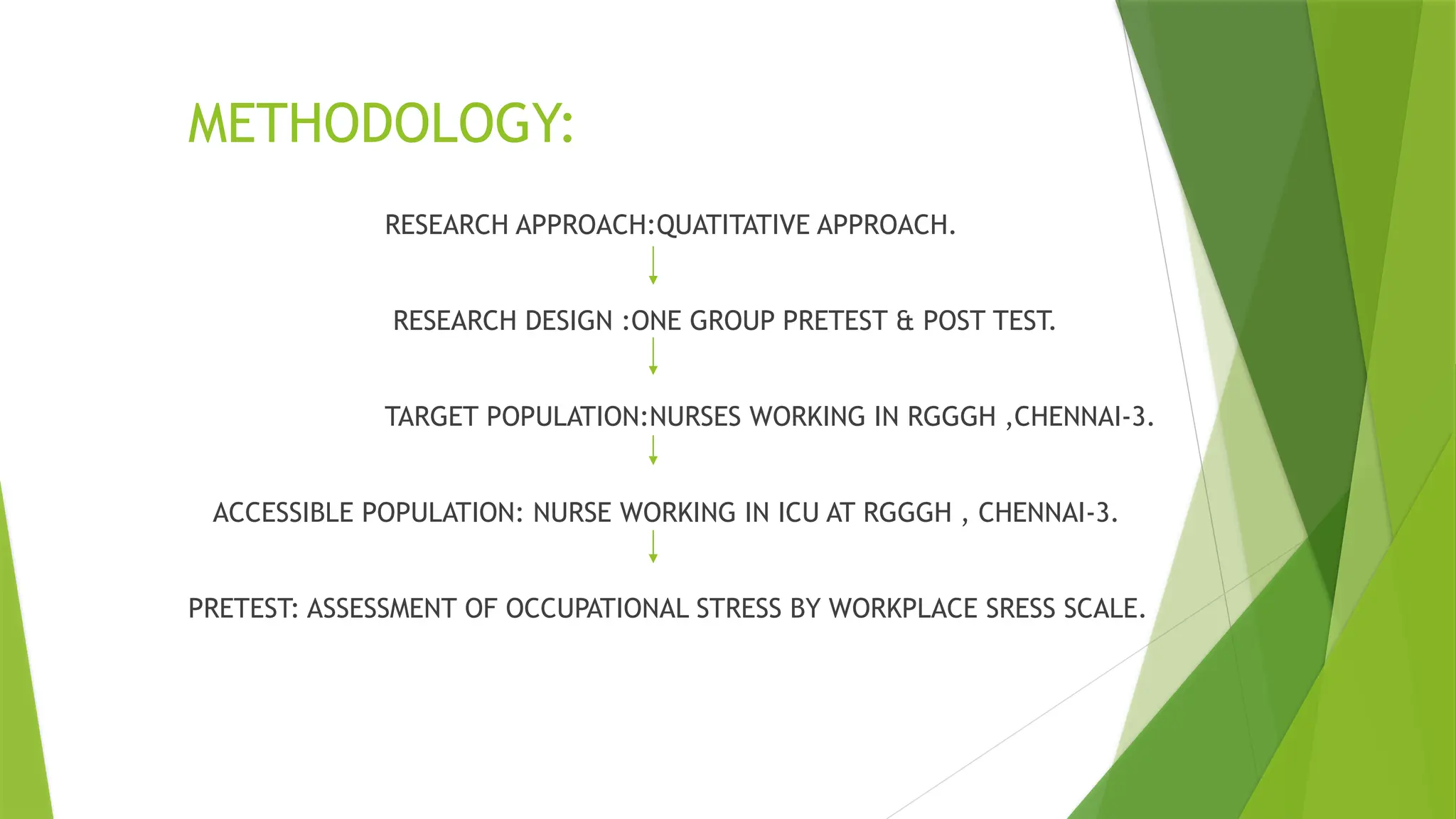
METHODOLOGY:
RESEARCH APPROACH:QUATITATIVE APPROACH.
RESEARCH DESIGN :ONE GROUP PRETEST & POST TEST.
TARGET POPULATION:NURSES WORKING IN RGGGH ,CHENNAI-3.
ACCESSIBLE POPULATION: NURSE WORKING IN ICU AT RGGGH , CHENNAI-3.
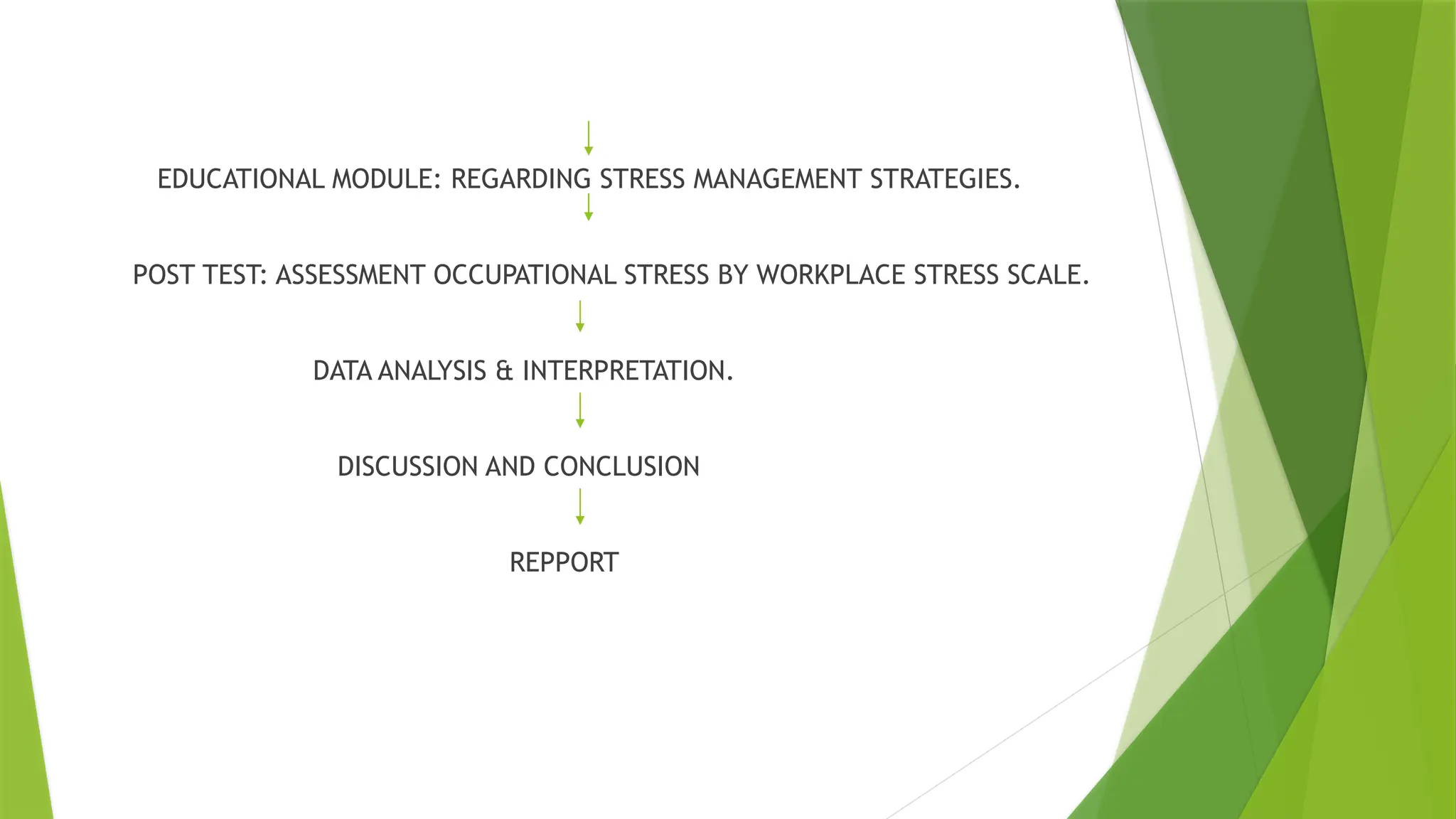
PRETEST: ASSESSMENT OF OCCUPATIONAL STRESS BY WORKPLACE SRESS SCALE.
EDUCATIONAL MODULE: REGARDING STRESS MANAGEMENT STRATEGIES.
POST TEST: ASSESSMENT OCCUPATIONAL STRESS BY WORKPLACE STRESS SCALE.
DATA ANALYSIS & INTERPRETATION.
DISCUSSION AND CONCLUSION
REPPORT
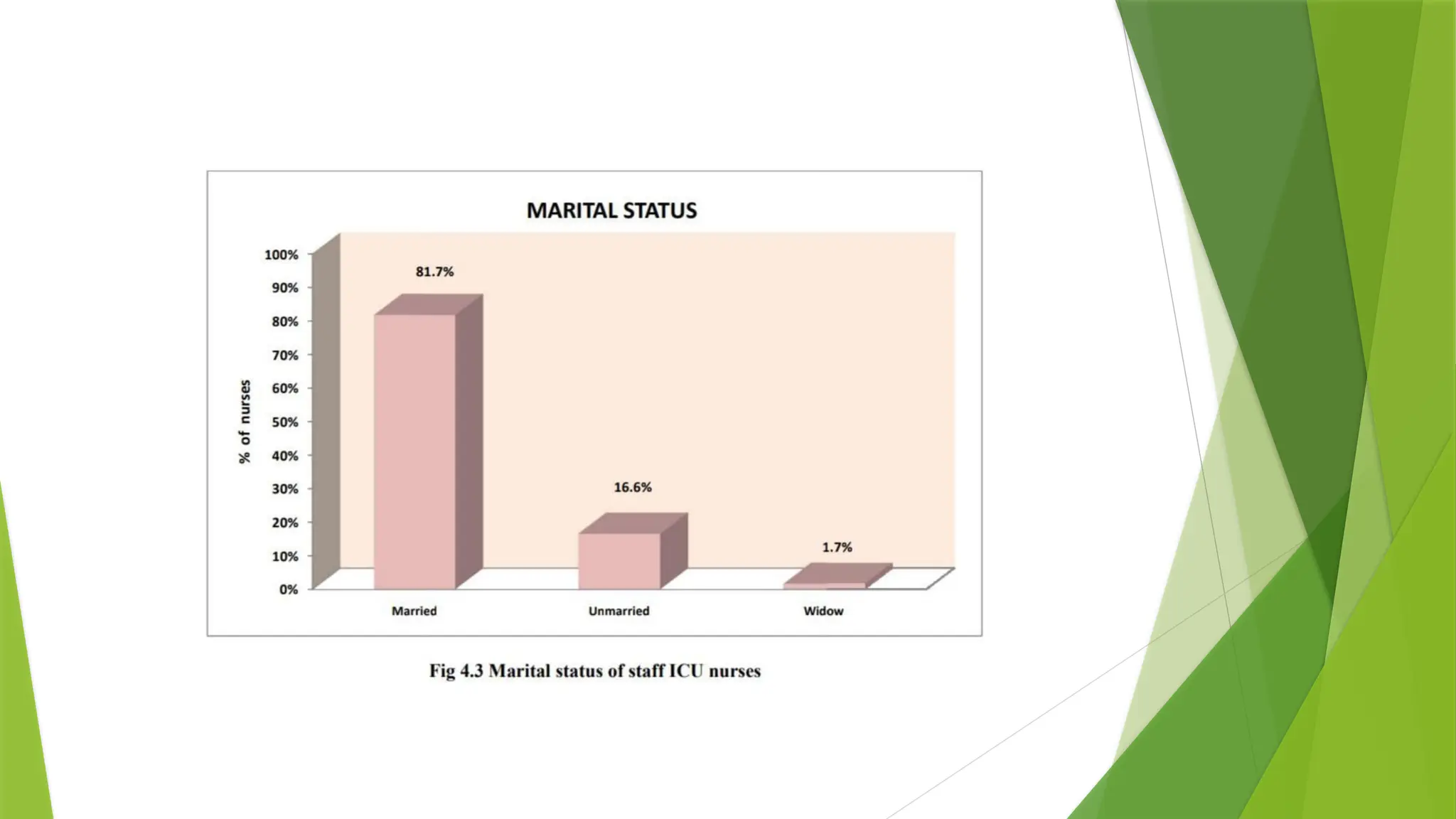
SECTION 1:Deals with the socio demographic variables of
ICU staff nurses
Section II:
Pre test level of occupational stress among nurses working in
ICU before education
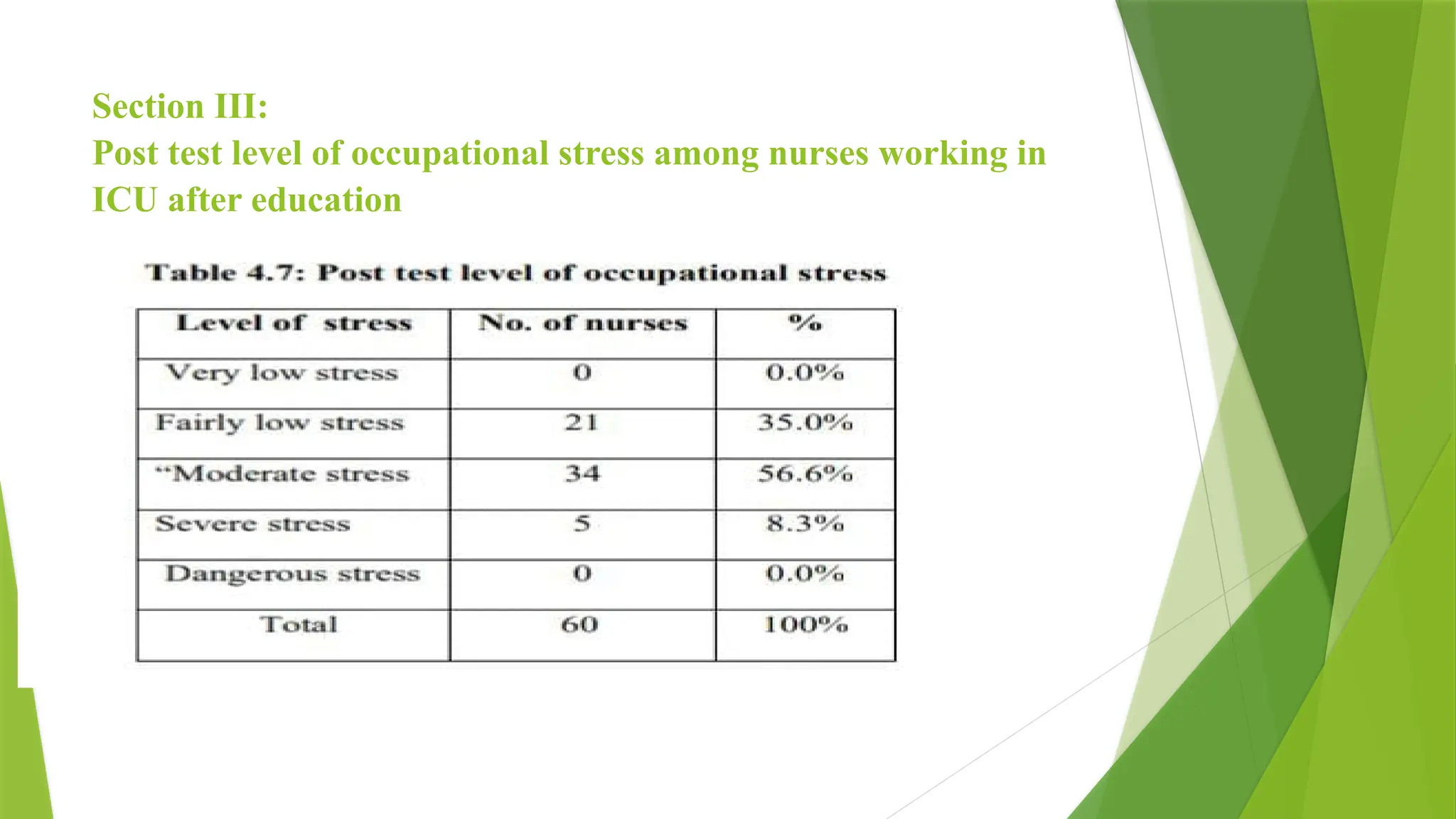
Section III:
Post test level of occupational stress among nurses working in
ICU after education
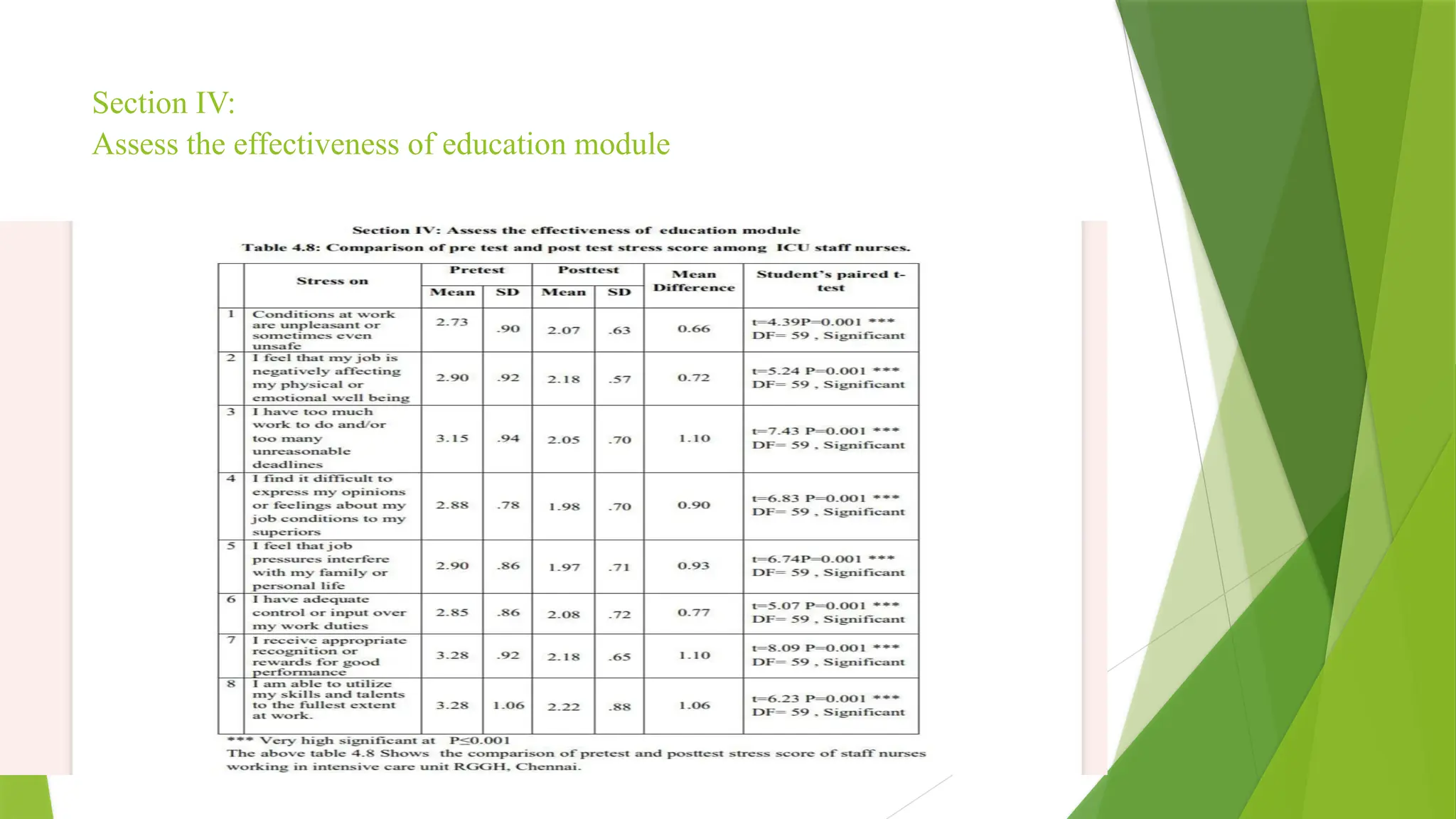
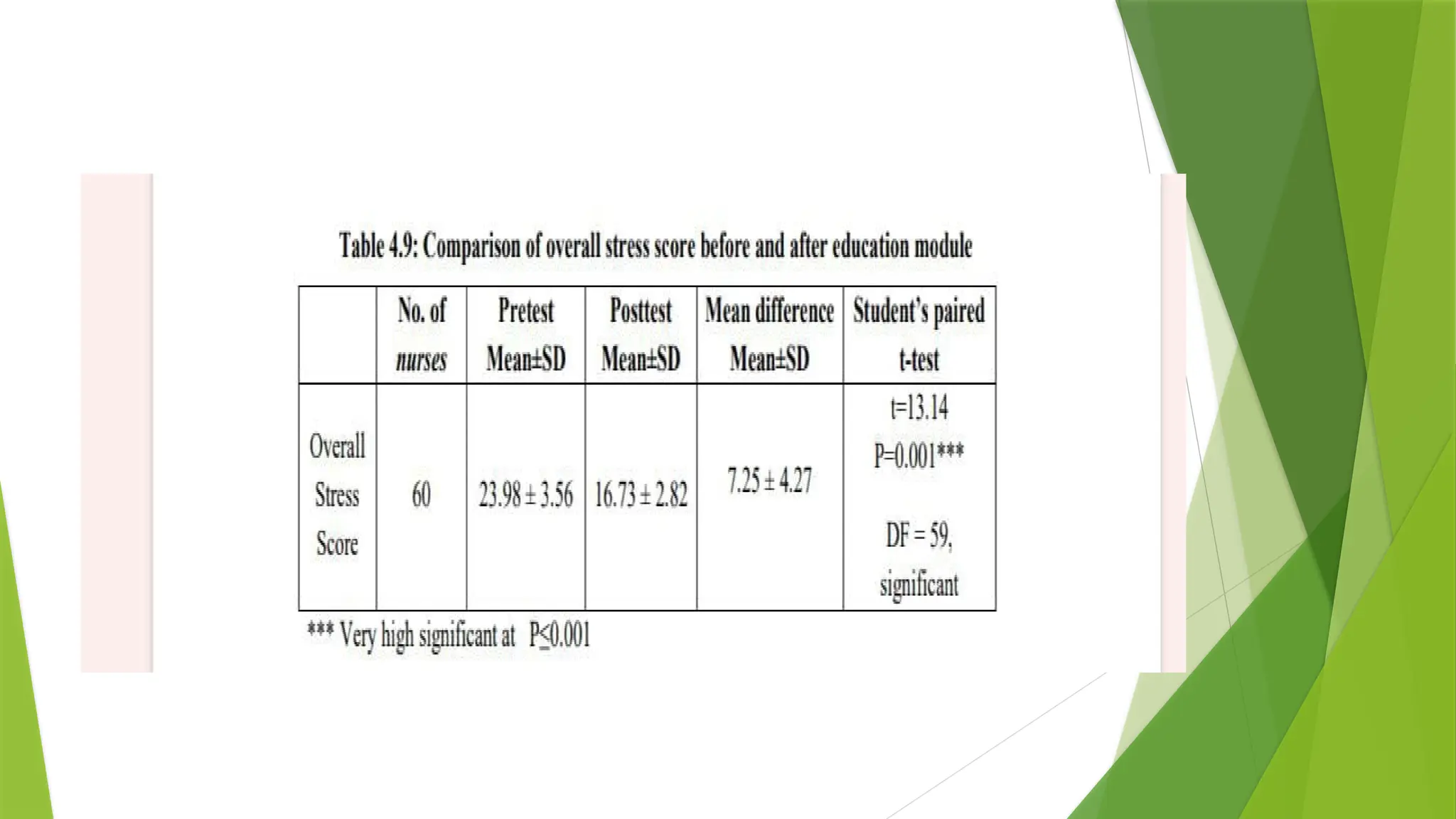
Section IV:
Assess the effectiveness of education module
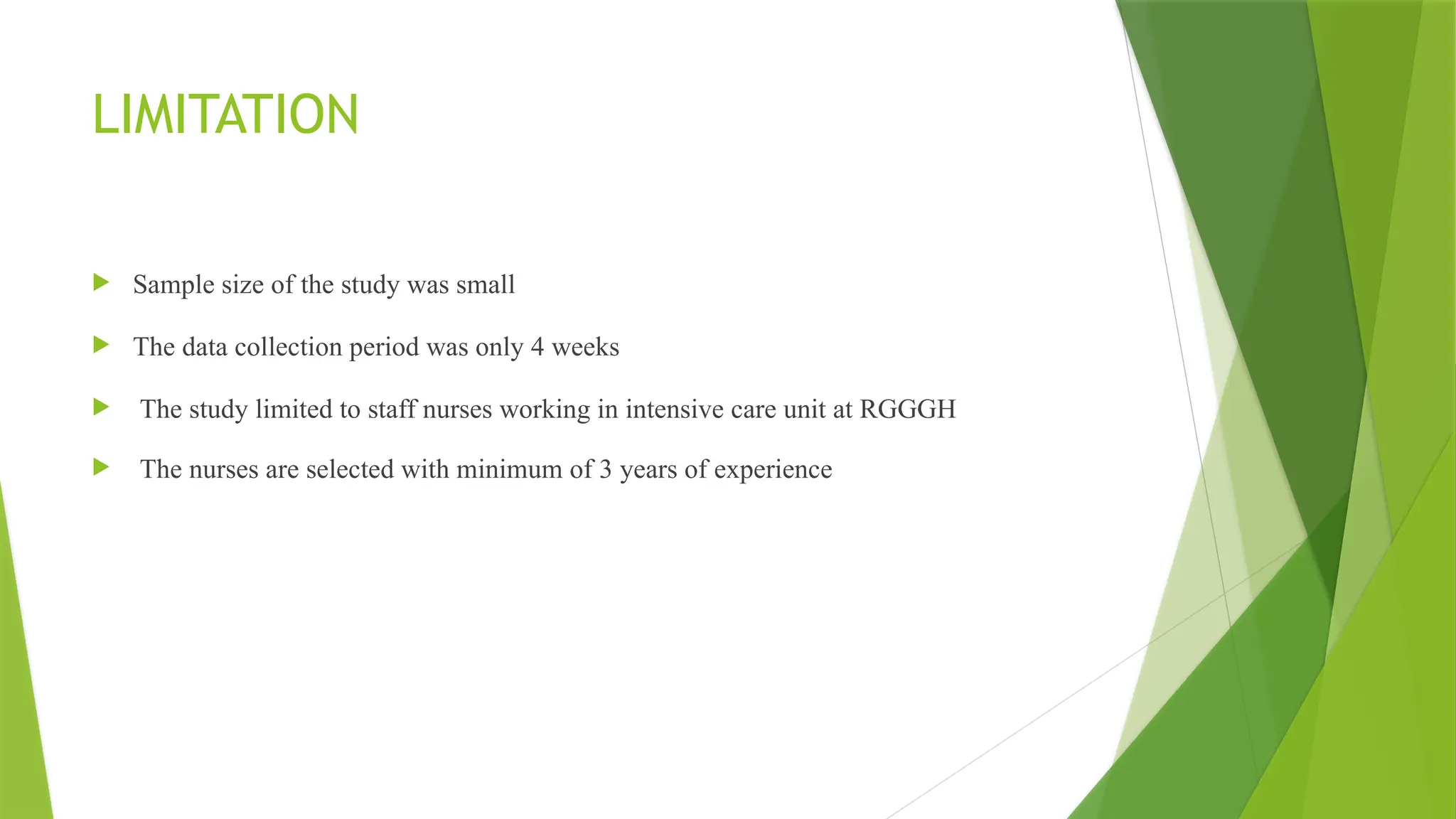
LIMITATION
 Sample size of the study was small
 The data collection period was only 4 weeks
 The study limited to staff nurses working in intensive care unit at RGGGH
 The nurses are selected with minimum of 3 years of experience
RECOMMENDATION:
 The present study findings will be motivating the other
researchers to conduct new studies with different variables in
large scale.
 Similar study can be conducted with different types of
intervention like meditation ,yoga ,laughter therapy to find out
the effectiveness of intervention in managing occupational stress.
 The comparative study can be conducted between government
hospital staff nurses private hospital staff nurses.
 A similar study can be undertaken in large samples to generalize
the findings
 A similar study can be done on all other health professionals like
doctors pharmacist
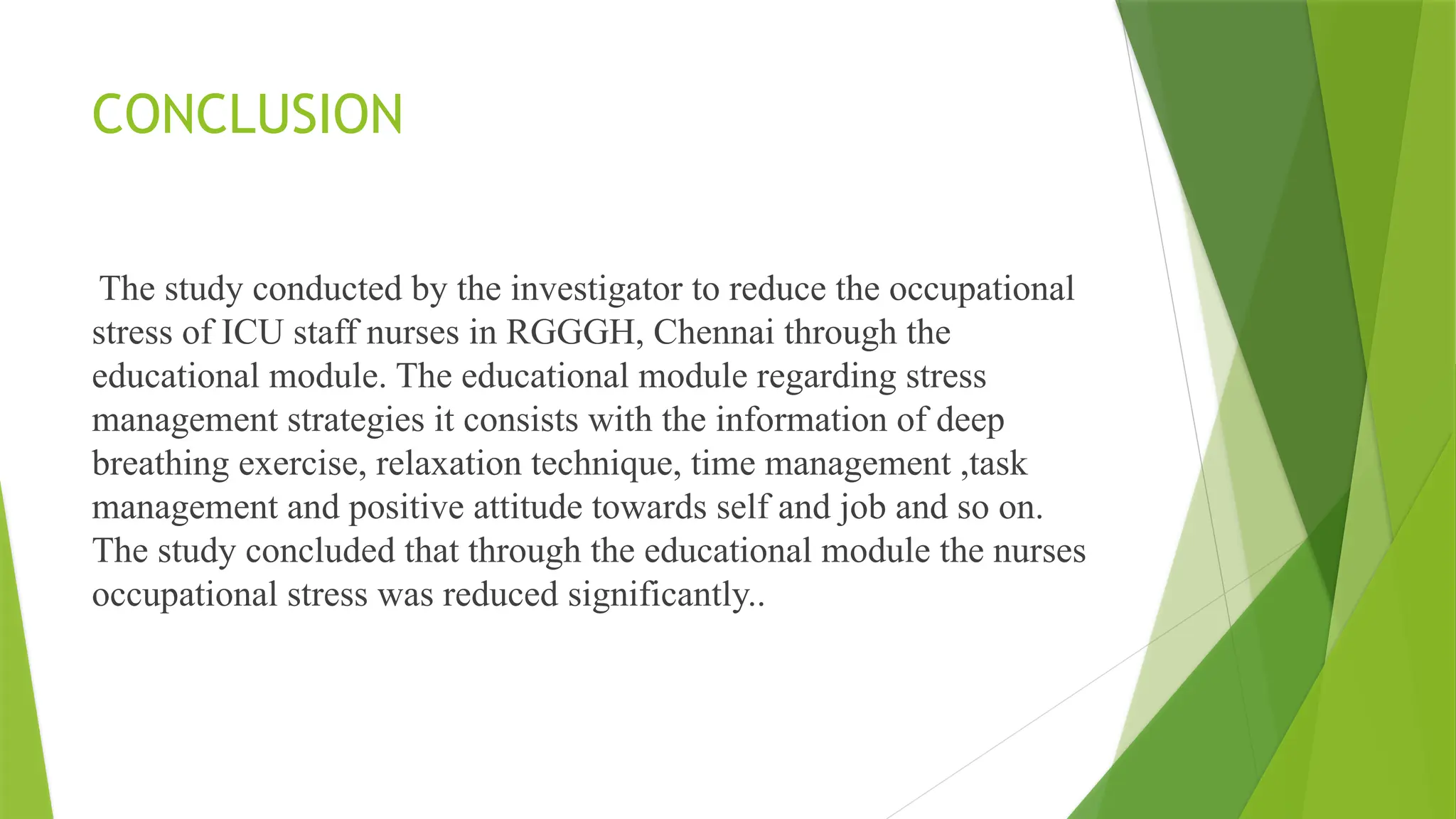
CONCLUSION
The study conducted by the investigator to reduce the occupational
stress of ICU staff nurses in RGGGH, Chennai through the
educational module. The educational module regarding stress
management strategies it consists with the information of deep
breathing exercise, relaxation technique, time management ,task
management and positive attitude towards self and job and so on.
The study concluded that through the educational module the nurses
occupational stress was reduced significantly..
POSITIVE CRITICISM:
1. The problem statement is not complex to study and appropriately
delimited in its scope.
2. The objectives are in accordance with the research problem.
3. The objectives stated in clear and concise form .
4. Results are well explained.
NEGATIVE CRITICISM:
1. The aim of the study is not mentioned.
2. Recommendation should be more.
3. Hypothesis should be in present tense.
4. Tabulated value(t) is not given so it is difficult to interpret the data.
5. In methodology sample size is not given.
6. Authors name is not given.

JORNAL PRESENTATION Technique criticisms

  • 1.
    JOURNAL CLUB PRSENTATION -PREPARED BY: MRS. MAMPY ACHARJEE 2ND SEM M.SC NURSING.
  • 2.
    Introduction: stress is factof everyday life and is known as either as a reaction or as a stimulus. .As reaction the meaning of stress is specific changes that human biological system is experiencing as stimulus is related to environment events that cause those changes. Sources of stress are called as stressors these are biological, chemical, microbial, psychological, developmental, socio cultural, and environmental. Occupational stress is the harmful emotional and physical reactions resulting from the interactions between the worker and her/his work environment where the demands of the job exceed the worker’s capabilities and resources.
  • 3.
    The effects ofoccupational stress are considered to be devastating to both employees and employers. Nursing is described as a stressful-profession and nurses are exposed to a great number of stressors in their working environment. According to the Occupational Health and Safety Survey of the American Nurses Association (ANA), the main concern for the nursing staff with regard to health and safety in the work environment is the acute or chronic effect of stress. Intensive care or critical care nursing is a nursing discipline that focuses on aring for patients that have critical and life threatening conditionsOccupational stress significantly reduces brain functions such as memory, concentration and learning and impairs the immune system, all of which are central to effective performance at work. It may also be manifested as ineffective coping patterns, impaired thought processes or disrupted relationships which renders the nurse incompetent and prone to errors in their clinical decision making and practice. Occupational stress reduces productivity, increases management pressures and makes people ill in many ways, evidence of which is still increasing .
  • 4.
    PROBLEM STATEMENT: Effectiveness ofeducation module on stress management in reduction of occupational stress among nurses working in intensive care units at RGGGH at Chennai”.
  • 5.
    ONJECTIVES OF THESTUDY: 1. To assess existing level of occupational stress among nurses working in intensive care units. 2. To assess the effectiveness of education module on reduction of occupational stress among nurses working in intensive care units in RGGGH at Chennai. 3. To find out the association between occupational stress and selected demographic variables.
  • 6.
    ASSUMPTION: 1. Nurses workingin intensive care units may have high occupational stress 2. Nurses working in intensive care units may have some knowledge regarding the management of stress. 3. Nurses working in intensive care units may reduce their occupational stress after administering education module
  • 7.
    RESEARCH HYPOTHESIS  H1:There will be statistically difference between the pre test level of occupational stress and post test scores.  H2: There will be statistically association between post test levels of occupational stress with selected demographic variables
  • 8.
    DELIMITATION OF THESTUDY 1. The study is limited to nurses with a minimum of 3years experience in intensive 2. The study is limited to a sample size of 60.
  • 9.
    METHODOLOGY: RESEARCH APPROACH:QUATITATIVE APPROACH. RESEARCHDESIGN :ONE GROUP PRETEST & POST TEST. TARGET POPULATION:NURSES WORKING IN RGGGH ,CHENNAI-3. ACCESSIBLE POPULATION: NURSE WORKING IN ICU AT RGGGH , CHENNAI-3. PRETEST: ASSESSMENT OF OCCUPATIONAL STRESS BY WORKPLACE SRESS SCALE.
  • 10.
    EDUCATIONAL MODULE: REGARDINGSTRESS MANAGEMENT STRATEGIES. POST TEST: ASSESSMENT OCCUPATIONAL STRESS BY WORKPLACE STRESS SCALE. DATA ANALYSIS & INTERPRETATION. DISCUSSION AND CONCLUSION REPPORT
  • 11.
    SECTION 1:Deals withthe socio demographic variables of ICU staff nurses
  • 19.
    Section II: Pre testlevel of occupational stress among nurses working in ICU before education
  • 21.
    Section III: Post testlevel of occupational stress among nurses working in ICU after education
  • 23.
    Section IV: Assess theeffectiveness of education module
  • 25.
    LIMITATION  Sample sizeof the study was small  The data collection period was only 4 weeks  The study limited to staff nurses working in intensive care unit at RGGGH  The nurses are selected with minimum of 3 years of experience
  • 26.
    RECOMMENDATION:  The presentstudy findings will be motivating the other researchers to conduct new studies with different variables in large scale.  Similar study can be conducted with different types of intervention like meditation ,yoga ,laughter therapy to find out the effectiveness of intervention in managing occupational stress.  The comparative study can be conducted between government hospital staff nurses private hospital staff nurses.
  • 27.
     A similarstudy can be undertaken in large samples to generalize the findings  A similar study can be done on all other health professionals like doctors pharmacist
  • 28.
    CONCLUSION The study conductedby the investigator to reduce the occupational stress of ICU staff nurses in RGGGH, Chennai through the educational module. The educational module regarding stress management strategies it consists with the information of deep breathing exercise, relaxation technique, time management ,task management and positive attitude towards self and job and so on. The study concluded that through the educational module the nurses occupational stress was reduced significantly..
  • 29.
    POSITIVE CRITICISM: 1. Theproblem statement is not complex to study and appropriately delimited in its scope. 2. The objectives are in accordance with the research problem. 3. The objectives stated in clear and concise form . 4. Results are well explained.
  • 30.
    NEGATIVE CRITICISM: 1. Theaim of the study is not mentioned. 2. Recommendation should be more. 3. Hypothesis should be in present tense. 4. Tabulated value(t) is not given so it is difficult to interpret the data. 5. In methodology sample size is not given. 6. Authors name is not given.