Business Analysis
Focus on Management Information
Projects
Business Analysis focus on Management Information
Jacques Fourie
9 July 2015
1.01
Presentation:
Author:
Date:
Version:
Business Planning
Business Analysis
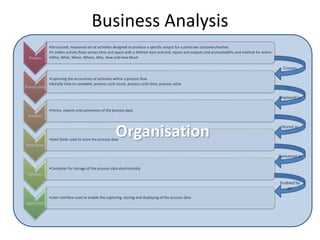
Process
•Structured, measured set of activities designed to produce a specific output for a particular customer/market.
•It orders activity flows across time and space with a defined start and end, inputs and outputs and accountability and method for action.
•Who, What, When, Where, Why, How and How Much
Process data
•Capturing the occurrence of activities within a process flow
•Activity time to complete, process cycle count, process cycle time, process value
Artifacts
•Forms, reports and summaries of the process data
Data items
•Data fields used to store the process data
Database
•Container for storage of the process data electronically
Application
•User interface used to enable the capturing, storing and displaying of the process data
Creates
Displayed in
Stored as
Contained in
Enabled by
an
Organisation
Business Requirements Definition
How did we get to this situation?
What is the opportunity we have to fix the situation / take advantage of an opportunity?
What did the stakeholders voice as requirements and opportunities?
What is the boundaries / Scope of this planned intervention in terms of Organisation,
People, Applications, Timeframe and Geographical/Business area?
Who will use the solution? How will the organisation structure have to look to be able to
effectively drive the solution? What sort of skills will be required? How many people will
be required?
What work will be impacted? Detail what will be the impact on the Core, Supportive and
Management functions.
How will the application/s used fit in with our current application architecture? What will
the impact be on the systems environment and the management thereof? What do we
need to cater for in terms of application /data integration/sharing?
What clients will be impacted – and what will the impact be?
What do we need to measure to track the success of the intervention (Time, Cost, Quality
and Agility?
Who supports this intervention / initiative? Were the impacted areas consulted – have
they given comment, approval and sign-off?
Data Class / Structures
•Used for lookup tables /reference
Static data
•Defines the relations and hierarchies
Relational
•Is the occurrence / instance of an activity in a process
Transactional
•Measurement data / “How Much” in process definition – Time
and date, Value amount, Number / count
Variable
Metadatadefines
thedatastructures
Occurance/Instancedata
capturethecompletion
ofanactionwithinthe
process
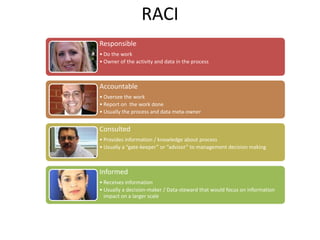
RACI
Responsible
• Do the work
• Owner of the activity and data in the process
Accountable
• Oversee the work
• Report on the work done
• Usually the process and data meta-owner
Consulted
• Provides information / knowledge about process
• Usually a “gate-keeper” or “advisor” to management decision making
Informed
• Receives information
• Usually a decision-maker / Data-steward that would focus on information
impact on a larger scale
Data and Process ownership
and Data Quality
• Creates / accountable
for the creation of the
process, data structures
and data classes
•Uses the captured data
occurrences to manage
the business
•Captures the data
occurrence on behalf of
the data owner
•Meta-data ownership
reside outside of the
bank
•Data owner / activity
owner in the process
•Performs the action/s in
the process
•Creates the data
occurrence in the RACI
Data
Owner
Data
Custodian
Meta-data
Owner
Data
Steward
Data Quality- Consistent
- Data is structured
- Data Structures normalised
Data Quality- Timeous
and Relevant
1. Available
when needed
2. Must be able to use
It to run the business
Data Quality- Accurate
1. Consistent
2. Captured ASAP
Data Quality- Accurate
1. Consistent
2. Captured ASAP
Management information
(Dashboards)
Gap Analysis
Conceptual data
model
Data Variables and
Data Dimensions
What do you want
to
measure/manage?
Display / presentation
level; thresholds and
alerts
Variables = Time ,Value and Number
fields (comes from defining “How
Much” in the process)
Data Dimensions = All other
normalised data fields (comes from
defining “What, Why, Who, How and
Where” in the process
Structure of the Data variables and
Dimensions in relation to all the other
Data Variables and Dimensions
(normalised to allow dimension
selection in the reports)
Analysis of the discrepancy between
what is required – as per the
conceptual data model and what is
available (actual databases/sources) in
the organisation i.e. What can be
sourced, What can be transformed and
What must be developed
Data De-Normalisation in a Data-Mart for reporting

MI Business Analysis

  • 1.
    Business Analysis Focus onManagement Information Projects Business Analysis focus on Management Information Jacques Fourie 9 July 2015 1.01 Presentation: Author: Date: Version:
  • 2.
  • 3.
    Business Analysis Process •Structured, measuredset of activities designed to produce a specific output for a particular customer/market. •It orders activity flows across time and space with a defined start and end, inputs and outputs and accountability and method for action. •Who, What, When, Where, Why, How and How Much Process data •Capturing the occurrence of activities within a process flow •Activity time to complete, process cycle count, process cycle time, process value Artifacts •Forms, reports and summaries of the process data Data items •Data fields used to store the process data Database •Container for storage of the process data electronically Application •User interface used to enable the capturing, storing and displaying of the process data Creates Displayed in Stored as Contained in Enabled by an Organisation
  • 4.
    Business Requirements Definition Howdid we get to this situation? What is the opportunity we have to fix the situation / take advantage of an opportunity? What did the stakeholders voice as requirements and opportunities? What is the boundaries / Scope of this planned intervention in terms of Organisation, People, Applications, Timeframe and Geographical/Business area? Who will use the solution? How will the organisation structure have to look to be able to effectively drive the solution? What sort of skills will be required? How many people will be required? What work will be impacted? Detail what will be the impact on the Core, Supportive and Management functions. How will the application/s used fit in with our current application architecture? What will the impact be on the systems environment and the management thereof? What do we need to cater for in terms of application /data integration/sharing? What clients will be impacted – and what will the impact be? What do we need to measure to track the success of the intervention (Time, Cost, Quality and Agility? Who supports this intervention / initiative? Were the impacted areas consulted – have they given comment, approval and sign-off?
  • 5.
    Data Class /Structures •Used for lookup tables /reference Static data •Defines the relations and hierarchies Relational •Is the occurrence / instance of an activity in a process Transactional •Measurement data / “How Much” in process definition – Time and date, Value amount, Number / count Variable Metadatadefines thedatastructures Occurance/Instancedata capturethecompletion ofanactionwithinthe process
  • 6.
    RACI Responsible • Do thework • Owner of the activity and data in the process Accountable • Oversee the work • Report on the work done • Usually the process and data meta-owner Consulted • Provides information / knowledge about process • Usually a “gate-keeper” or “advisor” to management decision making Informed • Receives information • Usually a decision-maker / Data-steward that would focus on information impact on a larger scale
  • 7.
    Data and Processownership and Data Quality • Creates / accountable for the creation of the process, data structures and data classes •Uses the captured data occurrences to manage the business •Captures the data occurrence on behalf of the data owner •Meta-data ownership reside outside of the bank •Data owner / activity owner in the process •Performs the action/s in the process •Creates the data occurrence in the RACI Data Owner Data Custodian Meta-data Owner Data Steward Data Quality- Consistent - Data is structured - Data Structures normalised Data Quality- Timeous and Relevant 1. Available when needed 2. Must be able to use It to run the business Data Quality- Accurate 1. Consistent 2. Captured ASAP Data Quality- Accurate 1. Consistent 2. Captured ASAP
  • 8.
    Management information (Dashboards) Gap Analysis Conceptualdata model Data Variables and Data Dimensions What do you want to measure/manage? Display / presentation level; thresholds and alerts Variables = Time ,Value and Number fields (comes from defining “How Much” in the process) Data Dimensions = All other normalised data fields (comes from defining “What, Why, Who, How and Where” in the process Structure of the Data variables and Dimensions in relation to all the other Data Variables and Dimensions (normalised to allow dimension selection in the reports) Analysis of the discrepancy between what is required – as per the conceptual data model and what is available (actual databases/sources) in the organisation i.e. What can be sourced, What can be transformed and What must be developed Data De-Normalisation in a Data-Mart for reporting