WHAT IS DEVELOPMENT BANKS/
WHAT ARE DEVELOPMENTAL FINANCIAL INSTITUTIONS
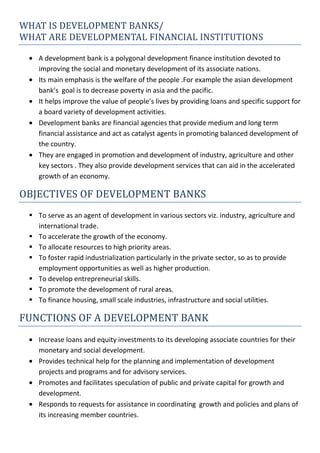
A development bank is a polygonal development finance institution devoted to
improving the social and monetary development of its associate nations.
Its main emphasis is the welfare of the people .For example the asian development
bank’s goal is to decrease poverty in asia and the pacific.
It helps improve the value of people’s lives by providing loans and specific support for
a board variety of development activities.
Development banks are financial agencies that provide medium and long term
financial assistance and act as catalyst agents in promoting balanced development of
the country.
They are engaged in promotion and development of industry, agriculture and other
key sectors . They also provide development services that can aid in the accelerated
growth of an economy.
OBJECTIVES OF DEVELOPMENT BANKS
 To serve as an agent of development in various sectors viz. industry, agriculture and
international trade.
 To accelerate the growth of the economy.
 To allocate resources to high priority areas.
 To foster rapid industrialization particularly in the private sector, so as to provide
employment opportunities as well as higher production.
 To develop entrepreneurial skills.
 To promote the development of rural areas.
 To finance housing, small scale industries, infrastructure and social utilities.
FUNCTIONS OF A DEVELOPMENT BANK
Increase loans and equity investments to its developing associate countries for their
monetary and social development.
Provides technical help for the planning and implementation of development
projects and programs and for advisory services.
Promotes and facilitates speculation of public and private capital for growth and
development.
Responds to requests for assistance in coordinating growth and policies and plans of
its increasing member countries.
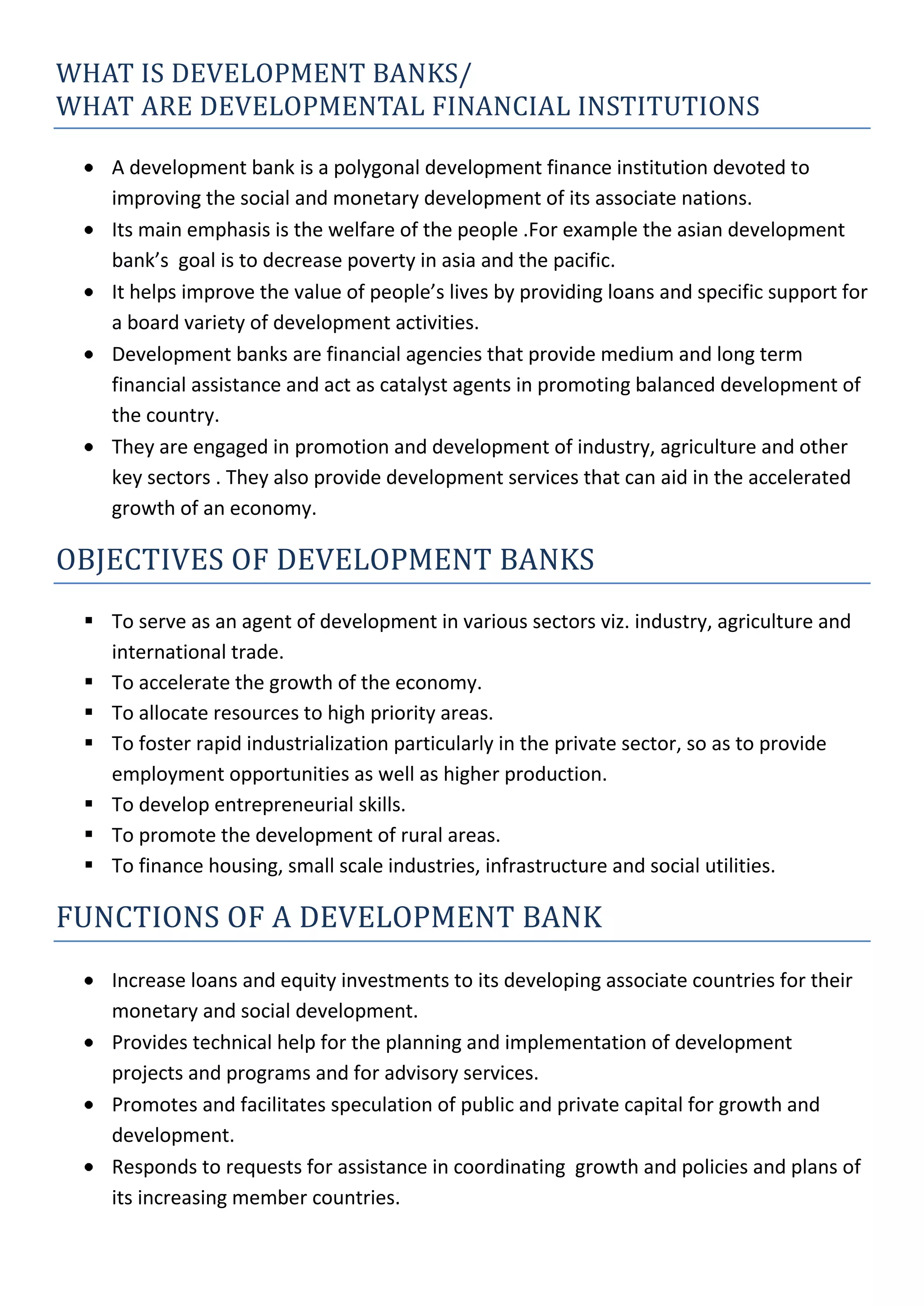
ROLES OF DEVELOPMENT BANKS IN FINANCIAL SYSTEM
 Providing funds
 Infrastructural facilities
 Promotional activities
 Development in backward areas
 Employment generation
 Accelerate industrialisation
DEVELOPMENT BANKS IN INDIA / DIFFERNT TYPES OF
DEVELOPMENTAL FINANCIAL INSTITUTIONS
 IFCI
 IDBI
 ICICI
INDUSTRIAL FINANCE CORPORATION OF INDIA
LIMITED(IFCI)
 The government of India set up the industrial finance corporation of India in July
1948.
 It was the first institution in the financial sector to be converted into a public limited
company on July 1, 1993.
 It was set up to provide institutional credit to medium and large industries.
 Management of IFCI has 12 directors in which 4 are nominated by the IDBI.
OBJECTIVES OF IFCI
 Promoted by new entrepreneurs
 Based on indigenous technology
 Which would result in substitution of imports
 Providing input for increasing agricultural products
 Guarantee loans and deferred payments
 Assist projects under co-operatives and in backward areas
 The period could be as long as 25 years and should not exceed that period
 Underwrite and directly subscribe to shares and debentures issued by companies
 Assist in setting up new projects as well as in modernisation of existing industries
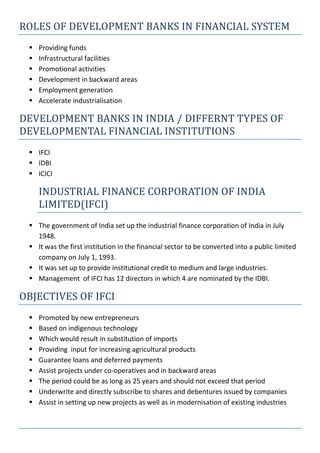
FUNCTIONS OF IFCI
 Granting loans and advances for the establishment , expansion, diversification and
modernisation of industries in corporate and co-operative sectors
 Guaranteeing loans raised by industrial concerns in the capital market , both in
rupees and foreign currencies
 Subscribing and underwriting the issue of shares and debentures by industries. Such
investment can be held up to 7 years
 Guaranteeing credit purchase of capital goods, imported as well as purchased with in
the country
 Providing assistance under the soft loans schemes to selected industries such as
cement , cotton textiles, jute, engineering goods etc.
 Providing technical , legal, marketing and administrative assistance to any industrial
concerns for the promotion , management and expansion of the industrial concern
 Providing equipment to the existing industrial concerns on lease under its equipment
leasing scheme
 Rendering merchant banking services to industrial concerns
INDUSTRIAL DEVELOPMENT BANK OF INDIA (IDBI)
 The industrial development bank of india (IDBI) was established on july 1 1964 under
the act of parliament as a wholly owned subsidiary of the Reserve Bank of India.
 In 16 febuary 1976 the ownership of IDBI was transferred to the government of India
and it was made the principal financial institution for coordinating the activities of
institutions engaged in financing , promoting, and developing industry in the country.
THE PRINCIPAL SOURCE OF FUNDS OF IDBI
 Share capital and reserves
 Borrowing from government of India and RBI
 Market borrowing by way of bonds
 Deposits and other borrowings
 Repayment of past assistance by borrowers
 Foreign currency borrowing form world banks
 Asian development banks and international markets
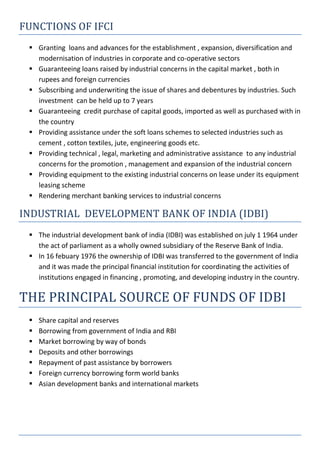
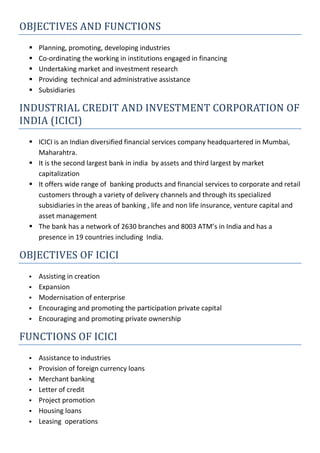
OBJECTIVES AND FUNCTIONS
 Planning, promoting, developing industries
 Co-ordinating the working in institutions engaged in financing
 Undertaking market and investment research
 Providing technical and administrative assistance
 Subsidiaries
INDUSTRIAL CREDIT AND INVESTMENT CORPORATION OF
INDIA (ICICI)
 ICICI is an Indian diversified financial services company headquartered in Mumbai,
Maharahtra.
 It is the second largest bank in india by assets and third largest by market
capitalization
 It offers wide range of banking products and financial services to corporate and retail
customers through a variety of delivery channels and through its specialized
subsidiaries in the areas of banking , life and non life insurance, venture capital and
asset management
 The bank has a network of 2630 branches and 8003 ATM’s in India and has a
presence in 19 countries including India.
OBJECTIVES OF ICICI
 Assisting in creation
 Expansion
 Modernisation of enterprise
 Encouraging and promoting the participation private capital
 Encouraging and promoting private ownership
FUNCTIONS OF ICICI
 Assistance to industries
 Provision of foreign currency loans
 Merchant banking
 Letter of credit
 Project promotion
 Housing loans
 Leasing operations
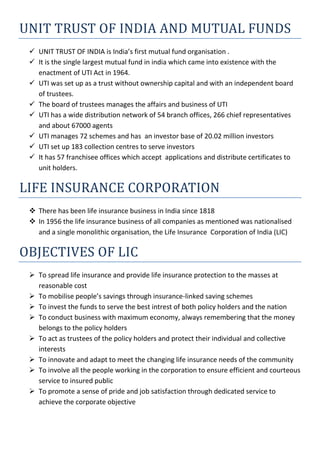
UNIT TRUST OF INDIA AND MUTUAL FUNDS
 UNIT TRUST OF INDIA is India’s first mutual fund organisation .
 It is the single largest mutual fund in india which came into existence with the
enactment of UTI Act in 1964.
 UTI was set up as a trust without ownership capital and with an independent board
of trustees.
 The board of trustees manages the affairs and business of UTI
 UTI has a wide distribution network of 54 branch offices, 266 chief representatives
and about 67000 agents
 UTI manages 72 schemes and has an investor base of 20.02 million investors
 UTI set up 183 collection centres to serve investors
 It has 57 franchisee offices which accept applications and distribute certificates to
unit holders.
LIFE INSURANCE CORPORATION
 There has been life insurance business in India since 1818
 In 1956 the life insurance business of all companies as mentioned was nationalised
and a single monolithic organisation, the Life Insurance Corporation of India (LIC)
OBJECTIVES OF LIC
 To spread life insurance and provide life insurance protection to the masses at
reasonable cost
 To mobilise people’s savings through insurance-linked saving schemes
 To invest the funds to serve the best intrest of both policy holders and the nation
 To conduct business with maximum economy, always remembering that the money
belongs to the policy holders
 To act as trustees of the policy holders and protect their individual and collective
interests
 To innovate and adapt to meet the changing life insurance needs of the community
 To involve all the people working in the corporation to ensure efficient and courteous
service to insured public
 To promote a sense of pride and job satisfaction through dedicated service to
achieve the corporate objective
Mfi 3 unit already

Mfi 3 unit already

  • 1.
    WHAT IS DEVELOPMENTBANKS/ WHAT ARE DEVELOPMENTAL FINANCIAL INSTITUTIONS A development bank is a polygonal development finance institution devoted to improving the social and monetary development of its associate nations. Its main emphasis is the welfare of the people .For example the asian development bank’s goal is to decrease poverty in asia and the pacific. It helps improve the value of people’s lives by providing loans and specific support for a board variety of development activities. Development banks are financial agencies that provide medium and long term financial assistance and act as catalyst agents in promoting balanced development of the country. They are engaged in promotion and development of industry, agriculture and other key sectors . They also provide development services that can aid in the accelerated growth of an economy. OBJECTIVES OF DEVELOPMENT BANKS  To serve as an agent of development in various sectors viz. industry, agriculture and international trade.  To accelerate the growth of the economy.  To allocate resources to high priority areas.  To foster rapid industrialization particularly in the private sector, so as to provide employment opportunities as well as higher production.  To develop entrepreneurial skills.  To promote the development of rural areas.  To finance housing, small scale industries, infrastructure and social utilities. FUNCTIONS OF A DEVELOPMENT BANK Increase loans and equity investments to its developing associate countries for their monetary and social development. Provides technical help for the planning and implementation of development projects and programs and for advisory services. Promotes and facilitates speculation of public and private capital for growth and development. Responds to requests for assistance in coordinating growth and policies and plans of its increasing member countries.
  • 2.
    ROLES OF DEVELOPMENTBANKS IN FINANCIAL SYSTEM  Providing funds  Infrastructural facilities  Promotional activities  Development in backward areas  Employment generation  Accelerate industrialisation DEVELOPMENT BANKS IN INDIA / DIFFERNT TYPES OF DEVELOPMENTAL FINANCIAL INSTITUTIONS  IFCI  IDBI  ICICI INDUSTRIAL FINANCE CORPORATION OF INDIA LIMITED(IFCI)  The government of India set up the industrial finance corporation of India in July 1948.  It was the first institution in the financial sector to be converted into a public limited company on July 1, 1993.  It was set up to provide institutional credit to medium and large industries.  Management of IFCI has 12 directors in which 4 are nominated by the IDBI. OBJECTIVES OF IFCI  Promoted by new entrepreneurs  Based on indigenous technology  Which would result in substitution of imports  Providing input for increasing agricultural products  Guarantee loans and deferred payments  Assist projects under co-operatives and in backward areas  The period could be as long as 25 years and should not exceed that period  Underwrite and directly subscribe to shares and debentures issued by companies  Assist in setting up new projects as well as in modernisation of existing industries
  • 3.
    FUNCTIONS OF IFCI Granting loans and advances for the establishment , expansion, diversification and modernisation of industries in corporate and co-operative sectors  Guaranteeing loans raised by industrial concerns in the capital market , both in rupees and foreign currencies  Subscribing and underwriting the issue of shares and debentures by industries. Such investment can be held up to 7 years  Guaranteeing credit purchase of capital goods, imported as well as purchased with in the country  Providing assistance under the soft loans schemes to selected industries such as cement , cotton textiles, jute, engineering goods etc.  Providing technical , legal, marketing and administrative assistance to any industrial concerns for the promotion , management and expansion of the industrial concern  Providing equipment to the existing industrial concerns on lease under its equipment leasing scheme  Rendering merchant banking services to industrial concerns INDUSTRIAL DEVELOPMENT BANK OF INDIA (IDBI)  The industrial development bank of india (IDBI) was established on july 1 1964 under the act of parliament as a wholly owned subsidiary of the Reserve Bank of India.  In 16 febuary 1976 the ownership of IDBI was transferred to the government of India and it was made the principal financial institution for coordinating the activities of institutions engaged in financing , promoting, and developing industry in the country. THE PRINCIPAL SOURCE OF FUNDS OF IDBI  Share capital and reserves  Borrowing from government of India and RBI  Market borrowing by way of bonds  Deposits and other borrowings  Repayment of past assistance by borrowers  Foreign currency borrowing form world banks  Asian development banks and international markets
  • 4.
    OBJECTIVES AND FUNCTIONS Planning, promoting, developing industries  Co-ordinating the working in institutions engaged in financing  Undertaking market and investment research  Providing technical and administrative assistance  Subsidiaries INDUSTRIAL CREDIT AND INVESTMENT CORPORATION OF INDIA (ICICI)  ICICI is an Indian diversified financial services company headquartered in Mumbai, Maharahtra.  It is the second largest bank in india by assets and third largest by market capitalization  It offers wide range of banking products and financial services to corporate and retail customers through a variety of delivery channels and through its specialized subsidiaries in the areas of banking , life and non life insurance, venture capital and asset management  The bank has a network of 2630 branches and 8003 ATM’s in India and has a presence in 19 countries including India. OBJECTIVES OF ICICI  Assisting in creation  Expansion  Modernisation of enterprise  Encouraging and promoting the participation private capital  Encouraging and promoting private ownership FUNCTIONS OF ICICI  Assistance to industries  Provision of foreign currency loans  Merchant banking  Letter of credit  Project promotion  Housing loans  Leasing operations
  • 5.
    UNIT TRUST OFINDIA AND MUTUAL FUNDS  UNIT TRUST OF INDIA is India’s first mutual fund organisation .  It is the single largest mutual fund in india which came into existence with the enactment of UTI Act in 1964.  UTI was set up as a trust without ownership capital and with an independent board of trustees.  The board of trustees manages the affairs and business of UTI  UTI has a wide distribution network of 54 branch offices, 266 chief representatives and about 67000 agents  UTI manages 72 schemes and has an investor base of 20.02 million investors  UTI set up 183 collection centres to serve investors  It has 57 franchisee offices which accept applications and distribute certificates to unit holders. LIFE INSURANCE CORPORATION  There has been life insurance business in India since 1818  In 1956 the life insurance business of all companies as mentioned was nationalised and a single monolithic organisation, the Life Insurance Corporation of India (LIC) OBJECTIVES OF LIC  To spread life insurance and provide life insurance protection to the masses at reasonable cost  To mobilise people’s savings through insurance-linked saving schemes  To invest the funds to serve the best intrest of both policy holders and the nation  To conduct business with maximum economy, always remembering that the money belongs to the policy holders  To act as trustees of the policy holders and protect their individual and collective interests  To innovate and adapt to meet the changing life insurance needs of the community  To involve all the people working in the corporation to ensure efficient and courteous service to insured public  To promote a sense of pride and job satisfaction through dedicated service to achieve the corporate objective