Metrology and the Consequences of
Bad Measurement Decisions
Presented by Scott Mimbs
Corporate Sponsor:
NCSLI Virginia Section Meeting 1213
MetrologyandtheConsequencesofBadMeasurementDecisions
Page 2
What you need to know about metrology
1. How does metrology affect me?
• Measurement data affect your decisions
2. What do I need to look for?
• Three essentials elements of “good” measurement data
3. What are the consequences of “bad” measurement-based decisions?
All measurement decisions have consequences…
The more critical the decision, the more critical the data. The more critical the data, the more
critical the measurement. NASA Reference Publication 1342
MetrologyandtheConsequencesofBadMeasurementDecisions
Page 3
Metrology and Measurement Data
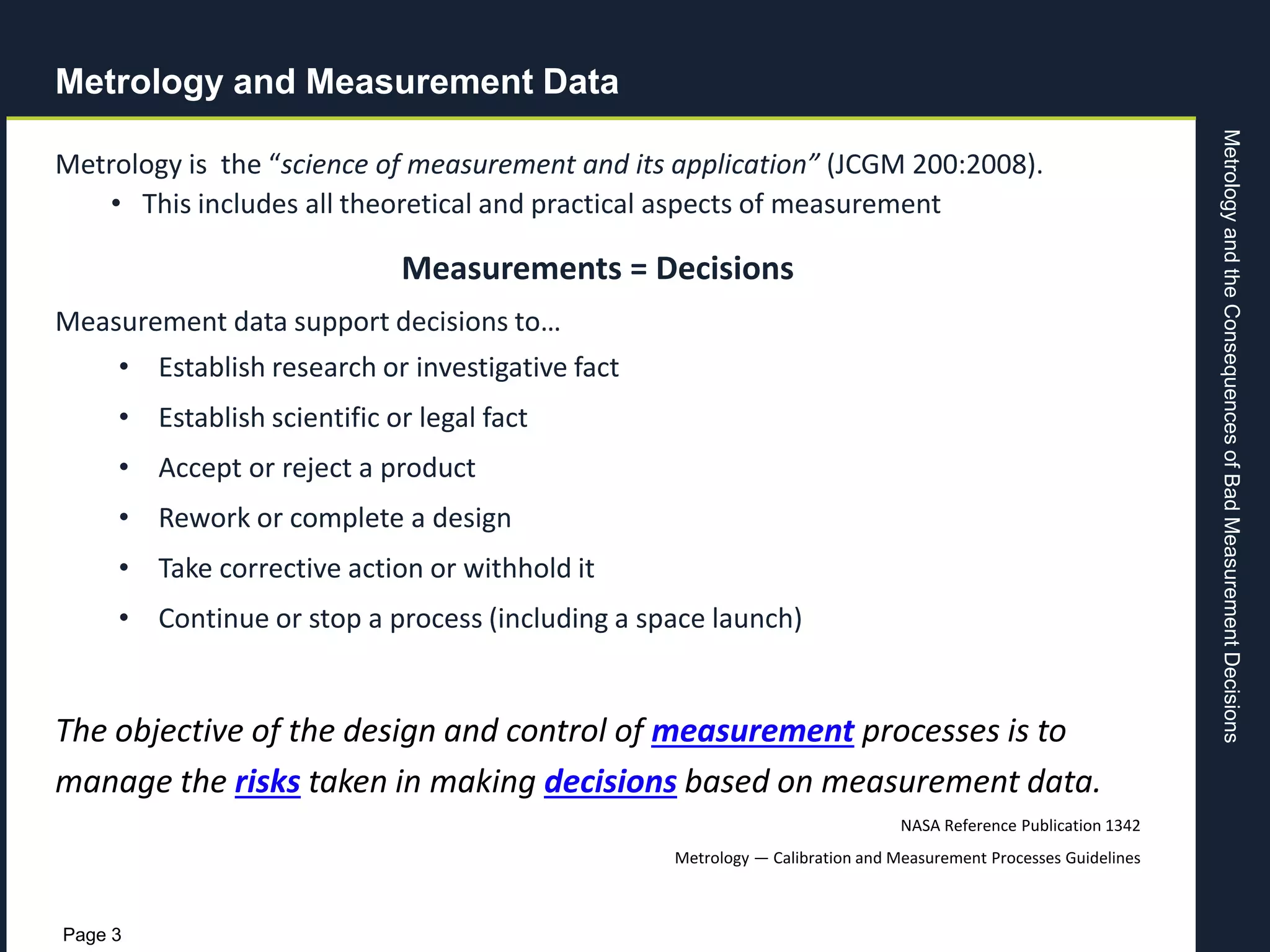
Metrology is the “science of measurement and its application” (JCGM 200:2008).
• This includes all theoretical and practical aspects of measurement
Measurements = Decisions
Measurement data support decisions to…
• Establish research or investigative fact
• Establish scientific or legal fact
• Accept or reject a product
• Rework or complete a design
• Take corrective action or withhold it
• Continue or stop a process (including a space launch)
The objective of the design and control of measurement processes is to
manage the risks taken in making decisions based on measurement data.
NASA Reference Publication 1342
Metrology — Calibration and Measurement Processes Guidelines
MetrologyandtheConsequencesofBadMeasurementDecisions
Page 4
An undesirable situation or circumstance that has both a
likelihood of occurring and a potentially negative consequence.
AS9100C
Defining Risk
MetrologyandtheConsequencesofBadMeasurementDecisions
Page 5
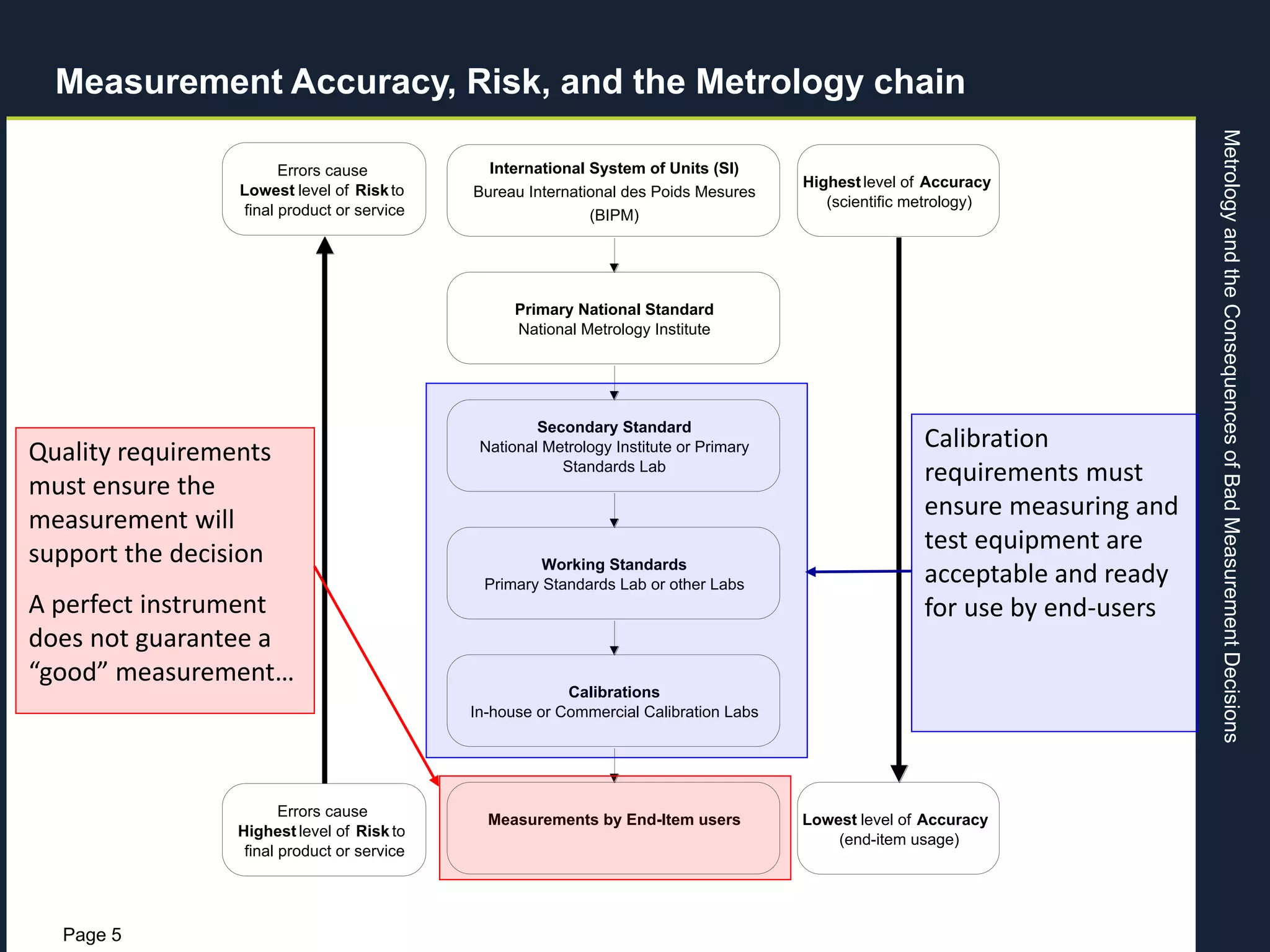
International System of Units (SI)
Bureau International des Poids Mesures
(BIPM)
Working Standards
Primary Standards Lab or other Labs
Measurements by End-Item users
Primary National Standard
National Metrology Institute
Secondary Standard
National Metrology Institute or Primary
Standards Lab
Calibrations
In-house or Commercial Calibration Labs
Highestlevel of Accuracy
(scientific metrology)
Lowest level of Accuracy
(end-item usage)
Errors cause
Lowest level of Riskto
final product or service
Errors cause
Highest level of Risk to
final product or service
Calibration
requirements must
ensure measuring and
test equipment are
acceptable and ready
for use by end-users
Quality requirements
must ensure the
measurement will
support the decision
A perfect instrument
does not guarantee a
“good” measurement…
Measurement Accuracy, Risk, and the Metrology chain
MetrologyandtheConsequencesofBadMeasurementDecisions
Page 6
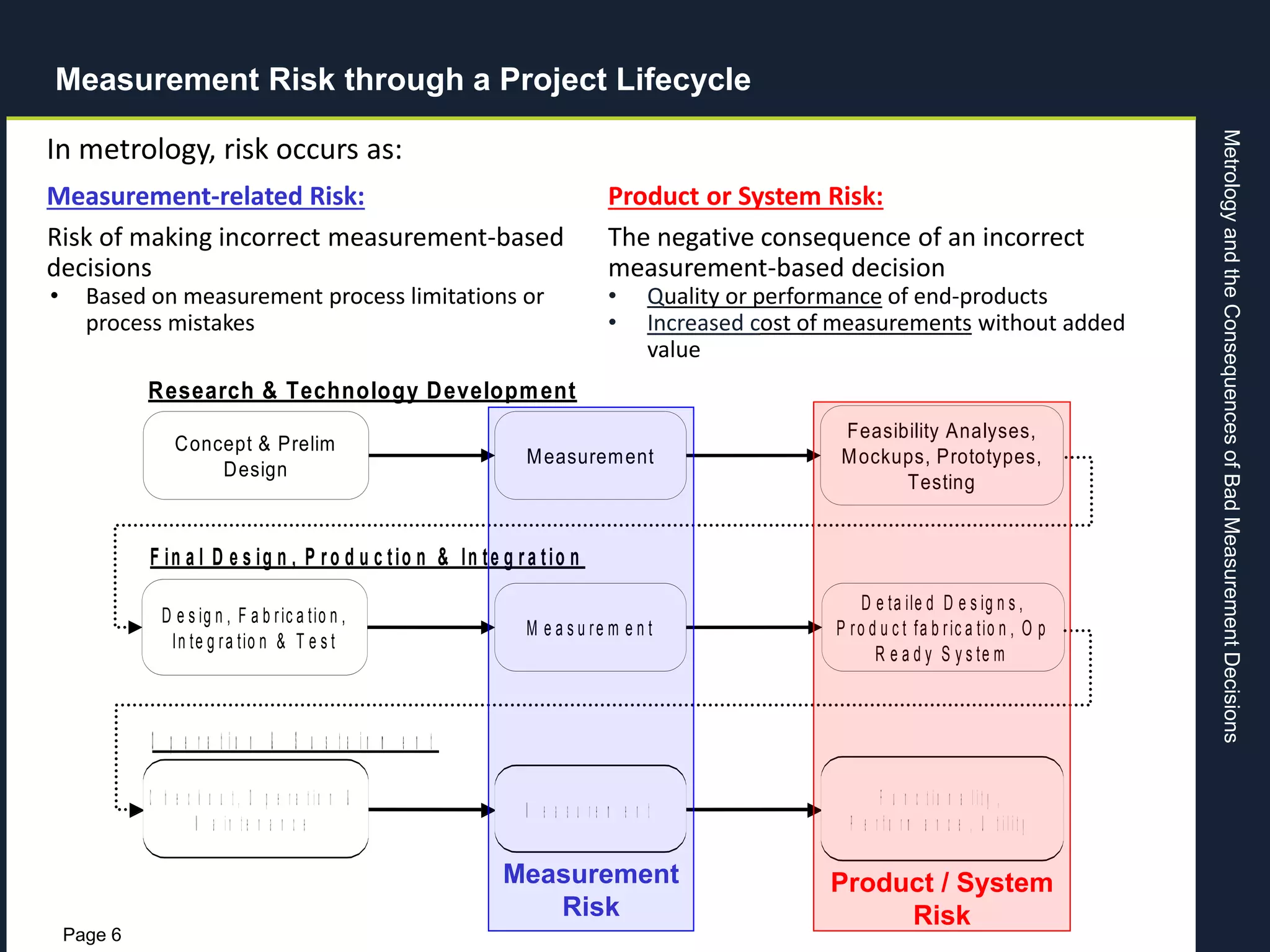
Measurement Risk through a Project Lifecycle
Measurement-related Risk:
Risk of making incorrect measurement-based
decisions
• Based on measurement process limitations or
process mistakes
Product or System Risk:
The negative consequence of an incorrect
measurement-based decision
• Quality or performance of end-products
• Increased cost of measurements without added
value
Concept & Prelim
Design
Feasibility Analyses,
Mockups, Prototypes,
Testing
Measurement
Research & Technology Development
D e s ig n , F a b ric a tio n ,
In te g ra tio n & T e s t
D e ta ile d D e s ig n s ,
P ro d u c t fa b ric a tio n , O p
R e a d y S y s te m
M e a s u re m e n t
F in a l D e s ig n , P ro d u c tio n & In te g ra tio n
C h e c k o u t , O p e r a t i o n &
M a i n t e n a n c e
F u n c t i o n a l i t y ,
P e r f o r m a n c e , U t i l i t y
M e a s u r e m e n t
O p e r a t i o n & S u s t a i n m e n t
Product / System
Risk
Measurement
Risk
In metrology, risk occurs as:
MetrologyandtheConsequencesofBadMeasurementDecisions
Page 7
Range of possible values at
95% confidence
A B C
+ L
- L
Nominal
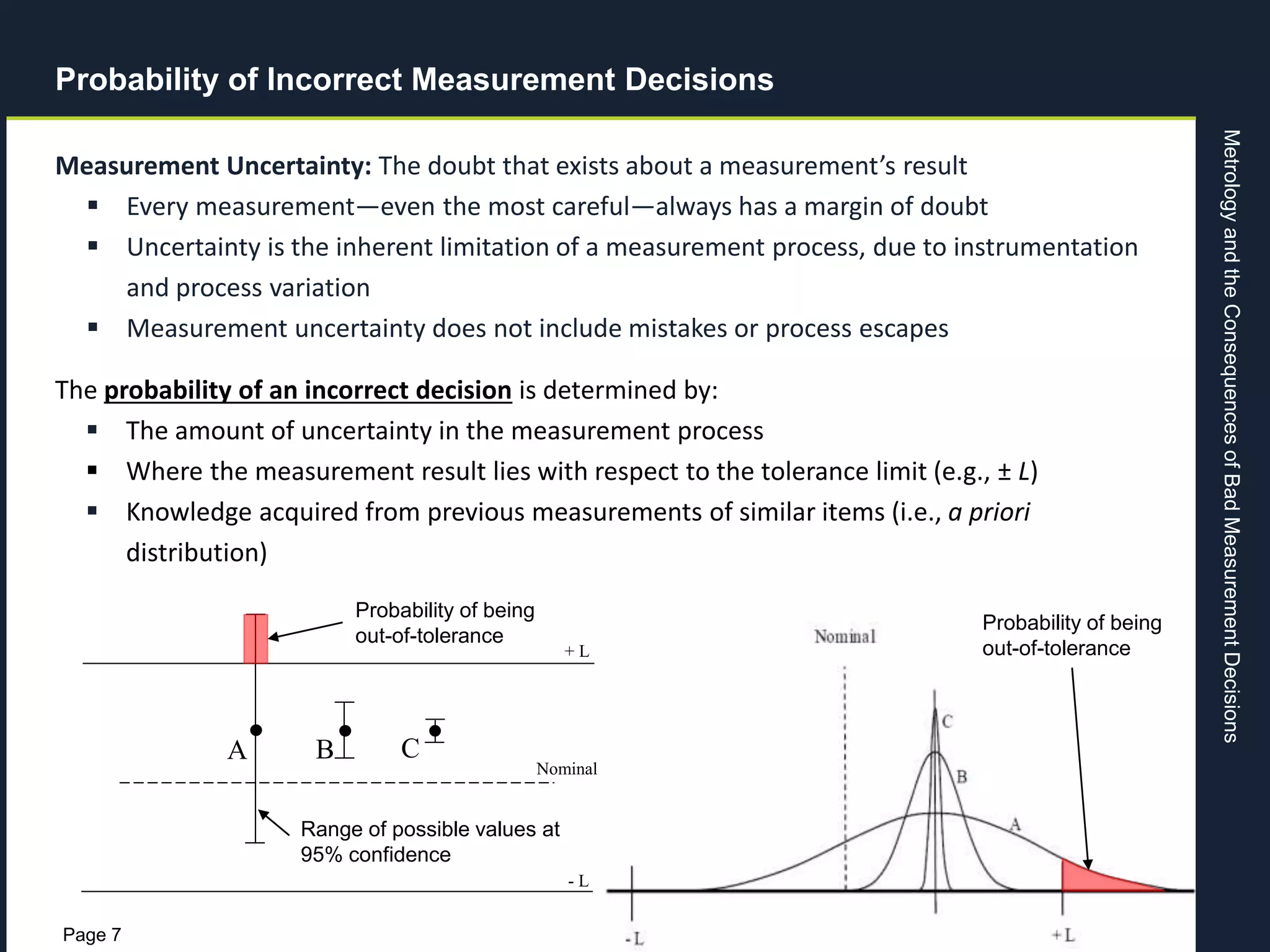
Probability of Incorrect Measurement Decisions
Measurement Uncertainty: The doubt that exists about a measurement’s result
 Every measurement—even the most careful—always has a margin of doubt
 Uncertainty is the inherent limitation of a measurement process, due to instrumentation
and process variation
 Measurement uncertainty does not include mistakes or process escapes
The probability of an incorrect decision is determined by:
 The amount of uncertainty in the measurement process
 Where the measurement result lies with respect to the tolerance limit (e.g., ± L)
 Knowledge acquired from previous measurements of similar items (i.e., a priori
distribution)
Probability of being
out-of-tolerance
Probability of being
out-of-tolerance
MetrologyandtheConsequencesofBadMeasurementDecisions
Page 8
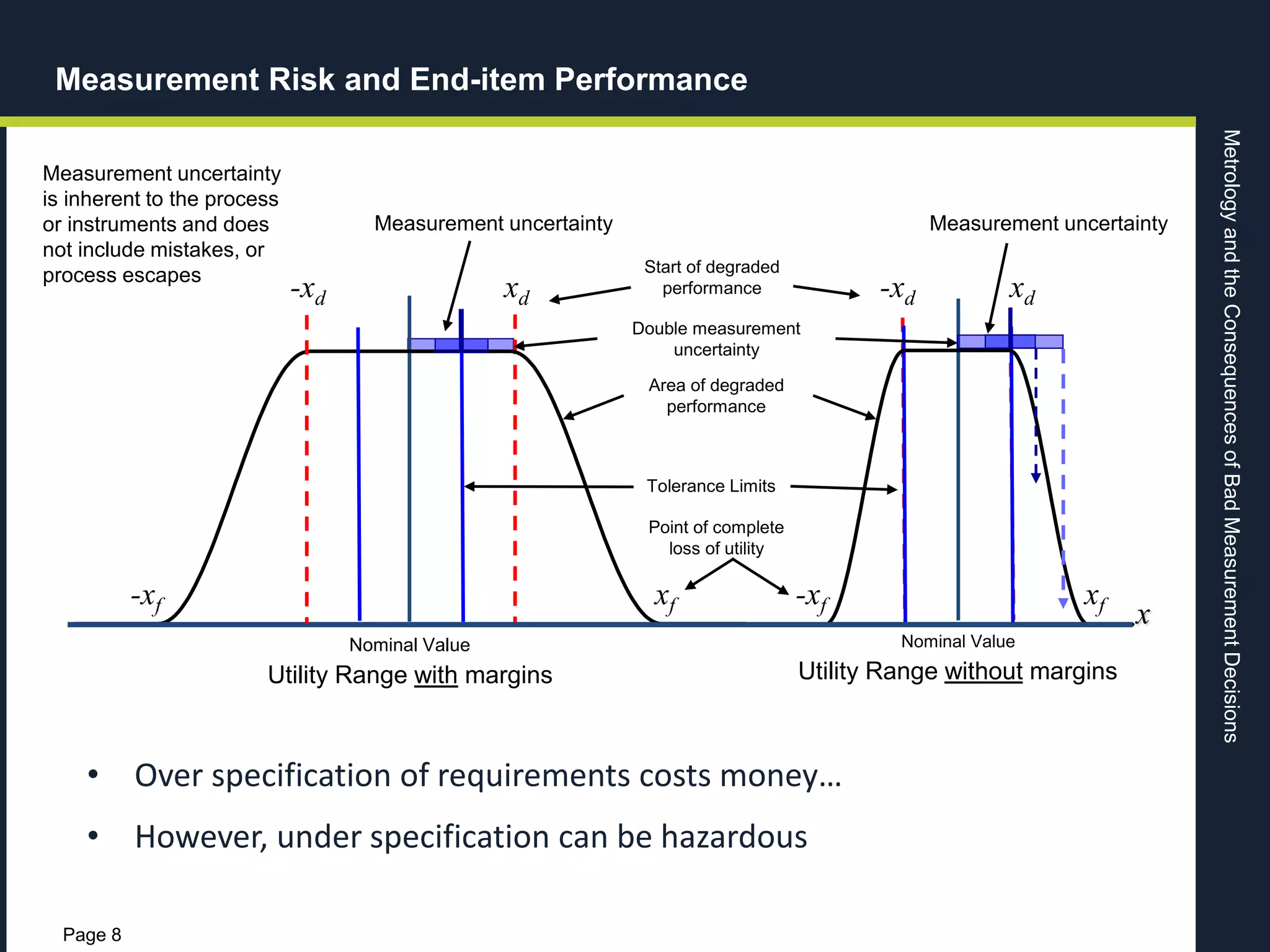
• Over specification of requirements costs money…
• However, under specification can be hazardous
Measurement Risk and End-item Performance
xd-xd
Nominal Value
xd-xd
x
xf-xfxf-xf
Nominal Value
Point of complete
loss of utility
Tolerance Limits
Area of degraded
performance
Double measurement
uncertainty
Measurement uncertainty Measurement uncertainty
Utility Range with margins Utility Range without margins
Start of degraded
performance
Measurement uncertainty
is inherent to the process
or instruments and does
not include mistakes, or
process escapes
MetrologyandtheConsequencesofBadMeasurementDecisions
Page 9
Essential Components of “Good” Measurement Data
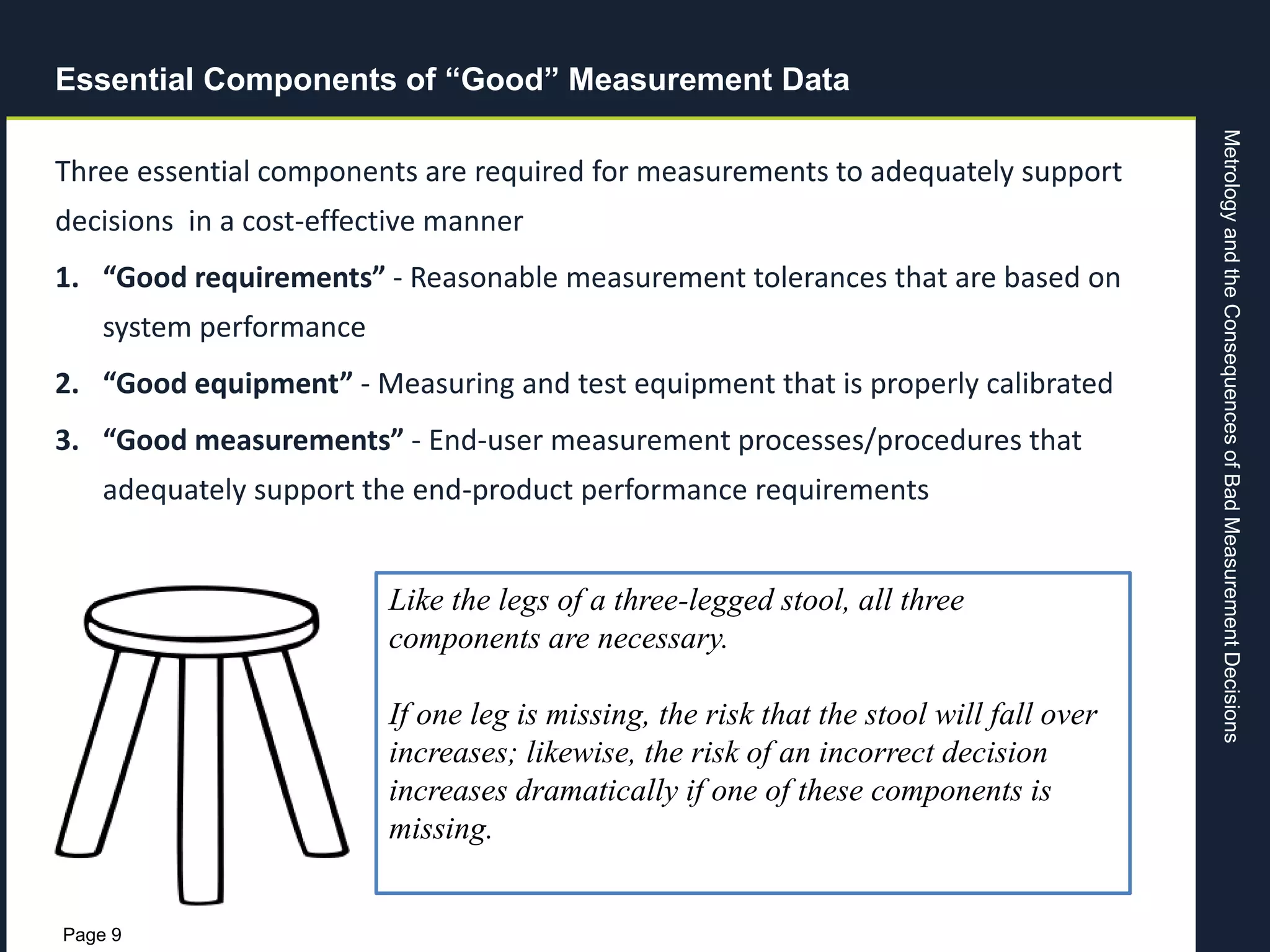
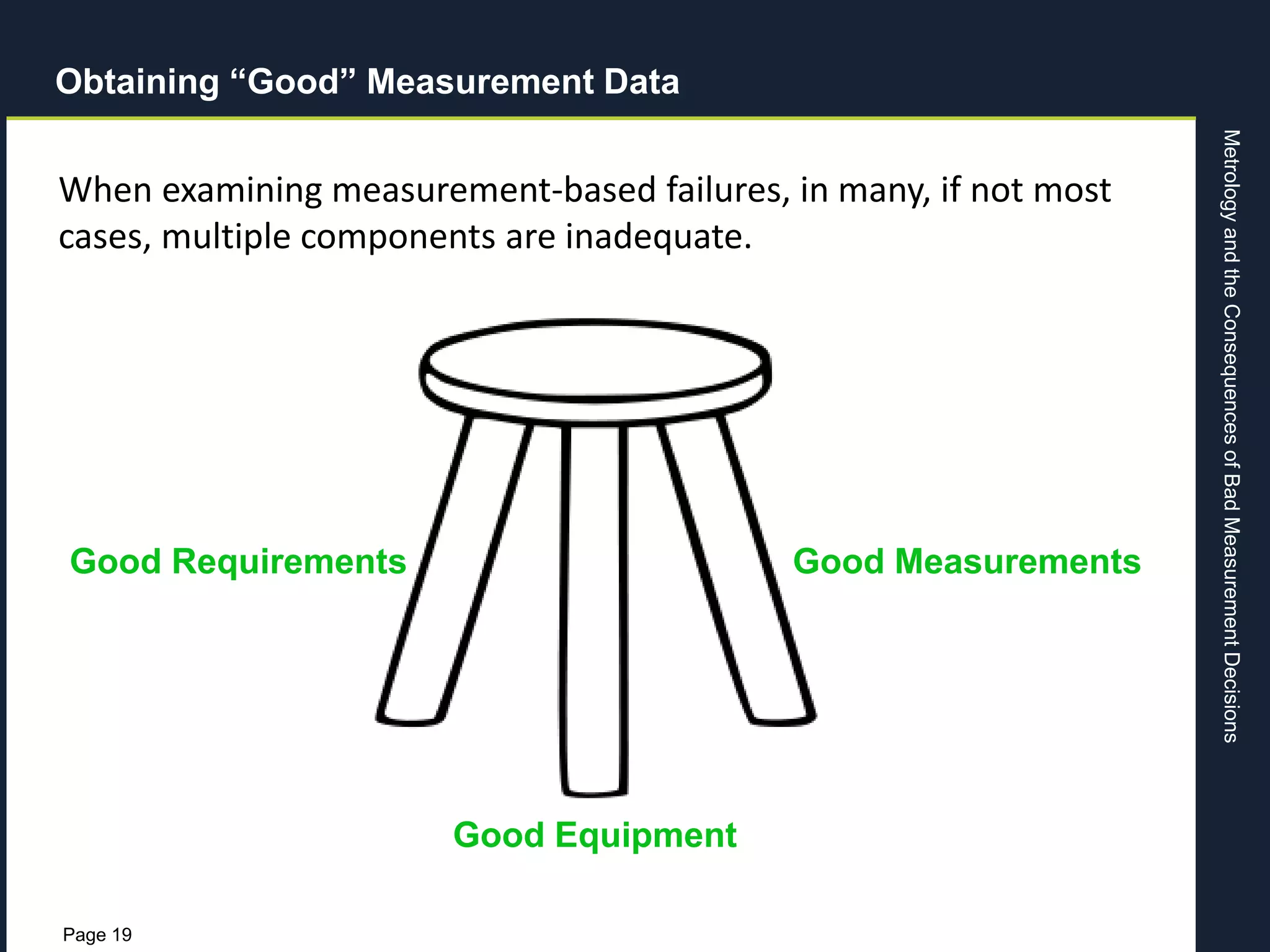
Three essential components are required for measurements to adequately support
decisions in a cost-effective manner
1. “Good requirements” - Reasonable measurement tolerances that are based on
system performance
2. “Good equipment” - Measuring and test equipment that is properly calibrated
3. “Good measurements” - End-user measurement processes/procedures that
adequately support the end-product performance requirements
Like the legs of a three-legged stool, all three
components are necessary.
If one leg is missing, the risk that the stool will fall over
increases; likewise, the risk of an incorrect decision
increases dramatically if one of these components is
missing.
MetrologyandtheConsequencesofBadMeasurementDecisions
Page 10
Component 1 – “Good Requirements”
Establish reasonable measurement requirements based on system
performance.
There must be a realistic link between the functional and design
requirements. Without this link, either:
– the cost of verifying the measurement requirements will increase without
adding value, or worse,
– verification of the design performance may not be adequate
Functional requirements:
– how the product is intended to perform
– For example, how high for a given set of conditions (“spacecraft will operate in an orbit
between 400 and 650 kilometers”)
Design requirements:
– provides the realization for the Functional requirements
– the physical (e.g., size, weight, etc.) and operational (e.g., pressure, RPM, etc.)
requirements of the product
This component can have the largest impact on subsequent cost of
metrology and the achievable end item quality.
MetrologyandtheConsequencesofBadMeasurementDecisions
Page 11
Component 1 – Standardizing “Good Requirements”
ISO 9001:2008 and SAE AS9100C provide a standardized approach to
“Good Requirements.”
ISO 9001:2008, Quality management systems — Requirements
7.3.2 Design and Development Inputs
These inputs shall include
a) functional and performance requirements,
7.3.3 Design and Development Outputs
Design and development outputs shall
c) contain or reference product acceptance criteria,
SAE AS9100, Quality Management Systems — Requirements for Aviation, Space and
Defense Organizations adds to ISO 9001 requirements
7.3.1 Design and Development Planning
Design and development planning shall consider the ability to produce, inspect, test and
maintain the product.
MetrologyandtheConsequencesofBadMeasurementDecisions
Page 12
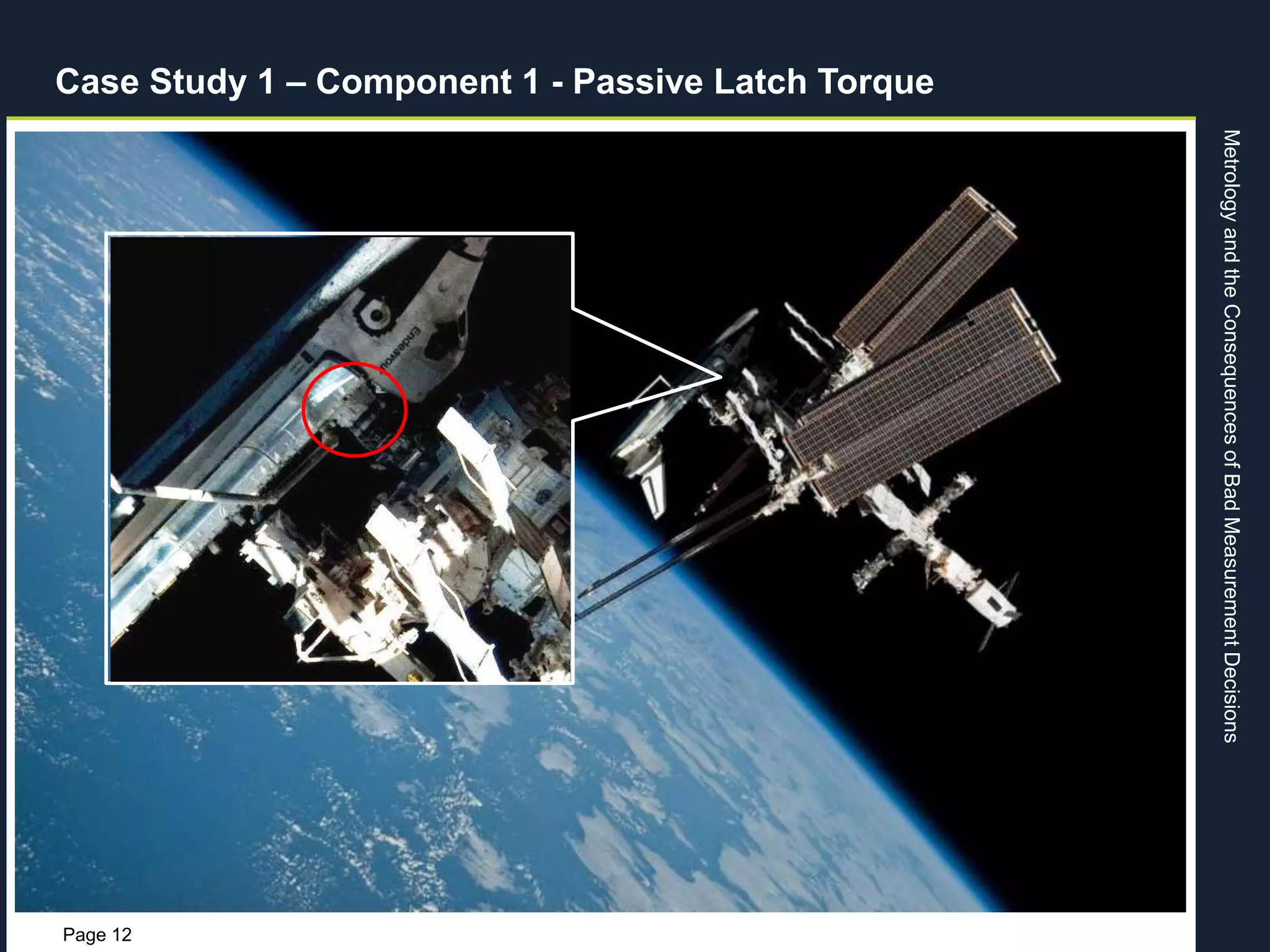
Case Study 1 – Component 1 - Passive Latch Torque
MetrologyandtheConsequencesofBadMeasurementDecisions
Page 13
Case Study 1 – Component 1 - Passive Latch Torque
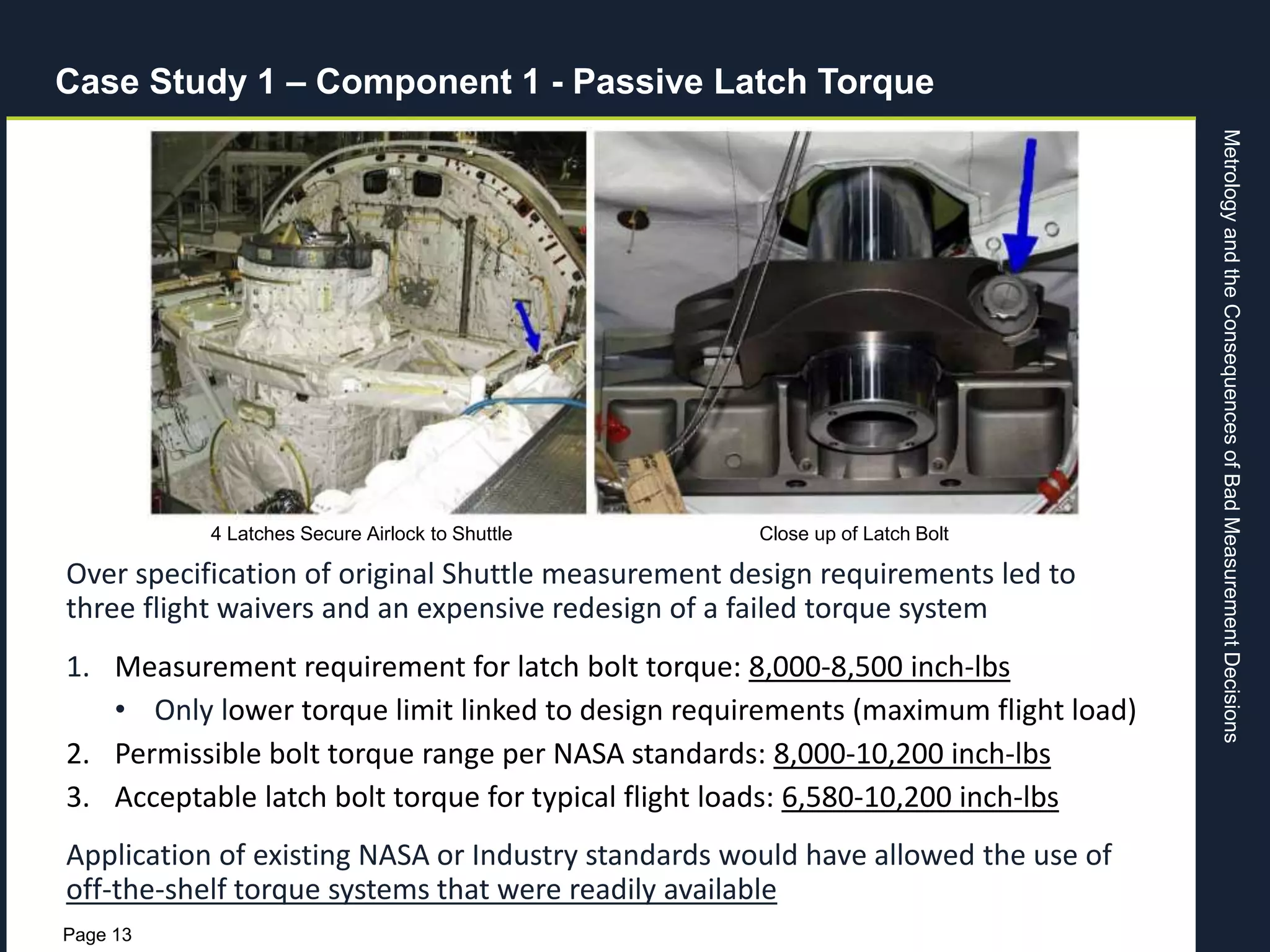
Over specification of original Shuttle measurement design requirements led to
three flight waivers and an expensive redesign of a failed torque system
1. Measurement requirement for latch bolt torque: 8,000-8,500 inch-lbs
• Only lower torque limit linked to design requirements (maximum flight load)
2. Permissible bolt torque range per NASA standards: 8,000-10,200 inch-lbs
3. Acceptable latch bolt torque for typical flight loads: 6,580-10,200 inch-lbs
Application of existing NASA or Industry standards would have allowed the use of
off-the-shelf torque systems that were readily available
4 Latches Secure Airlock to Shuttle Close up of Latch Bolt
MetrologyandtheConsequencesofBadMeasurementDecisions
Page 14
Component 2 – “Good Equipment”
Managing and controlling the accuracy of measuring equipment is an essential component.
Periodic calibration of measuring instruments:
 Ensures instrument accuracy
 Links measurements to national or international units of measure
 Enables measurements made at different places and/or times to be meaningfully compared
ISO 9001, Quality management systems — Requirements
7.6 Control of Monitoring and Measuring Equipment, requires
 The determination of measurements and equipment that provides evidence of product
conformity
 Calibration or verification of measuring instruments to national or international standards
 Calibration status labeling
 Assessment of measurement results made with non-conforming calibrated equipment
SAE AS9100, Quality Management Systems — Requirements for Aviation, Space and Defense
Organizations adds to ISO 9001 requirements
 A register for measuring equipment
 Suitable environmental conditions for calibration, inspection, and testing
 A process for recalling equipment requiring calibration/verification
NOTE: Utilizing international calibration standards, such as ISO 17025 and NCSLI Z540.3,
provides a level of assurance as to the adequacy of the calibration results.
MetrologyandtheConsequencesofBadMeasurementDecisions
Page 15
Case Study 2 - Component 2 - “Good Equipment”
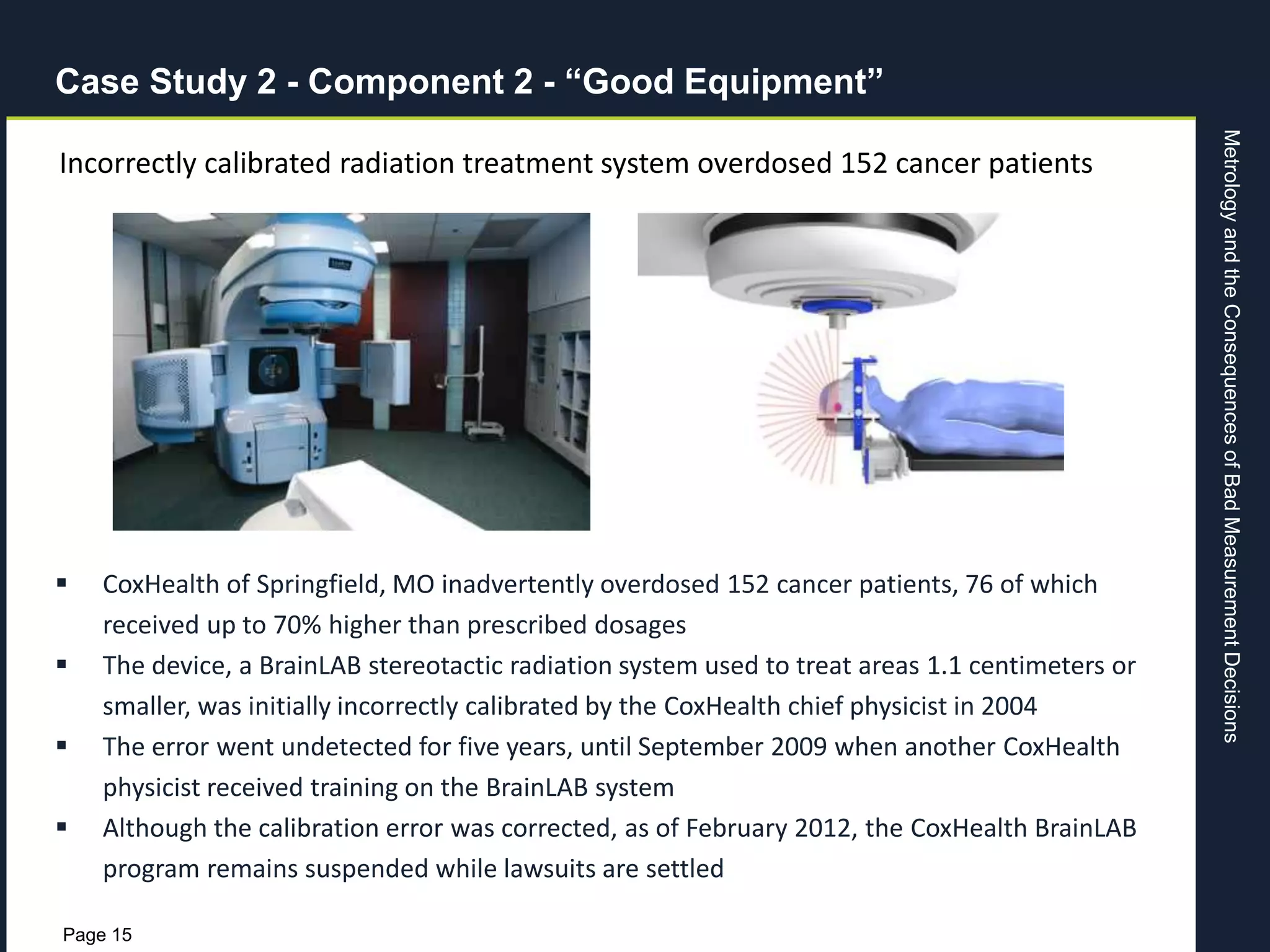
 CoxHealth of Springfield, MO inadvertently overdosed 152 cancer patients, 76 of which
received up to 70% higher than prescribed dosages
 The device, a BrainLAB stereotactic radiation system used to treat areas 1.1 centimeters or
smaller, was initially incorrectly calibrated by the CoxHealth chief physicist in 2004
 The error went undetected for five years, until September 2009 when another CoxHealth
physicist received training on the BrainLAB system
 Although the calibration error was corrected, as of February 2012, the CoxHealth BrainLAB
program remains suspended while lawsuits are settled
Incorrectly calibrated radiation treatment system overdosed 152 cancer patients
MetrologyandtheConsequencesofBadMeasurementDecisions
Page 16
Component 3 - “Good Measurements”
Adequate measurement processes/procedures to control errors that could lead to incorrect
decisions based on measurement data
 A properly calibrated instrument does not guarantee a “good” measurement result
ISO 9001, Quality management systems — Requirements
8.2.4 Monitoring and measurement of product requires
 Measurements to verify that product requirements have been met
 Records to prove conformity with the acceptance criteria
SAE AS9100, Quality Management Systems — Requirements for Aviation, Space and Defense
Organizations adds to ISO 9001 requirements
 Documentation of measurement requirements for product acceptance, including
a) criteria for acceptance and/or rejection,
b) where in the sequence measurement and testing operations are to be performed,
c) required records of the measurement results (at a minimum, indication of acceptance
or rejection), and
d) any specific measurement instruments required and any specific instructions associated
with their use.
MetrologyandtheConsequencesofBadMeasurementDecisions
Page 17
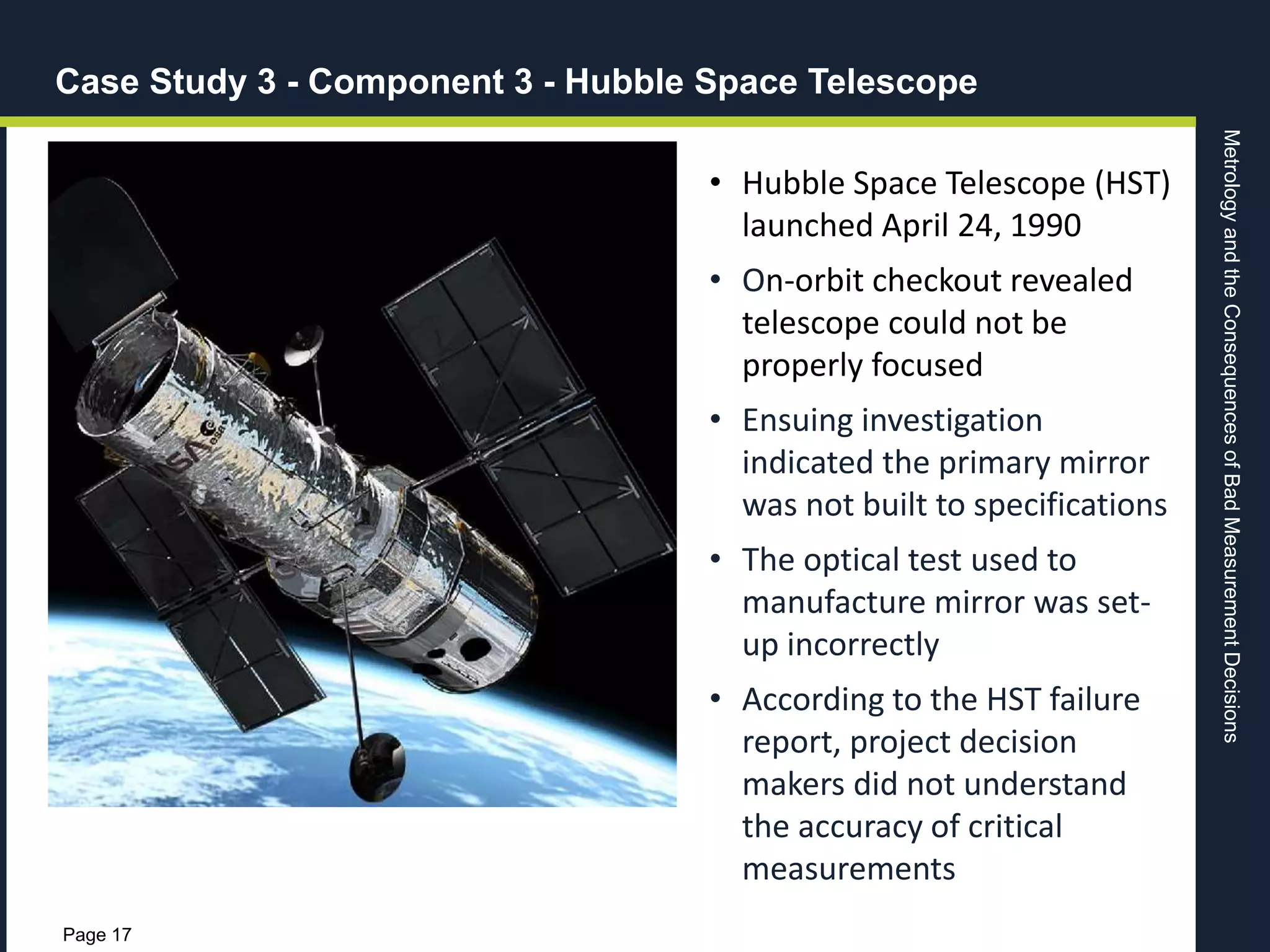
• Hubble Space Telescope (HST)
launched April 24, 1990
• On-orbit checkout revealed
telescope could not be
properly focused
• Ensuing investigation
indicated the primary mirror
was not built to specifications
• The optical test used to
manufacture mirror was set-
up incorrectly
• According to the HST failure
report, project decision
makers did not understand
the accuracy of critical
measurements
Case Study 3 - Component 3 - Hubble Space Telescope
MetrologyandtheConsequencesofBadMeasurementDecisions
Page 18
Case Study 3 - Component 3 - Hubble Space Telescope
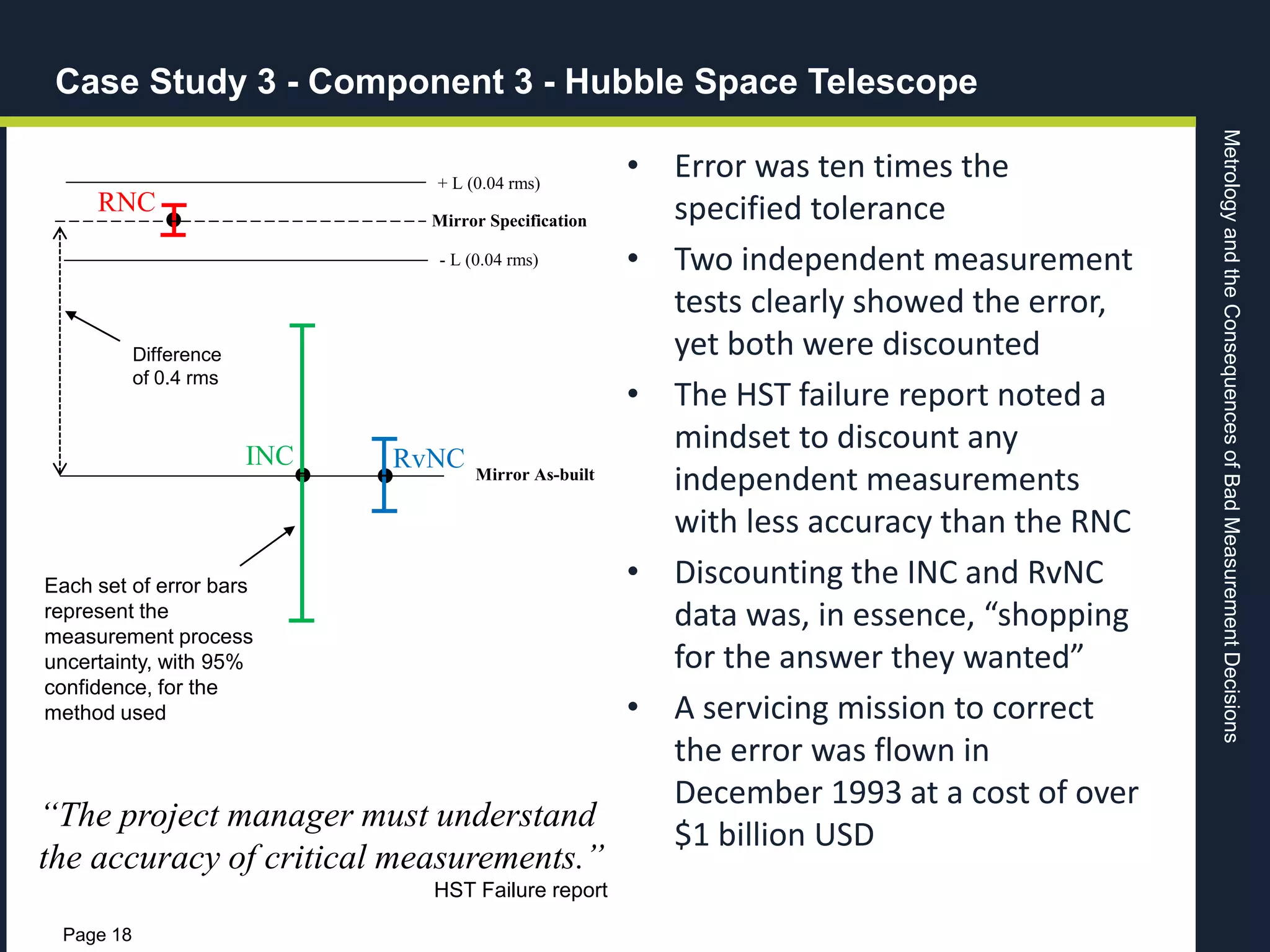
• Error was ten times the
specified tolerance
• Two independent measurement
tests clearly showed the error,
yet both were discounted
• The HST failure report noted a
mindset to discount any
independent measurements
with less accuracy than the RNC
• Discounting the INC and RvNC
data was, in essence, “shopping
for the answer they wanted”
• A servicing mission to correct
the error was flown in
December 1993 at a cost of over
$1 billion USD
+ L (0.04 rms)
- L (0.04 rms)
Mirror Specification
INC RvNC
RNC
Each set of error bars
represent the
measurement process
uncertainty, with 95%
confidence, for the
method used
Difference
of 0.4 rms
“The project manager must understand
the accuracy of critical measurements.”
HST Failure report
Mirror As-built
MetrologyandtheConsequencesofBadMeasurementDecisions
Page 19
Obtaining “Good” Measurement Data
When examining measurement-based failures, in many, if not most
cases, multiple components are inadequate.
Good Requirements Good Measurements
Good Equipment
MetrologyandtheConsequencesofBadMeasurementDecisions
Page 20
Case Study 4 – Air Force B-2A Crash
 The proximate cause of the crash
was moisture in the Air Data
System (ADS) which introduced
large errors during a field
calibration of several Port
Transducer Units onboard the
aircraft
 The measurement procedure did
not account or mitigate for
moisture Component 3
 There was a lack of understanding
regarding how the ADS affects the
aircraft flight safety Component 1
 Although the calibration procedure
was followed, an incorrect
measurement-based decision led
to the loss of a $1.4 billion asset,
fortunately without loss of life
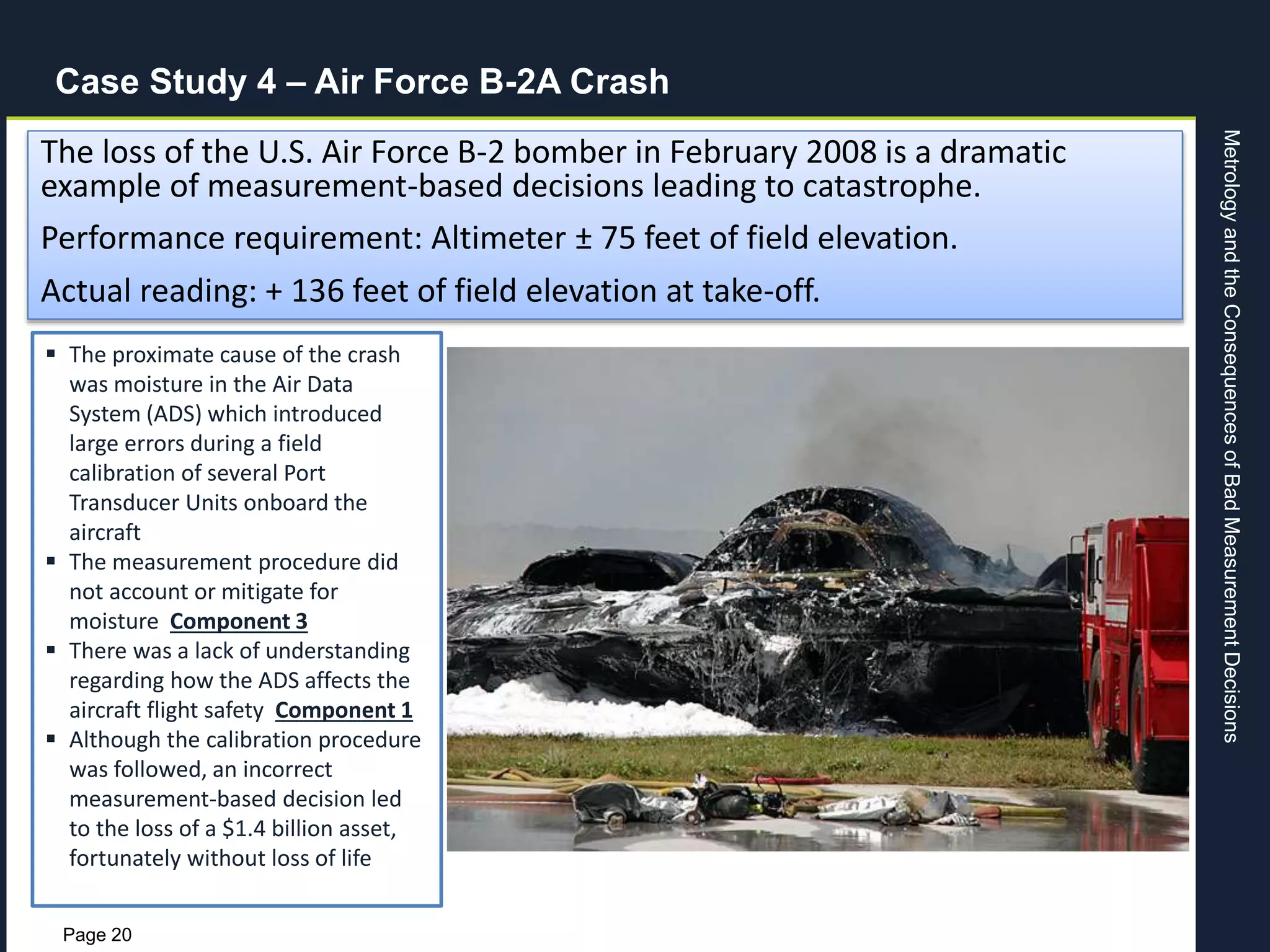
Air Force B-2A crash – February 23, 2008
The loss of the U.S. Air Force B-2 bomber in February 2008 is a dramatic
example of measurement-based decisions leading to catastrophe.
Performance requirement: Altimeter ± 75 feet of field elevation.
Actual reading: + 136 feet of field elevation at take-off.
MetrologyandtheConsequencesofBadMeasurementDecisions
Page 21
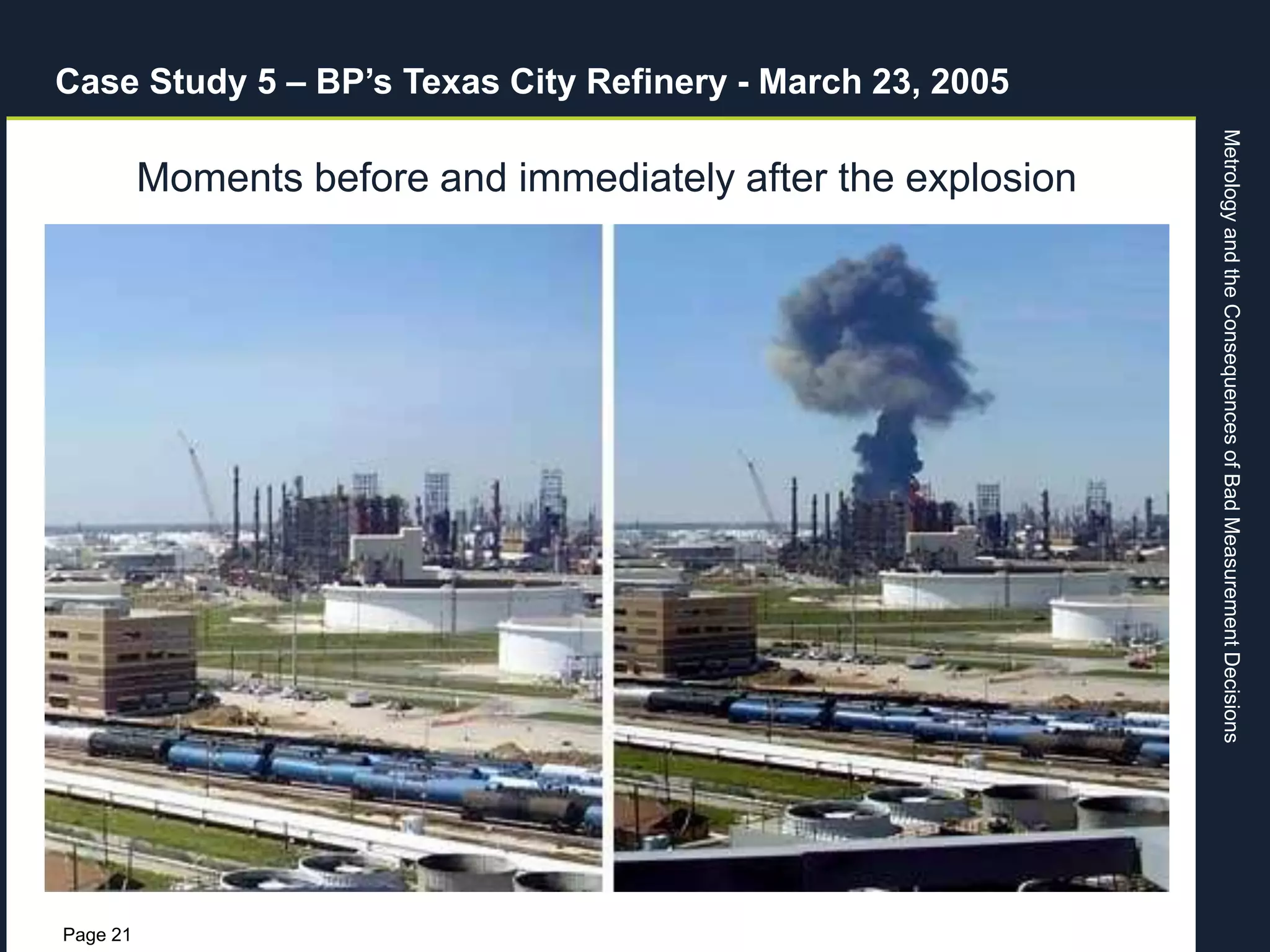
Case Study 5 – BP’s Texas City Refinery - March 23, 2005
Moments before and immediately after the explosion
MetrologyandtheConsequencesofBadMeasurementDecisions
Page 22
Case Study 5 – BP’s Texas City Refinery (continued)
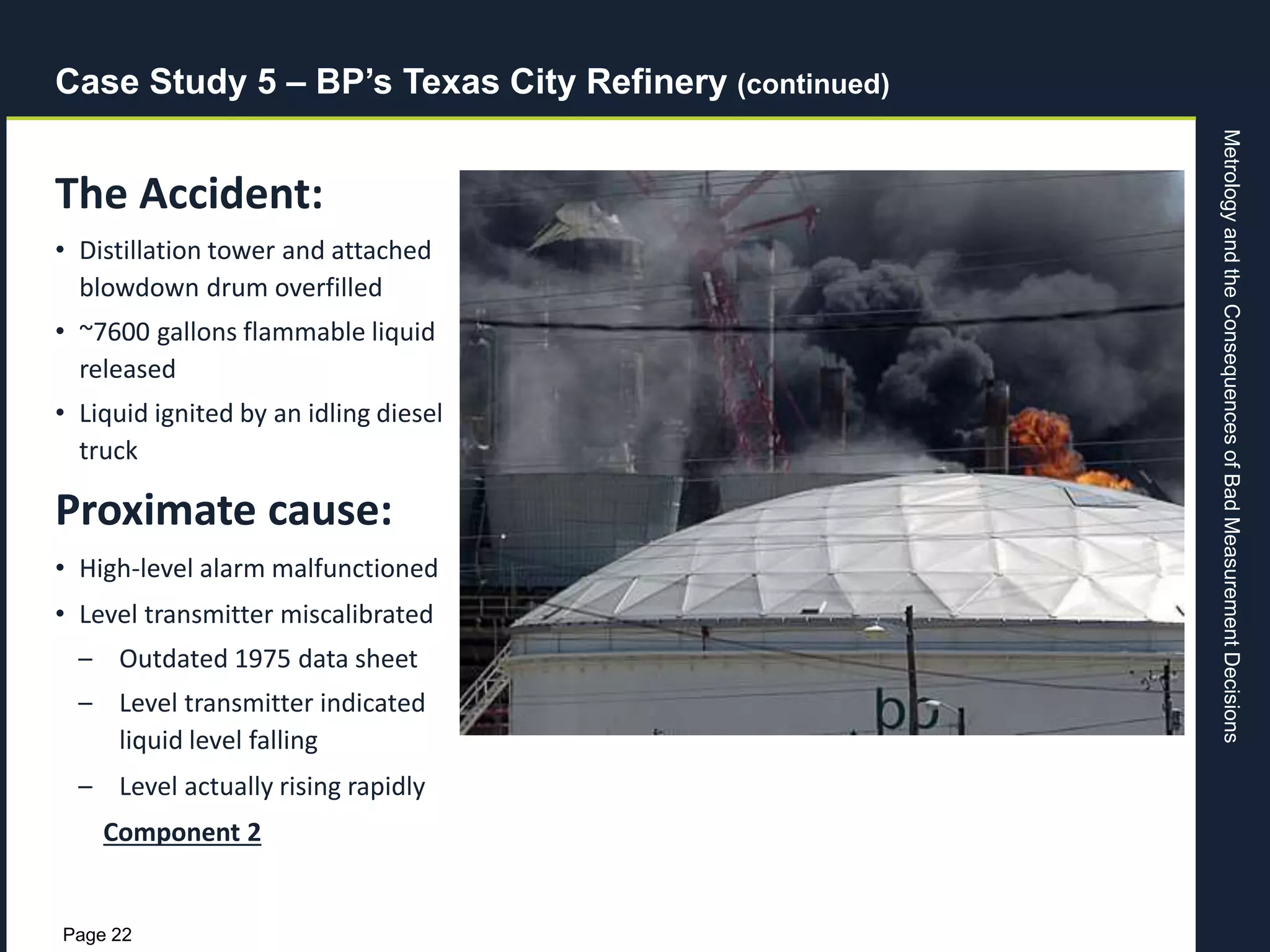
The Accident:
• Distillation tower and attached
blowdown drum overfilled
• ~7600 gallons flammable liquid
released
• Liquid ignited by an idling diesel
truck
Proximate cause:
• High-level alarm malfunctioned
• Level transmitter miscalibrated
– Outdated 1975 data sheet
– Level transmitter indicated
liquid level falling
– Level actually rising rapidly
Component 2
MetrologyandtheConsequencesofBadMeasurementDecisions
Page 23
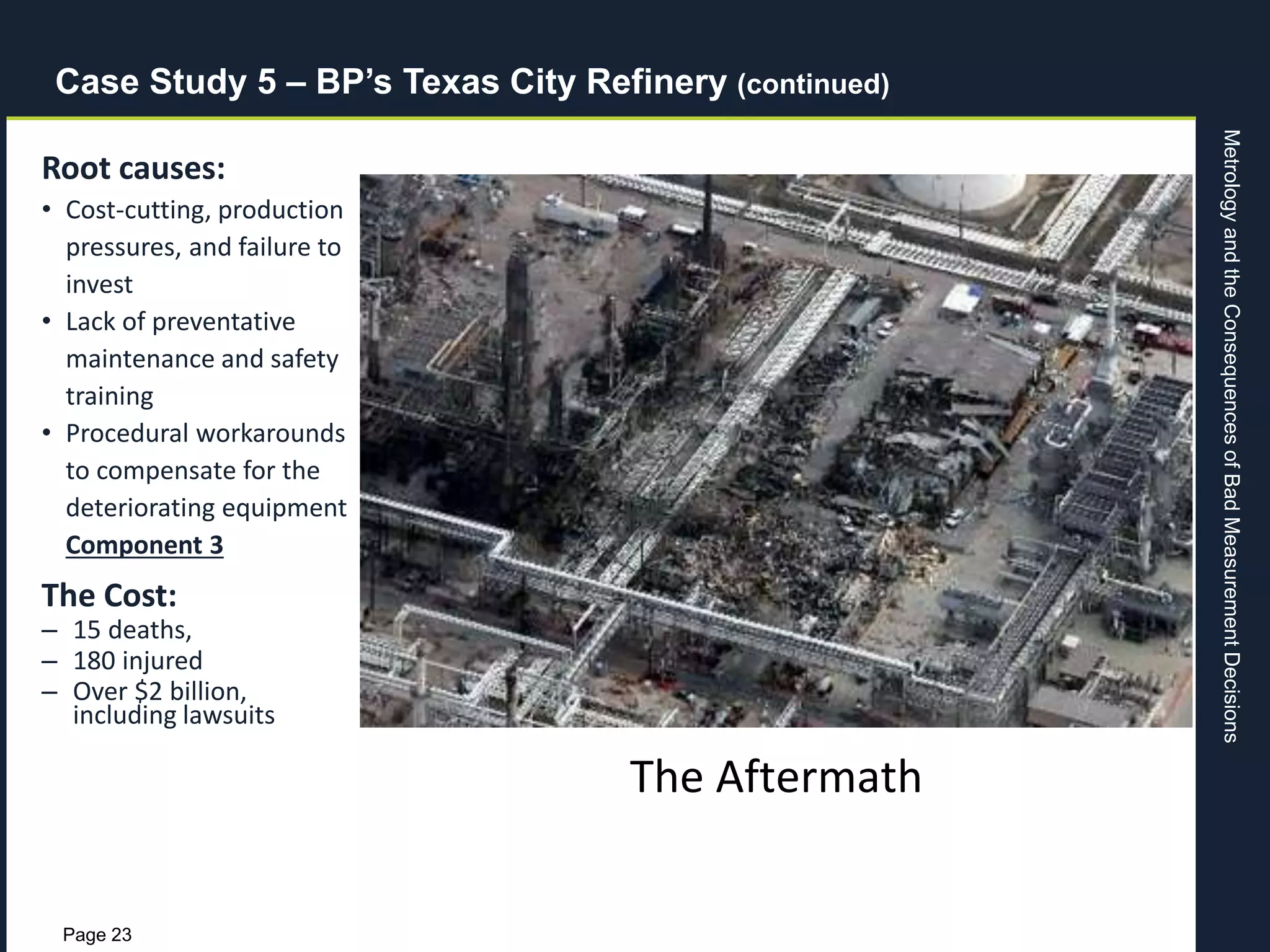
The Aftermath
Case Study 5 – BP’s Texas City Refinery (continued)
Root causes:
• Cost-cutting, production
pressures, and failure to
invest
• Lack of preventative
maintenance and safety
training
• Procedural workarounds
to compensate for the
deteriorating equipment
Component 3
The Cost:
– 15 deaths,
– 180 injured
– Over $2 billion,
including lawsuits
MetrologyandtheConsequencesofBadMeasurementDecisions
Page 24
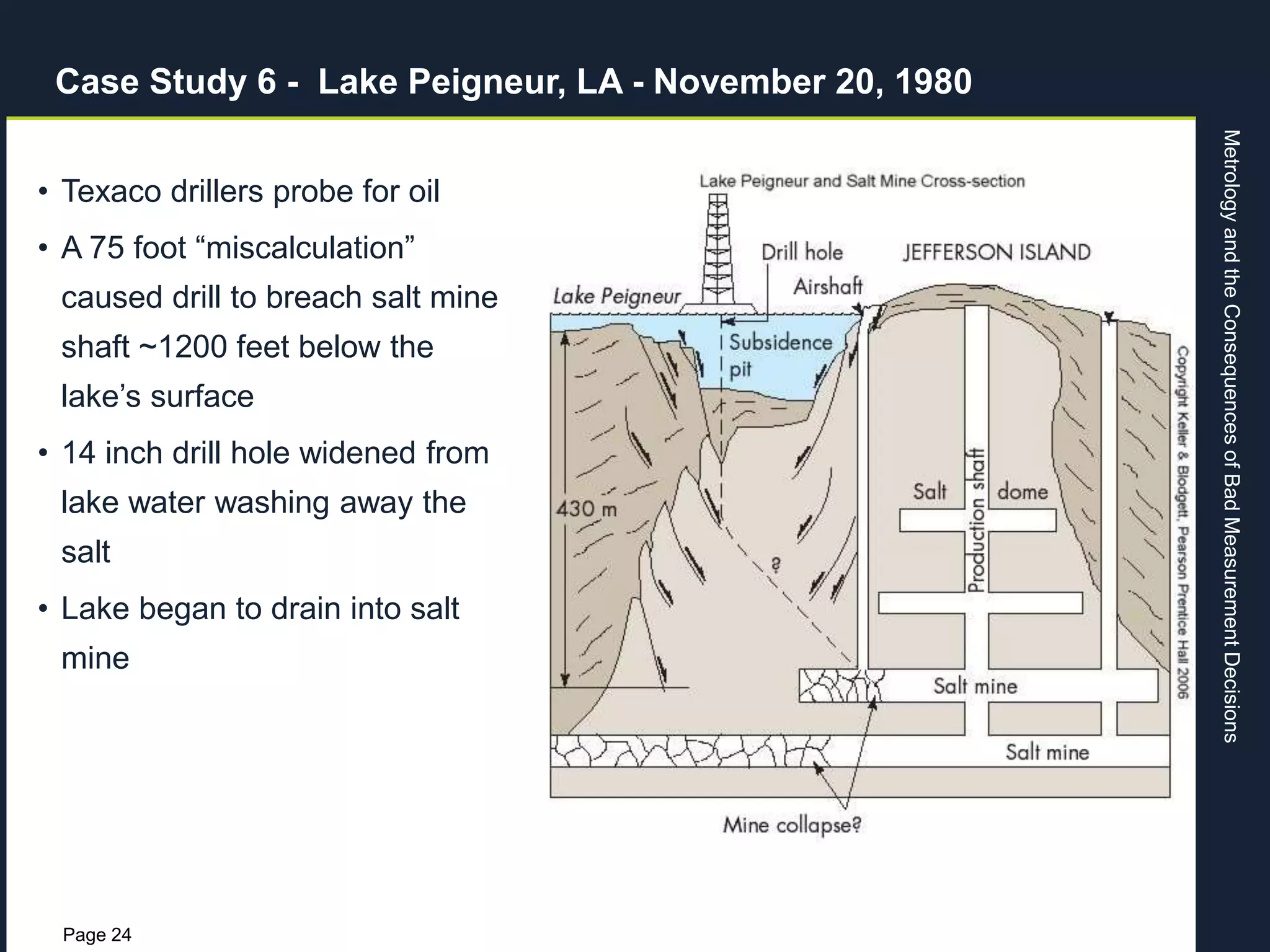
• Texaco drillers probe for oil
• A 75 foot “miscalculation”
caused drill to breach salt mine
shaft ~1200 feet below the
lake’s surface
• 14 inch drill hole widened from
lake water washing away the
salt
• Lake began to drain into salt
mine
Case Study 6 - Lake Peigneur, LA - November 20, 1980
MetrologyandtheConsequencesofBadMeasurementDecisions
Page 25
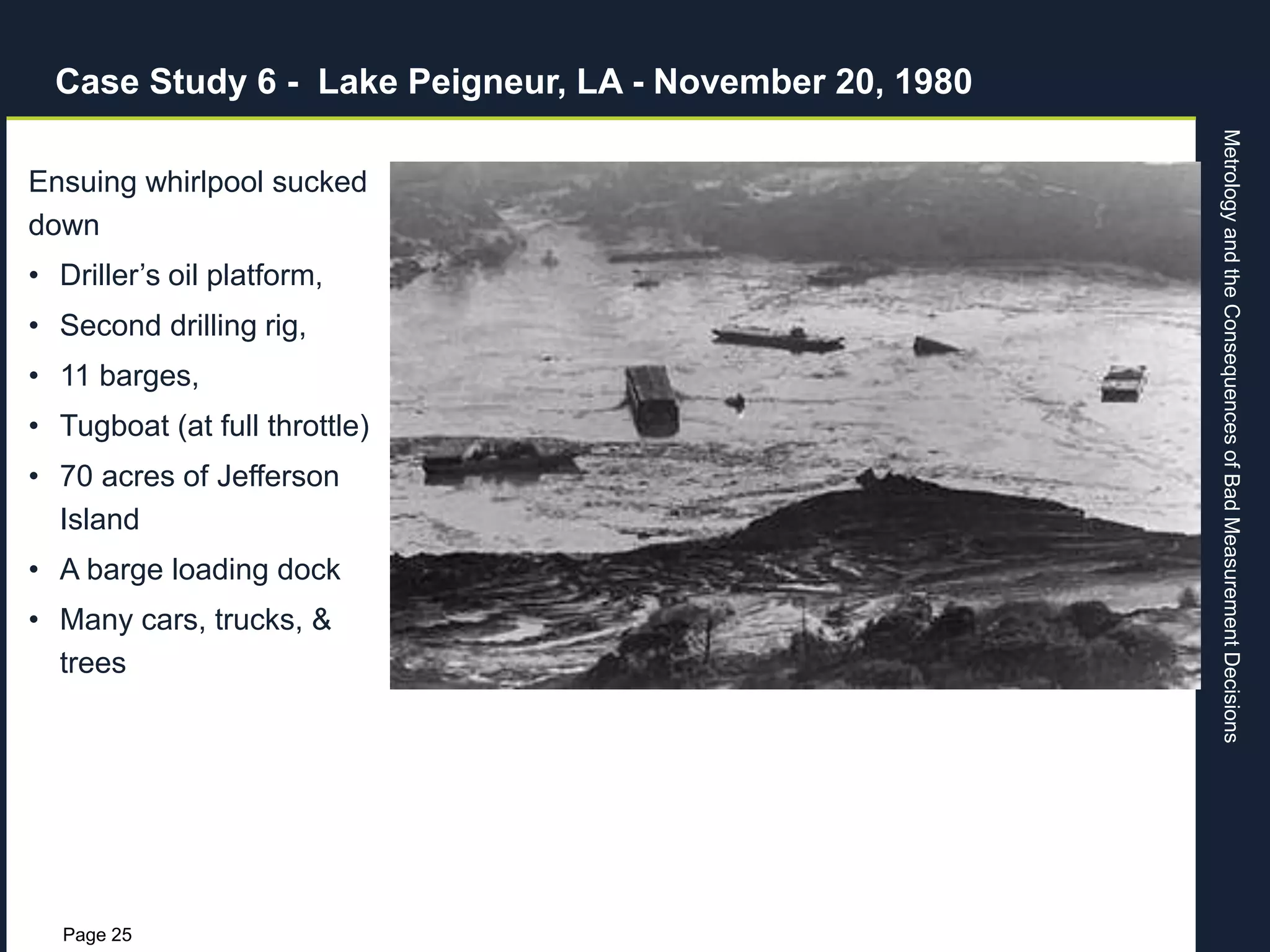
Ensuing whirlpool sucked
down
• Driller’s oil platform,
• Second drilling rig,
• 11 barges,
• Tugboat (at full throttle)
• 70 acres of Jefferson
Island
• A barge loading dock
• Many cars, trucks, &
trees
Case Study 6 - Lake Peigneur, LA - November 20, 1980
MetrologyandtheConsequencesofBadMeasurementDecisions
Page 26
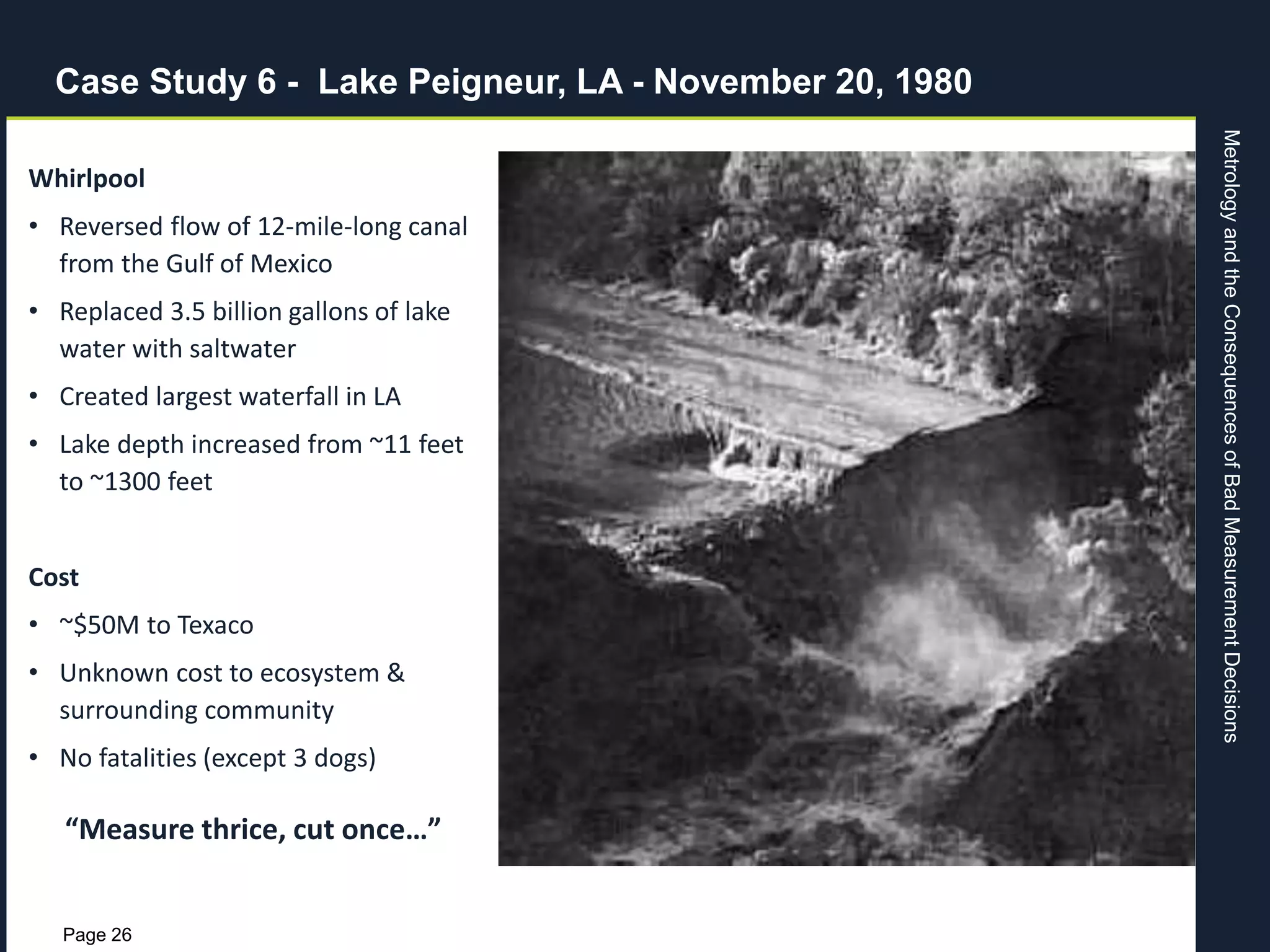
Whirlpool
• Reversed flow of 12-mile-long canal
from the Gulf of Mexico
• Replaced 3.5 billion gallons of lake
water with saltwater
• Created largest waterfall in LA
• Lake depth increased from ~11 feet
to ~1300 feet
Cost
• ~$50M to Texaco
• Unknown cost to ecosystem &
surrounding community
• No fatalities (except 3 dogs)
“Measure thrice, cut once…”
Case Study 6 - Lake Peigneur, LA - November 20, 1980
MetrologyandtheConsequencesofBadMeasurementDecisions
Page 27
Considerations and Cautions
Measurements support decisions – accept, reject, rework, scrap, or even launch
a space vehicle. In conformance testing, if a measurement does not support a
decision, it is unnecessary.
Essential Components:
1. Design specifications must be linked to functional requirements
a) Over specification is expensive,
b) Under specification can be hazardous
2. Calibration ensures the accuracy of measuring equipment
a) Links units of measurement to International standards (i.e., provides a pedigree)
3. Measurement processes must control errors that may lead to incorrect
measurement-based decisions
a) Proper selection and utilization of measuring equipment
b) Control/mitigate other relevant sources of error in the measurement process
– After all, a perfect instrument does not guarantee good measurement data
The more critical the decision, the more critical the data. The more critical the data, the more
critical the measurement. NASA Reference Publication 1342

Metrology & The Consequences of Bad Measurement Decisions

  • 1.
    Metrology and theConsequences of Bad Measurement Decisions Presented by Scott Mimbs Corporate Sponsor: NCSLI Virginia Section Meeting 1213
  • 2.
    MetrologyandtheConsequencesofBadMeasurementDecisions Page 2 What youneed to know about metrology 1. How does metrology affect me? • Measurement data affect your decisions 2. What do I need to look for? • Three essentials elements of “good” measurement data 3. What are the consequences of “bad” measurement-based decisions? All measurement decisions have consequences… The more critical the decision, the more critical the data. The more critical the data, the more critical the measurement. NASA Reference Publication 1342
  • 3.
    MetrologyandtheConsequencesofBadMeasurementDecisions Page 3 Metrology andMeasurement Data Metrology is the “science of measurement and its application” (JCGM 200:2008). • This includes all theoretical and practical aspects of measurement Measurements = Decisions Measurement data support decisions to… • Establish research or investigative fact • Establish scientific or legal fact • Accept or reject a product • Rework or complete a design • Take corrective action or withhold it • Continue or stop a process (including a space launch) The objective of the design and control of measurement processes is to manage the risks taken in making decisions based on measurement data. NASA Reference Publication 1342 Metrology — Calibration and Measurement Processes Guidelines
  • 4.
    MetrologyandtheConsequencesofBadMeasurementDecisions Page 4 An undesirablesituation or circumstance that has both a likelihood of occurring and a potentially negative consequence. AS9100C Defining Risk
  • 5.
    MetrologyandtheConsequencesofBadMeasurementDecisions Page 5 International Systemof Units (SI) Bureau International des Poids Mesures (BIPM) Working Standards Primary Standards Lab or other Labs Measurements by End-Item users Primary National Standard National Metrology Institute Secondary Standard National Metrology Institute or Primary Standards Lab Calibrations In-house or Commercial Calibration Labs Highestlevel of Accuracy (scientific metrology) Lowest level of Accuracy (end-item usage) Errors cause Lowest level of Riskto final product or service Errors cause Highest level of Risk to final product or service Calibration requirements must ensure measuring and test equipment are acceptable and ready for use by end-users Quality requirements must ensure the measurement will support the decision A perfect instrument does not guarantee a “good” measurement… Measurement Accuracy, Risk, and the Metrology chain
  • 6.
    MetrologyandtheConsequencesofBadMeasurementDecisions Page 6 Measurement Riskthrough a Project Lifecycle Measurement-related Risk: Risk of making incorrect measurement-based decisions • Based on measurement process limitations or process mistakes Product or System Risk: The negative consequence of an incorrect measurement-based decision • Quality or performance of end-products • Increased cost of measurements without added value Concept & Prelim Design Feasibility Analyses, Mockups, Prototypes, Testing Measurement Research & Technology Development D e s ig n , F a b ric a tio n , In te g ra tio n & T e s t D e ta ile d D e s ig n s , P ro d u c t fa b ric a tio n , O p R e a d y S y s te m M e a s u re m e n t F in a l D e s ig n , P ro d u c tio n & In te g ra tio n C h e c k o u t , O p e r a t i o n & M a i n t e n a n c e F u n c t i o n a l i t y , P e r f o r m a n c e , U t i l i t y M e a s u r e m e n t O p e r a t i o n & S u s t a i n m e n t Product / System Risk Measurement Risk In metrology, risk occurs as:
  • 7.
    MetrologyandtheConsequencesofBadMeasurementDecisions Page 7 Range ofpossible values at 95% confidence A B C + L - L Nominal Probability of Incorrect Measurement Decisions Measurement Uncertainty: The doubt that exists about a measurement’s result  Every measurement—even the most careful—always has a margin of doubt  Uncertainty is the inherent limitation of a measurement process, due to instrumentation and process variation  Measurement uncertainty does not include mistakes or process escapes The probability of an incorrect decision is determined by:  The amount of uncertainty in the measurement process  Where the measurement result lies with respect to the tolerance limit (e.g., ± L)  Knowledge acquired from previous measurements of similar items (i.e., a priori distribution) Probability of being out-of-tolerance Probability of being out-of-tolerance
  • 8.
    MetrologyandtheConsequencesofBadMeasurementDecisions Page 8 • Overspecification of requirements costs money… • However, under specification can be hazardous Measurement Risk and End-item Performance xd-xd Nominal Value xd-xd x xf-xfxf-xf Nominal Value Point of complete loss of utility Tolerance Limits Area of degraded performance Double measurement uncertainty Measurement uncertainty Measurement uncertainty Utility Range with margins Utility Range without margins Start of degraded performance Measurement uncertainty is inherent to the process or instruments and does not include mistakes, or process escapes
  • 9.
    MetrologyandtheConsequencesofBadMeasurementDecisions Page 9 Essential Componentsof “Good” Measurement Data Three essential components are required for measurements to adequately support decisions in a cost-effective manner 1. “Good requirements” - Reasonable measurement tolerances that are based on system performance 2. “Good equipment” - Measuring and test equipment that is properly calibrated 3. “Good measurements” - End-user measurement processes/procedures that adequately support the end-product performance requirements Like the legs of a three-legged stool, all three components are necessary. If one leg is missing, the risk that the stool will fall over increases; likewise, the risk of an incorrect decision increases dramatically if one of these components is missing.
  • 10.
    MetrologyandtheConsequencesofBadMeasurementDecisions Page 10 Component 1– “Good Requirements” Establish reasonable measurement requirements based on system performance. There must be a realistic link between the functional and design requirements. Without this link, either: – the cost of verifying the measurement requirements will increase without adding value, or worse, – verification of the design performance may not be adequate Functional requirements: – how the product is intended to perform – For example, how high for a given set of conditions (“spacecraft will operate in an orbit between 400 and 650 kilometers”) Design requirements: – provides the realization for the Functional requirements – the physical (e.g., size, weight, etc.) and operational (e.g., pressure, RPM, etc.) requirements of the product This component can have the largest impact on subsequent cost of metrology and the achievable end item quality.
  • 11.
    MetrologyandtheConsequencesofBadMeasurementDecisions Page 11 Component 1– Standardizing “Good Requirements” ISO 9001:2008 and SAE AS9100C provide a standardized approach to “Good Requirements.” ISO 9001:2008, Quality management systems — Requirements 7.3.2 Design and Development Inputs These inputs shall include a) functional and performance requirements, 7.3.3 Design and Development Outputs Design and development outputs shall c) contain or reference product acceptance criteria, SAE AS9100, Quality Management Systems — Requirements for Aviation, Space and Defense Organizations adds to ISO 9001 requirements 7.3.1 Design and Development Planning Design and development planning shall consider the ability to produce, inspect, test and maintain the product.
  • 12.
  • 13.
    MetrologyandtheConsequencesofBadMeasurementDecisions Page 13 Case Study1 – Component 1 - Passive Latch Torque Over specification of original Shuttle measurement design requirements led to three flight waivers and an expensive redesign of a failed torque system 1. Measurement requirement for latch bolt torque: 8,000-8,500 inch-lbs • Only lower torque limit linked to design requirements (maximum flight load) 2. Permissible bolt torque range per NASA standards: 8,000-10,200 inch-lbs 3. Acceptable latch bolt torque for typical flight loads: 6,580-10,200 inch-lbs Application of existing NASA or Industry standards would have allowed the use of off-the-shelf torque systems that were readily available 4 Latches Secure Airlock to Shuttle Close up of Latch Bolt
  • 14.
    MetrologyandtheConsequencesofBadMeasurementDecisions Page 14 Component 2– “Good Equipment” Managing and controlling the accuracy of measuring equipment is an essential component. Periodic calibration of measuring instruments:  Ensures instrument accuracy  Links measurements to national or international units of measure  Enables measurements made at different places and/or times to be meaningfully compared ISO 9001, Quality management systems — Requirements 7.6 Control of Monitoring and Measuring Equipment, requires  The determination of measurements and equipment that provides evidence of product conformity  Calibration or verification of measuring instruments to national or international standards  Calibration status labeling  Assessment of measurement results made with non-conforming calibrated equipment SAE AS9100, Quality Management Systems — Requirements for Aviation, Space and Defense Organizations adds to ISO 9001 requirements  A register for measuring equipment  Suitable environmental conditions for calibration, inspection, and testing  A process for recalling equipment requiring calibration/verification NOTE: Utilizing international calibration standards, such as ISO 17025 and NCSLI Z540.3, provides a level of assurance as to the adequacy of the calibration results.
  • 15.
    MetrologyandtheConsequencesofBadMeasurementDecisions Page 15 Case Study2 - Component 2 - “Good Equipment”  CoxHealth of Springfield, MO inadvertently overdosed 152 cancer patients, 76 of which received up to 70% higher than prescribed dosages  The device, a BrainLAB stereotactic radiation system used to treat areas 1.1 centimeters or smaller, was initially incorrectly calibrated by the CoxHealth chief physicist in 2004  The error went undetected for five years, until September 2009 when another CoxHealth physicist received training on the BrainLAB system  Although the calibration error was corrected, as of February 2012, the CoxHealth BrainLAB program remains suspended while lawsuits are settled Incorrectly calibrated radiation treatment system overdosed 152 cancer patients
  • 16.
    MetrologyandtheConsequencesofBadMeasurementDecisions Page 16 Component 3- “Good Measurements” Adequate measurement processes/procedures to control errors that could lead to incorrect decisions based on measurement data  A properly calibrated instrument does not guarantee a “good” measurement result ISO 9001, Quality management systems — Requirements 8.2.4 Monitoring and measurement of product requires  Measurements to verify that product requirements have been met  Records to prove conformity with the acceptance criteria SAE AS9100, Quality Management Systems — Requirements for Aviation, Space and Defense Organizations adds to ISO 9001 requirements  Documentation of measurement requirements for product acceptance, including a) criteria for acceptance and/or rejection, b) where in the sequence measurement and testing operations are to be performed, c) required records of the measurement results (at a minimum, indication of acceptance or rejection), and d) any specific measurement instruments required and any specific instructions associated with their use.
  • 17.
    MetrologyandtheConsequencesofBadMeasurementDecisions Page 17 • HubbleSpace Telescope (HST) launched April 24, 1990 • On-orbit checkout revealed telescope could not be properly focused • Ensuing investigation indicated the primary mirror was not built to specifications • The optical test used to manufacture mirror was set- up incorrectly • According to the HST failure report, project decision makers did not understand the accuracy of critical measurements Case Study 3 - Component 3 - Hubble Space Telescope
  • 18.
    MetrologyandtheConsequencesofBadMeasurementDecisions Page 18 Case Study3 - Component 3 - Hubble Space Telescope • Error was ten times the specified tolerance • Two independent measurement tests clearly showed the error, yet both were discounted • The HST failure report noted a mindset to discount any independent measurements with less accuracy than the RNC • Discounting the INC and RvNC data was, in essence, “shopping for the answer they wanted” • A servicing mission to correct the error was flown in December 1993 at a cost of over $1 billion USD + L (0.04 rms) - L (0.04 rms) Mirror Specification INC RvNC RNC Each set of error bars represent the measurement process uncertainty, with 95% confidence, for the method used Difference of 0.4 rms “The project manager must understand the accuracy of critical measurements.” HST Failure report Mirror As-built
  • 19.
    MetrologyandtheConsequencesofBadMeasurementDecisions Page 19 Obtaining “Good”Measurement Data When examining measurement-based failures, in many, if not most cases, multiple components are inadequate. Good Requirements Good Measurements Good Equipment
  • 20.
    MetrologyandtheConsequencesofBadMeasurementDecisions Page 20 Case Study4 – Air Force B-2A Crash  The proximate cause of the crash was moisture in the Air Data System (ADS) which introduced large errors during a field calibration of several Port Transducer Units onboard the aircraft  The measurement procedure did not account or mitigate for moisture Component 3  There was a lack of understanding regarding how the ADS affects the aircraft flight safety Component 1  Although the calibration procedure was followed, an incorrect measurement-based decision led to the loss of a $1.4 billion asset, fortunately without loss of life Air Force B-2A crash – February 23, 2008 The loss of the U.S. Air Force B-2 bomber in February 2008 is a dramatic example of measurement-based decisions leading to catastrophe. Performance requirement: Altimeter ± 75 feet of field elevation. Actual reading: + 136 feet of field elevation at take-off.
  • 21.
    MetrologyandtheConsequencesofBadMeasurementDecisions Page 21 Case Study5 – BP’s Texas City Refinery - March 23, 2005 Moments before and immediately after the explosion
  • 22.
    MetrologyandtheConsequencesofBadMeasurementDecisions Page 22 Case Study5 – BP’s Texas City Refinery (continued) The Accident: • Distillation tower and attached blowdown drum overfilled • ~7600 gallons flammable liquid released • Liquid ignited by an idling diesel truck Proximate cause: • High-level alarm malfunctioned • Level transmitter miscalibrated – Outdated 1975 data sheet – Level transmitter indicated liquid level falling – Level actually rising rapidly Component 2
  • 23.
    MetrologyandtheConsequencesofBadMeasurementDecisions Page 23 The Aftermath CaseStudy 5 – BP’s Texas City Refinery (continued) Root causes: • Cost-cutting, production pressures, and failure to invest • Lack of preventative maintenance and safety training • Procedural workarounds to compensate for the deteriorating equipment Component 3 The Cost: – 15 deaths, – 180 injured – Over $2 billion, including lawsuits
  • 24.
    MetrologyandtheConsequencesofBadMeasurementDecisions Page 24 • Texacodrillers probe for oil • A 75 foot “miscalculation” caused drill to breach salt mine shaft ~1200 feet below the lake’s surface • 14 inch drill hole widened from lake water washing away the salt • Lake began to drain into salt mine Case Study 6 - Lake Peigneur, LA - November 20, 1980
  • 25.
    MetrologyandtheConsequencesofBadMeasurementDecisions Page 25 Ensuing whirlpoolsucked down • Driller’s oil platform, • Second drilling rig, • 11 barges, • Tugboat (at full throttle) • 70 acres of Jefferson Island • A barge loading dock • Many cars, trucks, & trees Case Study 6 - Lake Peigneur, LA - November 20, 1980
  • 26.
    MetrologyandtheConsequencesofBadMeasurementDecisions Page 26 Whirlpool • Reversedflow of 12-mile-long canal from the Gulf of Mexico • Replaced 3.5 billion gallons of lake water with saltwater • Created largest waterfall in LA • Lake depth increased from ~11 feet to ~1300 feet Cost • ~$50M to Texaco • Unknown cost to ecosystem & surrounding community • No fatalities (except 3 dogs) “Measure thrice, cut once…” Case Study 6 - Lake Peigneur, LA - November 20, 1980
  • 27.
    MetrologyandtheConsequencesofBadMeasurementDecisions Page 27 Considerations andCautions Measurements support decisions – accept, reject, rework, scrap, or even launch a space vehicle. In conformance testing, if a measurement does not support a decision, it is unnecessary. Essential Components: 1. Design specifications must be linked to functional requirements a) Over specification is expensive, b) Under specification can be hazardous 2. Calibration ensures the accuracy of measuring equipment a) Links units of measurement to International standards (i.e., provides a pedigree) 3. Measurement processes must control errors that may lead to incorrect measurement-based decisions a) Proper selection and utilization of measuring equipment b) Control/mitigate other relevant sources of error in the measurement process – After all, a perfect instrument does not guarantee good measurement data The more critical the decision, the more critical the data. The more critical the data, the more critical the measurement. NASA Reference Publication 1342