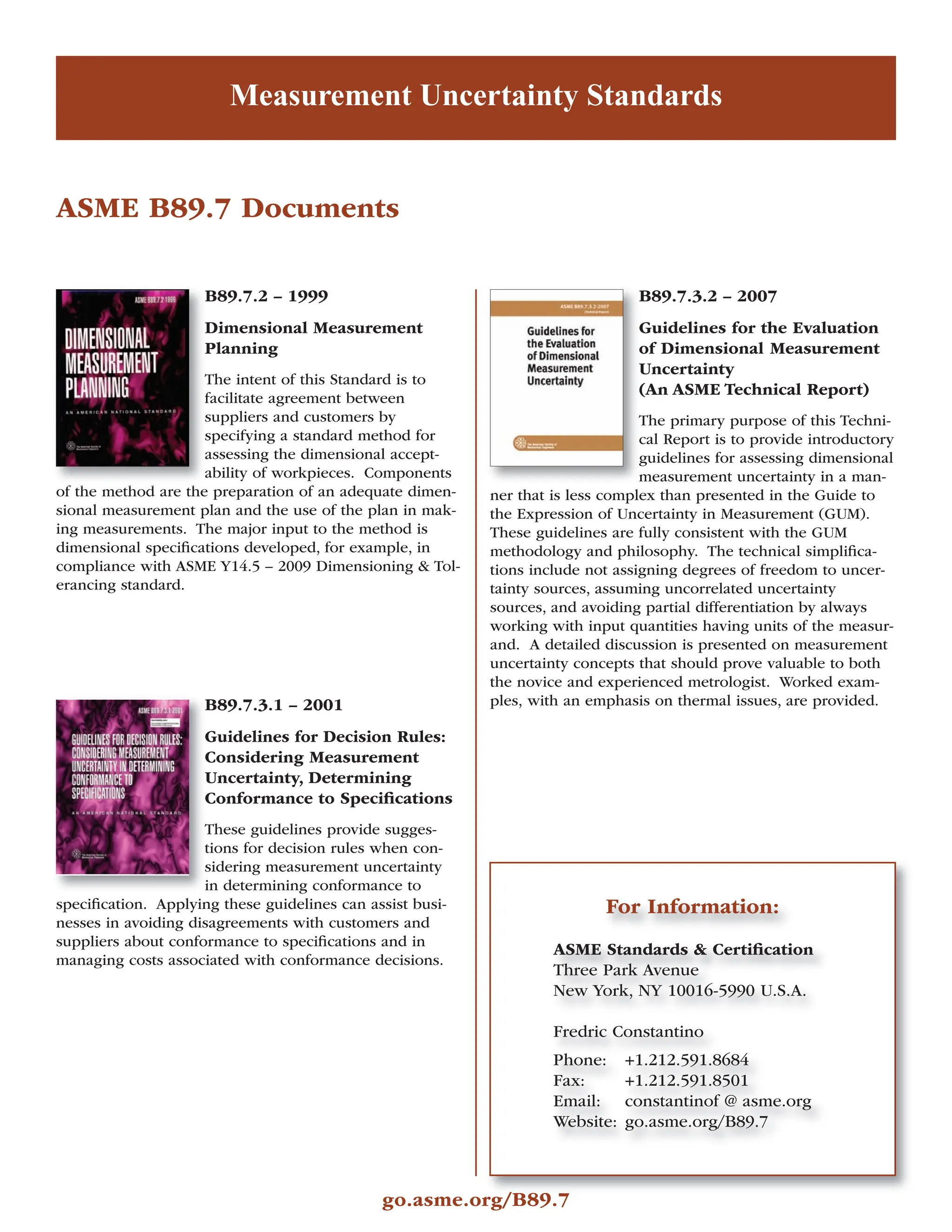
Cp (process) =1.33
0.0 0.1
0.2
0.0
0.4
0.6
0.8
1.0
1.6
1.4
1.2
1.8
2.0
0.3 0.4 0.5 0.6 0.7 0.8
Uncertainty/Tolerance
0.9 1.0
Cp (process) = 1.50
Cp (process) = 1.67
Cp (process) = 2.00
oa
1.27 U: Uncertainty
T: Tolerance
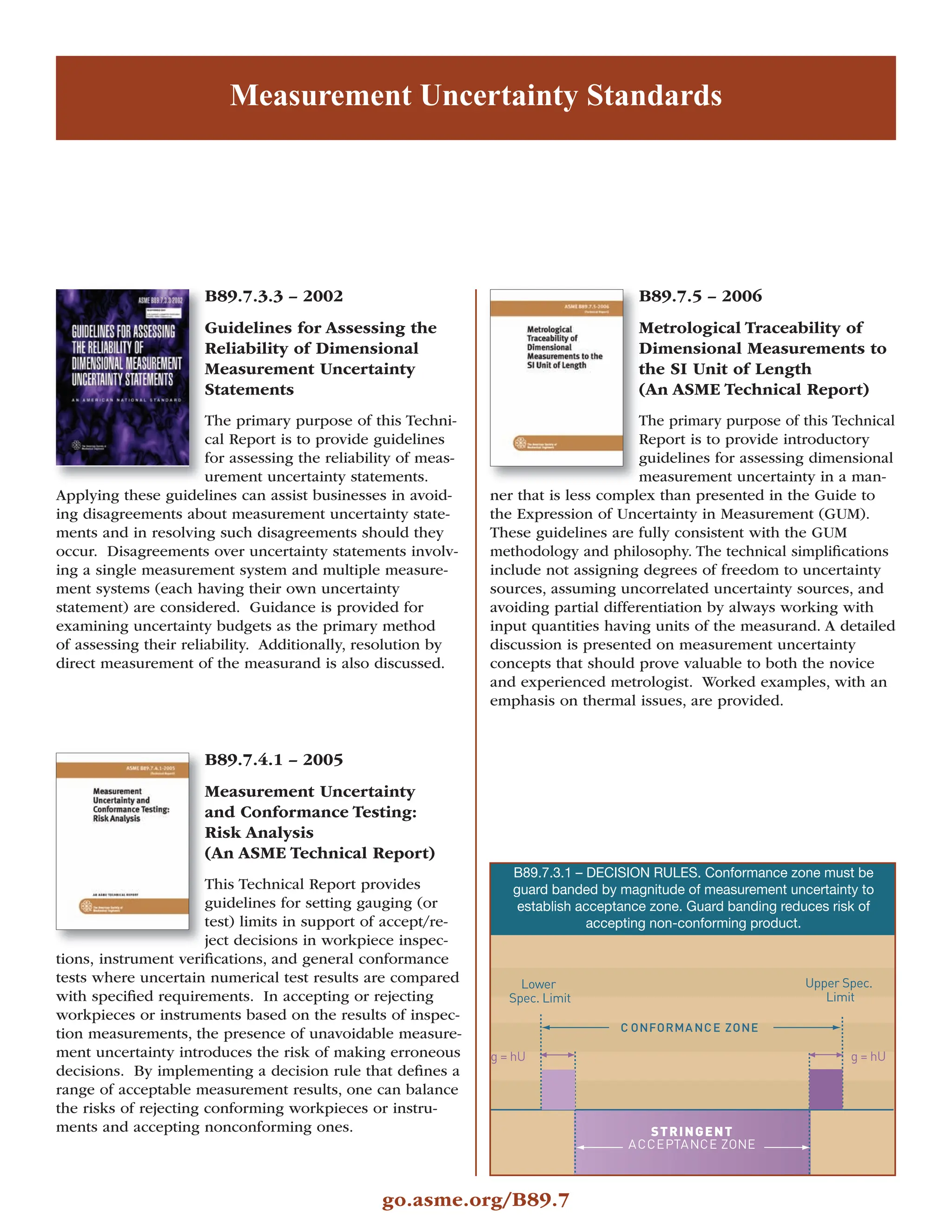
10% GR&R
What is Measurement
Uncertainty?
You’ve undertaken a measurement for a product design
that has been manufactured, assembled and inspected by
your supply chain.
But what if your particular measurement might be
“off” from what you would consider to be acceptable?
How do you assess your likelihood of being “off”?
How do you determine what is the acceptable range
for being “off”?
And how do you express this likelihood and range in
quantitative terms – so that all parties in your supply
chain can agree?
Clearly, the implications of such measurements are
enormously significant throughout the manufacturing,
assembling and inspection process, especially in such
“big ticket” industries as medical, aerospace, automotive,
disc-drive and energy. The potential impact on costs
could range into millions of dollars. So it benefits all
engineers greatly to be accurate in how they undertake,
evaluate and communicate their measurements.
Image at lower right courtesy of “Productive Metrology, Adding
Value to Manufacture,” by H. Kunzmann, T. Pfeifer, R. Schmitt,
H. Schwenke, A. Weckenmann, published in the CIRP Annual
vol. 54-2, 2005.
Measurement uncertainty is the quantitative evaluation of
the reasonable values that are associated with a measure-
ment result. It is a probabilistic expression of the doubt
in a particular measurement value.
Whether addressing the performance tests of instruments
or the calibrations of artifacts, ASME B89.7 documents
provide the framework for assessing the measurement
processes and quantifying the validity of the results of
measurement results. Results of measurements are the
numerical values produced by a measurement process.
Measurement uncertainty is a number that characterizes
the distribution of values that could reasonably be attrib-
uted to the realization of the measurand, or particular
quantity subject to measurement. As such, measurement
uncertainty is an indicator of the quality and reliability of
measurement results and can be used as an effective tool
to improve measurement processes.
The ASME B89 Division 7 committee was established with the
intent of developing standards in the field of measurement un-
certainty and to remain abreast of the latest developments in
the field. It also provides guidance to other B89 divisions. It is
noteworthy that documents created under the auspices of B89
Division 7 are significantly broader in scope than traditional
B89 performance-testing standards as they include all ramifica-
tions of and variations in the measuring process. It is also
important to state the B89.7 Series of documents use Type A
and Type B evaluations and are 100% GUM (Guide to the
Expression of Uncertainty in Measurement) compliant.
ASME B89 Division 7
go.asme.org/B89.7
Measured results must be repeatable and reproducible
but by itself can be both a technical and financial risk. Influence of measurement uncertainty on process parameters,
3.
Design
Measurement
Mfg
GDT
Uncertainty
Design
Measurement
Mfg
GDT
Uncertainty
Measurement
Design
Mfg.
What Practitioners SayAbout
Measurement Uncertainty
The main goal for [measurement] uncertainty is to make
sure the measurements taken by a certain system (gage,
CMM or the like) are appropriate for the application. The
cost of having poor measurements is multiplied as
the nonconforming components move through the
processes towards final assembly and on to a
customer.
—Paulo H. Pereira, Ph.D., ASQ-CQE
Global Quality
Production Center of Excellence
Caterpillar Inc.
Companies can save money with measurement uncer-
tainty by being in a position to make better technical and
business decisions.
Companies using gage repeatability and reproducibility
(GRR) as their basis for measurement systems analysis
would be at high-risk. This limited method of analysis is
not capable of capturing the full magnitude of measure-
ment error and biases induced by many influencing fac-
tors. Measured results must be repeatable and
reproducible, but by itself can be both a technical
and financial risk. It is easy to have measured re-
sults that are repeatably and reproducibly incorrect,
as uncorrected biases are easily induced that can be
many times larger than the GRR numbers initially recog-
nized by the metrologist.
Customers and suppliers already know when this is occur-
ring, as one of the two following situations happens:
Measurement data can look good -- it complies with speci-
fication requirements, but the parts do not work or prop-
erly fit. Or measurement data can look bad -- it does not
comply with specification requirements, but the parts ac-
tually do work.
—Greg Hetland, Ph.D.
Founder
International Institute of Geometric
Dimensioning Tolerancing (IIGDT)
Measurement uncertainty describes the accuracy of a
measurement result; it is the quantitative evaluation of
the reasonable values that are associated with a particu-
lar measurement. Whether addressing the performance
test results of instruments, or the calibrations of gauges,
standard methods for assessing the measurement uncer-
tainty and quantifying the validity of the results can be
used as an effective tool to improve measurement
processes.
Consensus standards like those provided in the ASME
B89.7 documents provide a means to achieve GUM-com-
pliant uncertainty statements and a recognized method of
establishing measurement traceability. As a result, use of
such standards reduces ambiguity about the conse-
quences of measurement uncertainty and allows
users to benefit from the established work of expert
analysis; thus avoiding potential pitfalls and
reducing costs.
—Steven D. Phillips, Ph.D.
Leader, Physicist
Large-Scale Coordinate Metrology Group
NIST – National Institute of Standards and
Technology
ASME B89 Division 7
go.asme.org/B89.7
GDT and Uncertainty
4.
ASME B89.7 Documents
B89.7.2– 1999
Dimensional Measurement
Planning
The intent of this Standard is to
facilitate agreement between
suppliers and customers by
specifying a standard method for
assessing the dimensional accept-
ability of workpieces. Components
of the method are the preparation of an adequate dimen-
sional measurement plan and the use of the plan in mak-
ing measurements. The major input to the method is
dimensional specifications developed, for example, in
compliance with ASME Y14.5 – 2009 Dimensioning Tol-
erancing standard.
B89.7.3.1 – 2001
Guidelines for Decision Rules:
Considering Measurement
Uncertainty, Determining
Conformance to Specifications
These guidelines provide sugges-
tions for decision rules when con-
sidering measurement uncertainty
in determining conformance to
specification. Applying these guidelines can assist busi-
nesses in avoiding disagreements with customers and
suppliers about conformance to specifications and in
managing costs associated with conformance decisions.
B89.7.3.2 – 2007
Guidelines for the Evaluation
of Dimensional Measurement
Uncertainty
(An ASME Technical Report)
The primary purpose of this Techni-
cal Report is to provide introductory
guidelines for assessing dimensional
measurement uncertainty in a man-
ner that is less complex than presented in the Guide to
the Expression of Uncertainty in Measurement (GUM).
These guidelines are fully consistent with the GUM
methodology and philosophy. The technical simplifica-
tions include not assigning degrees of freedom to uncer-
tainty sources, assuming uncorrelated uncertainty
sources, and avoiding partial differentiation by always
working with input quantities having units of the measur-
and. A detailed discussion is presented on measurement
uncertainty concepts that should prove valuable to both
the novice and experienced metrologist. Worked exam-
ples, with an emphasis on thermal issues, are provided.
Measurement Uncertainty Standards
For Information:
ASME Standards Certification
Three Park Avenue
New York, NY 10016-5990 U.S.A.
Fredric Constantino
Phone: +1.212.591.8684
Fax: +1.212.591.8501
Email: constantinof @ asme.org
Website: go.asme.org/B89.7
go.asme.org/B89.7
5.
Measurement Uncertainty Standards
B89.7.3.3– 2002
Guidelines for Assessing the
Reliability of Dimensional
Measurement Uncertainty
Statements
The primary purpose of this Techni-
cal Report is to provide guidelines
for assessing the reliability of meas-
urement uncertainty statements.
Applying these guidelines can assist businesses in avoid-
ing disagreements about measurement uncertainty state-
ments and in resolving such disagreements should they
occur. Disagreements over uncertainty statements involv-
ing a single measurement system and multiple measure-
ment systems (each having their own uncertainty
statement) are considered. Guidance is provided for
examining uncertainty budgets as the primary method
of assessing their reliability. Additionally, resolution by
direct measurement of the measurand is also discussed.
B89.7.4.1 – 2005
Measurement Uncertainty
and Conformance Testing:
Risk Analysis
(An ASME Technical Report)
This Technical Report provides
guidelines for setting gauging (or
test) limits in support of accept/re-
ject decisions in workpiece inspec-
tions, instrument verifications, and general conformance
tests where uncertain numerical test results are compared
with specified requirements. In accepting or rejecting
workpieces or instruments based on the results of inspec-
tion measurements, the presence of unavoidable measure-
ment uncertainty introduces the risk of making erroneous
decisions. By implementing a decision rule that defines a
range of acceptable measurement results, one can balance
the risks of rejecting conforming workpieces or instru-
ments and accepting nonconforming ones.
B89.7.5 – 2006
Metrological Traceability of
Dimensional Measurements to
the SI Unit of Length
(An ASME Technical Report)
The primary purpose of this Technical
Report is to provide introductory
guidelines for assessing dimensional
measurement uncertainty in a man-
ner that is less complex than presented in the Guide to
the Expression of Uncertainty in Measurement (GUM).
These guidelines are fully consistent with the GUM
methodology and philosophy. The technical simplifications
include not assigning degrees of freedom to uncertainty
sources, assuming uncorrelated uncertainty sources, and
avoiding partial differentiation by always working with
input quantities having units of the measurand. A detailed
discussion is presented on measurement uncertainty
concepts that should prove valuable to both the novice
and experienced metrologist. Worked examples, with an
emphasis on thermal issues, are provided.
C ONFORMA NCE ZONE
Lower
Spec. Limit
Upper Spec.
Limit
STRINGENT
ACCEPTANCE ZONE
g = hU g = hU
go.asme.org/B89.7
B89.7.3.1 – DECISION RULES. Conformance zone must be
guard banded by magnitude of measurement uncertainty to
establish acceptance zone. Guard banding reduces risk of
accepting non-conforming product.
6.
ASME Related Documents
Y14.5– 2009
Geometric Dimensioning
and Tolerancing
The Y14.5 standard is considered
the authoritative guideline for the
design language of geometric di-
mensioning nd tolerancing (GDT.)
It establishes uniform practices for
stating and interpreting GDT and
related requirements for use on engineering drawings
and in related documents. GDT is an essential tool for
communicating design intent — that parts from technical
drawings have the desired form, fit, function and inter-
changeability. By providing uniformity in drawing specifi-
cations and interpretation, GDT reduces guesswork
throughout the manufacturing process — improving qual-
ity, lowering costs, and shortening deliveries.
ASME also offers 12 related standards on GDT, including:
Y14.41 – 2003: Digital Product Definition Data Practices.
For more offerings and info, visit: go.asme.org/gdt.
B46.1 – 2009
Surface Texture, Surface
Roughness, Waviness and Lay
This Standard is concerned with the
geometric irregularities of surfaces.
It defines surface texture and its
constituents: roughness, waviness,
and lay. It also defines parameters
for specifying surface texture. The
terms and ratings in this Standard relate to surfaces pro-
duced by such means as abrading, casting, coating, cutting,
etching, plastic deformation, sintering, wear, erosion, etc.
Look for a new 2010 ASME B46.1 edition, which will in-
clude an executive summary presenting the essential is-
sues in measuring surface roughness. The 2010 edition
will contain many additions and clarifications over the
current edition, and provides in one volume an overall
guide to surface roughness measurement including in-
strument descriptions, filtering requirement, parameter
selection, and harmonization with the new ISO 3-D texture
parameters. To order, visit: go.asme.org/B46catalog.
B89.4.10360.2 – 2008
Acceptance Test and
Reverification Test for
Coordinate Measuring
Machines (CMMs) Part 2:
CMMs Used for Measuring
Linear Dimensions
(Technical Report)
This Technical Report establishes requirements and methods
for specifying and testing the performance of coordinate
measuring machines (CMMs) having three linear axes
perpendicular to each other and up to one rotary axis
positioned arbitrarily with respect to these linear axes.
In addition to clarifying the performance evaluation of
CMMs, this Technical Report seeks to facilitate performance
comparisons among machines by unifying terminology,
general machine classification, and the treatment of
environmental effects.
This is a redesignation and update of B89.4.1-1997. It
was created to harmonize the B89.4.1 standard with ISO
10360.2 by incorporating the entire 10360.2 document
into it and adding additional requirements that can be
found in text boxes throughout the technical report.
To Order:
ASME Information Central
22 Law Drive
P.O. Box 2900
Fairfield, NJ 07007-2900 U.S.A.
Phone: +1.973.882.1170
Toll-free: +1.800.THE.ASME (843.2763)
Fax: +1.973.882.5155
Email: infocentral @ asme.org
Website: go.asme.org/B89.7catalog
ASME B89 Division 7
go.asme.org/B89.7
7.
About ASME
Codes andStandards
ASME is the leading international developer of
codes and standards associated with the art, science,
and practice of mechanical engineering. Starting
with the first issuance of its legendary Boiler
Pressure Vessel Code in 1911, ASME’s codes and
standards have grown to nearly 600 offerings cur-
rently in print. These offerings cover a breadth of
topics, including pressure technology, nuclear plants,
elevators/escalators, construction, engineering design,
standardization, and performance testing.
Developing and revising ASME codes and standards
occurs year-round. More than 4,000 dedicated volun-
teers—engineers, scientists, government officials,
and others, but not necessarily members of the
Society—contribute their technical expertise to
protect public safety, while reflecting best practices
of industry. The results of their efforts are being
used in over 100 nations; thus setting the standard
for code-development worldwide.
Standards Development Process
In developing all its codes and standards, ASME em-
ploys a consensus-based process that considers the
input of all relevant stakeholders. Due process for
all input is assured and monitored. All codes-and-
standards development is open to public review at
appropriate stages, and the actions of the committee
are documented and completely transparent.
ASME’s development process is accredited by The
American National Standards Institute (ANSI), while
its principles are consistent with those of the World
Trade Organization’s Technical Barriers to Trade
Agreement.
Volunteer for ASME B89 Division 7
ASME Codes and Standards enjoys ongoing volunteer
contributions from hundreds of leading companies,
consultants, academics and government officials.
Contributors range from department heads and the
top technical experts in their fields all the way to
young engineers in their early-career stages. This
mix helps assure that the resulting standards are
truly visionary, while also being practical and
applicable for everyday end-users.
For more information on volunteering, visit:
go.asme.org/B89.7
About ASME
ASME helps the global engineering community
develop solutions to real world challenges facing
all people and our planet. Founded in 1880 as the
American Society of Mechanical Engineers, ASME
has grown to serve 120,000 professional members
in 138 countries. We actively enable inspired collab-
oration, knowledge sharing and skill development
across all engineering disciplines, all around the
world, while promoting the vital role of the engineer
in society.
ASME products and services include our renowned
codes and standards, certification and accreditation
programs, professional publications, technical con-
ferences, risk-management tools, government/regu-
latory advisory, continuing education and professional
development programs. These efforts, guided by
ASME leadership, and powered by our volunteer
networks and staff, help make the world a safer and
better place, today, and for future generations.
Measurement Uncertainty Standards
go.asme.org/B89.7
8.
T h re e P a r k A v e n u e
N e w Y o r k , N Y
1 0 01 6 - 5 9 9 0 U . S . A .
ASME Standards and Certifications

![Design
Measurement
Mfg
GDT
Uncertainty
Design
Measurement
Mfg
GDT
Uncertainty
Measurement
Design
Mfg.
What Practitioners Say About
Measurement Uncertainty
The main goal for [measurement] uncertainty is to make
sure the measurements taken by a certain system (gage,
CMM or the like) are appropriate for the application. The
cost of having poor measurements is multiplied as
the nonconforming components move through the
processes towards final assembly and on to a
customer.
—Paulo H. Pereira, Ph.D., ASQ-CQE
Global Quality
Production Center of Excellence
Caterpillar Inc.
Companies can save money with measurement uncer-
tainty by being in a position to make better technical and
business decisions.
Companies using gage repeatability and reproducibility
(GRR) as their basis for measurement systems analysis
would be at high-risk. This limited method of analysis is
not capable of capturing the full magnitude of measure-
ment error and biases induced by many influencing fac-
tors. Measured results must be repeatable and
reproducible, but by itself can be both a technical
and financial risk. It is easy to have measured re-
sults that are repeatably and reproducibly incorrect,
as uncorrected biases are easily induced that can be
many times larger than the GRR numbers initially recog-
nized by the metrologist.
Customers and suppliers already know when this is occur-
ring, as one of the two following situations happens:
Measurement data can look good -- it complies with speci-
fication requirements, but the parts do not work or prop-
erly fit. Or measurement data can look bad -- it does not
comply with specification requirements, but the parts ac-
tually do work.
—Greg Hetland, Ph.D.
Founder
International Institute of Geometric
Dimensioning Tolerancing (IIGDT)
Measurement uncertainty describes the accuracy of a
measurement result; it is the quantitative evaluation of
the reasonable values that are associated with a particu-
lar measurement. Whether addressing the performance
test results of instruments, or the calibrations of gauges,
standard methods for assessing the measurement uncer-
tainty and quantifying the validity of the results can be
used as an effective tool to improve measurement
processes.
Consensus standards like those provided in the ASME
B89.7 documents provide a means to achieve GUM-com-
pliant uncertainty statements and a recognized method of
establishing measurement traceability. As a result, use of
such standards reduces ambiguity about the conse-
quences of measurement uncertainty and allows
users to benefit from the established work of expert
analysis; thus avoiding potential pitfalls and
reducing costs.
—Steven D. Phillips, Ph.D.
Leader, Physicist
Large-Scale Coordinate Metrology Group
NIST – National Institute of Standards and
Technology
ASME B89 Division 7
go.asme.org/B89.7
GDT and Uncertainty](https://image.slidesharecdn.com/25586-250915044318-17a259a5/75/25-3221132-123-132-123-123-1586-pdf-3-2048.jpg)