Presentation On:-
Progress Report
Prepared By:-
Ahsan Saeed
Amjad Farooq
Muhammad Usman
What Is Progress Report ?
An assessment that take place during a project or process, that conveys details
such as what sub-goals have been accomplished, what resources have been
expended, what problems have been encountered, and whether the project or
process is expected to be completed on time and within budget.
A progress report is simply what the names implies – a report, usually brief,
explaining the progress you’ve made on a given project or set of projects.
Progress Report Consist Of Following Sections
• 1. Introduction
• 2. Background
• 3. Accomplishment
• 4. Problems
• 5. Future Work
• 6. Conclusions
1. Introduction
In this section, introduce the project and report, and briefly summarize the
project status. Sometimes this information appears under the heading
“Introduction” or “Summary” (especially in more formal reports) other times,
particularly in memos, it is simply the opening paragraph.
2. Background
Briefly review the project itself, including the major tasks and what you should
have accomplished by this point.
If you’re writing to your immediate supervisor about your work on the only
major project underway in your design group, you may not need to say anything
beyond the introduction.
3. Accomplishments
Summarize what you’ve done in the time covered by the report. This section
should include both major tasks you’ve completed and, if appropriate,
significant finding or results. Be careful, not to be include too much detail –
address finding you think the reader needs to know, but don’t waste time
providing information that’s not relevant to the readers goal.
4. Problems
Summarize any problems you’ve encountered, and either how you have solved
them or how you have plan to solve them. If these problems have resulted in
changes to the project – a new schedule, a new focus, more research required,
etc. – state those changes clearly.
5. Future work
Outline the work remaining on the project, including completion dates and
times estimate as appropriate. If you have made changes to the project plan,
you should note them here (as well as in problems Section).
6. Conclusions
For longer reports, the conclusions may need to again summarize the overall
project status; for brief reports, that summary may be written as introduction.
Progress Report on Rawalpindi-Islamabad
Metro Bus
1. Introduction
• In this section, introduce the project and report, and briefly summarize the
project status.
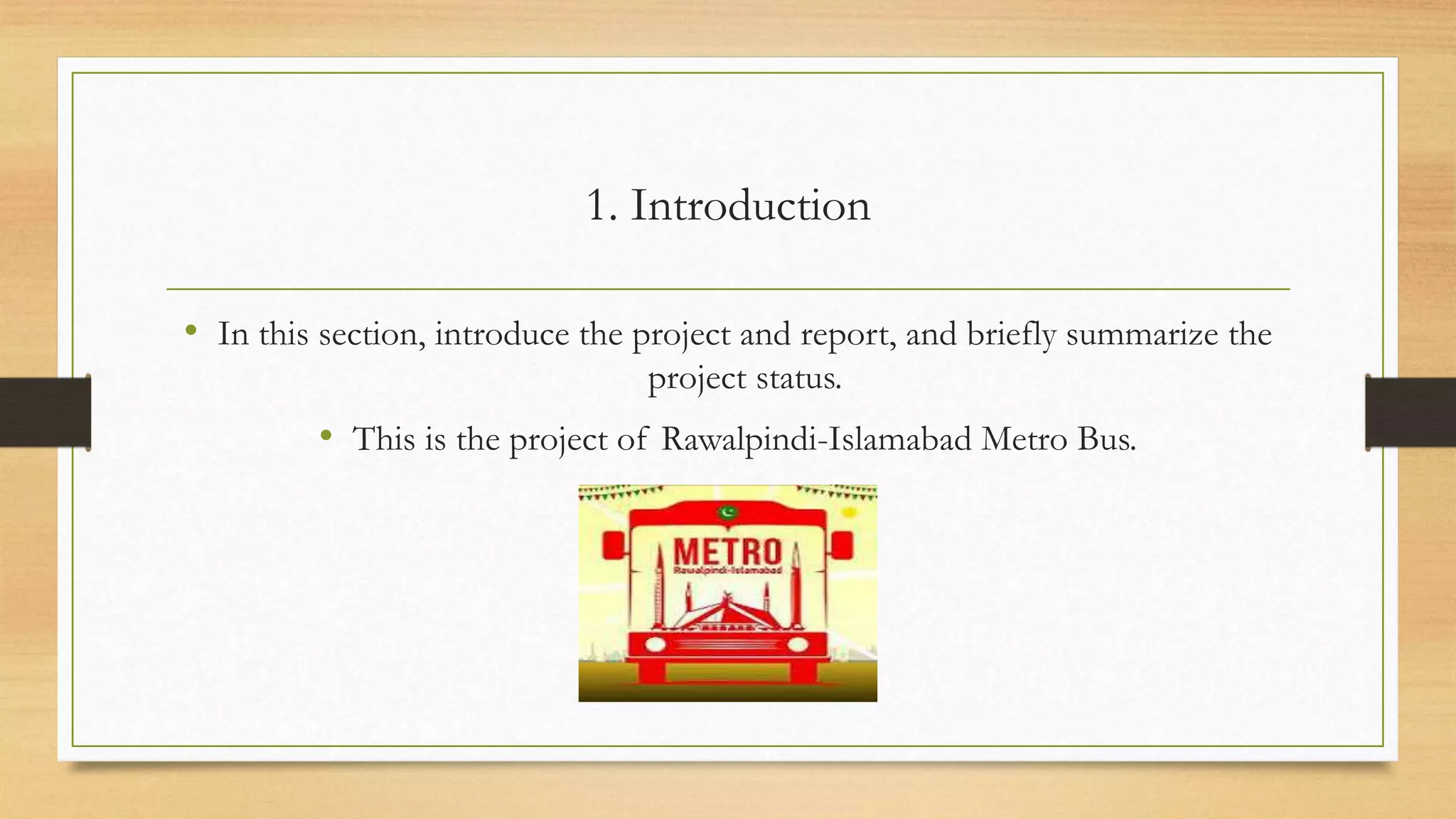
• This is the project of Rawalpindi-Islamabad Metro Bus.
Owner ---- Government of Punjab
Locale ---- Rawalpindi-Islamabad, Punjab Pakistan.
Transit Type ---- Bus Rapid Transit
Number of Lines ---- 1
Number of Stations ---- 14
Daily Ridership ---- 135,000
Website ---- www.metrori.pk
Operation Began ---- 4th June, 2015
Operators ---- Punjab Metro Bus Authority
Number of Vehicle’s ---- 68
System Length ---- 22.5 km
Project Cost ---- 44.31 Billion Rupees
At a Glance
Rawalpindi Islamabad Total
Length 8.6 Km 13.90 Km 22.5 Km
Cost 19.47 24.84 44.31
No. of Stations 10 14 24
2. Background:-
In this section, briefly review the project itself, including
the major tasks.
A. Population Growth of The Capital:-
The capital city of Pakistan “Islamabad” is the ninth largest city
in the country. The population of the city has grown from
100,000 in 1951 to 1.30 million in 2012. Since its foundation,
Islamabad has attracted people from all over Pakistan, making it
one of the most cosmopolitan and urbanized cities of Pakistan
and center of economic and service activities which attract
people from all over the country.
B. Population Growth of Rawalpindi:-
Adjacent to the Southern edge of Islamabad lies the city of
Rawalpindi. It is situated in the North Eastern part of the Potohar
Plateau in North Punjab.
Being Headquarter of Rawalpindi Division and a close neighbor of
the Federal Capital, Islamabad, the population of Rawalpindi City
has rapidly increased over the years.
C. Traffic Burden on Murree Road:-
Murree Road is one of the busiest and most preferred link
between the twin cities due to its shorter length and direct
approach. During the last few years there has been an un-
predicted increase in vehicular traffic in the city, especially
along Murree Road, resulting in severe traffic congestion on this
route. This congestion causes excessive delays, environmental
pollution.
Public transport is one of the major contributors in the traffic
mix and the quality of service being provided is of poor
standard.
D. Joint Decision by the Federal and Provisional Government
• In a meeting held in 19th January 2014, the two government (federal &
provisional) decided that the project shall be funded on 50:50 sharing basis.
As the Punjab government has recently completed Lahore metro bus project
successfully. So that prime minister decided that the project will execute by
provisional government by (RDA). It will work in close coordination with
(CDA). Punjab metro bus authority (PMA) will control the operation &
maintenance of the project after its completion.
3. Accomplishments
• This is the work done which was completed in the time covered by the report till 5th januarary 2016.
• Sr. No. Component Total Progress
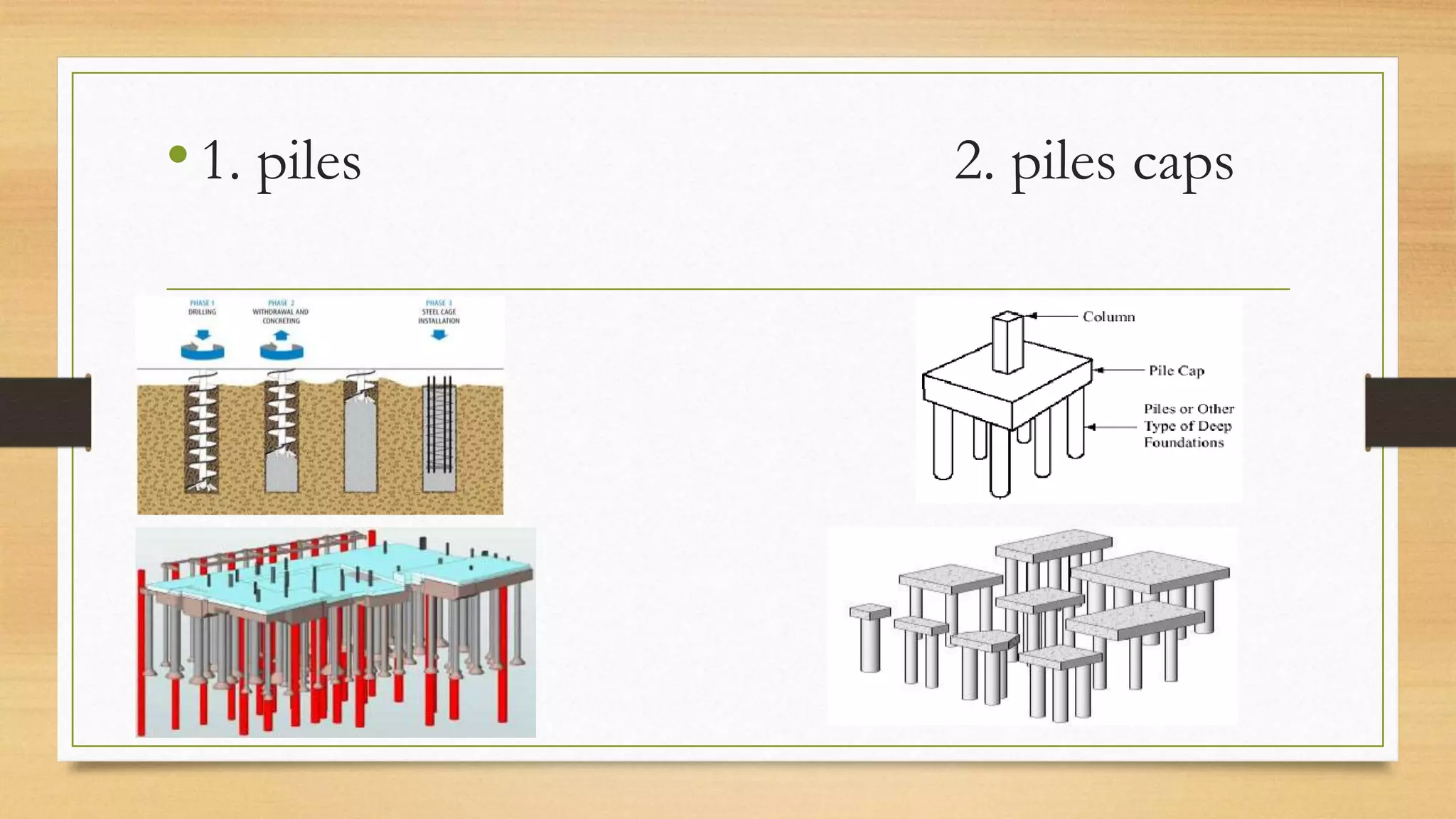
• 1. Piles 2225 2187 (98%)
• 2. Pile Caps 370 364 (98%)
• 3. Piers 378 356 (94%)
• 4. Transoms 332 287 (86%)
• 5. Girders 1491 1459 (98%)
• 6. Girders Launching 1491 750 (50%)
•1. piles 2. piles caps
•3. piers 4. Transoms
5. Girders 6. Girders Launching
4. Problems:-
This section involves the problems which we have encountered and their solutions or planning to
solve them.
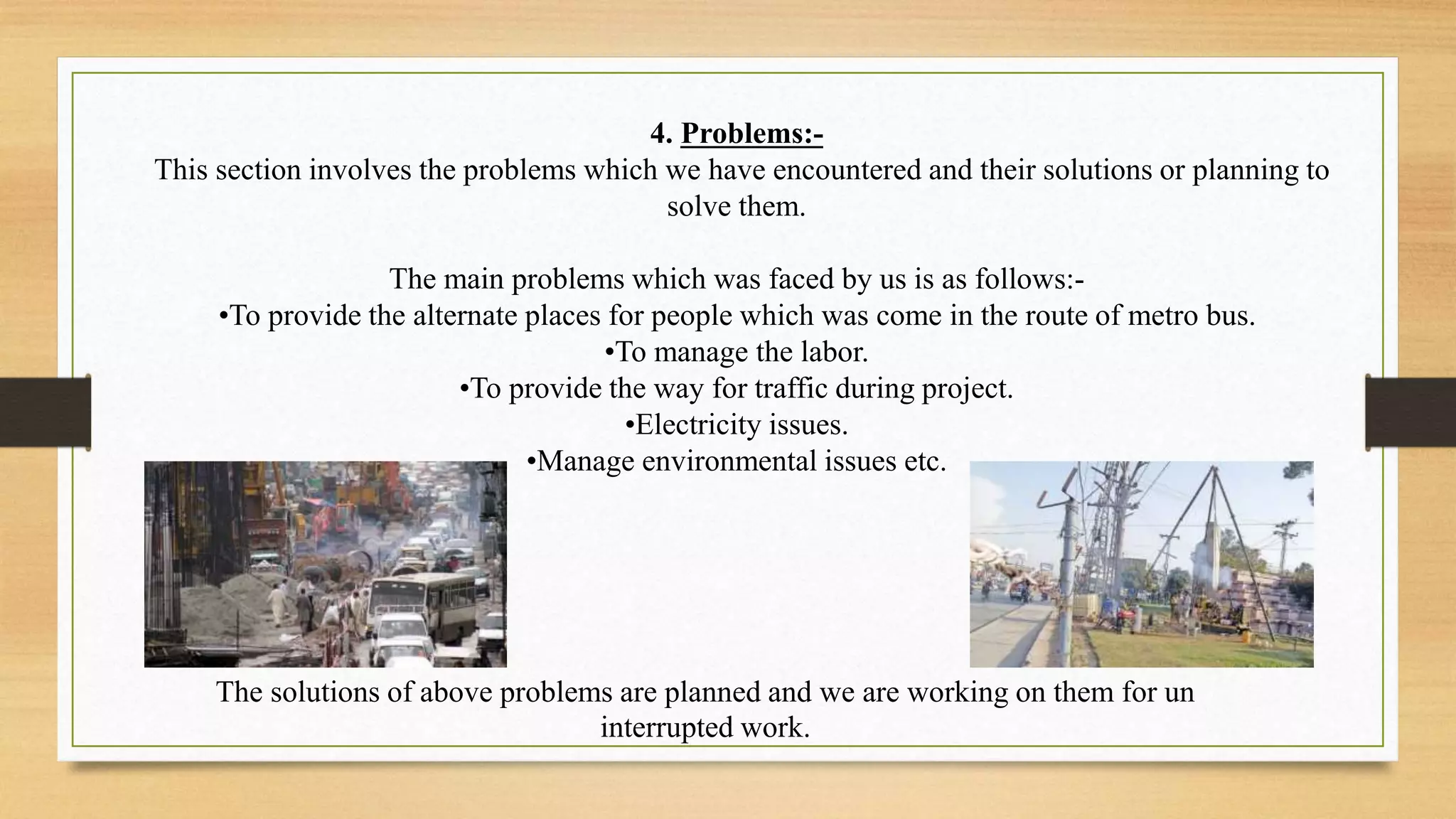
The main problems which was faced by us is as follows:-
•To provide the alternate places for people which was come in the route of metro bus.
•To manage the labor.
•To provide the way for traffic during project.
•Electricity issues.
•Manage environmental issues etc.
The solutions of above problems are planned and we are working on them for un
interrupted work.
5. Future Work:-
In this section outline the remaining work on the projects, including completion
dates and time estimates as appropriate.
There is 10 stations in Islamabad and we have completed 4 stations yet so rest
of 6 stations are under construction now a days. They are constructed till 7th
March 2016.
6. Conclusions:-
In this section we again need to summarize the over all
project status.
A. Signal Free:-
The entire length i.e. 8.6 km of Metro Bus corridor in
Rawalpindi area shall be elevated structure whereas
about 14 km in Islamabad Shall be at grade but made
signal free by constructing grade separations at various
intersections.
B. Number of Stations:-
Ten (10) stations in the Rawalpindi Part and fourteen (14) in the
Islamabad Part are provided along the corridor.
C. Functional Elements:-
Functional elements at the stations include ticketing
booths, concourse level passenger transfer, escalators,
platform screen doors turnstiles for automatic fare
collection and all other amenities for passenger
convenience.
D. Central Control Room:-
A central ITS control room is also included in the project to
control the whole operation of the Metro Bus system.
E. Number of Lanes:-
Initially the plan of a 10 lane Underpass (2 Lanes for Metro Bus and 8 Lanes for mix
traffic) along the 9th Avenue was Proposed at Peshawar Moor intersection. Later on, in
view of the traffic issues at Peshawar Moor intersection, ongoing
Widening/Rehabilitation of Kashmir Highway & its link with new Islamabad Airport, it
was decided to dovetail the Metro Bus corridor in the interchange already designed by
CDA Which will cost Rs 6.75 Billion. The same will be simultaneously executed with
Metro Bus Project.
References:-
o www.wikipedia.com
o www.pma.com
o www.cda.com
o www.rda.com
Any Question
To
Sir Ali Raza for giving us such a platform for enhance our communication
skills and way of style to share our knowledge with our honorable Teacher and
respected fellows.

Metro bus

  • 2.
    Presentation On:- Progress Report PreparedBy:- Ahsan Saeed Amjad Farooq Muhammad Usman
  • 3.
    What Is ProgressReport ? An assessment that take place during a project or process, that conveys details such as what sub-goals have been accomplished, what resources have been expended, what problems have been encountered, and whether the project or process is expected to be completed on time and within budget. A progress report is simply what the names implies – a report, usually brief, explaining the progress you’ve made on a given project or set of projects.
  • 4.
    Progress Report ConsistOf Following Sections • 1. Introduction • 2. Background • 3. Accomplishment • 4. Problems • 5. Future Work • 6. Conclusions
  • 5.
    1. Introduction In thissection, introduce the project and report, and briefly summarize the project status. Sometimes this information appears under the heading “Introduction” or “Summary” (especially in more formal reports) other times, particularly in memos, it is simply the opening paragraph.
  • 6.
    2. Background Briefly reviewthe project itself, including the major tasks and what you should have accomplished by this point. If you’re writing to your immediate supervisor about your work on the only major project underway in your design group, you may not need to say anything beyond the introduction.
  • 7.
    3. Accomplishments Summarize whatyou’ve done in the time covered by the report. This section should include both major tasks you’ve completed and, if appropriate, significant finding or results. Be careful, not to be include too much detail – address finding you think the reader needs to know, but don’t waste time providing information that’s not relevant to the readers goal.
  • 8.
    4. Problems Summarize anyproblems you’ve encountered, and either how you have solved them or how you have plan to solve them. If these problems have resulted in changes to the project – a new schedule, a new focus, more research required, etc. – state those changes clearly.
  • 9.
    5. Future work Outlinethe work remaining on the project, including completion dates and times estimate as appropriate. If you have made changes to the project plan, you should note them here (as well as in problems Section).
  • 10.
    6. Conclusions For longerreports, the conclusions may need to again summarize the overall project status; for brief reports, that summary may be written as introduction.
  • 11.
    Progress Report onRawalpindi-Islamabad Metro Bus
  • 12.
    1. Introduction • Inthis section, introduce the project and report, and briefly summarize the project status. • This is the project of Rawalpindi-Islamabad Metro Bus.
  • 13.
    Owner ---- Governmentof Punjab Locale ---- Rawalpindi-Islamabad, Punjab Pakistan. Transit Type ---- Bus Rapid Transit Number of Lines ---- 1 Number of Stations ---- 14 Daily Ridership ---- 135,000 Website ---- www.metrori.pk Operation Began ---- 4th June, 2015
  • 14.
    Operators ---- PunjabMetro Bus Authority Number of Vehicle’s ---- 68 System Length ---- 22.5 km Project Cost ---- 44.31 Billion Rupees At a Glance Rawalpindi Islamabad Total Length 8.6 Km 13.90 Km 22.5 Km Cost 19.47 24.84 44.31 No. of Stations 10 14 24
  • 15.
    2. Background:- In thissection, briefly review the project itself, including the major tasks. A. Population Growth of The Capital:- The capital city of Pakistan “Islamabad” is the ninth largest city in the country. The population of the city has grown from 100,000 in 1951 to 1.30 million in 2012. Since its foundation, Islamabad has attracted people from all over Pakistan, making it one of the most cosmopolitan and urbanized cities of Pakistan and center of economic and service activities which attract people from all over the country.
  • 16.
    B. Population Growthof Rawalpindi:- Adjacent to the Southern edge of Islamabad lies the city of Rawalpindi. It is situated in the North Eastern part of the Potohar Plateau in North Punjab. Being Headquarter of Rawalpindi Division and a close neighbor of the Federal Capital, Islamabad, the population of Rawalpindi City has rapidly increased over the years.
  • 17.
    C. Traffic Burdenon Murree Road:- Murree Road is one of the busiest and most preferred link between the twin cities due to its shorter length and direct approach. During the last few years there has been an un- predicted increase in vehicular traffic in the city, especially along Murree Road, resulting in severe traffic congestion on this route. This congestion causes excessive delays, environmental pollution. Public transport is one of the major contributors in the traffic mix and the quality of service being provided is of poor standard.
  • 18.
    D. Joint Decisionby the Federal and Provisional Government • In a meeting held in 19th January 2014, the two government (federal & provisional) decided that the project shall be funded on 50:50 sharing basis. As the Punjab government has recently completed Lahore metro bus project successfully. So that prime minister decided that the project will execute by provisional government by (RDA). It will work in close coordination with (CDA). Punjab metro bus authority (PMA) will control the operation & maintenance of the project after its completion.
  • 19.
    3. Accomplishments • Thisis the work done which was completed in the time covered by the report till 5th januarary 2016. • Sr. No. Component Total Progress • 1. Piles 2225 2187 (98%) • 2. Pile Caps 370 364 (98%) • 3. Piers 378 356 (94%) • 4. Transoms 332 287 (86%) • 5. Girders 1491 1459 (98%) • 6. Girders Launching 1491 750 (50%)
  • 20.
    •1. piles 2.piles caps
  • 21.
  • 22.
    5. Girders 6.Girders Launching
  • 23.
    4. Problems:- This sectioninvolves the problems which we have encountered and their solutions or planning to solve them. The main problems which was faced by us is as follows:- •To provide the alternate places for people which was come in the route of metro bus. •To manage the labor. •To provide the way for traffic during project. •Electricity issues. •Manage environmental issues etc. The solutions of above problems are planned and we are working on them for un interrupted work.
  • 24.
    5. Future Work:- Inthis section outline the remaining work on the projects, including completion dates and time estimates as appropriate. There is 10 stations in Islamabad and we have completed 4 stations yet so rest of 6 stations are under construction now a days. They are constructed till 7th March 2016.
  • 25.
    6. Conclusions:- In thissection we again need to summarize the over all project status. A. Signal Free:- The entire length i.e. 8.6 km of Metro Bus corridor in Rawalpindi area shall be elevated structure whereas about 14 km in Islamabad Shall be at grade but made signal free by constructing grade separations at various intersections. B. Number of Stations:- Ten (10) stations in the Rawalpindi Part and fourteen (14) in the Islamabad Part are provided along the corridor.
  • 26.
    C. Functional Elements:- Functionalelements at the stations include ticketing booths, concourse level passenger transfer, escalators, platform screen doors turnstiles for automatic fare collection and all other amenities for passenger convenience. D. Central Control Room:- A central ITS control room is also included in the project to control the whole operation of the Metro Bus system.
  • 27.
    E. Number ofLanes:- Initially the plan of a 10 lane Underpass (2 Lanes for Metro Bus and 8 Lanes for mix traffic) along the 9th Avenue was Proposed at Peshawar Moor intersection. Later on, in view of the traffic issues at Peshawar Moor intersection, ongoing Widening/Rehabilitation of Kashmir Highway & its link with new Islamabad Airport, it was decided to dovetail the Metro Bus corridor in the interchange already designed by CDA Which will cost Rs 6.75 Billion. The same will be simultaneously executed with Metro Bus Project.
  • 28.
  • 29.
  • 30.
    To Sir Ali Razafor giving us such a platform for enhance our communication skills and way of style to share our knowledge with our honorable Teacher and respected fellows.

Editor's Notes

  • #14 Transit----- the action of passing people or things across a place.
  • #16 Cosmopolitan-----familiar with people of different countries and cultures