The old and the new
TRIAD
• Students:
• Mehdi Laouiti
• Thang Vu
• Thiago Resende
Agenda
 Introduction
 Aims and objectives
 The classic Triad
 The classic Triad under threat
 BRICS
 The new Triad
 Why the new Triad
 Conclusion
Introduction
 World trade is dominated by a relatively small
number of nations. Governments of these nations
take a lead in international organizations and their
companies are responsible for a large number of
international trade and investment.
 Most commonly, countries are ranked according to
their national income or their share of world trade.
Another indicator might be the level of foreign direct
investment (FDI) undertaken by their home based
MNEs.
 Currently, a glance at international trade reveals that
some of the Asian countries, such as China , Korea
and India are emerging as powerful economies and
have almost taken a place from two of the world
economic leaders and the triad nations; japan and
Europe.
 While some of the Triad nations are showing a
downfall, America sustains its leadership in world
economy. China can be considered as the new
Aims and Objectives
 To indicate significance of the worlds major
trading nations;
 Discuss the role played by USA, Japan and
Europe in the world economy;
 Identify newly emerging economic nations;
 Identify the key determinants of the success
of the emerging nations;
 Consider advantages and disadvantages of
doing business in US, Japan, Europe, India
and China;
 Determine the reasons why some nations
are showing downfall.
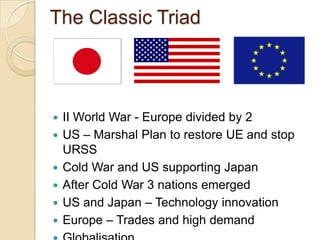
 II World War - Europe divided by 2
 US – Marshal Plan to restore UE and stop
URSS
 Cold War and US supporting Japan
 After Cold War 3 nations emerged
 US and Japan – Technology innovation
 Europe – Trades and high demand
The Classic Triad
 USA
 GDP ¼ of world´s economy
 1st Military power
 Multinationals exploring 3rd world countries
The Classic Triad
 Japan
 Technology innovation - robotic
 Importing raw material and exporting electronics
 Developing new processess to optimize production
 Europe
 Trades and commercial alliances
 High demand for products (densely populated area)
 Top countries pulling the economy
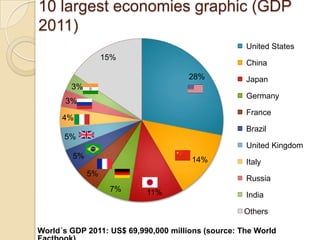
10 largest economies graphic (GDP
2011)
28%
14%
11%7%
5%
5%
5%
4%
3%
3%
15%
United States
China
Japan
Germany
France
Brazil
United Kingdom
Italy
Russia
India
Others
World´s GDP 2011: US$ 69,990,000 millions (source: The World
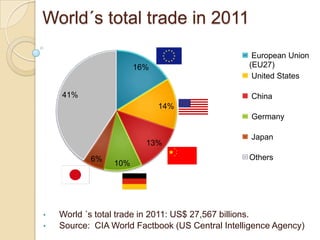
World´s total trade in 2011
• World ´s total trade in 2011: US$ 27,567 billions.
• Source: CIA World Factbook (US Central Intelligence Agency)
16%
14%
13%
10%
6%
41%
European Union
(EU27)
United States
China
Germany
Japan
Others
The Classic Triad Is Surviving
 Survives but within a broader picture of NAFTA, EU and Asia
(ASEAN).
 There are pockets of data that support a new Triad but that we
await confirmation within the bigger picture and public domain (
published books by experts) that a new structure is emerging/has
emerged.
 Traditional Triadic model perhaps needs changing to NAFTA, EU
and even BRIC (Brazil, Russia, India, China), but really all is
speculation from isolated pockets of data looking at different
indicators of economic activity.
 There is still value in the classic Triad currency. We have changed
to metric, but the old units survive and are used, pounds weight,
gallons, inches etc. so why not continue with the classic Triad
BRICS
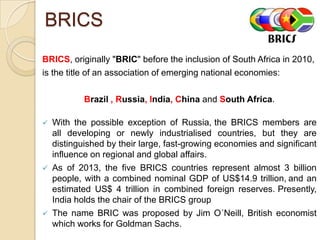
BRICS, originally "BRIC" before the inclusion of South Africa in 2010,
is the title of an association of emerging national economies:
Brazil , Russia, India, China and South Africa.
 With the possible exception of Russia, the BRICS members are
all developing or newly industrialised countries, but they are
distinguished by their large, fast-growing economies and significant
influence on regional and global affairs.
 As of 2013, the five BRICS countries represent almost 3 billion
people, with a combined nominal GDP of US$14.9 trillion, and an
estimated US$ 4 trillion in combined foreign reserves. Presently,
India holds the chair of the BRICS group
 The name BRIC was proposed by Jim O´Neill, British economist
which works for Goldman Sachs.
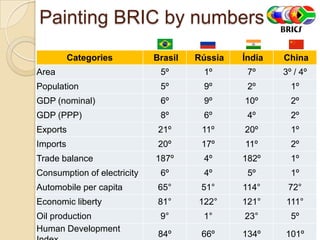
Painting BRIC by numbers
Categories Brasil Rússia Índia China
Area 5º 1º 7º 3º / 4º
Population 5º 9º 2º 1º
GDP (nominal) 6º 9º 10º 2º
GDP (PPP) 8º 6º 4º 2º
Exports 21º 11º 20º 1º
Imports 20º 17º 11º 2º
Trade balance 187º 4º 182º 1º
Consumption of electricity 6º 4º 5º 1º
Automobile per capita 65° 51° 114° 72°
Economic liberty 81° 122° 121° 111°
Oil production 9° 1° 23° 5º
Human Development
84º 66º 134º 101º
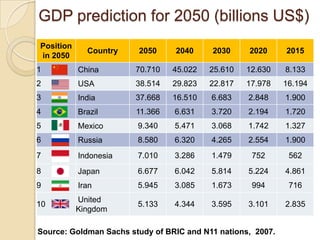
GDP prediction for 2050 (billions US$)
Source: Goldman Sachs study of BRIC and N11 nations, 2007.
Position
in 2050
Country 2050 2040 2030 2020 2015
1 China 70.710 45.022 25.610 12.630 8.133
2 USA 38.514 29.823 22.817 17.978 16.194
3 India 37.668 16.510 6.683 2.848 1.900
4 Brazil 11.366 6.631 3.720 2.194 1.720
5 Mexico 9.340 5.471 3.068 1.742 1.327
6 Russia 8.580 6.320 4.265 2.554 1.900
7 Indonesia 7.010 3.286 1.479 752 562
8 Japan 6.677 6.042 5.814 5.224 4.861
9 Iran 5.945 3.085 1.673 994 716
10
United
Kingdom
5.133 4.344 3.595 3.101 2.835
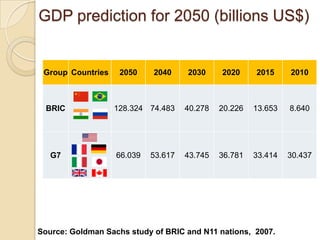
GDP prediction for 2050 (billions US$)
Source: Goldman Sachs study of BRIC and N11 nations, 2007.
Group Countries 2050 2040 2030 2020 2015 2010
BRIC 128.324 74.483 40.278 20.226 13.653 8.640
G7 66.039 53.617 43.745 36.781 33.414 30.437
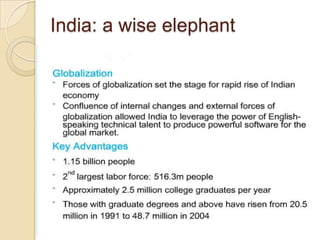
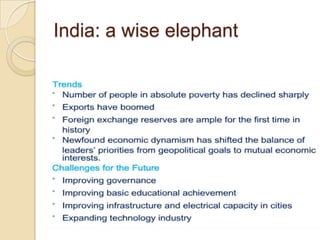
India: a wise elephant
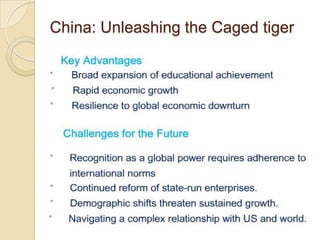
China: Unleashing the Caged tiger
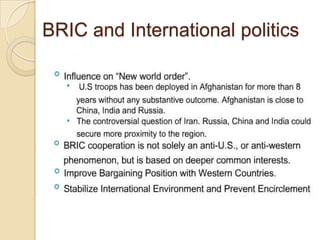
BRIC and International politics
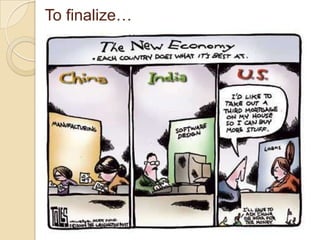
 America is now driving the globalization of India and China.
 The “ New TRIAD “ has already formed within US, China and
India, creating large sources, and growing markets for
foods, services and capital.
 The new triad has become a growth engine for the global
economy, all three economies are growing in terms of GDP and
productivity.
 India and China are both critical to America’s continued
economic success.
The New Triad
Trade between triad
 All countries in the triad are net suppliers
to the US consumers.
 China has the largest trade surplus ($110
Bn).
 China and India provides low-cost
production and delivery centres
Trade Potential
 China and India together provide huge
workforces in services and manufacturing
sectors
 China and India represent cheap sources
of labor and large consumer market
Direct Investment Potential
 FDI represents the expansion of
American enterprises to foreign countries
in productions and investments
 US being an insider, is increasingly
critical in markets like India and China
Portfolio Investment Potential
 Both 3 countries have Significant
ammount of Portfolio Investment
 These create a positive global dynamic
for America
The New Triad
Why The New Triad?
Of the world’s top ten economies, India, China and US:
 Constitute 70% of the total population (approx.)
 Share of the top three economies is 3/4th of the world’s
GDP (approx.)
 Present largest markets in the world
 Will be largest resource consumers
 Will raise issues on environment and sustainability
 Are going to shape the future geo-political landscape
Conclusion
Forecast from Goldman Sachs says that India and China
will dominate the economy in 2050, forming the new
TRIAD.
 The old TRIAD still remain for few years;
 The demand of US, EU and Japan will remain level;
 The BRICS and new TRIAD will take over from 2020;
 Until 2050 the BRICS GDP will be twice big as G7.
To finalize…
Thank you!