Cognitive Processes Table
A Structured Overview of Key
Cognitive Functions
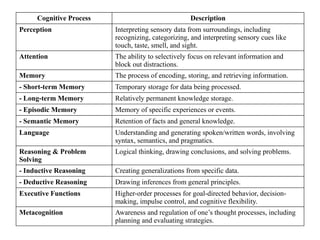
Cognitive Process Description
Perception Interpreting sensory data from surroundings, including
recognizing, categorizing, and interpreting sensory cues like
touch, taste, smell, and sight.
Attention The ability to selectively focus on relevant information and
block out distractions.
Memory The process of encoding, storing, and retrieving information.
- Short-term Memory Temporary storage for data being processed.
- Long-term Memory Relatively permanent knowledge storage.
- Episodic Memory Memory of specific experiences or events.
- Semantic Memory Retention of facts and general knowledge.
Language Understanding and generating spoken/written words, involving
syntax, semantics, and pragmatics.
Reasoning & Problem
Solving
Logical thinking, drawing conclusions, and solving problems.
- Inductive Reasoning Creating generalizations from specific data.
- Deductive Reasoning Drawing inferences from general principles.
Executive Functions Higher-order processes for goal-directed behavior, decision-
making, impulse control, and cognitive flexibility.
Metacognition Awareness and regulation of one’s thought processes, including
planning and evaluating strategies.
Behavioural or mood changes: Examples include mood swings, elevated irritation,
agitation, or retreat from social interactions.
Making poor decisions: due to impaired judgment, particularly in circumstances where
problem-solving or judgment is needed.
Language issues: include needing help understanding written or spoken language,
following conversations, or coming up with the appropriate phrases.
Memory loss: It might manifest as repeating inquiries or stories or as forgetting newly
taught material or significant dates or occurrences.
Confusion and disorientation: These include becoming lost in well-known locations,
unable to comprehend time or location, and becoming easily confused.
Loss of spatial awareness: Inability to judge distances or navigate spatial relationships,
which can cause unsteadiness or difficulty coordinating movements.
Inability to think abstractly: Having trouble understanding ideas that are neither physical
Cognitive_Processes_Table cognitive function.pptx

  • 1.
    Cognitive Processes Table AStructured Overview of Key Cognitive Functions
  • 2.
    Cognitive Process Description PerceptionInterpreting sensory data from surroundings, including recognizing, categorizing, and interpreting sensory cues like touch, taste, smell, and sight. Attention The ability to selectively focus on relevant information and block out distractions. Memory The process of encoding, storing, and retrieving information. - Short-term Memory Temporary storage for data being processed. - Long-term Memory Relatively permanent knowledge storage. - Episodic Memory Memory of specific experiences or events. - Semantic Memory Retention of facts and general knowledge. Language Understanding and generating spoken/written words, involving syntax, semantics, and pragmatics. Reasoning & Problem Solving Logical thinking, drawing conclusions, and solving problems. - Inductive Reasoning Creating generalizations from specific data. - Deductive Reasoning Drawing inferences from general principles. Executive Functions Higher-order processes for goal-directed behavior, decision- making, impulse control, and cognitive flexibility. Metacognition Awareness and regulation of one’s thought processes, including planning and evaluating strategies.
  • 3.
    Behavioural or moodchanges: Examples include mood swings, elevated irritation, agitation, or retreat from social interactions. Making poor decisions: due to impaired judgment, particularly in circumstances where problem-solving or judgment is needed. Language issues: include needing help understanding written or spoken language, following conversations, or coming up with the appropriate phrases. Memory loss: It might manifest as repeating inquiries or stories or as forgetting newly taught material or significant dates or occurrences. Confusion and disorientation: These include becoming lost in well-known locations, unable to comprehend time or location, and becoming easily confused. Loss of spatial awareness: Inability to judge distances or navigate spatial relationships, which can cause unsteadiness or difficulty coordinating movements. Inability to think abstractly: Having trouble understanding ideas that are neither physical