Literature Searches
Mark MacEachern
markmac@umich.edu
Agenda
Search Foundations
Databases (PubMed & Google Scholar)
Saving searches
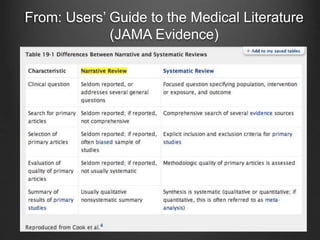
From: Users’ Guide to the Medical Literature
(JAMA Evidence)
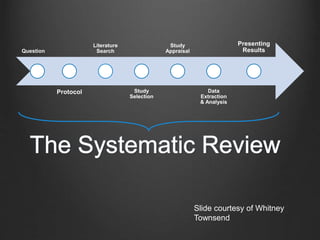
Question
Protocol
Literature
Search
Study
Selection
Study
Appraisal
Data
Extraction
& Analysis
Presenting
Results
Slide courtesy of Whitney
Townsend
Standards
PRISMA
IOM Standards for Systematic Reviews
Cochrane Handbook
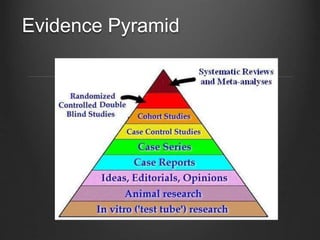
Evidence Pyramid
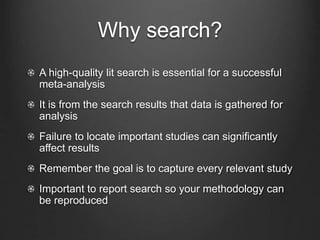
Why search?
A high-quality lit search is essential for a successful
meta-analysis
It is from the search results that data is gathered for
analysis
Failure to locate important studies can significantly
affect results
Remember the goal is to capture every relevant study
Important to report search so your methodology can
be reproduced
What to expect?
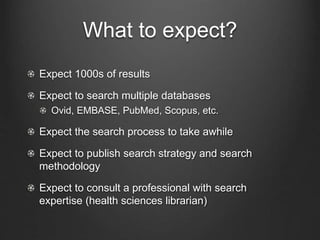
Expect 1000s of results
Expect to search multiple databases
Ovid, EMBASE, PubMed, Scopus, etc.
Expect the search process to take awhile
Expect to publish search strategy and search
methodology
Expect to consult a professional with search
expertise (health sciences librarian)
Constructing Effective
Searches
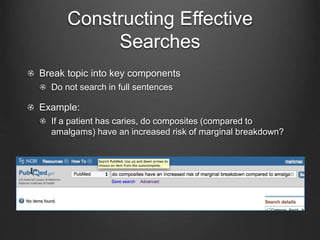
Break topic into key components
Do not search in full sentences
Example:
If a patient has caries, do composites (compared to
amalgams) have an increased risk of marginal breakdown?
Constructing Effective
Searches
Break topic into key components
Do not search in full sentences
Example:
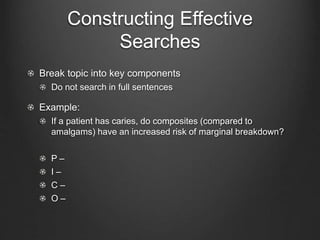
If a patient has caries, do composites (compared to
amalgams) have an increased risk of marginal breakdown?
P –
I –
C –
O –
Constructing Effective
Searches
Break topic into key components
Do not search in full sentences
Example:
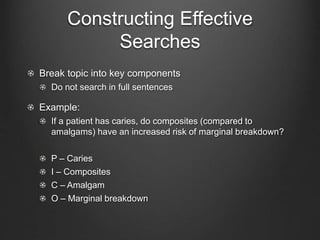
If a patient has caries, do composites (compared to
amalgams) have an increased risk of marginal breakdown?
P – Caries
I – Composites
C – Amalgam
O – Marginal breakdown
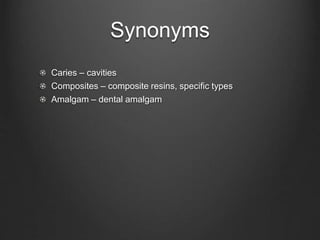
Synonyms
Caries – cavities
Composites – composite resins, specific types
Amalgam – dental amalgam
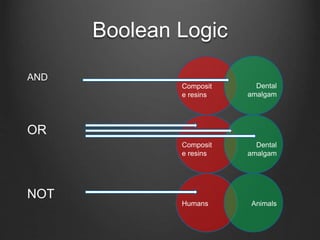
Boolean Logic
AND
Composit
e resins
Dental
amalgam
Dental
amalgam
Composit
e resins
AnimalsHumans
OR
NOT
Concept 2
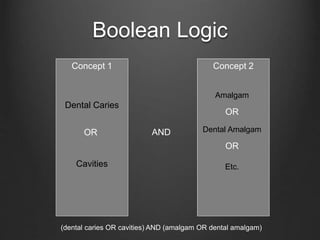
Boolean Logic
Concept 1
Dental Caries
Cavities
ANDOR
OR
OR
(dental caries OR cavities) AND (amalgam OR dental amalgam)
Amalgam
Dental Amalgam
Etc.
Search Terminology
Keywords
Controlled
vocabularies
Search Terminology
Keywords
Controlled
vocabularies
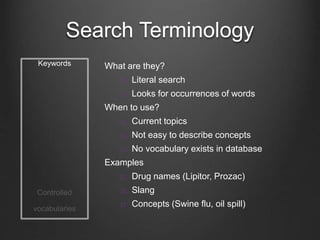
What are they?
 Literal search
 Looks for occurrences of words
When to use?
 Current topics
 Not easy to describe concepts
 No vocabulary exists in database
Examples
 Drug names (Lipitor, Prozac)
 Slang
 Concepts (Swine flu, oil spill)
Search Terminology
Keywords
Controlled
vocabularies
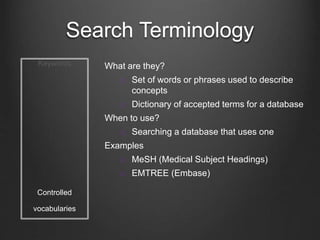
What are they?
 Set of words or phrases used to describe
concepts
 Dictionary of accepted terms for a database
When to use?
 Searching a database that uses one
Examples
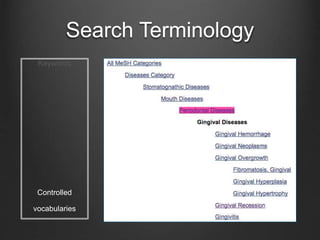
 MeSH (Medical Subject Headings)
 EMTREE (Embase)
Search Terminology
Keywords
Controlled
vocabularies
Common Techniques
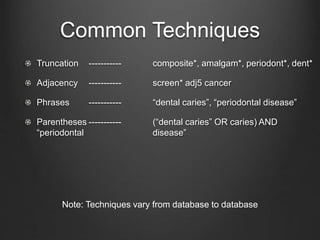
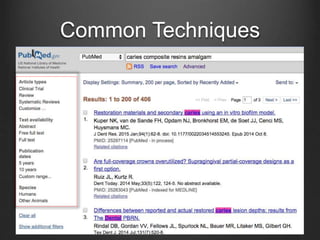
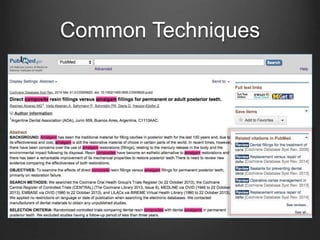
Truncation ----------- composite*, amalgam*, periodont*, dent*
Adjacency ----------- screen* adj5 cancer
Phrases ----------- “dental caries”, “periodontal disease”
Parentheses ----------- (“dental caries” OR caries) AND
“periodontal disease”
Note: Techniques vary from database to database
Common Techniques
Common Techniques
Common Techniques
PubMed
MeSH dental caries[mesh]
Major MeSH dental caries[majr]
Title dental caries[title]
Title/Abstract dental caries[title/abstract]
Journal journal of dental research[journal]
Author maceachern m[author]
Refer to ‘Search Builder’ in PubMed Advanced for other fields

Extensive Literature Searching

Editor's Notes

  • #5 Today we’ll be talking about two specific points on the systematic review continuum: The protocol, where you say what you’re planning to do for the SR The methods (presenting results), where you say what you did. To talk about these two points, we need to talk about the overall process/methodology of systematic reviews so we’ll touch briefly on all points indicated